And When Did You Last See Your Father? Book Review

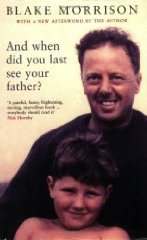
when-did-you-last-see-your-father-book-cover2I saw the movie When Did You Last See Your Father? at the Toronto International Film Festival last September, twice. I didn’t have the chance to read the book until a couple of days ago, about 7 months later. But as I read, all the scenes came back to me, and I appreciate the film even more than before. Yes, this is definitely a successful attempt at turning Book Into Film…and a hugely impressive one at that. The stellar cast with Jim Broadbent as the father and Colin Firth as the adult son, plus the exceptional supporting roles have brought out the spirit and the essence of the book poignantly, thanks to the very artistic and sensitive treatment by director Anand Tucker. To read my review of the movie, click here.

Blake Morrison is a contemporary British poet and writer. He was literary editor of The Observer and the Independent on Sunday before writing full time in 1995. AWDYLSYF is a memoir of his relationship with his father, Arthur Morrison, who died of cancer at age 75. Published in 1993, the book has won literary awards, and has been translated into many languages, from Japanese to Syrian.

The name of the book has its source in a painting of the same title by the Victorian artist W. F. Yeames. Yeames depicted an imaginary scene during the English Civil War. The young son of a Cavalier (Royalist) was questioned publicly by the enemy, the Roundheads (Parliamentarian), as to the whereabouts of his father. The question posed a serious dilemma for the boy. If he answered truthfully, he would endanger his father. If not, he would be commiting the immoral act of lying. Click here to read the story behind the painting.

And Painting by W. F. Yeames, When Did You Last See Your Father

Such a dilemma finds a parallel in the book. And it is apparent that Morrison has chosen to do the former, for the story he tells is incredibly candid, up-close and personal. As a reader, I’m glad he has done that. Eulogies are sometimes euphemism honoring the dead in order to please the living. But what Morrison has delivered is a courageously honest narrative of a precarious father-son relationship marked by ambivalence and love-hate sentiments. I can sense the pain such exposure could bring to the people involved, his mother, his sister, close family and friends. But I feel Morrison has burst the romantic bubble of the naturally congenial relationships we assume as we look at other people’s family portraits, or see families depicted in movies and novels. Love does not come naturally because of the tie that binds. Respect still needs to be earned, and loving acts need to be learned, for both parent and child.

The 20 independent, short chapters darting back and forth across the landscape of memory record the poignant reminiscence of a son living under the shadow of a powerful father. Arthur Morrison was a revered doctor in the town of Earby, in the County of Yorkshire…revered because of his imposing, domineering and callous demeanor. He could always get his way, and get out of troubles. In his recalling of childhood episodes, son Blake has aptly intermingled humor with pathos, all the more bringing out the complexity of character, and the ambivalence we sometimes feel towards our loved ones.  And to be fair, Arthur had cared for his family, albeit in his own patriarchal and egotistic manner.

He was gregarious.  In all social situations, he was the one leading the conversation and successfully avoiding topics that he was ignorant about…and was sure to stay away from games like Trivial Pursuit.

He hates feeling fallible: ‘I may not be right but I’m never wrong’ is the motto on a horrible brass wall-plate he has. He isn’t a vain man, but he is a proud, even bumptious one, a man with a puffed chest who learnt to water-ski in his fifties and thought he could go on forever.

How can such a character be brought to face his own imminent demise? Blake Morrison describes his father’s fast deterioration after diagnosed with cancer. The preparation though seemed to be harder for those who were going to be left behind than the patient himself. There was a relationship that needed mending, and, there were truths to be revealed. For years, Morrison had suspected the intimate relationship between his father and Auntie Beaty, a family friend. It had affected his perspective on his father, and on himself as a son. But he wasn’t given such a privilege. Other people’s secrets are theirs to own, even though that person is your father. And the living won’t tell: “Please leave me one last small piece–it’s mine” Auntie Beaty pleaded.

So the pressing question is: How is a son to prepare for the imminent demise of his own father, having lived in such a precarious relationship? The revelation comes at the end of the book. Death and mortality has a way of helping us put things in perspective:

Don’t underestimate filial grief, don’t think because you no longer live with your parents, have had a difficult relationship with them, are grown up and perhaps a parent yourself, don’t think that will make it any easier when they die.

Faced with the finality of death, all grievances one has towards the dying seem minute in comparison. As a son now, Blake has to learn to let go of his father, ironically, a lesson his father had failed to learn in the raising of his own son. Grievances give way to caring, to the consoling of the living, to the respect of a life lived on its own terms, to forgiveness, to closure.

In his Afterword, Morrison writes:

When young, we were impatient with our parents: now we want to atone for our callowness, and to acknowledge what they were and all they did.

Poignant words for us to ponder.


And when did you last see your father? by Blake Morrison is published by Granta Books, London. 1993. 230 Pages.

A movie tie-in edition by Granta Books is published October 2007.
~ ~ ~ ½ Ripples

Nim’s Island (2008)

I don’t want to miss any Jodie Foster movies.  She’s one of my all time favorites.  I’m also eager to watch Abigail Breslin again after her Little Miss Sunshine.  Further, after reading Annie Dillard’s novel, I just need something light and mindless.  Coincidentally, between these two, I only have to change lenses, for the view is more or less the same: the beauty and wonder of nature. 

Nim’s Island is a mixture of Swiss Family Robinson, Home Alone, Stranger Than Fiction, and Mr. Brooks.  Based on the popular children’s book of the same name by Wendy Orr, it’s about a girl called Nim who lives an idyllic life on a pristine island with her scientist dad Jack.  The island’s rich natural resources and wildlife are the sources of Jack’s research and Nim’s pleasure.  Her friends are Selkie the sea lion, Fred the iguana, Galileo the frigate bird, and the giant sea turtle…what’s his name? … Anyway, it’s a zoo out there on Nim’s island, but Nim and Jack keep it real organized, educational, and fun.

One of Nim’s favorite past time is reading the stories of her adventure hero Alex Rover (Gerard Butler, P.S. I Love You, 2007).  So, when a huge tropical storm hits the island, and her dad hasn’t come home for a few days collecting protozoa samples out in the open sea, she calls to Alex Rover for help.  Actually, it is the creator of Alex Rover that emails Nim first, asking about information to write the next novel, mistakenly thinking Nim is Jack’s research assistant. 

Far from being an adventure hero, Alexandra Rover, the author, is a recluse suffering from agoraphobia, whose best friend is her Purell hand sanitizer. She hasn’t been out of her San Francisco apartment for months. But knowing Nim is all alone on an island needing help, and prodded by her own adventure hero, she ventures out against her fears.  So there’s the interesting set up of the plot, the rest of the story is the adventures of Alex Rover the writer heading to the island to help out Nim, the real heroine.

The film suffers from some scenes and dialogues that appear to be banal and trite.  With its interesting storyline I think it can be done better with more creativity and imagination.  Having said that, I must say that the movie is beautifully shot on location in Queensland, Australia.  In a day and age when kids, and parents, for that matter, find it impossible to have fun outside of video games and electronic gadgets, this movie and the book can offer a wholesome alternative.

There is a new edition of the book that’s a movie tie-in, including 8 pages of color pictures from the film. It is illustrated whimsically by Kerry Millard.  A fun read.  And for all the budding biologists, zoologists, oceanographers, and for that matter, environmentalists in your home, this is a must-read. 

The intended age group I feel should be a bit lower for both the movie and the book.  I’d say a target audience and reader Age 6 – 10 would be more appropriate than the now 9 – 12.  

The best combination:  Go see the movie and then to the bookstore.

Now with that combination, I’ll have to give it

                  ~ ~ ~ Ripples 

The Maytrees by Annie Dillard: Book Review

To celebrate National Poetry Month, I am reviewing Annie Dillard’s novel The Maytrees.  That’s right.  For Annie Dillard, even her novel reads like poetry.  Consider these lines:

“Behind his head, color spread up sky.  In the act of diving, Orion, rigid, shoulder-first like a man falling, began to dissolve.  Then even the zenith and western stars paled and gulls squawked.”

Toby Maytree came home to Provincetown, Cape Cod, after the Second World War and met Lou Bigelow.  They soon fell in love and married, their lives bound by nature.

“His wife, Lou Maytree, rarely spoke.  She painted a bit on canvas and linen now lost.  They acted in only two small events–three, if love counts.  Falling in love, like having a baby, rubs against the current of our lives: separation, loss, and death.  That is the joy of them.”

Toby and Lou Maytree live a bohemian life. Toby works enough as a carpenter to support his real pleasure, poetry writing; Lou paints, rendering obsolete her MIT architecture degree.

“For a long time they owned no car, no television when that came in, no insurance, no savings.  Once a week they heard world news on the radio. They supported striking coal miners’ families with cash.  They loved their son, Pete, their only child.  Between them they read about three hundred books a year.  He read for facts, she for transport.  Nothing about them was rich except their days swollen with time.”

Can life, or love, be any simpler for any married couple?   Life in Cape Cod is idyllic for the Maytrees, and for a long while, time almost stood still.  Until, a third person, their long-time mutual friend Deary, came between them. Anticipating the ambivalence of guilt and desire, Toby and Deary secretly plans a move away to Maine, leaving Lou to raise Pete alone in Provincetown. 

“We bound ourselves to the fickle, changing, and dying as if they were rock.”

Dillard follows the Maytrees’ lives together, apart, and together again years later under very peculiar circumstances.  She uses condensed and poetic language to describe the subtle beauty of love, the reality of human frailty, the numbing of separation, and the inevitability of death.  Against the backdrop of nature, and a web of characters in the Maytrees’ lives, the author explores the power of forgiveness, the sharing of human responsibility, the acceptance of the human condition, and the preparation for death.  Love can still triumph despite failings, and yet, she also queries, what exactly, is love.

For most of the novel, Dillard displays fully her expertise: meditative nature writing, her thoughts touching the realms of science, literature, anthropology, religion, and philosophy. I do not pretend that I fully comprehend all that Dillard writes.  Eudora Welty in her 1974 New York Times review of Pilgrim at Tinker Creek admitted that: “I honestly do not know what she is talking about at such times.”  Who am I to say I have understood all that Dillard has written here in The Maytrees. It may help if you are well-versed in Keats, Kafka, and Wittgenstein.  But often it is in the language.  Occassionally, her condensed language has left me cold and clueless.  However, it is also her language that appeals to me.  Amidst the ambiguity, I have appreciated the mesmerizing power of her poetic sense.

“Later he stood on the foredune’s lip and looked at the stars over the ocean.  A wider life breathed in him, and things’ rims stirred and reared back.  Only the lover sees what is real, he thought.  Only the lover sees the beloved truly, inwardly.  Far from being blind, love alone can see.  Watching the sky now, and forever after, doubled his world.  He felt he saw through Lou’s eyes as an Aztec priest, having flayed an enemy, donned the skin.  Or somewhat less so.”

At the end, death wraps up a life and a narrative. Surprisingly, Dillard describes it in a prosaic and matter-of-fact manner. And yet, the images are vivid, and the humanity shines through.  This is the genius of Annie Dillard. The Maytrees is a gem of a story; it gives and demands much. It may need some effort to plough through, but well worth the time. And like poetry, you would want to go back and savor it again.

The Maytrees by Annie Dillard. Harper Collins, 2007.  224 pages.

~ ~ ~ Ripples 


In Praise of Austen: Virginia Woolf’s A Room of One’s Own


 A Room of One’s Own is based on a series of lecture Woolf delivered at the two women’s colleges in Cambridge University on the topic of “Women and Fiction”.  It was published in 1929.

Woolf lamented the disparities women in a patriarchal society had to face throughout history.  The stream of consciousness flowed into torrents of incisive social observations and satirical commentaries.

She noted that women had long been deprived of equitable opportunities in education and employment. Men were rich, women were poor; men got to roam the country and travel the world, women had to be satisfied with the domestic.  Men were great writers, poets, playwrights, women had to concede to find fulfillment in “making puddings and knitting stockings”. Men had rooms to work, to rest, to create…women, the average, middle class women, seldom had a room of their own.

…to have a room of her own, let alone a quiet room or a sound-proof room, was out of the question, unless her parents were exceptionally rich or very noble, even up to the beginning of the nineteenth century.

And sadly, Woolf had to utter this statement:

Yet genius of a sort must have existed among women as it must have existed among the working classes.

Isn’t it true, Jane spent her most prolific years writing in a very public room in Chawton House.  In the midst of family activities, at a small and spartan desk, she revised Pride and Prejudice and Sense and Sensibility, wrote Mansfield Park, Emma, and Persuasion, and began Sanditon:

Jane's writing desk in Chawton

And isn’t it true that only in movies do we see the idyllic desk against a clear window, with soft light diffusing in, gently illuminating a lady dressed in elegant regency gown, writing on expansive papers and stationary, contemplating in solitude:

Room or no room, recognized or not, something happened towards the end of the eighteenth century that, according to Virginia Woolf, deserved much more mention in history than the Crusades or the Wars of the Roses:  The middle-class woman began to write.

Woolf pointed out that not only did Jane Austen lack a room of her own, having had to write her novels in the very public sitting-room, she had to hide her manuscripts or cover them with a piece of blotting-paper, as observed by her nephew James Edward Austen Leigh in his Memoir of Jane Austen.

Ironically, there lay the genius of Austen, and the few woman writers around her time such as Bronte and George Eliot.  Woolf wrote:

…and we must accept the fact that all those good novels, Villette, Emma, Wuthering Heights, Middlemarch, were written by women without more experience of life than could enter the house of a respectable clergyman; written too in the common sitting-room of that respectable house and by women so poor that they could not afford to buy more than a few quires of paper at a time upon which to write.

Little did they know, it was in such a room that they were trained in the prerequisites of novel writing:

…all the literary training that a woman had in the early nineteenth century was training in the observation of character, in the analysis of emotion.  Her sensibility had been educated for centuries by the influences of the common sitting-room.  People’s feelings were impressed on her; personal relations were always before her eyes.  Therefore, when the middle-class woman took to writing, she naturally wrote novels…

Not only that, they wrote good novels.  With reference to Jane Austen, Virginia Woolf concluded:

Here was a woman about the year 1800 writing without hate, without bitterness, without fear, without protest, without preaching.  That was how Shakespeare wrote.

High praise indeed.

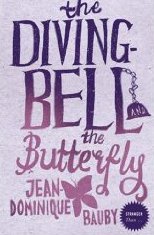
The Diving Bell and the Butterfly: The Memoir

diving-bell-and-the-butterfly-book-cover1

This is one book that should be read after watching the film.  Without visualizing what Jean-Dominique Bauby had gone through after his massive stroke, the reader simply could not empathize or appreciate enough of Bauby’s effort in ‘writing’ his memoir.

But in case you missed the theatre screening and are still waiting for the DVD to come out, you may like to read my review of the film by clicking here.

At age 43, Jean-Dominique Bauby, the editor-in-chief of France’s Elle magazine, was paralyzed after a massive stroke.  The only ability left in his whole body was the blinking of his left eye. With the help of his speech therapist, he learned to communicate with the outside world by blinking to the corresponding French alphabets held in front of him.

When the physical body fails us, what elements remain that can qualify us as a human being? Our beating heart?  Our brainwave?  Bauby’s memoir has so poignantly shown us the two essential functions that kept his soul alive:  memory and imagination.  Locked-in syndrome may have encased his physical body, the butterfly within escapes to the expanse of limitless skies.

The 140-page memoir expertly translated by Jeremy Leggatt comprises of 29 personal essays, ‘written’ one blink at a time, and published shortly before his death in 1997. What is trapped inside a totally debilitated body was a vivid memory and lively imagination, that despite being confined to a hospital bed, can set free a soul that yearns for love and intimacy, a soul that still basks in the humor and pleasures of life.

No words can speak more powerfully than Bauby’s own.  Here are some excerpts from his book.

Shortly before his stroke, he visited his 92 year-old father and helped him shave:

I complete my barber’s duties by splashing my father with his favorite aftershave lotion.  Then we say goodbye…We have not seen each other since.  I cannot quit my seaside confinement.  And he can no longer descend the magnificent staircase of his apartment building on his ninety-two-year-old legs.   We are both locked-in cases, each in his own way: myself in my carcass, my father in his fourth-floor apartment.  Now I am the one they shave every morning…

One would never know how potent memories and the imagination can be:

Once I was a master at recycling leftovers.  Now I cultivate the art of simmering memories.  If it’s a restaurant, no need to book.  If I do the cooking, it is always a success.  The bourguignon is tender, the boeuf en gelée translucent, the apricot pie possesses just the requisite tartness.  Depending on my mood I treat myself to a dozen snails, a plate of Alsatian sausage with sauerkraut, and a bottle of late-vintage golden Gewurztraminer, or else I savour a simple soft-boiled egg with fingers of toast and lightly salted butter.  What a banquet!

Or how poignant the little gestures of love and intimacy are:

While I have become something of a zombie father, Theophile and Celest are very much flesh and blood, energetic and noisy.  I will never tire of seeing them walk along side me, just walking, their confident expressions masking the unease weighing on their small shoulders.  As he walks, Theophile dabs with a Kleenex at the thread of saliva escaping my closed lips.  his movements are tentative, at once tender and fearful, as if he were dealing with an animal of unpredictable reactions.  As soon as we slow down, Celeste cradles my head in her bare arms, covers my forehead with noisy kisses and says over and over, “You’re my dad, you’re my dad,” as if in incantation.

As I finished the book, I could not help but ask myself:  Do I have enough ingredients to practice ‘the art of simmering memories’ if I ever needed to?

~ ~ ~ ½ Ripples


Pride and Prejudice (1995 TV)

Colin Firth and Jennifer EhleIs it coincidental that PBS has chosen, of all the six Jane Austen adaptations, to air Pride and Prejudice the Sunday before Valentine’s Day? I think they must have strategically placed it there, knowing that this novel is one of the most-loved books in literature, as the results in recent polls have shown. They must have known that Pride and Prejudice is ranked the third most reread books in Britain, and first in a poll on books that people in the British nation can’t live without.

Other surveys reveal similar results. In a 2003 BBC poll, Pride and Prejudice ranked second as UK’s favorite book. In 2007, it ranked first.

Only in Britain, you might say…but it seems like this is a phenomenon across countries.

In Australia, Austenmania and Janespotting are the common terms to describe this unprecedented occurrence since the mid 1990’s. The Pride and Prejudice miniseries (1995) broke TV ratings, books and sales records.

Jane Austen takes an international stance as it goes multicultural. In Bride and Prejudice (2004), the best-loved Austen novel received a dashing Bollywood makeover. Which country doesn’t have its own class system and prejudice? The movie has also put Aishwarya Rai (with Colin Firth in The Last Legion, 2007) on the world map.

Most recently, Venezuelan director Fina Torres is getting ready to film Sense and Sensibilidad, with screenplay by Mexican Luis Alfaro. Locations of filming will be in Mexico and East L.A., and to be released at the end of 2008. If Jane is around she would be much gratified and amused to see her books gaining such a multi-cultural following.

Just last Friday, the February 8th issue of the Taiwan-based (North American East Edition) Chinese Newspaper World Journal has a full-page coverage on Jane Austen and her many movie and television adaptations.

In the cyberworld, as recent as this past week, Project Gutenberg ranks Jane Austen as the third most downloaded author in the past 30 days after Mark Twain and Charles Dickens, while Pride and Prejudice is the most downloaded Austen books.

But of course, statistics are irrelevant when it comes to matter of the heart.

We who love Austen’s works and in particular, for me, Pride and Prejudice, will continue to reread the book and rewatch this TV miniseries regardless of what the polls show. Different people might find different reasons for its appeal. But I, for one, feel that Austen has created through Elizabeth Bennet and Fitzwilliam Darcy the ideal (note: not perfect) woman and the ideal man. I see in them the essential ingredients of relationships, with oneself, and with others: respect, compassion, kindness, generosity, hope, and grace, but above all, the willingness to change and be transformed for the better. I’m much grounded to expect perfection in the human world, but through Austen’s depiction I can cherish and admire the ideal.

With Valentine’s Day drawing near, and with our world unfolding as it is, cherishing the ideal could well be the key to help us build a more beautiful tomorrow.

*******

Click here to go directly to Pride and Prejudice: Part 2.

Click here to go to Part 3, The Finale of Pride and Prejudice (1995 TV).

To Read or Not To Read: Canadian Version

So here it is, the most recent Canadian statistics on book reading.  According to an Ipsos Reid survey commissioned by CanWest News Service and Global Television, conducted between Dec. 11 and 13, 2007,  31 % of the 1001 respondents of the survey did not read a single book for pleasure in all of 2007, 4% behind the U.S. in an identical poll.

Now, it really hits home…I know, we’ve been through all the discussions about how accurate these polls are, and the causes, and the biases…etc. in my last two posts.  So here, I’d just like to briefly point out a few interesting findings from this one:

  • The 69% of Canadians who were reading in 2007 did so voraciously, averaging 20 books in 2007.
  • According to industry giant Indigo Books, the Canadian market is remaining steady.  The biggest selling day of the year, Dec. 22, saw an average of 570 customers per minute.
  • West Coasters were Canada’s most avid readers in 2007.  B.C. residents devoured an average 33 titles.
  • Fiction was the most popular genre among Canadians, at 56% of books read.

My response remains the same as I wrote in my post on New Year’s Eve.  Again, after visiting your blogs, I was much impressed and humbled by some of your personal reading statistics, and glad to know about still others who have indicated reading resolutions and goals for the New Year, again I say…all is not lost.

So to all, enjoy your reading, whatever genre, whatever modes they may be, and have a rewarding 2008!

To Read or Not To Read: A Personal Response


It looks like my last post has stirred up some ripples. I thank you all for your input to a very complex topic.  Your comments certainly make an interesting forum, where there’s the exchange of ideas and the sharing of opposing views.  That this is even possible is basically because we all read and write.  It’s not too late to thank our teachers for this.

Indeed, the issue of reading is a complicated one.  On the outset, and from your comments, we see aspects dealing with the skill, the form, and the content of reading.  While at the same time, underlying are the very values we hold towards this seemingly simple act: What is reading after all?  How should it be taught in our schools and transmitted (or not) in our homes?  And, what should the content be in order to classify the act as such?

As someone who has involved in literacy research, I have seen recent academic studies taken the perspective of re-defining reading and writing not as a skill but a social practice. Our values sustain the act, or transform it. As we see the ubiquitous usage of the internet and digital communication, we are witnessing the power of technology changing our social values, lifestyle, interests, and how we spend our time.

The NEA surely had the effects of our technological age in mind, thus, an update on the reading habits of Americans.  The last one they did was in 2004.  As with any survey, the NEA Study has its limitations and confined by its own perspective and contextual stance.  And, within the parameters of the present study, they did not go into details the causes, but they did present the correlations of variables.  The results can be considered as reflections of our contemporary society.  The correlations of factors and the implications of the findings are significant enough for us to ponder.  Again, you can download the 98-page report in pdf format here (3.32 MB).

I welcome the progress we have made in digital and internet technology, bringing the world closer at the twitch of our finger, feeding us with instant knowledge and information. I congratulate those who attempt to bring the world of print to their readers by more convenient modes of delivery, such as transmitting reading materials in digital mode, and others who attempt to attract young readers through the creation of new kinds of books, such as graphic novels and manga’s. 

And yet…I lament the erosion of a part of our culture and civilization, the form of reading and writing as we still know it.  I’m concerned about the gradual obliteration of the “classics”, or the dying of the literary form. I lament to see the decline of appreciation and comprehension of literature, for I believe the humanity and universality in many of these works still speak in our world today.  I believe there’s an urgent need to create even more literary works in the face of technological domination.  There may not be a golden age of reading, but there has been a heritage of writing.

I worry about our next generation replacing the art and pleasure of book reading with offerings from other media. I’m also concerned about the English language disintegrating into cyber lingos, or replaced by sensational, action-packed anime. It is a phenomenon graver than just seeing the puzzled faces of our young as they look at an analog clock or try to use a dial phone. 

The progress we have made in technology does not mean that we should downplay the loss of a heritage.  That we can artificially make ice should not trivialize the disappearance of glaciers. The ushering in of electronic music should not obliterate the works of Mozart.  The two can co-exist…isn’t that the postmodern promise? 

No doubt, reading and writing will survive, since we still need to look up information, make lists, chat on-line…and blog.  But I regret to see the erosion of literary reading and the appreciation of literature, classic or contemporary, and may it not come to pass, the termination of its creation in the future, near or distant.

As another year draws to a close,  we may need to take stock of both our progress and our loss.  I’m not a doomsayer, but surveys like the NEA’s point to what seems like an irreversible trend.  While some may not see it as a gloomy path but just a shift of social practices and lifestyle, the survey results reflect our priorities and the shifting values in this day and age. 

Or, is it really irreversible? 

Maybe all is not lost.  At the start of a new year, I’d like to remain optimistic.  Maybe it begins with…yes, a New Year’s resolution on reading… 

A Happy New Year to All!

To Read or Not To Read

To Read or Not To Read: A Question of National Consequence…That is the name of the recent study conducted by the National Endowment for the Arts on reading habits in America.  Just as I was writing about the study in the UK on re-reading in my post Reading and Re-reading, regretting no such kind of surveys being done in North America, and here it is, the NEA’s reading survey results, incidentally, released the same day I published my post. 

Well, maybe I should not be so much of lamenting the lack of reading surveys than the actual survey results.  In a nutshell, the major findings are:

  • Americans are reading less, especially the young.  For example, the percent of non-readers among 17 year-olds doubled to almost 20% in the last two decades.  Or, on the average, 15 – 24 year-olds spend 7 minutes reading on a weekday, 25 – 34 year-olds are slightly better, 9 minutes.
  • Reading comprehension is on the decline, as indicated by reading scores.
  • The decline in reading has civic, social, and economic implications.

The whole 98-page report can be downloaded in pdf format here.  It is not Stephen King material, but just the same…interesting reading with an ominous undertone.  It covers various topics including correlations between pleasure reading and academic scores, reading habits, reading and multitasking, employment, internet and digital technology, the relevance of newspaper, and yes, even blogging.

I understand that the issue is complicated and the causes are complex.  Critics are quick to point out that the form and purpose of reading have changed in this internet driven age.  People still read to look up information they need, critics argue.

Maybe the concern should be the gradual extinction of literary reading, the reading of literature for pleasure, and the whole business of reading and writing.  When the figure shows that 63% of college seniors read little or nothing for pleasure, even the pragmatists should be worried when they consider the bottom line.

Reading and Rereading

Update: As this post is published, the National Endowment for the Arts releases the results of a national reading survey.  Click on the post “To Read Or Not To Read” on December 29, 2007 to find out more. 

A recent poll in the UK revealed that 77% of 2034 people surveyed reread books.  Further, a fifth of them re-read their favorite book more than five times.

webpage-books-on-shelves.jpg

According to this survey conducted by Costa, here’s the list of the most reread books in the UK:

1.  The Harry Potter series, JK Rowling

2.  The Lord of the Rings Series, JRR Tolkien

3.  Pride and Prejudice, Jane Austen

4.  The Hobbit, JRR Tolkien

5.  Jane Eyre, Charlotte Bronte

6.  1984, George Orwell

7.  The Da Vinci Code, Dan Brown

8.  The Lion, The Witch And The Wardrobe, C.S. Lewis

9.  Wuthering Heights, Emily Bronte

10. Catch 22, Joseph Heller

Interestingly, there’s yet another survey polling UK readers’ choice of ‘books they can’t live without’.   And here’s the list:

1 Pride and Prejudice – Jane Austen
2 The Lord of the Rings – JRR Tolkien
3 Jane Eyre – Charlotte Brontë
4 Harry Potter series – JK Rowling
5 To Kill a Mockingbird – Harper Lee
6 The Bible
7 Wuthering Heights – Emily Brontë
8 Nineteen Eighty-Four – George Orwell
9 His Dark Materials – Philip Pullman
10 Great Expectations – Charles Dickens

 Who says the classics  are no longer relevant in today’s day and age? 

Out of curiosity, I wanted to find out whether similar research had been done in North America.  I found nothing for either the US or Canada.  I wonder if that is indicative of something. 

However, I did manage to locate one book-related poll for the US.  According to an Associated Press-Ipsos study conducted in August 2007, one in four adults in the US, or 27% of those surveyed, read no books at all in the past year. 

Again, I wonder if that is indicative of something…umm… just another poll.