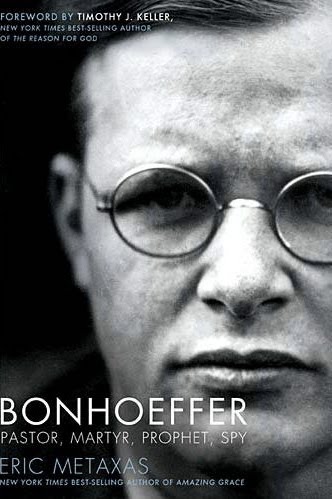
Book Haul 2013

Here I go again, the annual Book Sale at Crossroad Market, organized by the Servants Anonymous Society. It’s a worthy cause, therefore, guilt-free looting of good condition used books, over a million of them donated by citizens like me. But I must say, I haul back more than I donate over the years, for many of them I plan to keep.

Compared to the last few years, I’m a bit more restrained this time. Here are some of my loot, all trade paperbacks for just $2 each:
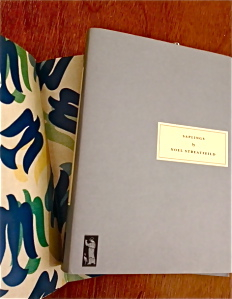
saplings-book-coverSaplings by Noel Streatfeild — I picked it up right away as soon as I saw the grey, minimalist book cover. Delighted to find inside is beautifully designed. Look at the photo I shot on the left. You can see both the dust cover and the inside of the book cover. This is my first Persephone Book, publisher of neglected women writers. I’ve not heard of the title or the author, but trust the London publisher’s choice, and glad to find it in such a mint condition at a used book sale, I quickly grabbed it.

Parade's End BBC Book Cover copyParade’s End by Ford Madox Ford — Truth be told, I’d never heard of FMF until I read Hemingway’s A Moveable Feast a couple of years ago. What a name. The only one I can think of along that line is… William Carlos Williams. Anyway, BBC’s adaptation of Parade’s End as a TV mini-series has added another name to my list of favorite actors: Benedict Cumberbatch (Again, ‘what a name.’) In these dry months in between seasons of Downton Abbey, Parade’s End makes one satisfying treat.
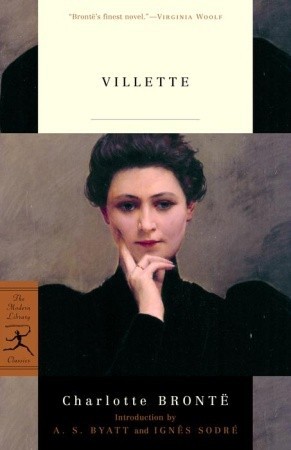
Villette by Charlotte BronteVillette by Charlotte Bronte — Here’s another reason for buying a book because of the publisher. I’m a collector of The Modern Library Classics. So finding this in the Classics section in the book sale was a pleasant surprise. A. S. Byatt offers her views in the intro. Other than Jane Eyre, I’ve not read anything else from Charlotte Bronte. Have you read this?
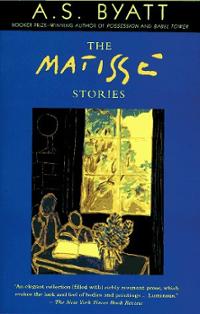
matisse-stories-a-s-byatt-paperback-cover-artThe Matisse Stories by A. S. Byatt — Three stories about three art works by Matisse. A beautiful little book. This from Goodread’s description: “These three stories celebrate the eye even as they reveal its unexpected proximity to the heart… the intimate connection between seeing and feeling…” My kind of stories.
City of GodCity of God by E. L. Doctorow — Some years ago, The New York Times called the film adaptations of Doctorow’s works ‘expensive failures’. Reason: his novels are ‘too cerebral’, ‘too lyrical’, ‘too writerly’ to be transposed into cinematic images. Got it. Whenever I’ve the time and in the mood for some cerebral challenges, I know what book to pick up. After all, I’ve long wanted to read Doctorow. The subject matter of City of God just may arouse interest to help me through the thickets of Biblical proportion.

Becoming George Sand copyBecoming George Sand by Rosalind Brackenbury — George Sand I’ve heard of, Frédéric Chopin’s lover, one of those female writers who had to adopt a male pseudonym in 19th C. society. The interesting part is the modern parallel of the story of a female French professor in Edinburgh. Author Brackenbury (due to my ignorance I’ve not heard of) graduated from Cambridge University (which I’ve heard of) and now Fellow of Creative Writing at the College of William and Mary (that good name I’ve also heard of) in Williamsburg, VA. Enticing enough.

Tell It to the TreesThe Hero’s Walk and Tell It To The Trees by Anita Rau Badami — A look at the book cover of Tell It to the Trees helps me get the idea… The Indian diaspora in cold, wintry Canada, and for that I find a linkage. Not that I’m from India, but close enough. I’m sure Anita Rau Badami has a lot more to tell than adjusting to the climate. Born in India, now living in Montreal, Rau Badami has in recent years emerged as a clear voice in Canada’s literary landscape.
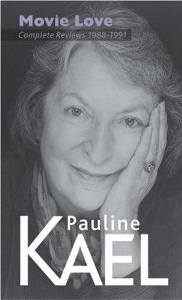
Movie Love Book CoverMovie Love: Complete Reviews 1988-1991 by Pauline Kael — Roger Ebert in his memoir Life Itself acknowledged Pauline Kael (1919-2001) as his mentor and major influence. While Ebert got a Pulitzer for his movie criticism, Kael got a National Book Award. She had been praised for re-inventing the form and aesthetics of the genre of film critiques. Along with a dearth of female literary voices in film criticism like Susan Sontag (1933-2004), seems like such a species had become extinct nowadays. All the more to appreciate ‘a classic’.

Wonderful TownWonderful Town: New York Stories from The New Yorker, edited by David Remnick — A Modern Library edition compiling over forty short stories published in The New Yorker before 2000, since that’s the pub. date. Reading the Table of Content is like reading the Who’s Who of 20th C. literary scene… John Cheever, Irwin Shaw, Philip Roth, Jonathan Franzen, James Thurber, John Updike, Vladimir Nabokov, Jamaica Kincaid, J. D. Salinger, Isaac Bashevis Singer, Susan Sontag, Woody Allen, Jeffrey Eugenides, Bernard Malamud, E. B. White… just to name a few. Woody Allen? You gasped. But, why are you surprised?

***

I’m a keeper of lists. If you’re interested, here are my loots from previous years:

2012

2011

2010

2009

***

Proust Read-Along: The Swann and Gatsby Foil

“He knew perfectly well as a general truth that human life is full of contrasts…” Swann’s Way, P. 510

While plowing through Part 2, ‘Swann In Love’, I happened to reread The Great Gatsby. Thanks to Baz Luhrmann’s new movie adaptation, I’m sure many more are doing the same. And oh what interesting contrasts Swann and Gatsby make.

Both are deeply in love, yearning for a woman who seems to be utterly elusive. Gatsby frantically maximizes to attract Daisy; Swann willingly minimizes to reach Odette. From a poor background, Gatsby grabs whatever means he can to build his wealth; Swann whose niche belongs to high society, has to pretend that he is nobody special, stooping to ‘a lower social sphere’ (P. 285) to be near Odette.

That distance is more than social. Swann is willing to forsake his cultured tastes of art and music, to lay aside even his own research and writing on Vermeer (Odette: I’ve never heard of him, is he alive still? P. 279). Swann is willing to lay down his interests and privileges for a woman who is uncouth in the sophistication of high society, who has superficial views and flashy tastes, and alas, even promiscuous.

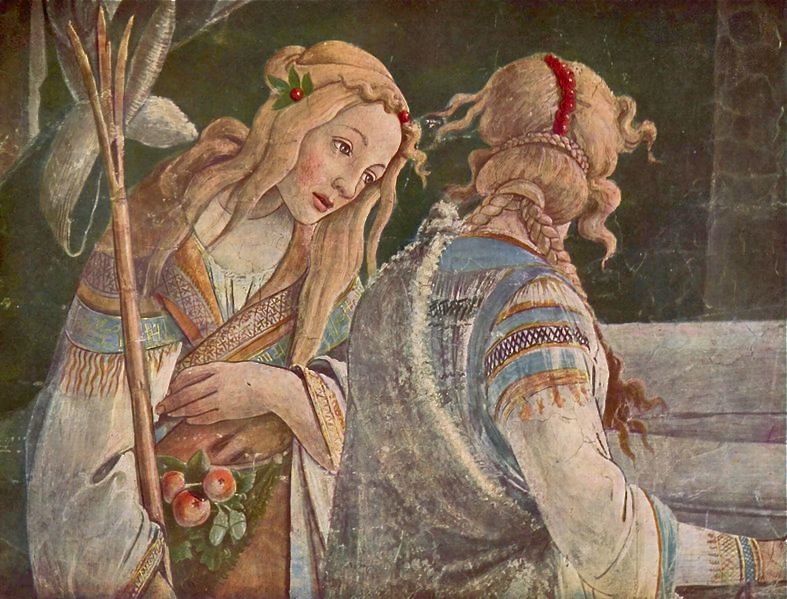
However, love transforms all deficiencies and blemishes into ethereal beauty. Here’s how Swann visualizes Odette. To him, she is like Sipporah, Jethro’s daughter, Botticelli’s fresco in the Vatican’s Sistine Chapel:

Zipporah, Jethro's Daughter by Botticelli

Following Odette to her ‘little nucleus’ at the Verdurins, Swann downplays his association with prominent people and tries not to be so outspoken with his knowledge and opinion about art and music.

When he is alone with Odette, he has taken her values and interests:

he tried at least to ensure that she should be happy in his company, tried not to counteract those vulgar ideas, that bad taste which she displayed on every possible occasion, and which in fact he loved, as he could not help loving everything that came from her, which enchanted him even. (P. 348)

Is this measurement of incompatibility in tastes inherently snobbish? Yes, Swann (or Proust) is sensitive enough to analyze this in depth. What is ‘taste’ anyway, or the intellectual beliefs with which he has been raised from the days of his youth?

… the objects we admire have no absolute value in themselves, that the whole thing is a matter of period and class, is no more than a series of fashions, the most vulgar of which are worth just as much as those which are regarded as the most refined. (P. 350)

So, all for love of Odette, Swann is willing to give up going to the Jockey Club, lunching with the Prince of Wales, or his love of Holland, or a visit to the Versailles (‘which bored her to tears’):

And so he denied himself the pleasure of visiting those places, delighted to tell himself that it was for her sake, that he wished only to feel, to enjoy things with her. (p. 350)

Those colorful shirts Gatsby has hoarded, Odette would have loved them, just like Daisy, and his mansion too… if only Swann had resided in a more prestigious address, somewhere ‘more worthy of him’ instead of his house on the Quai d’Orleans. (P. 346)

Odette’s fondness of Swann begins to wane as Forcheville enters into the picture. She becomes even harder to get. Swann is burned with jealousy, anger and bitterness. Yet he cannot forget her. His love even grows stronger for her, despite receiving an anonymous letter defaming her. Why,

People often say that, by point out to a man the faults of his mistress, you succeed only in strengthening his attachment to her… he had begun to desire the possession — as if that were ever possible — of another person. (P. 517)

Perhaps that is a mark of love: the demand for exclusivity. This is exactly what Gatsby wants Daisy to admit, that she has never loved Tom, that she has always loved him. “Oh, you want too much,” she cried to Gatsby.

But Swann is more fortunate. He knows he must gain back Odette’s full and exclusive devotion and somehow he does. I’m glad to read in Part 3 that eventually Odette does become Mme Swann. I’d be curious to know how that comes about. (Proust’s strategy to get us go on reading the next volumes?)

**

Part 3 is an enjoyable and much swifter read as the narrator remembers his childhood in Paris drown in unrequited love (so far, not sure about how this unfolds later) for Swann and Odette’s daughter Gilberte. Because of his love for Gilberte, the boy is infatuated with M and Mme Swann as well. His crush on the elusive Gilberte parallels Swann’s love for Odette in their earlier days.

The last sentence in Volume 1 of In Search of Lost Time, like that in The Great Gatsby, ends with a haunting remark on memory and the past:

The places we have known… were only a thin slice, held between the contiguous impressions that composed our life at that time; the memory of a particular image is but regret for a particular moment; and houses, roads, avenues are as fugitive, alas, as the years.

There are much more to be said, but nothing can replace the actual experience of reading Proust first hand. From March to May as I plowed through Swann’s Way, there had been up’s and down’s. Numerous times long sentences entangled, yet the very next moment could be so beautiful and lucid it dissipated all frustrations. I now look forward to Volume II.

**

Thanks for joining me in this Read-Along. Finish or not, you’re welcome to share your thoughts. Throw your two pebbles into the pond and make some ripples. If you have written a post, do let me know so I can link it here.

Bellezza of Dolce Bellezza

**

CLICK HERE to my post on Part 1 of Swann’s Way: Combray

***

Proust Read-Along: Swann’s Way Part One, Combray

Reading these first 264 pages of Proust conjures up some of my own memories…

I was sitting in a graduate class. A fellow student was doing a presentation on phenomenology. He brought into class a chocolate cake, cut it and gave each of us a piece. We were to describe this particular act of ‘Eating chocolate cake in class’.

What elicited only single words or phrases from us, Proust could have written pages. Why, from pages 60 to 64 the narrator details his experience of eating four morsels of the little cakes ‘petites madeleines’, the uplifting sensation, the taste, the action of dipping them into tea before eating, and the diminishing enjoyment after each mouthful. Above all, he relays how the very act of eating these madeleines has evoked long-buried childhood memories of Combray:

… in that moment all the flowers in our garden and in M. Swann’s park, and the waterlilies on the Vivonne and the good folk of the village and their little dwellings and the parish church and the whole of Combray and its surroundings, taking shape and solidity, sprang into being, town and gardens alike, from my cup of tea. (p. 64)

I don’t pretend to understand everything I read. Far from it. These first 264 pages of Proust’s seven volumes of In Search of Lost Time for me is a learning experience. I have to read through ambiguity, discard the expectations of clarity and congruity, accept incomprehension and press on. But an experience still, and surprisingly, an enjoyable one. An eye-opener too. Where have I read a sentence of 31 lines (p. 67-68) in such flowing prose, with such sensitivity and nuanced observations? And I must add, which I read at 1 a.m. I’m a quick study.

Sure, the unexamined life is not worth living. Proust must have plowed through his to the single second, and in depth too, as the madeleine-eating episode reveals. Insomnia sure has its benefits… arousing volumes of memories for the narrator.

Proust Book

From this first reading I’m surprised to find Proust’s subject matter comes from the mundane, from people and places in the village Combray where the narrator would go to stay for a period of time every year as a child. Even more a surprising delight is the loquacious way he describes the events, the people, the scenery, and the insights he can generate from the minutest observations.

A tiled roof is a tiled roof, okay, it looks more beautiful reflected on the river. But I was struck by how the narrator caught himself with speechless admiration, and ironically, articulating it with lucidity and humor:

The tiled roof cast upon the pond, translucent again in the sunlight, a dappled pink reflection which I had never observed before. And, seeing upon the water, and on the surface of the wall, a pallid smile responding to the smiling sky, I cried aloud in my enthusiasm, brandishing my furled umbrella: “Gosh, gosh, gosh, gosh!” But at the same time I felt that I was in duty bound not to content myself with these unilluminating words, but to endeavour to see more clearly into the sources of my rapture.  (p. 219)

Indeed, humor is another surprising find for me. In several places I’ve put down on the margin of the page, LOL!

So, I’ve quickly learned to go past those passages and sentences that have lost me, but soon as I come to something I can comprehend, and do resonate, I’d stop and reread, savoring the beauty of that moment.

My favourite passages include the heartbreaking accounts of the child’s longing for his mother’s goodnight kiss, the description of the church St. Hilaire where he goes to Sunday mass, the pages depicting the river Vivonne and the hawthorn trees in Swann’s park, the child’s discussions with Swann on reading and books, and his frustration with writer’s block as he strives to write poetry as a youngster.

But there is one passage I must mention. That is about the child’s Mamma caring to talk with their house maid and cook Françoise, asking her little questions about her feelings for her own family:

Francoise answered, laughing: ‘Madame knows  everything… [like] the X-rays that they brought here for Mme Octave, and which can see what’s in your heart’ — and she went off, overwhelmed that anyone should be caring about her, perhaps anxious that we should not see her in tears: Mamma was the first person who had given her the heart-warming feeling that her peasant existence, with its simple joys and sorrows, might be an object of interest, might be a source of grief or pleasure to someone other than herself (p. 73).

This, I think, is exactly what Proust has done.

Seeing the extraordinary in the ordinary, the village life, the kitchen and the table, the interactions and socializing, family relations, walking the country paths, the irises and the hawthorns… Reading this first part reminds me of paintings by Pieter Bruegel, or Van Gogh… and, not far from eating chocolate cake.

***

How’s your reading so far?

Janell of An Everyday Life

tuesday in silhouette

Wrap up post on Parts Two and Three: May 15.

***

Before I Go To Sleep by S. J. Watson

Before I Go to Sleep47 year-old Christine has lost her memory for twenty some years due to trauma. She wakes up every morning to a forgotten past. She spends her day piecing together a life, who and where she is, her personal history, and, who her husband Ben is. Upon the advice of Dr. Nash, she writes it all down in a journal before she goes to sleep at night, for she’ll wake up the next morning wiped clean of her day old memory once again.

The book deals with some interesting issues. If the past is horrible to recall, would it be better if one does not remember, or, would one be better off knowing the truth despite pain? Is one made more vulnerable by knowing or not knowing? Further, if mental images conjure up, how can one be sure they are memories of actual happenings and not one’s imagination?

Author S. J. Watson leads the reader into a maze of intrigues, teasing us with an unreliable narrator Christine, casting shadows of imminent dangers, and trying to capture us with her vulnerability. So memory loss is an effective plot device, keeping us in the dark guessing, creating suspense, and revealing ever so slowly what really had taken place that caused the amnesia to set in, and how she could ever escape.

The book starts off with a most interesting scenario as Christine wakes up to an unknown world, but towards the middle it seems like it has forgotten that it is just the protagonist who has amnesia, not the readers, as it repeats the facts and descriptions with Christine’s journal entries. The last part is a page-turning thriller, albeit with a relatively improbable ending. The last pages explaining everything with a neatly wrapped up ‘here you go, see how logical it is’ kind of finish.

Memories… such a thematic element can be exceptionally gratifying to explore with deeper characterization. Surely the author has brought up the idea that memory defines us, a reader seeking for a more contemplative rendering of such a concept would be disappointed however, for Watson has chosen to use this interesting thematic material to craft a suspense thriller and not an idea-driven literary work. So what we have with notions relating to memories, to the nature of our identity and personality… etc. are merely used to build up a suspenseful plot. As a thriller, the book aims to lead on and not delve in.

Am I being a bit harsh here? Why, I just caught myself. I could well have been more lenient if I were not reading it along with Proust’s In Search of Lost Time (Remembrance of Things Past). Am I being fair to make comparison? It’s like comparing apples with oranges. Yet the coincident is too fascinating… both deal with remembering and sleeping, albeit one trying to fall asleep while the other trying not to. Just thinking… even the book covers that I have are similar.

Lots of ‘I love you’s’ are uttered, but none that can stir up any emotions in me the reader. Several films kept conjuring up in my mind as I read… Memento, Eternal Sunshine of the Spotless Mind, The Vow, and I must say the latter two managed to stir some affective resonance in me while exploring the topic of amnesia and a love relationship. But with this book, I just wanted to race to the end. For some, this might well be proof of an entertaining read.

And that is why I have high hopes for its film adaptation. Yes, I must applaud Watson for his strong debut. This novel published in 2011 has gained awards and accolades, on the bestseller lists in several countries, and translated into 30 plus languages. Its film rights has been snatched up by Ridley Scott. Filming now, it features the impressive cast of Nicole Kidman as Christine, Colin Firth (The King’s Speech) as Ben, and Mark Strong (Zero Dark Thirty) as Dr. Nash; Anne-Marie Duff (Nowhere Boy) is also on board. This is definitely a film I want to watch, not just because of the actors, but the screenwriter Rowan Joffe, who will direct as well. Joffe has shown us, with his script for The American (George Clooney stars) that yes, sometimes the film can be better than the book. Let’s hope this is also the case.

In the end page Watson notes that his novel, though totally fictitious, is inspired by actual medical cases, particularly that of Clive Wearing‘s, the British musicologist, conductor and BBC music producer, who has the same condition as Christine’s, albeit his is an even shorter memory span, just a short minute or so. His real life accounts have been recorded by his loving wife Deborah Wearing in her book Forever Today: A Memoir of Love and Amnesia. While he lives in the constantly present, he does not forget music or his love for his wife. Now that would be one inspiring book to read.

***

Click here to watch a short clip on Clive and Deborah Wearing on YouTube. Does he not remind you of another real life character, a pianist, whose life had also been made into a movie?

Diary of a Country Priest: An Easter Meditation

Last year around this time, I wrote about the book The Diary of A Country Priest by French author Georges Bernanos, (Journal d’un curé de campagne, 1936). I’d like to repost my review this week, for every time I read it, I find the essence of Easter.

***

The Diary of a Country Priest Book Cover

A young priest comes to his first parish, the rural town of Ambricourt, filled with humble hopes. All he wants is to serve the people, to give of himself, to bring God’s love. But as soon as he sets foot in the village, he is engulfed by hatred and rejection. There are dark secrets too sinister to be exposed. The young priest is an unwelcome alien. In a town afflicted by hypocrisy, pride, anger and bitterness, he is despised, taunted and ridiculed. His own innocence is no match even for the children in his catechism class, especially the precocious Seraphitas, a girl ‘with a hardness far beyond her years.’

Ambricourt is a world afflicted by the ‘leprosy of boredom’, a microcosm of the human condition. Bernanos uses diseases to illustrate his point well. The young priest himself is being slowly consumed by terminal illness. The pain in his stomach ultimately defeats his body, cancer. His diet consists mainly of bread dipped in wine which he makes for himself, and some potato soup. Poverty of means, but also frailty of body to take in solid food. Many a times we see him in the Garden of Gethsemane, pleading for strength in anguish. But he faithfully presses on, using his diary to confide his deepest thoughts, a means to commune with his God.

On the outskirt of Ambricourt is the Château of the powerful M. le Comte. The Count needs no priest to know about his adulterous affairs, this time, with the governess Mlle Louise. His wife Mme la Comtesse is totally absorbed by her long-held bitterness and grief from the loss of her young son. And his daughter Mlle Chantal is a deeply disturbed girl eaten up by anger and jealousy. Soon, she will be sent away to England, a most convenient plan devised by her father.

It is with this deep mess of a family that the young priest finds himself entangled. The most intense scene of the whole book, the climatic moment, comes when the priest goes to the Château to meet with Mme la Comtesse. She lost her beloved son when he was only eighteen months old, a child hated by his jealous older sister Chantal.

On his last day they went out for a walk together. When they came back my boy was dead.

Mme la Comtesse is fully engulfed by hatred for her daughter, grief for her lost son, and bitterness towards God.

Hearing her speak, a tear flows down the face of the young priest. “Hell is not to love any more, madame.” The young priest responds. And with miraculous strength, he delivers the following words.

… But you know that our God came to be among us. Shake your fist at Him, spit in His face, scourge Him, and finally crucify Him: what does it matter? It’s already been done to Him.

Towards the end of some soul piercing exchanges, Mme la Comtesse kneels down, releases her pain, and receives blessings from the young priest. Afterwards, she writes to him in a letter:

… I have lived in the most horrible solitude, alone with the desperate memory of a child. And it seems to me that another child has brought me to life again…

And this young child, a priest, consumed by illness, wreaked by frailty of spirit, can only marvel at the power through weakness:

Oh miracle — thus to be able to give what we ourselves do not possess, sweet miracle of our empty hands!

Not long after this, he succumbs to his illness. A life too short, a mission seems unaccomplished. But his last words faintly uttered on his deathbed are as powerful as the God who sends him:

Does it matter? Grace is everywhere…

And in the film, these three words leave me with one of the most impressive endings of all the films that I’ve seen:

“All is grace.”

 ***

~ ~ ~ ~ Ripples

CLICK HERE to read my film review of The Diary of a Country Priest.

The Diary of a Country Priest by Georges Bernanos, translated by Pamela Morris, Perseus Books Group, Philadelphia, PA, 1965, 298 pages.

Journal d’un curé de campagne, 1936, was winner of the Grand prix du roman de l’Académie française.

Let’s Spring to Proust

Here we are, almost spring. According to my 2013 Read-Along plan, it’s time for Proust: In Search of Lost Time, Vol. 1, Swann’s Way.

Proust Book

Before we start, check this out. An excellent intro of Proust from The Guardian:

“So, Proust. Have you made it past the first 50 pages?

I’m guessing that a healthy proportion of people who pick up the book don’t even get beyond page 51. Within a similar word count, Raymond Chandler could have got through two murders, six whiskies, half a dozen wisecracks. Raymond Carver could have described at least six suburban households descending into despair. And Hemingway had almost finished The Old Man and The Sea. Yet, in pure plot terms, pretty much all that happens in those first pages of Proust is that the young Marcel struggles to fall asleep.” 

Right. But I do urge you to finish this very helpful Guardian article on Proust.

Those who are familiar with Read-Along’s on Ripple Effects know, we go slow. Ah… go slow on Proust? Well yes, that just means you can read Chandler and Hemingway while you’re watching young Marcel struggle to sleep.

Here’s our very simple plan. You can read whatever version you like, if you’re so inclined, the original French edition will even be better. We can compare notes and thoughts. I’ll stick with the Modern Library version in the photo above, just because of the enticing cover.

Here are the dates for the two posts:

Part One, Combray (264 pages): to post April 15

Part Two, Swann In Love (278 pages) & Part Three, Places Names, The Name (61 pages): to post May 15

Two months to finish In Search of Lost Time Vol 1: Swann’s Way. I’m sure with our mutual support, we can all go past page 51 and even reach the end.

Interested? Do let me know in a comment. I’ll be sure to add and link your blog in the following list. If you’re not a blogger, you’re welcome to join in as well. Just come by on the two posting dates and share your thoughts.

So far, here are the participants who have confirmed with me:

Bellezza of Dolce Bellezza

Janell of An Everyday Life

Gavin of Page247

Tuesday of Tuesday in Silhouette

Jessica of Bluestockings.com

Alison of Chino House

Hope to see you join in.

***

Previous Read-Along on Ripple Effects

Bonhoeffer: Pastor, Martyr, Prophet, Spy by Eric Metaxas 

Anna Karenina by Leo Tolstoy

Midnight’s Children by Salman Rushdie

***

Bonhoeffer Read-Along Part 2: Ch. 19 – 31

I’ve read some of Dietrich Bonhoeffer’s writing years ago, but knew close to nothing about the life of this highly admired Christian theologian, pastor and anti-Nazi martyr. Eric Metaxas’s 2010 biography of Bonhoeffer is an informative first step for me to delve into a selfless and heroic life. Within the close to 600 pages are highly readable narratives, at times humorous and even entertaining, albeit juxtaposed with pathos and sombre accounts.

Book Cover

What I’ve appreciated most is Metaxas’s inclusion of Bonhoeffer’s own voice, excerpts from his writing, letters, sermons, and words spoken as reported by witnesses. One of the most important sources is from his theology student and confidant Eberhard Bethge who had written what generally considered the definitive biography on Bonhoeffer. That’s over a thousand pages. I’m in no position to offer any critique on the accuracies of Metexas’s book, for I have not read both or any other historical documents to compare notes. Here I’m just sharing my thoughts as a reader, casting my two pebbles into the pond of resonance.

In this second part, Chapters 19 to the end, the mood changes as we see Hitler tightening the noose on his opponents, especially the Jews and their sympathizers. Bonhoeffer had to help his twin sister Sabine’s family flee the country before it was too late, as her husband Gerhard Leibholz was Jewish.

Dietrich’s own Confessing Church which had boldly stood against Hitler’s anti-semitic laws was now facing Gestapo arrests, its seminary Finkenwalde shut down, and its pastors slapped with the ordinance to swear an oath to Hitler. For his own safety, he had made arrangement to leave Germany for America. The Union Seminary in NYC had offered him a teaching post, welcoming the return of this brilliant theologian from Germany.

Bonhoeffer sailed to NYC on June 12, 1939, finding a safe haven in America, but not peace of mind. His inner turmoils were so overwhelming that he stayed there for just twenty-six days. His pastor’s heart prodded him to rush back to Germany to be with those who were suffering. My admiration for the man grew even more as I came to this part.

Mere waiting and looking on is not Christian behavior. The Christian is called to sympathy and action, not in the first place by his own sufferings, but by the sufferings of his brethren, for whose sake Christ suffered.

It was a much deteriorated country to which he returned under the grip of a mad Führer. War broke out. His brother Karl and brother-in-law Dohnanyi were in the Resistance against Hitler’s regime. Soon, Dietrich was involved too, at first offering encouragement and emotional support, but later worked for the Abwehr, the German spy agency, as a pastor, which he was, but unbeknownst to the Abwehr, as an undercover for the Resistance. What a dangerous job to take on!

In Operation 7, Bonhoeffer successfully helped seven Jews escape to Switzerland from certain death. A larger amount of foreign currency had to be transferred out of the country to suport their livelihood. Thus a track was left for his later Gestapo arrest. It’s interesting to note one of the two relatively minor reasons for his arrest is money laundering, for it’s much easier for the Gestapo to believe that than for them to think any German of sound mind would want to help Jews escape.

I can see a courageous man with integrity. Bonhoeffer could not stand aside to see the murders of innocents and the spread of evil. Yet, it’s disturbing to see his stance belonged only to a dearth of people at that time. Hitler’s murderous rampage and the Gestapo’s torturous tactics seized the country with a ferocious grip. Soon, those few dissident voices had to go underground, for their own lives were at stake. I kept asking myself what would I have done… a question I’m afraid to answer.

It was also then that Dietrich was swept by love with Maria von Wedemeyer. Their love was like silver linings behind dark, ominous clouds. Most of their time was spent apart, for Dietrich was held in prison by then, a most precarious relationship indeed. Yet from their letters, I could see love bring them hope, and hope in turn enriches their bond. It was heartbreaking to read their letters to each other, foreseeing wedding and marriage. From the dreadful Gestapo prison, Dietrich wrote Maria:

You mustn’t think I’m unhappy. Anyway, what do happiness and unhappiness mean? They depend so little on circumstances and so much more on what goes on inside us. I’m thankful every day to have you – you and all of you – and that makes me happy and cheerful.

Maybe the title of this book should add in one more description: Lover.

Bonhoeffer and Bethge
Photo taken from the book.

Dietrich had earlier written a Wedding Sermon from the Tegel military prison in Berlin for the wedding of his best friend Eberhard and his niece Renate. In there is a most inspiring thought:

It is not your love that sustains your marriage, but from now on, the marriage that sustains your love.

Later, he was transferred to the Buchenwald death camp outside Berlin, and ultimately, to Flossenbürg for his execution. It’s heart-wrenching to read about Bonhoeffer’s last days, still keeping a calm and peaceful composure, touching other prisoners and even the doctor overseeing his execution. What is death? In his own words:

… life only really beigns when it ends here on earth, that all that is here is only the prologue before the curtain goes up….  if only we can be still and hold fast to God’s Word… Death beckons to us with heavenly power, if only we realize that it is the gateway to our homeland, the tabernacle of joy, the everlasting kingdom of peace.

I had expected Metexas’s book to be informative, but I had not thought it would read like a page-turner. The last chapters are so intense and engrossing that it felt like I was reading the script to the film Valkyrie, about the foiled plan to assassinate Hitler by Colonel Stuaffenberg and a subsequent coup. Bonhoeffer was not personally involved in the operation. But it was due to the failure of the Valkyrie plan that Bonhoeffer’s hidden identity with the Resistance was later discovered. Nine months after Stuaffenberg’s execution, Bonhoeffer was hanged at the Flossenbürg prison on April 9, 1945, just two weeks before the Allies marched in, and three weeks before Hitler took his own life.

Maria and Dietrich’s parents did not know of his demise until much later. Upon hearing the memorial service on BBC radio broadcast on July 27, 1945, Dietrich’s parents were confirmed of the saddest news a parent could ever hear. I was deeply moved to read the Sermon on the Mount excerpt from Matthew 10:17-42. What jumped out from the passage were these most apt and powerful verses:

And fear not them which kill the body, but are not able to kill the soul…

Whoever therefore shall confess me before men, him will I confess also before my Father which is in heaven. But whosoever shall deny me before men, him will I also deny before my Father which is in heaven.

And with the script of Bishop Bell’s poignant sermon at the Memorial Service, Metaxas ends his biography of Bonhoeffer: Pastor, Martyr, Prophet, Spy.

I thank all those who have read along with me, some with their thoughts posted on their blogs, some silently participating. If you’ve written a post, do let me know in a comment. I’ll be sure to link it here.

Alison of Chino House: 3 Encouragements from reading Bonhoeffer

***

CLICK HERE to read my post on Part 1: Chapters 1 – 18

***

Next Read-Along: Marcel Proust’s In Search of Lost Time Vol. 1: Swann’s Way

Upcoming Book to Movie Adaptations

2012 has been a great year for movie adaptations based on or loosely tied to books. Argo, Beast of the Southern Wild, Les Misérables, Anna Karenina, Life of Pi, Lincoln, Silver Linings Playbook are all from adapted screenplays.

Now that the Award Season is behind us, time to move forward to see what some of the upcoming movie adaptations are in the works. The following is a list of films in various stages of development, with some scheduled to be released in 2013. Time to read or reread the books before your see the movies.

**

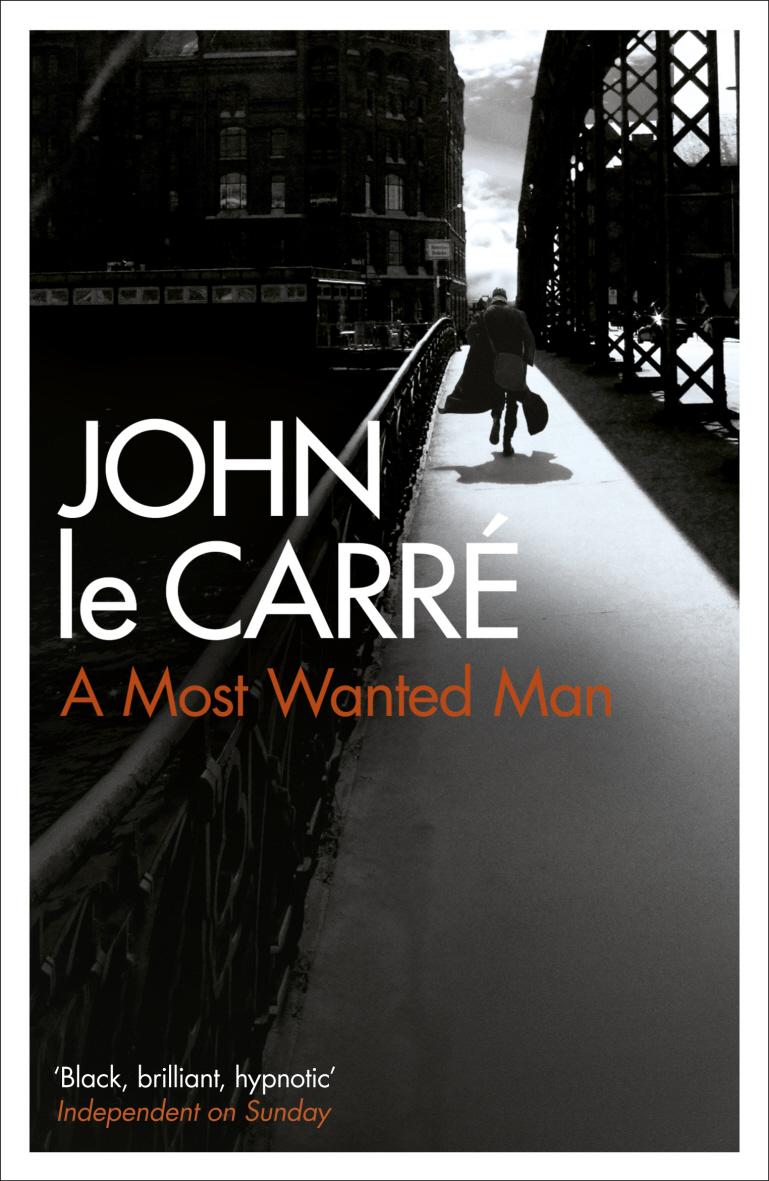
A Most Wanted Man 

A Most Wated Man

Philip Seymour Hoffman stars in John le Carré’s thriller (2008) with a contemporary theme of international war on terror. Hopefully it will reprise the depth of the star-studded Tinker Tailor Soldier Spy. Robert Wright, Rachel McAdams, and Willem Dafoe are in.

A Wrinkle In Time

A Wrinkle in Time

After the success of LOTRNarnia, The Hobbit, some think it’s time to remake Madeleine L’Engle’s YA Sci-Fi classic A Wrinkle In Time. Disney it is, together with Bedrock with Jeff Stockwell (A Bridge to Terabithia, 2007) writing the script. Let’s hope it’s a production worthy of its literary source.

Before I Go To Sleep 

Before I Go to Sleep

Adapted from S. J. Watson’s popular and intriguing novel about a woman having bouts of amnesia every morning she wakes up. If your memory or enthusiasm needs a little prodding, here’s this cast: Nicole Kidman, Colin Firth, and Mark Strong. Nobody can forget Colin Firth as Mr. Darcy (TV 1995), but do you remember Mark Strong as Mr. Knightley in Emma (TV 1996)? Both were in Tinker Tailor Soldier Spy (2011) and Mark Strong in the recent Zero Dark Thirty (2012). I can’t wait for this one. Will have to read the book first.

The Book Thief

The Book Thief

The popular and acclaimed YA book by Markus Zusak with setting in WWII Nazi Germany. YA or not, it’s been on the NYT Bestseller List for over 4 years. Interesting fact is, Downton Abbey director Brian Percival will helm the production, which will star Geoffrey Rush (The King’s Speech, 2010) and Emily Watson (Anna Karenina, 2012). The young Canadian actress Sophie Nélisse who’s brilliant in the Oscar nominated Monsieur Lazhar (Canadian entry for Best Foreign Language Film, 2011) will play young Liesel.

Devil’s Knot

Devil's Knot

Based on Mara Leveritt’s book Devil’s Knot: The True Story of the West Memphis Threethe true case of the wrongful conviction and imprisonment of three teenaged boys for eighteen years for the murder of three children in West Memphis, Arkansas. Colin Firth and Reese Witherspoon star. Acclaimed Canadian director Atom Egoyan helms, with music score by the recent Oscar winning Canadian composer for Life of Pi Mychael Danna. Yes, sounds like an international joint effort. The film has a 2013 release date in the U.S.

The Great Gatsby

The Great Gatsby

Completed in 2012, but delayed its release until May 2013. Just as well, considering all the mighty rivals of last year’s movies. The trailer looks unsettling, and in 3D, I’m afraid the Baz Luhrmann version may focus on the loud and glitzy but ignore the true colours of Jay Gatsby. Of course, innocent until proven guilty. My eyes are peeled. Leo DiCaprio is Jay, Carey Mulligan Daisy, Isla Fisher Myrtle, Tobey Maguire Nick. Quite a cast.

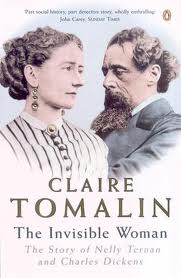
The Invisible Woman

The Invisible Woman

Claire Tomalin’s account of Charles Dickens’ affair with the young writer Nelly Ternan will be brought to screen with script from Abi Morgan (Shame, The Iron Lady) to be directed by Ralph Fiennes, who will play Dickens himself. To add to the rave, Kristin Scott Thomas is also on board. Felicity Jones will be playing Nelly Ternan. Fiennes never ceases to amaze us with his versatility, after directing Shakespeare’s Coriolanus in postmodern style, now comes Dickens.

The Piano Tuner

The Piano Tuner

It has been reported that the iconic German director Werner Herzog (Cave of Forgotten Dreams, 2010) is directing the movie adaptation of this 2002 book by Daniel Mason. Set in 1890’s Burma where the British Empire was having its glorious era, the chords of harmony and dissonance ring. Not a lot of info on it, but as I read a few book reviews, which are all careful not to reveal any spoilers, I can see this can be a colourful and thought-provoking cinematic offering in the hands of an auteur whose career has spanned half a century.

Romeo and Juliet

Romeo and Juliet

Don’t rant about Jane Austen’s novels being turned into just too many movies. Shakespeare probably holds the record. This time, a 21st C. version of Romeo and Juliet will be written by none other than Julian Fellowes, who has brought us the wildly and globally popular Downton Abbey, something Shakespeare just might approve. The new pair of star-crossed lovers? Douglas Booth (Great Expectations, TV 2011) and Hailee Steinfeld (True Grit, 2010), with a cast of prominent US and British actors.

The Sea

The Sea

Irish writer John Banville adapts his own Booker-winning novel (2005) of the same title. Ciaran Hind (Persuasion, 1995) stars. Banville has also written the screenplay of the Oscar nominated movie Albert Kobbs with Glenn Close. I was planning to read The Sea last year for the Ireland Reading Challenge but later made another choice. Now knowing there will be a movie, I should get back to it.

Suite Française

Suite Française

The heart-wrenching novel by Irène Némirovsky with setting in German occupied WWII Paris. Kristin Scott Thomas (I’ve Loved You So Long, 2008) and Michelle Williams star with Rust and Bone actor Matthias Schoenaerts. Glad to know screen adaptation is written by the Oscar winning screenwriter Ronald Harwood, who has given us such memorable films like The Browning Version (1994), The Pianist (Oscar win 2002), Being Julia (2004), The Diving Bell and the Butterfly (Oscar nom, 2007), and the recent Dustin Hoffman directorial debut Quartet (2012). I’m reading this book together with the Bonhoeffer bio. Can’t wait to see the film.

The Taming of the Shrew

Taming of the Shrew

Yes, another Shakespeare’s play in the works. This one will be adapted by the screenwriter who has brought us The Iron Lady (2011), the movie Meryle Streep won an Oscar for playing Magaret Thatcher. Coincident? This time, the iron lady is Katharina, and she’ll be played by recent Oscar winner Anne Hathaway. From Fantine to the Shrew? She’ll need a lot of method acting and we’ll need a lot of forgetting to see her in that new role. As for Petruchio? Let me know who you think should be the one. No, I’m not the casting director, but I’ll put in a good word for you.

***

Do you know of any other literary titles to be adapted into films in the coming year? Let me know in a comment.

Thanks for your input, here are the titles some of you have added to my list:

Serena

Broken

Mr. Morgan’s Last Love

August: Osage County

Much Ado About Nothing

***

Bonhoeffer Read-Along Part 1: Chapters 1-18

February 4 has come and gone without fanfare, without even being noticed by me, the one hosting a read-along of a bio on Bonhoeffer. That day two weeks ago would have been Dietrich Bonhoeffer’s 107th birthday (1906-1945). I’m feeling a sense of loss for missing it.bonhoefer book cover

A sense of sadness too which comes from knowing a young and brilliant life so purposeful even from the start was cut short violently. It also comes from empathy with the parents Karl and Paula, who had to experience the death of three of their four sons and two sons-in-law during war time. Back in 1918, their second son Walter died in action in WWI. And during WWII, their third son Klaus, youngest Dietrich, and two sons-in-law were executed by the Nazis for their role in the German resistance against Hitler. Sad especially that they only learned of Dietrich’s death through a radio broadcast of his memorial service from England. He was only 39.

My impression from the outset is, Dietrich Bonhoeffer’s was a life of purpose, even from an early age. It was made possible largely by a nurturing and vibrant family, and a lively brood of four boys and four girls. Father Karl Bonhoeffer, a prominent psychiatrist and university professor, instilled intellectual rigor; mother Paula imparted faith and fervor. The young lives benefitted from the cultural and musical home environs, but more importantly, the indomitable sense of social justice.

The Bonhoeffer children
The eight Bonhoeffer children with their governess at a holiday home (ca. 1910). Karl and Paula Bonhoeffer in the background. Dietrich to the right of the governess.

Dietrich knew he wanted to study theology when he was only thirteen. He graduated summa cum laude from the University of Berlin, obtaining his doctorate when he was only twenty-one. What brilliant mind and potential! And with that mind he saw through the trickery and schemes of an emerging demigod in Hitler. This is probably my favorite quotes from him. You can see his driven sense of direction:

If you board the wrong train it is no use running along the corridor in the opposite direction.

This has been my query all the time, and Eric Metaxas’s accounts have partially answered it. How could Hitler have gained such power without being challenged? It can’t be all due to fear, that came later. Hitler was democratically elected by the people as chancellor in 1933. The Führer Principle was readily embraced by most. So nationalism played a large part. Then came racism, with the establishment of new laws barring Jews, many of them in prominent positions too from the legal, academic, and medical fields, and then the engulfment of the German Church by the Third Reich. It’s utterly mind boggling. Why was it that the Bonheoffer family was only one of a dearth of lucid observers during this dark chapter in German history?

Nothing is beyond the Nazis reach. The ‘purging’ of the literary and scientific realms resulted in the casting out of thoughts and works by anyone not of the Aryan race, including Helen Keller, Jack London, H.G. Wells, Albert Einstein, Thomas Mann, and the poet Heinrich Heine, who wrote these prophetic words in 1821 in his play Almansor:

Where books are burned, they will, in the end, burn people too.

Metaxas’s book is informative and detailed, especially on Bonhoeffer’s effort to take back the German Church from the Nazis by establishing The Confessing Church with Karl Barth. Metaxas has also painted a very human portrait, a purposeful young man, bold, principled, passionate, and full of life. I move along eagerly, albeit sometimes confused by the numerous names and historical accounts. I want to find out what actually happened in the end, although not so sure how I can bear to read about Dietrich’s ultimate demise.

What are your thoughts so far? Throw your two pebbles into the pond. I’ll be glad to link your post here. Do go and visit:

Alison of Chino House

Ellen The Happy Wonderer

***

To read my wrap-up post on Chapters 19 – 31, CLICK HERE.

***

Soliloquy of a Book Hoarder

To read, or not to read, that is not the question:
Whether ’tis nobler in the mind to suffer
slings and arrows of outrageous fortune,
or to take arms against a shelf of troubles,
and by reading end them.

Before January is completely gone, I must make a resolution for this year. With all the good fortune, yes, books I’ve hoarded over the years at outrageously low prices, like slings and arrows raining down from shelves, many more shooting out from boxes… I must conquer them.

No excuse, but… loots hauled back from the annual Crossroad Market book sale is the Trojan horse of latent guilt. Why, wouldn’t you have fallen into the trap too, 15 books for $30? All in mint condition, some look like they’ve never been opened.

Upon reading two bloggers, Grad and Terri B, resolving to do similar courageous acts, I must start doing something to end the onslaught. I thereby resolve that in 2013 I’ll read from my TBR piles  only  , ok, mostly. Actually, the Bonheoffer and the Proust read-alongs are within this strategic move.

Here are some of the slings and arrows of my good fortune. Any of these in your TBR piles too? Read-along?

**

Margaret Atwood: The Handmaid’s Tale

Anne Bronte: The Tenant of Wildfell Hall

A. S. Byatt: Possession

Kate Chopin: The Awakening

Kiran Desai: The Inheritance of Loss

Junot Diaz: The Brief Wondrous Life of Oscar Wao

Jonathan Frantzen: The Corrections, Freedom

Shilpi Somaya Gowda: Secret Daughter

Henry James: The Ambassadors

Nicole Krauss: The History of Love

Ian MacEwan: Enduring Love, Saturday, Amsterdam

Herman Melville: Moby Dick (Will be reading in August with TerriB)

Hilary Mantel: Wolf Hall

Claire Messud: The Emperor’s Children

Toni Morrison: Love

Irène Némirovsky: Suite Française

Marilynne Robinson: Home, Housekeeping

Arundhati Roy: The God of Small Things

Salman Rushdie: The Enchantress of Florence

John Steinbeck: East of Eden

Zadie Smith: White Teeth

Jane Urquhart: The Underpainter

Winifred Watson: Miss Pettigrew Lives for a Day

Edith Wharton: The Age of Innocence

 **

Non-fiction:

Julia Briggs: Virginia Woolf, An Inner Life

Joseph Campbell: The Hero With A Thousand Faces

Mary Karr: Lit

Marilynne Robinson: Absence of Mind

**

2013 Read-Along Begins: Bonhoeffer

Here we are already the third day into the new year. How fast time flies! To kick things off, here’s the first Read-Along. Allow me to just reiterate from my open invite on Dec. 12, 2012:

Bonhoeffer: Pastor, Martyr, Prophet, Spy by Eric Metaxas 

bonhoefer book cover

In the top ten of Barnes and Noble’s Best non-fiction books of 2010, and on New York Times Best-Seller list, this Dietrich Bonhoeffer biography intrigues me greatly. Author Metaxas’s title makes me want to know more about this legendary figure whose books I had read in my youth, but now think I don’t know him enough to fully appreciate his daring life, a man of faith and anti-Nazi in wartime Germany.

This slow reading plan gives you plenty of time so you can still pursue other books on your plate. I’ve roughly divided the biography in two parts, posting twice:

Chapters 1 – 18 (277 pages): to post on February 15

Chapters 19 – 31 (264 pages): to post on March 15

 **

With Arti, it’s always a slow read. You still have time now to order your book if you haven’t got it. And for others, dust it off the shelf. We’re reading the first part, Chapters 1 – 18 in Jan/Feb and posting our thoughts on these chapters on Feb. 15

Some of you may not be bloggers, you’re most welcome to join in the reading. Come to any of our posts on Feb. 15 and share your thoughts with us in the comment section. As I always say, the pond is open for all to throw in a pebble or two, make some ripples.

**

As of today, those who are joining in this read-along are:

Shoreacres of The Task At Hand (and cousin 🙂 )

Shari Green

Alison of Chino House

And those who have shown interest and still deciding, hope they will hop on soon:

nikkipolani

Jeanie of The Marmelade Gypsy

Hedda of Hedda’s Place

Ellen of The Happy Wonderer (reading already, hope she’ll join in the discussion)

If you’d like to read along with us, or join in any time later, just let me know in a comment and leave a link so I can add you on the list.

**

Before Feb. 15, you can always tweet me @Arti_Ripples or anyone of us who speaks in 140 characters.

Happy Reading!

***

COMING UP in March to May: Proust Read-Along

Reading the Season: Surprised by Joy

If Shakespeare and Hamlet could ever meet, it must be Shakespeare’s doing. Shakespeare could, in principle, make himself appear as Author within the play, and write a dialogue between Hamlet and himself. The ‘Shakespeare’ within the play would of course be at once Shakespeare and one of Shakespeare’s creatures. It would bear some analogy to Incarnation. — C. S. Lewis, Surprised by Joy (p. 227)

What an apt analogy for Christmas. surprised_by_joy_the_shape_of_my_early_life_frontcover_large_1thqlUR3XQVIcV2 Chronicle of Joy Surprised by Joy is C. S. Lewis’s (1898-1963) autobiographical account of his experience with Joy in his younger days, that elusive something of which he had a hard time grasping. Subtitled The Shape of my Early Life, it is an honest chronicle of an intellectual journey. As a young teenager going to the junior school of Wyvern, Lewis had shed the veneer of Christianity from home and declared himself an atheist. But his quest for Joy remained. It was to him an ‘inconsolable longing’ for ‘the real Desirable’. As a child, a form of Joy came to him through solitary reading, writing and drawing. In his youth, Joy channelled through Wagner’s Ring Cycle and Norse mythology, or Northernness. As he grew, he began to realize that pleasure did not equate with Joy, neither physical nor aesthetic, neither Nature nor Wagnerian music, neither books nor poetry, nor the intellectual gratification from reading, nor the excitement of Northernness.

You might as well offer a mutton chop to a man who is dying of thirst as offer sexual pleasure to the desire I am speaking of. .. Joy is not a substitue for sex; sex is very often a substitute for Joy. I sometimes wonder whether all pleasures are not substitutes for Joy. (p. 170)

Reading and Studying Surprised by Joy is Lewis’s chronicle of his encounters with books and countless authors. As a young boy he was first taught Latin by his mother, who sadly died of illness when he was only nine years old. He went through all forms of education, home, public, boarding school, and the most gratifying to him was after his father pulled him out of Wyvern and directed him to a private teacher in preparation for Oxford. While his father was uncertain about the move, Lewis secretly relished the idea and thrived in the experience. His teacher was Mr. Kirkpatrick, or ‘Bookman’. He was an atheist, a rationalist, a logician. He had acutely sharpened Lewis’s critical thinking with logic and Dialectics, and well prepared him to enter Oxford. He assigned to Lewis readings from classical literature: Homer, Demosthenes, Cicero, Lucretius, Catullus, Tacitus, Herodotus, Virgil, Euripides, Sophocles, and Aeschylus. On his own, Lewis immersed in Norse myths and the Wagner’s Ring Cycle. His reading expanded to Goethe and Voltaire. It was only later upon a friend Arthur’s influence that he began to devour literature in the English language. “I read … all the best Waverleys, all the Brontes, and all the Jane Austens.” There were of course others, Donne, Milton, Spenser, Malory, Thomas Browne, George Herbert, the Romantics, Yeats, William Morris, G. K. Chesterton, and George MacDonald.

I was by now a sufficiently experienced reader to distinguish liking from agreement. I did not need to accept what Chesterton said in order to enjoy it. (P. 190)

Yet he could not help but began to revise some of his world views. Yeats, Maeterlinck, and ultimately, George MacDonald informed him of alternative glimpses other than the material world. Unde hoc mihi I admit I had to look this Latin phrase up. And this I found: Unde hoc mihi … translated as “And whence is this to me” (KJV), or “And why is this granted to me” (ESV) A phrase that moved me so. As I was reading, two-third into his autobiography these words leapt out:

Unde hoc mihi? In the depth of my disgraces, in the then invincible ignorance of my intellect, all this was given me without asking, even without consent. (p. 181)

Lewis describes the epiphany, utterly inexplicable, the moment which came to him when all things seemed so clear, and the presence of something not mythical or magical which he had craved in his mind, but ‘Holiness’. It was then that his Atheism was transformed into Theism (In a moment of divine enlightenment not unlike Levin’s conversion at the end of Anna Karenina.) This humble exclamation unde hoc mihi is used by Lewis as he alludes to Luke 1:43 when Mary, pregnant with the Christ Child, went to see her cousin Elizabeth, who also by miraculous means in her barren state, pregnant with John, the forerunner before Christ. Upon hearing Mary’s salutation to her, Elizabeth felt the babe leap in her womb, and she exclaimed: “And why is this granted to me that the mother of my Lord should come to me?” Why, a learned scholar, specialist of the Classics, logical thinker skilled in Dialectics, claimed no credits of his own in this enlightenment. But it is only the beginning, he had not met the Person yet. Further, he realized that whatever that had given him Joy before, like Nature,

that those mountains and gardens had never been what I wanted but only symbols which professed themselves to be no more, and that every effort to treat them as the real Desirable soon honestly proved itself to be a failure. (p. 204)

As he began to teach at Oxford, Lewis was surprised to find two fellow professors he respected were, alas, Christians. One of them was J. R. R. Tolkien. But Lewis was an unlikely candidate for Christianity, with his ‘deep-seated hatred of authority, monstrous individualism, lawlessness’ and his abhorrence of a ‘transcendental Interferer’ (p. 172). Yet that unquenchable longing for Joy was ever present. Friendship with Tolkien began to break down some long held biases. He admitted that “I was by now too experienced in literary criticism to regard the Gospels as myths… To accept the Incarnation was a further step… It brings God nearer, or near in a new way.” It was another year before Lewis finally “gave in and admitted that God was God… Perhaps the most reluctant convert in all England.” Ironically, as he humbly exclaimed unde hoc mihi, ‘why is this granted to me’, he was submitting to ‘Divine humility’, the Incarnation. Hamlet finally met his Author. And what of Joy? I can’t give out too many spoilers, can I?

**

I read Surprised By Joy along with Bellezza. Do click here to read her thoughts on the book.

Surprised by Joy: The Shape of my Early Life by C. S. Lewis, Harcourt Publishing, Orlando, Florida, 1955, 238 pages. This is the edition I read with the image posted.

**

Reading the Season Posts in Previous Years:

2020: Jack by Marilynne Robinson

2019: ‘A Hidden Life’ by Terrence Malick: a film for the Season

2018: Madeleine L’Engle’s Poem The Irrational Season

2017: A Wrinkle In Time by Madeleine L’Engle

2016:  Silence by Shusaku Endo

2015: The Book of Ruth

2014: Lila by Marilynne Robinson

2013: Poetry by Madeleine L’Engle

2012: Surprised by Joy by C. S. Lewis

2011: Walking on Water by Madeleine L’Engle

2010: A Widening Light, Luci Shaw

2009: The Irrational Season by Madeleine L’Engle 

2008: The Bible and the New York Times by Fleming Rutledge

2008: A Grief Observed by C. S. Lewis

***