Exit Through the Gift Shop (2010)

Update: “Exit Through The Gift Shop” is nominated for an Oscar for Best Documentary Feature. Academy Awards ceremony Feb. 27, 2011.

If you haven’t seen a Banksy signature piece in any urban centres, now you can watch a Banksy film, Exit Through The Gift Shop, ‘directed’ by the elusive street artist himself, and legitimately shown in theatres near you. And a big spoiler: no, you don’t get to see his face… only a dark silhouette inside a hoodie, voice distorted… or, maybe that’s not even Banksy himself.

The infamous and secretive graffiti artist has been claimed by some as the instigator of the ‘street art movement’.  Believed to be based in Bristol, England, Banksy has made his presence known by spray painting his articulately constructed stencilled work on walls in the most unlikely places of the world.  The following one is found on the high, separating wall in the West Bank:

The May 10 issue of TIME magazine has included Banksy in the poll of 100 Most Influential People In The World.  His silent graffiti are clear political and social statements, thought-provoking messages imbued with whimsical and imaginary images.  His works have been auctioned off at Sotheby’s, including the murdered telephone booth on a London street.  Sign of the time: the triumph of the cell phone.

At the time of the film’s premiere screening earlier this year at the Sundance Film Festival in Park City, Utah, Banksy made his presence known by contributing to the city scene with his notorious images.  Here’s one of them:

.

The documentary Exit Through The Gift Shop, ironically, is more about the filmmaker wannabe Thierry Guetta “Terry” who started off filming street artists from Paris, London, and back to his home city L.A.  His life came to a drastic turn as he, by chance, was introduced to the underground Banksy, and started tagging along, capturing Banksy’s creative process in his camcorder.

What turned him around was Banksy’s advice that he wouldn’t be a good filmmaker.  That was motivation enough for Terry, who re-directed his energy towards his new ambition: to be a street artist himself.  So the film is exactly that, the first part is the exhilarating depiction of the colorful underground world of street artists from Europe to LA, hunt down and tagged along by Terry the videotaping enthusiast.  But the film dims into a lesser light when the latter half shifts to focus on Terry himself, who, without much self-discernment, churned out obviously second-rate works which prompted Banksy to declare never to help anyone produce a doc about street art again.  We learn that as the end credits roll.

Unlike the anonymous and elusive Banksy, Terry is a self-promoting opportunist, calling himself Mr. Brainwash, his productions MBW. He hired staff to help him produce works of pop fusions, tacky, Kinko re-mixes of Warhol reproductions, while at the same time, reaping millions of dollars from their sales.

And with that Banksy cleverly throws out to us the obvious questions: What is art, or maybe, When is art, art?  And, Who can be an artist?

As I watched the first part about these highly skilled and agile urban legends, reminiscence of none other than Phillippe Petit of Man On Wire, I was entertained and amazed at the artistic skills and versatility involved. But of course, these are less dangerous, more down-to-earth feats, nevertheless the spirit of Phillippe Petit lingers.  As fellow artist Shepard Fairey writes in TIME magazine about Banksy:

He doesn’t ignore boundaries; he crosses them to prove their irrelevance.

So naturally, the film leads us to that menacing debate: Street art or vandalism?  Here’s Banksy’s own take on this issue, quoted in LA Weekly:

“I’m not so interested in convincing people in the art world that what I do is ‘art,’ ” Banksy says. “I’m more bothered about convincing people in the graffiti community that what I do is really vandalism.”

… mmm interesting thought… but then again, as elusive as his persona.

Exit Through The Gift Shop tags along this subheading: “The World’s First Street Art Disaster Movie”.  The disaster apparently refers to the public’s indiscriminate taste for Terry’s MBW works.  However, it probes further into a deeper layer, the distinction between ‘good’ art and ‘bad’ ones. I like Shepard Fairey’s take on the Mr. Brainwash phenomenon:

“Don’t be annoyed by him. Make him irrelevant, make something better.”

If we can all agree on what is ‘better’.  Take for example, among Banksy’s works, I like this one the best… No, it doesn’t reflect Arti’s own personal habit.  It appeared on a Camden street, and later met the fate of being cleaned up by order of the Camden City Council:
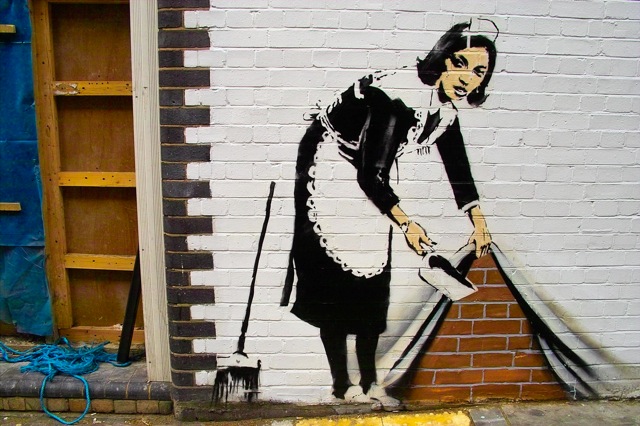
 

‘Directed’ by Banksy himself, the doc is narrated by Rhys Ifans, an award-winning British actor (Notting Hill‘s Spike).  It’s entertaining, informative, and thought-provoking.  This is the closest to an original Banksy.

~~~ Ripples

***

With the film’s premiere showing in Toronto, guess Banksy has also made his debut on the walls there:

CLICK HERE TO SEE BANKSY IN TORONTO.

Thanks to a reader from England, I was given the link to this, a must-see:

CLICK HERE TO SEE BANKSY V. THE BRISTOL MUSEUM

***

Photo Sources:

Banksy on West Bank Wall: http://news.bbc.co.uk/2/hi/entertainment/4748063.stm

Banksy at Sundance, Park City, Utah: http://festival.sundance.org/2010/blog/entry/banksys_missive/

Murdered Telephone Booth: http://www.laweekly.com/2010-04-08/art-books/banksy-revealed/2

Maid Sweeps Under: Wikipedia Commons

***
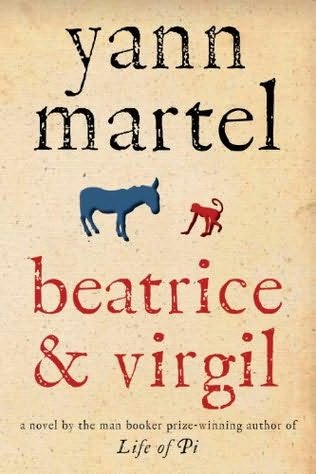
 

Beatrice & Virgil by Yann Martel

It has been nine years since Yann Martel’s second novel The Life of Pi first published. Its winning the Booker Prize in 2002 has solidly placed him on the international literary stage. Beatrice and Virgil is the long awaited third novel by this Saskatoon based Canadian author.

Beatrice is a donkey.  Virgil, a howler monkey.  They are the two characters in a play written by a taxidermist.  Beatrice and Virgil are also specimens in his shop Okapi Taxidermy.  The two names come from Dante’s Divine Comedy, to which the book has made reference. The metaphor of taxidermy is a fresh frame Martel constructed to look at the Holocaust. The preservation of evidence of lives lived, the mounting of historical facts.

Beatrice and Virgil is also a love story.  The two animals cherish each other and have to face the cruelty of extinction together.  In the play, they have elaborate talks about fruits, a striped shirt, God and faith.  It’s all allegorical of course.  And there’s the rub.

While I fully appreciate Martel’s attempt at creating a new frame to present the atrocity of the Holocaust, I doubt using animals as symbols and parallels, depicting the cruel treatment of them would suffice to convey the magnitude and severity of this horrific crime against humanity.  Despite a sincere intent and the riveting storyline, I feel the book fails to deliver the dynamics and efficacy in its form as an allegory.

Nonetheless, the book conveys some very interesting points, through which Martel has demonstrated the imaginative power of literary creation.  First off, the author plays with the notion that the line separating fiction and non-fiction is indeed blurry.  To make a case of it, he writes himself into the story.  The main character is an author called Henry, whose wife Sarah later on gives birth to their son Theo, the name of Martel’s own son with his partner, the writer Alice Kuipers.

Back to the story, Henry’s second book has stirred international sensations, winning prizes, adopted by schools and book clubs, and adapted into a Hollywood movie.  Life of Pi is all that.  And just like in real life, it has been a few years after that before the fictional Henry completes his third novel, a book on the Holocaust.  But this time, he has trouble finding a publisher (now this may diverge from real life.)

This new book Henry wants to get published is a literary fusion. He wants it to be a ‘flip book’.  One side is fiction, the other side an essay, with the title on both.  And that is exactly what the cover of this book Beatrice and Virgil is like.  Henry observes that all Holocaust accounts have been ‘historical, factual, and literal’, it is worthwhile to create a fictional rendition of it, “a new choice of stories”, providing readers with an artistic expression representing these well documented, horrific happenings.  And this is exactly what Martel has done, constructing imaginary portals based on facts.

Once these layers have been peeled off, there is yet another with Henry meeting the taxidermist who is writing the play using Beatrice and Virgil as the two main characters. Coincidentally, he is also called Henry. So, the amateur writer Henry mysteriously involves the professional writer Henry to help him with the completion of his play on the Holocaust.  But of course, there remains yet another layer of secret.

The image of Escher’s Drawing Hands keeps emerging in my mind as I read the book, how a writer would write himself into the story and into the story.

While the style of storytelling is intriguing, when one considers the topic and the major crux of the book, that being the atrocity that is the Holocaust, it is apparent that the choice of the deadpan treatment of a donkey and a howler monkey in allegorical terms just would not suffice. While the play in the book is reminiscent of other two-character plays, namely, Tom Stoppard’s Rosencrantz And Guildenstern Are Dead and Samuel Beckett’s Waiting For GodotBeatrice and Virgil seems to lack the wit of the former and the depth of the latter.

And as I think about the fact that it has taken the author nine years to come to this one, I wonder, just wonder… Oh, the creative process is indeed an incomprehensible and uncertain path, as cryptic as an Escher drawing.

Beatrice & Virgil by Yann Martel, published by Knopf Canada, 2010, 224 pages.

~~ ½ Ripples

***

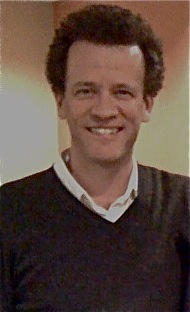
Epilogue:  Yann Martel Reading at the Calgary Public Library

.

.

After writing the above section on Beatrice & Virgil, Arti has the privilege of listening to Yann Martel read from his new book at the Calgary Public Library tonight (April 28, 2010).  It’s always interesting to hear a writer read from his own work.  It’s even more gratifying listening to the Q & A session afterwards.  Yes, he is still sending books to Stephen Harper because he firmly believes that literature is the tool to understand the human condition.

The writer also talked about the creative act, and the use of animals as symbolism. Animals are inherently poignant.  And, how did he know at that pivotal moment of his life, that he wanted to become a writer?  It’s from within, you’d know it because you’d simply want to write without any consideration of monetary gains or praises.  It’s a strong feeling inside moving you to just do it.

Do I need to make any changes to the review above after hearing the author read from the book?  No, I don’t think so.  But what has changed is my view of the writer.  I have come face to face with a very personable and casual human being, someone who is convinced that literature can teach us how to be human, that fiction is as important as facts, and that the creative act of writing is driven by an inherently insatiable desire to simply write, without the intention of being published or any notion of ‘success’ in mind.

***

Floating Weeds (1959)

‘Floating weeds, drifting down the leisurely river of our lives.’

.

.

April is national poetry month… and I’ve been thinking poetry these days.  So that’s why the very title of this DVD on the shelf of the indie video store attracted me right away.  I took it down soon as I saw it was directed by Ozu.  Ozu’s films are visual poetry, the title ‘Floating Weeds’ is an apt prelude.

Floating Weeds (浮草, Ukigusa, 1959) is a remake of Ozu’s 1934 silent film ‘A Story of Floating Weeds’.  The title comes from a favored Japanese metaphor as the above quote depicts.  In this newer version the director has added colors and sound, and given his story a blossoming rebirth. The colors are vibrant yet the cinematography is contemplative.  Unlike some art house films, and despite its title, ‘Floating Weeds’ is enlivened by humor, human interests, and augmented by actions.  Despite the pensive mood the title evokes, I found it to be more story-driven than many of his other works.  However, it is characters that ultimately carry the story, and Ozu’s brilliant direction that makes viewers care about them.

The story begins with a train dropping off a troupe of travelling players to perform in a small town.  The master of the company Komajuro takes the chance to visit his former lover and see his son Kiyoshi, now grown up to be a fine young man, aspiring to attend college in the big city.  But Komajuro has kept his real identity as Kiyoshi’s father from his son because he does not wish his low social status as a travelling actor, and the vulgar circle he associates with to tarnish Kiyoshi’s future.  The plot thickens as Komajuro’s current mistress Sumiko finds out about his secrets. Burnt with anger and jealousy, she plots a scheme to destroy Kiyoshi by bribing the young actress Kayo to seduce him.  The young man soon falls for the actress, but the scheme turns into a full-blown mutual love relation.  Sadly, a marriage with Kayo would mean the quashing of his aspiration for higher education, and possible social reverberations and disgrace.

At the mean time, the drama troupe hits a low with disappointing attendance. The company has to disband.  Komajuro facing failure on different fronts, has to make choices not only for himself, but the future of his son.  In the final shot, the train that once took the travelling players to town now carries them off as disbanded individuals facing uncertain future. Like floating weeds, they drift on in the stream of life. And for Komajuro, he leaves town with the slim hope that his son would fare better than he in the oblivious currents of time.

I’ve enjoyed the subtle style of Ozu.   Here is one of my favorite scenes in the film, and the dialogues are as contemporary as you can find in a 2010 movie.  Whether one sees it as insight or foresight (considering it was remade in 1959), both are gems one discovers while watching the story unfold as casually as a quiet flowing stream.

The scene is about Komajuro talking to his son Kiyoshi as he arrives to his former lover’s home. All the years, Kiyoshi has only known Komajuro as an uncle.  Although Komajuro is ecstatic to see his son all grown up with a bright future, he is also wary that his travelling drama troupe does not measure up to what he would wish for his son.  Here in this scene, father and son’s conversation seems to touch on another issue: art and popularity.  Through this most casual dialogue exchange, Ozu might have conveyed his own ambivalence on the subject more sharply than any wordy treatise.

Kiyoshi: I’ll go see your show.  What do you play?

Komajuro: Forget it.  It’s not meant for you.

Kiyoshi:  Who is it for?

Komajuro:  An audience.

Kiyoshi:  I’m an audience.

Komajuro:  I know.  It’s nothing high-class.  Forget about it.

Kiyoshi:  Why show such plays?  Show something better.

Komajuro:  But I can’t.

Kiyoshi:  Why?

Komajuro:  Audiences today won’t understand good plays.  So you can’t come to see it.

**

In his commentary on the 1934 silent movie, writer and film critic Donald Richie notes that Ozu’s films are full of ellipses. There are story sequences he left out for the audience to bridge.  As well, he handled the story with restraints.  Such a subtle way of presenting the material is a very modern style of storytelling.  That might explain why I would care for characters in a Japanese movie made half a century back, where I have to read subtitles, and watch in black and white, or even silent.  Herein lies the ingenuity and artistry of Ozu, that an audience so far removed in time, space, and culture, would find universality and common ground to be totally absorbed.

The Criterion Collection 2-DVD set includes both the 1934 silent movie and the 1959 color remake. The first features commentary by Donald Richie, the later version by Roger Ebert. According to IMDB, ‘Floating Weeds’ (1959) is on Ebert’s list of 10 best movies of all times.

~~~~ Ripples

CLICK HERE to my review of Ozu’s classic Tokyo Story.

***

Yasujiro Ozu and The Art of Aloneness

Growing up in Hong Kong during the 60’s, I had my share of Japanese literature and films, as well, the early version of anime.  Books were in Chinese translations, films with Chinese subtitles, and anime needed no language.  As a youngster I had my fix of Samurai action flicks by the legendary Akira Kurosawa, or the early sagas of The Blind Swordsman deftly performed by Shintarô Katsu.  The fast, magical sword-fighting movements displayed in elegantly choreographed sequences defined what ‘cool’ was in the eyes of a very young film lover, decades before Jason Bourne emerged.

But I admit, I had never heard of Yasujiro Ozu (小津 安二郎, 1903-1963) before reading the book The Elegance of The Hedgehog, and since, have become a mesmerized Ozu fan.

In Muriel Barbery’s marvellous work of fiction The Elegance of The Hedgehog, I was fascinated by the following excerpt that led me to explore the world of Ozu. Barbery mentioned some dialogues in the Ozu film ‘The Munekata Sisters’ (1950). Here, after quoting elder sister Setsuko, Barbery wraps up the chapter from the point of view of the concierge Renée, narrator of the book:

SETSUKO
True novelty is that which does not grow old, despite the passage of time.

The camellia against the moss of the temple, the violet hues of the Kyoto mountains, a blue porcelain cup — this sudden flowering of pure beauty at the heart of ephemeral passion: is this not something we all aspire to?  And something that, in our Western civilization, we do not know how to attain?

The contemplation of eternity within the very movement of life.

I could not find any copy of ‘The Munekata Sisters’, but I did manage to find a few other Ozu films on DVD in The Criterion Collection at an independent video store. One particularly stands out, both the film and the special features.  And that’s Tokyo Story (1953), the best known and most acclaimed Ozu work.

.

TOKYO STORY (with spoiler)

.

.

Instead of the macho samurai films of his time, Ozu chose to explore the quiet subject of family relationships, parents and children, brothers and sisters, husbands and wives, and from them come the topics of marriage, loyalty, aging, death, filial duties, parental expectations, and generational conflicts.  Through his perceptive camera work, Ozu sensitively revealed the undercurrents beneath the seemingly calm surface of daily family interactions.

‘Tokyo Story’ is about an aging couple Shukichi (the Ozu actor Chishu Ryu) and Tomi (Chieko Higashiyama) from small town Onomichi going on a trip to visit their adult children in bustling Tokyo.  At that time, postwar Japan was cranking up her economic engine, and urbanization was taking off.  Shukichi and Tomi’s children were all busily engaged in their work and family, with no time or patience to entertain their visiting parents, albeit struggling with a thin sense of obligation. They passed the two old folks from home to home, and finally sent them off to a spa resort on their own, a supposedly well-meant package substituting for their absentee hospitality.

With his subtle cinematic language, Ozu explored the issues facing the family in urban, postwar Japan. I’m surprised that in a time when the rebuilding of national pride was as much an essential as that of the economy,  Ozu was brave enough to depict the collapse of the family, revealing the conflicts and tensions behind the amicable social façade.  It’s interesting how contemporary and universal they are.  Have we not heard of those ubiquitous ‘mother-in-law jokes’ in our modern Western society?  Or, in real life, do we not struggle between taking care of our own family and career, and finding the time and energy to look after our aging parents?

.

But the contemplative cinematic offerings of Ozu draw us into deeper thoughts. ‘Tokyo Story’ quietly depicts the truth of these issues: No matter how many siblings there are in a family, each person is responsible for his or her own decision and action.  Even in a mass society like Japan, one can still make individual choices. Despite the currents, one can stand alone against the tides, and act according to one’s heart and conviction. While the brothers and sister are evading the task of hospitality, the young widowed daughter-in-law Noriko (the Ozu actress Setsuko Hara) chooses to care for her deceased husband’s parents out of genuine love.  She stands alone in her kindness and grace, a selfless heroine in a family hinged upon superficial ties.

Illness and death too have to be borne alone.  Despite their being together all the years of their marriage, Shukichi and Tomi each has to face the imminent all alone.  After Tomi falls ill upon arriving home from Tokyo, the strong bond of togetherness in marriage quickly dissolves into helpless resignation of parting and letting go.  Shukichi soon realizes he has to face life all alone.  The poignant scene though is that despite his loss, he looks out for his daughter-in-law Noriko, appreciating her loyalty, and relieving her of further obligations.  Despite having no blood ties, the two of them have touched each other in a way that’s beyond flesh and blood. Noriko selflessly gives while Shukichi accepts and appreciates in the midst of aloneness. The tables are turned, while they are left to face life alone, they are yet bound together in an unspoken bond, one that’s far stronger than filial ties.

The Criterion Collection carries several sets of Ozu titles.  ‘Tokyo Story’ is one in a trilogy of Noriko’s stories.  Disc Two features ‘I Lived, But…’,  a two-hour documentary on the life of Ozu, and ‘Talking with Ozu’: a 40-minute tribute to the great director featuring reflections from international auteurs Stanley Kwan, Aki Kaurismaki, Claire Denis, Lindsay Anderson, Paul Schrader, Wim Wenders, and Hou Hsiao-hsien.  It also features audio commentary by Ozu film scholar David Desser.

~~~~ Ripples

CLICK HERE to my review of another Ozu classic: Floating Weeds (1959)

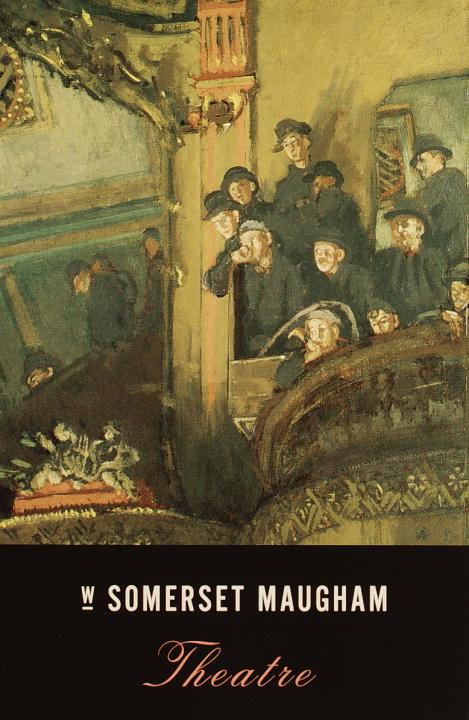
THEATRE by W. Somerset Maugham: In Search of Reality

It was pure serendipity. I thought I knew almost all of Maugham’s titles, but this one just escaped me.  I found it on the ‘New and Notable’ shelf in the public library. It’s a Vintage International edition paperback published in 2001. Not new but it looked untouched and inviting.

Two pages into the book I knew right away I had seen it before. Of course, that’s the movie Being Julia (2004). Annette Bening got a Best Actress Oscar nom for her portrayal of Julia Lambert, a famous actress on the London stage in the 1930’s. The movie is a colorful account of how a successful stage actress deals with her mid-life crisis. With fame, fortune, and achievement in bounty, what more could she ask for but… love and passion. And during the course, obstacles, jealousy, and betrayal are all overcome, and revenge carried out; on or off stage, no matter, it’s equally exciting for the glamourous Julia Lambert.

But not until I read this novel on which the movie was based did I realize that a most important passage had been left out. And oh what an omission! For the crux of the book rests on those few pages. And not only that, the screenwriter had chosen to alter a character to suit his fancy, rounding off the edges of conflicts and alleviating tensions in presenting a smooth and suave storyline.

In the movie, Julia’s son Roger is a young man fresh out of Eton and planning to attend Cambridge after the summer. That much is true to the book.  Roger is shown to be a devoted son, lovingly supportive of his mother in her pursuits in career and love life. But this is not the case in the novel.  Maugham has crafted Roger as a critical young man, offering the necessary tension to the story. In a crucial scene at the end of the book, he questions Julia’s behaviour and integrity. These challenges form the climatic confrontation between mother and son, projecting the meaning behind the very title of the novel.

Here is an excerpt from this scene that captures the essence of the whole book. Julia asks Roger:

“What is it you want?”
Once again he gave her his disconcerting stare.  It was hard to know if he was serious, for his eyes faintly shimmered with amusement.
“Reality.”
“What do you mean?”
“You see, I’ve lived all my life in an atmosphere of make-believe…. You never stop acting. It’s second nature to you. You act when there’s a party here. You act to the servants, you act to Father, you act to me. To me you act the part of the fond, indulgent, celebrated mother. You don’t exist, you’re only the innumerable parts you’ve played. I’ve often wondered if there was ever a you or if you were never anything more than a vehicle for all these other people that you’ve pretended to be.  When I’ve seen you go into an empty room I’ve sometimes wanted to open the door suddenly, but I’ve been afraid to in case I found nobody there.”

By turning Roger into a complacent and docile young man, the screenwriter had failed to present the necessary tension in the story. Further, by avoiding the character foil between the successful actress mother and her meaning-pursuing, idealistic son, the movie fails to deliver the essential subtext, despite an impressive performance by Annette Bening.

Further, the best is yet to come in the book… such is the ingenuity of W. Somerset Maugham.  After a superb, revengeful performance, overarching her rival, the young and beautiful Avice Crichton, and drawing everyone’s admiration back to herself, Julia celebrates on her own with a nice meal and mulls over a gratifying notion, on the very last page:

“Roger says we don’t exist. Why, it’s only we who do exist.  They are the shadows and we give them substance. We are the symbols of all this confused, aimless struggling that they call life, and it’s only the symbol which is real. They say acting is only make-believe. That make-believe is the only reality.”

This is ever so relevant for us today. With all the online personae we can create and project, all behind the guard of anonymity, Roger’s quest for what’s real remains a valid search.

Sherry Turkle, the acclaimed ‘anthropologist of cyberspace’, has observed the liminal reality in our postmodern world and stated her own quest:

“I’m interested in how the virtual impinges on what we’ve always called the real, and how the real impinges on the virtual.”

Let’s just hope that the advancement of technology would not get the better of us, blurring the lines of fact and fiction, offering shields for fraud and deceits. Behind the liminal existence, let’s hope too that we still care what’s real and what’s not, and that our humanity will still be valued and not be compromised or lost in the vast abyss of bits and bytes.

The upcoming Academy Awards too, is another platform to showcase such a duality. I always find the acceptance speeches of award winners intriguing: what’s genuine and what’s fake in their thank you’s. Are they presenting their real self or merely acting? Outside of their roles, which part of them is authentic? Or, do they ever get out of their roles?

It’s interesting too to explore the influence of movies nowadays. Again, the postmodern emphasis is on the narrative, multiples of them, and storytelling the vehicle of meaning. Does the notion of Maugham’s character Julia mirror our world… that movies have become the symbols of what we call life? That make-believe has sometimes been merged with reality? Can we still tell them apart? Or, should we even try? Considering the pervasive effects of pop culture in our life today, considering a single movie can command a worldwide box office sale of $2.4 billion, and counting… Maugham was prophetic indeed.

***

The Hurt Locker (2008, DVD)

UPDATE March 7:  The Hurt Locker has just won 6 Oscars including Best Picture and Best Director.  CLICK HERE to read Oscar Results 2010.

UPDATE Feb. 21:  The Hurt Locker just won Best Picture at the BAFTA Awards (British Academy of Film and Television Arts). Kathryn Bigelow became the first woman to win Best Director.  “I would like to dedicate this to never abandoning the need to find a resolution for peace,” she said in her acceptance speech. Mark Boal won Best Original Screenplay.   CLICK HERE TO READ MORE.

CLICK HERE TO VIEW THE ACCEPTANCE SPEECHES.

With The Hurt Locker, Kathryn Bigelow could well have shattered the stereotype of female filmmakers, if there even was an image established for them.  But a good guess is that they have generally been misconstrued as merely producers of romances, tear jerkers, simply put, ‘chick flicks’.  A look at Bigelow’s filmography shows a track record of action thrillers. But it’s with The Hurt Locker, a captivating work about a bomb disposal team in Iraq, that she has garnered floods of accolade.

Professor Martha Lauzen of San Diego State University studies women in the movie industry over the years.  She found that women represented only 9 per cent of Hollywood directors in 2008 – the same figure she had recorded in 1998.  In this male-dominated circle, Bigelow is only the fourth woman ever in the 82-year history of the Oscars to be nominated Best Director.  The other three were Lina Wertmuller (Pasqualino Settebellezze, 1975), Jane Campion (The Piano, 1993) and Sofia Coppola (Lost In Translation, 2003).  None of them won.

Recently, Bigelow made history by being the first woman to win the Director’s Guild Award with The Hurt Locker.  According to past trend, winners of the DGA usually went on to win the Oscar, with a few exceptions.  Bigelow could be making Oscar history as well comes March 7.  But of course, she has tough competition from her ex James Cameron.

The Hurt Locker focuses on an Explosive Ordnance Disposal (EOD) team in Iraq in 2004.  In this urban guerrilla war zone, the signature weapon is the Improvised Explosive Device (IED), or, roadside bomb. What stands out in this film is the intense psychological tension captured by the camera, the excellent editing, and the poignant performance of the three specialists in the EOD team.  The nuanced playing out of their opposing psyche and the dynamics of their interactions are what fuel the riveting momentum.

Into this three-men EOD team the story zooms in on one character, Sgt. Will James (Jeremy Renner), bomb specialist, reckless maverick whose hubris and adrenalin cravings propel his dubiously heroic acts.  The quote at the beginning gives a hint of what is to come: “… war is a drug.”  Unlike other typical reactions to war, James embraces it.  The whole movie is a character study exploring such a psychological make-up.  And we are held on the edge of our seats as we follow the Dirty Harry of Baghdad clearing IED’s on the streets.

But the script excels in presenting a multi-layered character.  As the story progresses, we see a softer side to the tough bomb expert, and yet, all revealing is movingly restrained.  Renner’s performance is magically convincing.  He has me on his side as soon as he appears on screen.

Using relatively unknown actors, the film poignantly portrays the vulnerability of Everyman in the war zone. But they can’t be unknown anymore after this. Jeremy Renner (Sgt. Will James), Anthony Mackie (Sgt. Sanborn), and Brian Geraghty (Spc. Owen Eldridge) have left their impressive marks here. Pitching in, albeit for only short moments, are some more well-known actors, Ralph Fiennes, Guy Pearce and David Morse.

Impressively shot like a documentary, its every scene intense, drawing the viewer in like a participant, an onlooker. Great camera works, excellent editing, breath-taking pacing, and thoroughly human.

Unlike other war movies, there are few bloody scenes, no gratuitous war mongering or protesting. Bigelow in the special feature mentions that the film takes an apolitical, non-partisan stance.  Such a neutral, matter-of-fact depiction, focusing on the micro-level of three men handling the most dangerous job in the world, is no less powerful in conveying the danger, the sacrifice, and the courage needed to go through every single day in Iraq.  The film stands out among other war movies in its sensitive and sometimes even eloquent treatment of the raw emotions and the dynamics of personalities caught in a hurt locker.

The term ‘hurt locker’ refers to a situation of extreme pain and hardship.  The production itself could well illustrate the point.  Filmed on location in Jordan, cast and crew had to endure long hours in searing heat of 115 degrees, had to make do with scarce resources, and improvise in tough circumstances. It had been suggested that “no woman over 40 could possibly have the stamina to direct a feature film.” Overcoming such a sexist view is the challenge every woman director has to face.  Bigelow has proven herself to be admirably competent, crafting and delivering a superb production with an all male cast, (except a short appearance by Evangeline Lilly), in a land far from home.

The Hurt Locker ties with Avatar with 9 Oscar noms, including Best Picture and Best Director, but it gets nods in two categories that Avatar doesn’t, Best Actor and Best Writing, Screenplay written directly for the screen.

Jeremy Renner receives a Best Actor nod for his engrossing performance as Staff Sgt. William James.  A fusion of James McAvoy and Russell Crowe, Renner has proven himself to be a worthy contender in the Oscar race.

Mark Boal gets an Oscar nom for his very first screenplay.  This in itself is impressive, and a pointer to what makes a good piece of writing: write what you know.  His personal 2004 experience in Baghdad as an embedded journalist with a bomb squad is what makes the story, characters, and every single detail so real and poignant.

The DVD has some fascinating Special Features capturing the Behind The Scene moments, a Gallery, and commentaries from Bigelow and Boal.  Those who want to see the film before the Awards show will have to opt for the DVD. As a smaller, indie production, The Hurt Locker had only a short release in selective theatres.  Hopefully after March 7, it might get a chance to be put on the big screen again.  So, now you know who I root for comes Oscar night.

~ ~ ~ ½ Ripples


***

Click here for an insightful panel discussion on the movie, Spoiler Warning though, from Canada’s National Post.

***

Emma (2009, TV): Episode 3

The final instalment of Emma has a major challenge, to reveal the hidden agendas, and to tie up all the loose ends in just under an hour. The hurried scenes leave me with a feeling of watching a trailer, a montage of excerpts loosely linking up the story.  This is especially so in the first half dealing with Jane Fairfax and Frank Churchill’s secret relationship.

If the story feels a bit fragmented in this last episode, the cinematography makes up for that shortfall.  The hour is saturated with stunning shots, magnificent scenic views and exquisite interior renditions.  The Box Hill picnic scene is a vivid example:

Ironically, the pivotal Box Hill scene was not shot in Box Hill, a busy tourist attraction in Surrey.  Instead, it was shot in Leith Hill, Mole Valley, another much quieter scenic point.  For an interesting comparison of the two hills, click here to go to ‘this is surrey today’.

The Box Hill picnic is a crucial turning point in the story.  Emma’s callous and sarcastic joke on Miss Bate and the subsequent scolding she receives from Mr. Knightly is nothing short of an epiphany in self-knowledge.  The genuine remorse she feels could well reflect her greatest strength.  I’m sure such quality of character is what seizes Mr. Knightly with tenderness, moving him to consider her “faultless in spite of all her faults.”

I have a feeling too that this is the very reason Austen finds her heroine likable.  Romola Garai has effectively portrayed a contrite and humbled Emma, while Jonny Lee Miller has delivered convincingly a silent lover with passion and principle.  My initial reservation about his role has definitely changed for the better in this final episode.

Fortunately as well, the endearing lines of Mr. Knightly to Emma, no, not the ‘badly done!’ admonition, but the heartfelt praise he spurts out in spontaneity, remains intact and without any modernized alteration from screenwriter Sandy Welch.  Of course it needs to be declared in its authentic whole… Miller has the best lines of the series:

“I cannot make speeches, Emma… If I loved you less, I might be able to talk about it more.  But you know what I am.  You hear nothing but truth from me.  I have blamed you, and lectured you, and you have borne it as no other woman in England would have borne it.”

As with all Austen’s novels, the ending comes with nuptial ties. But as Masterpiece Classic’s host Laura Linney points out at the opening, considering the social discriminations inflicted upon the woman in Jane Austen’s time, allowing no ownership of properties, no decent employment (even Jane Fairfax compares the governess position with slavery), and no respect or rights given to the single female of low means, it is only a justifiable reward for the author to end her story with loving marriages for her well-deserved protagonists.

Towards this end, the camera takes us to the magnificent view of Beachy Head in the last scene.  As Emma and Mr. Knightly stand on the edge of the cliff overlooking the boundless ocean, we see the series come to an idealistic end, maybe a broader stroke than that in Austen’s novel. But as some critics have noted, it is love that the author emphasizes rather than romance.  From that perspective, looking outward together to the ocean vast instead of gazing into each other’s eyes may well be an apt interpretation of Austen’s heart.

***

CLICK HERE to go to Episode 1

CLICK HERE to go to Episode 2

Arti’s reviews of Emma (2009), Episodes 1 to 3, have been compiled into one article and published in the Jane Austen Centre Online Magazine. CLICK HERE to read the many other interesting articles on Jane Austen and her time.

**Photo Sources: Box Hill Picnic bbc.com; Beachy Head, not a scene from the movie, taken from Wikimedia Commons.

Emma (2009, TV): Episode 1

Previously on Masterpiece Classic

Yes, treat this post as a recap to prepare you for Episode 2 in just a couple of days.

So finally, North American viewers have the chance to see the long awaited 2009 BBC production of Emma, three months after its release in the UK.  A click on imdb will find no less than 15 different versions of this popular Austen work.  Yet another one?  It just naturally leads one to question, why?  After seeing this first episode, let me give it a shot: just because it’s so much fun to do.

That’s how I felt as I watched the PBS broadcast last Sunday.  This newest adaptation of Emma is probably the best I’ve seen, and Romola Garai easily the best-cast Emma so far.  Yes, I’m comparing her with Gwyneth Paltrow (1996) and Kate Beckinsale (1996, TV).  She may well be one of the best-cast Austen heroines for their roles in my opinion, let’s just say, neck and neck with Jennifer Ehle’s Elizabeth Bennet.

What a difference from her guilt-ridden Briony in the movie Atonement.  Well, Garai’s Emma is guilt-ridden too as the errant, over-confident matchmaker, but her genuine heart and willingness to own up to her misjudgment have made her personality shine through.

In creating Emma, Austen had said that “I’m going to take a heroine whom no-one but myself will much like.”  Seems like this adaptation does a great service pulling us over to Austen’s side. Garai’s Emma reflects the probable reasons why the author found her character likable: vivacious, charmingly clueless, and above all, her readiness to admit faults, her genuine heart towards herself and others.  Garai’s animated performance is most apt in a comedic genre such as this.  So far in the first episode, the irony and humor have come through.

The impressive cinematography matches perfectly the personality and atmosphere of the novel, brisk, agile, fun, and yes, as Mr. Knightly narrates in the beginning, golden.  Just the kind of colour scheme for a clever comedy, the exact reflection of its main character.  As a comedy, a little exaggeration in the colours is acceptable and quite effective I think.  Overall, the visuals are captivating, beautiful shots of the English country landscape, the well situated mansions and their interior renderings.  I’ve particularly appreciated the few overhead shots, and some of the contrasting darker scenes in the beginning.

And yes, the beginning is where a film can captivate right away.  I’ve enjoyed screenwriter Sandy Welch’s treatment of the plot, drawing out three characters, Emma, Frank Churchill, and Jane Fairfax, who had all lost their mother as a young child, and focusing on how markedly different their lives have turned out.

For the casting of Jonny Lee Miller as Mr. Knightly, however, I have a little reservation, in this first episode anyway.  The sparks between Emma and him look more like sibling bickering than the undercurrents of subliminal lovers’ quarrels, which Austen so brilliantly depicts. The 16 years of age difference is almost unobservable here, although in real life they are ten years apart.  But I’ve enjoyed Jonny Lee Miller’s portrayal of the conflicting Mr. Knightly, at times detached, at times involved, and at times, exasperated.

Michael Gambon is excellent as the fastidious Mr. Woodhouse. The legendary actor has delivered a convincing performance as an endearing but taxing hypochondriac.  As for Harriet Smith and Jane Fairfax, I’m afraid my preference is the 1996 TV production‘s casting of Samantha Morton and Olivia Williams in these roles.  But then again, my view can change as I continue watching.

This first episode strikes me as a lively, contemporary rendition. While screenwriter Sandy Welch had chosen to use more modern language in her dialogues, I don’t think she needed to stray too far from the original to achieve this.  As I’m re-reading Emma for these screenings, I find the book very accessible for modern readers, the characters are those whom we can relate to, their motives and emotions very similar to what we are familiar with.  Austen’s skills in observation and her intelligence in depicting human nature and her characters’ inner world are simply impressive, considering she was writing almost a hundred years before Freud and the birth of modern psychology.

****

CLICK HERE TO GO TO MY REVIEW OF EPISODE 2

CLICK HERE TO GO TO EPISODE 3, THE CONCLUSION

Arti’s reviews of Emma (2009), Episodes 1 to 3, have been compiled into one article and published in the Jane Austen Centre Online Magazine. CLICK HERE to read the many other interesting articles on Jane Austen and her time.


Why We Read Jane Austen

The first challenge you face when writing about Pride and Prejudice is to get through your first sentences without saying, “it is a truth universally acknowledged…”

—–  Martin Amis

Isn’t it true that these words from the clever and satirical opening line of Jane Austen’s Pride and Prejudice [1] have been so overused that they have sadly become a cliché in our contemporary language, together with ‘zombies’ and ‘vampires’?

So what did I expect from a book entitled A Truth Universally Acknowledged:  33 Great Writers on Why We Read Jane Austen?

I admit, at first I thought it was a literary version of those lifetime achievement award presentations, where the honoree is showered with superfluous speeches by his/her peers, over champagne and frivolous dinner, something which Jane Austen herself would abhor.

I found out soon enough that between the modest and classic looking covers, Susannah Carson, the editor of the volume, had gathered the essays of 33 writers, not toasts or roasts, but detailed biographical notes, thoughtful musings, heartfelt admiration and in-depth analysis of Austen characters and works.  It is a collection of articles stemming from a balanced fusion of sense and sensibility, something that Austen herself would have approved.

Included are literary figures from the late 19th to 20th centuries like E. M. Forster, W. Somerset Maugham, C. S. Lewis, Eudora Welty and Virginia Woolf.  Contemporary contributors include writers, academics, Austen historian, and screenwriters.  There are views from Harold Bloom, Lionel Trilling, Janet Todd, Anna Quindlen, A. S. Byatt, Amy Bloom, to name a few.  All of them point to Austen’s inimitable humor, incisive observations of human nature and unwavering moral stance that make her works still relevant two hundred years later today.

The following are some samples from this smorgasboard of Austen delights.

Harold Bloom, writing the preface, concludes with these lines:

We read Austen because she seems to know us better than we know ourselves, and she seems to know us so intimately for the simple reason that she helped determine who we are both as readers and as human beings.

Anna Quindlen, defending the subject matter in Austen’s works being mainly about the family (it’s a pity that she even needs to do this):

…[Austen was] a writer who believed the clash of personalities was as meaningful as—perhaps more meaningful than—the clash of sabers.  For those of us who suspect that all the mysteries of life are contained in the microcosm of the family, that personal relationships prefigure all else, the work of Jane Austen is the Rosetta stone of literature.

Austen once referred her own writing as “the little bit (two inches wide) of ivory on which I work with so fine a brush, as produces little effect after much labour.”  In response, screenwriter and director Amy Heckerling, who has adapted Emma into the movie ‘Clueless’, compares Austen’s writing to a Vermeer painting:

“Sometimes the finest brushes paint the biggest truths.”

James Collins, a writer and editor, and frequent contributor to The New Yorker, shares a very personal view:

I find that reading Jane Austen helps me clarify ethical choices, helps me figure out a way to live with integrity in the corrupt world, even helps me adopt the proper tone and manner in dealing with others… Reading Austen I sometimes feel as if my morals are a wobbly figurine that her hand reaches out and steadies.

But she is not all didactic and stern… far from it.  Jane Austen has long been celebrated for her animated humour and witty ironies, the essence of her writing.  I love this analogy that Collins uses:

Her ironies swirl and drop like the cast of a fly fisherman. This rhythmic motion seems to me ideal for both accepting and rejecting the ways of the wretched world while maintaining balance.

Demonstrating the relevance of her satires for today, Benjamin Nugent, the author of American Nerd: The Story of My People, discusses the nerds in Pride and Prejudice, Mary Bennett and Mr. Collins, and why they miss out on life.

If you read sci-fi novels, you’ll generally read about worlds in which scientists and the technologies they create drive the plot; if you read Austen, you’ll read about a world in which technology means nothing and the triumphs and failures of conversational agility drive everything.

His advice for modern day nerds:

Young nerds should read Austen because she’ll force them to hear dissonant notes in their own speech they might otherwise miss, and open their eyes to defeats and victories they otherwise wouldn’t even have noticed.  Like almost all worthwhile adolescent experience, it can be depressing, but it can also feel like waking up.

It takes a sharp ear and intelligence to be a good humorist, and Austen shows that she has what it takes to be one at an early age.  About her prodigious talent, Virginia Woolf praises her first work, the novella Love and Friendship, written when Austen was only 15:

an astonishing and unchildish story… Spirited, easy, full of fun, verging with freedom upon sheer nonsense–Love and Friendship is all that…  The girl of fifteen is laughing, in her corner, at the world.

Indeed, as editor Susannah Carson has stated, any hint of ‘romance’ in her novels is merely the irony of it. About the seemingly unconvincing romantic plot in Northanger Abbey, Carson asserts:

What if Austen actually intended the romance plot to be unconvincing?  … It is probable… that Austen intended the failure of the romance plot, not to sabotage her own work, but to make a point about romance plots in general… that [they] are inherently artificial.

That Northanger Abbey is a satire on the gothic novel has long been noted.  Other writers also stress that Austen should not be labelled as a ‘romance writer’ because of the satirical styling behind her writing.  W. Somerset Maugham keenly observes:  “She had too much common sense and too sprightly a humor to be romantic.”

In his essay ‘Beautiful Mind’, writer Jay McInerney bravely admits that: “If my actual romantic life has sometimes been influenced by superficial considerations, as an Austen reader the basis of my affections has been almost entirely cerebral.

Amy Bloom sums it up succinctly about this common confusion about romance and love:

Jane Austen is, for me, the best writer for anyone who believes in love more than in romance, and who cares more for the private than the public. She understands that men and women have to grow up in order to deserve and achieve great love, that some suffering is necessary (that mewling about it in your memoir or on a talk show will not help at all), and that people who mistake the desirable object for the one necessary and essential love will get what they deserve.

To master such a distinction could well be one of the main reasons why we read Jane Austen.

**

A Truth Universally Acknowledged:  33 Great Writers on Why We Read Jane Austen, edited by Susannah Carson, published by Random House, NY, 2009, 295 pages.

**

[1] The first line of Pride and Prejudice goes like this: “It is a truth universally acknowledged, that a single man in possession of a good fortune, must be in want of a wife.”

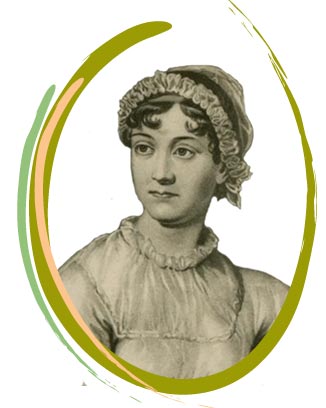
Photos Sources: Book cover randomhouse.com, Jane Austen Portrait tvo.org, Jane Austen Centre, Bath, taken by Arti of Ripple Effects, Dec. 07.

This article has recently been published in the current Jane Austen Centre Online Magazine. Click to go there for other interesting articles on Jane and the Regency world.

**

Related Posts you might enjoy:

In Praise of Austen: Virginia Woolf’s A Room Of One’s Own

A Jane Austen Education by William Deresiewicz

**

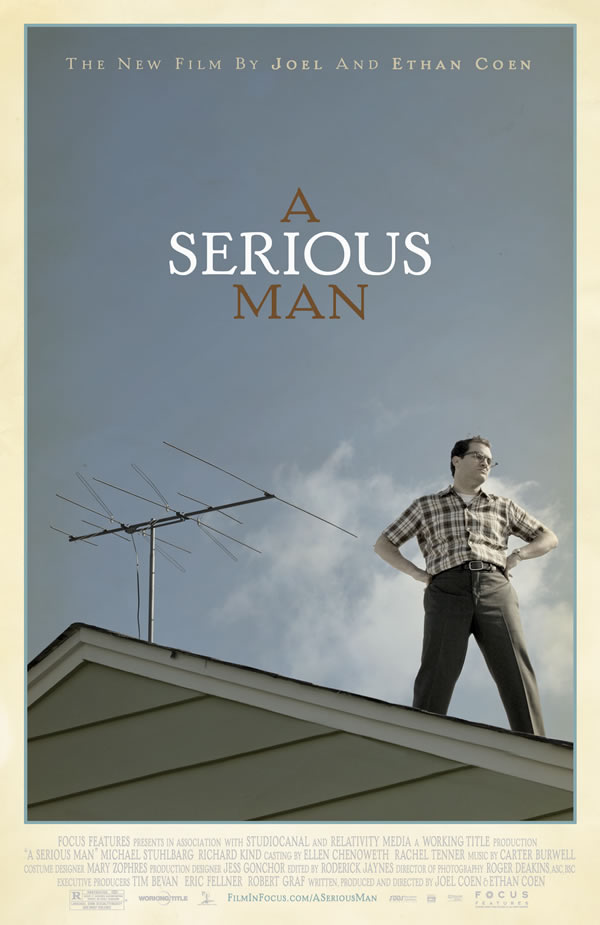
A Serious Man (2009)

UPDATE:  A Serious Man has been nominated for a Best Picture Oscar in the coming 82nd Academy Awards, to be held March 7th, 2010.  Joel and Ethan Coen receive a nod for Best Original Screenplay.

Do we go to the movies to be entertained, or to search for meaning and answers about life? For those who frequent Ripple Effects, you probably can guess what my stance is. Yes, allow me to answer a question with a question… Why must the two be mutually exclusive?

I’m all intrigued about films that explore deep subjects and yet remain as comedies, or, dramedies, as the genre has evolved in recent years. A Serious Man is one such films, entertaining and yet hauntingly serious. But it’s not entertaining with a big splash of hilarity. It is a dark comedy, a film that makes you chuckle in a most poignant way. It’s the deadpan humor that strikes deep. The subject matter in A Serious Man deals with the inscrutable question: Why do bad things happen to good people? And, if we can’t find the answer to the why, then at least, how should we then live?

The film has been described as the most personal of Joel and Ethan Coen’s works; others see it as the most Jewish they’ve done, or even somewhat autobiographical. The setting is 1967 Minnesota, where the Coen brothers grew up.

A Serious Man has won the 2009 Independent Spirit’s Robert Altman Award, and accolades for its screenplay.  It’s one of the American Film Institute’s Top 10 Films of 2009. Michael Stuhlbarg’s excellent performance receives a 2010 Golden Globe nom for Best Actor, Musical or Comedy.

Larry Gopnik (Michael Stuhlbarg) is a college physics professor, a conscientious man who just tries to live his life minding his own business, trying to do what is right.  Yet, it’s trouble he finds everywhere he turns. His wife Judith (Sari Lennick) is divorcing him for their mutual friend Sy Ableman (Fred Melamed); his daughter Sarah (Jessica Mcmanus) is stealing from him to do a nose job; his son Danny (Aaron Wolff) is taking drugs even as he prepares for his bar mitzvah; his unstable brother Arthur (Richard Kind) is staying uninvited in his house and has no intention to leave any time soon.  On the career front, his student Clive (David Kang) is bribing him for a passing grade; his tenure committee is making decision on his future while an anonymous letter is circulating, defaming him. At the same time, his chest x-ray result is back, and, an ominous tornado is making its way to his son’s school. I’m exhausted just to keep up. Can anyone explain why Larry is having so many problems while he is only trying to be a mensch, or, a serious man?

Larry goes searching for answers from three rabbis. While the first two cannot give him a satisfactory answer, the third, the most senior, is too busy to see him. Who then is left to help him through all his troubles?

Many critics equate Larry’s predicament with Job of the Bible, a righteous man facing incredulous torments. But Larry is no Job. He may attempt to be a righteous man, but he is not totally blameless. I feel the film may reflect the notion described in the book of Ecclesiastes even more:

… And yet I perceived that the same event happens to all of them. Then I said in my heart, ‘What happens to the fool will happen to me also.  Why then have I been so very wise?’ … this too is meaningless.

Ecclesiastes 2: 14 – 15

If we have no control over the bad things that happen to all, it’s only natural to question why we ought to be good then. If his wife runs away with another man, is it justified that Larry should lust for another woman? Since bad things will happen to the good and the bad alike, why bother being good? Do we act prudently because we expect positive consequences, or, do we act prudently because it is the right thing to do, period. And now, the moment of decision, the bribe…

A Serious Man throws at us more questions than answers, expectedly so, for who has all the answers? It is in such precarious situations that we look into our hearts and search ourselves. Instead of a challenge thrown at HaShem, God, I see the film as one that’s turned towards us: what would I have done?

~ ~ ~ Ripples

****

Up In The Air (2009)

UPDATE February 21: Up In The Air just won Best Adapted Screenplay at the BAFTA (British Academy of Film and Television Arts) Awards.   CLICK HERE TO READ MORE.

UPDATE February 2nd OSCARS NOMINATIONS:  Up In The Air has been nominated for a Best Picture Oscar in the coming 82nd Academy Awards.  Jason Reitman gets a nod in the directing category, George Clooney in the Best Actor category, Vera Farmiga and Anna Kendrick for Best Actress.  Jason Reitman and Sheldon Turner also received nomination for Best Adapted Screenplay.

UPDATE January 17th: Jason Reitman and Sheldon Turner have just won the Best Screenplay Award at the Golden Globes tonight.

Now that we’ve entered the new year, the awards season has arrived.  Only two weeks to go before the Golden Globes presentation, and about a week after that the Screen Actors Guild Awards, the buzz now is around the nominees.  And this one is a good start for the new year.

Watching Up In The Air is like reading an O. Henry story.  The twist at the end makes it hauntingly poignant. But O. Henry probably would not have imagined that a story could be told in such a visually dynamic way.

Following Oscar nominated Juno (2007) and Golden Globe nom Thank you for Smoking (2005), director Jason Reitman, together with screenwriter Sheldon Turner, have created a screen adaptation of Walter Kirn’s novel.  Reitman has crafted an apt and relevant contemporary tale with just the right pacing, suitable for those too rushed to stop for a story.  I’m sure they’ll enjoy this one.

‘I fly, therefore I am’ … that could well be the philosophical stance of Ryan Bingham (George Clooney).  He flies from city to city, doing something most bosses shy away from: laying off people.  Apparently Ryan loves his job.  It gives him the reason to be constantly on the go. One time on the plane, he is asked “Where are you from?’  With just the slightest hesitation, he answers: “Here.”

Ryan Bingham is also a motivational speaker.  He brings a backpack to the podium, an object lesson too vivid to ignore:  the more you put in, things and people the same, the heavier it’ll get, the more bogged down you’ll be.  His warning to his audience: ‘The slower we move, the faster we die.’  He’s the guru of non-committal living.

Goerge Clooney is perfectly cast as Ryan Bingham.  His suave, urbane sophistication is tailor-made for the role. Add in the nonchalant nuances, no wonder his performance earns him a nom for the Golden Globe.

But just when Ryan is performing so well with his air ballet — even his carry-on-suitcase-packing manuevers look sleek and stylish, thanks to some fascinating series of shots — Ryan gets notification that he’ll soon be grounded. Thanks to newly hired, Cornell grad Natalie Keener (Anna Kendrick), who has developed a video conferencing system for the company, Ryan can now do his job without leaving his office.

To phase in, Ryan is to bring Natalie along to familiarize her with his job.  It’s most amusing to watch the foil between the experienced and the naive, the callous and the tender.  At the same time, the plot thickens as Ryan meets another frequent flyer, Alex Goran (Vera Farmiga), in a hotel lounge.  Meeting Alex, who seems to share his airborne lifestyle, Ryan’s outlook on life soon faces a major turnaround.

As the film unfolds, you’ll find the title ‘Up In the Air’ not so much refers to the obvious: air travel, but a more metaphorical meaning.  It points to the existential limbo in which we sometimes find ourselves, always moving but never arriving, constantly twirling in the transitory, never coming to a rest.

Further, the film deftly deals with the questions most relevant to us all:  Is the rootless and ungrounded life worth living?  Does the ‘airborne’ phenomenon define the modern man/woman? What makes life meaningful after all?

The dramedy explores these issues without being didactic.  You’d be gratified to see Ryan’s awakening, and empathize with his situation as his path twists and turns.  With its slick editing, catchy music, witty dialogues, and great acting, the movie offers some worthwhile and enjoyable entertainment.

Up In The Air is nominated for 6 Golden Globes: Best Picture, Best Director, Best Actor, Best Supporting Actress (both, Farmiga against Kendrick), and Best screenplay.  I think this will be a strong contender comes January 17th, and will likely soar to the Oscars.

As to which O. Henry story particularly stood out in my mind as I was watching the movie? Without giving out any spoilers, let me just say: when we know we need to change, let’s just hope that we’d get the chance to do so.

~ ~ ~ Ripples

Susan Boyle’s Dream

So Susan Boyle’s dream has come true.  I’m glad I’ve participated in the process.  I’ve contributed to this whole massive dream fulfillment, albeit just a drop in the bucket… bought her CD today.  (No, I did not get this product free… there you go FTC)

The fact that Susan Boyle did not win British Got Talent didn’t affect the sales of her debut Album.  Even before its release in late November, she has broken the pre-sales record on Amazon.  Immediately after its release, her Album has broken the first week sales record for a debut album in the UK (410,000), beating U2 and Michael Jackson. In Australia (85,000), highest first week sales record, gone platinum right away.  In the US, sales reached 701,000 for just the week of Thanksgiving, surpassing the record set by Eminem in May this year for one week sales, by a gap of almost 100,000.  Needless to say, it tops the sales list in Canada as well.

So why did I bother to add another drop in the bucket?  Simple, I just wanted to show my support.  I know, the cynics would say it’s Simon Cowell, her producer, who is the one grinning from ear to ear.  Okay, if it takes Simon to realize her dream, so be it.

I’d like to see the 48 year-old unemployed single woman, church volunteer and obscure Scottish village dweller, who has been living and caring for her mother until her passing at 91, fulfill her singing dream.  In a previous post, I have written about the possible fallout of Susan Boyle’s 15-minute fame, the sensational YouTube appearance, and her later makeover.  But I’m glad it has turned out amazingly well for her.

Now to those who want her not to change but remain an uncouth, rural woman, I’d say, let her be. Although there’s nothing wrong being just that, uncouth and rural.  However, Susan Boyle can be whoever she wants to be,  get whatever hairdo she likes, buy new clothes if she wants, and smile or not smile for the paparazzi ….

I trust her dream is a genuine one, and she deserves to be noticed because of her humble root and high aspiration with its matching talent.  With more professional instructions and training, her skills could be augmented still some more.  Greater versatility means a wider repertoire, maximizing her potential.  From the few selections here on her CD, I feel that her voice can perform convincingly from Broadway show tunes to soft, quiet folk… blues and even jazz.

Just because of that, I’m a bit disappointed in the selections and some of the arrangements on this CD.  Except for her ‘I Dreamed A Dream’, ‘Cry Me a River’, ‘Who I was born to be’ and ‘Proud’, the other titles are somewhat limiting and have not given her enough range to showcase her wonderful voice.  The arrangements are all slow, with piano and/or guitar accompaniment.  At times her voice is solitary, at times blended with nice background chorus and beautiful strings.  Easy, gratifying listening overall… but I think the producers can take greater risks with her strong higher range, and the soulful, slightly raspy voice.

Here’s the track listing:

1.  Wild Horses (A nice rendition of The Rolling Stones classic.  Hear her sing this song on YouTube. http://www.youtube.com/watch?v=Yb3XAP0c8WU)

2.  I Dreamed A Dream (As if she’s the first one singing it!)

3.  Cry Me A River (A song she’d recorded in  1999 for a charity.  Shows she can do blues and maybe even jazz)

4.  How Great Thou Art (Somewhat weak arrangement, with just the four-line chorus)

5.  You’ll See (‘About determination, independence, and the ability to show them what your are made of’)

6.  Daydream Believer (A slow, even meditative rendition of The Monkees hit, my fave as a teenager.)

7.  Up To The Mountain (‘Sometimes I just lay me down Lord, no more can I do. But then I go on again, because you ask me to’… reminiscence of a spiritual. )

8.  Amazing Grace (So many have recorded this and it still feels fresh.)

9.  Who I Was Born To Be (The song says: ‘And though I may not know the answers, I can finally say I’m free. And if the questions lead me here, then I am who I was born to be.’… and then she writes: ‘Mom must have picked this for me.’)

10.  Proud (‘My dilemma was finding my own identity – a conflict… with myself.’)

11.  The End Of The World (A touch of nostalgia.)

12.  Silent Night (For Christmas … and anytime.)

What I’ve appreciated is that in the booklet, she writes a short personal note at the end of each song.  And on the last page, after thanking all who need to be thanked, she wrote these words:

I would like to dedicate this Album to my beloved Mother, to whom I made a promise to ‘be someone’.

X  God Bless

I’ve made a right choice with that drop in the bucket.

***