Got this from WordPress a couple days ago. How time flies!
RIPPLE EFFECTS Coming of Age
Ripple Effects has been tracking my life for the past 18 years! The movies I’ve seen, books I’ve read, birds I’ve captured with my camera, places I’ve travelled, film festivals I’ve attended, and through the years with special thoughts every Easter and at Christmas, Reading the Season inspirational book sharing.
Through the years I’ve been featured on WordPress’ Freshly Pressed, and Rotten Tomatoes had reached out inviting me to be their Tomatometer Approved Critic. I’ve gained over 7,600 followers, treasured the friendship made with some of you both virtually via the blogosphere and personally. For this I’m truly grateful.
If I ever write a memoir, this is my manuscript. To browse through these posts is to know me. Thank you all for the pebbles you’ve thrown into the Pond to create your own ripples. Many of you are recent followers, but there are some who have been with me from early on. And I’m sure you’d find it revealing to read your own thoughts way back then.
Who knows what the future holds. As far as I’m given the opportunity, I’ll continue to document my pondering and wandering here at Ripple Effects. Hope this site can be your restful retreat in your journey through life as well.
What better days than Easter to speak of death, and life eternal.
“I am the resurrection and the life. Whoever believes in me, though he die, yet shall he live,and everyone who lives and believes in me shall never die.” (John 11: 25-26)
The past few months I’ve been silent on Ripple Effects. Actually, for the past year, I’d been posting just occasionally. Fact is, for fifteen months, I’ve been caring for my husband afflicted with cancer. It had been a roller coaster ride of ups and downs. On some days, he was well enough that we could go out to have a meal in a restaurant; on other days, it would be just a tiny morsel or nothing at all. All these months, I’d learned to find joy in afflictions, and be grateful for just being able to sit down at the breakfast table together, the warm, morning rays seeping in, and immersed in the moment.
This year started with an ominous diagnosis. The metastasized cancer cells had not only mutated but the new growth was extremely aggressive. Battling terminal illness had made everything superfluous, books, movies, or music. What was left was the very essence of my being, faith in the risen Christ. Both of us were often revived by the promises of the living God, inspired by His Word, and sustained by the encouragement and prayers of countless supporters the world over via online prayer groups. It had been a journey of faith. Ultimately, it’s all grace.
But we have this treasure in jars of clay, to show that the surpassing power belongs to God and not to us. We are afflicted in every way, but not crushed; perplexed, but not driven to despair; persecuted, but not forsaken; struck down, but not destroyed… (2 Corinthians 4:7-9)
On March 21, my husband departed to a better country. We were not unfamiliar with the immigrant experience. Now, a final move to that eternal kingdom, a homeland much more beautiful than anywhere in this world. He had arrived there first, I’ll join him one day. He was accepting, which was grace in itself. We were prepared, even planned his celebration of life service together. The event turned out to be a memorable occasion for hundreds to gather for a collective remembrance in peace and even joy.
Therefore we do not lose heart. Though outwardly we are wasting away, yet inwardly we are being renewed day by day. For our light and momentary troubles are achieving for us an eternal glory that far outweighs them all. So we fix our eyes not on what is seen, but on what is unseen, for what is seen is temporary, but what is unseen is eternal. (2 Corinthians 4:16-18)
“She wanted to see the owl before it got too dark. She was becoming more and more interested in birds. It was a sign of old age, she supposed.” –––– Virginia Woolf, The Years* (186)
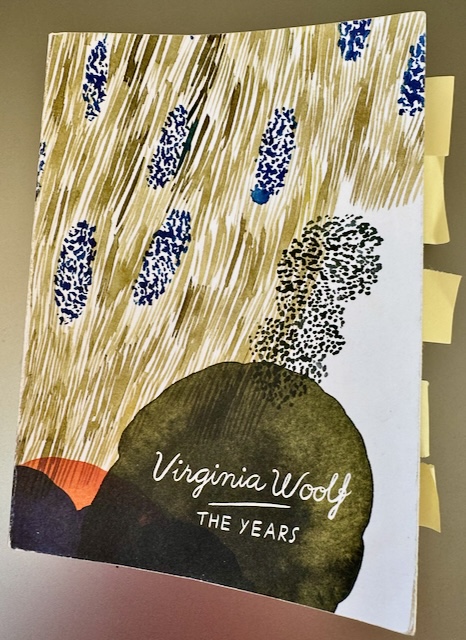
Finally, I finish my other 1937 Club read hosted by Kaggsy and Simon that took place in April, two months late, and that’s Virginia Woolf’s The Years, published in 1937. It sure feels like years for me to finish this book. Better late than never, for I have full intention to see what Woolf had to say in her last novel published during her lifetime (Between the Acts was published shortly after her death in 1941), specifically, what was in her mind just a few years before she took her own life.
The book follows the children of Colonel Abel Pargiter’s family as they go through the years crossing the 19th century into the 20th. It’s a family saga through chapters titled for a specific year, beginning with 1880, 1891, then into the new century 1907, 1908 and to the First World War, and finally the “Present Day” which is the 1930’s. Within each chapter the narratives are episodic, characters appear without introductions; readers would have to piece together who’s who and how they relate to each other.
A few unexpected mental associations came to me during my reading. The quote above at the beginning of this post is one of those surprises. A loud Whoa! when I read it: Interest in birds as a sign of ageing. It’s a thought in the mind of Eleanor, the eldest of the Partiger children, when she is fifty-five. She goes on to live past seventy when the book ends, and I’m sure has seen many more owls.
Another surprise for me in my reading experience of The Years is how it’s like watching an arthouse film, or any good movie for that matter. My first impression of that beginning chapter 1880 is that it reads like a script where the expressions and actions of the characters are highly nuanced and the subtext in their conversations speak volumes. Nothing much is happening but the seemingly uneventful narrative carries unsettling undercurrents.
Here’s an example. The Colonel, with his wife Rose on her death bed, is a troubled and temperamental man whom his seven children fear more than respect or love. He comes back home unexpectedly during supper time in the opening chapter and the way he drinks his tea while trying to strike up conversations in a surly manner with his children reflects his changing mood. A ready movie scene here. I’ve taken out the dialogues, but just the description of his tea-drinking actions reveal a lot about his character:
He stirred his sugar round and round in the cup as if to demolish it… ground the grains of sugar against the walls of his cup. [After some tense conversations with his children] Then he seemed to repent of his gruffness… He drank up his tea. Some drops fell on his little pointed beard. He took out his large silk handkerchief and wipe it impatiently… [Later] the Colonel took up his cup, saw there was nothing in it, and put it down firmly with a little chink. The ceremony of tea-drinking was over. (13-14)
Another surprise is that reading The Years makes me think of Downton Abbey, how a family goes through changes both in the larger socio milieu and in their personal lives through the years. The time-lapse is about the same as the six seasons of Downton, from horses to cars, from candles to electric lights, WWI and the changes it brings. The following line in Woolf’s novel makes me think of the Dowager Violet Crawley:
Then he looked at a car. It was odd how soon one got used to cars without horses, he thought. They used to look ridiculous. (215)
BTW, Edith Crawley, who breaks the mould and ventures out to live in London on her own and heads up a magazine she inherits from Michael Gregson and a London flat, has mentioned that she had met Virginia Woolf there, one of Michael’s Bloomsbury acquaintances. One can imagine the author just might have certain influence on her.
The Years is about lives lived, actions or non-actions, the regrets and the resignation of what had happened, the unchangeability of the past. Check out these lines, the introspection of Eleanor’s, just reminds me of Mary Crawley, who had uttered similar words thinking of her own past errors in judgment:
But once it’s done, there it is… How irrecoverable things are, she thought. We make our experiments, then they make theirs. (185)
Above all else, The Years is about the past and memories, and the meaning of it all. Proust’s Remembrance of Things Past comes to mind, no surprise. Both authors value the writing down of lives lived. But Woolf goes into a more depressed mode of seeing even the futility of it. As the chapters, ie, the years, move on, Woolf is more explicit about her view on life––I suppose that’s her perspective––through Eleanor’s point-of-view. Considering Woolf taking her own life just four years after this book was published, I paid attention to the reflections and internal search for existential meaning, or the failing of which, and find these passages particularly poignant. Short sentences like this: “Scenes passed over scenes; one obliterated another,” to reflection like the following, again, quite a cinematic moment:
Things can’t go on for ever, she thought. Things pass, things change, she thought, looking up at the ceiling. And where are we going? Where? Where?… The moths were dashing round the ceiling; the book slipped on to the floor. .. made an effort; turned round, and blew out the candle. Darkness reigned. (195)
to what seems like ultimate despair, take note that Woolf wrote this in the 1930’s:
But how can one be ‘happy’? she asked herself, in a world bursting with misery. On every placard at every street corner was Death; or worse––tyranny; brutality; torture; the fall of civilization; the end of freedom. (358)
I gave the book 3.5 out of 5 stars in my Goodreads review, an evaluation that’s based on my first reading, having had to figure out who’s who –– considering the Pargiters have seven children and some of them have their own children. And then there are extended family members, cousin, niece and nephew, and servants. I’m sure upon second reading, I’d be able to get a clearer picture of all the characters and would enjoy it more, for it really deserves more than one reading.
__________
* The edition that I used (photo above) is Vintage Classics, Penguin Random House UK, London. 401 pages. Introduction by Susan Hill. With this inscription before the Introduction: “The text of this edition of The Years is based on that of the original Hogarth Press Edition, published by Leonard and Virginia Woolf on 15th March 1937.”
“Easter, which turns a terrible Friday into Good Friday. It is almost too brilliant for me to contemplate; it is like looking directly into the sun; I am burned and blinded by life.
**
There are times when I feel that He has withdrawn from me… but Easter is always the answer to My God, my God, why has thou forsaken me!
**
Easter is the most brilliant of all blessings.
–––––– Madeleine L’Engle, The Irrational Season
The following excerpt doesn’t directly refer to Easter, but its inherent meaning does:
I am encouraged as I look at some of those who have listened to their “different drum”: Einstein was hopeless at school math and commented wryly on his inadequacy in human relations, Winston Churchill was an abysmal failure in his early school years… Byron had to compensate for a club foot; Demosthenes for a stutter; and Homer was blind… Socrates infuriated his countrymen. And what about Jesus, if we need an ultimate example of failure with one’s peers? Or an ultimate example of love?
______ Madeleine L’Engle, A Circle of Quiet
And in a lighter mode:
Pride is heavy. It weighs. It is a fatness of spirit, an overindulgence in self. This gluttony is earthbound, cannot be lifted up. Help me to fast, to lose this weight. Otherwise, O Light one, how can I rejoice in your Ascension?
(Photos taken by Arti at Lake Ontario shore, Sept. 2022.)
****
To those who celebrate this life transforming, historical event, Happy Easter to you all!
‘Tis the Season to be meditative if we’re to find peace against the tide, seek meaning amidst the frenzy. Reading the Season is the annual Christmas reading post here on Ripple Effects. I’d selected Luci Shaw’s poems before, see list at the bottom of this post. The following is a new discovery.
It is as if Infancy were the Whole of Incarnation by Luci Shaw
One time of the year the new-born child is everywhere, planted in madonnas’ arms hay mows, stables in palaces or farms, or quaintly, under snowed gables, gothic angular or baroque plump, naked or elaborately swathed, encircled by Della Robia wreaths, garnished with whimsical partridges and pears, drummers and drums, lit by oversize stars, partnered with lambs, peace doves, sugar plums, bells, plastic camels in sets of three as if these were what we need for eternity.
But Jesus the Man is not to be seen. We are too wary, these days, of beards and sandalled feet.
Yet if we celebrate, let it be that he has invaded our lives with purpose, striding over our picturesque traditions, our shallow sentiment, overturning our cash registers, wielding his peace like a sword, rescuing us into reality demanding much more than the milk and the softness and the mother warmth of the baby in the storefront creche,
(only the Man would ask all, of each of us) reaching out always, urgently, with strong effective love (only the Man would give his life and live again for love of us).
Oh come, let us adore him— Christ—the Lord.”
–– Luci Shaw (Check out her beautiful website here)
I found this poem online. Have been trying to locate its original printed source to no avail. If you know where it was printed, do let me know in a comment.
Many gems in this treasure trove of poetry from Mary Oliver’s Devotions. For a birder, these simple words particularly resonate. Sharing a few here:
THIS MORNING
This morning the redbirds’ eggs have hatched and already the chicks are chirping for food. They don’t know where it’s coming from, they just keep shouting, “More! More!” As to anything else, they haven’t had a single thought. Their eyes haven’t yet opened, they know nothing about the sky that’s waiting. Or the thousands, the millions of trees. They don’t even know they have wings.
And just like that, like a simple neighborhood event, a miracle is taking place.
I WAKE CLOSE TO MORNING
Why do people keep asking to see God’s identity papers when the darkness opening into morning is more than enough? Certainly any god might turn away in disgust. Think of Sheba approaching the kingdom of Solomon. Do you think she had to ask, “Is this the place?”
ON MEDITATING, SORT OF
Meditation, so I’ve heard, is best accomplished if you entertain a certain strict posture. Frankly, I prefer just to lounge under a tree. So why should I think I could ever be successful?
Some days I fall asleep, or land in that even better place—half asleep—where the world, spring, summer, autumn, winter— flies through my mind in its hardy ascent and its uncompromising descent.
So I just lie like that, while distance and time reveal their true attitudes: they never heard of me, and never will, or ever need to.
Of course I wake up finally thinking, how wonderful to be who I am, made out of earth and water, my own thoughts, my own fingerprints— all that glorious, temporary stuff.
THE WORLD I LIVE IN
I have refused to live locked in the orderly house of reasons and proofs. The world I live in and believe in is wider than that. And anyway, what’s wrong with Maybe?
You wouldn’t believe what once or twice I have seen. I’ll just tell you this: only if there are angels in your head will you ever, possibly, see one.
The passing of Gordon Lightfoot yesterday at the age of 84 evokes a stream of nostalgic consciousness. The following is an old post dating back to more than ten years ago. I wrote it after visiting Unionville in Ontario; the profusion of cattails by the pond stirred up memories of listening to Lightfoot’s song. As a tribute to the Canadian music legend, I’m reposting it here.
____________
Took a short trip to Ontario last week and came home overwhelmed with nostalgia. It all started when I visited the town of Unionville and saw these, crowds and crowds of cattails growing profusely at the pond, the fields, and by the footbridge:
.
For some inexplicable reasons, I’m much fond of cattails. The first time I learned about them was from listening to the song by Gordon Lightfoot… before I’d actually seen one.
Some time in the 70’s, for many afternoons I sat in the art room of a high school somewhere in Alberta, working on some art project, but mostly doing nothing at all while listening to Gordon Lightfoot. Mr. Hannington held a laissez faire art class… we could do just about anything, or nothing. Usually, there would only be three or four of us in the room. We would just sit around, chat, daydream, and immerse in the voice of Gordon Lightfoot on the radio.
I didn’t turn out to be an artist, while one of us did. But I’ve remained partial to cattails, mesmerized by the song and the singer. Those Lightfoot afternoons in the art room emerged from the depth of hazy memories, the lyrics were the soft winds caressing naked limbs as I walked in this natural reserve in Unionville.
Pussywillows, cattails, soft winds and roses Rainpools in the woodland, water to my knees Shivering, quivering, the warm breath of spring Pussywillows, cat-tails, soft winds and roses
Catbirds and cornfields, daydreams together Riding on the roadside the dust gets in your eyes Reveling, disheveling the summer nights can bring Pussywillows, cattails, soft winds and roses
Slanted rays and colored days, stark blue horizons Naked limbs and wheat bins, hazy afternoons Voicing, rejoicing the wine cups do bring Pussywillows, cattails, soft winds and roses
Harsh nights and candlelights, woodfires a blazin’ Soft lips and fingertips resting in my soul Treasuring, remembering, the promise of spring Pussywillows, cattails, soft winds and roses
(To my artist friend CD: Keep the fire burning.)
***
Some of you had left comments in that old post. If you’re interested to know what you had said, click on the link to find out.
When despair for the world grows in me and I wake in the night at the least sound in fear of what my life and my children’s lives may be, I go and lie down where the wood drake rests in his beauty on the water, and the great heron feeds. I come into the peace of wild things who do not tax their lives with forethought of grief. I come into the presence of still water. And I feel above me the day-blind stars waiting with their light. For a time I rest in the grace of the world, and am free.
In my end is my beginning. –– T. S. Eliot, ‘East Coker’ from The Four Quartets
In the past few months, three of our longtime friends had died, one from Covid, two from other health issues, all unexpected. What hope do three heartbroken widows have if not for that very good Friday and the magnificent Sunday shedding the hope of reunion in a glorious eternity.
The poet John Donne puts into words boldly in his 1633 sonnet.
Death, be not Proud
Death, be not proud, though some have called thee Mighty and dreadful, for thou art not so; For those whom thou think’st thou dost overthrow Die not, poor Death, nor yet canst thou kill me. From rest and sleep, which but thy pictures be, Much pleasure; then from thee much more must flow, And soonest our best men with thee do go, Rest of their bones, and soul’s delivery. Thou art slave to fate, chance, kings, and desperate men, And dost with poison, war, and sickness dwell, And poppy or charms can make us sleep as well And better than thy stroke; why swell’st thou then? One short sleep past, we wake eternally And death shall be no more; Death, thou shalt die.
Centuries later, a Kentucky farmer has written some down-to-earth lines. Wendell Berry’s poem for Easter calls for turning the belief into action. Resurrection begins now:
A Poem on Easter
The little stream sings in the crease of the hill. It is the water of life. It knows nothing of death, nothing. And this is the morning of Christ’s resurrection. The tomb is empty. There is no death. Death is our illusion, our wish to belong only to ourselves, which is our freedom to kill one another. From this sleep may we too rise, as out of the dark grave.
At start of spring I open a trench in the ground. I put into it the winter’s accumulation of paper, pages I do not want to read again, useless words, fragments, errors. And I put into it the contents of the outhouse: light of the sun, growth of the ground, finished with one of their journeys. To the sky, to the wind, then, and to the faithful trees, I confess my sins: that I have not been happy enough, considering my good luck; have listened to too much noise, have been inattentive to wonders, have lusted after praise. And then upon the gathered refuse of mind and body, I close the trench, folding shut again the dark, the deathless earth. Beneath that seal the old escapes into the new.
Intrigued by the title? I was, and that prompted me to investigate further. The subtitle pushed me out of indecision: an autobiography in essays. I’ve read two of Messud’s novels, The Burning Girl and The Woman Upstairs, both I couldn’t embrace wholeheartedly. However, the title of this non-fiction jumped out at me.
I’ve appreciated Claire Messud the memoirist and critic much more than Messud the fiction writer, albeit I admit I’ve read only two of her seven novels. The first part of this autobiography in essays reveals her multicultural roots and the various geographical locales that had made up who she is as a writer. A French father born in colonial Algeria and a Canadian mother, what an interesting fusion of culture.
Messud has left footprints and therefore collected memories in many parts of the world. She writes about her growing up years moving from Connecticut to Australia then to Canada and back to the United States, and later her travel to Beirut, an emotionally torn, love trip both for her dying father who had spent his childhood there with fond memories, and for herself.
In the eponymous essay, ‘Kant’s Little Prussian Head’, she writes:
“I can echo Walt Whitman in asserting that ‘I contain multitudes.’ I am who I am because I was where I was, when I was; and almost all of it is invisible to the world. This is true, of course, for each of us” (80).
Messud is generous in sharing the intimacies of her family relationships, especially those of her parents’ and grandparents’. I’ve found too that certain parts of her novels are based on real life experiences and encounters, e.g. the character Cassie in The Burning Girl.
The second part is both taxing and satisfying as she critiques on various international writers and artists, making up a good list for me to explore. Even though I haven’t read some of them or seen their artwork, I find the essays informative, insightful, and exemplary in critique writing. Her prose is elegant and inspiring, and at times, exhilarating.
The Camus essays are captivating for me in terms of the historical backdrop and political situations of Algiers and the tough handling by the then French government. Camus the pacifist had to confront issues of violence, colonization and post-colonial dilemmas.
Her essay on Kazuo Ishiguro’s Never Let Me Go elicits more poignancy from the already devastating fate of the characters Kathy and Tommy. In particular, she sheds new light into the moving scene where Kathy embraces the pop song Never Let Me Go longingly.
The essay on the photographer Sally Mann is mesmerizing. In an interview, Mann had said, “unless you photograph what you love, you are not going to make good art… it’s always been my philosophy to make art out of the everyday, the ordinary” (290).
Herein lies the dilemma of privacy and art making as Mann had candidly photographed her children growing up and her husband who is afflicted by muscular dystrophy, thus making her a highly controversial artist. Anyway, herein lies the dilemma of a memoirist, I suppose, like Messud’s book, there has to be the revealing of relational intimacy and private lives in order to imbue authenticity and truths in an autobiography.
Back to the essay ‘Kant’s Little Prussian Head’, Messud has, in her ingenious way, explains to her readers how she gets the title from. I’ll leave it with you to explore instead of me clumsily paraphrase. However, I’d like to conclude by quoting this moving episode of Messud and her mother who was afflicted with dementia:
“In the last two years of her life, she was often quiet––she who had been so vitally social––and once, as she sat in silence, I asked her what she was thinking. With a wry and wistful smile, she answered, “Shards of memory, and new worlds discovered”(82).
To store up and share fragments gleaned from the ruins of the past is just one of the reasons for Messud to write, as well, for her readers to collect and keep in our own trove containing our own shards of memory, as we all share the magic of these lived experiences through the literary and the arts.
~ ~ ~ ~ Ripples
Kant’s Little Prussian Head & Other Reasons Why I Write: an autobiography in essays by Claire Messud, W.W. Norton & Company, NY, 2020. 306 pages.












 Ripple Effects