‘Anatomy of a Fall’ or how to dissect a marriage

In lieu of heading to Toronto for TIFF as in pre-Covid time, I stay put in my city hoping some of my anticipated films might trickle down. Of the nine titles on my to-be-watched list, only one came to the Calgary International Film Festival. I’m glad it’s this year’s Palme d’Or winner Anatomy of a Fall.

French director Justine Triet is the third woman to have won the Palme d’Or, Cannes Film Festival’s top prize in sixty-eight years. The two previous winners were Julia Ducournau for Titane in 2021 and Jane Campion for The Piano in 1993. It’s interesting to note that Triet co-writes the screenplay with her husband Arthur Harari, encompassing English, French and a little German in the dialogues, showing how language can connect as well as alienate a couple depending upon the circumstance.

A teacher and struggling writer, Samuel (Samuel Theis) is found dead on the snow-covered ground of his chalet in the French Alp. The only other person in the house at that time is his wife Sandra (Sandra Hüller), a successful German novelist who has just finished an interview with a journalist in the living room, and loud music is on all this time from somewhere else in the house. The body is discovered by their eleven year-old son, Daniel (Milo Machado Graner), who comes home after walking their family dog Snoop. Actually, it’s Snoop that first finds the body as Daniel is visually impaired.

Two possibilities are pondered in the investigation of the fall, suicide or murder, Samuel being pushed out of the balcony outside the high attic. The main segment of the film is the trial a year later of Sandra, the wife, who stands accused of murdering her husband, with their blind son the sole witness in the courtroom drama. Sandra seeks the help of an old friend Vincent (Swann Arlaud) to be her attorney. Vincent isn’t a high profile lawyer, but he’s empathetic and rational in his reasoning. Since accidental death is the least plausible in this case, the only option to defend his client is to present evidence for suicide. Sandra might look stoic and aloof but Vincent’s support is essential during such a difficult time.

Vincent (Swann Arlaud) and Sandra (Sandra Hüller) in Anatomy of a Fall

Intense and riveting throughout, Anatomy of a fall brings back the joy of pure cinema experience, that is, watching a film that’s made up of a well-crafted script delivered by superb acting, captured in astute camera work, especially with close-ups depicting the nuances of emotions, with no CGI effects, no car chases or apocalyptic explosions, just mere human interactions that speak volumes. And with that note, I must add too that sound or its absence is important in the film. From the loud music of a song by 50 Cent at the beginning to the piano pieces played by Daniel, extension of his inner struggles, all are crucial in the storytelling.

When a wife is on trial for the murder of her husband, every minute detail of their marital relationship will be dissected, dirty laundries aired out and conversations scrutinized without discretion. Out of consideration for not hurting Daniel’s feelings, he is excused on the day some raw evidence from a recording of a fight between his parents is to be played out in court, but he insists to be there. ‘I’ve already been hurt,’ he says.

And it is this voice recording––juxtaposed with flashback sequences for us viewers––that form the pivotal segment of the film, a highly charged, epitome of powerful acting especially from Hüller. It is also this raging recording that casts a doubt in Daniel’s mind regarding his mother, and a little clarity in understanding the balance of relational power between his parents. The flashback scene is for us viewers; in court, only the voices are heard. For Daniel, that is enough. What follows is the key to the the ingenuity of the script, leading to the eventual outcome of the trial.

Not only is her marriage on trial, Sandra’s own personal, psychological makeup is questioned. The prosecutor (Antoine Reinartz) uses anything he can find to create an image of Sandra being a cold and revengeful wife. The content of her novels are examined and taken as a revealing of her psyche. Herein lies an intriguing issue: can a work of fiction be used as evidence to incriminate its author in a court of law? For the prosecutor, to help his case, it’s convenient to equate Sandra’s novels as parallels of her real life. Defence lawyer Vincent is quick to rebut this reasoning, “is Stephen King a serial killer?”

The two and a half hour duration could have been tightened a bit, but sitting through it in the dark theatre with my sole attention drawn to the nuanced performance by the whole cast and in high anticipation of the trial result, I wasn’t aware of the time passing. Just found out France has submitted another film to enter the Best International Film category for 2024 Oscars, rendering Anatomy of a Fall out of the race in that category. Nevertheless, Hüller is worthy of a Best Actress Oscar nom, Machado Graner playing Daniel deserves some high praises, and Triet’s directing and her original screenplay need to be noted, the film could have a chance in the Best Picture category. Overall, a captivating work of suspense, character study, and intelligent filmmaking.

~ ~ ~ 1/2 Ripples

***

TIFF 2023 Lineups and my TBW List

While Barbenheimer is dominating the box office, a phenomenon that coins a new word in our vernacular thanks to the simultaneous release of the two movies Barbie and Oppenheimer, my attention, however, is drawn to the lineups in the film festivals beginning the end of August with Venice and then the Toronto International Film Festival in September. All others follow in the fall.

I won’t be heading to TIFF this year but I do have a To Be Watched list after browsing through their lineups if any of these films ever show up in my city or for streaming. Do watch for these titles, as I’m sure you’d find some that pique your interest… and might show up in the Awards Seasons later this year. Here’s my list:

NYAD 
International Premiere. True story of Diana Nyad, at age 64, became the first person to swim 110 miles from Cuba to Florida without a shark cage. Starring Jodie Foster and Annette Bening, directed by the Oscar winning husband and wife adventure team Jimmy Chin and Elizabeth Chai Vasarhelyi (Free Solo, 2019). Now, you might ask … who’s playing the swimmer Nyad?

Anatomy of a Fall
Winner of the Palme d’Or at Cannes this year, a French film directed by Justine Triet and starring German actress Sandra Hüller. A man is found dead and his wife is put on trial for his murder while their visually impaired son faces a moral dilemma as the sole witness. Sounds most intriguing. Other than Cannes, the film has also won the Audience Award at the Sydney Film Festival.

In Restless Dreams: The Music of Paul Simon 
World Premiere. Documentary following America’s music icon Paul Simon into the studio making his new album Seven Psalms while looking back on his six-decade career from Sounds of Silence to Graceland.

North Star 
World Premiere. Directorial debut of veteran British star Kristin Scott Thomas (The English Patient, 1996) A family drama about three sisters returning home for the third wedding of their twice-widowed mother. The past and the future converge as mother and daughters reunite with some unexpected guests. Could be autobiographical.

The Critic 
World Premiere. Adaptation of the 2015 novel Curtain Call by Anthony Quinn. A mystery thriller storyline driven by ambitions and deceits in the theatre world. Directed by Anand Tucker (Girl with a Pearl Earring, 2003) with a wonderful UK cast including Lesley Manville, Gemma Arterton, Mark Strong, Ben Barnes, Romola Garai, and Ian McKellen.

Monster 
The North American Premiere of acclaimed Japanese auteur Hirokazu Koreeda, who is a master of family drama such as Shoplifters (2018), Our Little Sister (2015), and Like Father, Like Son (2013) From TIFF’s webpage, Monster is “a delicate story of love and humanity, a moral tale about school bullying, scored by the late Ryuichi Sakamoto.”

Wildcat
Ethan Hawkes explores the life and art of writer Flannery O’Connor and featuring his daughter Maya Hawks as the titular character. Laura Linney in supporting role.

The Zone of Interest 
Adaptation of Martin Amis’s 2015 Walter Scott Prize winning novel directed by Jonathan Glazer. Premiered at Cannes in May, garnering the Grand Prix and the FIPRESCI Prize. The story is a macabre juxtaposition of horror and a love affair between a Nazi officer the wife of the commandant of the Auschwitz concentration camp.

Maestro
I placed it last on this list because it’s not at TIFF but in Venice, just a week before TIFF kicks off. The Maestro refers to the American legendary composer and conductor Leonard Bernstein, played by Bradley Cooper. The story explores his complex relationship with his wife Felicia, played by Carey Mulligan. High on my anticipation list. Bradley Cooper directs his second musician-based feature after A Star is Born (2018)

***

Arti at TIFF and Ripple on Rotten Tomatoes

DSC_0718

Two major news. Yes, the above title says it all.

I’m in Toronto now, all geared up to watch the screenings of a dozen films I’ve selected at the Toronto International Film Festival Sept. 6 – 16. Will keep you posted on the sights and sounds here.

There are 342 films in TIFF’s various Programs, submitted by filmmakers from 84 countries. Among the selections, 254 are full feature films, 88 shorts. These are selected from 7,926 submissions from all over the world.

Following a Ripple tradition, presenting titles from book to screen, here are some of TIFF’s feature productions that are adaptations from published, written sources:

First Man, dir. by Damien Chazelle, Ryan Gosling as Neil Armstrong, based on the book First Man: The Life of Neil Armstrong by James R. Hansen

Beautiful Boy dir. by Felix Van Groeningen based on two memoirs, Beautiful Boy by father David Sheff and Tweak by son Nic. Steve Carell and Timothée Chalamet play father and son.

Burning dir. by Chang-dong Lee, based on the short story “Barn Burning” by Haruki Murakami, which (in my opinion) is in turn based on the short story of the same name by William Faulkner.

The Hate U Give dir. by George Tillman Jr., based on the book of the same name by Angie Thomas (2017 National Book Award longlist, Young People’s Literature)

If Beale Street Could Talk dir. by Barry Jenkins (2017 Oscar winner ‘Moonlight’), based on the book of the same name by James Baldwin.

The Front Runner dir. by Jason Reitman, based on the book All the Truth Is Out by Matt Bai. Hugh Jackman as the 1987 presidential candidate Gary Hart.

The Sisters Brothers dir. by Jacques Audiard, based on the book of the same name by Patrick Dewitt (shortlisted for the Booker Prize 2011)

Wildlife dir. by Paul Dano, based on the book of the same name by Richard Ford. Carey Mulligan and Jake Gyllenhaal star.

A Million Little Pieces dir. by Sam Taylor-Johnson, based on the (controversial) memoir by James Frey

**

The second piece of news actually is equally exciting. My movie reviews on Ripple Effects are now approved to be included in the Rotten Tomatoes® review aggregation website. That means, yes, my two pebbles will be counted in the Tomatometer® score for a movie which I’ve reviewed on Ripple and submitted to them. (This actually is a spin-off as they first approved me for my reviews on Asian American Press.)

Nothing’s changed. Just feeling good that the Ripples from the Pond can have far-reaching Effects.

***


Lion: From Personal Memoir to the Big Screen

The memoir A Long Way Home by Saroo Brierley, first published in 2014, has officially changed its name to Lion. This may well be a metaphor for its author. Only a change in the name, but everything inside remains intact. From a child lost on the streets in Calcutta, India, to a man grown up in Hobart, Tasmania, Saroo remains who he is. He writes in his memoir: “I now have two families, not two identities. I am Saroo Brierley.”

lion-movie-tie-in-edition

Lion (previously titled A Long Way Home) the memoir by Saroo Brierley

5 year-old Saroo was lost in a Calcutta (now Kolkata) train station, almost a thousand miles away from his home in a small village, Ganesh Talai. With no language (a different dialect), not clear of the name of the place he calls home (mispronounced by him as “Ginestlay”) or even his own last name, Saroo is utterly alone and helpless. Living dangerously on the streets of Calcutta for some weeks, he was picked up and sent to a youth detention centre, which was only a tiny bit safer from the streets. Subsequently Saroo was sent to an orphanage, Nava Jeevan (“new life”), run by the benevolent Mrs. Sood. There she arranged for his adoption by a loving Australian couple, John and Sue Brierley.

That could have been the happy ending of a tumultuous experience for Saroo, as he grew up in calm and beautiful Hobart, Tasmania, well adjusted and dearly loved by his adoptive parents. But for twenty-five years, Saroo has not forgotten his first home. As he grew, he was all the more tormented by the memory of his birth mother, and the brothers and sisters who had shared the first five years of his life. An important message he has always wanted to convey to them is that he’s ok, and that they need not worry about him. For years he has been haunted by the thoughts that his mother and older brother Guddu must have been devastated with losing him without a trace, as it was Guddu who had left him alone on a bench at the train station near his home, telling him to stay put as Saroo was too sleepy to tag along on that fateful night.

With the help of Google Earth twenty years later, and vague memories of the physical features of his home surrounding, Saroo finally located his village and flew back to India to search for his mother. They reunited a few doors down from his old home, as his mother had persisted all these years to not move away but stay there to wait for him, hoping against hope that her son would come back to her. The photo inserts in the book add even more poignancy as we see the Brierleys meet Saroo’s birth mother Kamla in India.

Utterly moving, authentic, genuine and real. While Slumdog Millionaire may be entertaining and eye-opening for those of us who are not familiar with Indian’s millions of children living on the streets, Lion is a true portrayal of one lost child, determined to find his way back home twenty-five years later across the oceans.

**

Lion the Movie

Is the movie any good? For those who think it’s always the book that’s better, here’s my answer: Yes, very good. Premiered at TIFF16 last September, Lion has since garnered awards and nominations, including young Sunny Pawar, his debut performance as an actor. Kudos to all those involved in transporting this story from a personal memoir onto the big screen for international viewers. If not for the movie, even though it has been reported in India and Australia, I for one in North America would not have known about this real life miracle.

So, hats off to Australian director Garth Davis, screenwriter, the acclaimed Australian  poet/writer Luke Davies, and the cast, Sunny Pawar as young Saroo, Dev Patel (Slumdog Millionaire, 2008) as the adult, Nicole Kidman and David Wenham the adoptive parents, Rooney Mara the girlfriend, and the cast of Saroo’s Indian family. They have delivered an authentic and moving real-life story.

Basically structured into three parts, the first focuses on five year-old Saroo, living in poverty but is loved by his mother and siblings. One night he pleads with his older brother Guddu to go with him to his night work, salvaging garbage left on trains. After reaching the closest station from his home village, Saroo is too tired, so he stays behind sleeping on a bench to wait for Guddu. He wakes up in the middle of the night to find himself all alone. He gets on one of the parked train to look for Guddu but falls asleep again in there. He wakes to his horror as he finds he is being transported in the speeding train further and further away from his home.

Cinematographer Greig Fraser (Zero Dark Thirty, 2012; Bright Star, 2009) uses his camera effectively showing some haunting images, a horrified 5 year-old, alone on a train speeding to the unknown. Throughout the film as well, he tells the story poignantly with his camera. Scores composed by Volker Bertelmann and Dustin O’Halloran add power in eliciting emotions, taking us closely with Saroo on his incredulous life journey.

Second part we see Saroo grown up in Australia, having a good relationship with his adopting parents but troubled nonetheless by his past. The frustration of having only vague memories of the physical features of the train station near his home makes it an impossible task to search for an unknown town in the vast land of India. Thanks to Google Earth and his unyielding perseverance, the adult Saroo was rewarded with a dream come true.

While the physical locales might be distant and vague, memories of his childhood experiences are lucid and close. In the second part, the director and screenwriter have deftly inserted Saroo’s memories of his childhood days in India, enriching the screen story of his intimate relationships with his family. These inclusions add to the texture and are placed aptly to enhance the continuity of the child and the man. Very effective.

I welcome the quiet and slower pace in Part Two, and appreciate Patel’s portrayal of inner turmoils. Kidman has done an amiable job as the adoptive mother trying to hold the family together, with two Indian boys, now grown men, both deeply troubled by their past in different ways. If Part One is about the outward dangers of a lost child, Part Two illustrates the internal turmoils one still wages into adulthood.

Part three is that triumphant and exhilarating reunion. How we want to see a happy ending by then. Although we know that is forthcoming, it is still exciting and gratifying to embrace the uplifting end. Lion is a story well told cinematically, and worth every minute of a viewer’s attention. Do wait till the very end before you leave the theatre, the photos at the closing credits make a beautiful wrap. And why the title Lion? That’s for you to find out.

~ ~ ~ ~ Ripples 

for both Book and Movie

***

Related Reviews on Ripple Effects:

Slumdog Millionaire

The Best Exotic Marigold Hotel

The Second Best Exotic Marigold Hotel

The Lunchbox

Top Ripples 2016

Here’s a wrap of my experience for the year, not that the books or movies are necessarily new, some are, some aren’t, and some are rereads. All top ripples:


Movies

Arrival (A different kind of Sci-fi)

Things To Come (Isabelle Huppert)

Paterson (Celebration of Everyday by Everyman)

The Salesman (I won’t miss any film by Asghar Farhadi)

Our Little Sister (Koreeda’s quiet and moving work)

Love and Friendship (Binge watched Whit Stillman after this)

Happy Hour (Worth every of its 317 mins. )

A Better Summer Day (Edward Yang, a late discovery)

45 Years (From short story to film: Upcoming post)

National Theatre Live: The Deep Blue Sea (Impressive)


Books

Do Not Say We Have Nothing by Madeleine Thien

A Man Called Ove by Fredrik Backman

Silence by Shusaku Endo

Culture Making by Andy Crouch

Both Ways is the Only Way I Want It by Maile Meloy

In Other Words by Jhumpa Lahiri 

Words Without Music: A Memoir by Philip Glass

Short stories by Ted Chiang


Experience

Five Days in London

TIFF 2016: The Zhang Ziyi Encounter

TIFF16 Review: After The Storm

“After the Storm” was screened at TIFF in September. Next week, it will be at BFI London FF and after that, the Chicago IFF. My review was first published on Asian American Press. I thank the editor for allowing me to post my review here on Ripple Effects.

***

Japanese auteur Koreeda Hirokazu graced the Toronto International Film Festival once again this year with his new feature, “After the Storm”. Since 1995, with his multiple award-winning feature “Maborosi”, Koreeda has been a staple at TIFF, which has screened every one of his feature films. His recent works are still fresh in many viewers’ minds, “Still Walking” (2008), “Like Father, Like Son” (2013), and “Our Little Sister” (2015).

With all the avant garde and experimental, new waves of filmmaking bursting out at film festivals every year, Koreeda’s traditional style of storytelling offers a fine balance and an affirming voice. His films focus on the contemporary Japanese family, bringing out themes arising from the individual and extending to the universal. Humanity is what Koreeda is interested in, and his treatment of human foibles and failures is kind and forgiving. “After the Storm” is no exception.

Ryota (Abe Hiroshi) used to be an award-winning author. But for years he has not produced any more works. Divorced from his wife Kyoko (Maki Yoko) and sorely missing his 9 year-old son Shingo (Yoshizawa Taiyo), Ryota is at the bottom of his life. Months behind in his child support payments, he is laden with debt, entrapped by a gambling habit that’s hard to kick. It runs in the family it seems, for his late father had also been a gambler. With his work at a detective agency, Ryota would try all means to squeeze extra cash out of his clients, including deception and even extortion.

Koreeda’s dealing of Ryota is gentle and sympathetic. While he may look unkempt, the six-foot-two actor Abe Hiroshi has his charm and charisma. We see the nasty side of Ryota as he slips into his mother’s cramped unit in a housing project, looking for anything of value he could lay his hands on for pawning. A moment later, Koreeda lets us have a glimpse too of the other side of Ryota, that of a son to an ageing mother Yoshiko (Kiki Kilin). The mother-son portrait is witty and tactful, punctuated with heartwarming humour. It is a reunion of the two actors, also as mother and son, from Koreeda’s 2008 feature film “Still Walking”.

Mother knows best, even when your son doesn’t live with you any more. Deep in her heart, Yoshiko wishes to see her son reunite with her daughter-in-law Kyoko whom she is very fond of. She also treasures the affectionate bonding with grandson Shingo. If only they could get back together as a family, that would be a big relief and comfort, growing old can then be much bearable.

One evening, a passing storm keeps them together in Yoshiko’s home for the night. The impromptu reunion, though awkward, is probably gratifying for every one of them. Koreeda is, alas, a realist. Life is full of disappointments. However close they have come to bonding once again, the moment is short-lived. But the reminiscence and dynamics of the small family’s once intimate relationship regurgitates enough to spark off a renewal for Ryota. While they may continue on with their own separate ways, a new perspective has subtly wiggled in. Perhaps, there’s hope after all. The young, green grass covered with raindrops the morning after the storm is a refreshing metaphor.

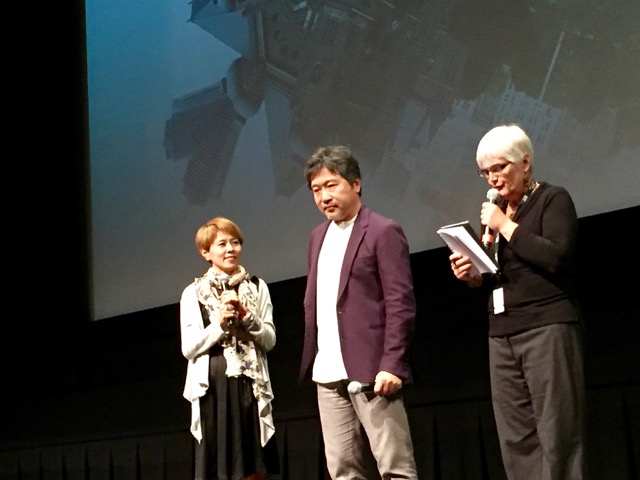
koreeda

The film was shot in the housing project where Koreeda had spent his youthful years. That was where his mother lived after his father had passed away. In the Q & A session, Koreeda admitted that certain incidents in the film did happen in the director’s own family. When writing the script though, once he has created his characters, Koreeda would let them run free and so they would develop themselves. Their stories just came out naturally.

Answering questions in Japanese with a translator beside him, Koreeda humbly thanked his Toronto audience, whom he had in mind when he made his films, as TIFF had screened every one of his features. He noted that as we grew older, we had to deal with disappointments, for life often didn’t turn out to be what we’d like to see. “After the Storm” shows us that Koreeda has dealt with his characters’ life disappointments with a forbearing spirit. As for viewers of his films, Koreeda does not disappoint.

~ ~ ~ 1/2 Ripples

***

Other reviews of Koreeda films on Ripple Effects:

Our Little Sister: A Respite from Summer Superhero Movies

Like Father, Like Son: Parent and Child Reunion 

A Quiet Passion at TIFF16

“A Quiet Passion” is a biopic of the reclusive 19th century American poet Emily Dickinson. It is written and directed by the esteemed English auteur Terence Davies, who brought us the adaptation of Edith Wharton’s novel “The House of Mirth” in 2000, “The Deep Blue Sea” based on Terence Rattigan’s play in 2011, and last year’s “Sunset Song”, a beautiful cinematic rendition of Scottish writer Lewis Grassic Gibbon’s work.

Literary filmmaking is Davies’ repertoire. If a movie is about a poet, under his helm, it is only natural that it would be crafted like poetry. In this sense, “A Quiet Passion” is a fine example. Every frame is meticulously composed and lit, the atmosphere dense with meaning. We also hear lines from Dickinson’s poems read out as voiceover. We experience poetry in sight and sound.

However, not all poetry is of the Romantics, roaming vales and hills, dancing with the daffodils. Davies’s Emily Dickinson (Cynthia Nixon) is confined in her father Edward’s (Keith Carradine) Amherst house. Her main human interactions are with her immediate family, a stern father, a depressed mother (Emily Norcross), an attorney brother Austin (Duncan Duff), and her younger sister (Jennifer Ehle). If she ever felt claustrophobic, there’s her sister-in-law Susan Gilbert (Jodhi May) and her close friend Vryling Buffam (Catherine Bailey). Too narrow a social circle? Not really, for they are all responsible for sharpening her views and words. And they make a wonderful cast.


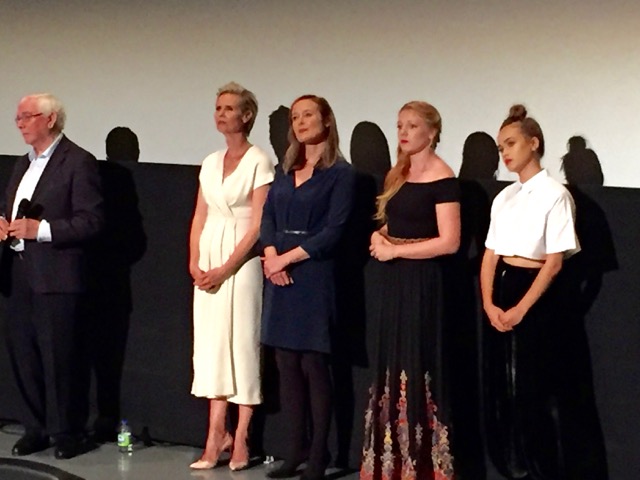
a-quiet-passion
Terence Davies, Cynthia Nixon, Jennifer Ehle, Jodhi May, Catherine Bailey
Under the direction of Davies, Cynthia Nixon (of ‘Sex and the City’ fame) portrays Emily Dickinson with an austere persona restrained by social mores and troubled by unrequited romantic pursuit. She might have been a rebel with a just cause in confronting restrictive societal norms, but I was surprised to see Dickinson here as a verbal combatant, a bitter and belligerent soul. Somehow from my limited reading of her poetry, that image has not set in my mind.

“A Quiet Passion” is a mixed bag of oxymoron. In an austere setting, characters deliver ornate speeches like you only hear in a stage play. Shrouded in a confining milieu, you hear comedic exchanges and humorous, deadpan facial expressions, even LOL moments. While the cinematography is meditative and calm (as in Davies’ last work “Sunset Song”), the feeling evoked is unsettling anticipation.

Emily’s supportive and devoted sister Lavinia (Vinnie), well played by Jennifer Ehle (of Elizabeth Bennet fame), gives me a breath of fresh air, for often she is the quiet passion supporting the poet, a gentle strength and a moral compass. Vinnie is the pragmatic and rational voice, like reminding Emily that Rev. Wadsworth—on whom Emily has a romantic crush—is a married man. But she is ever so sweet and pleasant as Jennifer Ehle is, even when admonishing.

The sisterhood between Nixon’s Emily and Ehle’s Vinnie makes me think of another literary sisterhood, that of Jane and Cassandra Austen. But what a difference. I long for Jane’s joie de vivre, something that’s missing here in this relatively harsh portrayal of Emily Dickinson. Further, I couldn’t help but compare this film with another that’s also about a poet: Jane Campion’s “Bright Star” (2009), a beautiful cinematic rendering of the English Romantic poet John Keats (Ben Whishaw) and his muse Fanny Brawne (Abbie Cornish).

The last scenes are as severe as they are heart breaking. Death may be a frequent motif in Dickinson’s poetry, as Emily had experienced the passing of her parents, but the constant pounding of her own illness makes me think of another oxymoron: superfluous suffering. The repeated scenes of seizures Emily goes through in the last section of the film may be a bit too much to watch for some, although Nixon has certainly given us a true-to-life performance. I can’t imagine all the takes she had to repeat, acting out those excruciating seizures on her bed.

When asked about the seizures in the Q & A after, Nixon replied that she had not done any research or specifically prepared; she just went ahead and did it. All the research had been done by Davies. He had read up on volumes of Dickinson’s biographies for the film.

What “A Quiet Passion” has done for me is stirring up my curiosity in finding out what Emily Dickinson the person was really like, and, I want to delve into more of her poetry. I have to remind myself though that the cinematic portrayal here is only Davies’ own interpretation and personal response to her poetry. I just like to explore on my own.

~ ~ ~ Ripples


Establishing Shot

What is a film buff, avid birder, and nature lover going to do in Toronto during TIFF, torn between so many attractions?

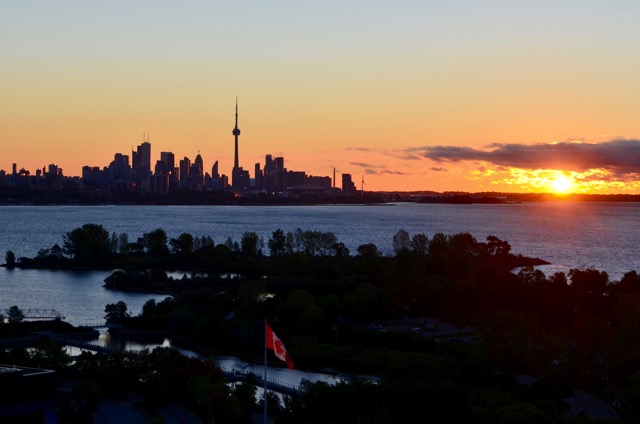
Well, one has to stay grounded first. So here’s the establishing shot. Indeed, it’s Toronto. And a memorable date it was when I took this photo of the early morning cityscape. My computer told me it was Sept. 11, 2016, at 6:38 am:

9-11-638

I was fortunate to be able to shoot these pics from a high-rise building with magnificent views. Here let me call this one Urban Canadian Sunrise. Yes, see the flag in the foreground? Can’t say it’s just another city:

urban-canadian-sunrise

And from the balcony above looking down, my birding instinct was gratified as I made my first sighting of a Mute Swan taking in the early morning air:

mute-swan

A stone-throw away was a park where I made this other first-time encounter. I had no clue what it was until I looked it up in a bird book after I’d come back home:

Juvenile Black Crowned Night Heron

Know what it is? A Juvenile Black-crowned Night Heron.

Several other first time sightings awaited me as I went on the ‘Marshwalk’ at the Royal Botanical Gardens in Burlington, 57 km (35 mi) southwest of Toronto a few days later. The Great Egret and some juvenile (brownish colour) mute swans:

great-egret

egret-swans

Yes, TIFF16 was a cinephile fantasy. And the people there were overflowing with enthusiasm to make your visit memorable:

tiff

More posts coming up on that main event.