The Downton Ripples

Or, How I Overcome Downton Abbey Withdrawal Syndrome.

First, I bought the Blu-rays and rewatched both Season 1 and 2 several times. And then, I let my curiosity lead and follow mere intuition. Downton has prompted me to seek out books and films with setting in the early part of the 20th C.

I was most intrigued by the irreversible changes modernity has brought about, but on a more sombre note, I was moved to learn of the grave number of lives lost in a war I knew so little, WWI.

As heir to Downton Matthew Crawley has aptly noted while fighting in the trenches:

War has a way of distinguishing between the things that matter and the things that don’t.

The Great War did not end all wars as claimed, but had ended countless lives of a young generation, and altered numerous others. On the positive side, it had toppled society’s status quo and broken down previously impenetrable barriers, when men of different social classes fought side by side in the trenches, and where women played a substantial role in the war effort.

And then there are the stories of individuals and families… I’ve thoroughly enjoyed this reading and watching spree. But I have to stop somewhere and share with you what marvellous works you can follow while waiting for Downton Abbey Season 3 to arrive.

So, here’s Arti’s Annotated List of Downton Ripples:

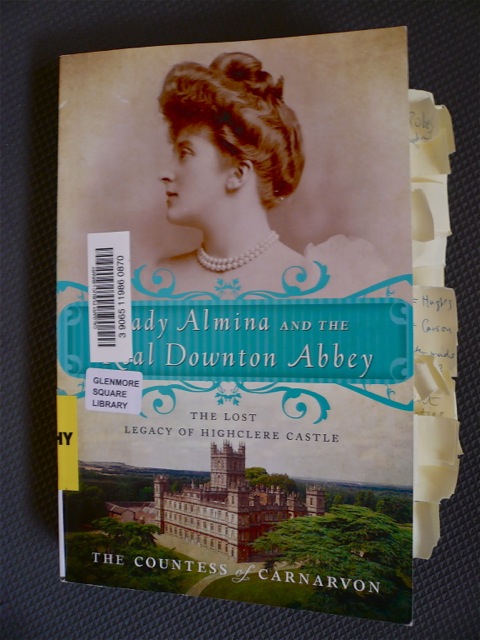
Lady Almina and the Real Downton Abbey by Fiona Carnarvon — A springboard to all my WWI period exploration. What impressed me was that Highclere Castle itself was actually turned into a hospital during the War and many of its staff enlisted and some killed. I was moved by the number of casualties and the horrific conditions in the battlefields. My full review of the book is posted here. 

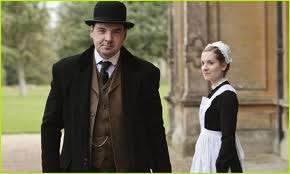
The World of Downton Abbey — by Jessica Fellowes, niece of write/creator of the series Julian Fellowes. A compendium to the production, the hardcover larger-sized book is filled with photos, background info and quotes from the actors. After skimming through the whole book, one item stands out: Mr. Bates’ fall. That’s when Mrs. O’Brien trips him and he falls flat on his face on the gravel. How did they shoot this? Any special effects? Well, unfortunately for Mr. Bates, none whatsoever.

This is what Bates, Brendan Coyle said:

I must have done it 18 times and by the end I was wounded! I wore knee pads and a torso shield, but when you fall you have to really commit to falling.

Ouch! Some method acting.

Lost Empires (1986)— 7 Episode mini-series based on J. B. Priestly’s novel set in 1913, a year before WWI broke out. Colin Firth is young Richard Herncastle. Lost both parents at 19, he follows his Uncle Nick on his travelling magic stage show, learning the ropes of the itinerant performer in the music hall circuit. A coming-of-age saga chronicling the loss of innocence in love and life. Some noted actors in the series include Sir Laurence Olivier and John Castle.

A Farewell to Arms (1929) — Hemingway’s WWI semi-autobiographical sketch of love and loss. I listened to the audiobook read by Mad Men’s John Slattery. In authentic Hemingway style, his narrative is matter-of-fact and stoic. After that I watched the 1932 movie adaptation with Gary Cooper and Helen Hayes. An adaptation that makes me wish Hemingway was the screenwriter and director.

Brideshead Revisited (1945)– Evelyn Waugh has used a huge and magnificent mansion owned by an aristocratic family to tell his story. Something like Downtown but in a much serious tone. Its subtitle “The Sacred and Profane Memories of Captain Charles Ryder” sets the stage for a tug of war between God and man. I listened to the audio book read by Jeremy Irons, who has turned Waugh’s narratives into pure poetry. Probably the best audiobook I’ve ever listened to.

I’m still watching the 11 Episode TV series (1981) with Jeremy Irons playing the main character of Charles Ryder. So far, I’ve enjoyed the detailed and slower-paced depiction of the work. The book really needs a whole series to tell its story.

I’ve also rewatched the 2008 movie adaptation. As much as I respect the actors in it, Emma Thompson, Matthew Goode, Michael Gambon… I think it has trivialized Waugh’s masterpiece. The adaptation has taken the crux of the matter out and replaces with photogenic visuals and a story converted for more popular appeal. But it could well send one back to the book for curiosity’s sake.

Easy Virtue (2008) — For something totally light and swift, I rewatched this movie based on a Noel Coward play. Filled with Coward’s own music and some Cole Porter, the film depicts how the changes of the times have brought to yet another aristocratic family.

Larita (Jessica Beale) is the first woman race car driver to cross the finish line in Monte Carlo. The year is 1930. An American, she marries on a whim John Whittaker (Ben Barnes), the son of an English aristocratic family… and quickly becomes enemy on the home front to matriarch Veronica Whittaker (Kristin Scott Thomas), and subversive ally to her husband, disillusioned WWI officer played by Colin Firth. If you’re interested, here’s my full review of the movie.

A Handful of Dust (1988) — After Brideshead Revisited I went on to watch another of Evelyn Waugh’s adaptation. Again, a large mansion… how many of these architectural heirlooms do they have in England? Anyway, the master of this house Tony Last (James Wilby) is too busy looking after his property that he loses his wife Brenda (Kristin Scott Thomas). Title comes from T.S. Eliot’s The Waste Land (1922)… that sent me into reading the poem again.

Goodbye To All That (1929) — Autobiography of Robert Graves, English poet and writer. I’m most impressed by the men of letters in that period, they enlisted readily. Robert Graves and Siegfried Sassoon were both involved in the most devastating battles in France. Both were seriously injured. Deep in the trenches they wrote poetry. Their views towards the war changed as time went by, but their experiences in the battlefields brought about poignant legacies as eye witnesses of a horrific war and its aftermath. Ironically, Graves handles his subject matter with some light-hearted reminiscence.

The Remains of the Day (1993) — Not quite the same period but a bit later in the brewing year before England’s engagement in WWII. I rewatched this film adaptation of Kazuo Ishiguro’s Booker Prize winning novel in full, sumptuous Merchant Ivory style. The film leads me to think of a few parallels… Darlington ~ Downton, Stevens ~ Carson, but I’m glad Carson has more heart. And in both Downton and Remains of the Day, a character named Richard Carlisle.

The list goes on with Passchendaele and Birdsong yet to read and watch. But I know when Season 3 of Downton commences, I’ll gladly return and transfix myself once again in the Crawley family.

What have you been doing since Downton Abbey?

***

You may also be interested in:
Quotable Quotes from Downton Abbey

Lady Almina and the Real Downton Abbey

Lady Almina and the real Downton Abbey: Facts that give rise to Fiction

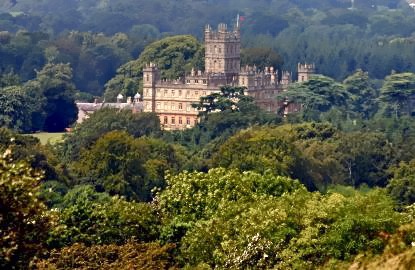
Downton Abbey in real life is Highclere Castle, situated among a thousand acres of beautiful parkland, perching on a hill with a vantage point of even more spectacular views. It is home to the Earls of Carnarvon for centuries. The book is written by Fiona Carnarvon. Lady Almina is the great grandmother of her husband, the 8th Earl of Carnarvon. The book chronicles the life and legacy of Lady Almina, who married into Highclere at 19, and evolved from a youthful debutante to a seasoned and capable, aristocratic lady with a heart. Here is the source material for the fictional creation so well received by viewers all over the world.

I’m not one easily swayed to follow what’s being hailed in current culture. But for some reasons I’ve been drawn to the human drama of the hugely successful Downton Abbey. Until I read this book I have not thought that mere facts can be as engaging as fiction. Compared to the epic proportion of historical events detailed in the book, the TV series are but minute vingnettes, albeit they do have their endearing appeal.

This is my library copy of the book after I finished reading it. There are no less than 80 tiny yellow stickies to mark my interest:

At first, I was expecting a book offering tidbits of the Highclere Castle, its designs and architecture, and how its life, both upstairs and downstairs, corresponds with the TV production, etc.

But while it lacks the design and architectural specifics I was looking for, the book has brought me something else. Yes, there is a myriad of Edwardian high society accounts, the fashion and the opulence, as expected. But to my surprise, the latter part of the book offers a greater appeal to me. I was fully absorbed by its massive archival information on The Great War, from the trenches in Europe to the battlefields in the Middle East, wartime to post-war politics, Highclere’s involvement in international power brokerage, George’s brother Aubrey and T.E. Lawrence’s friendship, and the last chapters bring me to the archeological site of the Valley of the Kings in Egypt.

Nurse Almina

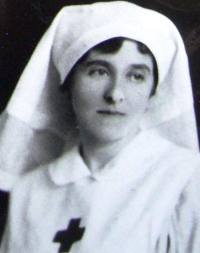
Unlike the Crawleys in Downton Abbey, the Carnarvons threw themselves fully into the war effort without hesitation. As soon as Britain entered The Great War (1914-1918), Highclere was turned into a well-equipped hospital, not just a convalescence home. Financially supported by her wealthy father, Almina hired the best in medical personel, well-trained nurses and specialized doctors, and furnished the Caslte with state-of-the-art equipment. Almina herself oversaw the whole operation and heavily involved in personal nursing care as well. A real-life Lady Cora/Isabel Crawley working in unity.

Seeing Matthew Crawley’s muddy face in the trenches cannot convey to me the horrors of the war. The detailed accounts in the book are terrifying to read. There were so many ways to die: guns and shells, broken bones even just a broken femur, long, bumpy rides to a hospital, gas, hunger, diseases, lack of medical supplies and doctors, even rain. Non-stop rain in Passchendaele had caused trenches to collapse, drowning many soldiers in the mud.

The Battle of Somme claimed 60,000 lives on its first day on July 1, 1916. Four months later, 415,000 British and Dominions soldiers had been killed or wounded. The Battle of Ypres saw the Germans use a new weapon. 168 tonnes of chlorine gas was released into Allied positions. 5,000 French soldiers in the trenches died within ten minutes, 10,000 were blinded as they escaped. In 1917, the number of British casualties and injured totalled 800,000. Many of Highclere staff were wounded and killed, those sent home were the lucky ones. The missing and the ones buried on foreign soil made the impact even more heartbreaking.

The Dowager Countess of Carnarvon, Elsie, had always been receptive to innovations and improvements. Unlike her counterpart in Downton Violet Crawley, Elsie welcomed electricity and the telephone. In 1919, at 63, she became vice-chairman of the Vocal Therapy Society and promoted the use of singing to help shell-shocked men to overcome debilitating stammers. Umm… she would have made a good team with Lionel Logue, who set up shop on Harley Street. Just ask Bertie KGVI, he knew it worked.

On a totally different note, the last chapters of the book transport me to the archaeological site of the Valley of the Kings in Luxor, Egypt. Almina’s husband George Herbert, 5th Earl of Carnarvon, was one of the last British aristocratic archaeologists, having spent £50,000 (£10 million in today’s money) over the course of fourteen years on excavating in Egypt.

Howard Carter, left, & Carnarvon at King Tut’s tomb

Lord Carnarvon personally hired the expert archaeologist Howard Carter to team up with him in his pursuit of Egyptian antiquities. Their breakthrough work came in 1922, when they discovered the burial chamber of the young King Tutankhamun. Unlike rumors that had distressed the archaeological dual that they would ship the finds to England, the King Tut artifacts have  been the possession of the Egyptian government since the discovery.

I had not realized the connection before… how Downton Abbey could have a certain degree of separation from King Tut. But the book soon ends with the sad news that the already weak Lord Carnarvon soon succumbed to illness. He died in Cairo at age 57, just a few months after the excavation. It’s noted in the book that at the time of his death, back at Highclere Castle in the night, his beloved terrier Susie howled once and died.

Here I’ve just touched on a few yellow stickies. You need to read the book to grasp all the significant events during that first quarter of the 20th century. As the book has been written and published ‘in record time’ as the author has noted, likely to coincide with the broadcast of Downton Abbey Season 2, it is not a literary work, not even a social or political commentary of any sort. Yes, I was looking for the author’s view on aristocracy and the Empire. Nevertheless, it is a compact historical account that chronicles the lives of some individuals who had left indelible marks in an era of irreversible change and new discoveries. 

Excellent Photos, A Bibliography of researched works and archival materials, and an Index make up the supplementary resources.

~ ~ ~ Ripples

Lady Almina and the Real Downton Abbey: The Lost Legacy of Highclere Castle by The Countess of Carnarvon, Broadway Paperbacks, NY, November, 2011, 310 pages.

***

Other posts you may like:

Quotable Quotes from Downton Abbey

The Rant of the Armchair Traveller

***

Quotable Quotes from Downton Abbey

SEASON 6 Recaps:

SEASON 6 FINALE: Goodbye to All That

SEASON 6 Episode 1, Jan.3, 2016

SEASON 6 Episode 2, Jan. 10, 2016

SEASON 6 Episode 3, Jan. 17, 2016

SEASON 6 Episode 4, Jan. 24, 2016

SEASON 6 Episode 5, Jan. 31, 2016

SEASON 6 Episode 6, Feb. 7, 2016

**

‘You can’t do very much as an actress unless you have the proper words to say…’ — Penelope Wilton, Isobel Crawley

Four weeks have passed since Downton Abbey Season 2 Finale aired on PBS. How are you holding up? To alleviate Downton Abbey withdrawal symptoms, I’ve been in a perpetual state of re-watching all the episodes from Season 1 and 2. Downton Abbey on Blu-ray is absolutely beautiful.

Downton Abbey film location: Highclere Castle

This Golden Globe, Emmy, and BAFTA award-winning miniseries has many appeals. For me, apart from the sumptuous setting, attention to details, great acting, and inspiring cinematography, the main attraction is the writing. Julian Fellowes’ script gives us intelligent dialogues reminiscent of Oscar Wilde’s wit and satire.

I have compiled a list of quotes from both Seasons. Lucky for 78 year-old Maggie Smith, she gets the best lines as Violet Crawley, Dowager Countess of Grantham.

Here they are in chronological order so you can reprise the scene. Enjoy!

Season 1

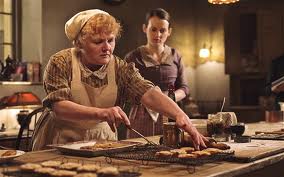
“O, heavens, girl. You’re building a fire, not inventing it.” — Mrs. Hughes to Daisy, S1E1

“Nothing in life is sure.” — Mrs. Patmore, re. Titanic sinking, S1E1

Mrs. Patmore and Daisy

“Every mountain is unclimbable until someone climbs it. So every ship is unsinkable until it sinks.” — Lord Grantham, S1E1

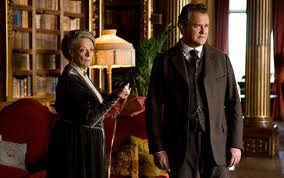
“We are allies, my dear, which can be a good deal more effective.” Violet Crawley, Dowager Countess of Grantham, in reply to Cora Crawley’s “Are we to be friends, then?” S1E1

Violet Crawley, Dowager Countess of Grantham

“What is a ‘weekend’?” — Violet Crawley, S1E2

“Daisy, what’s happened to you? I said you could go for a drink of water, not a trip up the Nile.”  — Mrs. Patmore. S1E3

“Are you afraid someone will think you’re American if you speak openly?” — Lord Grantham to Dowager Countess, S1E3

Dowager Countess and Lord Grantham

“But nobody learns anything from a governess, apart from French and how to curtsey.” Lady Sybil, S1E4

“No one ever warns you about bringing up daughters. You think it’s going to be like Little Women. Instead they’re at each other’s throats from dawn till dusk.” — Cora Crawley,  Countess of Grantham, S1E5

The Crawley Sisters

“Mary can be such a child. She thinks that if you put a toy down, it’ll still be sitting there when you want to play with it again.” — Lord Grantham, S1E5

“I love you Mr. Bates. I know it’s not ladylike to say it, but I’m not a lady and I don’t pretend to be.”  — Anna, S1E5
Mr. Bates and Anna
“If she won’t say yes when he might be poor, he won’t want her when he will be rich.” — Violet Crawley, Dowager Countess, S1E7
.
“First electricity, now telephones. Sometimes I feel as if I were living in an H.G. Wells novel.”  — Violet Crawley, S1E7
*****
Season 2
Mary Crawley seeing Matthew off to war.
 “War has a way of distinguishing between the things that matter and the things that don’t.” — Matthew Crawley, S2E1
.
Matthew Crawley in the trench

“I’m not a romantic… But even I concede that the heart does not exist solely for the purpose of pumping blood.” Violet Crawley, S2E2

“I’m a woman, Mary. I can be as contrary as I choose.” Violet Crawley, S2E4

“Are you like everyone else in thinking that because she’s a countess she has acquired universal knowledge by divine intervention?” Isobel Crawley to Dr. Clarkson re. Cora, Countess of Grantham, S2E4  (And you can substitute the word ‘countess’ with any word you need when quoting it.)

Dr. Clarkson and Isobel Crawley

“I’d rather have the right man, than the right wedding.” — Anna, S2E5

“I’m an American, I don’t share your English hatred of comfort.” Cora Crawley to Lord Grantham, S2E6

Lord Grantham and Cora Crawley

“Don’t be defeatist, dear. It’s very middle class.”  Violet Crawley to Edith, S2E8

“Sir Richard, life is a game in which the player must appear ridiculous.” Violet Crawley, Last Episode, Christmas at Downton Abbey.

“I want a good man for you, a brave man. Find a cowboy in the Middle West and bring him back to shake us up a bit.” Robert Crawley to daughter Mary. Last Episode, Christmas at Downton Abbey.

“1920. Is it to be believed? I feel as old as Methuselah.” Violet Crawley, Last Episode, Christmas at Downton Abbey.

***

DOWNTON RECAPS

DOWNTON Season 5 Finale, March 2, 2015: A Moorland Holiday

*

Season 4 Episode 8 (PBS): London 

Season 4 Episode 7 (PBS) 

Season 4 Episode 6 (PBS)

Season 4 Episode 5 (PBS)

Season 4 Episode 4 (PBS)

Season 4 Episode 3 (PBS)

Season 4 Episode 2 (PBS)

Downton Abbey Season 4 Opening (2 Hour) Special 

*

CLICK HERE to Quotable Quotes from Season 3: New List

*

SEASON 3: EPISODE 1  

SEASON 3: EPISODES 2 & 3 

SEASON 3: EPISODES 4 & 5 (More Downton Quotes)

SEASON 3: EPISODES 6 & 7 Finale

CLICK HERE to visit the Highclere Castle website. An absolute must-see.

*

Other posts you might like:

Quotable Quotes from Downton Abbey Season 3

Downton Abbey The Complete Scripts: Season 1

The Downton Ripples

Lady Almina and the real Downton Abbey: Facts that Give Rise to Fiction

***

Emma (2009, TV): Episode 3

The final instalment of Emma has a major challenge, to reveal the hidden agendas, and to tie up all the loose ends in just under an hour. The hurried scenes leave me with a feeling of watching a trailer, a montage of excerpts loosely linking up the story.  This is especially so in the first half dealing with Jane Fairfax and Frank Churchill’s secret relationship.

If the story feels a bit fragmented in this last episode, the cinematography makes up for that shortfall.  The hour is saturated with stunning shots, magnificent scenic views and exquisite interior renditions.  The Box Hill picnic scene is a vivid example:

Ironically, the pivotal Box Hill scene was not shot in Box Hill, a busy tourist attraction in Surrey.  Instead, it was shot in Leith Hill, Mole Valley, another much quieter scenic point.  For an interesting comparison of the two hills, click here to go to ‘this is surrey today’.

The Box Hill picnic is a crucial turning point in the story.  Emma’s callous and sarcastic joke on Miss Bate and the subsequent scolding she receives from Mr. Knightly is nothing short of an epiphany in self-knowledge.  The genuine remorse she feels could well reflect her greatest strength.  I’m sure such quality of character is what seizes Mr. Knightly with tenderness, moving him to consider her “faultless in spite of all her faults.”

I have a feeling too that this is the very reason Austen finds her heroine likable.  Romola Garai has effectively portrayed a contrite and humbled Emma, while Jonny Lee Miller has delivered convincingly a silent lover with passion and principle.  My initial reservation about his role has definitely changed for the better in this final episode.

Fortunately as well, the endearing lines of Mr. Knightly to Emma, no, not the ‘badly done!’ admonition, but the heartfelt praise he spurts out in spontaneity, remains intact and without any modernized alteration from screenwriter Sandy Welch.  Of course it needs to be declared in its authentic whole… Miller has the best lines of the series:

“I cannot make speeches, Emma… If I loved you less, I might be able to talk about it more.  But you know what I am.  You hear nothing but truth from me.  I have blamed you, and lectured you, and you have borne it as no other woman in England would have borne it.”

As with all Austen’s novels, the ending comes with nuptial ties. But as Masterpiece Classic’s host Laura Linney points out at the opening, considering the social discriminations inflicted upon the woman in Jane Austen’s time, allowing no ownership of properties, no decent employment (even Jane Fairfax compares the governess position with slavery), and no respect or rights given to the single female of low means, it is only a justifiable reward for the author to end her story with loving marriages for her well-deserved protagonists.

Towards this end, the camera takes us to the magnificent view of Beachy Head in the last scene.  As Emma and Mr. Knightly stand on the edge of the cliff overlooking the boundless ocean, we see the series come to an idealistic end, maybe a broader stroke than that in Austen’s novel. But as some critics have noted, it is love that the author emphasizes rather than romance.  From that perspective, looking outward together to the ocean vast instead of gazing into each other’s eyes may well be an apt interpretation of Austen’s heart.

***

CLICK HERE to go to Episode 1

CLICK HERE to go to Episode 2

Arti’s reviews of Emma (2009), Episodes 1 to 3, have been compiled into one article and published in the Jane Austen Centre Online Magazine. CLICK HERE to read the many other interesting articles on Jane Austen and her time.

**Photo Sources: Box Hill Picnic bbc.com; Beachy Head, not a scene from the movie, taken from Wikimedia Commons.

Emma (2009, TV): Episode 1

Previously on Masterpiece Classic

Yes, treat this post as a recap to prepare you for Episode 2 in just a couple of days.

So finally, North American viewers have the chance to see the long awaited 2009 BBC production of Emma, three months after its release in the UK.  A click on imdb will find no less than 15 different versions of this popular Austen work.  Yet another one?  It just naturally leads one to question, why?  After seeing this first episode, let me give it a shot: just because it’s so much fun to do.

That’s how I felt as I watched the PBS broadcast last Sunday.  This newest adaptation of Emma is probably the best I’ve seen, and Romola Garai easily the best-cast Emma so far.  Yes, I’m comparing her with Gwyneth Paltrow (1996) and Kate Beckinsale (1996, TV).  She may well be one of the best-cast Austen heroines for their roles in my opinion, let’s just say, neck and neck with Jennifer Ehle’s Elizabeth Bennet.

What a difference from her guilt-ridden Briony in the movie Atonement.  Well, Garai’s Emma is guilt-ridden too as the errant, over-confident matchmaker, but her genuine heart and willingness to own up to her misjudgment have made her personality shine through.

In creating Emma, Austen had said that “I’m going to take a heroine whom no-one but myself will much like.”  Seems like this adaptation does a great service pulling us over to Austen’s side. Garai’s Emma reflects the probable reasons why the author found her character likable: vivacious, charmingly clueless, and above all, her readiness to admit faults, her genuine heart towards herself and others.  Garai’s animated performance is most apt in a comedic genre such as this.  So far in the first episode, the irony and humor have come through.

The impressive cinematography matches perfectly the personality and atmosphere of the novel, brisk, agile, fun, and yes, as Mr. Knightly narrates in the beginning, golden.  Just the kind of colour scheme for a clever comedy, the exact reflection of its main character.  As a comedy, a little exaggeration in the colours is acceptable and quite effective I think.  Overall, the visuals are captivating, beautiful shots of the English country landscape, the well situated mansions and their interior renderings.  I’ve particularly appreciated the few overhead shots, and some of the contrasting darker scenes in the beginning.

And yes, the beginning is where a film can captivate right away.  I’ve enjoyed screenwriter Sandy Welch’s treatment of the plot, drawing out three characters, Emma, Frank Churchill, and Jane Fairfax, who had all lost their mother as a young child, and focusing on how markedly different their lives have turned out.

For the casting of Jonny Lee Miller as Mr. Knightly, however, I have a little reservation, in this first episode anyway.  The sparks between Emma and him look more like sibling bickering than the undercurrents of subliminal lovers’ quarrels, which Austen so brilliantly depicts. The 16 years of age difference is almost unobservable here, although in real life they are ten years apart.  But I’ve enjoyed Jonny Lee Miller’s portrayal of the conflicting Mr. Knightly, at times detached, at times involved, and at times, exasperated.

Michael Gambon is excellent as the fastidious Mr. Woodhouse. The legendary actor has delivered a convincing performance as an endearing but taxing hypochondriac.  As for Harriet Smith and Jane Fairfax, I’m afraid my preference is the 1996 TV production‘s casting of Samantha Morton and Olivia Williams in these roles.  But then again, my view can change as I continue watching.

This first episode strikes me as a lively, contemporary rendition. While screenwriter Sandy Welch had chosen to use more modern language in her dialogues, I don’t think she needed to stray too far from the original to achieve this.  As I’m re-reading Emma for these screenings, I find the book very accessible for modern readers, the characters are those whom we can relate to, their motives and emotions very similar to what we are familiar with.  Austen’s skills in observation and her intelligence in depicting human nature and her characters’ inner world are simply impressive, considering she was writing almost a hundred years before Freud and the birth of modern psychology.

****

CLICK HERE TO GO TO MY REVIEW OF EPISODE 2

CLICK HERE TO GO TO EPISODE 3, THE CONCLUSION

Arti’s reviews of Emma (2009), Episodes 1 to 3, have been compiled into one article and published in the Jane Austen Centre Online Magazine. CLICK HERE to read the many other interesting articles on Jane Austen and her time.


The Appeal and Fallout of the Susan Boyle Phenomenon

Update:  CLICK HERE to read my post on Susan Boyle’s debut Album ‘I Dreamed A Dream’.

By now, tens of millions have converged on YouTube to watch the sensational phenomenon of Susan Boyle, the middle-age woman from Scotland on Britain’s Got Talent.  Arti has waited for the dust to settle a bit before commenting, allowing her hindsight to catch up.

So, what’s the appeal of Susan Boyle?  The planned and scripted intention of the producer and judges aside, what is so attractive about the 47 year-old woman?  Is it the plain, country look, the greying frizzy hair, the unkempt and overweight physique?  In this image-driven, urbane society of ours, these features definitely aren’t valuable assets.  Or, as so many have claimed, it’s her voice that has enthralled us all.  Yes,  the lady certainly has potential and talent in this regard.   But truth be told, could Susan Boyle have garnered so much praise if she had looked differently?

The universal appeal of Susan Boyle is the mismatch of her look with her voice, a perceived dissonance based on a prejudiced, preconceived notion marking viewers’ expectations.   What talent could a middle-age, plain-looking, hamlet-dwelling woman have?  The public has a real fun case of being fooled.  Ha, the joke is on us.  We’ve been wrong all along.  Unattractive bodies can be talented personalities.  And the audience had enjoyed the twist and surprise.  Susan Boyle’s  TV appearance provides real entertainment value, albeit manipulative according to skeptics of reality shows.  Simon Cowell should be most gratified.   It’s all about the ratings, and future record sales.

susan-boyles-new-lookBut wait, don’t speak too soon.  Now the 47 year-old has a few hairs on her eyebrows plucked, her unruly lock trimmed and dyed a younger look, donned some neater attire.  Lo and behold, the mismatch has diminished.  As the excitement wanes, criticisms arise.  “She shouldn’t change too much,” the public decries.  “That’s the limit that she should go, no further,” the critics advise.  Wouldn’t it be terrible if Susan Boyles decides to join Weight Watchers.  Of course she shouldn’t, it’ll be much less entertaining.
What have we become now?  Spectators of a freak show in a circus?  What about those lyrics that have enthralled us initially?  Can a woman not be allowed to have her own way, make her own decision to change or not, choose her own lifestyle, and interpret her own dream?  Is she selling her soul just by having a facial?  I’m afraid Susan Boyle is no match for our sensationalism and thrill-seeking crowd of  reality TV viewers, or the humongous entertainment business looking to generate more profits in whatever way possible.

I worry too that the overnight rise to stardom is making Susan Boyle equally vulnerable to become an instant victim of the fallout.  A trampled rose or discarded weed, they meet the same destiny.  Of course, I wish her well and that the pursuit of her dream will not become a nightmare in the callous arena of public opinion.

The curious case of Susan Boyle also reminds me of another woman with talent living in obscurity two hundred years ago.  She was a bit younger,  living in rural England, striving to be herself in the pursuit of her dream to become a writer.  Sadly, she did not live to middle-age, nor see her name credited to her work.  To avoid fallouts and social reverberations, she had to seek anonymity.  Now we know her as Jane Austen.

The lyrics of that tune still sound poignant:  “After changes upon changes, we’re more or less the same;  after changes, we’re more or less the same…”

Photo Credit:  Andrew Milligan/PA,  Source: Times Online http://entertainment.timesonline.co.uk/tol/arts_and_entertainment/tv_and_radio/article6161198.ece

***

Original writing by Arti of Ripple Effects.  ALL RIGHTS RESERVED.  If you are reading this on a website other than Ripple Effects, you are reading a post that has been copied without permission.  Go to https://rippleeffects.wordpress.com to read this and other original and interesting articles on entertainment, books and movies.

Too Much Jane?

davies460

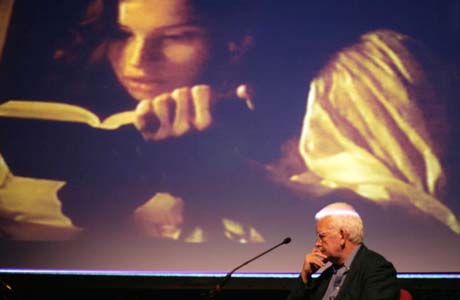
Andrew Davis pondering

The Welsh filmmaker Peter Greenaway once made a controversial remark criticising film versions of literary work as mere “illustrated books”.  Regarding Jane Austen’s work, he said:

Cinema is predicated on the 19th century novel.  We’re still illustrating Jane Austen novels–there are 41 films of Jane Austen novels in the world.

What a waste of time.

Click here for the Wales news article containing the above quote.

To the discomfort of Mr. Greenaway, there have been more Austen adaptations made since he spoke.  As recent as just two weeks ago, BBC has announced that a four-episode production of Emma will be launched this fall.  The award-winning writer Sandy Welch (Jane Eyre, 2006, TV; Our Mutual Friend, 1998, TV) is working on the new script, with actors pending.

Why do we need another Austen adaptation?  Do we need another “illustrated book” as Greenaway has argued?

I was surprised to hear such remarks from Mr. Greenaway, himself an art house filmmaker.  He certainly doesn’t need to be reminded of the power of the visual.  I have expressed my stance against his argument in a previous post entitled ‘Vision not Illustration’.  But as more Austen adaptations appear, laying ratings and profits aside, I still believe there is an artistic merit in turning book into film.

The visual has an immense power in bringing out the essence of the literary.  An image can elicit deep and hidden thoughts, stir up emotions of past experiences, point to new insights, and unleash multiple responses in just a short lapse of time.  The cliché  “A picture speaks a thousand words” has its application in this visually driven generation.  Not that I do not treasure the classics, or the literary tradition.  Far from it.  I think a good film adaptation can, at best, enhance our enjoyment of the literary, and if it fails, can only help us appreciate the original genius even more.

If Bach, over 300 years ago, could invent Theme and Variations, why can’t we in this post-modern age, where multiple narratives are cherished, create adaptations to a recognized original?  Of course, the key is held by the filmmakers. It takes the insightful and  interpretive lens of a good writer, director, and cinematographer to craft a fresh perspective, one that can evoke a new vision and yet still remain true to the spirit of the original.

Kate Harwood of BBC explains why another adaptation of Emma is ensued:

In Emma, Austen has created an intriguing heroine, and our four-hour canvas allows us to explore this multi-faceted character in detail.  Emma was Austen’s last novel, written when she was at the height of her craft, and we are delighted that such an esteemed writer as Sandy Welch is bringing her vision to this appealing story.

How appropriate it is for Harwood to see film as a canvas for visual exploration, and the writer’s vision as a crucial element in the creative process.

I say, bring on more Austen adaptations.  Jane would be most pleased… belatedly.

*****

The above posted article has since been published in the Jane Austen Centre Online Magazine, where you can read more about Jane and her world.  Click here to go there.   

Click here to read my review of Part 1 and Part 2 of Sense and Sensibility, broadcast on PBS Masterpiece Classic Feb. 1 and 8.

Jane Austen: Sense Or Sensibility?

With PBS Masterpiece Classic broadcsting Sense and Sensibility (2008 ) again on Feb 1 and 8, it’s good time to muse on the question:  Which Austen heroine was Jane herself most like?  You can see the poll on my side bar, and the results so far. 

As you watch Sense and Sensibility once again, look closer at Elinor and Marianne.  Mind you, if you have a chance, watch the 1995 movie too, then you’d appreciate Emma Thompson and Kate Winslet in bringing out the differences between sense and sensibility even more clearly I think.

No doubt, we all like to perceive Jane herself as the very source that had inspired the creation of our all time heroine, Elizabeth Bennet of Pride and Prejudice, intelligent, witty, self-assured, sharp in her critique of social norms, and brave enough to challenge, and diverge.  She dominates our popular votes here with a 44% lead… so far.

But Anne Elliot of Persuasion is also a popular choice, mature, patient and wise.  The silent lover is a strong second with 23%.

magrittes-le-blanc-seing

After reading the biographies of Jane, knowing how she had loved the burlesque and to play a part in the family’s performances, how openly she had engaged in activities with her brothers and the student boarders in her home, how she had  written satires while still a youngster, how critical she could be, and above all, upon my reading Claire Tomalin’s incisive analysis of Jane’s relationship with her older sister Cassandra, I tend to lean toward a very unpopular choice. 

I think Jane by nature was more like Marianne Dashwood, passionate, spontaneous, expressive and bold.  It’s Cassandra, like Elinor, who reminded her to rein in her emotions, to keep her skepticism in check, and to help her fit into a world that was not ready for a female like her.  Have you wondered why Cassandra needed to burn so many of Jane’s letters to her after Jane’s death?

Is it sense and sensibility we’re talking about here, or rather nature and nurture? 

No matter.  It’s best that our favorite writer remains an enigma.  But, if you have to choose, thinking back to all the Austen heroines in her six novels, who do you think Jane resembled the most?

Cast your vote and let Janeites decide.

To read my review of Sense and Sensibility (2008, TV), Part 1, Click here.

Click here for Part 2.


*****  

Tess of the D’Urbervilles (2008, TV): Part 2

tessThe “lite version” of Part 1 has turned into a heavy and somber continuation on PBS Masterpiece.  In this second and final part, screenwriter David Nicholls and director David Blair unleash the gloomy Hardy worldview unreservedly,  releasing the bleak and dismal elements that are almost too much for new year viewing.  The music has played a major and dramatic role in setting the tone and mood of the movie.  The cinematography too, in contrast to the lush green opening in the first part, has drawn us into a slough of mud, grey and black.  Hardy’s view of nature lamenting the tragic condition of his heroine is effectively conveyed, engrossing albeit a tad too melodramatic.

Kudos to David Nicholls for a meticulous job in adaptation.  He has kept the plot intact, for the most part faithful to Hardy’s book.  While a couple of incidents are left out, quite meaningful and symbolic too, but not to diminishing effects.  These include the sleepwalking episode, the Freudian slip of Angel’s innermost longing to love Tess despite all restraints.  The second being Tess’ mercy-killing of pheasants wounded by hunters, a sensitive portrayal of her own predicament.  However, Hardy would not have her killed off so easily.  Like the sadistic “President of the Immortals” in his view, Hardy the author wreaks havoc on his heroine, leading her into scenes after scenes of tragic events beyond her control.

tess-part-23

Tess can forgive Angel for his sexual sin, but he refuses to forgive her.  Actually, what sin has she committed if she was innocently violated by Alec D’Urberville when she was a young girl.  She loves Angel unconditionally, but his love for her is marred by constraints.  Later, she cannot avoid stalking by Alec, who keeps preying on her, and in her most needy and vulnerable, takes advantage of her again by manipulating her love for her family.  Whatever dignity she may have Tess ultimately sacrifices it for her beloved family.  But I admire Tess’  integrity, yes I like to see it as integrity, and not pride, that has sustained her until that very end when she finally has no choice but to yield to Alec’s sinister scheme.

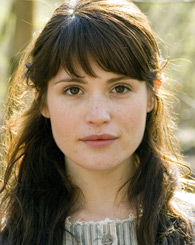
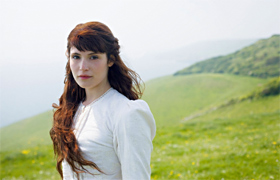
It is for this reason that I find Gemma Arterton’s portrayal of Tess as just a proud and feisty gal to suit modern viewers incongruent with the book.  She may look innocent enough, but her performance at times is contrived and lacks the striving complexity required.  But her tears are effective and moving, I must say.  While Hans Metheson has delivered his diabolic role adequately, Eddie Redmayne as the losing lover at the end is a bit lacking.

And Angel, oh, what a tragic character.  The seemingly altruistic lover cannot stand the test against social mores.  In the book, the chapter describing the mutual confession of sins between the newlyweds is aptly entitled:  “The Woman Pays”.  What an irony of double standard!  This might well be the name of the novel.  While Hardy may have held an entangled and agnostic view of the transcendent, his social critique is incisive and spot-on.

the-stonehenge-1

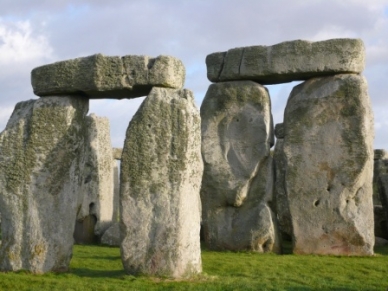
At long last, Tess and Angel can enjoy marital bliss, but only for a painful, fleeting moment.  Tess says in her anguish:  “It is too late”,  the four words that define the tragedy of her life.  As a young girl, she did not understand the meaning of Alec’s sinister advances until too late.  And now as a married woman, her husband has come to her rescue too late.  I learn from the end notes of my Penguin edition that the original title of the book was Too Late, Beloved! What a heart-wrenching story.

PBS has a link to an online interactive Q & A with screenwriter David Nicholls.  In there he  answers the many questions viewers have regarding the process of turning book into film. I have enjoyed Nicholls’ previous adaptation of Blake Morrison’s memoir into the movie “And When Did You Last See Your Father”, starring Colin Firth and Jim Broadbent, an excellent and sensitive film.  I look forward to seeing more of Nicholls’ work in the future.

~ ~ ½ Ripples

Click here to go back to Tess of the D’Urbervilles, Part 1.

*****

Tess of the D’Urbervilles (2008, TV): The Lite Version

tess-of-the-durbervilles-movie

After reading Thomas Hardy’s Tess of the D’Urbervilles just shortly before watching the new re-make on PBS Masterpiece, I can fully understand why screenwriter David Nicholls has done what he did.  He has turned a heavyweight into a light classic.  For if Hardy’s book is to be adapted in spirit and letter, it would certainly be less appealing and just too heavy a burden to cast upon our collective psyche.

As an author, Hardy himself personifies the sadistic ‘President of the Immortal’ he perceives.  Humans are just the playthings for The Immortal’s jest.  As an agnostic, he can’t just outright blame it all on God, since he isn’t sure even if God exists.  But in the book, he makes his readers know clearly the cosmic tragedy his characters are caught in, by turning Browning’s lines into:

God’s not in his heaven:  all’s wrong with the world!

If we can see Hardy on the streets today, I’m sure he’s the guy who takes Murphy’s Law to heart:  Anything bad that can happen will happen.  That’s what he makes of his heroine Tess in the story.  A pure, beautiful and innocent country girl, fresh and untouched for life, is being caught in all sorts of circumstances that will bring only heart-wrenching consequences, one after the other all the way to the end.

David Nicholls has spared us the looming Hardy worldview and lightened it up for us, and I don’t blame him for that.  For who needs more tragedies of cosmic proportion in this very tumultuous time in our human history.   Mind you, he has presented the plot faithfully.  In this first part at least, you see the sequence of events in the book adapted to the dot, albeit in a much more condensed and hurried pace.  Considering the full length of the book is about 400 pages, and the made-for-TV movie is four hours long, that means for every hour he has to cover 100 pages.  From this first part, I’d say he has done an admirable job.

tess-and-alec

Now to Gemma Arterton.  I’ve enjoyed her role as Elizabeth Bennet in ITV’s Lost In Austen.  So it is with high expectation that I come to watch Tess.  If the screenplay is a light version, then Arterton’s Tess is aptly portrayed, for I have a feeling that she has turned it into a comic character at the beginning of the movie.  But maybe that is to contrast her later portrait of lost innocence.  Nevertheless, I feel there is something lacking, maybe the almost god-like purity and depth of love in Tess are qualities just too demanding for so young an actress to depict.

Hans Matheson’s Alec D’Urberville is much more attractive than the detestable Alec described in the book.  Though the obvious villain, his dark and sensual appearance is symptomatic of a soul in turmoil. He has added complexity to his character that even sheds a bit of appeal. I look forward to his crucial role in the latter part of the story.

angel-clareIn contrast, Angel Clare is the innocent lover.  His willing to challenge his strict Victorian upbringing in a clergy family for love of a milkmaid indicates his bold rejection of social norms and family expectations… up to this stage.   Eddie Redmayne has delivered a convincing performance.
The character that really draws my attention, surprisingly, is Tess’ younger sister Liza-Lu, played by Jo Woodcock.  For some reason that face has the look and intensity that’s so fitting in a film like this.  And the three milkmaids that offer the much needed relief to the story, Marion, Retty and Izz, are well cast and portrayed.  They play no minor roles in Tess’ life.

Finally, I must also mention the new host of Masterpiece Laura Linney.  I admit, she’s more what I had in mind for the character of Tess while reading the book.  Unfortunately that part is taken.  Oh well, I’ll see her again next week, and in future Masterpiece presentations.

So, for a lighter and entertaining take on the tragic story of Tess,  and to browse through the plot in a few visually appealing hours while sidestepping the somber philosophical view of Hardy’s, this BBC production offers a viable choice.

(Photos Source: bbc.co.uk)

~ ~ ½ Ripples (so far)

Click here to go to Tess of the D’Urbervilles, Part 2

*****


Lost in Austen Episode 4 (2008, TV): Lost and Found

After trudging through a slow and a tad too serious Episode 3, the production has redeemed itself by finishing up with a grand finale. Episode 4 has found its original pace with its fast sequences to wrap things up, offering unexpected and entertaining twists and turns.

One thing that screenwriter Guy Andrews remains consistent with is his attempt to mix things up as much as he can, like Lydia eloping with Bingley, Wickham turning wicked schemes into timely rescues, Mrs. Bennet coming to her senses and confronts Lady Catherine de Bourg, and ultimately, the big ultimate, Elizabeth Bennet swaps places with Amanda Price not for a moment, but for good. The laughs and fun derived from these “post-modern moments” are all based on juxtaposing time and mixing up of characters and story lines. The whole production is an effective deconstruction of an all-time classic and its adaptations.

gemma-arterton-as-elizabeth-bennet

The most fun of them all, of course, is Amanda coming back through the portal and see Elizabeth Bennet in 21st Century London, with a new pixie hairdo, working as a nanny, computer savvy, environmentally conscious, and fully liberated. What more, she enjoys modern, post-modern rather, life so much that she intends to stay for good. And once she sees Darcy, who follows Amanda to the modern world, Lizzy right away knows who he is, thanks, as we all do nowadays, to all the webpages about Colin Firth’s wet shirt scene.

Darcy on the other hand is totally lost in the future. Here the scene is almost a replication of the one from Kate and Leopold (2001), where Hugh Jackman portrays a late 19th Century English nobleman travelling through a time portal and lands in modern day NYC. Darcy is even wearing a similar long, blue coat like Leopold, mesmerized by the tele and the busy urban traffic. And the ending too, a similar twist as Meg Ryan’s ultimate choice at the end of the movie.

What would Jane Austen think? “Turns in her grave” as Amanda puts it? As a satirist and a fan of the burlesque, Jane might have a good laugh too I think. I’m sure she was confident and self-assured enough to know that parodies of her work, at best, remain only as they are, spin-offs and re-makes of something that is inimitable. No matter how you deconstruct Jane Austen, you would always come out admiring the ingenuity of the brilliant mind behind that original creation.

*****

Episode 1

Episode 2

Episode 3


Lost In Austen: Episode 3 (2008, TV)

Japanese man petitions to marry comic-book character“, thus says the headline. Taichi Takashita has launched an online petition to the Japanese government for the legalizing of marriages between human and cartoon characters. He’s aiming for a million signatures, as of the end of October, he’s got a thousand. In this day and age, I’ve more or less braced myself for any type of shocking news.

Now, back to fiction. I’m not surprised to see Amanda Price falling in love with a fictional character, especially one like Fitzwilliam Darcy, but I am quite unwilling to accept Darcy to be ardently in love with her. But of course, this is a parody, albeit in this episode, the humor has gone from LOL to subtle satire.

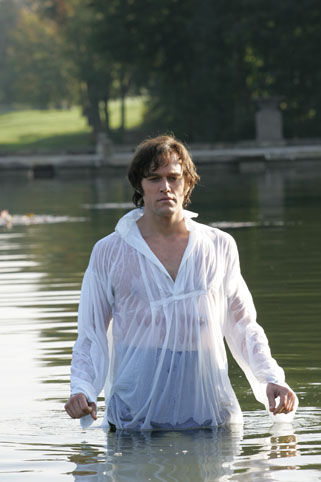
wet-shirt-scene-in-lost-in-austenI suppose the wet shirt scene in which Darcy heeding Amanda’s request to dip into the pool is meant to be the most notable moment, or maybe even the climax, of the whole production. This scene just confirms my view that Lost In Austen is more a parody on Pride and Prejudice adaptations, rather than the novel of Jane Austen’s. There never is a wet shirt scene in the book. The parody could well be on Andrew Davis’ imaginary take on wooing modern female viewers, or a satire on the cult following of Colin Firth’s role as Darcy since the 1995 BBC production.

The scene also offers another Firth moment when Amanda asks Darcy whether he loves her because of her change from the spikey and vulgar modern female to the simpering klutz trying to fit into the Regency mold. Well, truth be told, Darcy finds her character, both before and after, equally disagreeable, but he still loves her with all his heart. Isn’t that the Mark Darcy line to Bridget Jones, “I like you very much, just as you are.”

Anyway, there really isn’t much else to be excited about in this episode. The director seems to be indecisive as to where he wants to take us, and in what form. The lively and fresh beginning of Episode 1 has subsided and the production has turned into another TV drama, one that has taken itself a little too seriously.

So now, another week, another episode…oh, the ennui and the ambivalence.

Yet, I shall conquer this, I shall.

Episode 1

Episode 2

Episode 4