Man On Wire (2008, DVD): Romancing the Towers

man-on-wire1When the idea of building the World Trade Center Twin Towers began to germinate in NYC, on the other side of the globe, a young man in France started to weave a dream.  He wanted to walk across the top of the Towers on a wire after they were built.  Six years later, with the Towers nearing completion, Philippe Petit fulfilled his dream a few days short of his 25th birthday.  On August 7, 1974, he stepped on a wire strung across the roof top of the then tallest buildings in the world.  Hailed as ‘The Artistic Crime of the Century’, Philippe Petit’s breathtaking, and illegal, high wire act is the ultimate test of the human spirit, pushing the limit of audacity and strength.

Based on Philippe Petit’s book To Reach The Clouds,  Man On Wire has won over 20 film awards only a few short months after its release, ultimately receiving the Oscar Best Documentary for 2008.  Director James Marsh chronicles the extraordinary endeavor of Philippe Petit by means of interviews, dramatic re-creation, and archival footage.  Before the WTC, Petit had walked across the two steeples of the Nortre Dame Cathedral in Paris, and the Sydney Harbour Bridge.  The WTC Towers meant the summit of his aspirations.  In a Sundance Film Festival interview, he described his act as ‘marrying the Towers’.

 Director James Marsh has chosen a very human angle to present his subject, such that we’re not just watching an extraordinary circus feat.  The documentary reveals a child growing up with unusual physical talents.  It vividly depicts the fearlessness of youth, the weaving of a fairy tale, the bond of friendship without which Philippe could not have achieved, and finally the euphoria of a dream fulfilled.  The smile on Philippe’s face while on the wire says it all.

The interviews in the film have also brought some very personal elements into this enthralling event.  We see Philippe’s childhood friend and accomplice Jean-Louis overcome with emotion, now more than 30 years later, as he recalls and is still moved by the immensity of the experience.

It’s a crime, no doubt, but it’s team work of the highest level of difficulty.  That they had to haul hundreds of pounds of wire and equipment up to the roof top, shoot the wire across, anchor it safe, all without detection was itself an incredible feat.  Once that was done, the rest was easy for Philippe, he just needed to walk on the wire suspended 1,350 feet above ground.

And that is when the artful part comes in.  Philippe had not just walked on tightrope, but performed with grace and serenity, movements conjuring up images of ballet on air.  For 45 minutes, he slow-danced across the Towers eight times, lay, knelt, and sat on the wire to the amazement of the awestruck crowd on the ground.  There was unspeakable beauty in his magnificent boldness.

Police had to threaten him with a helicopter to get him off.  He and his friends were immediately handcuffed, taken to jail, and Phillipe undergone a psychiatric examination.  He was later released and given a life-time pass to the Towers.  When asked why he did it, he answered:

“There’s no why… Life should be lived on the edge.”

Excellent special features that come with the DVD include Philippe Petit’s 1973 Sydney Harbour Bridge Crossing, exclusive interview with Philippe Petit, and an animated short film based on the children book by Mordicai Gerstein “The Man Who Walked Between the Towers”, narrated by Jake Gyllenhaal.  Further,  in this post 9/11 world, the DVD is even more significant in that it chronicles someone who had taken the arduous steps to appreciate and to relate to the Towers in a most memorable way.

And then there’s the music.  I admit it’s the music that has enthralled me from the start, yes, even with just the menu.  While Michael Nyman has written some fantastic original score for the documentary, it’s French composer Eric Satie’s pieces that so captivate me.   Satie’s Gymnopedie No. 1 is the music that augments the beauty of Philippe’s poetic walk on wire.

While most of us would rather watch life being lived on the edge from the comfort of our living room, we would be inspired nonetheless to venture out of our couch for a little more excitement, and motivated to take just a bit more risks with our life.  For us ordinary folks, maybe living life to the fullest is an aspiration challenging enough.

~ ~ ~ ½ Ripples

  “If no one ever took risks, Michaelangelo would have painted the Sistine floor.”      — Neil Simon 


Philippe Petit and James Marsh Interviews:

Click here for the  NPR’s Studio 360 Interview

Click here for the Sundance Film Festival Interview on YouTube
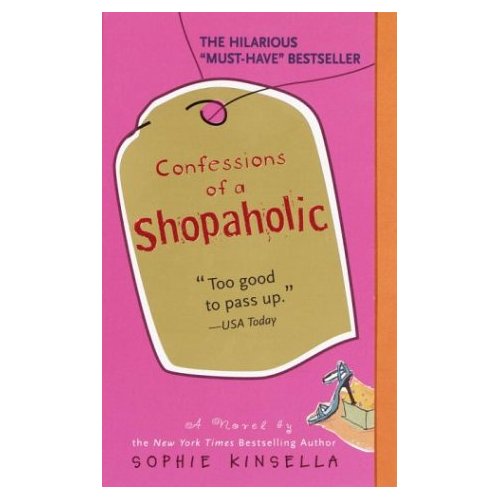


Confessions of a Shopaholic: Book and Movie

confessions-of-a-shopaholic-book-cover

‘Are you serious?’ my son exclaimed as he pried open my Amazon package.

‘It’s just a filler to make up the amount for free shipping,’  I said.  (Didn’t he know it was for his CD that I had to make this purchase in the first place?)

Ok, after reading Thomas Hardy, Jhumpa Lahiri, Philip Roth, not to mention the very hard-to-get-through Amy Bloom, all in a month’s time, I needed a break.  A break it is.

The book Confessions of a Shopaholic is like a commercial break:  it gives you a chance to relax in between tense moments, a filler, but unlike most commercials, it’s entertaining, very funny, and not as dismissible as it looks.  (To my copy-writer friend: Nothing personal,  it’s just the genre.)

I’d many LOL moments, and several times I caught myself reading with a smile on my face.  How many books have you read that can elicit that facial response? Not that I looked at the mirror while I read, but I just noticed.

I learned a long time ago that the best kind of humor is the self-deprecating kind.  Kinsella’s Shopaholic series just might have extended that axiom to include her own gender.  But why not, Jane Austen did that too, plus the other gender along the way.  And that reminds me, reading Shopaholic conjures up images of Bridget Jone’s Diary,  which in turn,  and remotely, suggests certain Austen-esque styling.

Rebecca Bloomwood is a twenty-five year old college grad lucky enough to have launched a job as a financial journalist at Successful Saving.  A whole new world opens up to her as she gets her VISA card and automatically given an overdraft limit at her bank.  Loaded with such financial ammunition, Becky plunges right into the swirl of brandname fashion and all other fancy stuff a gal just got to have.  After all, they’re all an investment to her, and shopping just seems to be the ideal workout. How can she keep fit just sitting at home?

“They should list shopping as a cardiovascular activity.  My heart never beats as fast as it does when I see a ‘reduced by 50%’ sign.”

In no time, Becky Bloomwood the financial journalist has sunk deep in debt.  The irony becomes more acute when she is invited to appear on TV as an adviser on personal finance management.

Kinsella has crafted a modern day satire on the female psyche vis-a-vis consumerism.  Ok, some female psyche… not all.  Her sharp observation of human nature, and spot-on nuances on both genders, together with the generous unleashing of self-deprecating humor, effectively mask the didactic end of  Shopaholic.  The book might have delivered the message for us all in today’s slumping economy.  It has unwittingly (or perhaps wittingly) depicted some of the causes of such a major breakdown in our financial system:  the allure of credits, the insatiable quest for posession, the deception of desire over need, and the tyranny of brandname consumerism.

The author has effectively created a comic caricature.   Rebecca is an addict in denial, but she’s amiable nonetheless.  We laugh at her flaws and errors because we can sympathize with her predicament, or maybe even identify with some of her weaknesses.  The book is almost script-ready, it has the funny dialogues, the colorful characters, the dramatic elements.  Although the story doesn’t get fired up until the last hundred pages, it’s an enjoyable read overall.

~ ~ ½ Ripples

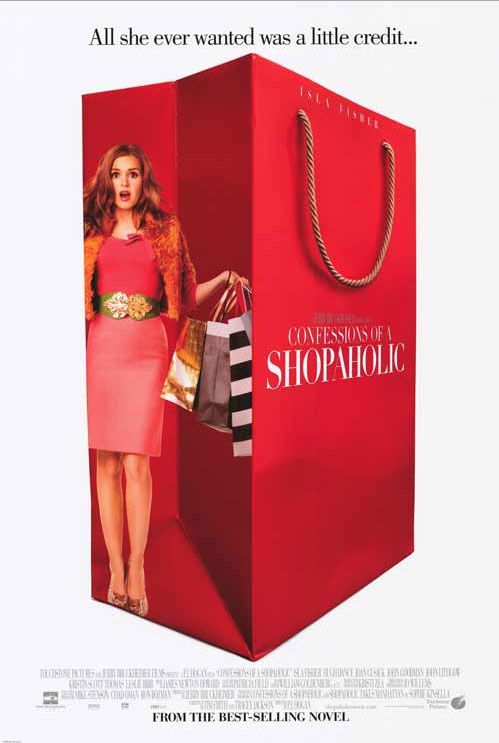
confessions_of_a_shopaholic_movie_poster

And for the movie, well, the movie is a different matter.

Australian director P.J. Hogan (My Best Friend’s Wedding, 1997) has wasted some highly workable comedic materials, and a talented supporting cast like Kristin Scott Thomas, Joan Cusack, John Lithgow, and John Goodman.  He has reduced a pleasing, humorous, and relatively intelligent book into a slapstick, patchy, and mindless farce.  LOL response in the theatre was almost nil, because the script is simply flat and not funny, despite the earnest attempt of the cast.  Isla Fisher (Definitely Maybe, 2008) has downgraded Becky Bloomwood into a stereotypical, silly female wrapped in pink;  Hugh Dancy (The Jane Austen Book Club, 2007), who plays her boss and later love interest, seems too constrained to be effective.  The movie simply epitomizes and confirms the bad rap ‘chick flicks’ are getting.

Throughout, I’ve the feeling that I’m watching the sequel of The Devil Wears Prada (2006) but without its depth of characterization, and Becky Bloomwood is the dumbed down version of Elle Woods in Legally Blonde (2001)… alas, a pitiful rendition of Pretty In Pink (1986).   What it lacks in brain it rescues itself with a little heart in the latter part.  But the fond feeling comes too little too late.

And I can’t help myself but to ask if the movie was directed by a female, would it be quite different.  But then I’d be stereotyping.

~ ½ Ripples

*****

The Oscar Results 2009

CLICK HERE for Oscar Results 2010

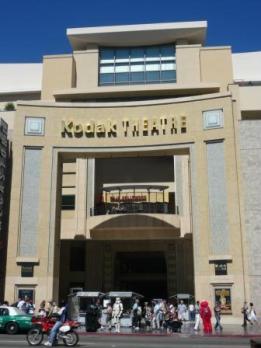
The film that defies all odds,  Slumdog Millionaire, was the big winner at the 81st Academy Awards at the Kodak Theatre in LA last night.  It won 8 Oscars:  Adapted Screenplay, Cinematography, Sound Mixing, Film Editing, Original Score, Original Song, Best director and Best Picture.

Its major rival, The Curious Case of Benjamin Button, which led the nominations with 13 nods, took only three golden statuettes, mainly in the technical categories.

Click here for the complete list of Oscar Winners.

Actually, the Academy Awards Show itself may well be the winner, thanks to a talented, Tony Award winning Hugh Jackman. After the slumping ratings in the past few years, the Oscars could well have been resuscitated last night.  Which previous Oscar host can sing and dance Broadway style so naturally, and bringing out the musical talent of Anne Hathaway at the opening gig, plus performing a tribute to previous musicals from West Side Story to Mamma Mia! with Beyoncé?  And, who says it takes a comedian to crack jokes?

Speaking of musical numbers, who could have thought the two songs of Slumdog Millionaire, with traditional Indian melodies, can be performed together with the other nominee, “Down To Earth” from the Sci Fi Animation Wall E.,  a collaboration of John Legend and A. R. Rahman.   It was a colorful post-modern rendition of musical fusion.

Entertainment aside, there are some moving moments that I’ve appreciated:

  • Penélope Cruz in her acceptance speech for Best Supporting Actress: “… art in any form has is and will always be our universal language and we should do everything we can to protect its survival.”
  • Heath Ledger’s posthumous award for Best Supporting Actor was accepted by his parents and sister who delivered some heartfelt words of thanks, ending with: “… we proudly accept this award on behalf of your beautiful Matilda.”
  • The Jean Hersholt Humanitarian Award was presented to Jerry Lewis, who began fundraising for muscular dystrophy since the 1950’s.
  • Kate Winslet paying tribute to Anthony Minghella and Sydney Pollack, two talented directors and producers who passed away last year, two months apart: “Anthony and Sydney, this is for you, this is for both of you.”
  • Previous winners in Acting categories came out together as a group to announce this year’s nominees.  Kudos to the writers for some moving intro narratives.  So, it was a night of gathering of veteran actors like Sophia Loren, Alan Arkin, Anthony Hopkins, Shirley MacLaine, Anjelica Huston and 85 year-old Eva Marie Saint, who won her Oscar in 1955 for On the Waterfront.
  • All the children who play major roles in Slumdog Millionaire came from India to attend the Awards and had the honor of winning an Oscar, no doubt a surreal experience for them.

A word about Slumdog Millionaire:  The two young actors Dev Patel and Frieda Pinto are the future stars to watch for.  They are poised, articulate, modest, and carry themselves marvellously in the limelight of fame and glamour.  I wish this Hollywood episode is the springboard to further career opportunities.  And for the children who still have to go back to the slums of Mumbai, I hope this experience would open doors for them to a better life in the days ahead.

*****

Time’s 25 Best Blogs 2009

Just when Arti is wondering how to spend the next 48 hours before Sunday’s Academy Awards, an incoming link pops up on her dashboard.  It is a blog talking about Time’s recent selection of  25 Best Blogs for 2009.   A stroke of glamour no less than the golden Oscar flashes across Arti’s muddled mind… huh, Ripple Effects got linked to what?  The researcher in Arti quickly heeds the call to check it out.   No, Ripple Effects is not on the list.  Slap, slap, wake up, this is the real world now… it’s just that one of Ripple Effects’ posts got linked by WordPress’ auto-generated linking mechanism.  In the huge blogosphere out there, being chosen as one of the top 25 blogs is just got to be harder than winning the Oscars.  What am I thinking.

For those interested in the curious case of  Time’s 25 Best Blogs of 2009, here is the list and the subject matter of the blogs:

  1. Talk Points Memo — Political
  2. The Huffington Post — Political
  3. Lifehacker — “Tips and downloads”
  4. Metafilter — Wikiweblog
  5. The Daily Dish — Atlantic Andrew Sullivan’s Political blog
  6. Freakonomics — NY Times Stephen Dubner and Levitt, Economics
  7. BoingBoing — Technology and fringe culture
  8. Got2BeGreen — Environment
  9. Zen Habits — Self-help and motivational
  10. The Conscience of a Liberal:  NY Times Paul Krugman, Nobel Laureate, Economics
  11. Crooks and Liars — Political
  12. Generación Y — Political
  13. Mashable — Social Networking
  14. Slashfood — Food
  15. The Official Google Blog — Business
  16. synthesis — opinions & ideas
  17. bleat — life in retro
  18. /Film — Films and Video Games
  19. Seth Godin’s Blog — Marketing
  20. Deadspin — Sports
  21. Dooce — Heather Armstrong on a female life
  22. The Pioneer Woman — Ree Drummond on a female pioneer life
  23. Said the Gramophone — Music
  24. Detention Slip — cheat sheet for education news
  25. Bad Astronomy — in praise of real science

So, here they are, your celebrities, the blockbusters of the blogosphere, some attracting millions of page views per month, the Hollywood Oscar scene of blogging.  But I must say I regret to see there are no blogs on the list that are dedicated to the arts or books.  Further, hats off to all those who write in obscurity, like many of my favorites.  They are the solitary bloggers who quietly express their views towards life’s issues, or share their love of a book, response to a film, or simply capture a moving moment, blogs that deserve to be read just the same as the blockbusters.

Maybe there needs to be an indie blogging recognition, like in the film industry, an Independent Spirit Award for bloggers who write and toil just for the simple pleasure of observing, expressing, sharing, and celebrating the essence of being human.  No glamour, no red carpet.

*****

P.S.  Ok, they have the red carpet too at the Spirit Awards and glamour automatically comes with that I suppose… Anyway, I’m sure you get my point.


Gran Torino (2008)

gran-torino

Still planning for this Valentine’s weekend?  How about a date movie?  Wait, guys, don’t run away.  This one’s for you.

I hate to read movie reviews with the tag line “Bring tissues”.   Half of our demographics would clearly stay away.  But what with a movie entitled “Gran Torino” starring Clint Eastwood?  Will it scare away the other half?  I’m here to ensure you all girlfriends, wives and future wives, it’s safe.  You won’t be bombarded with ear-piercing explosions and car crashes, or gratuitous adrenalin pumping violence, but there are engrossing moments that both of you will find meaningful.

Clint Eastwood is Walt Kowalski, a hardened and critical old man who has just lost his wife.   Walt Kowalski is Dirty Harry in his 70’s.  He hasn’t lost any of his macho madness.  Adding oil to the fire, he is one growling racist, and he makes his feelings known to all who cross his path, specifically, his new neighbors, a Hmong family originally from Laos.

The 1972 Gran Torino Walt owns and treats with great care is what the teenager next door has to steal under coercion as an act of gang initiation.  That night begins the series of events  that change the lives of these two households.

What’s interesting to watch is how Walt Kowalski’s antagonistic fervor is diverted into a protective mode, when the teenagers next door are bullied by gangs.  Here the spirit of Dirty Harry rises to the occasion.  Taking the teenage boy Thao (Bee Vang) under his wings, he begins to connect and even come to treasure a bond that he subtly strives to build up.

Contributing to the otherwise simple storyline is the  internal exploration of Walt’s tormented inner world.  He encounters his nemesis in the young Catholic priest Father Janovich (Christopher Carley), who has promised Walt’s wife that he would come check on him after she’s gone.  The movie efficiently makes the best use of these two character foils.  The innocent and naive versus the disgruntled skeptic.  It’s gratifying to see how both of them change over the course of events.  And it’s utterly moving to watch the slow process of one man’s ultimate search for redemption in the context of a beleaguered society riddled with hatred and racism.

Eastwood is by far the most experienced actor here.  In contrast, the young ones pale in their performance.  However, this is in a way realistic, for who wouldn’t be intimidated by such a formidable neighbor.  And yet, the movie excels in its delivery of a message, or two, so poignantly, it catches you off guard.

The multi-talented Eastwood here directs, acts, and composes the music.  He has crafted a powerful and moving piece of entertainment.  If you’re not too critical about the language, or a few simplistic stereotyping, this is one movie that can certainly make your day.

~ ~ ~ Ripples


Too Much Jane?

davies460

Andrew Davis pondering

The Welsh filmmaker Peter Greenaway once made a controversial remark criticising film versions of literary work as mere “illustrated books”.  Regarding Jane Austen’s work, he said:

Cinema is predicated on the 19th century novel.  We’re still illustrating Jane Austen novels–there are 41 films of Jane Austen novels in the world.

What a waste of time.

Click here for the Wales news article containing the above quote.

To the discomfort of Mr. Greenaway, there have been more Austen adaptations made since he spoke.  As recent as just two weeks ago, BBC has announced that a four-episode production of Emma will be launched this fall.  The award-winning writer Sandy Welch (Jane Eyre, 2006, TV; Our Mutual Friend, 1998, TV) is working on the new script, with actors pending.

Why do we need another Austen adaptation?  Do we need another “illustrated book” as Greenaway has argued?

I was surprised to hear such remarks from Mr. Greenaway, himself an art house filmmaker.  He certainly doesn’t need to be reminded of the power of the visual.  I have expressed my stance against his argument in a previous post entitled ‘Vision not Illustration’.  But as more Austen adaptations appear, laying ratings and profits aside, I still believe there is an artistic merit in turning book into film.

The visual has an immense power in bringing out the essence of the literary.  An image can elicit deep and hidden thoughts, stir up emotions of past experiences, point to new insights, and unleash multiple responses in just a short lapse of time.  The cliché  “A picture speaks a thousand words” has its application in this visually driven generation.  Not that I do not treasure the classics, or the literary tradition.  Far from it.  I think a good film adaptation can, at best, enhance our enjoyment of the literary, and if it fails, can only help us appreciate the original genius even more.

If Bach, over 300 years ago, could invent Theme and Variations, why can’t we in this post-modern age, where multiple narratives are cherished, create adaptations to a recognized original?  Of course, the key is held by the filmmakers. It takes the insightful and  interpretive lens of a good writer, director, and cinematographer to craft a fresh perspective, one that can evoke a new vision and yet still remain true to the spirit of the original.

Kate Harwood of BBC explains why another adaptation of Emma is ensued:

In Emma, Austen has created an intriguing heroine, and our four-hour canvas allows us to explore this multi-faceted character in detail.  Emma was Austen’s last novel, written when she was at the height of her craft, and we are delighted that such an esteemed writer as Sandy Welch is bringing her vision to this appealing story.

How appropriate it is for Harwood to see film as a canvas for visual exploration, and the writer’s vision as a crucial element in the creative process.

I say, bring on more Austen adaptations.  Jane would be most pleased… belatedly.

*****

The above posted article has since been published in the Jane Austen Centre Online Magazine, where you can read more about Jane and her world.  Click here to go there.   

Click here to read my review of Part 1 and Part 2 of Sense and Sensibility, broadcast on PBS Masterpiece Classic Feb. 1 and 8.

Jane Austen: Sense Or Sensibility?

With PBS Masterpiece Classic broadcsting Sense and Sensibility (2008 ) again on Feb 1 and 8, it’s good time to muse on the question:  Which Austen heroine was Jane herself most like?  You can see the poll on my side bar, and the results so far. 

As you watch Sense and Sensibility once again, look closer at Elinor and Marianne.  Mind you, if you have a chance, watch the 1995 movie too, then you’d appreciate Emma Thompson and Kate Winslet in bringing out the differences between sense and sensibility even more clearly I think.

No doubt, we all like to perceive Jane herself as the very source that had inspired the creation of our all time heroine, Elizabeth Bennet of Pride and Prejudice, intelligent, witty, self-assured, sharp in her critique of social norms, and brave enough to challenge, and diverge.  She dominates our popular votes here with a 44% lead… so far.

But Anne Elliot of Persuasion is also a popular choice, mature, patient and wise.  The silent lover is a strong second with 23%.

magrittes-le-blanc-seing

After reading the biographies of Jane, knowing how she had loved the burlesque and to play a part in the family’s performances, how openly she had engaged in activities with her brothers and the student boarders in her home, how she had  written satires while still a youngster, how critical she could be, and above all, upon my reading Claire Tomalin’s incisive analysis of Jane’s relationship with her older sister Cassandra, I tend to lean toward a very unpopular choice. 

I think Jane by nature was more like Marianne Dashwood, passionate, spontaneous, expressive and bold.  It’s Cassandra, like Elinor, who reminded her to rein in her emotions, to keep her skepticism in check, and to help her fit into a world that was not ready for a female like her.  Have you wondered why Cassandra needed to burn so many of Jane’s letters to her after Jane’s death?

Is it sense and sensibility we’re talking about here, or rather nature and nurture? 

No matter.  It’s best that our favorite writer remains an enigma.  But, if you have to choose, thinking back to all the Austen heroines in her six novels, who do you think Jane resembled the most?

Cast your vote and let Janeites decide.

To read my review of Sense and Sensibility (2008, TV), Part 1, Click here.

Click here for Part 2.


*****  

Unaccustomed Earth by Jhumpa Lahiri

unaccustomed_earth

“Jhumpa Lahiri is the kind of writer who makes you want to grab the next person you see and say, ‘Read this!'”

— Amy Tan

Unaccustomed Earth is one of the five fiction selections of  New York Times Best Books for 2008.  Jhumpa Lahiri’s debut work, Interpreter of Maladies, a collection of short stories, won the 2000 Pulitzer Prize for fiction, and later received the PEN/Hemingway Award, the New Yorker Debut of the Year award,  American Academy of Arts and Letters Addison Metcalf Award, and was translated into twenty-nine languages.  Her next work was The Namesake, a novel which was turned into film by acclaimed director Mira Nair.  Unaccustomed Earth is her third book.

Jhumpa Lahiri was born in London, England, to Bengali immigrants.  Her family later moved to the United States and settled in Rhode Island where she grew up. Lahiri went to Barnard College and received a B.A. in English Literature.  She furthered her studies in literature and creative writing and obtained three M.A.’s, and ultimately, a Ph.D. in Renaissance Studies at Boston University.  So, she knows her subject matter well.  In Unaccustomed Earth, characters are Bengali immigrants, mostly academics, their second generation who are born in foreign soil and their non-Indian friends or spouse.  The stories deal with the entanglement of cultural traditions, incompatible values, failed hopes and expectations, and the subsequent internal strives that haunt them all.

But why would we be interested in stories like these?  Herein lies Lahiri’s insight.  While the viewpoint of these characters might be parochial, Lahiri’s stories bring out the larger universal significance.  Who among us doesn’t belong to a community, and at one time or another, question his/her conformity in that very community?   Regardless of our ethnicity, who among us isn’t born into a family with its own peculiar traditions and values?  Who among us doesn’t feel the distance separating generations in our world of rapidly shifting paradigms, be they cultural, social, or spiritual?   And who among us, as one in the mass diaspora of drifting humanity, doesn’t want to lay down roots in fertile soil?

Despite the somber themes, reading Lahiri is an enjoyable ride.  Herein lies Lahiri’s talent.  She is a sensitive storyteller, personal in her voice, subtle in her description, meticulous in her observation of nuances, and stylish in her metaphoric inventions.  Her language is deceptively simple.  The seemingly lack of suspense is actually the calm before the storm, which usually comes as just a punchline in the end of each story, leaving you with a breath of  “Wow, powerful!”  But it is for that very line that you eagerly press on as if you are reading a thriller or a page-turner.

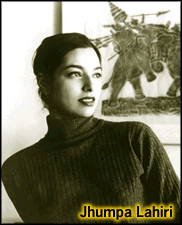
jhumpa_lahiriThe book is divided into two main parts.  The first contains five short stories.  The second, entitled “Hema and Kaushik”, consists of three stories but can be read as a novella on the whole, for they are about two characters whose lives intertwine in an inexplicable way.  While the characters and their situations are contemporary, their quest is the age old longing for love and connection.
I have enjoyed all the stories, but the most impressionable to me is the title one.  In  “Unaccustomed Earth”,  Ruma is married to an American, Adam, with a young child Akash, and pregnant with another.   Her recently widowed father comes to stay with her in Seattle from the East Coast, just for a visit.   During his stay, Ruma’s father builds up a bond with his grandson Akash.   The two create a little garden at the back of the house, a relationship thus flourishes as the flowers and plants blossom.  Ruma struggles with the idea of whether she should welcome her father to live with her for good to fulfil her filial duty, but by so doing, she would be adding a burden to her nuclear family.  What she does not know though is that her father has his secret and internal conflict as well.  He too wants a life of freedom and love.  The story ends with a dash of humor and a little surprise, reminiscent of a Somerset Maugham story.  I will not say more, or the spoiler will lessen your enjoyment.

I have read all three of Lahiri’s work.  And this is my query:  If her first book garnered the many literary awards including the Pulitzer, I just wonder what else could she win with her newest creation, which I enjoy far more.

Unaccustomed Earth by Jhumpa Lahiri, published by Alfred A. Knopf, NY, 2008.  333 pages.

~ ~ ~ Ripples

****


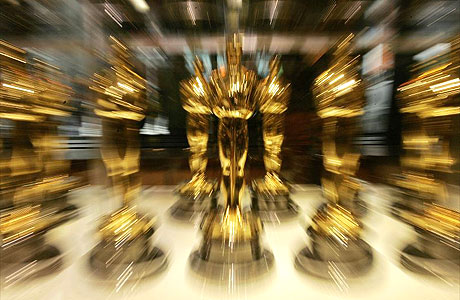
81st Academy Awards Nominations (2009)

oscars

CLICK HERE to read The 2009 Oscar Results.

So, the news is out. For a complete list of the 2009 Oscar nominees, click here to go to the official Oscars website. For those who didn’t bother getting up at 5:30 am PT to watch the announcement live, here’s the video clip.

The clear front runner is The Curious Case of Benjamin Button, grabbing 13 nominations, just one short of the record shared by All About Eve (1950) and Titanic (1997).

Slumdog Millionaire is not far behind, a fantastic rags to riches exemplar in itself, garnering 10 nominations.

When I look at the Best Picture categories, I notice that four of the five nominees are produced from an adapted screenplay.  Here are the origin of these now famous movies, the source materials that first spark and channel the creative energy of screenwriters,  causing them to propel a much lesser known work into the orbit of box office profits:

  • The Curious Case of Benjamin Button:  Loosely based on a short story of the same name by F. Scott Fitzgerald.  The imdb site does not even mention this source material.  But for those of you who want to acknowledge the original writer’s work, click here to read the short story online.
  • Frost/Nixon:  Based on a play by Peter Morgan.  To read the NY Times review of this theatre production, click here.
  • The Reader:  Based on the novel by the German writer Bernhard Schlink.  To read the discussion of book into film at guardian.co.uk, click here.
  • Slumdog Millionaire:  Based on the novel Q & A by the Indian novelist Vikas Swarup.  To read his interview on guardian.co.uk, click here.

So I say, kudos to all the original writers out there, without getting as much notice, not in this part of the world anyway, until their work is chosen to be made over into a movie, or picked by Oprah (The Reader).  It says a lot about our consumer and celebrity driven culture, that a piece of writing gains recognition only when it is released in a movie tie-in edition, or favored by a TV icon.

Well,  the message of Wall-E is relevant here.  I’m glad to see it getting 6 Oscar nods including Best Original Screenplay.  The last time an animated feature received 6 nominations was Beauty and the Beast (1991), itself a case in point with the hype of commercialism boosting the literary form.

And then on another note, I read about the first edition of Emma that Jane Austen signed and gave to her friend Anne Sharp (thought to be the inspiration for the character of Mrs. Weston in Emma) was on sale at the Antiquarian Book Fair in Hong Kong last week, asking price HK$3.95 million (approx. US $500,000).  I wonder also how much all those movies profited from adapting her novels.  I lament Jane who died impoverished.

Photo Source: guardian.co.uk

*****


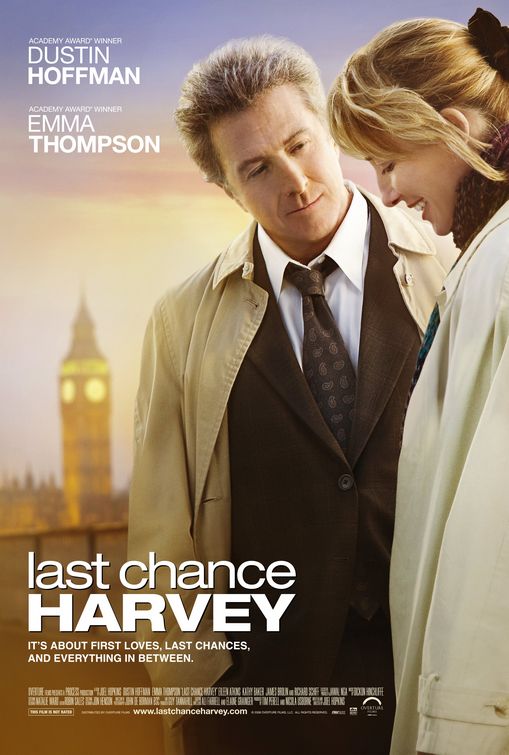
Last Chance Harvey (2008)

last_chance_harvey

Dustin Hoffman, Emma Thompson, London, England… attractions enough.  Can anyone ask for more?

… Well, yes…  how about a good plot.

The relatively new director/writer Joel Hopkins must have great confidence in his actors unleashing their charisma in lieu of a substantial plot… well, he’s lucky.  They do.  Despite a slow start, an uneventful and banal storyline reminiscence of past movies, I’ve enjoyed it, mainly because of the actors.  Just watching Hoffman and Thompson strike it up can lighten your day.  Their performance is worth the ticket, especially Hoffman.  Just watching his toast to the bride in the wedding of his daughter is worth the 92 minutes you sit in the theatre.

For their performance, both are nominees in their respective best acting category for a comedy or musical at the recent Golden Globe Awards.

Weddings are popular in recent movies.  Maybe because a wedding is the most sensitive occasion where families, past and present, have to come together, tempted to open old wounds, but also given the chance to mend relationships, or to simply love those for whom you haven’t got time in your life. A hotbed for drama to ensue.

Hoffman here plays Harvey, a divorced jingle writer facing a post mid-life crisis.  Not only is he hanging in a dead-end job, his life is one stale and stagnant bore.   The movie begins as he flies to London England for his daughter’s wedding. The excitement is soon doused by his realizing that the wedding ceremonies have all been planned without him. An embarrassment to his ex-wife Jean (Kathy Baker, The Jane Austen Book Club, 2007) and even to his daughter Susan (the fresh Canadian Liane Balaban, Definitely Maybe, 2008 ), Harvey nevertheless grasps the most critical moment to express his heart-felt endearment for his daughter at the reception.

Other than that self-assertion, and the father-daughter dance which is made possible only because his son-in-law is gracious enough to initiate, Harvey is totally slighted.  While drenched in self-pity, he meets Kate (Thompson).  She too is beginning to, (or has she already?), give up the chance of falling in love.   Kate is self-sufficient though, and probably feels she could fare better on her own, especially without her mother (Eileen Atkins, Evening, 2007) calling her every hour.  But of course, the rest of the story is predictable;  yet you still want to cherish the two great actors hitting it off, to witness Harvey winning Kate over.

Last Chance Harvey is like a stroll in the park.  It’s simple, light, relaxing.  I mean for both the viewers and the actors.  It sure looks like this is one easy job that the two of them can do even in their sleep.

But of course, for me as a viewer, I’d like to see more depth, more characterization, more twists and turns, more laughs.

I suppose it’s alright if you don’t mind coming out of a restaurant half-full… and you did enjoy the dessert.

~ ~ ½ Ripples


Tess of the D’Urbervilles (2008, TV): Part 2

tessThe “lite version” of Part 1 has turned into a heavy and somber continuation on PBS Masterpiece.  In this second and final part, screenwriter David Nicholls and director David Blair unleash the gloomy Hardy worldview unreservedly,  releasing the bleak and dismal elements that are almost too much for new year viewing.  The music has played a major and dramatic role in setting the tone and mood of the movie.  The cinematography too, in contrast to the lush green opening in the first part, has drawn us into a slough of mud, grey and black.  Hardy’s view of nature lamenting the tragic condition of his heroine is effectively conveyed, engrossing albeit a tad too melodramatic.

Kudos to David Nicholls for a meticulous job in adaptation.  He has kept the plot intact, for the most part faithful to Hardy’s book.  While a couple of incidents are left out, quite meaningful and symbolic too, but not to diminishing effects.  These include the sleepwalking episode, the Freudian slip of Angel’s innermost longing to love Tess despite all restraints.  The second being Tess’ mercy-killing of pheasants wounded by hunters, a sensitive portrayal of her own predicament.  However, Hardy would not have her killed off so easily.  Like the sadistic “President of the Immortals” in his view, Hardy the author wreaks havoc on his heroine, leading her into scenes after scenes of tragic events beyond her control.

tess-part-23

Tess can forgive Angel for his sexual sin, but he refuses to forgive her.  Actually, what sin has she committed if she was innocently violated by Alec D’Urberville when she was a young girl.  She loves Angel unconditionally, but his love for her is marred by constraints.  Later, she cannot avoid stalking by Alec, who keeps preying on her, and in her most needy and vulnerable, takes advantage of her again by manipulating her love for her family.  Whatever dignity she may have Tess ultimately sacrifices it for her beloved family.  But I admire Tess’  integrity, yes I like to see it as integrity, and not pride, that has sustained her until that very end when she finally has no choice but to yield to Alec’s sinister scheme.

It is for this reason that I find Gemma Arterton’s portrayal of Tess as just a proud and feisty gal to suit modern viewers incongruent with the book.  She may look innocent enough, but her performance at times is contrived and lacks the striving complexity required.  But her tears are effective and moving, I must say.  While Hans Metheson has delivered his diabolic role adequately, Eddie Redmayne as the losing lover at the end is a bit lacking.

And Angel, oh, what a tragic character.  The seemingly altruistic lover cannot stand the test against social mores.  In the book, the chapter describing the mutual confession of sins between the newlyweds is aptly entitled:  “The Woman Pays”.  What an irony of double standard!  This might well be the name of the novel.  While Hardy may have held an entangled and agnostic view of the transcendent, his social critique is incisive and spot-on.

the-stonehenge-1

At long last, Tess and Angel can enjoy marital bliss, but only for a painful, fleeting moment.  Tess says in her anguish:  “It is too late”,  the four words that define the tragedy of her life.  As a young girl, she did not understand the meaning of Alec’s sinister advances until too late.  And now as a married woman, her husband has come to her rescue too late.  I learn from the end notes of my Penguin edition that the original title of the book was Too Late, Beloved! What a heart-wrenching story.

PBS has a link to an online interactive Q & A with screenwriter David Nicholls.  In there he  answers the many questions viewers have regarding the process of turning book into film. I have enjoyed Nicholls’ previous adaptation of Blake Morrison’s memoir into the movie “And When Did You Last See Your Father”, starring Colin Firth and Jim Broadbent, an excellent and sensitive film.  I look forward to seeing more of Nicholls’ work in the future.

~ ~ ½ Ripples

Click here to go back to Tess of the D’Urbervilles, Part 1.

*****

2009 Golden Globe Winners

If you’re looking for the 2010 Golden Globes, CLICK HERE.

slumdog-golden-globe Photo Source:  Irish Times

Click here for the list of the 2009 Golden Globe winners

Slumdog Millionaire is the big winner of the night, garnering the golden globe in four categories:  Best Original Score (A. R. Rahman),  Best Screenplay (Simon Beaufoy),  Best Director (Danny Boyle), and Best Motion Picture – Drama.  Good to see the underdog win.  Hopefully the bright road leads all the way to the Oscars.

Another big winner is Kate Winslet, surprising even herself by winning both Best Supporting Actress (The Reader) and Best Actress (Drama, Revolutionary Road).  Her emotion was spontaneous… She even said sorry to her fellow nominees Meryl  (Doubt),  Kristin (I’ve Loved You So Long), and who’s the other one?  Yes,  Angelina (Changeling).  But ooh, she forgot Anne (Rachel Getting Married), who got all the hype from being recognized as the winner due to an earlier glitch on the GG website.

kate-winslet-golden-globe-2009 Photo Source: CBC.ca

Sally Hawkins nabbed the Best Actress trophy  (Comedy, Happy-Go-Lucky), beating fellow Brit  Emma Thompson (Last Chance Harvey).

After waited for a whole year, Steven Spielberg finally received the Cecil B. DeMille Award which he won in 2008  but was not presented due to the cancellation of the GG Awards ceremony. Or was it 50 years that he waited?  It was in 1959 that Spielberg made his first film, an 8 min. short.  He was 13.

Heath Ledger won posthumously Best Supporting Actor for The Dark Knight.  Chris Nolan accepted it on his behalf: “He will be eternally missed, but he will never be forgotten.”

Wall-E took the Globe for Best Animated Feature Film, deservedly.

As for the TV division, John Adams garnered four Awards, seeing Laura Linney, Tom Wilkinson, Paul Giamatti receiving their honors.

Overall, a big night for the Brits.

Click here to read CBC reporting.

Click here to see a clip of the highlights from BBC News.

*****