Heading to Cannes… in my mind 

I’m watching closely the Cannes Film Festival taking place right now. While my tour is virtual and imaginary, I look forward to TIFF in September when I go to Toronto, as some of these Cannes selections might reprise there.

So, if I were in Cannes now, this would be my list of films to watch (links for related films in the list below are to my Ripple reviews):

TÔI YAMANAMINO HIKARI (A PALE VIEW OF HILLS) directed by Ishikawa Kei 

The English translation quickly draws me in: A PALE VIEW OF HILLS is the first novel (1982) by Nobel Laureate Kazuo Ishiguro. An introspection of a Japanese woman living alone in England, spanning decades of life from post-WWII Japan to her resettling in a foreign country. Past memories intermingle with present day reality. Ishiguro is adroit in psychological narratives. I’m curious to see if the film lives up to his credit. Time to reread.

ELEANOR THE GREAT directed by Scarlett Johansson 

Scarlett Johansson’s directorial debut. Eleanor moves to New York City at age 90 for a fresh start and befriends a 19-year-old student. What an idea: A fresh start at 90. Even more amazing in real life, for 95 year-old June Squibb could well be the oldest actor still working, and just recently acclaimed for her performance in Thelma (2025). For those with a longer memory, Squibb was an Oscar nominee for best supporting actress playing Kate Grant in Alexander Payne’s Nebraska (2013). 

THE MASTERMIND directed by Kelly Reichardt

Kelly Reichardt is one of my all-time favourite directors. A look back at her works Wendy and Lucy (2008), Certain Women (2016)First Cow (2019), has piqued my curiosity in how she’d handle this art heist movie, Reichardt’s sensitive rendering of a more popular themed, mainstream subject. And the cast here is a huge attraction: Gaby Hoffman (Field of Dreams, 1989), Josh O’Connor (The Crown, 2020; Emma, 2020), and John Magaro (First Cow, 2019; Past Lives, 2023). 

Nouvelle Vague (NEW WAVE) directed by Richard Linklater

I was captivated by Linklater’s Before trilogy back in the days… Before Sunrise (1995), Before Sunset (2004), and Before Midnight (2013). But he’d shown his versatility by other more subsequent titles such as Boyhood (2014), and Hit Man (2023). Now in 2025, he dives into the French New Waves, his first French language film, creating a making-of feature in black and white to chronicle the shooting of Jean-Luc Godard’s classic Breathless (À Bout De Souffle), which premiered at Cannes in 1960. I anticipate an articulate and adroit handling of this homage to the French cinematic legacy. 

VIE PRIVEE (A PRIVATE LIFE) directed by Rebecca Zlotowski

We know Jodie Foster can speak French, but can she master the language in a full feature film showcased in Cannes, France. I sure hope so because the audience there can be very direct and umm… expressive in showing their love or disapproval. Foster plays a renowned psychiatrist investigating the death of one of her patients. The French cast includes Mathieu Amalric (The Diving Bell and the Butterfly, 2007; The Grand Budapest Hotel, 2014) and Virginie Efira (2023 César Awards Best Actress winner for Revoir Paris

Sentimental Value directed by Joachim Trier

Four years after The Worst Person in the World with which his star Renate Reinsve won Best Actress at Cannes and Trier went on to be nominated at the Oscars for his screenplay and his film representing Norway for Best International Feature Film, now director and star reunite to bring us a story exploring family, memories, and the power of art. Cast includes Stellan Skarsgard and Elle Fanning. 

Left-Handed Girl directed by Shi-Ching Tsou

What attracts me to this film, first is the title, then is the face of the little girl. What’s more intriguing is that Tsou’s directorial debut is produced, edited and co-written by Sean Baker, the US director who won the Palme d’Or last year with Anora, a feature that later went on to win five Oscars. The Left-handed Girl follows a single mother and her two daughters striving to adapt to a new environment in bustling Taipei as they open a stall at a night market.

Renoir directed by Chie Hayakawa

Hayakawa’s first feature film Plan 75 (2022) premiered at Cannes and won the Golden Camera award. It was Japan’s official entry to the Best International Feature Film at the Oscars in 2023. Renoir is Hayakawa’s second film, a coming-of-age story of a sensitive eleven year-old girl growing up in 1980’s Tokyo, living with a stressed-out mother and a terminally ill father. Cast includes Hirokazu Koreeda’s favourite actor Lily Franky (2018 Palme d’Or winner Shoplifters, Like Father, Like Son, 2013)

***
‘The Taste of Things’: the Country Kitchen as Vermeer’s Studio

At last year’s Oscar time, I was a little surprised that the buzzy Anatomy of a Fall wasn’t selected as the official entry by France to enter the race for Best International Feature Film. Instead, it was The Taste of Things. Now that I have the chance to watch it, I can understand why it was the choice and I totally agree with it. That it did not win seems immaterial, for its aesthetic value and the honour of being chosen to represent France make it a worthy accolade.

The Taste of Things is a delectable feature, a celebration of French gastronomy and its historic, culinary traditions, an exquisite and aesthetically riveting period film set in a country house. Vol-au-vent, pot-au-feu, roast rack of veal with braised vegetables… To say it’s a delicious food movie is just lowering the level of enjoyment, like eating an ice cream cone compared to being served baked alaska prepared by a gourmet. The film is not just about the taste of food, but of love, beauty, sensuality, and human connection, offering a deeply gratifying viewing experience.

Directed by the Vietnamese-French filmmaker Anh Hung Tran––whose first film The Scent of Papaya won a César Award in 1994 as well as accolades at Cannes––The Taste of Things sent Tran to Cannes again in 2023 and this time a Palme d’Or nominee and winning Best Director.

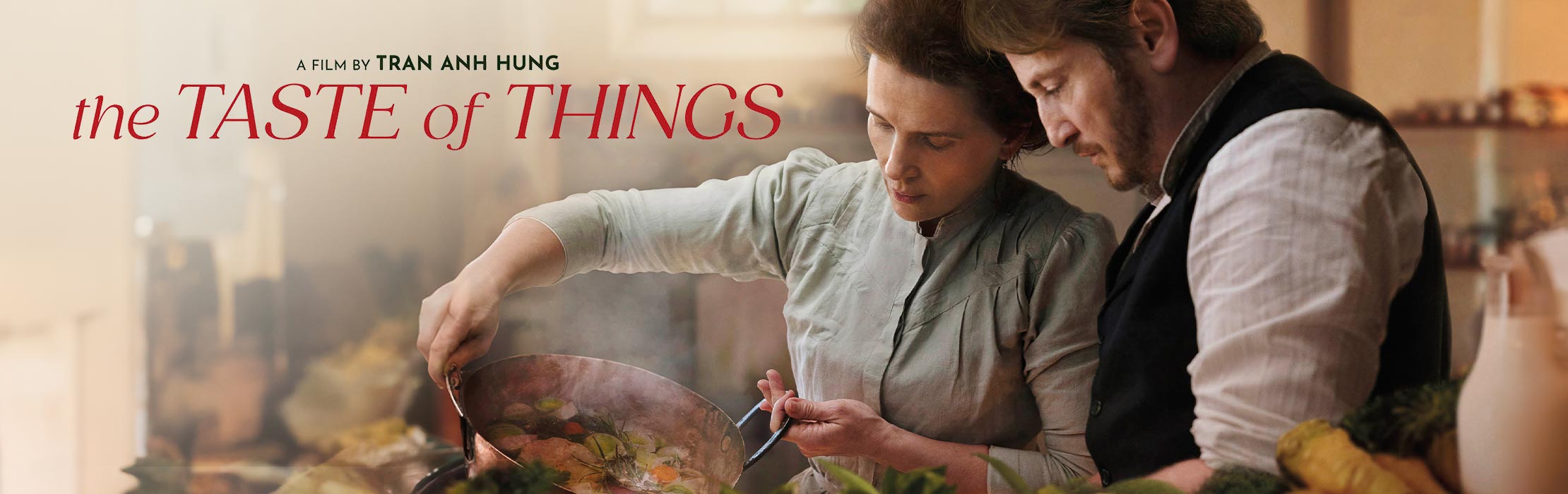
Tran reunited Juliette Binoche with her ex Benoît Magimel for the film. The two were divorced twenty years ago. Maybe a past relationship had some bearings on stirring up fond memories, for the pair exudes admirable chemistry on screen. Magimel plays the fictional gourmet Dodin Bouffant, nickname ‘Napoleon of gastronomy’, who resides in a country house during the late 19th century. His cook for twenty years has been Eugénie, superbly portrayed by Binoche, ethereal even in a rustic kitchen.

While Babette’s Feast (1988 Oscar’s Best Foreign Language Film) comes to mind readily, it’s the visual memory of Girl with a Pearl Earring (2004) that enhances my appreciation of The Taste of Things. Indeed, Dodin’s kitchen is like Vermeer’s studio, large window allowing natural light to pour in, the colour scheme of period costume and set design (Tran’s wife Nu Yên-Khê Tran), the naturalistic capturing of characters and their movement make it an exquisite, artistic production.

Inspired by Marcel Rouff’s novel La vie et la passion de Dodin-Bouffant, Gourmet (The Life and Passion of Dodin-Bouffant, Gourmet), writer director Tran wrote the screenplay of The Taste of Things as a prequel to Rouff’s novel, imagining the bond of love between Dodin and his longtime cook Eugénie. Dodin has proposed marriage to Eugénie time and again but is turned down every time. The twist comes when Eugénie falls ill and the reversal of roles emerges. Dodin begins to cook for her––love expressed through the ingenuity of new dishes meticulously prepared and the enjoyment of watching her savour his handiwork.

It’s interesting to note that there’s no music in the whole film. Massenet’s Méditation in piano version comes on only when the end credits roll. With no soundtrack, the essence is in the ambient sounds of nature, bird songs outside the country kitchen, and inside, the sounds of cooking, the crackling of the fire, and the gentle conversations among the characters as they prepare meals. In an interview, Tran mentions that: “The sound is the flavour of the picture. The picture has the beauty; the flavour of it comes from the sound.” 

Another crucial ingredient is the camerawork. Cinematography (Jonathan Ricquebourg) is the key in capturing the overall aesthetics and mood of the film. The camera is like a quiet observer, moving gently, often in long takes, following the characters in the kitchen, their movement like a choreographed sequence, smooth, seamless, serene and subtle. While the food preparation may seem complicated and time-pressed, the overall mood in the kitchen is always harmonious. The would-be apprentice, fourteen-year-old Pauline (Bonnie Chagneau-Ravoire) is particularly impressive. A tidbit: The French chef Pierre Gagnaire, owner and head chef of his eponymous restaurant, is the consultant for the movie. He himself has a role in there as well.

Overall, an artistic achievement to savour. Vermeer’s kitchen or Dodin’s studio? A fitting fusion of imaginary connections.

~ ~ ~ 1/2 Ripples

***

Thanks to Words and Peace for hosting Paris in July 2024

Note: All posts on Ripple Effects written by Arti, the real person.

***

Related Posts on Ripple Effects:

Anatomy of a Fall or how to dissect a marriage

Paris in July 2022: A Culinary Sojourn

Girl with a Pearl Earring: the painting, the novel, and the movie

Cannes Film Festival 2021, July 6-17

The pandemic has made armchair travellers of us. As many countries are still keeping Covid restrictions intact, some requiring quarantine for international arrivals, the best way to travel, at least for now, could well be sticking to your imaginary itinerary.

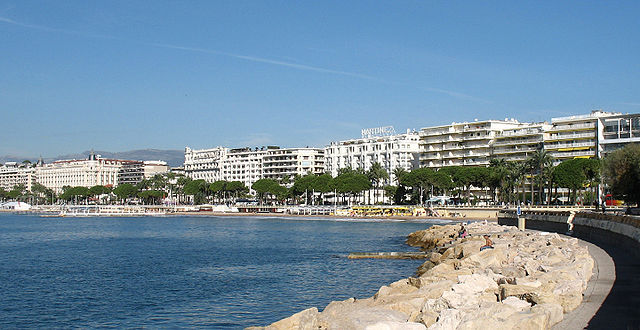
For the highly motivated, the prestigious Cannes Film Festival will resume July 6-17 this year, after a cancelled 2020 event. For filmmakers, this is good news, Cannes is bursting with films that have accumulated since 2019. So, put on your running shoes and head to the Promenade de la Croisette (photo above, source: Wikipedia Commons) and walk up the red carpet at the Palais des Festivals. After Covid, I’m sure the Cannes gate keepers will loosen up a bit with the high-heel code. Instead, Covid measures will be in place.

Saftey protocols include face coverings, social distancing, showing of full vaccination, if unable to provide, there’ll be Covid tests onsite. And, according to Reuters, while there will be ‘no kissing at the top of the red carpet’, festival director Thierry Fremaux said restrictions should not be too onerous.

Imagine you’re at the Palais des Festivals, the venue of the Cannes Film Festival, here’s what you’ll see…

Jodie Foster will kick off the 74th Festival de Cannes as the special guest of the Opening Ceremony. Foster first stepped on the red carpet at Cannes in 1976 when she was only 13 years old as the film she was in won the Palme d’Or, that’s Martin Scorsese’s Taxi Driver. This time, she will be awarded an honorary Palme d’Or.

You might also catch a glimpse of the jury president Spike Lee on the Croisette. Other celebs sightings could well be the stars in the official selections. The following are the ones I anticipate watching (For the full list, click here to the Cannes website)

______________

In Competition:

Annette (France) – Opening Film, Leos Carax directs Marion Cotillard, Adam Driver

Bergman Island (France) – Mia Hansen-Løve directs Mia Wasikowska, Tim Roth

Drive My Car (Japan) –  Ryûsuke Hamaguchi directs Hidetoshi Nishijima, Masaki Okada

Flag Day (USA) – Sean Penn directs Katheryn Winnick, Josh Brolin, Sean Penn

Memoria (Thailand) – Apichatpong Weerasethakul directs Tilda Swinton, Daniel Giménez-Cacho

The French Dispatch (USA) – Wes Anderson directs Timothée Chalamet, Elizabeth Moss, Frances McDormand and all the Wes Anderson usuals

A Hero (Iran) – Asghar Farhadi directs Amir Jadidi, Mohsen Tanabandeh

Un Certain Regard:

Blue Bayou (USA) – Justin Chon directs Justin Chon, Alicia Vikander

After Yang (USA) – Kogonada directs Colin Farrell, Jodie Turner-Smith

Cannes Premiere:

In Front of Your Face (Korea) – Hong Sang-Soo directs

Mothering Sunday – Eva Husson directs Olivia Colman, Colin Firth, Josh O’Connor

***

‘Our Little Sister’: A Respite from Summer Superhero Movies

The following is my review of the film “Our Little Sister” by the acclaimed Japanese director Hirokazu Kore-eda, published in Asian American Press. I thank aapress.com for allowing me to post it here on my blog.

For those who might think a Japanese film would never make it to your local cinema, check this list of U.S. screenings:

http://sonyclassics.com/ourlittlesister/dates.html

***

our-little-sister

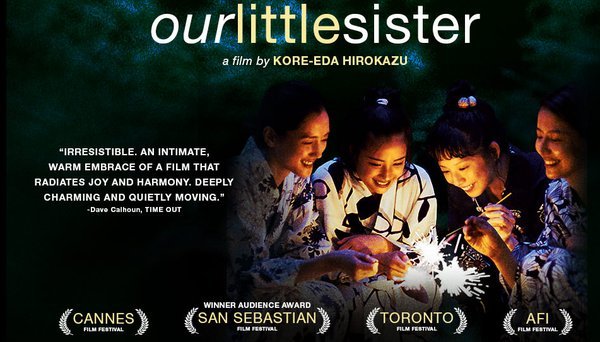
Premiering last year at Cannes, and later screened at other international film festivals the world over, Hirokazu Kore-eda’s “Our Little Sister” finally trickles into the local theatres of North American cities, which is timely. In a world rocked by tumultuous strife and unrests, this latest from Kore-eda makes a quiet solace, offering a taste of the ideal in human relationships and harmony despite brokenness.

“Our Little Sister” is Kore-eda’s most recent work after his 2013 Cannes Jury Prize winning “Like Father Like Son”. Following his usual subject of relationships in various family situations, “Our Little Sister” sees Kore-eda at the helm as director, writer, and editor of this production based on the popular Japanese graphic novel “Umimachi Diary” by Yoshida Akimi.

The three Koda sisters have not seen their estranged father for fifteen years. Sachi (Haruka Ayase), Yoshino (Masami Nagasawa) and Chika (Kaho) are now adults, living in the family’s traditional home his father had long deserted in the seaside town of Kamakura. His recent death sends the sisters to his funeral, awkwardly, meeting the woman who had stolen their father’s heart. But it is an inciting incident that changes all their lives. They meet their half sister, 15 year-old Suzu (Suzu Hirose). Herein lies the turning point for the four sisters. Moved by her little step-sister’s mature and quiet demeanor, or maybe stirred by her own older-sister instinct, Sachi invites Suzu to come away and live with them in Kamakura. Suzu gladly agrees.

The new Koda household now is a haven of happy sisterhood. Living under one roof, we see minimal conflicts and constant congeniality. Viewers from a different culture may find the saccharine relationships unrealistic. Are there not any conflicts at all? Of course there are. Kore-eda deftly leads us to some slow revealing. After three quarters of the 120-minute film, we begin to see inner turmoil rise to the surface.

Suzu had to take care of her father in his illness and seeing him to his last breath due to the incompetence of her mother; here is a young teenager bearing the burden of an adult. Now living with three older sisters, Suzu can finally enjoy the childhood she has missed. She quickly captures the attention of other students in her new school with her soccer skills, congeniality and maturity.

In the Koda household, Suzu is the angel of harmony, stirring up love and life. Kore-eda may have spent too much time on the leisurely-paced, day-to-day living such that viewers might feel the lack of conflicts to move the story along. I credit the style to Kore-eda’s realism and a candid camera focusing on the subtleties of nuanced interplay among the characters. Like his previous films “I Wish” (2011), the yearning for family connections of a young boy is shown by his actions and not so much by words, or in “Like Father Like Son” (2013), wherein conflicts are portrayed by contrasts and parallels. Here, while still nursing a deep resentment towards her father for deserting them years ago, Sachi struggles with the moral parallel now as she carries on a relationship with a married doctor at the hospital where she works.

Moral dilemmas, what to choose, how to live, and the search for identity are the issues Kore-eda’s characters have to deal with, but in a way that is quiet and gentle. He introduces us to other endearing characters in the town, adding numerous episodes to build up a human mosaic of harmony in the presence of brokenness and even death.

The scenic seaside town of Kamakura provides a beautiful backdrop for cinematographer Mikiya Takimoto (“Like Father, Like Son”) to shoot the film, reflective of the idyllic life that can be had, even in an imperfect world. The arching branches of the cherry blossoms, landscapes and seascapes mark the healing power of nature. But also like the petals of the cherry blossoms, which third sister Chika likes to pick up and gather in her palm, life is ephemeral.

Reminiscent of Ozu’s films, the passing train is a visual metaphor for the passage of time, changes, and the transience of life. To enrich the visuals, Yoko Kanno’s original score sweeps us through with warmth and tenderness, as a supporting voice telling the story. “Our Little Sister” is a heartwarming film for the unhurried heart to savor.


~ ~ ~ Ripples

***

Related Posts on Ripple Effects:

‘Like Father Like Son’: A Parent and Child Reunion

Yasujiro Ozu and the Art of Aloneness

Flight of the Red Balloon (2007)

In honour of Taiwanese director Hou Hsiao-hsien winning the Best Director award last Sunday at the 2015 Cannes Film Festival, I’m re-posting a review I wrote a few years back on Hou’s Flight of the Red Balloon (2007).

***

flight-of-the-red-balloon

In celebration of its 20th anniversary, the Musée d’Orsay in Paris has commissioned four notable directors to create a series of commemorative films. One of them is Olivier Assayas with his Summer Hours (l’Heure d’été) which I have reviewed.  Another is the highly acclaimed Taiwanese auteur Hou Hsiao-hsien. Flight of the Red Balloon is a unique piece of film art gently crafted by Hou in homage to Albert Lamorisee’s Oscar winning short Le Ballon Rouge (1956). Hou has long been garnering awards in international film festivals throughout Europe and Asia since the 1980’s, albeit relatively unknown in North America. Flight of the Red Balloon is his first French language film.

The little boy in this 2007 rendition is Simon (Simon Iteanu), a child growing up in the hustle and bustle of Paris. With an absentee father somewhere in Montreal pursuing his writing, and a frantically busy mother Suzanne (Juliette Binoche), Simon is alone in an adult world. Overloaded with her work as a voice-over artist in a puppet production plus other personal matters, Suzanne hires Song (Fang Song), a film student from Beijing, to look after Simon for her.

Suzanne is the embodiment of urban frenzy. As a single mother, she has to shuttle between home and work, deal with the eviction of a bad tenant in her lower apartment, confront her non-committal husband on the phone to Montreal, and connect with her daughter in Brussel, all in a day’s work. Simon is most perplexed.  “Why are you so busy, Mama?”, he asks.

song-and-simon

Song, on the other hand, offers the tranquility that is needed to balance life in the midst of chaos. As a film student, she uses her hand-held camera to record Simon’s activities, and by her quiet demeanor and calm observing, she reflects pleasure in the mundane, everyday trivialities called life. This is reality show without sensationalism.  Hou has ingeniously conveyed his perspective of realism with artistic overtone. No doubt, there is a lack of plot, suspense, or climax, but there is character contrasts, cinematic offerings in sights and sounds, and realistic, natural performance. Juliette Binoche has once again assured me why she is one of my favorite actresses. And no, you are not watching paint dry, you are watching life unplugged.

The red balloon forms the focal point of Hou’s signature long take. The almost God-like omnipresence hovering over buildings in the Paris skyline is a joyful symbol of childhood. Its silent drifting is as elusive as the fleeting memories of happiness. Even little Simon achingly remembers the pleasant days he had shared with his much older sister, who is now living in Brussel. We are all trying to catch and hold on to fond memories and meaningful relationships. Yet as the busyness of urban living numb our senses, we ignore and shove away what we think is a hindrance to our time, just like the people rushing out of the subway station, shoving away the red balloon. Only a child would try to catch and befriend it.

Complementing the cinematic artistry is the equally mesmerizing piano music, meditative, serene and restoring, setting the mood and the preamble of the film.  Other musical numbers are equally soulful. Click here for the official IFC site where you can have a taste of the sights and sounds of the film.

felix-vallotton-le-ballon-1899I particularly enjoy the ending. As Simon goes on a school trip to the art gallery of the Musée d’Orsay, the children gather on the floor to talk about Félix Vallotton’s 1899 painting Le Ballon, he leans back, slightly removes himself from his school mates, and lays on his back. As he looks up to the glass canopy of the museum ceiling, he sees it again, the red balloon, that omnipresence, watching over him, removed yet engaged, far away, yet ever so near.

~ ~ ~ Ripples

***

Other Related Posts on Ripple Effects:

Conversation with Juliette Binoche

Tuffing it out at TIFF14

Summer Hours (l’Heure d’été) by Olivier Assayas

Yasujiro Ozu and the Art of Aloneness

***

Like Father, Like Son (2013): Parent and Child Reunion

I had wanted to see this Japanese film since it came out last year. Missed it at TIFF13 last September, its North American premiere after winning the Cannes Film Festival’s Jury Prize in May. Glad it has finally arrived on Netflix, reaching a much wider audience than just festival goers, deservedly.

Like Father Like Son

Director Hirokazu Kore-eda wrote the screenplay based on a disturbing premise: what if after six years of raising your son, the hospital where he was born contacted you and told you that your child was switched at birth, and of course, they sent their apology.

The hospital officials do not take this lightly. DNA tests are done to confirm. They have a lawyer with them, arrange to have you meet the other parents, mediate and ease the proposed switch back, which they recommend with a six-month preparation period, preferably before the boys start grade one in school. They even find out who the nurse is that made the error; due to her own frustrations at the time she knowingly made the switch. Of course, she is deeply sorry for what she had done and duly prosecuted. Monetary compensations are arranged.

But all the above have absolutely nothing to do with easing the shock and alleviating the trauma afflicted upon the families. Formality and legality do not soothe the pain; apologies and money cannot compensate for the abrupt termination of relationships.

Director Kore-eda has treated the subject matter with much tenderness and charm. The cinematography is stylish, the children and adults are all captured in a realistic manner with splashes of endearing humour.

The two families come from very different social strata, and the two boys have been raised in opposite parenting styles. Interestingly, only one of the families seems to take this news much harder. Ryota Nonomiya (Masaharu Fukuyama) is a successful professional who spends most of his time in the glass towers of Tokyo busy at work. His son Keita (Keita Nonomiya), an only child, is raised in a protective environment. Mother Midori (Machiko Ono) is loving but also ambivalent about a husband who puts his career over his family.

The other family is a shop owner in a rural part of the country, their son Ryusei (Shôgen Hwang) is the eldest of three children. Father Yudai Saiki (Rirî Furankî) is every child’s dream. He spends his days playing with his children, fixes their toys, and exerts no rules, albeit Mom Yukari (Yoko Maki) might wish he could have spent more time working.

What makes a father? What makes a son? Fatherhood and bloodline tend to supersede all other factors in a patriarchal society like Japan. But the film reflects the point of view that not all families necessarily embrace such a value. Further, apparently there are different parenting styles even in a homogeneous Japanese society.

If there is ever a Japanese version of the movie Boyhood as we have seen here from Richard Linklater, Hirokazu Kore-eda would be the ideal person to direct it. Like Father Like Son follows his previous work I Wish (2011) in its sensitive and incisive depiction of a boy’s heart and yearning. He can tear apart the facade of societal formality–but in a most tender way–and lay bare the hopes and needs, the essence of parents child relationships.

I must give credits to Johann Sebastian Bach, and the late Canadian pianist Glenn Gould. The beginning of Bach’s Goldberg Variations has been used in numerous films, but every time the soulful slow moving piano melody comes out, I am moved, no matter how many times I’ve heard it, and in so many different genres of films. Just from memory, I can think of The English Patient (1996), Hannibal (2001), Shame (2011). It is so effective in augmenting cinematic moments without becoming clichéd.

Here, the Aria is well placed as director Kore-eda uses it as a motif to spur us into deeper thoughts. What makes a father, a son? What is more important, blood or relationships? What is the role of a wife and mother in a patriarchal society? What is the purpose of giving birth and bringing up a child? What is fulfilling and meaningful to us as human beings? Indeed, a motif that can strike a universal chord of resonance that transcends cultures.

~ ~ ~ 1/2 Ripples