Of Words and Spring

April is the month of empty dreams
Half the days gone
waiting for words and spring
still frozen ground
and on the screen
a frigid page as white as snow.

Brown could be the color of hope
After the white
for all I know
green is too much to wish for
I’m contented to see a patch
of dry and withered brown.

The sun is a perpetual sign
that there’s still hope
But it’s no herald of the seasons
for its presence comforts all year long
warming my blank and barren state
as I await for words and spring.

But Easter is an apt reminder
that The Word had come
spoken clear to half-frozen ears
His body hung on a lifeless tree
Blood and water flowed
onto parched and dusty earth

So what if no words come to me
That dreaded writer’s block
reigning the winter of sterility
numbing senses,
snatching thoughts,
seizing any sign of spring.

It’s not about a post or a blog,
Or even buds and melting snow.
The Word had come
lived and loved among us,
broken, bled, died and rose,
melting frozen hearts to greet
a new Spring and eternal growth.

Poem and Photos by Arti of Ripple Effects, April 2011. All Rights Reserved.


Reading the Season: Luci Shaw

Every year around this time, I try to stay afloat in the sea of chaos and consumerism.  My method of survival has been to seek a quiet haven where I can dwell upon the meaning of the Season.  I entitled my annual December post on this theme ‘Reading the Season’.

This year, watching the daring flash mob singing of Hallelujah Chorus in a shopping mall food court has jump started my quest for a spiritual respite.  In a time where the legitimate word is Jollity over Jesus, where Christ has been declared politically incorrect at Christmas, and where God is denounced together with Bigfoot and the tooth fairy in ads on buses, I want to mull on some subversive counter-reflections.

This time, I’ve steered my search towards poetry and found this collection edited by Luci Shaw.  It is the 1984 Regent College Publication of  A Widening Light: Poems of the Incarnation. (Click on link to read excerpts from Google Books.)


Luci Shaw has partnered with Madeleine L’Engle on her literary journey, including being her publisher, co-author, fellow poet and close writer-friend.  For years, I have enjoyed Luci Shaw’s poetry and her other works, and one time, had sat in her workshop learning the art and craft of journal writing.

A Widening Light is a collection of poetry by some of twentieth century prominent Christian writers and scholars, including C. S. Lewis, Eugene Peterson, Mark Noll, as well as lesser known but just as inspiring contributors.  My favourite in the collection are those from Madeleine L’Engle and Luci Shaw.

As a meager attempt to stoke the flame of faith and keep the Reason in the Season,  I’d like to share some excerpts from this collection here.

Made flesh
After the bright beam of hot annunciation
Fused heaven with dark earth
His searing sharply-focused light
Went out for a while
Eclipsed in amniotic gloom:
His cool immensity of splendor
His universal grace
Small-folded in a warm dim
Female space—
The Word stern-sentenced to be nine months dumb—
Infinity walled in a womb
Until the next enormity—the Mighty,
After submission to a woman’s pains
Helpless on a barn-bare floor
First-tasting bitter earth.

Now, I in him surrender
To the crush and cry of birth.
Because eternity
Was closeted in time
He is my open door
To forever.
From his imprisonment my freedoms grow,
Find wings.
Part of his body, I transcend this flesh.
From his sweet silence my mouth sings.
Out of his dark I glow.
My life, as his,
Slips through death’s mesh,
Time’s bars,
Joins hands with heaven,
Speaks with stars.

Luci Shaw


Some Christmas stars
Blazes the star behind the hill.
Snow stars glint from the wooden sill.
A spider spins her silver still

within Your darkened stable shed:
in asterisks her webs are spread
to ornament your manger bed.

Where does a spider find the skill
to sew a star?  Invisible,
obedient, she works Your will

with her swift silences of thread.
I weave star-poems in my head;
the spider, wordless, spins instead.

Luci Shaw


After annunciation

This is the irrational season
When love blooms bright and wild.
Had Mary been filled with reason
There’d been no room for the child.

Madeleine L’Engle

.

.

The risk of birth

This is no time for a child to be born.
With the earth betrayed by war and hate
And a nova lighting the sky to warn
That time runs out and the sun burns late.

That was no time for a child to be born.
In a land in the crushing grip of Rome;
Honour and truth were trampled by scorn—
Yet here did the Saviour make his home.

When is the time for love to be born?
The inn is full on the planet earth,
And by greed and pride the sky is torn—
Yet Love still takes the risk of birth.

Madeleine L’Engle


‘Reading The Season’ Posts over a Decade:

2020: Jack by Marilynne Robinson

2019: ‘A Hidden Life’ – A Film for the Season

2018: A Verse from Madeleine L’Engle’s The Irrational Season

2017: A Wrinkle in Time by Madeleine L’Engle

2016: Silence by Shusaku Endo

2015: The Book of Ruth

2014: Lila by Marilynne Robinson

2012: Surprised by Joy by C. S. Lewis

2011: Walking on Water by Madeleine L’Engle 

2010: A Widening Light by Luci Shaw

2009: The Irrational Season by Madeleine L’Engle

2008: The Bible and the New York Times by Fleming Rutledge 

2008: A Grief Observed by C. S. Lewis

***

Photos:  All photos in this post except “Water drops on spider web” are taken by Arti of Ripple Effects, All Rights Reserved.

‘Water drops on spider web’ is in the public domain, please refer to Wikimedia Commons for further  details.  CLICK HERE to go there.

Bernini’s Corpus and Modern Movies

The Art Gallery of Ontario holds more than 79,000 items in its collection, from 100 A.D. to the present. I’d just seen a tiny fraction of them during the six hours I was there. But if I’m to say which one has stirred the most ripples, it would be the bronze sculpture by Bernini, Corpus (The Crucified Christ), ca. 1655.

Successor of Michelangelo, the Italian Baroque architect and artist Gian Lorenzo Bernini had produced many famous Papal works. I’m impressed by how contemporary this 17th C. sculpture looks with its silvery-bronze color and its minimalist styling. Further, I’m amazed that it has been in private hands all the years… Like you might hear at a party, “Oh, I just happen to own a Bernini.” Having been ‘lost’ and then ‘found’, the sculpture was last in the possession of the Frum family who donated it to the AGO in 2007, estimated value at that time was $50 million.

Murray Frum, real estate developer and philanthropist, had earlier donated an entire African art collection to the AGO. To the general public, probably the most well-known member of his family is his late wife who died of cancer in 1992, the prominent CBC news journalist Barbara Frum.

Unlike the other art works of the crucifix that I’ve seen, the Bernini Corpus has no cross. Its 5 foot 6 inches life-size body hung in midair, supported only at the base.  There it is, right in the middle of the darkened gallery room displayed at eye-level, the suffering Christ suspended in silence. You can get near to the outstretched arms, you can see the loincloth blown to the side, and every minute detail on the body.

Without the backing of the cross, the image gives a weightier impression. You can go right up to the work, except of course you can’t touch it or take a picture, even though both were what I actually wanted to do… But at least, I could look and wonder in nearness.

The cruciform pose of Christ being hung on an invisible cross turns the literal event into a symbolic timelessness. The mere posture of two outstretched arms has long been associated with the essence of the cross: suffering, sacrifice, redemptive salvation. Such a visual icon has been used in many movies effectively. Whether you agree with the director’s message or parallel is another matter. Nonetheless, the archetypal cruciform pose is a powerful image when aptly embedded in a visual context.

Here are a few movies that I can think of where the cruciform pose vividly depicts a memorable moment. (Warning: The following section carries Spoilers.)

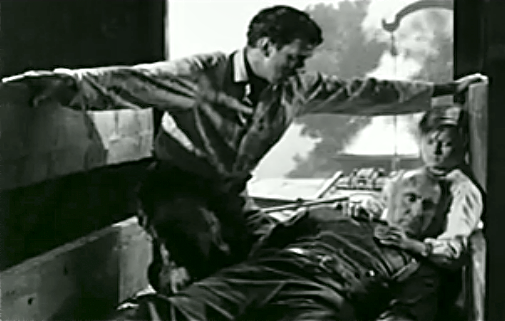
How Green Was My Valley (1941): John Ford’s visually contemplative work. When the shaft comes up from the underground mine carrying survivors of the explosion, you can see the rescuer Mr. Gruffydd in the cruciform pose. What’s more, you can even see the Pieta image:

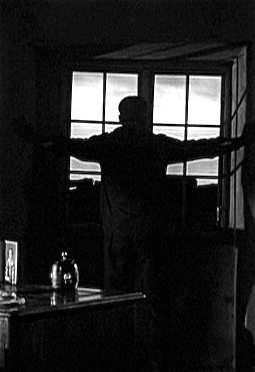
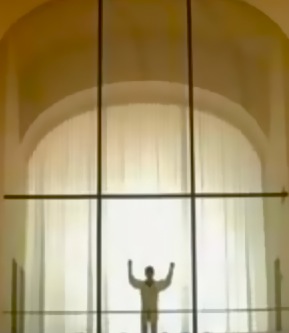
Through a Glass Darkly (1961): Ingmar Bergman’s classic. The estranged father David stretching his arms out in front of the window, sobbing and seeking redemption through family relationship: Cool Hand Luke (1967): After eating 50 eggs, it’s enough suffering for Luke (Paul Newman), a determined radical fighting a callous system in a hopeless prison. His graceful form is a clear contrast to the stark surroundings: The Graduate (1967): Ben (Dustin Hoffman) cries from above: “Elaine! Elaine! Elaine! …” Which yearning heart would not respond to such a passionate cry and be delivered in the nick of time out of a loveless union: Dances With Wolves (1990): Only when you’re not afraid to die, then can you live.  Lieutenant Dunbar (Kevin Costner) embraces death only to be ushered into a new life and adventure:

Shawshank Redemption (1994): Andy Dufresne (Tim Robbins) literally digs out a new path to salvation. This is the iconic scene of freedom and cleansing after climbing out from the sewage line: Superman Returns (2006): Superman (Brandon Routh) returning from Krypton to save the world. His famous line to Lois: “You wrote that the world doesn’t need a savior, but everyday I hear someone crying for one.” Gran Torino (2008): Walt Kowalski (Clint Eastwood) laying down his life to save his young friends from a neighborhood gang, in search of self-redemption: … I’m sure you can think of more.

***

Related Posts you might enjoy:

Alex Colville and the Movies

The Art Gallery of Ontario

***

Of Film and Faith

Now, the reason to be… in Vancouver.   As I mentioned in a previous post, I was at Regent College for two weeks in May to learn the language of film, and its interface with elements of theology.  I came home much gratified.  I’ve delayed writing about the course per se because it would mean the difficult task of capturing the Genie of ideas back and recapping the bottle.  But I know I need to do it sooner or later, for I want to record down a learning experience that’s, well, let’s just say epiphany is not too far-fetched a word.  It could well be that the little I knew initially made it more gratifying as I could gobble up more to fill the empty vessel.

My thoughts are random here, but that might be the best way to capture whatever that comes to my mind that I think is important and meaningful.  Allow me to ruminate freely.

The language of film is multi-faceted, but it more or less can be condensed into the phrase mise-en-scène: what the director puts into the scene by means of setting, camera angle, lighting, staging, wardrobe, blocking… all the cinematic elements.     Like the artist of a painting, the director conveys his point of view and aesthetics through a frame or a scene.  And for us viewers, it’s a matter of honing the skill of observing the obvious, and the not-so-obvious.  Our pleasure is to decipher and savor that which is created on screen.   It all relates to the Auteur Theory, the director as the author, the concept of caméra-stylo, the camera as pen.

The power of the cinematic pen is mighty indeed.  Take the Disney movie Bambi for example.  The screening of Bambi resulted in a huge decrease of hunting licenses sold after it was released, and subsequently the term ‘Bambi Effect’ was coined.  Or, the movie Billy Elliot, which resulted in a significant increase in ballet school enrollment.

***

Knowing the history of motion picture is essential to appreciate films, and this is the major emphasis of the course.  I’ve come to appreciate the pioneers of motion pictures whose works have become the exemplars and the artistic foundations of modern cinema: Vincente Minnelli, Preston Sturges, Charles Chaplin, Fritz Lang, John Ford, Orson Welles, Frank Capra…

Fjilm Noir Third Man Alley

Further, it’s most interesting to trace the influence of German expressionism has on Film Noir, how the idea behind Edvard Munch’s The Scream can effectively be transformed into cinematic expression, revealing the inner state of modern man.

Over the intensive two-weeks, we’d only have time to cover mostly black and white features, savoring their richness in techniques and their multi-layered meaning.  I’ve come to understand why the years 1930  to 1946 are called “The Golden Age of Cinema”.

And where does theology come in?  While knowing some Kierkegaard and Buber might help, but basically the content is very accessible.  Herein lies the ingenuity of the auteurs and their works.  The process of exploring the transcendent in the movies viewed by the populace is just fascinating.
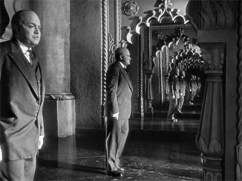
Citizen Kane

I’ve learned how Citizen Kane (1941, produced when Orson Welles was just 24!), generally considered one of the best movies of all time, like the Vanitas still life of Vermeer’s time, expresses the theme of Ecclesiastes, and asks the question, “So one has gained the whole world, then what?”

Another theological element is the archetype of the Christ figure, and I’m surprised to find it quite prevalent in many of these early motion pictures.  I admit I’ve never watched a Charlie Chaplin movie in its entirety until now.  In The Kid (1921) and City Lights (1931), the savior figure is humorously portrayed in the story, and the concept of unconditional love warmly illustrated.

City Lights

This archetype also appears  in Frank Capra’s  Meet John Doe (1941), where a main character declares the universal significance of the first John Doe two thousand years ago dying for all John Doe’s.  Visually, I’ve learned to identify the Pietà and the crucifix image in the composition of a frame in several of the features, an example being How Green Was My Valley (1941, John Ford).
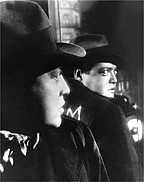
M by Fritz LangMotion pictures are an effective medium to convey the human condition.  In Fritz Lang’s thriller M (1931), the letter obviously refers to the murderer, a child killer that the whole town was after.  The not-so-obvious is the depiction of universal depravity, from the police to the masses, the message that we’re all complicit in the moral fabric of our society.  Similarly, Mel Gibson puts himself in his movie The Passion of the Christ (2004) as the Roman soldier nailing Christ on the cross.

Fast forward to the 80’s, I was introduced to the renowned Polish auteur Krzysztof Kieslowski.  It’s amazing how in Decalogue (1988), the essence of The Ten Commandments and their relevance in contemporary society are transformed into ten independent, one-hour stories and broadcast as a prime time TV series in Poland.  Decalogue is an artistically crafted and poignantly executed production that has won numerous international awards.  But would we see such kind of meaningful work as a prime time TV program here in North America?  The answer is obvious.

On the last day, I’d the chance to savor Babette’s Feast (1987), a highly acclaimed movie from Denmark (Oscar Best Foreign Language Film, 1988).  Based on a story by Isak Dinesen (Out of Africa), Babette’s Feast is a cinematic metaphor of goodness and freedom.  Its unique story and powerful visual images richly convey the theme of grace and mercy, and the liberating power of compassion.  The table prepared before us is free, sumptuous and abundant, but it takes an open heart of full acceptance and gratitude to fully enjoy it.  An inspiring film to wrap up my sojourn, creating resonance for the journey ahead.

Babette's Feast

***