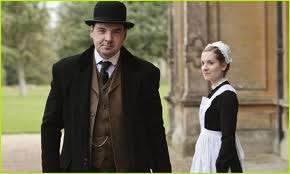
Quotable Quotes from Downton Abbey Season 3

These are some of my favourite lines from Season 3. They remind me of why I enjoy Downton Abbey in the first place, the humor and subtext, and the superb cast that delivers every time.

Episode 1

The family must never be a topic of conversation. – Violet Crawley

Miss O’Brien, we are about to host a society wedding. I have no time for training young hobbledehoys. – Mr. Carson

Daisy: You’ve still kept me here with a dishonest representation.
Mrs. Patmore: Oh dear. Have you swallowed a dictionary?

Don’t worry about me. I’m an American. Have gun, will travel.  – Cora

Have gun will travel

Forgive, perhaps. Forget, never. – Violet

Come war and peace, Downton still stands and the Crawleys are still in it. – Martha Levinson

Mary, dearest Mary. Now, you tell me all of your wedding plans. I’ll see what I can do to improve them.  – Martha

Edith: There you are. I see you’ve said hello to Grandmama.
Violet: She is like a homing pigeon. She finds our underbelly every time.

I should hate to be predictable. – Mary to Matthew, at her wedding altar

Episode 2

Let me call you sweetheart...

Nothing succeeds like excess. – Violet

Are you not popular downstairs? – Robert to Thomas

Some animals adapt to new surroundings. It seems a better choice than extinction. – Martha to Robert

Well, in my opinion, to misquote Dr. Johnson, if you’re tired of style, you are tired of life. – Mr. Carson

Episode 3

At my age, one must ration one’s excitement.  – Violet

Let him go, let him go. You know he’s right. Don’t stop him doing the only sensible thing he’s come up with in months. – Violet to Edith at the altar

Being tested only makes you stronger. – Cora to Edith

If the poor don’t want it, you can bring it over to me. – Violet to Carson re. the wedding food.
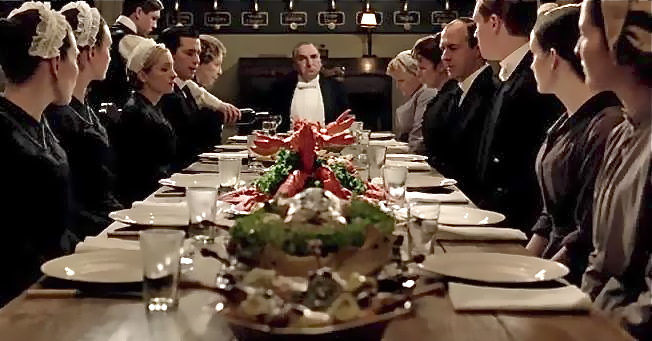
Wedding gourmet for downstairs

And the food? Here it is… probably the best quote of the Episode. In answering Alfred’s remark of: Is this all we’re getting? Just these picketty bits:

These are canapés, Alfred. For your first course, some truffled egg on toast, perhaps? Some oysters a la Russe? There’s lobster rissoles in Mousseline sauce or Calvados-glazed duckling, or do you fancy a little asparagus salad with Champagne-saffron vinaigrette? – Thomas and Mrs. Patmore

Episode 4

Robert: What a harsh world you live in.
Tom: We all live in a harsh world. But at least I know I do.

Carson: But Alfred is very good, you know. He’s very willing. Even if he is Miss O’Brien’s nephew.
Matthew: Clearly, nothing worse could be said of any man.
 

Episode 5

Cora: Sir Philip mustn’t bully him into silence.
Robert: My dear, this is just Clarkson’s professional pride like barbers asking, “Who last cut your hair?”

A woman of my age can face reality far better than most men. – Violet

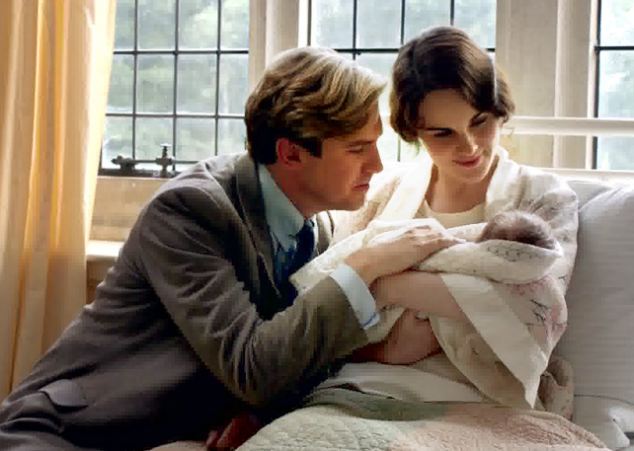
Sybil, Tom & baby

Edith: She was the only person living who always thought you and I were such nice people. Oh Mary… Do you think we might get along a little better in the future?
Mary: I doubt it. But since this is the last time we three will all be together in this life, let’s love each other now, as sisters should.

Episode 6

There hasn’t been a Catholic Crawley since the Reformation. – Robert

Anyone who has use of their limbs can make a salmon mousse. – Mrs. Patmore

You know the trouble with you lot? You’re all in love with the wrong people. Now take those upstairs! – Mrs. Patmore

Robert: I’m flabbergasted.
Cora: You’re always flabbergasted by the unconventional.

Dr. Clarkson: So you want me to lie to them and say there was no chance at all?
Violet: Lie… is so unmusical a word. I want you to review the evidence honestly and without bias.
Clarkson: Even to ease suffering, I could never justify telling an outright lie.
Violet: Have we nothing in common?

Episode 7
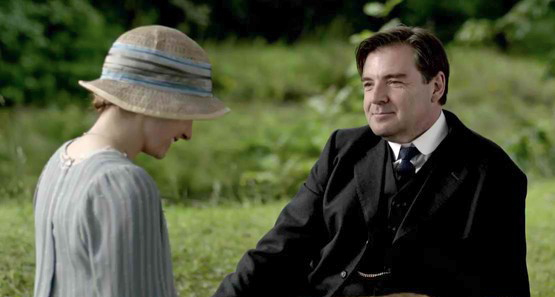
Bates and Anna

But in the meantime, you just rest. Stay in bed, read books. – Robert to Bates

Convince me again. – Matthew to Mary

I do think a woman’s place is eventually in the home, but I see no harm in her having some fun before she gets there. – Violet

What is The Scarlet Letter? – Violet

Robert: Second [condition], you will both admit it when you realize you were wrong.
Violet: Oh, well that is an easy caveat to accept because I’m never wrong.

What’s the matter, Robert? Are you afraid you’ll be converted while you’re not looking? – Cora

Episode 8
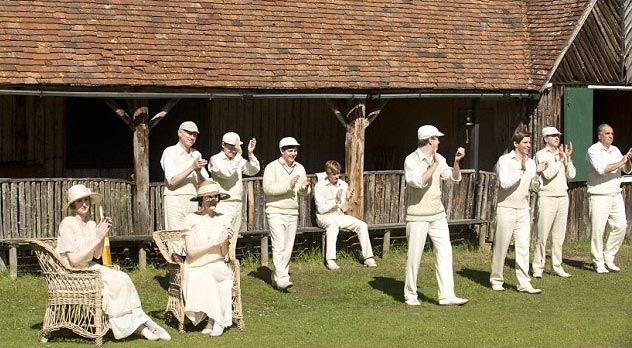
Cricket Match

Matthew: Bates must count himself lucky to be out of it [cricket match].
Anna: I think he’d like to walk normally, sir, even if playing cricket was the price he had to pay.

She hates London, so she’s coming to a great-aunt in Yorkshire to have a good time. How original. –Isobel to Violet re. Rose

Isobel: Of course, if you had had to sell Charlie to the butcher to be chopped up as stew to achieve the same ends, you would have done so.
Violet: Happily, it was not needed.

Episode 9 Finale

Edna: He’s nice looking, I give him that.
Mrs. Hughes: I don’t think you’re required to give him anything.

Don’t dislike him before you know him. That’s the hallmark of our parents’ generation, and I forbid it.  – Matthew to Mary, re. Gregson.

What I want is for her [Rose] to know that family can be a loving thing… Love is like riding or speaking French. If you don’t learn it young, it’s hard to get the trick of it later.  – Shrimpie

Matthew: I fall more in love with you every day that passes.
Mary: I’ll remind you of that next time I scratch the car.

Downton Abbey Christmas Special

*

Oh, but it’s more than just a scratch in the car. We’ll forgive, but not forget. – Arti

*

CLICK HERE to Quotable Quotes from Downton Abbey Season 1 and 2

***
Downton Abbey Season 3: Episodes 6 & 7 Finale

WARNING: MAJOR SPOILERS in this post.

Apparently I’m one of the last ones to find out what happens at the end of Season 3. Only a couple of weeks ago, I stumbled upon this video of the Downton Cast meet the Press after their SAG awards. Mrs. Hughes spilled the beans about Dan Stevens not coming back for S4 and what a bombshell for me.

I Googled it right away and found, lo and behold, it was already a known fact since last December. Of course, that’s when Britain had their first round of the Season 3 experience. So now the ripples have finally reached North American shore. What do you call it? Delayed shock? And we’ve just witnessed it. People, face the fact, Matthew Crawley is no more. Now, we have one whole year to process it, let it sink in, accept the fact, and move on to the next Season.

Just a brief recap of these last two episodes.

Episode 6

Mr. Bates is finally released from prison. All your Free Bates posters can now come down. While Thomas is the last one to join the welcome home party, ironically he is the one receiving the good graces of Bates and others. O’Brien has no place in any plot against anyone, for she has her soapy track record. She should have known better.

The clubbing fling of young cousin Rose with a married man old enough to be her father takes us away from Downton a while. The Gatsby-like 20’s atmosphere reminds us what the rest of the world is like if one is not a Downtonite.

And way to go for Edith, finding something to do before she is permanently settled into her destined role at home, at least this is what Granny Violet would have wanted for her Grand-daughter.

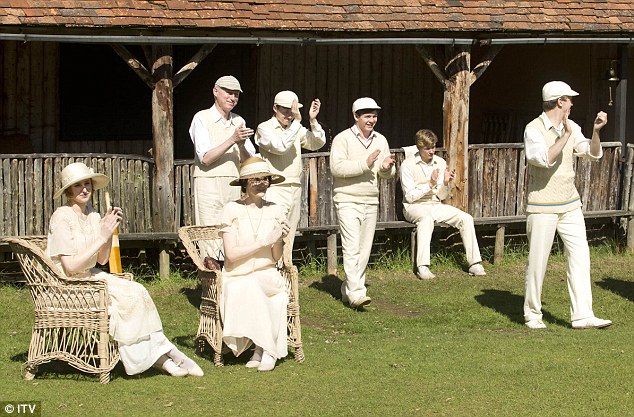
The Cricket Match

The cricket match is a visually beautiful scene. I love the colour scheme. The character that starts to come alive? Molesley. Wait till E7 where he will show what he’s truly made of.

Episode 7

By now we all know the ending. We have a whole year to forgive and forget. But of course, we’ll treasure the memories… The Scottish vacation takes us away from Downton for a short while to let us see how the usual characters behave in different situations. And that’s when we find O’Brien meeting her equal, Anna’s hidden talents, and Molesley’s true colours. Never underestimate a couple gulps of whiskey can do… total emancipation. Never thought Molesley can be so alive.

It’s the country fair again. Last year, Mrs. Hughes turned down an old crush there. This year, it’s Mrs. Patmore’s turn of stopping just in time of being fooled. Jimmy and Thomas come to an understanding that despite differences, they can still be friends. And Dr. Clarkson and Isobel Crawley? What will happen to them now? And oh, what will Mary name the young heir of Downton? Baby Matthew?

Downton Abbey Christmas Special

If you find Sybil’s death the saddest episode, I don’t know what to call this one. Matthew Crawley, the madly-in-love young husband and day-old new father, terminating his contract with a senseless car crash. After three Seasons, his demise covers less than a minute of screen time. What a difference between the endings of S2 and S3.

All these just show the cruel reality of media contracts and the inevitable plot treatment faced by TV script writers… killing off a character when his/her contract is up. Do you feel betrayed? Short-changed? Are you looking forward to Season 4? Will it begin with a funeral? Can you imagine how everyone will react… I think of Isobel first, then Mary, and Tom who has just found a friend in his new place in Downton. What about Robert, can he wait for another twenty years for the baby heir to grow up?

But most tricky of all… what will happen if another character or characters decide not to renew their contract? Wait, WWII is coming up soon, now that’s easy enough.

***

CLICK on the following links to:

Season 3: Episodes 4 & 5

Episodes 2 & 3 

Episode 1

Quotable Quotes from Downton Abbey (S1 & S2)

***

Downton Abbey Season 3: Episodes 4 & 5

Spoilers Alert! But if you’ve seen the Episodes, throw in your 2 pebbles and make some ripples.

The SAG Win

First off, a huge CONGRATS to the cast of Downton Abbey for their win in the Screen Actor’s Guild Award for Outstanding Performance by an Ensemble in a Drama Series on Sunday, Jan. 27, 2013. Too bad there were only five of them there. An unexpected win, no doubt. Click here to view Mrs. Hughes’s acceptance speech and Tom’s big smile.

Episode 4: Saddest Scene

Now, to a sombre tone. Episode 4 left me stunned and speechless. It will go down my TV viewing history as the saddest scene. Eclampsia was even trending on Twitter, I suppose. But if you Google the word, Sybil and Eclampsia will show up on the first page.

Ok, just a little deconstruction. At least this is how I take myself out of a daze. Sybil’s post-partum death is I’m sure a real life contract issue, and not the misdiagnosis of the high brow Sir Philip from London’s Harley Street. The last time I checked IMDb, Jessica Brown Findlay is filming with Russell Crowe in Winter’s Tale. So, Downton is a nice springboard.

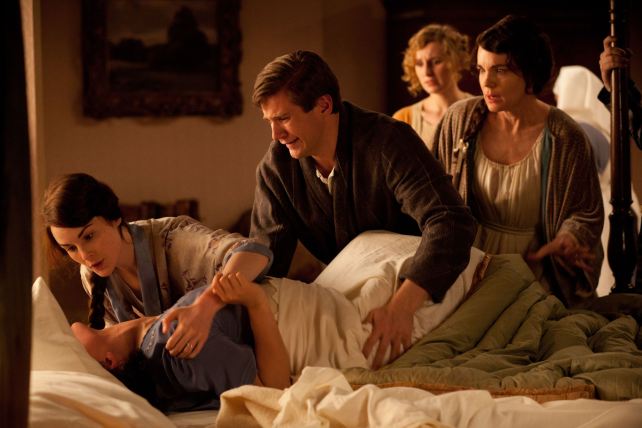
Nevertheless, we will remember her as the most angelic character of them all. The deathbed scene is heart-wrenching. Did you not notice the positions of all the characters? The two doctors turn their backs, friends in need indeed, thanks. Matthew holds onto the bedpost wincing helplessly and Robert stands there stunned. Mary tries to be helpful but has to step back at the end, for the scene belongs to Tom and Cora.

CHRISTMAS 2012 Review 113034

Reaction downstairs is moving too, especially with Thomas. Can he not be a changed man just like the two remaining Crawley sisters, pledge to get along better? But he is a bit changed already, hasn’t he? It’s Mrs. O’Brien who remains the schemer now.

And I must mention the impressive performance by Maggie Smith as the grieving grandmother. Her posture alone is heart-breaking. But soon we find she rises above the tragedy and takes the rational helm of the family. “Cherish our memories, and the child.” She tells Robert.

Episode 5: Quotable Quotes

Just when I thought E4 is a good one, E5 gets even better. Every storyline captures my attention. We have numerous one liners from almost everybody. E5 once again confirms why I like Downton Abbey. Let these dialogues speak for themselves…

Violet Crawley: Grief makes one so terribly tired.

Go home, lie down, life goes on.

And what does life bring? A rift on religion in the Crawley family. Downton writers sure know how to stir the pot, plot. Tom is going to christen his daughter, baby Sybil, in the Catholic tradition. Robert understandably is outraged. He knows his history.

Robert: There hasn’t been a Catholic Crawley since the Reformation!

But Robert, Tom Branson is not a Crawley. For the first time, Robert feels he has totally lost his daughter, and his authority.

Not only that, Robert has lost control of all the ladies in the house, as he finds them sitting at Isobel’s table being served by Ethel the ex-prostitute. More outrage. Flabbergasted.

Cora: You’re always flabbergasted by the unconventional.

Robert, have you forgotten your fling with your former maid, what’s her name?

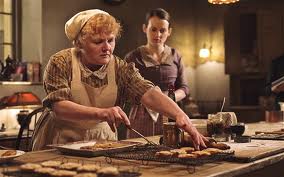
And all this cannot have happened without Mrs. Patmore going over to help Ethel to fortify her career move as Isobel’s cook.

Ethel: Can I really do it? Salmon mousse?

Mrs. Patmore: Anyone who has use of their limbs can make a salmon mousse.

Easy.

Ethel and Mrs. Patmore

Meanwhile downstairs, Mr. Carson, Robert’s alter ego, is equally indignant with his staff, from associating with an ex-prostitute, to Fox-Trotting, to the giggling of the maids. Don’t they learn any manners from home? Flabbergasted.

Mrs. Hughes: Perhaps their mothers don’t want them in service.

Mr. Carson: What are they supposed to do? Become BANKERS and LAWYERS?

Violet Crawley can certainly add, ‘so middle class.’

As for the vibes downstairs, Daisy, Alfred, Ivy, Jimmy, and Thomas form a love pentagon. Mrs. Patmore is most sensitive with this sort of things.

Mrs. Patmore: You’re all in love with the wrong people. 

And Violet Crawley, she’s always the most rational of them all. Robert and Cora not on speaking terms, the marriage of the grieving couple is crumbling. Grief does not only make one tired, but tired of one another, and let blame set in. Violet knows where the key lies (no pun intended). She persuades Dr. Clarkson to research on Eclampsia to denounce his previous diagnosis.

Dr. Clarkson: Even to ease suffering, I could never justify telling an outright lie.

Violet: Lie is so unmusical a word… Have we nothing in common?

Well, Dr. Clarkson just might not have needed to lie, for as a Tweet says, even a Caecarean Section could not have prevented Eclampsia and death in Sybil’s case in their time, citing this medical article.

You see why Downton Abbey is amazing? Its viewers would go all out to fuse facts and fiction, living vicariously with its characters.

While E4 ends with mourning, sending viewers to devastation, E5 ends with hope and good news. After all his ordeals, Mr. Bates will finally be released from prison. Thanks to the investigative work of Anna. Now, Mr. Bates Legal Team on Twitter can disband, and the real life ‘Free Mr. Bates’ signs can come down.

***

THANKS FOR ALL YOUR COMMENTS AND NOT LETTING OUT ANY SPOILERS.

***

Other Downton Posts:

Downton Abbey Season 3: Episode 6 & 7 Finale

Downton Abbey Season 3: Episodes 2 & 3

Downton Abbey Season 3: Episodes 1

Quotable Quotes from Downton Abbey

Lady Almina and the Real Downton Abbey

***

Downton Abbey Season 3: Episodes 2 & 3

Posts like this should go without saying: Spoilers Alert!

After a shaky start in E1, slowly picks up in E2, Downton Abbey is back on track and full steam ahead in E3. What a relief! I want to see it go on and on, season after season. But I would not wish to see it just ride on its popularity. I want the Downton feel back, that appeal which first captivated me from Seasons 1 and 2. I can feel it again in last night’s E3.

Previously in E2, the main event is the Runaway Groom: Sir Anthony Strallan gets cold feet and jilts Edith at the altar. Dramatic? Yes. Contrived? No. It takes courage for him to run away like that. Of course, he should have done that long ago and not wait till everyone is all dressed up. But I know, he isn’t sure before. I give him credits though for stopping the new career of Edith right there at the altar. And he needs to get out of there quick, before he changes his mind again.

I trust Sir Anthony is altruistic, thinking only of Edith. It’s not right for her to give up her life for an old man even though she sees him as her life work. Violet Crawley is quick to step in, contradicting Robert, with the three words that show who is still in charge: “Let him go.” With this dramatic scene, all else in E2 seems to fade by comparison.

The fancy wedding cuisine goes to the servants downstairs, and to the poor. But if they don’t want it, Violet Crawley wants them doggie bagged.

Gourmet wedding cuisine for downstairs

And oh yes, a letter suddenly appears, from Lavinia’s dead father, its content releases Matthew of his guilt for inheriting the large sum. So he is now free to chip in to save Downton Abbey from appearing on the real estate page in the paper. Does this deus ex machina device qualify the show as melodrama, or just sloppy screenwriting? Oh, who cares, the Crawleys don’t have to move, and that’s what’s important. A big hassle, downsizing. You can ask the Dashwoods of Sense and Sensibility, no fun moving from a big mansion to a little cottage.

Good news for Mrs. Hughes, it’s benign something something, not cancer. The relief is equally shared by Mr. Carson. Good man, the news sends him back to his former showbiz days, singing his heart out. But the kind words from Cora Crawley should not go unchecked. I’m sure Mrs. Hughes will be forever grateful: “You will stay here, and we will look after you.” Even though not getting cancer is still better.

**

With that we move on to E3, that’s where the drama begins, and the plot thickens.

Watching E3, I’m captivated once again as in previous Seasons. There are witty LOL lines, mostly from Violet Crawley as always; there are some not so LOL lines that are equally well said by others.

First off, I’m glad that Edith is no Ms. Havisham. Life is too good to be bogged down, even when you’re being jilted at the altar. And, as her mother says, testing can only make you stronger. That turns her from a jilted bride to women’s suffrage advocate. Take that, Ms. Havisham. So Edith has shifted her life purpose from taking care of an old man donning an arm sling to writing letters to the editor.

But the main event here in E3 involves Tom Branson, the former Downton chauffer turned Downton son-in-law turned Irish revolutionary. Woa, what drama. He escapes from Dublin police and slips back into Downton, leaving Sybil to run for her life. Oh, it’s all planned. But still, herein lies the dilemma. He wants to go back to Dublin but he’ll be arrested as soon as he sets foot there. Sybil wants to give birth in Downton, peaceful and safe, two words that are not in her husband’s dictionary.

Some memorable lines come from Tom’s confrontation with his father-in-law Robert Crawley, patriarch of Downton, who seldom wears anything else other than a tux, choice of wardrobe being black or white ties, with clout in high places, albeit still a good man he is.

Robert:  What a harsh world you live in.

Tom: We all live in a harsh world, but at least I know I do.

Something Robert would not have understood.

Ethel saying goodbye

Ethel the former maid turned prostitute can surely understand. It is a harsh world she lives in, having to raise a child with little means. Of course it’s heart wrenching to have to give up her son, handing him back to his grandparents, out of her own choice this time, knowing the child will have the best opportunities with them; with her, he has no chance. She had fought to keep him, tried to raise him on her own, but it didn’t work. That’s what makes it sad. It is poignant to see her wave goodbye as the coach moves away, with Mrs. Hughes and Isobel Crawley standing behind her, supportive yet each holding a different opinion about her choice.

New footman Jimmy is the main attraction downstairs, a timed bomb I can tell. And Mrs. Patmore finally gets a new kitchen maid to lighten up Daisy’s work load. But with this new gal, I’m sure Daisy regrets having started labor grievances. Alfred wants to make the new kitchen maid feel at home in no time. Be careful what you wish for, Daisy, you just may get it, nemesis in disguise.

I haven’t mentioned Bates and Anna you may have noticed. I know, Bates legal team is working day and night on Twitter, and free John Bates signs in the real world. But for dramatic effects, and a change of scenery from the lofty and elegant Downton Abbey, we see Bates debased in a prison cell. Here’s another person to agree with Tom. It’s a harsh world outside Downton. But then as Cora Crawley has said, testing would only make you stronger. Bates and Anna are exemplary in living out this motto. That Julian fellow sure knows how to lead and tease. With Bates and Anna madly reading each other’s letters after weeks of non-communication, Episode 3 ends, leaving us wishing the week would just fly by.

***

Other Related Posts:

Downton Abbey Season 3, Episode 1

Season 3, Episodes 4 & 5

Season 3, Episodes 6 & 7 Finale

Quotable Quotes from Downton Abbey

Lady Almina and the Real Downton Abbey: Facts that Give Rise to Fiction

***

Downton Abbey Season 3: Episode 1

CLICK HERE to Season 3: Episodes 2 & 3

When the pre-show outshines the main feature, I’m beginning to have a little concern.

The episode “The Secrets of Highclere Castle” is a fantastic one-hour focus on the history and present day Highclere Castle, the setting of Downton’s Crawley mansion. The information is largely collected in the book written by Countess Fiona Carnarvon, Lady Almina and the Real Downton Abbey: The Lost Legacy of Highclere Castle. Read my review of the book here. And you can watch the whole one hour feature here.

Lady and Lord Carnarvon
Lady Fiona and Lord George Herbert Carnarvon

I have high praise for Downton Abbey S1 and S2. That’s why since last February, there have been quite a few ripples sent out from the pond here. Like numerous others, I’m following the countdown to S3, this cultural phenomenon of using Downton Abbey to measure the passing of a year. So it was with much anticipation that I watched S3 premiered in North America on PBS last night.

It begins shakily (metaphorically and literally… maybe some shots with a hand-held camera?) telling the recent development of how everyone is doing. So many stories, so little time. So what we get is a montage, vignettes by the seconds. That is fine too, but somehow, the people seem different now.

It takes a while for me to get into the act, to get back that captivating feel as in S1 and S2. Such moments are sparse and far between, I’m afraid to say. Ok… before you fans of Downton throw pebbles at me instead of into the pond, there are a few ‘movie moments’.

My favorite is when Robert reveals to Cora he has lost all her money in a failed railroad company (Canadian? Sorry). He sheds tears for the loss while she is so forgiving and loving. What a moving scene. Cora Crawley is now my favourite Downton character.

Matthew and Mary
Matthew and Mary

Another sweet moment gives me back the feeling of why I love DA in the first place, is the Matthew and Mary blind kiss the night before the wedding, a wedding that is almost called off. But here in S3 E1, it seems Mary has gone back to her old, old self where practical matters and Downton heritage surpasses love and honor. In this case, I’m all for Matthew, who is unwilling to take the large sum he inherits from Lavinia’s father. Again, here’s the guy with some backbone when it comes to moral dilemmas.

Shirley MaClaine as Martha Levinson
Grandmama from America

Shirley MacLaine as Martha Levinson, the Grandmama from America, is the highly anticipated new twist. And she doesn’t disappoint. We need someone to turn the table, tip the balance, add some spice of life to the stiff traditions of Downton, if that means setting a buffet table, guests choose their own food, be it cold cuts and what not, sit anywhere they like, and joining in an after dinner singing of ‘Let Me Call You Sweetheart’. Violet Crawley, take that.

The prison scenes with Bates and Anna are heartwarming, another reminder of why I love DA in the first place. Some nice shots. I particularly like the one he slowly limps down the long flight of stairs. While for justice’s sake he should be out of there. But for cinematic variety, I think Bates in prison offers a nice human touch of pathos, which again is why I like DA in the first place.

Other plot lines seem quite weak. Daisy goes on strike? She should first join a union. The too tall footman/valet Alfred’s troubles with Thomas, recycled from previous episodes of Bates’. And Mrs. Hughes, I feel so sorry for her. But Mrs. Patmore proves to be a solid and lively character. Edith has grown more beautiful while Sybil turns lacklustre.

I hope the rest of the episodes deliver what I’ve so highly anticipated. The 20’s is a stylish backdrop for a costume drama. They’re all dressed up, and I wish they have somewhere to go, and bring me there with them.

***

Other Related Posts:

Season 3: Episodes 2 & 3

Season 3: Episodes 4 & 5

Season 3: Episodes 6 & 7 Finale

Quotable Quotes from Downton Abbey

The Downton Ripples

Lady Almina and the Real Downton Abbey: Facts that give rise to Fiction

***

The Downton Ripples

Or, How I Overcome Downton Abbey Withdrawal Syndrome.

First, I bought the Blu-rays and rewatched both Season 1 and 2 several times. And then, I let my curiosity lead and follow mere intuition. Downton has prompted me to seek out books and films with setting in the early part of the 20th C.

I was most intrigued by the irreversible changes modernity has brought about, but on a more sombre note, I was moved to learn of the grave number of lives lost in a war I knew so little, WWI.

As heir to Downton Matthew Crawley has aptly noted while fighting in the trenches:

War has a way of distinguishing between the things that matter and the things that don’t.

The Great War did not end all wars as claimed, but had ended countless lives of a young generation, and altered numerous others. On the positive side, it had toppled society’s status quo and broken down previously impenetrable barriers, when men of different social classes fought side by side in the trenches, and where women played a substantial role in the war effort.

And then there are the stories of individuals and families… I’ve thoroughly enjoyed this reading and watching spree. But I have to stop somewhere and share with you what marvellous works you can follow while waiting for Downton Abbey Season 3 to arrive.

So, here’s Arti’s Annotated List of Downton Ripples:

Lady Almina and the Real Downton Abbey by Fiona Carnarvon — A springboard to all my WWI period exploration. What impressed me was that Highclere Castle itself was actually turned into a hospital during the War and many of its staff enlisted and some killed. I was moved by the number of casualties and the horrific conditions in the battlefields. My full review of the book is posted here. 

The World of Downton Abbey — by Jessica Fellowes, niece of write/creator of the series Julian Fellowes. A compendium to the production, the hardcover larger-sized book is filled with photos, background info and quotes from the actors. After skimming through the whole book, one item stands out: Mr. Bates’ fall. That’s when Mrs. O’Brien trips him and he falls flat on his face on the gravel. How did they shoot this? Any special effects? Well, unfortunately for Mr. Bates, none whatsoever.

This is what Bates, Brendan Coyle said:

I must have done it 18 times and by the end I was wounded! I wore knee pads and a torso shield, but when you fall you have to really commit to falling.

Ouch! Some method acting.

Lost Empires (1986)— 7 Episode mini-series based on J. B. Priestly’s novel set in 1913, a year before WWI broke out. Colin Firth is young Richard Herncastle. Lost both parents at 19, he follows his Uncle Nick on his travelling magic stage show, learning the ropes of the itinerant performer in the music hall circuit. A coming-of-age saga chronicling the loss of innocence in love and life. Some noted actors in the series include Sir Laurence Olivier and John Castle.

A Farewell to Arms (1929) — Hemingway’s WWI semi-autobiographical sketch of love and loss. I listened to the audiobook read by Mad Men’s John Slattery. In authentic Hemingway style, his narrative is matter-of-fact and stoic. After that I watched the 1932 movie adaptation with Gary Cooper and Helen Hayes. An adaptation that makes me wish Hemingway was the screenwriter and director.

Brideshead Revisited (1945)– Evelyn Waugh has used a huge and magnificent mansion owned by an aristocratic family to tell his story. Something like Downtown but in a much serious tone. Its subtitle “The Sacred and Profane Memories of Captain Charles Ryder” sets the stage for a tug of war between God and man. I listened to the audio book read by Jeremy Irons, who has turned Waugh’s narratives into pure poetry. Probably the best audiobook I’ve ever listened to.

I’m still watching the 11 Episode TV series (1981) with Jeremy Irons playing the main character of Charles Ryder. So far, I’ve enjoyed the detailed and slower-paced depiction of the work. The book really needs a whole series to tell its story.

I’ve also rewatched the 2008 movie adaptation. As much as I respect the actors in it, Emma Thompson, Matthew Goode, Michael Gambon… I think it has trivialized Waugh’s masterpiece. The adaptation has taken the crux of the matter out and replaces with photogenic visuals and a story converted for more popular appeal. But it could well send one back to the book for curiosity’s sake.

Easy Virtue (2008) — For something totally light and swift, I rewatched this movie based on a Noel Coward play. Filled with Coward’s own music and some Cole Porter, the film depicts how the changes of the times have brought to yet another aristocratic family.

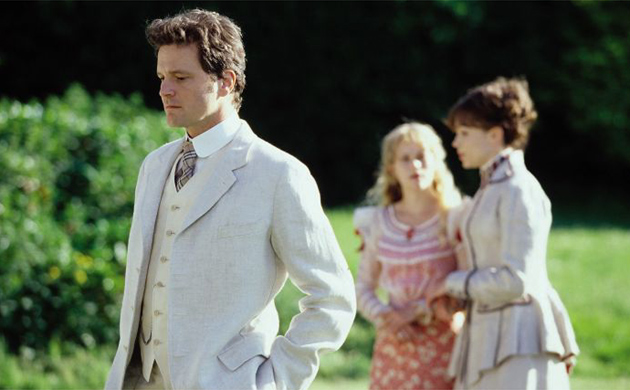
Larita (Jessica Beale) is the first woman race car driver to cross the finish line in Monte Carlo. The year is 1930. An American, she marries on a whim John Whittaker (Ben Barnes), the son of an English aristocratic family… and quickly becomes enemy on the home front to matriarch Veronica Whittaker (Kristin Scott Thomas), and subversive ally to her husband, disillusioned WWI officer played by Colin Firth. If you’re interested, here’s my full review of the movie.

A Handful of Dust (1988) — After Brideshead Revisited I went on to watch another of Evelyn Waugh’s adaptation. Again, a large mansion… how many of these architectural heirlooms do they have in England? Anyway, the master of this house Tony Last (James Wilby) is too busy looking after his property that he loses his wife Brenda (Kristin Scott Thomas). Title comes from T.S. Eliot’s The Waste Land (1922)… that sent me into reading the poem again.

Goodbye To All That (1929) — Autobiography of Robert Graves, English poet and writer. I’m most impressed by the men of letters in that period, they enlisted readily. Robert Graves and Siegfried Sassoon were both involved in the most devastating battles in France. Both were seriously injured. Deep in the trenches they wrote poetry. Their views towards the war changed as time went by, but their experiences in the battlefields brought about poignant legacies as eye witnesses of a horrific war and its aftermath. Ironically, Graves handles his subject matter with some light-hearted reminiscence.

The Remains of the Day (1993) — Not quite the same period but a bit later in the brewing year before England’s engagement in WWII. I rewatched this film adaptation of Kazuo Ishiguro’s Booker Prize winning novel in full, sumptuous Merchant Ivory style. The film leads me to think of a few parallels… Darlington ~ Downton, Stevens ~ Carson, but I’m glad Carson has more heart. And in both Downton and Remains of the Day, a character named Richard Carlisle.

The list goes on with Passchendaele and Birdsong yet to read and watch. But I know when Season 3 of Downton commences, I’ll gladly return and transfix myself once again in the Crawley family.

What have you been doing since Downton Abbey?

***

You may also be interested in:

Quotable Quotes from Downton Abbey

Lady Almina and the Real Downton Abbey

Lady Almina and the real Downton Abbey: Facts that give rise to Fiction

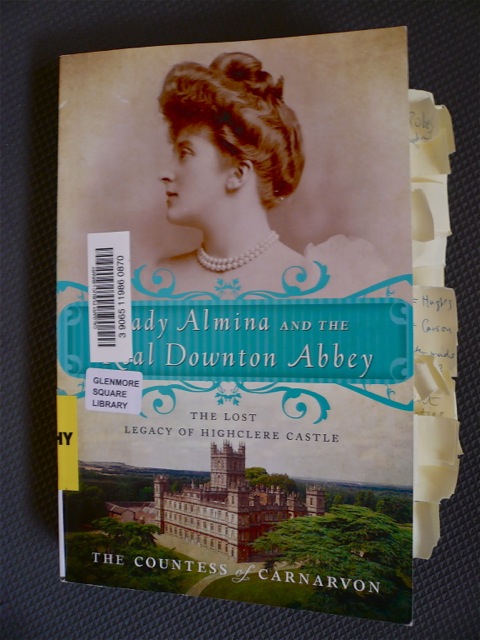
Downton Abbey in real life is Highclere Castle, situated among a thousand acres of beautiful parkland, perching on a hill with a vantage point of even more spectacular views. It is home to the Earls of Carnarvon for centuries. The book is written by Fiona Carnarvon. Lady Almina is the great grandmother of her husband, the 8th Earl of Carnarvon. The book chronicles the life and legacy of Lady Almina, who married into Highclere at 19, and evolved from a youthful debutante to a seasoned and capable, aristocratic lady with a heart. Here is the source material for the fictional creation so well received by viewers all over the world.

I’m not one easily swayed to follow what’s being hailed in current culture. But for some reasons I’ve been drawn to the human drama of the hugely successful Downton Abbey. Until I read this book I have not thought that mere facts can be as engaging as fiction. Compared to the epic proportion of historical events detailed in the book, the TV series are but minute vingnettes, albeit they do have their endearing appeal.

This is my library copy of the book after I finished reading it. There are no less than 80 tiny yellow stickies to mark my interest:

At first, I was expecting a book offering tidbits of the Highclere Castle, its designs and architecture, and how its life, both upstairs and downstairs, corresponds with the TV production, etc.

But while it lacks the design and architectural specifics I was looking for, the book has brought me something else. Yes, there is a myriad of Edwardian high society accounts, the fashion and the opulence, as expected. But to my surprise, the latter part of the book offers a greater appeal to me. I was fully absorbed by its massive archival information on The Great War, from the trenches in Europe to the battlefields in the Middle East, wartime to post-war politics, Highclere’s involvement in international power brokerage, George’s brother Aubrey and T.E. Lawrence’s friendship, and the last chapters bring me to the archeological site of the Valley of the Kings in Egypt.

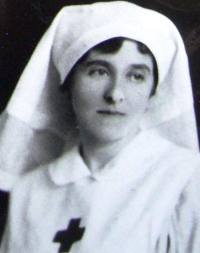
Nurse Almina

Unlike the Crawleys in Downton Abbey, the Carnarvons threw themselves fully into the war effort without hesitation. As soon as Britain entered The Great War (1914-1918), Highclere was turned into a well-equipped hospital, not just a convalescence home. Financially supported by her wealthy father, Almina hired the best in medical personel, well-trained nurses and specialized doctors, and furnished the Caslte with state-of-the-art equipment. Almina herself oversaw the whole operation and heavily involved in personal nursing care as well. A real-life Lady Cora/Isabel Crawley working in unity.

Seeing Matthew Crawley’s muddy face in the trenches cannot convey to me the horrors of the war. The detailed accounts in the book are terrifying to read. There were so many ways to die: guns and shells, broken bones even just a broken femur, long, bumpy rides to a hospital, gas, hunger, diseases, lack of medical supplies and doctors, even rain. Non-stop rain in Passchendaele had caused trenches to collapse, drowning many soldiers in the mud.

The Battle of Somme claimed 60,000 lives on its first day on July 1, 1916. Four months later, 415,000 British and Dominions soldiers had been killed or wounded. The Battle of Ypres saw the Germans use a new weapon. 168 tonnes of chlorine gas was released into Allied positions. 5,000 French soldiers in the trenches died within ten minutes, 10,000 were blinded as they escaped. In 1917, the number of British casualties and injured totalled 800,000. Many of Highclere staff were wounded and killed, those sent home were the lucky ones. The missing and the ones buried on foreign soil made the impact even more heartbreaking.

The Dowager Countess of Carnarvon, Elsie, had always been receptive to innovations and improvements. Unlike her counterpart in Downton Violet Crawley, Elsie welcomed electricity and the telephone. In 1919, at 63, she became vice-chairman of the Vocal Therapy Society and promoted the use of singing to help shell-shocked men to overcome debilitating stammers. Umm… she would have made a good team with Lionel Logue, who set up shop on Harley Street. Just ask Bertie KGVI, he knew it worked.

On a totally different note, the last chapters of the book transport me to the archaeological site of the Valley of the Kings in Luxor, Egypt. Almina’s husband George Herbert, 5th Earl of Carnarvon, was one of the last British aristocratic archaeologists, having spent £50,000 (£10 million in today’s money) over the course of fourteen years on excavating in Egypt.

Howard Carter, left, & Carnarvon at King Tut’s tomb

Lord Carnarvon personally hired the expert archaeologist Howard Carter to team up with him in his pursuit of Egyptian antiquities. Their breakthrough work came in 1922, when they discovered the burial chamber of the young King Tutankhamun. Unlike rumors that had distressed the archaeological dual that they would ship the finds to England, the King Tut artifacts have  been the possession of the Egyptian government since the discovery.

I had not realized the connection before… how Downton Abbey could have a certain degree of separation from King Tut. But the book soon ends with the sad news that the already weak Lord Carnarvon soon succumbed to illness. He died in Cairo at age 57, just a few months after the excavation. It’s noted in the book that at the time of his death, back at Highclere Castle in the night, his beloved terrier Susie howled once and died.

Here I’ve just touched on a few yellow stickies. You need to read the book to grasp all the significant events during that first quarter of the 20th century. As the book has been written and published ‘in record time’ as the author has noted, likely to coincide with the broadcast of Downton Abbey Season 2, it is not a literary work, not even a social or political commentary of any sort. Yes, I was looking for the author’s view on aristocracy and the Empire. Nevertheless, it is a compact historical account that chronicles the lives of some individuals who had left indelible marks in an era of irreversible change and new discoveries. 

Excellent Photos, A Bibliography of researched works and archival materials, and an Index make up the supplementary resources.

~ ~ ~ Ripples

Lady Almina and the Real Downton Abbey: The Lost Legacy of Highclere Castle by The Countess of Carnarvon, Broadway Paperbacks, NY, November, 2011, 310 pages.

***

Other posts you may like:

Quotable Quotes from Downton Abbey

The Rant of the Armchair Traveller

***

Quotable Quotes from Downton Abbey

SEASON 6 Recaps:

SEASON 6 FINALE: Goodbye to All That

SEASON 6 Episode 1, Jan.3, 2016

SEASON 6 Episode 2, Jan. 10, 2016

SEASON 6 Episode 3, Jan. 17, 2016

SEASON 6 Episode 4, Jan. 24, 2016

SEASON 6 Episode 5, Jan. 31, 2016

SEASON 6 Episode 6, Feb. 7, 2016

**

‘You can’t do very much as an actress unless you have the proper words to say…’ — Penelope Wilton, Isobel Crawley

Four weeks have passed since Downton Abbey Season 2 Finale aired on PBS. How are you holding up? To alleviate Downton Abbey withdrawal symptoms, I’ve been in a perpetual state of re-watching all the episodes from Season 1 and 2. Downton Abbey on Blu-ray is absolutely beautiful.

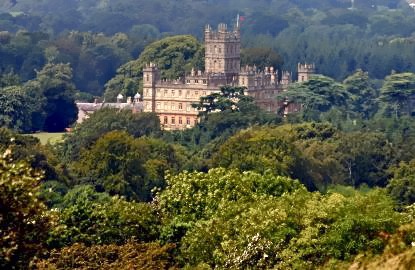
Downton Abbey film location: Highclere Castle

This Golden Globe, Emmy, and BAFTA award-winning miniseries has many appeals. For me, apart from the sumptuous setting, attention to details, great acting, and inspiring cinematography, the main attraction is the writing. Julian Fellowes’ script gives us intelligent dialogues reminiscent of Oscar Wilde’s wit and satire.

I have compiled a list of quotes from both Seasons. Lucky for 78 year-old Maggie Smith, she gets the best lines as Violet Crawley, Dowager Countess of Grantham.

Here they are in chronological order so you can reprise the scene. Enjoy!

Season 1

“O, heavens, girl. You’re building a fire, not inventing it.” — Mrs. Hughes to Daisy, S1E1

“Nothing in life is sure.” — Mrs. Patmore, re. Titanic sinking, S1E1

Mrs. Patmore and Daisy

“Every mountain is unclimbable until someone climbs it. So every ship is unsinkable until it sinks.” — Lord Grantham, S1E1

“We are allies, my dear, which can be a good deal more effective.” Violet Crawley, Dowager Countess of Grantham, in reply to Cora Crawley’s “Are we to be friends, then?” S1E1

Violet Crawley, Dowager Countess of Grantham

“What is a ‘weekend’?” — Violet Crawley, S1E2

“Daisy, what’s happened to you? I said you could go for a drink of water, not a trip up the Nile.”  — Mrs. Patmore. S1E3

“Are you afraid someone will think you’re American if you speak openly?” — Lord Grantham to Dowager Countess, S1E3

Dowager Countess and Lord Grantham

“But nobody learns anything from a governess, apart from French and how to curtsey.” Lady Sybil, S1E4

“No one ever warns you about bringing up daughters. You think it’s going to be like Little Women. Instead they’re at each other’s throats from dawn till dusk.” — Cora Crawley,  Countess of Grantham, S1E5

The Crawley Sisters

“Mary can be such a child. She thinks that if you put a toy down, it’ll still be sitting there when you want to play with it again.” — Lord Grantham, S1E5

“I love you Mr. Bates. I know it’s not ladylike to say it, but I’m not a lady and I don’t pretend to be.”  — Anna, S1E5
Mr. Bates and Anna
“If she won’t say yes when he might be poor, he won’t want her when he will be rich.” — Violet Crawley, Dowager Countess, S1E7
.
“First electricity, now telephones. Sometimes I feel as if I were living in an H.G. Wells novel.”  — Violet Crawley, S1E7
*****
Season 2
Mary Crawley seeing Matthew off to war.
 “War has a way of distinguishing between the things that matter and the things that don’t.” — Matthew Crawley, S2E1
.
Matthew Crawley in the trench

“I’m not a romantic… But even I concede that the heart does not exist solely for the purpose of pumping blood.” Violet Crawley, S2E2

“I’m a woman, Mary. I can be as contrary as I choose.” Violet Crawley, S2E4

“Are you like everyone else in thinking that because she’s a countess she has acquired universal knowledge by divine intervention?” Isobel Crawley to Dr. Clarkson re. Cora, Countess of Grantham, S2E4  (And you can substitute the word ‘countess’ with any word you need when quoting it.)

Dr. Clarkson and Isobel Crawley

“I’d rather have the right man, than the right wedding.” — Anna, S2E5

“I’m an American, I don’t share your English hatred of comfort.” Cora Crawley to Lord Grantham, S2E6

Lord Grantham and Cora Crawley

“Don’t be defeatist, dear. It’s very middle class.”  Violet Crawley to Edith, S2E8

“Sir Richard, life is a game in which the player must appear ridiculous.” Violet Crawley, Last Episode, Christmas at Downton Abbey.

“I want a good man for you, a brave man. Find a cowboy in the Middle West and bring him back to shake us up a bit.” Robert Crawley to daughter Mary. Last Episode, Christmas at Downton Abbey.

“1920. Is it to be believed? I feel as old as Methuselah.” Violet Crawley, Last Episode, Christmas at Downton Abbey.

***

DOWNTON RECAPS

DOWNTON Season 5 Finale, March 2, 2015: A Moorland Holiday

*

Season 4 Episode 8 (PBS): London 

Season 4 Episode 7 (PBS) 

Season 4 Episode 6 (PBS)

Season 4 Episode 5 (PBS)

Season 4 Episode 4 (PBS)

Season 4 Episode 3 (PBS)

Season 4 Episode 2 (PBS)

Downton Abbey Season 4 Opening (2 Hour) Special 

*

CLICK HERE to Quotable Quotes from Season 3: New List

*

SEASON 3: EPISODE 1  

SEASON 3: EPISODES 2 & 3 

SEASON 3: EPISODES 4 & 5 (More Downton Quotes)

SEASON 3: EPISODES 6 & 7 Finale

CLICK HERE to visit the Highclere Castle website. An absolute must-see.

*

Other posts you might like:

Quotable Quotes from Downton Abbey Season 3

Downton Abbey The Complete Scripts: Season 1

The Downton Ripples

Lady Almina and the real Downton Abbey: Facts that Give Rise to Fiction

***

The Importance of Being Earnest by Oscar Wilde

To celebrate St. Patrick’s Day, I’d like to post my second selection for the Ireland Reading Challenge 2012, and raise a toast to Oscar Wilde for his LOL funny three-act play The Importance of Being Earnest.  

Though written in 1894, Wilde’s work is surprisingly modern. Subtitled “A Trivial Comedy for Serious People”, it is a mashup of mistaken identities, social satire, biting ironies, and one-liners worthy of our late-night talk shows.

You can finish the breezy eighty-some pages in one sitting, but don’t read it in public. You don’t want to be mistaken. To most people, only a lunatic would LOL alone without a bluetooth hanging on his ear.

Jack Worthing is in love with Gwendolen Fairfax of London, cousin of his friend Algernon Moncrieff. But obstacles abound for his courtship. As a country gentleman with many responsibilities, he has to create a wayward younger brother and town-dweller named Earnest as an excuse for him to go out to town for pleasure and to see Gwendolen. While in town, he has taken the name Earnest. Algernon, just the opposite, has to create an invalid Bunbury in the country for him to visit so he can meet and woo Jack’s ward Cecily, while pretending he is Earnest, Jack’s younger brother from London.

Locales may be a hindrance, their major obstacle is Lady Bracknell, Gwendolen’s mother and Algernon’s Aunt, a formidable and feisty gatekeeper of aristocratic matrimony.

With Downton Abbey’s dialogues still ringing in my ears (been re-watching the blu-rays perpetually since its Season 2 Finale on PBS) I can easily imagine the Dowager Countess of Grantham, Violet Crawley, uttering Lady Bracknell’s lines. Screening for Jack’s eligibility as a suitor for her daughter Gwendolen, Lady Bracknell conducts the following interview.

LADY BRACKNELL:  How old are you?

JACK:  Twenty-nine.

LADY BRACKNELL:  A very good age to be married at. I have always been of opinion that a man who desires to get married should know either everything or nothing. Which do you know?

JACK (after some hesitation):  I know nothing, Lady Bracknell.

LADY BRACKNELL:  I am pleased to hear it. I do not approve of anything that tampers with natural ignorance. Ignorance is like a delicate exotic fruit; touch it and the bloom is gone. The whole theory of modern education is radically unsound. Fortunately in England, at any rate, education produces no effect whatsoever…

LADY BRACKNELL:  Are your parents living?

JACK:  I have lost both my parents.

LADY BRACKNELL:  To lose one parent, Mr. Worthing, may be regarded as a misfortune; to lose both looks like carelessness.

JACK:  The fact is, Lady Bracknell … I don’t actually know who I am by birth. I was … well, I was found.

LADY BRACKNELL:  Found!

JACK:  The late Mr. Thomas Cardew, an old gentleman of a very charitable and kindly disposition, found me, and gave me the name of Worthing, because he happened to have a first-class ticket for Worthing in his pocket at the time. Worthing is a seaside resort.

LADY BRACKNELL:  Where did the charitable gentleman who had a first-class ticket for this seaside resort find you?

JACK (gravely):  In a hand-bag.

LADY BRACKNELL:  A hand-bag?

JACK (very seriously):  Yes, Lady Brakcnell. I was in a hand-bag—a somewhat large, black leather hand-bag, with handles to it—an ordinary hand-bag in fact.

LADY BRACKNELL:  In what locality did Mr. Thomas Cardew come across this ordinary hand-bag?

JACK:  In the cloak-room at Victoria Station. It was given to him in mistake for his own.

LADY BRACKNELL:  The cloak-room at Victoria Station?

JACK:  Yes. The Brighton line.

LADY BRACKNELL:  The line is immaterial. Mr. Worhting. I confess I feel somewhat bewildered by what you have just told me. To be born in a hand-bag, whether it had handles or not, seems to me to display a contempt for the ordinary decencies of family life…

And many more lines that would show you Wilde could have made one great Oscar host.

***

The Movie (2002, DVD)

I’ve got the DVD. It never fails to delight no matter how many times I re-watch it. Lady Brecknell is portrayed by Judi Dench, as proficient as any Dench performance, albeit a bit too severe here. But just as well, she’s a monster to Jack Worthing.

Jack is played by the ever talented Colin Firth. Dispelling the Mr. Darcy myth, Firth shows he can be one freewheeling comedic actor. Having seen many of his works, I find that with the right words to say, he can always deliver in style, even if he needs to stammer to get his words out.

Before Mamma Mia! (2008), Colin Firth had sung in a movie strumming a guitar, it is here. With Rupert Everett as the piano playing Algernon, the two come together in a duet to woo their love.

Frances O’Connor, who plays Fanny Price in Mansfield Park (1999), is Gwendolen, animated but much intimidated by her icily fierce mother Lady Brecknell. Reese Witherspoon is Cecily, Jack’s 18 year-old ward. The gals can easily call each other sisters if not for the mistaken identity of their love interest, Earnest. Thinking they are romantic rivals, the ladies are at each other’s throat as much as their genteel upbringing can allow, and  quickly become allies once the misunderstanding clears up.

Both Jack and Algernon are willing to go all out to have their names changed to Earnest via christening by the minister Dr. Chasuble, a role mastered easily by veteran actor Tom Wilkinson. Dr. Chasuble is a silent admirer of Cecily’s governess Miss Prism, played by Anna Massey with much comedic sense and timing.

At the end, Jack finds out his true parentage, realizes that he is more kin than kind to Algernon, and three matrimonies ensue, a happy ending Jane Austen would have approved. The movie adaptation is an enjoyable way to go through the play, not just with sight, sound and cinematic fun, but a delightful all-star cast.

Some tidbits: The film won a Best Costume Design award from Italy, and Reese Witherspoon was a nominee of the Teen Choice Award 2002. Looking at the cast today, we see 3 Oscar winners and 1 Oscar nominee.

As usual, the DVD carries special features like The Making Of and Behind the Scene featurettes, interviews with stars and crew, and audio commentary, always a valuable companion to the main feature.

~ ~ ~ Ripples