Brooklyn: From Book to Film

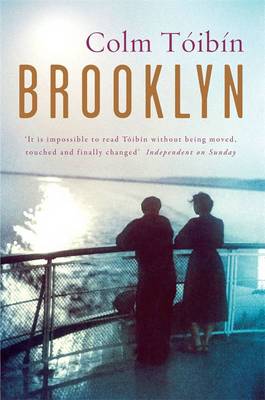
Director John Crowley’s movie adaptation of Brooklyn by Colm Tóibín has aptly answered my query (last post): what elements in the book make movie materials? Potentially, a lot. The trick is not to turn them into cliché moments on screen, for this isn’t an unusual story: a young woman leaving home and finding independence and love in a new land. While the film has its flaws, Crowley has crafted a beautiful and stylish transposition.

Author Nick Hornby has done it again following his Oscar nominated screenplay for An Education (2009) adapted from Lynn Barber’s memoir, a film that launched Carey Mulligan’s breakout role and Oscar nod, also a coming-of-age story.

Here in Brooklyn, Hornby tells his story by linking up succinct scenes that just about cover all key episodes in the book. They are short, to the point, and well-paced. The editing too is seamless, driving the film on without delay. After all, they only have about 120 minutes, and they’ve done a smooth job doing that.

Brooklyn Movie Poster

Tóibín’s seemingly simple narration of young Eilis Lacey’s journey of emigration from Ireland to America in the 1950’s is transposed onto film with sensitivity and nuance. The ‘mundaneness’ of daily living – working in a department store, dinner back at the boarding house, night class several days in the week – is transformed into vivid scenes by a lively cast of actors. To their credits, the already animated dinner table banters at Mrs. Kehoe’s (Julie Walters) rooming house as described by Tóibín have now come to life. Indeed, Julie Walters embodies Mrs. Kehoe, and Jim Broadbent as Father Flood is well cast.

Crowley, or is it Hornby, had softened Tóibín’s shrewd descriptions of some of his characters, presenting them in a sympathetic light, making them more likeable. The mood is less serious than the book but evoking empathy just the same. Although two weak spots I find. First is the glamorous and confident older sister Rose (Fiona Glascott) is not depicted as such, lessening the effect that is to come later. Secondly, Jim Farrell (Domhnall Gleeson) is absent at the beginning but appears only in the last part of the film, hence there is not much for character contrast or development.

While most of the supporting characters are well played, the film belongs to Saoirse Ronan, the young Irish actor who first drew notice from Joe Wright’s adaptation of Ian McEwan’s Atonement (2007). Her performance as 13 year-old Briony sent chills up my spine. With that role Ronan became one of the youngest Academy Awards nominees. In the most recent Wes Anderson’s The Grand Budapest Hotel (2014) she sends out very different vibes. As of now for Brooklyn, Ronan has a Golden Globe Best Actress nom. I anticipate she will go all the way to the Oscars.

Cinematographer Yves Bélanger is apt to let the camera linger on Ronan close-up many times, for she acts without speaking. Her facial expressions representing the spectrum of Eilis’s emotions and thoughts are spot on. It is a delight to watch her.

Another animated scene is dinner at Tony’s (Emory Cohen) Italian family home. Here, we see the characters jump out of the book, especially the kid brother, 8 year-old Frankie (James DiGiacomo), whose infamous line is “We don’t like Irish people.” But of course, the whole family welcomes Eilis and supports Tony, who has interpreted his literary version well: respectful, authentic and transparent, as Tóibín writes,”he was as he appeared to her; there was no other side to him.”

Domhnall Gleeson as Jim Farrell has a hard role to play for its very short appearance in the last part. He has not much material to work from but just hangs around with Nancy (Eileen O’Higgins) and George (Peter Campion) who try to set him up with Eilis. Not much to launch a lightning courtship.

Colours play a major role in the film, albeit I feel a pinch of contrivance; watching the colourful 1950’s costumes is like looking into the window of a candy shop with all kinds of macaroons. However, the colours may well set the mood and setting for the film: The overall greenish tone of the first part in Ireland, to the stark green coat Eilis wears as she leaves home on board the ocean liner to the cheery bright yellow cardigan after she has met Tony. Towards the last part, it’s back to the greenish hue of Enniscorthy, only the newly returned Irish/American gal wearing her bright colours. Too explicit a visual translation? Maybe, but I like macaroons, and I won’t hold a Ripple against the colour treatment.

Another visual imagery is at the beginning, right after Eilis has landed in America and gone past the immigration line, she opens the door to head out. We see her step out into an overwhelming brightness of white. Too heavenly? Or maybe just the right sign to boost the confidence of our seasick and insecure heroine?

How do you translate Tóibín’s quiet descriptions on screen? His signature depictions of a calm surface that hides tumultuous billows of emotions? Crowley gives us silence. Indeed, there are cinematic moments that are devoid of sound; the most memorable one is close to the ending when Eilis reveals her secret to her mother (Jane Brennan), sending shock waves and despondence on her face. Yet she restrained her emotions. Mother and daughter embrace in utter silence with tears flowing, saying possibly a last goodbye to each other in their lives and releasing a determined letting go for both.

Brooklyn is a beautiful adaptation worthy of its literary source, among one of the best films I’ve seen in 2015.

~ ~ ~ ~ Ripples 

***

Update Jan. 14, 2016:
3 Oscar Nominations – Best Picture, Best Actress, Best Adapted Screenplay

***

Related Review Posts:

Brooklyn by Colm Tóibín Book Review

Atonement: Book Into Film

The Budapest Hotel: A Grand Escape

Ex Machina (2015) 

Brooklyn by Colm Tóibín: A Second Encounter

As one who is interested in the adaptation process, I’m always eager to find out how filmmakers choose movie materials.

I first read Colm Tóibín’s Brooklyn a few years back when it was first published. I admit I found it uneventful and a bit bland at that time. On the shelf it went after my reading, and I didn’t bother to think too much about it.

Only in recent months when I knew about its upcoming movie adaptation that I was drawn back to it. My major quests this time: to give it another chance and to find out what in it that appeals to filmmakers.

Well, glad I reread it, for I’m actually giving myself a second chance. This time the ‘uneventful’ narratives become a quiet and gentle portrayal of a young woman’s journey of self-discovery, a coming-of-age story told with nuance and grace.

I read it more carefully this time, noting in particular the subtexts and inferences. I paid attention not only to the characters’ inner thoughts and feelings from Tóibín’s direct statements, but his descriptions of their actions and find that he’s a master of subtleties.

Brooklyn_Colm_Toibin

Brooklyn is about migration, this time around, I can see how relevant and timely it is with our present global situation. From the small town of Enniscorthy, Wexford County, Ireland, Eilis sails across the Atlantic on her own to reach the shore of America just for a better future.

The initial foresight is however from her older sister Rose, the financial supporter and all round sustainer of both Eilis and their widowed mother. It is no wonder that Eilis feels it’s Rose that should be the one to go to America, Rose, the good golfer, glamorous, fashionable, capable and confident.

And Eilis? Here’s a little episode while still in Enniscorthy. She goes to a dance with her best friend Nancy and watches her being invited to the dance floor by a promising young man George. Sitting on the sideline Eilis watches her every move and then we read:

“Ellis looked away in case her watching made Nancy uncomfortable, and then looked at the ground, hoping that no one would ask her to dance. It would be easier now, she thought, if George asked Nancy for the next dance when this set was over and she could slip quietly home.”

When this set is over she isn’t given such a chance, for then George brings Nancy and Eilis over to the bar for a lemonade and we are introduced to his friend Jim Farrell, who “just nodded curtly but did not shake hands… his face emotionless.” Towards the end of the book we will see Jim Farrell appear again as some sort of a nemesis who poses a moral dilemma for Eilis.

Tóibín has given us an unlikely heroine in Eilis, a reluctant emigrant. Always the recipient of Rose’s support and encouragement, Eilis is in fact pushed out of her comfort zone by her well-meaning older sister. In her personal journey we see how Eilis grow and mature, and most importantly, with her good nature intact.

In Brooklyn, Father Flood helps her settle in Mrs. Kehoe’s rooming house and secures a job as a sales clerk at Bartocci’s department store. She gets a taste of rooming house politics, and at Bartocci’s, learn work ethics and the soft skills that are so essential to survive socially. And yet, she is plagued with homesickness as soon as she receives the first letters from home.

At the mid-point of the book, Eilis meets Tony, not Irish but from an Italian immigrant family. No matter, Tony’s authentic charm and devotion break down all cultural barriers and alleviates Eilis’s homesickness.

Tony is gentle with her, courteous and considerate. How do we know? As a die-hard Brooklyn Dodgers fan, Tony never mentions baseball in front of Eilis. Instead, he listens attentively to her and having learned of her night class at Brooklyn College, waited for her after class just to walk her home.

Eilis discovers Tony’s love of baseball when he brings her home for dinner over conversations with her brothers at the dinner table. His family? That’s another charming story.

Just as she begins to settle in and fully enjoy her new life in Brooklyn, Eilis receives a tragic news that sends her back to Ireland for a short while. Now we are at the last part of the book with only fifty-one pages left. Here we have the major conflict of the novel, a moral dilemma that Eilis needs to resolve.

I much appreciate Tóibín’s storytelling. After presenting us in details a successful immigrant experience, a young woman becoming independent in a new land, finding herself, meeting a love interest, and even planning for a future with him, Tóibín drops a bombshell shattering all that has been built and invested. And all this while, he’s been so calm and quiet leading to it.

Further, Tóibín shows us how we can be a different person in different settings and environment. Once back in Ireland, the independent and confident Eilis is changed back to her old self. Under the roof of her mother, she is the dutiful and accommodating daughter once again, but this time, with the added burden of guilt.

Tóibín’s narratives are often quiet and mild, but his characterization is shrewd. We see the acerbic Mrs. Kelly who runs a tight ship in her grocery store where Eilis works on Sundays, and her American counterpart Mrs. Kehoe, Eilis’s landlady. Then there’s the curt Jim Farrell who doesn’t even cast Eilis a glance but earnestly woos her when she comes back after dipping in American waters; and finally there’s Eilis’s mother, subtly scheming and manipulative.

With the subject of migration, the ultimate quest is finding a home. As we read Eilis’s personal journey across the Atlantic from Ireland to America and back again, we see her tossed by the waves of loyalty and belonging. Like her first voyage over the turbulent sea, unsettling and gut retching, her return to Enniscorthy is an even more acute challenge. But at the end we see Eilis make her choice, and it is gratifying.

She is finally ashore.

~ ~ ~ 1/2 Ripples

***

Movie review of Brooklyn is here.


November Wrap: East Meets West at the Pond

November is an eclectic month of reading and viewing for me. I’ve watched films ranging from a Chinese wuxia legend from the Tang Dynasty, to the English suffrage movement, to the scandal in the Catholic Church in Boston… and read books from crime thrillers to Westerns to the Gilded Age to India before and after independence.

Arti is a hybrid after all, constantly navigating between cultures and languages. When it comes to books and films, dashing between genres, periods and styles only adds spice to life.

Here’s the list of my November books and films.

Films

The Assassin

The Assassin

Acclaimed Taiwanese director Hou Hsiao-Hsien’s genre-defying wuxia epic earned him Best Director at Cannes this May. Hailed as the most beautiful film at the Festival, this adaptation of a 9th century Tang Dynasty Chinese legend may not be as easily grasped in terms of its storyline as its visual appeal. The film is recently voted #1 on the reputable Sight and Sound Magazine‘s Best Films of 2015 list, that’s the result of a poll gathering the views of 168 international film critics. It is a rare gem indeed. My full review at Asian American Press.  ~ ~ ~ ~ Ripples

(BTW, Hou’s last film? The Musée d’Orsay commissioned French feature on the Museum’s 20th anniversary: Flight of the Red Balloon.)

Room

A highly watchable adaptation of Emma Donoghue’s 2010 Booker Prize shortlisted novel. Kudos to the actors Brie Larson as Ma, Jacob Tremblay as 5 yr-old Jack, and yes, to Donoghue herself for writing the screenplay. One of those titles that I’ve enjoyed watching more than the literary source. My review on Ripple Effects.  ~ ~ ~ 1/2 Ripples
Update Jan. 14, 2016: 4 Oscar Nominations including Best Picture

Suffragette

Carey Mulligan has put forth a nuanced performance as the laundry gal turned suffragette in this Sarah Gavron (Brick Lane, 2007) directed historical drama. It’s worthwhile to watch the informative depiction of the actual events woven with fictional personal stories, especially Mulligan’s riveting portrayal of Maud, how her beginning naivety is forged into committed devotion to the suffrage movement. Prolific screenwriter Abi Morgan (Irony Lady, 2011, just to name one of her works) has laid out a fact-based drama with a heart-wrenching climatic scene. The sacrifice these voiceless, working women were willing to lay down is inspiring.
~ ~ ~ 1/2 Ripples

Secret in their Eyes

The Hollywood re-make of Argentine author Eduardo Sacheri’s crime thriller is a tall order, for its previous film adaptation is the Oscar winner of 2009 Best Foreign Language Film. My post on the book, original film, and Hollywood version is here. ~ ~ ~ Ripples

Spotlight

One of the best films I’ve seen this year, detailing the sequences of how the Boston Globe’s ‘Spotlight’ team of investigative journalists uncovered the systemic cover-up of child sexual abuse among Catholic priests. The Pulitzer winning reporting is presented in the film as painstaking procedurals in matter-of-fact dramatizing. For those who may be a bit worried about the subject matter, there is no sensationalized scenes of abuse, and on the part of the reporters, no portrayal of heroism. Such may well be the praise-worthy elements of this production. The cast’s performance is convincing, in particular, Liev Schreiber as the soft-spoken but motivating, no-nonsense editor Marty Baron. Come Awards time, I trust the production, its cast and crew, and director Tom McCarthy (The Visitor, 2007) will be duly recognized.    ~ ~ ~ ~ Ripples
Update Jan. 14, 2016: 6 Oscar Nominations including Best Picture

Fireflies in the Garden

My guess is, you haven’t heard of this 2008 movie. Neither have I until I saw it on TV a few days ago. The story about a father-son’s love-hate relationship from childhood to adulthood is realistically depicted. Caught in between the straining conflicts between the always angry and harsh father and a sensitive, vulnerable son, is the mother, always loving and protecting, something like the family dynamics in Terrence Malick’s The Tree of Life. It also echoes the Oscar winning Ordinary People (1981), the small-scaled, Bergman-esque chamber film of deep entanglement of unresolved parent-child conflicts. Another film just popped into mind and that’s Colin Firth, Jim Broadbent’s When Did You Last See your Father.

Fireflies has a well-selected cast with Ryan Reynolds, Willem Dafoe and Julia Roberts. I’m surprised to see the low rating the film received among critics. Disappointed really that it wasn’t well received. What’s that to me, and why am I  concerned? There’s a half-baked screenplay in my closet that’s something along that line. I know, more rewrites.  ~ ~ ~ Ripples

**

Books (Click on links to my Goodreads reviews)

It’s all a chain reaction started with …

The Burning Room by Michael Connelly (Audiobook)

I’ve not missed a single one of Connelly’s Detective Bosch novels. This time I listened to the audiobook and was much impressed by the voice of its narrator Titus Welliver.

Appaloosa by Robert B. Parker (Audio MP3)

So I checked about Welliver’s other audio works, and found Appaloosa by Robert B. Parker. I’d seen the 2008 film adaptation with Ed Harris and Viggo Mortensen and quite enjoyed it. So I jumped right in and found it to be a very well-written book, one of the few Westerns I’ve read.

And from this Robert B. Parker, I went on to explore more about him and learned that he was the ‘Dean of American Crime Fiction’. Here are two of his works crime stories I followed up with:

Promised Land  (Audio MP3)
The Godwulf Manuscript  (Audio MP3)

The Custom of the Country by Edith Wharton
From crime fiction to the Gilded Age. I bought this book at Edith Wharton’s home at The Mount during my New England road trip, during which I learned that Julian Fellowes was much influenced by Wharton and especially this title.

The Secret in their Eyes by Eduardo Sacheri (Audio MP3)

Plato and a Platypus Walk into a Bar: Understanding Philosophy through Jokes by Thomas Cathcart and Daniel Klein (eBook) – click on link to read my one-line review of this title on Goodreads.

The Boston Girl by Anita Diamant
Makes me think of Colm Tóibín’s Brooklyn which I’m rereading to prep for the upcoming film adaptation.

Heat and Dust by Ruth Prawer Jhabvala
Shifting between the English in India before independence and later the 70’s, a clash in cultures and the human toll of unfulfilled marriages. I reread this to prepare for the James Ivory Retrospective this coming weekend right here in my City, with the legendary director (now 87) attending. Yes, really looking forward to this event.

**

Currently Reading / Listening

In the Heart of the Sea by Nathaniel Philbrick (for the upcoming film)

Brooklyn by Colm Tóibín (reread for the upcoming film)

Parade’s End by Ford Madox Ford (Audiobook)

***

Related posts you may like:

Flight of the Red Balloon (2007)

The Tree of Life (2011) by Terrence Malick

When Did you Last See your Father?

Appaloosa (2008)

Serendipity on Route 7

My drive continued south from Bennington, Vermont, via RT 7 to Williamstown, Massachusetts. There I stayed for the night. I knew Williams College was located there. But while exploring the town, I came to this building and saw the huge banner. Upon further investigation, I was excited to discover the campus of Shakespeare & Company:

The Miller BldgDSC_0337 (1)Later I found out that the actor Christopher Reeve met his future wife Dana in Williamstown where they later married. Reeve began as an apprentice at age 15 with the Wiliamstown Theater Festival right in those venues and eventually performed there for fourteen more seasons.

I had the chance to talk to a woman who was working on the grounds and learned that, lo and behold, she was born in Alberta, Canada, my home province! Imagine a chance encounter with an Alberta born American thousands of miles away.

The Berkshires region is beautiful and cultural. I made a mental note to come back to Williamstown for its annual Theater Festival.

My original plan was just to drive south on RT 7 from Williamstown to Lenox to see the Edith Wharton House at The Mount, when another serendipitous find came upon me: Tanglewood Music Center. So here I was at the famous summer home of the Boston Symphony Orchestra on my way to Edith Wharton House.

The Koussevitzky Music Shed was named after the Russian-born conductor, composer and double-bassist, long-time music director of the Boston Symphony Orchestra from 1924 to 1949:

TanglewoodI lingered at Tanglewood for quite some time, for the grounds were beautiful and offered magnificent views. Another mental note: I must come back for the Tanglewood Festival in the summer. :

viewAcross the road from Tanglewood, fall foliage began to emerge. That was October 7. I can imagine how beautiful it is now:

across from TanglewoodAnd finally, to The Mount, Edith Wharton’s home from 1902 – 1911. I knew she was a prolific novelist and short-story writer, the first woman to win the Pulitzer Prize (The Age of Innocence, 1921); later I learned too that she had been nominated for the Nobel Prize for Literature three times.

So I was a little surprised to find out from the tour guide at The Mount that she was also a house and landscape designer in her own right. Her book The Decoration of Houses is still used today by architects and designers.

Built as a writers retreat, The Mount reflects Wharton’s fondness of symmetry:

SymmetryWhat happened to the left side of the building? That makes it not symmetrical, you might ask. That’s the servants quarter which Wharton was willing to compromise her design principle.

Here’s another view why it’s called The Mount:

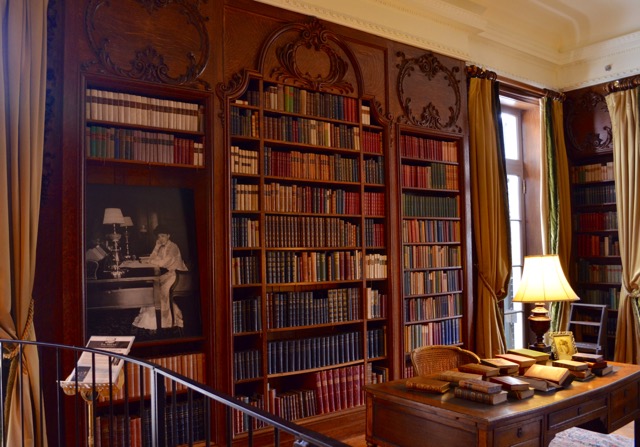
The MountI took a tour of both the inside as well as her gardens. Here’s one wall of her library:

One wallWell read in several languages since she was young, Wharton left these books behind  when she moved away to live in Paris the latter part of her life after the demise of her marriage. Her husband Edward had fallen into a state of dementia after lengthy bouts of depression and mental illness. The writer’s years at The Mount had not been as happy as its surroundings could offer her.

The Drawing Room:

The Drawing RoomDining Room, where Henry James was one of several usual guests:

Dining RoomBut where did she write? Not in the library, or at the desk in her room, but right in her bed. She had an assistant who would take her handwritten pages and type them up after her six hours of continuous writing every morning before she got out of bed. I’m sure Wharton would love to have a laptop:

Writing bed (1)And these other items I found interesting. Downton images conjured up in my mind. Typewriter, telephone, telegram:

DSC_0347
An original 1902 ice box, Daisy would love it but maybe not Mrs. Patmore. Give her some time to warm up:

Ice Box
A luggage lift. Definitely would be a fave among the footmen:

Luggage lift

And only after the tour did I find out, The Mount had given a Life Time Achievement Award to Julian Fellowes. The Downton creator had attributed Wharton as a major influence on his works, first Gosford Park (Oscar Best Original Screenplay, 2002) and then Downton Abbey. Speaking upon receiving the Award at the Harvard Club, Fellowes noted that he was particularly inspired by Wharton’s “… ability to judge without feeling the need to condemn.”

I bought the book The Custom of the Country in the gift shop and only just now did I learn that it is being adapted into a TV mini-series, with Scarlett Johansson playing the anti-heroine, Undine Spragg. This will mark Johansson’s first TV role.

As for Julian Fellowes’ new work? I eagerly await. After visiting The Mount, I can see what a natural shift it is for him to create an American version of Downton. The Gilded Age should be a smooth sequel.

From Lenox, I began the last leg of my New England Road Trip. I headed east on I90, a breezy 2.5 hrs. drive back to Wayland, the suburb outside Boston, thus completing the loop and a memorable journey. An item checked off my bucket list.

***

Follow my New England series:

Go Set A Watchman: Sequel or Prequel?


Go Set A Watchman Book Cover


Background

Go Set A Watchman is Harper Lee’s first draft of a novel (See links at the end of the post). In 1957, Lee’s agent submitted it to Tay Hohoff, an editor at the now defunct publishing house J. B. Lippincott. Hohoff did not see it adequate to be published; however, she did see promising elements in it, “the spark of the true writer flashed in every line,” she later recounted.

The draft’s protagonist, 26 year-old Jean Louise Finch, Scout, now a New Yorker, goes back to visit her childhood home in fictional Maycomb County, Alabama, and finds discrepancies about her father Atticus now from the man she thought she had known all the years growing up. To her alarm and disillusionment, Atticus, while a good father and a good man to all the rest in Maycomb, holds racist views and is firmly a segregationist.

Hohoff advised Lee to rewrite the draft but this time, instead of writing Jean Louise Finch as an adult, focus on her reminiscence of her childhood growing up in Maycomb with her brother Jem, living under the roof of her father Atticus, and summer days spent with a boy next door called Dill. After more than two years of editing and rewriting, To Kill A Mockingbird was born. And the rest is history.

So here’s the query I have: If your novel, after two years of editing and re-inventing, had developed into a final form and published in 1960, some 50 plus years ago, had gained high acclaims, won the Pulitzer, become a beloved American classic, been adapted into an Oscar winning movie, and achieved international recognition, why would you want your very first draft as a novice be published to the world now?

At 89 years old, Harper Lee now lives in a nursing home, a stroke survivor who has lost most of her hearing and eyesight, and just months after her sister Alice Lee – guardian of her privacy and legal advisor – had passed, and suddenly a ‘newly discovered’ Harper Lee novel appeared.

In a recent New York Times Op Ed article entitled “The Harper Lee ‘Go Set A Watchman’ Fraud”, columnist Joe Nocera vehemently argues that the Rupert Murdoch-owned HarperCollins had “manufactured a phoney literary event.” The publishing house had sold more than 1.1 million copies of the book in a week, the ‘fastest-selling book in company history’ according to the publisher, to which Nocera decries “Go Set A Watchman constitutes one of the epic money grabs in the modern history of American publishing.”

The above is the major challenge surrounding this phenomenal ‘literary event’. So how should one read the book? Controversy aside, what can we reap from reading Go Set A Watchman?

Definitely not as a sequel and not a prequel either, but take it as it is: A first draft of To Kill A Mockingbird.

Only when comparing the two books as a ‘Before and After’ transformation can we see how the writing process had taken place. By reading Watchman as a first draft, we come to appreciate how a seasoned editor had helped a novice and an aspiring writer to achieve her goal to become a respectable, published author. And this we know Hohoff had done most successfully.

To Kill A Mockingbird Book Cover

***

Reading Go Set A Watchman

First off, to all readers, a major reminder: Harper Lee is a real person, and Atticus Finch is a fictional character. In Lee’s first draft, Go Set A Watchman, Atticus is a good father, but a racist. Yes, he had successfully defended Tom Robinson and gained him an acquittal, that was a court appointed case. This is anecdotally mentioned in Watchman. But Atticus is a self-professed Jeffersonian Democrat, one who subscribes to Jefferson’s view that: “A man couldn’t vote simply because he was a man… He had to be a responsible man.”

Lee spends a climatic chapter towards the end describing the arguments between father and daughter on the issue of race. While both are polar extremes, and I don’t want to quote the words from Atticus pouring forth his arguments about how “white is white and black’s black”, I must point out that it is Scout who loses her cool during the debate. She is the one who blows right out, foul-mouthed and accusing her father with hurtful, derogatory terms. Throughout the verbal confrontation, Atticus remains a gentleman. “I’m seventy-two years old, but I’m still open to suggestions.”

And I’m quite impressed by the next episode, and that’s when Scout cools down and goes back to her father, seeking reconciliation. It’s not just a simple case of ‘agree to disagree’, but somewhat laying out a more complex relationship with the ambivalent stance of ‘I can’t beat you, I can’t join you,’ but love can still triumph over all. That is the spark of an inspiring writer I can see in the conclusion of Lee’s Watchman. As Scout apologizes for her foul-mouthed diatribe aimed at her father the day before, this line from Atticus will remain with me: “I can take anything anybody calls me as long as it’s not true.”

Hohoff might just have seen this character trait in Atticus that she advised Lee to expand on in her rewrite. I see this admirable element as I read. Let the fictional character Atticus be created as an ideal type of a man, open to others’ opinions, upholding his ground with firmness but with no malicious hostility. And yes, we can all appreciate this change of heart in Lee’s rewriting in Mockingbird. Let Atticus be the ideal father and friend, a deserving, honourable man.

Further, in Watchman, the racist turn in Atticus has not been well accounted for. Since Jean Louise has come back to Maycomb annually to see her father, why the sudden discovery of his racist stance? And why had she not known about his views considering her close relationship with her father all her growing years and only in recent years in her adult life had she moved to NYC. But most important point of all Lee had not explained in Watchman, why had Atticus changed his view? These could be flaws in the plot line that Hohoff had Lee re-think.

As recounted, Lee based her Atticus character on her own father, the lawyer Amasa Coleman Lee who had actually defended two black men but failed to have them acquitted. According to reports, the elder Lee had been a segregationist but later changed his views to support integration. The real life parallel is obvious. The details we could only speculate, was it the man that had influenced the change in the book, or maybe vice versa?

In the rewriting process, there is the elimination of two significant characters in Watchman, Hank, Jean Louise’s suitor, and Uncle Jack, holder of family secrets. Once a clear storyline is established, with the equally moving minor plot of Boo Radley, a parallel Mockingbird theme with Tom Robinson as both being vulnerable victims, Hank and Uncle Jack would not be needed to uphold the story lines. So, no matter how much a writer had invested in a character, cuts and alterations could be the outcome, quite like the deleted scenes we see on DVDs, the rational choices we have to make in the long creative process. On the other hand, a character that exists only in memory, Jem, who had died in Watchman, is revived to his lively self, and we are all grateful for that revision.

One of the main reasons Hohoff had rejected the first draft was that it was episodic, lacking a unified story arc as a novel. Readers of Watchman will find this so, especially when Jean Louise switches back and forth from the present to the past. As I read, the past holds much more attractions as Scout describes her growing up days in Maycomb. We see the children in a different perspective, something like a ‘behind the scene’, a ‘making-of’ featurette. Thanks to Hohoff, such episodes are restrung into the gem of a book called To Kill A Mockingbird. Indeed, Hohoff had grasped the social psyche well, there was a need for a noble, heroic character in her time then, and maybe even more so in our time now.


***


LA Times (With video)

The Telegraph

New Republic

The New York Times (Jonathan Mahler)

The New York Times (Serge F. Kovaleski and

The Wall Street Journal

The Washington Post

The Washington Free Beacon

Wikipedia


National Theatre Live

National Theatre Live launched in June, 2009. Cameras are placed in strategic locations in the theatre to capture the stage performance live and broadcast to various venues the world over. According to the NTL website, over 3.5 million people have experienced this remote viewing of plays from London stages, with over 1,100 venues around the world, 550 in the UK alone. For the price of a movie ticket, I can be transported to the front row of these performances.

I ‘discovered’ this treasure too late, well, too late to see Skylight, with two of my faves Carey Mulligan and Bill Nighy. Skylight received 7 nominations for the Tony Awards coming this Sunday, June 7, including acting noms for Mulligan and Nighy, direction for Stephen Daldry, and overall Best Revival of a Play.

NTL’s Skylight had been shown in our Cineplex already, and I missed it. But, all is not lost. In the past two months since I knew about this treasure, I’ve watched three plays and have bought ticket to the October debut of Hamlet with Benedict Cumberbatch. Looking forward to that.

Here are the three shows I’d watched in the past few weeks. Click on the link to the NTL website for full descriptions. The following is just a summary of my thoughts.

The Hard Problem by Tom Stoppard

The Hard Problem

My full admiration to Tom Stoppard for writing a play to explore this hard problem, one that’s not very popular nowadays when science and technology reign supreme, when Dawkins speaks like the indisputable authority: Is evolutionary biology the all-encompassing codebook answering every human question? Hillary, a psychology research fellow at the Krohl Institute for Brain Science prays to God every night, simply madness to her fellow researcher. Her concerns: Can neuroscience explain consciousness, or beauty, or morality, faith, longings? And, sometimes one does need a miracle or two when dealing with personal regrets. The play is an intellectual odyssey with lively and energetic exchanges of amusing dialogues, humour that teases me with lines reminiscent of Rosencrantz and Guildenstern are Dead.

This is Stoppard’s new play in nine years. Mentored by Samuel Beckett, friend of Harold Pinter, writing for both stage and screen, Stoppard, at 77, remains one of my most respected writers. I’d loved Rosencrantz and Guildenstern are Dead, but his works on screen have been equally impressive with the Oscar winning Shakespeare In Love (1998), Parade’s End (2012, one of my fave TV mini-series), the Oscar nominated Anna Karenina (2012), and Empire of the Sun (1987, a unique and haunting chronicle of childhood).

And for this play, nobody is preaching anything here, there’s no need to, just raising the hard problem, that’s all. We hear that line in Hamlet ring out loud and clear: “There are more things in heaven and earth, Horatio, than are dreamt of in your philosophy.”

**

The View from the Bridge by Arthur Miller

A View from the Bridge performed at Wyndham's Theatre Richard Hansell as Louis, Nicola Walker as Beatrice, Mark Strong as Eddie, Michael Gould as Alfieri, Emun Elliott as Marco ©Alastair Muir 16.02.15

Mark Strong is explosive as Eddie Carbone, the longshoreman who accommodates in his home two of his wife’s cousins, brothers and illegal immigrants just arrived from Sicily. Eddie’s possessive care and love for his niece Catherine who has been living with him all the years, turns to malicious jealousy as she falls for the younger of the brothers. Miller’s play is about the American Dream gone sour.

What an eye-opener of a stage play. Mounted at London’s Young Vic Theatre, the stage design is stylishly minimal. With audience viewing from three sides, it lays bare the human soul and its inexplicable and unbridled emotions. I have not seen anything like it. First off, can you imagine two men taking a shower on stage at the beginning of the play… with real water, and towards the end, that water turns into blood showering down, covering all the characters for the stunning, tragic ending.

**

Man and Superman by Bernard Shaw

Man and Superman

This one, I must say hats off to Ralph Fiennes for his extraordinary energy. Playing Jack Tanner, a radical thinker of his days, and the reluctant guardian and later romantic resolve for a beautiful heiress, Fiennes leads us on a wild ride from reality to fantasy, from earth to hell and back again. Well, no superhero in our CGI saturated movies nowadays can rival. Blurting out lines after lines non-stop for over three hours, in one take, dialogues covering all the brilliance of Shaw’s philosophical, social, and political views, with spot-on timing and great fun. Which comedian can beat that? And of course, what he and Shaw had shown us is that words and the intellect can be more powerful and entertaining than on screen action sequences and technical wizardry.

***

~ ~ ~ ~ Ripples to all of the above 

Far From the Madding Crowd (2015)

Here’s the paradox of books to movies. The more you know about the book, the more critical you’ll be when watching the movie, and the less likely you’ll enjoy it. Here’s a case in point. If you want to enjoy this current version of Far From the Madding Crowd without hindrance, do not read or reread Hardy’s novel before you see it. For me, alas, I’ve read it twice in the last few months. So, who can I blame if I find the movie disappointing?

Now, I know exactly that I need to judge a movie on its own merits and not according to how ‘faithful’ it is to the source. I’ve written a post on this view. This current adaptation misses the mark not because it’s not ‘faithful’ but because it has been mishandled. The script, the direction, and for that matter, the casting. Now hear me out. far-form-the-madding-crowd I had high expectations for it. Here we have an Oscar nominated director, Thomas Vinterberg (The Hunt, 2012), offering a new version from John Schlesinger’s 1967 production which touted a high calibre cast of Julie Christie, Peter Finch, Alan Bates and Terrance Stamp. After almost fifty years, should one not hold a certain high level of excitement in welcoming a new version with a modern cast?

To start off, I must give credit where it’s due and that’s to the director of photography Charlotte Bruus Christensen (The Hunt) for bringing the beautiful Dorset country to the big screen so we can visualize Hardy’s ‘Wessex’. The camera captures the lush green fields and gentle rolling hills at dawn and dusk, the farming life, the harvesting under the golden sun. Reminds me of Terrence Malick’s Days of Heaven. The scenic and authentic location of the filming is an alluring backdrop to the story.

Now to the screenplay. David Nicholls is no stranger to simplified versions of classics. His last Hardy light Tess of the D’Urbervilles, a TV mini-series (2008), had four episodes to tell the story. But here as a full-length feature, this new Madding Crowd script could make CliffsNotes writers feel they are doing some heavy lifting. Actually, the movie is not far from the source material, almost all of the scenes and many of the dialogues come from the book, with some alterations, but this is understandable. One would think alterations should be for the purpose of dramatization; so it’s just mind boggling that certain scenes that are essentially dramatic in the novel have been left out, ones that could have enhanced the tension substantially. Two readily come to mind: First is the circus scene where Sergeant Troy was nearly recognized by Bathsheba, and the second is right at the climax of the story, Boldwood’s Christmas party, not omitted but with its tension substantially lessened.

Danish director Vinterberg’s previous work The Hunt – a 2014 Oscar Best Foreign Language Film nominee – was a riveting and psychological piece of work. He could have operated in that mode here. With the scenes sweeping by, and leaving out some pivotal cinematic moments, he has missed chances to engage the audience. The altered state of the climatic scene is regretful. Take that crucial act when Boldwood was driven by mad passion (I’m trying to avoid spoiler here in case you haven’t read the book) during that fateful Christmas party in his home. Instead of displaying the conflict and tension in full public view, Vinterberg has taken the action out into the dark of night. Without all the guests as witnesses, the gravity of the conflict and Boldwood’s ultimate action is effectually diminished; not only that, the handling is incredulously haphazard and swift. While Hardy’s Far From the Madding Crowd exudes a lighter mood compared to the cosmically burdened Tess of the U’Derbervilles – and I chuckled at many of his lines while reading – I don’t expect movie viewers would take this film as a comedy. But this was exactly the audience’s reaction in the theatre. When you hear loud laughter at the climax of the movie, you know the director has missed the mark.

The story is about the characters, more so here when you have one headstrong female being wooed by three vastly different men. What’s intriguing is the emotional ‘trilemma’ of our heroine. The effervescent Bathsheba Everdene, the independent, new mistress of the Weatherbury farm is, alas, misdirected. Carey Mulligan can be a convincing Bathsheba, but the strength of character is diminished by the breezy script and a director who fails to draw out her potential. From the “I shall astonish you all” first meeting with her farmhands to the “Please don’t desert me, Gabriel!” plea to Oak so he would come back to rescue her ailing flock, there are pages of Hardy descriptions. Surely, time is of the essence in a 120-minute movie, but at least show visually the gravity of her situation before she so readily rides horseback and race to Gabriel. As a transition, let the camera frame a wide angle shot of the field littered with sheep lying helpless, ready to expire, for she’s about to lose them all. But just showing a sheep in distress doesn’t warrant the quick change in character, from leading to pleading. It looks like Vinterberg has crafted a feeble and even exploitive Bathsheba who gets her way by her outward charm. In several scenes she could have been more intense; we see no Hardy’s expression of ‘nether lip quivered.’

Among the three suiters, the strongest performance comes from Michael Sheen as William Boldwood. His nuanced facial expressions speak louder than words. Whether intentioned by Vinterberg or not, Sheen has turned the truly, madly, deeply love-sick Boldwood into a comic character, more so than Hardy’s portrayal. Or, were the laughters not intended? No matter, Sheen’s performance compensates for the lack of in the other two men.

Gabriel Oak the resourceful shepherd is the strong and silent type. Not only is he a man of few words, the Belgium actor Matthias Schoenaerts has turned him into a man of few expressions as well. Schoenaerts is fine in action thrillers like The Drop (2014) but just not in a romantic lead, as in Rust and Bone (2012), and now Madding Crowd, for he fails to command the image of either a lead or a romantic. In several scenes, we as audience are left hanging, ungratified, for his lack of verbal response to Bathsheba’s sincere words. 

If Schoenaerts is expressionless, here is an equal rival, Tom Sturridge as Sergeant Troy. The George Wickham parallel who dazzles with his brass and scarlet, Sergeant Troy is a subdued character here who lures with his sword. Is it the director or the screenwriter, the few lines given him are mostly sparse and one-liners like “I don’t think I’ve ever seen a face as beautiful as yours.” Sure, that’s from Hardy, but in richer descriptive context. Or, another short line to explain (away) pages of happenings absent on screen.

I’m writing this not in disrespect but disappointment in that a good chance to do justice to Hardy’s illuminating work is missed. Yet, all is not lost; there still remains a synopsis of a Hardy story and Hardy country in full cinematic view. Further, we are confirmed, again, that Carey Mulligan can sing, in a particular folksy, soulful way. So far, I’ve heard her sing in three movies, and each time it enriches the storytelling. When Awards Season comes this fall, I look forward to a stronger performance from her in Suffragette. Simply by virtue of the release date, it is an award hopeful. Some are already predicting Oscar nods for her role in that production.

As for Madding Crowd, let’s just note that it’s a May-released movie.

~ ~ 1/2 Ripples 

________________

Other related review posts:

Tess of the d’Urbervilles (2008, TV)

The Great Gatsby (2013)

Never Let Me Go (2010)

An Education (2009)

Can a Movie Adaptation Ever be As Good As the Book?

Spoilers as Pointers

Last week, I wrote a review of Gone Girl, the movie adaptation of Gillian Flynn’s wildly popular book, and I caught myself tiptoeing around the story trying not to drop any spoilers. Now as I think back to it, that episode leads me to a minor revelation.

Why do I have to be so extra careful? The answer is obvious enough. If I just hint at what the major twist is, I’d be giving away the story, largely diminishing the viewer’s enjoyment, eliminating the element of surprise. In reply to some comments, I’d even suggested to people not to read the book first if they are going to see the movie.

Here’s the question I’ve been mulling over this past week, and I can’t help but be a bit amused. I don’t think I’ve ever written a post in this state of mind before. The word used by a commenter was ‘restraint’. I felt more like ‘silenced’.

Did I put a “Spoiler Alert” at the beginning of my review of say, Anna Karenina (2012)? Since its publication as a serial in the 1870’s, the trajectory of this extra-marital affair is well-known; critics are not muffled from discussing the tragic end of that gone girl. Revealing the storyline has not dampened people’s interest from reading the book or watching its movie adaptations, ten of them so far, as full features or TV series.

Or take The Great Gatsby, that fateful yellow car ride ultimately leads to the end of Gatsby. Ooops, there goes the spoiler. With this, have I killed the movie for would-be viewers? I don’t think so. Why? Simply because that green light blinking across the shore is so powerful a lure, driving a man to dream the impossible dream. And we want to see the elaborate efforts this enigmatic character exerts to strive for that unreachable goal.

Or, let’s say, 12 Years A Slave (2013) based on Solomon Northup’s memoir. Here, the title is the spoiler. The slave had to survive the twelve years in order to write his own memoir. But of course, we want to know how he survived, his resilience, and what he has to say about the slavery system, about human nature.

Or take a contemporary novel, Life of Pi (2012). After a shipwreck, a 16 year-old boy adrift on the Pacific Ocean for 227 days on a life raft is finally rescued and lives to tell his tale. Now that’s giving away the whole story. Does that spoil the fun of watching the movie? Not at all. Why? Because we see spectacular scenes of the boy pitted against nature, persevering over perils that could shatter or enhance his faith, dealing with personal loss, recapturing memories and reality … we are hooked because there are rich layers of meaning packed inside a simple storyline.

So, for stories that explore more than the plot can tell, even though we may know the ‘what’, we want to see the ‘how’. We want to get on the ride and enjoy the scenery, for there are interesting and intriguing sights along the way.

To spoil or not to spoil… depends if the book is just only about the plot, manipulating the twists and turns to shock and surprise, yes, a clever page turner, then a spoiler would definitely diminish the enjoyment, robbing the viewer of the element of surprise and entertainment.

But if the kind of reading or viewing offers a deeper exploration of characters and the human condition, or framing from a historical or social backdrop to confront issues, or depicting scenes of a shared humanity, or unpacking subtext and meaning… then, dropping a spoiler may not be so disastrous.

I know, there are exceptions and I’m not trying to generalize, but, could the acceptability of spoilers be the pointers to the difference between literature and pulp fiction?

***

Related Movie Reviews on Ripple Effects:

Gone Girl (2014)

12 Years A Slave (2013)

Anna Karenina (2012)

The Great Gatsby (2013)

Life of Pi (2012)

***


Old Tales, New Takes

From the comments in my post What Maisie Knew (2012): From Book to Film, I see literature lovers, especially those who have read Henry James’s novel, are curious to watch the movie, wondering what a modern day film version could offer. Here is a good example of an adaptation exerting artistic and creative freedom to transpose while bringing out the spirit of the source material, ideas transferred as types onto the screen.

I can imagine too for literature purists, this is horror story. To them, movie adaptations are by definition a lower form of creation. They may be more acceptable if they follow exactly the same story lines and characterization. Any diversion spells disloyalty. How faithful and literal they are in the transposition is the sacred measure of their quality.

Having seen some retelling of literature effectively turned into cinematic form, I had long discarded the ‘loyalty’ criterion in my personal viewing. A ‘faithful adaptation’ doesn’t guarantee success, an example is the newest Romeo and Juliet (2013) which, using a modern day term, is pretty ‘lame’.

On the other hand, you might have enjoyed some movies without being aware of the literary source on which they are based, however loosely:

Apocalypse Now – Joseph Conrad’s Heart of Darkness

Bridget Jones’s Diary – Jane Austen’s Pride and Prejudice

The Claim – Thomas Hardy’s The Mayor of Casterbridge

Clueless – Jane Austen’s Emma

Cruel Intentions – Choderlos de Laclos’s Les Liaisons Dangereuses

Easy A – Nathaniel Hawthorne’s The Scarlet Letter

The Hours – Virginia Woolf’s Mrs. Dalloway

Jude – Thomas Hardy’s Jude the Obscure

The Lion King – Shakespeare’s Hamlet

My Fair Lady – Bernard Shaw’s Pygmalion

From Prada to Nada – A Latina version of Austen’s Sense and Sensibility

O Brother, Where Art Thou? – Homer’s Odyssey

Ran (Kurosawa’s, another evidence that literature is universal) – Shakespeare’s King Lear

West Side Story – Shakespeare’s Romeo and Juliet

Of course there are those that still use the same title without having to hide an alter ego, but have given the source material a contemporary spin. Because of their new angle to an old story, viewers can glean fresh insights and gain a deeper appreciation. Here are a few productions in recent years that are worth watching:


Coriolanus (2011)


coriolanus_03Ralph Fiennes’ directorial debut. Shakespeare’s Coriolanus is placed in present day, fictional Rome. Modern politics, urban warfare, but same old human hunger for power, the treachery of pride and the ever complex entanglements of family ties. Ralph Fiennes is superb as Coriolanus rivalling and later aligning with his archenemy Aufidius (Gerald Butler). Vanessa Redgrave and Jessica Chastain play the two significant others in the life of Coriolanus the vengeful career warrior, his mother and wife. Alas, what’s a woman to do?


Much Ado About Nothing (2012)

Much Ado About Nothing (2012)If a movie adaptation had already been made by Kenneth Branagh with Emma Thompson and all the Brits in full period costumes and a colourful set, what is one supposed to do for a remake? Joss Whedon was ingenious enough to shoot it in a couple of weeks, like on a whim, right in his own Santa Monica, California home, in black and white. Every room, furniture, wine glass, and the swimming pool is Whedon’s, but every line is Shakespeare’s. Old story, modern humour. A most creative take.


Trishna (2011)

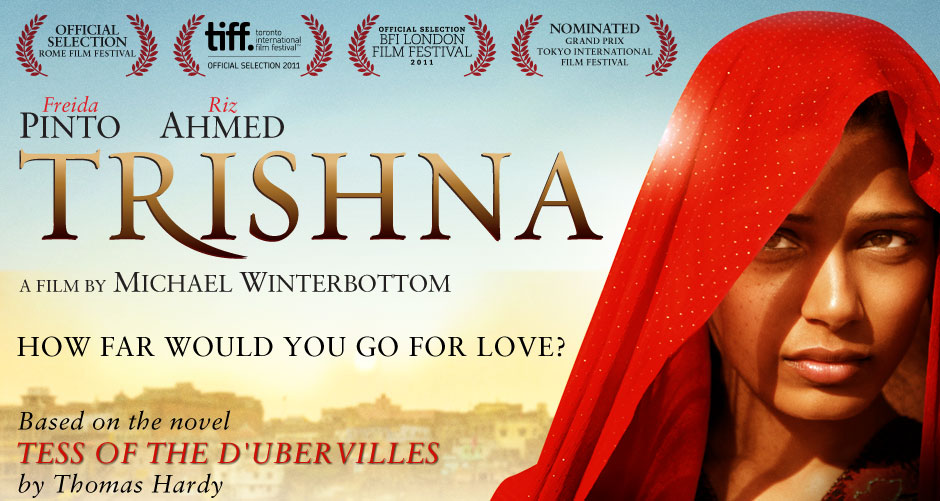
TrishnaThis is British director Michael Winterbottom’s third adaptation of a Thomas Hardy novel, after Jude (1996, Jude the Obscure) and The Claim (2000, The Mayor of Casterbridge set in 1860’s California). This time he transports us to India. From the mass of humanity, we zoom in to one innocent girl in a poor rural area, 19 year-old Trishna. The trajectory of her fate and encounters parallel Tess of the d’Urbervilles in Thomas Hardy’s novel, equally poignant and tragic. The transposition is convincing. Freida Pinto of Slumdog Millionaire fame is perfectly cast as Trishna. Winterbottom’s naturalistic style matches the mood of the novel. Not easy to watch at times as we follow a powerless female in a class-centred, male dominated world. A beautifully shot film.


Blue Jasmine (2013)

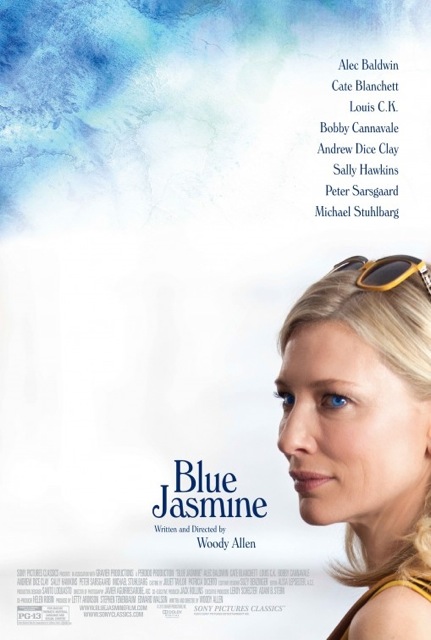
Blue Jasmine Movie PosterI’ve written a full post on this. I see Blue Jasmine as Woody Allen’s homage to Tennessee Williams’ A Streetcar Named Desire. A different time and place, altered names and backstories, but same kind of struggles, parallel character types. Vivien Leigh won an Oscar for her role as Blanche in the 1951 movie version as a displaced, worldly older sister coming to take shelter with her younger, less well-to-do sister. Cate Blanchett won hers playing Jasmine who faces similar predicaments. In typical Woody Allen style, a pathos and humour mashup. Blue Jasmine is an excellent new take on a piece of classic literature. Of course, in this case, we only see the overarching parallels, but it does speak to the subliminal power of old tales.


***

RELATED POSTS:

Can A Movie Adaptation Ever Be As Good As the Book?

Tess of the d’Urbervilles (2008 TV): The Lite Version Part 1, Part 2

Blue Jasmine: Homage and Re-imagining 

Slumdog Millionaire (2008)

A Summer in Genoa (2008, Michael Winterbottom, Colin Firth)

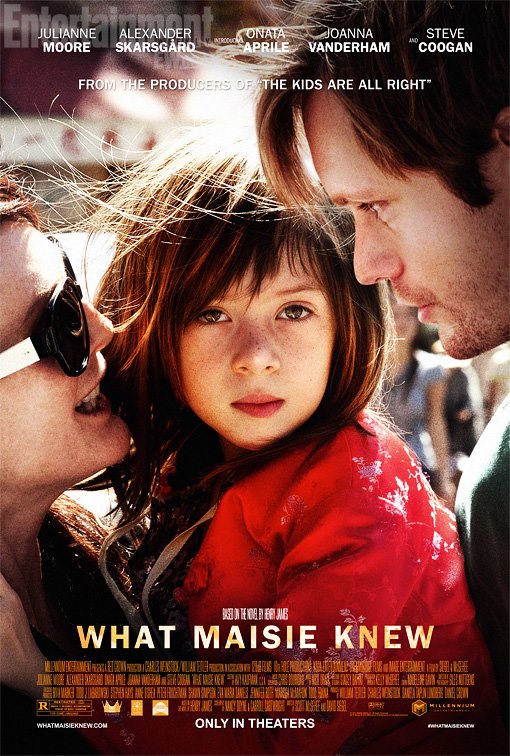
What Maisie Knew (2012): From Book to Film

With all due respect to Henry James, I’d rather be watching this contemporary adaptation of his work than slashing through the thickets of his novel. A thicket of a book, the last time I used this description was with Proust. And, if I’m to decipher long and incomprehensible sentences I’d rather be reading Proust than James. Nevertheless, James’s novel is a dense and deep psychological analysis of a dysfunctional marriage and its fallout on the child, a relevant issue today. Nobody wins in cases like that.

When published in 1897, it was probably one of the earliest fictional depictions of divorce and child-custody. Precocious Maisie knows much more than her parents could ever imagine. Like a volleyball, she is being tossed back and forth between her Mama and Papa, whichever side she lands on loses, for they both want their life to be free from child-rearing, free from ties and obligations. The notion of being ‘free’ recurs in the last chapters of the book, a key to how Maisie ends up choosing who to follow — her governess Mrs. Wix, someone who is not obsessed with being ‘free’, but who is committed to Maisie’s welfare.

What Maisie Knew


Again, may I reiterate here as in previous posts about books to movies, the two are totally different art forms. Here, one is a 300 page literary work, internal, dense and deep. The other is a 93-minute production of visual storytelling, enhanced by dialogues and musical score. To achieve this end, screenwriters Nancy Doyne and Carroll Cartwright have to pick and choose the most relevant storyline and characters, and opt out of lengthy, internal exploration of psychological entanglements, something the literary form can describe readily. The screenwriters have done a good job in their choices, keeping the story simple and relevant for viewers a hundred years after the book was published. Despite the subject matter, the movie is enjoyable and highly watchable.

Set in modern day NYC, it smoothly tells a poignant story from the child’s point of view. Six-year-old Maisie (Onata Aprile) is eyewitness and victim of her parents’ constant quarrels and later divorce, a young child caught in the thorns and thistles of adult relationships. It is unfortunate that the most sensitive and observant child is often the most vulnerable. The naturalistic capture by the camera of Maisie’s quiet observations is most heart-wrenching. Maisie learns that the adult world is a busy place, her presence, an inconvenience. Thanks to the screenwriters’ gentler treatment, the movie spares us from some cruel, hateful fights in the book. We see Maisie ultimately get a taste of what it’s like to be cared for and to have some simple, childhood joy. The ending shot is beautiful.

Unlike Maisie in the novel, there is no moral dilemma for her in the movie. No doubt, the moral element is crucial in James’s novel. Divorce and adultery must have poked deep into the heart of James’s readers in his days. But our contemporary society has, alas, evolved into a ‘morally neutral’ state of numb resistance. The screenwriters may well know too that entertainment value comes before the didactic. We see no moral choices here with Maisie in the movie. After all, a young child will readily cling to whoever that loves her in deeds rather than mere words. Kudos to the filmmakers, they know the heart of a child.

Directors Scott McGehee and David Siegel capture the story from Maisie’s viewpoint, natural and realistic, camera lens often at a lower angle. Certain shots are particularly affective, from inside a taxi, the transport of choice in Manhattan, at different times the vehicle that takes away Mama, Papa, and caring Margo. We would see from inside the taxi out to Maisie standing on the roadside, abandoned and distraught.

The wonderful cast is what makes the movie so absorbing, and at times, even heartwarming, despite its subject matter. The then seven year-old Onata Aprile is a natural. Julian Moore’s solid performance as her mother Susanna is convincing. She is a touring rock-and-roll singer who has passed her prime. Jealous and temperamental, Susanna’s love for Maisie is possessive, and often displayed in empty words. British actor Steve Coogan, known to North American viewers by his recent starring role in Philomena, plays the career-minded art dealer father Beale. Like his ex-wife, he is too busy with his own life to care for a child. They both say they love Maisie, showering bursts of affection whenever they see their child.

What saves Maisie is the awkwardly positioned step-parents, her father’s new wife and Maisie’s former babysitter Margo (Joanna Vanderham, the parallel of Ms. Overmore in the book) and her mother’s new love interest, the tall and young bartender Lincoln (Alexander Skarsgård, a Sir Claude parallel). As predicted, they soon are abandoned themselves and the two quickly form a tie that includes Maisie in their life. Diverging from James’s story, the two are genuinely loving and caring, a soothing balm to Maisie and the viewers.

Overall, a fine, contemporary adaptation of the novel. To James purists, a loose reinvention; for viewers seeking meaningful entertainment, this should be on the list of films to watch.

~ ~ ~ Ripples


 ***

Half Way Through a Budding Grove

Half way through reading In Search of Lost Time, Vol. II, Within A Budding Grove, I’ve discovered a key to enjoying Proust. Just as it’s best to eat madeleines by dipping them in tea before putting the moistened petite cakes in your mouth, the most enjoyable way to read Proust is lying in bed with an unhindered mind. In this most relaxed state, I’m at ease to stroll leisurely through a budding grove, or the thickets of a genius’s mind.

Within A Budding Grove Modern Library

So far, I’ve gone passed the narrator Marcel’s painful struggles with adolescent, unrequited love for M. Swann’s daughter Gilberte. In contrast, his crush for Mme Swann has been appreciated and normalized. Unlike the cool and aloof Gilberte, Mme Swann welcomes Marcel into their home warmly, including him in their family outings, and their home gatherings with their friends, thus allowing him an opportunity to meet his literary hero, the writer Bergotte.

And here’s the passage I’m most impressed by, so far. The man Bergotte is very different from the writer Marcel has encountered in his ‘divine writing’. The man appears to be very common, inarticulate even, and devoid of eloquence, a man who spent his childhood in a ‘tasteless household’. Marcel is shocked by this discovery, and scrambles to come to terms with such dissonance. In a most ingenious analysis, the young Marcel comes to this conclusion:

But genius, and even great talent, springs less from seeds of intellect and social refinement superior to those of other people than from the faculty of transforming and transposing them… To mount the skies it is not necessary to have the most powerful of motors, one must have a motor which, instead of continuing to run along the earth’s surface… is capable of converting its speed into lifting power. (p. 175)

As I read these few pages, Jane Austen came to mind. A writer who had lived her short life mainly in a rural setting, her associations parochial and far from ‘high society’, and yet could transport herself and thus her readers to a different world from her mundane social environs. Her imagination soared as it took flight with her incisive observations of human nature.

… the men who produce works of genius are not those who live in the most delicate atmosphere, whose conversation is the most brilliant or their culture the most extensive, but those who have had the power, ceasing suddenly to live only for themselves, to transform their personality into a sort of mirror… genius consisting in reflecting power and not in the intrinsic quality of the scene reflected. (p. 175-176)

The adolescent Marcel’s disillusionment with the discrepancy between the man and writer Bergotte leads him to an uplifting insight:

The day on which the young Bergotte succeeded in showing to the world of his readers the tasteless household in which he had spent his childhood, and the not very amusing conversations between himself and his brothers, was the day on which he rose above the friends of his family, more intellectual and more distinguished than himself; they in their fine Rolls-Royces might return home expressing due contempt for the vulgarity of the Bergottes; but he, in his modest machine which had at last ‘taken off,’ soared above their heads. (p. 176)

Yes, more Proust’s words than mine on this post. Many other highlighted passages and surprising delights, but will have to wait till I’ve come out of the budding grove the end of November. If you’re interested, you’re welcome to join me in a read-along of In Search of Lost Time, Vol. II: Within A Budding Grove.

CLICK HERE to my wrap-up post: Out of the Budding Grove

***

Related Posts:

Proust Read-along Swann’s Way Part I: Combray (Featured in ‘Freshly Pressed’)

The Swann and Gatsby Foil

What Was Jane Austen Really Like? Reading Tomalin and Shields

In Praise of Austen: Virginia Woolf’s A Room of One’s Own

***

Munro and Movies

Thanks to the Swedish Academy, Alice Munro doesn’t need a blockbuster movie to raise awareness of her works. Described by The New York Times as ‘Master of the Intricacies of the Human Heart’, and with her story settings mostly in rural counties and small towns, the 82 year-old writer must have known how the small and intimate can have far-reaching effects.

The short story as a literary form too must have gained importance and legitimation overnight now that Munro is honored as Nobel Laureate. The novel isn’t the only peak of the mountain of literary pursuits. Readers too, can now be totally comfortable with reading ‘just a short story’.

Back to movies, with our contemporary mega, blockbuster culture, it sure looks like the general public need to see a movie before knowing about a literary work. While I don’t like the idea, I’ve to admit that could well be the case nowadays. But for Munro, can anyone name a full feature movie that’s based on her short stories?

Right. Actually there are four. Edge of Madness (2002) is relatively unknown. Another one interestingly is an Iranian film, Canaan, which won the Audience Awards–Best Film at the Fajr International Film Festival in 2008. A better known adaptation is Away From Her (2006). It remains one of my all time favorite films. The most recent completed production is Hateship Loveship which premiered at TIFF13. I regret missing it when I was there in September. A film based on her story ‘Runaway’ is currently in development.

With Munro winning the Nobel, hopefully we’ll have the chance to see a general release of Hateship Loveship. So there you go, Munro could well be helping to reverse the trend: the writer promoting the film.

To celebrate Munro’s Nobel win, I’d like to repost in the following a review of Away From Her which I wrote in 2008. The film was directed by the young and talented Canadian actor/director Sarah Polley, who was nominated for an Oscar for her adapted screenplay based on Munro’s short story ‘The Bear Came Over the Mountain’. Julie Christie received an Oscar nomination for her role as Alzheimer’s afflicted Fiona.

You can read Munro’s story ‘The Bear Came Over the Mountain’ now online, thanks to a timely reprint by The New Yorker.

**

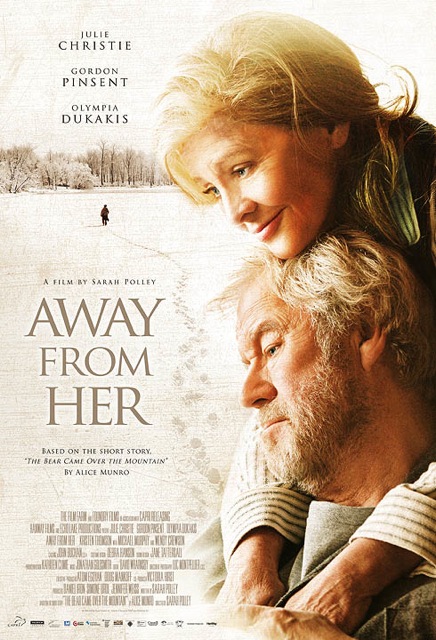
Capri_AwayFromHer_PosterB

AWAY FROM HER: A Short Review

How can you turn a good short story into a full length movie without compromising its quality? By turning it into a screenplay written by an equally sensitive and passionate writer, and then, through her own talented, interpretive eye, re-creates it into a visual narrative. Along the way, throw in a few veteran actors who are so passionate about what the script is trying to convey that they themselves embody the message.

Sarah Polley has made her directorial debut with a most impressive and memorable feat that I’m sure things will go even better down her career path. What she has composed on screen speaks much more poignantly than words on a page, calling forth sentiments that we didn’t even know we had. As Alzheimer’s begins to take control over Fiona, what can a loving husband do? Julie Christie and Gordon Pinsent stir up thoughts in us that we’d rather bury: how much are we willing to give up for love? Or, how would we face the imminence of our loved ones’ and our own mental and physical demise?

Based on the story by Alice Munro, ‘The Bear Came Over the Mountain’, Polley brings out the theme of unconditional love not with your typical Hollywood’s hot, young, and sexy on screen, but aging actors in their 60’s and 70’s. It may not be as pleasurable to watch wrinkled faces hugging and kissing, or a man and a woman in bed, bearing age spots and all, but such scenes effectively beg the question: why feel uncomfortable?

Why does love has to be synonymous with youth, beauty, and romance? It is even more agonizing to watch how far Grant is willing to go solely for love of Fiona. Lucky for us, both writers spare us the truly painful at the end. It is through persistent, selfless giving that one ultimately receives; however meager and fleeting that reward may seem, it is permanence in the eyes of love. And it is through the lucid vision of a youthful 28-year-old writer/director that such ageless love is vividly portrayed…. Oh, the paradoxes in life.

~ ~ ~ Ripples

***