While We’re Young: Wearing the Hat of Authenticity

The discussion that follows involves major plot points. Spoiler Alert. If you have watched the movie, you’re welcome to share your views in the comment section.

**

The film begins with an excerpt from Henrik Ibsen’s play The Master Builder. In the context of the play, Solness, the Master Builder, is fearful of the young, specifically, the draftsman he has taken under his wings, Ragnar. Solness’ anxiety lies in his apprehension that one day, soon, the young Ragnar would open shop on his own as a full-fledged builder, surpassing him and rendering his life work obsolete. He has the following exchange with a young lady friend Hilda:

Solness: … Wait and see, the young will come here, thundering at the door! Breaking in on me!
Hilda: Then I think you should go out and open your door to the young.
Solness: Open the door?
Hilda: Yes. Let them come in to you – as friends.

Writer/director Noah Baumbach sets the stage for a contemporary story with the parallel of Solness in his main character Josh Shrebnik, 44, aptly played by Ben Stiller. Josh is a documentary filmmaker who may have passed the peak of his career, his latest project dragging on for ten years without new grant money coming in. In the continued education class where he teaches documentary filmmaking, he meets a hipster couple in their 20’s, Jamie (Adam Driver) and Darby (Amanda Seyfried). Jamie expresses great admiration for Josh, feeding him what he needs. Soon, Josh and his wife Cornelia (Naomi Watts) become fast friends with them, and begin to drift away from their peers, new parents Marina (Maria Dizzia) and Fletcher (Adam Horrovitz).

In Frances Ha (2012), Baumbach brought us a positive profile of youth embodied in co-writer and star Greta Gerwig. Gerwig grasped the gist of youth beautifully by portraying an aspiring young dancer in NYC finding her way to a career and to her own true self. In Frances we see a delightful image of the young. Here in While We’re Young, Baumbach presents another view on youth. He does it by juxtaposing hipsters with the middle-aged, leading the audience through a revealing and interesting story. While the brunt of the laughs falls on the older pair Josh and Cornelia, the ultimate revealing is on the younger generation.
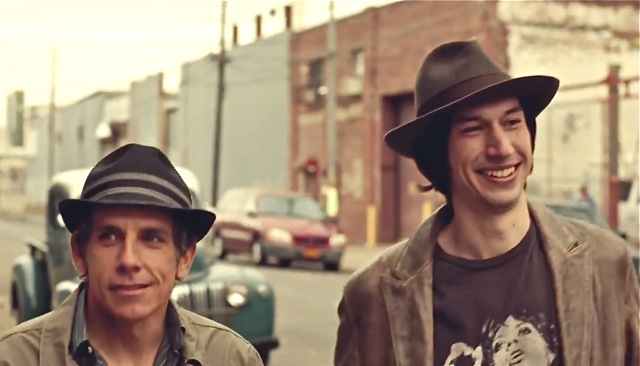
While We're Young

What makes the movie rich and intriguing is that what looks like a simple, single storyline embeds multi-layered thematic materials. On the surface, Baumbach lets us laugh at Josh and Cornelia, forty-something, childless, needing to come to terms with aging but not until one last attempt at rejuvenation. Hanging out with Jamie and Darby makes them feel young again. Josh dons a fedora hat, wears hipster shoes, rides a bike to keep up with Jamie. Cornelia goes with Darby to a hip hop dance class, and stressed herself out with the moves. For more flavour, both try the new experience of detoxing through a vomit inducing potion in a shaman party. Watts sure can keep up in her comedic act with Stiller, just right in juggling between depth of emotions and light-hearted fun. After St. Vincent, where she plays a small, funny role alongside Bill Murray, Watts has proven once again that she can wear the comic hat suitably.

On another level, we see Baumbach contrasting the ironic lifestyle choices in a sequence of fast cuts. We see the middle-aged couple using iPhone to Google once something comes up, while Jamie and Darby just try to remember and recall the info. Googling is too easy; they don’t want instant answers. If they can’t recall, they’re contented with not knowing. I can’t get enough of these subtly planted Baumbach jokes. As Josh listens to CD’s on his laptop, Jamie enjoys his wall to wall collection of vinyl records, played on a turntable. Jamie makes his own table, Darby makes ice cream from scratch. They ride a bike to get around. Their hipster lifestyle totally grabs Josh as genuine and cool; impressing him even more is their generous and open demeanour. A budding documentary filmmaker, Jamie invites Josh to co-direct his film. Josh is totally sold.

Ben Stiller is a natural when it comes to playing a clueless, de-valued character like this one. In Greenberg (2010), his previous collaboration with Baumbach, he plays a similar role, middle-aged and lost in the flow of life, also touched and changed by a youthful character (Greta Gerwig). It’s easy for us to laugh at Stiller, a greying forty-four-year-old hipster-wanna-be trying hands-free cycling following Jamie but only for a short two seconds before he twisted his back. The back will soon heal, but it’s “Arthritis” on the knees that the doctor is more concerned about. The joke there in the doctor’s office is just too good for me to include here. And, when did he last have his eyes checked?

As the story develops however, we begin to see Josh having second thoughts. Maybe Jamie’s work isn’t as authentic and spontaneous as it looks. Adam Driver is perfect in projecting a fused expression of innocence and mischief. His calculated moves startle Josh. Herein lies a crucial, contentious thematic element. There’s a fundamental breach of integrity. Is Jamie ignorant about ethics or is he simply amoral? Isn’t a documentary supposed to present truths? To what extent can it be staged or its ‘facts’ twisted? Nil, according to old-schooled Josh; such methods are fraudulent, crossing ethical boundaries, inexcusable. To Jamie, it’s no big deal, “it doesn’t matter that it’s fake.” To us the viewers, this third act is the juice in the meat. Josh’s indignation is justified.

But then, Baumbach pulls back, as if being too harsh on young Jamie. As I think about the notion of authenticity in the movie, I realize it comes in different forms, not only in documentary filmmaking, but with the actual life these characters are living. A love for retro and owning a collection of vinyl records don’t mean Jamie has real experience living in the 60’s. Or for Josh, imitating hipster fashion doesn’t make him young, as his friend Fletcher says: “You’re just an old man with a hat.” Taking an example from a recent real-life happening: when we see a veteran news anchor faking accounts to add glamour and self-importance to his reporting we know age is not the dividing line for authenticity. So maybe Baumbach has a point there by cutting Jamie some slack at the end. In the last scene, Josh, wiser now, utters: “He’s not evil; he’s just young.”

Let’s hope authenticity won’t become a dismissible fashion trend like a hat.

~ ~ ~ 1/2 Ripples

***

Other Ripple Reviews you may like to read:

The Secret Life of Walter Mitty (2013)

Force Majeure (2014)

The Grand Budapest Hotel (2014)

Inside Llewyn Davis (2014)

The Second, Best Exotic Marigold Hotel (2015)

The comma is not a typo. If you pause there before you say the rest, you’re clear in announcing the sequel, and not ‘The Second Best…’ for it’s not.

I’d say, it’s a little better maybe, funnier and more lively than the first. I can hear some protests. But in my case, kudos to the Bollywood dancers entertaining us before the movie began – two pairs of youthful and energetic Indian dancers giving us a taste of Bollywood – we were all warmed up and ready to embrace the show.

banner-the-second-best-exotic-marigold-hotel-film
Who will speak up against Ageism in the movie industry? What better spokespersons than the stars themselves? Let their charisma and performance speak.

The Second Best Exotic Marigold Hotel is all about checking into new beginnings. In the last chapter, life can be beautiful and fulfilling, and one is never too late to enjoy it, even if they are merely ephemeral, fleeting moments. With the latent energy of the Marigold residents, they intend to make those precious moments last for the rest of their lives.

Director John Madden, who helmed Shakespeare in Love (1998) and saw it go on to win seven Oscars, brings us the sequel to his unexpected box office success of the first Marigold Hotel. This is no Shakespeare In Love, of course, but from the digital ink of screenwriter Ol Parker, we have some fine dialogues despite a lack of substantial plot lines; from the mouths of the seasoned and weathered come some refreshing viewpoints.

Even if you’re not starstruck, you have to tip your hat to this cast of talents, veteran actors whose average age works out to be 70; yes, I looked them up and did the math. Two-time Oscar winner Maggie Smith, Judi Dench (also Oscar winner and exactly 19 days older than Maggie in real life, as she said in the movie), Bill Nighy, Penelope Wilton, Ronald Pickup, Celia Imrie, Diana Hardcastle, and this time around, the newly-aged and still handsome Richard Gere, with David Strathairn also playing a small role.

The young proprietor of the retirement hotel in Jaipur, India, Sonny Kapoor, is eagerly planning for an expansion of his business venture, a second Marigold Hotel. Performed with much animation by Dev Patel of Slumdog Millionaire fame, Sonny is basically the foil, not just in his youthfulness and agile Bollywood dance skills, but in his overacting. My query: why is his Indian accent thicker than his mother’s (Lillete Dubey)? Nevertheless, watching the threesome, the soon-to-be-married Sonny and Sunaina (Tina Desai) plus the odd addition of Kushal (Shazad Latif), is energizing and mood altering. In the last act, having the Marigold residents join in the Bollywood dance at the wedding party is a treat, an acquired taste for some viewers I admit.

Under the direction of DP Ben Smithard, we see some colourful street scenes and beautiful sights. Following the constant panning camera between pillars and doorways, we become silent observers of the lives of these Marigold residents.

Throughout the movie, I’ve jotted down a few fine lines which, if spoken by the inexperienced, could well become platitudes. But here delivered by these professionals of film and stage, the one-liners are spot-on and memorable. Everyone has a story and there are a few notable dialogues, like this between the eldest pair swept by clashing undercurrents:

Muriel (Maggie Smith): You’re just nineteen days older than I am.
Evelyn (Judi Dench): Nineteen days is the life span of a wasp.

Exactly, time is relative. Fact is, time is what these Marigold residents don’t have. That’s what makes each of their story so pressing. At 79, Evelyn is faced with the choice of accepting or declining a new career as well as a genuine but shy suitor, Douglas (Bill Nighy). Her feeling in a nutshell:

“Sometimes it seems the difference between what we want and what we fear is the width of an eyelash.”

Good that she realizes just in time, and it’s clever how she conveys her message to Douglas at Sonny’s wedding. So, her new insight after much pondering:

“I thought, how many new lives can we have? Then I thought, as many as we like.”

And for Norman (Ronald Pickup) and Carol (Diana Hardcastle), it’s never too late to change as we see love turn them from promiscuity to monogamy. Well, even a faint attempt is encouraging.

As for Madge (Celia Imrie), she finally decides which direction she should take, left, right, or straight ahead, probably for the first time in her life.

Who can laugh at the old but themselves? Here when Jean (Penelope Wilton) suddenly reappears at the Marigold, I can associate her role as the sharp-tongued Isobel Crawley in Downton Abbey:

“I couldn’t resist the opportunity to come out and visit the old ruins, and see how the hotel was doing too.”

As a self-appointed tour guide in Jaipur, Douglas knows it’s never too old to step out into uncharted territory. Some good laughs there with his little helper in the background feeding him info or he’ll be just as lost as his tourist clients. As well, he is experiencing love like an insecure young chap. This is my favourite line, not only for the words but the way Nighy says them can make your heart ache:

“The great and terrible thing about life is there’s just so much bloody potential.” The subtext is brilliantly conveyed by his obvious frustration and agitated demeanour.

Ah… “There is no present like the time” [sic, exactly]

Time is a gift and a torment when you’re only given a limited portion under the low-hanging clouds of mortality. Here’s the poignant scene at the end. It belongs to Muriel (Maggie Smith), could well be foreshadowing what we will see in Season 6 of Downton Abbey. Her voiceover is full of pathos:

“There is no such thing as an ending; just a place where you leave the story.”

Of course there are flaws in the movie. But just like wrinkles, you’ve come to overlook them while admiring the person. Call it an escape or a two-hour vacation, The Second, Best Exotic Hotel offers a fun and gratifying ride.

 ~ ~ ~ Ripples

*** 

Related Posts on Ripple Effects:

The Best Exotic Marigold Hotel (2012)

The Lunchbox (2013): A Meal that Binds

Downton Abbey Season 5 Finale

Slumdog Millionaire (2008)

Leviathan: The Beast Within Us

The Chinese have a saying – while we’re at foreign language films – ‘A tyrannical government is more ferocious than the tiger’. That Leviathan is selected as the official entry from Russia to the Oscar race baffles me. But I can also see those in power there just may not be bothered by small town corruptions which the film depicts, for they must be more focused on the larger picture that carries greater magnitude, the scenery in Crimea.

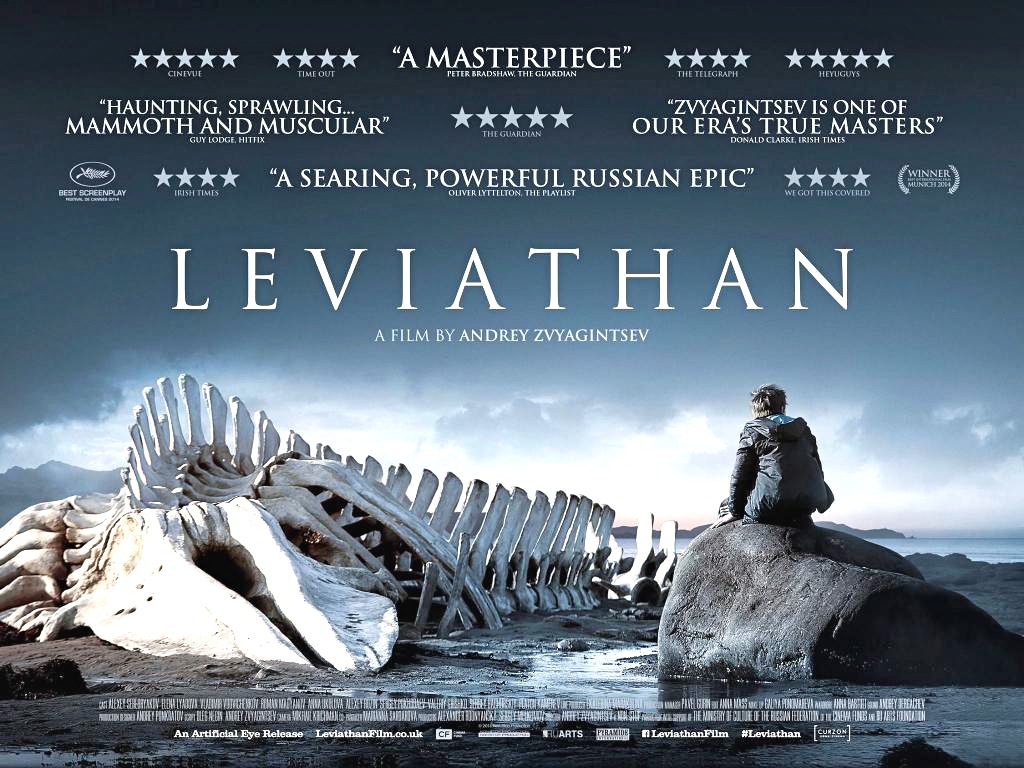
Leviathan, that monstrous beast the priest in the film quotes to the main character Kolya is from the book of Job in the Bible. While the context in the Biblical passage is about the Creator’s might over the huge creature, it is a metaphor with layered meaning in writer/director Andrey Zvyagintsev’s film: A citizen against a powerful mayor vying for his home property, and the monstrous beast inside the characters with which they all have to wrestle.

Leviathan Movie Poster

Kolya (Aleksey Serebryakov) is an apt parallel of a modern day Job in the sense of the misfortunes he encounters. The little guy is no match for a greedy and powerful mayor and a corrupt system when it comes to holding on to what he legally owns, his home on a piece of  land by the shoreline in the coastal town of Pribrezhny. Even his lawyer friend Dimitry (Vladimir Vdovichenkov), who has come all the way from Moscow to advocate for him, falls victim to the small town mayor Vadim (Roman Madyanov).

The seemingly idyllic setting of Kolya’s coastal home is apparently an illusion. The cinematography is stunning and probing at the same time, for apart from the scenic serenity, there are also broken and derelict boats discarded on the shore, as well as carcasses of sea creatures, in particular, a whale-like skeleton that we the audience would gasp upon seeing but that the local residents don’t even take a second look. Their lives are intertwined with the Leviathan, however skeletal its remains.

But Kolya is not Job. He is hotheaded and impulsive. Apart from fighting the external beast of the mayoral hostile take-over of his home property, Kolya has to keep his wife Lilya (Elena Lyadova) at bay from his lawyer friend Dimitry, as well as bring up teenaged son Roman (Sergey Pokhodaev) on a path he himself is at a loss in finding. The worst is yet to come though. We empathize with Kolya, a man so trapped, he is unable to find a way out other than drowning his misery in alcohol. The church is not helping either, why, its most powerful congregation member is the mayor himself.

Too far and remote a film to identify? The setting maybe, but not the story. Leviathan resonates with the human condition it depicts, the Leviathans within us that we have to wrestle wherever we may be. Not just Kolya, but every character is crying for a redemptive way out of his or her predicament, unless blind as the mayor who basks in his own schemes. With the nuanced performance of the cast, we have the pleasure to appreciate a production superbly crafted, and that’s what gratifies when watching a film well made, despite the subject matter.

Leviathan has won 2014 Cannes Film Festival’s Best Screenplay Award, and last month the Golden Globe’s Best Foreign Language Film. This Sunday at the Oscars, Leviathan has a good chance of grabbing the coveted prize in its category, Best Foreign Language Film of the Year.

My pick? Still rooting for Ida, for its positive choice at the end.

~ ~ ~ 1/2 Ripples

***

My Reviews of 2015 Oscar Nominated Films:

Ida

Boyhood

The Grand Budapest Hotel

Whiplash

Gone Girl 

Interstellar and Ida

Kingsman: The Secret Service

I started Proust’s The Guermantes Way a few months ago, still have some five hundred pages to go. So if I have two hours to spare, why do I not get back to it and make some headway, instead of going to the theatre to see Kingsman: The Secret Service on the first day of its screening?

For pure escape, of course. And then there’s the CF factor.

Yes, if the Colin Firth you have in mind is Mr. Darcy doing his graceful dive into the pond, you’re in for a big cognitive dissonance. Indeed, you can call this a paradigm shift for Colin Firth. He’s still a gentleman, mind you, dapper and poised, but he is one suave, choreographed fighting and killing machine, six month in the training, as he admitted in (real life) interviews.

British director Matthew Vaughn, who brought us Kick-Ass (2010) and X-Men: First Class (2011), had taken on adapting the Marvel comics created by Dave Gibbons and Mark Millar (Kick-Ass) by mashing fantasy and realism into one big action-packed, stylish, fun and at times farcical British spy adventure. The production is like an homage to Ian Fleming’s James Bond and all those in the secret intelligence service MI6, from Q to M.

But to evoke an even deeper root, The Kingsman is Arthur (Michael Caine) and his knights, Galahad (Colin Firth), Lancelot (Jack Davenport), and the mastermind Merlin (Mark Strong). A pure fantasy. Behind the facade of a tailor shop in London is the  organization’s high tech base, and rightly so, for a gentleman’s suit is his armour, and the Kingsmen are the new knights.

Firth’s dapper presence is a prime model showing off the bespoke tailoring. What you see on screen you can also get, a collaboration of the film’s costume designer Arianne Phillips and the online retailer Mr. Porter. A Kingsman brand of wardrobe and accessories is the exclusive product spinoffs. Fantasy meets reality.

Kingsman

Not just a fashion statement though. What Galahad Harry Hart tells the young recruit Eggsy (Taron Egerton), who comes from a seedy part of London, records of petty crimes under his belt, raised by a single mother with an abusive boyfriend, all subsequent to the early death of his father, a former Kingsman: “Being a Kingsman has nothing to do with the circumstances of one’s birth; if you’re prepared to adapt and learn, you can transform.” After thinking a bit, Eggsy responds, “Like My Fair Lady.” If there’s any mindful lesson one can glean from watching this seemingly mindless entertainment, here it is.

Back to the task at hand. The dual plot lines are tightly woven as we see Eggsy going through a demanding training and screening process, at the same time Hart has to deal with the high tech villain cum philanthropist Richmond Valentine (Samuel L. Jackson). Valentine sees mankind as a virus. He has developed the means to eradicate the pests, from a mind-controlling implant to a free-for-all SIM card through which he can activate, gleefully watching people kill off each other.

Comic book clarity, black and white, no shades of grey. While the plot may be formulaic, there are special effects and production designs that are fresh and captivating. I particularly like the tailor shop cum secret organization lair, with its underground passageways, and yes, the neat arrays of wardrobe accessories that are lethal weapons in disguise.

As an R-rated movie, some scenes are demanding of the viewers, and in the genre of action/adventure/comedy, graphic violence is prolific. The church scene may not sit well with some, albeit the explanation of the carnage is offered only after the very long and deadly sequence. Valentine is playing God to control their minds and impulses. Despite its flaws, which are easily covered by the quick change of scenes, overall it is a well-paced, well-acted, and stylish production.

Music is prominent in conveying the spectacle and thrills, as well as humour. I chuckle when I hear the British composer Edward Elgar’s Pomp and Circumstance accompanying one of the explosive, climatic sequence at the end, the extravaganza of human heads turned fireworks, a good reminder and celebration of where all the fantasy of the gentleman spy originates.

As with a genre of this kind, the movie is not for everyone. If you can’t stand the sight of blood, or graphic violence, or hear the F word prolifically uttered, or are reluctant to let farcical surrealism override a rational mind, then maybe you’d like to stay home and attack your TBR pile of reads. Don’t bother flipping through the comic book either. As the bookstore clerk warned me when I asked about it, “It’s very graphic.”

And yet, the two hours of pure escapism has proven to be invigorating. I’m just about ready to get back to Proust.

~ ~ ~ Ripples

Paddington: The Marmalade to Spread on Your Day

What can a little bear from ‘Darkest Peru’ do to ease one’s tension, uplift a depressed mood, or simply elicit laughs out loud? Plenty. Paddington can do plenty of good for all of the above. I’d chosen the right film to come out of a stressful month.

Clever, fast-paced, passionate, and very funny, Paddington the movie is 95 minutes of pure delight. Although Michael Bond’s stories first came out in 1958, director and screenwriter Paul King has brought out some relevant, contemporary issues in his adaptation such as migrating to a new land, finding a home, striving to belong, accepting diversity, and basically the universal search for ways we can all live together despite differences.

Paddington

The movie begins with a black-and-white old news reel. I like that already. An English explorer, Montgomery Clyde (Time Downie), heads over to ‘Darkest Peru’ and discovers a talking bear family. As he leaves, he urges them to visit London. After an earthquake that killed his Uncle Pastuzo (Michael Gambon, voice), the little bear (charmingly voiced by Ben Whishaw) is sent out by Aunt Lucy (voice of Imelda Staunton) to head for a new life in this believed-to-be-friendly London. To send him off, Aunt Lucy hangs a little sign with a string around his neck that says: “Please look after this bear. Thank you.”

And so the little stowaway with a suitcase full of marmalade hides on board a cargo ship and is transported to a foreign land where the Brown family finds him at Paddington Station. Thus his new name.

Despite the chaos that ensues in the Brown household, and the initial reluctance of Mr. Brown (Hugh Bonneville, who is like a Papa bear himself), and daughter Judy (Madeleine Harris, “So embarrassing!”), Paddington’s inept charm readily wins the heart of the enthusiastic Mrs. Brown (the always enthusiastic Sally Hawkins) and very friendly young son Jonathan (Samuel Joslin). Later, Paddington finally gains even the public’s favour with his serendipitous heroism on the streets of London.

Here is no place to argue against stock characters. Of course we need a villain; we have the parallel of Cruella De Vil of 101 Dalmatians in the form of Millicent, played by Nicole Kidman. I’m sure she enjoys doing that too. Driving a van that says Taxi when the sliding door is opened, she soon reveals herself a taxidermist when the door is closed. Good to see stars letting loose in non-typecast roles. Julie Walters and Jim Broadbent also present for you to discover. And if you know what the Paddington Bear author Michael Bond looks like, you can find him in cameo too.

Very well integrated are the effects of real-life, human actors interfacing with the animated bear and other cartoonish scenarios. Do we need to know how the technical genius behind the screen worked, how they used around 600 shots with bears, which required 350 people across two countries working on the visual effects for three years… to enjoy the film? Definitely not, maybe best we don’t go into the complexities of CGI’s, simulations, and yes, how to deal with fur. The final results are all what the technical team had striven for, delivering what they would like us to see. I can fully appreciate the effects. Kudos to them all.

It is definitely a snub Paddington doesn’t get an Oscar nomination, in any category. While in the land of its origin (England, not Peru), Paddington is nominated for two 2015 BAFTA Awards (The ‘British Oscars’): Best Adapted Screenplay and Best British Film. So I do hope the box office here can redeem the slight on this side of the Atlantic. Go see how the little bear and his new-found family can dispel your winter blues. Noms or no noms, this is a winner in my book.

As for that sign Aunt Lucy hangs around Paddington’s neck, we may need to heed it even more in this conflict-ridden world of ours:

“Please look after this bear. Thank you.”

~ ~ ~ 1/2 Ripples

***

Click on the link to the fascinating article in The Telegraph, Paddington: The technology behind the small bear from Darkest Peru.


Force Majeure (2014): Act of God or Act of Human

As I’m writing, this just popped up: Force Majerure (Sweden) is now one of nine films shortlisted for the Oscars Foreign Language Film category, advanced from the initial round with features from eighty-three countries. Soon, this list will be further shortened to make up the five nominees for the 87th Academy Awards. Nominations will be announced at 5:00 a.m. PT, January 15, 2015.

Force Majeure

I watched Force Majeure at TIFF in September, a second time again this week as it comes to our local theatre. Please note, it is impossible to discuss this film in an intelligent manner without mentioning the storyline. Therefore, consider yourself warned. Spoiler Alert. But let me assure you, this won’t lessen your enjoyment of the movie; rather, it could prepare you for a more purposeful viewing.

‘Force majeure’ in translation means ‘an overwhelming and irresistible force’. Director Ruben Östlund tells his visual story based on this notion. A young family goes on a week of skiing holiday in the French Alps, a much needed family time as the husband has been busy at work. What is intended to be a fun family vacation is turned into something totally unthought of, making this one of the most original film ideas I’ve come across in years.

The slick and stylish camerawork begins with a close-knit family. Mom and Dad Ebba (Lisa Loven Kongsli) and Tomas (Johannes Kuhnke) look like a well-matched couple; their pair of school-aged children Vera (Clara Wettergren) and Harry (Vincent Wettergren) are smart and charming. All four of them sleep together on one King-sized bed in the resort hotel, wear the same style of underwear, brush their teeth in one accord, do everything together, until one split-second their view of each other is shaken to the core.

Family photo

The ski resort conducts controlled avalanches to maintain the ski slopes. At lunch on the second day, the family sits at a table in the outside terrace, taking in the spectacular scenery. Suddenly a controlled avalanche is launched. At first, everyone is curious and excited, marvelling at the sight. But soon the avalanche appears too close for comfort. Panic begins to send people scattering away from their tables.

Ebba grabs her children, but with two of them, she looks for Tomas to help. Tomas in the mean time is nowhere to be found, for he is the first one to run away from their table. Sounds hilarious? The scenario can be quite comical actually, but that only sets the stage for a critical look at a marriage relationship, and with that, the duties, roles, and expectations of a husband and a father.

Director Östlund aptly presents to us a situation worthy of discussion. What deserves praise is the way he does it: with deadpan humour, slick editing, stylish cinematography and clever dialogues. The music motif captures the mood perfectly with excerpt from Vivaldi’s Four Season, where the intensifying summer storm brewing, and soon wreaks havoc on what could have been a perfect family holiday.

As Ebba relays the embarrassing episode to friends Mats and Fanny, superbly played by supporting actors Kristofer Hivju and Fanni Metelius, the scenario soon divides the two couples along gender lines, and divergent and conflicting views regarding male and female roles and dispositions ensue. Suppressed chuckles in the theatre could well be the intended effects by the director, but I couldn’t help but LOL at certain shots.

Tomas’s earlier denial is later dissolved into concession as he declares himself ‘a victim of his own instincts’. What an intriguing claim. Are we autonomous agents fully responsible for our own actions, or victims of our personality? I first thought the term Force Majuere refers to the avalanche, but as the story unfolds, I begin to see it as the force within, our innate nature, as Tomas puts it, the impulse that drives him to act a certain way. The term ‘controlled avalanche’ is perhaps the most intriguing oxymoron inferring to the nature of our behaviour.

The final act may look a little incompatible with the rest of the film. However, I feel it is a sensitive and nuanced depiction of this thing we can call ‘humanness.’ What’s joining us all is our frailty. A quote from another movie suddenly comes to mind: “The things that people in love do to each other they remember, and if they stay together it’s not because they forget, it’s because they forgive.”

An interesting scenario presented in a visually captivating and delightful cinematic offering. I hope Force Majeure will make it to the final cut in the Oscar race. And, my instinct tells me it just might.

~ ~ ~ 1/2 Ripples

***

Other Related Posts on Ripple Effects:

Ida’s Choice: Thoughts on Pawlikowski’s Ida

Tuffing it out at TIFF14

Top Ripples 2014

Whiplash (2014): What Price Perfection?

This is one movie Tiger Mom can wholeheartedly approve. There’s a line spoken by the critical-to-the-point-of-sadistic music teacher Mr. Fletcher:

“There are no two words in the English language more harmful than ‘good job.'”

In a sense, Whiplash can be taken as the dramatization of that Tiger Mom philosophy.

Whiplash Movie Still

The 2014 Sundance winner is writer/director Damien Chazelle’s second feature. In Whiplash, which he also wrote, Chazelle tells a very original story, the training of a music student and the intense, ambivalent relationship between a mentor and his trainee. How far can a teacher go before crossing the line into abuse, however well the teacher’s intention to draw out the best from the student?

We see the tortuous journey a promising jazz drummer, Andrew (Miles Teller), has to embark on as he freshly enters the fictional Shaffer Conservatory of Music in NYC. I’m not in the position to say whether it indirectly reflects upon which music school, so I better not dwell on this further. But one thing I do agree is that, yes, the Western way is too full of praise. The pursuit of excellence is often replaced by that of fun, and complacency and self-satisfaction (to protect self-esteem) the stumbling block to improvement. Tiger Mom can attest to that too.

Andrew has all intentions to learn and master top notch drumming skills under the demanding tutelage of Fletcher. He doesn’t want to be just a good drummer, he wants to be great, and he is willing to pay the price to get there. Being selected to play in Fletcher’s studio jazz band is a coveted privilege, staying in there requires nothing short of the physical and mental endurance as required in a war zone.

Like the drill sergeant in Kubrick’s Full Metal Jacket (1987), yelling insults and putdowns at the young recruits, shattering egos and self-confidence, Fletcher keeps his players in shipshape form by ruthless coercion and intimidation. He demands perfection. J. K. Simmons is most impressive in his role as Fletcher. What a transformation to Mr. Hyde from the kind and loving Dad in Juno (2007). It is likely that he will have a place in the award nominations come the next two months.

Miles Teller as Andrew is equally tenacious. Thus we see a dynamic duo in contention, excellent acting from both. Teller may have lots of competition when it comes to a Best Actor nom, but he is still young and has fuel for miles to come. His drumming skills are impressive too, or is it the excellent camera and editing work?

The agile camera is effective in depicting the intensity of the relationship between Andrew and Fletcher, capturing the dramatic effects like a thriller, with manic drumming in impossibly fast tempo and the exasperating face of Andrew’s that exudes both anguish and determination. Seamless editing, gripping cinematography and sound are prominent elements that will likely be acknowledged at award noms.

What price perfection? What does a student have to do to gain acceptance and respect from his teacher, the one whose approval that matters most in his training?

What started off as realistic storytelling a la suspenseful drama in the first two acts begins to transform into a totally different genre more like magical realism in the final scenes. Like Gone Girl is a dramatic exaggeration of a marriage gone wrong, Whiplash is a hyperbole of a troubled teacher/student relationship taken to the extreme.

How to get to Carnegie Hall is not only by way of practice, practice, practice, but also entails plenty of blood, sweat, and tears. We see the free flow of all the above in the movie.

Despite my reluctance to fully embrace the ending sequences, I have thoroughly enjoyed the movie. A very original story idea well executed as a suspense thriller, add in some fine jazz music and mood setting technical effects, Whiplash is an impressive production from a young writer/director with great potential. I can’t help but wonder if there’s any real life similarity between him and his protagonist.

~ ~ ~ Ripples

 Awards Update:

Feb. 22, 2015: J. K. Simmons wins Best Supporting Actor Oscar. Also wins Oscar in Sound Mixing, Editing.

Feb. 21, 2015: J. K. Simmons wins Best Supporting Actor at the Independent Spirit Awards.

Feb. 8, 2015: 3 BAFTA wins for Best Supporting Actor, Editing, Sound.

Jan. 15, 2015: 5 Oscar noms for Best Picture, Best Supporting Actor, Best Original Screenplay, Best Editing, Best Sound Mixing.

Jan. 11: J. K. Simmons wins Golden Globe

Dec. 11: J. K. Simmons gets Golden Globe nom for Best Supporting Actor

Dec. 10: J. K. Simmons gets SAG nom for Best Supporting Actor

Dec. 7: J. K. Simmons wins Best Supporting Actor at the L.A. Film Critics Awards

Dec. 1: J. K. Simmons wins Best Supporting Actor from the New York Film Critics Circle

Whiplash has received 4 Film Independent Spirit Award nominations including Best Feature, Best Director, Best Supporting Actor (J. K. Simmons), and Best Editing.

Before I Go To Sleep (2014): Movie or Book?

Spoiler Alert: This post may contain information that one could deem spoilers, and, not just for this movie but for the other one, yes, you guessed it, Gone Girl

Before I Go To Sleep

If as some say Gone Girl is misogynist, then Before I Go to Sleep is the counter argument. Why of course, there’s a 50/50 chance that the villain is the female or the male character, and in some cases, both. And if it’s both, does that make the movie misanthropic?

So much about our humanity, which is what these crime suspense thrillers are all depicting, albeit in a more exaggerated way. Here is the movie adaptation of the very popular debut novel written by British writer S. J. Watson. Again, allow me to answer a question up front, book or movie first?

I know, there’s a likely chance that you have no intention to touch either, but here’s just an interesting thought, especially with the Gone Girl phenom still rippling. For this one, I’d say read the book first, mainly because if one goes to the movie unprepared, one would likely find the premise preposterous. A woman waking up every morning with no memory? But actually there are real-life cases which the author mentions in the epilogue of the book.

On the last page Watson notes that his novel, though totally fictitious, is inspired by actual medical cases, particularly that of Clive Wearing‘s, the British musicologist, conductor and BBC music producer, who has the same amnesiac condition, albeit his is an even shorter memory span, just a short minute or so.

Before I Go To Sleep is about a woman Christine (Nicole Kidman) who wakes up every morning with a total blank, forgetting who or where she is, and not knowing the person lying beside her in bed. He happens to be her husband Ben (Colin Firth), who has to explain to her every morning and reminds her who she is, and that an accident occurred fifteen years ago when she was 25 had left her in a state of amnesia with just a day’s memory span, but no matter, he tells her that he loves her.

Actually quite an interesting premise for a suspense thriller, the amnesiac as a vulnerable, ready victim. To add to the mystery, Christine receives a phone call from a Dr. Nasch (Mark Strong) every morning after Ben leaves the house for work. He tells her he has been helping her and gets her to look for a camera in a shoe box hidden inside her closet. In there she can replay what she has recorded the night before, bits and pieces of her memories.

The movie is a graphic and more suspenseful enactment of the novel, directed by Rowan Joffe, who had written the screenplay and directed Graham Greene’s Brighton Rock (2010). But I had found impressive his screenplay for The American (2010) which, under the direction of Anton Corbijn (A Most Wanted Man, 2014), is one of the rare spy thriller that is soulful. Come to think of it, I can’t help but think such a collaboration, Joffe screenplay, Corbijn directs could have made Before I Go To Sleep a better movie.

As I had mentioned in my review of the novel Before I Go To Sleep, the major flaw of the book is that the author forgets that it’s his character who has amnesia, not his readers. So every chapter starts off with her reading more or less the same journal entry she wrote the night before is a bit too tedious.

Such a condition has been improved in the movie by Joffe, and with the convincing performance by Kidman, we are made sympathetic observers instead of being bored by the repetition. A video camera to jot her memory is also a better way to capture visual anguish than reading from a journal. Making the film more interesting than the novel are the flashbacks Christine has, the bits and pieces that she remembers. But then again, are those real memories or fragments of her imagination?

Colin Firth has shattered his Mr. Darcy persona for good. It is still a pleasure to watch him, albeit Darcy devotees and purists may find some scenes uncomfortable, faced with the revelation that O, Colin Firth is an actor, an impressive one yes, but not the real Mr. Darcy they love to keep in their memory.

This is a second partnership between Firth and Kidman, shortly after The Railway Man (2013). Their next collaboration will be the upcoming film Genius (2015), another book to movie adaptation to watch for.

Mark Strong is probably one of the most underrated actors today. He has been in so many movies, delivering strong performance… Zero Dark Thirty (2012), Tinker Tailor Soldier Spy (2011), plus many others and dating back to 1997, with Colin Firth in the first Fever Pitch (1997). Further, he’s my favourite Mr. Knightley in Emma (TV, 1996). His upcoming work is on my must-see list: The Imitation Game (2014).

Book to movie, here’s one that I have to say, I’ve enjoyed the movie more than the book, albeit it’s nothing more than leading and misleading, and slow revealing until the climatic end. Again I note, as with others of the crime and suspense genre, it’s not for everyone. But like Gone Girl, it has shoved to the forefront, domestic violence or violence of any sort involving the betrayal of trust, manipulation and self-gratification in dominance. Fortunately, this movie has a happier ending.

~ ~ 1/2 Ripples

***

Related Reviews on Ripple Effects:

Before I Go To Sleep by S. J. Watson Book Review

Gone Girl The Movie (2014)

The Railway Man Movie Review (2013)

The Railway Man Book Review 

The Gone Girl Ripples: Binge-Watching Hitchcock

Caution: This post may contain SPOILERS, depending on how your imagination works.

**

“If you want to analyze everything in terms of plausibility then you end up doing a documentary.” – Alfred Hitchcock

Alfred Hitchcock is the best person to defend any outrageous act in a movie, and I’m thinking here about the one in the last section of Gone Girl, the altered scene that is different from Gillian Flynn’s book.

After watching the movie, something drove me back to Hitchcock. So in the past week, I’ve binge-watched all the Hitchcock thrillers that I could find, over half a dozen. Three of them I will discuss here, for they are like prototypes of Gone Girl. I’m sure both Flynn and Fincher have had the master’s influence silently creeping up their spine.

Surprisingly, the most obvious element common in these Hitchcock films is light-hearted humour, which I didn’t find in Gone Girl. Some dialogues are LOL funny.  Crime and suspense can happen side by side with laughter; good and evil indwells at the same time. It is like Hitchcock is asking how can we separate these two sides of human nature?

And a common setting of these stories? Right within a marriage and the family.

Suspicion (1941)

This is the film that’s closest to Gone Girl‘s first part. Joan Fontaine won the Best Actress Oscar with her role as the naive but devoted Lina as she falls for the suave and charming Johnnie played by Cary Grant. They get married shortly after they meet. As the film progresses, Lina suspects her husband more and more. Hitchcock tells the story from Lina’s point of view, dropping clues so we are as suspicious as Lina. Despite his outward charm, Johnnie could just be a scoundrel after her rich father’s money.

Cary-Grant-in-SuspicionWith this suspicion in mind, a glass of milk can be seen as poison. Here is an unforgettable shot as we see Johnnie walks up the long flight of stairs holding the healthy drink on a platter, now perceived (by us, as directed by Hitchcock) as poison.

Without spilling any spoilers, I read that Hitchcock’s own preferred ending is different from what the audience see in the eventual cut released on screen. Who can mess with Cary Grant’s good guy image? Not even the master himself.

~ ~ ~ Ripples

**

Strangers On A Train (1951)

Two people unknown to each other meet on a train. One is a tennis star Guy Haines (Farley Granger) and the other a psychotic misanthrope Bruno Anthony (Robert Walker), who suggests they crisscross two murder schemes: he kills Guy’s wife so the tennis pro can marry his lover, and Guy kills Bruno’s father whom the son loathes. At his stop, Guy gets off the train taking the conversation with this stranger as a joke, and forgetting his initial-inscribed lighter on the compartment table.

So the one who takes this plan seriously goes ahead and follows through, while the other is drawn into a crime being the prime suspect. When Guy refuses to carry out his part, Bruno goes back to the crime scene so he can plant the lighter there to incriminate Guy. Here we can see Hitchcock’s signature style in extending his suspense in the most mundane act. As he is heading over there, Bruno drops Guy’s lighter through the grills of a street sewage hole. The camera closes up on a frantic hand stretching as far into the hole as possible to retrieve the lighter lodged in there. This is the kind of shots that could lodge in our memory even after we forget the whole storyline.

No matter how suspenseful and wicked the plot, Hitchcock’s movies are fun to watch. The key person to suspect something is wrong is usually a minor character, a younger sister with thick glasses, brainy, observant. We find her here as Guy’s lover Ann’s younger sister Barbara, played by the director’s own daughter Patricia Hitchcock.

The noir writer Raymond Chandler adapted Patricia Highsmith’s first novel of the same name. Those who think black-and-white movies dating back sixty years could not possibly be as entertaining as what we have today must see this one.

~ ~ ~ 1/2 Ripples

**

Shadow of a Doubt (1943)

Still earlier, seventy years ago, the Pulitzer winning playwright and novelist Thornton Wilder was one of three co-writers of the screenplay based on a short work by Gordon McDonell, who won the Best Writing Oscar for his original story.

http://trueclassics.files.wordpress.com/2010/10/family-shadow-of-a-doubt.jpg

Again, the setting is quiet small town America, Santa Rosa, where nothing happens much. That’s the ironic setting at the beginning of the film when Young Charlie (Teresa Wright), the eldest girl in a ‘typical’ family, lying on her bed, lamenting the boredom of suburban living. She suddenly thinks of an idea that would make her day.

So Young Charlie springs up and heads to the telegram office to send a message to her favorite relative Uncle Charlie (her namesake, played by the ubiquitous Joseph Cotton), her mother’s younger brother, a charmer living in NYC, urging him to come visit them. While there, Mrs. Henderson hands her a telegram from her Uncle Charlie that says he’s coming to visit them in a couple of days.

Young Charlie is elated. Here’s the following conversation she has with Mrs. Henderson:

Young Charlie:  Mrs. Henderson,  do you believe in telepathy?

Mrs. Henderson:  Well, I ought to. That’s my business.

Young Charlie:  Oh, not telegraphy. mental telepathy. Like… well, suppose you have a thought, and suppose the thought’s about someone you’re in tune with. Then across miles, that person knows what you’re thinking and answers you. And it’s all mental.

Mrs. Henderson:  I don’t know what you’re talking about. I only send telegrams the normal way.

It’s this kind of unexpected pleasantries that make Hitchcock films so enjoyable, even in the midst of crime and suspense. As we would soon see, young Charlie has a crush on her Uncle Charlie. But that’s just the beginning of the film, and we soon find Uncle Charlie just may not be what he seems to be.

Young Charlie: … we’re not just an uncle and a niece. It’s something else. I know you. I know that you don’t tell people a lot of things. I don’t either. I have a feeling that inside you somewhere, there’s something nobody knows about.

Uncle Charlie:  Something… nobody knows?

Young Charlie:  Something secret and wonderful and… I’ll find it out.

Uncle Charlie:  It’s not good to find out too much, Charlie.

Young Charlie: But we’re sort of like twins. Don’t you see?

These dialogues sum up the premise of the movie Gone Girl 70 years later. How much do we know about another person, even if that person is one of our family. How can one get inside the head of another and read the mind? There can be dark secrets within the mind that knowing them may endanger the one who discovers them.

The setting is similar too, a sleepy, innocent American small town and a newcomer from NYC. Good and evil are like twins, they lie obliviously beside each other.

Hitchcock is such a brilliant creator of suspense. Even just with young Charlie rushing through busy streets to get to the library before it closes at 9 pm keeps me on the edge of my seat, for I want to know if she makes it before it closes since she needs to find the missing newspaper page her Uncle Charlie is trying to throw away. What’s on there that he needs to hide it from her family?

Exactly, you have to run to the library to find yesterday’s paper to read on a piece of news story. That’s filmmaking dating back 70 years, but no less suspenseful and thrilling. Well, the library just closed as she gets there, but after knocking on the door, the librarian lets her in, scolds her a little then gives her three minutes to find what she needs.

As the camera zooms in, we finally see the news on the page: the nationwide search for the Merry Widow Murderer.

~ ~ ~ ~ Ripples

**

Filmmaking techniques have advanced unimaginably since Hitchcock’s time, yet after changes and changes, we are more or less the same, and films remain one of the most agile means to expose and entertain all in one shot.

To Read my review of Gone Girl the movie, CLICK HERE.

**

The Gone Girl Phenom: A Reality Show in the Making?

NOTE: It is my full intention to drop NO SPOILERS in this post. Can one write a review but save the spoilers? Yes, but difficult. I’ll try to do that. What’s more, take this as an ‘op-ed’ on a book-to-film phenom, and a small commentary on our contemporary media-driven culture.

**

Let me cut to the chase. To answer the question that a lot of you may have, no need to crack open my head: If you have already read the book, will that hinder you from fully enjoying the film?

The answer is yes. For a film that predicates on the twists and turns in the plot line, where suspense is built on keeping the audience in the dark, a person having read the book before seeing the movie has to be amnesic to be surprised. As in my case, my suspense is more like “will Gillian Flynn throw us a curve ball here?” That’s why by the time the third act comes, with its slightly altered storyline, it then began to pique my curiosity more.

However, and this is a big However, Gone Girl is many things. Above all, it is pure Fincher entertainment. Following his Social Network (2010) and Girl with the Dragon Tattoo (2011), Gone Girl is stylish, slick, absorbing and contemporary. It depicts adults behaving badly like a Hitchcock thriller. It is a modern film noir where, albeit not in black and white, the mostly dim, sepia tone, together with the numbing electronic pulses of the music combine to elicit mystery and suspense. A hyperbole of a marriage gone wrong, it is about the knowable and unknowable of ourselves and others, even those close to us. It is about violence in our thoughts and actions, and the fronts we put up to cover the deviance.

But then, don’t read too much into it. This is not a philosophical quest in finding who we are, albeit the question has been asked in the film, nor is it a diatribe on our social condition, the marriage institution, or domestic violence. This movie is simply as it is, pure entertainment.

For me, the most crucial issue it touches on has to do with our mass, popular culture, our media-driven, insatiable thirst for sensational headlines, or hashtags for that matter, and our crowd-sourcing way in forming opinion. Like a satire, it points to the influence of our TV personalities, the link between popularity and credibility, the follower and fan-based momentum.

A former Entertainment Weekly writer, Gillian Flynn’s third novel Gone Girl debuted in the New York Times Bestseller list in 2012 and has been there for 91 weeks. The two weeks before the film premieres, its sales has doubled.

Gone Girl Movie Still

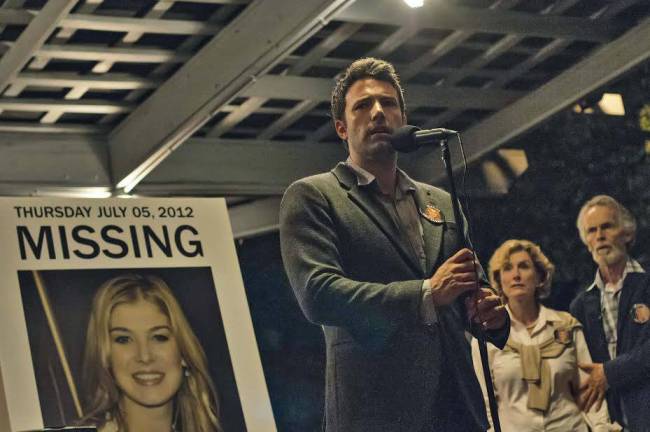
The story seems straight forward enough. Amy Dunn, a New Yorker transplanted in Missouri after she follows her husband Nick to move back to his hometown as his mother is diagnosed with cancer. On their fifth anniversary, Amy is gone missing. Nick soon becomes the prime suspect in the case. Although a body has not been found, murder is on everyone’s mind. With this premise the story unfolds, and we are off to a ride of twists and turns all the way to the end.

Ben Affleck and Rosamund Pike are convincing as the troubled couple. Affleck, who is not known as a superb character actor, is above his previous level here. Although I must say, having read the book could affect how we judge his performance. As for Rosamund Pike, I have no doubt this is her breakout role. Glad to see she finally get this golden opportunity after her supporting parts in An Education (2009), and in Pride and Prejudice (2005) playing Jane, the eldest Bennet sisters, overshadowed by Keira Knightly’s Lizzy.

However for me, I’m most impressed by Kim Dickens in her portrayal of the thinking detective Rhonda Boney perfectly, a role that usually falls upon a male star, like Columbo, or the doubting, persistent detective that looks at evidence and not dwell on prejudice. Her character is the one I like the best in the movie.

The production also benefits from supporting roles from Carrie Coon playing Nick’s twin sister Margo, Neil Patrick Harris as Amy’s former boyfriend Desi Colling, Tyler Perry as defence lawyer Tanner Bolt, although more screen time and story could have been written for him.

If you have read the book, what’s in it for you in the movie? Several things. First off, watch for how the savvy former Entertainment Weekly writer Gillian Flynn transforms her novel into a screenplay, and how a talented director in turn crafts a stylish and absorbing film out of Flynn’s script, from mere words on the page. While you’re at it, watch how a cast of actors interpret their roles (with many cues from the director I’m sure) and make the characters come to life. How do they compare with your imagination while reading the book?

The director of photography plays a dominant role in styling the visual, the light and shadow, the overall tone. Together with the suspenseful, numbing and electrifying music and the smooth editing, the 149 minutes feel like 90. Likely awards nominations for several categories, in particular adapted screenplay, editing, and acting categories. But Best Picture? I have major reservations about that.

Treat this as a modern day Hitchkock movie, a contemporary Film Noir that’s slick and teasing. Fincher’s Girl With A Dragon Tattoo may be the warm-up task, a borrowed source. But here is an authentic American book-to-movie success story. The trend from this day on could well be authors writing more ‘ready-for-movie’ novels.

Now, to the media frenzy. The surge in Gone Girl sales and all the hype pushed the movie in this past opening weekend to the number one spot in box office sales, an impressive $38 million, doubled that of Ben Affleck’s own Best Picture Oscar Argo (2012).

The product may be good, but still a movie needs a strong marketing end. So, all the buzz are the generated effects from a successful marketing campaign, and a large fan base sure is a major asset. All indications point to the Gone Girl phenom could well send the movie to hit targets in profits and Oscar noms.

According to Variety, Chris Aronson, president of domestic distribution at Fox, had said, “we did an excellent job of marketing the movie and making it a cultural event where people had to see it in order to be part of the conversation.”

“That’s a testament to the film becoming a zeitgeisty film,” he said.

Exactly. Nowadays, looks like there’s a more acute pressure for one to be part of the conversation at parties or the Friday social, and especially, on social media. And zeitgeist is just the right word to describe a phenom. I’ll be harsh to say it’s a ploy, but the fan-based momentum is just the right fuel to ignite a trend like a wildfire. But amidst the rave, judge for yourself the worth of the movie and decide if you want to be in this reality show or not.

This may be the very issue satirized in the film. View the production for what it’s worth, seek the evidence, and think for yourself how many ripples you’ll give it. Then decide if you ‘like’ it or not.

~ ~ ~ Ripples

Your comment is most welcome. By all means, share your opinion on the movie, the book, or my post. But while you’re at it, for the pleasure of those who have not read the book or seen the movie, please observe the NO SPOILER intention here.

***

Awards Update:

Jan. 15, 2015: Rosamund Pike nominated for an Oscar for Best Actress

Dec. 11: 4 Golden Globes noms: Best Director David Fincher, Best Actress (Drama) Rosamund Pike, Best Screenplay Gillian Flynn, Trent Reznor, Atticus Ross for Best Original Score

Dec. 10: Rosamund Pike gets SAG nom for Best Female Actor

Boyhood (2014): The Moment Seizes Us

Boyhood is a groundbreaking film. It has taken director Richard Linklater twelve years to shoot, most uniquely, with the same cast. The actors had to commit to many annual shootings over this twelve-year period. This is not a documentary. Written by Linklater himself, the film follows a linear narrative storyline of a boy named Mason, played by Ellar Coltrane, who is very patient indeed; he had to wait twelve years to have his work put on screen.

We first see Mason in 2001 when he is just six years old starting grade one and 165 minutes later, we see him at eighteen, entering college. He literally grows up in front of our eyes. You may shrug with a casual, ‘Ok… so what?’

Here are the implications of what this all means in the hands of a director with the gift of depicting perceptively the essence of human relationships, most notably, from his trilogy Before Sunrise (1995), Before Sunset (2004), Before Midnight (2013). The passage of time is prominent in his trilogy with the films screened nine years apart. In there, we follow the chance meeting of actors Ethan Hawke and Julie Delpy on a train to their married life eighteen years later. While time is also of the essence here (just a pun, no hurry), Boyhood has a distinct difference.

Boyhood

Like time-lapse photography of a seedling to fruition we used to watch in biology class, Boyhood captures the life of Mason in one seamless unity. The editing is fluid and smooth. We see the passage of time from the games he plays (from Game Boy to Xbox to Wii), the social and political changes, the ephemeral shifting of pop culture, especially music (from Coldplay to Arcade Fire and those in between), and the evolving of technology. Most important of all, we see the human factor tossed and carried along in the current of time.

Linklater leads us to see Mason in the context of his family life, or whatever that defines it. What I see is not a happy boyhood. At the beginning of the film, Mason and his two-year-older sister Samantha (Lorelei Linklater) have to leave their friends and move from small town Texas to Houston, where their determined single-parent mom (Patricia Arquette) can attend college to improve her job prospect. During this time, their divorced and absent dad (Ethan Hawke) suddenly reappears back into their lives.

Dad brings joy to the children. He is full of life and cares about them, at least while it is his turn to take them out. This may be ordinary in America nowadays, divorced parenthood, but I see the yearning in the hearts of the children on screen for a happy, reconciled family. There is deeper pain than just the loneliness we see on the surface of Mason and Samantha.

The brilliance of the director is in the captivating telling of what seems to be an ordinary, typical childhood. In a realistic style as if allowing me the viewer to be an invisible observer, Linklater makes me care for every member of this family.

But the character I find most admirable is mom Olivia. She does her best to improve her lot for the sake of her children. Her decisions may not be welcomed by them, and she makes mistakes, but she sticks to her guns with what she thinks is right and presses on. Ultimately she reaches her goal in getting a college teaching post. Arquette’s performance is understated and affective. My prediction is a possible acting nomination(s) for her come Awards Season.

We soon see Olivia remarry, this time to her psychology professor Bill (Marco Perella). It turns out to be a mistake. Bill later reveals himself to be a controlling alcoholic, abusive to his wife and kids. While Mason and Samantha gain a pair of step brother and sister of their own age, they now live under the roof of a harsh disciplinarian stepfather.

A poignant scene which I will not easily forget is after an abusive episode, Olivia disappears. Unable to find his wife, a fuming Bill has all four children sit on the sofa for interrogation, and gets each of them to hand him his/her cell phone. He checks the messages and usage history to see if any of them has communicated with their mother.

Mason has questioned his mom, “Why do you marry him? He’s a jerk.” Olivia answers, “So you can have a family.” Without missing a beat, he says, “we already have one.” Linklater has me at the edge of the seat, amazing with a film like this, to see how mom Olivia gets herself and her own kids out of such a dire situation under Bill’s roof.

In contrast, it is a joy to see the children with their birth father. And most importably, we see the bond of genuine love between the parents and their children despite the divorce. It is gratifying to see that, through the years, the adults grow up as well.

As time passes, we see Mason emerges to be an artistic youth, with a passion for photography. And yet, like his dad, he disregards rules and structures. We see him continue to seek out what it is that makes life meaningful. And yet, the adults in his life seem to be as confused as he is. Mason sees them make bad choices, struggles with his own, and questions ‘so what’s the point?’ Olivia too, after all that life hands her, and ultimately seeing her kids graduate from high school and herself achieving respectability with her college teaching career, utters “I just thought there will be more.”

Eventually, we see Mason at eighteen. The film ends with his first day of settling in a college dorm. He quickly makes friend with his roommate and his girlfriend and her roommate. They skip the orientation and go hiking. On the mountainous path, they sit down and talk, young people facing a brand new chapter in their lives. Like the vast mountain ranges, their future lays out in front of them, appealing and yet full of challenges and mystery. We see too that Mason has found a new soulmate as the girl shares with him, “You know how everyone’s always saying seize the moment? I don’t know, I’m kind of thinking it’s the other way around, you know, like the moment seizes us.”

As the film fades to black, I breathe out a sigh of relief. At least, there’s no irreparable disaster. No matter what has happened in the past twelve years, the present is most livable, and the future is hopeful.

~ ~ ~ ~ Ripples 

***

Awards Update:

Feb. 22, 2015: Patricia Arquette wins Oscar for Best Supporting Actress.

Feb. 21, 2015: Patricia Arquette wins Best Supporting Actress at Indie Spirit Awards, Richard Linklater wins Best Director.

Feb. 8, 2015: 3 BAFTAs Wins, Best Film, Best Director, Best Supporting Actress

Jan. 15, 2015: 6 Oscar noms, Best Picture, Best Director, Actor, Actress, Original Screenplay, Editing.

Jan. 11, 2015: 3 Golden Globe wins, Best Picture Drama, Best Director, and Best Supporting Actress.

Dec. 11: 5 Golden Globes noms: Best Picture – Drama, Richard Linklater for Best Director and Best Screenplay, Patricia Arquette and Ethan Hawke for Best Supporting Actress and Actor.

Dec. 10: 3 SAG Noms: Best Performance by a Cast in a Motion Picture, Best Male Supporting Actor, Best Female Supporting Actor

Dec.7: Boyhood wins Best Picture, Best Director, Best Actress, and Best Editing in the L.A. Film Critics Awards

Dec. 7: Boyhood wins Best International Independent Film Award at BIFA (UK)

Dec.1: Boyhood wins Best Picture, Richard Linklater Best Director, Patricia Arquette Best Supporting Actress from the New York Film Critics Circle

Dec.1: Boyhood wins Audience Award at Gotham Awards 2014

Other Related Posts:

Before Sunrise, Before Sunset, Before Midnight

The Tree Of Life

The Hundred-Foot Journey: A Delicious Fusion

Oscar-nominated director Lasse Hallström serves us a tasty treat in the fairy-tale style of his previous, acclaimed Chocolat (2000). The underlying ingredient that spices up the story this time is more than just dainty sweets. This one is surprisingly gratifying.

Produced by Steven Spielberg and Oprah Winfrey, “The Hundred-Foot Journey” is adapted from the light-hearted novel of the same name by Richard C. Morais. Oscar nominated screenwriter Steven Knight (Eastern Promises, 2007) has done a marvelous job in turning the cartoonish style of a book into a robust and more complex cinematic parable, with dashes of humor and clever dialogues for added delights.

THFJ Movie Poster

The story is most relevant today in our world overwhelmed by warring differences and conflicts. It is an immigrant story. It also presents an ideal case of how cultures can coexist and harmony can be found in diversity.

The Kadam family leaves India after the tragic loss of their mother and their family restaurant in a fire caused by an angry mob. After a short stay in London, Papa (Om Puri) leads his family to settle in the picturesque village of Saint-Antonin-Noble-Val in Southern France. The first few minutes of back story is concise and captivating.

Papa soon finds a derelict restaurant for sale. His own Maison Mumbai, the first Indian restaurant in the vicinity is subsequently opened, a seemingly arduous venture. Papa is a headstrong patriarch, undeterred by the initial protests of his sons, and the Michelin starred Le Saule Pleureur across the street. The proprietor of that haute cuisine establishment is the formidable Madam Mallory (Helen Mirren), who is determined to drive her competitor out.

On opposite sides of this one-hundred-foot wide roadway thus rage the battle of sights, sounds, and aromas, of spices and sauces, ambiance and costumes, an all-out war of clashing cultures.

Indian spices

Hassan (Manish Dayal) is the head cook of the Kadam family. He has learned the skills from his late mother; loving memories of her cooking fuel his gastronomic passion. Furthermore, Hassan is endowed with a distinct talent for the culinary art. He is most ready to explore brave new tastes.

The young sous chef across the street, Marguerite (Charlotte Le Bon), plays no small part in Hassan’s curiosity of French cooking. The two strike up an ambivalent relationship as both friends and foes.

After Madam Mallory discovers the gift in Hassan, she offers to take him under her wings. Such a proposition is, expectedly, rejected by Papa. However, it is Hassan’s decision and passion after all. His determination soon overrides the objection from Papa.

By taking his first step to cross the great hundred-foot divide, Hassan turns the page of both parties in the cuisine conflicts. His journey ultimately leads to an additional Michelin star for Le Saule Pleureur and fame for himself. Hassan’s excelling and competing in the qualifying challenge in Paris is the bridge reconciling the two sides of the road.

It is fun to see the hostile rivals Madam Mallory and the patriarch of the Kadam family coming together. Their changed demeanor brings out the latent, better qualities of each other, offering us some nuanced performance and heart-warming scenes. I must note that there were constant, spontaneous laughs and even restrained applause in the theatre of the preview screening I was in.

Peace offering

The film itself is a smorgasbord of international talents. Acclaimed Swedish director Lasse Hallström takes the helm. English Screenwriter Steven Knight adapts a novel by Richard C. Morais, an American born in Portugal and raised in Switzerland. English star Dame Helen Mirren masters some French accented English dialogues, her previous Oscar winning role as The Queen is amusingly embedded. Papa Om Puri is a veteran Indian actor with a British OBE honor. Mandish Dayal who plays Hassan is American born of Indian descent; his love interest is the up-and-coming actress Charlotte Le Bon (also in Yves Saint Laurent, 2014), a French-Canadian from Montreal.

Director of photography Linus Sandgren (American Hustle, 2013, Swedish born BTW) entices viewers with his close-ups of fresh fruits, vegetables, spices, and market offerings. For those who may wonder, those spiked, round objects are sea urchins. The agile and well-paced sequences of food being prepared are most effective. In contrast, the wide-angle, bird’s eye views of the picturesque Southern France countryside are equally mesmerizing.

Music is an important ingredient in the film. Composed by the prolific A. R. Rahman, who won two Oscars for his work in Slumdog Millionaire, the score adds a distinguished Indian flare. With the lively Indian music juxtaposed against the backdrop of serene Southern France, the film offers viewers some interesting mixes of sights and sounds.

There are times when the editing could be tighter, scenes that need to be made clearer and more coherent, especially in the last third of the film. However, the overall production is a delicious offering. The gratifying finish serves the idea that, apart from the Michelin, home is where the ultimate star is to be found, a thought to savor and an enticement for tasting it all over again. I know I will go for a second helping.

~ ~ ~ Ripples

***

Awards Update:

Dec. 11: Helen Mirren gets a Golden Globe nom for Best Performance by an Actress in a Motion Picture – Comedy or Musical

Other Related Posts on Ripple Effects:

My book review of The Hundred-Foot Journey by Richard C. Morais

Haute Cuisine Movie Reivew

Gourmet Rhapsody by Muriel Barbery