Downton Abbey Season 4 Opening Special

That we use a TV series to mark the beginning of a new year speaks volumes about our contemporary life. However, we are products of our time and culture, and our annual waiting has run its course of patience training. So, let the games begin.

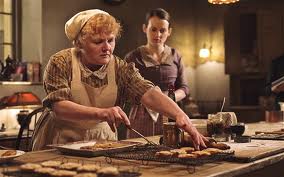
There are so many characters to reintroduce to us that I can understand Julian Fellowes has to write a fast-paced opening. In the first hour, almost all the scenes are like vignettes, spanning 30, 60, or 90 seconds. That means, if you don’t much care for one plot line, like Mrs. Patmore’s ambivalent encounter with an electric mixer, you can just count a few more seconds, you’ll see another character with another dilemma.
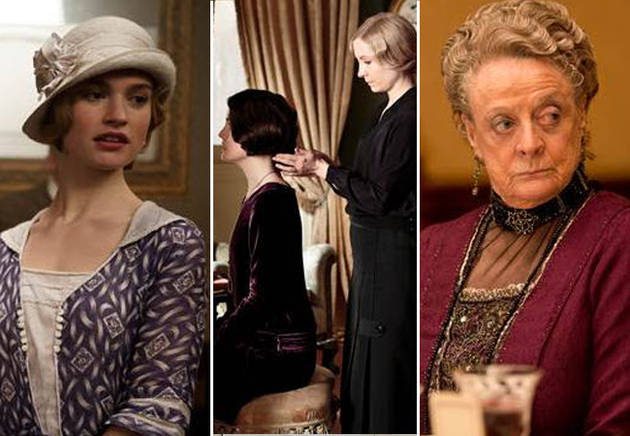
Downton Abbey S4  copy

Is it an apt opening? I must say, as with that of Season 3, I am a bit underwhelmed. But I’m sure, as the episodes roll out, I’ll get warmed up real soon. After all, there are so many characters and plot lines, there must be one that I like.

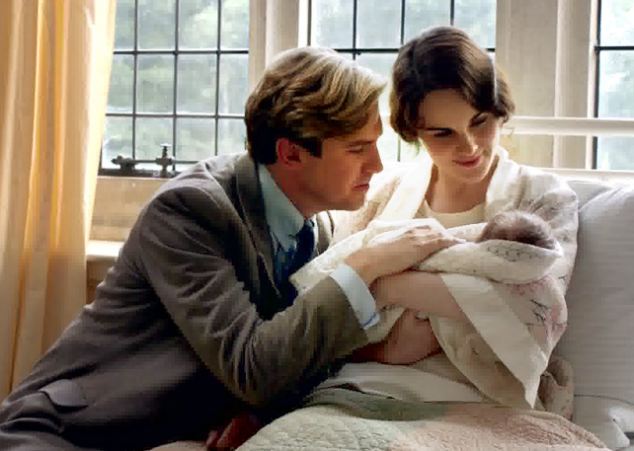
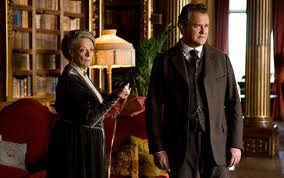
Season 4 opens six months after Matthew Crawley’s very untimely death, 50 years too early according to his widow. Mary’s sorrow has shrouded the first hour of this two-hour special, subtitled ‘House of the Walking Dead.’ So we just hope that Mary will soon take her grandmother’s advice, choose life over death. Violet Crawley remains one of my favourite characters, she beseeches effectively at the right moment, and despite her old age, is more lucid than her son.

We see Robert Crawley’s less than amiable self once again, trying to take charge of grandson George’s share of Downton by sidestepping Mary, all in the cover of protecting her fragile emotions. No malicious intent there but merely convenience over principle. Violet Crawley has once again shown that mother knows best. This has got to be my favourite line of the whole episode, an eighty-something Violet Crawley talking to her sixty-something son Lord Grantham:

When you talk like that I’m tempted to ring for Nanny and have you put to bed with no supper.

So it is a rewarding scene as we see Mary finally decides to come out of the land of the dead, crying over the shoulder of not her parents’ but Mr. Carson’s, who has seen her grow up and always has a soft spot for her. That’s one of the few moving scenes in this special.

Mary could have gotten closer to her mother-in-law Isobel Crawley who on her own has to deal with the loss of an only son. Mrs. Hughes has done a kind act, drawing her out of mourning by appealing to her benevolent spirit, while at the same time helping Charles Grigg, Mr. Carson’s former showbiz partner, to get back on his feet. To kill two birds with one stone, or invasion of privacy? Depends on who you ask. Nevertheless, I’m sure at the end of the day, Mr. Carson would thank Mrs. Hughes for intruding into his past so he can find some reconciliation with Grigg.

A character that seems to have turned into a lively spark of the household, hoisting the flag of modernism, other than the obvious, ever bubbly Rose, is Lady Edith. She has taken hold of her life, venturing out to seek her own fortune, or misfortune, in career and in love, disregarding her father’s safe standards. In the London social scenes we see some fresh, Gatsby-eques fashion and set designs. Her love interest, Michael Gregson, is willing to take up German citizenship in order that he can divorce his lunatic wife and marry Edith. There in the 1920’s turning to Germany? I can expect the plot to thicken quite a bit later.

O’Brien’s midnight move is an efficient way to handle actors not renewing their contracts. Now this one is easier to swallow than killing them off. With no obvious villain left to be his partner or rival, Tom Barrow has to shoulder the whole realm of evil plotting against the innocents. But with Nanny West, he just hits it by luck. So now he’s in favour with Cora Crawley. Who’s going to be his next victim?

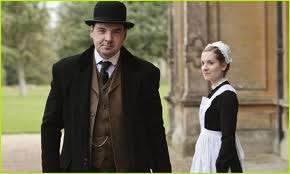
Mr. Bates has been quiet, while Anna has some adventure as chaperone of Lady Rose to a working-class dance hall. I have not watched any of the upcoming episodes, but I feel Bates and Anna can be given more story and screen time. Let’s say, their strong relationship can withstand some slings and arrows Julian Fellowes wishes to hurl their way.

So what do you think of Downton Abbey S4 E1? Favourite scene and characters? Quotable quotes?

***

Related Posts:

Downton Abbey Season 4: Episode 2

Downton Abbey Season 3

Quotable Quotes from Downton Abbey Seasons 1 & 2

Quotable Quotes from Downton Abbey Season 3

***
Downton Abbey Season 3: Episodes 6 & 7 Finale

WARNING: MAJOR SPOILERS in this post.

Apparently I’m one of the last ones to find out what happens at the end of Season 3. Only a couple of weeks ago, I stumbled upon this video of the Downton Cast meet the Press after their SAG awards. Mrs. Hughes spilled the beans about Dan Stevens not coming back for S4 and what a bombshell for me.

I Googled it right away and found, lo and behold, it was already a known fact since last December. Of course, that’s when Britain had their first round of the Season 3 experience. So now the ripples have finally reached North American shore. What do you call it? Delayed shock? And we’ve just witnessed it. People, face the fact, Matthew Crawley is no more. Now, we have one whole year to process it, let it sink in, accept the fact, and move on to the next Season.

Just a brief recap of these last two episodes.

Episode 6

Mr. Bates is finally released from prison. All your Free Bates posters can now come down. While Thomas is the last one to join the welcome home party, ironically he is the one receiving the good graces of Bates and others. O’Brien has no place in any plot against anyone, for she has her soapy track record. She should have known better.

The clubbing fling of young cousin Rose with a married man old enough to be her father takes us away from Downton a while. The Gatsby-like 20’s atmosphere reminds us what the rest of the world is like if one is not a Downtonite.

And way to go for Edith, finding something to do before she is permanently settled into her destined role at home, at least this is what Granny Violet would have wanted for her Grand-daughter.

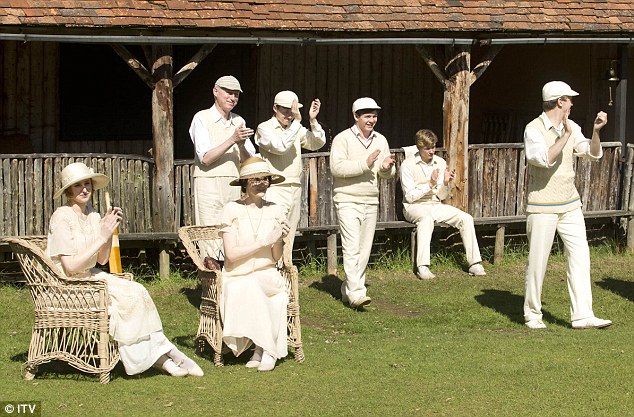
The Cricket Match

The cricket match is a visually beautiful scene. I love the colour scheme. The character that starts to come alive? Molesley. Wait till E7 where he will show what he’s truly made of.

Episode 7

By now we all know the ending. We have a whole year to forgive and forget. But of course, we’ll treasure the memories… The Scottish vacation takes us away from Downton for a short while to let us see how the usual characters behave in different situations. And that’s when we find O’Brien meeting her equal, Anna’s hidden talents, and Molesley’s true colours. Never underestimate a couple gulps of whiskey can do… total emancipation. Never thought Molesley can be so alive.

It’s the country fair again. Last year, Mrs. Hughes turned down an old crush there. This year, it’s Mrs. Patmore’s turn of stopping just in time of being fooled. Jimmy and Thomas come to an understanding that despite differences, they can still be friends. And Dr. Clarkson and Isobel Crawley? What will happen to them now? And oh, what will Mary name the young heir of Downton? Baby Matthew?

Downton Abbey Christmas Special

If you find Sybil’s death the saddest episode, I don’t know what to call this one. Matthew Crawley, the madly-in-love young husband and day-old new father, terminating his contract with a senseless car crash. After three Seasons, his demise covers less than a minute of screen time. What a difference between the endings of S2 and S3.

All these just show the cruel reality of media contracts and the inevitable plot treatment faced by TV script writers… killing off a character when his/her contract is up. Do you feel betrayed? Short-changed? Are you looking forward to Season 4? Will it begin with a funeral? Can you imagine how everyone will react… I think of Isobel first, then Mary, and Tom who has just found a friend in his new place in Downton. What about Robert, can he wait for another twenty years for the baby heir to grow up?

But most tricky of all… what will happen if another character or characters decide not to renew their contract? Wait, WWII is coming up soon, now that’s easy enough.

***

CLICK on the following links to:

Season 3: Episodes 4 & 5

Episodes 2 & 3 

Episode 1

Quotable Quotes from Downton Abbey (S1 & S2)

***

Lincoln (2012): Some Alternative Views

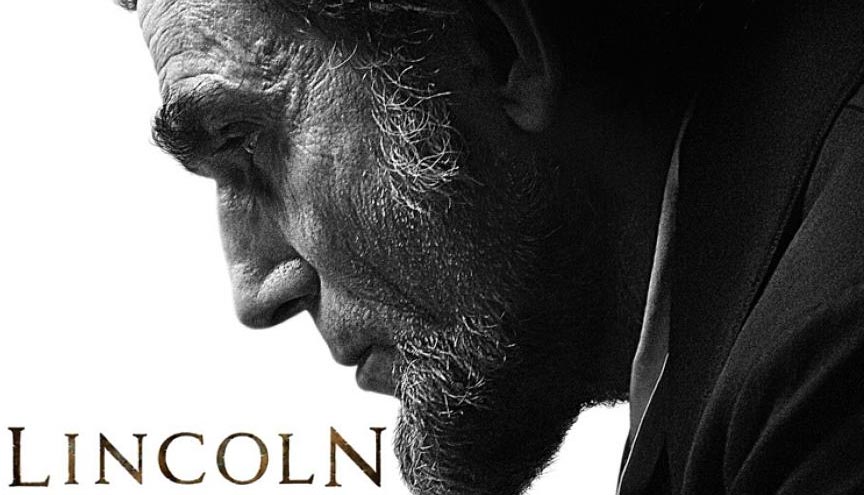
What more can I say that has not been said about this movie? I don’t want to repeat that it’s a strong contender for the Oscar race, or that Daniel Day-Lewis will likely taste his third Best Actor win as Lincoln, or that Tommy Lee Jones should get a nom in Best Supporting Actor for his role as Thaddeus Stevens, or Tony Kushner’s fine dialogues and captivating screenplay…

Here are some other thoughts that came to me as I watched the film, and later brewed in my mind.

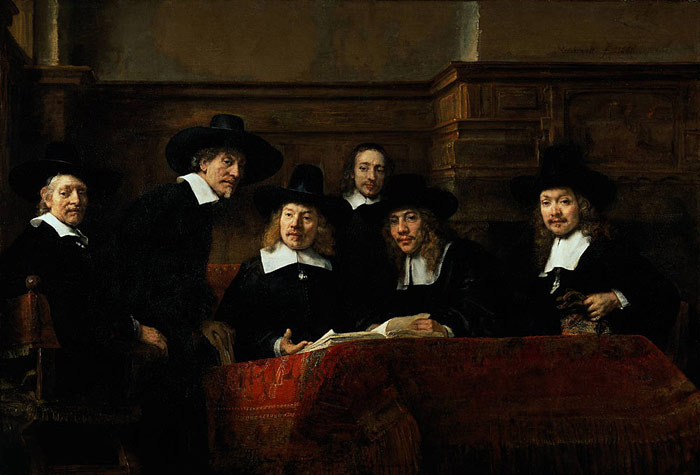
The Rembrandt impression. Watching the film is like seeing Rembrandt’s paintings come to life… especially all the indoor scenes with men gathering, in black, blue, and brown overtone throughout. Yes, the diffusing light from the windows may suggest Vermeer, but the predominantly men in most scenes dressed in black remind me more of Rembrandt. Like this one:

I can’t say much about the Dutch Masters in the above painting, they look pretty tame. But in the film Lincoln, the scenes wherein men congregate to discuss national affairs show the fierce power brokering and politicking of the time. We all know it was men who conferenced, talked about serious issues, made and won decisions, with whatever means avail to them, insults, intimidations, bickering, and persistent lobbying just to name a few.

And the women… The limited screen time Sally Field as Mary Todd Lincoln gets in the film could well indicate their position. Heaven forbid they get suffrage, and a voice. Truly, what can a wife do behind, in Mary’s own words, the most loved and powerful man in the country? How far we’ve come… but, does suffrage guarantee voices being heard? Just wondering.

As Mary Todd Lincoln, Field could well get an Oscar nom for her supporting role. She has done a fine job portraying the private grief behind the public face. Her son Willie died of high fever the night they had to entertain guests in a reception three years ago. A poignant scene occurs when the Lincolns as husband and wife quarrel over their past loss and now the possibility of losing another as their eldest son Robert (Joseph Gordon-Levitt) determines to enlist in the army, against his parents’ wish, or, is it only his mother’s?

From the photos above, we can tell how the casting, make-up and costume bring out the historic Mary Todd Lincoln. I remember Sally Field on Jay Leno said that she had to gain 25 pounds in 6 months to play the role, and later had to shed them all.

As an outsider, i.e., a non-American, I can’t say much about the accuracy of the content. I’m most interested to know which are Lincoln’s own words and in what context, and which are the scriptwriter’s. Even the British actor Daniel Day-Lewis himself had reportedly turned down the role at first as he felt he knew too little about the 16th U.S. President to portray him. As an outsider, I find it intriguing how an immensely influential historical figure is interpreted and portrayed. And apparently, there’s more than one angle.

Some time ago I watched PBS’s Looking For Lincoln, a documentary presented and written by Harvard professor Henry Louis Gates, Jr. It brings out a very different Lincoln, a complex, morally conflicting figure who had not initially tied the notions of freedom for the slaves with equality of the races. Gates went through extensive archival documents, Lincoln’s own notebooks, writings and debates, and interviews with scholars and academics to discover a Lincoln who had to lay aside prejudicial views and take on gradual personal changes as the Civil War bled on.

Interestingly, Gates interviews Doris Kearns Goodwin, the Pulitzer Prize winning biographer whose book Team of Rivals was what Spielberg based his film in parts on. It has been noted that even before she wrote it Spielberg was willing to secure the film rights. In Gates’ documentary, Goodwin admits that there is a need to demythologize the man Lincoln. While generations revere his greatness, he is very much human with strengths and weaknesses.

Spielberg’s interpretation is the popular frame and presents a singularly, saintly and benevolent emancipator instead of a complex and pragmatic politician, a 19th century white man who was very much a product of his times.

No matter, whatever angle Spielberg has chosen to interpret and present Lincoln, he has done it convincingly. Credits are due to Daniel Day-Lewis’s superb performance. He has salvaged any shortfalls with great charisma.

However, I do feel there are two weak sections in the film… the opening and later at the end. Seems like Spielberg is trying a tad bit too hard right at the start, for the opening scene sounds contrived as four young Union soldiers, two from each race, stand in awe in front of Lincoln in an army camp and recite back to him the Gettysburg Address.

The other is the assassination. With the whole movie resting on careful detailing of the passage of the 13th Amendment, I was surprised to find Spielberg’s treatment of Lincoln’s assassination in such a hasty manner, albeit the young son Tad’s reaction is moving. This is a scene that deserves much greater intensity and depth, not only for dramatic effects but for the balance of the whole story and expectation from the audience. Now this is the director who gave us the chilling sequences of Jaws, building the suspense of impending danger through the thumping of music and the ironic oblivion of the crowds.

Nevertheless, the second Inaugural Address ends the film on a poignant note. With malice toward none, with charity for all… Spielberg leaves us with Day-Lewis’s charismatic persona of Lincoln exhorting the crowd. With that, he has crafted another epic which will long be remembered, but in the short term, a sure contender come Oscars 2013.

~ ~ ~ ~ Ripples

***

CLICK HERE to watch PBS’s ‘Looking For Lincoln’. It is presented in titled segments. You can click on any of them to watch. But I highly recommend that you go through the whole documentary, just for some alternative views.

PHOTO SOURCES: Mary Todd Lincoln and Sally Field from Vanity Fair. Others are stills from movie trailer. 

Quotable Quotes from Downton Abbey

SEASON 6 Recaps:

SEASON 6 FINALE: Goodbye to All That

SEASON 6 Episode 1, Jan.3, 2016

SEASON 6 Episode 2, Jan. 10, 2016

SEASON 6 Episode 3, Jan. 17, 2016

SEASON 6 Episode 4, Jan. 24, 2016

SEASON 6 Episode 5, Jan. 31, 2016

SEASON 6 Episode 6, Feb. 7, 2016

**

‘You can’t do very much as an actress unless you have the proper words to say…’ — Penelope Wilton, Isobel Crawley

Four weeks have passed since Downton Abbey Season 2 Finale aired on PBS. How are you holding up? To alleviate Downton Abbey withdrawal symptoms, I’ve been in a perpetual state of re-watching all the episodes from Season 1 and 2. Downton Abbey on Blu-ray is absolutely beautiful.

Downton Abbey film location: Highclere Castle

This Golden Globe, Emmy, and BAFTA award-winning miniseries has many appeals. For me, apart from the sumptuous setting, attention to details, great acting, and inspiring cinematography, the main attraction is the writing. Julian Fellowes’ script gives us intelligent dialogues reminiscent of Oscar Wilde’s wit and satire.

I have compiled a list of quotes from both Seasons. Lucky for 78 year-old Maggie Smith, she gets the best lines as Violet Crawley, Dowager Countess of Grantham.

Here they are in chronological order so you can reprise the scene. Enjoy!

Season 1

“O, heavens, girl. You’re building a fire, not inventing it.” — Mrs. Hughes to Daisy, S1E1

“Nothing in life is sure.” — Mrs. Patmore, re. Titanic sinking, S1E1

Mrs. Patmore and Daisy

“Every mountain is unclimbable until someone climbs it. So every ship is unsinkable until it sinks.” — Lord Grantham, S1E1

“We are allies, my dear, which can be a good deal more effective.” Violet Crawley, Dowager Countess of Grantham, in reply to Cora Crawley’s “Are we to be friends, then?” S1E1

Violet Crawley, Dowager Countess of Grantham

“What is a ‘weekend’?” — Violet Crawley, S1E2

“Daisy, what’s happened to you? I said you could go for a drink of water, not a trip up the Nile.”  — Mrs. Patmore. S1E3

“Are you afraid someone will think you’re American if you speak openly?” — Lord Grantham to Dowager Countess, S1E3

Dowager Countess and Lord Grantham

“But nobody learns anything from a governess, apart from French and how to curtsey.” Lady Sybil, S1E4

“No one ever warns you about bringing up daughters. You think it’s going to be like Little Women. Instead they’re at each other’s throats from dawn till dusk.” — Cora Crawley,  Countess of Grantham, S1E5

The Crawley Sisters

“Mary can be such a child. She thinks that if you put a toy down, it’ll still be sitting there when you want to play with it again.” — Lord Grantham, S1E5

“I love you Mr. Bates. I know it’s not ladylike to say it, but I’m not a lady and I don’t pretend to be.”  — Anna, S1E5
Mr. Bates and Anna
“If she won’t say yes when he might be poor, he won’t want her when he will be rich.” — Violet Crawley, Dowager Countess, S1E7
.
“First electricity, now telephones. Sometimes I feel as if I were living in an H.G. Wells novel.”  — Violet Crawley, S1E7
*****
Season 2
Mary Crawley seeing Matthew off to war.
 “War has a way of distinguishing between the things that matter and the things that don’t.” — Matthew Crawley, S2E1
.
Matthew Crawley in the trench

“I’m not a romantic… But even I concede that the heart does not exist solely for the purpose of pumping blood.” Violet Crawley, S2E2

“I’m a woman, Mary. I can be as contrary as I choose.” Violet Crawley, S2E4

“Are you like everyone else in thinking that because she’s a countess she has acquired universal knowledge by divine intervention?” Isobel Crawley to Dr. Clarkson re. Cora, Countess of Grantham, S2E4  (And you can substitute the word ‘countess’ with any word you need when quoting it.)

Dr. Clarkson and Isobel Crawley

“I’d rather have the right man, than the right wedding.” — Anna, S2E5

“I’m an American, I don’t share your English hatred of comfort.” Cora Crawley to Lord Grantham, S2E6

Lord Grantham and Cora Crawley

“Don’t be defeatist, dear. It’s very middle class.”  Violet Crawley to Edith, S2E8

“Sir Richard, life is a game in which the player must appear ridiculous.” Violet Crawley, Last Episode, Christmas at Downton Abbey.

“I want a good man for you, a brave man. Find a cowboy in the Middle West and bring him back to shake us up a bit.” Robert Crawley to daughter Mary. Last Episode, Christmas at Downton Abbey.

“1920. Is it to be believed? I feel as old as Methuselah.” Violet Crawley, Last Episode, Christmas at Downton Abbey.

***

DOWNTON RECAPS

DOWNTON Season 5 Finale, March 2, 2015: A Moorland Holiday

*

Season 4 Episode 8 (PBS): London 

Season 4 Episode 7 (PBS) 

Season 4 Episode 6 (PBS)

Season 4 Episode 5 (PBS)

Season 4 Episode 4 (PBS)

Season 4 Episode 3 (PBS)

Season 4 Episode 2 (PBS)

Downton Abbey Season 4 Opening (2 Hour) Special 

*

CLICK HERE to Quotable Quotes from Season 3: New List

*

SEASON 3: EPISODE 1  

SEASON 3: EPISODES 2 & 3 

SEASON 3: EPISODES 4 & 5 (More Downton Quotes)

SEASON 3: EPISODES 6 & 7 Finale

CLICK HERE to visit the Highclere Castle website. An absolute must-see.

*

Other posts you might like:

Quotable Quotes from Downton Abbey Season 3

Downton Abbey The Complete Scripts: Season 1

The Downton Ripples

Lady Almina and the real Downton Abbey: Facts that Give Rise to Fiction

***

Emma (2009, TV): Episode 3

The final instalment of Emma has a major challenge, to reveal the hidden agendas, and to tie up all the loose ends in just under an hour. The hurried scenes leave me with a feeling of watching a trailer, a montage of excerpts loosely linking up the story.  This is especially so in the first half dealing with Jane Fairfax and Frank Churchill’s secret relationship.

If the story feels a bit fragmented in this last episode, the cinematography makes up for that shortfall.  The hour is saturated with stunning shots, magnificent scenic views and exquisite interior renditions.  The Box Hill picnic scene is a vivid example:

Ironically, the pivotal Box Hill scene was not shot in Box Hill, a busy tourist attraction in Surrey.  Instead, it was shot in Leith Hill, Mole Valley, another much quieter scenic point.  For an interesting comparison of the two hills, click here to go to ‘this is surrey today’.

The Box Hill picnic is a crucial turning point in the story.  Emma’s callous and sarcastic joke on Miss Bate and the subsequent scolding she receives from Mr. Knightly is nothing short of an epiphany in self-knowledge.  The genuine remorse she feels could well reflect her greatest strength.  I’m sure such quality of character is what seizes Mr. Knightly with tenderness, moving him to consider her “faultless in spite of all her faults.”

I have a feeling too that this is the very reason Austen finds her heroine likable.  Romola Garai has effectively portrayed a contrite and humbled Emma, while Jonny Lee Miller has delivered convincingly a silent lover with passion and principle.  My initial reservation about his role has definitely changed for the better in this final episode.

Fortunately as well, the endearing lines of Mr. Knightly to Emma, no, not the ‘badly done!’ admonition, but the heartfelt praise he spurts out in spontaneity, remains intact and without any modernized alteration from screenwriter Sandy Welch.  Of course it needs to be declared in its authentic whole… Miller has the best lines of the series:

“I cannot make speeches, Emma… If I loved you less, I might be able to talk about it more.  But you know what I am.  You hear nothing but truth from me.  I have blamed you, and lectured you, and you have borne it as no other woman in England would have borne it.”

As with all Austen’s novels, the ending comes with nuptial ties. But as Masterpiece Classic’s host Laura Linney points out at the opening, considering the social discriminations inflicted upon the woman in Jane Austen’s time, allowing no ownership of properties, no decent employment (even Jane Fairfax compares the governess position with slavery), and no respect or rights given to the single female of low means, it is only a justifiable reward for the author to end her story with loving marriages for her well-deserved protagonists.

Towards this end, the camera takes us to the magnificent view of Beachy Head in the last scene.  As Emma and Mr. Knightly stand on the edge of the cliff overlooking the boundless ocean, we see the series come to an idealistic end, maybe a broader stroke than that in Austen’s novel. But as some critics have noted, it is love that the author emphasizes rather than romance.  From that perspective, looking outward together to the ocean vast instead of gazing into each other’s eyes may well be an apt interpretation of Austen’s heart.

***

CLICK HERE to go to Episode 1

CLICK HERE to go to Episode 2

Arti’s reviews of Emma (2009), Episodes 1 to 3, have been compiled into one article and published in the Jane Austen Centre Online Magazine. CLICK HERE to read the many other interesting articles on Jane Austen and her time.

**Photo Sources: Box Hill Picnic bbc.com; Beachy Head, not a scene from the movie, taken from Wikimedia Commons.

Emma (2009, TV): Episode 2

‘An authentic human being’ is how the host of Masterpiece Classic Laura Linney describes Emma.  Jane Austen’s characters have no supernatural powers, she notes.  But herein lies the magic of her writing.  She takes the ordinary and draws out the unnoticed features.  From these everyday characters like you and me, she skillfully displays the intricacies woven in their interactions, and reveals the undercurrents of hidden intentions and desires.  It is in the revealing of the subtext that makes her story so captivating even for us modern day readers.

Episode 2 continues with this interesting story as we see Emma confused by her own feeling towards Frank Churchill, Harriet’s shifting admiration for the same, Frank Churchill’s seemingly open admiration for Emma, Mr. Knightly’s growing sentiments for the same, and, Jane Fairfax’s hidden anguish, ignored by the subject of her desire.  It seems that everybody’s feeling is mixed up with everybody else’s.  The comedy of errors gathers momentum.

Cinematography continues to be a major contributor to the storytelling.  I particularly appreciate the several Vermeer moments, like the one with Emma gazing out the window deep in thought, or the camera silently captures her playing the pianoforte, immersed in diffused light.  I’ve also enjoyed how the visual reveals inner thoughts.  Mr. Knightly’s longing is projected by the flashback of his dancing with Emma, shifting to the single swan in the pond, warm music enfolding… a beautiful cinematic moment where the visual and music communicate effectively without words.

Mrs. Elton is animatedly played by Christina Cole.  In terms of comedic and obnoxious effects, she is of her husband’s equal, a good match indeed. While Rupert Evans is proficient in portraying a sly Frank Churchill, he does not look like the one I have in mind.  But that is not important. My main concern is with the role of Jane Fairfax.  This second episode confirms my misgiving from the beginning.  I feel there is a miscast here.  I miss her elegance, poise and subtleties as described by the author.  She is supposed to be Emma’s worthy rival after all.

The dance at The Crown Inn is a delight to watch.  That is also the occasion showing everybody’s true colour.  And Mr. Knightly has proven himself to be one considerate gentleman as he invites Harriet to dance after she is slighted by Mr. Elton.  Also, we’re beginning to see Mr. Knightly more and more in love, while the object of his desire remains relatively clueless, albeit a sense of appreciation has arisen in her confused heart.  The dances are fun to watch too, much more lively and convivial than the courtly dances we see in other Austen adaptations.

After two episodes, the story and the characters are well developed, the overall effects pleasing and enjoyable.  I look forward to the next instalment.

*****

CLICK HERE TO GO TO MY REVIEW OF EPISODE 1

CLICK HERE TO GO TO EPISODE 3, THE CONCLUSION

Arti’s reviews of Emma (2009), Episodes 1 to 3, have been compiled into one article and published in the Jane Austen Centre Online Magazine. CLICK HERE to read the many other interesting articles on Jane Austen and her time.


Emma (2009, TV): Episode 1

Previously on Masterpiece Classic

Yes, treat this post as a recap to prepare you for Episode 2 in just a couple of days.

So finally, North American viewers have the chance to see the long awaited 2009 BBC production of Emma, three months after its release in the UK.  A click on imdb will find no less than 15 different versions of this popular Austen work.  Yet another one?  It just naturally leads one to question, why?  After seeing this first episode, let me give it a shot: just because it’s so much fun to do.

That’s how I felt as I watched the PBS broadcast last Sunday.  This newest adaptation of Emma is probably the best I’ve seen, and Romola Garai easily the best-cast Emma so far.  Yes, I’m comparing her with Gwyneth Paltrow (1996) and Kate Beckinsale (1996, TV).  She may well be one of the best-cast Austen heroines for their roles in my opinion, let’s just say, neck and neck with Jennifer Ehle’s Elizabeth Bennet.

What a difference from her guilt-ridden Briony in the movie Atonement.  Well, Garai’s Emma is guilt-ridden too as the errant, over-confident matchmaker, but her genuine heart and willingness to own up to her misjudgment have made her personality shine through.

In creating Emma, Austen had said that “I’m going to take a heroine whom no-one but myself will much like.”  Seems like this adaptation does a great service pulling us over to Austen’s side. Garai’s Emma reflects the probable reasons why the author found her character likable: vivacious, charmingly clueless, and above all, her readiness to admit faults, her genuine heart towards herself and others.  Garai’s animated performance is most apt in a comedic genre such as this.  So far in the first episode, the irony and humor have come through.

The impressive cinematography matches perfectly the personality and atmosphere of the novel, brisk, agile, fun, and yes, as Mr. Knightly narrates in the beginning, golden.  Just the kind of colour scheme for a clever comedy, the exact reflection of its main character.  As a comedy, a little exaggeration in the colours is acceptable and quite effective I think.  Overall, the visuals are captivating, beautiful shots of the English country landscape, the well situated mansions and their interior renderings.  I’ve particularly appreciated the few overhead shots, and some of the contrasting darker scenes in the beginning.

And yes, the beginning is where a film can captivate right away.  I’ve enjoyed screenwriter Sandy Welch’s treatment of the plot, drawing out three characters, Emma, Frank Churchill, and Jane Fairfax, who had all lost their mother as a young child, and focusing on how markedly different their lives have turned out.

For the casting of Jonny Lee Miller as Mr. Knightly, however, I have a little reservation, in this first episode anyway.  The sparks between Emma and him look more like sibling bickering than the undercurrents of subliminal lovers’ quarrels, which Austen so brilliantly depicts. The 16 years of age difference is almost unobservable here, although in real life they are ten years apart.  But I’ve enjoyed Jonny Lee Miller’s portrayal of the conflicting Mr. Knightly, at times detached, at times involved, and at times, exasperated.

Michael Gambon is excellent as the fastidious Mr. Woodhouse. The legendary actor has delivered a convincing performance as an endearing but taxing hypochondriac.  As for Harriet Smith and Jane Fairfax, I’m afraid my preference is the 1996 TV production‘s casting of Samantha Morton and Olivia Williams in these roles.  But then again, my view can change as I continue watching.

This first episode strikes me as a lively, contemporary rendition. While screenwriter Sandy Welch had chosen to use more modern language in her dialogues, I don’t think she needed to stray too far from the original to achieve this.  As I’m re-reading Emma for these screenings, I find the book very accessible for modern readers, the characters are those whom we can relate to, their motives and emotions very similar to what we are familiar with.  Austen’s skills in observation and her intelligence in depicting human nature and her characters’ inner world are simply impressive, considering she was writing almost a hundred years before Freud and the birth of modern psychology.

****

CLICK HERE TO GO TO MY REVIEW OF EPISODE 2

CLICK HERE TO GO TO EPISODE 3, THE CONCLUSION

Arti’s reviews of Emma (2009), Episodes 1 to 3, have been compiled into one article and published in the Jane Austen Centre Online Magazine. CLICK HERE to read the many other interesting articles on Jane Austen and her time.


Joshua Bell in the Subway

I watched Joshua Bell play the Mendelssohn Violin Concerto last night on PBS Live at Lincoln Center.  It’s the Mostly Mozart Festival in NYC.

This is one of my favorite pieces of classical music.  The melodious theme comes right out in the opening bars, not needing any intro from the orchestra as in conventional concertos.  I like it that way, swift, cut to the chase.  And here’s the sign of greatness:  the audacity to break new grounds.  Last night I saw the violinist’s audacity matching that of Mendelssohn’s: Bell re-wrote the cadenza for himself.  He has not only given an engaging performance, but has left his watermark in the piece as well.

If you want to see what a born winner is like, just briefly look at his bio.  At 10, he was a tennis champion.  Four years later, he made his professional debut as a violinist and became the youngest person to play with the Philadelphia Orchestra.  And the rest is history.

Bell has recorded more than 30 CD’s, won 4 Grammys, indirectly an Oscar as he performed the winning soundtrack for Best Original Score in ‘The Red Violin’, and garnered accolades too numerous to mention.  His achievements culminated in the prestigious Avery Fisher Prize in 2007, the highest honor for a musician in America.  That puts him in rank with previous prize winners Yo-Yo Ma, Emanuel Ax, and Andre Watts.  But beyond his musical career, he continues with sports and pursues other pastimes.  How about a video games world championship for versatility? Yup, he got that too, in 1996.

Well ok, so far so good… until he was asked by Washington Post writer Gene Weingarten to busk in a Washington DC subway station during morning rush hour.  At 7:51 am on January 12, 2007, a few months before he won the Avery Fisher Prize, Joshua Bell stood in a DC subway station in jeans and a long-sleeve T.  He opened up his case, and started playing his 1713 Stradivarius.

That was probably the first time he had been ignored or even given the cold shoulder:

He got $32.17 for his 43 minutes playing, not counting the woman who recognized him and gave him a twenty.  And yes, there were a few pennies in his case.  More than a thousand people passed by.  In the hustle and bustle of morning rush, few had even stopped to look at him, despite hearing the music.

The commuters were oblivious to the treat that would have cost them a hefty $100 in a concert hall, if they could find a ticket that is.  And for Weingarten,  he got a Pulitzer Prize for Feature Writing for his Washington Post cover story ‘Pearls Before Breakfast’.  To read this fascinating article, CLICK HERE.

Meant to be a philosophical musing on ‘Art and Contexts’, the experiment aims at exploring the epistemology of beauty.  Will we know what beauty is once it’s taken out of context?  Are there preconditions for us to appreciate the arts?  Do we have to recognize a musician before we can admire the music he plays?  If art is taken out of its frame, is it still art?

But… maybe it’s more a sociological study of urban life, or one of economics.  Even if people recognize beauty, is it worthwhile to stop and sacrifice a few precious minutes?   Weighing the economic cost of being late for work, and the enjoyment of music, the bottom line is quite obvious.  What place does beauty have in the pragmatics of our daily routines?  Where do music and the arts rank in life’s competing priorities?

Pearls before breakfast… What breakfast?  Gotta run…

***

Jane Austen: Sense Or Sensibility?

With PBS Masterpiece Classic broadcsting Sense and Sensibility (2008 ) again on Feb 1 and 8, it’s good time to muse on the question:  Which Austen heroine was Jane herself most like?  You can see the poll on my side bar, and the results so far. 

As you watch Sense and Sensibility once again, look closer at Elinor and Marianne.  Mind you, if you have a chance, watch the 1995 movie too, then you’d appreciate Emma Thompson and Kate Winslet in bringing out the differences between sense and sensibility even more clearly I think.

No doubt, we all like to perceive Jane herself as the very source that had inspired the creation of our all time heroine, Elizabeth Bennet of Pride and Prejudice, intelligent, witty, self-assured, sharp in her critique of social norms, and brave enough to challenge, and diverge.  She dominates our popular votes here with a 44% lead… so far.

But Anne Elliot of Persuasion is also a popular choice, mature, patient and wise.  The silent lover is a strong second with 23%.

magrittes-le-blanc-seing

After reading the biographies of Jane, knowing how she had loved the burlesque and to play a part in the family’s performances, how openly she had engaged in activities with her brothers and the student boarders in her home, how she had  written satires while still a youngster, how critical she could be, and above all, upon my reading Claire Tomalin’s incisive analysis of Jane’s relationship with her older sister Cassandra, I tend to lean toward a very unpopular choice. 

I think Jane by nature was more like Marianne Dashwood, passionate, spontaneous, expressive and bold.  It’s Cassandra, like Elinor, who reminded her to rein in her emotions, to keep her skepticism in check, and to help her fit into a world that was not ready for a female like her.  Have you wondered why Cassandra needed to burn so many of Jane’s letters to her after Jane’s death?

Is it sense and sensibility we’re talking about here, or rather nature and nurture? 

No matter.  It’s best that our favorite writer remains an enigma.  But, if you have to choose, thinking back to all the Austen heroines in her six novels, who do you think Jane resembled the most?

Cast your vote and let Janeites decide.

To read my review of Sense and Sensibility (2008, TV), Part 1, Click here.

Click here for Part 2.


*****  

Tess of the D’Urbervilles (2008, TV): Part 2

tessThe “lite version” of Part 1 has turned into a heavy and somber continuation on PBS Masterpiece.  In this second and final part, screenwriter David Nicholls and director David Blair unleash the gloomy Hardy worldview unreservedly,  releasing the bleak and dismal elements that are almost too much for new year viewing.  The music has played a major and dramatic role in setting the tone and mood of the movie.  The cinematography too, in contrast to the lush green opening in the first part, has drawn us into a slough of mud, grey and black.  Hardy’s view of nature lamenting the tragic condition of his heroine is effectively conveyed, engrossing albeit a tad too melodramatic.

Kudos to David Nicholls for a meticulous job in adaptation.  He has kept the plot intact, for the most part faithful to Hardy’s book.  While a couple of incidents are left out, quite meaningful and symbolic too, but not to diminishing effects.  These include the sleepwalking episode, the Freudian slip of Angel’s innermost longing to love Tess despite all restraints.  The second being Tess’ mercy-killing of pheasants wounded by hunters, a sensitive portrayal of her own predicament.  However, Hardy would not have her killed off so easily.  Like the sadistic “President of the Immortals” in his view, Hardy the author wreaks havoc on his heroine, leading her into scenes after scenes of tragic events beyond her control.

tess-part-23

Tess can forgive Angel for his sexual sin, but he refuses to forgive her.  Actually, what sin has she committed if she was innocently violated by Alec D’Urberville when she was a young girl.  She loves Angel unconditionally, but his love for her is marred by constraints.  Later, she cannot avoid stalking by Alec, who keeps preying on her, and in her most needy and vulnerable, takes advantage of her again by manipulating her love for her family.  Whatever dignity she may have Tess ultimately sacrifices it for her beloved family.  But I admire Tess’  integrity, yes I like to see it as integrity, and not pride, that has sustained her until that very end when she finally has no choice but to yield to Alec’s sinister scheme.

It is for this reason that I find Gemma Arterton’s portrayal of Tess as just a proud and feisty gal to suit modern viewers incongruent with the book.  She may look innocent enough, but her performance at times is contrived and lacks the striving complexity required.  But her tears are effective and moving, I must say.  While Hans Metheson has delivered his diabolic role adequately, Eddie Redmayne as the losing lover at the end is a bit lacking.

And Angel, oh, what a tragic character.  The seemingly altruistic lover cannot stand the test against social mores.  In the book, the chapter describing the mutual confession of sins between the newlyweds is aptly entitled:  “The Woman Pays”.  What an irony of double standard!  This might well be the name of the novel.  While Hardy may have held an entangled and agnostic view of the transcendent, his social critique is incisive and spot-on.

the-stonehenge-1

At long last, Tess and Angel can enjoy marital bliss, but only for a painful, fleeting moment.  Tess says in her anguish:  “It is too late”,  the four words that define the tragedy of her life.  As a young girl, she did not understand the meaning of Alec’s sinister advances until too late.  And now as a married woman, her husband has come to her rescue too late.  I learn from the end notes of my Penguin edition that the original title of the book was Too Late, Beloved! What a heart-wrenching story.

PBS has a link to an online interactive Q & A with screenwriter David Nicholls.  In there he  answers the many questions viewers have regarding the process of turning book into film. I have enjoyed Nicholls’ previous adaptation of Blake Morrison’s memoir into the movie “And When Did You Last See Your Father”, starring Colin Firth and Jim Broadbent, an excellent and sensitive film.  I look forward to seeing more of Nicholls’ work in the future.

~ ~ ½ Ripples

Click here to go back to Tess of the D’Urbervilles, Part 1.

*****

Tess of the D’Urbervilles (2008, TV): The Lite Version

tess-of-the-durbervilles-movie

After reading Thomas Hardy’s Tess of the D’Urbervilles just shortly before watching the new re-make on PBS Masterpiece, I can fully understand why screenwriter David Nicholls has done what he did.  He has turned a heavyweight into a light classic.  For if Hardy’s book is to be adapted in spirit and letter, it would certainly be less appealing and just too heavy a burden to cast upon our collective psyche.

As an author, Hardy himself personifies the sadistic ‘President of the Immortal’ he perceives.  Humans are just the playthings for The Immortal’s jest.  As an agnostic, he can’t just outright blame it all on God, since he isn’t sure even if God exists.  But in the book, he makes his readers know clearly the cosmic tragedy his characters are caught in, by turning Browning’s lines into:

God’s not in his heaven:  all’s wrong with the world!

If we can see Hardy on the streets today, I’m sure he’s the guy who takes Murphy’s Law to heart:  Anything bad that can happen will happen.  That’s what he makes of his heroine Tess in the story.  A pure, beautiful and innocent country girl, fresh and untouched for life, is being caught in all sorts of circumstances that will bring only heart-wrenching consequences, one after the other all the way to the end.

David Nicholls has spared us the looming Hardy worldview and lightened it up for us, and I don’t blame him for that.  For who needs more tragedies of cosmic proportion in this very tumultuous time in our human history.   Mind you, he has presented the plot faithfully.  In this first part at least, you see the sequence of events in the book adapted to the dot, albeit in a much more condensed and hurried pace.  Considering the full length of the book is about 400 pages, and the made-for-TV movie is four hours long, that means for every hour he has to cover 100 pages.  From this first part, I’d say he has done an admirable job.

tess-and-alec

Now to Gemma Arterton.  I’ve enjoyed her role as Elizabeth Bennet in ITV’s Lost In Austen.  So it is with high expectation that I come to watch Tess.  If the screenplay is a light version, then Arterton’s Tess is aptly portrayed, for I have a feeling that she has turned it into a comic character at the beginning of the movie.  But maybe that is to contrast her later portrait of lost innocence.  Nevertheless, I feel there is something lacking, maybe the almost god-like purity and depth of love in Tess are qualities just too demanding for so young an actress to depict.

Hans Matheson’s Alec D’Urberville is much more attractive than the detestable Alec described in the book.  Though the obvious villain, his dark and sensual appearance is symptomatic of a soul in turmoil. He has added complexity to his character that even sheds a bit of appeal. I look forward to his crucial role in the latter part of the story.

angel-clareIn contrast, Angel Clare is the innocent lover.  His willing to challenge his strict Victorian upbringing in a clergy family for love of a milkmaid indicates his bold rejection of social norms and family expectations… up to this stage.   Eddie Redmayne has delivered a convincing performance.

The character that really draws my attention, surprisingly, is Tess’ younger sister Liza-Lu, played by Jo Woodcock.  For some reason that face has the look and intensity that’s so fitting in a film like this.  And the three milkmaids that offer the much needed relief to the story, Marion, Retty and Izz, are well cast and portrayed.  They play no minor roles in Tess’ life.

Finally, I must also mention the new host of Masterpiece Laura Linney.  I admit, she’s more what I had in mind for the character of Tess while reading the book.  Unfortunately that part is taken.  Oh well, I’ll see her again next week, and in future Masterpiece presentations.

So, for a lighter and entertaining take on the tragic story of Tess,  and to browse through the plot in a few visually appealing hours while sidestepping the somber philosophical view of Hardy’s, this BBC production offers a viable choice.

(Photos Source: bbc.co.uk)

~ ~ ½ Ripples (so far)

Click here to go to Tess of the D’Urbervilles, Part 2

*****


A Room With A View (2007 TV)

It will probably take another Merchant Ivory production to best an earlier version.  The 1985 movie A Room With A View has ingrained in my memory certain images of sight and sound that are difficult to replace, like Lucy opening the window and the camera slowly zooms in the beautiful view of Florence, highlighting the Il Duomo. Or the ending shot of the silhouettes of Lucy and George sitting by the same window… To me, A Room With A View is Kiri Te Kanawa singing Puccini’s aria “O mio babbino caro” (O My Beloved Father), achingly depicting the agony of unrequited love.  Further, it is also the humor that underlies the whole story as Forster has intended, as evidenced by the chapter (or scene) titles.

Nevertheless, I came to watch this newest BBC production with an open mind.  I was eager to see how a 21st Century, Andrew Davis rendition would present this E. M. Forster love story.  Every new adaptation of an old classic should offer us a new vision.  With such endeavors Andrew Davis has proven to be relatively successful in the past with his Austen and Dickens adaptations.  Here, I anticipate another window opening out to a fresh and different view.

For this adaptation, Davis writes the screenplay as Lucy’s flashback.  And, letting his imagination roam, he has Lucy coming back to the same Florentine room in The Bertolini, by herself, as a young widow.  So with this in mind, the overall sepia tone throughout fits well with the context, a memory re-lived, through the eyes of a lonely young woman who has lost her husband in the war.  The colorless overtone might well depict the sombre mood of a very different Lucy.

But there’s the rub. With this new “twist”, Davis has put himself in a difficult position in that, the present might be sombre and sad, but the past is most vibrant and radiant.  He’s got in his hands the difficult task of reconciling the two. What mood should he establish?  The sombre loss of the present or the fantastic journey of self-discovery and the ecstasy of a young heart heeding true love of the past?   umm…alright, let’s just go on with the show…

I have appreciated the fine cinematography and camerawork. The attraction of the Florentine art and architecture as well as Rome’s grandeur are caught with a sense of depth, not just picturesque shots, ironically, thanks to the lack of color.  They are frames from Lucy’s point of view, a well-protected, English young woman’s first encounter with greatness and history outside of her familiar, parochial life.

As for the actors, I have mixed feelings.  In the 1985 movie, Helena Bonham-Carter’s fresh persona of Lucy Honeychurch is sensitively matched by Julian Sand’s poised portrayal of George Emerson, an ideal image of young love.  Somehow, I don’t feel the chemistry here between Elaine Cassidy (When Did You Last See Your Father, 2007) and Rafe Spall.  The film is supported by some excellent acting though by veterans like Sophie Thompson (Emma, 1996) as Charlotte Bartlett, Mark Williams (Sense and Sensibility 2008 TV) as Mr. Beebe, Sinead Cusack as Miss Lavish, and Timothy Spall (Enchanted, 2007) as the elder Emerson.  Tim and Rafe Spall dispaly an authentic father son relationship on screen, naturally.

Timothy and Rafe Spall

A weak link I feel is Laurence Fox as Cecil Vyse.  No, I’m not trying to compare him with Daniel Day Lewis’s performance, which is inimitable.  But I truly feel it’s a miscast here.  Fox as a chap who is no good for anything but books, one who is so physically inapt to avoid a game of tennis?  Not very convincing.  What we have in this TV version is more like an eerie and chain-smoking Wickham or Willoughby.  Speaking of which, the smoke screen connecting to his almost every appearance may well be intentional, visually depicting how marred and distorted Cecil is in his view of himself and of others, particularly, Lucy.

Indeed, as the title well conveys, it is the metaphor of seeing that is the key notion throughout the TV adaptation.  In order to impress into our mind, the director has us see lots of scenes by the window. But of course, it’s not so much of looking out but looking in that is crucial here.  The whole story is built on Lucy’s seeing clearly what is in her heart, and that the one who has drawn her out of her own self-deception is the one who can offer her ultimate bliss, and that is George Emerson.  It is not just about Cecil turning down a tennis match, but it is the last straw, the pivotal turning point where Lucy realizes how egotistic Cecil  is. Lucy to him is but an object of art and music, but not as a woman, definitely not as a lover.  Forster describes it most strikingly, “The scales fell from Lucy’s eyes.”  A Biblical allusion no less than an epiphany.

In this case of course, by following her heart, Lucy is making the moral choice of defying the long tradition of the English class system, smashing the inequalities underneath the civility, and unmasking the snobbishness she has been raised to aspire to.  In her new voice, as Cecil has noticed, Lucy has announced a new-found insight.  As an admirer of Jane Austen along with his fellow Bloomsbury writer Virginia Woolf, Forster might have written lines that Elizabeth Bennet could have uttered, lines like:

I won’t be protected.  I will choose for myself what is ladylike and right.  To shield me is an insult. Can’t I be trusted to face the truth but I must get it second-hand through you?

Or,

If a girl breaks off her engagement, every one says: ‘Oh, she had someone else in her mind;’ … It’s disgusting, brutal!  As if a girl can’t break it off for the sake of freedom.

Unfortunately, these lines find no place in the film.

Forster is not afraid to let us see a very muddled Lucy, being confronted by her own feelings and passions that are contrary to her up-bringing, loving someone from a lower social status.  The open view of Italy has offered her a wider spectrum to what she is accustomed to seeing. Here lies the muddled complexity of characterization…For often in life, we are walking confusion, unsure of our feelings, insecure about our actions, isn’t such muddledness the very commonality of our being human?

But thanks to her humility, Lucy comes to realize what is in her heart, and who she wants to be.  In her recanting of her engagement to Cecil, she admits to be less educated, not as well-versed in the arts and music as Cecil.  Maybe because of that, she is more flexible to explore and to associate with those allegedly seen as socially lower than herself.  Here lies the paradox, It takes the uneducated eye to find understanding. Cecil is an intellectual, expert in things but not people, his highly educated mind has done nothing for him but left him in a room with no view.

Zadie Smith in her brilliant 2003 Orange Word Lecture entitled “Love, Actually”, discussed the writing of E. M. Forster and Jane Austen. Regarding Lucy’s gaining insight, Smith observed incisively:

It is not by knowing more that Lucy comes to understand, but by knowing considerably less.

As for Davis’ new “twist” at the end … I think that has altered the whole story from a light-hearted piece of social satire and endearing love story to a sombre drama with an awkward ending.  And for the last scene, Lucy going on a picnic with the cab-driver, and their final gesture… I think Davis has gone too far with his gratuitous imagination.  If that is the new vision he is offering us,  I’d rather stick with the old view.

~ ~  Ripples

*******

Photo Source of window with a view: StudentsVille