Saturday Snapshot June 27: The Busy Beaver

It is on the face of our 5-cent coin, an emblem of Canada. And thanks to conservation and the lack of demand in the pelt hat, the Beaver – at one time endangered – is now safe in numbers.

the nickel

However, we seldom see one, definitely not an everyday sighting. As for me, I’ve never seen one on land like the image on the coin, busy with its chore. But they are around; surely we can see the aftermath they leave behind. Here are evidences of their presence:

Work of a Beaver's

Beaver's aftermath

That’s why we have these:

Wired protections

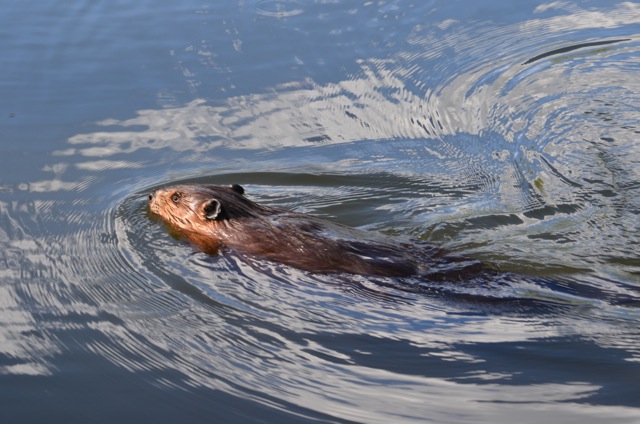
I’ve had the chance of seeing a beaver recently at a pond, taking a break from its busy schedule:

The Pond


Beaver in the pond

Sure looks like a bear is swimming towards you:

Beaver 3

Beaver 1

A closer look and you can see its long and robust body:

Beaver

yet agile, diving in and speeds away underwater:

Diving

But what I find interesting are the ripples it makes. Look back at the above photos and below:

The Beaver Close-up


More Ripples


Ripples 3


Ripples

Or is it just me, watching out for ripples everywhere?

((( *** )))

Saturday Snapshot is hosted by West Metro Mommy Reads. CLICK HERE to see what others have posted.

ALL PHOTOS TAKEN BY ARTI OF RIPPLE EFFECTS

DO NOT COPY OR REBLOG

***

Like Father, Like Son (2013)

In honour of Father’s Day tomorrow, I’m re-posting my review of the acclaimed Japanese film Like Father, Like Son. (Update: Director Hirokazu Koreeda’s most recent work Our Little Sister is a Palme d’Or nominee at Cannes 2015.)

***

I had wanted to see this Japanese film since it came out last year. Missed it at TIFF13 last September, its North American premiere after winning the Cannes Film Festival’s Jury Prize in May. Glad it has finally arrived on Netflix, reaching a much wider audience than just festival goers, deservedly.

Like Father Like Son

Director Hirokazu Koreeda wrote the screenplay based on a disturbing premise: what if after six years of raising your son, the hospital where he was born contacted you and told you that your child was switched at birth, and of course, they sent their apology.

The hospital officials do not take this lightly. DNA tests are done to confirm. They have a lawyer with them, arrange to have you meet the other parents, mediate and ease the proposed switch back, which they recommend with a six-month preparation period, preferably before the boys start grade one in school. They even find out who the nurse is that made the error; due to her own frustrations at the time she knowingly made the switch. Of course, she is deeply sorry for what she had done and duly prosecuted. Monetary compensations are arranged.

But all the above have absolutely nothing to do with easing the shock and alleviating the trauma afflicted upon the families. Formality and legality do not soothe the pain; apologies and money cannot compensate for the abrupt termination of relationships.

Director Kore-eda has treated the subject matter with much tenderness and charm. The cinematography is stylish, the children and adults are all captured in a realistic manner with splashes of endearing humour.

The two families come from very different social strata, and the two boys have been raised in opposite parenting styles. Interestingly, only one of the families seems to take this news much harder. Ryota Nonomiya (Masaharu Fukuyama) is a successful professional who spends most of his time in the glass towers of Tokyo busy at work. His son Keita (Keita Nonomiya), an only child, is raised in a protective environment. Mother Midori (Machiko Ono) is loving but also ambivalent about a husband who puts his career over his family.

The other family is a shop owner in a rural part of the country, their son Ryusei (Shôgen Hwang) is the eldest of three children. Father Yudai Saiki (Rirî Furankî) is every child’s dream. He spends his days playing with his children, fixes their toys, and exerts no rules, albeit Mom Yukari (Yoko Maki) might wish he could have spent more time working.

What makes a father? What makes a son? Fatherhood and bloodline tend to supersede all other factors in a patriarchal society like Japan. But the film reflects the point of view that not all families necessarily embrace such a value. Further, apparently there are different parenting styles even in a homogeneous Japanese society.

If there is ever a Japanese version of the movie Boyhood as we have seen from Richard Linklater, Hirokazu Kore-eda would be the ideal person to direct it. Like Father Like Son follows his previous work I Wish (2011) in its sensitive and incisive depiction of a boy’s heart and yearning. He can tear apart the facade of societal formality – but in a most tender way – and lay bare the hopes and needs, the essence of parents child relationships.

I must give credits to Johann Sebastian Bach, and the late Canadian pianist Glenn Gould. The beginning of Bach’s Goldberg Variations had been used in numerous films, but every time the soulful slow moving piano melody comes on, I am moved, no matter how many times I’ve heard it, and in so many different genres of films. Just from memory, I can think of The English Patient (1996), Hannibal (2001), Shame (2011)… It is so effective in augmenting cinematic moments without becoming clichéd.

Here, the Aria is well placed as director Kore-eda uses it as a motif to spur us into deeper thoughts. What makes a father; what makes a son? What is more important, blood or relationships? What is the role of a wife and mother in a patriarchal society? What is the purpose of giving birth and bringing up a child? What is fulfilling and meaningful to us as human beings? Indeed, a motif that can strike a universal chord of resonance that transcends cultures.

~ ~ ~ 1/2 Ripples

***

Saturday Snapshot June 13: Birdspeak

Note: Click on the photo to enlarge for a better view.

**

Evening. Outside the home of the Starlings.

Home of the Starlings

Junior doesn’t look very happy. I’m hungryyyy!

Junior not happy

Now where is she? What’s taking her so long?

What's taking her so long?

Here you are… fresh worms:

Here you are, fresh worms

Now eat up, chomp, chomp, chomp:

Eat up

What? You want more?! This is my third trip already.

What? More?

After some time, Mom Starling finally comes back with more.

Ok, here you are, fresh worms! Now where did the monkey go?

Ok here you are, more worms

You want me to bring it to your room?!

Now where did he go?

Get off the computer!

Get off the computer!

***

Saturday Snapshot is hosted by West Metro Mommy Reads. CLICK HERE to see what others have posted.

ALL PHOTOS TAKEN BY ARTI OF RIPPLE EFFECTS

DO NO COPY OR REBLOG

***

Ex Machina (2015)

I mentioned in a previous post that movies aiming for awards are usually released in the last few months of the year. I should also stress that some movies released earlier in the year could be award contenders too, albeit much fewer. Last year’s The Grand Budapest Hotel is one fine example. And this year, Ex Machina could be another one.

The title would instantly lead one to think of the literary device ‘deus ex machina‘ (Latin, direct translation: God out of a machine). Originated in Greek theatre, when the imminent disastrous ending is suddenly intervened by a god extended by mechanical means, saving the day. Without the word ‘deus‘ for God, what we have left is Ex Machina, out of a machine, and in this science fiction/suspense thriller, it’s the robotic Artificial Intelligence (AI). Leaving out the word ‘deus’ only intrigues us more: who is God now, the human creator, or the AI?

Ex Machina

I’m not a huge fan of science fiction, neither a CGI or special effects aficionado.  But I’m always drawn to those movies that, despite their genre, carry a meaningful thematic element. Ex Machina, Alex Garland’s directorial debut is one such production. Garland’s previous adaptation of Kazuo Ishiguro’s Never Let Me Go into screenplay had drawn my attention for the same reason. It’s the substance that makes it worthwhile.

In Ex Machina, viewers are gratified not only by the content, but the form as well. The set design is minimal but stylish, the music is ponderous and inviting, just like the natural environs we find the ‘research facility’ in the movie, home of Nathan Bateman (Oscar Isaac), the software genius and reclusive founder of the world’s most powerful search engine Bluebook. Nathan conducts a competition in his own company, and the winner is a young coder named Caleb (Domhnall Gleeson). The prize is to spend a week in Nathan’s estate nestled in a pristine, natural setting. Just imagine a Frank Lloyd Wright designed home like Fallingwater with a futuristic touch.

After being dropped off by helicopter onto the grounds of Nathan’s remote, well-hidden facility, Caleb soon finds out the purpose of his mission – if he’s willing to accept it and sign a non-disclosure agreement – to conduct a Turing Test on Nathan’s latest invention, an AI called Ava, hauntingly played by Alicia Vikander, the highly sought after Swedish actress today. To complete his task, Caleb has to test if Ava is on a par with human in terms of her intellectual, language, and emotional competence. The thematic element unfolds like that of Kubrick’s 2001: A Space Odyssey. To avoid spoilers, I’ll just leave it at that.

Another gratifying element is the cerebral components of the film. Here are some examples. Nathan got the name Bluebook from Wittgenstein’s Blue Notebook, which contains the philosopher’s rumination on language and thinking. Even the Jackson Pollock on the wall carries a deeper meaning. How is art made? By the rational mind or automatic impulses? Ultimately, the key questions are: What is the essence of being human? And what will become of the human race if we continue down the unchecked trajectory with our technology?

But the story is not just one-sided with man creates machine, man tests machine. It is utterly intriguing to see the interplay among the threesome. The psychological wrangling between Nathan, Caleb, and Ava is mind-boggling. The twists and turns are the juicy bits in the plot line as we try to figure out actually who is out-smarting who. The suspense engages even more than a Hitchcock movie. The visual designs and effects of the AI is haunting as an existential horror because it is right here on earth and not lightyears away in space; we can relate how possible a similar scenario could be reality one day. A cautionary tale, if you will, and a brilliant one.

A successful debut for first-time director Garland, albeit he is no novice in writing. Garland has been a prolific novelist and screenwriter; his crafting of Ex Machina is highly nuanced and intelligent, at the same time, very human.  I will not go into the twists and turns, and definitely not the denouement; the viewer must experience it first-hand.

What I can say is the engrossing performance from all three actors. Oscar Isaac, who from his minor role in Drive to his Oscar nominated Inside Llewyn Davis, to last year with Jessica Chastain in A Most Violent Year, has shown time and again his versatility as an actor. Very convincing as the mastermind Nathan, the chilling genius and yet a mysterious, macho figure, Isaac portrays quite a fusion of seemingly incompatible characteristics. He could get another chance for an awards nod.

Domhnall Gleeson had his breakout role in Harry Potter, but has grown into an actor suitable for a myriad of roles that is congruent with his innocent, boyish look. His character here in Ex Machina develops a mutual relationship with the AI Ava, a scenario similar to Her (2013), wherein Joaquin Phoenix falls in love with his OS Samantha, voiced by Scarlett Johansson.

Why do Gleeson and Vikander, the innocent coder and the robot have such unlikely on-screen chemistry? Maybe because they had worked together in another film as a loving couple. Remember Anna Karenina (2012), Joe Wright directing Tom Stoppard’s adaptation? Well, these two had much interaction there as Levin and Kitty. And watch for Vikander in two upcoming book to movie adaptations: Testament of Youth and The Light Between Oceans, and Gleeson in Colm Tóibín’s Brooklyn. 

Ex Machina is a film that fits all aspects of a well-crafted production, in its writing, directing, thematic elements, set designs, visual effects, choice of music, and overall gratification as a sic-fi suspense thriller. Hopefully by the time Awards Season comes at the end of the year, it will not be forgotten.

~ ~ ~ ~ Ripples

***

Update January 14: 

Oscar Nominations for Best Original Screenplay and Visual Effects

***

Other related Review posts on Ripple Effects:

Never Let Me Go: From Book to Movie

Inside Llewyn Davis: A Serious Man in Greenwich Village

Anna Karenina (2012)

About Time: The Use and Abuse of Super Power

Notes From The Dark

This post is a little different from my usual Saturday Snapshot.

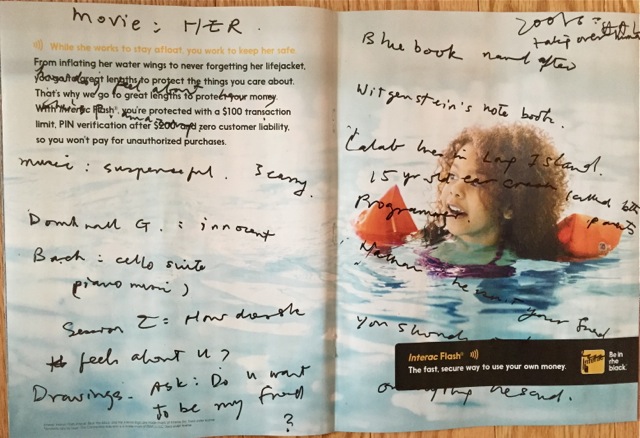
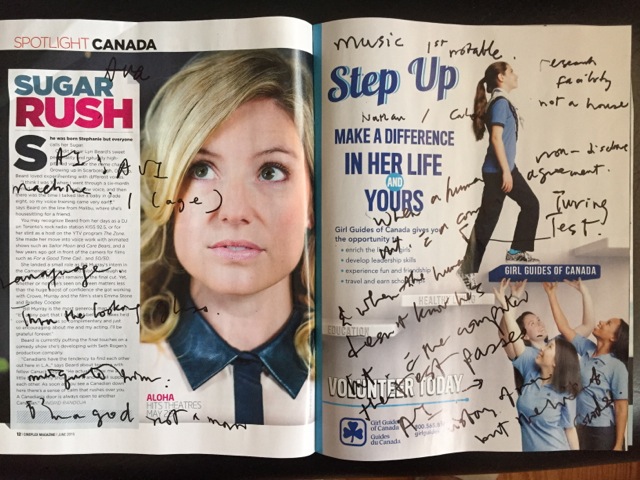
I’ve been asked how I remember so many details from a movie after just watching it once. Well, of course I can Google for some of the info, but to jot down lines and scenes that I don’t want to forget, I take notes.

How do you take notes inside a dark theatre? I used to bring along a small note book, fold the corner of the page to start with, and just use my pen to write whatever I could on the small pages… usually just a few words a page, for I didn’t want to overlap my writing. When I went home, I often had a hard time deciphering what I’d written.

But recently I found a perfect way. Instead of a small notebook, I take with me into the movie a copy of Cineplex magazine, lots of those in the stands at the theatre. Before the movie starts, I fold down the corner of the pages that have some blank or lighter space, take out a permanent black Sharpie marker pen, and I’m all set for note taking in the dark.

I don’t take my eyes off the screen when I write. So you can say it’s blind writing in the dark. Here are some of the pages of notes I’d taken recently. For interest’s sake, I’ve included the movie I was watching when making these notes. They make fun, altered book pages, don’t you think? And the effects of words on the page are all serendipitous too. And oh, if you suddenly remember some errands you forgot to do, you can jot that down too.

A View from the Bridge, National Theatre Live. I’ve a little drawing of the stage and seating here:

Dark Notes

View from the Bridge 1

**

Here are the pages from watching the movie Ex Machina (Review coming):

Ex Machina

Ex Machina 4

Ex Machina 1

Ex Machina 2

Ex Machina 3

When memory fails, mnemonic devices save the day all the time. Just need to channel a little creativity.

***

Saturday Snapshot is hosted by West Metro Mommy Reads. CLICK HERE to see what others have posted.

National Theatre Live

National Theatre Live launched in June, 2009. Cameras are placed in strategic locations in the theatre to capture the stage performance live and broadcast to various venues the world over. According to the NTL website, over 3.5 million people have experienced this remote viewing of plays from London stages, with over 1,100 venues around the world, 550 in the UK alone. For the price of a movie ticket, I can be transported to the front row of these performances.

I ‘discovered’ this treasure too late, well, too late to see Skylight, with two of my faves Carey Mulligan and Bill Nighy. Skylight received 7 nominations for the Tony Awards coming this Sunday, June 7, including acting noms for Mulligan and Nighy, direction for Stephen Daldry, and overall Best Revival of a Play.

NTL’s Skylight had been shown in our Cineplex already, and I missed it. But, all is not lost. In the past two months since I knew about this treasure, I’ve watched three plays and have bought ticket to the October debut of Hamlet with Benedict Cumberbatch. Looking forward to that.

Here are the three shows I’d watched in the past few weeks. Click on the link to the NTL website for full descriptions. The following is just a summary of my thoughts.

The Hard Problem by Tom Stoppard

The Hard Problem

My full admiration to Tom Stoppard for writing a play to explore this hard problem, one that’s not very popular nowadays when science and technology reign supreme, when Dawkins speaks like the indisputable authority: Is evolutionary biology the all-encompassing codebook answering every human question? Hillary, a psychology research fellow at the Krohl Institute for Brain Science prays to God every night, simply madness to her fellow researcher. Her concerns: Can neuroscience explain consciousness, or beauty, or morality, faith, longings? And, sometimes one does need a miracle or two when dealing with personal regrets. The play is an intellectual odyssey with lively and energetic exchanges of amusing dialogues, humour that teases me with lines reminiscent of Rosencrantz and Guildenstern are Dead.

This is Stoppard’s new play in nine years. Mentored by Samuel Beckett, friend of Harold Pinter, writing for both stage and screen, Stoppard, at 77, remains one of my most respected writers. I’d loved Rosencrantz and Guildenstern are Dead, but his works on screen have been equally impressive with the Oscar winning Shakespeare In Love (1998), Parade’s End (2012, one of my fave TV mini-series), the Oscar nominated Anna Karenina (2012), and Empire of the Sun (1987, a unique and haunting chronicle of childhood).

And for this play, nobody is preaching anything here, there’s no need to, just raising the hard problem, that’s all. We hear that line in Hamlet ring out loud and clear: “There are more things in heaven and earth, Horatio, than are dreamt of in your philosophy.”

**

The View from the Bridge by Arthur Miller

A View from the Bridge performed at Wyndham's Theatre Richard Hansell as Louis, Nicola Walker as Beatrice, Mark Strong as Eddie, Michael Gould as Alfieri, Emun Elliott as Marco ©Alastair Muir 16.02.15

Mark Strong is explosive as Eddie Carbone, the longshoreman who accommodates in his home two of his wife’s cousins, brothers and illegal immigrants just arrived from Sicily. Eddie’s possessive care and love for his niece Catherine who has been living with him all the years, turns to malicious jealousy as she falls for the younger of the brothers. Miller’s play is about the American Dream gone sour.

What an eye-opener of a stage play. Mounted at London’s Young Vic Theatre, the stage design is stylishly minimal. With audience viewing from three sides, it lays bare the human soul and its inexplicable and unbridled emotions. I have not seen anything like it. First off, can you imagine two men taking a shower on stage at the beginning of the play… with real water, and towards the end, that water turns into blood showering down, covering all the characters for the stunning, tragic ending.

**

Man and Superman by Bernard Shaw

Man and Superman

This one, I must say hats off to Ralph Fiennes for his extraordinary energy. Playing Jack Tanner, a radical thinker of his days, and the reluctant guardian and later romantic resolve for a beautiful heiress, Fiennes leads us on a wild ride from reality to fantasy, from earth to hell and back again. Well, no superhero in our CGI saturated movies nowadays can rival. Blurting out lines after lines non-stop for over three hours, in one take, dialogues covering all the brilliance of Shaw’s philosophical, social, and political views, with spot-on timing and great fun. Which comedian can beat that? And of course, what he and Shaw had shown us is that words and the intellect can be more powerful and entertaining than on screen action sequences and technical wizardry.

***

~ ~ ~ ~ Ripples to all of the above