Merry Christmas!

To all, a Merry Christmas!

Merry Christmas

Sharing with you a song for the Season, sung by the a cappella group Pentatonix.


Mary, did you know
that your Baby Boy would one day walk on water?

Mary, did you know
that your Baby Boy would save our sons and daughters?

Did you know
that your Baby Boy has come to make you new?
This Child that you delivered will soon deliver you.

Mary, did you know
that your Baby Boy will give sight to a blind man?

Mary, did you know
that your baby boy will calm the storm with His hand?

Did you know
that your Baby Boy has walked where angels trod?
When you kiss your little Baby you kissed the face of God?

Mary did you know.. Mary did you know

The blind will see.
The deaf will hear.
The dead will live again.
The lame will leap.
The dumb will speak
The praises of The Lamb.

Mary, did you know
that your Baby Boy is Lord of all creation?

Mary, did you know
that your Baby Boy would one day rule the nations?

Did you know
that your Baby Boy is heaven’s perfect Lamb?
The sleeping Child you’re holding is the Great, I Am.

***

Reading the Season: The Book of Ruth

For the past seven years, I’ve a special post at Christmas which I’d named Reading the Season, just to help me dwell on the Reason behind all the festivities. Some past authors I’d read include Marilynne Robinson, C. S. Lewis, Madeleine L’Engle, Luci Shaw. This year I’m going back to the source material, The Bible, for my Christmas read. And no, my selection isn’t from Luke 2, which Linus so eloquently delivers every year in the delightful A Charlie Brown Christmas.

I reread the little love story in The Book of Ruth, one of the earliest parallels pointing to the Christmas story. This time I found it particularly relevant. So here it goes…

moonrise


A long time ago in a land far, far away a man named Elimelech and his wife Naomi, together with their two sons Mahlon and Chilion, had to pack up and leave their hometown of Bethlehem in Judah to escape from a famine in the land. As migrants, they travelled to a foreign country called Moab.

Alas, Elimelech died soon after and left behind Naomi and their two sons. Years passed, the sons married two Moabite gals, Orpah and Ruth. Could it be the food there, for not long after Naomi’s two sons also died. Bitter and despondent, Naomi sent her two daughters-in-law back to their own family and began her lone journey to return to Bethlehem.

But Ruth was adamant to follow Naomi back to where she came from with this moving vow:

Don’t urge me to leave you or to turn back from you. Where you go I will go, and where you stay I will stay. Your people will be my people and your God my God.

Touched by her loyalty, Naomi let Ruth travel with her back to Bethlehem. She was like a migrant all over again. To the people there Naomi, if anyone still recognized her, was now widowed, sonless, bitter and destitute. The two women didn’t even have a refugee camp to take shelter.

To survive, Ruth went out to the fields to glean the grains left by the harvesters. It happened that they were in the fields of a kind landowner Boaz, who after noticing Ruth and hearing of her love for her mother-in-law, told his workers to leave more grains in the fields for her to glean. Yes, it just happened that she’d come to the right field.

When Naomi learned of Boaz, she saw a glimpse of hope. Definitely this was more than the food bank; this generous landowner actually was a relative belonging to her late husband’s clan. Out of desperation, she sent Ruth on a risky mission: to go to Boaz at night and approach him tactfully, letting him know of their ties in kinship.

Lo and behold, Boaz, an honourable and compassionate man, was harbouring a deep and ardent love for Ruth. That night, though surprised to see Ruth, he received her readily and with respect, restraining and keeping his torrid passion well under wraps, umm like… Mr. Darcy.

According to the law of the land, the closest relative had the first right to redeem the lands that Naomi’s late husband Elimelech had sold and to marry Ruth to carry on the family line. But lo, Boaz wasn’t that person; instead, he did the honourable thing, extending the first right of redemption to the closest relative, yes, like umm… Mr. Collins.

And it happened that Mr. Collins was willing to buy back the land but wait a minute, he couldn’t take Ruth as a wife. There could be reverberations, for Ruth was a foreigner, a Moabite. Further, the land was for her to continue with Naomi’s family ownership, and would not be under his name. “I pass,” he said in the sight of ten elder witnesses. Phew!

So only then did Boaz declare not only his willingness to redeem the land once owned by Elimelech, but also his desire to take Ruth as his wife to save her from destitute, poverty, and childlessness. How marvellous it was that Boaz, a legit kinsman redeemer according to the laws, was also truly, madly, and deeply in love with his redeemed.

And we are definitely indebted to the two lovers for producing the line of descendants, for Ruth later became the great grandmother of David, from whose ancestral line generations later came Jesus.

With this beautiful ending I come back to Christmas 2015, and ponder on the lowly birth of Christ at the manger, to become our Kinsman for the ultimate purpose as Redeemer.

“And the Word was made flesh, and dwelt among us… full of grace and truth.”  – John 1:14

DSC_0034

**

The Risk of Birth

This is no time for a child to be born,
With the earth betrayed by war & hate
And a comet slashing the sky to warn
That time runs out & the sun burns late.
That was no time for a child to be born,
In a land in the crushing grip of Rome;
Honour & truth were trampled by scorn–
Yet here did the Saviour make his home.
When is the time for love to be born?
The inn is full on the planet earth,
And by a comet the sky is torn–
Yet Love still takes the risk of birth.

                              – Madeleine L’Engle

***

Previous ‘Reading The Season’ Posts:

2014: Lila by Marilynne Robinson

2013: Poetry by Madeleine L’Engle

2012: Surprised by Joy by C. S. Lewis

2011: Walking on Water by Madeleine L’Engle

2010: A Widening Light, Luci Shaw

2009: The Irrational Season 

2008: The Bible and the New York Times by Fleming Rutledge

2008: A Grief Observed by C. S. Lewis

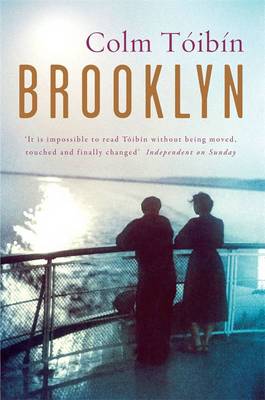
Brooklyn: From Book to Film

Director John Crowley’s movie adaptation of Brooklyn by Colm Tóibín has aptly answered my query (last post): what elements in the book make movie materials? Potentially, a lot. The trick is not to turn them into cliché moments on screen, for this isn’t an unusual story: a young woman leaving home and finding independence and love in a new land. While the film has its flaws, Crowley has crafted a beautiful and stylish transposition.

Author Nick Hornby has done it again following his Oscar nominated screenplay for An Education (2009) adapted from Lynn Barber’s memoir, a film that launched Carey Mulligan’s breakout role and Oscar nod, also a coming-of-age story.

Here in Brooklyn, Hornby tells his story by linking up succinct scenes that just about cover all key episodes in the book. They are short, to the point, and well-paced. The editing too is seamless, driving the film on without delay. After all, they only have about 120 minutes, and they’ve done a smooth job doing that.

Brooklyn Movie Poster

Tóibín’s seemingly simple narration of young Eilis Lacey’s journey of emigration from Ireland to America in the 1950’s is transposed onto film with sensitivity and nuance. The ‘mundaneness’ of daily living – working in a department store, dinner back at the boarding house, night class several days in the week – is transformed into vivid scenes by a lively cast of actors. To their credits, the already animated dinner table banters at Mrs. Kehoe’s (Julie Walters) rooming house as described by Tóibín have now come to life. Indeed, Julie Walters embodies Mrs. Kehoe, and Jim Broadbent as Father Flood is well cast.

Crowley, or is it Hornby, had softened Tóibín’s shrewd descriptions of some of his characters, presenting them in a sympathetic light, making them more likeable. The mood is less serious than the book but evoking empathy just the same. Although two weak spots I find. First is the glamorous and confident older sister Rose (Fiona Glascott) is not depicted as such, lessening the effect that is to come later. Secondly, Jim Farrell (Domhnall Gleeson) is absent at the beginning but appears only in the last part of the film, hence there is not much for character contrast or development.

While most of the supporting characters are well played, the film belongs to Saoirse Ronan, the young Irish actor who first drew notice from Joe Wright’s adaptation of Ian McEwan’s Atonement (2007). Her performance as 13 year-old Briony sent chills up my spine. With that role Ronan became one of the youngest Academy Awards nominees. In the most recent Wes Anderson’s The Grand Budapest Hotel (2014) she sends out very different vibes. As of now for Brooklyn, Ronan has a Golden Globe Best Actress nom. I anticipate she will go all the way to the Oscars.

Cinematographer Yves Bélanger is apt to let the camera linger on Ronan close-up many times, for she acts without speaking. Her facial expressions representing the spectrum of Eilis’s emotions and thoughts are spot on. It is a delight to watch her.

Another animated scene is dinner at Tony’s (Emory Cohen) Italian family home. Here, we see the characters jump out of the book, especially the kid brother, 8 year-old Frankie (James DiGiacomo), whose infamous line is “We don’t like Irish people.” But of course, the whole family welcomes Eilis and supports Tony, who has interpreted his literary version well: respectful, authentic and transparent, as Tóibín writes,”he was as he appeared to her; there was no other side to him.”

Domhnall Gleeson as Jim Farrell has a hard role to play for its very short appearance in the last part. He has not much material to work from but just hangs around with Nancy (Eileen O’Higgins) and George (Peter Campion) who try to set him up with Eilis. Not much to launch a lightning courtship.

Colours play a major role in the film, albeit I feel a pinch of contrivance; watching the colourful 1950’s costumes is like looking into the window of a candy shop with all kinds of macaroons. However, the colours may well set the mood and setting for the film: The overall greenish tone of the first part in Ireland, to the stark green coat Eilis wears as she leaves home on board the ocean liner to the cheery bright yellow cardigan after she has met Tony. Towards the last part, it’s back to the greenish hue of Enniscorthy, only the newly returned Irish/American gal wearing her bright colours. Too explicit a visual translation? Maybe, but I like macaroons, and I won’t hold a Ripple against the colour treatment.

Another visual imagery is at the beginning, right after Eilis has landed in America and gone past the immigration line, she opens the door to head out. We see her step out into an overwhelming brightness of white. Too heavenly? Or maybe just the right sign to boost the confidence of our seasick and insecure heroine?

How do you translate Tóibín’s quiet descriptions on screen? His signature depictions of a calm surface that hides tumultuous billows of emotions? Crowley gives us silence. Indeed, there are cinematic moments that are devoid of sound; the most memorable one is close to the ending when Eilis reveals her secret to her mother (Jane Brennan), sending shock waves and despondence on her face. Yet she restrained her emotions. Mother and daughter embrace in utter silence with tears flowing, saying possibly a last goodbye to each other in their lives and releasing a determined letting go for both.

Brooklyn is a beautiful adaptation worthy of its literary source, among one of the best films I’ve seen in 2015.

~ ~ ~ ~ Ripples 

***

Update Jan. 14, 2016:
3 Oscar Nominations – Best Picture, Best Actress, Best Adapted Screenplay

***

Related Review Posts:

Brooklyn by Colm Tóibín Book Review

Atonement: Book Into Film

The Budapest Hotel: A Grand Escape

Ex Machina (2015) 

Brooklyn by Colm Tóibín: A Second Encounter

As one who is interested in the adaptation process, I’m always eager to find out how filmmakers choose movie materials.

I first read Colm Tóibín’s Brooklyn a few years back when it was first published. I admit I found it uneventful and a bit bland at that time. On the shelf it went after my reading, and I didn’t bother to think too much about it.

Only in recent months when I knew about its upcoming movie adaptation that I was drawn back to it. My major quests this time: to give it another chance and to find out what in it that appeals to filmmakers.

Well, glad I reread it, for I’m actually giving myself a second chance. This time the ‘uneventful’ narratives become a quiet and gentle portrayal of a young woman’s journey of self-discovery, a coming-of-age story told with nuance and grace.

I read it more carefully this time, noting in particular the subtexts and inferences. I paid attention not only to the characters’ inner thoughts and feelings from Tóibín’s direct statements, but his descriptions of their actions and find that he’s a master of subtleties.

Brooklyn_Colm_Toibin

Brooklyn is about migration, this time around, I can see how relevant and timely it is with our present global situation. From the small town of Enniscorthy, Wexford County, Ireland, Eilis sails across the Atlantic on her own to reach the shore of America just for a better future.

The initial foresight is however from her older sister Rose, the financial supporter and all round sustainer of both Eilis and their widowed mother. It is no wonder that Eilis feels it’s Rose that should be the one to go to America, Rose, the good golfer, glamorous, fashionable, capable and confident.

And Eilis? Here’s a little episode while still in Enniscorthy. She goes to a dance with her best friend Nancy and watches her being invited to the dance floor by a promising young man George. Sitting on the sideline Eilis watches her every move and then we read:

“Ellis looked away in case her watching made Nancy uncomfortable, and then looked at the ground, hoping that no one would ask her to dance. It would be easier now, she thought, if George asked Nancy for the next dance when this set was over and she could slip quietly home.”

When this set is over she isn’t given such a chance, for then George brings Nancy and Eilis over to the bar for a lemonade and we are introduced to his friend Jim Farrell, who “just nodded curtly but did not shake hands… his face emotionless.” Towards the end of the book we will see Jim Farrell appear again as some sort of a nemesis who poses a moral dilemma for Eilis.

Tóibín has given us an unlikely heroine in Eilis, a reluctant emigrant. Always the recipient of Rose’s support and encouragement, Eilis is in fact pushed out of her comfort zone by her well-meaning older sister. In her personal journey we see how Eilis grow and mature, and most importantly, with her good nature intact.

In Brooklyn, Father Flood helps her settle in Mrs. Kehoe’s rooming house and secures a job as a sales clerk at Bartocci’s department store. She gets a taste of rooming house politics, and at Bartocci’s, learn work ethics and the soft skills that are so essential to survive socially. And yet, she is plagued with homesickness as soon as she receives the first letters from home.

At the mid-point of the book, Eilis meets Tony, not Irish but from an Italian immigrant family. No matter, Tony’s authentic charm and devotion break down all cultural barriers and alleviates Eilis’s homesickness.

Tony is gentle with her, courteous and considerate. How do we know? As a die-hard Brooklyn Dodgers fan, Tony never mentions baseball in front of Eilis. Instead, he listens attentively to her and having learned of her night class at Brooklyn College, waited for her after class just to walk her home.

Eilis discovers Tony’s love of baseball when he brings her home for dinner over conversations with her brothers at the dinner table. His family? That’s another charming story.

Just as she begins to settle in and fully enjoy her new life in Brooklyn, Eilis receives a tragic news that sends her back to Ireland for a short while. Now we are at the last part of the book with only fifty-one pages left. Here we have the major conflict of the novel, a moral dilemma that Eilis needs to resolve.

I much appreciate Tóibín’s storytelling. After presenting us in details a successful immigrant experience, a young woman becoming independent in a new land, finding herself, meeting a love interest, and even planning for a future with him, Tóibín drops a bombshell shattering all that has been built and invested. And all this while, he’s been so calm and quiet leading to it.

Further, Tóibín shows us how we can be a different person in different settings and environment. Once back in Ireland, the independent and confident Eilis is changed back to her old self. Under the roof of her mother, she is the dutiful and accommodating daughter once again, but this time, with the added burden of guilt.

Tóibín’s narratives are often quiet and mild, but his characterization is shrewd. We see the acerbic Mrs. Kelly who runs a tight ship in her grocery store where Eilis works on Sundays, and her American counterpart Mrs. Kehoe, Eilis’s landlady. Then there’s the curt Jim Farrell who doesn’t even cast Eilis a glance but earnestly woos her when she comes back after dipping in American waters; and finally there’s Eilis’s mother, subtly scheming and manipulative.

With the subject of migration, the ultimate quest is finding a home. As we read Eilis’s personal journey across the Atlantic from Ireland to America and back again, we see her tossed by the waves of loyalty and belonging. Like her first voyage over the turbulent sea, unsettling and gut retching, her return to Enniscorthy is an even more acute challenge. But at the end we see Eilis make her choice, and it is gratifying.

She is finally ashore.

~ ~ ~ 1/2 Ripples

***

Movie review of Brooklyn is here.


November Wrap: East Meets West at the Pond

November is an eclectic month of reading and viewing for me. I’ve watched films ranging from a Chinese wuxia legend from the Tang Dynasty, to the English suffrage movement, to the scandal in the Catholic Church in Boston… and read books from crime thrillers to Westerns to the Gilded Age to India before and after independence.

Arti is a hybrid after all, constantly navigating between cultures and languages. When it comes to books and films, dashing between genres, periods and styles only adds spice to life.

Here’s the list of my November books and films.

Films

The Assassin

The Assassin

Acclaimed Taiwanese director Hou Hsiao-Hsien’s genre-defying wuxia epic earned him Best Director at Cannes this May. Hailed as the most beautiful film at the Festival, this adaptation of a 9th century Tang Dynasty Chinese legend may not be as easily grasped in terms of its storyline as its visual appeal. The film is recently voted #1 on the reputable Sight and Sound Magazine‘s Best Films of 2015 list, that’s the result of a poll gathering the views of 168 international film critics. It is a rare gem indeed. My full review at Asian American Press.  ~ ~ ~ ~ Ripples

(BTW, Hou’s last film? The Musée d’Orsay commissioned French feature on the Museum’s 20th anniversary: Flight of the Red Balloon.)

Room

A highly watchable adaptation of Emma Donoghue’s 2010 Booker Prize shortlisted novel. Kudos to the actors Brie Larson as Ma, Jacob Tremblay as 5 yr-old Jack, and yes, to Donoghue herself for writing the screenplay. One of those titles that I’ve enjoyed watching more than the literary source. My review on Ripple Effects.  ~ ~ ~ 1/2 Ripples
Update Jan. 14, 2016: 4 Oscar Nominations including Best Picture

Suffragette

Carey Mulligan has put forth a nuanced performance as the laundry gal turned suffragette in this Sarah Gavron (Brick Lane, 2007) directed historical drama. It’s worthwhile to watch the informative depiction of the actual events woven with fictional personal stories, especially Mulligan’s riveting portrayal of Maud, how her beginning naivety is forged into committed devotion to the suffrage movement. Prolific screenwriter Abi Morgan (Irony Lady, 2011, just to name one of her works) has laid out a fact-based drama with a heart-wrenching climatic scene. The sacrifice these voiceless, working women were willing to lay down is inspiring.
~ ~ ~ 1/2 Ripples

Secret in their Eyes

The Hollywood re-make of Argentine author Eduardo Sacheri’s crime thriller is a tall order, for its previous film adaptation is the Oscar winner of 2009 Best Foreign Language Film. My post on the book, original film, and Hollywood version is here. ~ ~ ~ Ripples

Spotlight

One of the best films I’ve seen this year, detailing the sequences of how the Boston Globe’s ‘Spotlight’ team of investigative journalists uncovered the systemic cover-up of child sexual abuse among Catholic priests. The Pulitzer winning reporting is presented in the film as painstaking procedurals in matter-of-fact dramatizing. For those who may be a bit worried about the subject matter, there is no sensationalized scenes of abuse, and on the part of the reporters, no portrayal of heroism. Such may well be the praise-worthy elements of this production. The cast’s performance is convincing, in particular, Liev Schreiber as the soft-spoken but motivating, no-nonsense editor Marty Baron. Come Awards time, I trust the production, its cast and crew, and director Tom McCarthy (The Visitor, 2007) will be duly recognized.    ~ ~ ~ ~ Ripples
Update Jan. 14, 2016: 6 Oscar Nominations including Best Picture

Fireflies in the Garden

My guess is, you haven’t heard of this 2008 movie. Neither have I until I saw it on TV a few days ago. The story about a father-son’s love-hate relationship from childhood to adulthood is realistically depicted. Caught in between the straining conflicts between the always angry and harsh father and a sensitive, vulnerable son, is the mother, always loving and protecting, something like the family dynamics in Terrence Malick’s The Tree of Life. It also echoes the Oscar winning Ordinary People (1981), the small-scaled, Bergman-esque chamber film of deep entanglement of unresolved parent-child conflicts. Another film just popped into mind and that’s Colin Firth, Jim Broadbent’s When Did You Last See your Father.

Fireflies has a well-selected cast with Ryan Reynolds, Willem Dafoe and Julia Roberts. I’m surprised to see the low rating the film received among critics. Disappointed really that it wasn’t well received. What’s that to me, and why am I  concerned? There’s a half-baked screenplay in my closet that’s something along that line. I know, more rewrites.  ~ ~ ~ Ripples

**

Books (Click on links to my Goodreads reviews)

It’s all a chain reaction started with …

The Burning Room by Michael Connelly (Audiobook)

I’ve not missed a single one of Connelly’s Detective Bosch novels. This time I listened to the audiobook and was much impressed by the voice of its narrator Titus Welliver.

Appaloosa by Robert B. Parker (Audio MP3)

So I checked about Welliver’s other audio works, and found Appaloosa by Robert B. Parker. I’d seen the 2008 film adaptation with Ed Harris and Viggo Mortensen and quite enjoyed it. So I jumped right in and found it to be a very well-written book, one of the few Westerns I’ve read.

And from this Robert B. Parker, I went on to explore more about him and learned that he was the ‘Dean of American Crime Fiction’. Here are two of his works crime stories I followed up with:

Promised Land  (Audio MP3)
The Godwulf Manuscript  (Audio MP3)

The Custom of the Country by Edith Wharton
From crime fiction to the Gilded Age. I bought this book at Edith Wharton’s home at The Mount during my New England road trip, during which I learned that Julian Fellowes was much influenced by Wharton and especially this title.

The Secret in their Eyes by Eduardo Sacheri (Audio MP3)

Plato and a Platypus Walk into a Bar: Understanding Philosophy through Jokes by Thomas Cathcart and Daniel Klein (eBook) – click on link to read my one-line review of this title on Goodreads.

The Boston Girl by Anita Diamant
Makes me think of Colm Tóibín’s Brooklyn which I’m rereading to prep for the upcoming film adaptation.

Heat and Dust by Ruth Prawer Jhabvala
Shifting between the English in India before independence and later the 70’s, a clash in cultures and the human toll of unfulfilled marriages. I reread this to prepare for the James Ivory Retrospective this coming weekend right here in my City, with the legendary director (now 87) attending. Yes, really looking forward to this event.

**

Currently Reading / Listening

In the Heart of the Sea by Nathaniel Philbrick (for the upcoming film)

Brooklyn by Colm Tóibín (reread for the upcoming film)

Parade’s End by Ford Madox Ford (Audiobook)

***

Related posts you may like:

Flight of the Red Balloon (2007)

The Tree of Life (2011) by Terrence Malick

When Did you Last See your Father?

Appaloosa (2008)

The hardest part is getting out of the car

In chilly -5C (23F), snow a foot deep in some areas, the hardest thing is to get out of a warm car. I drove around, actually left the natural park and then, a couple of blocks later, thought about turning back, all because of the flocks of dark spots by the river I saw from afar.

Glad I finally mustered the will to make a U-turn, find a spot to park and part with the story I’ve been listening from the audiobook CD.  I layered up, attached the ice grippers on my shoes (discovered this secret only a year ago), put on toque and gloves, and with my camera gear in tow, stepped out of the car.

Here’s my reward.

From afar, just some tiny black dots on the water…

From afar


that turned out to be a party of ducks and geese, basking in the afternoon sun on the icy river:

DSC_0406


Basking

And from behind tall grass, a buck watching me watching the ducks:

Buck behind grass

Suddenly from the corner of my viewfinder, a pheasant flew into frame. Here’s the serendipitous sequence:

Pheasant 1Pheasant 2Pheasant 3

At another spot, more Mallards gathering, over a hundred of them:

More ducks

These pigeons could only watch.

Pigeon A: Don’t you wish you could swim?

Pigeon B: And get all wet in the icy water? I’m thankful that I can’t swim.

Your guess: which is A? and B?

If only we could swim


In the sky Canada Geese flew by:

DSC_0565

On the ground, remnants of fall:

DSC_0549


and some positive human footprints left behind.

DSC_0489


And so I learned: Any worthwhile journey began with a step out of a warm car.

Oh, and one more thing… 

Wisdom from the pigeon: Be thankful for what you can’t do. I’ve got lots to be thankful for.

***

This is my post for Saturday Snapshot: Nov. 28. Thanks to West Metro Mommy Reads for hosting. CLICK HERE to see what others have posted.

ALL PHOTOS IN THIS POST TAKEN BY 

ARTI OF RIPPLE EFFECTS

DO NOT COPY OR REBLOG


More Secrets In Their Eyes

Secret In Their Eyes (2015) is a recent remake of a foreign language film in Hollywood English. A prolific source, films from other countries. One might have seen them without even knowing their origin, from as far back as The Magnificent Seven (Seven Samurai, Japan), or this other Japanese transplant, Shall We Dance,  or from Israel, The Debt, or The Departed (Infernal Affairs, Hong Kong). The most popular in recent years is probably The Girl with the Dragon Tattoo from Sweden, based on the book series by Swedish writer Stieg Larsson.

How successful are these transpositions? To be fair, each production needs to be judged on its own merits; Scorsese won four Oscars with The Departed

But unlike the book to film adaptations, we’re not comparing two different art forms but like kinds. With this in mind, there are inherently certain challenges, especially with the original being an acclaimed work.

This current English version of Secrets In Their Eyes is case in point. It’s pitted against an Oscar winner, the 2009 Best Foreign Language Film from Argentina, an exceptional production. You’d have to match it to justify the attempt to remake.

Further, how the story works is almost wholly rests on one final shocking twist at the end. For those already familiar with the original Argentinian film, or have read the book – its movie tie-in edition out in bookstores everywhere in recent months – watching this latest version would naturally cut down on the intensity and suspense.

From one who’d experienced all three, here are some of my thoughts.

The Novel 

The Secret in their Eyes was originally a novel written by Argentinian author Eduardo Sacheri. It is a crime thriller set in the Dirty War period, mid 1970’s to 1980’s, a decade when the military government suppressed civil rights to eradicate left-wing subversives and dissidents. Many disappeared, and many more suddenly became political prisoners.

The story has two main plots. First, a young wife is raped and murdered, leaving the young widower devastated. Unsolved for years until a chance occurrence – a petty crime – leads police to pick up the murderer. He is tried, sentenced and sent to jail. But a personal vendetta and political corruption lead to his release after a short imprisonment, sending the young widower spiralling down to utter despondence. 

The second plot line is the unrequited love of the protagonist, a recently retired judiciary official, for a court judge on whom he had a crush all the years, an obsession that continues to nudge him even into his retirement as much as the unjust murder case he had handled. 

The plot is intricate, the story riveting, the characters well developed, but I have one issue with the novel, and that’s the writing style. Mind you, this is written in a personable and even colloquial style (maybe credit to the narrator of the audiobook), easy to get into. But here’s the rub.

The book is the best illustration of overwriting I’ve come across in recent years. Superfluous descriptions of characters, detours into backstories and anecdotes that are unnecessary. I can’t help but think of Bach, yes, J.S., who wrote his music with a grace note at the end as ornament, or used it sparingly in a piece. Well, Sacheri scatters grace notes all over the page. 

The 2009 Movie Adaptation
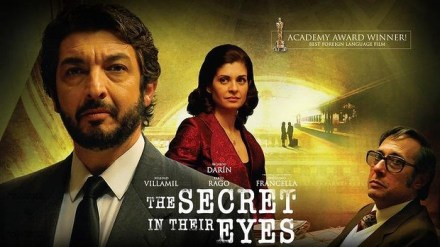
TSITE Argentina

The Argentinian film based on the novel was one of those adaptations that I’d enjoyed more than the book.

It’s an intense, moving and soulful film with superb performance. For a crime thriller to be moving and soulful is a rarity. It goes deep into the characters’ innermost being, not only for the tragic survivor, Morales the young widower, but for the Court official, Benjamin, and others involved. 

The film is detailed and thoughtful in its handling of the complex and intricate storylines. The actors are charismatic in drawing viewers in. The music score is gripping. I downloaded it right after I’d seen the movie.

For even more dramatic effect, the ending is what gives this film its distinct signature. The screenwriter/director Juan José Campanella took the liberty to depict an even more chilling twist than that in the book. 

The 2015 Movie Adaptation

Secret English Version

Billy Ray is the screenwriter and director. Ray is known for writing several acclaimed works including Captain Philips (Oscar nom. for Best Screenplay, 2013) Hunger Games (2012), State of Play (2009), and Shattered Glass (2003) which he also directs.

To transplant the Argentinian story onto American soil, Ray discards the Dirty War setting, which is understandable, and replaces with a war on terror scenario after 9/11, which is also understandable. National security has been entrenched in the American political psyche ever since that fateful day. 

Ray has three A-listers to work with. But to direct them, he seems to have a handful. Chiwetel Ejiofor plays a newly retired FBI investigator Ray (boggles me why screenwriter/director Billy Ray chooses the name) who thirteen years ago had to deal with the murder of his colleague Jess’s (Julia Roberts) daughter Carolyn (Zoe Graham). Coming into the picture is a Harvard Law grad DA Claire (Nichole Kidman) beginning her career. Ray has a crush on Claire the moment he sees her, who looks forever young between the time lapse as the film switches back and forth from 2002 to the present. 

These three characters have to deal with a mishandling of justice, as the suspect of Jess’s daughter’s murder is let go due to a different set of political priorities held by the brassy boss (Martin Morales, again, why pick that name? Morales is the young widower in the novel, the victim’s husband, another victim). Now just as Ray is retiring, a new lead comes up and he wants the case re-opened.

The story should be developed more to allow the characters to come alive. Now, they just seem to be going through the motion of acting and trying very hard at that, except Nicole Kidman. With Kidman, there’s something elusive about her that is hard to pin down. There seems to be a consensus between the director and the actress that says: looks are everything; just my presence is enough, no need to get serious.

On the other hand, there’s Julia Roberts, who has put forth an intense performance, conveying just the opposite, and that’s: looks aren’t important; I intend to win hearts with my sincerity and efforts. Good for her, I think she has done a good job here, despite a role that’s against type, giving her limited expressive outlets except being somber and dazed. But I like the last shot of her looking out the window at the ending.

Chiwetel Ejiofor, such a talented actor as demonstrated in 12 Years A Slave, seems to be directionless here. Maybe it’s the script, maybe it’s the direction, in both or either, it’s still Ray (Billy). As the helmsman, he needs to give the character Ray some insightful prompters. No, first as a screenwriter, he needs to develop more complexity in his story, and give his characters something to do to move it along instead of just have them face each other and talk.

But with these three, it just might be enough seeing them face each other and talk.

As mentioned above, the twist in the end is the distinct mark of the film. So, I was expecting the sequences leading up to it be driven with more powerful momentum, a crescendo in suspense. Somehow, it looks more like an anti-climax here than the final thrust of a thriller.

However, to watch these three actors come together on the same screen is still an interesting proposal. Overall, not as bad as some critics had sentenced.

Novel: ~ ~ ~ Ripples

2009 Argentinian Movie: ~ ~ ~ ~ Ripples

2015 English Version: ~ ~ ~ Ripples


Room: From Book to Film

Spoiler Alert: This review involves spoilers.

Is the book always better than its movie adaptation? Again I’d say, they are two different kinds of medium and art form, hence, hard to compare. But some just want a simple answer. So here it is, no. The book is not always better, and Room is a case in point.

Room Movie Poster (1)

Not that I’m putting down this 2010 Booker Prize shortlisted novel by Emma Donoghue, or that I lack the empathy to appreciate the scenario: A teenager kidnapped and locked in a garden shed, visited by her captor on a regular basis for his pleasure, two years later resulting in the birth of a baby boy whom she raised right there in the room until he is five years old. A sad and tormenting premise, albeit not totally implausible when there was a similar real life case just discovered not long before Donoghue wrote her book, and sadly, new ones coming out after as well.

I read the book upon its publication in 2010. Maybe it was my own intuitive reaction against the hype around it, I found reading three hundred some pages of juvenile talk, all from the point of view of a 5 year-old was a bit testing, at times even annoying. But the movie has offered me an alternative frame of looking at the story, and its author.

There are many positive ingredients in this affective and powerful adaptation. First is Donoghue. Writing the screenplay herself, the author expands our view from 5-year-old Jack (Jacob Tremblay) to include his Ma (Brie Larson), by so doing, raising our empathy for the captive, who has to appease her captor (Sean Bridgers) whom they call Old Nick, in order to stay alive and protect her young son.

A torturous line to tread, but Ma (her real name is Joy) has done it by turning the whole ordeal into a pleasant environment, giving Jack as normal a childhood as possible under such restraints. Old Nick brings them supplies when he comes in at night. That’s when Jack has to hide in the closet until Old Nick leaves. During daytime, Jack plays, exercises, and reads, even bakes a cake together with Ma for his birthday. The calm, playful scenario reminds me of the Holocaust movie Life Is Beautiful (1997) where the father turns a Nazi concentration camp ordeal into a game for his young son to shield him from the horrors of reality.

What is real, what is not? What is captivity, what is freedom? Jack learns that he and Ma are real, people in the TV are not. Room is all there is. The concept of himself being a captive has never enters his mind. Jack accepts all these until one day Ma knows that she cannot keep him in the shed anymore. Keeping her son safe from Old Nick’s hands becomes the prime motive for her to think of an escape plan.

I much appreciate director Lenny Abrahamson’s handling of the story: he chose not to exploit the crimes of Old Nick’s but to exalt the bond between Jack and Ma. The love between a mother and her child deflects all horrors of human depravity. Further, Ma’s nurturing helps Jack interpret his world and find beauty in it, from a confining shed to the outside world in the second part of the movie.

To counteract the argument that a movie leaves nothing to the imagination as it shows the visualized image of the literary, again, it depends on the handling by the director. Here in Room, some key issues are left to the audience’s own private thoughts. So if you are concerned about the movie being too graphic in its dealing with the crimes mentioned in the book, fear not, albeit I must say there are tense sequences for dramatic effects.

Donoghue has also structured the movie well, the first hour in the room, the next in the wider world, for we all need the balance; we all want to see Jack and Ma free. The contrast of the two worlds is mesmerizing to Jack. To Ma, however, the situation is much more complicated. The readjustment, the ‘what-if’s’, the ‘why didn’t you…” callously posed by the media are the slings and arrows hurled at her when she is interviewed, prompting her, and us the audience to ponder “What makes a parent? A good parent?”

Joy’s own mother Nancy is played by Joan Allen, in one of her most affable roles. Her acceptance and warm welcome helps Jack feel he belongs. In contrast, William Macy, her ex-husband Robert, sees only the criminal when he looks at the child. Leo (Tom McCamus), who lives with Nancy, observes from the sideline and helps in his own subtle way.

Another element I must mention is the music. I have not seen the films which Irish composer Stephen Rennicks had scored previous to Room. So for this first time hearing his work, I was deeply moved. The music augments the suspense and cues in the warmth, an essential ingredient to bring out the cinematic effects. As the film ends, I welcome it like a cathartic wash sweeping away the ugliness, leading Ma and Jack to embrace a fresh new beginning.

Shot in Toronto, the movie had captured the hearts of audiences in various film festivals and is the winner of Grolsch People’s Choice Award at TIFF15. Come this Awards Season, my prediction (and hope) is that it will gather nominations for screenplay, directing, music, actress, and for 8 year-old Jacob Tremblay.

~ ~ ~ 1/2 Ripples

***

Update January 14:
4 Oscar Nominations
– Best Picture, Best Actress, Best Director, Best Adapted Screenplay

Update January 10: Brie Larson won Best Actress Golden Globe

Update Dec. 10:
3 Golden Globe noms for Best Motion Picture-Drama, Best Actress and Best Screenplay. Now 9-year-old Jacob Tremblay got a SAG nom.for Best Supporting Actor. These are just a few mentions among other noms. for the film.

Related Post:

Books to Films at TIFF15

Can a Movie Adaptation ever be as good as the Book?

October’s Abundant Harvest

October is harvesting month for me. The first week I was still cruising on some small country roads in Northeast U.S. gathering visual delights. As soon as I came back home, I sent off a travel article to an online newspaper. Visitors to my pond at Ripple Effects get the details in ten blog posts beginning here.

Funny thing is, In my almost two weeks’ road trip, I’d rarely seen birds and have not watched one single movie. So as soon as I got back home, I quickly sought to quench the dry spell. Sad to say, my avian friends have migrated without saying goodbye. But there are always movies.

Here are the movies I’ve watched in October after coming home. Most are current releases, a few catch-ups. I’m a detailed list-maker of unnecessary facts, so the titles are in chronological order of my viewing:

The Intern with Robert De Niro as the overqualified senior (in age) intern

A new genre has evolved in recent years to capture the baby-boomer cinema goers – A Walk In The Woods, The Best Exotic Marigold Hotel, Quartet, My Old Lady – just to name a few. The Intern is pleasant enough, with an interesting proposal: make the best use of the resources seniors can offer in a business, here a startup created and operated by Jules (Ann Hathaway). The hipster way of running a company is explicitly, time and again, contrasted with the De Niro old school of management, etiquette and people skills, like Ben Stiller and Adam Driver in While We Were Young. But The Intern lacks a dramatic story arc to hold viewers’ (well, mine at least) interest and attention. I’ve been waiting for a twist somewhere but it never came, and Anders Holm who plays Jules’ husband Matt could well be a miscast.  ~ ~ 1/2 Ripples

Hamlet with Benedict Cumberbatch as the brooding Prince of Denmark

I bought the ticket to this National Theatre Live one-night screening months ago and am excited to report that I was one of 250,000 viewers worldwide to watch it. The date to remember: 10/15/15. It was a record for NTL for one single showing of a broadcast; Shakespeare would be ecstatic. I was squished in the last row corner seat in a full Cineplex auditorium, awestruck by the enthusiasm Benedict Cumberbatch had raised. There were young people in droves streaming into the theatre instead of the usually grey-haired audience at most NTL screenings.

Basically two things I’d like to say about this production at the Barbican in London via NTL’s camera work. First, the sound and lighting need to improve so we don’t have to strain our ears to hear that most famous soliloquy of all time delivered by Benedict Cumberbatch. Second, the performance was a bit uneven. While Cumberbatch had put on an energetic and affective act, and Ciaran Hinds as Claudius was very convincing and appealing even, there were roles that need to be pumped up to match.
~ ~ ~ Ripples

The Martian with Matt Damon as the best botanist on the Planet Mars

Well, science seems to be the saviour bringing Matt Damon back to Earth from Mars but director Ridley Scott knows the underlying secret. An evacuation of his teammates after a dust storm has left astronaut Mark Watney all alone on the Red Planet. To survive, he has to science his way out. Director Ridley Scott knows too well that he is working with flesh and blood, and science without the human touch will best be a fine documentary but won’t capture hearts and can’t triumph at the box office. Thanks to all his teammates in the space capsule coming back for him and all the smart people in NASA and elsewhere calculating to the dot of how this could take place, we get a captivating and entertaining human interest story. Look at the cast, it’s not rocket science that the film has fine materials to build on: Other than Damon, there’s Jessica Chastain, Kristen Wiig, Chiwetel Ejiofor, Jeff Daniels, Sean Bean…

A blogging success, Andy Weir first published his story as blog posts, followed by eBook, sold movie rights, movie production, and now the phenom. But what was I most impressed? That the film doesn’t use CGI to imitate the Red Planet but was shot on location in the magnificent Wadi Rum, southern Jordan. Previous films with Mars as setting had used the location as it’s probably one of the most Mars-like places on Earth. I had the experience of getting to about seventy miles north of Wadi Rum in Petra many years ago, beholding the city carved out of the red mountains. It was indeed out of this world.  ~ ~ ~ 1/2 Ripples
(
Update Jan. 14, 2016: 7 Oscar Nominations including Best Picture)

Bridge of Spies with Tom Hanks as the reluctant hero

Steven Spielberg knows what audience wants too, and that the formula of the “hero’s journey” works. Not to say this film is formulaic but it is predictable even when I didn’t know anything about our reluctant hero, insurance lawyer James Donovan (Tom Hanks) who later turned master negotiator. Bridge of Spies is set in the Cold War era, Donovan is asked to do the nasty task of defending an arrested Russian spy Rudolf Abel (Mark Rylance). As a result, Donovan has suddenly become public enemy no. 1 together with his defendant. As the real life events begin to take their course, Donovan is pulled into the journey with real gusto. He saves Abel from a certain death sentence, keeping him for more useful ends, you know, some sort of like insurance for the future. And rainy days finally come.

This is a highly watchable film, despite the fact that many might have known about this part of American history, the character Donovan and his ultimate endeavour to exchange Abel for American U2 pilot Gary Powers shot down from Soviet airspace. As with Ridley Scott’s The Martian, Spielberg knows it’s not the dry, actual negotiations that will interest the audience, but the added suspense and the human bond between Donovan and Abel that would appeal more. And so he threw in those elements; Spielberg is good at that. It’s the humanity behind his characters that capture his audience. And what’s more, shot like a Cold War era film, we get some thrilling noir type of camera work and the reminiscence of the denser and tenser spy films of the 60’s, like Le Carré’s The Spy Who Came in from the Cold. But of course, in this day, audience would welcome more Spielberg’s offer of lighter entertainment. ~ ~ ~ 1/2 Ripples
(Update Jan. 14, 2016: 6 Oscar Nominations including Best Picture)

Jafar Panahi’s TAXI where the banned Iranian director creates video selfies 

Banned from making films for twenty years for his outspoken stance against the government, Iranian director Jafar Panaji uses creative and bold ways to make his ‘non-films’. Here he is in the driver’s seat in a yellow cab, picking up his fares on the streets of Tehran with a camera mounted on his dashboard. We get a slice of what it’s like to live under an authoritarian power. Rather than a gloomy view, this 2015 Berlin International Film Festival winner brings us a light-hearted, human display of life in Tehran, however limited the crack is opened for us to look in from the outside. My full review here.  ~ ~ ~ 1/2 Ripples

This is Not A Film where banned director searches for new ways to speak out

This is Jafar Panahi’s 2011 work after he was given a 20-year ban by the Iranian court from filmmaking, screenwriting, giving interviews, and leaving the country. This is not a film, but a video selfie made in his home by friend and documentary filmmaker Mojtaba Mirtahmasb who was later arrested. We see a somber, stoic, but at times frustrated Panahi up and about in his home with his daily chores, and ‘telling’ a banned screenplay. He is also shown using his own iPhone to record a young man coming to his door to collect garbage, a film student helping his sister out for that night. The depth of human interest and the desires and aspirations of people in constraints depicted in this ‘non-film’ is poignant.  ~ ~ ~ Ripples

Remember where Christopher Plummer is a 90 year-old revenger with dementia

So what if the plot is implausible as long as we have a talented director (Atom Egoyan) conducting a fine orchestrated production with the riveting performance of Christopher Plummer. I mean, there are lots of implausible storylines in our movies nowadays, think Gone Girl, Before I Go to Sleep, ok, throw in The Martian even. The charismatic performance here in Remember by Plummer makes it believable and absorbing. Why, he has grasped and portrayed a dementia patient to the dot, forgetting who you are, where you are, and the essential why for your actions. A Holocaust survivor seeking revenge on the German officer responsible for his family’s death in Auschwitz is the premise. But Canadian director Atom Egoyan had led us into a thrilling story of suspense and unfolding. No, this is not ‘another Holocaust movie’ but a riveting thriller. Plummer has effectively led us to see the fragility of our mind and the nature of the memories we hold.  ~ ~ ~ Ripples

Meet The Patels where Ravi Patel shows us the Indian version of Meet the Parents

But with one major difference: This is a lively documentary. That makes it all the more fun and realistic. The Indian parents of their American born, and almost 30 year-old son Ravi Patel lend a helping hand to find him a wife by distributing his ‘bio dates’ resumé to friends and family and practically to the whole Patel clan. This is not incest but expanding the target market of about 50 miles radius of where the Patels come from in India. Ravi himself had gone through the ‘biodating system’, online matrimonial websites, and Patel Matrimonial Convention. But before all these, he’d had an American girlfriend whom he had kept as a secret from his parents and with whom he had just broken up. Ahh, that adds to the complication in this vividly told multi-visual doc.  Most gratifying is the conclusion… regardless of culture and traditions, loving parents just want their children to be happy. I can’t agree more.   ~ ~ ~ Ripples  My full review here.

The Past where Director Asghar Farhadi elicited some amazing performance

My third film from Iranian directors in just two weeks. Asghar Farhadi’s first French language film shot in Paris. I was much impressed by his previous work A Separation, which won the Academy Award for Best Foreign Language Film in 2012. The Past came a year later. So this is a catch-up for me; I’d long wanted to see it. Saw it on BluRay just a few days ago and again I must say, don’t let them just stream movies online, for the special features are just as good. Here we have Farhadi sharing with us the creative process in the making of The Past at a Directors Guild interview. This is too good a film to just write a couple of paragraphs on. A full review coming. But I can tell you, it’s going to be ~ ~ ~ ~ Ripples.

***

Write Where You Are

During my New England road trip, I’ve visited several literary places. Now these are my own way of storing my memories. Whatever site I’ve been that relates to a literary figure, I categorize it as such. And it’s interesting to note the different sources of inspiration.

Thoreau went for the minimal, the Spartan way of existence. So he built a log cabin in the woods and kept only the simplest furniture. Why he only stayed for two years two months and two days may be self-explanatory. But no matter, we’re glad he had tasted the bare minimum for us so we can read all about it in his book.

Interior

By comparison, his friend Ralph Waldo Emerson, who owned those woods where Thoreau had his experiment, lived in relative luxury and comfort. Here’s his residence, not a mansion but still a handsome house.

DSC_0561

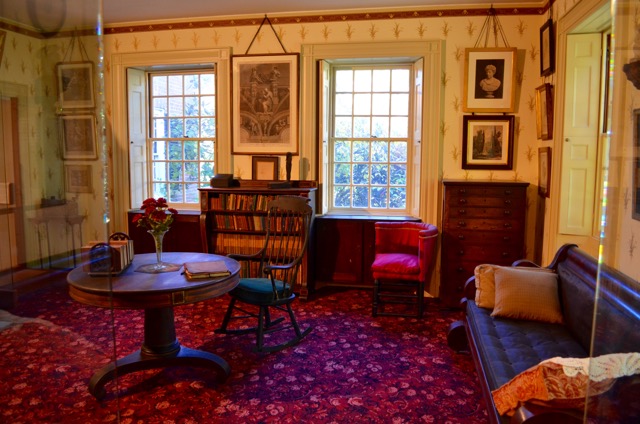
And inside the Concord Museum I saw his study with a flashy fuchsia decor which Thoreau might not have raved about. Just might not, but one never knows. They were friends.

Emerson's Study

Ralph Waldo’s grandfather The Rev. William Emerson’s house, The Old Manse (Scottish term for ‘Minister’s House’), wasn’t shabby either. Quietly situated by the river, a historic residence where literary figures gathered and where Ralph Waldo had lived for a while and wrote Nature, which sparked the Transcendental Movement (1834-35).

Manse 2

Nathaniel Hawthorne had lived in the same house too for a few years (1842-45), writing a book called Mosses from an Old Manse. He enjoyed the garden immensely; it was planted by Thoreau in 1842 to celebrate Hawthorne’s marriage to Sophia Peabody. Hawthorne could have found inspiration right there among the beets.

The Beets

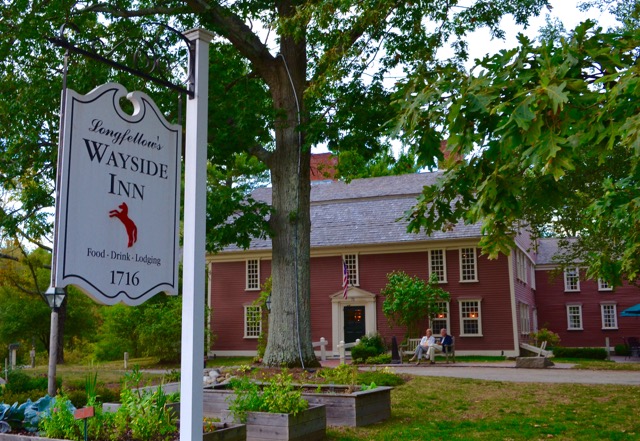
Longfellow, on the other hand, was intrigued by an old tavern and boarding house he had stayed one time in 1862. A homestead made into a lodge for itinerant farmers and transient guests had put stories in the mind of the creative, hence the publication of the Poet’s Tales of a Wayside Inn. For its namesake, the premises had since been named Longfellow’s Wayside Inn.

DSC_0193

Louisa May Alcott’s Orchard House looks like a warm haven for story brewing too, even though the family could have used more material goods than their philosophically-minded father had provided:

The Orchard House

Back to Nature, the aspiring young poet Edna St. Vincent Millay climbed to the top of Mt. Battie in Camden and beheld the magnificent bird’s eye view of Penobscot Bay. Sky and water pressed close into the impressionable mind of young Edna, triggering a catalyst reaction of permanent change.

View from the top 3

For another, it’s the connection with the land, the toiling of the soil, the gathering of its fruits that inspired. He might have many roads to choose, but aren’t we glad Robert Frost had chosen orchard tending in Vermont and not the ones he did not; we get plenty of thoughts.

Frost's Apple

And for those born into affluence and wed into more, life was a choice of how to use the resources one gets. I’m glad that Edith Wharton had spent her fortune on something that can be left behind for me to set foot on, yes, The Mount.

EW's Garden

I learned too that her legacy had been more than literary pleasures and architectural delights, but something more altruistic after she moved to Paris.

As WWI broke out, Wharton could have gone back to America for safe haven. But she stayed in France, and poured herself in the war efforts, which was inspiration in itself. Here I quote from The Mount’s webpage:

“She set up workrooms for unemployed seamstresses, convalescent homes for tuberculosis sufferers, hostels for refugees, and schools for children fleeing war-torn Belgium. In the first seven months of her efforts, nearly 900 refugees were cared for, “including the nuns and about 200 infirm old men and women, who are ‘children’ too … and could not be left alone in the ruins.” (Edith Wharton, New York Times, 1915)”

and the story didn’t end there… Click on the above link to read more.

Where does one find inspiration, motivation? The answer can vary as much as asking what I should eat today. But one thing I’d experienced on this trip was that life can be lived in myriads of ways, and with it comes inspiration; it could be as simple as a leaf on the ground, or as huge as a war. But I’ll choose the leaf, thank you.

The Leaf

Wherever I am, that’s a good start.

***

My New England Road Trip Series:

Serendipity on Route 7

My drive continued south from Bennington, Vermont, via RT 7 to Williamstown, Massachusetts. There I stayed for the night. I knew Williams College was located there. But while exploring the town, I came to this building and saw the huge banner. Upon further investigation, I was excited to discover the campus of Shakespeare & Company:

The Miller BldgDSC_0337 (1)Later I found out that the actor Christopher Reeve met his future wife Dana in Williamstown where they later married. Reeve began as an apprentice at age 15 with the Wiliamstown Theater Festival right in those venues and eventually performed there for fourteen more seasons.

I had the chance to talk to a woman who was working on the grounds and learned that, lo and behold, she was born in Alberta, Canada, my home province! Imagine a chance encounter with an Alberta born American thousands of miles away.

The Berkshires region is beautiful and cultural. I made a mental note to come back to Williamstown for its annual Theater Festival.

My original plan was just to drive south on RT 7 from Williamstown to Lenox to see the Edith Wharton House at The Mount, when another serendipitous find came upon me: Tanglewood Music Center. So here I was at the famous summer home of the Boston Symphony Orchestra on my way to Edith Wharton House.

The Koussevitzky Music Shed was named after the Russian-born conductor, composer and double-bassist, long-time music director of the Boston Symphony Orchestra from 1924 to 1949:

TanglewoodI lingered at Tanglewood for quite some time, for the grounds were beautiful and offered magnificent views. Another mental note: I must come back for the Tanglewood Festival in the summer. :

viewAcross the road from Tanglewood, fall foliage began to emerge. That was October 7. I can imagine how beautiful it is now:

across from TanglewoodAnd finally, to The Mount, Edith Wharton’s home from 1902 – 1911. I knew she was a prolific novelist and short-story writer, the first woman to win the Pulitzer Prize (The Age of Innocence, 1921); later I learned too that she had been nominated for the Nobel Prize for Literature three times.

So I was a little surprised to find out from the tour guide at The Mount that she was also a house and landscape designer in her own right. Her book The Decoration of Houses is still used today by architects and designers.

Built as a writers retreat, The Mount reflects Wharton’s fondness of symmetry:

SymmetryWhat happened to the left side of the building? That makes it not symmetrical, you might ask. That’s the servants quarter which Wharton was willing to compromise her design principle.

Here’s another view why it’s called The Mount:

The MountI took a tour of both the inside as well as her gardens. Here’s one wall of her library:

One wallWell read in several languages since she was young, Wharton left these books behind  when she moved away to live in Paris the latter part of her life after the demise of her marriage. Her husband Edward had fallen into a state of dementia after lengthy bouts of depression and mental illness. The writer’s years at The Mount had not been as happy as its surroundings could offer her.

The Drawing Room:

The Drawing RoomDining Room, where Henry James was one of several usual guests:

Dining RoomBut where did she write? Not in the library, or at the desk in her room, but right in her bed. She had an assistant who would take her handwritten pages and type them up after her six hours of continuous writing every morning before she got out of bed. I’m sure Wharton would love to have a laptop:

Writing bed (1)And these other items I found interesting. Downton images conjured up in my mind. Typewriter, telephone, telegram:

DSC_0347
An original 1902 ice box, Daisy would love it but maybe not Mrs. Patmore. Give her some time to warm up:

Ice Box
A luggage lift. Definitely would be a fave among the footmen:

Luggage lift

And only after the tour did I find out, The Mount had given a Life Time Achievement Award to Julian Fellowes. The Downton creator had attributed Wharton as a major influence on his works, first Gosford Park (Oscar Best Original Screenplay, 2002) and then Downton Abbey. Speaking upon receiving the Award at the Harvard Club, Fellowes noted that he was particularly inspired by Wharton’s “… ability to judge without feeling the need to condemn.”

I bought the book The Custom of the Country in the gift shop and only just now did I learn that it is being adapted into a TV mini-series, with Scarlett Johansson playing the anti-heroine, Undine Spragg. This will mark Johansson’s first TV role.

As for Julian Fellowes’ new work? I eagerly await. After visiting The Mount, I can see what a natural shift it is for him to create an American version of Downton. The Gilded Age should be a smooth sequel.

From Lenox, I began the last leg of my New England Road Trip. I headed east on I90, a breezy 2.5 hrs. drive back to Wayland, the suburb outside Boston, thus completing the loop and a memorable journey. An item checked off my bucket list.

***

Follow my New England series:

Vermont: More than Scenery

Vermont has so much to offer on top of the scenery. But I’ll start with that.

The hills are alive overlooking a breathtaking view of the distant Green Mountains. That was what attracted the von Trapp Family to settle there. Right, that’s the Family von Trapp of The Sound of Music fame. Goerg and Maria moved to Vermont in 1941 and bought a 300 acre farm near Stowe, as that location reminded them of their native Austria. There on the mountain top they started a guest lodge and had since developed into what is now an upscale resorts on 2,500 acres.

The Trapp Family Lodge in Stowe, VT, owned and operated by the eldest son of Maria and Georg von Trapp:

Trapp Family LodgeJust 36 miles west of Stowe was Lake Champlain on the edge of Burlington, a vibrant college town. The Lake is a large body of fresh water, once called the sixth of the Great Lakes. It borders the States of Vermont, New York and stretches up north to Quebec, Canada.

At the pier of Lake Champlain:

Lake ChamplainI totally get how this boat is named:

DSC_0096I took the Vermont scenic drive Rt. 100 and headed south from Stowe. My destination was Bennington in the southwest corner of the State.

Not far from Stowe I arrived at Waterbury, a town with lots of restaurant choices for such a small place. I visited two major tourist sites there.

Just off RT 100 was the Ben & Jerry’s Ice Cream Factory, and they sure were prepared for the hundreds of visitors on the day I was there. A well organized and informative factory tour let me see how two college buddies’ $50 investment on an online ice cream making course had come to fruition. What’s impressive is their commitment to use supplies from local farms and cows that are steroids-free. A fair trade business to ensure global responsibility. (no, I don’t get a buck for writing this.)

Product MissionIn contrast, not far from the madding crowd at Ben & Jerry’s was the serene Waterbury Reservoir. When I got there it was already past sunset. So glad I could still take these photos:

Waterbury Reservoir

W R

Reservoir

Continued on Vermont Rt. 100 south I came by this most interesting site in the fields outside the small town of Waitsfield, population: 1,719 (2010). Here I found The Big Picture Theater, screening The Martian:

DSC_0103Two posters at the door caught my attention:

Kickstarter FFDownton Talk

One was a “Kickstarter Film Festival”. An indie film festival in this area? I was most impressed.

Another poster was about a talk on “The Costumes of Downton Abbey”. Here’s what the poster says if you can’t see it clearly (above right):
“Jule Emerson, former Costume Designer and Theater Professor at Middlebury College will discuss the fashions worn by Lady Mary and her family in the popular PBS series Downton Abbey. Free and Open to the Public”

No place is too remote for films and the Crawleys.

Rt. 100 offered some fall scenery very different from NH. I was attracted by the clumps of trees in distant hills along the road. It was a cloudy day, so instead of seeing bright and cheery foliage, I was captivated by the moody atmosphere. Just as beautiful:

Moody

Before arriving at Bennington, I stopped by South Shaftsbury to visit Robert Frost Stone House Museum. Frost bought the stone house and its 80 acres land in 1920, moving from the White Mountains in NH to warmer Vermont mainly for “a better place to farm and especially grow apples.” Aren’t we glad that he threw in some poems as well in his time-off from apple-picking.

In this fertile soil Frost not only gathered apples but poetic harvests as well. In the Stone House, there’s a “Stopping by Woods” Room where the Poet wrote his most famous “Stopping by Woods on a Snowy Evening.” A facsimile of the handwritten manuscript and many other pertinent materials – parody included – were displayed. Trust my words. I didn’t want to get caught taking pictures in a ‘Photography Forbidden’ premises.

I did take photos outside of Frost’s Stone House:

Frost's Stone Houseand his juicy legacy, the apple tree in front of the house:

DSC_0205From Shaftsbury I drove the few blocks to Bennington, There at the back of the First Congregational Church was the cemetery where Robert Frost was buried.

Yes, the sky was that blue that day:

DSC_0270Frost’s grave gathered no pens or pencils as I saw in Authors Ridge of Sleepy Hollow Cemetery in Concord ; instead, people have left pennies there. If they were meant to be tributes to the Poet, it’s simply mind boggling to see how people could think a penny would suffice. Allow me to offer a little alteration to a common saying, standing in front of Frost’s grave: If you don’t have anything poetic to leave there, don’t leave anything.

DSC_0251Coming up: my last stop, Lenox, MA.

***

Follow my New England series: