Books to kick off 2024

Before talking about the top movies of 2023 and the upcoming Oscars nominations later this month, let me start off with books. The first two below I’ve just finished, the rest are TBR ‘on my night table.’

The first book I finished this year is Nita Prose’s The Mystery Guest, her sequel to The Maid, which has brought a fresh take on the mystery genre. Very original, funny, and with a warm touch of human kindness. Molly Gray, now head maid of the Regency Grand Hotel, owes a lot to her upbringing by her grandmother, who had instilled in her a positive outlook, proper etiquette, fearless honesty, and a love of learning. Her innate talent for language and vocabulary surprisingly help her with crime solving while diligently fulfilling her duties at the Regency Grand.

Between Two Kingdoms: a Memoir of Life Interrupted by Suleika Jaouad. I came across this book while writing my review of American Symphony, the documentary on musician Jon Batiste who married Jaouad in 2022. Jaouad had gone through years of gruelling chemo-therapy and other treatments including bone marrow transplant for her acute myeloid leukemia diagnosed when she was 22. I listened to the audiobook narrated by Jaouad herself, with short musical interludes by Batiste. In her calm and clear voice, Jaouad chronicles her excruciating experiences of physical torments, the inner conflicts they bring, and her courageous road trip across the country to visit other sufferers. Poignant and inspiring.

I’ll be joining the Japanese Literature Challenge this month, the 17th year Bellezza has been hosting. This time, I’ll be reading together with Bellezza The Final Curtain, the latest Keigo Higashino’s novels translated into English. This one features Detective Kaga and a revealing of the family secret and mystery behind his mother who had left him and her husband sixteen years ago when Kaga was a teenager. I’ve just finished the first two chapters and it has already captivated me. Another intriguing read by the prolific mystery writer Higashino.

1937 Club sounds alluring. That’s the reading challenge hosted by Simon, and this year it’s reading books published in 1937. Why, I’ve got one on my shelf which I’ve not yet read and the year was right on, published in 1937: Out of Africa by Isak Dinesen, real name Karen Blixen. After watching the movie many years ago, I’d always wanted to read the book. What is it really like in the literary landscape without the images of Meryl Streep and Robert Redford emerging in my mind whenever I think of the title.
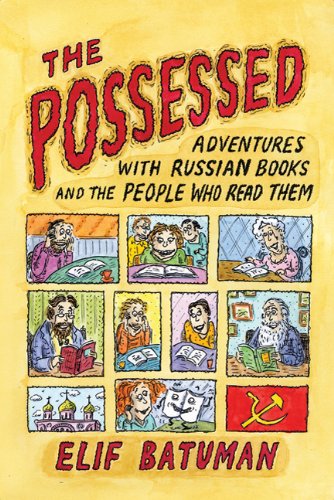
Last year I ‘discovered’ Elif Batuman, read her two novels The Idiot (2017) and Either/Or (2022). The former was a Pulitzer Prize finalist. Autobiographical, these two books are based on the life of a young woman entering Harvard with eye-opening and mind-boggling episodes. Academic and intellectual subjects are involved as well as a crush and the vain search for true love, but what stands out in Batuman’s writing is her humor. Pleasant surprises come with laughing out loud while reading. Recently I bought The Possessed, her first book (2010) –– couldn’t resist the book cover–– a collection of essays about her experiences in her specialization, Russian literature.

Another book cover I simply couldn’t resist while browsing in a bookstore. No, not Manga or graphic novel, but Virginia Woolf’s To The Lighthouse. I read it years ago but forgot most of it. What an interesting book cover. If you enlarge the picture you can see there are bubble dialogues. I’m just too curious to see how the publisher ‘reconciles’ the stream of consciousness content with the comic book like cover. But maybe no need to, after all, it’s a postmodern age we’re in.


The House of Doors by Tan Twan Eng. Longlisted for the 2023 Booker Prize. My main interest is in its storyline of English writer William Somerset Maugham visiting Malaya during the 1920’s, at that time a British colony. I’d watched biographical video on WSM on YouTube and learned that his personal secretary/companion who was with him in his travels to Malaya held a deceitful agenda which ultimately ruined Maugham’s financial assets and alienated him from his family at the end of his life. Just wonder how Tan tells his story re. the relationship between the two.


The Everyman Chesterton. From the Everyman’s Library, the 899 page volume includes some essential reads of the English writer, philosopher, Christian thinker, arts and literary critic G. K. Chesterton: his Autobiography, Biography of Charles Dickens, Commentary on the Victorian Age in Literature, Orthodoxy, The Everlasting Man, St. Thomas Aquinas, Father Brown Stories and Poems. I won’t be reading all of these but will definitely select some of these classic works to explore.


The Hemingway Stories, a book gifted to me which was purchased at the Hemingway House in Key West, Florida. Some of the stories I’d read before, but definitely a memorable collection of the nineteen notable stories from 1923 to 1936, including The Snows of Kilimanjaro, The Killers, The Three Day Blow, and for me to reread A Clean, Well-Lighted Place, and Hills like White Elephants.


The Plays of Anton Tchekov which includes ‘The Sea Gull,’ ‘The Cherry Orchard,’ ‘Three Sisters,’ ‘Uncle Vanya.’ Also a gift to me, and what’s significant about this volume is that it’s a Modern Library, New York edition with a Preface written by Eva Le Gallienne (1899-1991) in the year 1929. Gallienne I just checked was a classic herself, British-American stage actress, producer, director, author, translator. Would this be considered a rare book?
Reading the Season: Babe or Man, Man or King? A Poem by Luci Shaw

‘Tis the Season to be meditative if we’re to find peace against the tide, seek meaning amidst the frenzy. Reading the Season is the annual Christmas reading post here on Ripple Effects. I’d selected Luci Shaw’s poems before, see list at the bottom of this post. The following is a new discovery.

It is as if Infancy were the Whole of Incarnation
by Luci Shaw

One time of the year
the new-born child
is everywhere,
planted in madonnas’ arms
hay mows, stables
in palaces or farms,
or quaintly, under snowed gables,
gothic angular or baroque plump,
naked or elaborately swathed,
encircled by Della Robia wreaths,
garnished with whimsical
partridges and pears,
drummers and drums,
lit by oversize stars,
partnered with lambs,
peace doves, sugar plums,
bells, plastic camels in sets of three
as if these were what we need
for eternity.

But Jesus the Man is not to be seen.
We are too wary, these days,
of beards and sandalled feet.

Yet if we celebrate, let it be
that he
has invaded our lives with purpose,
striding over our picturesque traditions,
our shallow sentiment,
overturning our cash registers,
wielding his peace like a sword,
rescuing us into reality
demanding much more
than the milk and the softness
and the mother warmth
of the baby in the storefront creche,

(only the Man would ask
all, of each of us)
reaching out
always, urgently, with strong
effective love
(only the Man would give
his life and live
again for love of us).

Oh come, let us adore him—
Christ—the Lord.”

       –– Luci Shaw (Check out her beautiful website here)

I found this poem online. Have been trying to locate its original printed source to no avail. If you know where it was printed, do let me know in a comment.

Reading the Season in Previous Years:

2022: Dietrich Bonhoeffer’s God is in the Manger

2021: Sabbath Poems by Wendell Berry

2020: Jack by Marilynne Robinson

2019: ‘A Hidden Life’ – A Film for the Season

2018: A Verse from Madeleine L’Engle’s The Irrational Season

2017: A Wrinkle in Time by Madeleine L’Engle

2016: Silence by Shusaku Endo

2015: The Book of Ruth

2014: Lila by Marilynne Robinson

2013: Poetry by Madeleine L’Engle

2012: Surprised by Joy by C. S. Lewis

2011: Walking on Water by Madeleine L’Engle 

2010: A Widening Light by Luci Shaw

2009: The Irrational Season by Madeleine L’Engle

2008: The Bible and the New York Times by Fleming Rutledge 

2008: A Grief Observed by C. S. Lewis

‘American Symphony’ is a Must-See 2023 Documentary

While waiting for Maestro to come to our city’s theatres, serendipity strikes. I found this newly released documentary on Netflix. Two classical music features coming out at the same time, I thought. But to my surprise, American Symphony isn’t about a classical music icon like Leonard Bernstein in Maestro but––it would make an interesting contrast–– Jon Batiste, the Louisiana born and Juilliard trained musician, singer, songwriter, composer, pianist and bandleader on The Late Show with Stephen Colbert.

Directed by Matthew Heineman, a multiple award-winning and Oscar nominated director, who has brought us an intimate and moving love story. I knew nothing about Batiste before watching this doc, only seen him on Stephen Colbert, the bandleader that gives an assured, warm smile when the camera focuses on him. American Symphony showcases Batiste’s new composition of the same name, as well as following his celebrated rise to the summit of musical stardom in 2022 when he garnered eleven Grammy nominations across genres and winning five including Album of the Year.

What captivates me is not only Batiste’s talents or his music. Surely these as well as his process of creativity are what make this doc highly entertaining, but what’s inspirational is the focus of his relationship with his wife, writer Suleika Jaouad, whose myeloid leukemia has returned after years of dormancy. In the midst of jubilation and career honors, there’s the searing pain of seeing his wife suffer in hospital. Batiste stays by her side as she goes through bone marrow transplant, and lovingly supports her through the whole treatment.

What is soul-stirring is the inward revealing of Batiste’s faith in his God, his humility in the midst of career wins and recognitions, and his readiness to accept whatever that could come his way. The doc is an intimate look into the duality of triumph and suffering, the vibrancy and the vulnerability of life, a candid and endearing love story.

As for the eponymous ‘American Symphony’, Batiste’s new composition, we get to see its rehearsal process throughout the feature, and savor excerpts of it towards the end. This last section is a revelation. The work had its world premiere in Carnegie Hall to a full house in September 2022. An innovative symphony encompassing tributes to jazz icons and the Black cultural roots, Batiste at the piano, a full orchestra, vocals from classical and gospel traditions, and including Native Americans in their own costumes and with their drums and songs, yearnings of human voices in cacophony, a moving experience. It would be interesting to see Maestro after watching American Symphony.

~ ~ ~ 1/2 Ripples

***

‘The Holdovers’ is easy viewing for the holidays

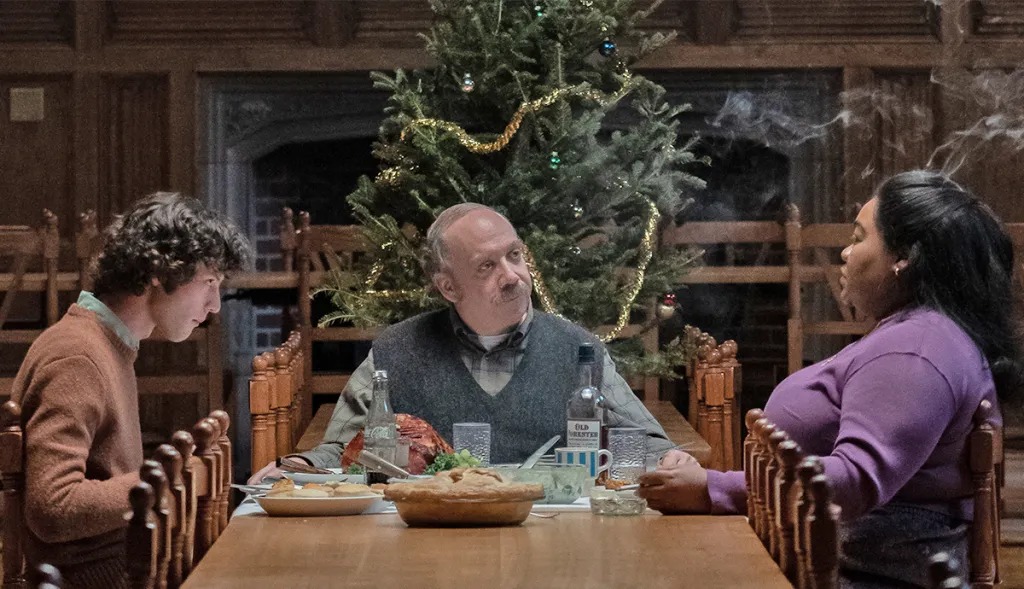
Alexander Payne’s newest feature is a pleasant dramedy for this coming holidays season. Set in a 1970 remote New England winter, boarding school history teacher Paul Hunham (Paul Giamatti) is tasked with supervising the few students who can’t go home during Christmas break, the holdovers.

When a helicopter sent by one of the students’ rich daddy comes to pick up the group, Angus Tully (Dominic Sessa) is left behind as he is just like his cranky history teacher at Barton Academy, unpopular among his peers. Angus’ pain stems more from being abandoned by his mother who wants to spend Christmas with her new boyfriend alone. Together with the chief cook of the school Mary Lamb (Da’Vine Joy Randolph), a grieving mother who has just lost his son in Vietnam, three damaged souls are left to spend their winter holidays in an empty boarding school.

Payne has won two Oscars for Best Writing, Adapted Screenplay, for The Descendants (2011) and Sideways (2004), both with which he was also nominated for Directing. His third directing Oscar nom was for the black-and-white feature Nebraska (2014). Payne’s forte of capturing the humanity in conflicting relationships is apparent in his works. Such is the main drive and the fun found in The Holdovers, where we see Payne reunites with Sideways‘s Giamatti. The idea for the film came from a 1935 French movie, but interestingly, Payne chose to have the TV writer David Hemingson do the screenplay, his debut feature.

The story idea isn’t new, misfits thrown together in reluctant circumstances starting out repelling each other but through unexpected turns of events, human decency shines through. Watching The Holdovers brings back memories of Dead Poets Society and Scent of a Woman. But this is a much lighter and warmer feature with nonetheless poignancy towards the end. Payne’s signature style of sprinkling humour with pathos is prevalent here, at times even with slapstick, Chaplain-like actions added in. Later a road trip to Boston solidifies the unlikely companionship, events leading to the triumphant transformation of self for all three characters.

The 133-minute screen time could be tightened though, especially in the first part where it feels likes the story has not started until everyone has gone and only the three remaining characters are left in the empty school. It then picks up momentum when a road trip is in gear. The first part is set up for slow-paced viewing offering scenic New England in the snow; the song selections are appealing, and maybe with a touch of sarcasm. While waiting for the inciting turn to kick start the story, viewers can sit back and maybe for some, reminisce on their own prep school experiences.

He may be pompous and grumpy, Hunham’s sadistic approach to teaching just shows that his intention is genuine in preparing his students to enter Ivy League schools by their own academic merits and not because their fathers give money for a new building or a fancy gym. He even has the gall to fail a senator’s son, hence, his unpopular status among the principal, faculty, and needless to say, his students. As a classics and ancient history teacher, Hunham’s personal vernacular is where some of the humor lies. His lines are quotable quotes. Giamatti is perfectly cast, a natural in portraying such an eccentric. Come awards time, he is likely to be noted for his performance.

Da’Vine Joy Randolph as Mary is superb. Despite nursing deep loss, she is sensitive to others’ needs, a character foil against Hungham. her quiet presence exudes a much needed sensibility to balance out the incompatible trio. It’s always heartwarming to see human decency and kindness seep through the clouds of personal pain.

Sessa is discovered from an audition at an actual New England boarding school. It’s interesting that he looks more mature than a high school student. So, in that sense, he doesn’t seem to be a fitting cast. However, to make up for his appearance, his acting is natural and in this his movie debut, has shown himself to be a pristine actor with much potential.

The Holdovers could make another crowd pleasing Christmas movie with holding power in the years to come. It’s easy viewing and inviting for rewatch, especially to catch the quotable lines, Hunham style.

~ ~ ~ Ripples

***

Related Ripple Review:

Nebraska (2013): Color is Superfluous

and a related quote from a previous post:

“Medicine, law, business, engineering, these are noble pursuits and necessary to sustain life. But poetry, beauty, romance, love, these are what we stay alive for.” — Dead Poets Society

‘NYAD’ is a movie of two heroes

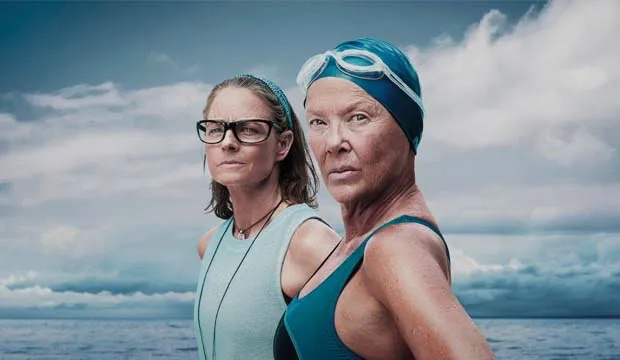
Diana Nyad is the first person to swim more than 100 miles from Havana, Cuba to Key West, Florida without a protective shark cage. The date was September 2, 2013. Nyad reached Florida shore after 53 hours of swimming in open water at the age of 64.

First off, I’m aware of the controversy surrounding this achievement of Nyad’s, as well as those of her past as a marathon swimmer. However, I’m here to discuss the movie NYAD only, so that’s what this post is about. The movie is based on Diana Nyad’s memoir Find a Way: the Inspiring Story of One Woman’s Pursuit of a Lifelong Dream (2016); since I’ve not read the book, I won’t be touching on any of its content or comparing the source material with the adaptation.

NYAD is the first narrative feature of Oscar winning documentarian couple Jimmy Chin and Elizabeth Chai Vasarhelyi. Chin himself is no stranger to extreme sports. An acclaimed mountaineer and National Geographic photographer who has reached the top of Mount Everest twice and skied down its vertical surface. With Free Solo (my review), the husband-and-wife filmmakers won the Best Documentary Feature Oscar in 2019. The film chronicles rock climber Alex Honnold scaling the 3,000 feet vertical wall of El Capitan in California’s Yosemite National Park using his bare hands and feet, solo and free from ropes and safety gears.

I can see right away how this feat of Honnold’s parallels that of Nyad’s, who swam in the open ocean with no enclosed protection from sharks, albeit in her successful, final attempt, donned a jellyfish protective suit to finish her challenge. Both the mountain climber and the marathon swimmer possess the same drive: an obsessive, iron will.

Annette Bening is perfect in her portrayal of Nyad, a determined but difficult, and sometimes abrasive character. It takes such kind of one-track stubbornness––and a whole supporting team including an expert navigator (John Bartlett, aptly played by Rhys Ifans), boat pilot, medic, jellyfish expert, shark detracting divers, and others––sailing alongside the marathon swimmer to achieve such an arduous venture.

Above all, it’s Nyad’s lifelong friend and coach Bonnie Stoll––superbly-matched casting of Jodie Foster––who supports and trains her during this grueling ordeal, albeit reluctantly at the start. Nyad might be the ultimate triumph, but it is Bonnie, the loyal friend being pushed into her own onerous hero’s journey that makes it possible, preparing the swimmer both physically and psychologically to realize her dream. Bening and Foster playing off each other is the best stroke of the movie. A moving scene towards the end shifts the focus of the motivating force, surely it requires an indomitable will, but it’s deep, genuine love that finishes the course.

As documentary filmmakers shooting their first dramatic narrative, Chin and Vasarhelyi deftly insert actual footage of Nyad’s earlier failed attempts, the first one when she was only 28, as well as her interviews and talks. Such inclusions strengthen the authenticity of the drama. It’s inspiring to see that Nyad is not afraid to look at her past failures. Ironically, it is her first failed attempt at 28 that sparks the idea to try again when she’s 60, and prods her to face the challenge head-on at 61, then tries again, and again, until she finally achieves her goal in her fifth attempt at 64. Showing such repeated efforts could make the film look redundant, but Bening and Foster’s on screen relationship captures my attention throughout.

Bening needs to be applauded for her willingness to go all out to portray Nyad in the most realistic way she could. Chin had noted in an interview that the actress spent four to eight hours a day in the water shooting the film, “and she did all the swimming.” To prepare for her role, Bening, who was well into her 60’s at the time, had to go through a year of intense training in swimming and physicality before the production. Most likely Mary Oliver had struck Bening just the same as her poetic voice had moved Nyad. In the movie, these lines from ‘The Summer Day’ were the initial motivation inspiring Nyad to take up such a Herculean challenge at 60:

“Doesn’t everything die at last, and too soon?
Tell me, what is it you plan to do
with your one wild and precious life?”

Another insertion the directors use to dramatize the seemingly monotonous swims is fantasy sequences, which are not too well received by some reviewers. Not for me. Like one lost in the desert wearing out to the brink of expiring with thirst, mirages appear in the hallucinated mind. This is a parallel situation. In the dire demand of the grueling swim in treacherous waters almost to the brink of death, disorientation could set in.

Another dramatic device are the faded flashbacks of Nyad as a young swimmer, including some hazy implications of abuse. While serving the biopic element of the feature, these flashbacks lack the significance and continuity with the present day Nyad and her goal. Tighter editing and elaboration of these scenes might serve their purpose better.

Must mention is the original score by Alexandre Desplat whose expansive repertoire include two Oscar wins (The Shape of Water, The Grand Budapest Hotel). The song selections are interesting as well, maybe only appeal to certain demographics; some of these titles must have brought back fond memories from viewers of Nyad’s generation. The opening of the film are underwater shots of Nyad swimming in the pool, and to my pleasant surprise, ‘The Sound of Silence’ comes on, reminiscence of a similar scene where a dazed Benjamin, freshly graduated from college trying to figure out his path in life. We all know where that comes from.

I’m excited to see Chin and Vasarhelyi venture out into the narrative feature genre. The fusion of dramatization with actual documentary footage is an effective transition into their new mode of storytelling. NYAD is an inspiring film not just for its subject matter but for the performance of the two lead actors which is most memorable.

~ ~ ~ Ripples

***

‘Anatomy of a Fall’ or how to dissect a marriage

In lieu of heading to Toronto for TIFF as in pre-Covid time, I stay put in my city hoping some of my anticipated films might trickle down. Of the nine titles on my to-be-watched list, only one came to the Calgary International Film Festival. I’m glad it’s this year’s Palme d’Or winner Anatomy of a Fall.

French director Justine Triet is the third woman to have won the Palme d’Or, Cannes Film Festival’s top prize in sixty-eight years. The two previous winners were Julia Ducournau for Titane in 2021 and Jane Campion for The Piano in 1993. It’s interesting to note that Triet co-writes the screenplay with her husband Arthur Harari, encompassing English, French and a little German in the dialogues, showing how language can connect as well as alienate a couple depending upon the circumstance.

A teacher and struggling writer, Samuel (Samuel Theis) is found dead on the snow-covered ground of his chalet in the French Alp. The only other person in the house at that time is his wife Sandra (Sandra Hüller), a successful German novelist who has just finished an interview with a journalist in the living room, and loud music is on all this time from somewhere else in the house. The body is discovered by their eleven year-old son, Daniel (Milo Machado Graner), who comes home after walking their family dog Snoop. Actually, it’s Snoop that first finds the body as Daniel is visually impaired.

Two possibilities are pondered in the investigation of the fall, suicide or murder, Samuel being pushed out of the balcony outside the high attic. The main segment of the film is the trial a year later of Sandra, the wife, who stands accused of murdering her husband, with their blind son the sole witness in the courtroom drama. Sandra seeks the help of an old friend Vincent (Swann Arlaud) to be her attorney. Vincent isn’t a high profile lawyer, but he’s empathetic and rational in his reasoning. Since accidental death is the least plausible in this case, the only option to defend his client is to present evidence for suicide. Sandra might look stoic and aloof but Vincent’s support is essential during such a difficult time.

Vincent (Swann Arlaud) and Sandra (Sandra Hüller) in Anatomy of a Fall

Intense and riveting throughout, Anatomy of a fall brings back the joy of pure cinema experience, that is, watching a film that’s made up of a well-crafted script delivered by superb acting, captured in astute camera work, especially with close-ups depicting the nuances of emotions, with no CGI effects, no car chases or apocalyptic explosions, just mere human interactions that speak volumes. And with that note, I must add too that sound or its absence is important in the film. From the loud music of a song by 50 Cent at the beginning to the piano pieces played by Daniel, extension of his inner struggles, all are crucial in the storytelling.

When a wife is on trial for the murder of her husband, every minute detail of their marital relationship will be dissected, dirty laundries aired out and conversations scrutinized without discretion. Out of consideration for not hurting Daniel’s feelings, he is excused on the day some raw evidence from a recording of a fight between his parents is to be played out in court, but he insists to be there. ‘I’ve already been hurt,’ he says.

And it is this voice recording––juxtaposed with flashback sequences for us viewers––that form the pivotal segment of the film, a highly charged, epitome of powerful acting especially from Hüller. It is also this raging recording that casts a doubt in Daniel’s mind regarding his mother, and a little clarity in understanding the balance of relational power between his parents. The flashback scene is for us viewers; in court, only the voices are heard. For Daniel, that is enough. What follows is the key to the the ingenuity of the script, leading to the eventual outcome of the trial.

Not only is her marriage on trial, Sandra’s own personal, psychological makeup is questioned. The prosecutor (Antoine Reinartz) uses anything he can find to create an image of Sandra being a cold and revengeful wife. The content of her novels are examined and taken as a revealing of her psyche. Herein lies an intriguing issue: can a work of fiction be used as evidence to incriminate its author in a court of law? For the prosecutor, to help his case, it’s convenient to equate Sandra’s novels as parallels of her real life. Defence lawyer Vincent is quick to rebut this reasoning, “is Stephen King a serial killer?”

The two and a half hour duration could have been tightened a bit, but sitting through it in the dark theatre with my sole attention drawn to the nuanced performance by the whole cast and in high anticipation of the trial result, I wasn’t aware of the time passing. Just found out France has submitted another film to enter the Best International Film category for 2024 Oscars, rendering Anatomy of a Fall out of the race in that category. Nevertheless, Hüller is worthy of a Best Actress Oscar nom, Machado Graner playing Daniel deserves some high praises, and Triet’s directing and her original screenplay need to be noted, the film could have a chance in the Best Picture category. Overall, a captivating work of suspense, character study, and intelligent filmmaking.

~ ~ ~ 1/2 Ripples

***

Anna’s Hummingbird: A Lesson in Smallness

Earlier this week I spent a few days in Vancouver, British Columbia. The Richmond Nature Park was high on my agenda since I ‘discovered’ the place last time I visited and found it to be a haven for hummingbirds. This time, I’m not disappointed as I’ve seen many albeit it’s hard to take a good photo of them, for they are small and ultra fast.

Every hummingbird is a miracle in itself. They are the smallest of birds, most species measuring 3-5 inches (7.6 -10 cm) in length and about 0.1 oz. (3 – 4 grams) in weight. The bee hummingbird of Cuba is the smallest bird in the world, only 2 inches (5 cm) in length and weighs 0.07 oz (1.95 gram).

According to World of Hummingbird, depending on their activity, hummingbirds’ wing beats can range from 70 to 200 times per second (when diving). And they can dive! Up to 60 miles per hour. Hummingbirds are the only birds that can fly forward, backward, hover and stay still in the air, fly sideway, and even upside down.

During migration, the Rufous Hummingbird fly from the Gulf of Mexico to Alaska to breed, that’s nearly 4,000 miles. These small but powerful flyers can travel as much as 23 miles in one day. As they cross the Gulf of Mexico they may cover up to 500 miles at a time. Their average speed in direct flight is in the range of 20-30 mph (32 – 48 km/hr), and up to three times that fast during courtship dives. Interesting info. here.

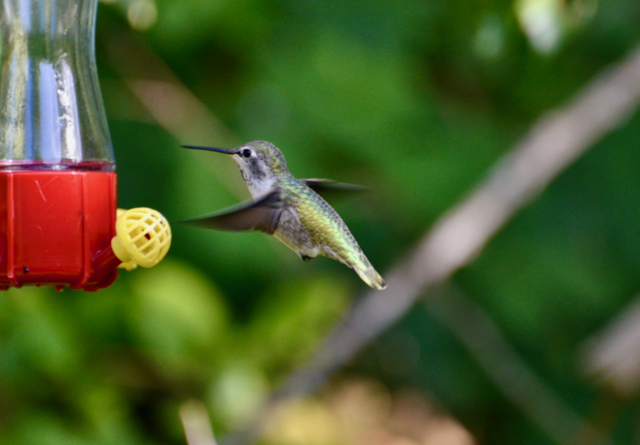
There are numerous fascinating facts to be found online, but nothing beats the actual experience of watching these tiny birds flapping their wings to stay still in the air like a motorized flapping cross, or see their iridescent feathers shimmering in the morning light. They are just too fast for me to take photos, especially when darting in midair. I could only capture some while they were sipping nectar from a feeder, or perching on a branch.

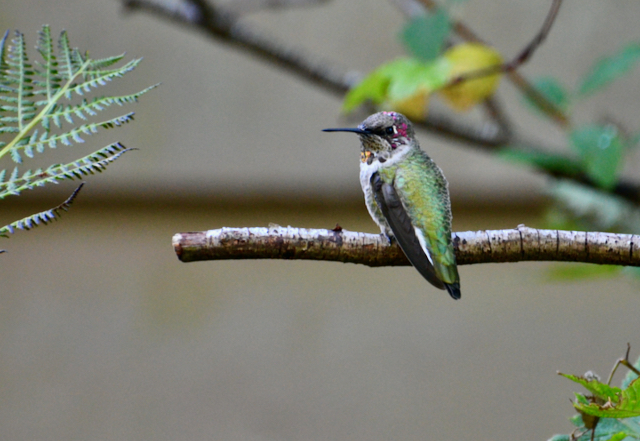
When I visited Richmond Nature Park earlier this week, I only found Anna’s Hummingbirds, although the signs indicate Rufous also hang out there. From the info I’ve gathered, Anna’s Hummingbirds now don’t migrate but settle in the Pacific Coast of North America, from California to B.C. in Canada. So there I was, encountering these beautiful, small miracles that morning.

Here’s a male Anna’s Hummingbird staying still:

the female or immature ones are mostly green without the fuchsia red on their head and neck, but their iridescent plumage and the colourful spots on the head are a sight to behold:

“… I have always known you are present in the… wings of birds.”
–– Mary Oliver, from the poem ‘Six Recognitions of the Lord’

***

The Netflix Diversion

As two of my highly anticipated movies (see my list here) coming out in the fall will be on Netflix: Maestro and NYAD, I just can’t resist anymore. Three days ago I decided to subscribe to Netflix. While waiting for these two movies to show up, I’ve got plenty of others to watch. These past few days, I’ve finished a few. Yes… daily life has been a bit diverted. My capsule reviews in the following. All three TV series are worth watching and the doc on Joan Didion, a must-see.

BEEF –– A road rage incident pushes two lives down the abyss of rage and revenge which ultimately torpedoes into an explosive meltdown. The fight between Amy Lau (Ali Wong), an entrepreneur, wife and mother living in an upper middle class neighborhood and her adversary Danny Cho (Steven Yeun), a handyman striving to make ends meet as a dutiful son and watchful older brother is not only a satire of the disparity between the rich and the poor, but a realistic depiction of the existential angsts shared by all regardless of social and economic status, or, as the series has effectively shown, racial background. Highly addictive, cleverly written and first-rate acting. 13 Primetime Emmy Awards nominations.

The Diplomat –– Kate Wyler (Keri Russell) is appointed by the POTUS (Michael McKean) as the new ambassador to the United Kingdom, a post she reluctantly takes up. With her previous experience in war-torn countries and Afghanistan which she expects to return, her new post in London is a major cultural clash, hence resulting in some mismatched decorum and humorous moments. Adding to her maladjustment and complicating matters when dealing with volatile, international crises is her husband Hal (Rufus Sewell), himself the former ambassador to the UK. The once political influencer now has to take up the role as a diplomat’s wife in a precarious marriage. Interesting play on gender politics, marital/power relationships, on top of intense, political chess play. Russell is nominated for Outstanding Lead Actress in a Drama Series in the upcoming Emmy Awards, deservedly. Interesting to note some of the language used here is quite similar to the rage-filled one in BEEF.

The Lincoln Lawyer –– I pick up from the current Season 3. While I like Michael Connelly’s character, former LAPD detective Harry Bosch, more than his Mickey Haller, a lawyer who works out of a Lincoln dealing with seedy clients, I’ve enjoyed the TV adaptation. Haller, aptly played by Manuel Garcia-Rulfo, is a pleasing yet complex character, resourceful, smart, an upholder of the law but has his blind spots. As a recovering addict, vulnerability coexists with his assets. Other characters are also well cast, jumping out of Connelly’s novels to become well fleshed-out and likable human beings (we just might be using this term more now to distinguish between the real and the fake), making up a lively supporting cast. Interesting to note that in the 10 episodes of S3, despite dealing with crimes and criminals, the language used is relatively free of foul play.

________________

Joan Didion: The Center Will Not Hold

Directed by Griffin Dunne, actor/director and Joan Didion’s nephew, this brief, biographical documentary of Didion follows her career and life during some of America’s tumultuous decades. Dunne’s interviews with her aunt elicit some intimate conversation and poignant memories from Didion, by now frail and with apparent impediment. An astute observer of society, Didion had given us some monumental commentaries of her times with her writings. Listening to the narration in the documentary and seeing the iconic photos and footage of significant turns of history, Didion’s analyses just as well could have applied to our world today, just as she has quoted in her Slouching Towards Bethlehem the line in Yeats’s poem: “Things fall apart; the centre cannot hold.”

The latter part of the documentary is about Didion’s own personal tragedy, chronicling the sudden death of her husband John Gregory Dunne and just months later, her daughter Quintana, her grief poured out in The Year of Magical Thinking and Blue Nights. English playwright David Hare had been her anchor in transforming mourning and loss into artistic expression on stage, giving her some sort of a closure. Hare directs the Broadway play adaptation of The Year of Magical Thinking with Vanessa Redgrave as the sole performer. Redgrave shared a similar experience as her daughter Natasha Richardson died suddenly after a ski accident. The documentary has kept a short clip from the play and presented personal recollections from Hare and those close to her life, friends and colleagues. A poignant and moving feature.

~ ~ ~ 1/2 Ripples

***

Related Posts on Ripple Effects:

Blue Nights: A Book Review

Voice of the Poet: Things Fall Apart

When the birds are gone

It may still be summer, but most of the migratory birds have started their winter journey south. My favourite avian friends seem to have departed without saying goodbye. So, I train my eyes to look at all the beauties that I haven’t noticed before when I was only focused on birding. Even the dandelions look good when contrasted with the clear, blue river, or the small butterfly, or is it a moth?

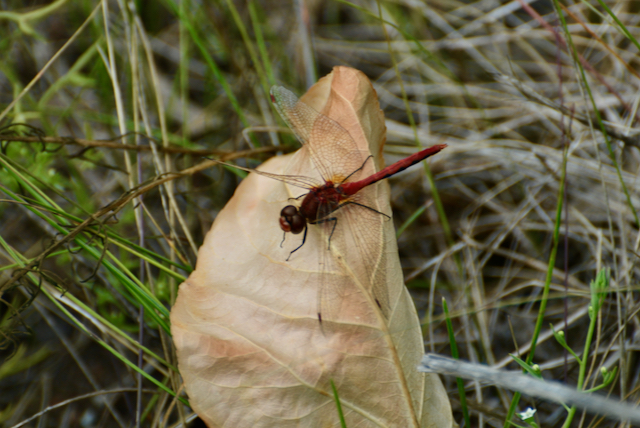
I’ve discovered a brand new interest. What are these red flying objects in front of my eyes, so many of them darting around. Red dragonflies… I haven’t noticed them before. My curiosity sent me to Google and yes, I’m sure they are dragonflies and not damselflies. The main difference is that dragonflies’ wings spread out like this when they’re at rest:

while damselflies fold up their wings at rest like this:

I’ve seen blue dragonflies before, lots of them here, but this time it’s the red dragonflies that are so abundant. I haven’t noticed them before. They are beautiful and easier to capture in photos than birds:

some intimate moments:

Of course I’ll miss my avian friends for another long absence until next spring, but there are other beauties to behold. It’s small things like these that sometimes make me jump out of bed with excitement. No, they won’t be around come winter, but I’m sure there are other blessings to explore then.

***

TIFF 2023 Lineups and my TBW List

While Barbenheimer is dominating the box office, a phenomenon that coins a new word in our vernacular thanks to the simultaneous release of the two movies Barbie and Oppenheimer, my attention, however, is drawn to the lineups in the film festivals beginning the end of August with Venice and then the Toronto International Film Festival in September. All others follow in the fall.

I won’t be heading to TIFF this year but I do have a To Be Watched list after browsing through their lineups if any of these films ever show up in my city or for streaming. Do watch for these titles, as I’m sure you’d find some that pique your interest… and might show up in the Awards Seasons later this year. Here’s my list:

NYAD 
International Premiere. True story of Diana Nyad, at age 64, became the first person to swim 110 miles from Cuba to Florida without a shark cage. Starring Jodie Foster and Annette Bening, directed by the Oscar winning husband and wife adventure team Jimmy Chin and Elizabeth Chai Vasarhelyi (Free Solo, 2019). Now, you might ask … who’s playing the swimmer Nyad?

Anatomy of a Fall
Winner of the Palme d’Or at Cannes this year, a French film directed by Justine Triet and starring German actress Sandra Hüller. A man is found dead and his wife is put on trial for his murder while their visually impaired son faces a moral dilemma as the sole witness. Sounds most intriguing. Other than Cannes, the film has also won the Audience Award at the Sydney Film Festival.

In Restless Dreams: The Music of Paul Simon 
World Premiere. Documentary following America’s music icon Paul Simon into the studio making his new album Seven Psalms while looking back on his six-decade career from Sounds of Silence to Graceland.

North Star 
World Premiere. Directorial debut of veteran British star Kristin Scott Thomas (The English Patient, 1996) A family drama about three sisters returning home for the third wedding of their twice-widowed mother. The past and the future converge as mother and daughters reunite with some unexpected guests. Could be autobiographical.

The Critic 
World Premiere. Adaptation of the 2015 novel Curtain Call by Anthony Quinn. A mystery thriller storyline driven by ambitions and deceits in the theatre world. Directed by Anand Tucker (Girl with a Pearl Earring, 2003) with a wonderful UK cast including Lesley Manville, Gemma Arterton, Mark Strong, Ben Barnes, Romola Garai, and Ian McKellen.

Monster 
The North American Premiere of acclaimed Japanese auteur Hirokazu Koreeda, who is a master of family drama such as Shoplifters (2018), Our Little Sister (2015), and Like Father, Like Son (2013) From TIFF’s webpage, Monster is “a delicate story of love and humanity, a moral tale about school bullying, scored by the late Ryuichi Sakamoto.”

Wildcat
Ethan Hawkes explores the life and art of writer Flannery O’Connor and featuring his daughter Maya Hawks as the titular character. Laura Linney in supporting role.

The Zone of Interest 
Adaptation of Martin Amis’s 2015 Walter Scott Prize winning novel directed by Jonathan Glazer. Premiered at Cannes in May, garnering the Grand Prix and the FIPRESCI Prize. The story is a macabre juxtaposition of horror and a love affair between a Nazi officer the wife of the commandant of the Auschwitz concentration camp.

Maestro
I placed it last on this list because it’s not at TIFF but in Venice, just a week before TIFF kicks off. The Maestro refers to the American legendary composer and conductor Leonard Bernstein, played by Bradley Cooper. The story explores his complex relationship with his wife Felicia, played by Carey Mulligan. High on my anticipation list. Bradley Cooper directs his second musician-based feature after A Star is Born (2018)

***

A Midsummer Day’s Meditation

Many gems in this treasure trove of poetry from Mary Oliver’s Devotions. For a birder, these simple words particularly resonate. Sharing a few here:

THIS MORNING

This morning the redbirds’ eggs
have hatched and already the chicks
are chirping for food. They don’t
know where it’s coming from, they
just keep shouting, “More! More!”
As to anything else, they haven’t
had a single thought. Their eyes
haven’t yet opened, they know nothing
about the sky that’s waiting. Or
the thousands, the millions of trees.
They don’t even know they have wings.

And just like that, like a simple
neighborhood event, a miracle is
taking place.

I WAKE CLOSE TO MORNING

Why do people keep asking to see
God’s identity papers
when the darkness opening into morning
is more than enough?
Certainly any god might turn away in disgust.
Think of Sheba approaching
the kingdom of Solomon.
Do you think she had to ask,
“Is this the place?”

ON MEDITATING, SORT OF

Meditation, so I’ve heard, is best accomplished
if you entertain a certain strict posture.
Frankly, I prefer just to lounge under a tree.
So why should I think I could ever be successful?

Some days I fall asleep, or land in that
even better place—half asleep—where the world,
spring, summer, autumn, winter—
flies through my mind in its
hardy ascent and its uncompromising descent.

So I just lie like that, while distance and time
reveal their true attitudes: they never
heard of me, and never will, or ever need to.

Of course I wake up finally
thinking, how wonderful to be who I am,
made out of earth and water,
my own thoughts, my own fingerprints—
all that glorious, temporary stuff.


THE WORLD I LIVE IN

I have refused to live
locked in the orderly house of
reasons and proofs.
The world I live in and believe in
is wider than that. And anyway,
what’s wrong with Maybe?

You wouldn’t believe what once or
twice I have seen. I’ll just
tell you this:
only if there are angels in your head will you
ever, possibly, see one.

***

A good day birding is like…

watching a good movie. It’s not easy to come upon, therefore, most gratifying.

I’m partial to yellow birds: Warblers, Goldfinches, Vireos… and a more orangey hue, the Baltimore Oriole. These are all that I’ve seen around here in the hinterland above the 49th parallel, unlike many of you in the warm and welcoming south having the chance to see more colourful varieties.

The woods by the Pond is a haven of warblers this year, but to capture one with the camera is highly challenging. They never stay still on a branch for more than a couple of seconds, let alone finding them clear from leaves. I can see them, small, yellow flying creatures in the air darting from tree to tree and hear them calling, as if teasing me, “catch me if you can.”

During my good day of birding a couple weeks ago I was able to get some of these tiny yellow warblers in my camera:

Serendipity is what makes good birding. Just as I was pleased with myself for taking some photos of yellow warblers, I found a warbler’s nest. A bonus! Trying my best to be as unobtrusive as possible, I took these pictures:

and look at this one carefully, you can see the tiny beak of a baby warbler sticking out:

I called it a good birding day and started to head back to my car when I saw an orangey thingy in a small tree at a distance. The Baltimore Oriole! I’ve heard from other birders that they’d seen one recently and everybody was looking for it. You who live in Baltimore or almost anywhere south of the 49th might have a good laugh at how excited we are in spotting a Baltimore Oriole. It’s not rare, but still a very special sighting for us. I took these from afar:

That’s a wrap of a good day birding. What more, I don’t need to write a review!

***