Saturday Snapshot Dec. 21: Life in the Snow

I don’t have to dream of a white Christmas. I’m living it. Today is the first day of winter, but we already have a few blizzards, and record snowfall.

In June we had our hundred-year flood. And now we have our hundred-year snowfall. According to records, the last time we had this much snow in just 16 days was in 1901, 112 years ago.

You might think life is arduous up here, but I tell you, it can be idyllic. Except for the traffic jams in and out of shopping malls at this time of the year, we’re a relatively happy lot. What more, being so close to Nature, I’m always delighted to see how contented our neighbours in the wild are, oblivious to the hustle and bustle of the Season.

Here are some photos I took in the last few weeks.

Snow-covered river banks:

Snowcovered river bankProof of life (and I don’t think they’re all human footprints):

Proof of LifeDid they ever show you how to identify a Mallard’s track in scouting? No? Here it is:

Mallard's Footprints

Galore of duck activities:

Duck Activities

… or inactivity:

Penguins look-alikes

Icy landing:

Landing in the Icy Water

I was elated to see something else other than the common Mallard. At first I thought it was a Sandpiper, but when I checked in my bird book later at home, I learned that it was a Killdeer. Amazing, for they are supposed to be in the American south by now. Guess somebody wants to linger a while longer in the snow and ice:

Killdeer On Ice

Traffic jam in the sky. Not quite a perfect V? You have to cut them some slack, they are Mallards, not Canada Geese.

Traffic Jam in the Sky

A solitary walk for this buck crossing the icy river. No jam here:

Buck at the RiverAnd deep in the snow, a few good folks had left some bird seeds. For the Woodpecker, it’s always tempting to go for fast food rather than to peck wood, especially when there’s no line-up:

Fast Food for Woodpecker

What’s Christmas without a little snow?

***

Saturday Snapshot is hosted by Melinda of West Metro Mommy Reads. CLICK HERE to see what others have posted.

All photos in this post are taken by Arti of Ripple Effects, December, 2013. DO NOT COPY OR REBLOG.

***

Nebraska (2013): Color is Superfluous

When a director decides to shoot his film in black-and-white, he must have certain confidence in the story, characters and aesthetics that he feels color may just be a distraction or even superfluous. Alexander Payne’s Nebraska is exactly that.

I have thoroughly enjoyed this slow-paced, thoughtful, aesthetically gratifying, and deadpan funny movie. To take a break from the cacophony of festivities, the hustle and bustle of Christmas shopping, dinner planning and party hopping, Nebraska is a surprisingly fitting film to watch.

By no means is this a ‘holiday movie’, but if the season is about family, giving, and love, this is an apt offering on the big screen. There are strong thematic undercurrents that carry the quiet story from beginning to end. And I was gratified to see, once again, that visuals speak louder than words when it comes to the cinematic medium.

Nebraska - Woody & David

Woody Grant (Bruce Dern) is an old man of few words. Maybe the onset of dementia has driven him even more delusional and isolated, and alcohol doesn’t help either. Dern’s performance is spot on and totally engaging. From a marketing promo in the mail, Woody is convinced that he has won a magazine sweepstakes of one million dollars. He needs to get to Lincoln, Nebraska, to claim his prize. We see him at the beginning of the movie heading to Nebraska from Billings, Montana, on foot. He is too old to drive but not to walk.

Woody’s brash and critical wife Kate (June Squibb) calls their estranged sons David (Will Forte) and Ross (Bob Odenkirk) for help but all fail to dissuade him. Soften by the old man’s total absorption, and too kind to douse his dream, David takes a few days off work to drive his father to Nebraska. Thus begins an unlikely bonding road trip for father and son.

To quench his delusion, Kate and Ross will converge in Hawthorn, Nebraska, a town where Woody was born and spent most of his energetic years. There in Hawthorn, a fictitious town for the movie, they will meet up with Woody’s older brother Ray’s family for an impromptu reunion, hopefully to get Woody’s mind off Lincoln and the prize, and then they will return home to Montana after.

Hawthorn is the home of a younger Woody, a past that he rarely mentions, a place where his son David will come to discover a father he had never known. At Ray’s home, David meets his not-so-friendly cousins Randy (Kevin Kunkel) and Cole (Devin Ratray, remember the bad burglar from the first two Home Alone movies?) While the town folks are all congratulatory on his million-dollar win, Woody’s old auto business partner Ed Pegram (Stacy Keach) suddenly reminds him of outstanding debts.

A character whom I find the most endearing is Woody’s girl friend of his youthful past, the long time editor of the town’s newspaper Peg Nagy (Angela McEwan). She wants to run an interview with Woody about his alleged win. David meets up with her at the newspaper to clear up the misunderstanding. There we see a gentle and kind old lady who seems to have much admiration for his father, knowing him in the past as a sturdy, young man. Though now a widow, Peg is a happy and fulfilled grandmother. This is probably the most poignant scene of the movie. Through David’s learning of his Dad as a promising young man and this quiet, pleasant lady Peg, the haunting thought seeps into our mind: ‘What if things turned out differently?’ The black-and-white medium could well be the message itself. We are reminded of a past which we cannot relive. At the same time, we are provoked to think of the alternative scenarios of what could have been.

Director Payne had won two Oscars both for Best Adapted Screenplay for his previous acclaimed movies Sideways (2004) and The Descendants (2011). Nebraska is a totally different work, and one which I like the most among the three. A common thread that runs through all of them is the prominence of specific locales, the California wine country in Sideways, Hawaiian islands in The Descendants, and here the scenery flanking the long stretch of highways from Montana to Nebraska. In stirring and soulful black-and-white, the passing wide landscape of rolling hills and boundless prairies convey the existential passage of time, lost youth, and whatever memories that one accumulates or tries to forget, all immaterial as old age takes over, a soulful touch from the director of the new retiree played by Jack Nicholson in About Schmidt (2002).

But this is a comedy, and there are lots that I have responded with spontaneous chuckles and laughs. The humor is totally enjoyable, and so is the overall atmosphere. We see a change in the mood as the son begins to appreciate more about his father. The ending is affective and gratifying. A check on IMDb leads me to the tidbit that director Payne was born in Omaha, Nebraska. Ah… the river runs deep.

If I have a say, Nebraska would appear in the upcoming Oscar nominations for Best Picture, Best Director, Best Actor (Bruce Dern), Best Cinematography (Phedon Papamichael), and Best Screenplay (Bob Nelson). However, considering the black and white styling, and the quiet, low-tech and slow-paced storytelling, it just may not attract those who are spectacle-driven. But that would be their loss.

~ ~ ~ ~ Ripples

***

Other Awards Season Reviews on Ripple Effects:

12 Years A Slave: Beauty and Sadness

All Is Lost

Lee Daniel’s The Butler: The Trouble with Famous Faces

The Book Thief: From Book To Film

***

Reading the Season: Poetry by Madeleine L’Engle

The brilliance of A Wrinkle in Time is that its author Madeleine L’Engle can convey scientific and spiritual concepts at the same time and in a way that young readers can enjoy. There’s no conflict between the cerebral and the spiritual; they co-exist comfortably in L’Engle’s work. Not only that, they fuse together and from that alchemy rises a whole new, inexplicable entity: Faith.

It’s that time of the year when I try to tune out distractions to dwell on the meaning of the Season, the reason why we have Christmas in the first place. I call these posts ‘Reading the Season’.

This time, I’ve selected four of Madeleine L’Engle’s poetry. ‘After Annunciation’ I have posted before. But I’d like to share it again here because the deceptively simple lines carry much depth and wisdom. Same with ‘The Risk of Birth, Christmas, 1973’. These two remain my favourite thoughts during Advent. 1973 or now? Ever timely. The poems are taken from The Ordering of Love: The New & Collected Poems of Madeleine L’Engle, published by Shaw Books, 2008.

The Ordering of Love

**

After Annunciation

This is the irrational season
When love blooms bright and wild.
Had Mary been filled with reason
There’d have been no room for the child.

**

Sonnet, Trinity 18

Peace is the centre of the atom, the core
Of quiet within the storm. It is not
A cessation, a nothingness; more
The lightning in reverse is what
Reveals the light. It is the law that binds
The atom’s structure, ordering the dance
Of proton and electron, and that finds
Within the midst of flame and wind, the glance
In the still eye of the vast hurricane.
Peace is not placidity: peace is
The power to endure the megatron of pain
With joy, the silent thunder of release,
The ordering of Love. Peace is the atom’s start,
The primal image: God within the heart.

**

Instruments (I)

The sky is strung with glory.
Light threads from star to star
from sun to sun
a liv­ing harp.
I rejoice, I sing, I leap upwards to play.
The music is in light.
My fin­gers pluck the vibrant strings;
the notes pulse, throb, in exul­tant harmony;
I beat my wings against the strands
that reach across the galaxies
I play

NO

It is not I who play
it is the music
the music plays itself
is played
plays me
small part of an innumerable
innum­ber­able
orches­tra.
I am flung from note to note
impaled on melody
my wings are caught on throb­bing fil­a­ments of light
the wild cords cut my pinions
my arms are outstretched
are bound by ropes of counterpoint
I am cross-eagled on the singing that is strung
from puls­ing star
to flam­ing sun
to

I burn in a blaze of song.

**

The Risk of Birth, Christmas, 1973

This is no time for a child to be born,
With the earth betrayed by war & hate
And a comet slashing the sky to warn
That time runs out & the sun burns late.
That was no time for a child to be born,
In a land in the crushing grip of Rome;
Honour & truth were trampled by scorn–
Yet here did the Saviour make his home.
When is the time for love to be born?
The inn is full on the planet earth,
And by a comet the sky is torn–
Yet Love still takes the risk of birth.

***

‘Reading The Season’ Posts over a Decade:

2020: Jack by Marilynne Robinson

2019: ‘A Hidden Life’ – A Film for the Season

2018: A Verse from Madeleine L’Engle’s The Irrational Season

2017: A Wrinkle in Time by Madeleine L’Engle

2016: Silence by Shusaku Endo

2015: The Book of Ruth

2014: Lila by Marilynne Robinson

2012: Surprised by Joy by C. S. Lewis

2011: Walking on Water by Madeleine L’Engle 

2010: A Widening Light by Luci Shaw

2009: The Irrational Season by Madeleine L’Engle

2008: The Bible and the New York Times by Fleming Rutledge 

2008: A Grief Observed by C. S. Lewis

***

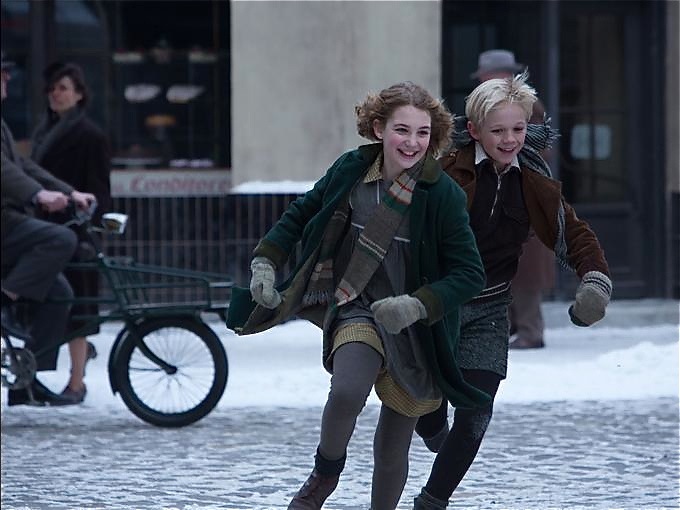
The Book Thief (2013): From Book to Film

It’s been a week since I watched The Book Thief, but the face of Geoffrey Rush still creeps into my mind every now and then. We were talking about famous faces on a previous post. A good actor draws you right into his character without distractions from his previous roles, and here’s a good example. Regardless of Rush’s successful roles in the past, here in The Book Thief, I only see Hans, the nondescript yet loving step-father to Liesel.

The Book Thief

The movie is an adaptation of the popular 2005 YA novel of the same name by Markus Zusak. The book had appeared on the New York Times Bestseller list for 375 weeks. It had since been translated into more than forty languages. Congruent with the age target of the book, this is an appropriate adaptation. It is a PG movie, so we won’t see the violence and horror as intense and explicit as in Schindler’s List.

Before anyone jumps to shoot it down as a ‘sanitized’ version of the Holocaust, let me just say it pertains to the spirit of the novel in quietly depicting life in a small German town under the pressure of Nazi warmongering. It shows a side of the usual WWII movies we seldom see, the ordinary German folks. Zooming in on a street in a small town, it shows the effects of a fierce political regime have on its grass-root citizens: husbands and wives, children, friends, neighbors and acquaintances like the neighborhood tailor or accountant, some of whom suddenly taken away and labelled as the Enemy: Jews.

The focus of the story is on the humanity. No doubt, the majority of the town folks are swayed by and immersed in Nazi ideology, yet there are still a few who stand silently against the ferocious regime, but can do nothing. Even a feeble voice of dissent will send them to conscription regardless of age. That’s what happens to Hans.

As in the book, we have Death as the voice-over narrator, quietly looming over the fictional town Molching, busy at work. Liesel (Sophie Nélisse) arriving at her new home to her adopted parents on Heaven Street. Yes, ironic, since her little brother has died during the trip. The girl soon finds her new home a comfort, and makes a new friend with Rudy (Nico Liersch) next door. Her step-mother is Rosa, played by Emily Watson who reprises her role as in The War Horse as the seemingly tough and bossy wife and overseer of the home. Her husband is Hans, played by Geoffrey Rush with affective charisma, who shows himself from the beginning that he is the emotion powerhouse, the engine that runs the movie.

Directed by Brian Percival (who helms episodes of Downton Abbey), the movie is unabashedly explicit in its emotional channeling. By that, I don’t mean it’s overtly sentimental and melodramatic. The fine line that separates the two may be the word ‘restraint’. Rush and Watson have depicted this quality memorably. He may look oblivious in appearance, but is ever wise and compassionate in spirit; she conversely holds a feisty facade only to hide a tender and caring heart. It is a delight watching them relate to each other.

Liesel and Rudy 1

For a YA novel turned into film, the spotlight has to be on the young protagonist Liesel. Sophie Nélisse is a precocious rising star who has won a Genie in the acclaimed French Canadian film Monsieur Lazhar (2011). She has already won a Spotlight Award at the Hollywood Film Festival for The Book Thief. Nico Liersch playing Rudy looks to be a few years too young, but being a good actor, the two loyal friends ultimately shine through as the movie picks up its momentum.

The plot line of hiding the Jewish young man Max, son of Han’s wartime comrade to whom he owes his life, adds texture to the story. Max inspires Liesel to love words even more, igniting that spark in her later to write down her story. To Max, the hiding place is more than a shelter from the storm. It is his connection to the decency and dignity of being human. The snowball fight in his hideout in the basement is one of my favorite scenes.

As for books, reading, and words, looks like they just work as a cover, in both the book and the movie. That Liesel comes as an illiterate ten year-old in Germany may not be quite plausible. The few episodes where she steals a book are incidental, lacking potent effects. The movie nevertheless is persuasive in its subtle way by turning mere book characters into flesh and blood human beings. The Book Thief is about humans. It shows their ugly face that haunts even Death, and their triumphant side that makes Death envious, the power to love, to hope, and to live despite tragedy and loss.

This is not a great film, but one that quietly touches, and subversively moves one to tears. It will not make any major award list, and would likely be dismissed by some critics. But this is the kind of films that, years later, one would discover serendipitously and exclaim, “Why have I missed this little gem?”

~ ~ ~ Ripples

Out of the Budding Grove

When I picked up Swann’s Way earlier in March, I had no idea that 2013 is the 100th Anniversary of its publication. Now in hindsight, I’m all the more excited with this serendipitous selection for a Read-Along. And what discoveries I’ve made reading Proust!

Six months later in September, I started Vol. II Within A Budding Grove, allowing myself and any fellow reader two months to finish this 730 page volume.

Within A Budding Grove Modern Library

I reiterate, I’ve encountered thickets blocking the way through the budding grove, but I must say, the enjoyment I’ve reaped from slashing and plowing through it is greater than my frustration. All in all, coming out of it feels like finding my way through a corn maze. Out I come dazed but gratified.

I’ve posted some thoughts on Part One of Within A Budding Grove here. This latter part is about Balbec, a seaside resort the adolescent narrator travels with his Grandmother to stay for the summer to recuperate his health. Like his memories of Combray, Proust’s description of Balbec is detailed and colourful. He relays to his reader his journey, the scenery, the Grand Hotel they stay in, its guests and their social hierarchical interactions, his new-formed friendship with the painter Elstir who introduces him to the band of girls the young narrator admires but is too shy to greet on his own, Albertine, Andrée, Rosemonde, Gisele…

The original title of this volume is In the Shadow of Young Girls in Flower (À l’ombre des jeunes filles en fleurs) which I think is spot on. But, the budding grove is an apt metaphor too for his adolescent self discoveries of love and passion. And in one hilarious scene with Albertine, Proust has shown he can be a writer for Saturday Night Live any time. Too long to quote here but well worth the read. (p. 700-701 in case you want to skip the first 699 pages.)

And young Marcel is ever in-touch with his own feelings for these girls, especially Albertine. Here is his honest analysis:

At the start of a new love as at its ending, we are not exclusively attached to the object of that love, but rather the desire to love from which it well presently arise (and, later on, the memory it leaves behind)… (p. 676)

Ahh… romancing a desire and a future memory.

What about Gilberte, Swann’s daughter, with whom the young narrator is so obsessed earlier? To his credit, young Marcel has a full grasp of his own psyche. Why? It’s all a matter of Habit, he reasons. Since Gilberte has snubbed him, he needs to forget her and let go of any form of Habit reminding him of his previous life in pursuing her. This trip to Balbec takes him away from the familiar and replaces his memories of Gilberte, and a static existence, with fresh experiences and revitalized senses. Getting out of his home in Paris and going away might just be the best medicine:

… one’s days being paralysed by a sedentary life, the best way to gain time is to change one’s place of residence. My journey to Balbec was like the first outing of a convalescent who needed only that to convince him that he was cured. (p. 301)

Even before he gets to Balbec, while on the train stopping at a station, the sensitive and observant narrator is already filled with delight as he sees a young milk-girl carrying a jar of milk walking to the train at the break of dawn:

She passed down the line of windows, offering coffee and milk to a few awakened passengers. Flushed with the glow of morning, her face was rosier than the sky. I felt on seeing her that desire to live which is reborn in us whenever we become conscious anew of beauty and of happiness. (P. 318)

My own memories of the changing hue on those Bohemian Waxwings come to mind. Proust has effectively conveyed the power of association, the linking of words on a page to the reader’s own memory and the joy it had once elicited.

**

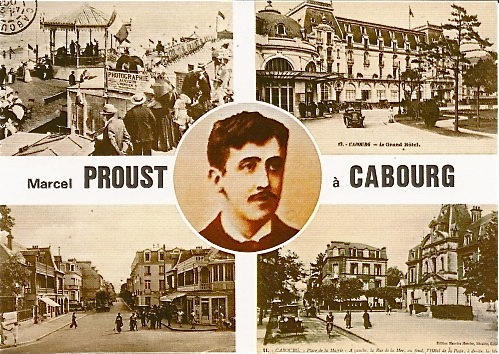
Proust in Cabourg copy 1
Photo Source: franceculture.fr

Proust insists that In Search of Lost Time is not autobiographical, but said “The pleasure that an artist gives us, is to introduce us to another universe.” No matter, his writing relates closely to his life experiences, parallel universe if you will.

Balbec is the fictitious reconstruction of Cabourg, a seaside resort town in the Basse-Normandie region of France where Proust frequented between 1907-1914. While Proust explores voluntary and involuntary memories in his long work, he could well be weaving memories with imagination, fusing fiction with real life experiences, creating an intricate tapestry.

Lydia Davis, translator of the most recent edition of Swann’s Way (The Way by Swann’s), offers this insight: “this novel is not autobiography wearing a thin disguise of fiction but . . . fiction in the guise of autobiography.”

Right.

Whichever way you slice it, it’s still as delicious as madeleines dipped in tea.

***

Some Relevant Links:

The TLS blog: French literary anniversaries, part 4 – Du côté de chez Swann

CLICK HERE to a webpage on Cabourg where you can see the video of The Grand Hotel, with Proust’s room still being kept there.

Proust in Cabourg

In The Shadow of Young Girls in Flowers, from The Modernism Lab at Yale University

Photo Source: franceculture.fr

***

Related Posts on Ripple Effects:

Half Way Through a Budding Grove

Swann’s Way Part I: Combray

Parts 2 & 3: Swann In Love

***

12 Years A Slave (2013): Beauty and Sadness

UPDATE Feb. 16: 12 Years A Slave just won BAFTA 2014 Best Film and Chiwetel Ejiofor, Best Actor. 

UPDATE: 12 Years A Slave is nominated for 9 Academy Awards including Best Picture, Best Director, Best Actor, Best Supporting Actor, Best Supporting Actress, Best Adapted Screenplay, Best Costume Design, Best Production Design, Best Film Editing.

Movies this season seem to come in pairs in terms of subject matter, which makes interesting viewing. Gravity and All Is Lost is a pair. Lee Daniel’s The Butler and 12 Years A Slave another. I watched them purposely back to back.

12 Years A Slave is powerful in many ways, most readily is the aesthetics and styling, both visual and audio. Before he turned to directing, Steve McQueen was a visual artist trained in fine art in London and New York, and it shows. His cinematic work is a testament to the fact that film is a mixed-media art form. More importantly, it shows that film art does not have to be esoteric, or be appreciated only by an ‘artsy’ few. 12 Years A Slave is an exemplar. It carries no elitism but speaks to all. What more, the subject matter may be ugly, but the medium depicting it can be artistically gratifying, thus, conveying the message with even greater potency and inspiration.

12 Years A Slave Poster copy

The film is an adaptation of the 1855 memoir written by Solomon Northup, a free black man, known for his skills in playing the violin. He was living happily with his wife and two children in Saratoga, New York. One day, two men came to offer him a gig to play the fiddle at a circus. Solomon was deceived, drugged, and later smuggled to Louisiana to be sold as a slave. There for twelve years, he endured insufferable hardships until he miraculously met a Canadian carpenter named Bass who stood against slavery. With his help Solomon found freedom and rejoined his family.

I disagree with some critics who assert that the film is too artfully directed, pristine and sanitized to convey the ugliness of the subject matter. One of the qualms they have is with a scene at the beginning of the movie wherein a beating is being shot with artful camera work and lighting. After he is drugged and chained in a dark holding cell, Solomon is fiercely beaten until the torturing paddle breaks in two. Amidst the total darkness in that filthy cell, we see him cower in pain, yet his white shirt literally shines. I noticed that scene too and appreciated how well it was shot. For me, I saw the glowing white garment as a powerful symbol of purity and innocence amidst utter depravity. I’m glad there’s an artist/director to helm this film. We are seeing how the cinematic medium can be sculpted to its full potential. I don’t see anything ‘art’-ificial about it or sense any contrivance.

The issue here is the paradox of conveying ugliness in a well-crafted and artful frame. I have no qualms with that. Should art capture beauty only? Or, should ugliness be depicted by casual and shoddy work in order to be ‘realistic’? The answer is elementary. A quality medium can only enhance the poignancy of the message.

On another level, the film shows us that amidst evil, beauty can still be found. It exists in the persevering spirit of Solomon Northup. Herein lies the inspiration of the story. I found this quote from an excellent interview article with director Steve McQueen. It speaks to the fact that, in the midst of utter sadness, the human spirit can still glean what’s positive and beautiful. From the memoir of Solomon Northup we read these words:

There are few sights more pleasant to the eye, than a wide cotton field when it is in the bloom. It presents an appearance of purity, like an immaculate expanse of light, new-fallen snow.

Acclaimed British actor Chiwetel Ejiofor’s performance as Solomon Northup is inspiration itself. His nuanced expressions portray clearly some very mixed and intense emotions under the most desperate of circumstances, like consoling a female slave lying next to him at night and yet keeping his integrity, or being forced by the sadistic Epps to whip another slave. Even at the point of despair, Solomon maintains his self-respect, remains upright and kind, and upholds a human spirit that no whips can break. The actor is also heading straight to the Oscars according to consensual predictions.
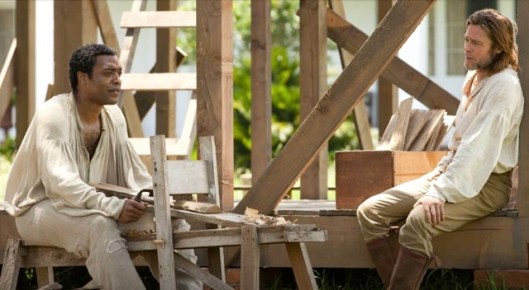
Glimpse of hopeThe excellent supporting cast also renders beauty to the overall production, some of whom might garner recognition of their own come Awards time. Newcomer Lupita Nyong’o is impressive as fellow slave Patsey, a desperate soul dangled on the edge of survival and despair. Paul Giamatti (who won a Golden Globe as John Adams in 2009) plays a mercenary slave trader. The excellent character actor Michael Fassbender (in both of McQueen’s previous films Hunger, 2008 and Shame, 2011) as slave breaker Epps embodies the wickedness of the system and a soul derailed. Paul Dano (There Will Be Blood, 2007; Prisoners, 2013) is within type as the murderous slave driver Tibeats. Again the paradox appears. We’re glad to see actors giving superb performance playing villainous roles.

Then there’s the versatile Benedict Cumberbatch, picking up a Southern drawl to portray the kind slave owner Ford. His scenes with Solomon offer some needed relief. Unfortunately, those better days are short-lived. The man who helps Solomon to freedom is Canadian Samuel Bass, very short screen appearance by Brad Pitt. He is an itinerant carpenter working on Epps’ land. This chance encounter makes Solomon aware of Bass’s anti-slavery stance. For the first time in all those years of captivity, he confides his true identity in someone trustworthy and pleads for Bass to contact help in his home state up north.

The music and sound, or the lack of it, are equally effective. Composer Hans Zimmer’s soundtrack ‘Solomon’ is epic and heroic. The spirituals sung by the slaves on the plantation express their deep yearnings for release and freedom. In one scene towards the end, we see other slaves singing their heart out the spiritual ‘Roll Jordan Roll’. At first Solomon listens as a bystander. After a while he can’t help but pour his soul out and join in. That’s the point he totally identifies with the others in their hopeless condition, calling out to God for deliverance.

What follows is memorable. Sometimes silence speaks louder than sound. That moment of silence marks the change of fate for Solomon. I was captivated by the lack of sound, and the camera static, closing up on Solomon’s face of apprehension and despair for a long minute. Often it is the slow, silent space a director allows us to absorb and wait that I appreciate most.

As I stepped out of the theatre, I breathed out a sigh of satisfaction. True there was much sadness in Solomon’s story, but I was relieved to see ultimately his perseverance pay off. I was gratified too that this story of the human spirit triumphant is well told in a meditative pace, sculpted artfully, and delivered by poignant performance. This is the beauty of film art.

~ ~ ~ ~ Ripples

***

Related Links:

My Review of 12 Years A Slave the memoir by Solomon Northup

Download 12 Years A Slave the book

Solomon Northup from Wikipedia

The Underground Railroad

***

Lee Daniel’s The Butler (2013): The Trouble with Famous Faces

The Butler is none other than Cecil Gaines, an African American who has worked in the White House serving eight presidents from the late 50’s to the 80’s. Never heard of him? Good, because, as screenwriter Danny Strong (who wrote the Sarah Palin satire Game Change) has emphasized, Cecil Gaines is a fictional character, albeit there was a real life person who had done similar things for thirty-four years through eight Administrations in the White House. He was Eugene Allen. The movie is fiction inspired by that true story. But here, it’s all about Cecil Gaines, a character that Forest Whitaker portrays convincingly.

That leads to this Disclaimer: This is not an Accuracy Police report. But, uh… just a memo from the Facial ID department.

The Butler Movie Poster

After watching The Butler, I’d like to recommend that movie stars go on sabbatical leaves. After a certain number of years of high-profile, on-screen appearances, famous actors or talk show hosts should pursue other interests, anything that’s behind the camera… write, direct, produce, compose, climb K2… before coming back out for another movie role. For here, I can see the distractions that can come from too famous a face.

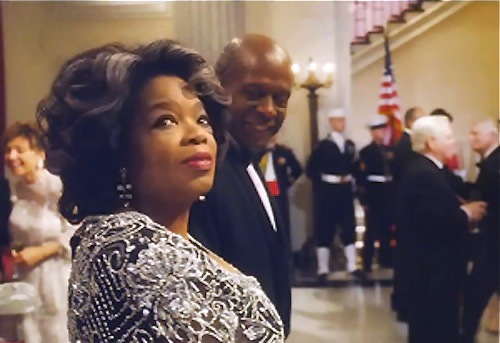
Why? It takes me a long while to adjust to Oprah being the alcohol-dependent Mrs. Gaines, despite her strong performance, or, tell myself that’s Dwight D. Eisenhower I’m looking at, not Robin Williams. With every Administration that flashes by, my focus as a viewer is more on figuring out which famous star is playing which famous politician. That’s James Marsden as JFK, and Liev Schreiber as uh… comical LBJ… sitting on a toilet while barking instructions to his staff?

By the time John Cusack comes on screen, I’m asking myself, now, who is he supposed to be? I can only see John Cusack, and it looks like he’s trying to convince me that, “No! I’m Richard Nixon!” He too, looks like a caricature. Later when Ronald Reagan appears, I can only see the make-up. Sorry Alan Rickman,  didn’t recognize you. Looks like you’re wearing a Halloween mask. I must say though, hats off to Jane Fonda, she’s one good Nancy look-alike, although I know she has her share of protests. Now, that’s another issue… the incompatibility of ‘Hanoi Jane’ taking up the role of Nancy Reagan. I can understand why some Vietnam War vets are up in arms.

The Butler & his wife

The trouble with famous faces… they have a hard time convincing viewers that they are not who they appear but the character they are playing. In The Butler, that just might not be a problem because it seems the filmmakers are confident that star power can get us through. Further, the sequences of Administrations go by so quickly, they are more like passing spectacles than memorable episodes.

Other than star powers that function only on appearance, there are some riveting scenes from the main storyline, that of a father-son relationship against the backdrop of racial turmoils in America. While Cecil Gaines works as a butler in the White House all those years, his son Louis (David Oyelowo) has been deeply involved in the Civil Rights Movement, arrested and jailed several times, often putting his life at risk. Major differences in political viewpoints generate sparks and tensions to eventual deep gulf between father and son.

A memorable scene is when father and son argue at the dinner table over Sidney Poitier winning the Academy Award. Cecil thinks that is a sign showing white people are accepting and honoring blacks. But son Louis points out Poitier is appeasing white viewers in presenting himself as a white, black man. Interesting thought, not unheard of. The subsequent result of the argument makes a memorable scene.

Juxtaposing actors’ performance with visceral archival footage of racial violence like the lunch counter sit-ins, the Freedom Bus burning by the Ku Klux Klan, the assassination of Martin Luther King… makes some informative and engaging storytelling. That may be the reason why, after the pivotal historical accounts of the Civil Rights Movement, the movie begins to lose my attention. What looks to be significant begins to appear parochial towards the end, where I even feel some partisan undercurrents.

Overall, the movie may have been too ambitious in covering everything, a father-son relationship, the black family, the country’s racial conflicts, the Vietnam War, to South Africa’s Apartheid. Its Forest Gump-esque storytelling lacks a unified and consistent styling. The incompatibility applies to the choice of music too. I’m fine with the period music of the eras, but using the Schumann Piano Concerto in A Minor at the opening scene feels like a mismatch. Other familiar classical pieces like Mozart’s piano sonatas for White House scenes sound like casual and superficial picks.

A movie riding on its star-studded cast… a mixed bag of famous faces. If you like a parade, this is fun to look at.

~ ~ 1/2 Ripples

***

Screenwriters Talk and Bloggers Blog

Thanks to blogger Sim at Chapter 1-Take 1 for the heads-up, I watched the whole 54 mins. of The Writers Roundtable via Hollywood Reporter. Gearing up for the upcoming Awards Season, these Roundtable talks give us a chance to hear some possible award contenders talk about their craft. I’m particularly drawn to the writers.

“No great film would have been possible without a great screenplay.” That’s how the clip begins. Sitting around a table to discuss their experience are some of this year’s acclaimed screenwriters.

The panel includes (In alphabetical order of the movie title):

John Ridley: 12 Years a Slave
Julie Delpy: Before Midnight
Nicole Holofcener: Enough Said
Jonas Cuaron: Gravity
Danny Strong: Lee Daniel’s The Butler
George Clooney and Grant Heslov: The Monuments Men (release date has since been delayed till next Feb.)

There are lots of interesting exchanges, and it’s refreshing to hear them talk uncensored and unscripted. Take for example the following dialogue relating to independent writing vs. writing for studio:

HR (Hollywood Reporter): Have you written any studio films?
Holofcener: Only for money (chuckle from somewhere). I mean like, not for myself.

*

HR (to all): Do you like writing?
Strong: I do. I really enjoy it. I spent years as an actor. You just can’t go do it. You get hired to do it, so I started writing, to get my mind off the auditions…
Holofcenter: What if you can’t act, and you can’t write?
Clooney: You direct.

*

There are lengthy discussions on the issue of historical accuracy, the truths vs. dramatization. I feel this is the hot topic lately, with The King’s Speech a couple years ago, to last year’s torture scenes in Zero Dark Thirty, the accuracy of Argo, and this year’s Captain Philips, and Lee Daniel’s The Butler.

Here’s The Butler‘s screenwriter Danny Strong’s defence:

Strong: Well, in the case of The Butler, I made very clear that this was a fictionalization. So much so that I changed the character’s name to Cecil Gaines in the hope of saying: “This isn’t Eugene Allen. This is something else.” But the history in the film is all true…”

And then comes Clooney’s allegation unplugged.

Clooney: This is a new thing, by the way. This is all, like, bloggers — if that existed when Lawrence of Arabia came out, believe me, Lawrence’s own autobiography would not hold water. Patton wouldn’t. You can go down the list of movies — Gandhi — these movies are entertainment… These are not documentaries. You’re responsible for basic facts. But who the hell knows what Patton said to his guys in the tent?

*

Whoa… bloggers? Thank goodness, bloggers get a chance to prod screenwriters to dig deeper into their facts, even if fiction is to be made from them. Because of bloggers, viewers can sharpen their senses to not just accept the dramatization as facts. Because of bloggers posting about movies, people are made more aware of historical events and background info. I see not all sites do, but the ones I frequent can have the effect of honing one’s judgement and critical thinking, even (maybe more so) when opinions differ. How we need these skills as we watch movies nowadays instead of just being passively entertained (or not).

Thanks George, for spelling out the importance of the work bloggers do.

You’re right too, George, because of the blogosphere, filmmakers now have to deal more rigorously (or, don’t they?) with the dichotomy between truth and fiction, historical accuracy and dramatization. Yes, the butler Cecil Gaines is a fictional character, but there are many real historical figures in that story context… like, say… Ronald Reagan, whose son Michael Reagan had protested against the film for painting his father with a racist brush.

As someone with a half-baked screenplay in the closet, I know how hard it is to even get to finish the first draft, and after that, hopefully, find someone qualified and experienced enough to read it and advise on rewrite. Then you go and rewrite, and rewrite some more. So I’m all respectful for all who can not only sell their spec script but actually see it produced, and not only produced, but distributed and shown on our theater screens. That’s why I attempt at every review with appreciation and humility.

At the same time, I’m also glad to see that the blogosphere has leveled the playing field for opinions and critiques, for accountability, and for creative expressions with checks and balances. I don’t see an end to the dichotomy between fact and dramatization, accuracy and entertainment, but at least we are free to challenge and critique. Don’t forget, George, bloggers are also the ones ready to defend and promote worthy productions. All for the better.

***

Related Posts on Ripple Effects:

Before Midnight: Reality Check

The King’s Speech: Fact and Fiction

Zero Dark Thirty and Argo

***

Saturday Snapshot Nov. 16: Magical Realism

At first, what drew my attention were the birds on top of the distant trees, sillouetted against the predawn sky. What were they?

Before SunriseBefore Sunrise 1Must be the hardy European Starlings, I thought. My birding instinct prodded me to get out of the house to find out, at 7:30 am, in -13C temperature.

As I got closer, their buzzing sound reminded me that I’d heard them before, in flocks, making sounds almost like cicadas, but lighter, more metallic and electric. By then, morning had broken. Indeed, they were not Starlings but Waxwings.

Morning has brokenThe sun shed its glorious light and I was much gratified to see that all those plump bellies were not Cedar Waxwings which I’d seen in the summer. From their grey pot belly, I could tell they were Bohemian Waxwings. Of course, they will be spending their winter here. The Cedar Waxwings had all gone south.

Bohemian WaxwingsWhat attracted them to our neighborhood? My stalking skill led me to find out. Ah… berries:

Frozen berriesIt was a delight watching them feast on these frozen fruits for breakfast:

Bohemian WaxwingsGot it!

Got itAnother oneSoon, washed by the glowing sunrise, their greyish plumage began to change into a magnificent color. No CGI (computer-generated images) here:

No CGIJust pure magical realism:

Washed by the morning sun

Magical Realism

Bohemian Sunrise

***

Saturday Snapshot is hosted by Melinda of West Metro Mommy Reads. CLICK HERE to see what others have posted.

ALL PHOTOS IN THIS POST TAKEN BY ARTI OF RIPPLE EFFECTS, NOVEMBER, 2013. PLEASE DO NOT COPY OR REBLOG.

***

Saturday Snapshot Nov. 9: Fall or Winter?

This is what our neck of the woods looks like. Autumn still.

Snowy SunsetSnow or no snow, a gal’s gotta eat.

Snow or no snow, a gal's gonna eatEvening meal

Deer at evening mealAnd at the creek…

The Creek

Snow covered logWho’s afraid of a little snow?

Who's afraid of a lil' snowThis Chickadee flew right to me, ‘Welcome to my hood!’

Chickadee“Fall or winter, what does it matter?”

Would you like a tour?

***

Saturday Snapshot is hosted by Melinda at West Metro Mommy Reads. CLICK HERE to see what others have posted.

***

About Time (2013): The Use and Abuse of Superpower

Time travel can be tricky. The idea has been used so many times that it has almost turned into a cliché. While it can bring about interesting cinematic moments, offering some creative, postmodern juxtapositions, it is hard to navigate that overused capsule of storytelling to new height.

This is a movie I’d anticipated. Not that I’m a fan of Richard Curtis, but I do find a couple of his works delightful. He is the prolific writer/director/producer of many popular romantic comedies. His works in any of the above-mentioned capacities include Four Weddings and a Funeral (1994), Notting Hill (1999), Bridget Jones’s Diary and its sequel (2001, 2004), Love Actually (2003), The Girl in the Café (2005), and the not so romantic comedies of Mr. Bean (1992-2007), among many other titles. About Time is his third movie as director.

While I’m indifferent to the travel back in time story idea, I do have fond memories of a few movies which now have found a place in my mental playlist, tagged time travel. They include Somewhere In Time (1980), Kate and Leopold (2001), and the more recent, Midnight In Paris (2011). As for About Time, despite my high anticipation, I’m afraid it will slip away in no time.

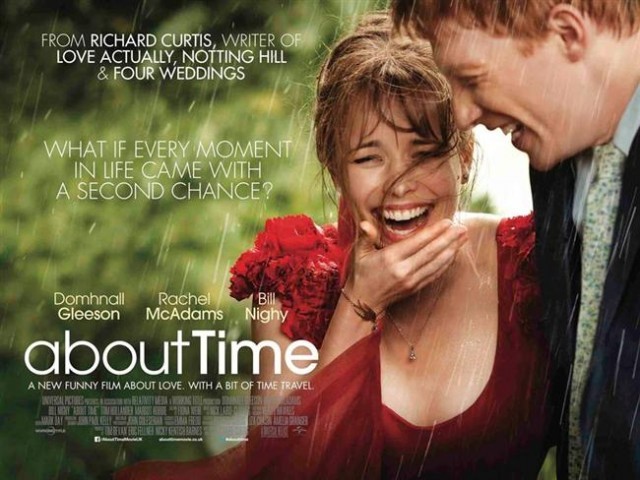
About Time

The year Tim (Domhnall Gleeson) turns 21, his Dad (Bill Nighy) tells him a secret: all the men in his family have the power to travel back in time. Fine. What you will use this extraordinary power for is totally up to you. Dandy. Tim knows exactly what to do with it: find a girl to love. Not a hard decision, for Tim tends to be a novice in relationships and unsure of himself. He soon sets his eyes on Mary (Rachel McAdams).

Tim has the time of his life trying out his new-found power. He uses it to redo the mistakes he has made, erase the speech bubbles he has messed up, reappear as more savvy than he really is. To his advantage, he hits on Mary and repeats his romancing act with her multiple times, she oblivious of being played. This being the brunt of a joke is highly problematic. That it is a comical episode does not mask the fact that this is an obvious abuse of superpower.

But of course, the film is made up of many more episodes. We see Tim and Mary get married and have children of their own. There are accidents and mishaps, and Tim soon finds out that even though he can go back in time, he cannot avoid consequences of actions, his and others. The last part of the movie seems a shift from earlier segments in delivering lines that get a bit too sentimental and preachy, utterances of platitudes.

Director Curtis has a fine cast in his hands. However, maybe because of the romcom genre, they give the impression of an overacting bunch. If Domhnall Gleeson does not ring a bell you might want to travel back to Harry Potter movies, True Grit, and last year’s Anna Karenina where he played Levin in the adaptation of Tolstoy’s classic. I definitely enjoyed his Levin role more. Rachel McAdams, interestingly, has been in several time travel movies, including Midnight in Paris. Again, her act there is more convincing. Well, to quote Mr. Darcy, the epitome of aloof coolness, they ‘smile too much.’

So that’s when I doubly appreciate Bill Nighy. You don’t have to smile in order to be funny. Actually, you should refrain from doing just that. He is the veteran here and I feel he saves the show. Nighy’s performance turns sentimental episodes into moving moments, especially with the father-son relationship.

A lightweight, sugar-coated romcom, definitely an item on the dessert menu, that is, if you don’t much care for the main dish.

~ ~ 1/2 Ripples

***

Other related reviews on Ripple Effects:

Midnight In Paris (2011)

The Girl In The Café (2005): The Hunger for Connection

Anna Karenina (2012)

True Grit: A Cool Summer Read and Movie

***

All Is Lost (2013)

If Life of Pi (2012) is magical realism, then All Is Lost is absolute realism. Some say it’s a modern version of Hemingway’s The Old Man and the Sea. I tend to see it as the flip side of Life of Pi. It is the magical, the supernatural that we pant for while watching the man in the film silently struggle to stay alive in the middle of the Indian Ocean. Without a miracle, this is what it is.

At the back of my mind was this query… In our age driven by visual spectacles and mega sights and sounds, why would someone take up a project of this nature, a 106 minute feature film with just one character and no dialogue, except for a few words from voice over in the opening when the man utters what seems to be his last words to his loved ones.

I admire the courage and talent of writer/director J. C. Chandor, who writes a 32 page script (according to IMDb) and directs it as a minimalist production in a time when the movie industry has gone ultra mega and high tech. All Is Lost is only Chandor’s second feature film. His directorial debut which he also wrote? Margin Call (2011), about the tempest in the tumultuous ocean of investment banking. Versatility is the mark of talent indeed.

But the film belongs to Robert Redford. No longer The Sundance Kid (1969) here but a 77 year-old actor playing a man dangling over the edge of survival. Redford just might have put forth the definitive performance in his long career. He has taken on the role with grace and gentleness, a paradox to his predicament in such a physical drama. He carries the whole film by engaging our empathy. His screen presence is the replacement of fancy plot lines, setting and dialogues. He plays a character with no name. Only when the end credits roll do we find out that he is called ‘Our Man’. 

Robert Redford in All is Lost

Unlike Tom Hanks in Cast Away (2000), who speaks and yells his mind, and socializes with a volley ball, Our Man is the epitome of restraint. He is the strong and silent type of veteran sailors on a solo voyage, who encounters the misfortune of being stranded in the vast ocean. At the beginning of the film we see Our Man wake up to find his sailboat has been hit by a loose cargo container floating by. The sailboat is taking on water through a hole in the hull. The radio and equipments are damaged. Our Man deals with the situation resourcefully. He uses a repair kit to mend the damage, pump water out, dry out his boat. We see him eat and shave. 

Just as he has made some headway to restore safety, an impending storm blows his way. Our Man is no match for nature’s callous ferocity. He ends up having to escape a sinking boat and jump into a life raft, bringing with him a meager supply of food and water. He learns to use a sextant, and carefully charts his drift. His only hope is to be seen if his raft drifts into the course of cargo ships. He utters no words except for a futile S.O.S. call while in his sinking boat, and one expletive out of total frustration in the raft after a few days of bare survival.

One man, one raft, one sea. The wide-screen cinema is probably the best medium to depict such an existential predicament. We don’t need special effects, for this is all that we have. And the nameless ‘Our Man’ shows how universal he is. And what of him? A patient and courageous man trying with all that he has and all that he is to stay alive, waiting to be found, hoping to be saved.

Do we need to know the name on that cargo container that hit his boat? It really is immaterial considering all that Our Man has gone through and all the efforts he has put forth to be saved. But just for information, we see the name in English, ‘Ho Won’, an obvious translation from the two Chinese words below: “Good Luck”. A jest too harsh.

Spoiler Alert. If you have not seen the film, you might want to skip the next paragraph, just that one. If you have seen the film, you’re most welcome to share your thoughts on the ending.

Like Life of Pi, the ending is open to your own interpretation. Two lines of thoughts conjured up as I watched the open-ended final scene: Only when one has lost all would one be saved. Or, go into that good night with gentleness, for brightness awaits. I can see both these scenarios to be applicable here. Again, this is one of those films that leaves the viewer to draw the conclusion, a type of ending which may not be very popular but one that conveys the multiplicity of reality.

As the credits roll, we hear the song for the film. I first thought singer songwriter Alex Ebert was calling ‘Our Man’ throughout his song. As I later found in the credits, it was ‘Amen’ (with the ‘Ah’ sound). Yes, ‘Amen’ is the title of the song.

A fine movie to watch with a quiet mind and patient disposition. A necessary offering in our present day of excess among some numbing and mindless entertainment. It’s like holding your breath in your hectic course of life for 106 minutes, and survive.

~ ~ ~ Ripples

***

Click here to listen to Alex Ebert’s song ‘Amen’ and watch the trailer of the movie All Is Lost.

***