The Budapest Hotel: A Grand Escape

“But it doesn’t mean anything.”
“So we put in words. One word for every note, like this…”

— ‘Do-Re-Mi’ from The Sound of Music

Does music need words to make it meaningful? Do we have to find a message in a work of art before we can appreciate it?
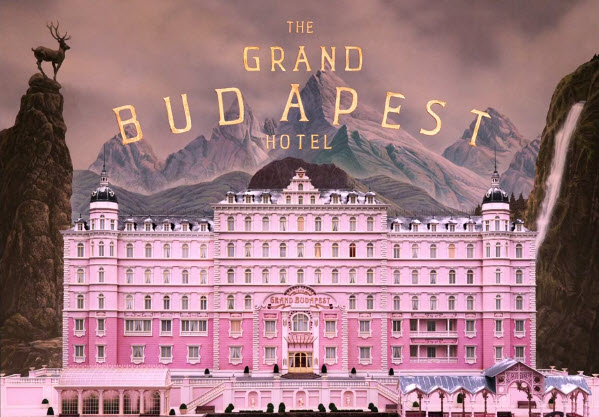
the-grand-budapest-hotel movie poster

Here we are with a cinematic piece that can’t be ‘explained’. What genre? What theme? What purpose? I’m not going to bother. As with my experience of watching previous Wes Anderson movies, somehow, I feel I need to let my rational side relax and just enjoy the ride. Rushmore probably has more of a traditional storytelling mode and thematic content. But with The Royal Tenenbaums, I have to adjust the quirky frequency to high, it’s a totally different kind of viewing experience. Fantastic Mr. Fox, I was mesmerized by the stop-motion animation and humour, great voices add to the lively adaptation of Roald Dahl’s story. Moonrise Kingdom, I wasn’t fully gratified but by then, I was used to the Wes Anderson style of ‘magical realism’.

That ‘magical realism’ strikes again in The Grand Budapest Hotel. Not my favourite colour palette, red and pink, by I was totally captivated as soon as the film began. I was being led into a fairytale world of real life people. From the cinematic framing, it aptly demonstrates the idea of symmetry. In many frames, the subject is right in the centre, almost perfect symmetry on both sides of the screen. But does it mean anything? One might ask. If we have to be rational about it, shall we just say, for the effects of a neat and tidy piece of the old world. Framing nostalgia before the world becomes too distorted, too inhumane. This is, after all, 1930’s Europe. And we can see the parallels in signs and symbols especially towards the end of the movie when uniformed men take over the Hotel.

Grand Budapest Signs & Symbols

Wes Anderson credits Stefan Zweig in creating The Grand Budapest Hotel. The Austrian writer’s name is shown at the very beginning of the end credits. In numerous interviews, Anderson pays tribute to Zweig’s whole collection of works, a writer who is noted as once ‘the world’s most translated author’. Zweig is a relatively new discovery for Anderson but so deeply has the writer inspired the filmmaker that ‘it’s basically plagiarism’, Anderson joked at the news conference when the film premiered at the Berlin Film Festival.

As someone who is much intrigued by the creative process of adapting books into films, I did read some Zweig before watching Budapest. I must be reading the wrong works though, I’d thought. From the novella Chess Story, to a few of the stories I read in the new collection recently translated into English, all tell very gloomy tales. The writings almost exude a sense of despair, as the characters are mostly running away from persecutions and ethnic cleansing, or memories thereof, even driven to madness as the chess champion Czentovic in Chess Story, albeit some descriptions embed a subtle trace of humour.

Maybe along the notion of ‘Wabi-sabi“, beauty and sadness, what Zweig has done subtly and now Anderson explicitly is to extract and fuse “humor and sadness”. Here in Budapest, writer/director Anderson has freely utilized the element of fantasy and fun to paint the passing of an old world, a realism too sad for millions in 1930’s Europe, Zweig being one of the subsequent victims. To escape the incendiaries of Nazism, Zweig and his second wife moved to England, then to the U.S., and finally to Brazil in 1940 where he ultimately committed suicide together with his wife in 1942, leaving a note of utter despair as he saw Nazism dominating Europe and his former homeland Austria.

In this fictitious Republic of Zubrowka, where The Grand Budapest Hotel is situated, Anderson offers us a great escape despite setting his story within the brewing tension of 1930’s Europe. The story begins with a closer to present day author (Tom Wilkinson) reminiscing upon an extraordinary experience which has inspired his book The Grand Budapest Hotel.

The Concierge Desk and Main Staircase

Years ago when he was still a young writer (Jude Law), in finding cures for writer’s block, he had retreated to a mountain hotel The Grand Budapest and in there met its owner, Mr. Moustafa (F. Murray Abraham). Known as Zero when he  himself was just a lobby boy in an age long passed, the owner told the writer his story of how he came to inherit this grand piece of property, albeit in a run-down shape now. Someone volunteering an extraordinary life story to an author in an exotic locale, the beginning of Budapest reminds me of Life of Pi, another great tale of magical realism.

But the movie belongs to Ralph Fiennes as the hotel Concierge and go-to person for all sorts of favours, M. Gustave. The death of long time patroness of the Hotel Madame D. (Tilda Swinton) has dragged M. Gustave and his protégé, the new lobby boy Zero, down a rabbit hole of misadventures and fortunes. Fiennes has proven that he is a versatile actor that can be as evil as Amon Goeth in Schindler’s List, or as madly romantic as Count Almasy in The English Patient, or as charming and fun here in Budapest. His comic timing is first-rate, his expressions, spot-on. My long-range forecast, an Oscar nom awaits him next year for his role in Budapest.

Gustave & Zero

The line-up of talents is long, not just in acting, where we find the usuals of Wes Anderson movies like Edward Norton, Tilda Swinton, Bill Murray, Owen Wilson, Adrien Brody, Willem Dafoe, Jeff Goldblum. Saoirse Ronan (breakout role as young Briony in Atonement) as Agatha the pastry maker is adroit and whimsical. She’s well matched to the young lobby boy Zero, aptly played by Tony Revolori.

The movie is also marked by the delightful compositions of Alexandre Desplat, whose musical scores adorn many notable movies in recent years. A collaborator with Anderson since Rushmore but here, Desplat’s scores captivated me early on with the lively East European themes and in particular, the Russian folk melodies. Some instruments that we seldom hear in other films are distinctly alluring, such as balalaikas, zithers, dulcimers, and organ, with full orchestral rendering. Another long-range forecast, Oscar for original score.

And then there’s the make-up of Tilda Swinton, the art work and production design of the whole Budapest experience (even the parody painting “Boy with an Apple” is an original art work by English painter Michael Taylor from a real life model), the flowing editing, the original screenplay and directing, the cinematography, Budapest Hotel is going to be one grand entry in the next Academy Awards.

~ ~ ~ 1/2 Ripples

 ***

Read a related post: How Zweig Inspired Anderson’s The Grand Budapest Hotel

Awards Update:

Feb. 22, 2015: Oscars for Best Costume Design, Make-up, Production Design, Original Score.

Feb. 14, 2015: Wins Best Original Screenplay from WGA.

Feb. 8, 2015: 5 BAFTA wins, Original Screenplay, Original Music, Production Design, Make-up and Hair, Costume Design.

Jan. 15, 2015: 9 Oscar noms, Best Picture, Best Director, Best Original Screenplay, Cinematography, Editing, Production Design, Make Up and Hair-Styling, Costume Design, Original Score.

Jan. 11, 2015: Golden Globe win for Best Motion Picture – Comedy or Musical

Dec. 11: 4 Golden Globe noms for Best Motion Picture – Comedy or Musical, Wes Anderson for Best Director and Best Screenplay, Ralph Fiennes for Best Actor – Comedy or Musical

Dec. 10: SAG nom for Best Cast in a Motion Picture

Dec. 7: The Grand Budapest Hotel wins Best Screenplay and Best Production Design at the L.A. Film Critics Awards

Dec. 1: The Grand Budapest Hotel just wins Best Screenplay from the New York Film Critics Circle

Related Links:

From BBC CULTURE: The Writer Behind Budapest Hotel
From NPR: The Rise and Fall of Stefan Zweig

The Music Behind the Screen

The Untold Story Behind ‘Boy With Apple’

Homage to Flannery O’Connor: Looking for ‘Intrusions of Grace’ in Films

Today is the birthday of Flannery O’Connor. As a tribute, I’m re-posting a piece I wrote a few years ago entitled “Looking for ‘Intrusions of Grace’ in Films: Pickpocket and Drive”

**

Our age not only does not have a very sharp eye for the almost imperceptible intrusions of grace, it no longer has much feeling for the nature of the violence which precede and follow them.” — Flannery O’Connor (quoted in my post A Good Man Is Hard to Find and Other Stories)

Flannery O’Connor made this remark back in 1963. It was not only a sharp social commentary and prophetic, but to me, it also stands as one of the signs of a good film. Amidst the violence and ugliness a film may depict, the presence of grace, however small, or a mere spot of purity, could bring out a powerful contrast. Usually that is what’s needed to emit a redemptive spark, a glimpse of light pointing to the transcendent.

With this frame of grace among violence, I go back to the films I’ve watched and try to find some good examples. My task proves to be more difficult than I first thought. But after some deep searching through my mental archive, several films came to mind. I’ll just mention two for this post.

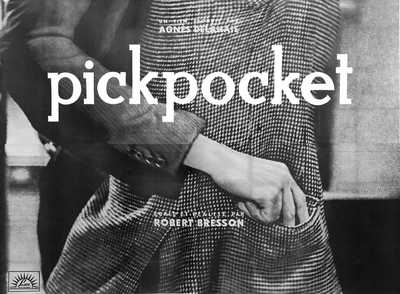
Pickpocket (1959)


pickpocket movie poster

Robert Bresson’s modern version of Dostoevsky’s Crime and Punishment. Caught in his own desensitized internal world, our protagonist Michel commits acts of theft as a desperate measure to fill the void in his existence. He goes through his days in a haunting vacuum devoid of meaning and emotions. He is unfeeling even towards his own dying mother, reminds me of Meursault in Camus’s The Stranger. Although not an axe murderer like Raskolnikov in Crime and Punishment, Michel theorizes that those with superior talents and intelligence, the supermen in society, should be free to disobey laws in certain cases. He is numbed by his own hubris, and stifled by his cold and absurd worldview. Outright violence is not visible here, but we see the battle of wits he engages with the police inspector behind his trails, and we see him struggle in an amoral and meaningless existence.

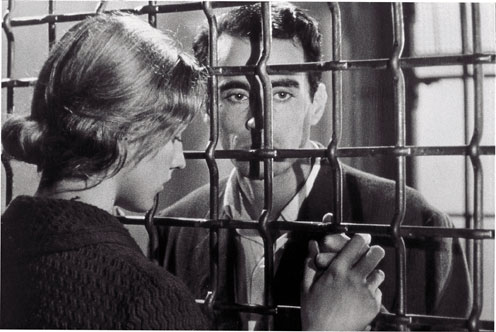
Grace comes as Jeanne, a neighbor and carer of Michel’s ailing mother. Jeanne lives on her own looking after her younger brother. Her father is a drunk and her mother has deserted them. But she continues to live and care. She accepts her circumstances calmly, and extends kindness to those unrelated to her, caring for Michel’s mother, a neighbor on another floor. She stands as a stark contrast to Michel’s aloofness. At the end of the film, Jeanne came to visit Michel in prison after he was arrested, the two separated by the cold iron bars. For the first time, Michel feels love and wants to reciprocate it. And thus the cathartic ending as he totally melts in the presence of pure love and grace, wrapping up the film with this last line:

“Oh, Jeanne, to reach you at last, what a strange path I had to take.”


Pickpocket


**

Drive (2011)

A current release that comes with high acclaims. The film was nominated for the Palme d’Or and Nicolas Winding Refn won Best Director at the Cannes Film Festival this year (2011). With slick and dashing camera work, the violence in “Drive” is visceral and graphic, a big contrast to the black and white, internal “Pickpocket”. However, I see some parallels between these two films made 50 years apart.

Ryan Gosling is “the Driver”. He does not even have a name. He is an expert stunt driver for movies and works at an autobody shop by day, drives a get-away car in the underworld of crimes by night. Like Michel in “Pickpocket”, he drifts in existence, numb and desensitized to the world around him. That is, until he meets Irene (Carey Mulligan), his neighbor.

Drive 1


Mulligan’s almost angelic presence in the film is most effective as a stark contrast to those around her. She lives alone looking after a child and works as a waitress in a diner. She appeals to the Driver by being herself, innocent, taking life as it is, responsible, caring for a child alone while his father is locked up in prison. Irene is a spot of purity in a rough environment. Her mere presence has transformed the Driver. From being aloof the Driver has become engaged emotionally, friendly and protective of both mother and son.

Drive

The plot thickens as Irene’s husband is released from prison and rejoins his family. The Driver is caught in an awkward situation. But he soon realizes that the husband’s resolve for a new start is genuine. The power of transformation is so thorough that the Driver is willing to go out on a limb to help the husband with one last heist in order to break the hold a gang has on the man, his wife and kid. While things go awry terribly and the ending is not as clean-cut as “Pickpocket”, we learn that the Driver remains a changed man from the ephemeral friendship he once had with Irene and her child.

Some might say Mulligan is a miscast, that she’s not “damaged enough”, and would prefer a ‘stronger’ character. I disagree. I feel that Mulligan has portrayed Irene’s innocent persona aptly, and yes, those ethereal dimples can just melt any heart. Hers is the perfect role for exactly the right reason. In the dark underworld of gangs, violence and crimes, she stands out as a tiny source of purity, a spark of grace. It all shows that what may look weak and vulnerable can have transformative power over the strong. A thought that may well be unpopular today.

***

Other related posts from Ripple Effects:

A Good Man Is Hard To Find and Other Stories by Flannery O’Connor

Bernini’s Corpus and Modern Movies

Notes on the Synthesis of Film, Art… Life?

***

Saturday Snapshot February 22: Austen Doors and Windows

Continuing with the theme of doors and windows, let’s hop over to the UNESCO city of Bath. I was there twice. These are a few photos I took on those trips.

The beloved author Jane Austen lived there from 1801 – 1806 after her family moved from her birthplace Steventon when she was 26. Their first address was 4 Sydney Place:

4 Sydney PlaceNo 4 Sydney PlaceIn their last year in Bath the family moved to 25 Gay Street:

25 Gay Street

25 Gay Street

Down the road to No. 40 is the Jane Austen Centre:

40 Gay Street Jane Austen Centre

The Great Pump Room was a social hub in Austen’s day. Her observations there must have inspired her satirical descriptions of high society in Northanger Abbey. Now an elegant restaurant:

The Pump Room Entrance

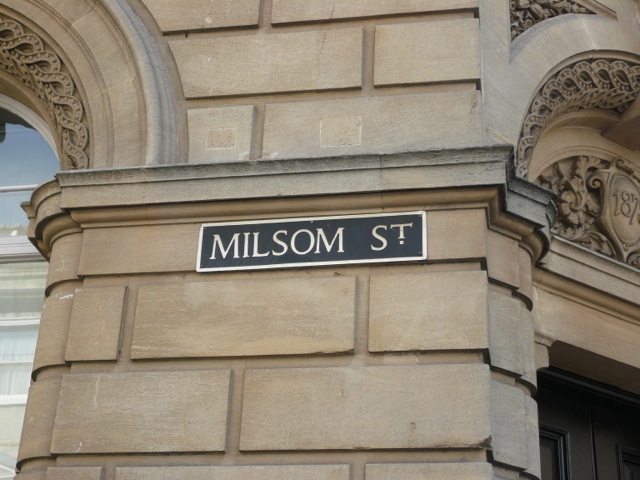
Austen used Bath as the setting for her novel Persuasion. Milsom Street was a vibrant commercial area of shops and businesses in those days as in now. The first time Anne Eliot saw Captain Wentworth again was when he passed by a shop on Milsom Street.

Milsom StreetMilsom Streetscape  Here’s a modern day shop window, Milsom & Son, a music store:

Milsom & Son

No, Jane would not have stepped in there to shop for CD’s or DVD’s. But she would likely have gone into this place, Sally Lunn Bun, the oldest building in Bath dating back to 1482 and a business that was present in Jane’s time. There’s a Kitchen Museum in the basement of the restaurant:

Sally Lunn's Bun

Sally Lunn Bun entrance

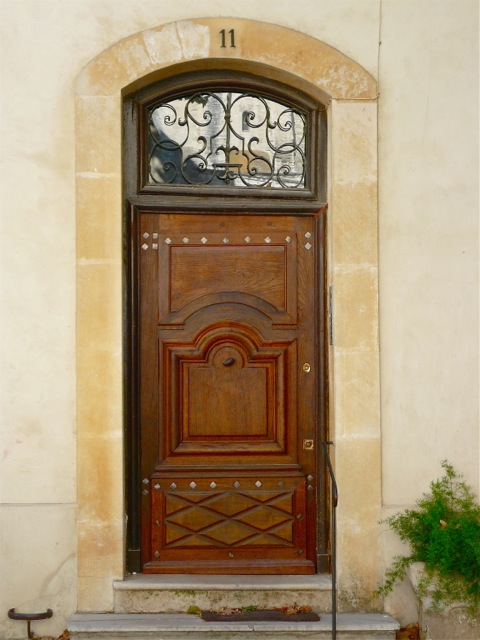
How can I resist showing you what’s inside the door and window:

Sally Lunn Bun

You might like to explore more of Bath in my other posts Jane Austen’s Bath and Bath’s Persuasion in which I recorded my walking tour using the novel Persuasion as a guidebook.

Saturday Snapshot is hosted by Melinda of West Metro Mommy Reads. Click Here to see what others have posted.

***

Saturday Snapshot February 15: Windows & Doors

By now, I’m sure many of you are tired of looking at white and greyish stuff, be it snow, or its liquid form. Let me take you on my escapade to Provence, France, and continue to bask in some warm colours.

This time, we’re looking at windows and doors. Again, they are photos from my trip to Avignon and Arles in the summer of 2010.

Blue Windows in ArlesShop windowAvignonSix windows in ArlesPink window

A shop window

Yellow windows2 blue windows

Now here’s the trick: Choose a photo. Look intensely at it for one minute then close your eyes and let the image imprint in your mind. When you reopen your eyes, I’m sure you won’t see white. Let’s just dream a little dream of warm summer daze.

Saturday Snapshot is hosted by Melinda of West Metro Mommy Reads. CLICK HERE to see what others have posted.

***

ALL PHOTOS TAKEN BY ARTI OF RIPPLE EFFECTS.
DO NOT COPY OR REBLOG

12 Years A Slave, Narrative of Solomon Northup: A Voice That Must Be Heard

“Is everything right because the law allows it?” — Solomon Northup

This is one of those cases where after watching the movie, I knew I must read the original source material, especially that it was written by Solomon Northup himself. If the movie is an artistic, cinematic account of a dark page in history, Solomon’s narrative is the quintessential eyewitness report, a first-person, authentic voice that is both a victim and a legitimate accuser of an inhumane and unjust system.

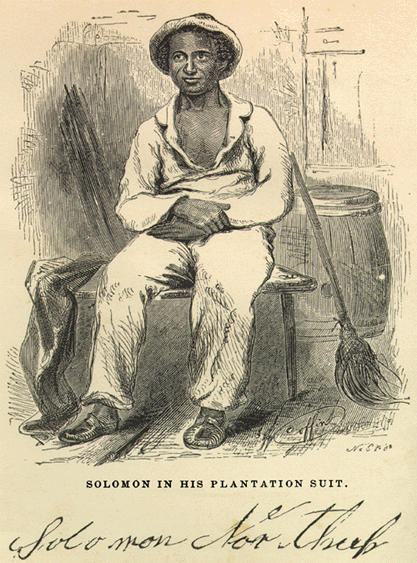
Solomon Northup copy

Born a free man in the State of New York, Solomon was happily living in Saratoga Springs, married to Anne and enjoying a loving family life as father to Elizabeth, 10, Margaret, 8, and Alonzo, 5. In March, 1841, his life was tragically altered when he was deceived by two men, Brown and Hamilton, and followed them to Washington, believing that he was to be hired to play the violin in a circus. Solomon was later drugged, kidnapped, chained and beaten. Together with other captured victims, he was smuggled to New Orleans and sold as a slave, his name changed to Platt, erasing any evidence of a previous life.

Having no free papers to prove his identity, transported and sold like a chattel to the Bayou in Louisiana, Solomon’s fate was sealed hundreds of miles away from home. His agony was heart-wrenching:

Were the events of the last few weeks realities indeed? — or was I passing only through the dismal phases of a long, protracted dream? It was no illusion. My cup of sorrow was full to overflowing … To the Almighty Father of us all — the freeman and the slave — I poured forth the supplications of a broken spirit, imploring strength from on high to bear up against the burden of my troubles, until the morning light aroused the slumberers, ushering in another day of bondage. (p. 77)

Solomon Northup’s eloquent writing immediately draws me in. It has a traditional and formal ring to the ear, but not archaic; it exudes clarity, finesse and grace. I’m struck by his stylish narrative even when he is describing depravity and injustice. After reading, I can see how the book had inspired director Steve McQueen’s beautifully rendered, artistic cinematic work on such an ugly subject matter. 

The movie follows the memoir closely, albeit leaving out a lot of details. Reading the source material after the movie can fill those in, making it so gratifying.

It was strictly forbidden of slaves to learn to read or write; pen and paper were prohibited. Any slave found to have even minimal education would be severely punished. Solomon had to feign ignorance all the years as a slave to survive. His memoir was written after he gained back his freedom in 1853.

I was most impressed that while Solomon yearned for deliverance and justice, he harboured no traces of personal vengeance against his tormenters. He had proven himself a man of integrity. Often he was sought after for his resourcefulness and his skills in playing the violin. He had entertained masters, and offered momentary relief to fellow slaves.

For two years Solomon was under the kind master William Ford, but had to be sold to the ‘slave breaker’ Edwin Epps to escape from Ford’s jealous and murderous slave driver Tibeats. The subsequent ten years with Epps became an extended living nightmare.

While the movie adaptation is an excellent production which I gave 4/4 Ripples, I find  Solomon Northup’s memoir even more engrossing. I’m particularly impressed by the fact that the book is not a self-absorbed account of sufferings, but as a careful memoirist, he records many details that are informative and even interesting, such as the natural vegetation of the Bayou environment, the cotton and sugar cane crops growing from seeding to harvesting, and the geography of the locales.

Like a perceptive ethnographer, he chronicles plantation life as a slave, the dwellings, diet, work load, daily chores, maltreatments. From his candid revealing, we are led into the subjective world of slavery, being sensitized to what it is like living in bondage and helplessness, constantly fearful of severe whipping and even death. Like a suspense writer, Solomon leads us to follow his risky attempts to seek help, and await in bated breath the day of his rescue. 

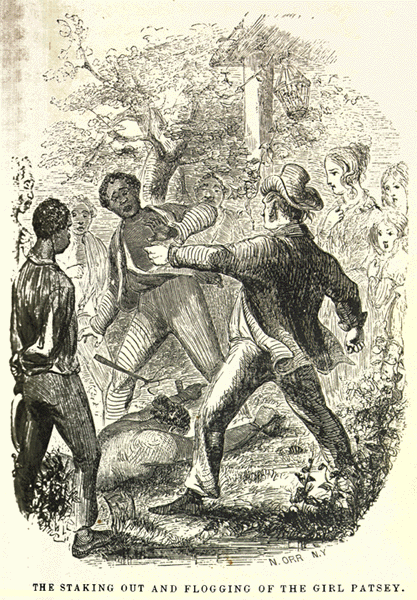
An incisive observer of human nature, Solomon sharply describes the psychological makeup of the alcoholic psychopath Epps, and the conflicting power relation binding Epps and his wife, complicated by his gratuitous fondness of the slave girl Patsey. We see in the movie Patsey suffers the brunt of her Mistress’ jealousy, and the maltreatment under her Master who tries to please his wife. The traumatic scene in the movie where Solomon is ordered by Epps to whip Patsey is described even more poignantly in the book. I’m surprised that the literary narrative has a more powerful hold on me than the visual rendition in this scene.

Flogging of Patsey copy

The memoir serves its purpose as a piece of personal narrative that’s poignant and deeply moving. The resilience and faith of Solomon Northup is crucial in his later being rescued. His longing for freedom and justice that is devoid of personal vengeance is most admirable and inspiring.

The rescue is a long and testing process, not so short as in the movie which I feel is a bit off balance. The adaptation should have given viewers a sense of the actual attempt especially in his home state of New York among those who try to find and rescue him. Thanks to the free-thinking, itinerant carpenter Bass from Canada who came to work for Epps for a short time, Solomon saw a crack opened for a chance to relay news back to the North by way of Bass.

Solomon had disappeared from the lives of his wife and three children for twelve years. Thankfully they were all well. When he reunited with them, he had the pleasure of seeing his newborn grandson, named after him by a devoted daughter. His youngest son Alonzo had the plan to make enough money to buy back his freedom if he could be located. It was indeed a moving scene as depicted in the following sketch from the book:

Family Reunion copy

After he had regained freedom, the slave trader Burch, ‘a speculator in human flesh’, was arrested and brought to trial in Washington, where he kidnapped and sold Solomon into slavery. However, Solomon was denied the right to be a witness against Burch for he was a black man. Burch was later found not guilty and discharged. Solomon wrote in his memoir:

A human tribunal has permitted him to escape, but there is another and a higher tribunal, where false testimony will not prevail, and where I am willing, so far at least as these statements are concerned, to be judged at last. (p. 319)

His faith in that ‘higher tribunal’ and an ultimate judge had carried Solomon Northup through the twelve years of slavery. His narrative not only is a voice that testifies against the injustice of man, but poignantly declares that freedom transcends physical bondage. Amidst inhumanity and despair, he had chosen to remain human, and to value integrity and faith. Solomon Northups’ ordeal is a glimmer of light in a dark page of history.

The Oscars dim by comparison.

~ ~ ~ ~ Ripples

CLICK HERE to read my movie review of 12 Years A Slave

***

Free Download:

Twelve Years A Slave, Narrative of Solomon Northup, NY, Miller, Orton & Mulligan, 1855, 336 pages, with appendix of legal documents and papers. You can download the PDF version of the original 1855 publication free here.

***

Saturday Snapshot February 8: Cabin Fever continues…

The snow and cold persist. I’ve to revisit Southern France to assuage cabin fever. Here are more photos from my Provence travels in the summer of 2010.

Avignon, the historic centre of Western Christendom in the Middle Ages. Its Palais des Papes, or, Palace of the Popes, is a UNESCO World Heritage Site. The Medieval Gothic architecture was designed as a fortress and palace, residence for the Popes. Six papal conclaves were held there in the 14th century.

Palais des PapesSigns pointing to others historic monuments:

Signs

The Bridge of Avignon, Pont St. Bénezet, or Pont d’Avignon, was built between 1177 – 1185, rebuilt in 1234 after it was damaged in a siege by Louise VIII, King of France. It was an important crossing over the Rhone River. Only four arches now remain:

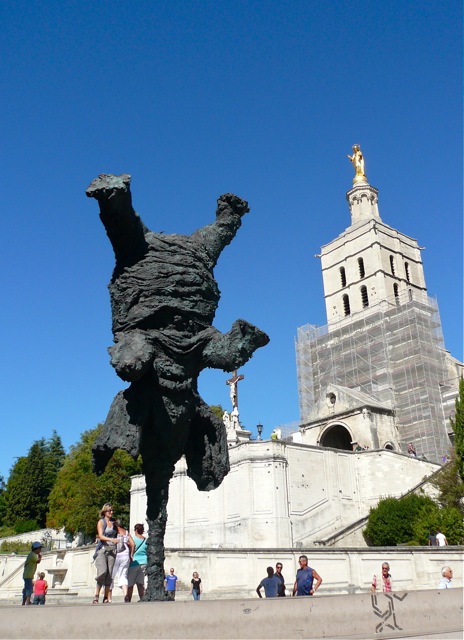
Pont d'AvignonNot all serious history though… Right outside the Palais Des Papes, I saw an elephant doing Yoga:

Elephant outside Palace of the PopesA closer look:

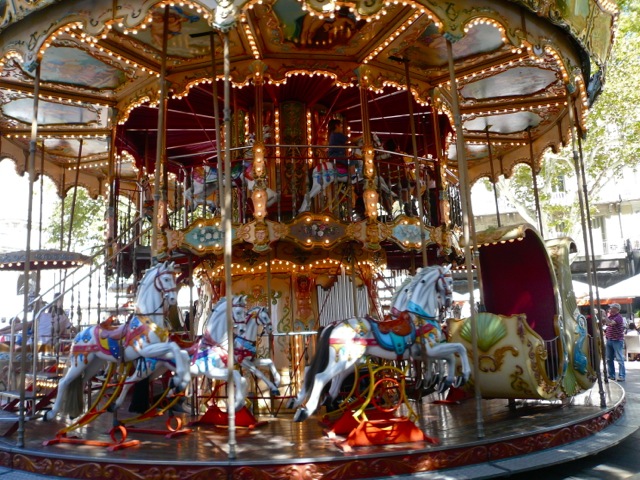
Elephant doing YogaAnd in the town centre, this beautiful merry-go-round:

Entertainment in town centreAnd puppeteers getting ready for a skeleton show:

Street performersSnap back to reality… no elephant in the room or dancing skeleton. And it’s -16C outside. Just let me hop back on that merry-go-round…

***

Saturday Snapshot is hosted by Melinda of Metro Mommy Reads.
CLICK HERE to see what others have posted.

ALL PHOTOS TAKEN BY ARTI OF RIPPLE EFFECTS.
DO NO COPY OR REBLOG

***

Saturday Snapshot January 25: Cabin Fever

It’s January 25, and we’re deep in winter. I don’t need any more photos to remind me of our seasonal deal, snow and ice. Saw the movie The Secret Life of Walter Mitty a couple of days ago. And Oh, how I need to unleash the Walter Mitty in me now, and let my mind zoom off to distant lands, warm, temperate, and colourful.

So here I am, travelling back to the summer of 2010, taking a road trip in Provence, France. A cure for cabin fever: I breath in the warm air, feast my eyes on colours and relive a most memorable family vacation.

We took a day trip from Avignon to Vaison la Romaine and Chateauneuf du Pape, passing through vineyards, stopping by markets.

A vineyard beside a 12th Century chapel in Vaison la Romaine:

Vineyard by 12th Century Chapel in Vaison

Grapes on vine

A street market. The colours … what a contrast to our wintry white and grey:

Street Market in Vaison

Colourful pots

Colours Colorful rolls

Motor carI like the kid here. What was he looking at?

The Kid

Or here, the yellow rose. Imagine opening your front door and be greeted by a cheerful, yellow rose:

The Yellow Rose

And the fan here. Just looking at it can cure cabin fever. Let your inner Walter Mitty take you for a ride:

The Fan

***

Saturday Snapshot is hosted by Melinda of West Metro Mommy Reads. CLICK HERE to see what others have posted.

ALL PHOTOS TAKEN BY ARTI OF RIPPLE EFFECTS. DO NOT COPY OR REBLOG.

***

Saturday Snapshot January 11: Inspired by Llewyn Davis

The movie Inside Llewyn Davis strikes me with its overall atmospheric tone colour. The almost black-and-white, cyan greyness that shroud the scenes convey a pervasive sense of melancholy. While I was seized by the gloominess, I also saw the beauty in the cinematography.

And the snow. During his trip to Chicago, Llewyn has to tread through snow on the streets, without a winter coat, without proper shoes. His socks are soaked through.

I took these two snow photos just recently. At first I wasn’t pleased with their lack of colour. But after watching the movie, I’ve come to appreciate them more. These are all colour photos, not black and white:

Snowflakes

Snowflakes 2

Without any green, trees can still be beautiful.

Tree

Trees

O the beauty of greyness.

***

Saturday Snapshot is hosted by Melinda of West Metro Mommy Reads. CLICK HERE to see what others have posted.

Photos in this post taken by Arti of Ripple Effects. Do Not Copy or Reblog.

***

CLICK HERE to read my review of the movie Inside Llewyn Davis.

Inside Llewyn Davis: A Serious Man in Greenwich Village

As preparation for the movie, I bought the CD soundtrack a few weeks before. This has proven to be a mistake, for I’d been listening to it so much that when I watched the film, I wasn’t surprised by the music at all. I consider that a loss. It would have been much better that I were mesmerized by that haunting voice of Llewyn Davis (Oscar Isaac) for the first time as I watched the movie.

Inside Llewyn Davis copy

Music is a major player in many Coen brothers movies, often used to comedic and acerbic effects. The whole odyssey in O Brothers Where Art Thou (2000) comes to mind readily, or Jefferson Airplane in A Serious Man (2009) where ‘Somebody to Love’ reinvents itself, or even in True Grit‘s (2010) ‘Leaning on the Everlasting Arms’ as we see the one-arm Mattie Ross riding into the sunset.

But in Inside Llewyn Davis, music is no laughing matter. Llewyn is the serious man here, a folksinger down on his luck. T. Bone Burnett has crafted an impressive music production. It should be noted too that Marcus Mumford, lead singer of Mumford and Sons and husband of Carey Mulligan, is also involved in the song arrangement and singing, in particular, the part of Llewyn’s duo partner Mike in ‘Fare Thee Well’.

The setting is New York City’s Greenwich Village, 1961. Llewyn is a folk music purist, an idealist. All he wants is a gig to kick off as a solo performer. The backstory is that his singing duo partner had committed suicide by jumping off the George Washington Bridge. The record he has produced as a soloist isn’t selling. It’s cold in NYC, Llewyn is homeless and coatless. Maybe it’s arrogance coming from being a music purist that makes him callous and abrasive, even to fellow folk singers, or maybe he needs to have that aloof hardness as an armour to sustain the slings and arrows life hurls his way.

O, if only Llewyn’s personality were as charismatic as his voice, he probably would have done better in life. Despite his musical talents, our protagonist, like a Shakespearean tragic hero, is trapped by his own character flaws and tripped by no small amount of fate, he slips slides into the wayside. Sadly, that’s exactly where he lands at the end of the movie.

He has friends and acquaintances, but there’s not much that they can do to help. He has already made the best use of their couches, and some of their wives. The latest to get pregnant is Jean, played against type by the sweet Carey Mulligan, all wrapped up in anger, understandably so, for her friend Llewyn is more concerned about a lost cat than her upcoming abortion. Jean has a very limited vocabulary to express herself except the overused expletive. Not a pleasant role to play I’m sure. Her character could have been written with a bit more depth.

Oscar Issac, Justin Timberlake, Carey Mulligan copy 2

Jean and her husband Jim (Justin Timberlake) are also folk singers but ‘careerists’ according to Llewyn. They would one day concede to life in the suburb, settle down and have kids. ‘Is that so bad?’ Jean asks Llewyn. The answer is obvious. Llewyn is definitely not going down that path.

Talented folk singers converge at the Gaslight Café in Greenwich Village during the 1960’s. Why some succeed and others don’t, the Coen brothers seem not so much to offer rational explanations than to depict the misfortunes of one. In that dim, brick-walled and smoke-filled Café, we hear some fantastic singing. We hear Jim, Jean and their friend Troy (Stark Sands) perform ‘Five Hundred Miles’, evoking Peter, Paul and Mary. At one point, to an oblivious Llewyn, we see the silhouette of what looks like Bob Dylan and hear his voice singing ‘Farewell’.

Cinematography (Bruno Delbonnel) sets the mood from the opening scene. In that basement Café, we see the place dimly lit with spotlight on Llewyn’s face, as his ‘Hang Me, O Hang Me’ captivates us right away. We follow him later as he steps outside to a pitch-dark alley where he meets his nemesis. Even during the day, we see him walk on wind-swept streets under dull, grey sky. The overall bleakness can be soothed only when Llewyn picks up his guitar and sing. His voice seems to be able to neutralize any outrageous fortune.

Llewyn takes a surreal road trip to Chicago to try his luck with a club owner Bud Grossman (F. Murray Abraham, a double for Bob Dylan’s manager Albert Grossman?) He is stuck in the car with the old and sardonic Roland Turner (John Goodman) who wraps up his opinion in one short line: “Folk singer? I thought you said you were a musician.” If the trip seems absurd, it could well be the exact impression the directors intend. We follow one week in the life of Llewyn Davis, a week of failed attempts, gloomy encounters, and bleak prospects. The only light is the voice.

~ ~ ~ 1/2 Ripples

***

Related Reviews on Ripple Effects:

A Serious Man (2009)

True Grit (2010)

***

And The Word Was Made Homeless

Awesome Sky

The House of Christmas

by G. K. Chesterton (1874–1936)

There fared a mother driven forth
Out of an inn to roam;
In the place where she was homeless
All men are at home.
The crazy stable close at hand,
With shaking timber and shifting sand,
Grew a stronger thing to abide and stand
Than the square stones of Rome.

For men are homesick in their homes,
And strangers under the sun,
And they lay on their heads in a foreign land
Whenever the day is done.
Here we have battle and blazing eyes,
And chance and honour and high surprise,
But our homes are under miraculous skies
Where the yule tale was begun.

A Child in a foul stable,
Where the beasts feed and foam;
Only where He was homeless
Are you and I at home;
We have hands that fashion and heads that know,
But our hearts we lost – how long ago!
In a place no chart nor ship can show
Under the sky’s dome.

This world is wild as an old wives’ tale,
And strange the plain things are,
The earth is enough and the air is enough
For our wonder and our war;
But our rest is as far as the fire-drake swings
And our peace is put in impossible things
Where clashed and thundered unthinkable wings
Round an incredible star.

To an open house in the evening
Home shall men come,
To an older place than Eden
And a taller town than Rome.
To the end of the way of the wandering star,
To the things that cannot be and that are,
To the place where God was homeless
And all men are at home.

*****

“And the Word was made flesh, and dwelt among us.” John 1:14

**

(Photo taken by Arti of Ripple Effects, Sept. 2010. All Rights Reserved.)

***

 MERRY CHRISTMAS EVERYONE!

 
***


12 Years A Slave (2013): Beauty and Sadness

UPDATE Feb. 16: 12 Years A Slave just won BAFTA 2014 Best Film and Chiwetel Ejiofor, Best Actor. 

UPDATE: 12 Years A Slave is nominated for 9 Academy Awards including Best Picture, Best Director, Best Actor, Best Supporting Actor, Best Supporting Actress, Best Adapted Screenplay, Best Costume Design, Best Production Design, Best Film Editing.

Movies this season seem to come in pairs in terms of subject matter, which makes interesting viewing. Gravity and All Is Lost is a pair. Lee Daniel’s The Butler and 12 Years A Slave another. I watched them purposely back to back.

12 Years A Slave is powerful in many ways, most readily is the aesthetics and styling, both visual and audio. Before he turned to directing, Steve McQueen was a visual artist trained in fine art in London and New York, and it shows. His cinematic work is a testament to the fact that film is a mixed-media art form. More importantly, it shows that film art does not have to be esoteric, or be appreciated only by an ‘artsy’ few. 12 Years A Slave is an exemplar. It carries no elitism but speaks to all. What more, the subject matter may be ugly, but the medium depicting it can be artistically gratifying, thus, conveying the message with even greater potency and inspiration.

12 Years A Slave Poster copy

The film is an adaptation of the 1855 memoir written by Solomon Northup, a free black man, known for his skills in playing the violin. He was living happily with his wife and two children in Saratoga, New York. One day, two men came to offer him a gig to play the fiddle at a circus. Solomon was deceived, drugged, and later smuggled to Louisiana to be sold as a slave. There for twelve years, he endured insufferable hardships until he miraculously met a Canadian carpenter named Bass who stood against slavery. With his help Solomon found freedom and rejoined his family.

I disagree with some critics who assert that the film is too artfully directed, pristine and sanitized to convey the ugliness of the subject matter. One of the qualms they have is with a scene at the beginning of the movie wherein a beating is being shot with artful camera work and lighting. After he is drugged and chained in a dark holding cell, Solomon is fiercely beaten until the torturing paddle breaks in two. Amidst the total darkness in that filthy cell, we see him cower in pain, yet his white shirt literally shines. I noticed that scene too and appreciated how well it was shot. For me, I saw the glowing white garment as a powerful symbol of purity and innocence amidst utter depravity. I’m glad there’s an artist/director to helm this film. We are seeing how the cinematic medium can be sculpted to its full potential. I don’t see anything ‘art’-ificial about it or sense any contrivance.

The issue here is the paradox of conveying ugliness in a well-crafted and artful frame. I have no qualms with that. Should art capture beauty only? Or, should ugliness be depicted by casual and shoddy work in order to be ‘realistic’? The answer is elementary. A quality medium can only enhance the poignancy of the message.

On another level, the film shows us that amidst evil, beauty can still be found. It exists in the persevering spirit of Solomon Northup. Herein lies the inspiration of the story. I found this quote from an excellent interview article with director Steve McQueen. It speaks to the fact that, in the midst of utter sadness, the human spirit can still glean what’s positive and beautiful. From the memoir of Solomon Northup we read these words:

There are few sights more pleasant to the eye, than a wide cotton field when it is in the bloom. It presents an appearance of purity, like an immaculate expanse of light, new-fallen snow.

Acclaimed British actor Chiwetel Ejiofor’s performance as Solomon Northup is inspiration itself. His nuanced expressions portray clearly some very mixed and intense emotions under the most desperate of circumstances, like consoling a female slave lying next to him at night and yet keeping his integrity, or being forced by the sadistic Epps to whip another slave. Even at the point of despair, Solomon maintains his self-respect, remains upright and kind, and upholds a human spirit that no whips can break. The actor is also heading straight to the Oscars according to consensual predictions.

Glimpse of hopeThe excellent supporting cast also renders beauty to the overall production, some of whom might garner recognition of their own come Awards time. Newcomer Lupita Nyong’o is impressive as fellow slave Patsey, a desperate soul dangled on the edge of survival and despair. Paul Giamatti (who won a Golden Globe as John Adams in 2009) plays a mercenary slave trader. The excellent character actor Michael Fassbender (in both of McQueen’s previous films Hunger, 2008 and Shame, 2011) as slave breaker Epps embodies the wickedness of the system and a soul derailed. Paul Dano (There Will Be Blood, 2007; Prisoners, 2013) is within type as the murderous slave driver Tibeats. Again the paradox appears. We’re glad to see actors giving superb performance playing villainous roles.

Then there’s the versatile Benedict Cumberbatch, picking up a Southern drawl to portray the kind slave owner Ford. His scenes with Solomon offer some needed relief. Unfortunately, those better days are short-lived. The man who helps Solomon to freedom is Canadian Samuel Bass, very short screen appearance by Brad Pitt. He is an itinerant carpenter working on Epps’ land. This chance encounter makes Solomon aware of Bass’s anti-slavery stance. For the first time in all those years of captivity, he confides his true identity in someone trustworthy and pleads for Bass to contact help in his home state up north.

The music and sound, or the lack of it, are equally effective. Composer Hans Zimmer’s soundtrack ‘Solomon’ is epic and heroic. The spirituals sung by the slaves on the plantation express their deep yearnings for release and freedom. In one scene towards the end, we see other slaves singing their heart out the spiritual ‘Roll Jordan Roll’. At first Solomon listens as a bystander. After a while he can’t help but pour his soul out and join in. That’s the point he totally identifies with the others in their hopeless condition, calling out to God for deliverance.

What follows is memorable. Sometimes silence speaks louder than sound. That moment of silence marks the change of fate for Solomon. I was captivated by the lack of sound, and the camera static, closing up on Solomon’s face of apprehension and despair for a long minute. Often it is the slow, silent space a director allows us to absorb and wait that I appreciate most.

As I stepped out of the theatre, I breathed out a sigh of satisfaction. True there was much sadness in Solomon’s story, but I was relieved to see ultimately his perseverance pay off. I was gratified too that this story of the human spirit triumphant is well told in a meditative pace, sculpted artfully, and delivered by poignant performance. This is the beauty of film art.

~ ~ ~ ~ Ripples

***

Related Links:

My Review of 12 Years A Slave the memoir by Solomon Northup

Download 12 Years A Slave the book

Solomon Northup from Wikipedia

The Underground Railroad

***

Saturday Snapshot Nov. 16: Magical Realism

At first, what drew my attention were the birds on top of the distant trees, sillouetted against the predawn sky. What were they?

Before SunriseBefore Sunrise 1Must be the hardy European Starlings, I thought. My birding instinct prodded me to get out of the house to find out, at 7:30 am, in -13C temperature.

As I got closer, their buzzing sound reminded me that I’d heard them before, in flocks, making sounds almost like cicadas, but lighter, more metallic and electric. By then, morning had broken. Indeed, they were not Starlings but Waxwings.

Morning has brokenThe sun shed its glorious light and I was much gratified to see that all those plump bellies were not Cedar Waxwings which I’d seen in the summer. From their grey pot belly, I could tell they were Bohemian Waxwings. Of course, they will be spending their winter here. The Cedar Waxwings had all gone south.

Bohemian WaxwingsWhat attracted them to our neighborhood? My stalking skill led me to find out. Ah… berries:

Frozen berriesIt was a delight watching them feast on these frozen fruits for breakfast:

Bohemian WaxwingsGot it!

Got itAnother oneSoon, washed by the glowing sunrise, their greyish plumage began to change into a magnificent color. No CGI (computer-generated images) here:

No CGIJust pure magical realism:

Washed by the morning sun

Magical Realism

Bohemian Sunrise

***

Saturday Snapshot is hosted by Melinda of West Metro Mommy Reads. CLICK HERE to see what others have posted.

ALL PHOTOS IN THIS POST TAKEN BY ARTI OF RIPPLE EFFECTS, NOVEMBER, 2013. PLEASE DO NOT COPY OR REBLOG.

***