All Is Lost (2013)

If Life of Pi (2012) is magical realism, then All Is Lost is absolute realism. Some say it’s a modern version of Hemingway’s The Old Man and the Sea. I tend to see it as the flip side of Life of Pi. It is the magical, the supernatural that we pant for while watching the man in the film silently struggle to stay alive in the middle of the Indian Ocean. Without a miracle, this is what it is.

At the back of my mind was this query… In our age driven by visual spectacles and mega sights and sounds, why would someone take up a project of this nature, a 106 minute feature film with just one character and no dialogue, except for a few words from voice over in the opening when the man utters what seems to be his last words to his loved ones.

I admire the courage and talent of writer/director J. C. Chandor, who writes a 32 page script (according to IMDb) and directs it as a minimalist production in a time when the movie industry has gone ultra mega and high tech. All Is Lost is only Chandor’s second feature film. His directorial debut which he also wrote? Margin Call (2011), about the tempest in the tumultuous ocean of investment banking. Versatility is the mark of talent indeed.

But the film belongs to Robert Redford. No longer The Sundance Kid (1969) here but a 77 year-old actor playing a man dangling over the edge of survival. Redford just might have put forth the definitive performance in his long career. He has taken on the role with grace and gentleness, a paradox to his predicament in such a physical drama. He carries the whole film by engaging our empathy. His screen presence is the replacement of fancy plot lines, setting and dialogues. He plays a character with no name. Only when the end credits roll do we find out that he is called ‘Our Man’. 

Robert Redford in All is Lost

Unlike Tom Hanks in Cast Away (2000), who speaks and yells his mind, and socializes with a volley ball, Our Man is the epitome of restraint. He is the strong and silent type of veteran sailors on a solo voyage, who encounters the misfortune of being stranded in the vast ocean. At the beginning of the film we see Our Man wake up to find his sailboat has been hit by a loose cargo container floating by. The sailboat is taking on water through a hole in the hull. The radio and equipments are damaged. Our Man deals with the situation resourcefully. He uses a repair kit to mend the damage, pump water out, dry out his boat. We see him eat and shave. 

Just as he has made some headway to restore safety, an impending storm blows his way. Our Man is no match for nature’s callous ferocity. He ends up having to escape a sinking boat and jump into a life raft, bringing with him a meager supply of food and water. He learns to use a sextant, and carefully charts his drift. His only hope is to be seen if his raft drifts into the course of cargo ships. He utters no words except for a futile S.O.S. call while in his sinking boat, and one expletive out of total frustration in the raft after a few days of bare survival.

One man, one raft, one sea. The wide-screen cinema is probably the best medium to depict such an existential predicament. We don’t need special effects, for this is all that we have. And the nameless ‘Our Man’ shows how universal he is. And what of him? A patient and courageous man trying with all that he has and all that he is to stay alive, waiting to be found, hoping to be saved.

Do we need to know the name on that cargo container that hit his boat? It really is immaterial considering all that Our Man has gone through and all the efforts he has put forth to be saved. But just for information, we see the name in English, ‘Ho Won’, an obvious translation from the two Chinese words below: “Good Luck”. A jest too harsh.

Spoiler Alert. If you have not seen the film, you might want to skip the next paragraph, just that one. If you have seen the film, you’re most welcome to share your thoughts on the ending.

Like Life of Pi, the ending is open to your own interpretation. Two lines of thoughts conjured up as I watched the open-ended final scene: Only when one has lost all would one be saved. Or, go into that good night with gentleness, for brightness awaits. I can see both these scenarios to be applicable here. Again, this is one of those films that leaves the viewer to draw the conclusion, a type of ending which may not be very popular but one that conveys the multiplicity of reality.

As the credits roll, we hear the song for the film. I first thought singer songwriter Alex Ebert was calling ‘Our Man’ throughout his song. As I later found in the credits, it was ‘Amen’ (with the ‘Ah’ sound). Yes, ‘Amen’ is the title of the song.

A fine movie to watch with a quiet mind and patient disposition. A necessary offering in our present day of excess among some numbing and mindless entertainment. It’s like holding your breath in your hectic course of life for 106 minutes, and survive.

~ ~ ~ Ripples

***

Click here to listen to Alex Ebert’s song ‘Amen’ and watch the trailer of the movie All Is Lost.

***

Saturday Snapshot Nov. 2: Cool Blue

Blue is the most cool color for a photo background. Note: not the ‘coolest’ like in temperature, but just real cool as in awesome. We in southern Alberta are blessed with a clear, blue sky most of the time. Here are some photos I’ve taken in the past weeks. No color alteration have been done on them.

On a clear day, you can see the Rockies… like a mirage:

On a clear day you can see...Different shades of blue:

ShorebirdsThe sparrows on the roof enjoy the cloudless blue too:Sparrows nesting on roofCrab apples look more colorful:

CrabapplesSo’s the Northern Flicker:

Northern Flickerand the Pelican, more startling white:

Pelican overheadWe can even live with the snow when the sky is so blue:

God Is LoveWords on the frame of front door: “gud er kaerlighed” (Danish)… “God is Love”.

Which blue is most cool for you?

***

Saturday Snapshot is hosted by Melinda of West Metro Mommy Reads. CLICK HERE to see what others have posted.

All photos on this post taken by Arti of Ripple Effects, 2013. Please do not copy or reblog.

***

Is This A Library?

(Title inspired by Stefanie of So Many Books)

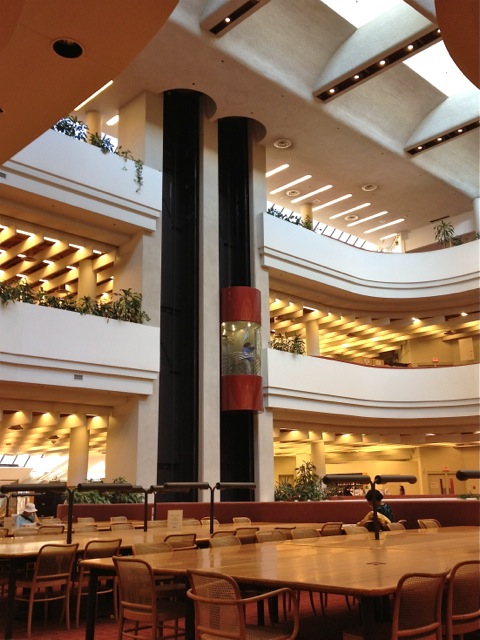
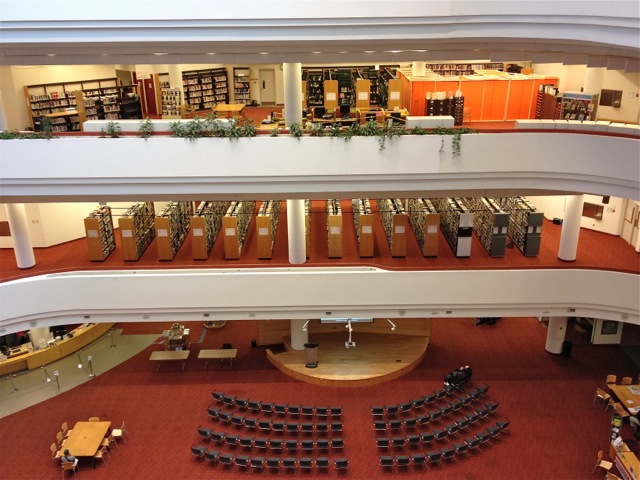
I gasped and asked myself this question. For Saturday Snapshot Sept. 21, here are some views:

Indoor pond at entranceIMG_1170IMG_1174IMG_1175IMG_1173The answer to the question of course is Yes. It’s the Toronto Reference Library. I was most excited to have made a serendipitous find in there too.

There was a gallery in the library. Its current exhibit was entitled
FLIGHT: A THRILLING HISTORY OF AN IDEA.

Human has long been mesmerized by the idea of flight.

From Daedalus:

Daedalus

to Da Vinci:

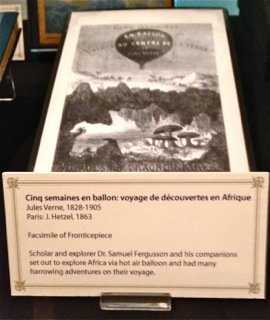
Leonardo Da Vinci and FlightFrom Jules Verne:

Jules Verneto Audubon:

Audubon

Yes, it’s a library all right.

***

Saturday Snapshot is hosted by Melinda of West Metro Mommy Reads. Click Here to see what others have posted.

***

Blue Jasmine (2013): Homage and Re-Imagining

Sometimes when we see different versions of an original piece of art we tend to dismiss them as cheesy imitations, turning art into a cliche, like, the many faces and parodies of the Mona Lisa.

And sometimes, when we see a work that we know is a new version of an older masterpiece and yet we appreciate it, all because it brings us a breath of fresh air, a different perspective, new insights, a re-imagining, or offers us some new pleasures.

Here are a few examples. Robert Bresson’s Pickpocket (1959) is the auteur’s version of Dostoevsky’s Crime and Punishment, and movingly crafted. West Side Story (1961), we appreciate it as a different styling of Romeo and Juliet. Kurosawa’s Ran (1985), we know it to be a Japanese rendition of King Lear, and we marvel at the director’s handling of a Shakespearean classic from a different culture. A bit later, the younger generation in the 1990’s enjoyed Clueless (1995) even though they may not have noticed the resemblance to Jane Austen’s Emma. With Disturbia (2007), we see Alfred Hitchcock’s Rear Window making its way into the minds of teenaged viewers, and who cares that they didn’t even know it.

Woody Allen has done that many a times in his over four decade career as a director, creating different versions of the works from those he had expressed deep admiration. Call it homage, if you will, or borrowing, but we never have the impression that he’s ‘copying’. Copying is mindless triviality. But a look at Allen’s Interiors, we’ll see the deep shadow of Ingmar Bergman’s Cries and Whispers, the intense yet intimate styling of a chamber drama. Or Hannah and Her Sisters, an apt parallel with Bergman’s Fanny and Alexander. Crimes and Misdemeanors and Match Point, we see him deal with the issue of Dostoevsky’s Crime and Punishment, or rather, crime and the absence of punishment. I’m sure you can think of some more examples.

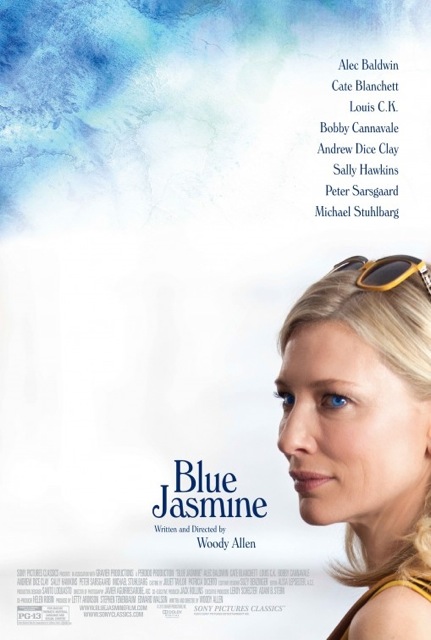
Blue Jasmine Movie Poster

So here with Allen’s 48th feature Blue Jasmine, does it matter that its structure and characterization parallel Tennessee Williams’ A Streetcar Named Desire, the Elia Kazan 1951 classic movie? Especially when we see such a finely crafted, enjoyable, and impressively performed modern version, we can only admire Allen’s imagination and creativity. I have a feeling that he (or his casting staff) gets Cate Blanchett to star as Jasmine because of her on-stage mastery of Blanche Du Bois in Tennessee Williams’ A Streetcar Named Desire performed not too long ago.

With Blue Jasmine, the 77 year-old director seems to have hit his stride yet again. Two years ago, Midnight in Paris brought him the highest opening box office gross in his career, now Blue Jasmine has surpassed that. Blue Jasmine will also be the widest screened Woody Allen movie, so far. It reaffirms the director’s talent in how he can bring out the best from his actors.

Cate Blanchett turns from blanche to blue, but just the same as she steps down the social ladder in a fragile mental state, dependent on a cocktail of alcohol and anti-depressants. She is Jasmine, a New York socialite who has to go stay with her working class sister Ginger (Sally Hawkins) in San Francisco after her husband Hal (Alec Baldwin) meets the full legal consequence of his fraudulent business dealings, a definite change of course from Allen’s earlier movies Crimes and Misdemeanors and Match Point.

The real and imaginary in Jasmine’s mind is smoothly shifted as we see her delusional self living in the present and the past at the same time. Allen handles it very well. The non-lineal storytelling is seamless. Blanchett is superb in her lucid performance, portraying convincingly a whole spectrum of emotions and mental states, while tugging at our heartstrings as we see her try desperately to stand on her own two feet for the first time in her life. This is where Allen is best, piercing sad human situations with light and gentle humor.

Allen has plenty of materials to poke fun at and chances to deliver his social commentaries. Yes folks, there is a class system in democratic America, and the humor in the film is at the expense of both the upper class and maybe more, the menial workers. Mind the gap, for it is unbridgeable. Fact is, the fun of the film, I’m afraid, is at the expense of depicting some of the characters a bit like caricatures. Having said that, I must applaud the wonderful acting from the supporting cast. They look like they are convinced first of their character’s idiosyncrasy, making their portrayals so unabashedly natural.

Further, Allen seems to redeem himself in presenting a moralistic stance. True love can be found right there in Ginger’s circle with her devoted boyfriend Chilli (Bobby Cannavale), whom Jasmine calls a ‘loser’; the deceivers are from the upper crust, Hal (Alec Baldwin) being the prominent figure. Others who may look like a step up for Ginger could well be a mirage. The wonderful supporting cast includes Andrew Dice Clay as Ginger’s ex-husband Augie, Louie C. K. the seemingly hopeful sound engineer, Michael Stuhlbarg, the serious man turned desperate dentist, and Peter Sarsgaard as Dwight, no doubt the parallel of Mitch (Karl Malden) in A Streetcar Named Desire (1951).

Blanchett’s Jasmine performance has already sent out Oscar buzz, and it’s only August. She carries the film through brilliantly. An Oscar nomination should be well deserved. We are glad to find too that Allen has not missed a beat after his success with Midnight in Paris, still churning out enjoyable films on an annual basis, while sometimes a superb actor can much enhance our appreciation, as it is the case here. 

~ ~ ~ Ripples

Other related posts:

Midnight In Paris

A Serious Man (Michael Stuhlbarg)

An Education (Peter Sarsgaard)

Do we need a Rebecca Remake? Another Grapes of Wrath?

Art and Cliché

***
Saturday Snapshot: Blue Moon Rising

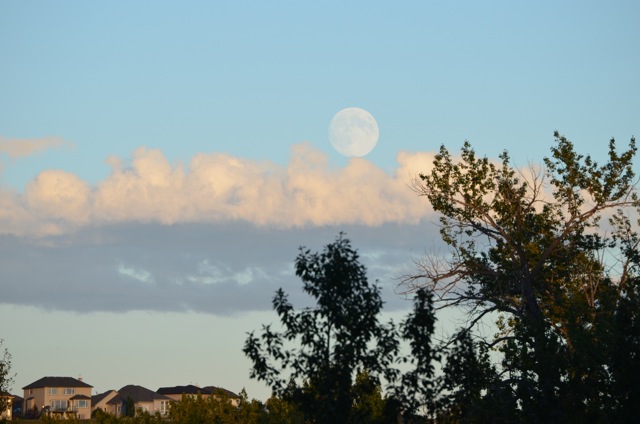
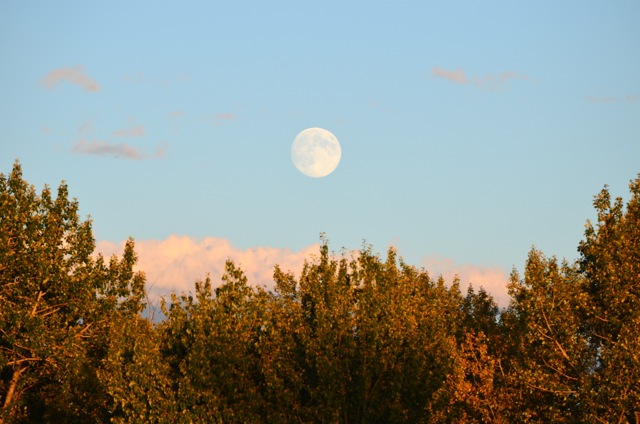
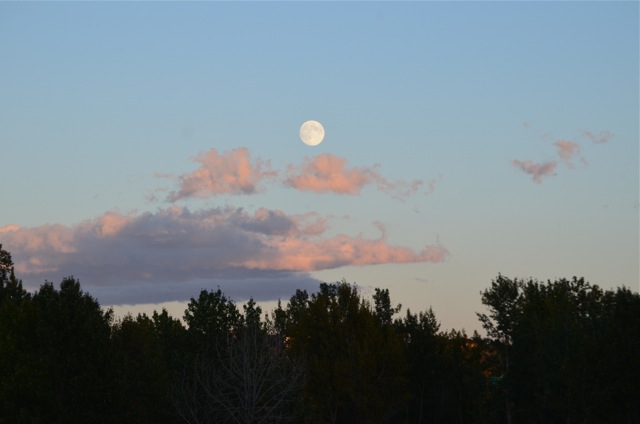
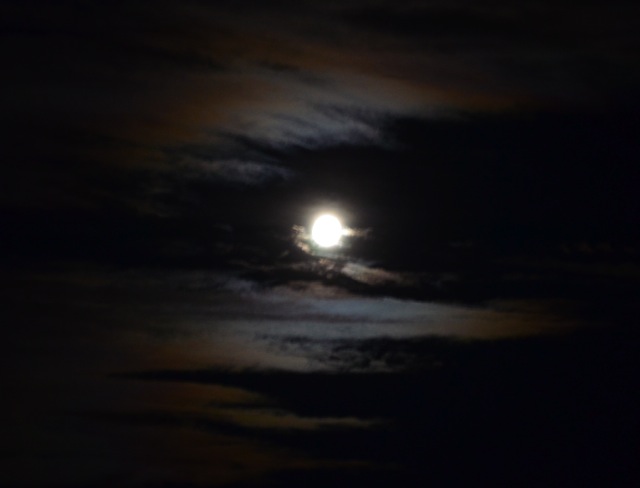
… well almost, since I took these photos on August 19, one day before the actual blue moon appearing. But I was awe-struck just the same. Knowing nothing about the astronomical phases at that time except simply captivated by the beauty of the rising moon while birding, I took these photos.

Not until the next night did I learn about the Blue Moon, elated that I had caught the moonrise serendipitously the day before. Here’s a shortened sequence:

Moonrise 1Moonrise 2Moonrise 4

Moonrise 5Moonrise 6Moonrise 7Moonrise 9Once in a blue moon, I can get the date right. But I’m happy just the same to have hit it a day early out of the blue. Why, the next night was cloudy. So this is a blue moon for me.

All photos on this post taken by Arti of Ripple Effects.

Please DO NOT COPY OR REBLOG.

***

Saturday Snapshot is hosted by Melinda of West Metro Mommy Reads. Click here to see what others have posted.

***

Before Midnight (2013): Reality Check

Spoiler Alert: It’s impossible to discuss this film meaningfully without giving out the storyline, same with the two prequels.

***

We are gleaners of memories. An interesting parallel applies to the two characters Celine and Jesse as well as ourselves as audience. But if you haven’t seen Before Sunrise and Before Sunset, it would enhance your viewing pleasure to watch them first.

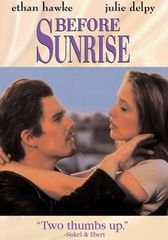
Flashback: Before Sunrise (1995)

Before SunriseTwo young people, Parisian Celine (Julie Delpy) and American Jesse (Ethan Hawkes) meet on a train passing through Europe. They strike up a conversation and become so in-tuned with each other that when the train arrives Jesse’s stop in Vienna, he convinces Celine to get off with him even though her destination is Paris. There for just one night until sunrise, they walk around the city and talk about life, death, love, religion, relationships, and being transients… for they know this may well be their only encounter with each other in both of their lives. The next morning Jesse has to fly back to the U.S. As they part, they promise to meet again in six month at the same hour, on the same train platform. Throughout the film, we feel fate, or whatever you call it, has a strong presence in their short few hours together. We feel their sincerity in capturing those precious  moments, as we hear Celine’s words ring true:

“If there’s any kind of magic in this world… it must be in the attempt of understanding someone sharing something.”

Flashback: Before Sunset (2004)

Before SunsetNine years after that chance meeting, Jesse is in Paris on the last leg of a book tour. He has written a book based on that memorable encounter nine years ago. At the Shakespeare and Company bookstore, Celine shows up. They now meet for a second time, again for a short few hours before Jesse has to leave on a plane to fly back to the U.S. Their conversation reveals that, alas, their well intended reunion six months after their first chance meeting has turned into a star-crossed, missed opportunity. After that, fate has led them down separate paths. Jesse is now married and has a son. Celine, still on her own, yearns for that first romance to develop but now seems even more elusive.

To the present: Before Midnight (2013)

Before Midnight

So we have been following Jesse and Celine like a longitudinal study, albeit meeting them just twice within this eighteen year period. In the first two films, director Richard Linklater has us follow Jesse and Celine in real time through long takes, walking along with them in Vienna and Paris, listening in on their conversations and see them pour their hearts out, just to be heard, to be known. Those were romantic moments. This time is summer in Greece; this time is reality check.

We see Jesse and Celine now married. What happens in between those nine years is that Jesse has divorced his wife in Chicago, come over to Paris, married Celine and together they have two lovely twin daughters. But things aren’t so idyllic, for Jesse is troubled by not being around for his now young teenaged son Hank from his previous marriage and whom he can only see in the summer. The film begins with Jesse seeing his son off at the airport.

For the next 15 minutes and in one stationary take through the front windshield of the car, we see a happy couple Jesse and Celine driving from the airport to a Greek country house, with their twin daughters sleeping in the backseat. We hear them talk, yes, they love to talk to each other, just as we’ve seen in the past.

In the setting of an idyllic seaside residence, Jesse and Celine join a small gathering of writers. we see them prepare and eat healthy Greek salads and discuss equally idyllic topics such as writing, love, knowing each other, virtual reality (yes, for the contemporary effect), and being transients in life. Again, that first train encounter comes to mind. In conclusion they drink to ‘passing through’.

The next act is reminiscence of previous Before films… Jesse and Celine walk to a hotel paid for by their writer friends, who have also taken up the duty of babysitting their twins so the two of them can fully enjoy each other for the night. For twenty minutes the camera follows them in real time strolling through some scenic rural town toward their country hotel, exchanging thoughts like before. But no, not totally like before, for now they are eighteen years older, 41, and each with emotional undercurrents running deep.

Five minutes in the hotel room, discordant riptides begin to surface. Talk turns into quarrel. Why, this is just too real. In the past, we see them only in romantic mode. Now as they expose their underlying thoughts and suspicions, tempers flare, words turn callous. We would silently say ‘ouch!’ occasionally.

The beginning scene of the first film, Before Sunrise, has become a stark foreshadowing… sitting near Jesse and Celine on that train, two middle-aged couple argue fiercely in German. Seeing their temper flare but not understanding what they were arguing about, Jesse and Celine ponder on the question of how two people can grow old together in harmony.

Now here in what is supposed to be an ideal get-away, for twenty minutes we are the invisible witnesses of a marital conflict, and we would want to stay in there to see what happens next, not because of the schadenfreude effect, but because this is just too real.

Romance is holiday, marriage is work.

Hawke and Delpy own these scenes depicting realistically what marriage could entail. Other films readily come to mind… Ingmar Bergman’s Scenes From A Marriage (1973) and Woody Allen’s Husbands and Wives (1992). Before Midnight is a contemporary version, with a highly watchable backdrop and natural performance. Unlike Bergman and Allen, Linklater is commendable in crafting a more positive ending. It’s refreshing to see a glimmer of hope at the end of nasty quarrels.

In the final act, Jesse attempts to woo his wife back. How he does it is most endearing. Every moment in the present is an opportunity to create a fond memory to look back to in the future. This complicated package called love is a piece of work. Director Linklater and his two stars, who co-wrote the screenplay with him, might well have passed to us the secret of marital success… Before too late, glean fond memories from the past to sustain the relationship at present; before too late, create more loving memories to carry it into the future.

One line from Celine in Before Sunset is most apt here: “Memory is a wonderful thing if we don’t have to deal with the past.” Jesse might have known this too well, not to leave the present a mess for future to deal with, but leave it as a pleasant memory to cherish in the days ahead.

With a trilogy of films beginning with the word ‘Before’ in the title, we should know that time is of the essence. Time to make the present a memorable past for the future, before too late.

That line still lingers as the film ends… ‘To passing through.’

~ ~ ~ 1/2 Ripples for all three films

***

Munch 150: The Works Still Scream

This captivating documentary is the second installment of the ‘Exhibition: Great Art On Screen’ series with host Tim Marlow. An ‘event film’, the term refers to this kind of doc focusing on a special occasion, here, the 150th year of the renowned Norwegian expressionist Edvard Munch’s birthday (1863-1944). To celebrate, a comprehensive exhibition of Munch’s works is being held in two venues in Oslo from June to October, 2013, the National Museum and the Munch Museum. The film captures the highlights of this exhibition.

I soon learned too that the theatre charged more for the experience. However, the $17 ticket is acceptable. Short of seeing the actual paintings at the two venues and being free to walk around, I’ve saved a hefty plane ticket to Oslo, and I get to see the works magnified clearly on the big screen and hear expert commentary so I can appreciate even the minute brushstrokes up close. Sure, I can always wear a headphone, if it’s available, to hear the commentary while walking through the exhibition. But it’s a refreshing experience to look at the paintings enlarged on a giant screen, hearing in-depth analysis juxtaposed with dramatized biopic vignettes as I sit back and eat popcorn in a dark, air-conditioned theatre on a hot summer day.

The film Munch 150 has aptly taken advantage of the medium of the cinema. Unlike the previous film in this series, Manet: Portraying Life, which ironically, is devoid of life, Munch 150 has presented to the viewer what such a medium can best do. The camera as a guide and magnifying glass, projecting onto the big screen images larger than life, accompanied by insights from curators and host Tim Marlow, an audio-visual experience. Yes, I’ve mentioned ‘big screen’ several times. That is essentially the benefit that the TV screen or your computer monitor would not suffice.

Edvard Munch (Norwegian pronunciation: [ˈmuŋk], in English, something like ‘Moonk’ with a glottal sound on the ‘n’) was born in 1863 in a small Norwegian village. His family moved to Kristiania (now Oslo) the next year. From an early age, Munch was haunted by death and illness. He first saw his mother die of tuberculosis when he was five, and later, his beloved older sister Sophie tormented and died of the same illness when he was fourteen. He himself was plagued by frequent sickness, and at one time was near death with tuberculosis. Physically struggling with poor health, inwardly, Munch was often stricken by desires and guilt. Nihilistic thoughts added burning fuel to an already troubled soul. These all led to alcoholism, depression and breakdown later in life.

Writing and painting became his outlets. Journals allowed him to spill his thoughts, and the canvas was the visceral medium for him to release deep, psychological turmoils. His fears and anguish, all angst and pains found expression in his art.

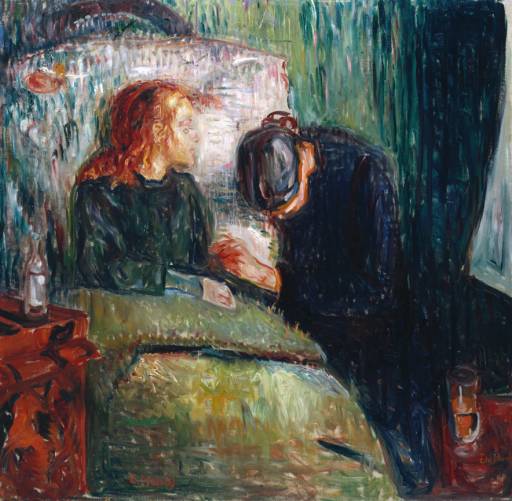
The Sick Child

I was particularly impressed by his early work The Sick Child (1885-86), depicting the trauma he had experienced as he watched his beloved, ailing sister Sophie lay in bed frail with tuberculosis. A grieving woman holding her hand, head bowed in sorrow. It was a disturbing scene, and yet I’d appreciated the colours and brushstrokes that seemed as if they were just rendered in a free and haphazard way. From the commentary, I felt the poignancy.

The Sick ChildThe camera and commentator guided me to see the scratches left on the canvas, most noticeably on the pillow near Sophie’s face, something which I wouldn’t have noticed if I just walked by it in the museum. These scratches were troubling to look at, probably made by a pallette knife, or a hard brush. They were marks of anguish and frustration, the outburst of emotions during what must have been a painful process. Munch always left ‘blemishes’ on his paintings. Here, the scratches and patchy layers of paints on paints showed raw emotions unleashed. That was the reason the work was met with criticisms and rejections in his day. It was not pretty and neat as his predecessors had done. He was, literally, painting outside the lines.

The Frieze of Life

Many of Munch’s more well known works are in the series called The Frieze of Life—A Poem about Life, Love and Death. The Munch Museum in Oslo exhibits the paintings as a series on four white walls in a room — and here’s the unconventional — without frames. The curator commented that this was what Munch would have intended. Without the distractions of the frames, the paintings speak out loud and clear. In The Frieze of Life, Munch explored the very essence of being human, the frameless, existential experience that is universal.

The Scream (1893)

The_ScreamThe Scream is in the section of The Frieze of Life categorized as ‘Angst’. It is the most well-known of Munch’s paintings. A deathlike skull-face devoid of gender, hands covering the ears and screaming out into the void. Munch painted this after an actual experience while he was walking in the woods, hearing a huge scream inside him. He was overcome with fear. After that episode, he painted The Scream. In it is a figure that has since become the epitome of existential angst. I’d appreciated the comment in the film stating that ‘it’s an icon, not a cliché.’

The Scream made history just last May. It had set an auction record for a piece of art work, fetching $119.9 million (£74m) at Sotheby’s in New York. Almost seventy years after his death, Munch’s works still scream.

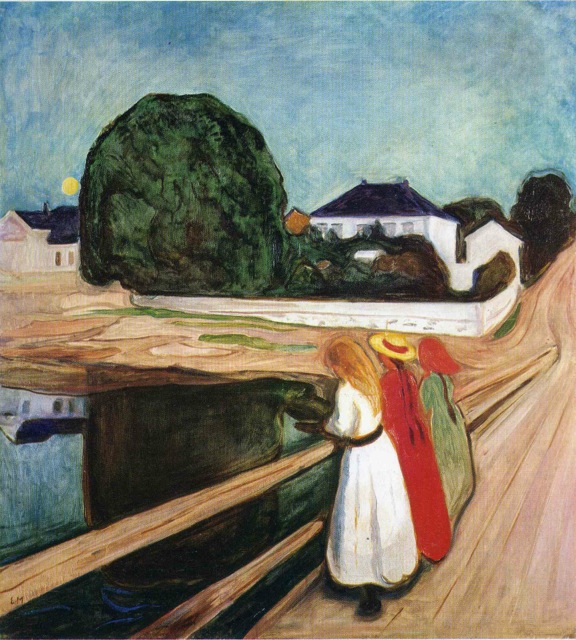
The Girls on the Bridge (1901)

The Girls on the BridgeA more delightful painting, The Girls on the Bridge is fresh, bright, and colourful, exuding a summer spirit. But even in this work, Munch depicted the struggles between innocence (white dress) and desire (red). And while we see the green clump of a tree, full of life, we also see its ominous, dark reflection on the water. In the midst of life, we are in death. Munch seemed like a party pooper, but maybe that’s why he needed to scream. Or else we wouldn’t have heard him.

~ ~ ~ Ripples

The next and last installment in the series is Vermeer and Music.

Sources of images: Wikipedia

***

Related Posts:

Art and Cliché

Arles: In the Steps of Van Gogh

Inspired by Vermeer

Edward Hopper, William Safire: The Visual and the Word

***

Our Mega Culture

A look at our summer offerings on the big screens can readily point to one fact: Bigger and louder is what we get. Apparently, they seem to be the key to box office sales. After all, aren’t those figures the raison d’etre, the reason why movies are made in the first place?

From Box Office Mojo come these stats: Iron Man 3 ($400m+ domestic box office sales, 8 weeks in release), Star Trek Into Darkness ($200m+, 6 weeks), Man of Steel ($200m+, 2 weeks), World War Z ($88m, 1 week). Don’t think it’s only the superheroes and zombies that dominate, Luhrmann’s spectacle The Great Gatsby rakes in $142 million in 7 weeks.

Here’s the irony: the bigger your city is, the more small movies you can see. And if you’re like me dwelling in one of those hamlets not on the list of ‘selective cities’, then you’re stuck with bigness all summer, like it or not. (This is my list of ‘small’ movies I’m waiting for.)

The French director Jean-Luc Godard once said:

As soon as you can make films, you can no long make films like the ones that made you want to make them.

The legendary film critic Pauline Kael interpreted his statement as follows [1]:

This we may guess is not merely because the possibilities of making big expensive movies on the American model are almost nonexistent for the French but also because as the youthful film enthusiast grows up, if he grows in intelligence, he can see that the big expensive movies now being made are not worth making. And perhaps they never were: the luxury and wastefulness, that when you are young seems … magical, become ugly and suffocating when you’re older and see what a cheat they really were.

Kael wrote that in 1966, that’s forty-seven years ago. How I wish she could be around now. Sure like to hear what she has to say about all the summer blockbusters we’re getting. What we have mainly are sequels to previous blockbusters, their makers hoping the trend would perpetuate. Would Kael revise her view now? Big movies not only are still being made, they have become more and more popular. It seems viewers don’t care much that the emperor has no clothes.

It’s Gatsby’s idea, isn’t it? The grander, louder and more spectacular the party you throw, the higher chance you just might get what you’re looking for. Alas, look at the ending.

Who makes the trend? The marketers of movies would tactfully say they’re just offering what people want. But subtly, or not so subtly, what people want is also shaped by marketers. Mass appeal and popularity have overridden discernment and individuality. Do you find viewers’ tastes have changed over the years? Or, do movie goers nowadays belong to a different demographics than before?

What I’m concerned is the obliteration of the already elusive notion of film as an art form. We’re now too dominated by bigness, and spectacles, and technologies, rather than going into the story, characters, techniques, meaning… the still, small voice of fine artistry.

Star Trek Into Darkness

I’d the chance, ok, my choice, to go watch Star Trek Into Darkness and Man of Steel recently. Interesting contrasts there. I used to be a Star Trek fan. Yes, used to be because the Star Trek we have today is a totally different product altogether, albeit the character names remain the same. This current one looks like school children play-acting… serious pretending, frantic scurrying here and there, and loud blasts into oblivion. The only adult seems to be Benedict Cumberbatch as Khan.

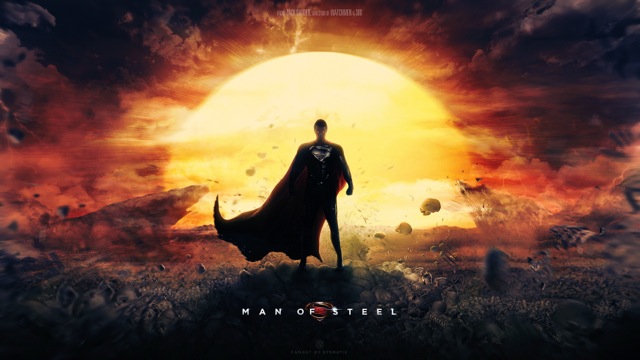
Man of Steel has more mature actors and more serious acting, but the second half is not much different, gratuitous CGI action sequences that are 30 minutes too long, and loud blasts into oblivion.

The constant bombardment of expanded loudness in the theater had only one effect on me, made me turn off my receiver, same effect as somebody wanting to win an argument by raising his voice at me.

Man of Steel 1

Truth be told, because of the cast I went to see this revision of Superman. Kevin Costner and Diane Lane as Clark Kent’s earth parents? Who can miss that? Amy Adams as Lois Lane? I’m sold. And, Michael Shannon as the evil General Zod coming to turn earth into Krypton? I must see how he does it.

And the current Star Trek, what strange new world it has gone to where no one had predicted before. My favorite is still the original TV series. As for the movies? It’s Star Trek VI: The Undiscovered Country (1991). That’s the swan song of the original TV cast and one where Christopher Plummer as the Klingon General Chang recites Shakespeare like he’s at the Stratford Festival. His lines come from The Merchant of Venice, The Tempest, Romeo and Juliet, Julius Caesar and Hamlet. If you want postmodernism across the media, here you have a perfect mash-up. Yes, light years away from the Star Trek of Summer 2013, and generations apart.

Steven Spielberg in a recent statement made at the opening of a new USC Cinematic Arts building predicted there would be an ‘implosion’ in the movie industry, ‘where three or four or maybe even a half-dozen megabudget movies are going to go crashing into the ground, and that’s going to change the paradigm.”

He also added we might have to pay $25 to see the next Iron Man, but $7 to see Lincoln. A scenario which George Lucas echoed. Umm… if those are the ticket prices for the different kinds of movies in the future, not a bad sort of a paradigm shift.

***

[1] These two quotes are taken from Pauline Kael’s review of Jean-Luc Godard’s Band of Outsiders (1964), from American Movie Critics: An Anthology from the Silents Until Now, Expanded Edition, edited by Phillip Lopate, published by The Library of America, N.Y., 2008.

Saturday Snapshot May 18: The Bow

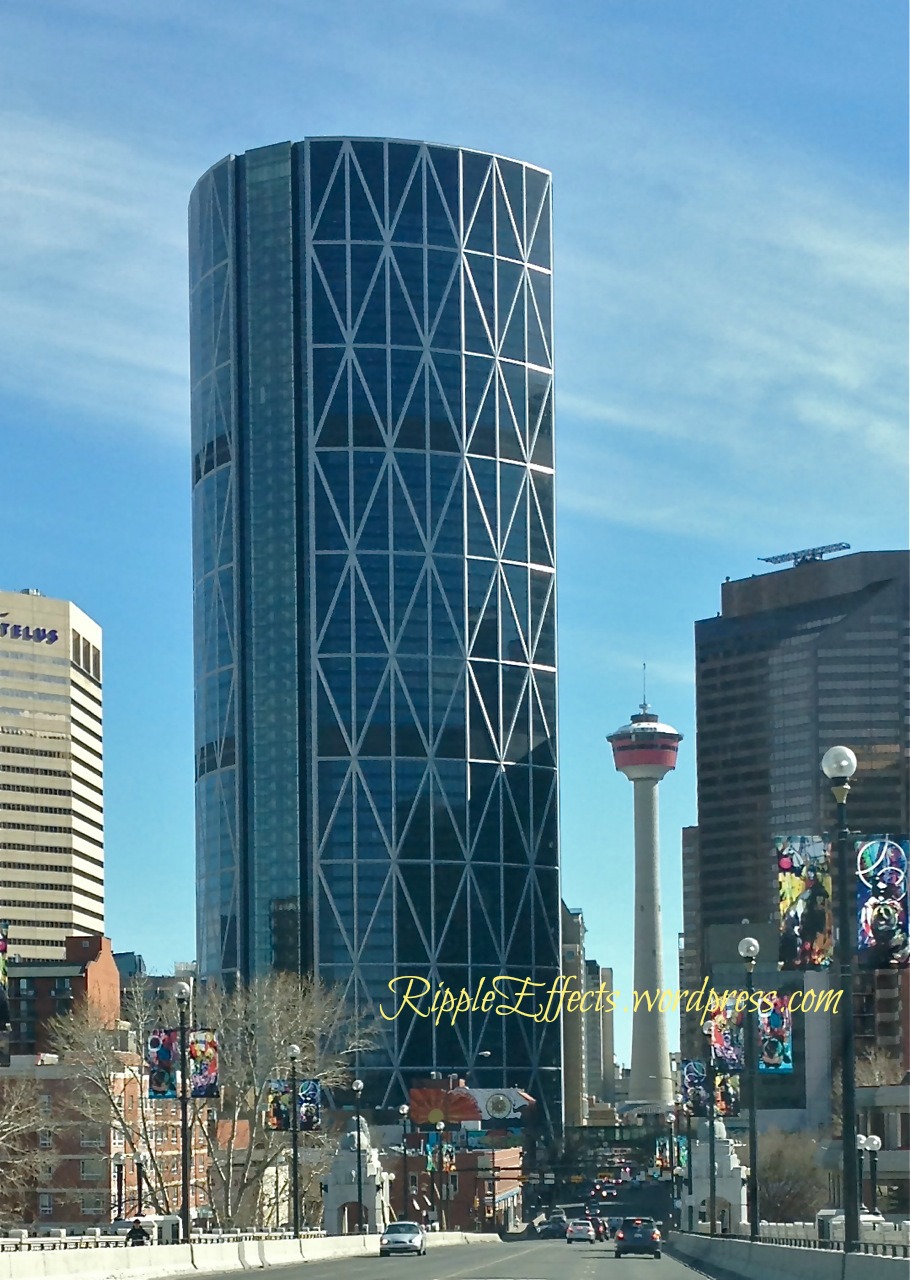
The Bow is the newest addition to our downtown cityscape. Design architects are the acclaimed, London-based Foster and Partners. This new kid on the block has put Cowtown Calgary on the map as it is recently named one of The World’s Most Spectacular Corporate Buildings by the German building database Emporis.

You can see how spectacular it is on Foster and Partners’ website with their professional presentation. But for Arti, the Cowtown inhabitant roaming in the midst of the buzz and the dust, weaving through busy downtown traffic, these snapshots are personal and authentic, no posing, and believe it or not, shot with just her iPhone:

The Bow 1

The Bow is named after the river that winds through our City. So it’s apt to design the building in a crescent shape, fluid as the river, and shaped like a bow:

The Bow 2

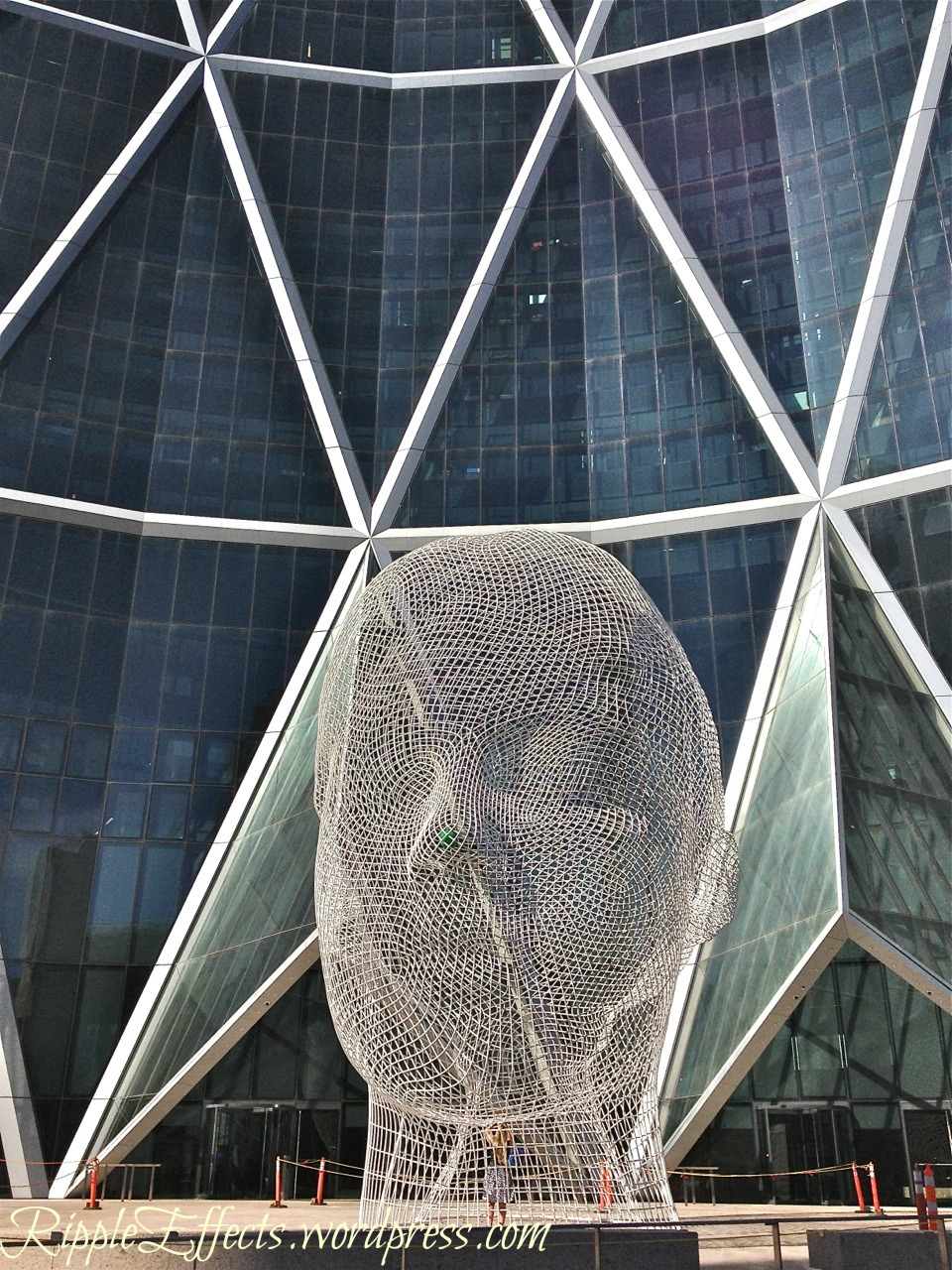
A bit closer now, you can see the art installation in front of the building. It’s a 12 m. tall wire sculpture entitled ‘Wonderland’, created by the renowned Barcelona-based designer Jaume Plensa whose works can be found all over the world:

The Bow 3

It’s the head of a girl, intriguing when you think of the title ‘Wonderland’. Why, of course, it must be a wonder to enter someone’s head. Here, you can do that through a door. See the green balloon inside her nose?

Wonderland

***

Saturday Snapshot is hosted by Alyce of At Home With Books. Click Here to see what other bloggers have posted.

Sign of Spring: Melting Snow

These are photos for Saturday Snapshot April 27.

Snow has mostly melted now, but there are still remnants of winter. Strangely, I feel a sense of loss. That’s why I treasure these photos, chronicling the fading of another season.

Inglewood Bird Sanctuary in our City a couple of weeks ago…

Inglewood Bird Sanctuary

Inglewood Bird Sanctuary 1

It was a pleasure to watch this pair of Mergansers enjoy themselves in the icy water. For me, I was in full winter gear… down jacket, toque and gloves:

Male & Female Common Mergansers

They were beautiful to look at. Seems like you can tell right away which is male and female:

Female and Male Mergansers

A few days later, in another part of the City I captured the last scenes of winter:

Melting snow

Finally this one, I just can’t resist naming it: “Doolittle Reflection”. It reminds me of Bev Doolittle’s paintings, Click Here and see what you think.

Doolittle Reflection

Snow… why am I missing it?

***

Saturday Snapshot is hosted by Alyce of At Home With Books.

Proust Read-Along: Swann’s Way Part One, Combray

Reading these first 264 pages of Proust conjures up some of my own memories…

I was sitting in a graduate class. A fellow student was doing a presentation on phenomenology. He brought into class a chocolate cake, cut it and gave each of us a piece. We were to describe this particular act of ‘Eating chocolate cake in class’.

What elicited only single words or phrases from us, Proust could have written pages. Why, from pages 60 to 64 the narrator details his experience of eating four morsels of the little cakes ‘petites madeleines’, the uplifting sensation, the taste, the action of dipping them into tea before eating, and the diminishing enjoyment after each mouthful. Above all, he relays how the very act of eating these madeleines has evoked long-buried childhood memories of Combray:

… in that moment all the flowers in our garden and in M. Swann’s park, and the waterlilies on the Vivonne and the good folk of the village and their little dwellings and the parish church and the whole of Combray and its surroundings, taking shape and solidity, sprang into being, town and gardens alike, from my cup of tea. (p. 64)

I don’t pretend to understand everything I read. Far from it. These first 264 pages of Proust’s seven volumes of In Search of Lost Time for me is a learning experience. I have to read through ambiguity, discard the expectations of clarity and congruity, accept incomprehension and press on. But an experience still, and surprisingly, an enjoyable one. An eye-opener too. Where have I read a sentence of 31 lines (p. 67-68) in such flowing prose, with such sensitivity and nuanced observations? And I must add, which I read at 1 a.m. I’m a quick study.

Sure, the unexamined life is not worth living. Proust must have plowed through his to the single second, and in depth too, as the madeleine-eating episode reveals. Insomnia sure has its benefits… arousing volumes of memories for the narrator.

Proust Book

From this first reading I’m surprised to find Proust’s subject matter comes from the mundane, from people and places in the village Combray where the narrator would go to stay for a period of time every year as a child. Even more a surprising delight is the loquacious way he describes the events, the people, the scenery, and the insights he can generate from the minutest observations.

A tiled roof is a tiled roof, okay, it looks more beautiful reflected on the river. But I was struck by how the narrator caught himself with speechless admiration, and ironically, articulating it with lucidity and humor:

The tiled roof cast upon the pond, translucent again in the sunlight, a dappled pink reflection which I had never observed before. And, seeing upon the water, and on the surface of the wall, a pallid smile responding to the smiling sky, I cried aloud in my enthusiasm, brandishing my furled umbrella: “Gosh, gosh, gosh, gosh!” But at the same time I felt that I was in duty bound not to content myself with these unilluminating words, but to endeavour to see more clearly into the sources of my rapture.  (p. 219)

Indeed, humor is another surprising find for me. In several places I’ve put down on the margin of the page, LOL!

So, I’ve quickly learned to go past those passages and sentences that have lost me, but soon as I come to something I can comprehend, and do resonate, I’d stop and reread, savoring the beauty of that moment.

My favourite passages include the heartbreaking accounts of the child’s longing for his mother’s goodnight kiss, the description of the church St. Hilaire where he goes to Sunday mass, the pages depicting the river Vivonne and the hawthorn trees in Swann’s park, the child’s discussions with Swann on reading and books, and his frustration with writer’s block as he strives to write poetry as a youngster.

But there is one passage I must mention. That is about the child’s Mamma caring to talk with their house maid and cook Françoise, asking her little questions about her feelings for her own family:

Francoise answered, laughing: ‘Madame knows  everything… [like] the X-rays that they brought here for Mme Octave, and which can see what’s in your heart’ — and she went off, overwhelmed that anyone should be caring about her, perhaps anxious that we should not see her in tears: Mamma was the first person who had given her the heart-warming feeling that her peasant existence, with its simple joys and sorrows, might be an object of interest, might be a source of grief or pleasure to someone other than herself (p. 73).

This, I think, is exactly what Proust has done.

Seeing the extraordinary in the ordinary, the village life, the kitchen and the table, the interactions and socializing, family relations, walking the country paths, the irises and the hawthorns… Reading this first part reminds me of paintings by Pieter Bruegel, or Van Gogh… and, not far from eating chocolate cake.

***

How’s your reading so far?

Janell of An Everyday Life

tuesday in silhouette

Wrap up post on Parts Two and Three: May 15.

***

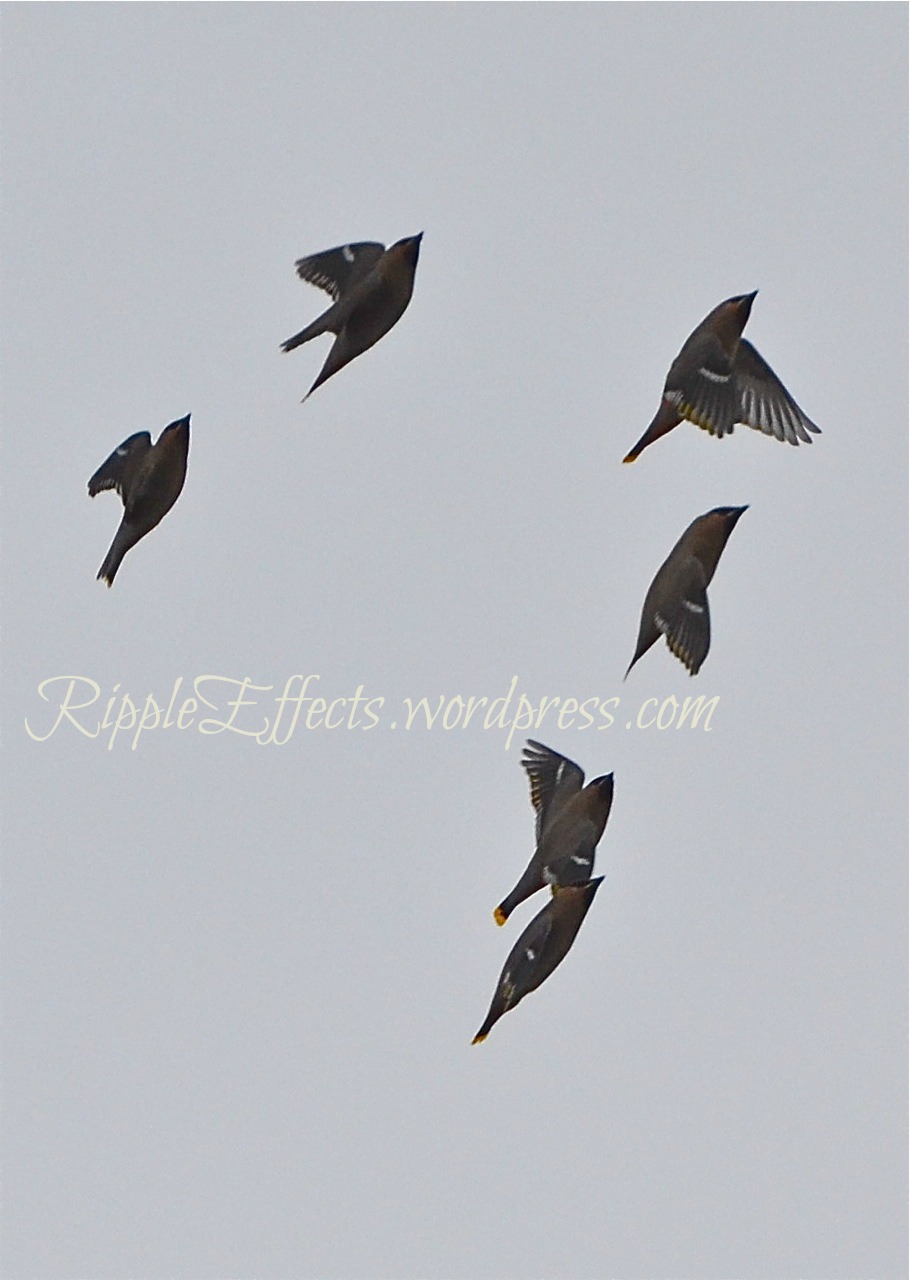
Saturday Snapshot April 13: Bohemian Waxwings in Flight, Defying Grey

I had the chance to see the elusive Bohemian Waxwings converge in the past weeks. Now they are gone. From afar, they may evoke images from a Hitchcock movie:

Flocks of Bohemian Waxwings

But just a closer look would change your view… Avian Cirque du Soleil, acrobats of the sky:

Avian Cirque du soleil

Or… flight aesthetics, mesmerizing to behold:

Avian Aesthetics

I would have wanted a clear blue sky. But the grey offers a deeper fascination. These energetic Waxwings seem to defy the overcast dreariness, exuding a spirit and an aesthetics that colour cannot bring.

***

Saturday Snapshot is hosted by Alyce of At Home With Books.

All photos taken by Arti of Ripple Effects, 2013. All Rights Reserved.
I regret the obtrusive watermarks. I could well have positioned them down in a corner to enhance aesthetics. But practicality took over… hopefully they are deterrents of copying.

***