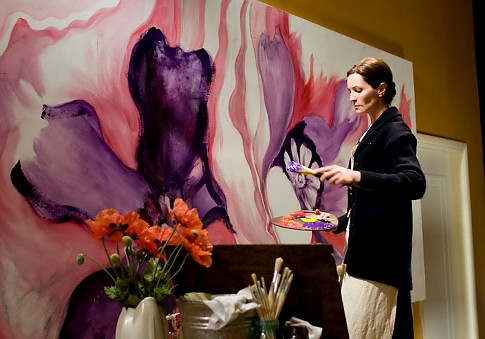
Arles: In The Steps of Van Gogh

Solution to Arti’s Cryptic Challenge #4: Arles

While Paris has her cultured beauty and sophistication, I’d appreciated the change of scenery and warmer weather as I headed south to Provence.  Three hours via the TGV took us to the historic City of Avignon, site of the Papal Palace before the Vatican. We stayed in Avignon for three days, taking daily excursions out to nearby towns.  Arles was a must-see on my list.

Van Gogh moved to Arles from Paris in 1888, seeking the tranquility that was so elusive to him in the big city.  In his letter to his brother Theo upon arrival to Arles, he wrote:

It seems to me almost impossible to be able to work in Paris, unless you have a refuge in which to recover and regain your peace of mind and self-composure. Without that, you’d be bound to get utterly numbed.”    — Tuesday, Feb. 21, 1888.

The fresher and more colourful palette is apparent during this most prolific period of the artist’s life.  Bright yellows, blues, shorter and swirling brush strokes established his signature style.  As for me, I was a bit disappointed to see the sunflowers have already withered in late August.  Fields of yellow were now massive brown.  They would be harvested at a later time for their oil, a good reminder that, for tourists, it’s the view, but for those living here, it’s their livelihood.  The lavenders on the Luberon mountains too had long passed the season.  Note to myself:  Early to Mid July is best if I ever come this way again.

But all was not lost.  I was gratified to follow some of Van Gogh’s footsteps as I explored the clearly posted Van Gogh sites in the town, the scenes and locales where the artist so vividly captured in his paintings.

Arles is a Roman town.  What more prominent to reflect its past glory than the Roman Arena in the town centre.  Why all the arches?  The free flow of pedestrian traffic.  The full seating capacity, 20,000 people, could exit the Arena in 7 minutes.
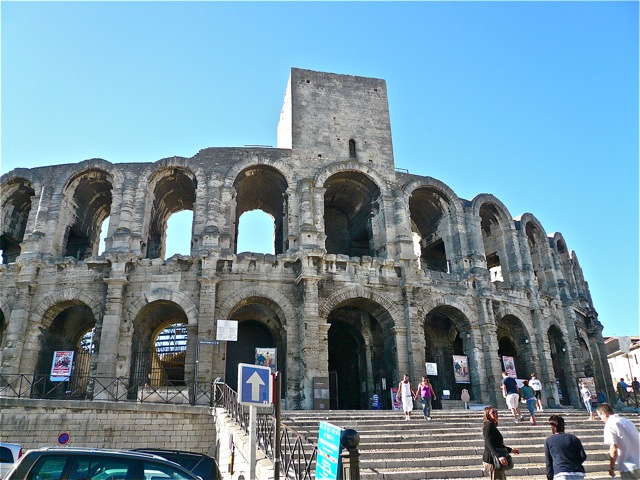
.

Used by gladiators in ancient time, the Arena is still the venue for bullfights:
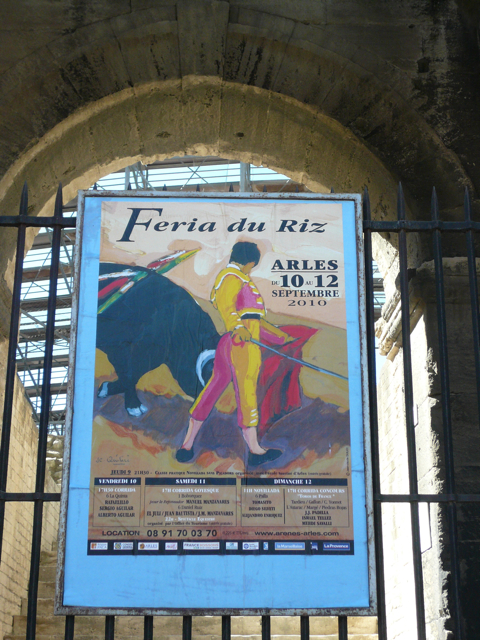
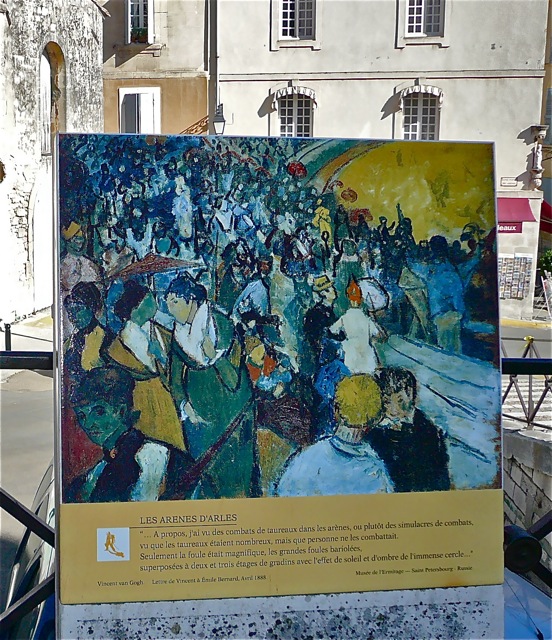
But Van Gogh’s interest was not so much on the violent action of bullfighting than on the people, as his painting Spectators In The Arena At Arles (December, 1888) clearly shows:
The Café Terrace on the Place du Forum was his hang-out, renamed Café Van Gogh now.  The yellow building upon the backdrop of the blue, starry night had deeply inspired the artist:

Café Terrace At Night (September, 1888):

Van Gogh had wanted to make Arles a hub for fellow artists.  Upon his urging, Gauguin came to join him in October, 1888.  The two painters frequented the Café Terrace many a night but only for two short months.  What happened on December 23rd was reported by the local paper the next day:

At 11:30 pm., Vincent Vaugogh [sic], painter from Holland, appeared at the brothel at no. 1, asked for Rachel, and gave her his cut-off earlobe, saying, ‘Treasure this precious object.’  Then he vanished.[1]

After this incident, Van Gogh was admitted to a local hospital, now the Espace Van Gogh in Arles, a cultural centre:

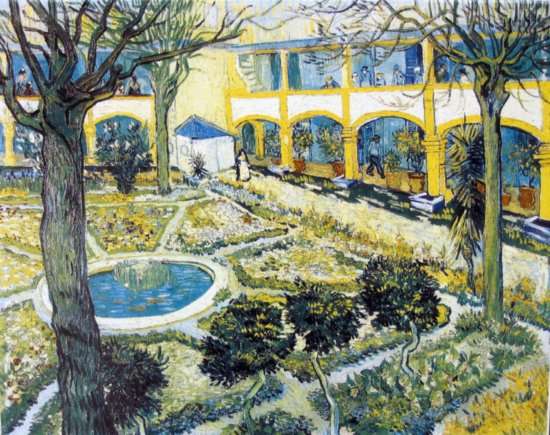
In January, 1889, Van Gogh returned home to the Yellow House, but for the next few months, suffered onslaughts of hallucinations and delusions. His view of his own condition nevertheless was lucid and even progressive for his time.  His letter to Theo is poignant, as he openly faced his predicament and earnestly sought a solution:

And for the time being I wish to remain confined, as much for my own tranquillity as for that of others.

What consoles me a little is that I’m beginning to consider madness as an illness like any other and accept the thing as it is, while during the actual crises it seemed to me that everything I was imagining was reality.”

— Sunday, April 21, 1889.

On May 8, 1889, he checked himself into the Saint Paul de Mausole, the mental hospital at St-Rémy-de-Provence.  Under the care of his doctor Théophile Peyron, the artist’s condition improved and he thrived in the idyllic environment there.  Art therapy had brought healing and prolific output.  Van Gogh stayed there for a year and created more than 150 paintings.
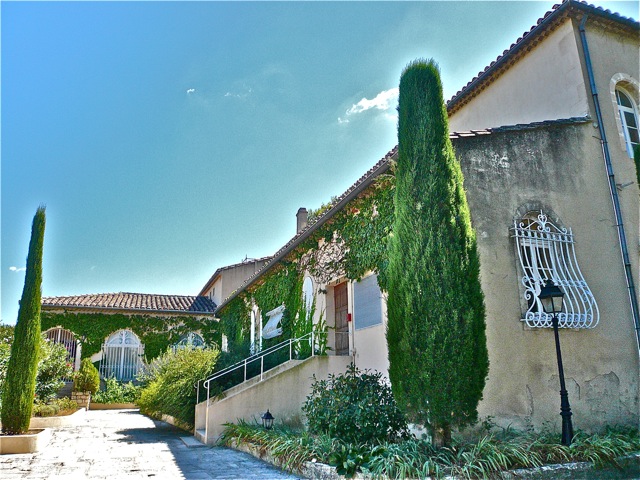
Dr. Théophile Peyron out at the front garden:

.

The olive grove outside St. Paul hospital:

.

To his brother Theo, he wrote on Sunday, May 11, 1890:

At the moment the improvement is continuing, the whole horrible crisis has disappeared like a thunderstorm, and I’m working here with calm, unremitting ardour to give a last stroke of the brush.  I’m working on a canvas of roses on bright green background and two canvases of large bouquets of violet Irises…
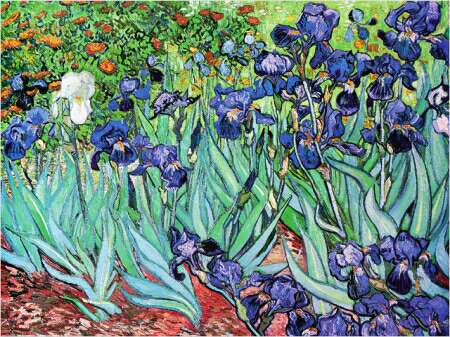
My Van Gogh trip ended at St. Rémy, and so be it.  I’ve seen the sites wherein the artist was at his most prolific.  I’ve seen the town and surroundings where he found inspiration.  I’ve seen his final solace where he attained some stability and painted with passion.  I’d like to keep these as memories of my travel to Provence.  I could hardly bear to think of his last days, discharged from St. Rémy just a few days after the above letter, headed north to Auvers-sur-Oise on the outskirt of Paris, and in just two short months, succumbed to the recurrence of his illness. He shot himself in the chest with a revolver on July 27, 1890, and died of his wound two days later.

Back to the thoughts I wrote about in my last post: How do we keep art from turning into a cliché?  I think it takes a certain awareness of the artist as a person, plus a measure of empathy and respect for the struggle to live and create… and realizing that the beautiful works are often triumphs in spite of life’s overwhelming adversities, rather than the natural products of bliss and fortune.

To wrap up my travel posts, and taking the risk of turning it into a cliché albeit my motive is pure, here’s the YouTube clip again, Don McLean’s tribute to Vincent:

Some Van Gogh links:

An excellent and comprehensive site for Van Gogh’s letters, 900 of them, poignant account of his life.

The Van Gogh Museum, Amsterdam

Van Gogh Gallery online

Wikipedia: Vincent Van Gogh

***

[1]  Rick Steves’ Provence and French Riviera 2010, published by Avalon Travel, p. 69.

Art and Cliché

My musing on high art and popular culture earlier in my trip came to a new twist as I visited the Louvre. I just couldn’t help but wonder: Can art be too popular? When does art turn from a form of aesthetics into a subject of parody? Will mass popularity reduce an objet d’art into a cultural cliché?
Here’s what prompted my query:

.

Even more fascinating is this view twenty feet away:

.

And in comparison, here’s another gallery in the Louvre displaying lesser known works:

.

.

When does art become a cliché?  In our case, the Mona Lisa…

When you see her in comics, or paint-by-number sets in dollar stores, or morph into Alfred E. Neuman on Mad Magazine’s cover, or into Monica Lewinsky on the New Yorker, or find her on The Far Side Gallery, or in The Simpsons, or a Pantene commercial showing off her revitalized curly hair, or when you find 450 parodies of her image on a single website. According to an image tracking source, the Mona Lisa is the most used and abused image in advertising.

I know, other artists had created altered versions of Mona Lisa from early on. Eugene Bataille (Sapeck) painted her smoking a pipe, Marcel Duchamp added a moustache and goatee, Salvadore Dali fused himself into her image.

Poor girl, she didn’t even know what hit her, or how her one time, private sitting for da Vinci had generated so many imaginative renditions centuries down the road, as people are still using, or abusing, her image for private gains. She should have bargained for residual payments.

Are we more comfortable now that the barrier of ‘high art’ has been broken?  Are we enjoying the legacy and freedom the Dada Movement and the Surrealists had claimed for us?  I must declare outright, I’m not particularly a fan of the Mona Lisa, but I’m just a bit annoyed seeing other similar misuse, like Michelangelo’s David in boxers, or Venus de Milo wearing sunglasses.

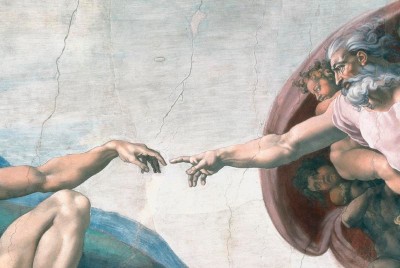
Other vulnerable examples are not hard to find. Think of this magnificent piece of painting in the Sistine Chapel… another easy target for cliché and parody:

Or this self portrait of a tormented soul:

.

Or take these beginning haunting notes from a brilliant symphony, they have become an expression of suspense not much deeper than the tune in Final Jeopardy:

.

The opening chorus of this masterpiece has now been reduced to a punctuation mark in our vernacular, an exclamation used for scenarios from finding your lost keys to losing 10 pounds:

Isn’t the advertising industry supposed to be the flagship of creativity?  And, when it comes to the creative process, aren’t we supposed to flee from clichés and produce fresh expressions? Isn’t originality a goal to strive for anymore? Or, has parody become the new genre and proof of ingenuity in our time?

And I’m just too tired to go into all the zombie and vampire versions of Jane Austen’s novels…

Bath’s Persuasion

Solution to Arti’s Cryptic Challenge #2:  Bath

From London’s Paddington Station we took the 90 minute train ride to Bath Spa, saving us half the time than with the bus.  The City of Bath is a UNESCO World Heritage Site.  Its magnificent Roman Baths and stylish Georgian streets and architecture make this a wonderful gem for tourists.  The first time I visited there was in December, 2007. For a more general overview of the beauty of Bath you can find my two previous posts here and here.

In this revisit, I was a more intentional traveller.  I let Austen’s Persuasion be my guide.  With a detailed street map of Bath in my hand, I went exploring the places mentioned in the novel, coincidentally, many of them I missed in my last visit.

“I was not so much changed…” was Anne Elliot’s words to Captain Wentworth upon seeing him eight years after turning him down.  The termination of their relationship was not her own intention, but duty had driven her to yield to Lady Russell’s persuasion.  It would have been a “throw-away” for Anne at 19 to engage with “a young man who had nothing but himself to recommend him, and no hopes of attaining affluence, … uncertain profession, and no connections.” (p. 20)

But the star-crossed lovers are granted the bliss of a second chance, and rightly grab it this time.  Austen’s setting of Bath in the book is no coincidence.  The Georgian City was the centre of fashion and the epitome of genteel society, a hotbed of social phenom for the critic and satirist in Austen.  Jane had lived in Bath herself for four years, 1801 – 1805, with her sister Cassandra and their parents.  Ironically, she was unpersuaded by its attractions according to her biographer Claire Tomalin.

Austen aptly uses Bath’s addresses for the purpose of her characterization.  Geographical location is everything in a class-conscious society, as Keiko Parker’s excellent article Jane Austen’s Use of Bath in Persuasion points out.

First off,  there’s the Pump Room, where in Jane Austen’s days people socialized and met one another, gathered to drink the therapeutic water, catch the latest fashion, simply to see and be seen.  The magnificent structure and decor makes The Pump Room a fine restaurant now:

Despite its grand decor, the areas around the baths are residences for the common folks in Austen’s time.  Mrs. Smith, the poor, infirmed widow with whom Anne maintains a loyal friendship, lives in the Westgate Buildings close to the Baths.  Anne becomes a laughing stock for the snobbish Sir Walter when he hears of her least favourite daughter is determined to visit Mrs. Smith instead of accepting an invitation to Lady Dalrymple’s, someone belonging to the upper echelon of society:

“Miss Anne Elliot, you have the most extraordinary taste! Everything that revolts other people, low company, paltry rooms, foul air, disgusting associations, are inviting to you.” (p. 113)

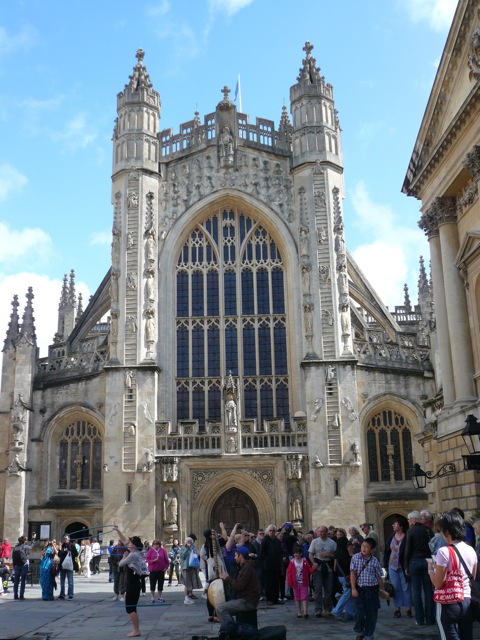
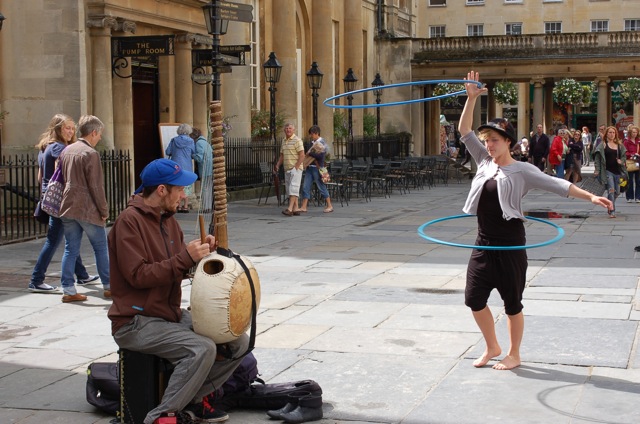
Today, the open area outside the Pump Room by the Roman Baths is perhaps the most popular tourist gathering place. Tour buses stop at the Bath Abbey for pick up and drop off, buskers perform in the open space outside the Roman Baths and Pump Room:

.

Nearby is Sally Lunn’s Bun, originated in 1680 by a young French refugee, in the oldest house of Bath, ca. 1482.  Now a restaurant on top with the cellar a museum that houses the original kitchen and cookwares, Sally Lunn’s serves this traditional creation: a large, soft, round bun that can go with just about anything.  But probably best like this, simply with garlic butter:


The beautiful street corner outside Sally Lunn’s:

.

Further up the town, there’s Milsom Street, a vibrant commercial area of shops and businesses.  The first time Anne saw Captain Wentworth again in Bath was on Milsom Street.  Here’s a present day view of the same site:

.

.

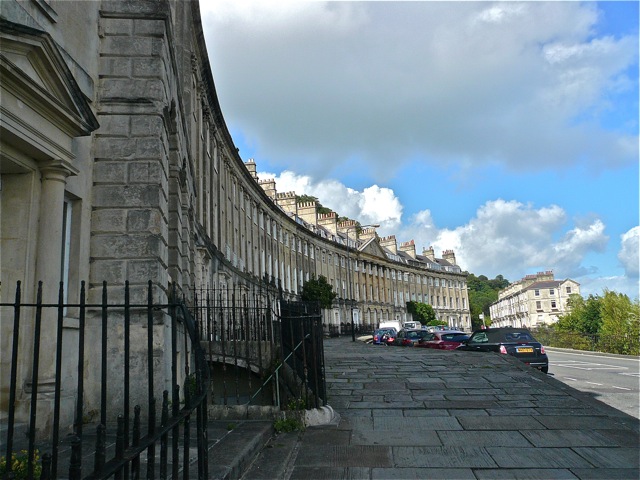
As for Sir Walter himself, despite having to rent out his country mansion Kellynch Hall to avoid financial ruins, he has no intention that his retreat to Bath should compromise his status and comfort.  It’s only natural that others are curious: “What part of Bath do you think they’ll settle in?”  The answer is quite obvious:  the part that is befitting their social standing.  According to Keiko Parker’s insightful article, physical elevation in Bath directly corresponds to social standing.  The highest point at that time would have to be Camden Place, which is today’s Camden Crescent.  While I was looking for it,  the ‘Ye Old Farmhouse Pub’ was mentioned to me as the marker.  I was glad to find it while walking up Landsdown Road, for it was indeed quite an uphill walk.

.

.

“Sir Walter had taken a very good house in Camden Place, a lofty, dignified situation, such as becomes a man of consequence; and both he and Elizabeth were settled there, much to their satisfaction.

Anne entered it with a sinking heart, anticipating an imprisonment of many months…” (p. 98)

Just typical Austen, the overt contrast of characters using something indirect, here, the sense of place.

The houses on Camden Crescent has unobstructive view of lower Bath.  They are not grand mansions, but then again, location is everything.  The following are some of the houses found on this road across from the escarpment:

.

And where do Sir Walter’s tenants Admiral and Mrs. Croft lodge during their short stay in Bath?  On Gay Street, not too high, not too low: “… perfectly to Sir Walter’s satisfaction.  He was not at all ashamed of the acquaintance, and did, in fact, think and talk a great deal more about the Admiral than the Admiral ever thought or talked about him.” (p. 121)

Elizabeth is not even half as kind as her vain and snobbish father.  Regarding the Crofts’ arrival in Bath, she suggests to Sir Walter that “We had better leave the Crofts to find their own level.” (p. 120)

In contrast, Anne has a good impression of the Admiral and his dear wife, the kind and down-to-earth couple, Mrs. Croft being the sister of Captain Wentworth having minimal bearing on Anne’s fondness of them. During their sojourn in Bath to mend a gouty Admiral Croft, Anne enjoys watching them strolling together, “it was a most attractive picture of happiness to her.” (p. 121)

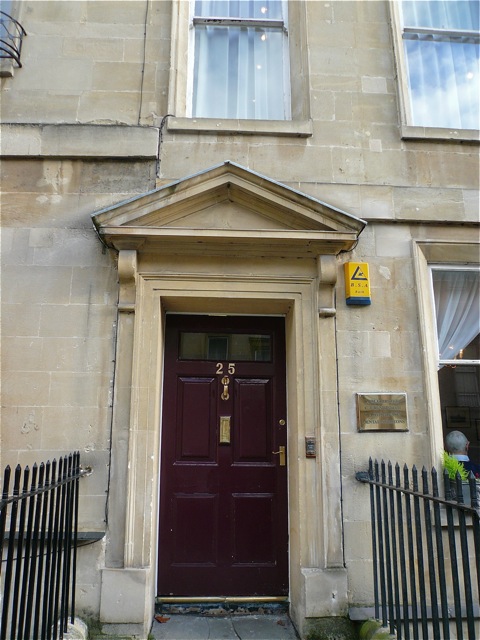
So I’m just not a bit surprised to see their temporary lodging in Bath being on Gay Street.  Who else had lived there?  Jane Austen herself: #25 to be exact:

.

As for a suitable place for socializing, Sir Walter and his favourite daughter Elizabeth choose the Upper Assembly Rooms, a much newer development closer to their upper, more fashionable side of town, although he would prefer entertaining in private which is even more prestigious.

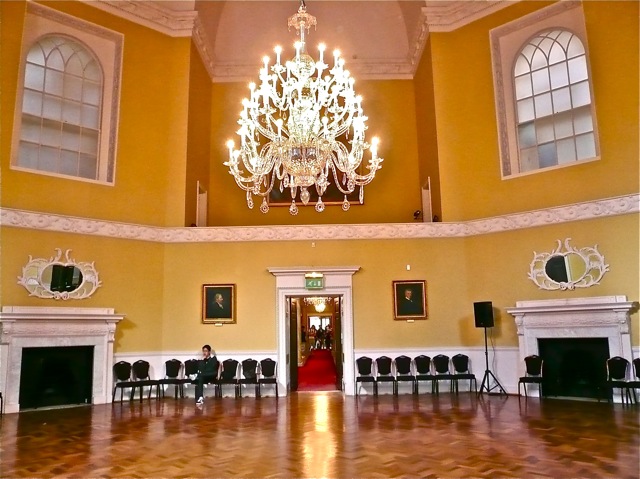
The Assembly Rooms are a magnificent architectural legacy in their own rights.  Designed by John Wood the Younger, who raised the £20,000 needed for the venture, the ground-breaking project began in 1769 and opened for public use in 1771.  It was the biggest investment in a single building in 18th Century Bath. Four public rooms made up the suite:  The Octagon, Ball Room, Card Room, and Tea Room.

“Sir Walter, his two daughters, and Mrs, Clay, were the earliest of all their party at the rooms in the evening; and as Lady Dalrymple must be waited for, they took their station by one of the fires in the Octagon Room (p. 131).

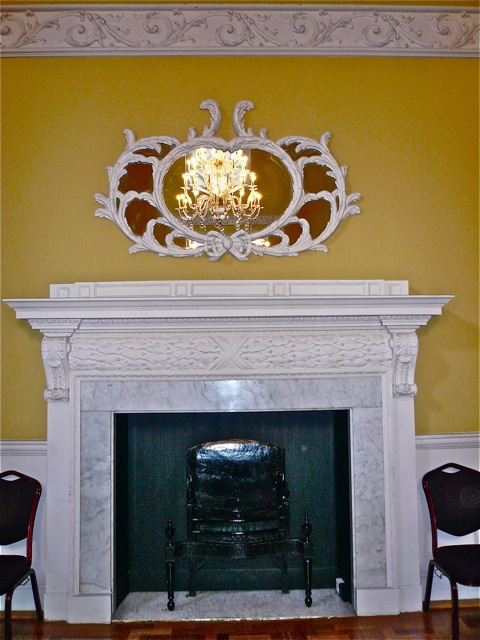
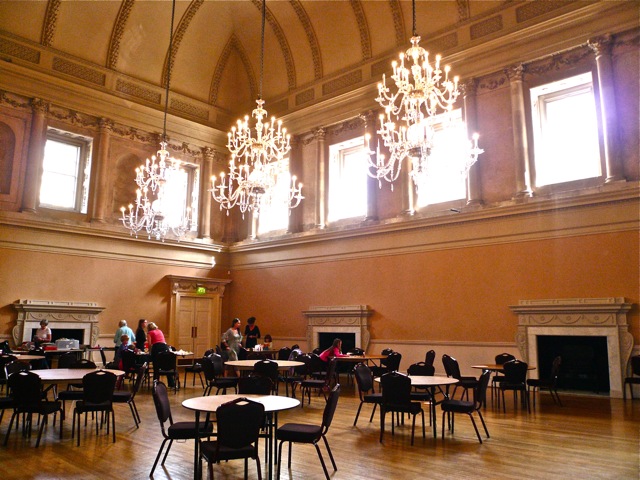
Here’s the exquisite Octagon Room:

Regarding the chandelier, there’s this interesting account in The Authorised Guide (p.7):

“On 15 August 1771 Jonathan Collett quoted £400 for supplying five cut-glass chandeliers for the Ball Room.  They were up in time for the opening of the Rooms in September, but the following month disaster struck when ‘one of the arms of the chandilers in the Ballroom fell down during the time the company was dancing, narrowly missing  Gainsborough.  What could be salvaged from the set was made up into a single chandelier, which now hangs in the Octagon.”

I was just simply amazed at how long these chandeliers had lasted, well over 300 years, and in excellent shape.  Their brilliance had not faded, evolving first from candlelight, then to gas, and now electric:

.

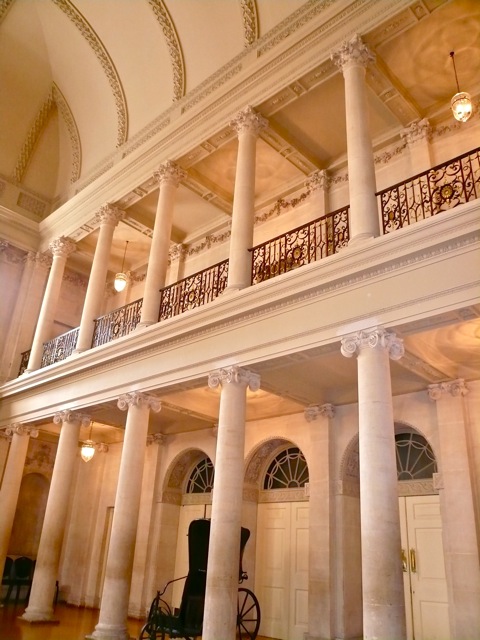
Anne and her party attend a music program in the Concert Hall.  That’s a function in the Tea Room.  Despite the name which seems to convey a small and cozy setting, the Tea Room is a gorgeous room of 60 ft. by 43 ft. dimension.  On one end is a magnificent colonnade of the Ionic order.  Subscription concerts are regular events held in the Tea Room. Mozart and Haydn had written compositions to be performed there, with Haydn himself having graced the magnificent venue.

.

.

But what does Anne Elliot think about all the grandeur?  After earlier in the Octagon Room talking with Captain Wentworth, who has openly expressed his long-held passion for her, Anne, overwhelmed by a great flood of euphoria, now walks into the Concert Room (Tea Room):

“Anne saw nothing, thought nothing of the brilliancy of the room.  Her happiness was from within.  Her eyes were bright, and her cheeks glowed; but she knew nothing about it.  She was thinking only of the last half hour…” (p. 134)

As a visitor to the historic venue, I was captivated by the well-maintained interior and its elegance, and presently amused and surprised to find this display in between two columns: The Chair, which is mentioned several times in Persuasion. The Bath Chair was invented right here in the Georgian City to transport the rich and the sick.  It could be steered by the passenger:

.

.

Jane might have noticed the frivolity and seen through the façade of high society of her time, and sharply depicted her observations in her brilliant novels, but as a modern day tourist and Janeite, I’m just amazed at how well history has been preserved, and that all these locations and life had been experienced by Jane herself. She might have the burden of society on her, which ironically had inspired and unleashed her talents, but for me, a present day tourist and reader of her works, I am totally persuaded that Bath is a place I will definitely revisit some more in the future.

***

All photos taken by Arti of Ripple Effects, August 2010.  All Rights Reserved.

References:

1. Jane Austen: A Life by Claire Tomalin, Penguin Books, 2000.

2.  Persuasion by Jane Austen, The Modern Library Classics, Introduction by Amy Bloom, Modern Library Paperback Edition, 2001.

3. The Authorised Guide: The Assembly Rooms, Bath. Published by the Heritage Services division of Bath and North East Somerset Council in association with the National Trust.  Written by Oliver Garnett and Patricia Dunlop.

4. “What Part of Bath Do You Think They Will Settle In?”: Jane Austen’s Use of Bath in Persuasion by Keiko Parker.  Retrieved Online http://www.jasna.org/persuasions/printed/number23/parker.pdf

Tate Modern and Billy Elliot

Solution to Arti’s Cryptic Challenge #1:  London… don’t mind the gap.

When time is short, you must select and forego.  The Tate Modern has long been on my ‘must-see’ list yet unfulfilled.  So for the short stay I had in London, I chose this one above all else.  Five years ago, my then 15 year-0ld son went to visit and wrote in his email back to me: ‘Tate Modern is brilliant.’  This time I got to see it first hand.

If a museum of modern art can wow a teenager, there must be something in there that links the gap.  And was I disappointed?  Yes and no.  No because it was brilliant indeed, both the conceptual design, architecture and the exhibits.  And yes, because I was so preoccupied with the directions getting there from our hotel that I forgot my camera.  No excuse for that, I know.  And what makes it worse, the museum allows photography even of its exhibits.  In my utter disappointment, my now 20 year-old said to me calmly, ‘you just have to make do.’  That I did with my iPhone.

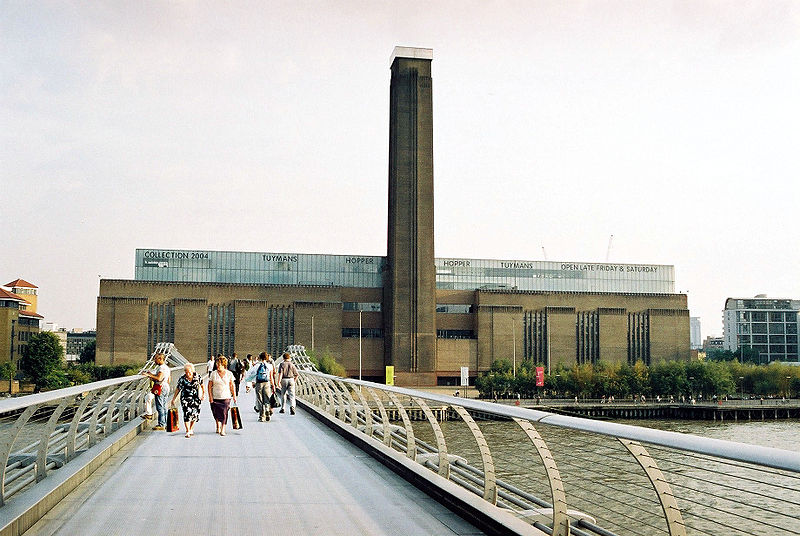
The Tate Modern was converted into a modern art museum from an obsolete power plant on the south bank of the River Thames.  The idea itself is brilliant. What better use of a derelict power station along the beautiful Thames?  Used to be a gloomy stretch of land by the river bank, now the whole area, the Southbank, is revitalized and is home to many London attractions, including the Shakespeare Globe Theatre, the Millennium Bridge, The London Eye, theatres and green, open space.

And thanks to Wikipedia Commons, I found the following photos.  The Tate Modern viewed from the Millennium Bridge.

The Tate Modern was designed by the Swedish architects Jacques Herzog and Pierre de Meuron, the 2001 winner of the Pritzker Prize, the ‘Nobel Prize’ of architecture.  Their concept of maintaining the industrial motif and juxtaposing it with the artistic is ingenious.  Furthermore, they have turned the massive industrial space into a people space.  The main entryway is named The Turbine Hall, allowing people to fill the massive vacuum that was once associated with a power plant. The huge area also makes display of larger pieces of exhibits possible.  Now they are doing it again, yet another redesigning, an even more amazing remodelling and addition, all for the 2012 Olympics Summer Games in London.

Two streams of thoughts constantly ran through my mind during this trip.  One was the dichotomy of ‘High Art’ and ‘Public Art’, ‘high culture’ and ‘popular culture’.  Does such a rift still exist?  All the galleries and museums I visited were all flooded with people.  It was hard to take a picture without any heads caught in the frame.  So every photo I took was immediate.  I had to wait for people to move away and snap the moment quickly.  In the Turbine Hall at the Tate Modern, I saw families with young children, many pushing baby carriages, kids doing cartwheels on the huge floor space.

Is it still ‘high art’ if the exhibits are free to the public, a destination for family outing?  As a rock concert ticket can cost hundreds of dollars… now does that re-define the ‘high’ in culture?  Is it still ‘high art’ if people can get in free, as with the Tate Modern collection, enjoy what they see, gasp at the possibilities, or be bewildered by a notion conveyed through an artwork?  Do we need to ‘understand’ art in order to enjoy it?  Maybe we should just allow the object of art to speak for itself, and thereby, linking the gaps between us.

Here are a few exhibits I took with my iPhone.  Please do click on the link of each piece to see the good photos at the Tate Modern website and an explanation.  I was gratified to see works from some of my favourite artists in their original.

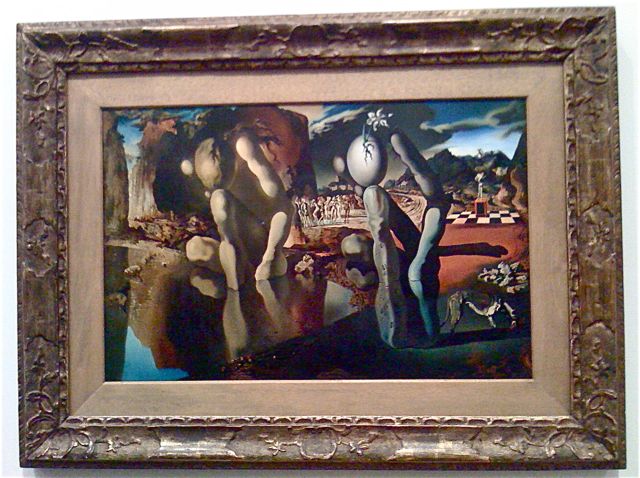
Metamorphosis of Narcissus by Salvadore Dali, the work that changed Freud’s original negative view of Surrealist art.  In the painting, you’re supposed to see Narcissus on a pedestal in the background, then kneeling by the fatal pond, and lastly transformed into a flower… and what a self-absorbed egghead he was:

.

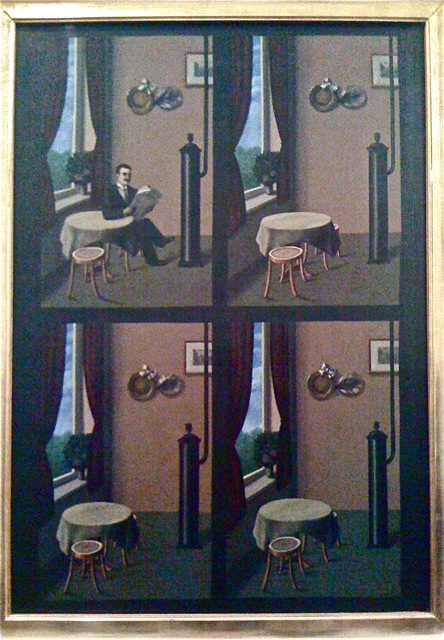
Man with a Newspaper (1928) by René Magritte (1898-1967), under the section ‘Poetry and Dream’.  These are supposedly four different perspectives … mmm … , but hey, this is Magritte speaking.  His dead pan surrealist style is regarded as a subtle form of social critique.

.

And here are a few other interesting works. Polish artist Magdalena Abakanowicz’s ‘Anti-form’ sculpture which she created during the 1960’s Soviet-occupation of Warsaw, another example of the freeing effect of art and the social statement they subtly convey:


Untitled sculpture with wood and wool by Jannis Kounellis, homage to Jackson Pollock’s drip painting:

.

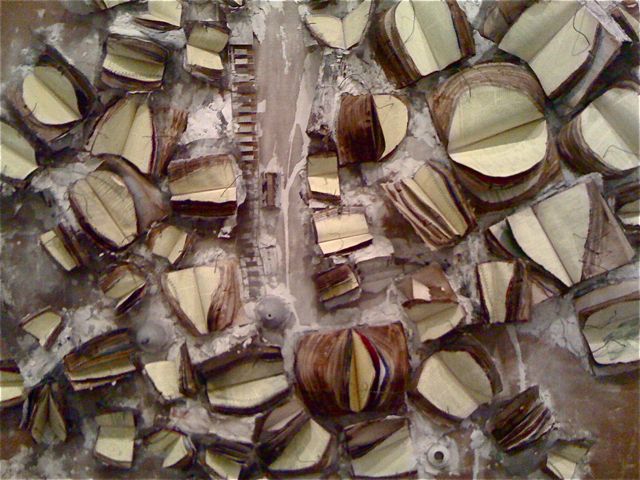
I like this work of open books, but don’t remember the artist or the name of it.  With the fast emergence of eBooks, this work could soon become an antique artifact:

***

The second event I chose was to see ‘Billy Elliot The Musical’.  I liked the movie a lot, appreciating the depth of conflicts which touch on the same dichotomy: ‘High Culture’ and ‘Mass Culture’, and the seeming incompatibility of art and life.  A miner’s son in a blue collar neighbourhood is attracted to the beauty of the ballet, and the freeing energy of dance.

The conflict persists starkly as the political backdrop of the miners’ strike turns ugly in the 1984-85 years. While their livelihood is at stake, and as the miners determine to pose the fiercest strike action against the Thatcher government, where does ballet come in?  It sounds trivial and even surreal to think of ballet compared to the major battles raging in the country. But this is also a conflict between the individual and the masses, the individual and, yes, even the family.

Billy’s new-found love and immense talent ultimately melt the heart of his macho father and older brother, and soon those in the mining community.  He is given the chance to audition for the National Ballet School, with the local miners raising funds to support his cause.


The movie allows more in-depth exploration of internal conflicts while as a musical, the focus has shifted to the dance performance, the music, and for crowd appeal, some Monty Python style romp com, mellow-dramatic scenes, and many exaggerated, stereotypical expressions and language choices. I’m afraid it looks like a contrived way to bring the ‘high’ down to the ‘common’ level.  Elton John’s music while lively, seems lacking in variety and depth compared to his other works and those in the Andrew Lloyld Webber tradition.

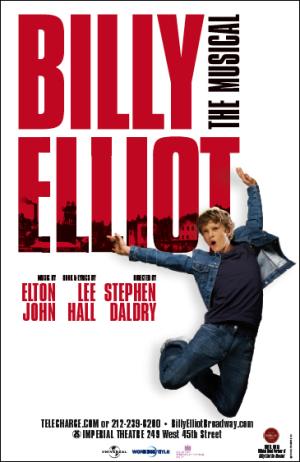
Performed on the London stage since 2005 and still going strong, ‘Billy Elliot the Musical’ is directed by Stephen Daldry, lyrics and book by Lee Hall.  It has won both the Lawrence Olivier Awards in England and the Tony Awards in the US.  It went on Broadway in 2008, and on the main stages in several other countries.  The night I went the role Billy Elliot was performed by 12 year-0ld Rhys Yeomans, and he was marvellous, both as actor and dancer.  He practically carried the whole show on his young shoulders, singing, acting, and dancing in superb style, energy, and versatility.  The role of Michael, Billy’s friend, was done animatedly by another 12-year-old, Reece Barrett. The boys’ performance were the main attractions for me.

In the middle of the show however, the performance was interrupted by a technical difficulty.  It was no minor glitch.  We had to wait in our seat for around 15 minutes before performance resumed.  Now that had discounted some of my enjoyment.  And when the show started again, a scene was skipped.  But overall, it was quite an experience at the Victoria Theatre in London.  A good choice I still think considering the limited time I had in London.

A Late Summer Hiatus

As the holidays draw to an end ever so quickly, and before I take off for a couple of weeks to recharge, it’s time to take stock and wrap up for the summer of 2010.

After watching 56 films in two months as a previewer for an upcoming international film festival, I don’t miss the cineplex for this summer’s offering. Yes, I’ve seen Inception.  And no, I didn’t dream that I saw it… although I remember waking up a couple of times. Anyway, its effect on me is quite similar to Avatar‘s, something I wouldn’t rave about except just say: ‘Been there, done that’.  The Girl With The Dragon Tattoo may well be the best summer movies in my opinion.

As for books, I’ve read a few, not a long list, but enough to keep me busy, relaxed, informed, and inspired. I’m glad I’ve discovered Tim Keller, pastor of the vibrant Redeemer Presbyterian Church of Manhattan.  His Reason For God has restored hope in me that it’s possible to embrace both faith and reason.  Seldom have I come across such an intellectual and sensible approach to the seeming dichotomy.

I must also mention Somewhere Inside: One Sister’s Captivity In North Korea and the Other’s Fight to Bring Her Home by Laura and Lisa Ling.  The book is a riveting account of journalist Laura Ling’s harrowing ordeal as a captive of the North Korean regime, and her remarkable release back to freedom together with her translator Euna Lee.  A testament of hope, resilience, the power of love, and the humanity we all share. An absorbing read, well told inside out.

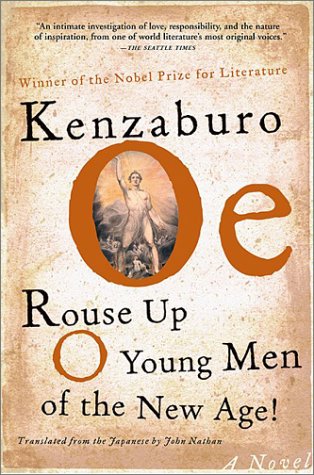
Also, Bellezza’s Japanese Literature Challenge 4 has really done its job.  For it was a challenge indeed reading Kenzaburo Oe’s Rouse Up O Young Men of the New Age! Another more leisurely but no less intense work is Kazuo Ishiguro’s Never Let Me Go. I’ve purposely delayed posting about it until I’ve seen its movie adaptation coming out in September.  I’m looking forward to the film version, with Carey Mulligan as Kathy, Keira Knightly as Ruth, and Andrew Garfield (our new Spider-Man) as Tommy.  That would be for my commitment to C. B. James’s Read the Book/See the Movie Challenge over at Ready When You Are, C.B.

So now, my two weeks of late summer hiatus.  Just for fun, here’s Arti’s Cryptic Challenge… some hints as to where I’ll be in the next little while …  and most likely what you’ll see posted on Ripple Effects comes September.

1.  Don’t mind the gap:  risky when boarding, but good pointer for parenting.

2.  “I am not yet so much changed…”  Upon this re-visit, I don’t expect much change either, for it has kept quite the same for hundreds of years.

3.  From “Lost Generation” to “Beat Generation”, Beach to Whitman, it has much to offer other than curb appeal.

4.  And finally, this little clip on YouTube is my best prep:

Enjoy what’s left of your summer.  I’ll be happy to hear from you about your summer reads, movies, and wrap-up.  Feel free to leave your comments here and I’ll try to read and reply them whenever I find a free WiFi hot spot.

Rouse Up O Young Men of the New Age!

Thanks to Bellezza’s Japanese Literature Challenge 4, I have the chance to explore the intricate world of Kenzaburo Oe (pronounced ‘oh-ay’, 大江 健三郎 ), Japan’s second Nobel Laureate for Literature (1994), after Yasunari Kawabata (川端 康成) received the Prize in 1968.

Like his earlier work A Personal Matter*, Rouse Up O Young Men of the New Age! is an autobiographical novel dealing with the author’s experiences of raising a handicapped child.  A Personal Matter was written when Oe was young, describing an ordeal still raw from the initial shock of the birth of his brain-damaged child. Rouse Up was published in 1983, almost twenty years after A Personal Matter.

Rouse Up chronicles a more mature protagonist, the writer K, who has gone past the stage of denial and escape, to come to terms with the reality of fathering a handicapped child. Through the arduous journey, the writer has gained insights and pleasure from his relationship with his son Hikari, whom he nicknamed Eeyore in his novels.

Oe starts off the book with K’s plan to write a dictionary of terms for his now maturing son, to prepare him for his entry into the real, adult world.  This turns out to be a learning task in itself.  How do you explain to a brain-damaged person what the word ‘foot’ means?  Or ‘river’, ‘life’, or ‘death’?  He needs to deconstruct the realities of his everyday life before he can grasp the essence and meaning of his encounters.

It’s interesting to see how K get through to his son in defining ‘foot’. Eeyore understands it in relation to ‘gout’ from which his father once suffered. After the healing of the pain and swelling of the gout, it has turned into ‘a nice foot’.  So, the understanding of ‘foot’ comes in light of the pain it had experienced. K soon realizes that the definitions are more for himself as for Eeyore.

The author’s long journey of acceptance and self-discovery owes mostly to his love for the works of William Blake.  Rouse Up is a smorgasbord of selections if you are a Blake scholar. So admittedly, I have had a hard time ploughing through Oe’s use of parallels from Blake’s poetic and artistic symbolisms to reflect on his own predicament.  In certain parts, Oe’s writing is just as esoteric as Blake’s mythical depictions.  However, one thing is clear.  My enjoyment of this novel is no less, and the poignancy of a father-son relationship no weaker as I find my way through the Blake maze.  The book requires and deserves multiple reading.

Despite its complexity and denseness, the essence filters through Oe’s meticulous descriptions.  Further, John Nathan’s translation navigates effectively through Oe’s nuanced and sensitive narratives.  I’m just curious as to what the original Japanese version looks like since there are numerous references and quotes from Blake.  Are they in English or in Japanese translation?

Two lines from The Four Zoas seem to have outlined K’s personal journey:

“That Man should Labour & sorrow & learn & forget, & return
To the dark valley whence he came to begin his labours anew.”

It’s a perpetual striving, not unlike Sisyphus’s effort, and yet still leads from one path to the next, prompting a renewed acceptance and offering novel discoveries on the way.

Aside from the esoteric passages of Blake’s visions, some very simple lines shine through, and they are the ones that are most moving for me:

… healing the rift with my son, I became aware of his grief through the agency of a Blake poem, “On Another’s Sorrow,” which includes this stanza:

Can I see a falling tear,
And not feel my sorrows share,
Can a father see his child,
Weep, nor be with sorrow fill’d.

One of the “Songs of Innocence,” the poem concludes with the following verse:

O! he gives to us his joy,
That our grief he may destroy
Till our grief is fled & gone
He doth sit by us and moan.

In his attempt to know more about Eeyore, K explores the power of dreams and the imagination. Using Blake’s mythological poetry and artwork, he tries to understand Eeyore’s internal world. Both he and his wife know Eeyore does not dream, but that does not preclude he does not have imagination.

Subscribing to Blake’s conviction that: “The Imagination is not a State:  It is the Human Existence itself.”, K strives in earnest to cultivate Eeyore’s imagination. Eeyore has an almost instinctive response to bird calls, distinguishing them even before he adopts human language.  As he grows older, he is drawn towards the music of Bach and Mozart.  His imagination soon finds a channel of expression in composing, an amazing accomplishment nurtured by a highly supportive and loving family.  In real life, Oe’s son Hikari is a composer.

Adopting Blake’s vision, K sees a future for father and son together in a state of grace, from Blake’s Jerusalem:

“Jesus replied Fear not Albion unless I die thou canst not live
But if I die I shall arise again & thou with me
This is friendship & Brotherhood without it Man is Not

So Jesus spoke! The Covering Cherub coming on in darkness
Overshadowed them & Jesus and Thus do Men in Eternity
One for another to put off by forgiveness, every sin.”

From coming to terms with the tragic reality of fathering a brain-damaged child, to ultimately, almost symbiotically, sharing his life with his son, is a process not short of a personal epiphany.  At the end of the novel, Eyeore has grown to be a twenty-year-old man. While still having a limited mental capacity, Eeyore has his way of exuding his own humor, love and care for those around him.  The story is a poignant tapestry weaving real-life and the visionary, through which an imagined world of reality is beautifully conceived.

As for the source of the book title, it comes as a moving episode at the end of the book.  I should keep that for you to discover.  A heart-warming finish to a poignant chronicle.

John Nathan’s Afterword is an eloquent tribute to the father, son, and the nurturing family. It is also a helpful annotation of the novel.

Rouse Up O Young Men of the New Age! by Kenzaburo Oe, translated by John Nathan, published by Grove Press, NY, 2002.  259 pages.

***

* A touching review of A Personal Matter has been posted recently by Claire at Kiss A Cloud.  Also, Mel U’s A Reading Life has posted extensively on Oe and other Japanese writers.  Of course, there’s Bellezza at Dolce Bellezza, who has hosted Japanese Literature Challenge all these years, now in its fourth term.  I thank them all for their inspiration.

Bernini’s Corpus and Modern Movies

The Art Gallery of Ontario holds more than 79,000 items in its collection, from 100 A.D. to the present. I’d just seen a tiny fraction of them during the six hours I was there. But if I’m to say which one has stirred the most ripples, it would be the bronze sculpture by Bernini, Corpus (The Crucified Christ), ca. 1655.

Successor of Michelangelo, the Italian Baroque architect and artist Gian Lorenzo Bernini had produced many famous Papal works. I’m impressed by how contemporary this 17th C. sculpture looks with its silvery-bronze color and its minimalist styling. Further, I’m amazed that it has been in private hands all the years… Like you might hear at a party, “Oh, I just happen to own a Bernini.” Having been ‘lost’ and then ‘found’, the sculpture was last in the possession of the Frum family who donated it to the AGO in 2007, estimated value at that time was $50 million.

Murray Frum, real estate developer and philanthropist, had earlier donated an entire African art collection to the AGO. To the general public, probably the most well-known member of his family is his late wife who died of cancer in 1992, the prominent CBC news journalist Barbara Frum.

Unlike the other art works of the crucifix that I’ve seen, the Bernini Corpus has no cross. Its 5 foot 6 inches life-size body hung in midair, supported only at the base.  There it is, right in the middle of the darkened gallery room displayed at eye-level, the suffering Christ suspended in silence. You can get near to the outstretched arms, you can see the loincloth blown to the side, and every minute detail on the body.

Without the backing of the cross, the image gives a weightier impression. You can go right up to the work, except of course you can’t touch it or take a picture, even though both were what I actually wanted to do… But at least, I could look and wonder in nearness.

The cruciform pose of Christ being hung on an invisible cross turns the literal event into a symbolic timelessness. The mere posture of two outstretched arms has long been associated with the essence of the cross: suffering, sacrifice, redemptive salvation. Such a visual icon has been used in many movies effectively. Whether you agree with the director’s message or parallel is another matter. Nonetheless, the archetypal cruciform pose is a powerful image when aptly embedded in a visual context.

Here are a few movies that I can think of where the cruciform pose vividly depicts a memorable moment. (Warning: The following section carries Spoilers.)

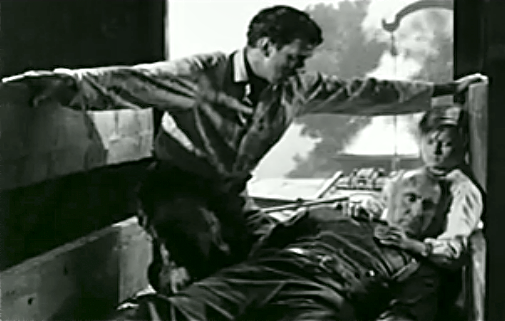
How Green Was My Valley (1941): John Ford’s visually contemplative work. When the shaft comes up from the underground mine carrying survivors of the explosion, you can see the rescuer Mr. Gruffydd in the cruciform pose. What’s more, you can even see the Pieta image:

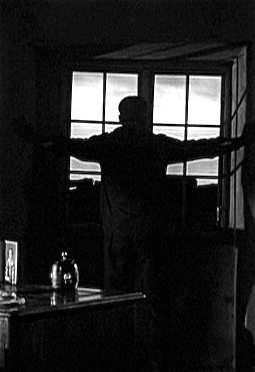
Through a Glass Darkly (1961): Ingmar Bergman’s classic. The estranged father David stretching his arms out in front of the window, sobbing and seeking redemption through family relationship: Cool Hand Luke (1967): After eating 50 eggs, it’s enough suffering for Luke (Paul Newman), a determined radical fighting a callous system in a hopeless prison. His graceful form is a clear contrast to the stark surroundings: The Graduate (1967): Ben (Dustin Hoffman) cries from above: “Elaine! Elaine! Elaine! …” Which yearning heart would not respond to such a passionate cry and be delivered in the nick of time out of a loveless union: Dances With Wolves (1990): Only when you’re not afraid to die, then can you live.  Lieutenant Dunbar (Kevin Costner) embraces death only to be ushered into a new life and adventure:

Shawshank Redemption (1994): Andy Dufresne (Tim Robbins) literally digs out a new path to salvation. This is the iconic scene of freedom and cleansing after climbing out from the sewage line: Superman Returns (2006): Superman (Brandon Routh) returning from Krypton to save the world. His famous line to Lois: “You wrote that the world doesn’t need a savior, but everyday I hear someone crying for one.” Gran Torino (2008): Walt Kowalski (Clint Eastwood) laying down his life to save his young friends from a neighborhood gang, in search of self-redemption: … I’m sure you can think of more.

***

Related Posts you might enjoy:

Alex Colville and the Movies

The Art Gallery of Ontario

***

Pussywillows, Cattails, Soft Winds and Roses

Took a short trip to Ontario last week and came home overwhelmed with nostalgia.  It all started when I visited the town of Unionville and saw these, crowds and crowds of cattails growing profusely in the pond, the fields, by the footbridge:

.

For some inexplicable reasons, I’m much fond of cattails. The first time I learned about them was from listening to the song by Gordon Lightfoot… before I’d actually seen one.

Some time in the 70’s, for many afternoons I sat in the art room of a high school somewhere in Alberta, working on some art project, but mostly doing nothing at all while listening to Gordon Lightfoot.  Mr. Hannington held a laissez faire art class… we could do just about anything, or nothing.  Usually, there would only be three or four of us in the room.  We would just sit around, chat, daydream, and immerse in the voice of Gordon Lightfoot on the radio.

I didn’t turn out to be an artist, while one of us did.  But I’ve remained partial to cattails, mesmerized by the song and the singer.  Those Lightfoot afternoons in the art room emerged from the depth of hazy memories, the lyrics were the soft winds caressing naked limbs as I walked in this natural reserve in Unionville.

Pussywillows, cat-tails, soft winds and roses
Rainpools in the woodland, water to my knees
Shivering, quivering, the warm breath of spring
Pussywillows, cat-tails, soft winds and roses

Catbirds and cornfields, daydreams together
Riding on the roadside the dust gets in your eyes
Reveling, disheveling the summer nights can bring
Pussywillows, cat-tails, soft winds and roses

Slanted rays and colored days, stark blue horizons
Naked limbs and wheatbins, hazy afternoons
Voicing, rejoicing the wine cups do bring
Pussywillows, cat-tails, soft winds and roses

Harsh nights and candlelights, woodfires a blazin’
Soft lips and fingertips resting in my soul
Treasuring, remembering, the promise of spring
Pussywillows, cat-tails, soft winds and roses

(To my artist friend CD: Keep the fire burning.)

***

Art Gallery of Ontario

There are several interesting facts about the AGO.  That it is situated in Toronto’s Chinatown is an example of the vibrant cultural mix an urban centre can sustain.  And in multicultural Canada, that sits well indeed.  These are the buildings right across from the front entrance of the AGO on Dundas Street:

On the upper floor of the building to the left, the four characters indicate it’s the “United Chinese Drama Society”.  The main floor is a French Café.  The building to the right is home to a Chinese clan association.  And the barber shop below… oh, what does it matter.

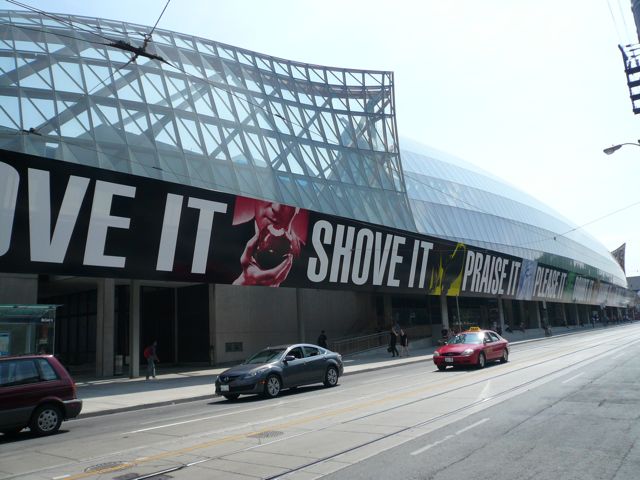
And across the street, spanning one full block from Beverley to McCaul, adjacent the Ontario College of Art and Design is the Art Gallery of Ontario:

.

The AGO originally began as The Art Museum of Toronto in 1900.  Its first home was The Grange, a Georgian Mansion built in 1817.  The last hundred years saw several stages of expansion. In 2008, the Gallery received a major facelift.  The prominent architect Frank Gehry brought the AGO into a new phase, and to finally contribute to the Canadian architectural landscape with his first design in Canada.  And what an approparite choice.  According to the AGO guide who led our tour, Gehry was born right here on this street some blocks away.  He holds fond childhood memories of the area, particularly the AGO.

At the back, one can see the very postmodern juxtaposition of the old Georgian Mansion The Grange with the new Gehry-designed AGO:

.

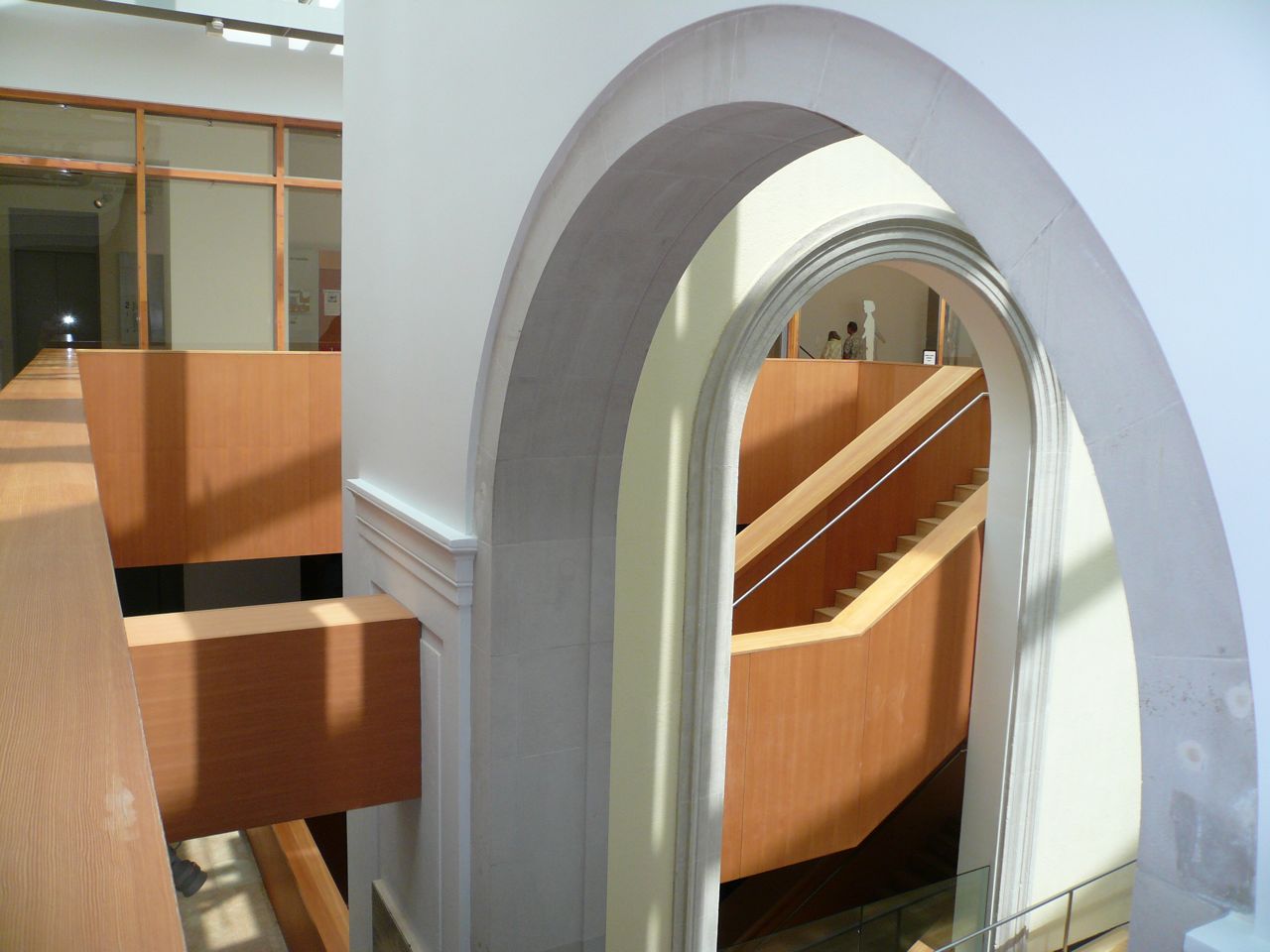
But the outside does not prepare one for what is installed within.  I was amazed many times over as I explored the gallery spaces. Photography was not allowed in the exhibits areas.  So I’ve only captured the general interiors, and they are breathtaking, elegant and exquisite:

.

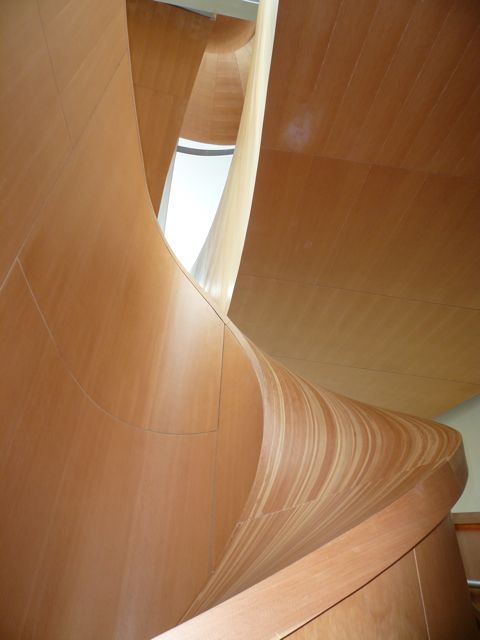
I love the contemporary light wood contours placed against the classical styling.  The overall color scheme is soothing and relaxing, without the austerity of some art galleries and museums.   Natural light is plentiful as it is let in through the glass ceiling.  Light and shadows play out in an interesting way:

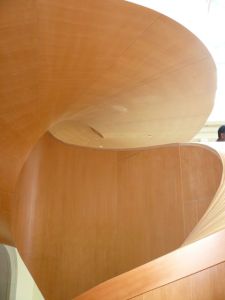
The central spiral stairwell is the main attraction.  It is made of B.C. douglas fir, light, fluid, swirls gracefully down from the top.  As I made my way down, every step I took offered me a new perspective.  An inspiration in itself:

.

.

.

.

. . 

.

.

.

And finally we were shown this magnificent design, right against the glass inside the front of the building:

.

.

Unlike Gehry’s other more showy works of bending metals, the AGO is decidedly unpretentious, curving wood against arches, blending nature with art, art with architecture, and architecture with an urban neighborhood.

.

TEXT AND PHOTOS by Arti of Ripple Effects, July 2010.  ALL RIGHTS RESERVED.

***

.

.

Book Sale 2010

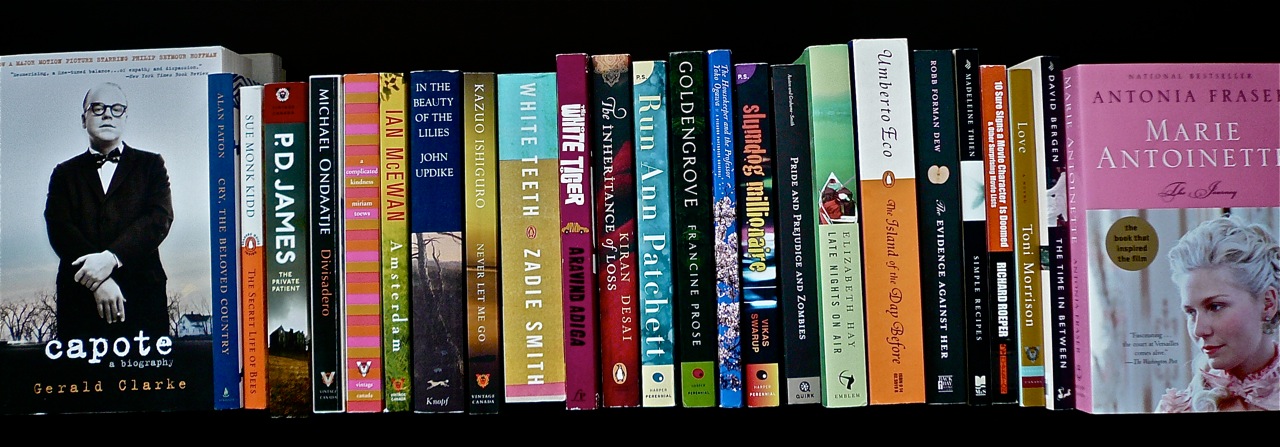
Went to the annual Book Sale at the Crossroads Market and hauled back my loot, officially kicking off Arti’s summer reading.  Although I must admit, I’ve many books on my TBR list.  They’re everywhere in my house, my bedside, on the couches, tables and chairs, and even on the floor.  Yet I would not miss the booksale at Crossroads.  The finds are just too good to pass.  My hours of scrutinizing always bring in great rewards.  Here’s a list of this year’s haul.  20 of them, almost all trade paperbacks, spine unbent, all new to like-new condition, at $1.50 each.  Here they are:

I’ve an eclectic selection here.  Here are the categories:

Biography

  • Capote: A Biography by Gerald Clarke  —  Book into film
  • Marie Antoinette by Antonia Fraser  — Book into film

Canadiana

  • The Time In Between by David Bergen —  2005 Giller Prize
  • Late Nights On Air by Elizabeth Hay  —   2007 Giller Prize
  • Divisadero by Michael Ondaatje  —  2007 Governor General’s Literary Award
  • A Complicated Kindness by Miriam Toews  —  2004 Governor General’s Literary Award

Contemporary Literature

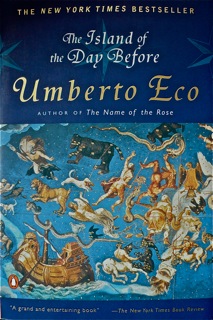
  • The Island of the Day Before by Umberto Eco — International literary awards author
  • Love by Toni Morrison — Nobel Prize author
  • Run by Ann Patchett  —  PEN/Faulkner and Orange Prize author
  • Cry The Beloved Country by Alan Paton — contemporary classic
  • Goldengrove by Francine Prose — National Book Award finalist
  • White Teeth by Zadie Smith —  2000 Whitbread First Novel Award
  • In The Beauty Of The Lilies by John Updike — Pulitzer winning author
  • The Evidence Against Her by Robb Forman Dew — National Book Award author
  • The White Tiger by Aravind Adiga — 2008 Man Booker Prize
  • Amsterdam by Ian McEwan — 1998 Man Booker Prize
  • The Inheritance of Loss by Kiran Desai — 2006 Man Booker Prize
  • The Housekeeper and the Professor by Yoko Ogawa — Japanese literary awards author
  • Never Let Me Go by Kazuo Ishiguro — Man Booker Prize author
  • The Secret Life of Bees by Sue Monk Kidd  —  Book into film

Mystery and Thriller

  • The 39 Steps by John Buchan
  • The Scarecrow by Michael Connelly
  • The Private Patient by P. D. James
  • The Messenger by Daniel Silva

Short Stories

  • Telling Tales edited by Nadine Gordimer
  • Simple Recipes by Madeleine Thien
  • The Complete Short Stories of W. Somerset Maugham

Tools of the Trade

  • The Declaration of Independent Filmmaking by Mark Polish et al.
  • 10 Sure Signs A Movie Character Is Doomed & Other Surprising Movie Lists by Richard Roeper
  • Art History’s History by Vernon Hyde Minor
  • Notting Hill Screenplay by Richard Curtis
  • The Sense and Sensibility Screenplay & Diaries by Emma Thompson

Fads

  • Pride And Prejudice And Zombies by Jane Austen and Seth Grahame-Smith
  • Slumdog Millionaire by Vikas Swarup  — Book into film

Guilty pleasure?  Compulsive hoarding?  Not really.  First off, I’m supporting a well-meaning charity, Servants Anonymous.  Secondly, I’m doing something that’s uber important in this digitally-driven society.  I’m contributing to the preservation of the art of the printed book.  And who knows, someday, these copies might well become valuable antique items when the e-industry totally takes over.

A look at their covers would make you long to touch them, real paper, book art and design, authentic hard copies of the printed word.  A future rarity, and I’m sure, collector’s items.

Exit Through the Gift Shop (2010)

Update: “Exit Through The Gift Shop” is nominated for an Oscar for Best Documentary Feature. Academy Awards ceremony Feb. 27, 2011.

If you haven’t seen a Banksy signature piece in any urban centres, now you can watch a Banksy film, Exit Through The Gift Shop, ‘directed’ by the elusive street artist himself, and legitimately shown in theatres near you. And a big spoiler: no, you don’t get to see his face… only a dark silhouette inside a hoodie, voice distorted… or, maybe that’s not even Banksy himself.

The infamous and secretive graffiti artist has been claimed by some as the instigator of the ‘street art movement’.  Believed to be based in Bristol, England, Banksy has made his presence known by spray painting his articulately constructed stencilled work on walls in the most unlikely places of the world.  The following one is found on the high, separating wall in the West Bank:

The May 10 issue of TIME magazine has included Banksy in the poll of 100 Most Influential People In The World.  His silent graffiti are clear political and social statements, thought-provoking messages imbued with whimsical and imaginary images.  His works have been auctioned off at Sotheby’s, including the murdered telephone booth on a London street.  Sign of the time: the triumph of the cell phone.

At the time of the film’s premiere screening earlier this year at the Sundance Film Festival in Park City, Utah, Banksy made his presence known by contributing to the city scene with his notorious images.  Here’s one of them:

.

The documentary Exit Through The Gift Shop, ironically, is more about the filmmaker wannabe Thierry Guetta “Terry” who started off filming street artists from Paris, London, and back to his home city L.A.  His life came to a drastic turn as he, by chance, was introduced to the underground Banksy, and started tagging along, capturing Banksy’s creative process in his camcorder.

What turned him around was Banksy’s advice that he wouldn’t be a good filmmaker.  That was motivation enough for Terry, who re-directed his energy towards his new ambition: to be a street artist himself.  So the film is exactly that, the first part is the exhilarating depiction of the colorful underground world of street artists from Europe to LA, hunt down and tagged along by Terry the videotaping enthusiast.  But the film dims into a lesser light when the latter half shifts to focus on Terry himself, who, without much self-discernment, churned out obviously second-rate works which prompted Banksy to declare never to help anyone produce a doc about street art again.  We learn that as the end credits roll.

Unlike the anonymous and elusive Banksy, Terry is a self-promoting opportunist, calling himself Mr. Brainwash, his productions MBW. He hired staff to help him produce works of pop fusions, tacky, Kinko re-mixes of Warhol reproductions, while at the same time, reaping millions of dollars from their sales.

And with that Banksy cleverly throws out to us the obvious questions: What is art, or maybe, When is art, art?  And, Who can be an artist?

As I watched the first part about these highly skilled and agile urban legends, reminiscence of none other than Phillippe Petit of Man On Wire, I was entertained and amazed at the artistic skills and versatility involved. But of course, these are less dangerous, more down-to-earth feats, nevertheless the spirit of Phillippe Petit lingers.  As fellow artist Shepard Fairey writes in TIME magazine about Banksy:

He doesn’t ignore boundaries; he crosses them to prove their irrelevance.

So naturally, the film leads us to that menacing debate: Street art or vandalism?  Here’s Banksy’s own take on this issue, quoted in LA Weekly:

“I’m not so interested in convincing people in the art world that what I do is ‘art,’ ” Banksy says. “I’m more bothered about convincing people in the graffiti community that what I do is really vandalism.”

… mmm interesting thought… but then again, as elusive as his persona.

Exit Through The Gift Shop tags along this subheading: “The World’s First Street Art Disaster Movie”.  The disaster apparently refers to the public’s indiscriminate taste for Terry’s MBW works.  However, it probes further into a deeper layer, the distinction between ‘good’ art and ‘bad’ ones. I like Shepard Fairey’s take on the Mr. Brainwash phenomenon:

“Don’t be annoyed by him. Make him irrelevant, make something better.”

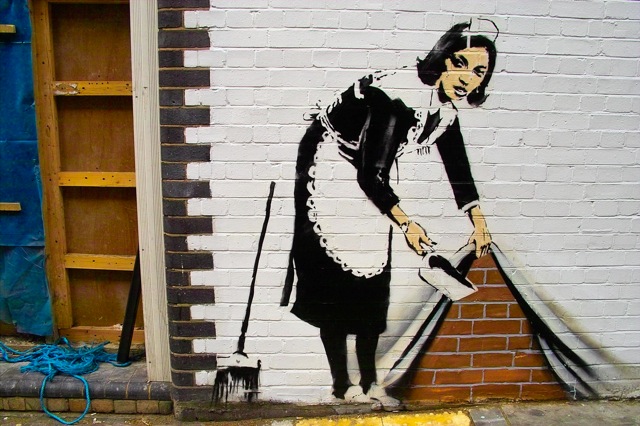
If we can all agree on what is ‘better’.  Take for example, among Banksy’s works, I like this one the best… No, it doesn’t reflect Arti’s own personal habit.  It appeared on a Camden street, and later met the fate of being cleaned up by order of the Camden City Council:


‘Directed’ by Banksy himself, the doc is narrated by Rhys Ifans, an award-winning British actor (Notting Hill‘s Spike).  It’s entertaining, informative, and thought-provoking.  This is the closest to an original Banksy.

~~~ Ripples

***

With the film’s premiere showing in Toronto, guess Banksy has also made his debut on the walls there:

CLICK HERE TO SEE BANKSY IN TORONTO.

Thanks to a reader from England, I was given the link to this, a must-see:

CLICK HERE TO SEE BANKSY V. THE BRISTOL MUSEUM

***

Photo Sources:

Banksy on West Bank Wall: http://news.bbc.co.uk/2/hi/entertainment/4748063.stm

Banksy at Sundance, Park City, Utah: http://festival.sundance.org/2010/blog/entry/banksys_missive/

Murdered Telephone Booth: http://www.laweekly.com/2010-04-08/art-books/banksy-revealed/2

Maid Sweeps Under: Wikipedia Commons

***


Movies for Mom

Some good movies are on DVD now.  Great to spend the evening with mom at the comfort of home.  Here are Arti’s movie recommendations for Mother’s Day.

Georgia O’Keeffe (2009, TV)

.


The cinematic biopic of the great American artist stars Joan Allen as Georgia O’Keeffe, and Jeremy Irons as her husband, the photographer Alfred Stieglitz.  Both received Golden Globe acting nomination, while the movie got the nom for Best Picture made for TV.  The production is a visual delight illuminating not only the works of the artist, but her elegant poise, and her environs, especially the cinematic New Mexico landscape.  On top of the spectacular visuals, I’d enjoyed the personal narration and the quotable quotes.  My favorite: “Where I was born and where and how I have lived is unimportant. It is what I have done with where I have been that should be of interest.”  As for the tumultuous relationship between O’Keeffe and Stieglitz, is it fair to say it is a case of iron sharpening iron?

*

The Blind Side (2009)


If your mom still hasn’t seen this one, it’s a good time to watch it with her… if it’s just to give moral support to Sandra Bullock.  Like her predecessors (Kate Winslet, Reese Witherspoon, Hilary Swank, Charlize Theron, Halle Berry, Julia Roberts), winning the Oscar Best Actress just proves to be too much to handle when the consequence is marital breakdown.  And what’s this about life imitating art (ok, let’s just call it art), Bullock attempts to live her movie role with her mixed-race adoption.  One thing that she’d find I’m sure, real-life mothering will prove to be a much more demanding role than in the movies.

*

Crazy Heart (2009)


Jeff Bridges won the Best Actor Oscar as worn-out country singer Bad Blake. Spent and hopelessly alcoholic, Bad Blake is movingly revitalized by journalist Jane Craddock.  Even for one who’s not keen on country western music, I’d thoroughly enjoyed the songs performed by Bridges himself.  Song writers Ryan Bingham and T-Bone Burnett won the Best Original Song Oscar with ‘The Weary Kind’.   As a bonus, you can also hear Colin Farrell sing.  Maggie Gyllenhaal gives a convincing performance as journalist Craddock, who starts from professional interest with the country singer to deeper, personal involvement.  But ultimately, her role as mother wins out.

*

Arti’s other recommendations?  All the movies listed on the sidebar.  All of them are on DVD now.  To read my review, just click on the picture.

No matter which movie you watch with mom, do talk about it afterwards… that’s the best part of the experience.

Here’s Jeff Bridges singing the Oscar winning song The Weary Kind:

*

To all who play the real-life role of mothering: A Happy Mother’s Day!  May you all get the nod and award you deserve!