Hamaguchi takes ‘Drive My Car’ to the highway of life

Among the ten Best Picture Oscar nominees this year, one is Japan’s official entry for Best International Feature Film. That Drive My Car is nominated also in the Best Picture category as well as in Directing and Adapted Screenplay is a major boost for director Ryûsuke Hamaguchi. The most recent precedent would be the South Korean feature Parasite in 2020.

The following is my review of Drive My Car, a screen adaptation based on Haruki Murakami’s short story. I thank Asian American Press for allowing me to repost it in full here on Ripple Effects.

___________

Ever since his five-hour epic Happy Hour garnered accolades in 2015, Japanese director Ryûsuke Hamaguchi has continued to fascinate juries in the festival circuit. During a pandemic year, he made two features, both screened to high acclaims. Wheel of Fortune and Fantasy won the 2021 Silver Berlin Bear Jury Prize and Drive My Car swept Cannes, winning Best Screenplay, the FIPRESCI Prize and the Prize of the Ecumenical Jury.
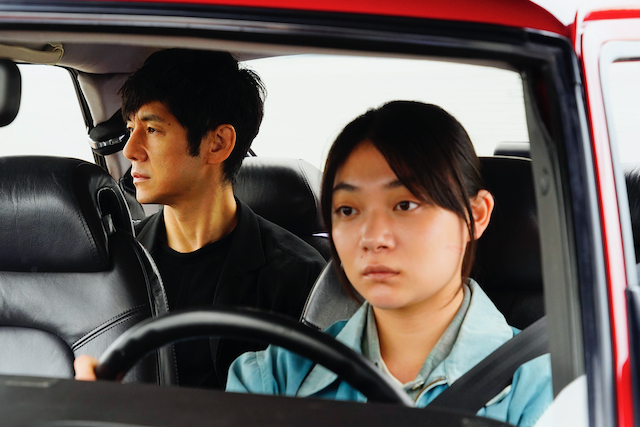
Hidetoshi Nishijima and Toko Miura in “Drive My Car”

Drive My Car is Hamaguchi’s creative and imaginative extension of Haruki Murakami’s minimal short story included in his collection Men Without Women. Two individuals unlikely to meet in ordinary circumstances, bare their soul to each other, one a stage actor and director Kafuku (Hidetoshi Nishijima), the other, a young female driver Misaki (Tôko Miura). The conversations that take place in the car prompt them to confront their own past.

The film opens with a long backstory. Kafuku has a loving and intimate relationship with his wife Oto (Reika Kirishima), a TV writer. Her story ideas come while the couple is making love. Both being in the arts, they support each other in an intimate way until one day Kafuku comes home unexpectedly and finds Oto in bed with another man. Kafuku walks back out quietly. The next day, Oto suggests they talk that night when he returns from work. Deeply hurt but fear for the collapse of their marriage, he delays coming home. When he finally gets home late that night he finds Oto has collapsed from a cerebral hemorrhage. She dies later without regaining consciousness. 

This prologue takes 40 minutes and that’s when the introductory credits appear on screen. Hamaguchi will take another two hours and more to tell the rest of his story which begins two years after Oto’s death. Despite the three-hour duration, the film captivates with thought provoking parallels between art and life and reveals the characters’ existential anguish with a quiet poignancy. 

Kafuku loves to drive his fire red Saab 900. He practices his lines while driving by interacting with dialogues recorded by his late wife Oto. As this main section of the movie begins, Kafuku is driving to Hiroshima to direct Anthon Chekhov’s Uncle Vanya at a theatre festival. However, upon arrival, he is disappointed to learn that due to insurance stipulations, he is not allowed to drive but the festival has provided him with a driver to drive his car. She is twenty-three year old Misaki (Toko Miura). 

The audition soon takes place. Kafuku has chosen actors from various Asian countries who deliver their lines in their native language including Korean, Mandarin, Japanese, Tagalog, and Korean sign language used in a most poignant way by a deaf actress. With such a cast, this performance of Uncle Vanya will be a powerful display of shared humanity.

Coming to the audition is Takatsuki (Masaki Okada). Kafuku recognizes him right away as the man he had seen making love to his wife in his home. To Takatsuki’s surprise, Kafuku casts him in the lead role. The two start to have talks with each other outside of the rehearsal, the subject they share: Oto.  

The parallel between the lines in Uncle Vanya Kafuku practices in the car and his real-life predicament is startling, and poignantly so. If he had returned home earlier that fateful night he might have been able to save Oto. Seized with guilt and grief, he recites the lines, ‘I am forty-seven years old. I may live to sixty; I still have thirteen years before me; an eternity! How shall I be able to endure life for thirteen years? What shall I do? How can I fill them? … If only I could live the rest of my life in some new way!’

A play within a film and lines corresponding to the real-life situation of the character is an intriguing way to tell a story. The mirroring effect can be emotionally gripping. Olivier Assayas’s Clouds of Sils Maria (2014) comes to mind. As Maria Enders (Juliette Binoche) practices the lines of the play she’s going to perform with the help of her assistant Valentine (Kristen Stewart), she is actually describing her own predicament. 

Reticent and appearing nonchalant, driver Misaki has a scarred childhood. Hearing the lines spoken in the car and as Kafuku talks about his guilt and loss, she too opens up. Two characters with a shattered past is thrown into each other’s internal turmoil, thus begins the healing of wounds and a step towards recovery. The aerial shot of the red Saab smoothly moving on the highway could well be a metaphor for the tranquility and freedom both occupants are seeking desperately.

A twist in the plot makes Takatsuki unable to perform in the play. Kafuku takes up the role as Vanya, a miserable man despondent with life. In a cathartic, final scene of the play, the lines are delivered in silence as the deaf actress playing Sonya encourages Vanya with her expressive sign language. The audience in the theatre, close up on Misaki, read the subtitles above the stage: ‘We must live our lives. Yes, we shall live, Uncle Vanya. We’ll patiently endure the trials that fate sends our way…’ As she finishes her speech pointing to eternal rest when they see God, the stage lights dim, with an oil lamp offering a tiny flicker of flame.

The last few minutes of the epilogue wraps the feature with a gratifying end.

____________

~ ~ ~ 1/2 Ripples

Top Ripples 2021

December 2021 was a hectic month, thus the delay of this year-end wrap up. 2021 was another unusual year. No in-person at a theatre to watch movies, but there were several excellent titles. Glad I could watch them online. As for books, I surprised myself as I counted over 50 books from my list on Goodreads, albeit I admit, many of them are audiobooks.

Here are the Top Ripples of my 2021. Links are to my reviews.

MOVIES

Carey Mulligan and Ralph Fiennes in The Dig, based on an historic event in Suffolk, England, 1939.

The Dig – I’d left this one out on my last list by (a huge) mistake, now corrected. This is one of the best movies I’ve watched during the pandemic. Carey Mulligan and Ralph Fiennes in their unusual roles based on a true, historic event. Beautifully shot.

Passing – Both book and movie adaptation are very well done.

Nomadland – Oscar 2021 Best Picture, Director and Actress. Both book and film are inspiring.

Minari – Autobiographical pic of Korean American director Lee Isaac Chung. Yuh-Jung Youn won the Oscar Best Actress in a Supporting Role for playing the eccentric grandma.

The Father – Anthony Hopkins nails it as the father afflicted with dementia and deservedly won his second Oscar at 84, the oldest Acting Oscar winner.

Promising Young Woman – Excellent Oscar winning screenplay by debut director Emerald Fennell. But it’s Carey Mulligan’s performance that speaks most poignantly for promising young women.

Drive My Car – Japanese director Ryûsuke Hamaguchi has created a play within a play while adapting a short story by Haruki Murakami. How ingenious is that? Japan’s official entry to the coming 94th Academy Awards. (Link to my review on Asian American Press)

BOOKS

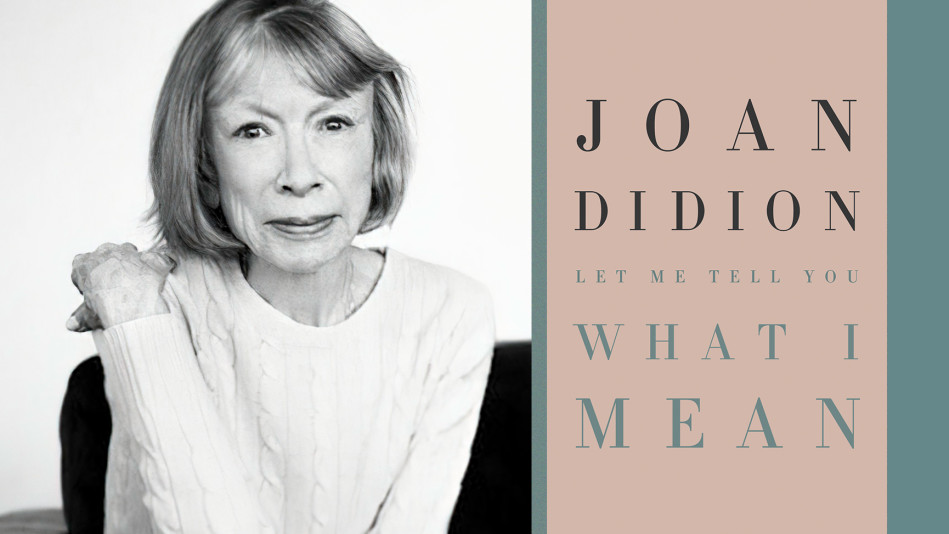
Joan Didion, Dec. 5, 1934 – Dec. 23, 2021.

The Brothers Karamazov by Fyodor Dostoevsky

Let Me Tell You What I Mean by Joan Didion

The Education of an Idealist: a Memoir by Samantha Power

Station Eleven by Emily St. John Mandel

Passing by Nella Larsen

Brat: an 80’s Story by Andrew McCarthy

The Lost Daughter by Elena Ferrante

Kant’s Little Prussian Head and Other Reasons Why I Write by Claire Messud

***

Oh little light… whispering hope

Two of my favourite songs, one for the Season, one for always. May your Christmas be a little light that shineth and a spark of hope.

Oh little town of Bethlehem, how still we see thee lie
Above thy deep and dreamless sleep the silent stars go by
Yet in thy dark streets shineth, the everlasting light
The hopes and fears of all the years are met in thee tonight.

+++

Whispering hope
Oh, how welcome Thy voice
Making my heart
In its sorrow rejoice

+++

Merry Christmas!

‘Passing’ by Nella Larsen, from Novella to Screen

Chicago born author Nella Larsen is the daughter of a Dutch mother and a father of mixed race Afro-Caribbean from Danish West Indies. With that multiplicity in racial background and the zeitgeist of the Harlem Renaissance during the 1920’s and 1930’s NYC, Larsen wrote Passing (1929), a novella about a Black woman passing as white in an acutely discriminatory society, setting up the stage for some suspenseful and intense storytelling.

Irene Redfield is a wife and mother of two sons, maintaining an orderly home in Harlem. Her husband Brian is a doctor, herself well connected and tightly engaged in the social life of her community. While visiting Chicago one time, she encounters an old school friend, Clare Kendry, whom she doesn’t recognize at first. It’s Clare who has spotted Irene in the rooftop restaurant and comes over to identify herself. That fateful reunion changes Irene’s life.

Twelve years have passed since Irene last saw Clare from school. Now standing in front of her is “an attractive-looking woman… with dark, almost black eyes and that wide mouth like a scarlet flower against the ivory of her skin.” (16)

That these two Black women can pass for whites and enter the Drayton Hotel’s rooftop restaurant is due to their light skin colour. This fact in itself implies the fluidity of racial definitions. Clare and Irene are biracial, and that term doesn’t even necessarily refer to half and half. Clare’s father is himself the son of a white father and a black mother. Her fair skin doesn’t betray her racial composition.

The character foil between Irene and Clare forms the crux and conflict in the story. Clare is bold and adventurous, a risk taker who is bound by no loyalty save for her own gratification. By marrying a white husband who is a banker, Jack Bellew, she has been living a privileged, white woman’s life. Curiously, she asks Irene “haven’t you ever thought of ‘passing’?”

Irene answered promptly: “No. Why should I?” And so disdainful was her voice and manner that Clare’s face flushed and her eyes glinted. Irene hastened to add: “You see, Clare, I’ve everything I want. Except, perhaps, a little more money.” (29)

To Irene, what Clare has done is dangerous and disloyal to her race. Well, she passes too sometimes but only when it’s necessary, like getting into Drayton’s rooftop restaurant to escape from the fainting spell due to the sweltering heat. But to Clare, it’s her life. She tells Irene, “all things considered… it’s even worth the price.” That is, despite the fact that she is living with a man who hates Blacks but is unaware of her racial heritage.

The search for identity is not so much the issue Clare is struggling with but loneliness. She has not been discovered for twelve years and now reuniting with Irene, she wants to re-connect with the people in her past life. Alluring and assertive, Clare gradually moves into Irene’s familial and social life.

Larsen’s 111 page novella is more than just about race. It is an intricately layered story that touches on multiple issues. While race is the most obvious one, more for Irene, but for Clare passing is for personal gain and socio-economic benefits, and the breakout of social boundaries. The book is also about female friendship, and the ambivalence that involves. Further, unexpected for all of them, as Clare enters Irene’s home, she begins to unhinge the equilibrium in relationships. She charms everyone, from the help to the two boys, and the most abhorrent suspicion Irene harbours, her husband Brian as well. Herein lies the turning point in the story.

Larsen tells her story with spare and concise narratives, her revealing of her character’s thoughts is precise and clear, that is, until we reach the ending. Like a suspense writer, Larsen has dropped hints as to where she’s leading the reader towards the end. And yet, it is as open-ended as how a reader is prepared to see. Herein lies Larsen’s ingenuity.

__________

Tessa Thompson as Irene (L) and Ruth Negga as Clare in Passing, film adaptation written and directed by Rebecca Hall

The film adaptation (2021) is the directorial debut of British actor Rebecca Hall who also wrote the screenplay. It is a project that she had attempted to launch for some years. The book aligns with a family history as her maternal grandfather was a Black man who had passed as white for most of his life in Detroit, Michigan.

What Larsen has written, Hall has materialized on screen with parallel, meticulous mastery. That the film is shot in black and white is a brilliant idea, for viewers can see quite readily, in between the black and the white is a spectrum of greys, clearly showing Larsen’s concept of the fluidity of socially-constructed racial definitions. The 4:3 Academy ratio works to lead us into a glimpse of a specific past where Clare could well fit the image of a flapper in 1920’s NYC.

Hall has simplified the locations and mainly focused on Harlem. She has effectively selected the essential passages and lines and transposed them on screen. Out of Larsen’s spare novella the writer-director has created a thought provoking visual narrative with stylish aesthetics and implications that still resonate in our times.

I’ve always been intrigued by the image on the Penguin edition of the book cover. At the beginning of the film, Hall shows us the significance of it. Irene wears a translucent hat that’s half covering her face, an aid to shield her features as she goes shopping in Manhattan, just in case, and in the hotel room where she meets Clare’s racist husband John (Alexander Skarsgård), a necessary means of defence.

The interplay between Tessa Thompson as Irene and Ruth Negga as Clare is immaculate and well-directed, nuances revealed in the slightest changes in facial expressions and gestures. The reunion of old friends is not all celebratory, an ambivalence is clearly conveyed by Irene. Andr´é Holland (Moonlight, 2016; Selma, 2014) plays Brian, loving husband and father who is acutely aware of the racial atrocities in the country. Like Clare, he wants to breakout and be free.

Another major asset is cinematography. Edu Grau (Suffragette, 2015; A Single Man, 2009) has crafted a stylish work with depth. His camera is spot-on when it’s needed to capture the expressions of the characters, especially between the two women as often their faces are the visual dialogues when none is spoken. And throughout the film, the jazz motif sets the mood that weaves through scenes.

What’s explicitly written in a book can only be shown with images on screen. Hall is effective in adding sequences that are illustrative in revealing Irene’s fears as she sees Brian and Clare becoming closer. And with the visual comes the sound. In the tea party at their home to honor the writer Hugh Wentworth (Bill Camp), Irene’s heavy breathing we hear as the camera follows her around the house lets us feel her restrained anger and unsettling spirit. The breaking of the tea pot and the conversations she has with Hugh who helps her pick up the pieces is most telling. These are apt additions as a gradual revealing leading to the end.

Like Larsen’s novella, the ending is open to interpretation. However, what Hall implies seems to be different from the author’s. Read the novella, watch the film. This is an intriguing pairing of two exceptional storytelling in both art forms.

Passing is a nominee of the 2021 Sundance Grand Jury Prize. It has been screening in the festival circuit and is a new release on Netflix starting November 10.

~ ~ ~ ~ Ripples

***

Passing by Nella Larsen, Penguin Books, NY., 2018, With an insightful Introduction and Suggestions for Further Reading by Emily Bernard, 128 pages. (Story from p. 10-120)

Novellas in November, click here and here to see what others are reading.

Kant’s Little Prussian Head & Other Reasons Why I Write by Claire Messud

Intrigued by the title? I was, and that prompted me to investigate further. The subtitle pushed me out of indecision: an autobiography in essays. I’ve read two of Messud’s novels, The Burning Girl and The Woman Upstairs, both I couldn’t embrace wholeheartedly. However, the title of this non-fiction jumped out at me.

I’ve appreciated Claire Messud the memoirist and critic much more than Messud the fiction writer, albeit I admit I’ve read only two of her seven novels. The first part of this autobiography in essays reveals her multicultural roots and the various geographical locales that had made up who she is as a writer. A French father born in colonial Algeria and a Canadian mother, what an interesting fusion of culture.

Messud has left footprints and therefore collected memories in many parts of the world. She writes about her growing up years moving from Connecticut to Australia then to Canada and back to the United States, and later her travel to Beirut, an emotionally torn, love trip both for her dying father who had spent his childhood there with fond memories, and for herself.

In the eponymous essay, ‘Kant’s Little Prussian Head’, she writes:

“I can echo Walt Whitman in asserting that ‘I contain multitudes.’ I am who I am because I was where I was, when I was; and almost all of it is invisible to the world. This is true, of course, for each of us” (80).

Messud is generous in sharing the intimacies of her family relationships, especially those of her parents’ and grandparents’. I’ve found too that certain parts of her novels are based on real life experiences and encounters, e.g. the character Cassie in The Burning Girl.

The second part is both taxing and satisfying as she critiques on various international writers and artists, making up a good list for me to explore. Even though I haven’t read some of them or seen their artwork, I find the essays informative, insightful, and exemplary in critique writing. Her prose is elegant and inspiring, and at times, exhilarating.

The Camus essays are captivating for me in terms of the historical backdrop and political situations of Algiers and the tough handling by the then French government. Camus the pacifist had to confront issues of violence, colonization and post-colonial dilemmas.

Her essay on Kazuo Ishiguro’s Never Let Me Go elicits more poignancy from the already devastating fate of the characters Kathy and Tommy. In particular, she sheds new light into the moving scene where Kathy embraces the pop song Never Let Me Go longingly.

The essay on the photographer Sally Mann is mesmerizing. In an interview, Mann had said, “unless you photograph what you love, you are not going to make good art… it’s always been my philosophy to make art out of the everyday, the ordinary” (290).

Herein lies the dilemma of privacy and art making as Mann had candidly photographed her children growing up and her husband who is afflicted by muscular dystrophy, thus making her a highly controversial artist. Anyway, herein lies the dilemma of a memoirist, I suppose, like Messud’s book, there has to be the revealing of relational intimacy and private lives in order to imbue authenticity and truths in an autobiography.

Back to the essay ‘Kant’s Little Prussian Head’, Messud has, in her ingenious way, explains to her readers how she gets the title from. I’ll leave it with you to explore instead of me clumsily paraphrase. However, I’d like to conclude by quoting this moving episode of Messud and her mother who was afflicted with dementia:

“In the last two years of her life, she was often quiet––she who had been so vitally social––and once, as she sat in silence, I asked her what she was thinking. With a wry and wistful smile, she answered, “Shards of memory, and new worlds discovered”(82).

To store up and share fragments gleaned from the ruins of the past is just one of the reasons for Messud to write, as well, for her readers to collect and keep in our own trove containing our own shards of memory, as we all share the magic of these lived experiences through the literary and the arts.

~ ~ ~ ~ Ripples

Kant’s Little Prussian Head & Other Reasons Why I Write: an autobiography in essays by Claire Messud, W.W. Norton & Company, NY, 2020. 306 pages.

______________

Memories of Thanksgiving Past

Today is Thanksgiving Day in Canada. 2021 marks a significant turn as we’re slowly coming out of a pandemic, albeit still riding through bumps and waves, currently the fourth one for us. Amidst the collective chaos and discontent, I still have much to be thankful for, learning to count my blessings despite what we’ve gone through.

However, I admit I’m in a nostalgic mode. I check back to my previous posts and revisit some experiences of my Thanksgiving Past.

Thanksgiving 2017

I just came back from New York City attending the NYFF. While the Walter Reade Theater at Lincoln Center was the venue, I’d the chance of visiting many places that were unforgettable for me. Like, Central Park:

Monet’s Water Lilies at MoMA:

And Luke’s lobster roll by Brooklyn Bridge:

Thanksgiving 2016

The end of a 5-day escapade to London where I’d bagged loads of fond memories. While the streets of Cambridge were like a ready movie set,

this one was the actual setting… a dejected William (Hugh Grant) walking through the four seasons in Notting Hill’s Portobello Market, to the sad tune of ‘Ain’t No Sunshine when She’s Gone’:

and the blue door where his fame-crazed flatmate Spike (Rhys Ifans) opens to a crowd of paparazzi, in his just-out-of-bed attire:

Thanksgiving 2015

Around that time I was driving through New England where many indelible images had lodged in my mind. Along the country roads of New Hampshire, it was a bit early to see red. The primary colour appeared to be orange:

Thanksgiving 2012

As I scrolled through past photos, it’s this orange that seized and brought me back to Thanksgiving Present. On Thanksgiving Day, 2012, I was at Iona Beach, Richmond, B.C. These lines and image are from my post then:

And finally, I saw the sun slide down the distant sky. What a sight to wrap up Thanksgiving. If anything’s common… it’s Common Grace:

Iona Beach in Richmond, B.C., on Thanksgiving Day, Oct. 8, 2012

To all my Canadian readers, Happy Thanksgiving!

To my neighbours to the south, early Thanksgiving greetings!

***

The Sound of Autumn Leaves

A few years ago, I flew a couple thousand miles and drove some more to see New England’s fall foliage. Today, within walking distance, I marvel at the colours of autumn right in my neck of the woods.

We don’t have maples trees here. Our fall colours are mainly yellow and rusty orange.

Birds have mostly flown south, what’s left is a scenery of silent gold… until I come to this aspen grove. No, they’re not silent at all, as I see how these trees put on a show of vibrancy.

Kawabata entitled one of his books The Sound of the Mountain. Here, I can hear the sound of flaming aspens, full of vitality and life.

Surely, Robert Frost had wisely noted that nothing gold can stay, and yet, I find these simple lines speak louder, as if in reply:

The leaves do not mind at all
That they must fall. *

If only for a short, ephemeral moment, they fulfill their purpose and shout out the sound of life.

_________________

*From the poem ‘The Leaves Do Not Mind At All” by Annette Wynne

Related Ripple Posts:

New England Road Trip begins here

The Sound of the Mountain by Yasunari Kawabata

Blackie Spit, Surrey, B.C.

Sometimes you stumble upon a place looking for something, unaware that there are so much more to explore. Last week I drove out to British Columbia, our neighbour province to the west. While in Surrey, I searched for birding spots in the area and decided on driving down to Blackie Spit by the coast.

The Spit is named after an early settler Walter Blackie. Way before Walter and his fellow Europeans arrived here, the place was called “Tsee-wahk” Point, indigenous language for “strawberry” or “elderberry”, a place rich in food. Their saying goes: “When the tide is out, my table is set.”

Blackie Spit is located where inlets from Boundary Bay flow in. Zooming out would be the Strait of Georgia:

I followed a path that put me inside a fairytale:

In such a setting, I shouldn’t have been surprised to stumble upon a Great Blue Heron but I was as I looked across a stream…

and just a few steps away along the path, another one. This time, right in front of me up on a tree:

Never have I seen a GBH so up close and personal, and not flying away even when I stepped right underneath it to take a picture. No cropping of the photo here.

As I walked further along the path, absorbing the stunning view of the outlet, I found yet another one. Three GBH in a row… I’ll call that a good birding day.

Or, was I dream walking? Can you see it too?

You found it?

Of course, there must be an abundance of food for them here, as the indigenous people had known a long time ago. I could see why when I saw this mural. I was in salmon habitat:

So, I was indeed dream walking…

–––––––––––––––

‘Hope’ is the thing with feathers

“Hope” is the thing with feathers –
That perches in the soul –
And sings the tune without the words –
And never stops – at all –

And sweetest – in the Gale – is heard –
And sore must be the storm –
That could abash the little Bird
That kept so many warm –

I’ve heard it in the chillest land –
And on the strangest Sea –
Yet – never – in Extremity,
It asked a crumb – of me.

–– Emily Dickinson

______________

Ripple from The Chair (E6).

One or Two Things

One or two things are all you need
to travel over the blue pond, over the deep
roughage of the trees and through the stiff
flowers of lightning–––some deep
memory of pleasure, some cutting
knowledge of pain.


For years and years I struggled
just to love my life. And then

the butterfly
rose weightless, in the wind,
“Don’t love your life
too much,” it said,

and vanished
into the world.

––– Mary Oliver, lines from “One or Two Things”

***


‘The Father’ depicts dementia in suspenseful realism

Dementia is a land where its inhabitants can never come out, and visitors can only look in from the outside. To add to the isolation, they speak a different language outsiders don’t understand.

In his role as an 80-year-old man afflicted with dementia in The Father, Anthony Hopkins has shown he’s an apt interpreter of that language. With his astute performance, the iconic British actor becomes the oldest person to win an acting Oscar this April, his second after The Silence of the Lamb in 1992.

The Father is based on the 2012 play Le Père by French playwright director Florian Zeller. It received the Molière Award for Best Play in 2014. The English version was translated by Christopher Hampton in 2016 and performed on Broadway. Hampton and Zeller co-wrote the adaptation to film. At this year’s Academy Awards, they won Best Adapted Screenplay. This is Hampton’s second Oscar win for writing; his first was for Dangerous Liaison in 1988. And for Zeller, his debut feature garnered six Oscar nominations including Best Picture.

Zeller’s intriguing way of storytelling lets viewers experience vicariously what a dementia sufferer goes through. First off, it is uncanny that Hopkins’s character is named Anthony. The film is shot from his point-of-view.

The editing by Yorgos Lamprinos strings together seamlessly the conflicting perspectives of Anthony’s: the mingling of memories, the confusion of happenings and imagination, the loss of a timeframe for past events, the distortion of present realities, and perhaps most disturbing for those close to him: unrecognizable faces. Describing how Zeller achieve these effects will be like giving out spoilers. I’ll just say this, The Father is like the Rashomon of dementia.

Zeller’s film is cinematic realism depicting the condition of dementia. The confused, bewildered look of Hopkins in close ups is accompanied by repetitive, eerie music, rendering the scenes suspenseful, not far from a Hitchcockian thriller. When one has lost the capacity of one’s brain, it is a scary experience. Anthony knows his way down the hallway to his room, but is this his flat? Where’s his watch, again? And, what happened to that painting that used to be hanging on the wall? The cast of seven brings out a powerful narrative in just 97 minutes.

Another realistic portrayal is Olivia Colman as the daughter Anne, who has to convince her father that he needs help. She struggles with the conflict between filial love and personal freedom, her husband (Rufus Sewell) does not make things easier for her either. And to complicate matter further, Anne is not her father’s favourite but her younger sister Lucy…

We’ve had a couple of excellent films on the subject of aging and dementia in the past. Away from Her (2006) directed by Sarah Polley who adapted Alice Munro’s short story is about a wife stricken by Alzheimer’s, and Michael Heneke’s Amour (2012) narrates an aging husband caring for his debilitated wife after her stroke, both received Oscar nods. Zeller has contributed to this repertoire of films with a perspective from the point-of view of the patient, adding to it a daughter’s internal conflicts.

No matter how much Anne tries to keep her father living with her, his condition needs professional care and monitoring, something she finds hard to get through to a dementia patient who is determined to be self-reliant. Colman’s performance is sensitive and moving.   

A very clever man, this father hasn’t totally lost it. The scene where he meets his new caregiver Laura (Imogen Poots) in Anne’s home shows how sharp he can still be, and not just Anthony the character, but Hopkins the actor, who is in his top form.

Original music is by Ludovico Einaudi (Nomadland, 2020) whose score reflects the mental state of Anthony’s, enhancing the cinematic effects. The opera music at the beginning of the film which Anthony is listening to, and later reprises is from Bizet’s Les pêcheurs de perles. The poignant piece is his link to the person he once was, the song entitled Je crois entendre encore: ‘I believe I still hear.’

Eventually, the inevitable question has to be asked by Anthony, an antithesis to a cathartic ending: ‘Who exactly am I?’

~ ~ ~ 1/2 Ripples

***

Related Reviews on Ripple Effects:

Away From Her

Rashomon and other Stories by Ryunosuke Akutagawa

And When Did You Last See Your Father

Beauty in the Curves

Yesterday I went back to the place where just a few days ago I saw the Trumpeter Swans, and this time I found more. One adult and five juveniles were swimming leisurely in a peaceful surrounding. The scene was breathtaking.

This was the closest I’ve ever got near to a bird this big. They were swimming just a few feet from the snow-covered river bank where I was standing. This time, I could observe much clearer the beauty of their form… and discovered, of course, it’s in the curves!

Their naturally endowed, long neck is a posture of grace when held up straight, elegant and serene:

But when they bend down, the velvety, long neck creates curves that are sensually stirring:

When they fly, I could see the lofty curvature composed by their wings:

Beauty in its most natural and simplest form. Not flaunting, just being. Nothing they do to cultivate that, all endowed by their Maker, the creative Giver of life and grace.

________

The Swan

Did you too see it, drifting, all night, on the black river?
Did you see it in the morning, rising into the silvery air –
An armful of white blossoms,
A perfect commotion of silk and linen as it leaned
into the bondage of its wings; a snowbank, a bank of lilies,
Biting the air with its black beak?
Did you hear it, fluting and whistling
A shrill dark music – like the rain pelting the trees – like a waterfall
Knifing down the black ledges?
And did you see it, finally, just under the clouds –
A white cross Streaming across the sky, its feet
Like black leaves, its wings Like the stretching light of the river?
And did you feel it, in your heart, how it pertained to everything?
And have you too finally figured out what beauty is for?
And have you changed your life?

– Mary Oliver (italicized lines her own)

_________

“A white cross streaming across the sky”

Yes, I saw it… and felt it. Still rippling in my heart.

***