Brooklyn by Colm Tóibín: A Second Encounter

As one who is interested in the adaptation process, I’m always eager to find out how filmmakers choose movie materials.

I first read Colm Tóibín’s Brooklyn a few years back when it was first published. I admit I found it uneventful and a bit bland at that time. On the shelf it went after my reading, and I didn’t bother to think too much about it.

Only in recent months when I knew about its upcoming movie adaptation that I was drawn back to it. My major quests this time: to give it another chance and to find out what in it that appeals to filmmakers.

Well, glad I reread it, for I’m actually giving myself a second chance. This time the ‘uneventful’ narratives become a quiet and gentle portrayal of a young woman’s journey of self-discovery, a coming-of-age story told with nuance and grace.

I read it more carefully this time, noting in particular the subtexts and inferences. I paid attention not only to the characters’ inner thoughts and feelings from Tóibín’s direct statements, but his descriptions of their actions and find that he’s a master of subtleties.
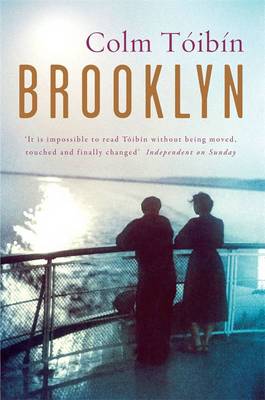
Brooklyn_Colm_Toibin

Brooklyn is about migration, this time around, I can see how relevant and timely it is with our present global situation. From the small town of Enniscorthy, Wexford County, Ireland, Eilis sails across the Atlantic on her own to reach the shore of America just for a better future.

The initial foresight is however from her older sister Rose, the financial supporter and all round sustainer of both Eilis and their widowed mother. It is no wonder that Eilis feels it’s Rose that should be the one to go to America, Rose, the good golfer, glamorous, fashionable, capable and confident.

And Eilis? Here’s a little episode while still in Enniscorthy. She goes to a dance with her best friend Nancy and watches her being invited to the dance floor by a promising young man George. Sitting on the sideline Eilis watches her every move and then we read:

“Ellis looked away in case her watching made Nancy uncomfortable, and then looked at the ground, hoping that no one would ask her to dance. It would be easier now, she thought, if George asked Nancy for the next dance when this set was over and she could slip quietly home.”

When this set is over she isn’t given such a chance, for then George brings Nancy and Eilis over to the bar for a lemonade and we are introduced to his friend Jim Farrell, who “just nodded curtly but did not shake hands… his face emotionless.” Towards the end of the book we will see Jim Farrell appear again as some sort of a nemesis who poses a moral dilemma for Eilis.

Tóibín has given us an unlikely heroine in Eilis, a reluctant emigrant. Always the recipient of Rose’s support and encouragement, Eilis is in fact pushed out of her comfort zone by her well-meaning older sister. In her personal journey we see how Eilis grow and mature, and most importantly, with her good nature intact.

In Brooklyn, Father Flood helps her settle in Mrs. Kehoe’s rooming house and secures a job as a sales clerk at Bartocci’s department store. She gets a taste of rooming house politics, and at Bartocci’s, learn work ethics and the soft skills that are so essential to survive socially. And yet, she is plagued with homesickness as soon as she receives the first letters from home.

At the mid-point of the book, Eilis meets Tony, not Irish but from an Italian immigrant family. No matter, Tony’s authentic charm and devotion break down all cultural barriers and alleviates Eilis’s homesickness.

Tony is gentle with her, courteous and considerate. How do we know? As a die-hard Brooklyn Dodgers fan, Tony never mentions baseball in front of Eilis. Instead, he listens attentively to her and having learned of her night class at Brooklyn College, waited for her after class just to walk her home.

Eilis discovers Tony’s love of baseball when he brings her home for dinner over conversations with her brothers at the dinner table. His family? That’s another charming story.

Just as she begins to settle in and fully enjoy her new life in Brooklyn, Eilis receives a tragic news that sends her back to Ireland for a short while. Now we are at the last part of the book with only fifty-one pages left. Here we have the major conflict of the novel, a moral dilemma that Eilis needs to resolve.

I much appreciate Tóibín’s storytelling. After presenting us in details a successful immigrant experience, a young woman becoming independent in a new land, finding herself, meeting a love interest, and even planning for a future with him, Tóibín drops a bombshell shattering all that has been built and invested. And all this while, he’s been so calm and quiet leading to it.

Further, Tóibín shows us how we can be a different person in different settings and environment. Once back in Ireland, the independent and confident Eilis is changed back to her old self. Under the roof of her mother, she is the dutiful and accommodating daughter once again, but this time, with the added burden of guilt.

Tóibín’s narratives are often quiet and mild, but his characterization is shrewd. We see the acerbic Mrs. Kelly who runs a tight ship in her grocery store where Eilis works on Sundays, and her American counterpart Mrs. Kehoe, Eilis’s landlady. Then there’s the curt Jim Farrell who doesn’t even cast Eilis a glance but earnestly woos her when she comes back after dipping in American waters; and finally there’s Eilis’s mother, subtly scheming and manipulative.

With the subject of migration, the ultimate quest is finding a home. As we read Eilis’s personal journey across the Atlantic from Ireland to America and back again, we see her tossed by the waves of loyalty and belonging. Like her first voyage over the turbulent sea, unsettling and gut retching, her return to Enniscorthy is an even more acute challenge. But at the end we see Eilis make her choice, and it is gratifying.

She is finally ashore.

~ ~ ~ 1/2 Ripples

***

Movie review of Brooklyn is here.

 

November Wrap: East Meets West at the Pond

November is an eclectic month of reading and viewing for me. I’ve watched films ranging from a Chinese wuxia legend from the Tang Dynasty, to the English suffrage movement, to the scandal in the Catholic Church in Boston… and read books from crime thrillers to Westerns to the Gilded Age to India before and after independence.

Arti is a hybrid after all, constantly navigating between cultures and languages. When it comes to books and films, dashing between genres, periods and styles only adds spice to life.

Here’s the list of my November books and films.

Films

The Assassin

The Assassin

Acclaimed Taiwanese director Hou Hsiao-Hsien’s genre-defying wuxia epic earned him Best Director at Cannes this May. Hailed as the most beautiful film at the Festival, this adaptation of a 9th century Tang Dynasty Chinese legend may not be as easily grasped in terms of its storyline as its visual appeal. The film is recently voted #1 on the reputable Sight and Sound Magazine‘s Best Films of 2015 list, that’s the result of a poll gathering the views of 168 international film critics. It is a rare gem indeed. My full review at Asian American Press.  ~ ~ ~ ~ Ripples

(BTW, Hou’s last film? The Musée d’Orsay commissioned French feature on the Museum’s 20th anniversary: Flight of the Red Balloon.)

Room

A highly watchable adaptation of Emma Donoghue’s 2010 Booker Prize shortlisted novel. Kudos to the actors Brie Larson as Ma, Jacob Tremblay as 5 yr-old Jack, and yes, to Donoghue herself for writing the screenplay. One of those titles that I’ve enjoyed watching more than the literary source. My review on Ripple Effects.  ~ ~ ~ 1/2 Ripples
Update Jan. 14, 2016: 4 Oscar Nominations including Best Picture

Suffragette

Carey Mulligan has put forth a nuanced performance as the laundry gal turned suffragette in this Sarah Gavron (Brick Lane, 2007) directed historical drama. It’s worthwhile to watch the informative depiction of the actual events woven with fictional personal stories, especially Mulligan’s riveting portrayal of Maud, how her beginning naivety is forged into committed devotion to the suffrage movement. Prolific screenwriter Abi Morgan (Irony Lady, 2011, just to name one of her works) has laid out a fact-based drama with a heart-wrenching climatic scene. The sacrifice these voiceless, working women were willing to lay down is inspiring.
~ ~ ~ 1/2 Ripples

Secret in their Eyes

The Hollywood re-make of Argentine author Eduardo Sacheri’s crime thriller is a tall order, for its previous film adaptation is the Oscar winner of 2009 Best Foreign Language Film. My post on the book, original film, and Hollywood version is here. ~ ~ ~ Ripples

Spotlight

One of the best films I’ve seen this year, detailing the sequences of how the Boston Globe’s ‘Spotlight’ team of investigative journalists uncovered the systemic cover-up of child sexual abuse among Catholic priests. The Pulitzer winning reporting is presented in the film as painstaking procedurals in matter-of-fact dramatizing. For those who may be a bit worried about the subject matter, there is no sensationalized scenes of abuse, and on the part of the reporters, no portrayal of heroism. Such may well be the praise-worthy elements of this production. The cast’s performance is convincing, in particular, Liev Schreiber as the soft-spoken but motivating, no-nonsense editor Marty Baron. Come Awards time, I trust the production, its cast and crew, and director Tom McCarthy (The Visitor, 2007) will be duly recognized.    ~ ~ ~ ~ Ripples
Update Jan. 14, 2016: 6 Oscar Nominations including Best Picture

Fireflies in the Garden

My guess is, you haven’t heard of this 2008 movie. Neither have I until I saw it on TV a few days ago. The story about a father-son’s love-hate relationship from childhood to adulthood is realistically depicted. Caught in between the straining conflicts between the always angry and harsh father and a sensitive, vulnerable son, is the mother, always loving and protecting, something like the family dynamics in Terrence Malick’s The Tree of Life. It also echoes the Oscar winning Ordinary People (1981), the small-scaled, Bergman-esque chamber film of deep entanglement of unresolved parent-child conflicts. Another film just popped into mind and that’s Colin Firth, Jim Broadbent’s When Did You Last See your Father.

Fireflies has a well-selected cast with Ryan Reynolds, Willem Dafoe and Julia Roberts. I’m surprised to see the low rating the film received among critics. Disappointed really that it wasn’t well received. What’s that to me, and why am I  concerned? There’s a half-baked screenplay in my closet that’s something along that line. I know, more rewrites.  ~ ~ ~ Ripples

**

Books (Click on links to my Goodreads reviews)

It’s all a chain reaction started with …

The Burning Room by Michael Connelly (Audiobook)

I’ve not missed a single one of Connelly’s Detective Bosch novels. This time I listened to the audiobook and was much impressed by the voice of its narrator Titus Welliver.

Appaloosa by Robert B. Parker (Audio MP3)

So I checked about Welliver’s other audio works, and found Appaloosa by Robert B. Parker. I’d seen the 2008 film adaptation with Ed Harris and Viggo Mortensen and quite enjoyed it. So I jumped right in and found it to be a very well-written book, one of the few Westerns I’ve read.

And from this Robert B. Parker, I went on to explore more about him and learned that he was the ‘Dean of American Crime Fiction’. Here are two of his works crime stories I followed up with:

Promised Land  (Audio MP3)
The Godwulf Manuscript  (Audio MP3)

The Custom of the Country by Edith Wharton
From crime fiction to the Gilded Age. I bought this book at Edith Wharton’s home at The Mount during my New England road trip, during which I learned that Julian Fellowes was much influenced by Wharton and especially this title.

The Secret in their Eyes by Eduardo Sacheri (Audio MP3)

Plato and a Platypus Walk into a Bar: Understanding Philosophy through Jokes by Thomas Cathcart and Daniel Klein (eBook) – click on link to read my one-line review of this title on Goodreads.

The Boston Girl by Anita Diamant
Makes me think of Colm Tóibín’s Brooklyn which I’m rereading to prep for the upcoming film adaptation.

Heat and Dust by Ruth Prawer Jhabvala
Shifting between the English in India before independence and later the 70’s, a clash in cultures and the human toll of unfulfilled marriages. I reread this to prepare for the James Ivory Retrospective this coming weekend right here in my City, with the legendary director (now 87) attending. Yes, really looking forward to this event.

**

Currently Reading / Listening

In the Heart of the Sea by Nathaniel Philbrick (for the upcoming film)

Brooklyn by Colm Tóibín (reread for the upcoming film)

Parade’s End by Ford Madox Ford (Audiobook)

***

Related posts you may like:

Flight of the Red Balloon (2007)

The Tree of Life (2011) by Terrence Malick

When Did you Last See your Father?

Appaloosa (2008)

Room: From Book to Film

Spoiler Alert: This review involves spoilers.

Is the book always better than its movie adaptation? Again I’d say, they are two different kinds of medium and art form, hence, hard to compare. But some just want a simple answer. So here it is, no. The book is not always better, and Room is a case in point.

Room Movie Poster (1)

Not that I’m putting down this 2010 Booker Prize shortlisted novel by Emma Donoghue, or that I lack the empathy to appreciate the scenario: A teenager kidnapped and locked in a garden shed, visited by her captor on a regular basis for his pleasure, two years later resulting in the birth of a baby boy whom she raised right there in the room until he is five years old. A sad and tormenting premise, albeit not totally implausible when there was a similar real life case just discovered not long before Donoghue wrote her book, and sadly, new ones coming out after as well.

I read the book upon its publication in 2010. Maybe it was my own intuitive reaction against the hype around it, I found reading three hundred some pages of juvenile talk, all from the point of view of a 5 year-old was a bit testing, at times even annoying. But the movie has offered me an alternative frame of looking at the story, and its author.

There are many positive ingredients in this affective and powerful adaptation. First is Donoghue. Writing the screenplay herself, the author expands our view from 5-year-old Jack (Jacob Tremblay) to include his Ma (Brie Larson), by so doing, raising our empathy for the captive, who has to appease her captor (Sean Bridgers) whom they call Old Nick, in order to stay alive and protect her young son.

A torturous line to tread, but Ma (her real name is Joy) has done it by turning the whole ordeal into a pleasant environment, giving Jack as normal a childhood as possible under such restraints. Old Nick brings them supplies when he comes in at night. That’s when Jack has to hide in the closet until Old Nick leaves. During daytime, Jack plays, exercises, and reads, even bakes a cake together with Ma for his birthday. The calm, playful scenario reminds me of the Holocaust movie Life Is Beautiful (1997) where the father turns a Nazi concentration camp ordeal into a game for his young son to shield him from the horrors of reality.

What is real, what is not? What is captivity, what is freedom? Jack learns that he and Ma are real, people in the TV are not. Room is all there is. The concept of himself being a captive has never enters his mind. Jack accepts all these until one day Ma knows that she cannot keep him in the shed anymore. Keeping her son safe from Old Nick’s hands becomes the prime motive for her to think of an escape plan.

I much appreciate director Lenny Abrahamson’s handling of the story: he chose not to exploit the crimes of Old Nick’s but to exalt the bond between Jack and Ma. The love between a mother and her child deflects all horrors of human depravity. Further, Ma’s nurturing helps Jack interpret his world and find beauty in it, from a confining shed to the outside world in the second part of the movie.

To counteract the argument that a movie leaves nothing to the imagination as it shows the visualized image of the literary, again, it depends on the handling by the director. Here in Room, some key issues are left to the audience’s own private thoughts. So if you are concerned about the movie being too graphic in its dealing with the crimes mentioned in the book, fear not, albeit I must say there are tense sequences for dramatic effects.

Donoghue has also structured the movie well, the first hour in the room, the next in the wider world, for we all need the balance; we all want to see Jack and Ma free. The contrast of the two worlds is mesmerizing to Jack. To Ma, however, the situation is much more complicated. The readjustment, the ‘what-if’s’, the ‘why didn’t you…” callously posed by the media are the slings and arrows hurled at her when she is interviewed, prompting her, and us the audience to ponder “What makes a parent? A good parent?”

Joy’s own mother Nancy is played by Joan Allen, in one of her most affable roles. Her acceptance and warm welcome helps Jack feel he belongs. In contrast, William Macy, her ex-husband Robert, sees only the criminal when he looks at the child. Leo (Tom McCamus), who lives with Nancy, observes from the sideline and helps in his own subtle way.

Another element I must mention is the music. I have not seen the films which Irish composer Stephen Rennicks had scored previous to Room. So for this first time hearing his work, I was deeply moved. The music augments the suspense and cues in the warmth, an essential ingredient to bring out the cinematic effects. As the film ends, I welcome it like a cathartic wash sweeping away the ugliness, leading Ma and Jack to embrace a fresh new beginning.

Shot in Toronto, the movie had captured the hearts of audiences in various film festivals and is the winner of Grolsch People’s Choice Award at TIFF15. Come this Awards Season, my prediction (and hope) is that it will gather nominations for screenplay, directing, music, actress, and for 8 year-old Jacob Tremblay.

~ ~ ~ 1/2 Ripples

***

Update January 14:
4 Oscar Nominations
– Best Picture, Best Actress, Best Director, Best Adapted Screenplay

Update January 10: Brie Larson won Best Actress Golden Globe

Update Dec. 10:
3 Golden Globe noms for Best Motion Picture-Drama, Best Actress and Best Screenplay. Now 9-year-old Jacob Tremblay got a SAG nom.for Best Supporting Actor. These are just a few mentions among other noms. for the film.

Related Post:

Books to Films at TIFF15

Can a Movie Adaptation ever be as good as the Book?

Serendipity on Route 7

My drive continued south from Bennington, Vermont, via RT 7 to Williamstown, Massachusetts. There I stayed for the night. I knew Williams College was located there. But while exploring the town, I came to this building and saw the huge banner. Upon further investigation, I was excited to discover the campus of Shakespeare & Company:

The Miller BldgDSC_0337 (1)Later I found out that the actor Christopher Reeve met his future wife Dana in Williamstown where they later married. Reeve began as an apprentice at age 15 with the Wiliamstown Theater Festival right in those venues and eventually performed there for fourteen more seasons.

I had the chance to talk to a woman who was working on the grounds and learned that, lo and behold, she was born in Alberta, Canada, my home province! Imagine a chance encounter with an Alberta born American thousands of miles away.

The Berkshires region is beautiful and cultural. I made a mental note to come back to Williamstown for its annual Theater Festival.

My original plan was just to drive south on RT 7 from Williamstown to Lenox to see the Edith Wharton House at The Mount, when another serendipitous find came upon me: Tanglewood Music Center. So here I was at the famous summer home of the Boston Symphony Orchestra on my way to Edith Wharton House.

The Koussevitzky Music Shed was named after the Russian-born conductor, composer and double-bassist, long-time music director of the Boston Symphony Orchestra from 1924 to 1949:

TanglewoodI lingered at Tanglewood for quite some time, for the grounds were beautiful and offered magnificent views. Another mental note: I must come back for the Tanglewood Festival in the summer. :

viewAcross the road from Tanglewood, fall foliage began to emerge. That was October 7. I can imagine how beautiful it is now:

across from TanglewoodAnd finally, to The Mount, Edith Wharton’s home from 1902 – 1911. I knew she was a prolific novelist and short-story writer, the first woman to win the Pulitzer Prize (The Age of Innocence, 1921); later I learned too that she had been nominated for the Nobel Prize for Literature three times.

So I was a little surprised to find out from the tour guide at The Mount that she was also a house and landscape designer in her own right. Her book The Decoration of Houses is still used today by architects and designers.

Built as a writers retreat, The Mount reflects Wharton’s fondness of symmetry:

SymmetryWhat happened to the left side of the building? That makes it not symmetrical, you might ask. That’s the servants quarter which Wharton was willing to compromise her design principle.

Here’s another view why it’s called The Mount:

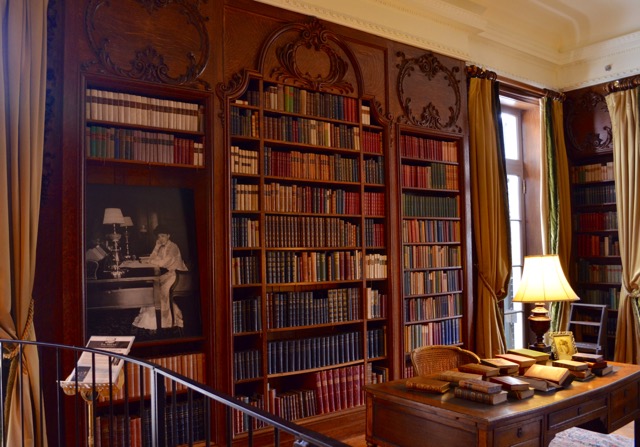
The MountI took a tour of both the inside as well as her gardens. Here’s one wall of her library:

One wallWell read in several languages since she was young, Wharton left these books behind  when she moved away to live in Paris the latter part of her life after the demise of her marriage. Her husband Edward had fallen into a state of dementia after lengthy bouts of depression and mental illness. The writer’s years at The Mount had not been as happy as its surroundings could offer her.

The Drawing Room:

The Drawing RoomDining Room, where Henry James was one of several usual guests:

Dining RoomBut where did she write? Not in the library, or at the desk in her room, but right in her bed. She had an assistant who would take her handwritten pages and type them up after her six hours of continuous writing every morning before she got out of bed. I’m sure Wharton would love to have a laptop:

Writing bed (1)And these other items I found interesting. Downton images conjured up in my mind. Typewriter, telephone, telegram:

DSC_0347
An original 1902 ice box, Daisy would love it but maybe not Mrs. Patmore. Give her some time to warm up:

Ice Box
A luggage lift. Definitely would be a fave among the footmen:

Luggage lift

And only after the tour did I find out, The Mount had given a Life Time Achievement Award to Julian Fellowes. The Downton creator had attributed Wharton as a major influence on his works, first Gosford Park (Oscar Best Original Screenplay, 2002) and then Downton Abbey. Speaking upon receiving the Award at the Harvard Club, Fellowes noted that he was particularly inspired by Wharton’s “… ability to judge without feeling the need to condemn.”

I bought the book The Custom of the Country in the gift shop and only just now did I learn that it is being adapted into a TV mini-series, with Scarlett Johansson playing the anti-heroine, Undine Spragg. This will mark Johansson’s first TV role.

As for Julian Fellowes’ new work? I eagerly await. After visiting The Mount, I can see what a natural shift it is for him to create an American version of Downton. The Gilded Age should be a smooth sequel.

From Lenox, I began the last leg of my New England Road Trip. I headed east on I90, a breezy 2.5 hrs. drive back to Wayland, the suburb outside Boston, thus completing the loop and a memorable journey. An item checked off my bucket list.

***

Follow my New England series:

September Wrap

Here’s a post of lists, movies I’ve seen and books I’ve read or listened to, all in September, a list that hopefully can tide you over till my next post, which will be after a long-planned hiatus. You’re welcome to throw in your thoughts on any title on this list, or ripple out to other shores.

DSC_0319

***

MOVIES At Theatres:

Man from U.N.C.L.E.

Who are they kidding? Might as well just put in this disclaimer: Title taken at random. This is not the Man from U.N.C.L.E. with David McCallum (yeah) as Illya Kuryakin and Robert Vaughn (boo) as Napoleon Solo during my childhood days. I knew what the acronym stood for even as a grade schooler, and was mesmerized by a world wide net of spies and intrigues, despite watching a B/W TV set. This 2015 U.N.C.L.E. feature movie is just like any other lesser spy flicks, feels like haphazardly done, dated spywares that fail to send any positive nostalgic vibes, and featuring an accidental duo just happen to have the same names as those in the 60’s TV series. The third person, Alicia Vikander, makes it a bit more watchable. ~ ~ Ripples

Mistress America

A bit disappointed considering how much I’d enjoyed Frances Ha and the works of Noah Baumbach. Greta Gerwig is a mystery to me. In all her roles she looks ultra cheerful, even in difficult circumstances, but is that overacting or is that what her character is supposed to convey, optimism as fuel for life? Anyway, I wanted to give Mistress America a second chance. But as I checked the showtimes a couple of weeks later, it wasn’t there anymore.  ~ ~ 1/2 Ripples

A Walk in the Woods

A pleasant surprise! Is there life after 50, 60 … 70? Robert Redford and Nick Nolte is an odd pair to answer that from the jagged edge of a cliff. All the cliché shots of two old men hiking the Appalachian Trail are in the movie trailer; the film has more to offer. Emma Thompson is a welcome addition as the forbearing wife hoping for the best. I’ve seen several of this genre in recent years: WildTracksThe Way, to name a few, with A Walk in the Woods being the lightest but still quite relevant. Lesson learned? Forget about your age, and, giving up doesn’t make you a failure. It has been a long while since I read Bill Bryson’s book on which the film is based. Watching the adaptation brings laughs which I remember were absent while reading. An easy 2 hours of relaxation without taking one single step.  ~ ~ ~ Ripples

Learning to Drive

Just the opposite, I was not enthused about the trailer and my hesitations about the film were confirmed as I watched. Based on a non-fiction piece from Katha Pollitt’s Learning to Drive and other Life Stories, the movie turns political by changing the Filipino driving instructor into a Sikh, played by Ben Kingsley. No matter, he has that poise and dignity no matter what costume he puts on. It’s not surprising to see Patricia Clarkson’s Wendy character – a woman in her fifties learning to drive for the first time in her life – get some bonus lessons on cultural awareness on top of parallel parking.  ~ ~ 1/2 Ripples

The End of the Tour

One of the best films I’ve seen this year, and maybe for some time. Nothing looks ‘performed’, yes, even the nervous Jesse Eisenberg as writer David Lipsky is his natural self, unsure of himself and of his subject David Foster Wallace, as he follows his Infinite Jest book tour to write an article for the Rolling Stone Magazine. Based on Lipsky’s book Although Of Course You End Up Becoming Yourself: A Road Trip With David Foster Wallace, the film belongs to Jason Segel. A surprising cast and Segel has delivered with poignancy as Wallace. Framed in a sympathetic tone, the film is a moving tribute to and a revelation of an author whom some may choose to misread.
~ ~ ~ 1/2 Ripples

Pawn Sacrifice

The title says it all. A pawn is sacrificed in the heat of the cold war. Based on the true events that rocked the chess world and quickly inflamed the political landscape, American Bobby Fischer (Tobey Maguire) captured the world championship in 1972, taking the title away from Soviet Grandmaster Boris Spassky (Liev Schreiber). While the film in all its earnest intentions effectively brings out the intensity of the rivalry, the main issue I feel is the casting. Liev Schreiber is too famous a face to be Boris Spassky, even speaking in Russian doesn’t make him any more convincing; Maguire is even more famous a face to be Fischer. And may I go into this? They both need to slim down a bit to fit the profile of the cold war chess rivals, especially Schreiber. My choice for Fischer? Nicholas Hoult. Spassky? Andrew Garfield.  ~ ~ ~ Ripples

***

MOVIES on DVD’s:

The Jungle Book

It has been a long, long while since I watched it and now a refresher to prepare for the star-studded voicing in the remake. This 1967 Disney animation just shows how much has changed in animations then and now. Hand-drawn, slower paced, and nuanced facial expressions from the animal characters, albeit a bit flat when compared to the hyperactive animations we see today. The new version of The Jungle Book is coming out in 2016, utilizing ‘up to the minute technology’, and fusing a real life Mowgli with CGI generated animals and jungle environs all in 3D. As for the 1967 version, the music and the songs will stay as original as ever.

This is Where I Leave You

Another August: Osage County, which is influencing which, for these two are so alike? Or, maybe just speaks to the fact that the dysfunctional family is the norm. Under the direction of their mother, five estranged siblings have to come back home to sit shiva as their father passed. Staying under the same roof for seven days is an ordeal with the Altman family, for everyone carries baggage they’d rather bury together with the dead. Not as bad a film as critics say. Jane Fonda is a less overbearing mother as Meryle Streep is in Osage County, so not to overshadow the rest of the cast. Jason Bateman, Tina Fey, Adam Driver, Corey Stoll may not be the best of siblings, they make one good cast. Don’t you just love the title?

Greenberg

From the dysfunctional family to the dysfunctional individual. Roger Greenberg (Ben Stiller) comes back to LA from NYC to housesit for his brother as the family takes a vacation. As one who had received treatment in a mental hospital, Roger has many personal issues to deal with, and it’s a little heart-wrenching to see him struggle to relate, albeit at times he comes through more as annoying than deserving kindness; but maybe that’s the point. Greta Gerwig plays Florence, dog walker for the family. Stiller is in his usual mode, lost to himself and others; Gerwig is her usual self too, pleasant despite all. So it’s not hard to predict the outcome but the process makes one interesting take. The first time Gerwig in director Noah Baumbach’s work. Here began a beautiful and rewarding partnership.

Panic Room

Re-watch after learning this is the breakout film for Kristen Stewart, age 12. Didn’t realize she played Jodie Foster’s daughter there when I first saw the movie years back, and now seeing it again I find the two do have some resemblance, in appearance and demeanour. Locked in a panic room in a fancy NYC apartment they just moved in, mother and daughter try to stay safe as a gang of burglars break in. Although not thoroughly plausible, especially how Foster answers the door as two policeman come to check on them, which then leads to some even more implausible outcomes at the end. But, overall, a riveting, edge-of-your-seat kind of viewing. And when you think of it, of course, it’s David Fincher.

Olive Kitteridge

Binge-watched this HBO 4-hour mini-series after it won 7 Prime Time Emmys last Sunday. Writing, acting, editing, camera work, the whole production is captivating, and at times, very funny, no, not the Bill Murray section – he’s actually serious here. Frances McDormand and Richard Jenkins are deserving winners. In her acceptance speech for the Best Mini Series, McDormand emphasized that it all came from a book. Yay for books, the wellspring of inspiration. Olive Kitteridge is author Elizabeth Strout’s Pulitzer Prize winning work; writer Jane Anderson wins her Emmy for the adapted screenplay. However marvelous the visualization, it all started with words on a page.


A Touch of Sin

In preparation for Jia Zhangke’s 2015 festival film Mountains May DepartA Touch of Sin was nominated for the Palme d’Or at Cannes 2013 and won Jia a Best Screenplay award. Jia’s camera frames a perspective that’s bold and true in his home country China, a nation obsessed with modernization, economic growth, and wealth accumulation. The film reveals the human costs for such enterprises. Unfortunately, his countrymen didn’t have a chance to watch this one as it was banned. But with Mountains May Depart, officials had said they would allow it. I’m afraid it just might be much tamer and easier for the palate.

***

BOOKS

Summer by Edith Wharton

After The Age of Innocence, I continue to explore the writings of The Gilded Age, to prepare for my New England trip and yes, Julian Fellowes’ new American TV series.

The End of Your Life Book Club by Will Schwalbe

Not as chilling as the title sounds, heartwarming memoir of a son chronicling the extraordinary life of his mother, Mary Anne Schwalbe, albeit she would have likely said, “O, mine is just another life. There are many more deserving ones.” While accompanying his mother at her chemo therapy sessions in the hospital, son and mother share books and reading. The two-persons book club is therapeutic for both.

Circling The Sun by Paula McLain (Audiobook read by Katharine McEwan)

Not sure how much is true in this fact-based fiction about Beryle Markham, the award winning race horse trainer in Kenya and in 1936, the first woman to fly solo across the Atlantic from east to west. Markham flew from England to NYC, but crash landed in Nova Scotia after a 21 hour harrowing flight head-on against the prevailing winds. (I later learned that Amelia Earhart’s 1932 flight was from west to east, a much ‘easier’ feat with the tailwind, landed in Ireland after only 15 hours in flight.) McLain’s book tells many more stories, and gossips, than just this monumental event. Beryl had known the Out of Africa author Karen Blixen in the small social circle in Kenya. Why, Beryl is the other woman in Deny’s life, according to McLain. Not too sure about the book, but I was much impressed by the voice of the narrator Katharine McEwan.

Satin Island by Tom McCarthy

The only 2015 Booker Prize shortlisted book I’ve read, so far, and it’s brilliant. The book presents a most interesting story of a ‘corporate anthropologist’ collecting field data for an ethnographic study of the human society in this digital age. The ‘Great Report’ is needed to be written, same as this book: what have we become at this juncture of human history and civilization? Maybe we do need anthropologists to offer a narrative of our contemporary society, or even better, we should all be trained as anthropologists to see ourselves better.

Remainder by Tom McCarthy

I’ve enjoyed McCarthy’s style of postmodern incisions. Remainder is his debut work and soon to be made into a movie. Walking down the street our unnamed (of course) protagonist was hit by a falling object. After coming out of a coma, he needs to re-enact his past to regain memories, and to reconstruct an authentic existence. Who is he, what is he? With the huge sum of monetary compensations, he steps out to do exactly that. Still reading, a fascinating premise.

***

Books to Films at TIFF15

September kicks off Film Festival Season, a prequel to all the movie nominations coming up at the end of the year. First there’s Venice, Telluride, and Sept. 10 begins the 10-day celebration of films from over 70 countries at the Toronto International Film Festival.

The following are several of the premieres at TIFF15 that are adaptations from literary sources. Just to throw some more reading ideas out in case you’re not already overwhelmed with book suggestions.

***

The Dressmaker by Rosalie Ham

The Dressmaker Movie-tie-in CoverAustralian author Rosalie Ham’s debut novel (2000) is divided into four sections named after four different kinds of fabric: gingham, shantung, felt and brocade. The historical, gothic novel has received several nominations and shortlisted for the Book of the Year Award (2001) by the Australian Booksellers Association. The film adaptation stars Kate Winslet as the dressmaker Tilly Dunnage who returns to her hometown seeking revenge on her being expelled years before, with a sewing machine as her accomplice. Sounds interesting? What more, she is a Titanic survivor (of course she is) and the plot thickens with a hearing on the doomed maiden voyage. Australian director Jocelyn Moorhouse wrote the screenplay and shot the film in Victoria. Liam Hemsworth and Judy Davis also star.

High-Rise by J. G. Ballard

HighRise(1stEd)J. G. Ballard’s most well-known novel probably is Empire of the Sun (1984) thanks to Steven Spielberg’s movie adaptation. That is a semi-autobiographical account of Ballard’s childhood years in a Shanghai internment camp during the Japanese invasion of China. The production is one of the better WWII, Pacific War movies, splashed with some surreal styling. Now High-Rise (1975) looks like a totally imaginative work. An ultra-modern high-rise apartment (hopefully with some updated renos from its inception in 1975) with all its conveniences and amenities only lead to the isolation of its tenants, dividing them into different classes and eventually, to rivalry and extreme violence. The high-rise is a self-contained microcosm of our civilized society, perhaps Lord of the Flies of the concrete jungle. An acerbic satire of our human condition, the film is directed by Ben Wheatley and stars Tom Hiddleston and Jeremy Irons.

Into the Forest by Jean Hegland

Into the ForestThis is Hegland’s debut novel (1996), and had been translated into eleven languages. Set in Northern California in the near future when a massive continental power outage causes the total shutdown of technology, subsequently, the total collapse of human society. The apocalyptic scenario unfolds as two teenaged sisters – at first living in an idyllic, remote forest – now have to fend for themselves, find food at the brink of starvation, secure safety in the wild, and in the process, grow in their relationship with each other and learn more about their world. A coming-of-age story as well as an allegory of our technologically dependent society. The film is shot in British Columbia where, yes, there are beautiful forests. Canadian director Patricia Rozema writes the screenplay and helms the production. Rozema is the one who brought us Jane Austen’s Mansfield Park the movie in 1999. Popular Canadian actress Ellen Page joins hands with Evan Rachel Wood to play the roles of the sisters.

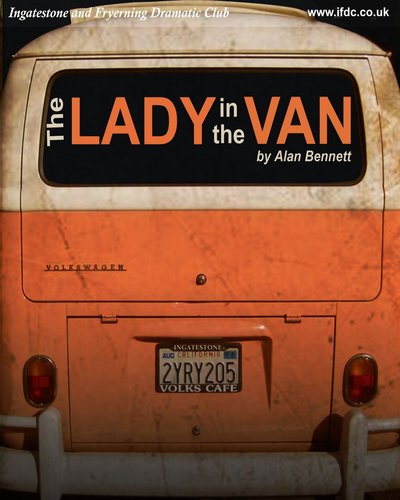
The Lady In the Van by Alan Bennett

The Lady in the VanThanks to the film adaptation, or I wouldn’t have known about this amazing story. Acclaimed English playwright Alan Bennett’s play is not fiction but a memoir. Bennett saw a transient woman living in a van on the street. Trying to help her out, he let her park on his own driveway for three weeks so she could sort things out and move on. Well, Miss Shepherd stayed for 15 years. Not surprisingly, she and the playwright form an unlikely bond of friendship. This ‘mostly true’, incredulous story needs to be told for its unique human scenario. From play to film is probably the best route to reach many more viewers. Who else other than Maggie Smith best fit the role as Miss Shepherd? And so she did, with Alex Jennings as Alan Bennett. Supporting cast includes Jim Broadbent, Dominic Cooper, and James Cordon. The is the third film wherein director Nicholas Hytner and playwright Alan Bennett team up. Their previous collaborations are The History Boys (2006) and The Madness of King George (1994).

The Martian by Andy Weir

The Martian movie tie in editionHere’s a Cinderella story that all bloggers can cheer for. In 2009, Andy Weir started posting on his personal blog as a post-by-post serial his well-researched sic-fi story about an astronaut stranded on Mars. Chapter by chapter he attracted numerous readers who, after the story was finished, suggested he publish it as an eBook so people could read it online as a whole. Weir did that and his eBook soon hit the top of Amazon’s best selling sic-fi list. Not long after, Random House stepped in and took it from there, from e to reality. Four days later, “Hollywood called for the movie rights,” Weir recalled. As I type, on this second week of September, Weir’s book is number one on the New York Times Best Sellers Trade Paperback Fiction list. And the movie? The legendary Ridley Scott takes the helm, with NASA consulting, Matt Damon stars, and an A-list supporting cast includes Jessica Chastain, Chiwetel Ejiofor, and Jeff Daniels. World premiere at TIFF before a general release later in October. And it all started with a blog post.

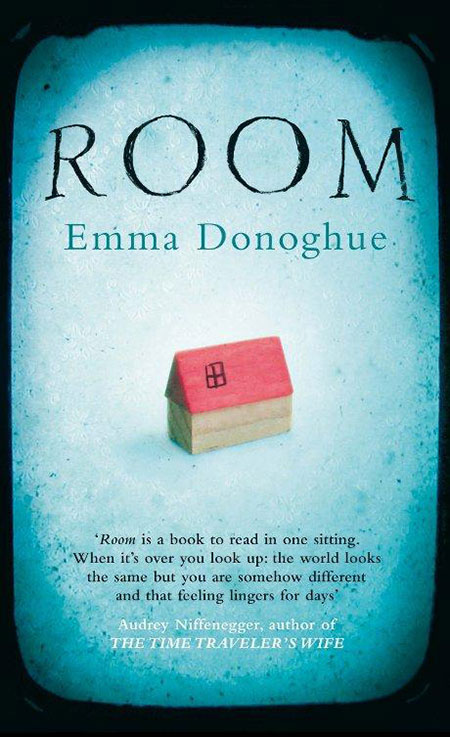
Room by Emma Donoghue

roomThe 2010 Booker-prize shortlisted novel by Irish-Canadian author Emma Donoghue reads like you’d want to see it visualized. Indeed, hearing constantly the voice of a 5 year-old could have that effect on you. So here we are. A movie adaptation. Locked in a room and made captive by a psychotic abuser, a young mother gives birth and for the next five years raises her child Jack in a shed. At 5, Jack has known no other worlds, but now begins to ask questions. Ma cannot contain the make-believe anymore so she tells Jack there’s a world out there, and starts to prepare him for a possible escape. The multiple-award winning novel is written from the child’s perspective. It depicts the power of love and the indomitable spirit of resilience and hope, but maybe not for the claustrophobic. The movie trailer is impressive; the 1.5 minute clip is powerful, consuming, and very moving. The film premiered at Telluride International Film Festival in early September and stunned the audience, drawing multiple standing ovations. Donoghue wrote the screenplay herself, that could well be a definite asset. Lenny Abrahamsson directs, with Brie Larson as Ma, Jacob Tremblay as Jack, Joan Allen and William H. Macy supporting.

UPDATE Sept. 20, 2015: ROOM has just won the Grolsch People’s Choice Award at TIFF15 tonight. FYI, a few of TIFF’s previous winners had gone on to win the Oscar Best Picture including 12 Years A Slave (2013), The King’s Speech (2010), Slumdog Millionaire (2008), American Beauty (1999).

***

Go Set A Watchman: Sequel or Prequel?


Go Set A Watchman Book Cover


Background

Go Set A Watchman is Harper Lee’s first draft of a novel (See links at the end of the post). In 1957, Lee’s agent submitted it to Tay Hohoff, an editor at the now defunct publishing house J. B. Lippincott. Hohoff did not see it adequate to be published; however, she did see promising elements in it, “the spark of the true writer flashed in every line,” she later recounted.

The draft’s protagonist, 26 year-old Jean Louise Finch, Scout, now a New Yorker, goes back to visit her childhood home in fictional Maycomb County, Alabama, and finds discrepancies about her father Atticus now from the man she thought she had known all the years growing up. To her alarm and disillusionment, Atticus, while a good father and a good man to all the rest in Maycomb, holds racist views and is firmly a segregationist.

Hohoff advised Lee to rewrite the draft but this time, instead of writing Jean Louise Finch as an adult, focus on her reminiscence of her childhood growing up in Maycomb with her brother Jem, living under the roof of her father Atticus, and summer days spent with a boy next door called Dill. After more than two years of editing and rewriting, To Kill A Mockingbird was born. And the rest is history.

So here’s the query I have: If your novel, after two years of editing and re-inventing, had developed into a final form and published in 1960, some 50 plus years ago, had gained high acclaims, won the Pulitzer, become a beloved American classic, been adapted into an Oscar winning movie, and achieved international recognition, why would you want your very first draft as a novice be published to the world now?

At 89 years old, Harper Lee now lives in a nursing home, a stroke survivor who has lost most of her hearing and eyesight, and just months after her sister Alice Lee – guardian of her privacy and legal advisor – had passed, and suddenly a ‘newly discovered’ Harper Lee novel appeared.

In a recent New York Times Op Ed article entitled “The Harper Lee ‘Go Set A Watchman’ Fraud”, columnist Joe Nocera vehemently argues that the Rupert Murdoch-owned HarperCollins had “manufactured a phoney literary event.” The publishing house had sold more than 1.1 million copies of the book in a week, the ‘fastest-selling book in company history’ according to the publisher, to which Nocera decries “Go Set A Watchman constitutes one of the epic money grabs in the modern history of American publishing.”

The above is the major challenge surrounding this phenomenal ‘literary event’. So how should one read the book? Controversy aside, what can we reap from reading Go Set A Watchman?

Definitely not as a sequel and not a prequel either, but take it as it is: A first draft of To Kill A Mockingbird.

Only when comparing the two books as a ‘Before and After’ transformation can we see how the writing process had taken place. By reading Watchman as a first draft, we come to appreciate how a seasoned editor had helped a novice and an aspiring writer to achieve her goal to become a respectable, published author. And this we know Hohoff had done most successfully.

To Kill A Mockingbird Book Cover

***

Reading Go Set A Watchman

First off, to all readers, a major reminder: Harper Lee is a real person, and Atticus Finch is a fictional character. In Lee’s first draft, Go Set A Watchman, Atticus is a good father, but a racist. Yes, he had successfully defended Tom Robinson and gained him an acquittal, that was a court appointed case. This is anecdotally mentioned in Watchman. But Atticus is a self-professed Jeffersonian Democrat, one who subscribes to Jefferson’s view that: “A man couldn’t vote simply because he was a man… He had to be a responsible man.”

Lee spends a climatic chapter towards the end describing the arguments between father and daughter on the issue of race. While both are polar extremes, and I don’t want to quote the words from Atticus pouring forth his arguments about how “white is white and black’s black”, I must point out that it is Scout who loses her cool during the debate. She is the one who blows right out, foul-mouthed and accusing her father with hurtful, derogatory terms. Throughout the verbal confrontation, Atticus remains a gentleman. “I’m seventy-two years old, but I’m still open to suggestions.”

And I’m quite impressed by the next episode, and that’s when Scout cools down and goes back to her father, seeking reconciliation. It’s not just a simple case of ‘agree to disagree’, but somewhat laying out a more complex relationship with the ambivalent stance of ‘I can’t beat you, I can’t join you,’ but love can still triumph over all. That is the spark of an inspiring writer I can see in the conclusion of Lee’s Watchman. As Scout apologizes for her foul-mouthed diatribe aimed at her father the day before, this line from Atticus will remain with me: “I can take anything anybody calls me as long as it’s not true.”

Hohoff might just have seen this character trait in Atticus that she advised Lee to expand on in her rewrite. I see this admirable element as I read. Let the fictional character Atticus be created as an ideal type of a man, open to others’ opinions, upholding his ground with firmness but with no malicious hostility. And yes, we can all appreciate this change of heart in Lee’s rewriting in Mockingbird. Let Atticus be the ideal father and friend, a deserving, honourable man.

Further, in Watchman, the racist turn in Atticus has not been well accounted for. Since Jean Louise has come back to Maycomb annually to see her father, why the sudden discovery of his racist stance? And why had she not known about his views considering her close relationship with her father all her growing years and only in recent years in her adult life had she moved to NYC. But most important point of all Lee had not explained in Watchman, why had Atticus changed his view? These could be flaws in the plot line that Hohoff had Lee re-think.

As recounted, Lee based her Atticus character on her own father, the lawyer Amasa Coleman Lee who had actually defended two black men but failed to have them acquitted. According to reports, the elder Lee had been a segregationist but later changed his views to support integration. The real life parallel is obvious. The details we could only speculate, was it the man that had influenced the change in the book, or maybe vice versa?

In the rewriting process, there is the elimination of two significant characters in Watchman, Hank, Jean Louise’s suitor, and Uncle Jack, holder of family secrets. Once a clear storyline is established, with the equally moving minor plot of Boo Radley, a parallel Mockingbird theme with Tom Robinson as both being vulnerable victims, Hank and Uncle Jack would not be needed to uphold the story lines. So, no matter how much a writer had invested in a character, cuts and alterations could be the outcome, quite like the deleted scenes we see on DVDs, the rational choices we have to make in the long creative process. On the other hand, a character that exists only in memory, Jem, who had died in Watchman, is revived to his lively self, and we are all grateful for that revision.

One of the main reasons Hohoff had rejected the first draft was that it was episodic, lacking a unified story arc as a novel. Readers of Watchman will find this so, especially when Jean Louise switches back and forth from the present to the past. As I read, the past holds much more attractions as Scout describes her growing up days in Maycomb. We see the children in a different perspective, something like a ‘behind the scene’, a ‘making-of’ featurette. Thanks to Hohoff, such episodes are restrung into the gem of a book called To Kill A Mockingbird. Indeed, Hohoff had grasped the social psyche well, there was a need for a noble, heroic character in her time then, and maybe even more so in our time now.


***


LA Times (With video)

The Telegraph

New Republic

The New York Times (Jonathan Mahler)

The New York Times (Serge F. Kovaleski and

The Wall Street Journal

The Washington Post

The Washington Free Beacon

Wikipedia


Suite Française Movie Adaptation

The film is the long anticipated adaptation of Irène Némirovsky’s final work in progress before her death in 1942. Born in Ukraine, Némirovsky had moved to live in France since 1919. Before the Nazi occupation, she was a prominent literary figure in her adopted country, having published nine novels and a biography of Chekhov. The Nazi takeover sent her fleeing Paris. She was writing Suite Française in the village of Issy-l’Evêque where she was living with her husband and two young daughters when the French police arrested her for her Jewish descent and sent her to her demise in Auschwitz.

Suite Française was intended to be a literary composition in musical terms. Like a musical suite, the author had planned to write five pieces, but had only finished the first draft of two upon her death. The whole set when completed could have been an impressive eyewitness paralleled fiction, a historic testament reflecting the larger picture from the microlevel, a family, or, a woman and a man from different sides of the war falling in love.

suite_francaise

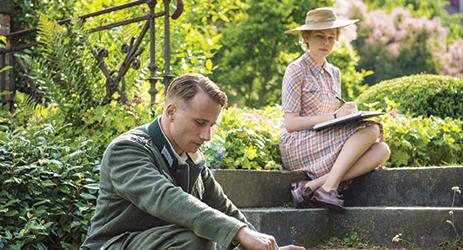
Such is the story of “Dolce”, the second novella in her Suite on which the movie is based. Lucile Angellia (Michelle Williams) falls in love with a German officer staying in her house where she lives with her widowed mother-in-law (Kristin Scott Thomas), the most elegant estate in the village. Lucile’s own husband has been missing in war and now a likely prisoner. That makes falling in love with the enemy right in your own home even more conflicting. However, Williams fails to bring out such internal battles or even ambivalence; Schoenaerts fares better in expressing the conflicts.

The opening of the film captures vividly what Némirovsky described as the ‘German artillery thunders… its wailings fill the sky’. As viewers we see people carrying suitcases and personal belongings scurry or simply dive for cover and we hear the sudden, roaring thunders of bomb blasting the country road on which refugees from Paris flee like rats – and as the camera zooms away – insects. It’s this kind of cinematic moments that make films powerful. We read about the air raids in the book, we see and hear the actual effects in the theatre. With that regard, the voiceover narrative by Michelle Williams is redundant. Or, maybe it’s just a lazy way of storytelling.

With that dynamic start, the film falters in not sustaining such power, albeit it still has many beautiful shots; romance in its period setting, the movie is visually appealing. But the attractions between Lucile and the handsome German official, Lieutenant Bruno von Falk, played by the ubiquitous Matthias Schoenaerts, soon becomes the centrepiece.

Like his role as Gabriel Oak in Far From the Madding Crowd, here Schoenaerts portrays another man of few words. Compare the two roles, he is more convincing here with his German officer look, and yes, sitting at the piano, mesmerizing Lucile with his soft touch. No words needed when music lures.

If not interrupted by her feisty mother-in-law, Lucile would have dived into the pool of passion immediately. Thanks to Kristin Scott Thomas, who adds some realistic sparks into the dreamy world of wartime romance with the ‘wrong man’. Such episodes could make interesting exploration, but the film is overwhelmingly mellowdramatic and seems not intended to be deep or psychological.

When a farmer, Benoit Labarie (Sam Reily), kills a German officer, the plot thickens. And as a viewer, I’m thankful for that turn in the otherwise relatively uneventful story. Benoit’s wife Madeleine (Ruth Wilson) urged Lucile to help him out. And that she did, risking everyone in her household and ultimately leading to the moral dilemma of both herself and her enemy lover.

The prolific film composer Alexandre Desplat (The King’s Speech, 2010, among many other works) wrote the signature piece “Bruno’s Theme”. While romantic in its overall styling, it is punctuated with discords, could well be a reflection of Bruno’s inner state. The ending of the film shows us his resolve. When love and duty is in conflict, there can’t be any favourable resolve. But then again, the film does not go further into that.

Kristin Scott Thomas plays a pivotal role in balancing sense and passion in her household, and bringing out some worthwhile and lively performance for the production. My major objection regarding this talented veteran of cinema and the stage is that nearly all her movie roles in recent years present her in character twenty years older than she really is. Here, the first shot we see Madam Angellier is her white painted, over-made-up face as an old widow. That is one reason why her other work in 2014 My Old Lady is so refreshing, for we get to see her in a suitable age where she can still find love.

Regarding WWII Holocaust movies, it is unfortunate that films of this genre in recent years based on popular fiction or chronicling significant historical events are mere passable works, like The Monuments Men, or The Book Thief, Sarah’s Keyor the related film Woman in Gold. Seems like the epic war movie genre with its affective power to move has not re-emerged in the past decade, iconic films such as Spielberg’s Schindler’s List (1993), Benigni’s Life Is Beautiful (1997), and Polanski’s The Pianist (2002) have all but remain distant memories.

As for Suite Française the movie, it should not be seen as the adaptation of Némirovsky’s book called Suite Française, however unfinished. The movie is best taken as a rendition of a storyline in one of its pieces, and true to the title ‘Dolce’, sweetly laced with soft touches. Overall, despite its flaws, it is still a watchable film.

~ ~ 1/2 Ripples

This is my second entry to the Paris In July blogging event hosted by Tamara of Thyme for Tea.

Paris in July 2015 Icon

***

Other Related Reviews on Ripple Effects:

Sarah’s Key (2010): From Book into Movie

The Book Thief (2013): From Book to Film

Far From the Madding Crowd (2015)

My Old Lady (2014)

Woman In Gold: Then and Now (2015)

The King’s Speech (2010)

***

Far From the Madding Crowd (2015)

Here’s the paradox of books to movies. The more you know about the book, the more critical you’ll be when watching the movie, and the less likely you’ll enjoy it. Here’s a case in point. If you want to enjoy this current version of Far From the Madding Crowd without hindrance, do not read or reread Hardy’s novel before you see it. For me, alas, I’ve read it twice in the last few months. So, who can I blame if I find the movie disappointing?

Now, I know exactly that I need to judge a movie on its own merits and not according to how ‘faithful’ it is to the source. I’ve written a post on this view. This current adaptation misses the mark not because it’s not ‘faithful’ but because it has been mishandled. The script, the direction, and for that matter, the casting. Now hear me out. far-form-the-madding-crowd I had high expectations for it. Here we have an Oscar nominated director, Thomas Vinterberg (The Hunt, 2012), offering a new version from John Schlesinger’s 1967 production which touted a high calibre cast of Julie Christie, Peter Finch, Alan Bates and Terrance Stamp. After almost fifty years, should one not hold a certain high level of excitement in welcoming a new version with a modern cast?

To start off, I must give credit where it’s due and that’s to the director of photography Charlotte Bruus Christensen (The Hunt) for bringing the beautiful Dorset country to the big screen so we can visualize Hardy’s ‘Wessex’. The camera captures the lush green fields and gentle rolling hills at dawn and dusk, the farming life, the harvesting under the golden sun. Reminds me of Terrence Malick’s Days of Heaven. The scenic and authentic location of the filming is an alluring backdrop to the story.

Now to the screenplay. David Nicholls is no stranger to simplified versions of classics. His last Hardy light Tess of the D’Urbervilles, a TV mini-series (2008), had four episodes to tell the story. But here as a full-length feature, this new Madding Crowd script could make CliffsNotes writers feel they are doing some heavy lifting. Actually, the movie is not far from the source material, almost all of the scenes and many of the dialogues come from the book, with some alterations, but this is understandable. One would think alterations should be for the purpose of dramatization; so it’s just mind boggling that certain scenes that are essentially dramatic in the novel have been left out, ones that could have enhanced the tension substantially. Two readily come to mind: First is the circus scene where Sergeant Troy was nearly recognized by Bathsheba, and the second is right at the climax of the story, Boldwood’s Christmas party, not omitted but with its tension substantially lessened.

Danish director Vinterberg’s previous work The Hunt – a 2014 Oscar Best Foreign Language Film nominee – was a riveting and psychological piece of work. He could have operated in that mode here. With the scenes sweeping by, and leaving out some pivotal cinematic moments, he has missed chances to engage the audience. The altered state of the climatic scene is regretful. Take that crucial act when Boldwood was driven by mad passion (I’m trying to avoid spoiler here in case you haven’t read the book) during that fateful Christmas party in his home. Instead of displaying the conflict and tension in full public view, Vinterberg has taken the action out into the dark of night. Without all the guests as witnesses, the gravity of the conflict and Boldwood’s ultimate action is effectually diminished; not only that, the handling is incredulously haphazard and swift. While Hardy’s Far From the Madding Crowd exudes a lighter mood compared to the cosmically burdened Tess of the U’Derbervilles – and I chuckled at many of his lines while reading – I don’t expect movie viewers would take this film as a comedy. But this was exactly the audience’s reaction in the theatre. When you hear loud laughter at the climax of the movie, you know the director has missed the mark.

The story is about the characters, more so here when you have one headstrong female being wooed by three vastly different men. What’s intriguing is the emotional ‘trilemma’ of our heroine. The effervescent Bathsheba Everdene, the independent, new mistress of the Weatherbury farm is, alas, misdirected. Carey Mulligan can be a convincing Bathsheba, but the strength of character is diminished by the breezy script and a director who fails to draw out her potential. From the “I shall astonish you all” first meeting with her farmhands to the “Please don’t desert me, Gabriel!” plea to Oak so he would come back to rescue her ailing flock, there are pages of Hardy descriptions. Surely, time is of the essence in a 120-minute movie, but at least show visually the gravity of her situation before she so readily rides horseback and race to Gabriel. As a transition, let the camera frame a wide angle shot of the field littered with sheep lying helpless, ready to expire, for she’s about to lose them all. But just showing a sheep in distress doesn’t warrant the quick change in character, from leading to pleading. It looks like Vinterberg has crafted a feeble and even exploitive Bathsheba who gets her way by her outward charm. In several scenes she could have been more intense; we see no Hardy’s expression of ‘nether lip quivered.’

Among the three suiters, the strongest performance comes from Michael Sheen as William Boldwood. His nuanced facial expressions speak louder than words. Whether intentioned by Vinterberg or not, Sheen has turned the truly, madly, deeply love-sick Boldwood into a comic character, more so than Hardy’s portrayal. Or, were the laughters not intended? No matter, Sheen’s performance compensates for the lack of in the other two men.

Gabriel Oak the resourceful shepherd is the strong and silent type. Not only is he a man of few words, the Belgium actor Matthias Schoenaerts has turned him into a man of few expressions as well. Schoenaerts is fine in action thrillers like The Drop (2014) but just not in a romantic lead, as in Rust and Bone (2012), and now Madding Crowd, for he fails to command the image of either a lead or a romantic. In several scenes, we as audience are left hanging, ungratified, for his lack of verbal response to Bathsheba’s sincere words. 

If Schoenaerts is expressionless, here is an equal rival, Tom Sturridge as Sergeant Troy. The George Wickham parallel who dazzles with his brass and scarlet, Sergeant Troy is a subdued character here who lures with his sword. Is it the director or the screenwriter, the few lines given him are mostly sparse and one-liners like “I don’t think I’ve ever seen a face as beautiful as yours.” Sure, that’s from Hardy, but in richer descriptive context. Or, another short line to explain (away) pages of happenings absent on screen.

I’m writing this not in disrespect but disappointment in that a good chance to do justice to Hardy’s illuminating work is missed. Yet, all is not lost; there still remains a synopsis of a Hardy story and Hardy country in full cinematic view. Further, we are confirmed, again, that Carey Mulligan can sing, in a particular folksy, soulful way. So far, I’ve heard her sing in three movies, and each time it enriches the storytelling. When Awards Season comes this fall, I look forward to a stronger performance from her in Suffragette. Simply by virtue of the release date, it is an award hopeful. Some are already predicting Oscar nods for her role in that production.

As for Madding Crowd, let’s just note that it’s a May-released movie.

~ ~ 1/2 Ripples 

________________

Other related review posts:

Tess of the d’Urbervilles (2008, TV)

The Great Gatsby (2013)

Never Let Me Go (2010)

An Education (2009)

Can a Movie Adaptation Ever be As Good As the Book?

Voice of the Poet: Things Fall Apart

April is National Poetry Month, and three quarters of the days are already gone. Still not too late for me to offer a poetry post. At present, I’m reading Joan Didion’s essay collection Slouching Towards Bethlehem (more about that in a later post). To start off her book, Didion uses W. B. Yeats’ poem “The Second Coming”, from which her book title originates.

Yeats wrote the poem in 1919, shortly after WWI; it was published in 1920. Didion used it like an epigraph for her book published in 1968, about fifty years later, apparently finding it speaks to her collection of essays on her experiences in 1960’s America.

Now almost another fifty years later, the poem still has not lost its relevance. Yeats’ mythical references aside, and just listen to the clearer and more direct words, I can hear the Poet’s voice speak hauntingly to our present world.

**

The Second Coming 
by William Butler Yeats (1865-1939)

Turning and turning in the widening gyre
The falcon cannot hear the falconer;
Things fall apart; the centre cannot hold;
Mere anarchy is loosed upon the world,
The blood-dimmed tide is loosed, and everywhere
The ceremony of innocence is drowned.
The best lack all conviction, while the worst
Are full of passionate intensity.

Surely some revelation is at hand;
Surely the Second Coming is at hand.
The Second Coming! Hardly are those words out
When a vast image out of Spiritus Mundi
Troubles my sight: somewhere in sands of the desert
A shape with lion body and the head of a man,
A gaze blank and pitiless as the sun,
Is moving its slow thighs, while all about it
Reel shadows of the indignant desert birds.
The darkness drops again; but now I know
That twenty centuries of stony sleep
Were vexed to nightmare by a rocking cradle,
And what rough beast, its hour come round at last,
Slouches towards Bethlehem to be born?

**

Especially the first stanza… hear what I mean?

From Z to A: How Zweig Inspired Anderson’s Grand Budapest Hotel

The following is the first part of my article in the new Spring Issue of the online review magazine Shiny New Books. In the article, I introduce the Austrian writer Stefan Zweig, whom director Wes Anderson acknowledged as the source of inspiration for his Oscar winning production. To read the whole piece, CLICK HERE. I’m sure you’ll find the SNB site informative and a valuable resource of books and authors.

***

The Grand Budapest Hotel won four Oscars at the 87th Academy Awards this February. In the end of the film leading the credits is the acknowledgement of Stefan Zweig (1881-1942), whose writings had inspired the production. During interviews, director Wes Anderson had joked that he ‘stole’ from the Austrian writer: ‘It’s basically plagiarism,” he said. Anderson is all modesty when making such a remark, for the film has his own signature style. Unlike Zweig’s more serious and darker hue, Anderson has created a colourful fantasy. Rather than an imitation, the film should be regarded as a worthy homage to an author who had been noted as one of the most translated German-language writers during the 1930’s.

the-grand-budapest-hotel movie poster

Anderson came across Zweig by chance when he purchased his 1939 novel Beware of Pity in a Paris bookstore. After two pages, he knew he had discovered a new favorite author. Twenty pages later, he wanted to adapt it into film. Then he read some more Zweig and liked them all. So he made a peculiar endeavour, he transposed the author’s oeuvre, his life and spirit into his own re-imagining, creating a film that eventually would catapult him to the zenith of acclamation.

The Grand Budapest Hotel was nominated for nine Oscars at the 2015 Academy Awards, including Best Picture, Best Directing, and Best Original Screenplay for Anderson himself. Albeit not having won these major categories, the film did capture four wins in Original Score, Production Design, Costume Design, Makeup and Hairstyling. The triumph is shared by the late Zweig, for he has now been introduced to many more readers, especially those of us in North America. New York Review Books has seen Zweig’s popularity rise after the movie, but it is UK’s Pushkin Press that holds the banner of a ‘Zweig revival’ by republishing many of his works in English translation.

Zweig was born 1881 in Vienna to a Jewish family who circulated freely in the upper crust of Austro-Hungarian society. He was versatile and prolific as a poet, translator, biographer, essayist, lyricist, short story writer and novelist. His literary achievement was prodigious. At nineteen, Zweig saw his first publication, a collection of poetry by the respectable publisher Schuster & Löffler. Upon this debut on the literary stage, Zweig was ecstatic to receive a gift from his idol, Rilke, who had read the youngster’s work and sent him a special edition of his own poetry with the inscription addressed to Zweig: “with thanks.” Later, still at the tender age of nineteen, Zweig saw his essays published in the feuilleton, literary supplement, of Vienna’s prestigious newspaper the Neue Freie Presse, sharing the pages with such formidable literary figures as Ibsen, Zola, Strindberg and Shaw.

The World of Yesterday ZweigReaders can find his excitement in recalling these unexpected early successes in his autobiography The World of Yesterday. It was not so much about fame but identity. The glorious world of yesterday included not only the fulfilled dream of a young man, but that of the Jewish people in finding a homeland, free and secure in Vienna. At long last, they could taste the reality of belonging. Jews in Vienna had become respectable, contributing members of society, particularly in the realms of the arts and culture.

As we can see from history, such a triumph would soon be obliterated. In August 1914, Zweig saw the world order and security that he so cherished and thrived on crumble as WWI broke out. If that was the beginning of the end, Nazism in the 1930’s rang in the death toll. Zweig had to escape to England, later the United States, finally landed in Brazil. Exiled and alienated, the Austrian writer was overwhelmed by despair as he saw his homeland and Europe devoured by Hitler. The German language he was born into and had so aptly used in his literary success he now had to apologize for. Such devastation and emptiness was too much to bear. In 1942, just a few days after He sent off his last book Chess Story to his American publisher, Zweig and his second wife committed suicide together in Petrópolis, Brazil.

Wes Anderson recreated Zweig’s pre-war world in his fictional Republic of Zubrowka, with The Grand Budapest Hotel itself as a metaphor of that secure microcosm, everything runs smoothly under the supervision of the concierge M. Gustave (Ralph Fiennes), at least in the first half of the film. The boxy Academy Ratio we see on screen evokes the idea of looking into an old photo album in all its nostalgic charm. The exile life of a genocide survivor we can find in Zero the lobby boy (Tony Revolori young, F. Murray Abraham older).

Passport CheckRichard Brody in his New Yorker article “Stefan Zweig, Wes Anderson, And a Longing for the Past” writes that Zweig himself had experienced the ‘practical difficulties’ and ‘psychological trauma’ of having lost his passport while on the run. The passport, Brody notes, “wasn’t even a commonplace document before the First World War.” Without it, one instantly was turned into an outlaw. Zero has M. Gustave to thank for standing up for him twice while travelling on the train without transit papers. The first time, officer Henckels (Edward Norton) recognizes M. Gustave, his parents’ friend, and remembers his kindness to him when he was a boy; human relations win over and Zero is spared. Unfortunately, luck runs out for M. Gustave in the second time, all because of the change in military control, a symbolic reference to the iron fist of the Nazi regime. No societal ties or achievements could save Zweig or the Jews in Europe during the Holocaust.

The following are two titles to which Anderson had made specific reference – Zweig’s only novel Beware of Pity and his novella The Post-Office Girl. The third is Anderson’s own selections, an excellent sampler of Zweig’s works, The Society of the Crossed Keys.

To continue reading my short reviews of these books, CLICK HERE to Shiny New Books. Or, just click anyway to see what an array of book reviews, author interviews and their own articles, book news and tidbits await you.

***

Staying Awake in the Garden

I came across this image in Biola University’s Lent Project. It is by the Austrian children’s book illustrator Lisbeth Zwerger. Among several awards she had won, Zwerger received the acclaimed Hans Christian Andersen Medal for illustration—the highest international award given for “lasting contributions to children’s literature”.

Staying Awake in GG

Its title is Jesus praying in the Garden of Gethsemane, from her book Stories From the Bible. Without condescension, Zwerger’s image speaks with clarity such that a child can easily grasp its essence. Three people dozing off, each against a tree. From a distance, under a massive dark cloud, a tiny, lone figure walking towards the ominous void. The illustration is perhaps one of the rarer perspectives that accompanies this narrative:

“Then Jesus went with them to a place called Gethsemane, and he said to his disciples, “Sit here, while I go over there and pray.” And taking with him Peter and the two sons of Zebedee, he began to be sorrowful and troubled. Then he said to them, “My soul is very sorrowful, even to death; remain here, and watch with me.” And going a little farther he fell on his face and prayed, saying, “My Father, if it be possible, let this cup pass from me; nevertheless, not as I will, but as you will.” And he came to the disciples and found them sleeping. And he said to Peter, “So, could you not watch with me one hour? Watch and pray that you may not enter into temptation. The spirit indeed is willing, but the flesh is weak.” Again, for the second time, he went away and prayed, “My Father, if this cannot pass unless I drink it, your will be done.” And again he came and found them sleeping, for their eyes were heavy. So, leaving them again, he went away and prayed for the third time, saying the same words again. Then he came to the disciples and said to them, “Sleep and take your rest later on. See, the hour is at hand, and the Son of Man is betrayed into the hands of sinners. Rise, let us be going; see, my betrayer is at hand.”    – Matthew 26: 36 – 46

What struck me is how modern the feel; these three guys could be anyone. And they are so casual too, like, barefoot in the park. Considering the horrific mission their Master is facing, their body language speaks avoidance, indifference, and, even betrayal. The spirit is willing but the flesh is weak – blame it on the good supper – they’re totally oblivious while their Master in a distance, alone, is fighting the most anguished battle of his life.

Are these guys named Peter, James and John? Why, they could be you and me.

***