Summer Indulgence (2008)

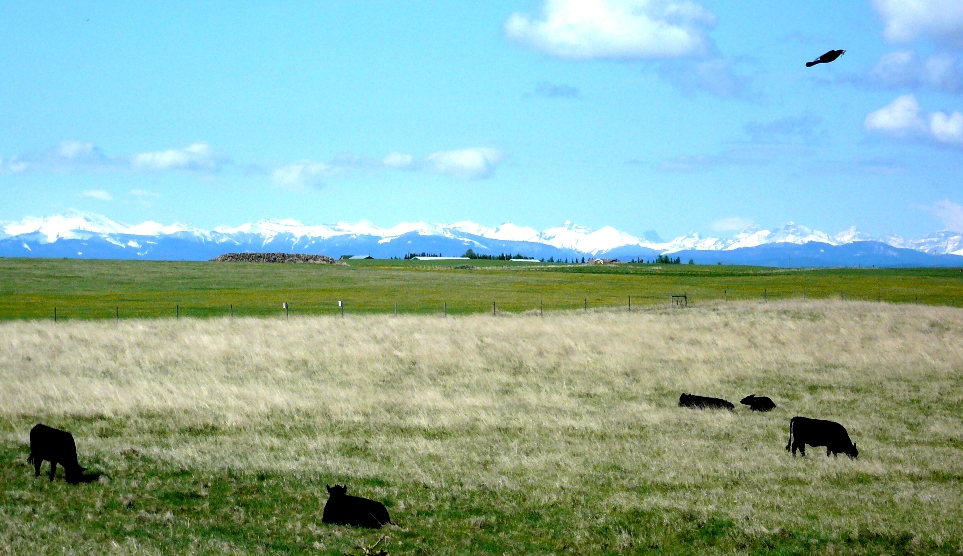
No, this is not a movie. It’s real life. I’ve to move to make way for some major renovations in our house. For a month or so, Arti the urbanite is living in the country. My summer abode is a log home amidst acres of farmland, at the foot of the Rockie Mountains in Alberta, Canada.  I have fresh air, big blue sky, quiet neighbors, and magnificent views. The following are some pictures of my summer indulgence.

The little big house on the Prairie:

Little big house on the Prairie


My view:


My quiet neighbors:


My other quiet neighbor:


My visitors:


There’s no water for me to make ripples.  I’ll have to create sketches in the wind.  I’m gratified by the views and the solitude I’m granted here in the open country.  But there are costs:  no TV, no Internet, the commuting to the City (about an hour’s drive), unwanted house guests: mice and other rodents.  As much as I yearn to embrace nature, I confess I’m no Thoreau or Dillard…I just can’t live without modern conveniences, nor can I survive without the Internet.  How can I be a recluse and stay away from the blogging community for a whole month!?

So here’s my list of survival gears:

Electronic gadgets:  A 7″ portable DVD player, a couple of cameras, my laptop, and of course, my BlackBerry.  I’ll have to drive to the nearest town to find Internet access.

DVD’s I brought with me:  Sketches of Frank Gehry, Paris, Je T’Aime, Life As A House, Fargo, The Hours, Wordplay, The Namesake…plus some titles I need to preview for a Film Festival.

Books:  My current reading list includes The Glass Castle by Jeannette Walls, Persuasion by Jane Austen, and two books by Robert K. Johnston, Reframing Theology and Film, and Reel Spirituality: theology and film in dialogue.

Also, I intend to visit the nearest town and explore some arts and crafts stores and yes, they have a public library there…I won’t feel so alienated after all. 


                                                                  ******


The Stone Angel (2007): Book Into Film

** The following review contains spoilers**

Since its publication in 1964, this is the first time The Stone Angel is adapted into a movie. As I mentioned in my review of the book last week, whoever that attempts to do this has a formidable task. This classic Canadian novel by Margaret Laurence is a depiction of memories encased in deep inner turmoil. The fleeting and random reminiscence of 90 year-old Hagar Shipley juxtaposing with the present would also prove challenging to bring on screen.

Director, screenwriter, and producer Kari Skogland has made a bold attempt at filling this tall order. Filming the movie in rural Manitoba, The Stone Angel delivers some nice shots of the prairie backdrop, even though Manawaka is a fictional town in the story. The sequences of flashbacks are aptly dealt with quite seamlessly.

The movie has its greatest asset in the cast, in particular Oscar winner Ellen Burstyn (Alice Doesn’t Live Here Anymore, 1974) as Hagar Shipley, and Christine Horne as her younger counterpart. Canada’s own Ellen Page also plays a minor role as Arlene, the girl Hagar’s son John (Kevin Zegers) wants to marry, and of course, against the wish of his mother. The two Ellen’s have some tense moments together. Page’s screen time may be too short though to gratify her fans.

Any fine actor, however, can only perform within the confines of the script. Here lies my major concern: the alteration of the crux of the story, maybe to appeal to a contemporary or a younger audience. The film is a much more mellow and sexed up version of the book. The fiery, ingrained pride of Hagar is much subdued. In fact, she has been changed to an even amiable character. Further, I feel the shifting of the time from the 60’s to modern day somehow trivializes the story. Who would have thought Marvin (Dylan Baker) would be talking on the cell phone and Hagar smoking marijuana…one item off her bucket list?

What author Margaret Laurence has depicted is not just any ordinary stubborn, grumpy old woman, but Hagar Shipley, the tragic heroine, however disdainful. She rages against the dying of the light and doesn’t go gentle with just about everyone because of her deep-seated hubris…even while facing death. The book’s final image of her wrestling the glass of water from the nurse, drinking it without help, wraps up the life of this fierce character. And it’s pathetic to see her pride leading her to make decisions and to act in ways that could well have caused the tragedies in her life.

The scene at the abandoned shed should have led to the poignant, climatic revelation. In the book, Hagar tries to run away from the fate of being confined to a nursing home. She spends a night in this derelict shack and encounters a stranger. During their conversation, she unknowingly verbalizes the pain and guilt she has been carrying all her life by talking about the tragic end of her beloved son John. The name of this newly formed confidant, Murray F. Lees, yes, Flees, points to her perpetual running away from constraints, or maybe even from herself.

But in the movie this stranger is Leo (Luke Kirby), who uses the shed to make out secretly with his girlfriend and then goes on to discuss forbidden sex and share a ‘joint moment’ with the 90 year-old woman.  In the theatre, I heard laughter.  The pathos that should have accompanied this pivotal scene either did not materialize or has been much lessened.

The portrayal of young Hagar played by Christine Horne, while proficient, may have also missed the gist of the story. We see a beautiful red-hair Hagar and a romanticised Bram (Cole Hauser) immersed in blissful courtship and marriage, at least in the first part of the movie. In the book Bram Shipley, a widower-farmer fourteen years her senior, is as rough and callous as Hagar is proud and obstinate.  Their marriage is rocky even from the start, reinforcing the notion that in defying her father, Hagar has made a decision that would later bring her great torments.

By depicting a softer Hagar, and toning down her abrasive pride, the film has diluted much of the poignancy and intensity of the conflicts. The strained relationship between Hagar and her favorite son John has not been sufficiently developed to elicit the emotional impact of the tragedy. Hagar has long placed her hope on John, whom she has esteemed to be worthy to wrestle with the angel, but he ends up breaking her heart. The swift dealing of the mother son relationship in the film fails to depict Hagar, like the stone angel, has been blind to her circumstances. Fortunately, the film has kept the authentic scene of Hagar reconciling with her elder son Marvin, who has taken care of her in her old days. It is Marvin who has wrestled with the angel and won.

The final scene with the Pastor Rev. Troy (Ted Atherton) singing the hymn, touching even the ‘holy terror’ in her death bed, draws the film to a poignant and peaceful close. The audience sees a yielding Hagar going gently into the good night. The voice over of Dylan Thomas’ quote seems inconsistent with what we see.  If Laurence could have her way, she likely would have concluded with the last image of the book where Hagar stubbornly tries to drink from the glass without the help of her nurse, defiant to the end.

I have a reader, a student apparently, once asked me whether he should skip a book he was studying in class and just use the movie version for his course work.  My advice is, watch the movie for entertainment, but read the book for your assignments… the two could be very different entities.

~ ~ ½ Ripples

Chesterton Quotes

I just couldn’t resist.  Even though I posted a link to GKC Quotes in my last entry, I’m compelled to share some here for all to savor.  As a writer who encompassed social commentary, political satire, literary criticism, philosophical ponderings, Christian apologetics, poetics and plain humor in his writing, G. K. Chesterton’s (1874-1936) wit and wisdom surpassed the social and political environment of his time:

                                                                      *****


“My country, right or wrong,” is a thing that no patriot would think of saying except in a desperate case.  It is like saying, “My mother, drunk or sober.”


“A good novel tells us the truth about its hero; but a bad novel tells us the truth about its author.


“By a curious confusion, many modern critics have passed from the proposition that a masterpiece may be unpopular to the other proposition that unless it is unpopular it cannot be a masterpiece.”


“Don’t ever take a fence down until you know the reason it was put up.”


“Fallacies do not cease to be fallacies because they become fashions.”


“Journalism largely consists of saying ‘Lord Jones is Dead’ to people who never knew that Lord Jones was alive.”


“Man seems to be capable of great virtues but not of small virtues; capable of defying his torturer but not of keeping his temper.”


“Music with dinner is an insult both to the cook and the violinist.”


“The most astonishing thing about miracles is that they happen.”


“To have a right to do a thing is not at all the same as to be right in doing it.”


“Art, like morality, consists of drawing the line somewhere.”


“If there were no God, there would be no Atheists.”


                                                                   *****

Links to more GKC quotes:

The American Chesterton Society Quotations Collection

The Quotations Page


To G. K. Chesterton: Happy 134th Birthday

Well, I miss it by a day, but I don’t think he’d mind. 

To celebrate the birthday of the gifted writer G. K. Chesterton (born May 29, 1874 – June 14, 1936), I’m posting here some thoughts I wrote down after I finished reading his book The Man Who Was Thursday earlier this year.


 ‘Well, I don’t understand anything…’  — Gabriel Syme

‘I understand nothing, but I am happy…’  — Dr. Bull

Just finished this book by G. K. Chesterton.  One word had been on my mind as I was reading it:  ingenious.  Of course, there were other words too, like baffling, profound, funny, even hilarious.  Published exactly 100 years ago in 1908, The Man Who Was Thursday: A Nightmare reads like an allegory, farce, fantasy, thriller, adventure, philosophical treatise, religious exposition, and a postmodern piece of literary anime, and yes, that’s 1908.

Having said all that, I must concede and humbly admit, upon finishing this first reading, I understand very little.  The twists and turns make one doubt what actually is real, or what is disguised as real, and where the line lies between good and evil, friend and foe, government and anarchists.  I’m baffled by the symbolism and eager to seek the appropriate interpretation. 

Who is Sunday?  Is he who I think he is?  The author in his own words in the addendum says, no, he’s not.  So, what am I to think? And, even if he is, how can I explain all the events that lead up to the ending?  And…what does the ending mean?

I welcome anyone who has read, studied, or taught the book to help me out with my bewilderment.  Of course, I could research on what scholastic publications have said, but, I’d just like to entertain some casual and random thoughts.

For those who wish to explore more, here are some Chesterton links:

The American Chesterton Society: Common Sense for the World’s Uncommon Nonsense  (Plainly tells you who you’re dealing with here)

G. K. Chesterton Quotations  (Just brilliant!)

Read Chesterton Online

The Man Who Was Thursday discussion on the blog “So Many Books”

The Stone Angel: Book Review

To read my review of the movie The Stone Angel (2007), Click Here.

I first read The Stone Angel years ago. In Canada, if you miss it in Grade 12, you’re bound to read it in your university literature class. Now that the movie adaptation has just been released, I dust off my old copy and re-read it, wondering how much of the book I actually could appreciate when I first read it as a teenager.

The epigraph containing Dylan Thomas’ famous lines sets the atmosphere of this classic Canadian novel by Margaret Laurence:

Do not go gentle into that good night.

Rage, rage against the dying of the light.

Readers soon find Hagar Shipley, the 90 year-old protagonist, doesn’t just rage against the dying of the light. Throughout her life, she has been raging against most anyone who wants to have a say in her life, first her father, then her husband, and ultimately, The Giver of that very Light.

Born the daughter of Jason Currie, a storeowner of Scottish descent and one of the founding fathers of Manawaka, Manitoba, Hagar takes after her father in her tenacity and brimming family pride. Fiercely independent, she has always sought her own way, and heeded only the bidding of her own will. So was it when she refused to comfort her dying brother Dan when she was a child, so was it when she despised her remaining brother Matthew’s meek acceptance of death when he too later died, so is it now as she rebels against her son Marvin’s decision to send her to a nursing home. Pride is her fuel, and she intends to use the very last drop to sustain her independence.

Telling her story in first person narrative, Hagar switches in time as her failing memory randomly darts back and forth. From these glimpses of her past, she frantically grasps whatever that can remind her of her own self: her childhood, marriage, motherhood, and now, her old age.

In her younger days, Hagar’s father had tried to stop her from marrying Bram Shipley, a widowed farmer fourteen years older than Hagar. “Common as dirt…lazy as a pet pig”, her father said of Bram. But she insisted her way:

There’s not a decent girl in this town would wed without her family’s consent” he said. “It’s not done.”

“It’ll be done by me,” I said, drunk with exhilaration at my daring.

As a result, she was disowned by her father, who upon his death, gave all his inheritance to the town instead of his only child left.

Was it love at first sight that Hagar decided to marry Bram Shipley after dancing with him in the townhall? Or was it her admiration for his raucous demeanor and rough independence, accountable to no one, to spite his class-conscious father? Regardless, by marrying Bram Shipley, she chose to live a life in poverty and crude existence. Yet this is the story of Hagar, like the Hagar in the Bible, an outcast from the house of Abraham, wandering in the wilderness, struggling for her own survival and striving for some sort of dignity.

Banished from the Curries, Hagar later in her marriage left Bram and took her younger son John to live on her own, working as a housekeeper, a self-imposed exile. And now in her old age, she flees to escape the plight of confinement in a nursing home. Hagar’s life is one of exiles and wanderings. John, her beloved son, was to her an anchor in her drifting existence.  Yet he only brought her heartbreaks and utter despair. His tragic end turned an already callous heart to stone-cold.

Hagar’s escape finally ends as she comes to terms with the tragedies that have riddled her life. During this last escapade, she takes shelter in a derelict shed. The inner turmoil and pains are verbalized as she unknowingly thinks out loud, sharing her past with a stranger there, someone by the name of Murray F. Lees. Yes…Flees.

Her son Marvin finds her the next day and she is hospitalized. By this time, her ailing body cannot sustain another flight. As Mr. Troy the pastor visits her, Hagar asks him to sing:

All people that on earth do dwell, sing to the Lord with joyful voice. Him serve with mirth, His praise forth tell; Come ye before Him and rejoice.

Upon hearing the words in the hymn, she asks herself:

I must always, always, have wanted that–simply to rejoice. How is it I never could?

Thus sends Hagar to an awakening, however fleeting:

Pride was my wilderness, and the demon that led me there was fear. I was alone, never anything else, and never free, for I carried my chains within me, and they spread out from me and shackled all I touched. Oh, my two, my dead. Dead by your own hands or by mine?

The stone angel, which stands hovering over the Currie-Shipley grave, has long been Hagar’s conception of the divine, cold, blind, and mute. But as she rages against fate, or God, she finally sees her own part in the tragedies of her life, a harsh reality she has long been escaping, too painful to face, until now.

Like the stone angel, she has also been blind to her own self and circumstances.  At her death bed, she finally sees Marvin as the true Jacob, gripping her tightly for her blessings.  The reconciliation is poignant but short-lived, for soon after she recoils into her own prideful cocoon.  Wrestling the glass from the nurse, she will not be helped.  Laurence finishes the story of Hagar Shipley with this final image:

I’ll drink from this glass, or spill it, just as I choose.  I’ll not countenance anyone else’s holding it for me….I hold it in my own hands.  There.  There.

And then–

Turning such a piece of literary work, so full of internal turmoil, symbolism and deep characterization into a movie? An arduous endeavor indeed. I look forward to the visual experience.

~ ~ ~ Ripples

Mansfield Park: Jane Austen the Contrarian

Mansfield Park is probably the most controversial and least favored of all six Austen novels. Drawing the issue of slavery into the limelight, post-colonialist critic Edward Said had certainly stirred up some ripples in alleging Austen’s acceptance of British imperialism with her mention of Sir Thomas Bertram’s Antigua plantation. [1]   Susan Fraiman has aptly presented her rebuttal to Said’s argument, noting in particular Austen’s brilliant irony and metaphor upon deeper reading. [2]   So here, I would just like to concentrate on Austen’s characterization, which I believe is more in line with her central purpose in Mansfield Park. That brings me to the other major controversy.

What makes a heroine?

Published after Pride and Prejudice, Mansfield Park presents a very different heroine from that of Austen’s previous success. Fanny Price is often measured against Elizabeth Bennet, consequently being looked upon as inferior. On the outset, Fanny is indeed everything Lizzy is not. First of all, she is physically fragile, easily succumbs to exhaustion and fainting spells, very unlike Lizzy who can take on extensive walks in the outdoors, happily treading through miles of muddy paths. No rosy cheeks from such exercise for Fanny. She may have grown into a fair lady at eighteen, but she does not have Lizzy’s athletic prowess, or her pair of fine eyes, the trademark of her exuberance.

Further, Fanny Price is painfully shy, an introvert. Readers may find her insipid, lacking glamour, but they may be more impatient with her passive, yielding personality. Why does Jane Austen present to us such a heroine, especially after the very lively and charismatic Lizzy Bennet? Well, I, for one, am glad to see Austen has demonstrated her wisdom by depicting an anti-stereotyped heroine. With Fanny Price, Austen has shattered the image of the typical heroine: a captivating beauty, quick witted and forthright, even audacious at times, endowed with energy and charisma. Why is reticence, or introvert nature being frowned upon? When did we start thinking of long-suffering and perseverance as negative traits? Why is humility not getting its rightful esteem? And, why are the quiet, observant and thinking female not as attractive as those who are more expressive, or who possess only outward beauty?

What Fanny lacks in physical vigor, she more than compensates with her inner strength. And it is in the nobility of character that Austen has chosen to depict her heroine. Underneath Fanny’s fragile appearance is a quiet and principled perseverance. Seeing the impropriety of staging a play which entails the remodelling of Sir Thomas’ very private library in his absence, Fanny stands firm in not participating, despite the pressures and insults from her older cousins, the persuasion from the Crawfords, the scornful criticisms from Mrs. Norris, and even the eventual yielding of Edmund himself.

In her ingenious manner with biting irony, Austen pits Fanny Price against her formidable foe, Mary Crawford. At first sight, “Mary Crawford was remarkably pretty.” Not long after that, Austen adds:

She had none of Fanny’s delicacy of taste, of mind, of feeling; she saw nature, inanimate nature, with little observation; her attention was all for men and women, her talents for the light and lively.

When it comes to moral uprightness, Mary Crawford is no match. Thanks to the way she defends her brother Henry who has snatched Maria away from her husband, even Edmund can now see clearly. Henry Crawford is a carnal schemer, and Mary Crawford is equally manipulative and egotistic. Unfortunately, it takes a scandal and trepidations for others to learn what Fanny has seen clearly from the very beginning.

In a way, Fanny Price is more lucid than Elizabeth Bennet in not succumbing to the lure of vanity with Henry Crawford’s superfluous praise and wooing. If only Elizabeth had conquered that soft spot regarding Wickham earlier on….but of course, there wouldn’t be any story then. And if it is admirably bold for Lizzy to resist Lady Catherine de Bourgh, someone who is of no relation to her, Fanny is all the more courageous in her refusing to marry Henry Crawford by standing up against the very guardian to whom she owes her upbringing and her present living, the patriarch Sir Thomas Bertram. It takes extraordinary fortitude to go against everyone in Mansfield Park, and follow her own heart, while the privilege to explain herself is infeasible.

Compared to other Austen heroines, Fanny Price is equally, if not more, worthy. Fanny has the passion of Marianne, while possessing the rationale of Elinor. That is why her secret love for Edmund can endure unfavorable conditions. Her lucid sense of judgement restrains her to reveal it to Edmund, who, with his emotional frailty, would be exasperated knowing his own beloved cousin is a rival rather than a friend of Mary Crawford. Her perseverance can easily match and surpass that of Anne Elliot. And, she may be uneducated and naive like Catherine Morland to start with, and is equally moldable and respectful when taught, she has way surpassed her mentor in insights and maturity as the story progresses.

By presenting a heroine who may not be a typical favorite, Austen seems to be writing contrary to conventional norms. (But is it just modern audience who have differed in their expectations, resulting in recent film adaptations altering the very spirit and essence of Austen’s characters to appeal to them?) Has Austen created a character so different from her other heroines? Comparing Mansfield Park with all her other novels, I do not feel she is particularly off her usual standpoint. As with her other heroines, Austen is more concerned with character, virtues, and morals, the inner qualities of the person rather than the outer appearance. Mansfield Park is the best manifestation of her stance. Ultimately, what shine through for our Austenian heroine are:

…the sweetness of her temper, the purity of her mind, and the excellence of her principles.

At the end, the steadfast and long-suffering Fanny Price triumphs. And for critics who assert that Austen had silently condoned slavery, the ending of Mansfield Park should silent them all, for it is the socially and economically disenfranchised and marginalized that is exalted and vindicated. In my view, Edmund does not deserve her. However, it is Fanny’s heart and long unrequited love that Austen attempts to satisfy. And I totally concur with that, for our heroine deserves it. And no, Fanny does not become mistress of Mansfield Park, which is also ideal: It is not affluence and materialism that win after all, but spiritual values and nobility of character that overcome, and they are their own rewards. The Parsonage is a most fitting place for both Edmund and Fanny to begin their life together.

Notes:

1. Said, Edward W. Culture and Imperialism. (Alfred A. Knopf, 1993). His chapter on Jane Austen’s Mansfield Park can be read in Dorothy Hale’s The Novel: An Anthology of Criticism and Theory 1900-2000. (Blackwell, 2005) pp. 691-715. You can read part of it online on Google Books by clicking here.

2. Fairman, Susan. Jane Austen and Edward Said: Gender, Culture, and Imperialism. Critical Inquiry, 21 (4), pp. 805-821.

To read my other JA posts, book reviews, movie and TV adaptations, and other related books, just click on ‘Jane Austen’ under categories on my sidebar.

Update:  You can read this article as well as other interesting and informative articles on Jane and the Regency Period in the Jane Austen Centre Online Magazine by clicking here.


And When Did You Last See Your Father? Book Review

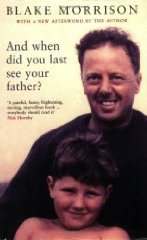
when-did-you-last-see-your-father-book-cover2I saw the movie When Did You Last See Your Father? at the Toronto International Film Festival last September, twice. I didn’t have the chance to read the book until a couple of days ago, about 7 months later. But as I read, all the scenes came back to me, and I appreciate the film even more than before. Yes, this is definitely a successful attempt at turning Book Into Film…and a hugely impressive one at that. The stellar cast with Jim Broadbent as the father and Colin Firth as the adult son, plus the exceptional supporting roles have brought out the spirit and the essence of the book poignantly, thanks to the very artistic and sensitive treatment by director Anand Tucker. To read my review of the movie, click here.

Blake Morrison is a contemporary British poet and writer. He was literary editor of The Observer and the Independent on Sunday before writing full time in 1995. AWDYLSYF is a memoir of his relationship with his father, Arthur Morrison, who died of cancer at age 75. Published in 1993, the book has won literary awards, and has been translated into many languages, from Japanese to Syrian.

The name of the book has its source in a painting of the same title by the Victorian artist W. F. Yeames. Yeames depicted an imaginary scene during the English Civil War. The young son of a Cavalier (Royalist) was questioned publicly by the enemy, the Roundheads (Parliamentarian), as to the whereabouts of his father. The question posed a serious dilemma for the boy. If he answered truthfully, he would endanger his father. If not, he would be commiting the immoral act of lying. Click here to read the story behind the painting.

And Painting by W. F. Yeames, When Did You Last See Your Father

Such a dilemma finds a parallel in the book. And it is apparent that Morrison has chosen to do the former, for the story he tells is incredibly candid, up-close and personal. As a reader, I’m glad he has done that. Eulogies are sometimes euphemism honoring the dead in order to please the living. But what Morrison has delivered is a courageously honest narrative of a precarious father-son relationship marked by ambivalence and love-hate sentiments. I can sense the pain such exposure could bring to the people involved, his mother, his sister, close family and friends. But I feel Morrison has burst the romantic bubble of the naturally congenial relationships we assume as we look at other people’s family portraits, or see families depicted in movies and novels. Love does not come naturally because of the tie that binds. Respect still needs to be earned, and loving acts need to be learned, for both parent and child.

The 20 independent, short chapters darting back and forth across the landscape of memory record the poignant reminiscence of a son living under the shadow of a powerful father. Arthur Morrison was a revered doctor in the town of Earby, in the County of Yorkshire…revered because of his imposing, domineering and callous demeanor. He could always get his way, and get out of troubles. In his recalling of childhood episodes, son Blake has aptly intermingled humor with pathos, all the more bringing out the complexity of character, and the ambivalence we sometimes feel towards our loved ones.  And to be fair, Arthur had cared for his family, albeit in his own patriarchal and egotistic manner.

He was gregarious.  In all social situations, he was the one leading the conversation and successfully avoiding topics that he was ignorant about…and was sure to stay away from games like Trivial Pursuit.

He hates feeling fallible: ‘I may not be right but I’m never wrong’ is the motto on a horrible brass wall-plate he has. He isn’t a vain man, but he is a proud, even bumptious one, a man with a puffed chest who learnt to water-ski in his fifties and thought he could go on forever.

How can such a character be brought to face his own imminent demise? Blake Morrison describes his father’s fast deterioration after diagnosed with cancer. The preparation though seemed to be harder for those who were going to be left behind than the patient himself. There was a relationship that needed mending, and, there were truths to be revealed. For years, Morrison had suspected the intimate relationship between his father and Auntie Beaty, a family friend. It had affected his perspective on his father, and on himself as a son. But he wasn’t given such a privilege. Other people’s secrets are theirs to own, even though that person is your father. And the living won’t tell: “Please leave me one last small piece–it’s mine” Auntie Beaty pleaded.

So the pressing question is: How is a son to prepare for the imminent demise of his own father, having lived in such a precarious relationship? The revelation comes at the end of the book. Death and mortality has a way of helping us put things in perspective:

Don’t underestimate filial grief, don’t think because you no longer live with your parents, have had a difficult relationship with them, are grown up and perhaps a parent yourself, don’t think that will make it any easier when they die.

Faced with the finality of death, all grievances one has towards the dying seem minute in comparison. As a son now, Blake has to learn to let go of his father, ironically, a lesson his father had failed to learn in the raising of his own son. Grievances give way to caring, to the consoling of the living, to the respect of a life lived on its own terms, to forgiveness, to closure.

In his Afterword, Morrison writes:

When young, we were impatient with our parents: now we want to atone for our callowness, and to acknowledge what they were and all they did.

Poignant words for us to ponder.


And when did you last see your father? by Blake Morrison is published by Granta Books, London. 1993. 230 Pages.

A movie tie-in edition by Granta Books is published October 2007.
~ ~ ~ ½ Ripples

A Room With A View (2007 TV)

It will probably take another Merchant Ivory production to best an earlier version.  The 1985 movie A Room With A View has ingrained in my memory certain images of sight and sound that are difficult to replace, like Lucy opening the window and the camera slowly zooms in the beautiful view of Florence, highlighting the Il Duomo. Or the ending shot of the silhouettes of Lucy and George sitting by the same window… To me, A Room With A View is Kiri Te Kanawa singing Puccini’s aria “O mio babbino caro” (O My Beloved Father), achingly depicting the agony of unrequited love.  Further, it is also the humor that underlies the whole story as Forster has intended, as evidenced by the chapter (or scene) titles.

Nevertheless, I came to watch this newest BBC production with an open mind.  I was eager to see how a 21st Century, Andrew Davis rendition would present this E. M. Forster love story.  Every new adaptation of an old classic should offer us a new vision.  With such endeavors Andrew Davis has proven to be relatively successful in the past with his Austen and Dickens adaptations.  Here, I anticipate another window opening out to a fresh and different view.

For this adaptation, Davis writes the screenplay as Lucy’s flashback.  And, letting his imagination roam, he has Lucy coming back to the same Florentine room in The Bertolini, by herself, as a young widow.  So with this in mind, the overall sepia tone throughout fits well with the context, a memory re-lived, through the eyes of a lonely young woman who has lost her husband in the war.  The colorless overtone might well depict the sombre mood of a very different Lucy.

But there’s the rub. With this new “twist”, Davis has put himself in a difficult position in that, the present might be sombre and sad, but the past is most vibrant and radiant.  He’s got in his hands the difficult task of reconciling the two. What mood should he establish?  The sombre loss of the present or the fantastic journey of self-discovery and the ecstasy of a young heart heeding true love of the past?   umm…alright, let’s just go on with the show…

I have appreciated the fine cinematography and camerawork. The attraction of the Florentine art and architecture as well as Rome’s grandeur are caught with a sense of depth, not just picturesque shots, ironically, thanks to the lack of color.  They are frames from Lucy’s point of view, a well-protected, English young woman’s first encounter with greatness and history outside of her familiar, parochial life.

As for the actors, I have mixed feelings.  In the 1985 movie, Helena Bonham-Carter’s fresh persona of Lucy Honeychurch is sensitively matched by Julian Sand’s poised portrayal of George Emerson, an ideal image of young love.  Somehow, I don’t feel the chemistry here between Elaine Cassidy (When Did You Last See Your Father, 2007) and Rafe Spall.  The film is supported by some excellent acting though by veterans like Sophie Thompson (Emma, 1996) as Charlotte Bartlett, Mark Williams (Sense and Sensibility 2008 TV) as Mr. Beebe, Sinead Cusack as Miss Lavish, and Timothy Spall (Enchanted, 2007) as the elder Emerson.  Tim and Rafe Spall dispaly an authentic father son relationship on screen, naturally.

Timothy and Rafe Spall

A weak link I feel is Laurence Fox as Cecil Vyse.  No, I’m not trying to compare him with Daniel Day Lewis’s performance, which is inimitable.  But I truly feel it’s a miscast here.  Fox as a chap who is no good for anything but books, one who is so physically inapt to avoid a game of tennis?  Not very convincing.  What we have in this TV version is more like an eerie and chain-smoking Wickham or Willoughby.  Speaking of which, the smoke screen connecting to his almost every appearance may well be intentional, visually depicting how marred and distorted Cecil is in his view of himself and of others, particularly, Lucy.

Indeed, as the title well conveys, it is the metaphor of seeing that is the key notion throughout the TV adaptation.  In order to impress into our mind, the director has us see lots of scenes by the window. But of course, it’s not so much of looking out but looking in that is crucial here.  The whole story is built on Lucy’s seeing clearly what is in her heart, and that the one who has drawn her out of her own self-deception is the one who can offer her ultimate bliss, and that is George Emerson.  It is not just about Cecil turning down a tennis match, but it is the last straw, the pivotal turning point where Lucy realizes how egotistic Cecil  is. Lucy to him is but an object of art and music, but not as a woman, definitely not as a lover.  Forster describes it most strikingly, “The scales fell from Lucy’s eyes.”  A Biblical allusion no less than an epiphany.

In this case of course, by following her heart, Lucy is making the moral choice of defying the long tradition of the English class system, smashing the inequalities underneath the civility, and unmasking the snobbishness she has been raised to aspire to.  In her new voice, as Cecil has noticed, Lucy has announced a new-found insight.  As an admirer of Jane Austen along with his fellow Bloomsbury writer Virginia Woolf, Forster might have written lines that Elizabeth Bennet could have uttered, lines like:

I won’t be protected.  I will choose for myself what is ladylike and right.  To shield me is an insult. Can’t I be trusted to face the truth but I must get it second-hand through you?

Or,

If a girl breaks off her engagement, every one says: ‘Oh, she had someone else in her mind;’ … It’s disgusting, brutal!  As if a girl can’t break it off for the sake of freedom.

Unfortunately, these lines find no place in the film.

Forster is not afraid to let us see a very muddled Lucy, being confronted by her own feelings and passions that are contrary to her up-bringing, loving someone from a lower social status.  The open view of Italy has offered her a wider spectrum to what she is accustomed to seeing. Here lies the muddled complexity of characterization…For often in life, we are walking confusion, unsure of our feelings, insecure about our actions, isn’t such muddledness the very commonality of our being human?

But thanks to her humility, Lucy comes to realize what is in her heart, and who she wants to be.  In her recanting of her engagement to Cecil, she admits to be less educated, not as well-versed in the arts and music as Cecil.  Maybe because of that, she is more flexible to explore and to associate with those allegedly seen as socially lower than herself.  Here lies the paradox, It takes the uneducated eye to find understanding. Cecil is an intellectual, expert in things but not people, his highly educated mind has done nothing for him but left him in a room with no view.

Zadie Smith in her brilliant 2003 Orange Word Lecture entitled “Love, Actually”, discussed the writing of E. M. Forster and Jane Austen. Regarding Lucy’s gaining insight, Smith observed incisively:

It is not by knowing more that Lucy comes to understand, but by knowing considerably less.

As for Davis’ new “twist” at the end … I think that has altered the whole story from a light-hearted piece of social satire and endearing love story to a sombre drama with an awkward ending.  And for the last scene, Lucy going on a picnic with the cab-driver, and their final gesture… I think Davis has gone too far with his gratuitous imagination.  If that is the new vision he is offering us,  I’d rather stick with the old view.

~ ~  Ripples

*******

Photo Source of window with a view: StudentsVille

Nim’s Island (2008)

I don’t want to miss any Jodie Foster movies.  She’s one of my all time favorites.  I’m also eager to watch Abigail Breslin again after her Little Miss Sunshine.  Further, after reading Annie Dillard’s novel, I just need something light and mindless.  Coincidentally, between these two, I only have to change lenses, for the view is more or less the same: the beauty and wonder of nature. 

Nim’s Island is a mixture of Swiss Family Robinson, Home Alone, Stranger Than Fiction, and Mr. Brooks.  Based on the popular children’s book of the same name by Wendy Orr, it’s about a girl called Nim who lives an idyllic life on a pristine island with her scientist dad Jack.  The island’s rich natural resources and wildlife are the sources of Jack’s research and Nim’s pleasure.  Her friends are Selkie the sea lion, Fred the iguana, Galileo the frigate bird, and the giant sea turtle…what’s his name? … Anyway, it’s a zoo out there on Nim’s island, but Nim and Jack keep it real organized, educational, and fun.

One of Nim’s favorite past time is reading the stories of her adventure hero Alex Rover (Gerard Butler, P.S. I Love You, 2007).  So, when a huge tropical storm hits the island, and her dad hasn’t come home for a few days collecting protozoa samples out in the open sea, she calls to Alex Rover for help.  Actually, it is the creator of Alex Rover that emails Nim first, asking about information to write the next novel, mistakenly thinking Nim is Jack’s research assistant. 

Far from being an adventure hero, Alexandra Rover, the author, is a recluse suffering from agoraphobia, whose best friend is her Purell hand sanitizer. She hasn’t been out of her San Francisco apartment for months. But knowing Nim is all alone on an island needing help, and prodded by her own adventure hero, she ventures out against her fears.  So there’s the interesting set up of the plot, the rest of the story is the adventures of Alex Rover the writer heading to the island to help out Nim, the real heroine.

The film suffers from some scenes and dialogues that appear to be banal and trite.  With its interesting storyline I think it can be done better with more creativity and imagination.  Having said that, I must say that the movie is beautifully shot on location in Queensland, Australia.  In a day and age when kids, and parents, for that matter, find it impossible to have fun outside of video games and electronic gadgets, this movie and the book can offer a wholesome alternative.

There is a new edition of the book that’s a movie tie-in, including 8 pages of color pictures from the film. It is illustrated whimsically by Kerry Millard.  A fun read.  And for all the budding biologists, zoologists, oceanographers, and for that matter, environmentalists in your home, this is a must-read. 

The intended age group I feel should be a bit lower for both the movie and the book.  I’d say a target audience and reader Age 6 – 10 would be more appropriate than the now 9 – 12.  

The best combination:  Go see the movie and then to the bookstore.

Now with that combination, I’ll have to give it

                  ~ ~ ~ Ripples 

The Maytrees by Annie Dillard: Book Review

To celebrate National Poetry Month, I am reviewing Annie Dillard’s novel The Maytrees.  That’s right.  For Annie Dillard, even her novel reads like poetry.  Consider these lines:

“Behind his head, color spread up sky.  In the act of diving, Orion, rigid, shoulder-first like a man falling, began to dissolve.  Then even the zenith and western stars paled and gulls squawked.”

Toby Maytree came home to Provincetown, Cape Cod, after the Second World War and met Lou Bigelow.  They soon fell in love and married, their lives bound by nature.

“His wife, Lou Maytree, rarely spoke.  She painted a bit on canvas and linen now lost.  They acted in only two small events–three, if love counts.  Falling in love, like having a baby, rubs against the current of our lives: separation, loss, and death.  That is the joy of them.”

Toby and Lou Maytree live a bohemian life. Toby works enough as a carpenter to support his real pleasure, poetry writing; Lou paints, rendering obsolete her MIT architecture degree.

“For a long time they owned no car, no television when that came in, no insurance, no savings.  Once a week they heard world news on the radio. They supported striking coal miners’ families with cash.  They loved their son, Pete, their only child.  Between them they read about three hundred books a year.  He read for facts, she for transport.  Nothing about them was rich except their days swollen with time.”

Can life, or love, be any simpler for any married couple?   Life in Cape Cod is idyllic for the Maytrees, and for a long while, time almost stood still.  Until, a third person, their long-time mutual friend Deary, came between them. Anticipating the ambivalence of guilt and desire, Toby and Deary secretly plans a move away to Maine, leaving Lou to raise Pete alone in Provincetown. 

“We bound ourselves to the fickle, changing, and dying as if they were rock.”

Dillard follows the Maytrees’ lives together, apart, and together again years later under very peculiar circumstances.  She uses condensed and poetic language to describe the subtle beauty of love, the reality of human frailty, the numbing of separation, and the inevitability of death.  Against the backdrop of nature, and a web of characters in the Maytrees’ lives, the author explores the power of forgiveness, the sharing of human responsibility, the acceptance of the human condition, and the preparation for death.  Love can still triumph despite failings, and yet, she also queries, what exactly, is love.

For most of the novel, Dillard displays fully her expertise: meditative nature writing, her thoughts touching the realms of science, literature, anthropology, religion, and philosophy. I do not pretend that I fully comprehend all that Dillard writes.  Eudora Welty in her 1974 New York Times review of Pilgrim at Tinker Creek admitted that: “I honestly do not know what she is talking about at such times.”  Who am I to say I have understood all that Dillard has written here in The Maytrees. It may help if you are well-versed in Keats, Kafka, and Wittgenstein.  But often it is in the language.  Occassionally, her condensed language has left me cold and clueless.  However, it is also her language that appeals to me.  Amidst the ambiguity, I have appreciated the mesmerizing power of her poetic sense.

“Later he stood on the foredune’s lip and looked at the stars over the ocean.  A wider life breathed in him, and things’ rims stirred and reared back.  Only the lover sees what is real, he thought.  Only the lover sees the beloved truly, inwardly.  Far from being blind, love alone can see.  Watching the sky now, and forever after, doubled his world.  He felt he saw through Lou’s eyes as an Aztec priest, having flayed an enemy, donned the skin.  Or somewhat less so.”

At the end, death wraps up a life and a narrative. Surprisingly, Dillard describes it in a prosaic and matter-of-fact manner. And yet, the images are vivid, and the humanity shines through.  This is the genius of Annie Dillard. The Maytrees is a gem of a story; it gives and demands much. It may need some effort to plough through, but well worth the time. And like poetry, you would want to go back and savor it again.

The Maytrees by Annie Dillard. Harper Collins, 2007.  224 pages.

~ ~ ~ Ripples 


Sense and Sensibility (2008 TV): Part 2

Even though the last kiss in the movie goes to Elinor and Edward, I feel this second part of Sense and Sensibility belongs to Marianne and Colonel Brandon.  Indeed, David Morrissey’s Colonel Brandon has been the leading man and Charity Wakefield’s Marianne shines.  Their lines even bring back some epic images of a past Austen adaptation.  Just dwell on them again:

Marianne: My feelings for him has changed so much…I love him.

Elinor: Then I am happy for you.

Words of endearment reminiscent of Davis’ adaptation of Pride and Prejudice (1995)…flashback to Lizzy’s response to Darcy’s second proposal, and as she explains to her unbelieving father of her accepting it, and of course, Mr. Bennet’s loving consent upon hearing her declaration of love for Darcy.  As for the imaginary scene of the fencing duel?  Isn’t that just reminds us of Darcy’s own struggle?  Further … isn’t it true that such an improvised addition could work just as well with Darcy and Wickham too?

I think we have seen enough Davis adaptations to not be surprised by his interpretive visions…not authentically out of Austen’s book, but effective just the same … and we forgive him yet again.

Indeed, not only the fencing duel, which is nicely shot, mesmerizing and dream-like, but all the scenes we see in this new version that are Davis’ own imagination are all quite effective, thanks also to the excellent camerawork and cinematography.  Scenes such as Brandon’s gentle touch of Marianne’s hand as she lay ill in her bed, the invitation to his own library and leaving Marianne to the privacy of her own enjoyment of the pianoforte, to the taming of the falcon, all vividly depict Brandon’s patient and quiet yearning for her.  And Marianne, even though by nature a free-spirited creature like the falcon, would eventually fly back and rest on the arm of the one who beckons her with his steadfast love.  Davis’ imaginary scenes are most effective in portraying Marianne’s turnaround.

There are some very moving moments for Elinor too.  Desperately seeking solitude in her silent suffering, Elinor finds shelter in a cave by the seaside.  The camera’s point of view from inside the cave looking out, framing her silhouette against a tumultuous ocean, a stunning vision.  Or, when she sits on a bench, again alone, facing the wide open sea, waiting, doubting, or just plain accepting… Our hearts pour out to her, and yet, it is Elinor’s perseverance that has won us over, not sentimentality.  Now that is authentic Austen.

At the end, as Edward enters the Dashwood cottage to propose to Elinor, the slightly shaky camerawork is most effective in depicting the agitated anticipation of both lovers, for Edward, the nervous uncertainty of his reception, and for Elinor, the restless suspense and later unpredictable euphoria….kudos to the screenwriter, director, and cinematographer.

The Welsh filmmaker Peter Greenaway once made a controversial remark criticising film versions of literary work as mere “illustrated books”.  Regarding Jane Austen’s work, he said:

“Cinema is predicated on the 19th century novel.  We’re still illustrating Jane Austen novels–there are 41 films of Jane Austen novels in the world.  What a waste of time.”

(Click here for the Wales news article containing the above quote.)

To which I respond:  The visual can powerfully bring out the essence of the literary.  A good film adaptation is more than illustration of printed words, but an inspiring visual narrative.  At best, it can offer an interpretive vision and a new perspective to a timeless piece of writing.

The present adaptation is a vivid example.

******

Click here to go back to Sense and Sensibility Part 1.

Don’t forget to vote in the Poll on the sidebar, Which Austen heroine do you think Jane was most like?

******

Sense and Sensibility (2008 TV): Part 1

Sense and Sensibility 2008

What can I say after watching just half of a movie?  But First Impressions last, and the notion has multi-layered meaning.

First off, I can’t help but compare this Andrew Davis version with the 1995 Emma Thompson’s screenplay.  And secondly, I’m eager to watch Part 2 next week to see how some of my feelings from Part 1 hold out, of course, to also quench my Austenian thirst.  PBS sure has underestimated the patience of Janeites who, I think, would not mind spending three hours to watch the whole movie in one sitting.

The two adaptations play out exactly as the story does.  Emma Thompson’s screenplay is an almost literal and reserved view of the novel, while Andrew Davis’ is an imaginative and free-spirited rendition.  The two versions are very much a parallel image of Elinor versus Marianne, sense contrasted with sensibility, or should I say, sense and sensuality?  The perfect scenario, of course, is a balance of the two.  And last night, while appreciating the fresh angle Davis has led me to look at the novel, I also long for a more literal, more authentic representation.

Davis has taken the liberty to create scenes intended to appeal to (what he thinks is the expectation of) modern day viewers, a much more erotic and sensual rendition than the Austen novel. Not authentic, but I admit, some of those scenes are quite effective. Not that I think Jane Austen needs that kind of help though.

Marrianne and Willoughby

I have particularly enjoyed the set design and cinematography.  The sumptuous Norland Park, the elegant costume, and the picturesque natural scenery, the almost Gothic billowing seaside of the Dashwood new home.  Barton cottage by the cliff?  Again, not authentic, but quite effective.  The howling winds and crashing waves are sharp contrast to the once quiet and comfortable life of Norland Park.  They also signify the turmoils in the hearts of the characters, betraying their calm composure.  There is a beautiful shot when Elinor runs up the windy mountain, the camera follows her wind-swept hair and fluttering dress.  As she stops at the edge of the cliff, looking down onto the rising waves, she opens the book Edward has given her as a parting gift, slowly caressing the words he left in there.  That is one moving scene.

I have thoroughly enjoyed the camera work.  Like an omniscient narrator, it captures not only the macro views, but by its silent pan and close-up shots, reveal the inner emotions and deeper characterization.  The blurry shots of the wind-charm hanging outside the cottage, strung up sea shells Margaret has collected by the craggy shore,  slowly dancing in the quiet breeze, a metaphor for the passing of time, or the changing of scenes…very effective indeed.

young-cast-of-sense-and-sensibility
This adaptation features a younger cast.  Hattie Morahan as Elinor, Charity Wakefield as Marianne, as well as Dan Stevens and Dominic Cooper as Edward Ferris and Willoughby are much more compatible in age to the story’s requirement than the 1995 movie.  However, I feel the contrast between the sisters are more proficiently acted by Thompson and Winslet….so far in this Part I anyway. The younger cast brings in a fresh perspective, but I miss the maturity and talent in the previous version.  I like Lucy Boynton’s Margaret (Miss Potter, 2006), a very clever performance and lucky girl…she has some of the best lines in the movie.  Another favorite character of mine in just watching this first part is Janet McTeer as Mrs. Dashwood, her performance almost overshadows her daughters.
Janet McTeer as Mrs. Dashwood

David Morrissey’s Colonel Brandon is portrayed as a more lofty and noble character than an emotionally tormented soul, a role Alan Rickman has mastered.  In the present version, Brandon meeting with Willoughby is an obvious reminiscence of a previous Andrew Davis adaptation, yes, the first, chance encounter of Darcy and Wickham in Meryton.  The cold and awkward expression on their faces are brought back here.  Morrissey’s tall and stately stature sharply contrasts with the much shorter, scoundrel-looking Willoughby, obviously contrasting not just a difference in physical appearance but in character. However, this is not what Austen intended.  The Willoughby she has described has all the social charm, height and good looks so to bring young girls under his grasp.  A deceitful character masked by a handsome appearance. Again, not authentic here, but as to effects, it depends on how much an Austen purist you are.  Nonetheless, I feel the Darcy and Wickham allusion is apparent.

Overall, I have enjoyed this first part of the new Sense and Sensibility.  The cinematography and camera work has done a great service to enhance a very elegant adaptation.  I anticipate eagerly to see how my First Impressions will play out in the concluding part coming up next week.

…if only I can just watch it now.

Update: Click here to go directly to my review of Part 2 and Conclusion of Sense and Sensibility (2008).

And… Don’t forget to cast your vote on the sidebar, Which Austen Heroine Was Jane Most Like?

******