What better days than Easter to speak of death, and life eternal.
“I am the resurrection and the life. Whoever believes in me, though he die, yet shall he live,and everyone who lives and believes in me shall never die.” (John 11: 25-26)
The past few months I’ve been silent on Ripple Effects. Actually, for the past year, I’d been posting just occasionally. Fact is, for fifteen months, I’ve been caring for my husband afflicted with cancer. It had been a roller coaster ride of ups and downs. On some days, he was well enough that we could go out to have a meal in a restaurant; on other days, it would be just a tiny morsel or nothing at all. All these months, I’d learned to find joy in afflictions, and be grateful for just being able to sit down at the breakfast table together, the warm, morning rays seeping in, and immersed in the moment.
This year started with an ominous diagnosis. The metastasized cancer cells had not only mutated but the new growth was extremely aggressive. Battling terminal illness had made everything superfluous, books, movies, or music. What was left was the very essence of my being, faith in the risen Christ. Both of us were often revived by the promises of the living God, inspired by His Word, and sustained by the encouragement and prayers of countless supporters the world over via online prayer groups. It had been a journey of faith. Ultimately, it’s all grace.
But we have this treasure in jars of clay, to show that the surpassing power belongs to God and not to us. We are afflicted in every way, but not crushed; perplexed, but not driven to despair; persecuted, but not forsaken; struck down, but not destroyed… (2 Corinthians 4:7-9)
On March 21, my husband departed to a better country. We were not unfamiliar with the immigrant experience. Now, a final move to that eternal kingdom, a homeland much more beautiful than anywhere in this world. He had arrived there first, I’ll join him one day. He was accepting, which was grace in itself. We were prepared, even planned his celebration of life service together. The event turned out to be a memorable occasion for hundreds to gather for a collective remembrance in peace and even joy.
Therefore we do not lose heart. Though outwardly we are wasting away, yet inwardly we are being renewed day by day. For our light and momentary troubles are achieving for us an eternal glory that far outweighs them all. So we fix our eyes not on what is seen, but on what is unseen, for what is seen is temporary, but what is unseen is eternal. (2 Corinthians 4:16-18)
I started this annual post at Christmas time in 2008, calling it Reading the Season. As the song goes, this might be ‘the most wonderful time of the year’, but it could well be the most distressing to many. In the hustle and bustle of the Season on the heels of that perennial frenzy called ‘Black Friday’, I hope Ripple Effects can be a respite from the busyness by offering a reading suggestion that could bring some quietude and to slow down the running wheel, hopefully the heart rates as well.
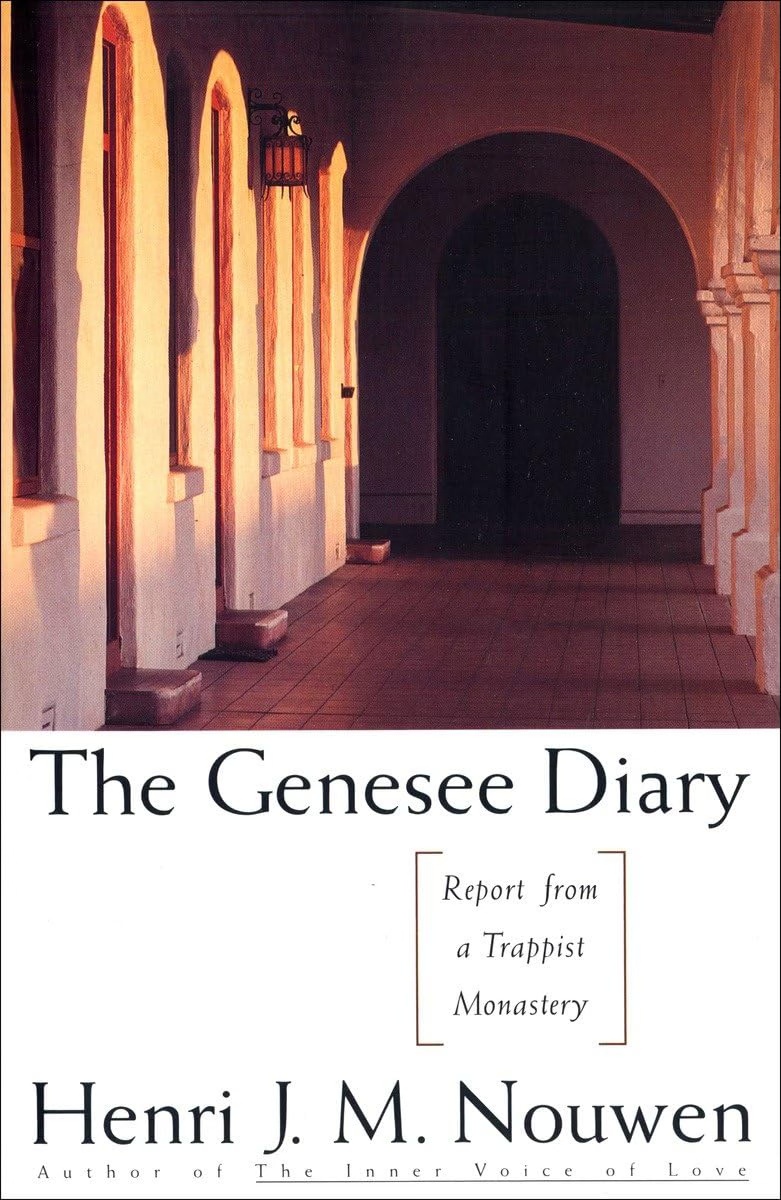
Henri Nouwen wore many hats, priest, speaker, writer, professor at Yale and Harvard Divinity Schools, and in the last ten years of his life from 1986-1996, quit his university teaching to live and serve as pastor among a community of intellectually disabled men and women, L’Arche–Daybreak in Ontario, Canada.
Twelve years before he made that life-changing commitment to L’Arche, in 1974, Nouwen spent seven months in a Trappist Monastery, the Abbey of the Genesee, in Upstate, New York. He started a diary in June as he began this experience and ending with the last entry on Christmas Day. He was searching for peace and quietude and to practice the contemplative life away from his busy commitments. His entries show his utter honesty with himself and total humility with God, and was always open to love and appreciate those around him. The monastery wasn’t cocoon living, he was in touch with world events and could grasp firmly the role of history in the present, and the continuity of the past in one’s personal journey. I’m glad to find too that he’s an avid bird watcher, and from nature, he gleans deeper understanding of self and God.
I’ve highlighted many passages, these are some of them. As a birder, I find this so intriguing. It may sound somber and serious, but I can also see the humour in it:
This morning Father John explained to me that the killdeer is a bird that fools you by simulating injury to pull your attention away from her eggs which she lays openly on a sandy place… I have asked pity for a very unreal problem in order to pull people’s attention away from what I didn’t want them to see.
Sometimes it seems that every bird has institutionalized one of my defence mechanisms. The cowbird lays her eggs in some other bird’s nest to let them do the brooding job; the Baltimore oriole imitates the sounds of more dangerous birds to keep the enemies away, and the red-wing blackbird keeps screaming so loudly overhead that you get tired of her noise and soon leave the area that she considers hers. It does not take long to realize that I do all of that and a lot more to protect myself or to get my own will done.
I wonder if I really have listened carefully enough to the God of history, the God of my history, and have recognized him when he called me by my name, broke the bread, or asked me to cast out my nets after a fruitless day? Maybe I have been living much too fast, too restlessly, too feverishly, forgetting to pay attention to what is happening here and now, right under my nose. Just as a whole world of beauty can be discovered in one flower, so the great grace of God can be tasted in one small moment. Just as no great travels are necessary to see the beauty of creation, so no great ecstasies are needed to discover the love of God. But you have to be still and wait so that you can realize that God is not in the earthquake, the storm, or the lightning, but in the gentle breeze with which he touches your back.
And a thought that for me brings a new perspective on Advent:
Advent does not lead to nervous tension stemming from expectation of something spectacular about to happen. On the contrary, it leads to a growing inner stillness and joy allowing me to realize that he for whom I am waiting has already arrived and speaks to me in the silence of my heart. Just as a mother feels the child grow in her and is not surprised on the day of the birth but joyfully receives the one she learned to know during her waiting, so Jesus can be born in my life slowly and steadily and be received as the one I learned to know while waiting.
“Easter, which turns a terrible Friday into Good Friday. It is almost too brilliant for me to contemplate; it is like looking directly into the sun; I am burned and blinded by life.
**
There are times when I feel that He has withdrawn from me… but Easter is always the answer to My God, my God, why has thou forsaken me!
**
Easter is the most brilliant of all blessings.
–––––– Madeleine L’Engle, The Irrational Season
The following excerpt doesn’t directly refer to Easter, but its inherent meaning does:
I am encouraged as I look at some of those who have listened to their “different drum”: Einstein was hopeless at school math and commented wryly on his inadequacy in human relations, Winston Churchill was an abysmal failure in his early school years… Byron had to compensate for a club foot; Demosthenes for a stutter; and Homer was blind… Socrates infuriated his countrymen. And what about Jesus, if we need an ultimate example of failure with one’s peers? Or an ultimate example of love?
______ Madeleine L’Engle, A Circle of Quiet
And in a lighter mode:
Pride is heavy. It weighs. It is a fatness of spirit, an overindulgence in self. This gluttony is earthbound, cannot be lifted up. Help me to fast, to lose this weight. Otherwise, O Light one, how can I rejoice in your Ascension?
(Photos taken by Arti at Lake Ontario shore, Sept. 2022.)
****
To those who celebrate this life transforming, historical event, Happy Easter to you all!
‘Tis the Season to be meditative if we’re to find peace against the tide, seek meaning amidst the frenzy. Reading the Season is the annual Christmas reading post here on Ripple Effects. I’d selected Luci Shaw’s poems before, see list at the bottom of this post. The following is a new discovery.
It is as if Infancy were the Whole of Incarnation by Luci Shaw
One time of the year the new-born child is everywhere, planted in madonnas’ arms hay mows, stables in palaces or farms, or quaintly, under snowed gables, gothic angular or baroque plump, naked or elaborately swathed, encircled by Della Robia wreaths, garnished with whimsical partridges and pears, drummers and drums, lit by oversize stars, partnered with lambs, peace doves, sugar plums, bells, plastic camels in sets of three as if these were what we need for eternity.
But Jesus the Man is not to be seen. We are too wary, these days, of beards and sandalled feet.
Yet if we celebrate, let it be that he has invaded our lives with purpose, striding over our picturesque traditions, our shallow sentiment, overturning our cash registers, wielding his peace like a sword, rescuing us into reality demanding much more than the milk and the softness and the mother warmth of the baby in the storefront creche,
(only the Man would ask all, of each of us) reaching out always, urgently, with strong effective love (only the Man would give his life and live again for love of us).
Oh come, let us adore him— Christ—the Lord.”
–– Luci Shaw (Check out her beautiful website here)
I found this poem online. Have been trying to locate its original printed source to no avail. If you know where it was printed, do let me know in a comment.
“Easter, which turns a terrible Friday into Good Friday. It is almost too brilliant for me to contemplate; it is like looking directly into the sun; I am burned and blinded by life.
There are times when I feel that He has withdrawn from me… but Easter is always the answer to My God, my God, why has thou forsaken me!
Easter is the most brilliant of all blessings.”
–––––– Madeleine L’Engle, The Irrational Season
Holy Sonnet 10
Death, be not proud, though some have called thee Mighty and dreadful, for thou are not so; For those whom thou think’st thou dost overthrow Die not, poor Death, nor yet canst thou kill me. From rest and sleep, which but thy pictures be, Much pleasure; then from thee much more must flow, And soonest our best men with thee do go, Rest of their bones, and soul’s delivery. Thou’art slave to fate, chance, kings, and desperate men, And dost with poison, war, and sickness dwell, And poppy’or charms can make us sleep as well And better than thy stroke; why swell’st thou then? One short sleep past, we wake eternally, And death shall be no more; Death, thou shalt die.
––––––– John Donne
“Truly, truly, I say to you, unless a grain of wheat falls into the earth and dies, it remains alone; but if it dies, it bears much fruit.”
–––––––– John 12:24
“… without a few days in hell, no resurrection is possible.”
–––––––– Mary Karr, Lit
And a lighter thought, the all brilliant Madeleine L’Engle again:
Pride is heavy. It weighs. It is a fatness of spirit, an overindulgence in self. This gluttony is earthbound, cannot be lifted up. Help me to fast, to lose this weight. Otherwise, O Light one, how can I rejoice in your Ascension?
Reading the Season is an annual post on Ripple Effects in the midst of the hustle and bustle of Christmas festivities. An interlude to find rest and to ponder on the reason for the season. Lately, I reread the popular fiction All the Light We Cannot See by Anthony Doerr; my mind is haunted by the horrors of a world war raged by a madman. And then I came across this book by Dietrich Bonhoeffer, God is in the Manger: Reflections of Advent and Christmas. What a timely discovery!
Dietrich Bonhoeffer was a pastor and theologian in WWII Germany. A brilliant intellectual who received his doctorate from the University of Berlin at age 21, Bonhoeffer bravely stood against Hitler, involved in the Resistance, captured, imprisoned, and paid the ultimate price. He was hanged at the Flossenbürg prison on April 9, 1945, just two weeks before the Allies marched in, and three weeks before Hitler took his own life.
Here are a few excerpts from Bonhoeffer’s God is in the Manger:
The lack of mystery in our modern life is our downfall and our poverty… Living without mystery means knowing nothing of the mystery of our own life, nothing of the mystery of another person, nothing of the mystery of the world… It means remaining on the surface, taking the world seriously only to the extent that it can be calculated and exploited, and not going beyond the world of calculation and exploitation. Living without mystery means not seeing the crucial processes of life at all and even denying them.
Replace the word mystery with miracle…
***
Only the humble believe him and rejoice that God is so free and so marvelous that he does wonders where people despair, that he takes what is little and lowly and makes it marvelous… God is near to lowliness; he loves the lost, the neglected, the unseemly, the excluded, the weak and broken.
***
God is in the manger, wealth in poverty, light in darkness, succor in abandonment.
***
For the great and powerful of this world, there are only two places in which their courage fails them, of which they are afraid deep in their souls from which they shy away. These are the manger and the cross of Jesus Christ.
And you think he’s intense and serious, well, yes he is, brilliant in insights and brave to speak truth to power. But from his other writings, there’s also humour, equally enlightening. Here’s a quote taken from Bonhoeffer: Pastor, Martyr, Prophet, Spy by Eric Metaxas. (Click on the link to my read-along post)
If you board the wrong train it is no use running along the corridor in the opposite direction.
Two of my favourite songs, one for the Season, one for always. May your Christmas be a little light that shineth and a spark of hope.
Oh little town of Bethlehem, how still we see thee lie Above thy deep and dreamless sleep the silent stars go by Yet in thy dark streets shineth, the everlasting light The hopes and fears of all the years are met in thee tonight.
+++
Whispering hope Oh, how welcome Thy voice Making my heart In its sorrow rejoice
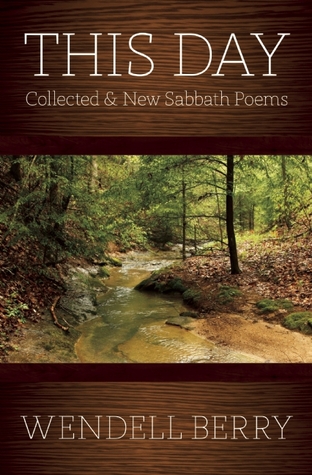
Wendell Berry’s Sabbath poems are an apt respite for our busy Christmas Season. A lover of nature––yet not a pantheist––his belief is specific, the Creator behind all that he can see and hear when he goes out to take long walks or work on his farm. However, his poetic imagination can deftly ripple out from the specific to the universal.
The following poems are selected from This Day: Collected and New Sabbath Poems, 1979-2013, all relating to Christmas and striking a deeper resonance as they end.
+++
Remembering that it happened once, We cannot turn away the thought, As we go out, cold, to our barns Toward the long night’s end, that we Ourselves are living in the world It happened in when it first happened, That we ourselves, opening a stall (A latch thrown open countless times Before), might find them breathing there, Foreknown: the Child bedded in straw, The mother kneeling over Him, The husband standing in belief He scarcely can believe, in light That lights them from no source we see, An April morning’s light, the air Around them joyful as a choir. We stand with one hand on the door, Looking into another world That is this world, the pale daylight Coming just as before, our chores To do, the cattle all awake, Our own white frozen breath hanging In front of us; and we are here As we have never been before, Sighted as not before, our place Holy, although we knew it not.
+++
Born by our birth Here on the earth Our flesh to wear Our death to bear
Our Christmas tree is not electrified, is not covered with little lights calling attention to themselves (we have had enough of little lights calling attention to themselves). Our tree is a cedar cut here, one of the fragrances of our place, hung with painted cones and paper stars folded long ago to praise our tree, Christ come into the world.
+++
The incarnate Word is with us, is still speaking, is present always, yet leaves no sign but everything that is.
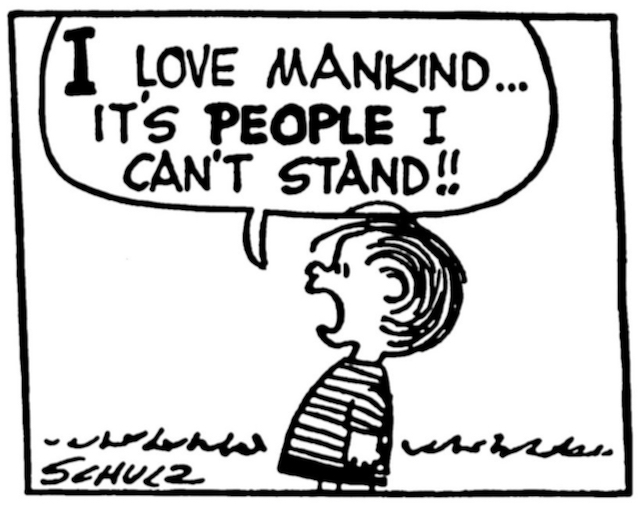
Nov. 12, 1959 Peanuts comic strip by Charles Schulz
And I thought Linus was so ingenious with such self-knowledge and view of mankind! But then again, it could be an example of great minds think alike… Charles Schultz and Fyodor Dostoevsky. Reading this first Part of The Brothers Karamazov (TBK) offers me surprising delights, for I find some well known, thought-provoking quotes in here.
The panel above is the last of the comic sequence where a frustrated Linus replies Lucy when she says he can never be a doctor because he doesn’t love mankind. In TBK, this line is, interestingly, spoken by a doctor, in an anecdote told by the Elder to ‘a lady of little faith’:
“the more I love mankind in general, the less I love people in particular, that is, individually, as separate persons.” (57)
Here’s the edition I use, references to page numbers in brackets are from this Pevear and Volokhonsky translation.
As I learn about the characterization in Part I, focusing on the father Karamazov and his sons, I can see why Dostoevsky created such a famous line.
Fyodor Pavlovich Karamazov – a man described as ‘worthless’, ‘depraved’, ‘muddleheaded’, ‘a buffoon’, and I’d just add womanizer and child abandoner, ‘for the child would have gotten in the way of his debaucheries.’ (p. 10) His eldest is Dmitri from first wife Adelaida Ivanovna, who deserted him and her own son. His second wife Sofia Ivanovna gave birth to Ivan and Alexi, and died when Alexi was four years old. All the brothers grew up away from their father.
Dmitri – Eldest, recently retired from the military. Abandoned by both his parents from birth, was raised by their servant Grigory and his wife for a while then a distant relative took over and some others. What could such a child turn out to be? The military has suited him well, so, at least his physique is well sculpted. However, the animosity towards his father runs deep, with conflicts over inheritance money and, alas, rivalry over the same woman Grushenka.
Ivan – The first son of Fyodor’s second wife. A rational man, argumentative, and an atheist. Expressed his view forthrightly in writing and in speech. While arguing against the existence of an overarching natural law of morality, he presents the scenario that if there’s no God, no immortality, then “nothing would be immoral any longer, everything would be permitted, even anthropophagy.” (p. 69) The Garnett translation uses the word ‘cannibalism’, which is much clearer. Without a universal measurement of good and evil, one cannot say what’s moral or not.
“If there is no immortality of the soul, then there is no virtue, and therefore everything is permitted.” (82)
I find it stimulating and gratifying to see Dostoevsky’s characters discuss issues such as this one openly, which reflects what were the important issues of the time. TBK is a novel of ideas, and Dostoevsky brings them out via lively dialogues and sometimes, surprisingly, in light-hearted strokes.
Alexei – or Alyosha, Dostoevesky’s hero as he states in his Author’s Note before the story begins. A youth who has quit his last year of schooling to return to his father’s town, and enters the monastery to follow the Elder Zosima. A ‘holy fool’ like the main character in Dostoevsky’s earlier book The Idiot. Called ‘an angel’ by his father, for this youngest son “pierced his heart… because he saw everything, and condemned nothing.” (94)
The Elder Zosima – Alyosha’s mentor, a spiritual leader in the monastery who gives advice to seekers. The ailing Elder urges Alyosha to ‘go into the world’ and not stay in the monastery after his death, something his youthful follower is perplexed about at this point in the book.
In a chapter entitled ‘A Lady of Little Faith’ (Bk 2, Ch.4), the Elder offers this advice to a woman who is distressed that she can’t find proof to confirm her faith, and the Elder replies,
“… One cannot prove anything here, but it is possible to be convinced.”
“How? By what?”
“By the experience of active love. Try to love your neighbors actively and tirelessly. The more you succeed in loving, the more you’ll be convinced of the existence of God and the immortality of your soul.” (56)
A crucial chapter is Book 2, Ch. 6, where the three brothers and their father meet at the Elder’s cell in the presence of other monks to seek the Elder’s judgement on the dispute between Fyodor and his son Dimitri. Here’s a prime example of how Dostoevsky lets his characters discuss serious issues embedded with comical effects.
During the meeting, the brothers engage with the monks and discuss serious subjects such as European Liberalism, Russian Liberalism, the role of the Church in the State, and most importantly, the existence of God, while an impatient Fyodor can’t wait to air out the family’s dirty laundry. I find the juxtaposition of these conversations deadpan farcical.
“Dmitri Fyodorovich!” Fyodor Pavlovich suddenly screamed in a voice not his own, “if only you weren’t my son, I would challenge you to a duel this very moment … with pistols, at three paces … across a handkerchief! Across a handkerchief!’ he ended, stamping with both feet.
Dmitri Fyodorovich frowned horribly and looked at his father with inexpressible contempt.
“I thought… I thought,” he said somehow softly and restrainedly, “that I would come to my birthplace with the angel of my soul, my fiancée, to cherish him in his old age, and all I find is a depraved sensualist and despicable comedian!”
“To a duel!” the old fool screamed again, breathless and spraying saliva with each word. (73-74)
The most important scene that takes place in this meeting is an action by the Elder Zosima. As if to end the Karamazov father and son confrontation, Zosima gets up, goes to Dmitri, kneels before him and bow, touching the floor with his forehead, astonishes everyone there. (74)
Another character, Rakitin, later interprets the Elder’s action as a foreshadowing, Zosima delivering a prophesy of a crime that will take place which has something to do with Dimitri and his father. I will have to read on to find out.
What a family!
Is it a coincidence that the unlovable head of the family Karamazov has the same first name as our author, Fyodor? I think here is a prime example of Dostoevsky’s humour and acerbic self-sarcasm. I gather that it’s the author’s intention to identify with humanity in all their foibles and failures––the fallen man.
As Dmitri tells Alyosha: “Don’t think I’m just a brute of an officer who drinks cognac and goes whoring. No, brother, I hardly think of anything else, of anything but that fallen man… I think about that man, because I myself am such a man.” (107)
Two other quotes that had sent ripples as I read:
“Here the devil is struggling with God, and the battlefield is the human heart.” (108)
“Faith is not born from miracles, but miracles from faith.” (26)
“April is the cruellest month…” says T. S. Elliot in The Waste Land. He has his reasons. For me, April teases us with uncertainties, so in that sense, it’s a bit cruel. Just when you think it’s spring, a snow storm cometh. And just as that snow has melted and the temperature goes way above freezing and you step out to that bright sunshine, the brutal wind blows your optimism away and drops you back to sub-zero chill.
Just like this frequent visitor to my backyard. Crept underneath the fence to hide in her favourite spot under the spruce tree, uncertain which coat to wear, winter or spring, white or brown:
Just as our world has lived through a pandemic year, now with vaccines in hand, here come the new waves of variant outbreaks, bringing more uncertainties.
I wrote this poem at Easter exactly ten years ago. At that time I was dealing with a bit of a writer’s block, some kind of brain freeze while facing the real freeze outside. The next time I re-posted the poem a few years later in 2016, I was stressed out dealing with the post-surgery care of a family member. Thanks to all who had commented then, we got out of it slowly and experienced the grace of healing.
Easter 2021 is none like others. Distressful situations have multiplied, their magnitude in epic scale. As with everyone else in this world, I’ve lived through a pandemic year, which alas, still has no end in sight with the outbreaks of variants. And personally, I’m wary even just walking in public, not only for Covid risk, but having to look out to avoid being spat at or punched in the face due to all the unprovoked violence against Asians, or women, or both. Face masks may help protect us from a physical virus, but not that stemming from the human heart. Looking out to the world political stage, looming conflicts breed like a plague.
That first Easter wasn’t a celebration but an execution. A dark day, a torturous public punishment, Crucifixion. It was there in the middle of the world––signifying the centre and reaching to all––one sacrificial death unleashed the power of divine love to save us from ourselves, a concept I’m beginning to grasp as more and more urgent and relevant now. After death came the ultimate miracle, resurrection. That same resurrecting power today can raise the deadest of soul to a brand new life.
_______
An Easter Poem
April is the month of empty dreams Half the days gone waiting for words and spring still frozen ground and on the screen a frigid page as white as snow.
Brown could be the color of hope After the white for all I know green is too much to wish for I’m contented to see a patch of dry and withered brown.
The sun is a perpetual sign that there’s still hope But it’s no herald of the seasons for its presence comforts all year long warming my blank and barren state as I await for words and spring.
But Easter is an apt reminder that The Word had come spoken clear to half-frozen ears His body hung on a lifeless tree Blood and water flowed onto parched and dusty earth
So what if no words come to me That dreaded writer’s block reigning the winter of sterility numbing senses, snatching thoughts, seizing any sign of spring.
It’s not about a post or a blog, Or even buds and melting snow. The Word had come lived and loved among us, broken, bled, died and rose, melting frozen hearts to greet a new dawn and eternal Spring.
–– Arti (April, 2011)
________
That historic Event in the past overrides all uncertainties in the future. He is risen!
Time for Ripple’s Christmas read, an annual post I name Reading the Season.
In the Pulitzer winning book Gilead (2004), Marilynne Robinson introduced us to the aging Rev. John Ames in the fictional Iowa town Gilead set in the 1950’s. The book is a letter Ames writes to his seven-year-old son, leaving him with a legacy of family memories, love and forgiveness.
In Home (2008), we enter the house of Ames’ lifelong friend, Rev. Robert Boughton, and meet her daughter Glory. For an ephemeral moment, his son Jack––Ames’ godson––the black sheep of the family appears. Jack returns home after twenty years of self-exile, looking for solace but sadly leaves again without reconciliation.
Lila (2014) is the story about Ames and his young wife Lila, who is homeless and aimless when the old Rev. first finds her on a country road. A beautiful story of how love bridges the great chasm between two utterly incompatible beings and leads to a magical union.
________
Marilynne Robinson’s newest book Jack (2020) is the fourth and last of the Gilead novels. It brings us back to the prodigal son in Boughton’s family, Jack, but this time, describing a sweet romance, albeit pointing to a challenging future. In terms of the time setting, Jack is a prequel to Gilead and Home. So we know how life unfolds for him. But for a moment, we dwell in some pleasant thoughts. The novel is like a reversal of Lila; here, Jack is the stray redeemed by Grace.
Nothing short of divine providence, Jack Boughton first meets Della Miles on the street, helping her in the rain to pick up papers blown by the wind. Della is a schoolteacher of literature, lover of poetry, witty, intelligent, and fearlessly independent. But, as fate would have it, she is a Black woman in segregated St. Louis during the 1950’s. Herein lies a precarious yet beautiful love story.
Jack and Della meet again one night in a cemetery serendipitously. Jack is destitute, just released after spending two years in prison, albeit for a theft he did not commit outside a pawn shop. Surely, justice isn’t on his side. Jack often gets roughed up or taunted, sometimes for no good reasons, but deep inside, he knows he’s not an innocent man. He’s destructive to others and himself, sometimes steals, and tries hard to remain sober. As mentioned in Home, years ago while still living at home in Gilead, Jack gets a girl pregnant, then just leaves town and disappears. The death of the baby later only adds to more burden and regrets.
Yet in Jack, Robinson’s depiction of the wayward protagonist is not without humour. Take this as an example:
Jack went out walking, trying to get tired enough to sleep, staying sober, so that if he did jump into the river, he could feel his demise has the dignity of considered choice.
Della has no reason to fall in love with Jack, the punishment for miscegenation is jail and being ostracized from her own family and both racial communities. The Miles are a reputable African American family of strong traditions and deep religious roots, the father being a Bishop in the Methodist denomination. No doubt Della is young and not tuned to the laws of a racist society that rewards the conformist and punishes the deviant. Yet, it is her internal light that leads her to defy unjust norms, look through Jack’s outward appearance to cherish his soul.
Della is Grace personified. The concept of ‘unmerited kindness’ is ubiquitous in the book, and Jack knows and is grateful to be the recipient of such. Receiving kindness might just be an understatement. He is redeemed and given a new life upon meeting Della.
Saying grace over pancakes in Della’s home after the cemetery meet, Jack recites spontaneously a verse from the poem “The Paradox” by African American poet Paul Dunbar (1872-1906) :
Down to the grave will I take thee, Out from the noise of the strife; Then shalt thou see me and know me–– Death, then, no longer, but life.
Indeed, the paradox of finding life among the dead is the pivotal moment in the book. They talk through the night as soulmates, treasuring the freeing experience inside the locked gate of a cemetery; for Jack, Della is like an epiphany, life in death.
Flannery O’Connor’s notion of the ‘intrusion of grace’ comes to mind as I read the book, light shining into darkness, even just a spark. Also emerged in my mental association is Dostoevsky’s Sonya, the Christlike figure that is a saving grace to Raskolnikov. Not that Jack is an axe murderer, but he knows too well that he needs to be rescued from himself.
Insight and wisdom come packaged in lightness of heart and humor, often embedded in the bantering between Della and Jack. And yet, they are lovers in limbo; while the subjective force of love prevails, there are uphill battles to be fought in the social and systemic front, and an arduous journey awaits. As the story timeframe takes place before Robinson’s Gilead and Home, we know how their lives turn out, which makes reading Jack such a bittersweet experience.
And here’s an imaginary scenario… if the love which surpasses all human barriers could be frozen in time, and let Grace have the last say, that would be heaven.
~ ~ ~ ~ Ripples
_________
2020 has been a most extraordinary year when we find and admit how fragile human beings are. We all need to be rescued not just from a physical virus but a spiritual one and be saved from ourselves. The Christmas Season is an appropriate time to ponder once again on that first crack of light, the epitome of the Intrusion of Grace.











 Ripple Effects