Of Film and Faith

Now, the reason to be… in Vancouver.   As I mentioned in a previous post, I was at Regent College for two weeks in May to learn the language of film, and its interface with elements of theology.  I came home much gratified.  I’ve delayed writing about the course per se because it would mean the difficult task of capturing the Genie of ideas back and recapping the bottle.  But I know I need to do it sooner or later, for I want to record down a learning experience that’s, well, let’s just say epiphany is not too far-fetched a word.  It could well be that the little I knew initially made it more gratifying as I could gobble up more to fill the empty vessel.

My thoughts are random here, but that might be the best way to capture whatever that comes to my mind that I think is important and meaningful.  Allow me to ruminate freely.

The language of film is multi-faceted, but it more or less can be condensed into the phrase mise-en-scène: what the director puts into the scene by means of setting, camera angle, lighting, staging, wardrobe, blocking… all the cinematic elements.     Like the artist of a painting, the director conveys his point of view and aesthetics through a frame or a scene.  And for us viewers, it’s a matter of honing the skill of observing the obvious, and the not-so-obvious.  Our pleasure is to decipher and savor that which is created on screen.   It all relates to the Auteur Theory, the director as the author, the concept of caméra-stylo, the camera as pen.

The power of the cinematic pen is mighty indeed.  Take the Disney movie Bambi for example.  The screening of Bambi resulted in a huge decrease of hunting licenses sold after it was released, and subsequently the term ‘Bambi Effect’ was coined.  Or, the movie Billy Elliot, which resulted in a significant increase in ballet school enrollment.

***

Knowing the history of motion picture is essential to appreciate films, and this is the major emphasis of the course.  I’ve come to appreciate the pioneers of motion pictures whose works have become the exemplars and the artistic foundations of modern cinema: Vincente Minnelli, Preston Sturges, Charles Chaplin, Fritz Lang, John Ford, Orson Welles, Frank Capra…

Fjilm Noir Third Man Alley

Further, it’s most interesting to trace the influence of German expressionism has on Film Noir, how the idea behind Edvard Munch’s The Scream can effectively be transformed into cinematic expression, revealing the inner state of modern man.

Over the intensive two-weeks, we’d only have time to cover mostly black and white features, savoring their richness in techniques and their multi-layered meaning.  I’ve come to understand why the years 1930  to 1946 are called “The Golden Age of Cinema”.

And where does theology come in?  While knowing some Kierkegaard and Buber might help, but basically the content is very accessible.  Herein lies the ingenuity of the auteurs and their works.  The process of exploring the transcendent in the movies viewed by the populace is just fascinating.
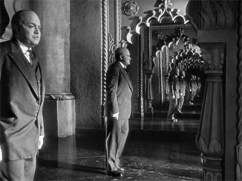
Citizen Kane

I’ve learned how Citizen Kane (1941, produced when Orson Welles was just 24!), generally considered one of the best movies of all time, like the Vanitas still life of Vermeer’s time, expresses the theme of Ecclesiastes, and asks the question, “So one has gained the whole world, then what?”

Another theological element is the archetype of the Christ figure, and I’m surprised to find it quite prevalent in many of these early motion pictures.  I admit I’ve never watched a Charlie Chaplin movie in its entirety until now.  In The Kid (1921) and City Lights (1931), the savior figure is humorously portrayed in the story, and the concept of unconditional love warmly illustrated.

City Lights

This archetype also appears  in Frank Capra’s  Meet John Doe (1941), where a main character declares the universal significance of the first John Doe two thousand years ago dying for all John Doe’s.  Visually, I’ve learned to identify the Pietà and the crucifix image in the composition of a frame in several of the features, an example being How Green Was My Valley (1941, John Ford).
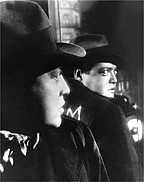
M by Fritz LangMotion pictures are an effective medium to convey the human condition.  In Fritz Lang’s thriller M (1931), the letter obviously refers to the murderer, a child killer that the whole town was after.  The not-so-obvious is the depiction of universal depravity, from the police to the masses, the message that we’re all complicit in the moral fabric of our society.  Similarly, Mel Gibson puts himself in his movie The Passion of the Christ (2004) as the Roman soldier nailing Christ on the cross.

Fast forward to the 80’s, I was introduced to the renowned Polish auteur Krzysztof Kieslowski.  It’s amazing how in Decalogue (1988), the essence of The Ten Commandments and their relevance in contemporary society are transformed into ten independent, one-hour stories and broadcast as a prime time TV series in Poland.  Decalogue is an artistically crafted and poignantly executed production that has won numerous international awards.  But would we see such kind of meaningful work as a prime time TV program here in North America?  The answer is obvious.

On the last day, I’d the chance to savor Babette’s Feast (1987), a highly acclaimed movie from Denmark (Oscar Best Foreign Language Film, 1988).  Based on a story by Isak Dinesen (Out of Africa), Babette’s Feast is a cinematic metaphor of goodness and freedom.  Its unique story and powerful visual images richly convey the theme of grace and mercy, and the liberating power of compassion.  The table prepared before us is free, sumptuous and abundant, but it takes an open heart of full acceptance and gratitude to fully enjoy it.  An inspiring film to wrap up my sojourn, creating resonance for the journey ahead.

Babette's Feast

***

Vermeer in Vancouver: Noticing the Obvious

For more Vermeer, Click Here to go to my post “Inspired By Vermeer”.

Vancouver Art Gallery’s premier summer kick-off is the impressive exhibition: Vermeer, Rembrandt and the Golden Age of Dutch Art. The exclusive show of masterpieces from Amsterdam’s renowned Rijksmuseum includes paintings, drawings, and decorative arts from 17th century Holland. After five hours at the Gallery, I left hungry for more Vermeer. Overall it was gratifying, but I was expecting just a few more glimpses of the great master.

Of all the 128 pieces of art work, there’s just one Vermeer painting. Placed at the end of the exhibit, apparently the highlight and climax of the show, is Vermeer’s Love Letter (1669). From his signature point of view, peeking through a partial opening of pulled-back curtain, we look into another room and see a maid just handed her mistress a letter. By the exchange of their glances, it seems they’re sharing a secret understanding. This is another one of Vermeer’s works that’s full of potential stories and rich in subtexts. Actually anyone of them is a novel to be written, not less dramatic as Girl With A Pearl Earring.

Vermeer's The Love Letter

Love Letter by Vermeer (1669-70)

~~

17th century Holland was a new Republic that had just gained independence from Spanish rule. The beginning of the exhibits sets the stage depicting a young nation with great maritime power. Domestically, it was a country marked by a vibrant economy and a rising middle class, as well as the flowering of arts and science, architecture and urban planning.

In the midst of such affluence and fresh hope, some of the artists spoke with their brushes as prophets of their time. Among paintings of naval glory and conquests, as well as glimpses of domestic life of the rich, there are also the quiet displays of still life. I must have seen them before. Why have I not noticed their significance previously?

They are paintings of withered blossoms, burnt out candles, hourglasses, books and musical instruments, and most prominently, skulls, eerie arrays of them, decaying bones and teeth. Why all these objects? The audio commentary confirms that they are Vanitas still life, the term rooted in Ecclesiastes, “Vanity of vanities.” And obviously, they are symbols of the fleeting nature of life, the callous passage of time, the transience of knowledge and human achievements:

Pieter Claesz Vanitas Still Life

Pieter Claesz: Vanitas Still Life (1628)

~

Skulls on a Table

Aelbert Jansz van der Schoor: Skulls on a Table (1660)

~

On the piece of writing crumpled up is one last word, Finis, The End:

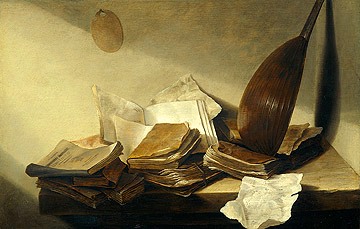
Still Life with Books Jan de Heem

Jan Davidsz de Heem, Still Life with Books (1625-29)

It’s commendable that the rich and powerful were willing to be reminded thus, considering these were once paintings adorning the walls of their affluent homes, a nagging presence they could not ignore. And they must have paid to have them painted.

~~

One of my favorites in the exhibition is Nicolaes Maes’ Old Woman in Prayer. Maes, a student of Rembrandt, had captured the simple piety of the old woman of lowly means: her earnest concentration, wrinkled face and hardened hands, the earthen wares and simple meal, and above all, her meager possessions on the ledge, an open Bible, a lamp, an hourglass and a prayer book. The warm light on her face almost makes her look divine. Maes did not forget to include a comic relief, her cat at the lower right bottom must have known what’s for dinner:

Nicolaes Maes Old Woman in Prayer

Nicolaes Maes: Old Woman in Prayer (1650-60)

~~

Sources: Skulls on a Table from Vancouver Sun. All other paintings in this post: Rijkmuseum, Amsterdam.

Beauty and Truth

Unlike my previous trips out here, this time in Vancouver is a learning experience. I’m spending two weeks at Regent College on the UBC campus to learn the language of faith and film. The art and architecture of Regent set the inspiring milieu for exploring beauty and truth. Here are a few vignettes:

The True North Wind Tower and Lux Nova Art Glass:

Installed in 2007, the tower stands as a symbol of integration. Its highest point is designed to be in line with the North Star, the beacon of direction through the ages. The structure brings together the seemingly polarized ends of science and art, and accentuates faith in all aspects of life. CLICK HERE to read more about this 40 foot tall distinguished landmark.

Architect Clive Grout designed the self-sustaining, energy efficient True North Wind Tower as a natural ventilation system for the library built underneath it. Artist Sarah Hall incorporated solar cells into a cascade of glass work. They store energy during the day to illuminate a colored, celestial waterfall at night. This is the first installation of solar energy and art glass fusion in North America.

Embellishing this graceful design are twelve dichroic glass crosses, weaving through an inscription of the Lord’s Prayer in Aramaic, the spoken language in Jesus’ time. What a magnificent alchemy of art, architecture, faith and science. Just two weeks ago, on April 29th, this beautiful architecture won the prestigious Design Merit Award for Sacred Landscapes from the American Institute of Architects (AIA) in San Francisco. CLICK HERE to read more about this Award.

Regent Wind Tower

A closer look at the art glass:

Lux Nova Art Glass Close Up 2

For the magnificent night view, CLICK HERE to go to Regent’s site.

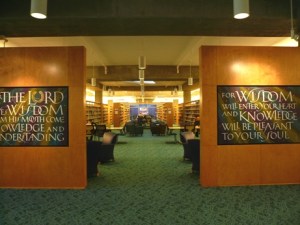
As for the theology library built underneath the tower, it’s another beauty:

Regent Library

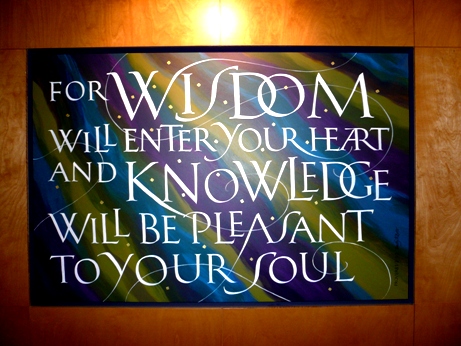
Wisdom

A stone-throw away from the Wind Tower is this serene setting:

Garden Bench

Even the wisteria speak to the intertwining togetherness of Beauty and Truth:

Intertwining Westeria Stems 4

Intertwining Westeria Stems 2

***

Original Photos and Text by Arti of Ripple Effects. ALL RIGHTS RESERVED, May, 2009. If you see them on a site that is not Ripple Effects, then they are copied without permission. CLICK HERE to go to the original post https://rippleeffects.wordpress.com

Stream of Easter Consciousness

stained-glass-2a2So students are sent back to school this week, just in time for Easter.  Nobody wants to have a holiday right on Easter week, especially the public school board.  That’s how you survive,  by being politically correct.  And the last two weeks’ holiday is called Spring Break of course.   Easter has almost become a banned word, like Christmas.  Who wants to be rude and offend others, we’re Canadians after all.
I know,  it’s not totally a taboo yet.  It’s a much tamer word, Easter, than Christmas, just because it doesn’t have the six-lettered word in it.  You can curse with that name, but no, God forbid you should say it in a proper context.   I can see you sneer, what’s a proper context, you ask.  You’re right of course, no word or context is more proper than others, we’re egalitarians after all.  As for Easter, as long as it’s synonymous with eggs and bunnies, pastels and flowers then it’ll never die.  Who needs resurrections?

All Fridays are good.  They even have a whole restaurant chain commemorating the day.  What’s it called… yes,  T.G.I. Friday’s.  Who says we’re not religious, we thank God for happy hours.  We’re much more open-minded now,  more civilized, equal and fair, don’t want to pick one day to be better than the others.  But definitely we won’t forget Ramadan, or the Chinese New Year.

There’s probably no God,  so stop worrying and enjoy your life, the sign on the bus says.  So we’re safe?   Whew!  No God means we can now be happy, worry free, all life, no death, …  Umm just let me figure this one out.  Give me a minute, I’m just not as smart as them.

Jesus wept.  He wept at the graveside of Lazarus, brother of his dear friends Martha and Mary.  He wept at the fragility of life.  He wept at the searing pain of separation.  He wept at the hopeless and uncomprehending expression on Mary’s face, even after he said to her I am the resurrection and the life.

Fleming Rutledge said more than ten years ago:  “I am deeply convicted, more so each year, of the profound sinfulness of the human race.  Yet because of the Cross and Resurrection of Jesus Christ — because of that and nothing else, because of that and nothing less — I am also convicted of the truth of what the Bible tells us about God’s plan of salvation.  The rainbow bridge does not lead to Valhalla, where the gods quarrel so much that they destroy themselves.  The rainbow bridge leads to the Cross and to the empty tomb on Easter Day.”

Utterly politically incorrect!  Who uses the word sin anymore?  Who’s Fleming Rutledge, anyway.  Never heard of him.  No?  It’s a she?  No wonder.

Now these words echo loud and clear too, written by T. S. Eliot in… what, 1934?  Aren’t they a bit archaic now?  Or, maybe they’re really prophetic:

Where is the Life we have lost in living?
Where is the wisdom we have lost in knowledge?

Where is the knowledge we have lost in information?

The cycles of Heaven in twenty centuries

Bring us farther from God and nearer to the Dust.

We should go on living, be happy and worry-free, the sign on the bus says.

So we go on living…

and Jesus still weeps.

stained-glass-41

*****

Original photos and text copyright by Ripple Effects, https://rippleeffects.wordpress.com, April 2009.  All Rights Reserved.

Jesu, Joy of Man’s Desiring

J. S. Bach’s Jesu, Joy of Man’s Desiring has never ceased to stir my heart.  Of all the renditions, none can grab me so movingly as Josh Groban in his captivating performance with the mesmerizing Lili Hayden on the violin.

Bach wrote the Cantata that contains this excerpt in 1723.  Its lyrics articulate for us what is unspoken in the depth of our souls, releasing our yearnings for a transcendent Creator, magnificent yet compassionate, afar yet ever so near.

Jesu, joy of man’s desiring
Holy wisdom, love most bright

Drawn by Thee, our souls aspiring
Soar to uncreated light

Word of God, our flesh that fashioned
With the fire of life impassioned
Striving still to truth unknown
Soaring, dying round Thy throne

Through the way where hope is guiding
Hark, what peaceful music rings
Where the flock, in Thee confiding
Drink of joy from deathless springs
Theirs is beauty’s fairest pleasure
Theirs is wisdom’s holiest treasure
Thou dost ever lead Thine own
In the love of joys unknown

*****

Reading the Season: Fleming Rutledge

Two things I always do whenever I go to Vancouver:  Check out the indie movies and visit the Regent College Bookstore on the UBC campus.  I admit before that gloomy December day when I entered the Regent Bookstore,  I had not heard of the name Fleming Rutledge.  Thanks to Regent’s gigantic book sale, I came out with, among others, two of Rutledge’s titles:  The Bible and The New York Times and The Battle for Middle-earth, a commentary on Tolkein’s writing.  For the purpose of basking in the Christmas Season in a more meaningful way, I delved right into The Bible and The New York Times.

The theologian Karl Barth has a famous axiom that says sermons should be written with the Bible in one hand and the newspaper in the other.  This book is evidence that Fleming Rutledge has taken this motto to heart in her over twenty years of preaching and teaching ministry.  The book is a compilation of her sermons delivered in the 80’s and 90’s from the pulpit of Manhattan’s Grace (Episcopal) Church where she has served for 14 years, as well as from her visits to other churches in Eastern U.S.  As for her writing, Annie Dillard has commented that, “this is beautiful, powerful, literary writing.”

The 34 sermons are arranged according to the liturgical calendar, all eloquent reflections on the meaning of the occasion, from Thanksgiving to Advent, Christmas to Lent.  I’ve heard numerous sermons in my life, countless I dare say, but I admit this is the first time that I read through a compilation of sermons and thoroughly enjoy them all like a page-turner.  They throw light on events of our world, from politics to popular culture, addressing them as springboard to a spiritual perspective albeit not without practical wisdom; her commentaries on the human condition are incisive and spot-on.  I’ve come out heartily admiring Rutledge’s intellectual prowess and literary repertoire, but above all, her boldness in proclaiming what may not be politically correct in this day.

rembrandts-annunciation-of-the-angel-gabriel-to-mary

The four Advent Sundays are preparatory for the main event of Christmas.  Rutledge reminds us that without recognizing the darkness we are in, there is no need for the Light.  Oblivious to unresolvable conflicts and the depravity of our human condition, we would not be desperate enough to search for truth and redemption.  Without being shattered by tragedies and wounded by sorrow and grief, we would not be genuinely seeking solace and healing.  And, not until we see the absurdity of our human world, we would not humbly seek meaning in the transcendent.

In one of her Advent sermons, actually exactly today, the last Sunday of Advent, Rutledge relates the spiritual experience of John Updike one time when he was alone in a hotel room in Finland.   He was besieged by a sense of awareness that pulled him to confront what he called a “deeper, less comfortable self.”   She quotes Updike’s own words:

“The precariousness of being alive and human was no longer hidden from me by familiar surroundings and the rhythm of habit.  I was fifty-five, ignorant, dying, and filling this bit of Finland with the smell of my stale sweat and insomniac fury.”

Rutledge notes that at the time:

Updike is in the prime of his life, at the peak of his powers and the pinnacle of his fame.  Yet even a celebrity has to be alone with himself at three o’clock in the morning, even as you and I.

If we approach Christmas in such a state of  “deeper, less comfortable selves”, then we might come closer to appreciate the magnitude of its significance and meaning.

Annie Dillard has commented that Rutledge “writes as a person who knows she is dying, speaking to other dying people, determined not to enrage by triviality.”  The world situation today is grave, our hope lies not within but beyond ourselves.  For this reason the Word became flesh and dwelt among us.

Emmanuel, God with us …

This is the meaning of the Virgin Birth:  God has moved.  God has moved, not we to him in our impotence, but he to us.

This is not the Season to be merely festive and jolly.  Christmas is the celebration of the Grand Entrance into humanity, thus reason for deep rejoicing.

“All hopes and fears of all the years,

Are met in Thee tonight.”

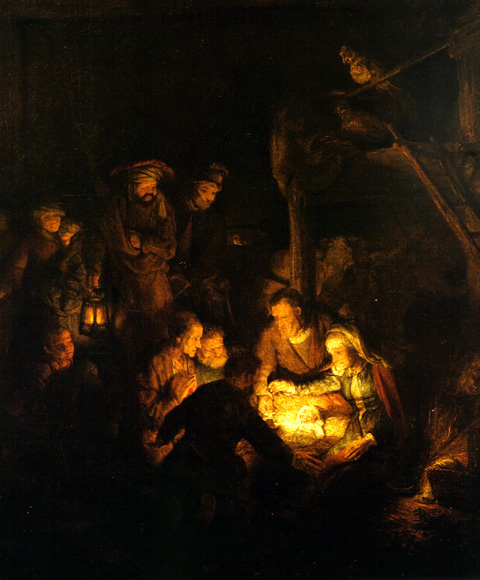
rembrandts-adoration-of-the-shepherds

******

Art images:  Rembrandt’s Annunciation of the Angel Gabriel to Mary and Adoration of the Shepherds

‘Reading The Season’ Posts over a Decade:

2020: Jack by Marilynne Robinson

2019: ‘A Hidden Life’ – A Film for the Season

2018: A Verse from Madeleine L’Engle’s The Irrational Season

2017: A Wrinkle in Time by Madeleine L’Engle

2016: Silence by Shusaku Endo

2015: The Book of Ruth

2014: Lila by Marilynne Robinson

2012: Surprised by Joy by C. S. Lewis

2011: Walking on Water by Madeleine L’Engle 

2010: A Widening Light by Luci Shaw

2009: The Irrational Season by Madeleine L’Engle

2008: The Bible and the New York Times by Fleming Rutledge 

2008: A Grief Observed by C. S. Lewis

Reading the Season: A Grief Observed by C. S. Lewis

c-s-lewis2To embrace the Christmas season in a more meaningful way, I’ve been trying to stay close to the heart of the matter by reading.

A Grief Observed by C. S. Lewis is one of my selections. Now, of all the wonderful books by the Oxford scholar, why would I choose this title for the Season?

From my reading of Joan Didion’s The year of Magical Thinking, I learned that during her mourning for the loss of her husband, she had read C. S. Lewis’ A Grief Observed. That sparked my curiosity. After finishing Didion, I turned right away to explore Lewis’s book about his own experience of loss.

After 58 years of bachelorhood, Lewis found the love of his life in Helen Joy Gresham, an American author who had come all the way to England in search of a genuine and credible faith. Their love story is poignantly portrayed in the movie Shadowlands (1993). In Helen Joy Gresham (‘H’ in the book),  Lewis found his equal in wit, intellect, and a faith that had endured testing and evolved from atheism to agnosticism and ultimately reaching irrevocable belief. Lewis entered into marriage with Joy at her hospital bed as she was fighting bone cancer. She did have a period of remission afterwards, during which the two enjoyed some traveling together. Regretfully, only four years into their marriage, Joy succumbed to her illness.

shadowlands

A Grief Observed is a courageous and honest disclosure of a very private pain. But what’s so different about this personal loss is that this prominent Christian apologist, acclaimed academic and writer, was willing to lay bare his questioning mind and disquiet heart to his readers. As his step-son Douglas Gresham wrote in the Introduction, the book is “a man emotionally naked in his own Gethsemane”. By crying out in anguish and exposing his torments, he shared his personal journey of painfully seeking the meaning of death, marriage, faith, and the nature of God. Lewis was brave enough to question “Where is God?” during his most desperate moments, when his heart was torn apart by searing pain and his intellect failed him with any rational answers.

Gradually he came out of despair realizing that the loudness of his screams might have drowned out the still, small voice speaking to him.

The time when there is nothing at all in your soul except a cry for help may be just the time when God can’t give it:  you are like the drowning man who can’t be helped because he clutches and grabs…

After all, you must have a capacity to receive, or even omnipotence can’t give.

After the fog of doubt has dispersed and the dust of despair has settled, Lewis saw the dawning of a gentle glimmer. He realized that he had been mourning a faint image or memory of his beloved, but not beholding the reality of her. The fickleness of his senses offered only fading fragments of her image. However, it is in praise that he could enjoy her the best.

I have discovered, passionate grief does not link us with the dead but cuts us off from them. This become clearer and clearer.  It is just at those moments when I feel least sorrow–getting into my morning bath is usually one of them–that H. rushes upon my mind in her full reality, her otherness.

Praise is the mode of love which always has some element of joy in it. Praise in due order; of Him as the giver, of her as the gift.

Further, as with God, he knew he should grasp the reality, not just the image.  He should treasure God Himself, not just the idea of Him:

I need Christ, not something that resembles Him.  I want H., not something that is like her.

Upon this revelation, Lewis powerfully points out that the Incarnation, the Word becoming flesh, is how God reveals Himself to us in His full reality.  Our ideas of God are shattered by Christ Himself.

The Incarnation… leaves all previous ideas of the Messiah in ruins.  And most are ‘offended’ by the iconoclasm; and blessed are those who are not.

As Christmas draws near, I ponder once again the humbling of the Creator God, born a babe to grow up to experience the full spectrum of being human, showing us by His life and death the reality of God, an iconoclastic act only He can perform.

Lewis has drawn me to the heart of the matter, the crux of the Season:

And the Word became flesh and dwelt among us, and we have seen his glory, glory as of the only Son from the Father, full of grace and truth.

— John 1:14

*****

‘Reading The Season’ Posts over a Decade:

2020: Jack by Marilynne Robinson

2019: ‘A Hidden Life’ – A Film for the Season

2018: A Verse from Madeleine L’Engle’s The Irrational Season

2017: A Wrinkle in Time by Madeleine L’Engle

2016: Silence by Shusaku Endo

2015: The Book of Ruth

2014: Lila by Marilynne Robinson

2012: Surprised by Joy by C. S. Lewis

2011: Walking on Water by Madeleine L’Engle 

2010: A Widening Light by Luci Shaw

2009: The Irrational Season by Madeleine L’Engle

2008: The Bible and the New York Times by Fleming Rutledge 

2008: A Grief Observed by C. S. Lewis

To G. K. Chesterton: Happy 134th Birthday

Well, I miss it by a day, but I don’t think he’d mind. 

To celebrate the birthday of the gifted writer G. K. Chesterton (born May 29, 1874 – June 14, 1936), I’m posting here some thoughts I wrote down after I finished reading his book The Man Who Was Thursday earlier this year.


 ‘Well, I don’t understand anything…’  — Gabriel Syme

‘I understand nothing, but I am happy…’  — Dr. Bull

Just finished this book by G. K. Chesterton.  One word had been on my mind as I was reading it:  ingenious.  Of course, there were other words too, like baffling, profound, funny, even hilarious.  Published exactly 100 years ago in 1908, The Man Who Was Thursday: A Nightmare reads like an allegory, farce, fantasy, thriller, adventure, philosophical treatise, religious exposition, and a postmodern piece of literary anime, and yes, that’s 1908.

Having said all that, I must concede and humbly admit, upon finishing this first reading, I understand very little.  The twists and turns make one doubt what actually is real, or what is disguised as real, and where the line lies between good and evil, friend and foe, government and anarchists.  I’m baffled by the symbolism and eager to seek the appropriate interpretation. 

Who is Sunday?  Is he who I think he is?  The author in his own words in the addendum says, no, he’s not.  So, what am I to think? And, even if he is, how can I explain all the events that lead up to the ending?  And…what does the ending mean?

I welcome anyone who has read, studied, or taught the book to help me out with my bewilderment.  Of course, I could research on what scholastic publications have said, but, I’d just like to entertain some casual and random thoughts.

For those who wish to explore more, here are some Chesterton links:

The American Chesterton Society: Common Sense for the World’s Uncommon Nonsense  (Plainly tells you who you’re dealing with here)

G. K. Chesterton Quotations  (Just brilliant!)

Read Chesterton Online

The Man Who Was Thursday discussion on the blog “So Many Books”

The Easter Message


dominus-flevit-mt-of-olives.jpg 


When I Survey the Wondrous Cross

When I survey the wondrous cross
On which the Prince of Glory died,
My richest gain I count but loss,
And pour contempt on all my pride.

Forbid it, Lord, that I should boast,
Save in the death of Christ my God,
All the vain things that charm me most,
I sacrifice them to His blood.

See from His head, His hands, His feet,
Sorrow and love flow mingled down,
Did e’er such love and sorrow meet,
Or thorns compose so rich a crown?

His dying crimson, like a robe,
Spreads o’er His body on the tree;
Then I am dead to all the globe,
And all the globe is dead to me.

Were the whole realm of nature mine,
That were a present far too small;
Love so amazing, so divine,
Demands my soul, my life, my all.

—– Isaac Watts, 1707


   ***

Photo: Dominus Flevit Church, Mount of Olives, Jerusalem.  Taken by Arti of Ripple Effects, www.rippleeffects.wordpress.com, November 2007.  All Rights Reserved.

The Message of Christmas

Hopefully by now, the dust has settled, and frantic frenzies can now be turned into some placid ponderings…

A Charlie Brown Christmas (1965 TV) remains my all time favorite Christmas special.  Charles Schulz has wittingly shrunk all humanity into his pint-sized Peanuts gang.  Aren’t we all but tiny specks in the vast universe, and yet our strives and questions are ever so close and immediate.

And for Charlie Brown, little did he know that by throwing up his arms and ranting his disappointment and frustration, had asked the existential question for us all:  “Isn’t there anyone who knows what Christmas is all about?”

And for Linus, little did he know that by answering this question, had delivered not only the Message of Christmas, but the crux of Christianity, pointed us all, the peanuts of the universe, to the way of reconciliation and redemption.

…Out of the mouth of babes (Psalm 8:2)…

A blessed Christmas to all!

Amazing Grace for Christmas

 Amazing Grace

This is one amazing film about an extraordinary man’s fight against slavery in 18th Century England.  The story chronicles Christian Parliamentarian and social reformer William Wilberforce’s mammoth battles in the British political arena to abolish the slave trade.

At that time, slaves were shipped from Africa to the West Indies in appalling conditions, many arriving dead.  They were chained to work on sugar plantations of British owners. Abolishing the slave trade meant a threat to the very economy of Great Britain.  William Wilberforce had given up twenty youthful years and his health to champion the anti-slavery cause.  Three days before his death, he saw his life-long advocacy triumphant as the abolition bill passed in the House of Commons, demolishing the institution of slavery in all of the British Empire.

The film is a display of superb artistry.  First of all, it benefits from a well-written screenplay by Steven Knight.  The award-winning Knight’s other film Eastern Promises (2007) has just garnered 3 Golden Globes nominations including Best Picture.

The exceptional cast is most satisfying to watch. Welsh actor Ioan Gruffudd is William Wilberforce, whose performance is intelligent and engaging.  He is effectively supported by a mass of extraordinary British actors, among them the veterans Albert Finney and Michael Gambon.

Albert Finney plays John Newton, the Pastor and mentor of Wilberforce.  It is from Newton that Wilberforce draws his inspiration and strength for his cause.  Newton himself used to be a slave trader.  His ephiphany came during a deadly storm while he was on a slave ship. The tempest he encountered reflected the torrents of guilt billowing in his own conscience.  Ultimately yielding to a merciful God, Newton was totally changed.  He abandoned the slave trade, his own livelihood, and became a Christian Pastor, spreading the message of God’s love and the freedom God had intended for all people. His writing of the tune and lyrics of Amazing Grace summed up the poignant conversion in his life.

The meticulously researched and designed period costumes and set, together with the fine cinematography bring out a beautiful and engaging film.  In many scenes, I feel like I’m looking through a portal of Rambrandt and Vemeer’s paintings in motion. 

The DVD is packed full of commentary and background information.  The music video of Chris Tomlin playing the piano and singing his contemporary version of Amazing Grace is both a visual and audio delight. 

One note of caution though, the film follows closely the British Parliamentary proceedings and political debates of the time.  Those anticipating a more romantic rendition may not have their expectation met.  However, I find the film very educational, informative, as well as inspiring.  What better gift to give this Christmas than the message inspired by the song Amazing Grace:

Chris Tomlin – Amazing Grace

(My Chains Are Gone)

Amazing grace
How sweet the sound
That saved a wretch like me
I once was lost, but now I’m found
Was blind, but now I see
‘Twas grace that taught my heart to fear
And grace my fears relieved
How precious did that grace appear
The hour I first believed
My chains are gone
I’ve been set free
My God, my Savior has ransomed me
And like a flood His mercy reigns
Unending love, Amazing grace

~ ~ ~ 3 Ripples