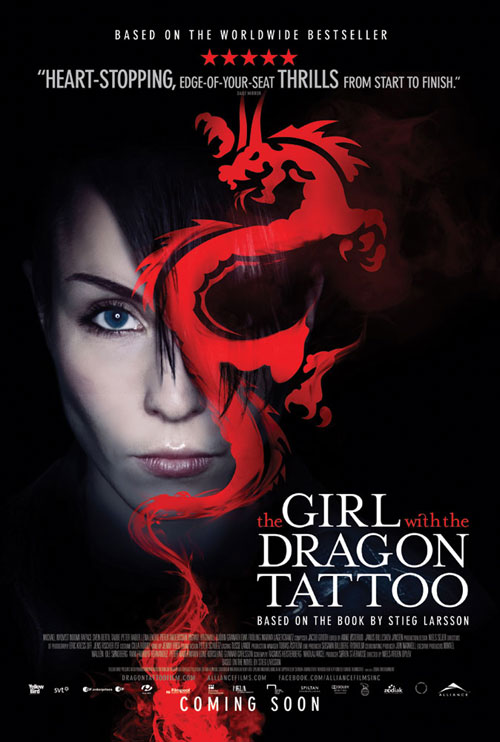
The Girl With The Dragon Tattoo: The Movie (2009)

Update Feb. 13: The Girl With the Dragon Tattoo just won BAFTA’s Best Film Not In The English Language.

Summertime… and the viewing is chilling.
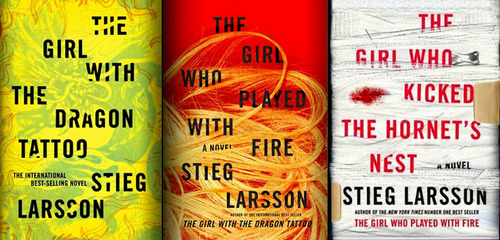
By now, we North Americans have caught the blazing heat that had swept other parts of the world a few years back, as we get the English translation of the Millennium Trilogy:  The Girl With The Dragon Tattoo, The Girl Who Played With Fire, and last of the series, The Girl Who Kicked The Hornets’ Nest.  All three books dominate the New York Times Best Seller Lists: When I last checked, the first two novels occupied the first and second places on the Paperback Trade and Mass-Market Lists, the newly published third title quickly claimed its second place on the Hardcover List.  The Trilogy has sold more than 27 million copies in 41 countries world wide.

It’s just too sad that the Swedish author did not get a taste of his own success.  Stieg Larsson died in 2004 of a heart attack at 50.  All three books were published posthumously.  Before his fame as a writer and journalist, Larsson had championed against racism and right-wing extremism for decades.

Those who frequent Ripple Effects might know, I’m interested in the transforming of books into films.  There are many instances where I would read the book first before seeing the movie.  But here’s an exception.  I’m glad I went into the movie theatre knowing nothing about the story.  Because of that, I was held on the edge of my seat from beginning to end, my mind fully engaged, all 152 minutes of it.

The story begins with a high profile journalist with Stockholm’s Millennium Publication, Mikael Blomkvist (Michael Nyqvist), losing a libel suit brought on by a corrupt financial giant. Blomkvist is given half a year of freedom before serving a three-month jail term. Meanwhile, the reclusive industrial tycoon Henrik Vanger (Sven-Bertil Taube) approaches and hires the disgraced journalist to investigate the disappearance and likely murder of his beloved niece Harriet Vanger 40 years ago, a unique assignment that intrigues Blomkvist.  Initially, Vanger has recruited Lisbeth Salander (Noomi Rapace), a ‘researcher’ with a security firm, to do a background check on Blomkvist. Lisbeth is in fact an expert hacker. Believing Blomkvist to be set up in the libel suit, she continues to track him, and the two finally meet up and join hands in search of the truth behind the disappearance of Harriet Vanger… and a bit more.
This is one engrossing and highly suspenseful piece of filmmaking in the crime thriller genre.  First off, the cinematography and the overall visual tonality is reminiscent of film noir, setting the mood effectively.  As well, the many Vermeer moments wherein the playout of light and shadows reflect aptly the complexity of the characters.  The revealing of hidden facts and personal secrets drive the riveting momentum.  Pacing is suitably executed.  While it’s not your bullet-speed Bourne flick, it unfolds the story smoothly, allowing some real acting to take place.  There are effective action sequences and some poignant moments.  And yes, there are also scenes where the audience could well be aware that their emotions are being led towards an intended end.  As witness of a violent crime against the heroine, the audience is pulled to a cathartic revenge, and feels okay with it.  Herein lies the effectiveness of the film.  Less obscure is the original Swedish title: “Men Who Hate Women”.  So the warning is: graphic violence.  But it’s not gratuitous and I have to say, only reveals the reality of how low and depraved human can be.


Another measure of success is how quickly the film has elicited my empathy and even compassion for the female protagonist.  It can make an ear and nose-pierced, misanthropic, rage-wrapped goth to become the heroine within minutes into the film.  This idea is original, iconoclastic, and timely too.  It draws us from the surface of looks and attire into understanding one’s psyche, to see how past experiences mould a life.  There are layers of truths to be understood if one is willing to go past the facade.

Condensing 600 some pages (Paperback) into 152 minutes must be an arduous task.  A lot of details are bound to be put aside.  But with every adaptation, the movie ought to be viewed as a totally different medium, and not be judged by how literal the transformation is.  Turning words into visuals has always been the demanding job of the screenwriter but also the realization of a vision from the director.  As a movie viewer, I’ve appreciated the work as a congruent whole, very well edited and all loose ends tied, even opening a tiny portal for the sequels coming up.

Shot entirely on location in Sweden, the work is an artful piece of filmmaking.  The wintry Swedish landscape is a quiet visual relief for our hot summer months. The movie has garnered several noms and awards, most notably The Swedish Guldbagge Awards in Best Film for director Niels Arden Oplev and Best Actress for Noomi Rapace.  It was also honored with the Audience Award at the Palm Springs IFF.

.

.

But will the movie and its two sequels gather as much hype as the novels?  Here in English only North America, I’m afraid not, at least not with the Swedish versions. Here are the stats if you’re interested. Watching a movie with subtitles is much more common in other parts of the globe than here.  Thus prompts Hollywood to plan for an English version. Well, is it language or profit?

My recommendation is: go for the Swedish one.  See a film in its most authentic adaptation, Swedish setting, original language dialogues, and superb performance.  Don’t let Hollywood distract you from the real thing. There have been rumors of Carey Mulligan, Natalie Portman, and Kristen Stewart taking the role as Lisbeth Salander, and Daniel Craig, Johnny Depp, Brad Pitt, and George Clooney as Blomkvist.  Well, if they must make an English version, my picks for the leads are Ellen Page and Jeremy Renner.

But no matter what, the Swedish original is a hard act to follow.  It’s now on DVD and Blu-ray.  And if it’s still being shown in theatres in your area, nothing beats seeing a thriller on a sweltering summer day, or night, inside a cool, dark theatre.

~ ~ ~ 1/2 Ripples


To Kill A Mockingbird

Clint turns 80 today.  A book dedicated to him as well as a special DVD just out to celebrate his life-long achievement.  There’s no shortage of Father’s Day gift ideas.  I understand though the man himself does not want any celebration on his birthday.  So to make his day, I’m not going to say anything more about him.

But there’s another birthday, or anniversary rather, that should be mentioned.  To Kill A Mockingbird turns 50 this year. Another good choice for Father’s Day, or any day really, and not just for fathers.  In recent years, as I see current events unfold, I truly feel this will make a marvellous gift for Law School graduates, or any graduate for that matter.   In this tumultuous time we’re in, where honor, justice, and nobility of character seem to become obsolete as quickly as the latest techno gadget, we all need a guidepost, a moral compass, ever more so.

To commemorate the 50th anniversary of its publication, Harper Collins has published a special edition:

Harper Lee had based the story on her childhood experiences in her hometown Monroeville, Alabama.  Her understated storytelling of Atticus Finch, Scout and Jem of Maycomb had won readers’ hearts the world over.   Two children growing up learning the value of respect and justice, love and integrity from their father.  Theirs was a most trying of times when racism and the Depression joined hands to destroy any fragile decency still present in a poverty-stricken town in the deep south.

Strangely, the story of such a parochial setting had triggered universal resonance.  The novel has been translated into at least 40 languages, sold over 30 million copies.  It has gained the number one spot on the list of greatest novels of all time.  It is the choice of British librarians according to a poll conducted by the Museum, Libraries and Archives Council (MLA), in which librarians around UK were asked the question, “Which book should every adult read before they die?”  Just hope people don’t wait till then.

***

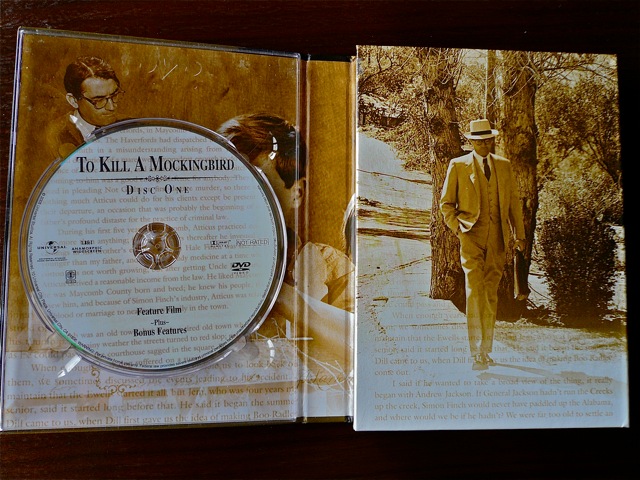
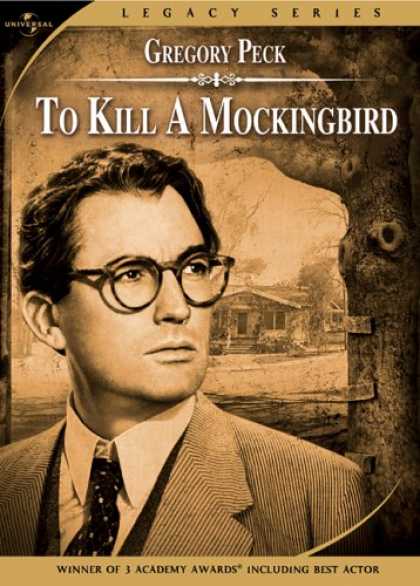
To Kill A Mockingbird DVD, Universal Legacy Series


To complement the book, I highly recommend the DVD set of the Oscar-winning movie (1962).  Make sure it’s the Universal Legacy Series (2005).  This is a two-disc collection with loads of memorable special features. Here’s a list:

  • Academy Award Best Actor Acceptance Speech — Gregory Peck
  • American Film Institute Life Achievement Award — Gregory Peck
  • Daughter Cecilia Park’s heartwarming tribute to her father
  • Scout Remembers — An interview with Mary Badham, who talks about her experiences working with Gregory Peck
  • Fearful Symmetry: The Making of To Kill A Mockingbird
  • The documentary A Conversation With Gregory Peck, produced by Cecilia Peck.  Scenes with Lauren Bacall, Martin Scorsese, President Bill Clinton and the Peck family.  Most moving is ordinary people sharing how the movie had impacted them, in their career choice, parenting and life.

“All the children of the whole world must have wished they could have Gregory Peck as their father.  He was ours, and that was our blessing.  He really was a lot like Atticus Finch… The last page of his film script of To Kill A Mockingbird, he had scrawled these four words at the bottom: Fairness, Courage, Stubbornness, Love. And they remind me so much of him…”  — Cecilia Peck’s tribute to his father

“It’s difficult to separate the man from the character.”  — Mary Badham (Scout) reminisces on her experience working with Gregory Peck

“Making millions is not the whole ballgame.  Pride of workmanship is worth more, artistry is worth more.  The human imagination is a priceless resource.  The public is ready for the best you can give them.  It just maybe that you can make a buck, and at the same time encourage, foster, and commission work of quality and originality.”  — From Gregory Peck’s acceptance speech for American Film Institute’s Life Achievement Award.

And if you think it’s all about Gregory Peck, well in a way it is.  I can’t think of anyone better to climb into the skin of Atticus and walk around in it.  The man is Atticus Finch, as his colleagues and family had testified. Gregory Peck received a well-deserved Best Actor Oscar for his role.  I must mention too that this is where Robert Duvall made his acting debut, without saying one single word, as Boo Radley.

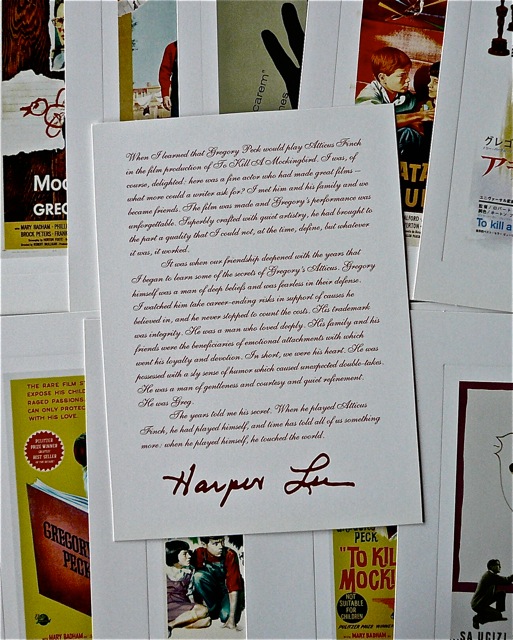
The other good reason for this Legacy Series is the 11 Exclusive Reproductions of Original Theatrical Posters. They are printed in a handsome set of cards, each a tribute from the country it comes from: Australia, Belgium, Italy, Japan, Argentina…

And last but never the least, a note from Harper Lee herself about the actor playing a character that was a cinematic reflection of her own father.

“When he played Atticus Finch, he had played himself, and time has told all of us something more:  when he played himself, he touched the world.”   —  Harper Lee

***

Movies for Mom

Some good movies are on DVD now.  Great to spend the evening with mom at the comfort of home.  Here are Arti’s movie recommendations for Mother’s Day.

Georgia O’Keeffe (2009, TV)

.


The cinematic biopic of the great American artist stars Joan Allen as Georgia O’Keeffe, and Jeremy Irons as her husband, the photographer Alfred Stieglitz.  Both received Golden Globe acting nomination, while the movie got the nom for Best Picture made for TV.  The production is a visual delight illuminating not only the works of the artist, but her elegant poise, and her environs, especially the cinematic New Mexico landscape.  On top of the spectacular visuals, I’d enjoyed the personal narration and the quotable quotes.  My favorite: “Where I was born and where and how I have lived is unimportant. It is what I have done with where I have been that should be of interest.”  As for the tumultuous relationship between O’Keeffe and Stieglitz, is it fair to say it is a case of iron sharpening iron?

*

The Blind Side (2009)


If your mom still hasn’t seen this one, it’s a good time to watch it with her… if it’s just to give moral support to Sandra Bullock.  Like her predecessors (Kate Winslet, Reese Witherspoon, Hilary Swank, Charlize Theron, Halle Berry, Julia Roberts), winning the Oscar Best Actress just proves to be too much to handle when the consequence is marital breakdown.  And what’s this about life imitating art (ok, let’s just call it art), Bullock attempts to live her movie role with her mixed-race adoption.  One thing that she’d find I’m sure, real-life mothering will prove to be a much more demanding role than in the movies.

*

Crazy Heart (2009)


Jeff Bridges won the Best Actor Oscar as worn-out country singer Bad Blake. Spent and hopelessly alcoholic, Bad Blake is movingly revitalized by journalist Jane Craddock.  Even for one who’s not keen on country western music, I’d thoroughly enjoyed the songs performed by Bridges himself.  Song writers Ryan Bingham and T-Bone Burnett won the Best Original Song Oscar with ‘The Weary Kind’.   As a bonus, you can also hear Colin Farrell sing.  Maggie Gyllenhaal gives a convincing performance as journalist Craddock, who starts from professional interest with the country singer to deeper, personal involvement.  But ultimately, her role as mother wins out.

*

Arti’s other recommendations?  All the movies listed on the sidebar.  All of them are on DVD now.  To read my review, just click on the picture.

No matter which movie you watch with mom, do talk about it afterwards… that’s the best part of the experience.

Here’s Jeff Bridges singing the Oscar winning song The Weary Kind:

*

To all who play the real-life role of mothering: A Happy Mother’s Day!  May you all get the nod and award you deserve!

Floating Weeds (1959)

‘Floating weeds, drifting down the leisurely river of our lives.’

.

.

April is national poetry month… and I’ve been thinking poetry these days.  So that’s why the very title of this DVD on the shelf of the indie video store attracted me right away.  I took it down soon as I saw it was directed by Ozu.  Ozu’s films are visual poetry, the title ‘Floating Weeds’ is an apt prelude.

Floating Weeds (浮草, Ukigusa, 1959) is a remake of Ozu’s 1934 silent film ‘A Story of Floating Weeds’.  The title comes from a favored Japanese metaphor as the above quote depicts.  In this newer version the director has added colors and sound, and given his story a blossoming rebirth. The colors are vibrant yet the cinematography is contemplative.  Unlike some art house films, and despite its title, ‘Floating Weeds’ is enlivened by humor, human interests, and augmented by actions.  Despite the pensive mood the title evokes, I found it to be more story-driven than many of his other works.  However, it is characters that ultimately carry the story, and Ozu’s brilliant direction that makes viewers care about them.

The story begins with a train dropping off a troupe of travelling players to perform in a small town.  The master of the company Komajuro takes the chance to visit his former lover and see his son Kiyoshi, now grown up to be a fine young man, aspiring to attend college in the big city.  But Komajuro has kept his real identity as Kiyoshi’s father from his son because he does not wish his low social status as a travelling actor, and the vulgar circle he associates with to tarnish Kiyoshi’s future.  The plot thickens as Komajuro’s current mistress Sumiko finds out about his secrets. Burnt with anger and jealousy, she plots a scheme to destroy Kiyoshi by bribing the young actress Kayo to seduce him.  The young man soon falls for the actress, but the scheme turns into a full-blown mutual love relation.  Sadly, a marriage with Kayo would mean the quashing of his aspiration for higher education, and possible social reverberations and disgrace.

At the mean time, the drama troupe hits a low with disappointing attendance. The company has to disband.  Komajuro facing failure on different fronts, has to make choices not only for himself, but the future of his son.  In the final shot, the train that once took the travelling players to town now carries them off as disbanded individuals facing uncertain future. Like floating weeds, they drift on in the stream of life. And for Komajuro, he leaves town with the slim hope that his son would fare better than he in the oblivious currents of time.

I’ve enjoyed the subtle style of Ozu.   Here is one of my favorite scenes in the film, and the dialogues are as contemporary as you can find in a 2010 movie.  Whether one sees it as insight or foresight (considering it was remade in 1959), both are gems one discovers while watching the story unfold as casually as a quiet flowing stream.

The scene is about Komajuro talking to his son Kiyoshi as he arrives to his former lover’s home. All the years, Kiyoshi has only known Komajuro as an uncle.  Although Komajuro is ecstatic to see his son all grown up with a bright future, he is also wary that his travelling drama troupe does not measure up to what he would wish for his son.  Here in this scene, father and son’s conversation seems to touch on another issue: art and popularity.  Through this most casual dialogue exchange, Ozu might have conveyed his own ambivalence on the subject more sharply than any wordy treatise.

Kiyoshi: I’ll go see your show.  What do you play?

Komajuro: Forget it.  It’s not meant for you.

Kiyoshi:  Who is it for?

Komajuro:  An audience.

Kiyoshi:  I’m an audience.

Komajuro:  I know.  It’s nothing high-class.  Forget about it.

Kiyoshi:  Why show such plays?  Show something better.

Komajuro:  But I can’t.

Kiyoshi:  Why?

Komajuro:  Audiences today won’t understand good plays.  So you can’t come to see it.

**

In his commentary on the 1934 silent movie, writer and film critic Donald Richie notes that Ozu’s films are full of ellipses. There are story sequences he left out for the audience to bridge.  As well, he handled the story with restraints.  Such a subtle way of presenting the material is a very modern style of storytelling.  That might explain why I would care for characters in a Japanese movie made half a century back, where I have to read subtitles, and watch in black and white, or even silent.  Herein lies the ingenuity and artistry of Ozu, that an audience so far removed in time, space, and culture, would find universality and common ground to be totally absorbed.

The Criterion Collection 2-DVD set includes both the 1934 silent movie and the 1959 color remake. The first features commentary by Donald Richie, the later version by Roger Ebert. According to IMDB, ‘Floating Weeds’ (1959) is on Ebert’s list of 10 best movies of all times.

~~~~ Ripples

CLICK HERE to my review of Ozu’s classic Tokyo Story.

***

Yasujiro Ozu and The Art of Aloneness

Growing up in Hong Kong during the 60’s, I had my share of Japanese literature and films, as well, the early version of anime.  Books were in Chinese translations, films with Chinese subtitles, and anime needed no language.  As a youngster I had my fix of Samurai action flicks by the legendary Akira Kurosawa, or the early sagas of The Blind Swordsman deftly performed by Shintarô Katsu.  The fast, magical sword-fighting movements displayed in elegantly choreographed sequences defined what ‘cool’ was in the eyes of a very young film lover, decades before Jason Bourne emerged.

But I admit, I had never heard of Yasujiro Ozu (小津 安二郎, 1903-1963) before reading the book The Elegance of The Hedgehog, and since, have become a mesmerized Ozu fan.

In Muriel Barbery’s marvellous work of fiction The Elegance of The Hedgehog, I was fascinated by the following excerpt that led me to explore the world of Ozu. Barbery mentioned some dialogues in the Ozu film ‘The Munekata Sisters’ (1950). Here, after quoting elder sister Setsuko, Barbery wraps up the chapter from the point of view of the concierge Renée, narrator of the book:

SETSUKO
True novelty is that which does not grow old, despite the passage of time.

The camellia against the moss of the temple, the violet hues of the Kyoto mountains, a blue porcelain cup — this sudden flowering of pure beauty at the heart of ephemeral passion: is this not something we all aspire to?  And something that, in our Western civilization, we do not know how to attain?

The contemplation of eternity within the very movement of life.

I could not find any copy of ‘The Munekata Sisters’, but I did manage to find a few other Ozu films on DVD in The Criterion Collection at an independent video store. One particularly stands out, both the film and the special features.  And that’s Tokyo Story (1953), the best known and most acclaimed Ozu work.

.

TOKYO STORY (with spoiler)

.

.

Instead of the macho samurai films of his time, Ozu chose to explore the quiet subject of family relationships, parents and children, brothers and sisters, husbands and wives, and from them come the topics of marriage, loyalty, aging, death, filial duties, parental expectations, and generational conflicts.  Through his perceptive camera work, Ozu sensitively revealed the undercurrents beneath the seemingly calm surface of daily family interactions.

‘Tokyo Story’ is about an aging couple Shukichi (the Ozu actor Chishu Ryu) and Tomi (Chieko Higashiyama) from small town Onomichi going on a trip to visit their adult children in bustling Tokyo.  At that time, postwar Japan was cranking up her economic engine, and urbanization was taking off.  Shukichi and Tomi’s children were all busily engaged in their work and family, with no time or patience to entertain their visiting parents, albeit struggling with a thin sense of obligation. They passed the two old folks from home to home, and finally sent them off to a spa resort on their own, a supposedly well-meant package substituting for their absentee hospitality.

With his subtle cinematic language, Ozu explored the issues facing the family in urban, postwar Japan. I’m surprised that in a time when the rebuilding of national pride was as much an essential as that of the economy,  Ozu was brave enough to depict the collapse of the family, revealing the conflicts and tensions behind the amicable social façade.  It’s interesting how contemporary and universal they are.  Have we not heard of those ubiquitous ‘mother-in-law jokes’ in our modern Western society?  Or, in real life, do we not struggle between taking care of our own family and career, and finding the time and energy to look after our aging parents?

.

But the contemplative cinematic offerings of Ozu draw us into deeper thoughts. ‘Tokyo Story’ quietly depicts the truth of these issues: No matter how many siblings there are in a family, each person is responsible for his or her own decision and action.  Even in a mass society like Japan, one can still make individual choices. Despite the currents, one can stand alone against the tides, and act according to one’s heart and conviction. While the brothers and sister are evading the task of hospitality, the young widowed daughter-in-law Noriko (the Ozu actress Setsuko Hara) chooses to care for her deceased husband’s parents out of genuine love.  She stands alone in her kindness and grace, a selfless heroine in a family hinged upon superficial ties.

Illness and death too have to be borne alone.  Despite their being together all the years of their marriage, Shukichi and Tomi each has to face the imminent all alone.  After Tomi falls ill upon arriving home from Tokyo, the strong bond of togetherness in marriage quickly dissolves into helpless resignation of parting and letting go.  Shukichi soon realizes he has to face life all alone.  The poignant scene though is that despite his loss, he looks out for his daughter-in-law Noriko, appreciating her loyalty, and relieving her of further obligations.  Despite having no blood ties, the two of them have touched each other in a way that’s beyond flesh and blood. Noriko selflessly gives while Shukichi accepts and appreciates in the midst of aloneness. The tables are turned, while they are left to face life alone, they are yet bound together in an unspoken bond, one that’s far stronger than filial ties.

The Criterion Collection carries several sets of Ozu titles.  ‘Tokyo Story’ is one in a trilogy of Noriko’s stories.  Disc Two features ‘I Lived, But…’,  a two-hour documentary on the life of Ozu, and ‘Talking with Ozu’: a 40-minute tribute to the great director featuring reflections from international auteurs Stanley Kwan, Aki Kaurismaki, Claire Denis, Lindsay Anderson, Paul Schrader, Wim Wenders, and Hou Hsiao-hsien.  It also features audio commentary by Ozu film scholar David Desser.

~~~~ Ripples

CLICK HERE to my review of another Ozu classic: Floating Weeds (1959)

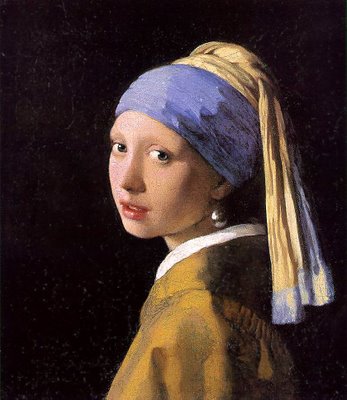
Girl With A Pearl Earring

The Painting (1665)

Girl With A Pearl Earring

Not much is known about this girl looking back at the artist with her soulful glance.  The pearl earring, the focal point of the painting, is obviously incompatible with her humble attire.  Vermeer has captured a mystery open to anyone’s imagination.  But it takes a master storyteller to create a believable and poignant narrative that can move modern readers three hundred some years later.

**

The Novel (1999)

Vermeer taught me that Less Is More, and I have been practicing that aesthetic principle in my writing ever since.”     — Tracy Chevalier

You can see it coming… it’s almost like reflex that after seeing a Vermeer exhibition I’d go back to the book Girl With A Pearl Earring by Tracy Chevalier, and re-watch the DVD of the movie based on it.  Well, especially when I didn’t get the chance to see the painting itself in the exhibition.

GWAPE Book CoverIt was this book that first sparked curiosity in me about Vermeer and his works.  Tracy Chevalier has done a superb job in creating out of her imagination the story behind the girl with the pearl earring, within the realistic social and historical contexts.  She has brought to the surface layers of possible subtexts hidden in this seemingly simple portrait.

I’ve appreciated that she has chosen the social segregation and hierarchical class structure of 17th century Delft as the backdrop of her novel.  So, instead of a sweet little tale or melodramatic story,  Chevalier highlights the complex social reality of power relations between servant and master, artist and patron.  She has masterfully created a scenario whereby the social distance between the servant girl, Griet,  and her master Vermeer, is drawn closer by her quiet understanding and appreciation of aesthetics.  With the same sharpness and sensitivity,  Chevalier has also shown how a wealthy patron can exploit art with his despicable, self-serving lust.

Chevalier’s ingenuity tugs at our heartstrings as we see the innocent and powerless being played as pawns,  no more than flies caught in the web of the rich and powerful.  The struggle between survival and artistic freedom is poignantly painted as irreconcilable subjects on the canvas of financial reality.  And fate teases all.  Yet among all these, the natural light that comes from art and beauty silently seeps through, brushing us warmly with a tender glow.

Do try to get hold of the Deluxe Edition.  It includes 9 full-color Vermeer paintings, which are cleverly incorporated into the story by the author.

Girl With A Pearl Earring by Tracy Chevalier, Deluxe Edition, published by PLUME, Penguin Group, 2005, 233 pages.

~ ~ ~ 1/2 Ripples

**

The Movie (2003)

.

GirlWithPearEarring1

Watching the movie Girl With A Pearl Earring is the closest to actually seeing a Vermeer exhibition.  Every frame is like a Vermeer painting with its extensive use of natural light from windows, contrasting the shadows in the interior of the Delft household.  The film was nominated for three Oscars in 2004, Best Art Direction-Set Decoration, Best Cinematography, and Best Costume Design.  In other words, it’s a pleasure to watch… it has to be because dialogues are sparingly used throughout.  Herein lies the strength of acting and the effectiveness of sound and visual communication.

The restrained performance of Colin Firth as Vermeer and Scarlett Johansson as Griet brings out the reality of the social order of the day.  A servant is not supposed to speak unless spoken to.  And what does a master has to say to an uneducated maid, unless he sees in her the appreciation of art and the clear understanding of aesthetics, of light and shadows, of beauty in the mundane.

Vermeer’s asking Griet to be his assistant and ultimately putting her in one of his works, albeit reluctantly for both, sparks off repugnant reverberation in town, and of course, the fierce jealousy of the painter’s wife Catherine (Essie Davis).  But as flies caught in the web of patron Van Ruijven (Tom Wilkinson), with debts to pay and a full household of mouths to feed, the artist has to bow to reality, and the even lower-ranked servant has to yield to her fate.

The visuals and music are the key to revealing the internal.  Beautifully shot in Luxembourg to simulate 17th Century Delft, the movie is a work of art in itself.  Colin Firth’s usual reticent persona on film fits him perfectly this time.  His taciturn portrayal of the ambivalent artist betrays the struggles within.  Scarlett Johansson delivers a convincing performance as pure and innocent Griet, and her gradual growth on the path of experience, albeit the book, as usual, depicts the inner turmoil more effectively.

The special feature on the DVD is enjoyable as well, chronicling the making of the movie.  I hope though that a Blu-ray version will come out one of these days, for that will indeed do justice to the cinematography and to the original artist, the master painter Johannes Vermeer himself.

~~~ Ripples

CLICK on the following links to go to related posts on Ripple Effects:

Inspired By Vermeer

Books and the Gender Issue


**

Movies for Mom

If you’re reading this on a site that is not Ripple Effects, your’re reading a post that has been copied without permission. Stop reading and CLICK HERE to go to the original post written by Arti of Ripple Effects. https://rippleeffects.wordpress.com

OK, now that the little bit of housekeeping is done, we can start. Mind you, the above words are the only pink, or red, you’ll see here, because this is not your typical Mother’s Day post. I’ve checked on several Mother’s Day sites for good movie ideas. They’re all framed by pink templates. They all point you to movies as old as Gone With The Wind (1939), or as teary as Terms of Endearment (1983), or as dysfunctional as The Joy Luck Club (1993). I mean these are great, but, renting an old DVD for Mom on Mother’s Day? Hasn’t she seen enough Sleepless in Seattle (1993) on Encore Avenue?

By all means, take Mom out to the theaters to watch a movie on her special day!

And guys, you don’t have to sit there, endure and groan silently for two hours. Because here you’ll find iconoclastic, i.e., stereotype bashing, non-chick-flick-genre movies that you and Mom will enjoy watching. Who says mothers are naturally drawn to pink or chick-flicks anyway? I’m speaking from experience. Nothing can make me more proud than to have my teenage son accompany me to the movies. (Bravo to him for his boldness!) Yes, just mother and son. And nothing is more rewarding than to share an experience that we can talk about afterwards.

Here’s Arti’s list of current movie recommendations for Mother’s Day, 2009. As I said earlier, this is the stereotype bashing list, so you won’t see Shopaholic here. Thrillers, actions, sci-fi’s, dramas… who doesn’t need an adrenalin rush every now and then to keep the body functioning?

State of Play

state-of-play

An absorbing story of corruption, deceit, and investigative journalism. The movie presents an interesting scenario: the old-school investigative newspaper reporter is pitted against the fresh-out-of-college blogger, both hired by the same newspaper to draw readership, a version of PC vs. Mac on the battlefield of journalism. When the female research assistant of congressman Stephen Collins (Ben Affleck) is murdered on the day of a crucial congressional hearing, Washington Globe reporter Cal McAffrey (Russell Crowe) is drawn into the search for the truth. He has to partner up, reluctantly, with Della Frye (Rachel McAdams), a pseudo-journalist/blogger. That’s the executive order handed down by their feisty and no-nonsense boss Cameron Lynne (Helen Mirren). As the investigation peels off layers of suspense, the pair is entangled with dangerous life and death situations. Adding to the intrigue is the role of Robin Wright Penn as the Congressman’s wife, and the colorful Jason Bateman as Dominic Foy, a crucial lead to solving the case. Mom would enjoy the performance by the stellar cast and the well edited screenplay. As to who saves the day at the end? I won’t spoil it for you… you deserve the credit for entertaining Mom.

Taken

taken

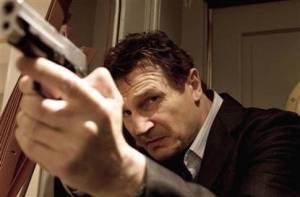
This may be in your second run theaters by now, well, so much the better. Don’t miss it on the big screen. After March 18, I look at Liam Neeson differently. Here in Taken, he embodies the superhero of parenthood. He shows us what a father will do to save his daughter, especially an ex-CIA dad against a human smuggling ring of bad guys. Bryan Mills (Neeson), a highly skilled agent who has retired early to make up for lost time with his daughter Kim (Maggie Grace), has to use all his resources when she is kidnapped while visiting Paris. The action-packed, fast-paced sequences leave you no time to be skeptical of the impossibilities. Mills’ expertly-trained speed and agility would make Jason Bourne drop his jaw (literally or figuratively). And, stand aside James Bond, you’re not in the league, it’s heart we’re talking about. Lose yourself, be swept away, it’s pure escape and fantasy. Any parent can identify with the fear of a child being taken and hurt and the feeling of helplessness that ensues. Liam Neeson just acts out the imaginary scenario, the omnipotent father coming to the rescue of his own, and he’s won my heart. (So remember, it’s great for Father’s Day too, but Dad will likely have to watch the DVD.)

Star Trek (2009)

Wolverine too hairy? Bad manicure? Bring Mom to Star Trek then, if she’ s up to pushing her way through the crowds. I’m sure she’d enjoy at least some elements of the movie. While you’re cheering for the young, new Kirk, she might be reminiscing the First Generation. This deserves a brand new post. So watch for it in the days to come.

Other recommendations have been reviewed on Ripple Effects. If they’re still on the big screen, Mother’s Day is a good time to enjoy them with Mom:

The key to making Mom happy: Spend time to talk afterwards.

****

Photo Source: Taken, msnbc.com; State of Play, usatoday.com

The Merchant Ivory Dialogues

Re-watching The White Countess (2005) has prompted me to savor other Merchant Ivory films .  I love their sumptuous period set design, stunning cinematography and exceptional acting.  Some of them have garnered Oscar accolades, and since become classics, creating a genre of their own.

Long before Bollywood and Slumdog Millionaire, there was Ismail Merchant, born in Mumbai (formerly Bombay), India, in 1936.  He later went to New York to further his education, and started making movies in 1960.  On his way to the Cannes Film Festival in 1961 representing the U.S. with his nominated short, he met American director James Ivory.  The two formed a production company that same year, and the rest is history.

Before producer Ismail Merchant passed away in 2005, the Merchant Ivory Productions had created timeless masterpieces, most notably, adaptations from the work of E. M. Forster, Henry James, and Kazuo Ishiguro.  Together with German/Polish screenwriter Ruth Prawer Jhabvala, they have turned literary satires and portrayal of class-conscious Edwardian and Victorian English society into accessible popular movies, interpreting the humor and wit with a mark of their own.  Ironically, none of the three are English.  Maybe it does take an outsider to see clearly.   A short list of their impressive productions includes  A Room With A View (1985),  Howards End (1992),  The Remains of the Day (1993),  and The Golden Bowl (2000).

james-ruth-and-ismail


But here in this post, I must present to you The Merchant Ivory Dialogues.  Oh that’s not how it’s titled.  But Arti just named it so.  In the 2005 Criterion Merchant Ivory Collection DVD of Howards End (1992, 9 Oscar nominations, 3 wins) I found in the Special Features this amusing interview with producer Ismail Merchant and director James Ivory.  The conversation between the two are so whimsical that they could almost form a comedic duo.


howards-end


Here are some excerpts:

On the idea of creating Howards End the movie:

 M: Howards End started with Ruth (screenwriter) telling me and I think gave Jim the novel to read.                                     


I: Well hold on. I’d read it.

M:    Oh, You’ve read it.  I see.

I: I’d read it in fact twice.   Ruth always sort of not exactly dangled the book in front of us after A Room with a View and Maurice.  But she saw it  as a really ambitious, and to her would be most, most rewarding project for us and for her.

M: Anyway, it was slow going for me.


***


On Jim Ivory’s favorite scene

I: For me … from the first time, if I remember anything about it, except this scene where Margaret jumps out of the car when they run over a cat.  Charles Wilcox doesn’t want to go back and a little girl runs into the road and starts crying and Margaret leaps out of the car…

M: We had to go to this incredible preparation, real cat and the artificial cat and the dead cat…

 I: There’s no real cat.

M: And so I said no I don’t want to do it, you know.  But he insisted because it was his favorite scene, and it is not in the film.  So you should listen to the producer first.

 I: That’s all I can really remember about the book the first time I read it was that scene,  which I thought is incredibly dramatic…

M: That’s your favorite scene which is not in the film.

I: Which we shot and cut out of the film. Anyway…


***


On Forster the Social Critic:

M: Howards End is about the class system, and what Forster said about the inheritance of England. This beautiful house, a metaphor for England,  will be inherited by the lower class. That is what happens here. This beautiful house is inherited by the clerk’s illegitimate son. Well anyway, this is an interpretation of mine.

I: I don’t think Forster had all that great love for the working classes …

M: Not love for the working class but…

I (voice covering M): He had an ideal, which was, people should be able to mingle from whatever their background, whatever their class, they all ought to be able to in a civilized and happy world. And in the good England everyone ought to be able to mix together if only the different kinds and types of people could make a connection. Then it would be for the betterment of all.


***


On American Funding (or the lack of)

M: Howards End was an ambitious film at that time, eight million dollars, the budget. We could not get eight million dollars from anybody, you know, it’s just not possible because Americans never saw the possibility of this film being successful as they never see anything of consequence or civilized film to be successful. They have blinkers on their eyes, they never see anything beyond, you know, the form …

I (moving about in his seat, almost rolling his eyes): All Americans?

M: All Americans

I (raises his eyebrows just enough to show his disagreement):   All Americans.

M: All American film companies… with the exception… there are some sensible people like Sony Classics, they were at that time with Orion pictures….they were very excited but they only gave us a very small sum of money…of course, their enthusiasm and support were greatly appreciated but we had to raise 85% of the money outside…


***

emma-thompson-vanessa-redgrave


On Getting Vanessa Redgrave on Board

I: And then there was the casting of Vanessa Redgrave, who all along, from the very beginning I had wanted in that part. I thought she was the actress to play the first Mrs. Wilcox. And we kept sending her scripts, and this is the way it’s always is with Vanessa… You’re not sure she’s got the script, you’re not quite sure she’s read it, whether she likes it, whether she’ll do it…

M: I’ll tell you the story. Jim’s heart was set on Vanessa, and so was mine. So we sent this script and then we went to tea at Waldorf  Hotel. And so we were sitting there and she said she had four, five months all planned… and the money you offer is not enough. So I said what would you like.  She said if you could double that amount, I would do it. So I said ok, that’s it, you said it, now it’s double your salary. She couldn’t believe it was instantly, spontaneously done, because knowing that we had a small budget and we had to struggle for every penny. This was like giving whatever you want.

I: A very bad precedent.

M: Sorry?

I: A very bad precedent.

M: No it’s not a bad precedent at all. And for her I would do anything, you know. If she said get me the moon, I would get the moon for her. And it’s not possible for people to get the moon, but I would do it.

***


Ah… the creative process, the self and the collaboration, the art and the business, the part and the whole… just fascinating.

~~~~~


Photos:  James Ivory, Ruth Prawer Jhabvala, and Ismail Merchant received BAFTA Fellowship Award (2002)  news.bbc.co.uk;  Emma Thompson and Vanessa Redgrave in Howards End, toutlecine.com


The Savages (2007, DVD)

the-savages-linney-hoffman

After my last post I had to take some time to withdraw. That’s when solitude can work as a soothing balm, allowing the personal space for reflection. Whether sudden or expected, young or old, death affects us all. And some strike a deeper chord.

A couple of days ago I got hold of The Savages on DVD. I thought I was late in watching this highly acclaimed indie film, and writing a review two years after its release. But watching it, I was surprised by the coincidence; for alas, it’s about death and aging. It’s ever timely now. I wouldn’t have appreciated it as much if I’d seen it then. For now, I’ve the first-hand experience of caring for two aging parents, and with my mother being in the early stage of Alzheimer. Two years ago I would not have imagined this scenario. But as those who have cared for the old can attest, two months can make a lot of difference.

As baby boomers begin to pass the turnstile into midlife, they now have to face the hard fact about their parents, and preparing for the ultimate to befall. Herein lies the story of The Savages.

Wendy Savage (Laura Linney, Best Actress Emmy for John Adams, 2008; Love Actually, 2003) and her brother Jon (Philip Seymour Hoffman, Oscar Best Actor for Capote, 2005) live miles apart. Their childhood home had been dysfunctional. Their mother left them when they were still young, their father was neglectful and abusive.  Now as adults, they both have trouble committing to intimate relationships. Jon teaches theater at the University of Buffalo, while Wendy is a struggling playwright, working as a temp to make ends meet in NYC. Living apart from each other and their father, both strive to carve out some sort of meaningful existence with their life. Now they are brought back together by the tie of responsibility, reluctantly, in the caring for their ailing father (Philip Bosco). An old man who is afflicted with Parkinson’s related dementia, Lenny Savage is still fiery and intimidating.

Among the acclaims the film has garnered (AFI movie of the year, Golden Globes, Independent Spirit Awards…) are two Oscar nominations, one for Laura Linney for Best Actress, the other for Tamara Jenkins’s  Original Screenplay.  Both deserve the recognition hands down.  Unlike Sarah Polley’s impressive film Away From Her (2006) with Julie Christie as an Alzheimer stricken wife, The Savages looks at dementia and death from the point of view of the son and daughter, and delicately explores their conflicting emotions of having to care for an estranged father. The rebuilding of sibling relationship has also proven to be difficult, yet through the process, both find the experience to be worthwhile.

The Savages is classified as a comedy. The script is smart and funny. But it is dark and deadpan humor that marks its appeal. The reality of human failings is handled with care and sensitivity. Linney, Hoffman, and Bosco form a dynamic trio in portraying the tension of love hate emotions among family members.  Despite the past failings of their father and their present perplexities of how best to care for him, the siblings know where their duty lies. Screenwriter and director Tamara Jenkins has effectively explored the issues without sentimentality and imbued humor at the appropriate moments. As with all of life’s predicaments, a little dash of humor can offer the most direct perspective into our shared humanity.

The special features offer insights into the making of the film and into the mind of the screenwriter and director Tamara Jenkins. Of all the subject matters, she chose the caring of our aging parents. I’ve appreciated her intent: “The idea was to make you realize that you’re not alone, that you’re part of the human race, that we’re all going through this together.” She’s done a great job in doing just that.

~ ~ ~ Ripples

(photo source:  mtv.com)


Natasha Richardson: Nell and The White Countess

natasha-richardson1

I’m shocked and saddened to learn of Natasha Richardson’s sudden passing.  I followed the news all day yesterday.  She had a minor fall on a beginners ski slope at the Quebec resort Mont Tremblant not far from Montreal while vacationing with her sons Michael and Daniel.  It turned out that she had sustained a serious head injury which was not noticeable at first.  But an hour later she started to have headaches and rapidly deteriorated.  She was rushed to Montreal’s Sacré-Coeur hospital and later transported to NYC Lenox Hill Hospital.  Her husband Liam Neeson (Taken, 2008, Schindler’s List, 1993) flew to Montreal to be with her from his Toronto set of Atom Egoyan’s Chloe, and had not left her side.

Natasha Richardson was a shining actor on the London stage and on Broadway, winning a Tony Award in 1998 for her lead role as Sally Bowles in the revival of the musical ‘Cabaret’, directed by Sam Mendes (Revolutionary Road, 2008 ).  Acting was in her genes as she was privileged to be born into a family of astounding theatre talents, her grandfather being Sir Michael Redgrave, one of England’s finest tragedians according to The New York Times, her mother Vanessa Redgrave (Oscar Best Actress, Julia, 1977; Howards End, 1992Atonement, 2007), her father the director/producer Tony Richardson, her sister Joely Richardson (Nip/Tuck).  Natasha Richardson died March 18, 2009.  She was only 45.

The highly acclaimed actress had left an impressive body of work from Shakespeare to the silver screen.  Her long filmography spans from comedies like The Parent Trap (1998) to the futuristic fable by Margaret Atwood The Handmaid’s Tale (1990).  One of her earlier film is A Month in the Country (1987) with Colin Firth and Kenneth Branagh.  But these two are most memorable to me:  Nell (1994) and The White Countess (2005).

NELL (1994)

nell1Natasha Richardson met Liam Neeson on the set, and married him that year.   Jodie Foster is Nell, who grows up in the wild forest of N. Carolina, far away from human civilization.  She knows no language, well, none that other human can understand.  The only two people she has seen are her mother and her twin sister, whom she communicates with a language of their own.  After they die, Nell is left alone to deal with her loss and survival, until one day, she is discovered by Dr. Jerome Lovell (Liam Neeson) and Dr. Paula Olson (Natasha Richardson).  From an initial academic interest, Lovell has grown to appreciate Nell as a person, and wants to bring her back to human society.  While both doctors have good intentions, others do not.  Herein lie the conflicts in the plot, the wild child versus the modern world, the experimental object versus the human being.  All three main characters put forth an impressive performance.  If you can still get hold of the DVD, now may be the poignant time to reminisce.
THE WHITE COUNTESS (2005)

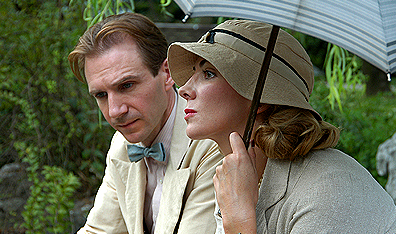
the-white-countessA lesser known film by Natasha Richardson, The White Countess (2005)  is a Merchant Ivory production (Merchant’s last film), its screenplay by the talented writer Kazuo Ishiguro (The Remains of the Day).  The story takes place in the exotic setting of Shanghai, China, shortly before WWII.  Slightly resembling Casablanca (1942), the movie excels in its mood and atmosphere.  Ralph Fiennes is Todd Jackson, a blind, former American diplomat who meets a Russian refugee Sofia (Natasha Richardson) in a night club.  Sofia belongs to a family of nobility, a White Russian countess herself, but now has to work in the lowliest line to support her family.  The Japanese invasion sets the stage for suspense, and the plot thickens.  Vanessa Redgrave plays Sofia’s aunt, and has delivered some moving moments performing with her daughter.  Natasha’s aunt Lynn Redgrave is also in the movie.  Now those scenes are ever more memorable.  The behind-the-scenes interviews with the three of them, together with Ralph Fiennes, commentary with Natasha Richardson and director James Ivory in the Special Features are just priceless now.  I purchased the DVD a while back, and have seen it several times.  I know I’ll treasure it even more now.

*****

Photo Sources:

Natasha Richardson: mirror.co.uk, Nell: Amazon.com, The White Countess:  cbc.ca

Man On Wire (2008, DVD): Romancing the Towers

man-on-wire1When the idea of building the World Trade Center Twin Towers began to germinate in NYC, on the other side of the globe, a young man in France started to weave a dream.  He wanted to walk across the top of the Towers on a wire after they were built.  Six years later, with the Towers nearing completion, Philippe Petit fulfilled his dream a few days short of his 25th birthday.  On August 7, 1974, he stepped on a wire strung across the roof top of the then tallest buildings in the world.  Hailed as ‘The Artistic Crime of the Century’, Philippe Petit’s breathtaking, and illegal, high wire act is the ultimate test of the human spirit, pushing the limit of audacity and strength.
Based on Philippe Petit’s book To Reach The Clouds,  Man On Wire has won over 20 film awards only a few short months after its release, ultimately receiving the Oscar Best Documentary for 2008.  Director James Marsh chronicles the extraordinary endeavor of Philippe Petit by means of interviews, dramatic re-creation, and archival footage.  Before the WTC, Petit had walked across the two steeples of the Nortre Dame Cathedral in Paris, and the Sydney Harbour Bridge.  The WTC Towers meant the summit of his aspirations.  In a Sundance Film Festival interview, he described his act as ‘marrying the Towers’.

 Director James Marsh has chosen a very human angle to present his subject, such that we’re not just watching an extraordinary circus feat.  The documentary reveals a child growing up with unusual physical talents.  It vividly depicts the fearlessness of youth, the weaving of a fairy tale, the bond of friendship without which Philippe could not have achieved, and finally the euphoria of a dream fulfilled.  The smile on Philippe’s face while on the wire says it all.

The interviews in the film have also brought some very personal elements into this enthralling event.  We see Philippe’s childhood friend and accomplice Jean-Louis overcome with emotion, now more than 30 years later, as he recalls and is still moved by the immensity of the experience.

It’s a crime, no doubt, but it’s team work of the highest level of difficulty.  That they had to haul hundreds of pounds of wire and equipment up to the roof top, shoot the wire across, anchor it safe, all without detection was itself an incredible feat.  Once that was done, the rest was easy for Philippe, he just needed to walk on the wire suspended 1,350 feet above ground.

And that is when the artful part comes in.  Philippe had not just walked on tightrope, but performed with grace and serenity, movements conjuring up images of ballet on air.  For 45 minutes, he slow-danced across the Towers eight times, lay, knelt, and sat on the wire to the amazement of the awestruck crowd on the ground.  There was unspeakable beauty in his magnificent boldness.

Police had to threaten him with a helicopter to get him off.  He and his friends were immediately handcuffed, taken to jail, and Phillipe undergone a psychiatric examination.  He was later released and given a life-time pass to the Towers.  When asked why he did it, he answered:

“There’s no why… Life should be lived on the edge.”

Excellent special features that come with the DVD include Philippe Petit’s 1973 Sydney Harbour Bridge Crossing, exclusive interview with Philippe Petit, and an animated short film based on the children book by Mordicai Gerstein “The Man Who Walked Between the Towers”, narrated by Jake Gyllenhaal.  Further,  in this post 9/11 world, the DVD is even more significant in that it chronicles someone who had taken the arduous steps to appreciate and to relate to the Towers in a most memorable way.

And then there’s the music.  I admit it’s the music that has enthralled me from the start, yes, even with just the menu.  While Michael Nyman has written some fantastic original score for the documentary, it’s French composer Eric Satie’s pieces that so captivate me.   Satie’s Gymnopedie No. 1 is the music that augments the beauty of Philippe’s poetic walk on wire.

While most of us would rather watch life being lived on the edge from the comfort of our living room, we would be inspired nonetheless to venture out of our couch for a little more excitement, and motivated to take just a bit more risks with our life.  For us ordinary folks, maybe living life to the fullest is an aspiration challenging enough.

~ ~ ~ ½ Ripples

  “If no one ever took risks, Michaelangelo would have painted the Sistine floor.”      — Neil Simon 


Philippe Petit and James Marsh Interviews:

Click here for the  NPR’s Studio 360 Interview

Click here for the Sundance Film Festival Interview on YouTube


WALL-E (2008, DVD)

Continuing with my review of  ‘hopeful movies’ for the new year,  this is a must-see… for your whole family.

wall-e

WALL-E has re-defined for me what makes a good movie.  It doesn’t need human actors, doesn’t even need dialogues.  Its visuals are stunning and thought-provoking, and the silent scenes speak volumes. Especially the first part of the movie, I’m fascinated by how human meanings and sentiments are conveyed with almost no dialogues yet with such eloquence.  It is ironic, I know, that it takes an animated robot, or two, to bring out what is important for us humans: The need to connect, the joy of simplicity, the power of a tiny green sapling bursting with life, and love, the essence of being human.  The creators of WALL-E have invented a fresh and entertaining way to send these age-old messages back to us humans, with grace, humor, and wonderment.  Now that’s creativity.

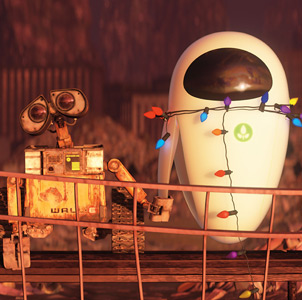
The time is post-apocalyptic, some time in the future where Earth is no longer habitable because its junks are piled up higher than sky scrappers.  WALL-E is a robot with one directive: garbage compacting.   Earth is no man’s land now.  One ‘human remains’ that WALL-E treasures is an old video tape of “Hello Dolly”.  WALL-E plays it constantly to admire that very human act and emotion:  courtship and love.  One day, he witnesses the landing of a spacecraft, from which comes Eve, an exploratory robot.  Now WALL-E has a chance to practice what he has learned.

As Earth is no longer viable for life, humans, ever ingenious, especially when it comes to their own enjoyment and gratuitous consumerism, have branched out into space, the final frontier.  They have created for themselves a utopia in a cruise ship, perpetually holidaying in space.  Their pastime is lounging on a couch, being served by automated robots.  Due to lack of use, their limbs have shrunk while their bodies have bloated.  No matter, they only need one finger to press buttons to eat, drink, and be merry.  WALL-E’s adventures begin as he follows Eve back to this ultra high-tech space station.

wall-e-and-eve

But Earth is home for humans, not a cruise ship in space.  Earth is meant for us to cultivate, to nurture, and to enjoy.  So, that’s the ultimate epiphany for all these perpetual space vacationers.  Herein lies the miniscule hope, symbolized by the tiny sapling of green, that there’s still a chance to return home and set roots once again, to live and grow.  The movie ends with all the right notes without being preachy or turning into a propaganda, nor does it wake us up by scare tactics.  It leads you on a pleasant ride and brings you to its intended destination without coercion or didactics.

The DVD has some excellent special features including a couple of animated short films, deleted scenes, and many more.  But my favorite part is ‘Animation Sound Design: Building Worlds From the Sound Up”, in which the legendary sound designer Ben Burtt shares secrets of creating the sounds of WALL-E. Credited by writer/director Andrew Stanton as the genius behind WALL-E, Burtt has won Oscars for his sound effects in E.T. The Extra-Terrestrial, Star Wars, and Indiana Jones movies.

Teach your children well… while there’s still time,  that’s the underlying axiom (the name of the cruise ship) of the movie.  An animation more relevant for adults than kids. After all, who are in a better position to bring hope to the next generation other than parents themselves?

~ ~ ~ ½ Ripples