My screenwriting course is wrapping up soon. For the past six months, I’ve been learning a new language, the language of the visual. It’s not as easy as it looks. I’ve to un-learn a lot of ingrained principles of prose writing to re-learn a whole new genre. And it has been an ego-shattering process.
Take this for example. A comment on one of my assignments:
“… I’d also like to see you snip away at excess verbiage in both dialogue and action paragraphs.”
Ouch! That hurts! Honestly, it took me a few weeks to get over that one.
‘Verbiage’. When the word is not used by yourself as a self-deprecating joke, now that’s tough to hear. The reason for such a judgment? Simply because I used complete sentences in my descriptions. The language of the screenplay, I’ve learned, is condensed language, not unlike poetry. It should be spot on, visually driven, and clear.
Readability is the key. I’ve been learning to write a ‘good read’. Reality is, my script will first be sent to the ‘gatekeepers’ of the film industry, and many of them may not be readers (that, I was told). So, nobody wants to see a bunch of words crowding the page. White spaces are what keep them interested. So, make it swift, succinct, use minimum number of words to convey maximum information. Yup, just like that, easy.
Right… so, here are some notes to myself, gleaning from the books I’ve read on the subject of screenwriting, to personalized feedbacks:
- Sentence fragments, though frowned upon by English teachers, are welcome in scripts.
- Action speaks louder than words: Whatever that can be conveyed by actions, no need for dialogues.
- Enter a scene as late as you can and get out before it finishes.
- Think minimalist and evocative.
- Layers, layers, layers
- Avoid clichés like the plague, both visuals and words.
- Avoid ‘On The Nose’ dialogues: stating directly what the writer needs to convey, instead of the more realistic everyday mundane, allusive, cut-off, inarticulate, real life conversations.
- As with all literature, learn to write subtexts, the undercurrents of emotions and contexts that are meant to be hidden, but only revealed by actions and dialogues.
- Do the above with razor-sharp clarity.
- The central dramatic question should be clear and simple, but not simplistic.
- Have the proper proportion of words and pictures to create a synchronicity of content and poetry.
- Don’t insult your actors by writing down specific reactions, or telling them their tone of voice…etc.
- Write organically: If a writer knows what is going to happen before writing, then the scene will often feel contrived because it will fail to surprise the writer, therefore the audience.
Now, come to think of these points, aren’t they useful for writing in other genres as well? Except the sentence fragments recommendation, that is, if you’re writing prose. And, the last point exactly echoes what I’ve heard Michael Ondaatje say:
“I don’t know what would happen, I don’t want to know”
Let the scene breath on its own, take its shape and grow.
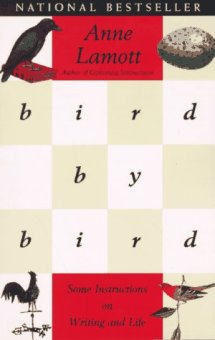
Or the advice given by Anne Lamott reinforcing succinct writing:
“You listen to how people really talk, and then learn little by little to take someone’s five-minute speech and make it one sentence, without losing anything.”
And… the wonders of paradox: ‘Expressing the visual in words’, ‘Be clear in conveying subtext’, ‘The minimalist creating layers of complexity’, ‘Write organically within the structure’…
Oh… the bittersweet experience of screenwriting.
****
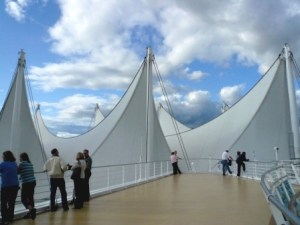
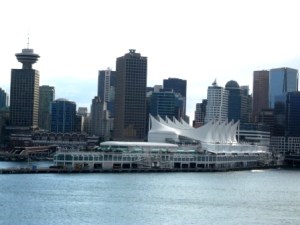

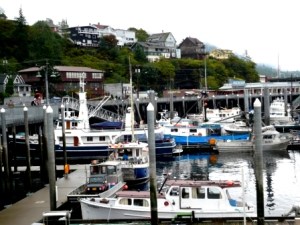
 Arti ventured into this area with a naturalist. Together with 15 others in our group, we trod the trails of the Alaska Rain Forest Sanctuary. Here are the sights I’ve sailed all the way for:
 Colorful undergrowth
 One of the many species of mushrooms, some giant ones grow on trees.
 Devil’s Paw, food for the bears. Underneath are poisonous hooks, but the bears deftly eat off the stems of the plant.
 Ferns and moss: Even tree branches are covered with moss. As the branches grow heavier, they will break off the tree, fulfilling a natural pruning process.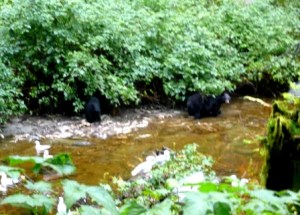






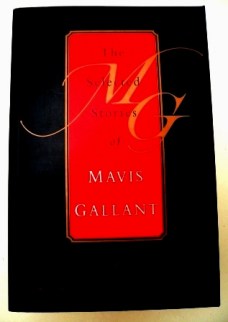 The Selected Stories of Mavis Gallant: 887 pages. Having seen the video of Mavis Gallant reading in a Paris book shop and her conversation with Jhumpa Lahiri, thanks to
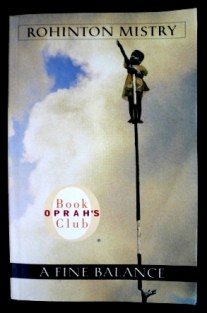 A lady held up a heavy box for me to take this one out underneath: A Fine Balance by Canadian writer Rohinton Mistry. “That’s a good pick,” she said.
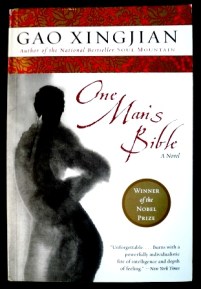 One Man’s Bible by Gao Xingjian, winner of the 2000 Nobel Prize for Literature, the first Chinese recipient of the Prize. Born in China, Gao has been living in France since 1987. The book is translated into English by Mabel Lee, associate professor of Chinese at the University of Sydney. Interesting… although this one I can read the original, the chance of me finding it in a farmers market here in Cowtown, Canada is not great. I’ll settle for the translation.
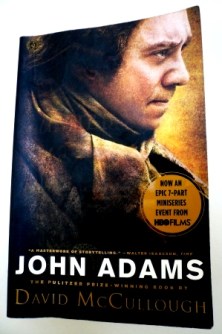 I missed the Golden Globe winning TV miniseries. So, grabbing the original material is just great. David McCullough’s 721 pages John Adams won the 2002 Pulitzer Prize for biography. This is a handsome movie-tie-in- cover edition with many color pictures. What a find!
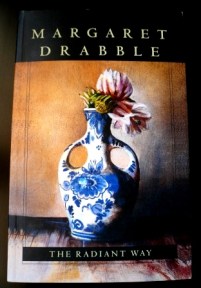 Talking about wonderful covers. How about this one: Margaret Drabble’s The Radiant Way. I’ve never seen this edition of Drabble’s book. A pleasure just to look at.
 And what’s summer reading without beach reads. Here’s my copy of The Devil Wears Prada by Lauren Weisberger. Again, seldom do I see a trade paperback of this title.

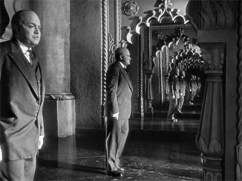

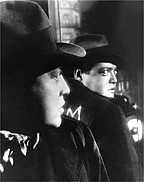 Motion pictures are an effective medium to convey the human condition. In Fritz Lang’s thriller M (1931), the letter obviously refers to the murderer, a child killer that the whole town was after. The not-so-obvious is the depiction of universal depravity, from the police to the masses, the message that we’re all complicit in the moral fabric of our society. Similarly, Mel Gibson puts himself in his movie The Passion of the Christ (2004) as the Roman soldier nailing Christ on the cross.








 Ripple Effects