Bright Star (2009)

Bright Star 1

Was it a vision, or a waking dream?

Fled is that music:– Do I wake or sleep?

— John Keats, Ode to a Nightingale (1819)

1819 was the most prolific year of the English Romantic poet John Keats.  Many of his well-known works were created then, two years before his untimely death from tuberculosis at age 25.  His muse was Fanny Brawne, his 18 year-old neighbor, a fresh and self-assured young fashion designer whom he met a year earlier. Untrained in poesy or prose, Fanny Brawne had nothing in common with the brooding poet, but Fate, cruel or kind, instilled in them a burning passion for each other.

Unable to maintain a living financially, Keats was honorable to restrain his love for Fanny, knowing marriage would never be realized.  Yet Fanny’s incessant devotion for him soon won him over.   In a short time, she devoured all of Keats’ poetry, as well as other literary works through the ages.  Their short-lived romance culminated in an engagement.  But they were never married.  Stricken by tuberculosis,  Keats left for Italy in 1820 to seek better climate for his ailing health, knowing that would be their last farewell.

When I have fears that I may cease to be

Before my pen has glean’d my teeming brain…

Nominated for a Palme d’Or at the Cannes Film Festival this year, Jane Campion’s Bright Star is a beautiful tapestry weaving together the visual and the word.  Based partly on Sir Andrew Motion’s biography on Keats, the film depicts the bittersweet romance between the poet and his muse, tragically short-lived yet ever burning bright.
Bright Star 3

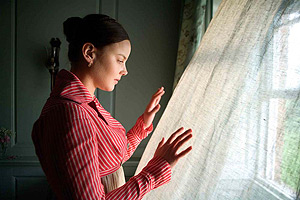
Campion has created on screen the dazzling visuals of the master painters.  There are numerous Vermeer moments in the interior shots, all done by the window with natural light seeping in as Fanny sews, makes her laces, reads love letters.  Outdoor scenes are a natural cinemascape reminiscence of impressionist vision.  Like the paintings of Monet and Seurat, hazy and dreamlike, they effectively convey the illusive union the young lovers achingly long for but is teasingly placed out of their reach.

Although never consummated, their passion for each other is no less ablaze.  The film is a clear statement that love is not synonymous with nudity and sex on screen.  Campion has depicted their passionate ardor with sensitivity and restraints.  There are moments of utter quietness, for love needs no language.  There are scenes adorned with melodious vocals and instrumentals, augmenting the yearning within.  Campion is a master of cinematic effects.

The talented Ben Whishaw (Perfume: The Story of a Murderer, 2006) is aptly cast as Keats.  Fanny Brawne is played by Abbie Cornish (Elizabeth: The Golden Age, 2007).  Both are award-winning rising stars in their homeland of England and Australia.  Bright Star could well be their breakout work in North America.

Bright Star 2

Paul Schneider (Lars and the Real Girl, 2007) is convincing as Keats’ friend Charles Brown, and what looks like Fanny’s love rival.  A stark contrast in character with the poet, Brown offers much needed tension and conflicts. Fanny’s adorable little sister Toots (Edie Martin) gets some of the best lines. Her brother and chaperone Samuel is played by Thomas Sangster.  But why Thomas Sangster?  The talented young actor who has held his own in such films as Love Actually (2003), Nanny McPhee (2005), and The Last Legion (2007) playing against such calibre actors as Liam Neeson, Ben Kingsley, Colin Firth and Emma Thompson, is put in the background only, with less than half a dozen speaking lines.  There’s definitely a miscast here. (Watch for his role as Paul McCartney in the upcoming John Lennon biopic Nowhere Boy.)

While the film is a beautiful testament of a star-crossed romance, compared to Campion’s previous works, I find it lacks the depth and complexity of The Piano (1993, Palme d’Or) and the intensity and riveting effect of The Portrait of a Lady (1996).  I have no problem with the slow pacing of Bright Star, but I do wish to see more dramatic conflicts and deeper exploration of character.  A thing of beauty should indeed bring us joy, or deep emotion, but for some reasons the visual beauty has not come across to me as affectively and engagingly as they are intended.

Nevertheless, as the only woman director to have won the Palme d’Or in the 62 years history of the Cannes Film Festival, and one of three women ever nominated for an Oscar in directing, Campion has much to offer.  I’m excited to see that it looks like the trajectory of Bright Star is one that shoots for the Academy Awards comes next March.

~ ~ ~ Ripples

(Photo Sources: canada.com, ctv.ca)

***

Whip It (2009)

Whip It

I can’t recall how many times I’d watched roller derby on TV, years back, maybe just a few times.  When I asked my niece who watched the movie with me, as a twenty-something, she hasn’t even seen it once.   But Drew Barrymore, in her directorial debut, has effectively captured the human side of a sport not many know about.  And with it, she has poignantly woven in some relevant issues her audience could relate to, no matter what demographics they’re in: coming-of-age, finding love, confronting parental expectations, searching for personhood and empowerment, parenting and letting go.

After watching Juno (2007), I knew I must see more of Ellen Page.  Here in Whip It, Page has proven that she’s not just impressive as an actor, but also as an athlete.   She plays Bliss Cavendar, a 17 year-old small town Texas girl, bored, docile, shuffled from one beauty pageant to another by her overbearing mother Brooke, a former beauty queen turned middle-age mail clerk (sensitively played by Marcia Gay Harden, Mystic River, 2003; Pollack, 2000).

After she watches a roller derby game with her best friend Pash (Alia Shawkat), and successfully tries out for the team Hurl Scouts in Austin, Texas, Bliss, now Babe Ruthless, sees her life take off with high octane energy.  She has passionately fallen for the high contact sport and a new boyfriend, rock band member Oliver (Landon Pigg).

The head-smashing, rowdy derby culture is probably the farthest away from the frothy and genteel beauty pageants of Texas, thus forms the great chasm between mother and daughter.  Of course Bliss tries to hide all her activities from her mother, until it can’t be covered anymore.  For she has become the poster girl for the final championship.

There are cliché sequences that we’ve all seen before, the light version of physical prowess as in Million Dollar Baby (2004), the get-back-up perseverance of Rocky, and, reminiscence of Shall We Dance (2004) in the final championship.  But, it’s all fun and even exhilarating.  Thanks to a great cast, the humor comes through naturally.  I must mention some great deadpan act from diner manager Birdman (Carlo Alban), who reminds me of Pedro in Napoleon Dynamite (2004).   Another great support is Hurl Scouts coach Razor played by Andrew Wilson.  His performance makes me feel like I’m watching a Wes Anderson movie.  Later I find out he’s older brother to Owen, then it’s all clear to me… it runs in the family.

[picapp src=”6/4/3/c/Whip_It_Los_86ef.JPG?adImageId=5337308&imageId=6660163″ width=”180″ height=”250″ /]  Barrymore has effectively created some powerful and touching scenes that make the comedy worthwhile.  It’s scenes like these that propel a comedy into the realm of meaning.  She has balanced the comical with hard reality, for it’s not simply about a girl choosing what she wants to do, purely from her own point of view.  Often our choices are entangled in a web of relationships.  Yes, we may have the autonomy to choose, but our choices also affect others.  Some gratifying moments are sensitively performed, between mother and daughter, father and daughter, and a 36 year-old derby teammate who openly shares her heart with Bliss in the car, with her young son in the back seat.

Into its second week of screening, Whip It has not fared as well as expected at the box office.  But for screenwriter Shauna Cross, who has turned her own novel Derby Girl into screenplay, I trust this is just another blow she’s got all too used to, as a roller derby girl herself from Austin Texas, before moving to L.A.  She knows how to get back up and keep on skating, even in the aggressive arena that’s L.A.

(Top Photo Source: USA Today, Bottom: PicApp.com)

~ ~ ~ Ripples

Edward Hopper, William Safire: The Visual and the Word

If you could say it in words, there would be no reason to paint.

In general it can be said that a nation’s art is greatest when it most reflects the character of its people.

—- Edward Hopper (1882 – 1967)

Edward Hopper’s words point to the power of the visual.  I always find Hopper’s realist paintings hauntingly retrospective, convey indescribable feelings, a sense of loneliness, a touch of alienation, yet, it’s hard to say exactly what it is.

Some use the phrase ‘urban loneliness’ to pinpoint the sentiment, as most readily expressed in his famous painting Nighthawks.  But others find the term too parochial even, opting for the more universal description of the human condition, ‘existential loneliness’.

In this visually-driven age, where pictures are instantly produced by a click, eliminating the wait for film processing, and where digitally created images can elicit unimaginable possibilities, has the value of words diminished, both in function and significance? In a time when ‘reading skills’ refer not only to the comprehension of the written language but the deciphering of graphics and visual symbols, has the power of words been eroded?

Does the recent passing of William Safire, called ‘the oracle of language’ by the NY Times, represent the passing of an era?  How many are left to champion the traditional form of communication, to point out word origin, to extol proper grammar usage?  While these gatekeepers are frowning on the split infinitive, the rest of the world has already jumped on board the newer vessel to boldly go where no person has gone before. The reign of literal communication has gradually (or quickly, or___ you fill in the blank) been replaced by the more accessible instant imaging, flickring, youtubing…

Let’s hope too that the traditional art form of painting will not be soon replaced by iPhone sketching.  If the New Yorker’s cover artist is using an iPhone app to touch-produce its cover pages, will the demise of oils and paints be far away?

Of course, I come to praise Hopper, not to bury words, or paints. Rather than saying his paintings defy literal descriptions, let’s just take up this bemusing challenge and do a role reversal:  What words conjure up in your mind when you look at these Hopper paintings? Let’s celebrate words, and paints, while we still have them.

Of all the subjects in his works, I particularly like the solitary figure, or the non-figure, like the room devoid of human presence.  Here are some of them:

Automat (1927):  Layered with subtext, what are the stories behind this lone female customer at the automat in such hour?  What is a good description of her predicament?

Automat 1927

.

New York Movie (1939): Here’s the reason why I love Hopper’s works.  The contrast, the darker side, the quiet undercurrent beneath the glamorous, the sombre reminder of complexity.

eh_new_york_movie

.

Rooms by the Sea (1951):  A touch of Magritte I feel.  An example of what I call the non-figure.  The philosophical quest of knowing: If nobody’s around to see it, does it still exist?

Edward - Hopper - rooms_by_the_sea

.

Cape Cod Morning (1950):  Unlike his other works, this solitary female figure is positive, eager,  enthused, and achingly expectant.  Is she a symbol of the optimism of a new age, or will she be disillusioned as reality sets in? 1950 or 2009, is there so much difference anyway?

Cape Cod Morning Hopper (1950)

.

Gas (1940):  I’m sure it’s not all about gas… does it allude to the lone traveling salesman like Willy Loman, or the gas station owner like George Wilson in The Great Gatsby?

gas_by_edward_hopper

.

Nighthawks (1942):  Perhaps the most famous of Hopper’s paintings.  As some call it, the depiction of ‘existential loneliness’.  Is that Sartre sitting there all alone at 2:00 am, contemplating in a diner with no exit?

nighthawk-by-edward-hopper

****

Click here to go to a related post ‘Inspired by Vermeer’ with another Edward Hopper painting, Morning Sun.


Julie and Julia (2009): Movie Review

julie-and-julia1

UPDATE Feb. 2, 2010: Meryl Streep is nominated for a Best Actress Oscar in the coming 82nd Academy Awards.

UPDATE Jan. 17, 2010:  Meryl Streep has just won the Best Actress Award (Comedy or Musical) at the Golden Globes.

Update Dec. 16, 2009: Julie and Julia has been nominated for a Golden Globe Best Motion Picture Award (Musical or Comedy).

Meryl Streep has been nominated for a Golden Globe Best Actress Award (Musical or Comedy).

For someone who would rather lie on the couch and watch the Food Channel than work in the kitchen, what better way to entertain herself than to watch a full feature movie on the legendary Julia Child and her modern day follower scrambling to keep pace.  But still, I had my doubt.

123 minutes of cooking, even though I don’t need to lift a finger, could still make me feel stuffed and exhausted. And, watching a novice attempt an almost impossible feat of cooking through Child’s 524 French recipes in 365 days in a cramped apartment could mean unlimited servings of predictable, clichéd kitchen mishaps.

So, it was with little expectation that I entered the theater.  But I was pleasantly surprised and much gratified.  For first of all,  the movie is not just about food and cooking.  Rather, it describes a journey of writing, publishing, and yes, blogging.  Now that really piqued my appetite.  As for the klutzy culinary mishaps, despite their banality, they are turned into laughable moments that we can all relate to, kudos to Amy Adams (Julie) and Meryl Streep (Julia).

Writer/director Nora Ephron has done a wonderful job weaving together two different books to create the screenplay:  Julia Child’s My Life in France (co-authored by Alex Prud’homme) and Julie Powell’s Julie and Julia:  My Year of Cooking Dangerously.  The two stories, which take place 50 years apart, are intertwined so seamlessly that the audience is given the impression that the two are acting side by side.  Now here’s a spoiler alert, skip to the next paragraph right now if you don’t want to know…  The parallel story lines remained so, Julie and Julia never met. And oh how much more the plot could have thickened if they did.  I was a bit let down by this, after being set up with the ‘Guess Who’s Coming to Dinner’ cue.

The beginning of the movie sets the stage for some visually pleasing sequences.  The retro design of Julia’s 50’s France is a scrumptious delight.  A revelation: Julia Child was not born knowing how to cook.  After following her diplomat husband Paul (the ever reliable Stanley Tucci, The Devil Wears Prada, 2006; Shall We Dance, 2004) to France, she began exploring her interests.  She had to start from scratch by going to culinary school, the Cordon Bleu.  A late bloomer she was, and what an inspiration… never too late to follow your heart.  Streep has done a marvelous job delivering the personality, speech and nuances of the legendary Julia Child.  I must say though, her performance in this movie seems like a prolonged bed bouncing scene from Mamma Mia!

julie-and-julia

And fast forward to the present, the cinematic effect makes a run down, one-bedroom apartment in Queens look cozy and even inspiring, which is justly so.  Julie Powell (Amy Adams, Doubt, 2008; Enchanted, 2007) is a struggling writer, emotionally drained by her day job answering the phone at the Lower Manhattan Development Corp in the wake of 911.  Following Child’s Mastering The Art of French Cooking at home after work saves her sanity and invigorates her desire to write.  Through blogging daily about her culinary experiment, Julie ultimately realizes her dream.

It is Amy Adams that has won my heart.  She is such a natural.  Her performance is pleasingly understated, just a touch to bring out the taste.  It is after all a thankless role, a novice following the cooking guru to the dot in her cramped kitchen.  A tad bit more spicy would spoil her portrayal as merely slapstick and banal.  Her down-to-earth demeanor, like her attempt to explain to her mother what blogging is, makes it sound like a conversation taken out of our own home.  And above all, it’s her relationship with her husband Eric (Chris Messina, Made of Honor 2008) that makes the story grounded and realistic.

And finally, bravo to the two husbands who are always supportive, encouraging, eat and praise whatever their wives cook.  And all the more for Julie’s Eric, who has to silently pop Tums before bed, and, even after running away to escape the nightly ordeal, would faithfully come back ready to reconcile.  Can these men be real?  Like Ephron’s other works, let’s just treat this one as another fantasy.  For it is she who created the screenplays for Sleepless in Seattle (1993), You’ve Got Mail (1998), and yes, When Harry Met Sally (1989).  But wait, Julia Child’s My Life In France is autobiographical.  And so’s Julie Powell’s account.  The tag line does not fail to inform us so: Based on two true stories. It’s good to know.

~ ~ ~ Ripples


Joshua Bell in the Subway

I watched Joshua Bell play the Mendelssohn Violin Concerto last night on PBS Live at Lincoln Center.  It’s the Mostly Mozart Festival in NYC.

This is one of my favorite pieces of classical music.  The melodious theme comes right out in the opening bars, not needing any intro from the orchestra as in conventional concertos.  I like it that way, swift, cut to the chase.  And here’s the sign of greatness:  the audacity to break new grounds.  Last night I saw the violinist’s audacity matching that of Mendelssohn’s: Bell re-wrote the cadenza for himself.  He has not only given an engaging performance, but has left his watermark in the piece as well.

If you want to see what a born winner is like, just briefly look at his bio.  At 10, he was a tennis champion.  Four years later, he made his professional debut as a violinist and became the youngest person to play with the Philadelphia Orchestra.  And the rest is history.

Bell has recorded more than 30 CD’s, won 4 Grammys, indirectly an Oscar as he performed the winning soundtrack for Best Original Score in ‘The Red Violin’, and garnered accolades too numerous to mention.  His achievements culminated in the prestigious Avery Fisher Prize in 2007, the highest honor for a musician in America.  That puts him in rank with previous prize winners Yo-Yo Ma, Emanuel Ax, and Andre Watts.  But beyond his musical career, he continues with sports and pursues other pastimes.  How about a video games world championship for versatility? Yup, he got that too, in 1996.

Well ok, so far so good… until he was asked by Washington Post writer Gene Weingarten to busk in a Washington DC subway station during morning rush hour.  At 7:51 am on January 12, 2007, a few months before he won the Avery Fisher Prize, Joshua Bell stood in a DC subway station in jeans and a long-sleeve T.  He opened up his case, and started playing his 1713 Stradivarius.

That was probably the first time he had been ignored or even given the cold shoulder:

He got $32.17 for his 43 minutes playing, not counting the woman who recognized him and gave him a twenty.  And yes, there were a few pennies in his case.  More than a thousand people passed by.  In the hustle and bustle of morning rush, few had even stopped to look at him, despite hearing the music.

The commuters were oblivious to the treat that would have cost them a hefty $100 in a concert hall, if they could find a ticket that is.  And for Weingarten,  he got a Pulitzer Prize for Feature Writing for his Washington Post cover story ‘Pearls Before Breakfast’.  To read this fascinating article, CLICK HERE.

Meant to be a philosophical musing on ‘Art and Contexts’, the experiment aims at exploring the epistemology of beauty.  Will we know what beauty is once it’s taken out of context?  Are there preconditions for us to appreciate the arts?  Do we have to recognize a musician before we can admire the music he plays?  If art is taken out of its frame, is it still art?

But… maybe it’s more a sociological study of urban life, or one of economics.  Even if people recognize beauty, is it worthwhile to stop and sacrifice a few precious minutes?   Weighing the economic cost of being late for work, and the enjoyment of music, the bottom line is quite obvious.  What place does beauty have in the pragmatics of our daily routines?  Where do music and the arts rank in life’s competing priorities?

Pearls before breakfast… What breakfast?  Gotta run…

***

Easy Virtue (2008)

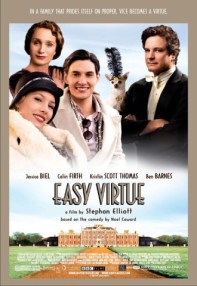
Easy Virtue posterCan we all get along?  That poignant plea is ever applicable,  from L.A to all corners of the world, today or years past.   And when it comes to families, which one doesn’t have its ups and downs?  So, since the answer is obvious, might as well make comedies out of the situation.
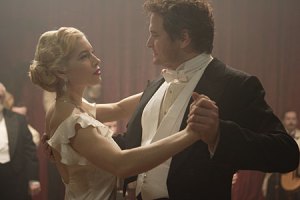
Based on the play by Noel Coward, and lavishly adorned with his songs, credits to the Easy Virtue Orchestra, the film is otherwise re-written to appeal to a contemporary audience.

The story takes place some years after the First World War, in the 1920’s.   The eldest son of an English aristocratic family, John Whittaker (Ben Barnes, The Chronicles of Narnia: Prince Caspian), comes home from abroad and brings back his new wife Larita, a race car driver (Jessica Biel, The Illusionist).  What ensue are battles on the home front between the audacious new bride and the stuffy and snobby matriarch of the family, Mrs. Whittaker (Kristin Scott Thomas, I’ve Loved You So Long).  The main spark of their explosive confrontations:  Larita is American.  And Larita does not disappoint.  She is exactly what Mrs. Whittaler expects her to be, and some more:  a gale of forbidden ideas and scandalous history.  For her performance, Kristin Scott Thomas received two Best Actress nominations.

The most intriguing character is Mr. Whittaker, played by Colin Firth (When Did You Last See Your Father, The Girl With The Pearl Earring, Pride and Prejudice).  A veteran of the Great War, Mr. Whittaker is a disillusioned man, aloof, perceptive, and cynical all at the same time.   He is the only one in the family extending a welcoming hand to Larita, and stands by his new found comrade in the domestic clash of cultures.   The climax of the story comes near the end in an enthralling scene of the two tango dancing.  Naturally, what follows is just anti-climatic.

Easy Virtue 1

The Whittakers live in a humongous mansion on acres of lush grounds for generations, reminiscence of Darcy’s Pemberley (yes, Colin Firth again), and for Mrs. Whittaker especially, no short supplies of pride or prejudice.  Whether it’s intentional of the director or not, at one scene in the Whittakers ballroom, I see Darcy, poised and tall.  But director Stephan Elliott and co-writer Sheridan Jobbins are no Jane Austen.  This comedy of manners may appear to be a burlesque of the traditional upper-class English family, but it lacks the depth of characterization and cathartic effect of an Austen work.

And that’s alright.

Easy Virtue may be frothy, loud, and ephemeral, but it is effective in delivering some witty lines, great comedic timing, some cool cinematography, and fine performance not just from the main characters, but the supporting roles.  I must mention the butler Furber (Kris Marshall), and the two Whittaker sisters Hilda (Kimberley Nixon) and Marion (Katherine Parkinson).  They have added much delight to the film.  A fun ride all the way.

I have not seen Colin Firth and Kristin Scott Thomas together in a movie since The English Patient (1996).  And truth be told, they are the reason for me to see this one.

Easy Virtue is currently released on limited screens across North America.

~ ~ ~ Ripples

More Great Finds!

Call me greedy.  I’ m happy to take the blame.  Since this is the last weekend of the gigantic used book sale at the Crossroad Market, I just had to go again for more treasure hunting.  If you take a look at my second loot list below, you’d have done the same.  As the lady said when I was squeezing my way in,

“It was a zoo yesterday.”

“You came here yesterday too?”  I asked.

“Yeah, sure!”   (Subtext:  What a dumb question… and, why didn’t you?)

So, again, these are all trade paperbacks in mint condition.  They are all a dollar each (Canadian).

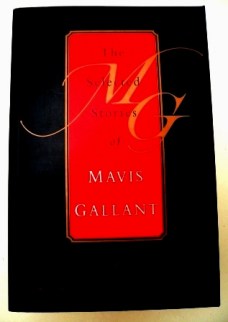
The Selected Stories of Mavis GallantThe Selected Stories of Mavis Gallant:   887 pages.  Having seen the video of Mavis Gallant reading in a Paris book shop and her conversation with Jhumpa Lahiri, thanks to fellow blogger oh introducing the Granta link, I was elated to find this volume.  It looked like it had not been opened, fresh, clean for the picking.

.

The Complete Short Stories of Thomas Wolfe

Short stories, the more the merrier.  I was delighted to find this volume:  The Complete Short Stories of Thomas Wolfe, 621 pages.  I’ve long wanted to read Wolfe, now’s a good time.


..

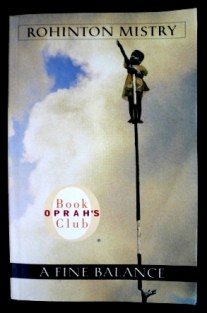
A Fine BalanceA lady held up a heavy box for me to take this one out underneath:  A Fine Balance by Canadian writer Rohinton Mistry.   “That’s a good pick,” she said.
“I’ve seen it many times, but think it’s too thick,”  I said.

“You wouldn’t want it to end,”  she said.    What higher recommendation can you get for a book?


                                        .

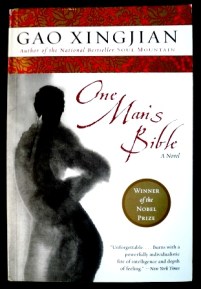
One Man's BibleOne Man’s Bible by Gao Xingjian, winner of the 2000 Nobel Prize for Literature, the first Chinese recipient of the Prize.  Born in China, Gao has been living in France since 1987.  The book is translated into English by Mabel Lee, associate professor of Chinese at the University of Sydney.  Interesting… although this one I can read the original,  the chance of me finding it in a farmers market here in Cowtown, Canada is not great.  I’ll settle for the translation.
.

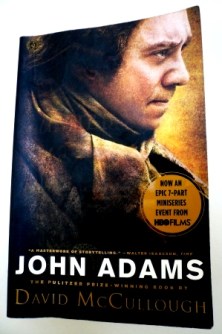
John AdamsI missed the Golden Globe winning TV miniseries.  So, grabbing the original material is just great.  David McCullough’s 721 pages John Adams won the 2002 Pulitzer Prize for biography.  This is a handsome movie-tie-in- cover edition with many color pictures.  What a find!


       .

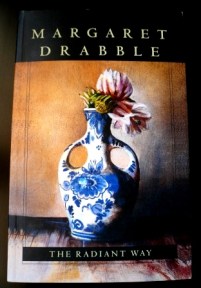
The Radiant WayTalking about wonderful covers.  How about this one:  Margaret Drabble’s The Radiant Way.  I’ve never seen this edition of Drabble’s book.  A pleasure just to look at.


The Devil Wears PradaAnd what’s summer reading without beach reads.  Here’s my copy of The Devil Wears Prada by Lauren Weisberger.  Again, seldom do I see a trade paperback of this title.



..

Here are the rest of  my 20 titles:

  • Digging to America by Anne Tyler
  • A Patchwork Planet byAnne Tyler
  • The Navigator of New York by Wayne Johnston (Giller and GG Finalist)
  • Larry’s Party by Carol Shields (Winner of 1998 Orange Prize and National Book Critics Circle Awards)
  • Fever Pitch by Nick Hornby (Saw the movie starring Colin Firth, quite liked it.)
  • The Book of Lost Things by John Connolly
  • The Reapers by John Connolly
  • The Lovely Bones by Alice Sebold (Just want to read it before the movie comes out.)
  • The Inheritance of Loss by Kiran Desai (Winner of the 2006 Man Booker Prize)
  • Durable Goods by Elizabeth Berg
  • The Gathering by Anne Enright (Winner of the 2007 Man Booker Prize)
  • Fall On Your Knees by Ann-Marie MacDonald
  • The Virgin Blue by Tracy Chevalier (Author of Girl With A Pearl Earring)
  • Bird by Bird:  Some Instructions on Writing and Life by Anne Lamott

It’s a tall order to read all the 40 books I hauled back these two weekends.  It’ll take me years.  But as any book lover can attest, it’s good to know they’re on my shelves.

***

Summer Reading 2009

When does ‘regular reading’ end and ‘summer reading” begin?  Well this year it’s easy.  The gigantic used book sale I went to over the weekend and the loot I brought back make it official:  Let summer reading 2009 begin.

The treasures I found were trade paperbacks in like-new condition.  And because I had twenty, they cost me just one dollar each.  Right, that’s Canadian dollar, even a better bargain.  How I found them was an ordeal.  They were painstakingly selected under smoldering heat at a farmers’ market.  For two hours, I elbowed my way in to grab hold of my targets which I had to eye from a distance over heads and shoulders.  But it’s all worth it.

Here’s a picture and a list of the titles I brought back:

Used Book Sale Loot 1

  • The Corrections by Jonathan Franzen
  • Anna Karenina by Leo Tolstoy
  • Simple Recipes by Madeleine Thien
  • Desperate Characters by Paula Fox
  • Bloodletting & Miraculous Cures by Vincent Lam (Giller Prize Winner)
  • The Sea by John Banville (Man Booker Prize Winner)
  • Saturday by Ian McEwan
  • Goodbye, Columbus by Philip Roth
  • Daisy Miller by Henry James
  • The Stories of Edith Wharton selected by Anita Brookner
  • The Mapmaker’s Opera by Béa Gonzalez
  • Always Now The Collected Poetry of Margaret Avison
  • Breathing Lessons by Anne Tyler (Pulitzer Author)
  • The English Patient by Michael Ondaatje (Booker Prize Winner)
  • Marginalia: A Cultural Reader by Mark Kingwell
  • Rebecca by Daphne Du Maurier
  • A Natural History of the Senses by Diane Ackerman
  • Lost Souls by Lisa Jackson
  • Moral Disorder by Margaret Atwood
  • Exit Music by Ian Rankin

Some of these titles I’ve long wanted to read, like Goodbye, Columbus and Rebecca.   Some are just well known titles or authors that I think I should read, like Tolstoy, Franzen and Tyler.   Some are winners of book prizes that I usually enjoy, the Booker, Giller, Pulitzer.   Some are fine Canadian authors and one of my favorite poets.   And some I’m just curious about like A Natural History of the Senses.  But one stands out.  This time, I’m literally judging a book by its cover:

Front Cover Mapmaker's Opera

Back Cover Mapmaker's Opera

The above are the front and back cover of the book.  There’s no title, only on the spine.  It’s enjoyable just looking at it.  But the title is appealing too:  The Mapmaker’s Opera.

Together with the books I’m already reading, plus my long TBR list, I think I’m topped up till next summer.

For More Great Finds, Click Here.

***

Of Film and Faith

Now, the reason to be… in Vancouver.   As I mentioned in a previous post, I was at Regent College for two weeks in May to learn the language of film, and its interface with elements of theology.  I came home much gratified.  I’ve delayed writing about the course per se because it would mean the difficult task of capturing the Genie of ideas back and recapping the bottle.  But I know I need to do it sooner or later, for I want to record down a learning experience that’s, well, let’s just say epiphany is not too far-fetched a word.  It could well be that the little I knew initially made it more gratifying as I could gobble up more to fill the empty vessel.

My thoughts are random here, but that might be the best way to capture whatever that comes to my mind that I think is important and meaningful.  Allow me to ruminate freely.

The language of film is multi-faceted, but it more or less can be condensed into the phrase mise-en-scène: what the director puts into the scene by means of setting, camera angle, lighting, staging, wardrobe, blocking… all the cinematic elements.     Like the artist of a painting, the director conveys his point of view and aesthetics through a frame or a scene.  And for us viewers, it’s a matter of honing the skill of observing the obvious, and the not-so-obvious.  Our pleasure is to decipher and savor that which is created on screen.   It all relates to the Auteur Theory, the director as the author, the concept of caméra-stylo, the camera as pen.

The power of the cinematic pen is mighty indeed.  Take the Disney movie Bambi for example.  The screening of Bambi resulted in a huge decrease of hunting licenses sold after it was released, and subsequently the term ‘Bambi Effect’ was coined.  Or, the movie Billy Elliot, which resulted in a significant increase in ballet school enrollment.

***

Knowing the history of motion picture is essential to appreciate films, and this is the major emphasis of the course.  I’ve come to appreciate the pioneers of motion pictures whose works have become the exemplars and the artistic foundations of modern cinema: Vincente Minnelli, Preston Sturges, Charles Chaplin, Fritz Lang, John Ford, Orson Welles, Frank Capra…

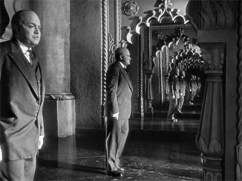
Fjilm Noir Third Man Alley

Further, it’s most interesting to trace the influence of German expressionism has on Film Noir, how the idea behind Edvard Munch’s The Scream can effectively be transformed into cinematic expression, revealing the inner state of modern man.

Over the intensive two-weeks, we’d only have time to cover mostly black and white features, savoring their richness in techniques and their multi-layered meaning.  I’ve come to understand why the years 1930  to 1946 are called “The Golden Age of Cinema”.

And where does theology come in?  While knowing some Kierkegaard and Buber might help, but basically the content is very accessible.  Herein lies the ingenuity of the auteurs and their works.  The process of exploring the transcendent in the movies viewed by the populace is just fascinating.

Citizen Kane

I’ve learned how Citizen Kane (1941, produced when Orson Welles was just 24!), generally considered one of the best movies of all time, like the Vanitas still life of Vermeer’s time, expresses the theme of Ecclesiastes, and asks the question, “So one has gained the whole world, then what?”

Another theological element is the archetype of the Christ figure, and I’m surprised to find it quite prevalent in many of these early motion pictures.  I admit I’ve never watched a Charlie Chaplin movie in its entirety until now.  In The Kid (1921) and City Lights (1931), the savior figure is humorously portrayed in the story, and the concept of unconditional love warmly illustrated.

City Lights

This archetype also appears  in Frank Capra’s  Meet John Doe (1941), where a main character declares the universal significance of the first John Doe two thousand years ago dying for all John Doe’s.  Visually, I’ve learned to identify the Pietà and the crucifix image in the composition of a frame in several of the features, an example being How Green Was My Valley (1941, John Ford).

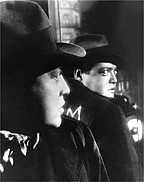
M by Fritz LangMotion pictures are an effective medium to convey the human condition.  In Fritz Lang’s thriller M (1931), the letter obviously refers to the murderer, a child killer that the whole town was after.  The not-so-obvious is the depiction of universal depravity, from the police to the masses, the message that we’re all complicit in the moral fabric of our society.  Similarly, Mel Gibson puts himself in his movie The Passion of the Christ (2004) as the Roman soldier nailing Christ on the cross.
Fast forward to the 80’s, I was introduced to the renowned Polish auteur Krzysztof Kieslowski.  It’s amazing how in Decalogue (1988), the essence of The Ten Commandments and their relevance in contemporary society are transformed into ten independent, one-hour stories and broadcast as a prime time TV series in Poland.  Decalogue is an artistically crafted and poignantly executed production that has won numerous international awards.  But would we see such kind of meaningful work as a prime time TV program here in North America?  The answer is obvious.

On the last day, I’d the chance to savor Babette’s Feast (1987), a highly acclaimed movie from Denmark (Oscar Best Foreign Language Film, 1988).  Based on a story by Isak Dinesen (Out of Africa), Babette’s Feast is a cinematic metaphor of goodness and freedom.  Its unique story and powerful visual images richly convey the theme of grace and mercy, and the liberating power of compassion.  The table prepared before us is free, sumptuous and abundant, but it takes an open heart of full acceptance and gratitude to fully enjoy it.  An inspiring film to wrap up my sojourn, creating resonance for the journey ahead.

Babette's Feast

***

Inspired by Vermeer

I’m just having so much fun discovering the immense influence of Vermeer on his posterior that I must post some more.  Here are a few interesting samples that I’ve found.

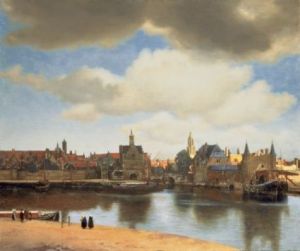
Holland has long been renowned for its natural light, and Vermeer has long been credited with his keen sensitivity in capturing that.  Here’s his View of Delft (ca. 1660),  which Marcel Proust called “the most beautiful painting in the world”:

Vermeer View of Delft

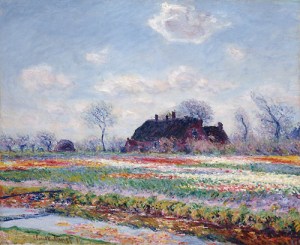
Visiting the Netherlands in 1886, Claude Monet adopted Vermeer’s point of view in observing the light of Holland in his painting of tulip fields and a farmhouse near Leiden:

Monet Tulip Fields near Leiden, Netherlands

**

Look at this famous Vermeer painting entitled Woman in Blue (ca. 1663):

Vermeer Woman in Blue

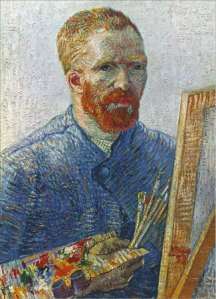
Van Gogh commented in 1888 on the exquisite artistry of Vermeer’s colors in the painting, “…blue, lemon-yellow, pearl-gray, black and white… the whole gamut of colors.”   He must have really liked Vermeer’s palette:

Van Gogh Self Portrait at Easel

**

Vermeer loved his subjects by the window.  Here’s another well known painting Girl Reading A Letter At An Open Window (1658), and below, Salvador Dali’s parody, homage, to Vermeer’s signature pose entitled Disappearing Image (1938).  Like Hitchcock, Dali liked to put himself in the picture:

Vermeer Girl Reading A Letter By The Window

Dali The Image Disappears

Tom Hunter Woman Reading A Possession Order

Now here’s a more contemporary example.  UK artist Tom Hunter, the first photographer to have a one-man show at the National Gallery of London, won the Kobal Photographic Portrait Award in 1998 with this poignant picture of a squatter, entitled Woman Reading a Possession Letter:

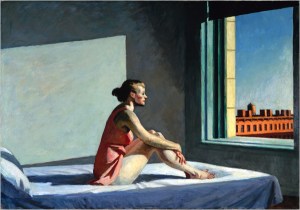
How about this from American realist painter Edward Hopper, Morning Sun (1952):

Edward Hopper Morning Sun

(For more Edward Hopper, Click Here.)

**

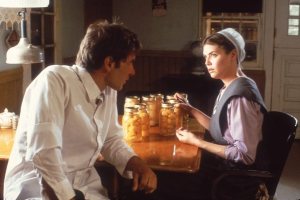
Director Peter Weir has created some ‘Vermeer scenes’ in his highly acclaimed 1985 movie ‘Witness’, with Harrison Ford and Kelly McGillis.  I can’t find pictures of the scene where the young Amish woman Rachel Lapp (McGillis) tending the wounded detective John Book (Ford) in the attic of her Amish house.  That is signature Vermeer.  But this one by the window can give you a glimpse.  Look at the contrast between the light and shadow on the two characters, the innocent and cloistered Rachel Lapp and the street-smart and gun wielding John Book:

Witness Harrison Ford and Kelly McGillis

**

And last but not least, Vermeer’s inspiration on modern packaging and product design.  Click here to read more about it.

Vermeer inspired Dutch Chocolate Cream Liquer

****

Related Posts:

Vermeer in Vancouver: Noticing the Obvious

Girl With A Pearl Earring

Edward Hopper, William Safire: The Visual and the Word.

Arles: In the Steps of Van Gogh

The Letters of Van Gogh

***

Sources and links:  All Vermeer paintings, Click here to go to Essential VermeerClick here to Tom Hunter Website. Click here to Webmuseum for Edward Hopper. Click here to Van Gogh Gallery. Click here to Metmuseum for Monet’s Tulip Fields near Leiden.

Girl With A Pearl Earring

The Painting (1665)

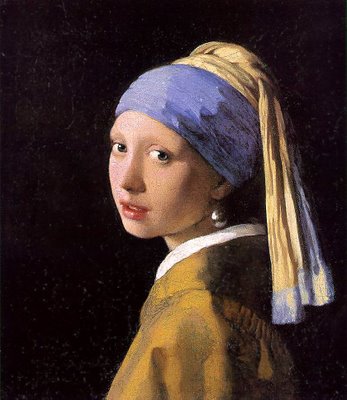
Girl With A Pearl Earring

Not much is known about this girl looking back at the artist with her soulful glance.  The pearl earring, the focal point of the painting, is obviously incompatible with her humble attire.  Vermeer has captured a mystery open to anyone’s imagination.  But it takes a master storyteller to create a believable and poignant narrative that can move modern readers three hundred some years later.

**

The Novel (1999)

Vermeer taught me that Less Is More, and I have been practicing that aesthetic principle in my writing ever since.”     — Tracy Chevalier

You can see it coming… it’s almost like reflex that after seeing a Vermeer exhibition I’d go back to the book Girl With A Pearl Earring by Tracy Chevalier, and re-watch the DVD of the movie based on it.  Well, especially when I didn’t get the chance to see the painting itself in the exhibition.

GWAPE Book CoverIt was this book that first sparked curiosity in me about Vermeer and his works.  Tracy Chevalier has done a superb job in creating out of her imagination the story behind the girl with the pearl earring, within the realistic social and historical contexts.  She has brought to the surface layers of possible subtexts hidden in this seemingly simple portrait.


I’ve appreciated that she has chosen the social segregation and hierarchical class structure of 17th century Delft as the backdrop of her novel.  So, instead of a sweet little tale or melodramatic story,  Chevalier highlights the complex social reality of power relations between servant and master, artist and patron.  She has masterfully created a scenario whereby the social distance between the servant girl, Griet,  and her master Vermeer, is drawn closer by her quiet understanding and appreciation of aesthetics.  With the same sharpness and sensitivity,  Chevalier has also shown how a wealthy patron can exploit art with his despicable, self-serving lust.

Chevalier’s ingenuity tugs at our heartstrings as we see the innocent and powerless being played as pawns,  no more than flies caught in the web of the rich and powerful.  The struggle between survival and artistic freedom is poignantly painted as irreconcilable subjects on the canvas of financial reality.  And fate teases all.  Yet among all these, the natural light that comes from art and beauty silently seeps through, brushing us warmly with a tender glow.

Do try to get hold of the Deluxe Edition.  It includes 9 full-color Vermeer paintings, which are cleverly incorporated into the story by the author.

Girl With A Pearl Earring by Tracy Chevalier, Deluxe Edition, published by PLUME, Penguin Group, 2005, 233 pages.

~ ~ ~ 1/2 Ripples

**

The Movie (2003)

.

GirlWithPearEarring1

Watching the movie Girl With A Pearl Earring is the closest to actually seeing a Vermeer exhibition.  Every frame is like a Vermeer painting with its extensive use of natural light from windows, contrasting the shadows in the interior of the Delft household.  The film was nominated for three Oscars in 2004, Best Art Direction-Set Decoration, Best Cinematography, and Best Costume Design.  In other words, it’s a pleasure to watch… it has to be because dialogues are sparingly used throughout.  Herein lies the strength of acting and the effectiveness of sound and visual communication.

The restrained performance of Colin Firth as Vermeer and Scarlett Johansson as Griet brings out the reality of the social order of the day.  A servant is not supposed to speak unless spoken to.  And what does a master has to say to an uneducated maid, unless he sees in her the appreciation of art and the clear understanding of aesthetics, of light and shadows, of beauty in the mundane.

Vermeer’s asking Griet to be his assistant and ultimately putting her in one of his works, albeit reluctantly for both, sparks off repugnant reverberation in town, and of course, the fierce jealousy of the painter’s wife Catherine (Essie Davis).  But as flies caught in the web of patron Van Ruijven (Tom Wilkinson), with debts to pay and a full household of mouths to feed, the artist has to bow to reality, and the even lower-ranked servant has to yield to her fate.

The visuals and music are the key to revealing the internal.  Beautifully shot in Luxembourg to simulate 17th Century Delft, the movie is a work of art in itself.  Colin Firth’s usual reticent persona on film fits him perfectly this time.  His taciturn portrayal of the ambivalent artist betrays the struggles within.  Scarlett Johansson delivers a convincing performance as pure and innocent Griet, and her gradual growth on the path of experience, albeit the book, as usual, depicts the inner turmoil more effectively.

The special feature on the DVD is enjoyable as well, chronicling the making of the movie.  I hope though that a Blu-ray version will come out one of these days, for that will indeed do justice to the cinematography and to the original artist, the master painter Johannes Vermeer himself.

~~~ Ripples

CLICK on the following links to go to related posts on Ripple Effects:

Inspired By Vermeer

Books and the Gender Issue


**

Movies for Mom

If you’re reading this on a site that is not Ripple Effects, your’re reading a post that has been copied without permission. Stop reading and CLICK HERE to go to the original post written by Arti of Ripple Effects. https://rippleeffects.wordpress.com

OK, now that the little bit of housekeeping is done, we can start. Mind you, the above words are the only pink, or red, you’ll see here, because this is not your typical Mother’s Day post. I’ve checked on several Mother’s Day sites for good movie ideas. They’re all framed by pink templates. They all point you to movies as old as Gone With The Wind (1939), or as teary as Terms of Endearment (1983), or as dysfunctional as The Joy Luck Club (1993). I mean these are great, but, renting an old DVD for Mom on Mother’s Day? Hasn’t she seen enough Sleepless in Seattle (1993) on Encore Avenue?

By all means, take Mom out to the theaters to watch a movie on her special day!

And guys, you don’t have to sit there, endure and groan silently for two hours. Because here you’ll find iconoclastic, i.e., stereotype bashing, non-chick-flick-genre movies that you and Mom will enjoy watching. Who says mothers are naturally drawn to pink or chick-flicks anyway? I’m speaking from experience. Nothing can make me more proud than to have my teenage son accompany me to the movies. (Bravo to him for his boldness!) Yes, just mother and son. And nothing is more rewarding than to share an experience that we can talk about afterwards.

Here’s Arti’s list of current movie recommendations for Mother’s Day, 2009. As I said earlier, this is the stereotype bashing list, so you won’t see Shopaholic here. Thrillers, actions, sci-fi’s, dramas… who doesn’t need an adrenalin rush every now and then to keep the body functioning?

State of Play

state-of-play

An absorbing story of corruption, deceit, and investigative journalism. The movie presents an interesting scenario: the old-school investigative newspaper reporter is pitted against the fresh-out-of-college blogger, both hired by the same newspaper to draw readership, a version of PC vs. Mac on the battlefield of journalism. When the female research assistant of congressman Stephen Collins (Ben Affleck) is murdered on the day of a crucial congressional hearing, Washington Globe reporter Cal McAffrey (Russell Crowe) is drawn into the search for the truth. He has to partner up, reluctantly, with Della Frye (Rachel McAdams), a pseudo-journalist/blogger. That’s the executive order handed down by their feisty and no-nonsense boss Cameron Lynne (Helen Mirren). As the investigation peels off layers of suspense, the pair is entangled with dangerous life and death situations. Adding to the intrigue is the role of Robin Wright Penn as the Congressman’s wife, and the colorful Jason Bateman as Dominic Foy, a crucial lead to solving the case. Mom would enjoy the performance by the stellar cast and the well edited screenplay. As to who saves the day at the end? I won’t spoil it for you… you deserve the credit for entertaining Mom.

Taken

taken

This may be in your second run theaters by now, well, so much the better. Don’t miss it on the big screen. After March 18, I look at Liam Neeson differently. Here in Taken, he embodies the superhero of parenthood. He shows us what a father will do to save his daughter, especially an ex-CIA dad against a human smuggling ring of bad guys. Bryan Mills (Neeson), a highly skilled agent who has retired early to make up for lost time with his daughter Kim (Maggie Grace), has to use all his resources when she is kidnapped while visiting Paris. The action-packed, fast-paced sequences leave you no time to be skeptical of the impossibilities. Mills’ expertly-trained speed and agility would make Jason Bourne drop his jaw (literally or figuratively). And, stand aside James Bond, you’re not in the league, it’s heart we’re talking about. Lose yourself, be swept away, it’s pure escape and fantasy. Any parent can identify with the fear of a child being taken and hurt and the feeling of helplessness that ensues. Liam Neeson just acts out the imaginary scenario, the omnipotent father coming to the rescue of his own, and he’s won my heart. (So remember, it’s great for Father’s Day too, but Dad will likely have to watch the DVD.)

Star Trek (2009)

Wolverine too hairy? Bad manicure? Bring Mom to Star Trek then, if she’ s up to pushing her way through the crowds. I’m sure she’d enjoy at least some elements of the movie. While you’re cheering for the young, new Kirk, she might be reminiscing the First Generation. This deserves a brand new post. So watch for it in the days to come.

Other recommendations have been reviewed on Ripple Effects. If they’re still on the big screen, Mother’s Day is a good time to enjoy them with Mom:

The key to making Mom happy: Spend time to talk afterwards.

****

Photo Source: Taken, msnbc.com; State of Play, usatoday.com