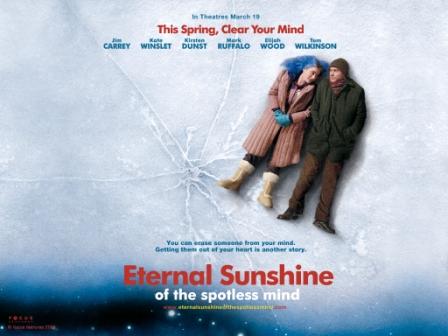
Eternal Sunshine of the Spotless Mind (2004) DVD

How happy is the blameless vestal’s lot!
The world forgetting, by the world forgot.
Eternal sunshine of the spotless mind!
Each pray’r accepted, and each wish resign’d.
          – Alexander Pope, “Eloisa to Abelard


**

Summer is the best time for me to catch up on movies I have missed in recent years.  Eternal Sunshine of the Spotless Mind is one of them.  I have long admired the title of this movie, and wondered who made it up and what it could possibly mean.  Well, I finally made the move and bought the DVD.  After watching it I gave out a sigh of contentment, “Of course!”

It is a challenge to write a review of this movie without spoiling the enjoyment of those who haven’t seen it.  But just let me say this Oscar Best Original Screenplay (2005) is one of the most ingenious in years.  Screenwriter Charlie Kaufman, of Adaptation (2002) and Being John Malkovich (1999) fame, teamed up with director Michel Gondy and screenwriter Pierre Bismuth, and created a wonderful and fresh look at a love story.

If science could allow you to erase any bad memories, which ones would you delete?  This is the premise of the film.  Two individuals, Joel Barish (Jim Carrey) and Clementine Kruczynski (Kate Winslet) met each other at a friend’s party and fell in love.  As with all relationships, they went through ups and downs, experiencing the exhilaration that love could bring, as well as the humiliation it could unleash.  Given the convenience of technological advancement, they elected to erase each other from their memories when their relationship turned sour.

What follows is nothing short of a visual treatise on the conflict between scientific advancement and what it  means to be human, but well embedded in an intelligent sci-fi comedy, evoking the minds of Nietzsche and Pope.

The fine script is augmented by the excellent acting of the cast.  I’m not a Jim Carrey fan, but I’ve particularly enjoyed his more ‘serious’ roles, like in The Truman Show (1998 ) and here in ESOTSM.  He has given a superb performance as the sullen Joel Barish.  Kate Winslet is convincing as the wild and intuitive Clementine.  Their amiable chemistry draws out some great performance from each other.

The rest of the cast is also fun to watch.  Kirsten Dunst (Marie Antoinette, 2006), Tom Wilkinson (Michael Clayton, 2007), Mark Ruffalo (Blindness, 2008 ), and Elijah Wood (The Lord of the Rings, 2001-2003), all lend exceptional support to the main characters.

Other than the acting, the movie also benefits from some excellent editing and technical expertise.  The switching back and forth in time, and the juxtaposition of memories with the present, and imagination with reality, is superbly intertwined.  On first viewing, one may find it a little confusing.  However, as the movie finishes, one would definitely want to watch the beginning again.

I was much gratified to see the story come to an ingenious end.  With love, bad memories are better than no memories.  As I was watching, a movie quote from another film came to mind:

The things that people in love do to each other they remember, and if they stay together it’s not because they forget, it’s because they forgive.

It is uplifting to be reaffirmed that being human encompasses the various subjectivity of experiences, be they sad or joyous.  And forgiveness and love may well be some of the loftiest ideals humanity could ever pursue.

The DVD comes with some excellent special features including behind-the-scenes look at the production, a conversation with Jim Carrey and director Michel Gondry, feature commentary with Michel Gondry and writer Charlie Kaufman, a music video, deleted scenes, and a neat little surprise.

~ ~ ~ Ripples

 

Excellent Blog Award

“I am not a great reader, and I have pleasure in many things.”

— Lizzy Bennet, Pride and Prejudice.

excellentblog1I’m honored to be named one of the recipients of the Excellent Blog Award given out by Vic, a.k.a. Ms. Place, of Jane Austen’s World.  Considering her criteria and a look at my fellow honorees, I feel greatly encouraged indeed.  Thank you Vic, it means a lot for a “non-Austen” blog to get a nod from Jane Austen’s World.  Actually it is blogs like yours that spur my interest in Austen and the Regency world.

Ripple Effects is not exclusively an “Austen blog”, although Jane Austen is one of my all time favorite writers, and you can certainly find many Austen posts here. But as Lizzy Bennet in Pride and Prejudice said: “I’m not a great reader and I have pleasure in many things”.  I enjoy writing about topics relating to my various interests in the arts and entertainment field.  I try to maintain a magazine-style format to encompass the diverse subjects.  Ms. Place has kindly observed: “I’ll never know what I’ll find when I visit.”

I love books, but I’m a slow reader.  So my mind is always trying to catch up with what my heart desires.  I love movies, but I seldom go to opening showings to avoid the crowd.  So what you read in Ripple Effects are often hindsights and resonances from delayed gratification.

At times, it’s a rough road, this blogging journey.  Sometimes I just drive not knowing where I’m heading. But receiving acknowledgement like this is the fuel needed for me to press on, and help me to relax enough to enjoy the scenery along the way.

At first I was planning to write a post like this on my first blogaversary August 29. But at 11 month now I feel I just can’t wait to express a heart-felt thank-you to all my fellow bloggers and the many anonymous visitors from around the world.  You’ve unknowingly added fuel to these clattering wheels.

******

Mamma Mia! (2008) Movie Reivew

If beach reads is to superficial page-turners, then summer movies is to mindless, senseless, jovial entertainment.  If you allow yourself to devour less than literature under the summer sun, you can have your fill by indulging in Mamma Mia!  Why not, what other times of the year can we immerse ourselves in superficiality, if not in the name of summer fun.

Like the recent re-emergence of past heroes such as Indiana Jones, Rocky Balboa, and the like, I suspect making Mamma Mia! is the mid-life fix for its actors and actresses.  And for stars like Meryl Streep, where else can you, as a 59 year-old, sing and dance like a rock diva, jump up and down on your mattress like it’s a trampoline, dance to you heart’s content on a Greek Island with the whole village backing you, and make a splash, literally, to end a wild number.  Looks like Streep has the time of her life making this movie.  What more, she’s got Pierce Brosnan, Colin Firth, and Stellan Skarsgard swinging and jiving with her.

On the eve of her daughter’s wedding, Donna (Streep) finds herself faced with three of her past lovers who have shown up upon receiving invitation from the bride to be, Sophie (Amanda Seyfried).  Before getting married to her sweetheart Sky (Dominic Cooper), Sophie feels the urgency to find her real father and have him walk her down the isle. Director Phyllida Lloyd did a passable job churning out a simplistic but fun-filled movie adaptation of her Tony Award winning musical.  What captures the audience is not so much the story but the popular songs written by ABBA’s Benny Andersson and Bjorn Ulvaeus.  Titles like “Mamma Mia”, “Take A Chance On Me”, “Dancing Queen”, “Knowing Me, Knowing You”, “The Winner Takes It All”, “SOS”, and “I Have A Dream”… supply the bulk of the movie goers their mid-life fix.

So who cares if it’s a silly, senseless, mindless escape.  At least, it works… well, more or less.  As I sat in the packed theatre, where families had to sit separately to find seats, where teenage boys came with their mothers, where I heard middle-age men laughing out loud, and where I caught myself watching the movie with a smile on my face and tapping my toes to the tunes, it sure worked as a great escape.  Don’t expect in-depth characterization, complexity in plot structures, insightful dialogues, and please don’t mind the miscast (Bond in song?)… it’s summer after all.

Adapted from the successful musical showcasing the songs of the sensational Swedish group ABBA, Mamma Mia! the movie features authentic singing from the movie stars themselves.  Yes, there are LOL moments listening to them singing in their amateurish voices.  Don’t expect professional vocal performance… from Pierce Brosnan?  The fun is hearing him seriously belt out “SOS”, now that’s entertainment.  And all ye fans of Colin Firth, he has definitely smashed the Darcy image, if it still lingers in your Janenite mind.  Here you can see him play the guitar, sing, hang loose, and dance like a rock star.

There seems to be no middle ground in our summer movies this year:  Mamma Mia! is as light and giggly as The Dark Knight is dark and gloomy.  If you can overlook the subliminal implications seeping through Mamma Mia:  The celebration of promiscuity and the appeal of the stereotypical senseless female, then this movie adaptation is a sure escape.  But if you’re expecting more, I’m sure there are other offerings under the lazy summer sun.

Photo Source:  Seattle Times and Universal Pictures


~ ~ ½ Ripples

Update December 11:  Mamma Mia! has just been nominated for a Best Picture Award (Comedy or Musical) at the 2009 Golden Globes, and Meryl Streep nominated for the Best Actress (Comedy 0r Musical) category.

Sketches of Frank Gehry (2005) DVD


“You can look anywhere and find inspiration.”

—- Frank Gehry

The past couple of months I’ve been tied down with previewing films for an upcoming International Film Festival that I haven’t time to watch films of my own choosing.  The past weekend I decided to cease the dry spell and watched the DVD I’ve purchased for a long while but haven’t the chance to view.  My only regret: Why did I wait so long?

This is a documentary about and made by two of my favorite artists:  Architect Frank Gehry and film director Sydney Pollack (Best Director 1985, Out of Africa), whom I sadly miss upon his untimely passing on May 26.  (To read my tribute to Sydney Pollack, click here.) Pollack worked on this film, his first documentary, over weekends
for about five years.  An official selection at the 2006 Cannes Film Festival, Sketches of Frank Gehry is his last directorial work.

Pollack has taken a simple and casual approach to present his long time friend Frank Gehry to the viewer, and that’s what impresses me.  The low-key yet artistic design of the film is a modest portrait of the architect whose body of work is often associated with rule-defying, bold and striking structures around the world.

Born 1929 in Toronto, Canada, Gehry moved to the United States with his family in 1947. His career spans four decades, establishing himself with renowned projects such as the Guggenheim Museum, Bilbao, Spain (1997), the Vitra Design Museum, Germany (1989), and more recently the Walt Disney Concert Hall, L.A. (2004). The personal and unpretentious portrayal of the architect brings out the mild and human side behind these massive physical structures.

Through informal dialogues, the filmmaker effectively captured the essence of artistic pursuit: the self-doubt during the creative process, the incubation and collaboration of ideas, the uncertainty of the soundness and appeal, and the ultimate exhilaration of the successful completion and reception of the work. Interestingly, the film works like a double-edged sword.  It explores the creative process of both the subject and the filmmaker.  And it is such revelation that makes the documentary so appealing.

In the beginning was the void:

Sydney:  Is starting hard?

Frank:  You know it is… I’m always scared that I’m not gonna know what to do.  It’s a terrifying moment.  And then when I start, I’m always amazed, “Oh, that wasn’t so bad.”

The veteran director had his uncertainties as well:

Sydney:  Several people approached him with the idea of making a documentary about him.  And when he asked me if I’d do it, I thought he was crazy.  Not just that I didn’t know anything about making documentaries, I don’t know anything about architecture.

“That’s why you’re perfect,” he said.

Maybe all our training and experience that we hang on to so dearly are impediments to a fresh, new perspective.

The film gives us the insider view of the Gehry creative process.  It is a collaborative effort involving inputs from design partners mulling over paper models and computer expertise transferring concepts to 3D digital mode. Despite the elaborate and sometimes long incubation period, every piece of work begins with the architect’s own signature squiggles on a blank piece of paper.

We see Pollack using a hand-held digital camera to capture more agile and personal shots. As the title suggests, the filmmaker interviewed and chatted with various artists, architects, critic, and even Gehry’s therapist to gain different perspectives into the heart and mind of the architect.  He was able to elicit some insightful comments.

Writer and curator Mildred Friedman has this to say about Gehry:

He’s an architect who’s also an artist.  He takes so many risks.  And that’s what artists do.  Artists take risks to do something new that no one has seen before.

Gehry’s therapist Milton Wexler:

A great many people come to me hoping they can change themselves, settle their anxieties, their problems, their marriage or whatever…  When an artist comes to me, he wants to know how to change the world.

And from Pollack, when talking about the epic and mythical Guggenheim Museum, Bilbao, Spain:

He sees that the whole reason for being an artist is that moment in somebody’s eyes when you reach him.

The nay-sayer is represented by Hal Foster, Professor of Art and Archaeology, Princeton University, who criticizes Gehry of making a spectacle of his work.  We also see montage of printed words from the media, such as “ugly”, and even “perverse”.

Responding to criticisms about Gehry’s galleries and museums competing with the very exhibits they showcase, Julian Schnabel, artist and filmmaker (The Diving Bell and the Butterfly, 2007), defends Gehry’s design with this audacious sum up:

I feel very comfortable in his spaces.  He understands scale.  And if it does compete with the art, maybe that art isn’t good enough.

Such thought-provoking comments are just some ideas one can mull over long after the film.

I must also mention the original score composed by Sorman and Nystrom.  Like a soothing balm, it is pure delight looking at Gehry’s fluid designs with the equally flowing and meditative musical rendering.

The special features on the DVD include a bonus 35 minutes interview and audience Q & A with Sydney Pollack at the L. A. Premiere of the film.  The icing on the cake, this feature offers Pollack’s reminiscence of the production and more thoughts on the creative process.  A valuable DVD to keep for anyone interested in the artistic expression of the human mind.

~ ~ ~ ½ Ripples

A note on the photos:  Arti has the pleasure of visiting two of Frank Gehry’s work.  The above photos are taken by Arti in October 2007 and February, 2008. The first two are the Walt Disney Concert Hall in L.A.  The last two are different views of The Peter B. Lewis Building at Case Western Reserve University in Cleveland, Ohio.  All Rights Reserved.

The source for the squiggles image:  Maclean’s Magazine.

Beach Reads and Summer Reading 2008

It’s that time of the year when you let it all hang loose and not care about whether what you’re reading is ‘literature’ or not. For some strange reasons, the hot summer months, the taking leave of work and school, the temporal evasion of chores and responsibilities seem to have emboldened us to new adventures, legitimizing ‘escape reading’. But my question is why only in the summer? Do seasons regulate our choices? Should ‘summer reading’ differ from that of the other 10 months in the year? Has the term “Beach Read” been coined merely to jack up book sales?

A look at some current writers’ “summer reading” casts even more doubts on arriving at a clear cut definition of “Beach Reads”. Dan Zak of Washington Post interviewed a sample of them and surveyed their summer reads. Here’s what he found:

  • Mary Higgins Clark: Gift from the Sea by Anne Morrow Lindbergh
  • Susan Choi: War and Peace by Leo Tolstoy
  • Janet Evanovich: The Great Gatsby by F. Scott Fitzgerald
  • Thomas Mallon: Nicholas Nickleby by Charles Dickens
  • Sue Monk Kidd: The Grimke Sisters From South Carolina: Pioneers for Women’s Rights and Abolition by Gerda Lerner.

… and so on and so forth. Click here to read more of Dan Zak’s article on summer reading.

And here’s Arti’s list. I’m currently reading Lisa Scottoline’s Lady Killer, which should satisfy a ‘traditional’ definition of a ‘beach read’. Other than that, I’m also re-reading Jane Austen’s Persuasion, and still plowing through two of Robert K. Johnston’s books, Reel Spirituality: Theology and Film In Dialogue and Reframing Theology and Film. If a ‘beach read’ is defined as a fast pace, plot-driven page-turner, these definitely don’t qualify.

I’ve just finished The Glass Castle by Jeannette Walls, which is one dynamite read, a wild ride any time of the year. It deserves a whole new post. But to categorize it as a ‘beach read’ would seem to have down-graded its quality and impact.

A few titles I plan on getting hold of this summer:

  • Then She Found Me by Elinor Lipman. After watching the film, I’m really interested to find out how a writer instills spirituality into the narrative of everyday living.
  •  Away by Amy Bloom. I’ve wanted to know more about her through her reading. So far I’ve only read one thing from her: Introduction to Jane Austen’s novel Persuasion.
  • The Savior by Eugene Drucker, founding member of the renowned Emerson String Quartet. In this debut novel, he dispels the myth of the saving power of music, using a Holocaust death camp as the backdrop. Should be one poignant read.

What’s your summer reading list like? Typical ‘beach read’ or evidence shattering its existence?

Summer Reading 2009 Click Here.

***

Music in my iPod

My son left me his old iPod when he visited me over the weekend. No, he doesn’t get the privilege to enjoy country living because he has to stay in the city for his summer job.  So, technically it’s not my iPod. But just the same. I’ve declared what’s in there my music. He has categorized all music into genres, easy for me to sort out what I like. And, what a pleasant surprise to find so many gems in there, wonderful embellishment for my pristine living out here in the log home.

There are 1,696 selections for me, grouped  into genres. I admit there are ones that I won’t venture into, like metal and rap, but there are enough categories for me to choose from.  Imagine my feeling listening to the music and looking out towards the open, green fields, distant snow-capped mountains underneath a canopy of dramatic clouds, against a big, blue sky…it’s not out-of-this-world, for I’m right in it! Magnificent!

So…what’s in my 18-year-old’s iPod?  Lots I can indulge in.  Here are some samples…

Classical:

  • Bach’s Partita played by Nigel Kennedy
  • The Complete Goldberg Variations played by Glenn Gould
  • The Art of the Fugue, The Well-Tempered Clavier all by Gould
  • Beethoven’s Symphony #6 Pastoral (For real!)
  • Chopin’s Sonatas, Etudes and Nocturnes
  • Holst’s The Planets  (How cool is that!?)
  • Rachmaninoff’s Piano Concertos
  • Tchaikovsky’s Cello Concertos

Classics:

  • ABBA
  • Andy Williams
  • The Beach Boys
  • The Beatles
  • Bette Midler (She’d be happy to be categorized as ‘Classics’)
  • Bob Dylan
  • Don McLean
  • Frank Sinatra
  • Gordon Lightfoot (Yes, Alberta Bound)
  • Joan Baez
  • Jimi Hendrix
  • Leonard Cohen
  • Simon & Garfunkel
  • Van Morrison

Jazz:

  • Art Tatum
  • Dave Brubeck Quartet
  • Duke Ellington
  • Eva Cassidy (Yes, he put her under Jazz)
  • George Gershwin
  • Glenn Miller,
  • John Coltrane
  • Miles Davis
  • Norah Jones
  • Ray Charles

Rock, Pop and Soundtracks:

  • Elton John
  • Jason Mraz
  • Mariah Carey & Whitney Houston
  • The Rolling Stones
  • Amy Adams
  • Broadway Musicals Cats, Les Miserables,
  • The Phantom of the Opera

With this techno luxury of sound bytes, who needs to go to the city!  And…I’m relieved to know there isn’t much of a generation gap here after all…

                                                               ******

My Blueberry Nights (2007)

Shown last year at the Cannes and several other Film Festivals before coming here for a general but limited release, My Blueberry Nights is director Wong Kar Wai’s first English language film. Since his legendary Chungking Express (1994), Wong’s films have attracted a cult following. I’ve thoroughly enjoyed his previous titles like In the Mood for Love (2000) and its sequel 2046 (2004). Let me just describe his style as “Film Noir in Postmodern Colors”. Wong’s films are atmospheric, flashy, up-close and penetrating. His characteristic use of mirrors and small, enclosed settings juxtaposes the reflective and the surreal. Many find him incomprehensible, frustrated at his sometimes self-absorbed artistry.

Wong’s signature directorial style found some new players here in My Blueberry Nights. In this debut film of popular jazz diva Norah Jones, Wong cast her against some very impressive acting talents including Jude Law, David Strathairn, Rachel Weisz, and Natalie Portman. Visually, MBN is a colorful cinematic kaleidoscope. Unfortunately, it remains merely so, for underneath the visual plane, there is not much substance in the script to gratify. It is almost painful to see acting talents uttering cliches and simplistic dialogues, and to even overact to compensate.

Jones is Elizabeth, newly dumped by her boyfriend and finding a confidant in cafe owner Jeremy, played by Jude Law. To escape from the pain of lost love, she leaves on a road trip on her own across America. Working as a waitress along the way, she meets characters who are in worse shape than she is: A police officer (David Strathairn) despair in love, his estranged wife (Rachel Weisz), and a weathered gambler who befriends her and teaches her a life lesson: never trust anyone. This role is played by Natalie Portman…ok, there might be a miscast here, but Portman has delivered some captivating performance. While this is Jones’ first time acting, her unseasoned and naive persona ironically is quite appropriate as the young and impressionable Elizabeth.

All the acting and singing talents however are not sufficient to rescue a deficient script. If you’re not a devoted fan of Wong Kar Wai, or any of the actors and singer here in this film, you might just like to manage your time better. I’ve admired some of Wong’s previous works, but am disappointed at this first piece in a new page of his career. Having said that, I look forward to his future endeavors.

~ ~ Ripples

                                          *****

The Stone Angel (2007): Book Into Film

** The following review contains spoilers**

Since its publication in 1964, this is the first time The Stone Angel is adapted into a movie. As I mentioned in my review of the book last week, whoever that attempts to do this has a formidable task. This classic Canadian novel by Margaret Laurence is a depiction of memories encased in deep inner turmoil. The fleeting and random reminiscence of 90 year-old Hagar Shipley juxtaposing with the present would also prove challenging to bring on screen.

Director, screenwriter, and producer Kari Skogland has made a bold attempt at filling this tall order. Filming the movie in rural Manitoba, The Stone Angel delivers some nice shots of the prairie backdrop, even though Manawaka is a fictional town in the story. The sequences of flashbacks are aptly dealt with quite seamlessly.

The movie has its greatest asset in the cast, in particular Oscar winner Ellen Burstyn (Alice Doesn’t Live Here Anymore, 1974) as Hagar Shipley, and Christine Horne as her younger counterpart. Canada’s own Ellen Page also plays a minor role as Arlene, the girl Hagar’s son John (Kevin Zegers) wants to marry, and of course, against the wish of his mother. The two Ellen’s have some tense moments together. Page’s screen time may be too short though to gratify her fans.

Any fine actor, however, can only perform within the confines of the script. Here lies my major concern: the alteration of the crux of the story, maybe to appeal to a contemporary or a younger audience. The film is a much more mellow and sexed up version of the book. The fiery, ingrained pride of Hagar is much subdued. In fact, she has been changed to an even amiable character. Further, I feel the shifting of the time from the 60’s to modern day somehow trivializes the story. Who would have thought Marvin (Dylan Baker) would be talking on the cell phone and Hagar smoking marijuana…one item off her bucket list?

What author Margaret Laurence has depicted is not just any ordinary stubborn, grumpy old woman, but Hagar Shipley, the tragic heroine, however disdainful. She rages against the dying of the light and doesn’t go gentle with just about everyone because of her deep-seated hubris…even while facing death. The book’s final image of her wrestling the glass of water from the nurse, drinking it without help, wraps up the life of this fierce character. And it’s pathetic to see her pride leading her to make decisions and to act in ways that could well have caused the tragedies in her life.

The scene at the abandoned shed should have led to the poignant, climatic revelation. In the book, Hagar tries to run away from the fate of being confined to a nursing home. She spends a night in this derelict shack and encounters a stranger. During their conversation, she unknowingly verbalizes the pain and guilt she has been carrying all her life by talking about the tragic end of her beloved son John. The name of this newly formed confidant, Murray F. Lees, yes, Flees, points to her perpetual running away from constraints, or maybe even from herself.

But in the movie this stranger is Leo (Luke Kirby), who uses the shed to make out secretly with his girlfriend and then goes on to discuss forbidden sex and share a ‘joint moment’ with the 90 year-old woman.  In the theatre, I heard laughter.  The pathos that should have accompanied this pivotal scene either did not materialize or has been much lessened.

The portrayal of young Hagar played by Christine Horne, while proficient, may have also missed the gist of the story. We see a beautiful red-hair Hagar and a romanticised Bram (Cole Hauser) immersed in blissful courtship and marriage, at least in the first part of the movie. In the book Bram Shipley, a widower-farmer fourteen years her senior, is as rough and callous as Hagar is proud and obstinate.  Their marriage is rocky even from the start, reinforcing the notion that in defying her father, Hagar has made a decision that would later bring her great torments.

By depicting a softer Hagar, and toning down her abrasive pride, the film has diluted much of the poignancy and intensity of the conflicts. The strained relationship between Hagar and her favorite son John has not been sufficiently developed to elicit the emotional impact of the tragedy. Hagar has long placed her hope on John, whom she has esteemed to be worthy to wrestle with the angel, but he ends up breaking her heart. The swift dealing of the mother son relationship in the film fails to depict Hagar, like the stone angel, has been blind to her circumstances. Fortunately, the film has kept the authentic scene of Hagar reconciling with her elder son Marvin, who has taken care of her in her old days. It is Marvin who has wrestled with the angel and won.

The final scene with the Pastor Rev. Troy (Ted Atherton) singing the hymn, touching even the ‘holy terror’ in her death bed, draws the film to a poignant and peaceful close. The audience sees a yielding Hagar going gently into the good night. The voice over of Dylan Thomas’ quote seems inconsistent with what we see.  If Laurence could have her way, she likely would have concluded with the last image of the book where Hagar stubbornly tries to drink from the glass without the help of her nurse, defiant to the end.

I have a reader, a student apparently, once asked me whether he should skip a book he was studying in class and just use the movie version for his course work.  My advice is, watch the movie for entertainment, but read the book for your assignments… the two could be very different entities.

~ ~ ½ Ripples

Sydney Pollack: The Passing of a Legend

Even if you’re not mad about movies, you’d probably still have seen some of Sydney Pollack’s works, either with him as a director, an actor, or a producer. 

A good movie is measured not in length, but in depth, and a career, in breadth.  But even if you’d like to use length to evaluate, Pollack’s five decades of contribution to the movie industry can certainly measure up.   

Consider these titles:

  • They Shoot Horses, Don’t They? (1969, director) 
  • The Way We Were (1973, director)
  • Three Days of the Condor (1975, director)
  • Absence of Malice (1981, director, producer)
  • The Firm (1993, director, producer)
  • Sabrina (1995, director, producer)
  • Sense and Sensibility (1995, producer)
  • The Talented Mr. Ripley (1999, executive producer)
  • Up At The Villa (2000, executive producer)
  • The Quiet American (2002, executive producer)
  • Cold Mountain (2003, producer)
  • The Interpreter (2005, actor, director, executive producer)
  • Sketches of Frank Gehry (2005, director)
  • Michael Clayton (2007, actor, producer)
  • Made of Honor (2008, actor)

Not to mention the numerous TV appearances, dating back to “Playhouse 90” (1959), “The Twilight Zone” (1960), “Alfred Hitchcock Presents” (1960), to “Will & Grace” and “The Sopranos”.

And with his directing, he had sent Jane Fonda, Susannah York, Paul Newman, Jessica Lange, Dustin Hoffman, Robert Redford, and Barbra Streisand to the Oscars.  

Yes, you might have noticed…I’ve left out two movies, and they’re classics:  Tootsie (1982) and Out of Africa (1985).  No…how can I have forgotten them? I’m just saving my favorites for last.  Pollack acted in and directed Tootsie.  He demonstrated that he was an incisive social critic who could tactfully embed his provocative commentary in an enjoyable comedy.

And Out of Africa…the movie that brought Pollack his Oscar win as Best Director, and won the Best Picture of 1985… I just want to say, it represents the epitome of a great love story, one that encompasses depth of character, poignancy, meaning and significance.  And the images, the music and cinematography…just astounding.  Why do we only have ‘Chick Flicks’ nowadays?  What happened to the art and depth of storytelling?

Pollack died of cancer in Los Angelas on May 26.  He was 73.  Here are some links covering the passing of Sydney Pollack:

BBC News with video clip

SFGate, San Francisco Chronicle

News.com.au

Yahoo News with ABC news clip

Then She Found Me (2007)


Then She Found MeLet me guess, movie making is as demanding and draining as child rearing…and, if you’re doing both together, well…kudos to you.  Case in point, a gaunt and much thinner Helen Hunt.  Well, maybe that was on purpose for her role.  Anyway, after some intermittent hiatus since her second marriage in 2001 and the birth of her daughter in 2004, the Oscar winning actress (As Good As It Gets, 1997) comes out with a film that she co-writes, directs, and stars in.  Then She Found Me shows that Hunt is alive and well, and that she certainly can multi-task.

As a directorial debut, Then She Found Me is a gem of a film. Based on the novel of the same name by Elinor Lipman, TSFM has been on the drawing board for a long ten years.  To read NY Times’ Interview with Helen Hunt, Click Here. Hunt adapted the book into screenplay with Alice Arlen and Victor Levin throughout a few years’ period. 

Dramedy is the word for this genre of film.  The drama component of the movie spurs on some meaningful exploration:  of motherhood, adoption, marriage, parenting, faith, and God… But it’s a comedy, first and foremost, and we’re rewarded by its remaining so.  The movie is funny, smart, warm-hearted and entertaining…and best of all, we’re spared all the possible preachy sessions that could have come out from dealing with its subject matters.

Juggling motherhood and movie-making could have explained Hunt’s tired and thinner look.  On screen, such an appearance is suitably in character, for she portrays a 39 year-old kindergarten teacher April Epner, newly married, and in a desperate rush to become pregnant before time runs out.  As an adopted child, April is all the more longing for a baby of her own, thinking of the deeper relationship, bonding and meaning that can naturally come out from giving birth to and raising her own child as opposed to adopting one. To this view, her step-brother, the natural son of her Jewish adoptive mother responds, “No, it’s the same”.

Well, she soon finds out.  Her excitement of finally getting pregnant is not shared by new husband Ben (Matthew Broderick).  It is obvious that he is not eager to become a parent, or a husband, for that matter.  Actually, this news comes to him after he feels that he has made a mistake in getting hitched for life, and has moved back to live with his mother.  Sadly, Ben is still a boy, donning a baseball cap and expects everyone, especially his wife, to accept his Peter Pan confusion.

But that’s not all.  Just after her husband has left her, April’s Jewish adoptive mother dies.  And to top it all off, April encounters her birth mother Bernice (Bette Midler).  Well to be exact, her mother has found her.  But at this chaotic point in her life, April is ambivalent about coming face to face with her birth mother, especially one who is so brassy, imposing and self absorbed.  Bernice is a local TV talk show host.  After 39 years of absence, she suddenly decides she wants to find her daughter.  But upon questioning by April why she had given her up after a short parenting gig, Bernice may have understood April’s ambivalence.  And I like it when the film leaves the queries as queries… simple answers to questions like these are never easy to find.

Helen Hunt and Colin Firth

Confused and emotionally fragile, April finds new romance and support in Frank (Colin Firth), the recently divorced father of a student in her class.  His artist wife has left him for another guy and at the moment, she’s travelling the world with him. Underneath Frank’s calm and affable demeanor is a very hurt, confused, and anguished man.  If Colin Firth thinks he still has not shed his stereotyped Darcy image, this is the time to do it.  His versatility as an actor just shines through in this conflicting character.  Once bitten, twice shy.   Frank is emotionally vulnerable, yet he also yearns to establish a meaningful and loving relationship with April.  The intermingling of two fragile and affable characters is the springboard to some amusing and poignant moments.

As a first time director of a full length movie, Hunt has done a proficient job, despite some minor problems with pacing and congruence of scenes.  Certain shots could have been shortened to maximize the intended humor while some scenes ought to be connected more smoothly.  The audience may need to fill in the blanks at times.  Having said that, I feel that my enjoyment is not tampered a bit.  One note of caution though, the language is part of the reason it gets an R rating, and that might turn away some viewers.  

Kudos should go to the admirable acting by Hunt herself, as well as Firth and Midler.  Midler is effective as a self-serving intruder at first, yet is sensitive enough to change, especially as she empathizes with April’s anxiety … learning to be a mother after all these years.  And I must mention Salman Rushdie, yes, the Salman Rushdie, who plays a supportive role as the obstetrician.  He has effectively sprinkled in some subtle humor.

Further, I admire Hunt for not shying away from the problem of faith, loss, and God.  The plot lends itself naturally to the exploration of these complex issues, and Hunt has boldly dealt with them directly. The religious expressions and prayers uttered might be in Hebrew, but the yearning, and the angst, is poignantly human and universal. 

Well, Mother’s Day has come and gone, but motherhood lasts a lifetime.  As a devoted single-parent to his children, Frank in the movie has demonstrated that the marriage vow “for better or for worse, in sickness and in health” can aptly apply to parenting.  And for all mothers, birth, adoptive, as well as those like Frank, who has to bear the responsibilities as one, it is in the nitty gritty of everyday realities that motherhood, or parenthood for that matter, finds its meaning and fulfillment. 

(The indie film is currently being screened on limited engagement in North America. It’s rated R in the U.S. for language and sexual content. In Canada, it’s rated from 14A to G, depending on the Province where it’s shown.)

To read my review of the book Then She Found Me, click here.


  ~ ~ ~ Ripples


And When Did You Last See Your Father? Book Review

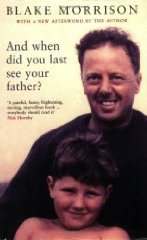
when-did-you-last-see-your-father-book-cover2I saw the movie When Did You Last See Your Father? at the Toronto International Film Festival last September, twice. I didn’t have the chance to read the book until a couple of days ago, about 7 months later. But as I read, all the scenes came back to me, and I appreciate the film even more than before. Yes, this is definitely a successful attempt at turning Book Into Film…and a hugely impressive one at that. The stellar cast with Jim Broadbent as the father and Colin Firth as the adult son, plus the exceptional supporting roles have brought out the spirit and the essence of the book poignantly, thanks to the very artistic and sensitive treatment by director Anand Tucker. To read my review of the movie, click here.

Blake Morrison is a contemporary British poet and writer. He was literary editor of The Observer and the Independent on Sunday before writing full time in 1995. AWDYLSYF is a memoir of his relationship with his father, Arthur Morrison, who died of cancer at age 75. Published in 1993, the book has won literary awards, and has been translated into many languages, from Japanese to Syrian.

The name of the book has its source in a painting of the same title by the Victorian artist W. F. Yeames. Yeames depicted an imaginary scene during the English Civil War. The young son of a Cavalier (Royalist) was questioned publicly by the enemy, the Roundheads (Parliamentarian), as to the whereabouts of his father. The question posed a serious dilemma for the boy. If he answered truthfully, he would endanger his father. If not, he would be commiting the immoral act of lying. Click here to read the story behind the painting.

And Painting by W. F. Yeames, When Did You Last See Your Father

Such a dilemma finds a parallel in the book. And it is apparent that Morrison has chosen to do the former, for the story he tells is incredibly candid, up-close and personal. As a reader, I’m glad he has done that. Eulogies are sometimes euphemism honoring the dead in order to please the living. But what Morrison has delivered is a courageously honest narrative of a precarious father-son relationship marked by ambivalence and love-hate sentiments. I can sense the pain such exposure could bring to the people involved, his mother, his sister, close family and friends. But I feel Morrison has burst the romantic bubble of the naturally congenial relationships we assume as we look at other people’s family portraits, or see families depicted in movies and novels. Love does not come naturally because of the tie that binds. Respect still needs to be earned, and loving acts need to be learned, for both parent and child.

The 20 independent, short chapters darting back and forth across the landscape of memory record the poignant reminiscence of a son living under the shadow of a powerful father. Arthur Morrison was a revered doctor in the town of Earby, in the County of Yorkshire…revered because of his imposing, domineering and callous demeanor. He could always get his way, and get out of troubles. In his recalling of childhood episodes, son Blake has aptly intermingled humor with pathos, all the more bringing out the complexity of character, and the ambivalence we sometimes feel towards our loved ones.  And to be fair, Arthur had cared for his family, albeit in his own patriarchal and egotistic manner.

He was gregarious.  In all social situations, he was the one leading the conversation and successfully avoiding topics that he was ignorant about…and was sure to stay away from games like Trivial Pursuit.

He hates feeling fallible: ‘I may not be right but I’m never wrong’ is the motto on a horrible brass wall-plate he has. He isn’t a vain man, but he is a proud, even bumptious one, a man with a puffed chest who learnt to water-ski in his fifties and thought he could go on forever.

How can such a character be brought to face his own imminent demise? Blake Morrison describes his father’s fast deterioration after diagnosed with cancer. The preparation though seemed to be harder for those who were going to be left behind than the patient himself. There was a relationship that needed mending, and, there were truths to be revealed. For years, Morrison had suspected the intimate relationship between his father and Auntie Beaty, a family friend. It had affected his perspective on his father, and on himself as a son. But he wasn’t given such a privilege. Other people’s secrets are theirs to own, even though that person is your father. And the living won’t tell: “Please leave me one last small piece–it’s mine” Auntie Beaty pleaded.

So the pressing question is: How is a son to prepare for the imminent demise of his own father, having lived in such a precarious relationship? The revelation comes at the end of the book. Death and mortality has a way of helping us put things in perspective:

Don’t underestimate filial grief, don’t think because you no longer live with your parents, have had a difficult relationship with them, are grown up and perhaps a parent yourself, don’t think that will make it any easier when they die.

Faced with the finality of death, all grievances one has towards the dying seem minute in comparison. As a son now, Blake has to learn to let go of his father, ironically, a lesson his father had failed to learn in the raising of his own son. Grievances give way to caring, to the consoling of the living, to the respect of a life lived on its own terms, to forgiveness, to closure.

In his Afterword, Morrison writes:

When young, we were impatient with our parents: now we want to atone for our callowness, and to acknowledge what they were and all they did.

Poignant words for us to ponder.


And when did you last see your father? by Blake Morrison is published by Granta Books, London. 1993. 230 Pages.

A movie tie-in edition by Granta Books is published October 2007.
~ ~ ~ ½ Ripples

The Ripple Rating System

At long last, a clarification on the Ripple Rating System.

First, some FAQ.

Q:  Why do the movies you review on your blog mostly get 3 Ripples, only a few 2.5 Ripples, and very few 4 Ripples?

A:  I love films, but my time is also precious.  So I usually pick those which I think I’ll enjoy, or which I’m curious about before I go see them.  I’m a selective movie goer, as most people are.  The same is true for readers picking which books they’ll read, or music lovers which song to buy…The ratings reflect whether I’ve made the right choice, in a way.  So far, I haven’t come across many that compel me to give 4 Ripples… but there are a few…

Q: How do you know which movies you’ll enjoy?

A:  I read about them, know the background first…sometimes, I go to the source material and read the book on which a movie is based.  I particualrly like to do this because I’m interested in the process of turning Book Into Film … Other times, I go to see the movie first, and then read the book if I am particularly moved.

Of course, the Ripples reflect personal resonances.  Nevertheless, they are given after considerable critical analysis and evaluation, and hopefully do not come out as mere impulse.  They might stir up ripples among my readers too, and that’s what the comment box is for.

I like NY Times movie critic A. O. Scott’s statement in his introduction to the book The New York Times Guide to the Best 1,000 Movies Ever Made:

This collection is more likely to start arguments than to settle them, argument being one of the solemn duties of criticism and, more importantly, one of the great pleasures of movie-going.”

You are welcome to express your opinion. But please comment in a way that shows your respect for other readers and yourself.

So here it is, Arti’s Ripple Rating System explained:

~ Ripple               = Stay away, I did

~ ~ Ripples         = Manage your time better

~ ~ ½ Ripples     = Average, Okay

~ ~ ~ Ripples     = Good, worth seeing

~ ~ ~ ½ Ripples  = Superior, must-see

~ ~ ~ ~ Ripples  = Almost Perfect