Testament of Youth

Premiered at the London Film Festival in October, 2014, Testament of Youth finally arrived to our city here in Western Canada in late August, and only for a week or so. It came quietly to our age-old indie theatre, nearly slipped by without my noticing it; if so, that would have been a loss for me.

I admit I haven’t read Vera Brittain’s acclaimed, 600 plus page memoir. I admit too that before watching Downton Abbey Seasons 1 and 2, the subject of WWI, its direct hits and collateral damages, had not piqued my interest that much. Now, even saying ‘piqued my interest’ trivializes the devastation – as this film has so poignantly shown us – the tragic loss of a generation of youth.

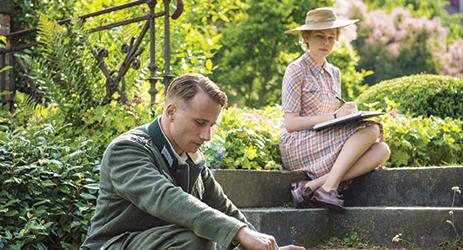
The beginning of the film, which is elegantly shot, shows us succinctly Vera Brittain’s (Alicia Vikander) well-to-do family. Vera and her brother Edward (Taron Egerton) are endearingly close. While their intention is good, their parents (Dominic West, Emily Watson) are protective and traditional: Edward has the chance to go to Oxford, Vera is meant for marriage. On this issue, Vera protests and argues with her father; eventually, her determination and intellectual vigour win through. A dream comes true when Vera enters the women’s Somerville College Oxford to study English Literature.
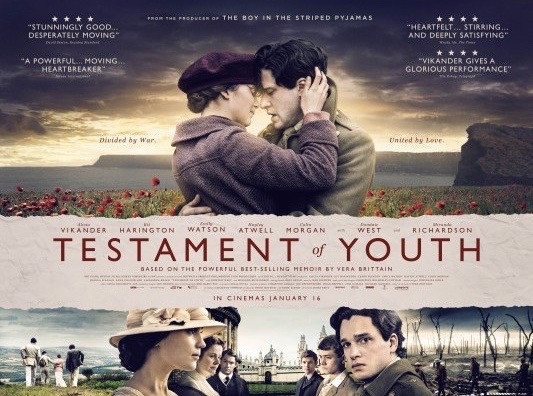
Testament of Youth Poster (1)

From her brother, Vera gets to know a few good Oxford men: Victor Richardson (Colin Morgan), Geoffrey Thurlow (Jonathan Bailey), and Roland Leighton (Kit Harington). Roland subsequently wins her heart with his sensitive, poetic inclination; the two soon are engaged. The winds of war blow callous and indiscriminate. As Britain is drawn into the fight, all these young men heed the call to enlist. Vera too decides to forsake her hard-earned Oxford education to join the Voluntary Aid Detachment as a nurse.

The saddest and most ironic notion about WWI is perhaps that it was first thought to be a fast and triumphal war. Surely, Britain came out a victor, but not before ringing up a horrific number of casualties and sending back home – for those fortunate enough – a permanently damaged generation. As the military struggle wained through four long years, Vera would ultimately lose all who are dearest to her: her brother Edward, her fiancé Roland, and their two close friends Victor and Geoffrey. After the war, Vera goes back to Oxford. Later, a disillusioned Vera becomes a vocal pacifist and an advocate of women’s rights.

This is British director James Kent’s full feature debut after years of helming TV productions. His effort is conscientious and serious, and for that, I’d much appreciated.  The film is beautifully shot and carefully crafted. The camera work, while giving us a traditional look, is agile and stylish; the editing succinct. I have not read the memoir so cannot offer comparison, but judging the film on its own, the screenplay is well written and the overall production, a captivating execution.

Kent has an excellent cast to work with, and that adds to the quality of the production. Vera Brittain is well portrayed by the nowadays ubiquitous, Swedish actress Alicia Vikander. She is in some very diverse roles, from Kitty in Anna Karenina (2012) to an AI robot in Ex Mechina (2015), to the witty British agent Gaby in The Man from U.N.C.L.E. (2015), and in several highly anticipated upcoming films.

Vikander is versatile, and her best quality is probably the intelligent and unsentimental mastery of her character. Here, she is a living testament to the devastation of war. For a witness to testify effectively, the most important element has to be clarity and not be overcome by emotions. She has delivered her message poignantly.

Other actors are just as competent in their roles, and a pleasure to watch, despite all their tragic end. Aaron Egerton as Edward, what a change from the street punk under Colin Firth’s mentoring in Kingsman: The Secret Service (2014). Kit Harington’s (Game of Throne fame) performance is effective, particularly in a scene where he comes home the first time from the trenches, a changed man. Veteran actors Dominic West and Emily Watson are excellent supports, especially West as the father torn by grief and ambivalence.

I have seen several WWI and II films in recent years: Sarah’s Key, The Book Thief, The Monuments Men, Suite Française, I have to place Testament of Youth above all of them. Visceral but not sentimental, the film communicates with painful clarity the devastation of war, the traumatic experiences in the trenches, and the cold, hard fact of a testimonial: the loss of a generation.

~ ~ ~ 1/2 Ripples

***

Other related Ripple Reviews:

Suite Française

The Book Thief

Sarah’s Key

Kingsman: The Secret Service

Ex Machina

Anna Karenina 

***


Go Set A Watchman: Sequel or Prequel?


Go Set A Watchman Book Cover


Background

Go Set A Watchman is Harper Lee’s first draft of a novel (See links at the end of the post). In 1957, Lee’s agent submitted it to Tay Hohoff, an editor at the now defunct publishing house J. B. Lippincott. Hohoff did not see it adequate to be published; however, she did see promising elements in it, “the spark of the true writer flashed in every line,” she later recounted.

The draft’s protagonist, 26 year-old Jean Louise Finch, Scout, now a New Yorker, goes back to visit her childhood home in fictional Maycomb County, Alabama, and finds discrepancies about her father Atticus now from the man she thought she had known all the years growing up. To her alarm and disillusionment, Atticus, while a good father and a good man to all the rest in Maycomb, holds racist views and is firmly a segregationist.

Hohoff advised Lee to rewrite the draft but this time, instead of writing Jean Louise Finch as an adult, focus on her reminiscence of her childhood growing up in Maycomb with her brother Jem, living under the roof of her father Atticus, and summer days spent with a boy next door called Dill. After more than two years of editing and rewriting, To Kill A Mockingbird was born. And the rest is history.

So here’s the query I have: If your novel, after two years of editing and re-inventing, had developed into a final form and published in 1960, some 50 plus years ago, had gained high acclaims, won the Pulitzer, become a beloved American classic, been adapted into an Oscar winning movie, and achieved international recognition, why would you want your very first draft as a novice be published to the world now?

At 89 years old, Harper Lee now lives in a nursing home, a stroke survivor who has lost most of her hearing and eyesight, and just months after her sister Alice Lee – guardian of her privacy and legal advisor – had passed, and suddenly a ‘newly discovered’ Harper Lee novel appeared.

In a recent New York Times Op Ed article entitled “The Harper Lee ‘Go Set A Watchman’ Fraud”, columnist Joe Nocera vehemently argues that the Rupert Murdoch-owned HarperCollins had “manufactured a phoney literary event.” The publishing house had sold more than 1.1 million copies of the book in a week, the ‘fastest-selling book in company history’ according to the publisher, to which Nocera decries “Go Set A Watchman constitutes one of the epic money grabs in the modern history of American publishing.”

The above is the major challenge surrounding this phenomenal ‘literary event’. So how should one read the book? Controversy aside, what can we reap from reading Go Set A Watchman?

Definitely not as a sequel and not a prequel either, but take it as it is: A first draft of To Kill A Mockingbird.

Only when comparing the two books as a ‘Before and After’ transformation can we see how the writing process had taken place. By reading Watchman as a first draft, we come to appreciate how a seasoned editor had helped a novice and an aspiring writer to achieve her goal to become a respectable, published author. And this we know Hohoff had done most successfully.

To Kill A Mockingbird Book Cover

***

Reading Go Set A Watchman

First off, to all readers, a major reminder: Harper Lee is a real person, and Atticus Finch is a fictional character. In Lee’s first draft, Go Set A Watchman, Atticus is a good father, but a racist. Yes, he had successfully defended Tom Robinson and gained him an acquittal, that was a court appointed case. This is anecdotally mentioned in Watchman. But Atticus is a self-professed Jeffersonian Democrat, one who subscribes to Jefferson’s view that: “A man couldn’t vote simply because he was a man… He had to be a responsible man.”

Lee spends a climatic chapter towards the end describing the arguments between father and daughter on the issue of race. While both are polar extremes, and I don’t want to quote the words from Atticus pouring forth his arguments about how “white is white and black’s black”, I must point out that it is Scout who loses her cool during the debate. She is the one who blows right out, foul-mouthed and accusing her father with hurtful, derogatory terms. Throughout the verbal confrontation, Atticus remains a gentleman. “I’m seventy-two years old, but I’m still open to suggestions.”

And I’m quite impressed by the next episode, and that’s when Scout cools down and goes back to her father, seeking reconciliation. It’s not just a simple case of ‘agree to disagree’, but somewhat laying out a more complex relationship with the ambivalent stance of ‘I can’t beat you, I can’t join you,’ but love can still triumph over all. That is the spark of an inspiring writer I can see in the conclusion of Lee’s Watchman. As Scout apologizes for her foul-mouthed diatribe aimed at her father the day before, this line from Atticus will remain with me: “I can take anything anybody calls me as long as it’s not true.”

Hohoff might just have seen this character trait in Atticus that she advised Lee to expand on in her rewrite. I see this admirable element as I read. Let the fictional character Atticus be created as an ideal type of a man, open to others’ opinions, upholding his ground with firmness but with no malicious hostility. And yes, we can all appreciate this change of heart in Lee’s rewriting in Mockingbird. Let Atticus be the ideal father and friend, a deserving, honourable man.

Further, in Watchman, the racist turn in Atticus has not been well accounted for. Since Jean Louise has come back to Maycomb annually to see her father, why the sudden discovery of his racist stance? And why had she not known about his views considering her close relationship with her father all her growing years and only in recent years in her adult life had she moved to NYC. But most important point of all Lee had not explained in Watchman, why had Atticus changed his view? These could be flaws in the plot line that Hohoff had Lee re-think.

As recounted, Lee based her Atticus character on her own father, the lawyer Amasa Coleman Lee who had actually defended two black men but failed to have them acquitted. According to reports, the elder Lee had been a segregationist but later changed his views to support integration. The real life parallel is obvious. The details we could only speculate, was it the man that had influenced the change in the book, or maybe vice versa?

In the rewriting process, there is the elimination of two significant characters in Watchman, Hank, Jean Louise’s suitor, and Uncle Jack, holder of family secrets. Once a clear storyline is established, with the equally moving minor plot of Boo Radley, a parallel Mockingbird theme with Tom Robinson as both being vulnerable victims, Hank and Uncle Jack would not be needed to uphold the story lines. So, no matter how much a writer had invested in a character, cuts and alterations could be the outcome, quite like the deleted scenes we see on DVDs, the rational choices we have to make in the long creative process. On the other hand, a character that exists only in memory, Jem, who had died in Watchman, is revived to his lively self, and we are all grateful for that revision.

One of the main reasons Hohoff had rejected the first draft was that it was episodic, lacking a unified story arc as a novel. Readers of Watchman will find this so, especially when Jean Louise switches back and forth from the present to the past. As I read, the past holds much more attractions as Scout describes her growing up days in Maycomb. We see the children in a different perspective, something like a ‘behind the scene’, a ‘making-of’ featurette. Thanks to Hohoff, such episodes are restrung into the gem of a book called To Kill A Mockingbird. Indeed, Hohoff had grasped the social psyche well, there was a need for a noble, heroic character in her time then, and maybe even more so in our time now.


***


LA Times (With video)

The Telegraph

New Republic

The New York Times (Jonathan Mahler)

The New York Times (Serge F. Kovaleski and

The Wall Street Journal

The Washington Post

The Washington Free Beacon

Wikipedia


Suite Française Movie Adaptation

The film is the long anticipated adaptation of Irène Némirovsky’s final work in progress before her death in 1942. Born in Ukraine, Némirovsky had moved to live in France since 1919. Before the Nazi occupation, she was a prominent literary figure in her adopted country, having published nine novels and a biography of Chekhov. The Nazi takeover sent her fleeing Paris. She was writing Suite Française in the village of Issy-l’Evêque where she was living with her husband and two young daughters when the French police arrested her for her Jewish descent and sent her to her demise in Auschwitz.

Suite Française was intended to be a literary composition in musical terms. Like a musical suite, the author had planned to write five pieces, but had only finished the first draft of two upon her death. The whole set when completed could have been an impressive eyewitness paralleled fiction, a historic testament reflecting the larger picture from the microlevel, a family, or, a woman and a man from different sides of the war falling in love.

suite_francaise

Such is the story of “Dolce”, the second novella in her Suite on which the movie is based. Lucile Angellia (Michelle Williams) falls in love with a German officer staying in her house where she lives with her widowed mother-in-law (Kristin Scott Thomas), the most elegant estate in the village. Lucile’s own husband has been missing in war and now a likely prisoner. That makes falling in love with the enemy right in your own home even more conflicting. However, Williams fails to bring out such internal battles or even ambivalence; Schoenaerts fares better in expressing the conflicts.

The opening of the film captures vividly what Némirovsky described as the ‘German artillery thunders… its wailings fill the sky’. As viewers we see people carrying suitcases and personal belongings scurry or simply dive for cover and we hear the sudden, roaring thunders of bomb blasting the country road on which refugees from Paris flee like rats – and as the camera zooms away – insects. It’s this kind of cinematic moments that make films powerful. We read about the air raids in the book, we see and hear the actual effects in the theatre. With that regard, the voiceover narrative by Michelle Williams is redundant. Or, maybe it’s just a lazy way of storytelling.

With that dynamic start, the film falters in not sustaining such power, albeit it still has many beautiful shots; romance in its period setting, the movie is visually appealing. But the attractions between Lucile and the handsome German official, Lieutenant Bruno von Falk, played by the ubiquitous Matthias Schoenaerts, soon becomes the centrepiece.

Like his role as Gabriel Oak in Far From the Madding Crowd, here Schoenaerts portrays another man of few words. Compare the two roles, he is more convincing here with his German officer look, and yes, sitting at the piano, mesmerizing Lucile with his soft touch. No words needed when music lures.

If not interrupted by her feisty mother-in-law, Lucile would have dived into the pool of passion immediately. Thanks to Kristin Scott Thomas, who adds some realistic sparks into the dreamy world of wartime romance with the ‘wrong man’. Such episodes could make interesting exploration, but the film is overwhelmingly mellowdramatic and seems not intended to be deep or psychological.

When a farmer, Benoit Labarie (Sam Reily), kills a German officer, the plot thickens. And as a viewer, I’m thankful for that turn in the otherwise relatively uneventful story. Benoit’s wife Madeleine (Ruth Wilson) urged Lucile to help him out. And that she did, risking everyone in her household and ultimately leading to the moral dilemma of both herself and her enemy lover.

The prolific film composer Alexandre Desplat (The King’s Speech, 2010, among many other works) wrote the signature piece “Bruno’s Theme”. While romantic in its overall styling, it is punctuated with discords, could well be a reflection of Bruno’s inner state. The ending of the film shows us his resolve. When love and duty is in conflict, there can’t be any favourable resolve. But then again, the film does not go further into that.

Kristin Scott Thomas plays a pivotal role in balancing sense and passion in her household, and bringing out some worthwhile and lively performance for the production. My major objection regarding this talented veteran of cinema and the stage is that nearly all her movie roles in recent years present her in character twenty years older than she really is. Here, the first shot we see Madam Angellier is her white painted, over-made-up face as an old widow. That is one reason why her other work in 2014 My Old Lady is so refreshing, for we get to see her in a suitable age where she can still find love.

Regarding WWII Holocaust movies, it is unfortunate that films of this genre in recent years based on popular fiction or chronicling significant historical events are mere passable works, like The Monuments Men, or The Book Thief, Sarah’s Keyor the related film Woman in Gold. Seems like the epic war movie genre with its affective power to move has not re-emerged in the past decade, iconic films such as Spielberg’s Schindler’s List (1993), Benigni’s Life Is Beautiful (1997), and Polanski’s The Pianist (2002) have all but remain distant memories.

As for Suite Française the movie, it should not be seen as the adaptation of Némirovsky’s book called Suite Française, however unfinished. The movie is best taken as a rendition of a storyline in one of its pieces, and true to the title ‘Dolce’, sweetly laced with soft touches. Overall, despite its flaws, it is still a watchable film.

~ ~ 1/2 Ripples

This is my second entry to the Paris In July blogging event hosted by Tamara of Thyme for Tea.

Paris in July 2015 Icon

***

Other Related Reviews on Ripple Effects:

Sarah’s Key (2010): From Book into Movie

The Book Thief (2013): From Book to Film

Far From the Madding Crowd (2015)

My Old Lady (2014)

Woman In Gold: Then and Now (2015)

The King’s Speech (2010)

***

National Theatre Live

National Theatre Live launched in June, 2009. Cameras are placed in strategic locations in the theatre to capture the stage performance live and broadcast to various venues the world over. According to the NTL website, over 3.5 million people have experienced this remote viewing of plays from London stages, with over 1,100 venues around the world, 550 in the UK alone. For the price of a movie ticket, I can be transported to the front row of these performances.

I ‘discovered’ this treasure too late, well, too late to see Skylight, with two of my faves Carey Mulligan and Bill Nighy. Skylight received 7 nominations for the Tony Awards coming this Sunday, June 7, including acting noms for Mulligan and Nighy, direction for Stephen Daldry, and overall Best Revival of a Play.

NTL’s Skylight had been shown in our Cineplex already, and I missed it. But, all is not lost. In the past two months since I knew about this treasure, I’ve watched three plays and have bought ticket to the October debut of Hamlet with Benedict Cumberbatch. Looking forward to that.

Here are the three shows I’d watched in the past few weeks. Click on the link to the NTL website for full descriptions. The following is just a summary of my thoughts.

The Hard Problem by Tom Stoppard

The Hard Problem

My full admiration to Tom Stoppard for writing a play to explore this hard problem, one that’s not very popular nowadays when science and technology reign supreme, when Dawkins speaks like the indisputable authority: Is evolutionary biology the all-encompassing codebook answering every human question? Hillary, a psychology research fellow at the Krohl Institute for Brain Science prays to God every night, simply madness to her fellow researcher. Her concerns: Can neuroscience explain consciousness, or beauty, or morality, faith, longings? And, sometimes one does need a miracle or two when dealing with personal regrets. The play is an intellectual odyssey with lively and energetic exchanges of amusing dialogues, humour that teases me with lines reminiscent of Rosencrantz and Guildenstern are Dead.

This is Stoppard’s new play in nine years. Mentored by Samuel Beckett, friend of Harold Pinter, writing for both stage and screen, Stoppard, at 77, remains one of my most respected writers. I’d loved Rosencrantz and Guildenstern are Dead, but his works on screen have been equally impressive with the Oscar winning Shakespeare In Love (1998), Parade’s End (2012, one of my fave TV mini-series), the Oscar nominated Anna Karenina (2012), and Empire of the Sun (1987, a unique and haunting chronicle of childhood).

And for this play, nobody is preaching anything here, there’s no need to, just raising the hard problem, that’s all. We hear that line in Hamlet ring out loud and clear: “There are more things in heaven and earth, Horatio, than are dreamt of in your philosophy.”

**

The View from the Bridge by Arthur Miller

A View from the Bridge performed at Wyndham's Theatre Richard Hansell as Louis, Nicola Walker as Beatrice, Mark Strong as Eddie, Michael Gould as Alfieri, Emun Elliott as Marco ©Alastair Muir 16.02.15

Mark Strong is explosive as Eddie Carbone, the longshoreman who accommodates in his home two of his wife’s cousins, brothers and illegal immigrants just arrived from Sicily. Eddie’s possessive care and love for his niece Catherine who has been living with him all the years, turns to malicious jealousy as she falls for the younger of the brothers. Miller’s play is about the American Dream gone sour.

What an eye-opener of a stage play. Mounted at London’s Young Vic Theatre, the stage design is stylishly minimal. With audience viewing from three sides, it lays bare the human soul and its inexplicable and unbridled emotions. I have not seen anything like it. First off, can you imagine two men taking a shower on stage at the beginning of the play… with real water, and towards the end, that water turns into blood showering down, covering all the characters for the stunning, tragic ending.

**

Man and Superman by Bernard Shaw

Man and Superman

This one, I must say hats off to Ralph Fiennes for his extraordinary energy. Playing Jack Tanner, a radical thinker of his days, and the reluctant guardian and later romantic resolve for a beautiful heiress, Fiennes leads us on a wild ride from reality to fantasy, from earth to hell and back again. Well, no superhero in our CGI saturated movies nowadays can rival. Blurting out lines after lines non-stop for over three hours, in one take, dialogues covering all the brilliance of Shaw’s philosophical, social, and political views, with spot-on timing and great fun. Which comedian can beat that? And of course, what he and Shaw had shown us is that words and the intellect can be more powerful and entertaining than on screen action sequences and technical wizardry.

***

~ ~ ~ ~ Ripples to all of the above 

Far From the Madding Crowd (2015)

Here’s the paradox of books to movies. The more you know about the book, the more critical you’ll be when watching the movie, and the less likely you’ll enjoy it. Here’s a case in point. If you want to enjoy this current version of Far From the Madding Crowd without hindrance, do not read or reread Hardy’s novel before you see it. For me, alas, I’ve read it twice in the last few months. So, who can I blame if I find the movie disappointing?

Now, I know exactly that I need to judge a movie on its own merits and not according to how ‘faithful’ it is to the source. I’ve written a post on this view. This current adaptation misses the mark not because it’s not ‘faithful’ but because it has been mishandled. The script, the direction, and for that matter, the casting. Now hear me out. far-form-the-madding-crowd I had high expectations for it. Here we have an Oscar nominated director, Thomas Vinterberg (The Hunt, 2012), offering a new version from John Schlesinger’s 1967 production which touted a high calibre cast of Julie Christie, Peter Finch, Alan Bates and Terrance Stamp. After almost fifty years, should one not hold a certain high level of excitement in welcoming a new version with a modern cast?

To start off, I must give credit where it’s due and that’s to the director of photography Charlotte Bruus Christensen (The Hunt) for bringing the beautiful Dorset country to the big screen so we can visualize Hardy’s ‘Wessex’. The camera captures the lush green fields and gentle rolling hills at dawn and dusk, the farming life, the harvesting under the golden sun. Reminds me of Terrence Malick’s Days of Heaven. The scenic and authentic location of the filming is an alluring backdrop to the story.

Now to the screenplay. David Nicholls is no stranger to simplified versions of classics. His last Hardy light Tess of the D’Urbervilles, a TV mini-series (2008), had four episodes to tell the story. But here as a full-length feature, this new Madding Crowd script could make CliffsNotes writers feel they are doing some heavy lifting. Actually, the movie is not far from the source material, almost all of the scenes and many of the dialogues come from the book, with some alterations, but this is understandable. One would think alterations should be for the purpose of dramatization; so it’s just mind boggling that certain scenes that are essentially dramatic in the novel have been left out, ones that could have enhanced the tension substantially. Two readily come to mind: First is the circus scene where Sergeant Troy was nearly recognized by Bathsheba, and the second is right at the climax of the story, Boldwood’s Christmas party, not omitted but with its tension substantially lessened.

Danish director Vinterberg’s previous work The Hunt – a 2014 Oscar Best Foreign Language Film nominee – was a riveting and psychological piece of work. He could have operated in that mode here. With the scenes sweeping by, and leaving out some pivotal cinematic moments, he has missed chances to engage the audience. The altered state of the climatic scene is regretful. Take that crucial act when Boldwood was driven by mad passion (I’m trying to avoid spoiler here in case you haven’t read the book) during that fateful Christmas party in his home. Instead of displaying the conflict and tension in full public view, Vinterberg has taken the action out into the dark of night. Without all the guests as witnesses, the gravity of the conflict and Boldwood’s ultimate action is effectually diminished; not only that, the handling is incredulously haphazard and swift. While Hardy’s Far From the Madding Crowd exudes a lighter mood compared to the cosmically burdened Tess of the U’Derbervilles – and I chuckled at many of his lines while reading – I don’t expect movie viewers would take this film as a comedy. But this was exactly the audience’s reaction in the theatre. When you hear loud laughter at the climax of the movie, you know the director has missed the mark.

The story is about the characters, more so here when you have one headstrong female being wooed by three vastly different men. What’s intriguing is the emotional ‘trilemma’ of our heroine. The effervescent Bathsheba Everdene, the independent, new mistress of the Weatherbury farm is, alas, misdirected. Carey Mulligan can be a convincing Bathsheba, but the strength of character is diminished by the breezy script and a director who fails to draw out her potential. From the “I shall astonish you all” first meeting with her farmhands to the “Please don’t desert me, Gabriel!” plea to Oak so he would come back to rescue her ailing flock, there are pages of Hardy descriptions. Surely, time is of the essence in a 120-minute movie, but at least show visually the gravity of her situation before she so readily rides horseback and race to Gabriel. As a transition, let the camera frame a wide angle shot of the field littered with sheep lying helpless, ready to expire, for she’s about to lose them all. But just showing a sheep in distress doesn’t warrant the quick change in character, from leading to pleading. It looks like Vinterberg has crafted a feeble and even exploitive Bathsheba who gets her way by her outward charm. In several scenes she could have been more intense; we see no Hardy’s expression of ‘nether lip quivered.’

Among the three suiters, the strongest performance comes from Michael Sheen as William Boldwood. His nuanced facial expressions speak louder than words. Whether intentioned by Vinterberg or not, Sheen has turned the truly, madly, deeply love-sick Boldwood into a comic character, more so than Hardy’s portrayal. Or, were the laughters not intended? No matter, Sheen’s performance compensates for the lack of in the other two men.

Gabriel Oak the resourceful shepherd is the strong and silent type. Not only is he a man of few words, the Belgium actor Matthias Schoenaerts has turned him into a man of few expressions as well. Schoenaerts is fine in action thrillers like The Drop (2014) but just not in a romantic lead, as in Rust and Bone (2012), and now Madding Crowd, for he fails to command the image of either a lead or a romantic. In several scenes, we as audience are left hanging, ungratified, for his lack of verbal response to Bathsheba’s sincere words. 

If Schoenaerts is expressionless, here is an equal rival, Tom Sturridge as Sergeant Troy. The George Wickham parallel who dazzles with his brass and scarlet, Sergeant Troy is a subdued character here who lures with his sword. Is it the director or the screenwriter, the few lines given him are mostly sparse and one-liners like “I don’t think I’ve ever seen a face as beautiful as yours.” Sure, that’s from Hardy, but in richer descriptive context. Or, another short line to explain (away) pages of happenings absent on screen.

I’m writing this not in disrespect but disappointment in that a good chance to do justice to Hardy’s illuminating work is missed. Yet, all is not lost; there still remains a synopsis of a Hardy story and Hardy country in full cinematic view. Further, we are confirmed, again, that Carey Mulligan can sing, in a particular folksy, soulful way. So far, I’ve heard her sing in three movies, and each time it enriches the storytelling. When Awards Season comes this fall, I look forward to a stronger performance from her in Suffragette. Simply by virtue of the release date, it is an award hopeful. Some are already predicting Oscar nods for her role in that production.

As for Madding Crowd, let’s just note that it’s a May-released movie.

~ ~ 1/2 Ripples 

________________

Other related review posts:

Tess of the d’Urbervilles (2008, TV)

The Great Gatsby (2013)

Never Let Me Go (2010)

An Education (2009)

Can a Movie Adaptation Ever be As Good As the Book?

Voice of the Poet: Things Fall Apart

April is National Poetry Month, and three quarters of the days are already gone. Still not too late for me to offer a poetry post. At present, I’m reading Joan Didion’s essay collection Slouching Towards Bethlehem (more about that in a later post). To start off her book, Didion uses W. B. Yeats’ poem “The Second Coming”, from which her book title originates.

Yeats wrote the poem in 1919, shortly after WWI; it was published in 1920. Didion used it like an epigraph for her book published in 1968, about fifty years later, apparently finding it speaks to her collection of essays on her experiences in 1960’s America.

Now almost another fifty years later, the poem still has not lost its relevance. Yeats’ mythical references aside, and just listen to the clearer and more direct words, I can hear the Poet’s voice speak hauntingly to our present world.

**

The Second Coming 
by William Butler Yeats (1865-1939)

Turning and turning in the widening gyre
The falcon cannot hear the falconer;
Things fall apart; the centre cannot hold;
Mere anarchy is loosed upon the world,
The blood-dimmed tide is loosed, and everywhere
The ceremony of innocence is drowned.
The best lack all conviction, while the worst
Are full of passionate intensity.

Surely some revelation is at hand;
Surely the Second Coming is at hand.
The Second Coming! Hardly are those words out
When a vast image out of Spiritus Mundi
Troubles my sight: somewhere in sands of the desert
A shape with lion body and the head of a man,
A gaze blank and pitiless as the sun,
Is moving its slow thighs, while all about it
Reel shadows of the indignant desert birds.
The darkness drops again; but now I know
That twenty centuries of stony sleep
Were vexed to nightmare by a rocking cradle,
And what rough beast, its hour come round at last,
Slouches towards Bethlehem to be born?

**

Especially the first stanza… hear what I mean?

From Z to A: How Zweig Inspired Anderson’s Grand Budapest Hotel

The following is the first part of my article in the new Spring Issue of the online review magazine Shiny New Books. In the article, I introduce the Austrian writer Stefan Zweig, whom director Wes Anderson acknowledged as the source of inspiration for his Oscar winning production. To read the whole piece, CLICK HERE. I’m sure you’ll find the SNB site informative and a valuable resource of books and authors.

***

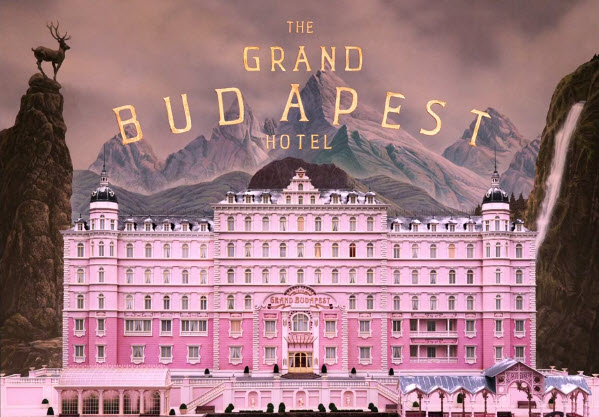
The Grand Budapest Hotel won four Oscars at the 87th Academy Awards this February. In the end of the film leading the credits is the acknowledgement of Stefan Zweig (1881-1942), whose writings had inspired the production. During interviews, director Wes Anderson had joked that he ‘stole’ from the Austrian writer: ‘It’s basically plagiarism,” he said. Anderson is all modesty when making such a remark, for the film has his own signature style. Unlike Zweig’s more serious and darker hue, Anderson has created a colourful fantasy. Rather than an imitation, the film should be regarded as a worthy homage to an author who had been noted as one of the most translated German-language writers during the 1930’s.

the-grand-budapest-hotel movie poster

Anderson came across Zweig by chance when he purchased his 1939 novel Beware of Pity in a Paris bookstore. After two pages, he knew he had discovered a new favorite author. Twenty pages later, he wanted to adapt it into film. Then he read some more Zweig and liked them all. So he made a peculiar endeavour, he transposed the author’s oeuvre, his life and spirit into his own re-imagining, creating a film that eventually would catapult him to the zenith of acclamation.

The Grand Budapest Hotel was nominated for nine Oscars at the 2015 Academy Awards, including Best Picture, Best Directing, and Best Original Screenplay for Anderson himself. Albeit not having won these major categories, the film did capture four wins in Original Score, Production Design, Costume Design, Makeup and Hairstyling. The triumph is shared by the late Zweig, for he has now been introduced to many more readers, especially those of us in North America. New York Review Books has seen Zweig’s popularity rise after the movie, but it is UK’s Pushkin Press that holds the banner of a ‘Zweig revival’ by republishing many of his works in English translation.

Zweig was born 1881 in Vienna to a Jewish family who circulated freely in the upper crust of Austro-Hungarian society. He was versatile and prolific as a poet, translator, biographer, essayist, lyricist, short story writer and novelist. His literary achievement was prodigious. At nineteen, Zweig saw his first publication, a collection of poetry by the respectable publisher Schuster & Löffler. Upon this debut on the literary stage, Zweig was ecstatic to receive a gift from his idol, Rilke, who had read the youngster’s work and sent him a special edition of his own poetry with the inscription addressed to Zweig: “with thanks.” Later, still at the tender age of nineteen, Zweig saw his essays published in the feuilleton, literary supplement, of Vienna’s prestigious newspaper the Neue Freie Presse, sharing the pages with such formidable literary figures as Ibsen, Zola, Strindberg and Shaw.

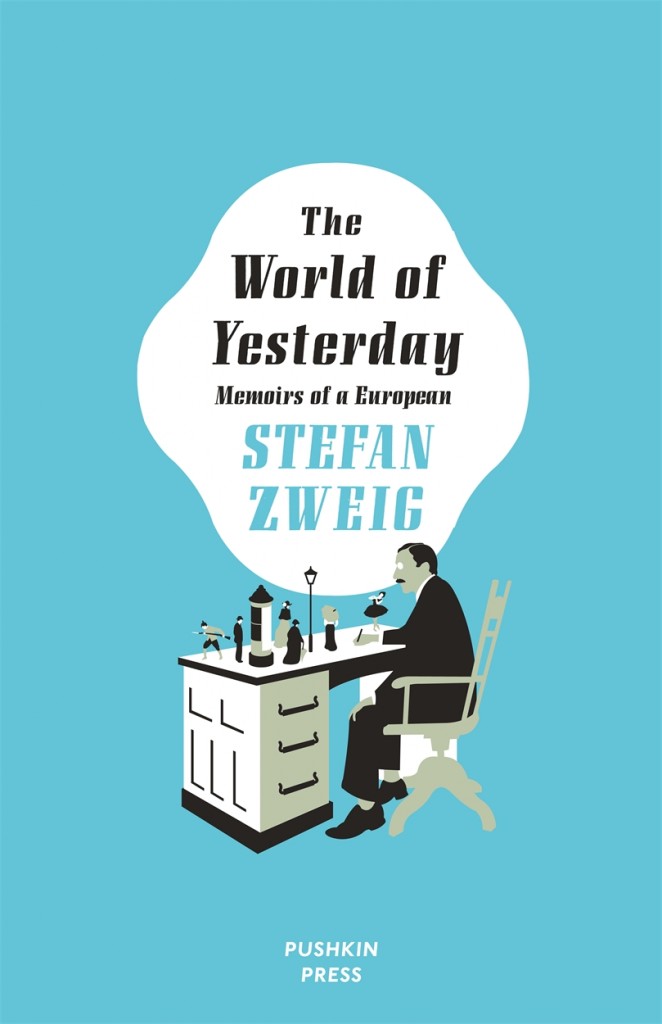
The World of Yesterday ZweigReaders can find his excitement in recalling these unexpected early successes in his autobiography The World of Yesterday. It was not so much about fame but identity. The glorious world of yesterday included not only the fulfilled dream of a young man, but that of the Jewish people in finding a homeland, free and secure in Vienna. At long last, they could taste the reality of belonging. Jews in Vienna had become respectable, contributing members of society, particularly in the realms of the arts and culture.

As we can see from history, such a triumph would soon be obliterated. In August 1914, Zweig saw the world order and security that he so cherished and thrived on crumble as WWI broke out. If that was the beginning of the end, Nazism in the 1930’s rang in the death toll. Zweig had to escape to England, later the United States, finally landed in Brazil. Exiled and alienated, the Austrian writer was overwhelmed by despair as he saw his homeland and Europe devoured by Hitler. The German language he was born into and had so aptly used in his literary success he now had to apologize for. Such devastation and emptiness was too much to bear. In 1942, just a few days after He sent off his last book Chess Story to his American publisher, Zweig and his second wife committed suicide together in Petrópolis, Brazil.

Wes Anderson recreated Zweig’s pre-war world in his fictional Republic of Zubrowka, with The Grand Budapest Hotel itself as a metaphor of that secure microcosm, everything runs smoothly under the supervision of the concierge M. Gustave (Ralph Fiennes), at least in the first half of the film. The boxy Academy Ratio we see on screen evokes the idea of looking into an old photo album in all its nostalgic charm. The exile life of a genocide survivor we can find in Zero the lobby boy (Tony Revolori young, F. Murray Abraham older).

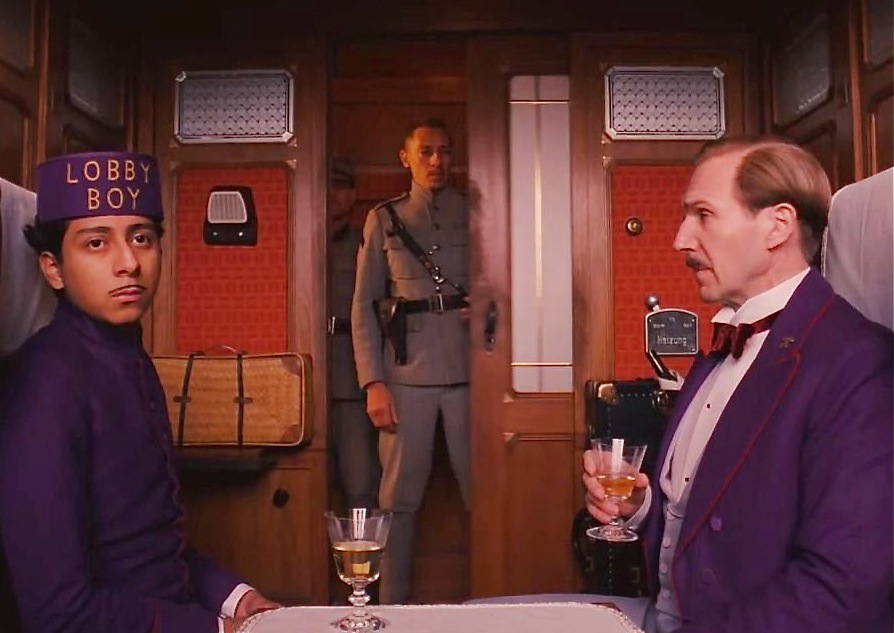
Passport CheckRichard Brody in his New Yorker article “Stefan Zweig, Wes Anderson, And a Longing for the Past” writes that Zweig himself had experienced the ‘practical difficulties’ and ‘psychological trauma’ of having lost his passport while on the run. The passport, Brody notes, “wasn’t even a commonplace document before the First World War.” Without it, one instantly was turned into an outlaw. Zero has M. Gustave to thank for standing up for him twice while travelling on the train without transit papers. The first time, officer Henckels (Edward Norton) recognizes M. Gustave, his parents’ friend, and remembers his kindness to him when he was a boy; human relations win over and Zero is spared. Unfortunately, luck runs out for M. Gustave in the second time, all because of the change in military control, a symbolic reference to the iron fist of the Nazi regime. No societal ties or achievements could save Zweig or the Jews in Europe during the Holocaust.

The following are two titles to which Anderson had made specific reference – Zweig’s only novel Beware of Pity and his novella The Post-Office Girl. The third is Anderson’s own selections, an excellent sampler of Zweig’s works, The Society of the Crossed Keys.

To continue reading my short reviews of these books, CLICK HERE to Shiny New Books. Or, just click anyway to see what an array of book reviews, author interviews and their own articles, book news and tidbits await you.

***

Seven Stanzas for a Happy Easter

Rocks


“Seven Stanzas At Easter” by John Updike

Make no mistake: if he rose at all
It was as His body;
If the cell’s dissolution did not reverse, the molecule reknit,
The amino acids rekindle,
The Church will fall.

It was not as the flowers,
Each soft spring recurrent;
It was not as His Spirit in the mouths and fuddled eyes of the
Eleven apostles;
It was as His flesh; ours.

The same hinged thumbs and toes
The same valved heart
That—pierced—died, withered, paused, and then regathered
Out of enduring Might
New strength to enclose.

Let us not mock God with metaphor,
Analogy, sidestepping, transcendence,
Making of the event a parable, a sign painted in the faded
Credulity of earlier ages:
Let us walk through the door.

The stone is rolled back, not papier-mache,
Not a stone in a story,
But the vast rock of materiality that in the slow grinding of
Time will eclipse for each of us
The wide light of day.

And if we have an angel at the tomb,
Make it a real angel,
Weighty with Max Planck’s quanta, vivid with hair, opaque in
The dawn light, robed in real linen
Spun on a definite loom.

Let us not seek to make it less monstrous,
For our own convenience, our own sense of beauty,
Lest, awakened in one unthinkable hour, we are embarrassed
By the miracle,
And crushed by remonstrance.

– John Updike (1932-2009)

***

Happy Easter to All!

Back to the Source: From Movie to Book

Those who have come to the pond here for a while would know I’m a Book to Movie person. If I know a film adaptation is coming out, I’d want to read the book first, as I’m always intrigued by the adaptation process. Maybe it’s the transposition of one art form into another that so fascinates me. Yes, you can say it’s a kind of theme and variation type of work.

But there are also times when I’m so captivated by a movie that, after watching it, I want to read the book on which it’s based. Thanks to Wes Anderson, I’m now reading Stefan Zweig.

the-grand-budapest-hotel movie poster

Before watching The Grand Budapest Hotel last April, I had never heard of the Austrian novelist, playwright, journalist and biographer Stefan Zweig. During the 1920’s and 1930’s, Zweig was one of the most famous and translated writers. And yes, here I am living under a Rock(ies), have never heard of the name until Wes Anderson’s confessional interviews, wherein he raved about how his (now) Oscar winning Budapest Hotel was influenced by the writings of Stefan Zweig. Also in the movie, there is the acknowledgement of Zweig as the source of inspiration as the film’s end credits begin to roll.

Here’s what’s interesting: Instead of adapting from one single work, Anderson created his Budapest Hotel sparked by the oeuvre of Zweig’s after he read his writings only a few years before. After watching the film, I’ve since read several of Zweig’s short stories, and a couple of novellas The Post Office Girl and Chess Story, and now continue to delve into more of his captivating, often bittersweet, stories. Watch for my article coming out in the April (Spring) issue of Shiny New Books on how Z inspired A.

So The Budapest is the most recent example of how a movie influences my reading. Over the years, there have been other ones. Here are some more:

12 Years A Slave (2013) – Steve McQueen’s artistic rendering of slavery may seem like a paradox, but acclaimed British actor Chiwetel Ejiofor’s performance as Solomon Northup is what spurred me to read the original memoir. Both are excellent works.

3:10 to Yuma (2007) – Have you ever read a Western short story? Western as in uh… cowboy, gunslingers. This is one of the few Western work I’ve ever read. The intriguing moral dilemma the movie depicts and its poignant ending had driven me to look for the short story by Elmore Leonard as soon as I left the theatre.

Bleak House (2005) – The BBC TV mini-series with Gillian Anderson as Lady Dedlock, Anna Maxwell Martin as Esther Summerson sealed the deal for me. The series also introduced me to the talented Carey Mulligan, her first role I believe. I turned to the 1,000 plus pages Dickens novel soon after the series finished. Because I’ve seen it first, it was a breezy read, almost.

Howards Ends (1992)  A cast with Emma Thompson, Helena Bonham Carter and Vanessa Redgrave is not hard to move and entertain. And thanks to Merchant Ivory, the dynamic dual of producer/director, and their team writer Ruth Prawer Jhabvala, I devoured the humorous and equally entertaining E. M Forster novel after that.

Revolutionary Road (2008) – I was captivated by the movie at first. Kate Winslet and Leo DiCaprio had done a marvelous job in depicting the entrapment of suburban life. But only through reading Richard Yates’ book did I sense the even deeper psychological entanglement that I missed in the film.

The Diving Bell and the Butterfly (2007) – I wrote in my book review, “This is one book that should be read after watching the film. Without visualizing what Jean-Dominique Bauby had gone through after his massive stroke, the reader simply could not empathize or appreciate enough of Bauby’s effort in ‘writing’ his memoir.” How? One blink at a time.

When Did You Last See Your Father (2007) – I watched the film twice at TIFF a few years back, Colin Firth as British writer Blake Morrison and Jim Broadbent as his overbearing and critical father dying of cancer. The life-long yearning of a son seeking his father’s approval is so sensitively portrayed. Reading Morrison’s memoir after only made me appreciate the film more.

How about you? Are there movies that have motivated you to go back to the source and read the book?

***

(CLICK ON the links in the titles to read my reviews.)

2015 Books to Movies

First off, I’m excited that two movies I reviewed months ago last year and which I’d given top ripples both won the Golden Globe Best Motion Picture Award last night: The Grand Budapest Hotel (Musical or Comedy) and Boyhood (Drama). The Golden Globe Awards marks the new year with excitement and glamour, an apt recognition of fine films made in the previous year, as we eagerly await the ultimate, the Academy Awards. That will be a final wrap for 2014 movies. So what is in-store for us in 2015? For those familiar with Ripple Effects, one of my focus is on books being turned into movies. The Books Into Films posts are some of the most popular on this blog. I’m particularly interested in the adaptation process, how one art form is transposed into another medium. What works, what doesn’t? And above all, how to appreciate each on its own terms. Here is my first list of books to read (or reread) before you go and watch the movie, all scheduled to be released in 2015, some with known dates, some more tentative. A second list will appear in the online review magazine Shiny New Books come January 29.

 ***

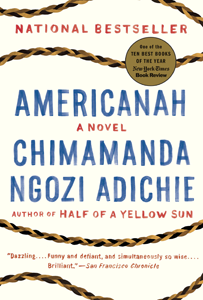
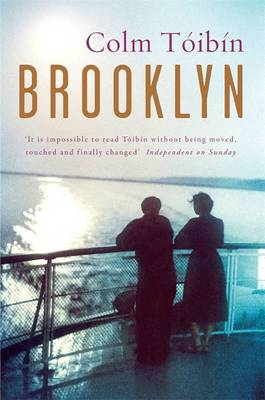
Americanah by Chimamanda Ngozi Adichie americanah The acclaimed novel by the award-winning author of Half of the Yellow Sun, Americanah tells a story that crosses three continents in the countries of Nigeria, US, and England, linking two lovers through the expanse of time and space, and exploring the evermore relevant issues of race, identity, drifting and belonging. Adichie’s novel is the winner of the 2013 National Book Critics Circle Award for Fiction among other accolades. It is now adapted into film starring Lupita Nyong’o, on the heels of her 2013 Oscar win as Patsey in 12 Years A Slave, and David Oyelowo, 2015 Golden Globe nominee for his role as Martin Luther King Jr. in Selma.   Brooklyn by Colm Tóibín Brooklyn_Colm_Toibin Once again the story of migrating and shifting ground, this time from Dublin to Brooklyn. Colm Tóibín’s 2009 Costa Novel Award winner and longlisted novel on the Booker Prize that year tells the story of Ellis Lacey moving to America from Ireland in the 1950’s, as many did, for new life and opportunities. But her story did not end there. The movie adaptation will premiere at Sundance Film Festival January 26, 2015. Saoirse Ronan plays Ellis. She has come a long way in her career with her first breakout role as young Briony in Ian McEwan’s Atonement. Cast includes Domhnall Gleeson, Jim Broadbent and Julie Walters.   Far from the Madding Crowd by Thomas Hardy far-from-the-madding-crowd A highly anticipated film adaptation of Hardy’s classic. That Carey Mulligan is playing Bethsheba Everdene increases my curiosity even more, especially as I hear her sing the folksy tune in the movie trailer. Those who hold onto the Julie Christie’s 1967 portrayal as the definitive version should see this for comparison. Screenplay by David Nicholls, who is no stranger to classics on screen, having previously adapted Tess of the D’urbervilles (TV, 2008), and more recently Great Expectations (2012). What makes this newest Hardy adaptation sound promising is its Danish director Thomas Vinterberg, whose film The Hunt was nominated for a 2014 Best Foreign Language Film Oscar. Matthias Schoenaerts plays Gabriel Oak. Note the name, he will appear in another book to film production.   In The Heart of the Sea by Nathaniel Philbrick in-the-heart-of-the-sea-book-cover The book records the true story of the tragic loss of the American whaleship The Essex from Nantucket when it was capsized by a sperm whale in the Pacific Ocean in November 1820. A real life Moby Dick, In The Heart of the Sea was the winner of the 2000 National Book Award for Nonfiction. The crews were stranded at sea for months. The book chronicles the tragedy and the horrific experience by a few survivors. Oscar winning director Ron Howard (A Beautiful Mind, 2001) cast the star of his acclaimed production Rush (2013), Chris Hemsworth, in this adaptation. Also notable is Ben Whishaw playing Herman Melville. A versatile actor, Whishaw had played the poet John Keats, the new Q in James Bond, and is now the voice of Paddington Bear, replacing Colin Firth.   Kingsman: The Secret Service by Dave Gibbons and Mark Millar secret-service-kingsman So what’s Colin Firth been busy doing? One of his new movies coming out in 2015 is the adaptation of a comic book, The Secret Service, created by Dave Gibbons and Mark Millar, definitely not something Firth or his fans could have expected when Mr. Darcy dove into that pond at Pemberley. A comic book? You gasp. That’s right, a totally legit read nowadays, when you have the graphic novel of Proust’s In Search of Lost Time on the same shelf in the library. Firth plays Harry Hart training up a young recruit for the Secret Service, with Taron Egerton, Mark Strong, Michael Caine, Samuel L. Jackson, directed by Matthew Vaughn who had all warmed up with Kick-Ass and X-Men. From the trailer, it sure looks like a visual delight, action-filled, slick and clever. The Secret In Their Eyes by Eduardo Sacheri The Secret in Their Eyes This originally Argentine crime thriller was first adapted into a Spanish movie that won the Best Foreign Language Film Oscar in 2010. As soon as I finished watching the film, I downloaded the music soundtrack; it was deeply moving. This is no ordinary crime thriller, but a poignant, psychological exploration of human experience and memories. The new English version of the film has an appealing cast starring Chiwetel Ejiofor (nominated for an Oscar for his role in 12 Years A Slave), Julia Roberts and Nicole Kidman, helmed by Hunger Games and Captain Phillips director Billy Ray. Ray also wrote the screenplay. I highly anticipate this English version, albeit I admit the original language version is usually the more affective and authentic rendition. Silence by Shûsaku Endô Silence  Shûsaku Endô’s historical fiction (1966) on the plight of the Catholic Jesuit missionaries to Japan in the 17th Century is a deep and disturbing novel. It touches on multiple levels of the human spirit and psyche, issues that are not easily labelled by the term ‘religion’, dealing with the problem of faith in a God that appears to be silent in the midst of suffering and persecutions of His followers. In a culture that is xenophobic at the time, Endô, a Catholic himself, confronts the issue of doubt and the power of evil head-on. The book reads like a page turner, and I expect the film adaptation to be cinematically gratifying in the hands of an auteur of the Catholic tradition, Martin Scorsese. The new edition of the book includes Scorsese’s preface. The film is shot in Taiwan instead of Japan, with a perfect cast: Liam Neeson, Andrew Garfield and Adam Driver, screenplay by Jay Cock, screenwriter of The Age of Innocence.

***

More to come… On January 29, go to Shiny New Books the online review magazine for my second list of 2015 Books into Films.

Reading The Season: Lila by Marilynne Robinson

Every year before Christmas, I read something that can draw me closer to the meaning of the Season. Amidst the busyness of the festivities, I try to carve out a piece of quiet. I name these annual posts Reading The Season. You can click on the links at the bottom for previous entries, dating back to 2008. This year, the publication of Marilynne Robinson’s third Gilead book, Lila, is a most timely read.

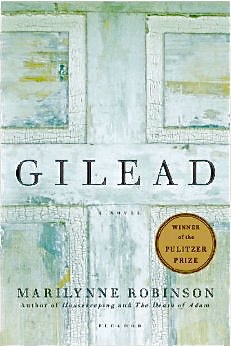
GileadGilead (2004) – Marilynne Robinson’s Pulitzer Prize and National Book Critic Circle Award winning novel introduces us to the fictional town of Gilead, Iowa. We hear the gentle voice of the narrator, the ageing Rev. John Ames, as he writes a letter to his seven-year-old son Robby, leaving a legacy of family heritage, love, forgiveness, and serenity.

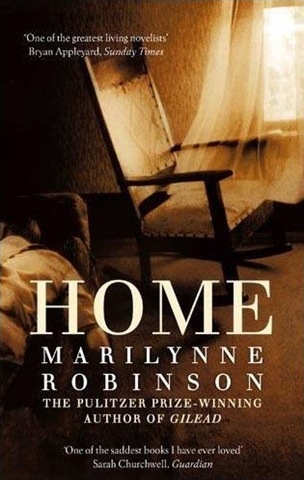
HomeHome (2008) – Based on the same Gilead characters, but from a different point of view allowing us privy to the household of the Rev. Robert Boughton, John Ames’s life long-friend. Glory, Boughton’s daughter, comes home to take care of her ailing father. She is there when her brother Jack returns after an absence of twenty years. The black sheep of the family, Jack’s estranged self yearns for reconciliation like a prodigal. The book, in all its complexities and depiction of alienation, escape, return and lost yet again, suggests home may not be a solace as sweet as one hopes.

Lila

Lila (2014) – Robinson’s newest, and 2014 National Book Award finalist. It is the third novel based on the characters in the town of Gilead, offering yet another point of view. But one can just read it on its own, albeit best to have read Gilead first, then the kind face of John Ames can be conjured up more readily. In this book, the perspective is from Ames’s much younger wife Lila, at first lonely and desolate, slowly drifting into place.

**

Lila Dahl

At the outset, we see Lila as an unwanted child, “cold”, ‘all cried out’. She is rescued by Doll, a destitute woman herself yet still has room in her heart for an abandoned little girl. Doll wraps Lila into her shawl and decides to bring her up. “Lila was the loneliest child, and there they were, the two of them together, keeping each other warm in the rain.” Lila later takes up Doll’s name as Dahl.

The two joins a small group of itinerant field workers led by Doane, living in camps out in the open. But the Depression breaks up the cohesive work party. Lila is later left on her own and for a little while, works in a brothel in St. Louis. Knowing she can’t stay there for long, she slips out one night, escaping from a blackhole of hopelessness.

After that she finds herself a cleaning job at a hotel, from which she has to escape again after seeing her nemesis whom she first encounters while in the brothel. She packs her bag and leaves town, taking rides from strangers going to wherever they drop her. Ultimately, Lila drifts to the outskirt of Gilead, finds an abandoned shack and takes shelter there. She cleans up the shack for a place to sleep, having no plans except to find odd jobs in the town yonder, earn enough money, then moves on, maybe to Sioux City.

Lila lives a life of poverty, loneliness and fear, mistrusting everyone. Doll may have been like a mother to her but she too has her own rough life and struggles. Doll knifes and kills a man who might be Lila’s own father, could well be out of protecting Lila. She is later jailed, leaving the knife in Lila’s possession. Lila keeps it with her all the years as a memento, a murder weapon, yes, but also a symbol of Doll’s loving protection and Lila’s own desolate past.

One day walking into Gilead Lila stumbles into a church to escape the rain, that is the turning point of her life. She sees the old man at the pulpit, the Rev. John Ames, and, he sees her.

John Ames

We know a lot about Ames from Robinson’s first book of Gilead, set in the 1950’s. A Congregationalist pastor in the town, Ames is sixty-seven years old when he first meets Lila, “a big, silvery old man”. Coming from a family tradition of ministers, John Ames is a man with a pastor’s heart.

Ames has had his share of personal grief. He had to bear the death of his beloved wife of his youth and his newborn son as she died in childbirth. Such unspeakable pain he had shared with his best friend Robert Boughton, pastor of the Presbyterian church in Gilead.

Ames and Boughton have been life long friends. They share pastoring advice, discuss foreign policies, debate theological problems, and bear the burden of each other’s family woes. Boughton has his in his son Jack, who takes John Ames’s namesake.

After seeing Lila at the church as she comes in from the rain, Ames keeps her in his heart. Residents of Gilead befriend Lila, giving her jobs, welcoming her in their midst, but Lila is aloof and skeptical, an outsider still. Ames personally engages her to talk and to know her more. One day, he goes to seek her out at the shack. She sees him coming as she walks towards Gilead. There on the path he reaches out to her and promises marriage. An inexplicable love story takes shape.

Sunset

Ames and Lila

“… the old man kept on courting her, like a boy, when she was hard and wary…”

After they are married, however incompatible it looks in Ames’s home, Lila still keeps Doll’s knife with her as a memento and as a symbol of her own tumultuous past, a part of herself. Ames is unperturbed. He lets her keep it, and he even uses it, taking it as a normal tool around the house. Total acceptance.

If condescension is present in the relationship, it is Ames who wants to learn from Lila. His utter humility is what moves her. Barely literate, Lila yearns to know about the Bible, study it and grasp its richness and meaning. They talk about the difficult books of Ezekiel and Job. Ames shares his thoughts about this elusive notion called existence, and listens attentively Lila’s perspective and experiences. Total respect.

Lila has questions rooted in her bitter past, the why’s of misfortunes, cruelty, and the hardships in life. She asks Ames with an inquiring heart. Ames, a pastor of many years, can find no easy answers. He ponders Lila’s queries, and readily and honestly admits his own limitations in knowing, while loving her all the more. Total humility.

Even after they are married, Lila sometimes still conjures up thoughts of leaving. Ames  knows this and gives her the freedom:

… if you ever change your mind, I want you to leave by daylight. I want you to have a train ticket in your hand that will take you right where you want to go, and I want you to take your ring and anything else I have given you. You might want to sell it. That would be all right. It’s yours, not mine… ” He cleared this throat. “You’re my wife,” he said. “I want to take care of you, even if that means someday seeing you to the train.” He leaned forward and looked into her face, almost sternly, so she would know he meant want he said.

She chooses to stay, a genuine response to his love.

When I read the book, I see a tender love story between two utterly incompatible beings, like an allegory and a parallel of the Christmas story, how the Creator God reaches out to take our hand, initiating an unfathomable relationship. Love for the reason of pure love. An unlikely and inexplicable union.

The Christmas Story

I first felt a little uncomfortable about the obvious incongruous pairing of Ames and Lila, yet, their love relation comes to fruition, albeit looking tentative at first. The gap between Ames and Lila is just a crack in the pavement when compared to the abyss separating Creator God and His creation. I see Ames and Lila’s story as an allegory, if you will, a parallel, however meagre, illustrating the joining of two utterly disparate sides.

The essence of the Season is in the reaching out to bridge that huge chasm. As Ames and Lila’s newborn son at the end of the book is an evidence of their love, we too receives a child, born in a manger that day in Bethlehem, a sign of ultimate mending. Total reconciliation.

***

Other Reading the Season Posts:

2020: Jack by Marilynne Robinson

2019: A Hidden Life, a film by Terrence Malick

2018: Madeleine L’Engle’s Poem The Irrational Season

2017: A Wrinkle In Time by Madeleine L’Engle

2016:  Silence by Shusaku Endo

2015: The Book of Ruth

2014: Lila by Marilynne Robinson

2013 Poetry by Madeleine L’Engle

2012: Surprised by Joy, C. S. Lewis

2011: Walking on Water, Madeleine L’Engle 

2010: A Widening Light, Poetry by Luci Shaw

2009: The Irrational Season, Madeleine L’Engle 

2008: The Bible and the New York Times, Fleming Rutledge 

2008: A Grief Observed, C. S. Lewis

 ***

Spoilers as Pointers

Last week, I wrote a review of Gone Girl, the movie adaptation of Gillian Flynn’s wildly popular book, and I caught myself tiptoeing around the story trying not to drop any spoilers. Now as I think back to it, that episode leads me to a minor revelation.

Why do I have to be so extra careful? The answer is obvious enough. If I just hint at what the major twist is, I’d be giving away the story, largely diminishing the viewer’s enjoyment, eliminating the element of surprise. In reply to some comments, I’d even suggested to people not to read the book first if they are going to see the movie.

Here’s the question I’ve been mulling over this past week, and I can’t help but be a bit amused. I don’t think I’ve ever written a post in this state of mind before. The word used by a commenter was ‘restraint’. I felt more like ‘silenced’.

Did I put a “Spoiler Alert” at the beginning of my review of say, Anna Karenina (2012)? Since its publication as a serial in the 1870’s, the trajectory of this extra-marital affair is well-known; critics are not muffled from discussing the tragic end of that gone girl. Revealing the storyline has not dampened people’s interest from reading the book or watching its movie adaptations, ten of them so far, as full features or TV series.

Or take The Great Gatsby, that fateful yellow car ride ultimately leads to the end of Gatsby. Ooops, there goes the spoiler. With this, have I killed the movie for would-be viewers? I don’t think so. Why? Simply because that green light blinking across the shore is so powerful a lure, driving a man to dream the impossible dream. And we want to see the elaborate efforts this enigmatic character exerts to strive for that unreachable goal.

Or, let’s say, 12 Years A Slave (2013) based on Solomon Northup’s memoir. Here, the title is the spoiler. The slave had to survive the twelve years in order to write his own memoir. But of course, we want to know how he survived, his resilience, and what he has to say about the slavery system, about human nature.

Or take a contemporary novel, Life of Pi (2012). After a shipwreck, a 16 year-old boy adrift on the Pacific Ocean for 227 days on a life raft is finally rescued and lives to tell his tale. Now that’s giving away the whole story. Does that spoil the fun of watching the movie? Not at all. Why? Because we see spectacular scenes of the boy pitted against nature, persevering over perils that could shatter or enhance his faith, dealing with personal loss, recapturing memories and reality … we are hooked because there are rich layers of meaning packed inside a simple storyline.

So, for stories that explore more than the plot can tell, even though we may know the ‘what’, we want to see the ‘how’. We want to get on the ride and enjoy the scenery, for there are interesting and intriguing sights along the way.

To spoil or not to spoil… depends if the book is just only about the plot, manipulating the twists and turns to shock and surprise, yes, a clever page turner, then a spoiler would definitely diminish the enjoyment, robbing the viewer of the element of surprise and entertainment.

But if the kind of reading or viewing offers a deeper exploration of characters and the human condition, or framing from a historical or social backdrop to confront issues, or depicting scenes of a shared humanity, or unpacking subtext and meaning… then, dropping a spoiler may not be so disastrous.

I know, there are exceptions and I’m not trying to generalize, but, could the acceptability of spoilers be the pointers to the difference between literature and pulp fiction?

***

Related Movie Reviews on Ripple Effects:

Gone Girl (2014)

12 Years A Slave (2013)

Anna Karenina (2012)

The Great Gatsby (2013)

Life of Pi (2012)

***