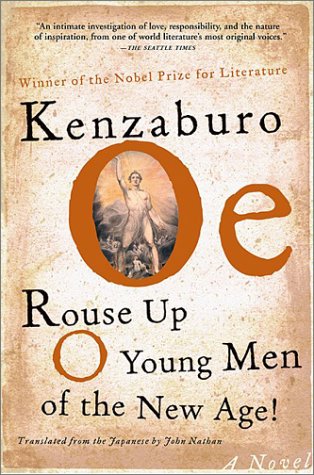
Rouse Up O Young Men of the New Age!

Thanks to Bellezza’s Japanese Literature Challenge 4, I have the chance to explore the intricate world of Kenzaburo Oe (pronounced ‘oh-ay’, 大江 健三郎 ), Japan’s second Nobel Laureate for Literature (1994), after Yasunari Kawabata (川端 康成) received the Prize in 1968.

Like his earlier work A Personal Matter*, Rouse Up O Young Men of the New Age! is an autobiographical novel dealing with the author’s experiences of raising a handicapped child.  A Personal Matter was written when Oe was young, describing an ordeal still raw from the initial shock of the birth of his brain-damaged child. Rouse Up was published in 1983, almost twenty years after A Personal Matter.

Rouse Up chronicles a more mature protagonist, the writer K, who has gone past the stage of denial and escape, to come to terms with the reality of fathering a handicapped child. Through the arduous journey, the writer has gained insights and pleasure from his relationship with his son Hikari, whom he nicknamed Eeyore in his novels.

Oe starts off the book with K’s plan to write a dictionary of terms for his now maturing son, to prepare him for his entry into the real, adult world.  This turns out to be a learning task in itself.  How do you explain to a brain-damaged person what the word ‘foot’ means?  Or ‘river’, ‘life’, or ‘death’?  He needs to deconstruct the realities of his everyday life before he can grasp the essence and meaning of his encounters.

It’s interesting to see how K get through to his son in defining ‘foot’. Eeyore understands it in relation to ‘gout’ from which his father once suffered. After the healing of the pain and swelling of the gout, it has turned into ‘a nice foot’.  So, the understanding of ‘foot’ comes in light of the pain it had experienced. K soon realizes that the definitions are more for himself as for Eeyore.

The author’s long journey of acceptance and self-discovery owes mostly to his love for the works of William Blake.  Rouse Up is a smorgasbord of selections if you are a Blake scholar. So admittedly, I have had a hard time ploughing through Oe’s use of parallels from Blake’s poetic and artistic symbolisms to reflect on his own predicament.  In certain parts, Oe’s writing is just as esoteric as Blake’s mythical depictions.  However, one thing is clear.  My enjoyment of this novel is no less, and the poignancy of a father-son relationship no weaker as I find my way through the Blake maze.  The book requires and deserves multiple reading.
Despite its complexity and denseness, the essence filters through Oe’s meticulous descriptions.  Further, John Nathan’s translation navigates effectively through Oe’s nuanced and sensitive narratives.  I’m just curious as to what the original Japanese version looks like since there are numerous references and quotes from Blake.  Are they in English or in Japanese translation?

Two lines from The Four Zoas seem to have outlined K’s personal journey:

“That Man should Labour & sorrow & learn & forget, & return
To the dark valley whence he came to begin his labours anew.”

It’s a perpetual striving, not unlike Sisyphus’s effort, and yet still leads from one path to the next, prompting a renewed acceptance and offering novel discoveries on the way.

Aside from the esoteric passages of Blake’s visions, some very simple lines shine through, and they are the ones that are most moving for me:

… healing the rift with my son, I became aware of his grief through the agency of a Blake poem, “On Another’s Sorrow,” which includes this stanza:

Can I see a falling tear,
And not feel my sorrows share,
Can a father see his child,
Weep, nor be with sorrow fill’d.

One of the “Songs of Innocence,” the poem concludes with the following verse:

O! he gives to us his joy,
That our grief he may destroy
Till our grief is fled & gone
He doth sit by us and moan.

In his attempt to know more about Eeyore, K explores the power of dreams and the imagination. Using Blake’s mythological poetry and artwork, he tries to understand Eeyore’s internal world. Both he and his wife know Eeyore does not dream, but that does not preclude he does not have imagination.

Subscribing to Blake’s conviction that: “The Imagination is not a State:  It is the Human Existence itself.”, K strives in earnest to cultivate Eeyore’s imagination. Eeyore has an almost instinctive response to bird calls, distinguishing them even before he adopts human language.  As he grows older, he is drawn towards the music of Bach and Mozart.  His imagination soon finds a channel of expression in composing, an amazing accomplishment nurtured by a highly supportive and loving family.  In real life, Oe’s son Hikari is a composer.

Adopting Blake’s vision, K sees a future for father and son together in a state of grace, from Blake’s Jerusalem:

“Jesus replied Fear not Albion unless I die thou canst not live
But if I die I shall arise again & thou with me
This is friendship & Brotherhood without it Man is Not

So Jesus spoke! The Covering Cherub coming on in darkness
Overshadowed them & Jesus and Thus do Men in Eternity
One for another to put off by forgiveness, every sin.”

From coming to terms with the tragic reality of fathering a brain-damaged child, to ultimately, almost symbiotically, sharing his life with his son, is a process not short of a personal epiphany.  At the end of the novel, Eyeore has grown to be a twenty-year-old man. While still having a limited mental capacity, Eeyore has his way of exuding his own humor, love and care for those around him.  The story is a poignant tapestry weaving real-life and the visionary, through which an imagined world of reality is beautifully conceived.

As for the source of the book title, it comes as a moving episode at the end of the book.  I should keep that for you to discover.  A heart-warming finish to a poignant chronicle.

John Nathan’s Afterword is an eloquent tribute to the father, son, and the nurturing family. It is also a helpful annotation of the novel.

Rouse Up O Young Men of the New Age! by Kenzaburo Oe, translated by John Nathan, published by Grove Press, NY, 2002.  259 pages.

***

* A touching review of A Personal Matter has been posted recently by Claire at Kiss A Cloud.  Also, Mel U’s A Reading Life has posted extensively on Oe and other Japanese writers.  Of course, there’s Bellezza at Dolce Bellezza, who has hosted Japanese Literature Challenge all these years, now in its fourth term.  I thank them all for their inspiration.

Summertime… and the reading is easy

.

Since my TBR booklist has evolved into one gigantic beast preying to devour my fragile conscience, I’m feeling the burden of possession with every single book I acquire, be it only $1.50 or even free.  While summer has officially slipped in, with all its alluring promises and freeing energy, I feel it’s time to confront the beast and with one resolve, slay it.

So, may I present herewith Arti’s Declaration of Independent Reading. It may not be self-evident to all that there exist certain unalienable rights for us book lovers yearning for emancipation.  Allow me to use the collective pronoun here as I feel I just might not be the only one.  Therefore, all ye under the bondage of your TBR beast, here are our claims:

  1. Nonobligatory reading.  Reading for the simple joy of the act, and not for any courses, profs, teachers, groups, bloggers or to appease that monstrous beast.  We might have book challenges to meet, but they are our own choosing.  Even if we have miles to go before we sleep, we go the miles to honor our own quest.

  2. We hold the right to buy and not read, just for the satisfaction of owning a title. We deserve to be recognized for our contribution to the economy and the publishing industry.  By our perpetual purchasing, we are supporting local and national businesses and the livelihood of many workers.

  3. Freedom to follow our hearts in our book selections, and not the New York Times bestseller lists, Amazon’s recommendations, or Oprah’s earnest plea.  No need to follow trends or don literary fashion.  No need to challenge those titles simply because we are told to read before we die.  Literary and the not-so-literary, classics or contemporary, all to our heart’s content.

  4. Smorgasbord Reading.  Our right to have more than one item on our plate, our right to read more than one book at a time.  Fiction, non-fiction, bios or poetry, whatever that suits our palate at the moment.

  5. Not to be discriminated against.   As bookaholics, we will resist any attempt to be added to the pathological list of substance abuse, addictions, or to be forcefully admitted into any 12-step programs or obsessive-compulsive behavior therapy.

  6. In the spirit of slow blogging, we hold the right to read slowly, to mull and chew, at our own pace without having to meet any quotas, numbers, or deadlines. Further, we have the right to reread a book or an author as many times as we want, and not be labelled as subversive, fanatics or cultic.

  7. We have the liberty to stop reading, throw a book out the window, or honestly declare our dislike, if that’s our view.  With this right, we keep our sanity intact, our discernment sharpened, our intelligence preserved.

***

There.  Now that’s off my chest, let me get back to my reading… or not.

oooh, summertime…

.

Photos by Arti of Ripple Effects, June, 2010.  ALL RIGHTS RESERVED.

***

Book Sale 2010

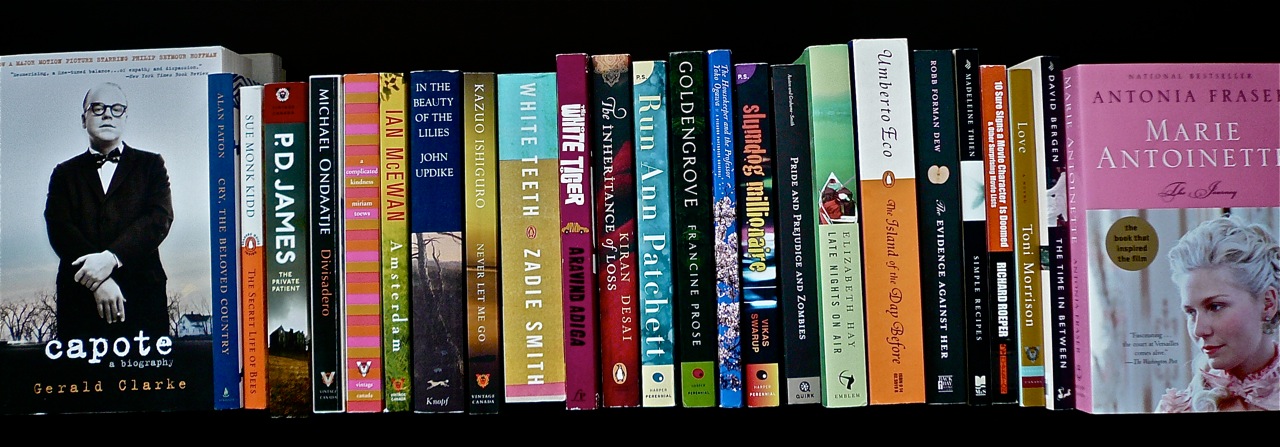
Went to the annual Book Sale at the Crossroads Market and hauled back my loot, officially kicking off Arti’s summer reading.  Although I must admit, I’ve many books on my TBR list.  They’re everywhere in my house, my bedside, on the couches, tables and chairs, and even on the floor.  Yet I would not miss the booksale at Crossroads.  The finds are just too good to pass.  My hours of scrutinizing always bring in great rewards.  Here’s a list of this year’s haul.  20 of them, almost all trade paperbacks, spine unbent, all new to like-new condition, at $1.50 each.  Here they are:

I’ve an eclectic selection here.  Here are the categories:

Biography

  • Capote: A Biography by Gerald Clarke  —  Book into film
  • Marie Antoinette by Antonia Fraser  — Book into film

Canadiana

  • The Time In Between by David Bergen —  2005 Giller Prize
  • Late Nights On Air by Elizabeth Hay  —   2007 Giller Prize
  • Divisadero by Michael Ondaatje  —  2007 Governor General’s Literary Award
  • A Complicated Kindness by Miriam Toews  —  2004 Governor General’s Literary Award

Contemporary Literature

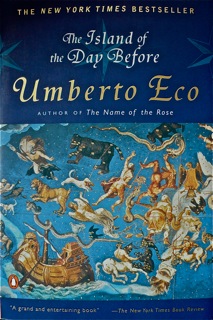
  • The Island of the Day Before by Umberto Eco — International literary awards author
  • Love by Toni Morrison — Nobel Prize author
  • Run by Ann Patchett  —  PEN/Faulkner and Orange Prize author
  • Cry The Beloved Country by Alan Paton — contemporary classic
  • Goldengrove by Francine Prose — National Book Award finalist
  • White Teeth by Zadie Smith —  2000 Whitbread First Novel Award
  • In The Beauty Of The Lilies by John Updike — Pulitzer winning author
  • The Evidence Against Her by Robb Forman Dew — National Book Award author
  • The White Tiger by Aravind Adiga — 2008 Man Booker Prize
  • Amsterdam by Ian McEwan — 1998 Man Booker Prize
  • The Inheritance of Loss by Kiran Desai — 2006 Man Booker Prize
  • The Housekeeper and the Professor by Yoko Ogawa — Japanese literary awards author
  • Never Let Me Go by Kazuo Ishiguro — Man Booker Prize author
  • The Secret Life of Bees by Sue Monk Kidd  —  Book into film

Mystery and Thriller

  • The 39 Steps by John Buchan
  • The Scarecrow by Michael Connelly
  • The Private Patient by P. D. James
  • The Messenger by Daniel Silva

Short Stories

  • Telling Tales edited by Nadine Gordimer
  • Simple Recipes by Madeleine Thien
  • The Complete Short Stories of W. Somerset Maugham

Tools of the Trade

  • The Declaration of Independent Filmmaking by Mark Polish et al.
  • 10 Sure Signs A Movie Character Is Doomed & Other Surprising Movie Lists by Richard Roeper
  • Art History’s History by Vernon Hyde Minor
  • Notting Hill Screenplay by Richard Curtis
  • The Sense and Sensibility Screenplay & Diaries by Emma Thompson

Fads

  • Pride And Prejudice And Zombies by Jane Austen and Seth Grahame-Smith
  • Slumdog Millionaire by Vikas Swarup  — Book into film

Guilty pleasure?  Compulsive hoarding?  Not really.  First off, I’m supporting a well-meaning charity, Servants Anonymous.  Secondly, I’m doing something that’s uber important in this digitally-driven society.  I’m contributing to the preservation of the art of the printed book.  And who knows, someday, these copies might well become valuable antique items when the e-industry totally takes over.

A look at their covers would make you long to touch them, real paper, book art and design, authentic hard copies of the printed word.  A future rarity, and I’m sure, collector’s items.

Top 20 Under 40

The New Yorker has released the anticipated list of top 20 fiction writers under 40, kicking off their summer fiction issue. It’s been eleven years now since the last list.

I’ve no trouble with the number 20, but I admit the number 40 does pose a problem.  If these figures represent the ‘defining voices’ of contemporary fiction, the stars to watch, is there still a future for those who by chance happen to be on the other side of that magic number?

Why should age be a demarkation when it comes to creative writing?  And, why 40? Why not 32 or 46?  It sounds arbitrary doesn’t it.  I know, we’re a lists-obsessed people.  Even the New Yorker editors admit that.  It’s funny that they seem to justify their act by citing The Ten Commandments, the twelve disciples, the seven deadly sins, the Fantastic Four.  Wow, do we ever need to elevate literary stardom to epic proportion… we have fierce competitions in 3-D movies, ‘Dancing with the Stars” and interactive video games, just to name a few.

Writers on their previous list include Jonathan Franzen, Jhumpa Lahiri, Michael Chabon and David Foster Wallace.  So, it’s a highly anticipated star roster.   As well, other magazines have published similar recognition.  Granta has its “Top 21 Under 35” twice a few years ago.  Sounds like a well-established marketing strategy.

Fine.  That is certainly understandable in a time when so many alternatives are competing with reading a short story or a novel. But still, the number 40 troubles me.  My sympathy goes to those who are no less promising but alas, have shot further than the 40 mark.  Without being recognized as ‘young’ anymore, will they still have a future?  Further, is there hope for those who might choose to pursue a passion that comes late in life?  I can see the futility if that dream is to be a concert pianist if one hadn’t taken up the instrument by the ripe old age of 12.  But, what about writing?  Is starting at 40, or 50, or even 60 too late?  Is the term ‘late bloomer’ a misguided notion offering false hope?

**

Oh… the promise and glamour of youth.  And woe to us who are beyond rescue in a society that’s obsessed with popularity and rankings, youthful looks and prodigious fame.

To soothe the wounded spirit, and keep the creative fire burning, Ripple Effects would like to propose the following iconoclastic list in this day ruled by ageism:

  • Top 50 over 53:  To honor the best 50 unpublished writers over 53
  • Top 100 under 67:  To seek out the best 100 blog writers under 67 in lieu of being published in the real world.  Why 100?  I’m sure this is just a minuscule sample of the tens of thousands possible candidates out there in the blogosphere.
  • Top 15 over 74:  To encourage the best 15 yet-to-be literary stars over 74, just to give hope to those still pursuing their life-long dream.
  • Top 3 over 82:  To celebrate the late-bloomers who have finally made it, actually publishing their debut novel after 82.  Why 3?  That’s obvious.

Sour grape?  No, that would be immature.  Let’s just say, virtual tasting of the elusive grape.  Never underestimate the power of hope and the freedom of casting aside the burden of age.

.

You can still see the ripples at eventide.   — Arti

.

***

Photo taken by Arti at The Inside Passage to Alaska,  September, 2009.  ALL RIGHTS RESERVED.

To Kill A Mockingbird

Clint turns 80 today.  A book dedicated to him as well as a special DVD just out to celebrate his life-long achievement.  There’s no shortage of Father’s Day gift ideas.  I understand though the man himself does not want any celebration on his birthday.  So to make his day, I’m not going to say anything more about him.

But there’s another birthday, or anniversary rather, that should be mentioned.  To Kill A Mockingbird turns 50 this year. Another good choice for Father’s Day, or any day really, and not just for fathers.  In recent years, as I see current events unfold, I truly feel this will make a marvellous gift for Law School graduates, or any graduate for that matter.   In this tumultuous time we’re in, where honor, justice, and nobility of character seem to become obsolete as quickly as the latest techno gadget, we all need a guidepost, a moral compass, ever more so.

To commemorate the 50th anniversary of its publication, Harper Collins has published a special edition:

Harper Lee had based the story on her childhood experiences in her hometown Monroeville, Alabama.  Her understated storytelling of Atticus Finch, Scout and Jem of Maycomb had won readers’ hearts the world over.   Two children growing up learning the value of respect and justice, love and integrity from their father.  Theirs was a most trying of times when racism and the Depression joined hands to destroy any fragile decency still present in a poverty-stricken town in the deep south.

Strangely, the story of such a parochial setting had triggered universal resonance.  The novel has been translated into at least 40 languages, sold over 30 million copies.  It has gained the number one spot on the list of greatest novels of all time.  It is the choice of British librarians according to a poll conducted by the Museum, Libraries and Archives Council (MLA), in which librarians around UK were asked the question, “Which book should every adult read before they die?”  Just hope people don’t wait till then.

***

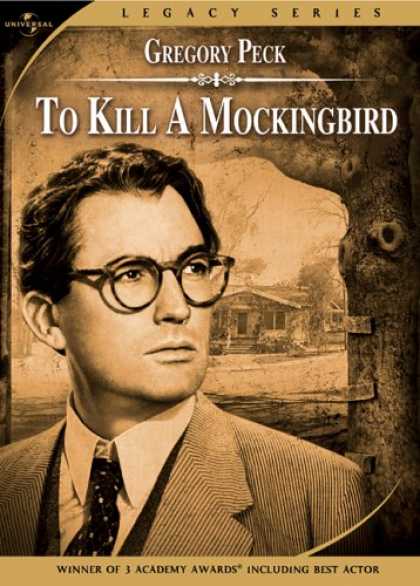
To Kill A Mockingbird DVD, Universal Legacy Series


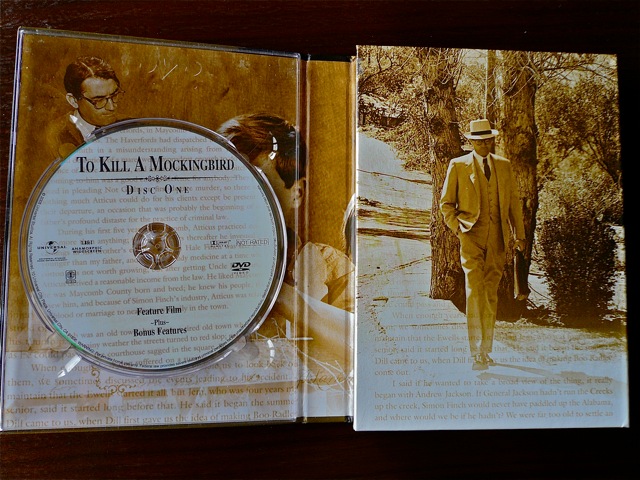
To complement the book, I highly recommend the DVD set of the Oscar-winning movie (1962).  Make sure it’s the Universal Legacy Series (2005).  This is a two-disc collection with loads of memorable special features. Here’s a list:

  • Academy Award Best Actor Acceptance Speech — Gregory Peck
  • American Film Institute Life Achievement Award — Gregory Peck
  • Daughter Cecilia Park’s heartwarming tribute to her father
  • Scout Remembers — An interview with Mary Badham, who talks about her experiences working with Gregory Peck
  • Fearful Symmetry: The Making of To Kill A Mockingbird
  • The documentary A Conversation With Gregory Peck, produced by Cecilia Peck.  Scenes with Lauren Bacall, Martin Scorsese, President Bill Clinton and the Peck family.  Most moving is ordinary people sharing how the movie had impacted them, in their career choice, parenting and life.

“All the children of the whole world must have wished they could have Gregory Peck as their father.  He was ours, and that was our blessing.  He really was a lot like Atticus Finch… The last page of his film script of To Kill A Mockingbird, he had scrawled these four words at the bottom: Fairness, Courage, Stubbornness, Love. And they remind me so much of him…”  — Cecilia Peck’s tribute to his father

“It’s difficult to separate the man from the character.”  — Mary Badham (Scout) reminisces on her experience working with Gregory Peck

“Making millions is not the whole ballgame.  Pride of workmanship is worth more, artistry is worth more.  The human imagination is a priceless resource.  The public is ready for the best you can give them.  It just maybe that you can make a buck, and at the same time encourage, foster, and commission work of quality and originality.”  — From Gregory Peck’s acceptance speech for American Film Institute’s Life Achievement Award.

And if you think it’s all about Gregory Peck, well in a way it is.  I can’t think of anyone better to climb into the skin of Atticus and walk around in it.  The man is Atticus Finch, as his colleagues and family had testified. Gregory Peck received a well-deserved Best Actor Oscar for his role.  I must mention too that this is where Robert Duvall made his acting debut, without saying one single word, as Boo Radley.

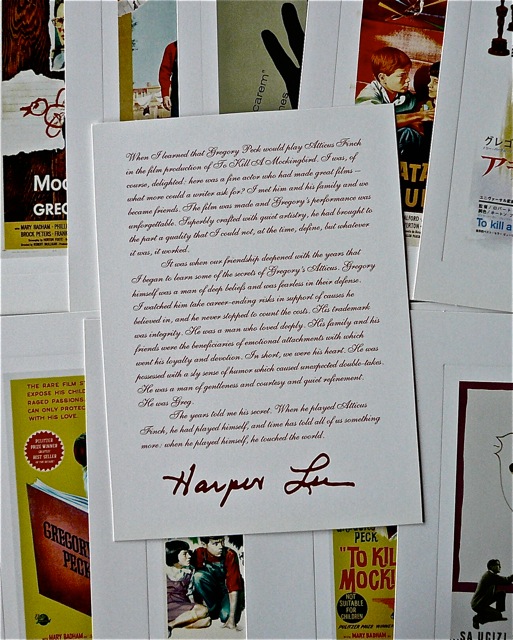
The other good reason for this Legacy Series is the 11 Exclusive Reproductions of Original Theatrical Posters. They are printed in a handsome set of cards, each a tribute from the country it comes from: Australia, Belgium, Italy, Japan, Argentina…

And last but never the least, a note from Harper Lee herself about the actor playing a character that was a cinematic reflection of her own father.

“When he played Atticus Finch, he had played himself, and time has told all of us something more:  when he played himself, he touched the world.”   —  Harper Lee

***

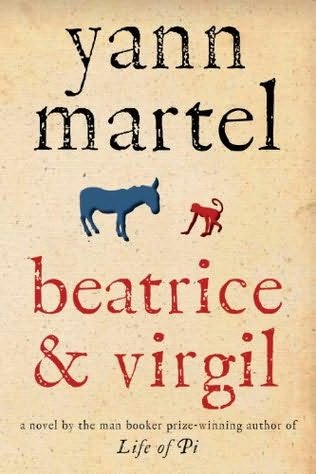
Beatrice & Virgil by Yann Martel

It has been nine years since Yann Martel’s second novel The Life of Pi first published. Its winning the Booker Prize in 2002 has solidly placed him on the international literary stage. Beatrice and Virgil is the long awaited third novel by this Saskatoon based Canadian author.

Beatrice is a donkey.  Virgil, a howler monkey.  They are the two characters in a play written by a taxidermist.  Beatrice and Virgil are also specimens in his shop Okapi Taxidermy.  The two names come from Dante’s Divine Comedy, to which the book has made reference. The metaphor of taxidermy is a fresh frame Martel constructed to look at the Holocaust. The preservation of evidence of lives lived, the mounting of historical facts.

Beatrice and Virgil is also a love story.  The two animals cherish each other and have to face the cruelty of extinction together.  In the play, they have elaborate talks about fruits, a striped shirt, God and faith.  It’s all allegorical of course.  And there’s the rub.

While I fully appreciate Martel’s attempt at creating a new frame to present the atrocity of the Holocaust, I doubt using animals as symbols and parallels, depicting the cruel treatment of them would suffice to convey the magnitude and severity of this horrific crime against humanity.  Despite a sincere intent and the riveting storyline, I feel the book fails to deliver the dynamics and efficacy in its form as an allegory.

Nonetheless, the book conveys some very interesting points, through which Martel has demonstrated the imaginative power of literary creation.  First off, the author plays with the notion that the line separating fiction and non-fiction is indeed blurry.  To make a case of it, he writes himself into the story.  The main character is an author called Henry, whose wife Sarah later on gives birth to their son Theo, the name of Martel’s own son with his partner, the writer Alice Kuipers.

Back to the story, Henry’s second book has stirred international sensations, winning prizes, adopted by schools and book clubs, and adapted into a Hollywood movie.  Life of Pi is all that.  And just like in real life, it has been a few years after that before the fictional Henry completes his third novel, a book on the Holocaust.  But this time, he has trouble finding a publisher (now this may diverge from real life.)

This new book Henry wants to get published is a literary fusion. He wants it to be a ‘flip book’.  One side is fiction, the other side an essay, with the title on both.  And that is exactly what the cover of this book Beatrice and Virgil is like.  Henry observes that all Holocaust accounts have been ‘historical, factual, and literal’, it is worthwhile to create a fictional rendition of it, “a new choice of stories”, providing readers with an artistic expression representing these well documented, horrific happenings.  And this is exactly what Martel has done, constructing imaginary portals based on facts.

Once these layers have been peeled off, there is yet another with Henry meeting the taxidermist who is writing the play using Beatrice and Virgil as the two main characters. Coincidentally, he is also called Henry. So, the amateur writer Henry mysteriously involves the professional writer Henry to help him with the completion of his play on the Holocaust.  But of course, there remains yet another layer of secret.

The image of Escher’s Drawing Hands keeps emerging in my mind as I read the book, how a writer would write himself into the story and into the story.

While the style of storytelling is intriguing, when one considers the topic and the major crux of the book, that being the atrocity that is the Holocaust, it is apparent that the choice of the deadpan treatment of a donkey and a howler monkey in allegorical terms just would not suffice. While the play in the book is reminiscent of other two-character plays, namely, Tom Stoppard’s Rosencrantz And Guildenstern Are Dead and Samuel Beckett’s Waiting For GodotBeatrice and Virgil seems to lack the wit of the former and the depth of the latter.

And as I think about the fact that it has taken the author nine years to come to this one, I wonder, just wonder… Oh, the creative process is indeed an incomprehensible and uncertain path, as cryptic as an Escher drawing.

Beatrice & Virgil by Yann Martel, published by Knopf Canada, 2010, 224 pages.

~~ ½ Ripples

***

Epilogue:  Yann Martel Reading at the Calgary Public Library

.

.

After writing the above section on Beatrice & Virgil, Arti has the privilege of listening to Yann Martel read from his new book at the Calgary Public Library tonight (April 28, 2010).  It’s always interesting to hear a writer read from his own work.  It’s even more gratifying listening to the Q & A session afterwards.  Yes, he is still sending books to Stephen Harper because he firmly believes that literature is the tool to understand the human condition.

The writer also talked about the creative act, and the use of animals as symbolism. Animals are inherently poignant.  And, how did he know at that pivotal moment of his life, that he wanted to become a writer?  It’s from within, you’d know it because you’d simply want to write without any consideration of monetary gains or praises.  It’s a strong feeling inside moving you to just do it.

Do I need to make any changes to the review above after hearing the author read from the book?  No, I don’t think so.  But what has changed is my view of the writer.  I have come face to face with a very personable and casual human being, someone who is convinced that literature can teach us how to be human, that fiction is as important as facts, and that the creative act of writing is driven by an inherently insatiable desire to simply write, without the intention of being published or any notion of ‘success’ in mind.

***

Alone Again… Unnaturally

A year ago around this time, I wrote the post ‘No Texting for Lent and The End of Solitude’. It was in response to the news about some Roman Catholic bishops urging the faithful to restrain from texting as a penance during Lent.  And around the same time, I came across the article by William Deresiewicz ‘The End of Solitude’, pointing out the difficulty of remaining alone in our over-connected society.

Now a year after Deresiewicz published his essay, the number of tweets had grown by 1,400%.  Now there are 50 million tweets per day, an average of 600 tweets per second.  So, if you’re calling for ‘No texting’ at Lent, you might as well tell people not to use the phone, the computer, the iPhone, all the smart gadgets, in other words, get off the human race for the time being.

Hey, that may not be such a bad idea.  The current issue of The American Scholar has another article by Deresiewicz, yes, on solitude again.  I’m glad to read articles on ‘Solitude’, why?  There just aren’t too many written on this topic.  And thanks to Deresiewicz, seems like his is the only voice crying in the digital wilderness.  The article is a lecture he delivered to the plebe class at the United States Military Academy at West Point in October of last year, entitled ‘Solitude And Leadership’.

If you want others to follow, learn to be alone with your thoughts.

This quote at the beginning of the article just about sums it all up.

Speaking to this class of freshman, all eager and gung-ho to fall in line with the rank and file of this prestigious Military Academy, Deresiewicz has the audacity (ok, guts) to tell his audience to shun conformity, break away from regimentation, to ask questions, to seek their own reality, to form their own opinion, and to exercise moral courage.  And his main crux: it is only through solitude can they do this.

Facebook and Twitter, and yes, even The New York Times, only expose you to other people’s thinking. Whenever you check your tweets, or get on to your social network, or read the newspaper for that matter, you are only hearing other people’s voices:

That’s what Emerson meant when he said that “he who should inspire and lead his race must be defended from travelling with the souls of other men, from living, breathing, reading, and writing in the daily, time-worn yoke of their opinions.” Notice that he uses the word lead. Leadership means finding a new direction, not simply putting yourself at the front of the herd that’s heading toward the cliff.

He urged them to read books instead.  Well aren’t books other people’s opinion too?  True, sometimes you need to put them down too to visualize you own reality and formulate your own stance.  But, books, especially the time-tested ones, have weathered social scrutinies and oppositions, and yet still stand today offering us wisdom of perspectives in finding our own path.

Further, the major difference between a well-written book and a tweet, or a Comedy Central episode, or even a newspaper article, is basically, time.

The best writers write much more slowly than everyone else, and the better they are, the slower they write. James Joyce wrote Ulysses, the greatest novel of the 20th century, at the rate of about a hundred words a day… for seven years. T. S. Eliot, one of the greatest poets our country has ever produced, wrote about 150 pages of poetry over the course of his entire 25-year career. That’s half a page a month. So it is with any other form of thought. You do your best thinking by slowing down and concentrating.

Of course, this may sound reductionist.  But, I like the idea of slowing down in this rapidly shifting world. Deresiewics urged the freshmen of West Point to practice concentrating and focusing on one thing rather than multi-tasking. He charged them to take the time to slowly read, think, and write, in solitude, an axiom that’s so rad that his audience probably had never heard before.

In this über connected world we’re in, it’s unnatural to be alone.  A solitary moment has to be strived for with extra effort, and much self-discipline.  That means unplugging the phone, turning off the computer and anything smart, yes, including friends, real or virtual.   For Lent or not for Lent, it could well be the only way to find out who we are and where we are heading.  Even if we’re not aspiring to lead, at least we know whom we should follow.  And, you’ll never know, others may be attracted to our slowness and surety that they just might step right behind us.  So it’s best not to steer them too close to the cliff.

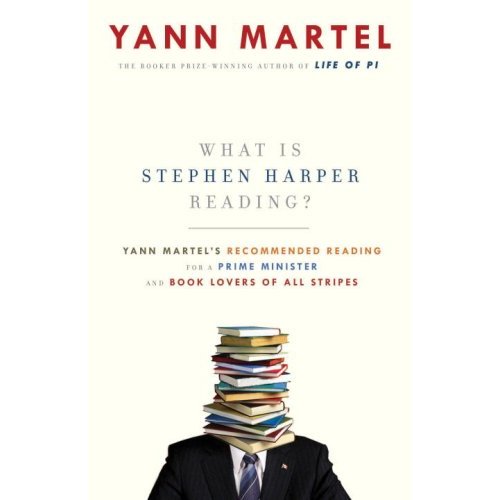
What Is Stephen Harper Reading?

.
Now that the Winter Olympics have come to a close, maybe more of the world would have heard of Stephen Harper.  No, no, he isn’t a medal winner.  Just a hockey fan, and, he happens to be Canada’s Prime Minister.
.

And it’s good time to read this book.  It all started one March day in 2007.  Fifty Canadian artists of all sorts were invited to a Parliamentary session to celebrate the fiftieth anniversary of the Canada Council for the Arts, each of them representing a particular year.

There they were sitting in the Visitors’ Gallery of the House of Commons, waiting for their item to come up on the long agenda of the day.  At 3:00 pm, the business came to the celebration.  All fifty of them were asked to stand up. The Minister for Canadian Heritage, Bev Oda at the time, rose up, acknowledged their presence, and gave a five-minute speech.  Applause.  Then on to the next business item.  Stephen Harper did not even look up at them standing in the Gallery.

The fifty guest artists were incredulous.  Among them was Yann Martel, who received a Canada Council grant in 1991 allowing him to write his first novel.  His literary career reached an admirable high in 2002 when he was awarded The Man Booker Prize for his book Life of Pi.  (CLICK HERE to read one appreciative reader’s response to the book, a personal note from Barack Obama.)

After this incident, driven by frustration, Martel decided to launch a most interesting project.  He started sending Stephen Harper a book every two weeks, with his personal letter introducing  the work, and of course, whenever appropriate, fill him in as to why that’s a good read for a Prime Minister.   With such an intention, one can predict the tone of these letters.  They are mostly sincere, mind you, albeit embedded with the occasional sarcasm, irony, and yes, some condescending subtext.

But overall, these letters to the Prime Minister sent with the books are genuine appeal to the Leader of the country to place more emphasis on the arts. They offer a place of stillness in the busy agenda of a politician.  Martel’s is a gentle voice to remind the prime policy maker the role of the arts, in particular, literature and its appreciation, in the making of a nation, the importance of beauty and the imagination in the building of a vision and in shaping the humanity of her people.

So, it’s not so much as to what Stephen Harper is reading, but what’s on his TBR list.  It remains unknown whether the PM has actually read any of these gifts, although letters of appreciation had been sent to Martel from his office. It’s fun too to read the choices of the titles… and their reasons.  But above all, I’ve enjoyed reading Martel’s insights into how the literary speaks in the context of contemporary political and social landscape.  Here are some examples.  I’ve included a quote or two from Martel’s letter sent with each title:

Animal Farm by George Orwell

Animal Farm is about collective folly.  It is a political book, which won’t be lost on someone in your line of business.  It deals with one of the few matters on which we can all agree:  the evil of tyranny.

Animal Farm is a perfect exemplar of one of the things that literature can be: portable history.  … in a scant 120 pages, … the reader is made wise to the ways of the politically wicked.  That too is what literature can be: an inoculation.”

The Island Means Minago by Milton Acorn (People’s Poet of Canada)

“But any revolution that uses poetry as one of its weapons has at least one correct thing going for it: the knowledge that artistic expression is central to who and how a people are.”

“… the past is one thing, but what we make of it, the conclusions we draw, is another.  History can be many things, depending on how we read it, just as the future can be many things, depending on how we live it… And it is by dreaming first that we get to new realities.  Hence the need for poets.”

The Educated Imagination by Northrop Frye

“Literature speaks the language of the imagination.”

“… the better, the more fertile our imagination, the better we can be at being both reasonable and emotional. As broad and deep as our dreams are, so can our realities become.  And there’s no better way to train that vital part of us than through literature.”

A Modest Proposal by Jonathan Swift

“So, more cuts in arts funding… What does $45 million buy that has more worth than a people’s cultural expression, than a people’s sense of who they are?”

Mister Pip by Lloyd Jones

“Lloyd Jones’s novel is about how literature can create a new world.  It is about how the world can be read like a novel, and a novel like the world.”

The Kreutzer Sonata by Leo Tolstoy

“Why a book on music?  Because serious music, at least as represented by new and classical music, is fast disappearing from our Canadian lives… the latest proof of this: the CBC Radio Orchestra is to be disbanded… How much culture can we do without before we become lifeless, corporate drones?  I believe that both in good and bad times we need beautiful music.”

The Uncommon Reader by Alan Bennett

“The irony in the story is as light as whipped cream, the humour as appealing as candy, the characterization as crisp as potato chips, but at the heart of it there’s something highly nutritious to be digested:  the effect that books can have on a life.”

“Whenever an independent bookstore disappears, shareholders somewhere may be richer, but a neighbourhood is for sure poorer.”

Gilead by Marilynne Robinson

“Speaking of President Obama, it’s because of him that I’m sending you the novel Gilead, by the American writer Marilynne Robinson.  It’s one of his favourite novels.”

“I would sincerely recommend that you read Gilead before you meet President Obama on February 19.  For two people who are meeting for the first time, there’s nothing like talking about a book that both have read to create common ground and a sense of intimacy, of knowing the other in a small but important way.  After all, to like the same book implies a similar emotional response to it, a shared recognition of the world reflected in it. This is assuming , of course, that you like the book.”

Julius Caesar by William Shakespeare

“Since Julius Caesar is about power and politics, we might as well talk about power and politics.  Let me discuss concerns I have with two decisions your government recently announced.

My first concern is about the Social Sciences and Humanities Research Council.  New money allocated to the Council is apparently to be spent exclusively on “business-related degrees”…. we’re losing sight of the purpose of a university if we think it’s the place to churn out MBAs.  A university is the repository and crucible of a society, the place where it studies itself.  It is the brain of a society.  It is not the wallet… A university builds minds and souls.  A business employs.”

Louis Riel by Chester Brown and The Sailor Who Fell From Grace With The Sea by Yukio Mishima

“But I’ve always liked that about books, how they can be so different from each other and yet rest together without strife on a bookshelf.  The hope of literature, the hope of stillness, is that the peace with which the most varied books can lie side by side will transform their readers, so that they too will be able to live side by side with people very different from themselves.”

**

Yann Martel is still sending books to Stephen Harper every two-weeks.  Other authors he has sent include Jane Austen, Flannery O’Connor, Ayn Rand, Gabriel Garcia Marquez, Douglas Coupland, Philip Roth, Alexander Solzhenitsyn, Franz Kafka, Virginia Woolf, Samuel Beckett, Michael Ignatieff, Paul McCartney, Dylan Thomas, Laura and Jenna Bush… quite an eclectic selection. Excellent demonstration of how we can be so drastically different in our perspectives and background, and yet can still stand shoulder to shoulder in this vast land of the free.

To read the full list of all the books he has sent, and yes, including this one, CLICK HERE to go to the official site:  What Is Stephen Harper Reading dot ca

What Is Stephen Harper Reading? by Yann Martel, published by Vintage Canada, 2009, 233 pages.

****

Regarding the role of universities and the humanities as dying disciplines, CLICK HERE to read my post: THE HUMANITIES AS AN ENDANGERED SPECIES.

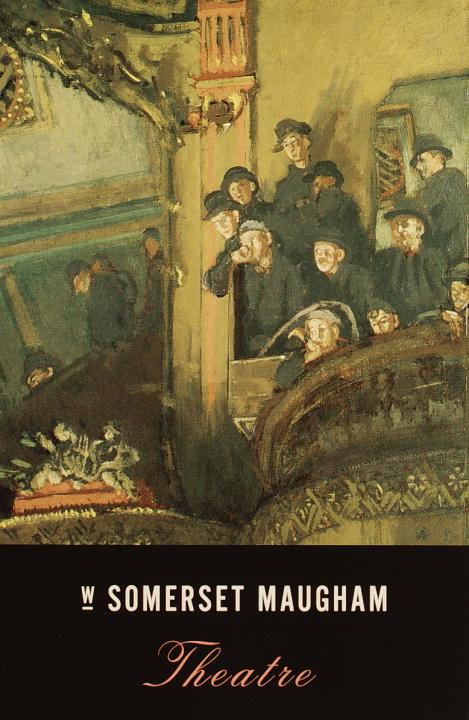
THEATRE by W. Somerset Maugham: In Search of Reality

It was pure serendipity. I thought I knew almost all of Maugham’s titles, but this one just escaped me.  I found it on the ‘New and Notable’ shelf in the public library. It’s a Vintage International edition paperback published in 2001. Not new but it looked untouched and inviting.

Two pages into the book I knew right away I had seen it before. Of course, that’s the movie Being Julia (2004). Annette Bening got a Best Actress Oscar nom for her portrayal of Julia Lambert, a famous actress on the London stage in the 1930’s. The movie is a colorful account of how a successful stage actress deals with her mid-life crisis. With fame, fortune, and achievement in bounty, what more could she ask for but… love and passion. And during the course, obstacles, jealousy, and betrayal are all overcome, and revenge carried out; on or off stage, no matter, it’s equally exciting for the glamourous Julia Lambert.

But not until I read this novel on which the movie was based did I realize that a most important passage had been left out. And oh what an omission! For the crux of the book rests on those few pages. And not only that, the screenwriter had chosen to alter a character to suit his fancy, rounding off the edges of conflicts and alleviating tensions in presenting a smooth and suave storyline.

In the movie, Julia’s son Roger is a young man fresh out of Eton and planning to attend Cambridge after the summer. That much is true to the book.  Roger is shown to be a devoted son, lovingly supportive of his mother in her pursuits in career and love life. But this is not the case in the novel.  Maugham has crafted Roger as a critical young man, offering the necessary tension to the story. In a crucial scene at the end of the book, he questions Julia’s behaviour and integrity. These challenges form the climatic confrontation between mother and son, projecting the meaning behind the very title of the novel.

Here is an excerpt from this scene that captures the essence of the whole book. Julia asks Roger:

“What is it you want?”
Once again he gave her his disconcerting stare.  It was hard to know if he was serious, for his eyes faintly shimmered with amusement.
“Reality.”
“What do you mean?”
“You see, I’ve lived all my life in an atmosphere of make-believe…. You never stop acting. It’s second nature to you. You act when there’s a party here. You act to the servants, you act to Father, you act to me. To me you act the part of the fond, indulgent, celebrated mother. You don’t exist, you’re only the innumerable parts you’ve played. I’ve often wondered if there was ever a you or if you were never anything more than a vehicle for all these other people that you’ve pretended to be.  When I’ve seen you go into an empty room I’ve sometimes wanted to open the door suddenly, but I’ve been afraid to in case I found nobody there.”

By turning Roger into a complacent and docile young man, the screenwriter had failed to present the necessary tension in the story. Further, by avoiding the character foil between the successful actress mother and her meaning-pursuing, idealistic son, the movie fails to deliver the essential subtext, despite an impressive performance by Annette Bening.

Further, the best is yet to come in the book… such is the ingenuity of W. Somerset Maugham.  After a superb, revengeful performance, overarching her rival, the young and beautiful Avice Crichton, and drawing everyone’s admiration back to herself, Julia celebrates on her own with a nice meal and mulls over a gratifying notion, on the very last page:

“Roger says we don’t exist. Why, it’s only we who do exist.  They are the shadows and we give them substance. We are the symbols of all this confused, aimless struggling that they call life, and it’s only the symbol which is real. They say acting is only make-believe. That make-believe is the only reality.”

This is ever so relevant for us today. With all the online personae we can create and project, all behind the guard of anonymity, Roger’s quest for what’s real remains a valid search.

Sherry Turkle, the acclaimed ‘anthropologist of cyberspace’, has observed the liminal reality in our postmodern world and stated her own quest:

“I’m interested in how the virtual impinges on what we’ve always called the real, and how the real impinges on the virtual.”

Let’s just hope that the advancement of technology would not get the better of us, blurring the lines of fact and fiction, offering shields for fraud and deceits. Behind the liminal existence, let’s hope too that we still care what’s real and what’s not, and that our humanity will still be valued and not be compromised or lost in the vast abyss of bits and bytes.

The upcoming Academy Awards too, is another platform to showcase such a duality. I always find the acceptance speeches of award winners intriguing: what’s genuine and what’s fake in their thank you’s. Are they presenting their real self or merely acting? Outside of their roles, which part of them is authentic? Or, do they ever get out of their roles?

It’s interesting too to explore the influence of movies nowadays. Again, the postmodern emphasis is on the narrative, multiples of them, and storytelling the vehicle of meaning. Does the notion of Maugham’s character Julia mirror our world… that movies have become the symbols of what we call life? That make-believe has sometimes been merged with reality? Can we still tell them apart? Or, should we even try? Considering the pervasive effects of pop culture in our life today, considering a single movie can command a worldwide box office sale of $2.4 billion, and counting… Maugham was prophetic indeed.

***

Emma (2009, TV): Episode 3

The final instalment of Emma has a major challenge, to reveal the hidden agendas, and to tie up all the loose ends in just under an hour. The hurried scenes leave me with a feeling of watching a trailer, a montage of excerpts loosely linking up the story.  This is especially so in the first half dealing with Jane Fairfax and Frank Churchill’s secret relationship.

If the story feels a bit fragmented in this last episode, the cinematography makes up for that shortfall.  The hour is saturated with stunning shots, magnificent scenic views and exquisite interior renditions.  The Box Hill picnic scene is a vivid example:

Ironically, the pivotal Box Hill scene was not shot in Box Hill, a busy tourist attraction in Surrey.  Instead, it was shot in Leith Hill, Mole Valley, another much quieter scenic point.  For an interesting comparison of the two hills, click here to go to ‘this is surrey today’.

The Box Hill picnic is a crucial turning point in the story.  Emma’s callous and sarcastic joke on Miss Bate and the subsequent scolding she receives from Mr. Knightly is nothing short of an epiphany in self-knowledge.  The genuine remorse she feels could well reflect her greatest strength.  I’m sure such quality of character is what seizes Mr. Knightly with tenderness, moving him to consider her “faultless in spite of all her faults.”

I have a feeling too that this is the very reason Austen finds her heroine likable.  Romola Garai has effectively portrayed a contrite and humbled Emma, while Jonny Lee Miller has delivered convincingly a silent lover with passion and principle.  My initial reservation about his role has definitely changed for the better in this final episode.

Fortunately as well, the endearing lines of Mr. Knightly to Emma, no, not the ‘badly done!’ admonition, but the heartfelt praise he spurts out in spontaneity, remains intact and without any modernized alteration from screenwriter Sandy Welch.  Of course it needs to be declared in its authentic whole… Miller has the best lines of the series:

“I cannot make speeches, Emma… If I loved you less, I might be able to talk about it more.  But you know what I am.  You hear nothing but truth from me.  I have blamed you, and lectured you, and you have borne it as no other woman in England would have borne it.”

As with all Austen’s novels, the ending comes with nuptial ties. But as Masterpiece Classic’s host Laura Linney points out at the opening, considering the social discriminations inflicted upon the woman in Jane Austen’s time, allowing no ownership of properties, no decent employment (even Jane Fairfax compares the governess position with slavery), and no respect or rights given to the single female of low means, it is only a justifiable reward for the author to end her story with loving marriages for her well-deserved protagonists.

Towards this end, the camera takes us to the magnificent view of Beachy Head in the last scene.  As Emma and Mr. Knightly stand on the edge of the cliff overlooking the boundless ocean, we see the series come to an idealistic end, maybe a broader stroke than that in Austen’s novel. But as some critics have noted, it is love that the author emphasizes rather than romance.  From that perspective, looking outward together to the ocean vast instead of gazing into each other’s eyes may well be an apt interpretation of Austen’s heart.

***

CLICK HERE to go to Episode 1

CLICK HERE to go to Episode 2

Arti’s reviews of Emma (2009), Episodes 1 to 3, have been compiled into one article and published in the Jane Austen Centre Online Magazine. CLICK HERE to read the many other interesting articles on Jane Austen and her time.

**Photo Sources: Box Hill Picnic bbc.com; Beachy Head, not a scene from the movie, taken from Wikimedia Commons.

Emma (2009, TV): Episode 2

‘An authentic human being’ is how the host of Masterpiece Classic Laura Linney describes Emma.  Jane Austen’s characters have no supernatural powers, she notes.  But herein lies the magic of her writing.  She takes the ordinary and draws out the unnoticed features.  From these everyday characters like you and me, she skillfully displays the intricacies woven in their interactions, and reveals the undercurrents of hidden intentions and desires.  It is in the revealing of the subtext that makes her story so captivating even for us modern day readers.

Episode 2 continues with this interesting story as we see Emma confused by her own feeling towards Frank Churchill, Harriet’s shifting admiration for the same, Frank Churchill’s seemingly open admiration for Emma, Mr. Knightly’s growing sentiments for the same, and, Jane Fairfax’s hidden anguish, ignored by the subject of her desire.  It seems that everybody’s feeling is mixed up with everybody else’s.  The comedy of errors gathers momentum.

Cinematography continues to be a major contributor to the storytelling.  I particularly appreciate the several Vermeer moments, like the one with Emma gazing out the window deep in thought, or the camera silently captures her playing the pianoforte, immersed in diffused light.  I’ve also enjoyed how the visual reveals inner thoughts.  Mr. Knightly’s longing is projected by the flashback of his dancing with Emma, shifting to the single swan in the pond, warm music enfolding… a beautiful cinematic moment where the visual and music communicate effectively without words.

Mrs. Elton is animatedly played by Christina Cole.  In terms of comedic and obnoxious effects, she is of her husband’s equal, a good match indeed. While Rupert Evans is proficient in portraying a sly Frank Churchill, he does not look like the one I have in mind.  But that is not important. My main concern is with the role of Jane Fairfax.  This second episode confirms my misgiving from the beginning.  I feel there is a miscast here.  I miss her elegance, poise and subtleties as described by the author.  She is supposed to be Emma’s worthy rival after all.

The dance at The Crown Inn is a delight to watch.  That is also the occasion showing everybody’s true colour.  And Mr. Knightly has proven himself to be one considerate gentleman as he invites Harriet to dance after she is slighted by Mr. Elton.  Also, we’re beginning to see Mr. Knightly more and more in love, while the object of his desire remains relatively clueless, albeit a sense of appreciation has arisen in her confused heart.  The dances are fun to watch too, much more lively and convivial than the courtly dances we see in other Austen adaptations.

After two episodes, the story and the characters are well developed, the overall effects pleasing and enjoyable.  I look forward to the next instalment.

*****

CLICK HERE TO GO TO MY REVIEW OF EPISODE 1

CLICK HERE TO GO TO EPISODE 3, THE CONCLUSION

Arti’s reviews of Emma (2009), Episodes 1 to 3, have been compiled into one article and published in the Jane Austen Centre Online Magazine. CLICK HERE to read the many other interesting articles on Jane Austen and her time.


Emma (2009, TV): Episode 1

Previously on Masterpiece Classic

Yes, treat this post as a recap to prepare you for Episode 2 in just a couple of days.

So finally, North American viewers have the chance to see the long awaited 2009 BBC production of Emma, three months after its release in the UK.  A click on imdb will find no less than 15 different versions of this popular Austen work.  Yet another one?  It just naturally leads one to question, why?  After seeing this first episode, let me give it a shot: just because it’s so much fun to do.

That’s how I felt as I watched the PBS broadcast last Sunday.  This newest adaptation of Emma is probably the best I’ve seen, and Romola Garai easily the best-cast Emma so far.  Yes, I’m comparing her with Gwyneth Paltrow (1996) and Kate Beckinsale (1996, TV).  She may well be one of the best-cast Austen heroines for their roles in my opinion, let’s just say, neck and neck with Jennifer Ehle’s Elizabeth Bennet.

What a difference from her guilt-ridden Briony in the movie Atonement.  Well, Garai’s Emma is guilt-ridden too as the errant, over-confident matchmaker, but her genuine heart and willingness to own up to her misjudgment have made her personality shine through.

In creating Emma, Austen had said that “I’m going to take a heroine whom no-one but myself will much like.”  Seems like this adaptation does a great service pulling us over to Austen’s side. Garai’s Emma reflects the probable reasons why the author found her character likable: vivacious, charmingly clueless, and above all, her readiness to admit faults, her genuine heart towards herself and others.  Garai’s animated performance is most apt in a comedic genre such as this.  So far in the first episode, the irony and humor have come through.

The impressive cinematography matches perfectly the personality and atmosphere of the novel, brisk, agile, fun, and yes, as Mr. Knightly narrates in the beginning, golden.  Just the kind of colour scheme for a clever comedy, the exact reflection of its main character.  As a comedy, a little exaggeration in the colours is acceptable and quite effective I think.  Overall, the visuals are captivating, beautiful shots of the English country landscape, the well situated mansions and their interior renderings.  I’ve particularly appreciated the few overhead shots, and some of the contrasting darker scenes in the beginning.

And yes, the beginning is where a film can captivate right away.  I’ve enjoyed screenwriter Sandy Welch’s treatment of the plot, drawing out three characters, Emma, Frank Churchill, and Jane Fairfax, who had all lost their mother as a young child, and focusing on how markedly different their lives have turned out.

For the casting of Jonny Lee Miller as Mr. Knightly, however, I have a little reservation, in this first episode anyway.  The sparks between Emma and him look more like sibling bickering than the undercurrents of subliminal lovers’ quarrels, which Austen so brilliantly depicts. The 16 years of age difference is almost unobservable here, although in real life they are ten years apart.  But I’ve enjoyed Jonny Lee Miller’s portrayal of the conflicting Mr. Knightly, at times detached, at times involved, and at times, exasperated.

Michael Gambon is excellent as the fastidious Mr. Woodhouse. The legendary actor has delivered a convincing performance as an endearing but taxing hypochondriac.  As for Harriet Smith and Jane Fairfax, I’m afraid my preference is the 1996 TV production‘s casting of Samantha Morton and Olivia Williams in these roles.  But then again, my view can change as I continue watching.

This first episode strikes me as a lively, contemporary rendition. While screenwriter Sandy Welch had chosen to use more modern language in her dialogues, I don’t think she needed to stray too far from the original to achieve this.  As I’m re-reading Emma for these screenings, I find the book very accessible for modern readers, the characters are those whom we can relate to, their motives and emotions very similar to what we are familiar with.  Austen’s skills in observation and her intelligence in depicting human nature and her characters’ inner world are simply impressive, considering she was writing almost a hundred years before Freud and the birth of modern psychology.

****

CLICK HERE TO GO TO MY REVIEW OF EPISODE 2

CLICK HERE TO GO TO EPISODE 3, THE CONCLUSION

Arti’s reviews of Emma (2009), Episodes 1 to 3, have been compiled into one article and published in the Jane Austen Centre Online Magazine. CLICK HERE to read the many other interesting articles on Jane Austen and her time.