Greta Gerwig Creates A Third Way to Adaptation with ‘Little Women’

In recent decades, there seems to have emerged two paths to approach movie adaptations of literary works, especially for a classic: faithful to the source, or awash it with contemporary strokes.

Here’s the rub: total loyalty would trigger criticisms of movies being a kind of illustrated book, simply redundant. But gloss it over with postmodern touches could strip an adaptation of the meaning and authenticity of the original text. Debates arise as to which is a better path.

A few days ago, in a Writers Panel with five screenwriters at the Santa Barbara International Film Festival, Greta Gerwig presented a third way. She didn’t call it that, but that’s how I see it, a happy medium (pun intended). Her approach to Little Women is both loyal to the spirit and letter of Louisa May Alcott’s as well as creating a contemporary, artful production for modern viewers to enjoy.
 

little-women-1


I’ve to quote her exact words as they are inspiring. Here’s the link to the video. The following quotes can be found from 27 to 36 mins. How does Gerwig handle the loyalty aspect? The writer-director did extensive research in preparation for her screenplay:

I wanted to treat the text of Little Women as almost a sacred text, also other texts that Louisa May Alcott and her family and other contemporaries had generated between letters, and other books that she’d written. I wanted to ground as much as I could in that. I wanted everything to be footnoteable (she well had coined a new word) and I wanted every line you ask me about and I can say it’s here, that I have my references.

How does her version relate with previous adaptations?

But the fact that it’s been adapted for screen seven times, it’s been made into an opera, and made into a musical and made into two anime shows, this is a loved and interpreted work. The way that something that’s been loved and interpreted many times you get this collective memory of what it is.

There’s the text, which is the book, and then there’s urtext, which is every time it’s loved and interpreted again. Urtext does have a relationship with the text, but it’s also separate… I wanted to deliver on the pleasures of Little Women as we’ve collectively come to know them.

And how does the collective interplay with the personal?

Gerwig instilled her own style and framed it in her own light. Quite a few things I’ve observed, the most obvious difference from previous versions is the structure, her juxtaposing the past and present timelines. The story is told as Jo’s memories seamlessly woven with her present as a struggling writer alone in NYC, a fresh take that adds depth and texture.

Gerwig paints the past with a golden hue signifying the warmth of cherished family memories and the present with a cool, blueish tone sending out harsher, lonelier vibes. She has also given an elevated role for Amy to interact with Jo, two seemingly rival siblings but could well be two sides of the same coin. Amy the pragmatic realist who grows up to understand too well her lack of economic status as a woman and who is ready to take financial security over real love ultimately gets both. Jo the dreamer and idealist, who’d vowed she’d never marry, has also carved out a path of her own.

So what does the ending mean?

I don’t want to say: O here’s what the ending means… I wanted to create something that’s open to interpretation along two lines. I think the movie belongs to the audience, so it’s down to the reflection you see…

With the layered ending, Gerwig effectively depicts the struggles of not only the book character Jo as an aspiring author in Little Women, but parallels it with Louisa May Alcott the woman writer in a man’s publishing world, and extending by implication to Gerwig’s own reality as a woman writer-director striving in a male-dominated film industry. The triple-layered final act opens the door to a golden future as we see a progressive school for boys and girls, and a published author giving birth to her work and keeping her own copyright. As for that third, invisible layer, I do wish Gerwig continual success in her writing and filmmaking career despite the obstacles she faces in the real world.

***

Related Posts on Ripple Effects:

Little Women Movie Review

Top Ripples of 2019 and the Decade

Can a Movie Adaptation ever be as Good as the Book?


Concord revisited with ‘Little Women’

Five years ago, I took a New England road trip with my cousin. It was a major endeavour for me coming from Western Canada, over 2,500 miles away. The photos here were taken during the road trip that fall. We began our drive across three States starting from Wayland, MA. Nearby Concord was our first point of interest. This is where Louisa May Alcott grew up and later transposed her real life family onto the page to write Little Women.

Thanks to writer/director Greta Gerwig’s adaptation, fond memories flash back as I watch the New England scenery captured so beautifully on screen. One of the memorable scenes is the panoramic autumn hillside in which Laurie made his failed attempt proposing to Jo. Another one was the Christmas morning breakfast give-away as Marmee led the girls to exercise love-in-action.

CONCORD, MA

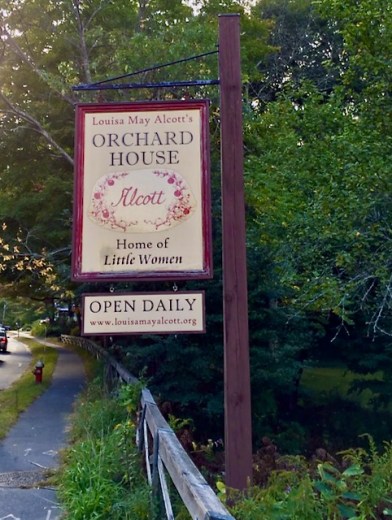
A major attraction in Concord is Orchard House where Louisa May Alcott wrote Little Women. The Alcott family owned Orchard House from 1857 to 1884, within which period all four Alcott girls Anna, Louisa, Lizzie and May had their most influential growing up years. The house is now a museum:

Sign

The rooms and furniture, Louisa’s (Jo) writing desk, the costume and props the girls made for their plays, Anna’s (Meg) wedding gown, and all of May’s (Amy) original paintings on the walls of her room are preserved inside the Orchard House Museum:

The Orchard House Museum

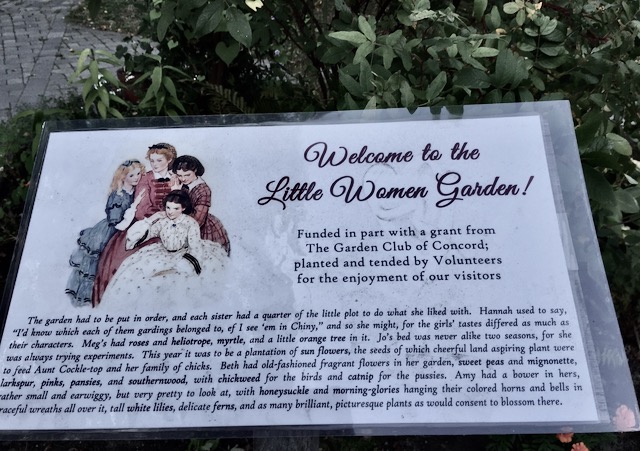
Louisa transposed her family onto the page, creating parallel characters in the March household. In the Little Women Garden, the March sisters had their own flower bed, each planted their section according to their taste or maybe, character. Here’s from the quote on the sign indicating their choices:

Meg – roses and heliotrope, myrtle, and a little orange tree
Jo – never alike two seasons, for she was always trying experiments
Beth – old-fashioned fragrant flowers, sweet peas and mignonette, larkspur, pinks, pansies, southernwood, with chickweed for birds and catnip for the pussies.
Amy – honeysuckle and morning-glories hanging their colored horns and bells in graceful wreaths all over it, tall white lilies, delicate ferns, and as many brilliant, picturesque plants.

The Garden

***

Here’s the issue many have questioned: Did Greta Gerwig alter the Little Women characters to appeal to modern day viewers, or, is she merely revealing Louisa May Alcott’s true image?

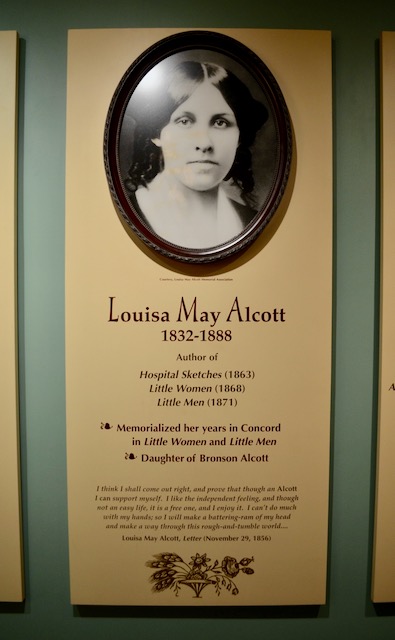
From Orchard House we went to visit the Concord Museum. Among plaques presenting some of Concord’s famous residents is this one of Louisa May Alcott. The quote on there comes from a letter Louisa wrote dated November 29, 1856:

I think I shall come out right, and prove that though an Alcott I can support myself. I like the independent feeling, and though not an easy life, it is a free one, and I enjoy it. I can’t do much with my hands; so I will make a battering-ram of my head and make a way through this rough-and-tumble world…


LMA

The Alcott parents, Bronson and Abigail were abolitionists and environmentalists. Bronson was the first teacher in Boston to admit a black student to his class despite protests from white parents who threatened either the black student go or they go. Bronson’s school was left with very few students consequently as he insisted his stance.

But his educational ideals must have been embraced by students as Bronson introduced the idea of raising their hands to speak in class, and he was the one who invented recess in school. There you go for a Jeopardy question.

Louisa’s mother Abigail was one of the first social workers in Boston, and was active in Women’s rights. She’d said, “I will go to the polls before I die if my daughters had to carry me there.”

The Alcott’s close friends and neighbours included prominent intellectuals and writers of the day: Emerson, Thoreau, Hawthorne. They made frequent, mutual visits, and had personal influence on Louisa’s formation and writing.

Down the road from the Alcott’s was Emerson’s home. Emerson had helped the financially strapped Bronson with acquiring Orchard House:

Emerson's Home

And living minimally by choice as an experiment, here’s Thoreau’s cabin (replica) at nearby Walden Pond:

thoreaus-cabin


Thoreau's Lake Side Cabin

Growing up under such stimulating milieu where thinkers and writers are free to explore new ideas and generate new philosophy, it was only natural that Louisa grew up grasping the values and the spirit of her parents and their friends, becoming a non-conformist herself.

Louisa had admitted she’s Jo in Little Women and added: “I didn’t make her half-bad enough.” If she’d been here today and directed the movie, I’ve a feeling she’d make Jo twice as radical and assertive. Gerwig is admirably restrained and for this, kudos to her.


***


Related Posts on Ripple Effects:

Little Women (2019) movie review

Can a movie adaptation ever be as good as the book?

A New England Fall Foliage Road Trip


Book to Movie Adaptations 2020

A list of upcoming book to screen titles for the new year, eclectic choices for different tastes, varied classics and contemporary notables. Looks like classic literary works of all sorts are enjoying a comeback on the big and small screens.

Classic Suspense:

Classic Mystery.jpgDeath on the Nile by Agatha Christie

Kenneth Branagh returns after his first Hercule Poirot take in Murder on the Orient Express (2017) which he directs. Once again, the prolific screenwriter/adaptor Michael Green pitches in. Interesting cast with Gal Gadot, Armie Hammer, Annette Bening.
.

RebeccaRebecca by Daphne du Maurier

Lily James is ubiquitous ever since she comes out of Downton as Lady Rose. Now she’s the young and naive Mrs. De Winter in a psychological warfare with her nemesis, housekeeper Mrs. Danver played by Kristen Scott Thomas. Can the master of Manderley save her? But of course, he must save himself first. That’s Armie Hammer, equally ubiquitous.
.

Classic Adventure:

The Call of the Wild.jpgThe Call of the Wild by Jack London

Harrison Ford heeds the call with action star Karen Gillan, Dan Stevens, and the Calgary-born, The Expanse star Cara Gee. Partially filmed in Yukon and some in Vancouver, B.C., Canada. Never heard of the Yukon Territories? This should be a good intro. I’m all for old classics, be they books or actors.
.

DOCTOR D (1).jpegVoyages of Doctor Dolittle by Hugh Lofting
Movie title Dolittle, an adventure spectacle with Robert Downey Jr. as the eponymous Doctor. See if you can identify the voices of these animals: Rami Malek, Emma Thompson, Ralph Fiennes, Marion Cotillard, Octavia Spencer… just to name a few of the stars in this production. Coming out January 17.

.

Classic Sci-Fi’s:

The Invisible ManThe Invisible Man by H. G. Wells

Classic sci-fi gets a resurrected boost. Wells’ novella and cautionary tale was first published in 1897. Now 123 years later in the 21st century, it’s adapted into a movie for the big screen. The Handmaid’s Tale Elizabeth Moss stars.
.

Brave New WorldBrave New World by Aldous Huxley

Huxley’s dystopian, imagined future written in 1931 is adapted into a TV series almost 90 years later. Again, a mark of what makes a book a classic, especially a sci-fi work. Downton early-exit Lady Sybil Jessica Brown Findlay’s in.
.

DuneDune by Frank Herbert

Another sci-fi classic, but closer to our time. A project by the acclaimed French Canadian director Dennis Villeneuve who has done some remarkable works like the Oscar nominated Arrival (2016), Blade Runner 2049 (2017) and Sicario (2015). Adapted into screen by Oscar winning writer Eric Roth (Forest Gump, 1994; A Star is Born, 2018). Timothée Chalamet, Rebecca Ferguson, and Oscar Isaac star.

Classic YA’s: 

Artemis_Fowl_first_edition_coverArtemis Fowl by Eoin Colfer

The first of Colfer’s popular series is a Disney production with Kenneth Branagh directing. A trending genre, the YA fantasy series has great potentials to be successful. A strong cast including Hong Chau, Judi Dench, Josh Gad.


The Secret Garden.jpgThe Secret Garden by Frances Hodgson Burnett
Like Little Women, this classic young reader novel has had several screen adaptations. I have no qualms about this; it only helps to spark renewed interest in the book. This new adaptation will have Colin Firth who was in the 1993 version to play Lord Archibald Craven and Julie Walters as Mrs. Medlock.
.

Contemporary Notables:

I Know this much is True.jpgI Know this much is True by Wally Lamb

Lamb’s novel about a twin brother’s advocacy and care for his paranoid schizophrenic sibling is adapted into a 6 episode TV miniseries. Mark Ruffalo will play both brothers, Dominick and Thomas Birdsey. Director Derek Cianfrance has a few fine works, the Cannes nominee Blue Valentine (2010), The Place Beyond the Pines (2012), and The Light Between Oceans (2016).

Little Fires.jpgLittle Fires Everywhere by Celeste Ng

Goodreads Choice of the Year Best Fiction (2017) and Novel of the Year on other sites, Chinese American writer Celeste Ng’s novel on class/race differences and aspirational conflicts in the idyllic community of Shaker Heights, Ohio, is adapted into a TV miniseries. Reese Witherspoon and Kerry Washington star.

Nine Perfect StrangersNine Perfect Strangers by Liane Moriarty

Moriarty’s website states her books had sold over 14 million copies worldwide. On the heels of her successful Big Little Lies turned into the small screen, Nine Perfect Strangers has already secured Nicole Kidman and Melissa McCarthy on board for the miniseries on Hulu. Her other books will follow.
.

the woman in the window.jpgThe Woman in the Window by A. J. Finn

A shaky narrator seeing a crime happening or being caught in one, Gone Girl was the first to kick off the trend. The Woman in the Window alludes to the Hitchcock classic Rear Window. Directed by Joe Wright (Darkest Hour, 2017; Anna Karenina, 2012), screenplay by Pulitzer winner Tracy Letts (August: Osage County, 2013), and an A-list cast with Amy Adams, Gary Oldman, Jennifer Jason Leigh, Julianne Moore.


‘Little Women’ is not just about heart, but mind, aesthetics, and other enjoyment

Greta Gerwig’s adaptation of Little Women is a joyous celebration of family and life. It’s an innovative feature, and a worthy rendition keeping Louisa May Alcott’s story intact and her spirit alive. The storytelling is shifted from linear to juxtaposing the timelines of seven years apart, from the March sisters’ teenage years to adulthood. A break from traditional adaptations of the novel, and a structure modern movie goers are familiar with.

LITTLE WOMEN (1)

So, instead of waiting for two hours to see what have become of the girls, viewers get to see how they’ve turned out from the start and throughout the film as the timelines switches back and forth. One effect is the intermingling of memory and present reality, adding texture to just linear storytelling. The editing is smooth as music and sound often overlap the changes of scenes like a visual dissolve.

The Oscar nominated director (Lady Bird, 2017) has surpassed herself in crafting an exquisite piece of artful creation. Unlike most other movies nowadays, Little Women is shot using 35mm film rather than digital technology. Cinematographer Yorick Le Saux offers viewers the inherent aesthetics of the medium, a grainy, more subtle visuals that augment picturesque New England in the exterior shots, and the depth and mood in the low-light interior. The picnic scene at the beach is pure delight. Mixed with Alexandre Desplat’s original music, the film is a beauty to behold.

Alcott’s 19th century American classic (1868-9) has been transposed to the big and small screen many times. No matter what your previously held memory is, Katherine Hepburn as Jo back in the 1933 first adaptation, or Elizabeth Taylor as Amy in 1949, or the 1994 adaptation with Susan Sarandon as Mrs. March and Wynona Ryder as Jo and a few up-and-coming youngsters such as Kristen Dunst, Claire Danes, and Christian Bale (as Laurie), Gerwig’s 2019 rendition is worthy to be the definitive version from now on as we head into the third decade of the 21st century.

The story is told from the point of view of Jo (Saoirse Ronan), an aspiring writer in New York at present. She reflects upon her path so far and reminisces on her family life, the cacophony of sisterhood in a busy household in Concord, MA, during the Civil War. A single woman author pitching to publishers, Jo’s struggles parallel Alcott’s, a woman writer in a man’s world. As well, it would be apt to refer to Gerwig’s own challenges as a female writer/director in the present day movie industry.

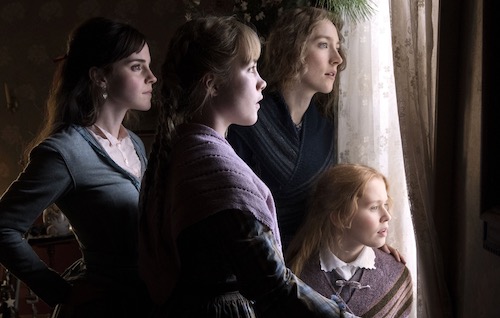
The film is an alchemy of authentic, period backdrop and set design, stylish yet down-to-earth costumes, fused with a fresh and contemporary synergy. Credits go to the four young actors bringing to life the March sisters Meg (Emma Watson), Jo (Saoirse Ronan), Beth (Eliza Scanlen) and Amy (Florence Pugh) as they live through hard times while their father has gone with the Union Army as a volunteer chaplain. Their neighbour and friend Laurie (Timothée Chalamet) remains a perpetual presence in their lives. Their altruistic mother, Marmee (Laura Dern), holds the family together and extends her care to those in need outside their home. She is the example of love and heart for her daughters to emulate. Her screen presence is comparatively small though as Gerwig lets her girls shine, especially Jo and Amy.

A touch of surprise for me is that Gerwig has kept the historic period and setting authentic without adding any postmodern quirks to shock or provoke. Her script allows Alcott’s points to flow out through the dialogues and characters within context. This is not fiery feminism, but an intelligent depiction of the status of women in the historic period. It’s an updated version doing justice to Alcott’s astuteness in her social critique which is, alas, still relevant today.

Kudos to Gerwig in bringing out the youngest sister Amy, not so much as a foil to Jo, but a worthy rival. Amy proves that even though bratty and capricious as a child, she has grown up to grasp a clarity in seeing the worth of a woman in her society, which is, not much. The realistic and rich Aunt March (Meryl Streep) has a firm view of this: it’s a lost cause with Jo who says she will not marry, or Meg who falls for a poor teacher and has to curb her material desires, and Beth’s ill health, she has put her hope on Amy to marry rich to dig the family out of poverty. Amy who has lived with her Aunt for a while when Beth is sick with scarlet fever understands her own situation with a cool head as she articulates it to Laurie. Knowing that she doesn’t have what it takes to be a truly great artist––she whose stance is to be great or nothing––Amy sees her predicament clearly. It all comes down to economics:

And as a woman, there’s no way for me to make my own money. Not enough to earn a living or to support my family, and if I had my own money, which I don’t, that money would belong to my husband the moment we got married. And if we had children, they would be his, not mine. They would be his property, so don’t sit there and tell me that marriage isn’t an economic proposition, because it is. It may not be for you, but it most certainly is for me.

Virginia Woolf’s A Room of One’s Own comes to mind as she argues that economic disparity between men and women systemically disadvantages talented women to become successful.

In her research, Gerwig delves into Alcott’s other books as well as letters, thereby knowing her from a deeper perspective and not just from the novel Little Women. This understanding and appreciation is translated into the screenplay, capturing Alcott’s sharpness of mind and the sensitivity of her soul. Here’s a poignant scene as Jo pours out her heart to Marmee after rejecting Laurie’s marriage proposal. Has she made the right decision? In an interview, Gerwig says the words are all Alcott’s, from her book Rose in Bloom, except the last sentence added by Gerwig herself, equally brilliant, piercingly clear, and very Dickinson:

Women have minds, as well as just heart; ambition and talent, as well as just beauty. And I’m so sick of people saying love is all a woman is fit for. But I’m so lonely.

The March family has had their share of misfortune. But life can be beautiful for those who behold it as such and deem it meaningful to pursue one’s own dream or simply to enjoy one’s passion, no matter how short the allotment of time. Despite challenging personal and social reality, it’s a bliss to be alive, and yes, even better when one succeeds. Gerwig has effectively brought out this theme with both sensitivity and heart. The ending scene speaks to this truth. 


~ ~ ~ ~ Ripples


***


Related Posts:

In Praise of Austen: Virginia Woolf’s A Room of One’s Own

Can a movie adaptation ever be as good as the book?

The Personal History of David Copperfield: From Book to Film

In a previous post I reviewed The Goldfinch, one of two literary adaptations on my list to watch while I was at the Toronto International Film Festival (TIFF) in September. The Personal History of David Copperfield is the other one, which also had its world premiere at TIFF; it represents a totally different approach to bringing a literary work to the big screen.

If The Goldfinch is an example of a traditional way of adaptation, striving at loyalty to the literary source while overlooking cinematic elements, David Copperfield is a brave venture out wielding post-modern strokes, not that it is changed into a contemporary setting, but that it is adapted with a modern-day zeitgeist. Here’s director Armando Iannucci’s rationale during a TIFF interview: Just as Dickens wrote David Copperfield reflecting life and society of his time, as a filmmaker today, he directs the adaptation through a frame of our time. 

David Copperfield
Dev Patel as David Copperfield. Image Credit: Courtesy of TIFF19

What stands out in such post-modern filmmaking is the ‘colour-blind casting’ of the production. David Copperfield is played by Dev Patel, a young British actor of Indian descent. Known for his breakout role in Slumdog Millionaire (2008), Patel has established a popular screen presence with a charisma that whisked him through many subsequent successful features such as the two Best Exotic Marigold Hotel (2011, 2015) and Lion (2016). Other non-white actors taking up main roles include Benedict Wong (Avengers: Endgame, 2019) as Mr. Wickfield, Rosalind Eleazar (Howards End, 2017) as Agnes and Nikki Amuka-Bird (The Children Act, 2017) as Mrs. Steerforth. It is a bold statement Iannucci is making: skin colour is not an issue. These talents are first and foremost, actors.

Iannucci indicated that he’d always have Patel in mind ever since he watched Lion (2016), a true story about an Indian boy separated from his older brother in a Calcutta train station and later sent away for adoption in Australia. Twenty-five years later, after a long search, he finally located and reunited with his mother in an Indian village. Watching Patel in Lion, Iannucci thought, that’s David Copperfield for him. Indeed, Dickens’s character David Copperfield could well be a metaphor for those who had suffered much in childhood and yet against all odds, have survived and grown up to be resilient and compassionate human beings.

The adaptation exudes energy and humour. Iannucci has chosen his cinematic palette with bright colours and sprinkled with comedic sparks. Surely, Dickens’s Copperfield has a sad upbringing, orphaned after his beloved mother dies young, and mistreated by his stepfather Mr. Murdstone and his sister Jane Murdstone, later having had to fend for himself as a child labourer at the ripe age of 12. Yet Dickens’s humour never fades. His light-hearted depiction of Aunt Betsey Trotwood or Mr. Micawber offer some hilarious characterization. Later, David’s brave and arduous escape to seek the shelter of Aunt Betsey turns his life around. The autobiographical fiction could well represent Dickens’s view that, in the midst of misfortunes and human pathos, there still lies a deeper essence, and that’s the joy of life. Iannucci deftly capitalizes this inherent quality in the the author’s writing and adorns his film with humour and jollity.

Here’s a note on Wikipedia on Armando Iannucci that I find interesting: “Born in Glasgow to Italian parents, Iannucci studied at the University of Glasgow followed by the University of Oxford, leaving graduate work on a D.Phil about John Milton to pursue a career in comedy.” I’m sure the story about his academic pursuit and career change entail more than just this one line can say, but that’s enough to give us the background of who’s bringing David Copperfield to the screen now. Iannucci is the creator and writer of the award-winning TV series Veep (2012-2019), the Oscar nominated political satire In the Loop (2009), and the dark comedy The Death of Stalin (2017), for which he won Best Director and Best Writer at BAFTA.

To those wary about the lack of seriousness, the superb cast is poised to deflect such criticisms. Tilda Swinton (Oscar winner Michael Clayton, 2007) as Betsey Trotwood and Hugh Laurie (Golden Globe Best Actor The Night Manager, House) as Mr. Dick are the anchors that complement Patel’s spirited performance. They are pivotal in transferring Dickens’s moral insights onto screen. Aunt Betsey’s kindness towards Mr. Dick, who in today’s term would be one stricken with mental illness, is a lesson in example, influencing David’s mutual friendship with him. The same with David’s support and acceptance of Mr. Micawber (Peter Capaldi) and his family while they are in dire financial distress. If we need a villain, Ben Whishaw’s Uriah Heep is there to show vividly the face of hypocrisy and the consequence of jealousy and deceit.

Such a light handling of the classic novel has its weakness naturally. While the moral lesson of good over evil still stands, David’s growing insights about love, life, and faith which Dickens writes about so eloquently have not been transferred onto screen as successfully. It is unfortunate that the movie does not elaborate on the effects of David’s misplaced adulations of Steerforth (Aneurin Barnard, The Goldfinch, 2019) nor does it focus on his awakening to the fervency Agnes has for him. David’s blindspot and Agnes’s hidden love for him would have made a poignant storyline. Nevertheless, the two eventually do come together, but just as a coda, with Dora (Morfydd Clark, Love & Friendship, 2016) getting the inkling of a mismatch between herself and the emerging writer to gracefully step aside, sparing David the deathbed scene from the book.

Overall, the adaptation is a joy to watch, and one of those films that I’d like to rewatch. It has just been screened at London Film Festival in early October, release dates in North America unknown. The casting might pose an issue for some, but it just may be another object lesson for today.


~ ~ ~ Ripples


***

Related Reviews on Ripple Effects:

The Goldfinch

Lion

Love & Friendship


Literary Adaptations at TIFF19: The Goldfinch

Two book-to-film adaptations were on my watch list while I was at the Toronto International Film Festival (TIFF) this September: Donna Tartt’s Pulitzer Prize winning The Goldfinch and the Dickens classic The Personal History of David Copperfield, both had their world premiere at TIFF. The two make such interesting contrasts that it would be good to discuss them together in one post, but that would be a long one. As I covet your attention, I’ll split them into two reviews. 

I listened to the audiobook of The Goldfinch in 2014, a year after the novel was published. My impression was: this one’s written for the screen. There are Dickensian characters and storylines transposed into present day. 13-year-old Theo is visiting a NYC art museum with his mother when she is killed in a bombing. In the aftermath, stunned and traumatized, he follows a mysterious track to an antique shop where the owner Hobie takes him in. There he meets Pippa, a girl he finds affiliation as she’s looking at the same painting with him in the museum when the bomb goes off. Later Pippa moves away and Theo goes to live with a wealthy Park Avenue family, the Barbours, only to have his stable life interrupted by the sudden reappearance of his long-gone, alcoholic father claiming full guardianship and taking him to live in Nevada, where he becomes friends with Boris, another boy lost in the sandy void.

Later, fleeing from his abusive father, Theo returns to the antique shop in NYC. Under the mentorship of Hobie he learns the skills of the trade. Years later, by chance and fate, Boris shows up again in his life, pulling him into the underworld of art dealings that eventually leads to a violent end, but that’s where the closure begins. “The Goldfinch” is the painting Theo takes with him after the museum bombing and hides it for himself, for it is a physical reminder of his last memory with his mother. They were looking at it when disaster struck; it was his mother’s favorite painting.

The Goldfinch.jpg
Nicole Kidman and Ansel Elgort in The Goldfinch. Image Credit: Courtesy of TIFF

That’s the main book story in a nutshell, and it appears that screenwriter Peter Straughan is keen to remain as faithful to the source material as possible. When the task at hand is loyalty to the original 784 page novel, the 149 minute screen time can feel like a laborious effort to create a replica, thus losing its flavour as an art form of a different medium, breathing, living cinema. The characters and major plot points are there, but what’s missing are the emotional depth and sparks of life.

Tartt’s novel has its Dickensian characters, and I can’t help but see parallels between The Goldfinch and The Personal History of David Copperfield. Theo and Davy, Boris and Steerforth, Theo’s father Larry and Davy’s stepfather Mr. Murdstone, Pippa and Agnes. The two features, however, represent two ends of possible choices for film adaptations.

Director John Crowley, who helmed Brooklyn (2015), a beautiful adaptation of Colm Tóibín’s novel, has a good cast to work with for The Goldfinch. Oakes Fegley (Wonderstruck, 2017) gives us a mature performance as young Theo. Nicole Kidman plays Mrs. Barbour decades apart, two roles that don’t give her much to say. Luke Wilson as Theo’s volatile father Larry and Sarah Paulson as his girlfriend Xandra are the livelier contrasts to other characters. Maybe Crowley focuses too much on the theme of grief that the overtone is sombre throughout. Ansel Elgort as adult Theo may not be a miscast but is boxed in by the only emotion he can express, gloominess. I can’t remember he has flashed a hearty smile once. That goes for other characters as well. The Goldfinch is a story of grief and Crowley has painted the mood in stark realism.

Thanks to the venerable cinematographer Roger Deakins (2018 Oscar winner Blade Runner 2049), we get to see some sunlight and energy in the Nevada desert days of  friendship between young Theo and Boris (Finn Wolfhard, TV Stranger Things). For most of the film, however, the color is a greyish cyan of dolefulness. While the museum bombing scene is dramatic, watching it over and over again––as Theo is drawn into guilt-ridden memory––could diminish the effect. But then, this would be an editing issue. And like Theo, don’t we all want to see the face of his mother, whose death is the cause of the grief, but that only comes for a short moment towards the end.

In an early scene, antique shop owner Hobie (Jeffrey Wright) shows young Theo how to tell a piece of furniture by touch to feel its authenticity. Too smooth has to be fake. Furniture that has weathered years of usage would be rougher and uneven. The character of adult Theo could have been a wiser man, more seasoned and worldly, but he remains static and stiff. The poignancy of fate with its power over one’s life comes late in the film and exerts little effect on the emotional connection with viewers. Unfortunately, Hobie’s antique lesson for young Theo is a metaphor for the adaptation. Other than a visual representation of the major plot of the novel, the film is a reproduction that lacks authenticity and liveliness.


~ ~ 1/2 Ripples


***

‘Gemma Bovery’ to cool your summer day

This film by the French director Anne Fontaine could offer you a couple hours of  cool entertainment in a lazy, hazy summer afternoon.

Gemma Bovery (2014)

Related image

Madame Bovary by Gustave Flaubert was published in 1856. There have been no less than half a dozen movie adaptations of this famous piece of literature, dating back as early as 1934 (dir. Jean Renoir). Only in 2014 did a female rendition emerge with Sophie Barthes in the helm and featured Mia Wasikowska as Emma Bovary. It’s a relatively conventional take on Flaubert’s literary classic.

Interestingly, in that same year, another movie version of Madame Bovary also came out. This one is by French director Anne Fontaine (born 1959). Under the helm of the versatile Fontaine, and in the spirit of Emma Bovary, this one looks like it’s a vignette from a parallel universe, defying traditional norms, laced with a deadpan, comical streak, and transported to modern day France.

Martin Joubert (Fabrice Luchini), a long-time academic publisher in Paris, moves back to Normandy to take over his father’s bakery, seeking for a peaceful and balanced life in the quiet region. A literature enthusiast, Martin’s antenna for the literary is sharp and sensitive. When a couple with the names of Charles and Gemma Bovery move into his adjacent house in the country, he quickly stands guard on the affairs of the young woman, as he knows the ending of the novel Madame Bovary by Flaubert. He uses all his male sense and sensibility to avoid a tragedy that could befall his new neighbours.

Director Fontaine’s title gives it away as a parody not to be taken too seriously. Gemma Arterton is a good choice as she appears to be a more convincing Gemma Bovery than Mia Wasikowska’s Emma Bovary. For those watchful for literary adaptations, Arterton was Tess of the D’Urbervilles (2008, TV miniseries) playing alongside Eddie Redmayne as Angel Claire. In a more recent year, Their Finest (2016) also saw her mastering her role poignantly.

Gemma is an interior decorator and Charles a furniture refurbisher. Parallel characters as in Flaubert’s novel appear in Gemma’s life after she moves into the Norman countryside, tempting her to fall into a similar track as Madame B.  Except, we don’t see her buying luxurious goods and remodelling her humble abode. Fontaine is bold to let her viewers see what Flaubert was describing with his words, albeit these scenes are short.

So, is Martin successful in avoiding a tragic end to his imagined literary heroine? No spoilers here. In a lazy, hazy summer afternoon, an ending short of crazy would not be worthwhile for a parody.


~ ~ 1/2 Ripples

**

Do you have a favourite French literature to movie adaptation?


Thanks to Tamara for hosting a 6th annual Paris in July event at Thyme for Tea.

PIJ2019 Tamara

Urban Progress, The Wasteland and An Easter Thought

Many contemporary films from China showcased at Film Festivals in recent years tend to use the country’s fast-paced urban development as backdrop. This new wave of filmmakers situate their characters and tell their stories amidst dilapidated buildings marked for demolition, sometimes the whole community torn down to make way for new projects. In the name of progress, many are uprooted and displaced.

In Life After Life (2017), we see a village abandoned as its former residents have all moved to the city. In Dead Pigs (2018) we see the feisty owner of the last house in an urban community standing alone, refusing to sell to the developer. The acclaimed auteur Jia Zhangke’s Cannes winning A Touch of Sin (2013) follows desperate individuals wrestled down by the strong arms of economic progress and capitalistic greed. His latest “Ash is Purest White” (2018) may be of a crime genre but we see the protagonist being swept along the tumultuous torrents of technological change and urban development, seeking whatever humanness that remains.

The most haunting has to be the 2018 film by the talented, young director Hu Bo, An Elephant Sitting Still. Hu parallels the desolation of the urban environs with the inner world of his characters: Despondent youths in a school bound for demolition, not that they have bright futures even if the school remains; aimless adults desperately seeking connection but ending in betrayal and loss; a grandfather facing gloomy days ahead as he’s cut off from his son’s family… Hu’s accusation of his society was astute and unsparing.

At one point in the film, The Wasteland is alluded to, certainly not only referring to the physical environs. That it is mentioned as a deadpan jest to make fun only exposes the indifference of the speaker to its meaning. Tragically life imitates art, Hu took his own life during the film’s post-production. He was 29.

Eliot wrote The Wasteland in the aftermath of WWI, lamenting the desolation and that dry, cracked piece of soil deep in the human soul, derelict and barren in the midst of post-war development and the loss of spirituality.

“What are the roots that clutch, what branches grow
Out of this stony rubbish? Son of man,
You cannot say, or guess, for you know only
A heap of broken images, where the sun beats,
And the dead tree gives no shelter, the cricket no relief,
And the dry stone no sound of water. Only
There is shadow under this red rock,
(Come in under the shadow of this red rock),
And I will show you something different from either
Your shadow at morning striding behind you
Or your shadow at evening rising to meet you;
I will show you fear in a handful of dust.”

….

Cut to Easter. I’ve been pondering these seemingly unrelated ripples from films during this Easter weekend, at a place thousands of miles from home. Then came this Easter thought. When that stone was rolled away at the grave, the Son of God reversed the trajectory of the human race. With that ultimate miracle of the resurrection, He’d blown life into the dry stone that is the human heart, turned wasteland into fertile soil, opening up the way to save us from ourselves.

Herein lies hope.

***

Books into Movies: 2019 and Beyond

Feeling the post-Oscar blues? How about turning to books, before they in turn are morphed into a movie? The following are some upcoming books being adapted into movies in various stages of development. Some are coming out soon, some just announced.

The Aftermath by Rhidian Brook

The movie adaptation starring Keira Knightley, Alexander Skarsgärd and Jason Clarke is coming out March 19, directed by Testament of Youth (2014) helmer James Kent. In recent years, WWII historical fiction has enjoyed a sensational growth in popularity, The Aftermath is another one of this highly sought after genre. The transfer to movies, while not always as effective, lacks no enthused followers. The Aftermath is set in 1946 Hamburg, a British family and a German widower and his daughter had to live under the same roof during a de-Nazification operation.

Cats: The Musical 

Based on T. S. Eliot’s collection of poems Old Possum’s Book of Practical Cats, Andrew Lloyd Webber’s musical Cats is hailed as one of the biggest hits in theatrical history on their website. Director Tom Hooper has another musical-turned-movie under his belt: Les Misérables (2012) which won 3 Oscars. Attractive cast in Cats the movie: Rebel Wilson, Idris Elba, Jennifer Hudson, Judi Dench, Ian McKellen, James Corden, Taylor Swift.

Death on the Nile & Witness for the Prosecution by Agatha Christie

Kenneth Branagh will direct Wonder Woman Gal Gadot and Armie Hammer in Death on the Nile. Branagh will reprise his role of Hercule Poirot, after starring in and directing Murder on the Orient Express in 2017. Now over forty years after her death, Christie’s influence has not waned. A movie adaptation of Witness for the Prosecution has also been announced with Ben Affleck directing.

The Goldfinch by Donna Tartt

John Crowley is no stranger to literary adaptations; his previous feature, Colm Tóibín’s Brooklyn, was nominated for 3 Oscars. This time, Donna Tartt’s Pulitzer Prize winning The Goldfinch reads like it’s written readily for the camera, considering the eclectic characters and the explosive storylines. Sarah Paulson and Nicole Kidman star. Screenplay adapted by Peter Straughan, who was nominated for a Best Adapted Screenplay Oscar for co-writing the 2012 script for John Le Carré’s Tinker Tailor Soldier Spy (2012).

In the Garden of Beasts by Erik Larson

Larson’s 2011 non-fiction is a captivating look into the power and social structure of Berlin during the emergent years of Hitler’s rule. Focus is on the the true story of William Dodd, a mild-mannered Chicago professor who becomes America’s first ambassador to Hitler’s Germany. And this is relatively hot-off-the-press: English film director Joe Wright will helm the production (See also the last entry of this post). Tom Hanks was originally linked with the role of Dodd (and a good choice I think); whether he will carry it through or just remain as producer is to be seen. This is one movie I’ll definitely watch out for. Before then, the book is a great read to prep for it.

Little Women by Louisa May Alcott

Geared for a Christmas release, this new version of Alcott’s classic is written and directed by Greta Gerwig. Gerwig is acclaimed for her take on the contemporary young woman, her psyche and struggles in films like Frances Ha (2012) and Lady Bird (2017). How will she approach Alcott’s novel of a bygone era? And if you still have Susan Sarandon, Winona Ryder, Kursten Dunst and Christian Bale from the 1994 cast stamped in your mind, now try to imagine Florence Pugh, Saoirse Ronan, Timothée Chalamet, Emma Watson, Meryl Streep and Laura Dern taking their places. Actually, not a bad replacement.

The Personal History of David Copperfield by Charles Dickens

First off, I must say this is one of my all time favourite novels, but I’m no purist. While I welcome new representations and interpretation, I still hope the upcoming movie will be Dickens-approved. A most interesting (postmodern) cast: we have Dev Patel as Davie, Tilda Swinton as Betsey Trotwood, Hugh Laurie as Mr. Dick, Ben Whishaw as the ultimate villain Uriah Heep, Benedict Wong as Mr. Wickfield. Directed by Armando Iannucci (The Death of Stalin, 2017).

Rebecca by Daphne Du Maurier 

In this remake of Rebecca, Armie Hammer will play Maxim de Winter. And who will be Mrs.? None other than Lily James, ubiquitous after Downton Abbey (Lady Rose). Do you think she will make one successful Mrs. de Winter? What I’m most interested in, however, is the production design, headed by 6-time Oscar nominee Sarah Greenwood, whose filmography includes Darkest Hour (2017), Anna Karenina (2012), and Atonement (2007) among many other titles. I think Manderley is in good hands. But will the whole production beat the classic Alfred Hitchcock noir with Laurence Olivier and Joan Fontaine? And who can be more chilling than Judith Anderson as Mrs. Danvers?

The Woman in the Window by A. J. Finn

Another wildly popular genre in recent years along the line of Gone Girl and Woman on the Train etc. is the modern day thriller-cum-unreliable-narrator (and alas, they’re mostly women!) mystery novels. Finn’s (Now what’s with the writer whose real name is Daniel Mallory using a pseudonym close to Flynn, the Gone Girl author?) NYT bestseller is turned into a movie with a top-notch cast. (Aside: do writers nowadays write in preparation for a movie?) Directed by the much sought-after Joe Wright, who’d helmed Darkest Hour (2017), Anna Karenina (2012), Atonement (2007), and Pride and Prejudice (2005). Wright has a dream cast in his hands: Amy Adams, Gary Oldman, Juliane Moore. The movie adaptation is written by Pulitzer winner, playwright/screenwriter Tracy Letts, who gave us August: Osage County.

________________

Which one(s) of the above do you anticipate most? Others not on this list?


***

Top Ripples 2018

Here’s the other one of my perennial posts, a wrap for the year. Books I’ve read and film experience that top the year for me. Here are the lists, in no particular order:

MOVIES

I’m appreciating foreign language films more and more, for they offer some of the best examples of what cinematic arts can offer, not CGI sparked spectacles. In my Top 10 list, the first four are from non-English speaking countries. They are also short-listed for the coming Academy Awards Best Foreign Language Film category. Links are to my reviews.

Roma

Shoplifters

Capernaum

Burning

A Star Is Born

Wildlife

The Favourite

Free Solo

Shirkers

The Kominsky Method

I must mention two films that I’d highly anticipated but somehow didn’t connect as I’d wanted to. Maybe if I’ve the chance to watch them again I might change my mind: Cold War and First Reform.

Two movies from 2017 which I hadn’t watched until January this year that should be mentioned here:

Three Billboards Outside Ebbing, Missouri

The Shape of Water


BOOKS

These are not necessarily published in 2018, but the best books that I’ve read this year. I’m not a ‘quantity reader’, nevertheless, a look back at my Goodreads record, I can’t believe I ate all these (links are to my reviews):

The Guermantes Way by Marcel Proust (after 3 years, finally finished)

Middlemarch by George Eliot

The Portrait of a Lady by Henry James

Pachinko by Min Jin Lee

Crime and Punishment by Fyodor Dostoevsky

Of Human Bondage by Somerset Maugham

Not Quite, Note White: Losing and Finding Race in America by Sharmila Sen

David Copperfield by Charles Dickens

The World of Yesterday by Stefan Zweig

Hillbilly Elegy: A Memoir of a Family and Culture in Crisis by J. D. Vance

***

Selective Top Ripples from past years are listed on the side bar. Click on the pictures to my reviews.

Again, thanks for visiting the Pond and throwing in your two pebbles. I’ve enjoyed every single ripple. Hope you’d found a quiet respite here for thoughts and renewal.

And to all, may 2019 bring you more great books and movies to cherish.

HAPPY NEW YEAR!

***

Update: This post should be written on the last day of the year. Since I’d posted it, I saw another film today which I feel should be included here on the Top Ripples 2018 list, and that’s The Favourite (Just opens today in our City). I’m taking The Rider out to keep the list of 10. The Rider I found I’d already included it in my Top Ripples list last year.

‘Burning’: From Short Story to Big Screen

Burning is based on the short story “Barn Burning” by the popular Japanese writer Haruki Murakami, the translated English version first published in the November issue of The New Yorker in 1992. Acclaimed Korean director Lee Chang-dong has fleshed out the minimalist narrative of Murakami’s story and created an extended ending, turning Burning from mere rumination into a dramatic suspense thriller, shedding traces of a myriad of literary allusions. That is the appeal of the works by the Korean novelist-turned-filmmaker.

Winner of the FIPRESCI Prize and a nominee for the Palme d’Or at Cannes this year, Burning had its North American premiere on September 9 at the Toronto International Film Festival. As well, South Korea has announced that Burning will be its official entry to the Best Foreign Language Film race at the 91st Oscars in 2019. The acclaimed film will be released in November in selective cities.

More than fifty years before Murakami’s short piece appeared in The New Yorker, back in 1939, a short story of the same name, “Barn Burning”, was published in Harper’s Magazine. Its author was William Faulkner. It was a dramatic story of class discrepancy in the American South, the chasm between the rich and the poor and the hateful revenge of a tenant farmer burning down the properties of his land owner. Interesting to note that Murakami made no mention of Faulkner in his story, which can be seen as a modern-day version of the American author’s work.

Director Lee’s adaptation shares similar meaning-imbued elements as his last feature Poetry from eight years ago. While his previous work is a character study of a grandmother trying to seek out a way to renew her life, in Burning, Lee focuses on the young, specifically, the millennials, and contrasting the social chasm between the rich and the poor with two characters.

burning_01
Yoo Ah-in as Jongsu in ‘Burning’. Photo courtesy of TIFF.

Jongsu (Yoo Ah-in) graduated from university majoring in creative writing. At present he is doing menial jobs as a living while trying to write a novel. On a delivery one day he comes across an old schoolmate, Haemi—impressive performance by newcomer Jun Jong-seo—working as a raffle promoter on the street. She recognizes Jongsu as according to her, they used to live in the same community when they were children. That brief encounter sparks off a precarious relationship between the two.

Due to some legal entanglement of his father’s, Jongsu has to leave the city to return to his father’s impoverished farm to look after it. He sleeps in a run-down shack, drives a rusty truck and clears the waste of the only cow left. At the same time, Haemi is going on a trip to Africa, and has asked Jongsu to go to her small apartment to feed her cat while she is away. This he gladly obliges.

But when Haemi returns after some time, she brings with her another man, Ben (Steven Yeun of the TV series ‘The Walking Dead’), a third person to the intimate relationship Jongsu had wanted to establish with Haemi.  Ben is more than just a disruptor but an enigma. He lives in a high-end apartment, dresses stylishly, drives a Porsche and exudes sophisticated tastes. He does not hold a job nor seem to mind Jongsu’s presence, but invites him home and brings him into his circle of friends. “The Gatsby in Korea” as Jongsu figures him, Ben is a man with a mysterious past and unsearchable intention.

burning_steven-yeun_1 (1).jpg
Steven Yeun as Ben, ‘The Gatsby in Korea’.

Things become more intriguing and uncomfortable when one night, Ben confides in Jongsu that he burns greenhouses for his own pleasure. He would scout out his target and set fire to it while watching from afar. The next one he has in mind actually is quite close to where Jongsu is staying, near his father’s farm. Here we see Murakami’s interesting flip of Faulkner’s story. Instead of a hateful man from a lower economic class driven by jealousy and bitterness to commit arson, we have the resourceful rich burning down greenhouses, but for what reason?

Unlike Murakami, Lee alludes to Faulkner, but also takes up Murakami’s suggestion that it is not only poverty or revenge that drives one to commit incendiary acts, but ennui, self-indulgence, or mere emptiness can also prod one towards inexplicable behaviour.

Steven Yeun, the Korean-American actor known for the TV series “The Walking Dead”, takes up his first major role in a Korean film. Yeun’s portrayal of an amoral, metrosexual may well be a modern-day parallel of Camus’s L’Etranger, The Stranger.  His often expressionless, but not unpleasant, face could well have conveyed the inner psyche of a rootless and purposeless existence.

One time at a social gathering, Haemi imitates the African ‘hunger dance’ in front of Ben and his friends. First, she acts with small, silent gestures showing the ‘little hunger’ of the literal, physical pang then changing to the ‘great hunger’ with her arms reaching upward and swaying to signify the empty soul reaching out in search of fulfilment. Watching her, Ben’s response is a yawn and a slight smile. Then a quick cut to a loud, electrifying night club scene with Haemi dancing wildly in a smoky, hazy atmosphere. Lee’s cinematic storytelling is stark and to the point.

The director’s rendering of passion and the human psyche is enhanced by Hong Kyung-pyo’s mesmerizing cinematography and the engaging score by Mowg and other incidental music, presenting sequences that are at times dreamlike, and at times, sadly realistic. In a stirring scene, Haemi dances again, this time against the setting sun out in Jongsu’s farm, her silhouette captivating her audience of two subtle rivals, one genuine, the other, unsearchable.

The plot thickens towards the last section when Jongsu tries to connect with Haemi after some time but finds her missing. Her apartment has been vacated, her phone disconnected. The next time he sees Ben, Ben is with another woman and admitted no knowledge of Haemi’s whereabouts. The disappearance of Haemi ignites Jongsu’s suspicion and drives the tension towards an explosive denouement which Lee adds to Murakami’s short story. It is an ending that is a surprise and yet also natural in context. Lee brilliantly brings his viewers full circle back to Faulkner with his layered storytelling.

Just like his previous works Poetry (2010) and Secret Sunshine (2007), Lee has shown once again that he is not only a masterful director but an astute observer of human psyche and behaviour.

***

~ ~ ~ 1/2 Ripples

Note: My review above was originally published in Asian American Press on Sept. 12, 2018. I thank AAPress for permission to repost here.

***

Update Nov. 16: “Burning” just nominated for Best International Film (South Korea) at the Film Independent Spirit Awards.

Dano’s ‘Wildlife’ elicits showcase performance from Carey Mulligan

Wildlife is a detailed capture of the dissolution of a marriage, from the point of view of the couple’s only child. It is also a coming-of-age story as 14 year-old Joe comes to realize the elusiveness of permanence in his parents Jerry and Jeanette’s once loving relationship. If all these names sound too common, that just might be one implication of the film – a specific look into a general human condition.

Wildlife
Carey Mulligan and Jake Gyllenhaal as Jeanette and Jerry in ‘Wildlife’. Photo courtesy of TIFF.

The film adaptation of Richard Ford’s novel is a selection in the Special Presentations program at the 2018 Toronto International Film Festival, screened as a Canadian premiere. It is the directorial debut of actor Paul Dano, co-writing the screenplay with Zoe Kazan (The Big Sick, 2017).

To those unfamiliar with Dano, maybe these titles will help you locate where he’s coming from and appreciate the variety of works he’s been in. Remember Little Miss Sunshine (2006)? He’s Olive’s older brother Dwayne who reluctantly gets into the yellow VW Beetle van and takes a vow of silence, or the dubious preacher confronting Daniel Day-Lewis in There Will Be Blood (2007)as the harsh slave driver in 12 Years a Slave (2013), or in the 2016 TV mini-series War & Peace as Pierre. Not the handsome leading man but always the character actor.

The small family in Wildlife consists of Jerry Brinson (Jake Gyllenhaal), a golf pro who has just moved into the town of Great Falls, Montana, with his wife Jeanette (Carey Mulligan) and son Joe (Ed Oxenbould). Just as they thought they’re settling in Jerry is fired from his job as a golf instructor in a country club. After waiting for a while for her husband to absorb the loss of job and pride but with no solution in sight to the household finance, Jeannette decides to come out of the home to look for work, ultimately finding a position as a swimming instructor at the Y.

That just may not be the cause of the conflict. What begins the total meltdown is when Jerry, out of the blue, packs up and follows a group of men heading to the forests to fight a wild fire fiercely raging near Great Falls, not knowing when he will return or if he can get out of it unscathed. Feeling utterly alone and abandoned, Jeanette begins to react to her precarious situation by venting with some out-of-character behavior. The successful businessman Warren Miller (Bill Camp), Jeannette’s swim student at the Y, just happens to be a convenient escape route. All these familial changes and development are observed uncensored by their sensitive teenaged son Joe.

From this his first attempt at directing, viewers would be gratified to find Dano to be an actor’s director; especially with the excellent cast he has under his helm, this is doubly rewarding. Dano lets the camera rest on the close-up faces of his characters to elicit superb performance, taking his time to capture the nuances in restraints, outburst, or just about any sort of inner feelings to surface.

Carey Mulligan.jpg
Carey Mulligan in ‘Wildlife’. Photo courtesy of TIFF.

This is one of the best, if not the best, performance I’ve seen Carey Mulligan in, changing from the loving wife and devoted mother to the angry and desperate single mom with a son to raise, to totally losing it, testing the boundaries of norms and behavior, and finally to the determined woman striking out on her own yet still bound by unseverable, familial ties. Mulligan deserves an Oscar nom for her role as Jeannette.

Watching his mother get close to Miller, Joe is torn between devotion and incredulity.  Although a successful businessman, Miller is a limping, older man. Joe is utterly perturbed by his mother’s capricious turn. Dano creates some poignant scenes depicting the interactions between mother and son during dad’s absence from home. Often the passive observer, Joe is restrained with countless questions he cannot express in words.

Mulligan gets all the juicy lines. After Jerry is gone to fight the wild fire, Jeanette brings Joe along to Miller’s house for dinner, putting on heavy make-up and dressing in a seductive night gown. She dances with the man intimately in front of her son. In another occasion, she dons cowgirl attire and admires herself in front of the mirror, reminiscing her younger days. Jeanette answers her son’s dazed expression with this line:

“It’s good to know your parents were once not your parents.”

There is a former life in every parent that even the closest child would not have known or understood. There are many thought-provoking lines in the film, but this one is particularly poignant.

Dano takes the liberty to follow the spirit of the text and creates a cinematic ending. His visual wrapping up is clear and spot-on, especially the scene at the studio where Joe works part-time. The final frame of the three sitting down together for a studio shot with Joe between his parents speaks volumes. A wild fire may have been put out, but the smouldering lingers; and the one keeping it under control may well have been a teenaged firefighter.


***


Update Nov. 16:

3 Nominations for “Wildlife” at the Film Independent Spirit Awards – Best First Feature, Best Female Lead, and Best Cinematography.