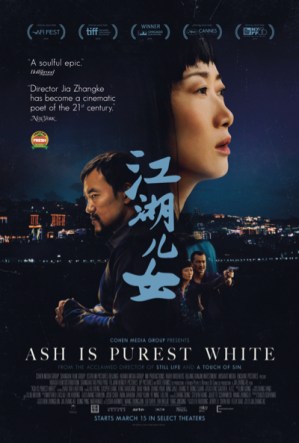
‘Ash is Purest White’ delivers a dramatic punch

Ash is Purest White Poster (2)Premiered at Cannes Film Festival in May 2018, and since then showing in numerous international film festivals around the world, “Ash is Purest White” is now playing in selective cities in the U.S. If you live near Twin Cities, MN, it opens Friday, March 29th at Landmark’s Edina Cinema.

Ash is Purest White” is acclaimed director Jia Zhangke’s latest feature, a China and France co-production. It is like a fusion of Jia’s previous “A Touch of Sin” (2013) and “Mountains May Depart” (2015). The film is structured in three parts, packed with conflicts of loyalty and betrayal, love and loss. The fast changing physical and technological landscapes in China are the realistic backdrop of a story wrapped in the contradictions of choice and fate.

For non-Chinese language viewers, the English title could well be a mystery. What exactly is its meaning, and what kind of genre is it?  The film has an answer as the phrase is explicitly mentioned: Anything that burns at a high temperature is made pure, thus, volcanic ashes are purest white, an apt metaphor as the story unfolds. The Chinese title, however, is less philosophical.  江湖兒女  (“Jianghu er nü”) literally means “jianghu’s sons and daughters”, implying an action genre movie.

“Jianghu”, that undefinable term with no direct English translation, gives it away as it refers to the ancient wuxia (martial arts) world or the gangster realm in present day. In an early scene when the two main characters, mobster big brother Bin (Liao Fan) and his girlfriend Qiao (Zhao Tao) are out in the natural landscape with a volcano in the backdrop, Bin says he belongs in the jianghu underworld: “For people like us, it’s always kill or be killed.” Qiao quickly responds, “I’m not part of the jianghu. You’ve watched too many gangster movies.” Bin in turn takes out his gun, wraps Qiao’s hands to hold it up, shows her how to cock and fire. “See now you’re in the jianghu,” he says.

That is a pivotal scene as it foreshadows things to come. Qiao is pushed into jianghu as she later fires the gun to ward off a group of hooligans in order to save Bin. What more, to protect him, she admits to the police that the gun belongs to her. With that, she spends five years in prison. Jia has created in Qiao a reluctant heroine, capturing our attention with her loyalty and courage, two elements that are essential in jianghu.

“Ash is Purest White” is a mixed bag of crime thriller, melodrama, acerbic realism and humour; the story is an engaging vehicle taking us on Qiao’s personal journey. With this his latest film, Jia won Best Director at the Chicago International Film Festival and Zhao, his wife and muse, Best Actress. Most recently, he added one more accolade as the film garnered Best Screenplay at the 13th Asian Film Awards in Hong Kong on March 16th.

A story told in three acts, the feature is a dramatic depiction of Qiao’s change as she is swept through the currents of life, first as a young woman following Bin around as his girlfriend, a relationship that he is reluctant to confirm. Then comes the pivotal scene of fate sending her to the second act, incarcerated. Later when released, she becomes more street-smart––being cheated, she learns to cheat––all for finding Bin, to pick up where they have left off.

The last part is 18 years from the beginning, Qiao has established herself in Bin’s previous hood, but Bin is no longer the feared and respected big brother. Fate has led him onto a path towards oblivion. The final scene leaves us with a poignant realization, the currents of time may have altered physical landscapes, certain things do not change within the hidden vault of the heart.

(A full version of this review is posted on Asian American Press. Click here to read. )

~ ~ ~ Ripples


What ‘Greta’ could have been

Greta Poster

Greta has all the ingredients to be a much more elevated film. The stalker and prey duo played by veteran French actress Isabelle Huppert and the popular young star Chloë Grace Moretz make a perfect match, director Neil Jordan has top talents in his helm.

At first, looking at the cast and the director’s filmography, I was expecting a psychological thriller. Jordan had won an Oscar for writing the original screenplay of The Crying Game (1992) which he also directed. Later he brought us The End of the Affair (1999), a memorable adaptation of Graham Greene’s novel, again as writer/director. Greta is the Irish director’s most recent feature.

With the older woman stalking a young, innocent prey storyline, Greta could have developed into a deeper, character-focused movie, with more backstory, maybe even a poignant depiction of loss, loneliness, and obsession. Actually it would have been Huppert’s forte to do just that. As Greta Hideg, a widow living by herself in NYC with only her piano music as companion, the role sheds a little reminiscence of Huppert’s Cannes winning character in The Piano Teacher (2001) directed by Michael Haneke. But here she is simply a violent psychopath.

A young, new transplant to NYC, Frances (Moretz) finds the handbag that Greta has left in the subway train. With good intention and much naiveté, she locates Greta’s address and brings it all the way to her home. The rest of the story unfolds with expected development but unexpected, sudden loud sounds aim to scare and shock. Thanks to the ‘chemistry’ between the two stars and their engaging performance, the movie holds up for the first hour. A third character, the free-wheeling roommate Erica (Maika Monroe) is a balm to a distressed Frances, and I admit, to us viewers as well.

The first 60 minutes of the movie was well grounded for some deeper development of story and characterization. However, writer/director Jordan chose the path of the horror genre and its wares, lapsing the second part into unconvincing maneuvers. Huppert as a revenger in Elle is psychologically thrilling; Huppert as a psychopath goes bonkers in Greta is ludicrous. When you hear laughter in the dark theatre during a horror movie, you can almost gauge the effectiveness of the intention.

As for the prominent leitmotif, Franz Liszt’s Liebestraum (Love Dream), it just serves to stir up yearnings for something deeper and artistically satisfying, instead of, alas, leaving us with an illusive dream.

~ ~ Ripples

**


Other Isabelle Huppert’s films reviewed on Ripple Effects:

Things to Come

Claire’s Camera


***


Books into Movies: 2019 and Beyond

Feeling the post-Oscar blues? How about turning to books, before they in turn are morphed into a movie? The following are some upcoming books being adapted into movies in various stages of development. Some are coming out soon, some just announced.

The Aftermath by Rhidian Brook

The movie adaptation starring Keira Knightley, Alexander Skarsgärd and Jason Clarke is coming out March 19, directed by Testament of Youth (2014) helmer James Kent. In recent years, WWII historical fiction has enjoyed a sensational growth in popularity, The Aftermath is another one of this highly sought after genre. The transfer to movies, while not always as effective, lacks no enthused followers. The Aftermath is set in 1946 Hamburg, a British family and a German widower and his daughter had to live under the same roof during a de-Nazification operation.

Cats: The Musical 

Based on T. S. Eliot’s collection of poems Old Possum’s Book of Practical Cats, Andrew Lloyd Webber’s musical Cats is hailed as one of the biggest hits in theatrical history on their website. Director Tom Hooper has another musical-turned-movie under his belt: Les Misérables (2012) which won 3 Oscars. Attractive cast in Cats the movie: Rebel Wilson, Idris Elba, Jennifer Hudson, Judi Dench, Ian McKellen, James Corden, Taylor Swift.

Death on the Nile & Witness for the Prosecution by Agatha Christie

Kenneth Branagh will direct Wonder Woman Gal Gadot and Armie Hammer in Death on the Nile. Branagh will reprise his role of Hercule Poirot, after starring in and directing Murder on the Orient Express in 2017. Now over forty years after her death, Christie’s influence has not waned. A movie adaptation of Witness for the Prosecution has also been announced with Ben Affleck directing.

The Goldfinch by Donna Tartt

John Crowley is no stranger to literary adaptations; his previous feature, Colm Tóibín’s Brooklyn, was nominated for 3 Oscars. This time, Donna Tartt’s Pulitzer Prize winning The Goldfinch reads like it’s written readily for the camera, considering the eclectic characters and the explosive storylines. Sarah Paulson and Nicole Kidman star. Screenplay adapted by Peter Straughan, who was nominated for a Best Adapted Screenplay Oscar for co-writing the 2012 script for John Le Carré’s Tinker Tailor Soldier Spy (2012).

In the Garden of Beasts by Erik Larson

Larson’s 2011 non-fiction is a captivating look into the power and social structure of Berlin during the emergent years of Hitler’s rule. Focus is on the the true story of William Dodd, a mild-mannered Chicago professor who becomes America’s first ambassador to Hitler’s Germany. And this is relatively hot-off-the-press: English film director Joe Wright will helm the production (See also the last entry of this post). Tom Hanks was originally linked with the role of Dodd (and a good choice I think); whether he will carry it through or just remain as producer is to be seen. This is one movie I’ll definitely watch out for. Before then, the book is a great read to prep for it.

Little Women by Louisa May Alcott

Geared for a Christmas release, this new version of Alcott’s classic is written and directed by Greta Gerwig. Gerwig is acclaimed for her take on the contemporary young woman, her psyche and struggles in films like Frances Ha (2012) and Lady Bird (2017). How will she approach Alcott’s novel of a bygone era? And if you still have Susan Sarandon, Winona Ryder, Kursten Dunst and Christian Bale from the 1994 cast stamped in your mind, now try to imagine Florence Pugh, Saoirse Ronan, Timothée Chalamet, Emma Watson, Meryl Streep and Laura Dern taking their places. Actually, not a bad replacement.

The Personal History of David Copperfield by Charles Dickens

First off, I must say this is one of my all time favourite novels, but I’m no purist. While I welcome new representations and interpretation, I still hope the upcoming movie will be Dickens-approved. A most interesting (postmodern) cast: we have Dev Patel as Davie, Tilda Swinton as Betsey Trotwood, Hugh Laurie as Mr. Dick, Ben Whishaw as the ultimate villain Uriah Heep, Benedict Wong as Mr. Wickfield. Directed by Armando Iannucci (The Death of Stalin, 2017).

Rebecca by Daphne Du Maurier 

In this remake of Rebecca, Armie Hammer will play Maxim de Winter. And who will be Mrs.? None other than Lily James, ubiquitous after Downton Abbey (Lady Rose). Do you think she will make one successful Mrs. de Winter? What I’m most interested in, however, is the production design, headed by 6-time Oscar nominee Sarah Greenwood, whose filmography includes Darkest Hour (2017), Anna Karenina (2012), and Atonement (2007) among many other titles. I think Manderley is in good hands. But will the whole production beat the classic Alfred Hitchcock noir with Laurence Olivier and Joan Fontaine? And who can be more chilling than Judith Anderson as Mrs. Danvers?

The Woman in the Window by A. J. Finn

Another wildly popular genre in recent years along the line of Gone Girl and Woman on the Train etc. is the modern day thriller-cum-unreliable-narrator (and alas, they’re mostly women!) mystery novels. Finn’s (Now what’s with the writer whose real name is Daniel Mallory using a pseudonym close to Flynn, the Gone Girl author?) NYT bestseller is turned into a movie with a top-notch cast. (Aside: do writers nowadays write in preparation for a movie?) Directed by the much sought-after Joe Wright, who’d helmed Darkest Hour (2017), Anna Karenina (2012), Atonement (2007), and Pride and Prejudice (2005). Wright has a dream cast in his hands: Amy Adams, Gary Oldman, Juliane Moore. The movie adaptation is written by Pulitzer winner, playwright/screenwriter Tracy Letts, who gave us August: Osage County.

________________

Which one(s) of the above do you anticipate most? Others not on this list?


***

The Favourite: How important is Historical Accuracy in a Period Movie?

Yorgos Lanthimos’ The Favourite is on my Top Ripples 2018 list. I added it in after I’d already posted my annual wrap. I judged it mainly on the basis of its aesthetics, film as an art form, the acting, cinematography, and overall styling.

I went into the theatre with no prior knowledge of the historical details. So, with no a priori burden as a fact-checker, I just let my curiosity lead me, and soon I was transported to a very different world in a very different time. The Favourite shows us Queen Anne’s court in early 18th C. England, where the Whigs fight against the Tories, where men wear wigs and stay indoor cheering on ducks racing or hurling fruits at a naked, good-humoured and heavy-set man (easy target) who finally slips on the fruity and juicy floor, while women play with guns and shoot pigeons outdoor, and pretty good aims they are too, both with the pigeons and in narrowly missing the human target, just as a warning.

the favourite

The film is all about the relational triangle between three women. The trio of actors are undoubtedly the distinguished assets of the production: Olivia Colman as Queen Anne, Rachel Weisz her intimate confidante Lady Sarah Churchill, and Emma Stone as Abigail, Sarah’s cousin and novice chambermaid, soon the new favourite of the Queen’s. Abigail is a quick study; in no time they are all drawn into a three-way tug-of-war. Although initially coerced by the leader of the Tories, Robert Harley (A wigged and made up Nicholas Hoult, long way from About A Boy, 2002), to spy on Anne and Sarah, who sides with the Whigs, Abigail later learns to use Harley’s influence as leverage to her advantage.

Against the historic backdrop of the war with France, the film is an intriguing look into a royal court and partisan politics, but the most meaty story is the power struggles among the three women, and how conflicting dynamics, sexual politics, emotional manipulation, jealousy, and treachery will ultimately consume all. If you’re on an existential quest for meaning, look elsewhere. This film is pure entertainment, irreverent, surreal, sumptuous in set design, costumes, make-up, and spot-on in editing and acting; but it’s not for the serious meaning seeker.

The Cinematography effectively augments the overall aesthetics. Director of photography (DP) Robbie Ryan used a fisheye lens and a roving camera to sweep wide-angled shots, giving us a lively, larger but distorted view, like looking into a fishbowl, which is totally compatible with the genre, for to say The Favourite is a comedy is an understatement. The film is more a farce, and at times outrageous to the point of gratuitous sensationalism. The effect is acerbic sarcasm.

But there are plenty pleasing things to look at as the camera captures the sumptuous set design. The fluid, almost 360º camerawork pans like an all knowing eye. That in itself is ironic, for hidden agendas are ubiquitous among the characters. Shot in 35 mm film, Ryan utilizes natural lighting, and in the dark, a single candle light, all work to serve up a classy, Rembrandt-like impression.

The music too, plays a prominent role in establishing the overall classical tone, Vivaldi, Bach, Handel… yet with a splash of contemporary touch as well, like, Elton John’s “Skyline Pigeon” on harpsichord, and piano. Incidentally, in a few scenes, a long-lasting single note or two – which I’m sure even Philip Glass would find too minimal – will repeat and repeat to pull the string of tension, keeping viewers edgy and uncomfortable. Considering Lanthimos’ previous Cannes winning films The Killing of a Sacred Deer (2017) and The Lobster (2013), The Favourite is relatively conventional in style as a period movie.

I have no favourite among the trio, all three deliver spot-on performance, lively in restraints or outbursts. Colman’s gout-stricken Queen Anne is ludicrous and simple minded, but only in appearance. In a candid moment in front of Abigail, she pours out her inner hurts, so much tragedy in her life: 17 pregnancies, none survived. The 17 rabbits she keeps in her bedchamber are symbols representing each one of her loss, twelve miscarriages and stillborn, five dead children. Doting on them is Anne’s way of dealing with her loss.

And kudos to Abigail who at one point has indeed shown genuine sympathy for the Queen’s plight. Anne is perceptive of this too, a point well earned in Abigail’s favour. Stone is well cast in her role, her initial naiveté shines through. She soon learns that is her best weaponry, and uses it well as she turns into a master of manipulation behind the youthful and innocent mask.

Weisz’s Sarah is cool, scheming, head-strong and controlling. She is the voice and brain of Queen Anne, and yet we can see too that there is a strain of care underlying the strong front. Love speaks the truth, she tells Anne at one point, and the Queen seems to accept Sarah’s opinion with docility – including comment such as “you look like a badger”, citing the smeared eyeshadow on her face – that is, until Abigail shows up.

A palace is a decadent place where power reigns supreme for whoever that happens to grab it for the moment. A mud bath for two could easily shift the dynamics of power balance. It’s intriguing and hard to discern if Anne’s fondness of lesbian pleasures is not so much a result of her innate senses but an intentional bait to control. Ultimately all three fall prey to uncensured misery. The closing shot shows there’s no winner, only the mashed up image of the two remaining in the Queen’s chamber, blurring and overlapping with the propagation of rabbits. And what are they, these rabbits, but symbols of death and remembrance of loss? Surely not a comedic ending.


~ ~ ~ Ripples

________________


After watching the film I went online to learn more about Queen Anne and the historic background of the movie. Here are some of my findings (Warning: Spoilers):

There were no rabbits – They are but director Lanthimos’ own creation. But does it matter that the real-life Queen Anne didn’t have a soft spot for bunnies? I feel they are quite effective here in the film, contrasting Anne’s soft heart and Abigail’s callous, sadistic dealing with those around her, notable is the scene where she steps on one almost crushing the poor creature flat on the floor. Quite like a movie adaptation of a book, a film is a totally different entity and art form for expression.

Abigail did not poison Sarah Churchill – I can understand, to advance the plot and consistent with Abigail’s callous scheming to get rid of obstacles in her way. However, maybe a slight apology to the real Abigail Hill in history for portraying her like a Lady Macbeth?

Queen Anne had a husband – Queen Anne married Prince George of Denmark in 1683.  She had been married for 19 years before she came to the throne and reigned for 12 years, 1702–1714. Prince George died six years into her reign in 1708. According to some historic records, their marriage was strong and she was devastated by his demise. Abigail arrived in Anne’s palace in 1704, married Samuel Masham in 1707, Sarah stripped from her royal position in 1711. There’s an overlap of several years with Anne’s husband still alive when Abigail came into Anne’s court.

There is no mention at all in the film about Anne’s husband Prince George. Anne was portrayed as a single woman with a lesbian lover, Sarah Churchill, then later shifted her favourite to Abigail. The main thrust of the film is built on a lesbian love triangle. Is that also within the creative license held by the filmmaker?

Sarah and Anne’s real relationship remains unclear – Historic records show Anne and Sarah were inseparable since childhood, thus fostering a long-time mutual devotion to each other. The two had exchanged letters with passionate descriptions. As for the new favourite, Abigail, there was rumour that a song was circulated by the Whigs suggested that Anne committed “dark deeds at night” with a “dirty chambermaid.”

Letters from Anne to Sarah still exist and it’s clear there was a deep love between them – until Anne shifted to a new favourite, and in the movie, all due to Abigail’s scheming.

In a BBC News article, Queen Anne biographer Anne Somerset and playwright Helen Edmundson, who wrote the 2015 play on the relationship between Anne and Sarah performed by the Royal Shakespeare Company, both agreed that “no one can now be entirely sure of the nature of the relationship between Anne and Sarah.” Further, “we should be wary of assuming that attitudes to sex, friendship and romance were the same as they are today.”

Such an ambiguity may just be too enticing a bait to pass by for a film director to tailor it for today’s audience. Does a period movie based on history need to be ‘faithful’ to it, or, the artist holds the creative license to imagine and create. Many period films do have discrepancies with historic facts. Perhaps, like adaptations from books, filmmakers can be revisionists as well?

***

Some links to historical background:

The woman behind Queen Anne’s reign, BBC News

Anne (1665 – 1714), BBC History

The True Story Behind The Favourite, TIME

Was Queen Anne Really Caught in a Lesbian Love Triangle? Fact Checking The Favourite, People

***

Related Post:

The King’s Speech: Fact and Fiction
Top Ripples 2018

Here’s the other one of my perennial posts, a wrap for the year. Books I’ve read and film experience that top the year for me. Here are the lists, in no particular order:

MOVIES

I’m appreciating foreign language films more and more, for they offer some of the best examples of what cinematic arts can offer, not CGI sparked spectacles. In my Top 10 list, the first four are from non-English speaking countries. They are also short-listed for the coming Academy Awards Best Foreign Language Film category. Links are to my reviews.

Roma

Shoplifters

Capernaum

Burning

A Star Is Born

Wildlife

The Favourite

Free Solo

Shirkers

The Kominsky Method

I must mention two films that I’d highly anticipated but somehow didn’t connect as I’d wanted to. Maybe if I’ve the chance to watch them again I might change my mind: Cold War and First Reform.

Two movies from 2017 which I hadn’t watched until January this year that should be mentioned here:

Three Billboards Outside Ebbing, Missouri

The Shape of Water


BOOKS

These are not necessarily published in 2018, but the best books that I’ve read this year. I’m not a ‘quantity reader’, nevertheless, a look back at my Goodreads record, I can’t believe I ate all these (links are to my reviews):

The Guermantes Way by Marcel Proust (after 3 years, finally finished)

Middlemarch by George Eliot

The Portrait of a Lady by Henry James

Pachinko by Min Jin Lee

Crime and Punishment by Fyodor Dostoevsky

Of Human Bondage by Somerset Maugham

Not Quite, Note White: Losing and Finding Race in America by Sharmila Sen

David Copperfield by Charles Dickens

The World of Yesterday by Stefan Zweig

Hillbilly Elegy: A Memoir of a Family and Culture in Crisis by J. D. Vance

***

Selective Top Ripples from past years are listed on the side bar. Click on the pictures to my reviews.

Again, thanks for visiting the Pond and throwing in your two pebbles. I’ve enjoyed every single ripple. Hope you’d found a quiet respite here for thoughts and renewal.

And to all, may 2019 bring you more great books and movies to cherish.

HAPPY NEW YEAR!

***

Update: This post should be written on the last day of the year. Since I’d posted it, I saw another film today which I feel should be included here on the Top Ripples 2018 list, and that’s The Favourite (Just opens today in our City). I’m taking The Rider out to keep the list of 10. The Rider I found I’d already included it in my Top Ripples list last year.

‘Roma’ and the Power of Childhood Memories

This awards season, a black-and-white film stands out. Many have noted its cinematography and director Alfonso Cuarón’s versatility, from his multiple Oscar-winning space drifting Gravity (2013) and adaptation of P. D. James’s dystopian thriller Children of Men (2006) to the current Roma, a semi-autobiographical work. Surely I agree to all these, but it’s the personal resonance that the film evokes that makes it so memorable for me.

ROMA.jpg
Yalitza Aparicio as Cleo in Alfonso Cuarón’s Roma. Photo courtesy of TIFF.

I first saw Roma at the 2018 Toronto International Film Festival in September. The large screen effects are enfolding. Cinematography is thoughtful and the state-of-the-art Dolby Atmos sound mixing–especially the climatic ocean scene towards the end of the film–was totally engulfing, as if I was alone in the raging sea, despite sitting in a fully packed theatre.

Watching it again this time on my laptop streaming from Netflix is another experience. The intimacy and allowance for repeat viewing and listening to specific dialogues (re-reading the subtitles) are the obvious benefits. Especially with our local theatres not screening the film, the streaming service has a definite role to play in bringing the worthy feature to more viewers. Certainly if Roma plays in your local theatre, do watch it on the big screen as the production was meant to be seen.

What’s most moving is the director’s gentle rendering of his maid and nanny Cleo (first-time performance by Yalitza Aparicio) in his childhood home in Roma, an upper-middle class neighbourhood in Mexico during the years 1970-71. Cuarón juxtaposes Cleo’s personal ordeal with the political backdrop of the time, and weaving an unassuming life of a maid with episodes of an earthquake, a fire and a threatening ocean climatic scene. Other than these, the everyday work of a maid are deceptively mundane, for underlying are the emotive elements of human relationships.

Cleo is an essential member of the household, cleaning, cooking, serving, and taking care of the four children and their parents. She’s the one who puts the younger ones to bed and wakes them up in the morning. From the nuanced, naturalistic framing and some deeply affective moments, Roma is an ode to those who care for children not just out of duty but genuine love.

The reciprocal sentiments from the children, mom Sofia (Marina de Tavira) and grandma Teresa (Verónica García) make the glue that hold the family together at a critical time when the father (Fernando Grediaga) disappears, supposedly on an academic trip to Quebec but coincidentally is seen on the street with another woman. Here the role played by Cleo, a maid, is delicate and precarious. “No matter what they tell you, we women are always alone,” wife Sofia says to Cleo one night returning home by herself half drunk. Cleo shares her pain.

The film belongs to Yalitza Aparicio who plays Cleo with unadorned naturalness. Before this first time acting, she was a preschool teacher. This could well explain her instinctive fondness for the children under her care in the film. Cleo has her personal sad experience with a young man with a different agenda, and it is the family and the children that rekindle her zeal after a personal tragedy, a remarkable exchange of mutual support and kindness.

As the cinematographer himself, Cuarón’s planning of shots is meticulous and masterful. The camera captivates from the opening credits. We see the close-up frame of what looks like clay tiles of the ground, yes, they are, as water is splashed on them and sounds of sweeping and cleaning are heard. As the story unfolds we learn that it is Cleo cleaning dog wastes in the family porch. But don’t lose sight of this seemingly mundane scene. Once water is splashed on the flat, dirty tiles they reflect an open sky above with an airplane flying across from afar. That is the exact ending shot of the film. From waste-filled clay tiles on the ground to the open sky, water is the agent of reflection, a cleansing element, and towards the end, water marks a confirming love and new zest for life.

Last week, I made a long distance phone call to the maid and nanny of my family when I was growing up in Hong Kong. She is 97 years old now and living on her own, still goes to the market to buy fresh ingredients to cook for herself. I was able to chat with her and send well wishes. Childhood memories are powerful markers of identity and experiences; thanks to Roma for evoking such while one is unaware, as it works magic in creating new imagery to sustain them.


~ ~ ~ ~ Ripples


***

‘Shirkers’ Could Well Kick Off Another #Movement

Writer-director Sandi Tan’s bio reads like an anime heroine. Born in Singapore, where chewing gum is outlawed and family expectations confining, teenager Sandi led a subversive life immersed in the rad, forbidden culture of Singapore. At the prodigious age of 14, she wrote for “Big O”, a magazine of Singapore’s underground rock scene. At 16, she started her own zine “The Exploding Cat” with best friend Jasmine Ng. It attracted a cult following; they received fan letters from New York, London, Paris, Jerusalem, even from prisons. But that’s not the exciting part. At the ripe old age of 19, Sandi made the first indie road movie of Singapore, with a few devoted cinephiles and curious onlookers.

Sandi Tan in Shirkers

It all began when an enigmatic American expat called Georges Cardona arriving in Singapore and started a film class attended by mostly 18 and 19 year-old girls. Sandi started Georges’ class with great aspirations. He took her and a few other gals under his wings, went on night drives after class and introduced them to the French New Wave.

In the summer of 1992, energized by youthful zeal, Sandi made a movie called “Shirkers” with people from her filmmaking class, a remarkable feat. She wrote the script and played the main role, a 16 years-old assassin called “S”. Her best friend Jasmine was editor; another friend Sophie Siddique was producer, and Georges, the director. Sophie as executive producer wrote a letter to Kodak and received all film supplies free. How they rounded up supporting actors and extras, location scouts, sound and techs was an endeavour only youthful verve would attempt.

After the completion of the filming, Sandi and her friends left Singapore for University; she went to England, Jasmine to New York, and Sophie to L.A. Georges remained in Singapore. And that was when the girls lost contact with him. None of them had seen any of the footage, and Jasmine had all the intention to return after school term to do editing work. Georges had disappeared without a trace and taken with him all the 16mm reels of their “Shirkers” film. A large chunk of the girls’ life had gone missing, especially Sandi’s, who had put her heart and soul into the venture, and who, on her own, had gone on a road trip in America with Georges, by then her best friend, a man twice her age with a wife and kid.

With Georges’s mysterious exit, the filmmaking dream of the clan had all but vanished into thin air. After finishing university in England, Sandi went back to Singapore and wrote for Singapore’s Straits Times as a film critic, apparently a dream detoured. Yet life went on. A few years later she proceeded to NYC for film school at Columbia University and later settled in the U.S. She had since made a couple of short films and written a novel, The Black Isle (Hachette USA), which was well received. But at the back of her mind, she could not forget “Shirkers”. Then, twenty-five years later, that fateful day arrived.

Without giving out spoilers, somehow events led to the recovery of the complete “Shirkers” in its original condition in 70 canisters of 16mm film, together with storyboards, scripts, mementos and props used in the production. An amazing turn.

The present documentary is not only about the creative process in filmmaking by a group of young enthusiasts, but also a chronicle of a period in Singapore’s social and cinematic history. What’s more, Sandi Tan’s feature could well kick off something like the #MeToo Movement, not about sexual advantage taken by the powerful, but about adults in mentoring positions toying with the hopes and dreams of their protégé, about the betrayal of trust and the robbing of rightful ownership of creative endeavours. But of course, Georges could well be just a deeply disturbed soul shirking from real life challenges and responsibilities.

Shirkers the documentary is a cinematic collage of 16mm film, digital, Super 8, slides, animations, hand-drawn illustrations and writing, a visual cacophony of creative expressions. Cinematographer Iris Ng (The Apology, Stories We Tell) has done a realistic capture of old friends reuniting with the Jasmine and Sophie interviews plus those of other personnel associated with the original production. Jasmine is now a filmmaker and Sophie faculty of Film at Vassar.

The editing in bridging the 25-year-gap is seamless, the mood personal and quirky. Notable also are the sound mixing and the original score. Shirkers is more than just a chronicle of a mysterious lost-and-found, but a narrative that transcends grievances to situate personal experience in a larger social and cultural context.

Shirkers premiered at the 2018 Sundance Film Festival in January where Sandi Tan won the World Cinema Documentary Directing Award. The film was later acquired by Netflix and released October 26 via the streaming service.

Latest news is that Shirkers is among the 166 entries for Best Documentary Feature in the coming Oscars. Nominations for the short-list will be announced on Tuesday, January 22, 2019. The 91st Academy Awards show will be broadcast live on Sunday, February 24, 2019.


~ ~ ~ Ripples


***

Update Nov. 16: Shirkers has just been nominated for Best Documentary Independent Spirit Award.

‘Claire’s Camera’ is a Whimsical Look at Communication

A Korean director shooting a film while attending the Cannes Film Festival, with two prominent Korean and French actors in his cast, taking just days in shooting to make what seems like a spontaneous gig had resulted in this whimsical 69-minute dramedy. Looks like something only the prolific, Cannes-honored director Hong Sangsoo can pull off. The versatile Isabelle Huppert (Things to Come, Elle) in one of her interviews said it took her only five days to do Claire’s Camera with Hong, with no script, except a daily run-through of the day’s story and lines.

3
Kim Minhee and Isabelle Huppert in Hong Sangsoo’s Claire’s Camera. Photo courtesy of Cinema Guild.

This is Huppert’s second time collaborating with Hong. The parallels in Claire’s Camera with real life are the very elements that lends to the film’s subtle humour. Claire (Huppert) is a school teacher from Paris visiting Cannes for the first time, accompanying a friend to the Film Festival. While wandering alone in this seaside resort taking pictures with her camera, Claire bumps into a triangle entanglement: a Korean director So (Jung Jinyoung), his film’s sales rep Yanghye (Chang Mihee) who has more than just a business relationship with So, and separately, her sales assistant Manhee (played by Hong’s muse Kim Minhee, On the Beach at Night Alone), whom she fires as she finds out Manhee’s one-night stand with the director.

Claire makes fast friends with Manhee after they meet on the beach. Here we see two actors from different countries using English to communicate, a language that’s not their own mother tongue. The verbal limitations may be a bother for some watching the film, but apparently not a hindrance for the two of them striking up an instant, equal friendship. They seem to know what the other is trying to say, and they care to ask each other questions, some quite personal, in order to know the other more.

Contrast that to a conversation where Manhee has with her boss Yanghye over coffee when she gets the message that she’s fired. They share the same Korean language, yet their interlocution is marked by unspoken sentiments and the boss’s minimal attempt to make it a two-way flow. Here’s a realistic depiction of a lopsided communication, one that’s not exclusive to the Korean culture. Those in authority hold the key to conversations.

In another scene, the lack of communication is what makes the naturalistic, deadpan humor work. When Claire first meets director So, the two are sitting at adjacent tables outside a café. As conversation begins, So asks Claire if he can sit with her at her table. She agrees and he stands up and moves to sit by her. But then the two have nothing more to say to each other, maybe due to language limitations. Claire then goes on to Google him on her phone to find out more about this director who’s sitting beside her. One has to take this as a comedic scene to appreciate the irony.

1
Jung Jinyoung and Isabelle Huppert in Claire’s Camera. Photo courtesy of Cinema Guild. 

The film is breezy and leisurely as the Cannes seaside, refreshing as the yellow jacket Claire is wearing; incidentally, her ‘costume’ is the actual wardrobe Huppert had brought when she was attending Cannes at that time. The setting is scenic and pleasant, whether it’s the pounding waves or the small lanes winding along cafes. No, we don’t get to see the red carpet or any of the glamour of the Cannes Film Festival, but we’re led into the side streets of storytelling.

The pitfall for those not familiar with Hong’s eccentric style could be the naturalistic, seemingly unscripted demeanours of his actors and their haphazard dialogues, and in this case especially sound laboured when characters try to interact with each other in a foreign language. And speaking of communication, the usual hard-drinking of his characters—director So here—could well be a language of expression in itself.

As for the camera Claire is always carrying, one would wish Hong could have used that a bit more, cinematically and imbued with deeper meaning. Hers is a Polaroid, so the image appears slowly on a hard copy. But we don’t get to see this effect or be led to any deeper relevance. However, in one notable dialogue towards the end when Manhee finally asks Claire a question that must have been on her mind all along, we finally hear something revealing:

Manhee: Why do you take pictures?

Claire: Because the only way to change things is to look at everything again very slowly.

Manhee: That sounds very nice.

The unfinished part seems to be, “but do we do it?”

Considering Hong Sangsoo’s signature style of repeating his film sequences in a movie like we’re watching it all over again but towards different results, Claire’s words could be more layered than they appear, and the slow appearing of an image on the Polaroid print could well be a mirroring for reflection.

Premiered at the Cannes Film Festival in May, 2017, Claire’s Camera has since been playing in film festivals all over the world. Cinema Guild will be releasing the film on Blu-Ray and DVD beginning Nov. 6, 2018. For more details click here: http://www.cinemaguild.com/theatrical/clairescamera.html

~ ~ ~ Ripples 

 ***

Related Reviews:

Let Things to Come be a Cooling Respite 

Art Imitates Life in Hong Sang-soo’s ‘On the Beach at Night Alone’

‘The Day After’ is a re-enactment Hong Sang-soo Style

WWII Comfort Women Speak Out in ‘The Apology’

In Min Jin Lee’s acclaimed novel Pachinko, there’s this episode in an early chapter. Sunja is harassed by three Japanese high school boys while heading home after shopping at the market. Hansu appears just in time to rescue her. After that, he kindly warns her:

 “Listen, you have to be careful not to travel alone or ever be out at night. If you go to the market by yourself, you must stay on the main paths. Always in public view. They are looking for girls now.”

       She didn’t understand.

       “The colonial government. To take to China for the soldiers. Don’t follow anyone. It will likely be some Korean person, a woman or a man, who’ll tell you there’s a good job in China or Japan. It may be someone you know. Be careful, …” (p. 32, Pachinko)

Korean-American author Lee is subtle here and does not dwell further on the issue. But this episode offers a realistic backdrop to her story set during the Japanese occupation of a large part of Asia. Sadly, the two sisters who work in Sunja’s mother’s boarding house are lured to work in China, with no news after that.

What was Lee referring to?

United Nations researchers report that between 1931 and 1945, the Japanese military forced an estimated 200,000 to 400,000 women and girls into institutionalized sexual slavery. They are called comfort women, a term used by the Imperial Japanese Army, euphemism for sexual slaves. Girls and young women were kidnapped, tricked, or taken away from their homes in Korea, China, Philippines, and Indonesia to comfort stations, another euphemism, for military brothels. To say they were victims of sexual assault was a description put mildly, because many of these women were literally raped on a daily basis.

THE APOLOGY 05_Director Tiffany Hsiung_Image courtesy Icarus Films
Writer-director Tiffany Hsiung

Chinese-Canadian filmmaker Tiffany Hsiung’s documentary The Apology follows three surviving comfort women. To honor them with dignity, Hsiung calls them ‘Grandmas’: Grandma Gil in Korea, Grandma Adela in the Philippines, and Grandma Cao in China.

Since 2009, the Toronto-based writer/director began documenting survivors of this silent atrocity, silent due to the long-held shame and fear of rejections of sexual violence victims. The six years of making The Apology had turned Hsiung into an advocate for WWII comfort women, seeking justice and sharing their stories in communities and universities in North America.

What had been a silent issue was first exposed by Korean survivor Kim Hak-sun, who spoke out in 1991, nearly five decades after World War II. Her brave act of putting away the shame and openly testifying to the horrible ordeals she had suffered prompted many other survivors to follow her lead. Such war-time atrocities began to draw international attention. The voices of these comfort women soon became a poignant outcry, a pioneer of social activism way before the present-day #MeToo Movement.

Grandma Gil of Korea was only 13 when she was forcibly taken away by Japanese soldiers from her home in Pyongyang to be a comfort woman in Harbin, China. She was seriously damaged physically, had gone through four operations during which she was made sterile. Today in her late 80’s, she is still separated from her family as Pyongyang now is in North Korea. She dreams of unification one day so she can see her family again.

Grandma Adela in the Philippines was 14 when she was taken away. Hsiung’s documentary shows us an actual comfort station in the Dona Baray Garrison, now desolate. Adela had not told her late husband about her past fearing rejection, but now felt she needed to let her son know. Hsiung’s camera captured the quiet understanding from her son as he learned of his mother’s painful experience during the war, a shameful secret no more. Sadly, Grandma Adela passed away after that before the production was completed.

Grandma Cao in a village in rural China had never told her adopted daughter. Again, Hsiung’s filming opened up the channel of release for her. There were three comfort women in her village. They were actually already documented by a local writer and a book had been published.

Grandma Gil in Korea is the most outspoken among these three survivors. She continues the protests that Kim Hak-sun had started. She bravely goes to Japan personally to speak to young women of a new generation, students who have not heard of such atrocities. She sits in street protests, over a thousand of such gatherings had taken place so far, yet all but fallen on deaf ears. Not only that, these woman protesters were often met with counter accusations and derogatory insults shouted at them.

A recent comment by a Japanese politician could well have represented the official view. Mayor Hashimoto had said that ‘sex slavery was necessary.’ His political party stated there was no need to apologize.

So, the protesters pressed on. Eventually 1.5 million signatures were gathered from across Asia and as far as Canada. Grandma Gil and several supporters personally delivered the boxes of petitions pressuring Japan to own up to their war crime and offer an apology. The documentary follows Grandma Gil all the way to the office of the United Nations Human Rights Council in Geneva, Switzerland, where the group delivered the boxes of signatures and met with the UN Human Rights Commission.

As of today, no apology has been given by the Japanese government.

The Apology is produced by the National Film Board of Canada. It will premiere on PBS’s POV Monday, October 22, 2018. Check your local station showtime, filmmaker info, trailer and other resources including reading list and lesson plan here:

http://www.pbs.org/pov/theapology/

POV streaming: http://www.pbs.org/pov/theapology/

***

~ ~ ~ 1/2 Ripples

A Star is Born and the Dilemma of Success

Bradley Cooper and Lady Gaga walked the red carpet at the Toronto International Film Festival (TIFF) this September for the North American premiere of their movie “A Star is Born”, a Gala presentation at TIFF. Now the movie reaches the general public as it is released in theatres worldwide.

A_STAR_IS_BORN
Bradley Cooper as Jack and Lady Gaga as Ally in “A Star is Born”. Photo courtesy of TIFF.

This is a bold and spectacular debut for both of them, Cooper as first time director, and the superstar singer her first leading movie role. The two manifest great chemistry on screen, casual and heartfelt. Cooper plays a famous singer Jackson Maine discovering the sensational voice and talent of a struggling singer/songwriter, restaurant worker Ally, a stripped-down, no (or minimal?) make-up Lady Gaga. It’s also a sad story as one star rises just as fast as the other falls like a meteor, self-destruct by alcoholism.

The love story begins with Maine searches for a drink after a performance one night as he has emptied the bottle in his car. His driver roams the streets for any bar that’s still open. They find one and Maine stumbles in just in time to hear Ally begin her gig. The song that she performs hooks and wows him. It’s “La Vie en Rose“, the iconic number by the legendary French singer Edith Piaf. That’s the inciting incident of the movie.

After the song he goes backstage, needing no introduction; he is Jackson Maine. He sits beside her and watches her take off her make-up, then with her permission, helps her peel off the Edith Piaf thin-lined eye brow. It’s just pasted on, not real. But what’s authentic is her voice, which Jack already knows, and he’ll soon discover, her heart as well.

That night, the two sit in the parking lot outside a grocery mart and chat into the night. Why doesn’t she write songs and sing her own work? People like her songs alright, but not her looks, she tells him. She’s self-conscious about her nose. He traces her facial features tenderly with his finger and tells her she’s beautiful. When his driver drops her off, as she’s walking up to her front door, he calls out from the car window: “Hey”. She looks back, he says: “I just wanted to take another look at you.” This line will later become the ominous turn into a heartbreaking end.

It’s Cooper’s directorial debut, and from this feature, we can see he’s a meticulous, sensitive and conscientious helmer. He catches and releases the right amount of tension and emotion with expert timing. His love lines are nuanced, casual yet touching. His singing is seasoned, a bit raspy and therefore quite moving. A Star is Born is remarkable achievement considering he’s the director, co-writer, actor, singer, and co-songwriter, with Lady Gaga and Lukas Nelson (son of Willie) of the 17 original songs in the production.

Kudos to Lady Gaga, other than a mesmerizing voice, her acting looks to be another talent that’s authentic; indeed, a star is born with this movie debut. But maybe that shouldn’t be surprising. She’s been a bold and versatile performer for a long while. It’s the unplugged looks and demeanour in the movie that’s a pleasant surprise. In reality, she’s already a supernova, so where will this further catapult her career? How will movie success affect other aspects of her life?

In the film, the change of Ally from a plain-looking, struggling artist to a performing star with dyed hair, showy costumes and vibrant dance steps stir Jack to remind her to go deep into her soul. Nothing’s perfect. Success comes with a price. Ally handles it relatively well. What is authentic? Surely not the appearance, the stage persona. At least, she still knows her heart. It looks like Jack has a harder time dealing with Ally’s success than the crumbling of his own. That still may be the easier part when compared to conquering the demon of alcoholism.

The very story of A Star is Born is itself a cautionary tale. Interestingly, Hollywood loves this story. The Cooper and Gaga version is the fourth time the tale is told. The very first A Star is Born back in 1937, its screenplay by Dorothy Parker, was based on a 1932 movie What Price Hollywood? directed by George Cukor. Imagine someone back in 1932 was already mulling on this question.

Cukor later directed Judy Garland and James Mason in the 1954 remake. Fast forward to 1976, Barbra Streisand and Kris Kristofferson starred in another version, this time Joan Didion and her husband John Gregory Dunn co-wrote the screenplay, turning the limelight to the musical stage from the movie industry. The 2018 Cooper-Gaga reprise gives credit to Didion and Dunn’s script.

In a perfect world, artistic success can find an ideal integration and balance with popularism and consumerism, while addictions are absent, superficiality and shallowness all but banished. A perfect scenario, but not in the real world. In the real world, we have stories, some repeated and same old but in different versions. No matter how many times they’ve been told, we still embrace them. All because they are real.

***

TIFF-launched foreign language films shooting for Oscars 2019

Watching foreign language films could be an acquired taste for some, not unlike eating sushi. Once you’ve gotten over the seemingly counter-intuitive idea of eating fish raw and allow the soft texture to melt in your mouth, you’ll be pleasantly surprised by the cold freshness and welcome the brain-stirring sting of the wasabi, as well, appreciate the sweet taste when lightly dipped in soya sauce, balanced by the blandness of the vinegared rice morsel. A delightful exploration.

Film festivals are the best venues for one to have a taste of these international, cinematic delicacies. And as usual, the 43rd Toronto International Film Festival (TIFF) this September was a launching pad for films from all over the world, several were subsequently announced as their country’s official entry to the upcoming Oscars Best Foreign Language Film race.

shoplifters_06

“Shoplifters”, this year’s Palme d’Or winner and Japan’s official entry to the
91st Oscar Best Foreign Language Film race.  Photo courtesy of TIFF

The following is the list of TIFF selections that made it to represent their country at the 91st Oscars. Posted also are their premiere status at TIFF. Some of these I’d seen at the Festival and since reviewed (just click on the links). More reviews are forthcoming. The Oscar nominations will be announced Tuesday, Jan. 22, 2019.

**

El Angel, Argentina, dir. by Luis Ortega, North American (NA) Premiere

Hidden Man, China, dir. by Jiang Wen, International Premiere

Birds of Passage, Columbia, dir. by Cristina Gallego & Ciro Guerra, Canadian (CA) Premiere

Sergio and Sergei, Cuba, dir. by Ernesto Daranas, NA Premiere

Winter Flies, Czech Republic, dir. by Olmo Omerzu, International Premiere

Never Look Away, Germany, dir. by Florian Henckel von Donnersmarck, NA Premiere

Sunset, Hungary, dir. by László Nemes, NA Premiere

The Cakemaker, Israel, dir. by Ofir Raul Graizer

Dogman, Italy, dir. by Matteo Garrone, CA Premiere

Shoplifters, Japan, dir. by Hirokazu Kore-eda, CA Premiere

Capernaum, Lebanon, dir. by Nadine Labaki, NA Premiere

Roma, Mexico, dir. by Alfonso Cuarón, CA Premiere (Review forthcoming)

Cold War, Poland, dir. by Pawel Pawlikowski, (Review forthcoming)

Burning, South Korea, dir. by Lee Chang-dong, NA Premiere

Border, Sweden, dir. by Ali Abbasi, NA Premiere

The Wild Pear Tree, Turkey, dir. by Nuri Bilge Ceylan (Review forthcoming)

**

The 91st Academy Awards ceremony will take place Sunday, February 24, 2019.


‘Hotel Mumbai’ captures both terror and resilience in the tragic attack

On November 26, 2008, the City of Mumbai, India, was under siege by terrorists in a co-ordinated shooting and bombing attack that lasted four days. For long hours until security forces arrived from outside of the City, twelve sites in Mumbai were attacked and civilians were gunned down defenceless or taken hostage.

An Australian production, Hotel Mumbai had its world premiere at the 43rd Toronto International Film Festival in September, 2018. Director Anthony Maras in this his debut feature captures the horrific attack ten years ago with a pace that is intense and sweeping, leaving viewers breathless as they watch terror unfold on screen, acts after acts of senseless violence. But don’t let this drive you away.

The setting of the thriller Hotel Mumbai is the luxury heritage Hotel Taj Mahal Palace, or the Taj, where many foreign, renowned personalities had frequented. It was one of the twelve targets of the terror attacks, for obvious reason. Gunmen armed with AK-47 assault rifle and hand grenades took foreigners hostage at the five-star hotel and shot point-blank many others. In the aftermath, 31 in the hotel were killed, almost half were staff refusing to escape but stayed to defend and assist the trapped hotel guests.

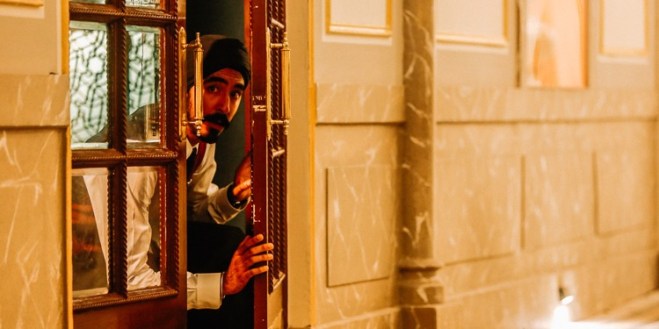
Hotel_Mumbai_0HERO (1)
Dev Patel as Arjun in “Hotel Mumbai”. Photo courtesy of TIFF.

The storylines following several guests in the hotel are particularly gripping, like Sally (Tilda Cobham-Hervey) hiding in a closet caring for a baby who wouldn’t stop crying as the baby’s parents David (Armie Hammer) and Zahra (Nazanin Boniadi) are trapped somewhere else in the hotel, trying to get to their infant son.

Dev Patel plays staff server Arjun. The turban he wears makes one of the guests fearful. A crisis situation could tip either way, as an opportunity for understanding and the breakdown of barrier, or an incendiary fuse leading to deeper hatred and animosity. In a volatile situation as the hotel is besieged, complications could be deadly. But Arjun exudes ample dignity and generosity. That turban will later become a symbol of selfless grace.

The consoling breathers and the meaningful elements in the film then were these acts of kindness and courage. Maras captures the human foibles in the face of dangers, as well the strength of the hotel staff in protecting their guests. Their sacrificial, heroic acts render the film not merely a record of atrocity, but a gratifying chronicle of resilience and bravery.

The bullet-riddled and fire damaged five-star hotel was fully reopened after only twenty-one months. A special commemoration was held and a monument set up to honor those who died.


TIFF Hotel Mumbai Press Conference (1)
“Hotel Mumbai” Press Conference at TIFF. From left: Director Anthony Maras, actors Dev Patel, Tilda Cobham-Hervey, Nazanin Boniadi, Anupam Kher, Jason Isaacs, and Armie Hammer (back). Photo by Diana Cheng

There was a good representation of main cast members at the press conference of the film, moderated by Richard Crouse of CTV. Present were director Anthony Maras and actors Dev Patel, Armie Hammer, Nazanin Boniadi, Jason Isaacs, Tilda Cobham-Hervey, and Anupam Kher. They all commended the hotel staff for their extraordinary courage, some they had met in person who were survivors of the attack.

Upon talking with hotel staff and understanding the actual events, the actors were impressed that small acts of kindness were the essence of resistance. There were staff who had escaped but went back to save hotel guests. Some in the kitchen would put cookie sheet inside their clothes as shield to protect themselves in order to cover guests as they escape. One particular poignant observation they all felt was the breakdown of barriers as both staff and guests were all victims of the horrific act of violence. All racial and financial barriers came down in the face of crisis.

The cast also stressed the point that the perpetrators were all misguided and brainwashed young men. Nine of the ten gunmen were killed. But the mastermind, called “the Bull” in the film—who was in constant contact, directing the attackers throughout by means of their cell phones—was never caught.


***