Nowhere Boy (2009)

“He’s a real Nowhere Man
Sitting in his Nowhere Land
Making all his nowhere plans for nobody”

—– John Lennon’s ‘Nowhere Man’

Other than the iconic first chord of ‘A Hard Day’s Night’ at the beginning of the movie, there is no mention of The Beatles in Nowhere Boy, which is fitting.  After all, the film is not about the Beatles, but a teenaged boy by the name of John Lennon growing up aimless and angry, and how he found passion and poured his life into a goal that finally led him to become one of the most important music figures of our time.

An apt title.  Lennon had had a tumultous childhood.  Raised by his aunt Mimi since five years-old, he did not meet his birth mother again, Mimi’s younger sister Julia, until he was 15.  The film picked up from there until he went to Hamburg in 1960.  Screenwriter Matt Greenhaigh had crafted a moving relational story based on the book written by John Lennon’s half-sister, Julia Baird, entitled Imagine This: Growing Up with My Brother John Lennon.

I’ve particularly enjoyed the mother-son relationship depicted so poignantly in the movie, and the tug of war between the one who has given birth to and the one who has raised the child.  For me, there is also a bit of competition, comparing the two amazing actors, Anne Marie Duff as Julia, Lennon’s birth mother, and Kristin Scott Thomas, as Aunt Mimi, who has raised the boy, stayed with him through thick and thin, and watched him emerge into a man of importance.
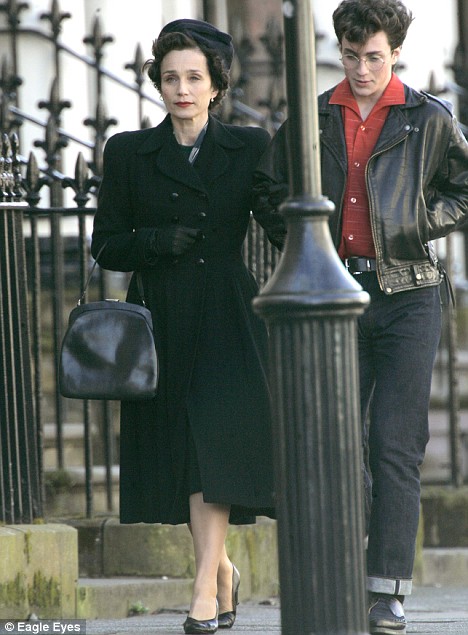
Everyone who watches a movie does so from his/her own frame of reference and perspective. While I’ve enjoyed the pre-Beatles era music and the early rock and roll in the film, as well as the human interest of youth striving to gain some sense of self, I’m nevertheless drawn to Scott Thomas’s role as Aunt Mimi.  She has shown what a mother is, even though she is not the one who has given birth to John.  She is someone who stays and not escapes, who takes care of daily tedium, who instills the ever unpopular notions of discipline and responsibility, and who takes nasty insults and hurting actions from a rebellious and still maturing teenager, all because of love.  Scott Thomas’s marvellous performance as the strict and stern Mimi is an effective foil against Duff’s frolicking Julia.  Both performances are moving.

Aaron Johnson has done a marvellous job in portraying a tormented soul torn between these two women. Meeting his birth mother Julia at 15, he can feel right away the thickness of blood.  On the outset, his musical talent has come from Julia, and his free spirit a natural extension of hers, yet he knows he is also tied to Mimi, and despite her restrained persona, he knows she has loved him deeply.

On his first gig as the Quarrymen, John is introduced to a fifteen year-old well-mannered teen by the name of Paul McCartney, nicely played by Thomas Brodie Sangster. Again, an effective foil between the two.  Paul is gentle, polite, chooses tea over beer, and does not have to bust and bang to release his pent-up emotions.  He also helps John with his guitar skills, teaching him more chords, and suggesting they write their own songs.  Paul definitely has it all collected under a stronger self despite the loss of his own mother just a year earlier.  Thus marks the beginning of a valuable friendship.

The fine production is significant considering it is a fact-based biopic of a period of Lennon’s life that has not been explored on film. Cinematographer Seamus McGarvey (Atonement, 2008) has crafted some colorful renditions for this period film.  The two sisters are also color-coded, Julia in red and pink, and Mimi, back and grey.  A bit too dramatic at times, but the point well taken, maybe something to do with director Sam Taylor-Wood being a visual artist before this her first feature film.  Also, some scenes may look melodramatic, but I was so immersed in the story I had thoroughly enjoyed them. The most moving scenes come at the end, and all the way through the credits.  That is when real photos and actual historical accounts are revealed, a poignant resonance to the film.

At the beginning of the end credits, we see that the film is dedicated to Anthony Minghella (1954-2008), the Oscar winning director who had brought us the The English Patient (1996), Cold Mountain (2003) and The Talented Mr. Ripley (1999), to name a few.  Minghella was instrumental in encouraging director Sam Taylor-Wood to make the transition from visual artist to filmmaker, and had worked with her on her short Love You More, which has earned her a nom for the Golden Palm at Cannes 2008.

Nowhere Boy garnered four BAFTA nominations including Outstanding British Film and Outstanding Debut Director for Sam Taylor-Wood.   Both Scott Thomas and Duff were nominated for BAFTA and The British Independent Film Awards, which Duff won, as well as the London Critics Circle Film Awards. Johnson’s impressive performance also led him to noms and wins.  Overall, a moving tribute to a pop icon and the two mother figures that had shaped his early life.

~~~ Ripples

A Late Autumn Walk

What’s more pleasurable

than a late Autumn walk in the wild

Chopin as companion, ballade cinematic

Tonal colors streamed through earbuds

Sight and sound in perfect harmony


.

Stripped of adorning leaves,

the birches displayed their true essence.

Backbones strong against the wind,

Branches lifted to reach the remaining sun

Stoic elegance intertwined Romanze Larghetto


.

.

And then we met,

A surprise encounter, a momentary start,

Among the low bushes a deer, antlers majestic,

Eyes darted up from his quiet meal,

Weighing my next move.


I walked past without stopping.

It’s not polite to stare,

especially when someone’s eating.

His gaze held me a moment, then let me pass.

I sensed a mutual respect, nature shared.


And so we parted, unperturbed,

after just a split second of cautious exchange,

leaving each other feeding freely,

foliage in his mouth,

and Chopin in my ears.


***


This is what I was listening to… Chopin Piano Concerto No. 1, Second Movement, Romanze Larghetto.

Art and Cliché

My musing on high art and popular culture earlier in my trip came to a new twist as I visited the Louvre. I just couldn’t help but wonder: Can art be too popular? When does art turn from a form of aesthetics into a subject of parody? Will mass popularity reduce an objet d’art into a cultural cliché?

Here’s what prompted my query:

.

Even more fascinating is this view twenty feet away:

.

And in comparison, here’s another gallery in the Louvre displaying lesser known works:

.

.

When does art become a cliché?  In our case, the Mona Lisa…

When you see her in comics, or paint-by-number sets in dollar stores, or morph into Alfred E. Neuman on Mad Magazine’s cover, or into Monica Lewinsky on the New Yorker, or find her on The Far Side Gallery, or in The Simpsons, or a Pantene commercial showing off her revitalized curly hair, or when you find 450 parodies of her image on a single website. According to an image tracking source, the Mona Lisa is the most used and abused image in advertising.

I know, other artists had created altered versions of Mona Lisa from early on. Eugene Bataille (Sapeck) painted her smoking a pipe, Marcel Duchamp added a moustache and goatee, Salvadore Dali fused himself into her image.

Poor girl, she didn’t even know what hit her, or how her one time, private sitting for da Vinci had generated so many imaginative renditions centuries down the road, as people are still using, or abusing, her image for private gains. She should have bargained for residual payments.

Are we more comfortable now that the barrier of ‘high art’ has been broken?  Are we enjoying the legacy and freedom the Dada Movement and the Surrealists had claimed for us?  I must declare outright, I’m not particularly a fan of the Mona Lisa, but I’m just a bit annoyed seeing other similar misuse, like Michelangelo’s David in boxers, or Venus de Milo wearing sunglasses.

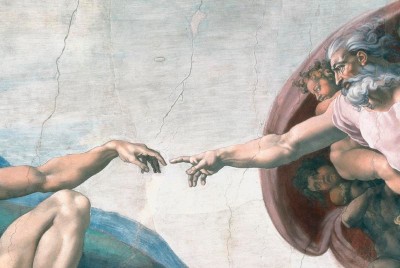
Other vulnerable examples are not hard to find. Think of this magnificent piece of painting in the Sistine Chapel… another easy target for cliché and parody:

Or this self portrait of a tormented soul:

.

Or take these beginning haunting notes from a brilliant symphony, they have become an expression of suspense not much deeper than the tune in Final Jeopardy:

.

The opening chorus of this masterpiece has now been reduced to a punctuation mark in our vernacular, an exclamation used for scenarios from finding your lost keys to losing 10 pounds:

Isn’t the advertising industry supposed to be the flagship of creativity?  And, when it comes to the creative process, aren’t we supposed to flee from clichés and produce fresh expressions? Isn’t originality a goal to strive for anymore? Or, has parody become the new genre and proof of ingenuity in our time?

And I’m just too tired to go into all the zombie and vampire versions of Jane Austen’s novels…

Tate Modern and Billy Elliot

Solution to Arti’s Cryptic Challenge #1:  London… don’t mind the gap.

When time is short, you must select and forego.  The Tate Modern has long been on my ‘must-see’ list yet unfulfilled.  So for the short stay I had in London, I chose this one above all else.  Five years ago, my then 15 year-0ld son went to visit and wrote in his email back to me: ‘Tate Modern is brilliant.’  This time I got to see it first hand.

If a museum of modern art can wow a teenager, there must be something in there that links the gap.  And was I disappointed?  Yes and no.  No because it was brilliant indeed, both the conceptual design, architecture and the exhibits.  And yes, because I was so preoccupied with the directions getting there from our hotel that I forgot my camera.  No excuse for that, I know.  And what makes it worse, the museum allows photography even of its exhibits.  In my utter disappointment, my now 20 year-old said to me calmly, ‘you just have to make do.’  That I did with my iPhone.

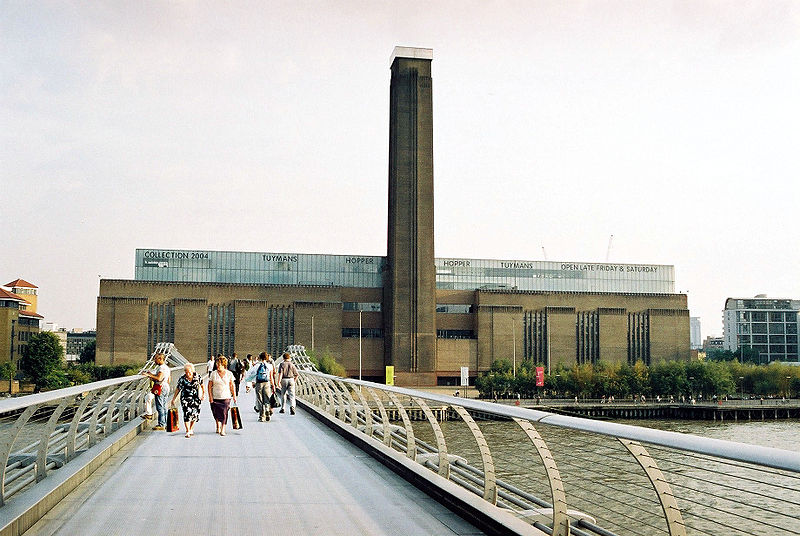
The Tate Modern was converted into a modern art museum from an obsolete power plant on the south bank of the River Thames.  The idea itself is brilliant. What better use of a derelict power station along the beautiful Thames?  Used to be a gloomy stretch of land by the river bank, now the whole area, the Southbank, is revitalized and is home to many London attractions, including the Shakespeare Globe Theatre, the Millennium Bridge, The London Eye, theatres and green, open space.

And thanks to Wikipedia Commons, I found the following photos.  The Tate Modern viewed from the Millennium Bridge.

The Tate Modern was designed by the Swedish architects Jacques Herzog and Pierre de Meuron, the 2001 winner of the Pritzker Prize, the ‘Nobel Prize’ of architecture.  Their concept of maintaining the industrial motif and juxtaposing it with the artistic is ingenious.  Furthermore, they have turned the massive industrial space into a people space.  The main entryway is named The Turbine Hall, allowing people to fill the massive vacuum that was once associated with a power plant. The huge area also makes display of larger pieces of exhibits possible.  Now they are doing it again, yet another redesigning, an even more amazing remodelling and addition, all for the 2012 Olympics Summer Games in London.

Two streams of thoughts constantly ran through my mind during this trip.  One was the dichotomy of ‘High Art’ and ‘Public Art’, ‘high culture’ and ‘popular culture’.  Does such a rift still exist?  All the galleries and museums I visited were all flooded with people.  It was hard to take a picture without any heads caught in the frame.  So every photo I took was immediate.  I had to wait for people to move away and snap the moment quickly.  In the Turbine Hall at the Tate Modern, I saw families with young children, many pushing baby carriages, kids doing cartwheels on the huge floor space.

Is it still ‘high art’ if the exhibits are free to the public, a destination for family outing?  As a rock concert ticket can cost hundreds of dollars… now does that re-define the ‘high’ in culture?  Is it still ‘high art’ if people can get in free, as with the Tate Modern collection, enjoy what they see, gasp at the possibilities, or be bewildered by a notion conveyed through an artwork?  Do we need to ‘understand’ art in order to enjoy it?  Maybe we should just allow the object of art to speak for itself, and thereby, linking the gaps between us.

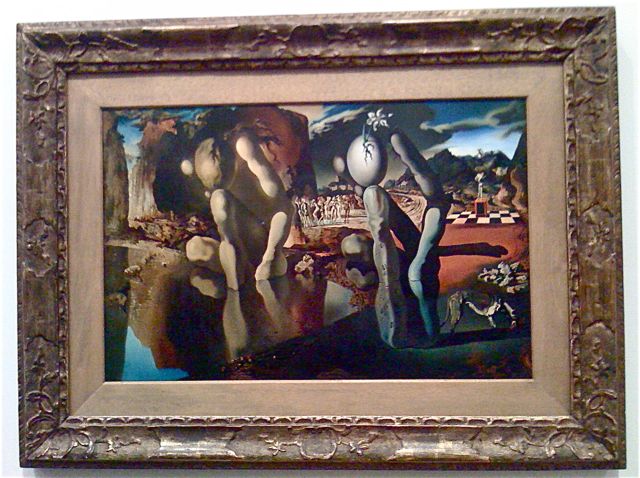
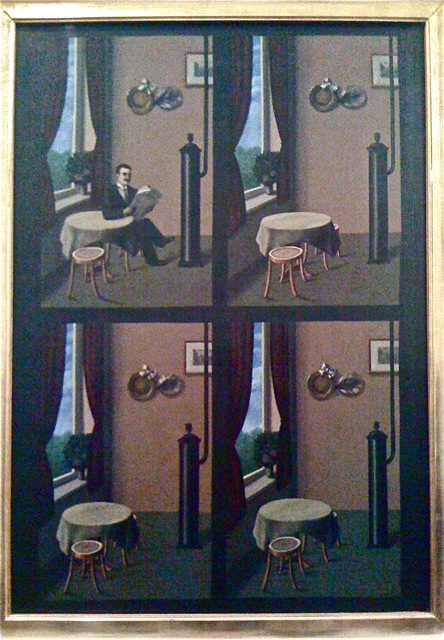
Here are a few exhibits I took with my iPhone.  Please do click on the link of each piece to see the good photos at the Tate Modern website and an explanation.  I was gratified to see works from some of my favourite artists in their original.

Metamorphosis of Narcissus by Salvadore Dali, the work that changed Freud’s original negative view of Surrealist art.  In the painting, you’re supposed to see Narcissus on a pedestal in the background, then kneeling by the fatal pond, and lastly transformed into a flower… and what a self-absorbed egghead he was:

.

Man with a Newspaper (1928) by René Magritte (1898-1967), under the section ‘Poetry and Dream’.  These are supposedly four different perspectives … mmm … , but hey, this is Magritte speaking.  His dead pan surrealist style is regarded as a subtle form of social critique.

.

And here are a few other interesting works. Polish artist Magdalena Abakanowicz’s ‘Anti-form’ sculpture which she created during the 1960’s Soviet-occupation of Warsaw, another example of the freeing effect of art and the social statement they subtly convey:


Untitled sculpture with wood and wool by Jannis Kounellis, homage to Jackson Pollock’s drip painting:

.

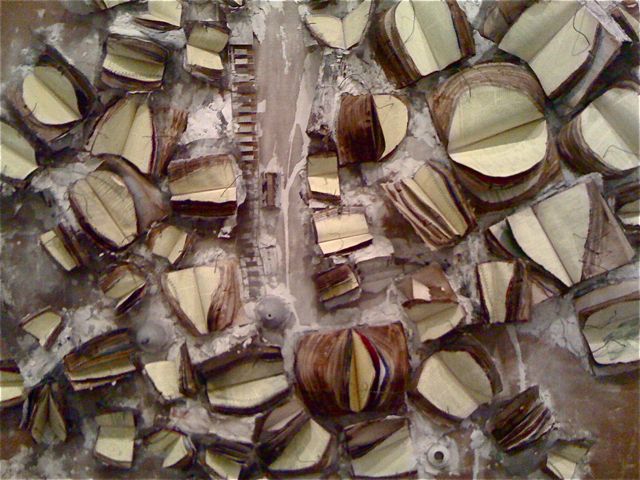
I like this work of open books, but don’t remember the artist or the name of it.  With the fast emergence of eBooks, this work could soon become an antique artifact:

***

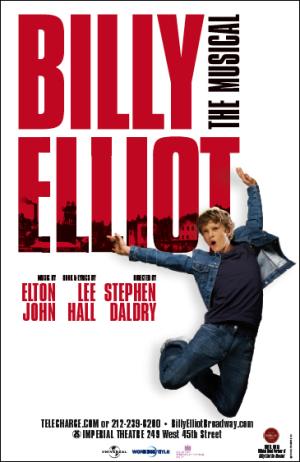
The second event I chose was to see ‘Billy Elliot The Musical’.  I liked the movie a lot, appreciating the depth of conflicts which touch on the same dichotomy: ‘High Culture’ and ‘Mass Culture’, and the seeming incompatibility of art and life.  A miner’s son in a blue collar neighbourhood is attracted to the beauty of the ballet, and the freeing energy of dance.

The conflict persists starkly as the political backdrop of the miners’ strike turns ugly in the 1984-85 years. While their livelihood is at stake, and as the miners determine to pose the fiercest strike action against the Thatcher government, where does ballet come in?  It sounds trivial and even surreal to think of ballet compared to the major battles raging in the country. But this is also a conflict between the individual and the masses, the individual and, yes, even the family.

Billy’s new-found love and immense talent ultimately melt the heart of his macho father and older brother, and soon those in the mining community.  He is given the chance to audition for the National Ballet School, with the local miners raising funds to support his cause.


The movie allows more in-depth exploration of internal conflicts while as a musical, the focus has shifted to the dance performance, the music, and for crowd appeal, some Monty Python style romp com, mellow-dramatic scenes, and many exaggerated, stereotypical expressions and language choices. I’m afraid it looks like a contrived way to bring the ‘high’ down to the ‘common’ level.  Elton John’s music while lively, seems lacking in variety and depth compared to his other works and those in the Andrew Lloyld Webber tradition.

Performed on the London stage since 2005 and still going strong, ‘Billy Elliot the Musical’ is directed by Stephen Daldry, lyrics and book by Lee Hall.  It has won both the Lawrence Olivier Awards in England and the Tony Awards in the US.  It went on Broadway in 2008, and on the main stages in several other countries.  The night I went the role Billy Elliot was performed by 12 year-0ld Rhys Yeomans, and he was marvellous, both as actor and dancer.  He practically carried the whole show on his young shoulders, singing, acting, and dancing in superb style, energy, and versatility.  The role of Michael, Billy’s friend, was done animatedly by another 12-year-old, Reece Barrett. The boys’ performance were the main attractions for me.

In the middle of the show however, the performance was interrupted by a technical difficulty.  It was no minor glitch.  We had to wait in our seat for around 15 minutes before performance resumed.  Now that had discounted some of my enjoyment.  And when the show started again, a scene was skipped.  But overall, it was quite an experience at the Victoria Theatre in London.  A good choice I still think considering the limited time I had in London.

A Late Summer Hiatus

As the holidays draw to an end ever so quickly, and before I take off for a couple of weeks to recharge, it’s time to take stock and wrap up for the summer of 2010.

After watching 56 films in two months as a previewer for an upcoming international film festival, I don’t miss the cineplex for this summer’s offering. Yes, I’ve seen Inception.  And no, I didn’t dream that I saw it… although I remember waking up a couple of times. Anyway, its effect on me is quite similar to Avatar‘s, something I wouldn’t rave about except just say: ‘Been there, done that’.  The Girl With The Dragon Tattoo may well be the best summer movies in my opinion.

As for books, I’ve read a few, not a long list, but enough to keep me busy, relaxed, informed, and inspired. I’m glad I’ve discovered Tim Keller, pastor of the vibrant Redeemer Presbyterian Church of Manhattan.  His Reason For God has restored hope in me that it’s possible to embrace both faith and reason.  Seldom have I come across such an intellectual and sensible approach to the seeming dichotomy.

I must also mention Somewhere Inside: One Sister’s Captivity In North Korea and the Other’s Fight to Bring Her Home by Laura and Lisa Ling.  The book is a riveting account of journalist Laura Ling’s harrowing ordeal as a captive of the North Korean regime, and her remarkable release back to freedom together with her translator Euna Lee.  A testament of hope, resilience, the power of love, and the humanity we all share. An absorbing read, well told inside out.

Also, Bellezza’s Japanese Literature Challenge 4 has really done its job.  For it was a challenge indeed reading Kenzaburo Oe’s Rouse Up O Young Men of the New Age! Another more leisurely but no less intense work is Kazuo Ishiguro’s Never Let Me Go. I’ve purposely delayed posting about it until I’ve seen its movie adaptation coming out in September.  I’m looking forward to the film version, with Carey Mulligan as Kathy, Keira Knightly as Ruth, and Andrew Garfield (our new Spider-Man) as Tommy.  That would be for my commitment to C. B. James’s Read the Book/See the Movie Challenge over at Ready When You Are, C.B.

So now, my two weeks of late summer hiatus.  Just for fun, here’s Arti’s Cryptic Challenge… some hints as to where I’ll be in the next little while …  and most likely what you’ll see posted on Ripple Effects comes September.

1.  Don’t mind the gap:  risky when boarding, but good pointer for parenting.

2.  “I am not yet so much changed…”  Upon this re-visit, I don’t expect much change either, for it has kept quite the same for hundreds of years.

3.  From “Lost Generation” to “Beat Generation”, Beach to Whitman, it has much to offer other than curb appeal.

4.  And finally, this little clip on YouTube is my best prep:

Enjoy what’s left of your summer.  I’ll be happy to hear from you about your summer reads, movies, and wrap-up.  Feel free to leave your comments here and I’ll try to read and reply them whenever I find a free WiFi hot spot.

Pussywillows, Cattails, Soft Winds and Roses

Took a short trip to Ontario last week and came home overwhelmed with nostalgia.  It all started when I visited the town of Unionville and saw these, crowds and crowds of cattails growing profusely in the pond, the fields, by the footbridge:

.

For some inexplicable reasons, I’m much fond of cattails. The first time I learned about them was from listening to the song by Gordon Lightfoot… before I’d actually seen one.

Some time in the 70’s, for many afternoons I sat in the art room of a high school somewhere in Alberta, working on some art project, but mostly doing nothing at all while listening to Gordon Lightfoot.  Mr. Hannington held a laissez faire art class… we could do just about anything, or nothing.  Usually, there would only be three or four of us in the room.  We would just sit around, chat, daydream, and immerse in the voice of Gordon Lightfoot on the radio.

I didn’t turn out to be an artist, while one of us did.  But I’ve remained partial to cattails, mesmerized by the song and the singer.  Those Lightfoot afternoons in the art room emerged from the depth of hazy memories, the lyrics were the soft winds caressing naked limbs as I walked in this natural reserve in Unionville.

Pussywillows, cat-tails, soft winds and roses
Rainpools in the woodland, water to my knees
Shivering, quivering, the warm breath of spring
Pussywillows, cat-tails, soft winds and roses

Catbirds and cornfields, daydreams together
Riding on the roadside the dust gets in your eyes
Reveling, disheveling the summer nights can bring
Pussywillows, cat-tails, soft winds and roses

Slanted rays and colored days, stark blue horizons
Naked limbs and wheatbins, hazy afternoons
Voicing, rejoicing the wine cups do bring
Pussywillows, cat-tails, soft winds and roses

Harsh nights and candlelights, woodfires a blazin’
Soft lips and fingertips resting in my soul
Treasuring, remembering, the promise of spring
Pussywillows, cat-tails, soft winds and roses

(To my artist friend CD: Keep the fire burning.)

***

Susan Boyle’s Dream

So Susan Boyle’s dream has come true.  I’m glad I’ve participated in the process.  I’ve contributed to this whole massive dream fulfillment, albeit just a drop in the bucket… bought her CD today.  (No, I did not get this product free… there you go FTC)

The fact that Susan Boyle did not win British Got Talent didn’t affect the sales of her debut Album.  Even before its release in late November, she has broken the pre-sales record on Amazon.  Immediately after its release, her Album has broken the first week sales record for a debut album in the UK (410,000), beating U2 and Michael Jackson. In Australia (85,000), highest first week sales record, gone platinum right away.  In the US, sales reached 701,000 for just the week of Thanksgiving, surpassing the record set by Eminem in May this year for one week sales, by a gap of almost 100,000.  Needless to say, it tops the sales list in Canada as well.

So why did I bother to add another drop in the bucket?  Simple, I just wanted to show my support.  I know, the cynics would say it’s Simon Cowell, her producer, who is the one grinning from ear to ear.  Okay, if it takes Simon to realize her dream, so be it.

I’d like to see the 48 year-old unemployed single woman, church volunteer and obscure Scottish village dweller, who has been living and caring for her mother until her passing at 91, fulfill her singing dream.  In a previous post, I have written about the possible fallout of Susan Boyle’s 15-minute fame, the sensational YouTube appearance, and her later makeover.  But I’m glad it has turned out amazingly well for her.

Now to those who want her not to change but remain an uncouth, rural woman, I’d say, let her be. Although there’s nothing wrong being just that, uncouth and rural.  However, Susan Boyle can be whoever she wants to be,  get whatever hairdo she likes, buy new clothes if she wants, and smile or not smile for the paparazzi ….

I trust her dream is a genuine one, and she deserves to be noticed because of her humble root and high aspiration with its matching talent.  With more professional instructions and training, her skills could be augmented still some more.  Greater versatility means a wider repertoire, maximizing her potential.  From the few selections here on her CD, I feel that her voice can perform convincingly from Broadway show tunes to soft, quiet folk… blues and even jazz.

Just because of that, I’m a bit disappointed in the selections and some of the arrangements on this CD.  Except for her ‘I Dreamed A Dream’, ‘Cry Me a River’, ‘Who I was born to be’ and ‘Proud’, the other titles are somewhat limiting and have not given her enough range to showcase her wonderful voice.  The arrangements are all slow, with piano and/or guitar accompaniment.  At times her voice is solitary, at times blended with nice background chorus and beautiful strings.  Easy, gratifying listening overall… but I think the producers can take greater risks with her strong higher range, and the soulful, slightly raspy voice.

Here’s the track listing:

1.  Wild Horses (A nice rendition of The Rolling Stones classic.  Hear her sing this song on YouTube. http://www.youtube.com/watch?v=Yb3XAP0c8WU)

2.  I Dreamed A Dream (As if she’s the first one singing it!)

3.  Cry Me A River (A song she’d recorded in  1999 for a charity.  Shows she can do blues and maybe even jazz)

4.  How Great Thou Art (Somewhat weak arrangement, with just the four-line chorus)

5.  You’ll See (‘About determination, independence, and the ability to show them what your are made of’)

6.  Daydream Believer (A slow, even meditative rendition of The Monkees hit, my fave as a teenager.)

7.  Up To The Mountain (‘Sometimes I just lay me down Lord, no more can I do. But then I go on again, because you ask me to’… reminiscence of a spiritual. )

8.  Amazing Grace (So many have recorded this and it still feels fresh.)

9.  Who I Was Born To Be (The song says: ‘And though I may not know the answers, I can finally say I’m free. And if the questions lead me here, then I am who I was born to be.’… and then she writes: ‘Mom must have picked this for me.’)

10.  Proud (‘My dilemma was finding my own identity – a conflict… with myself.’)

11.  The End Of The World (A touch of nostalgia.)

12.  Silent Night (For Christmas … and anytime.)

What I’ve appreciated is that in the booklet, she writes a short personal note at the end of each song.  And on the last page, after thanking all who need to be thanked, she wrote these words:

I would like to dedicate this Album to my beloved Mother, to whom I made a promise to ‘be someone’.

X  God Bless

I’ve made a right choice with that drop in the bucket.

***

Alberta Bound

Autumn in rural Alberta is immensity amplified.  Big sky and expanse of farmland is the main scenery, something what W. O. Mitchell describes as “the least common denominator of nature… land and sky.”

The air is crisp, fresh, and dry.  Colors are simple:  Big blue sky, golden harvest, even just hay rolled up in bales.  Farming against the snow-capped Rockies, rustic, serene, rejuvenating, harmonious fusion of nature and human endeavor.

Trees as windbreaks in the summer, nature’s sculpture in the fall.  So the leaves are gone, but only then can we see the beauty of the bare branches, like dancers celebrating the changing of the seasons.

The solitary figure in the field… en masse.

“Think I’ll go out to Alberta,
Weather’s good there in the fall.
Got some friends that I can go to working for…”

For some inexplicable reasons, as I’m posting these photos, a flood of nostalgia whirls up in me.  The melodies and lyrics of those songs and singers that we can claim our own keep filling my mind all day. Not too many up-and-coming like to hang around here, since all the fame and glory one seeks is down south.

But these remain our own: Gordon Lightfoot, Ian and Sylvia Tyson, Neil Young… and songs about Alberta, about heading west to seek a new life, or to escape from the pain of lost love.  Maybe the wide open country, big blue sky and wide expanse of land do have their healing powers.

And memories, forever clear, keep us rooted… here’s home.

****

Photos taken by Arti of Ripple Effects, November, 09.  All Rights Reserved.

Joshua Bell in the Subway

I watched Joshua Bell play the Mendelssohn Violin Concerto last night on PBS Live at Lincoln Center.  It’s the Mostly Mozart Festival in NYC.

This is one of my favorite pieces of classical music.  The melodious theme comes right out in the opening bars, not needing any intro from the orchestra as in conventional concertos.  I like it that way, swift, cut to the chase.  And here’s the sign of greatness:  the audacity to break new grounds.  Last night I saw the violinist’s audacity matching that of Mendelssohn’s: Bell re-wrote the cadenza for himself.  He has not only given an engaging performance, but has left his watermark in the piece as well.

If you want to see what a born winner is like, just briefly look at his bio.  At 10, he was a tennis champion.  Four years later, he made his professional debut as a violinist and became the youngest person to play with the Philadelphia Orchestra.  And the rest is history.

Bell has recorded more than 30 CD’s, won 4 Grammys, indirectly an Oscar as he performed the winning soundtrack for Best Original Score in ‘The Red Violin’, and garnered accolades too numerous to mention.  His achievements culminated in the prestigious Avery Fisher Prize in 2007, the highest honor for a musician in America.  That puts him in rank with previous prize winners Yo-Yo Ma, Emanuel Ax, and Andre Watts.  But beyond his musical career, he continues with sports and pursues other pastimes.  How about a video games world championship for versatility? Yup, he got that too, in 1996.

Well ok, so far so good… until he was asked by Washington Post writer Gene Weingarten to busk in a Washington DC subway station during morning rush hour.  At 7:51 am on January 12, 2007, a few months before he won the Avery Fisher Prize, Joshua Bell stood in a DC subway station in jeans and a long-sleeve T.  He opened up his case, and started playing his 1713 Stradivarius.

That was probably the first time he had been ignored or even given the cold shoulder:

He got $32.17 for his 43 minutes playing, not counting the woman who recognized him and gave him a twenty.  And yes, there were a few pennies in his case.  More than a thousand people passed by.  In the hustle and bustle of morning rush, few had even stopped to look at him, despite hearing the music.

The commuters were oblivious to the treat that would have cost them a hefty $100 in a concert hall, if they could find a ticket that is.  And for Weingarten,  he got a Pulitzer Prize for Feature Writing for his Washington Post cover story ‘Pearls Before Breakfast’.  To read this fascinating article, CLICK HERE.

Meant to be a philosophical musing on ‘Art and Contexts’, the experiment aims at exploring the epistemology of beauty.  Will we know what beauty is once it’s taken out of context?  Are there preconditions for us to appreciate the arts?  Do we have to recognize a musician before we can admire the music he plays?  If art is taken out of its frame, is it still art?

But… maybe it’s more a sociological study of urban life, or one of economics.  Even if people recognize beauty, is it worthwhile to stop and sacrifice a few precious minutes?   Weighing the economic cost of being late for work, and the enjoyment of music, the bottom line is quite obvious.  What place does beauty have in the pragmatics of our daily routines?  Where do music and the arts rank in life’s competing priorities?

Pearls before breakfast… What breakfast?  Gotta run…

***

The Soloist (2009): The Issue of Authenticity

The True Story

Nathaniel Anthony Ayers was born 1951 in Cleveland, Ohio.  He started his music education in the public schools.  He would be lucky to get a violin, be it one or two strings.  Music was his love and he showed his talent at a young age.  Ayers later went to Ohio University and Ohio State University. He had also played many times at the Aspen Music Festival.  His musical achievement culminated in a scholarship that sent him to Juilliard in New York City in 1970 when he was 19.

Ayers started with the double bass, later changed to the cello.  He was one of the few African-American students at the prestigious music school at that time.  Unfortunately, he only stayed there for two years.  Stricken with paranoid schizophrenia, Ayers had to drop out and return home to Cleveland.  With his talent and the training he was getting, if he had stayed on, he would have no problem getting a spot in any major orchestra in the country.  But his mother could find no solution for his worsening condition.  He was in and out of hospitals, receiving shock treatment as a last resort.

Ayers later drifted off to California and ended up living on the streets of L.A.  When L.A. Times reporter Steve Lopez found him, it was at Pershing Square, where a statue of Beethoven found a permanent home.  Passing by, Lopez heard classical music, and later discovered that it was played on a 2-string violin by a homeless man whose possessions were all that a shopping cart could hold.  That was the beginning of their friendship and the re-discovery of Nathaniel Anthony Ayers.

Lopez not only got his story, he had introduced back into society from the fringe of homelessness, the talented Mr. Ayers.  Based on this story, he went on to write the book The Soloist.  The members of the L.A. Philharmonic also offer help, letting Ayers in to listen to their rehearsals at the Disney Concert Hall, giving him lessons and playing with him the music he has loved.  As Lopez describes, music is Ayers’ medicine, these musician friends his doctors, the Disney Concert Hall his hospital.

Ayers’ real life story has been succinctly captured in a short 12 minutes documentary on CBS 60 Minutes.  From the short clip, Ayers’ gentleness, grace, articulation and musical talent readily shine through.  These few minutes’ glimpses into the person and talent of Nathaniel Anthony Ayers just show us that any story on him would be most authentically done by Mr. Ayers himself, and any feature film deservedly be a documentary.

The Movie

The authentic transposing of Ayers’ unique personality, his musical talent and techniques onto screen proves to be a challenge.  With all due respect to the excellent actors Jamie Foxx as Ayers, and Robert Downey Jr. as Lopez, the real life story just doesn’t transpose that effectively.  Ironically, the problem might well be that they are actors.  I was watching a life acted out.  Director Joe Wright has imbued the characters and scenes with colors and dramatic effects that at times, masking the poignancy with contrived overtones.

Depicting classical music talents on screen is difficult unless the actor is proficient in the same instrument.  I remember how I cringed seeing Meryl Streep ‘play’ the violin in Music of the Heart (1999).  I know Foxx is an achieved musician himself, trained in the piano but not a stringed instrument.  And I’ve heard how he had worked hard at placing his fingers on the cello to be in sync with the melody for his part in The Soloist.  Naturally, such preparation is insufficient to portray a string player of Ayers’ calibre.  The musical authenticity comes when the L.A. Philharmonic performs, but it only brings a sense of incongruence by comparison.

Director Joe Wright’s works include the passionate Atonement (2007) and the adaptation of Austen’s Pride and Prejudice (2005).  Ironically, in The Soloist, a movie where compassion and the healing power of music should be in the forefront, he falls short in depicting the heart and soul of Ayers’ story.  Wright has brought forth a hip flick, surprisingly dispassionate and two-dimensional.  The music of Beethoven could have been used more poignantly overall.  (I can’t help but think of Wright’s other work Atonement, where the rhythm and sound of just a typewriter can be so riveting.)   Also, maybe it’s a sign of our time, but I was disappointed that in a crucial scene, Beethoven’s affective power is being reduced to simply digital, visual effects.

With all its best intentions, the movie tries to touch on too many issues: homelessness, mental illness, the cure for mental illness, religious street ministry, journalism, career and marriage, … just to name a few.  I once heard a nurse say after feeling someone’s pulse: “Irregular heartbeat, all over the place.”  Now why do I have that memory while watching this movie?

I’ve been trying to pinpoint what is lacking.  One of the better film versions of classical musicians plagued with mental illness is Hilary and Jackie (1998).  Director Anand Tucker sensitively crafted an engrossing story.  Emily Watson gave a superb performance in not only depicting the inner struggles but the outward musicality of the renowned cellist Jacqueline du Pré.  Now, come to think of it, maybe what The Soloist lacks is such sensitive, articulate and refined artistry, in which light Mr. Ayers truly deserves to be portrayed.

~ ~ ½ Ripples


The Appeal and Fallout of the Susan Boyle Phenomenon

Update:  CLICK HERE to read my post on Susan Boyle’s debut Album ‘I Dreamed A Dream’.

By now, tens of millions have converged on YouTube to watch the sensational phenomenon of Susan Boyle, the middle-age woman from Scotland on Britain’s Got Talent.  Arti has waited for the dust to settle a bit before commenting, allowing her hindsight to catch up.

So, what’s the appeal of Susan Boyle?  The planned and scripted intention of the producer and judges aside, what is so attractive about the 47 year-old woman?  Is it the plain, country look, the greying frizzy hair, the unkempt and overweight physique?  In this image-driven, urbane society of ours, these features definitely aren’t valuable assets.  Or, as so many have claimed, it’s her voice that has enthralled us all.  Yes,  the lady certainly has potential and talent in this regard.   But truth be told, could Susan Boyle have garnered so much praise if she had looked differently?

The universal appeal of Susan Boyle is the mismatch of her look with her voice, a perceived dissonance based on a prejudiced, preconceived notion marking viewers’ expectations.   What talent could a middle-age, plain-looking, hamlet-dwelling woman have?  The public has a real fun case of being fooled.  Ha, the joke is on us.  We’ve been wrong all along.  Unattractive bodies can be talented personalities.  And the audience had enjoyed the twist and surprise.  Susan Boyle’s  TV appearance provides real entertainment value, albeit manipulative according to skeptics of reality shows.  Simon Cowell should be most gratified.   It’s all about the ratings, and future record sales.

susan-boyles-new-lookBut wait, don’t speak too soon.  Now the 47 year-old has a few hairs on her eyebrows plucked, her unruly lock trimmed and dyed a younger look, donned some neater attire.  Lo and behold, the mismatch has diminished.  As the excitement wanes, criticisms arise.  “She shouldn’t change too much,” the public decries.  “That’s the limit that she should go, no further,” the critics advise.  Wouldn’t it be terrible if Susan Boyles decides to join Weight Watchers.  Of course she shouldn’t, it’ll be much less entertaining.

What have we become now?  Spectators of a freak show in a circus?  What about those lyrics that have enthralled us initially?  Can a woman not be allowed to have her own way, make her own decision to change or not, choose her own lifestyle, and interpret her own dream?  Is she selling her soul just by having a facial?  I’m afraid Susan Boyle is no match for our sensationalism and thrill-seeking crowd of  reality TV viewers, or the humongous entertainment business looking to generate more profits in whatever way possible.

I worry too that the overnight rise to stardom is making Susan Boyle equally vulnerable to become an instant victim of the fallout.  A trampled rose or discarded weed, they meet the same destiny.  Of course, I wish her well and that the pursuit of her dream will not become a nightmare in the callous arena of public opinion.

The curious case of Susan Boyle also reminds me of another woman with talent living in obscurity two hundred years ago.  She was a bit younger,  living in rural England, striving to be herself in the pursuit of her dream to become a writer.  Sadly, she did not live to middle-age, nor see her name credited to her work.  To avoid fallouts and social reverberations, she had to seek anonymity.  Now we know her as Jane Austen.

The lyrics of that tune still sound poignant:  “After changes upon changes, we’re more or less the same;  after changes, we’re more or less the same…”

Photo Credit:  Andrew Milligan/PA,  Source: Times Online http://entertainment.timesonline.co.uk/tol/arts_and_entertainment/tv_and_radio/article6161198.ece

***

Original writing by Arti of Ripple Effects.  ALL RIGHTS RESERVED.  If you are reading this on a website other than Ripple Effects, you are reading a post that has been copied without permission.  Go to https://rippleeffects.wordpress.com to read this and other original and interesting articles on entertainment, books and movies.