The Downton Ripples

Or, How I Overcome Downton Abbey Withdrawal Syndrome.

First, I bought the Blu-rays and rewatched both Season 1 and 2 several times. And then, I let my curiosity lead and follow mere intuition. Downton has prompted me to seek out books and films with setting in the early part of the 20th C.

I was most intrigued by the irreversible changes modernity has brought about, but on a more sombre note, I was moved to learn of the grave number of lives lost in a war I knew so little, WWI.

As heir to Downton Matthew Crawley has aptly noted while fighting in the trenches:

War has a way of distinguishing between the things that matter and the things that don’t.

The Great War did not end all wars as claimed, but had ended countless lives of a young generation, and altered numerous others. On the positive side, it had toppled society’s status quo and broken down previously impenetrable barriers, when men of different social classes fought side by side in the trenches, and where women played a substantial role in the war effort.

And then there are the stories of individuals and families… I’ve thoroughly enjoyed this reading and watching spree. But I have to stop somewhere and share with you what marvellous works you can follow while waiting for Downton Abbey Season 3 to arrive.

So, here’s Arti’s Annotated List of Downton Ripples:

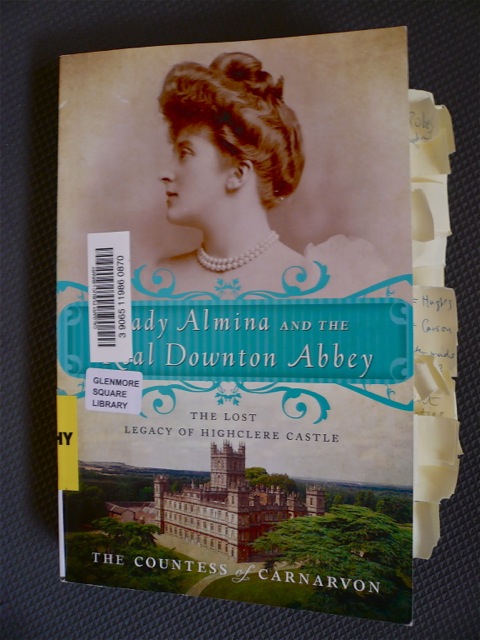
Lady Almina and the Real Downton Abbey by Fiona Carnarvon — A springboard to all my WWI period exploration. What impressed me was that Highclere Castle itself was actually turned into a hospital during the War and many of its staff enlisted and some killed. I was moved by the number of casualties and the horrific conditions in the battlefields. My full review of the book is posted here. 

The World of Downton Abbey — by Jessica Fellowes, niece of write/creator of the series Julian Fellowes. A compendium to the production, the hardcover larger-sized book is filled with photos, background info and quotes from the actors. After skimming through the whole book, one item stands out: Mr. Bates’ fall. That’s when Mrs. O’Brien trips him and he falls flat on his face on the gravel. How did they shoot this? Any special effects? Well, unfortunately for Mr. Bates, none whatsoever.

This is what Bates, Brendan Coyle said:

I must have done it 18 times and by the end I was wounded! I wore knee pads and a torso shield, but when you fall you have to really commit to falling.

Ouch! Some method acting.

Lost Empires (1986)— 7 Episode mini-series based on J. B. Priestly’s novel set in 1913, a year before WWI broke out. Colin Firth is young Richard Herncastle. Lost both parents at 19, he follows his Uncle Nick on his travelling magic stage show, learning the ropes of the itinerant performer in the music hall circuit. A coming-of-age saga chronicling the loss of innocence in love and life. Some noted actors in the series include Sir Laurence Olivier and John Castle.

A Farewell to Arms (1929) — Hemingway’s WWI semi-autobiographical sketch of love and loss. I listened to the audiobook read by Mad Men’s John Slattery. In authentic Hemingway style, his narrative is matter-of-fact and stoic. After that I watched the 1932 movie adaptation with Gary Cooper and Helen Hayes. An adaptation that makes me wish Hemingway was the screenwriter and director.

Brideshead Revisited (1945)– Evelyn Waugh has used a huge and magnificent mansion owned by an aristocratic family to tell his story. Something like Downtown but in a much serious tone. Its subtitle “The Sacred and Profane Memories of Captain Charles Ryder” sets the stage for a tug of war between God and man. I listened to the audio book read by Jeremy Irons, who has turned Waugh’s narratives into pure poetry. Probably the best audiobook I’ve ever listened to.

I’m still watching the 11 Episode TV series (1981) with Jeremy Irons playing the main character of Charles Ryder. So far, I’ve enjoyed the detailed and slower-paced depiction of the work. The book really needs a whole series to tell its story.

I’ve also rewatched the 2008 movie adaptation. As much as I respect the actors in it, Emma Thompson, Matthew Goode, Michael Gambon… I think it has trivialized Waugh’s masterpiece. The adaptation has taken the crux of the matter out and replaces with photogenic visuals and a story converted for more popular appeal. But it could well send one back to the book for curiosity’s sake.

Easy Virtue (2008) — For something totally light and swift, I rewatched this movie based on a Noel Coward play. Filled with Coward’s own music and some Cole Porter, the film depicts how the changes of the times have brought to yet another aristocratic family.

Larita (Jessica Beale) is the first woman race car driver to cross the finish line in Monte Carlo. The year is 1930. An American, she marries on a whim John Whittaker (Ben Barnes), the son of an English aristocratic family… and quickly becomes enemy on the home front to matriarch Veronica Whittaker (Kristin Scott Thomas), and subversive ally to her husband, disillusioned WWI officer played by Colin Firth. If you’re interested, here’s my full review of the movie.

A Handful of Dust (1988) — After Brideshead Revisited I went on to watch another of Evelyn Waugh’s adaptation. Again, a large mansion… how many of these architectural heirlooms do they have in England? Anyway, the master of this house Tony Last (James Wilby) is too busy looking after his property that he loses his wife Brenda (Kristin Scott Thomas). Title comes from T.S. Eliot’s The Waste Land (1922)… that sent me into reading the poem again.

Goodbye To All That (1929) — Autobiography of Robert Graves, English poet and writer. I’m most impressed by the men of letters in that period, they enlisted readily. Robert Graves and Siegfried Sassoon were both involved in the most devastating battles in France. Both were seriously injured. Deep in the trenches they wrote poetry. Their views towards the war changed as time went by, but their experiences in the battlefields brought about poignant legacies as eye witnesses of a horrific war and its aftermath. Ironically, Graves handles his subject matter with some light-hearted reminiscence.

The Remains of the Day (1993) — Not quite the same period but a bit later in the brewing year before England’s engagement in WWII. I rewatched this film adaptation of Kazuo Ishiguro’s Booker Prize winning novel in full, sumptuous Merchant Ivory style. The film leads me to think of a few parallels… Darlington ~ Downton, Stevens ~ Carson, but I’m glad Carson has more heart. And in both Downton and Remains of the Day, a character named Richard Carlisle.

The list goes on with Passchendaele and Birdsong yet to read and watch. But I know when Season 3 of Downton commences, I’ll gladly return and transfix myself once again in the Crawley family.

What have you been doing since Downton Abbey?

***

You may also be interested in:
Quotable Quotes from Downton Abbey

Lady Almina and the Real Downton Abbey

Saturday Snapshot: Book Sale 2012

For Paris in Julyclick here to my home page. I’ll be starting to post the first week of July. 

Saturday Snapshot is hosted by At Home With Books.

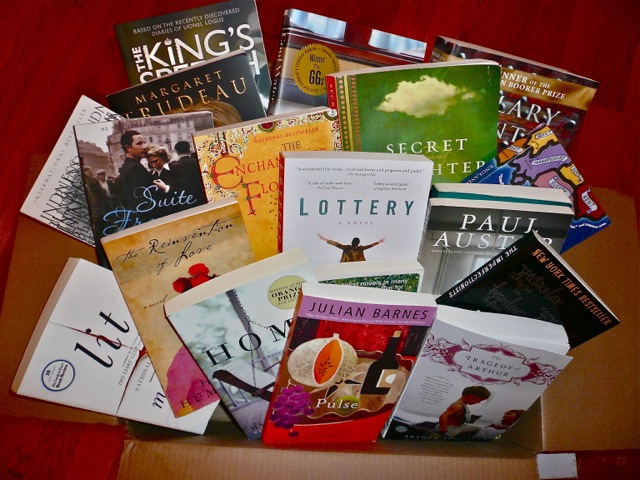
Every year the gigantic book sale organized by the Servants Anonymous Society in our City kicks off my summer reading stock-up. This weekend begins their tenth annual book sale at the Crossroads Market. Here’s a photo of the books I hauled back yesterday, all in like-new condition, all for $1.50 each since I’ve got 20 of them.

Many of the titles I’ve been watching out for some time. Some of them I came to know when I read their reviews on your blogs. Glad I can find them in the book sale and in such good condition. A few of the books look like they haven’t been opened.

Here’s the list in no particular order:

Travels In The Scriptorium by Paul Auster

England, England by Julian Barnes

Pulse, stories by Julian Barnes

Home by Marilynne Robinson

The Virgin Suicides by Jeffrey Eugenides

The Tragedy of Arthur by Arthur Phillips

Lit by Mary Karr

Suite Française by Irène Némirovsky

The Secret Daughter by Shilpi Somaya Gowda

Lottery by Patricia Wood

Blindness by José Saramago

The Reinvention of Love by Helen Humphreys

The Enchantress of Florence by Salman Rushdie

Wolf Hall by Hilary Mantel

The Mistress of Nothing by Kate Pullinger

Cool Water by Dianne Warren

The Imperfectionists by Tom Rachman

One Summer by David Baldacci

The King’s Speech by Mark Logue and Peter Conradi (biography of Lionel Logue)

Changing My Mind by Margaret Trudeau (autobiography)

**

Any of your favorites here? The Sale lasts for three weekends beginning June 8. If you were me, would you go back in the next two? Know my struggling sentiment?

**

Midnight’s Children Read-Along: Book Two (Part B)

CLICK HERE to read my Movie Review of Midnight’s Children

***

From the best exotic Marigold Hotel of today we go back to 1960’s India and Pakistan…

Here in this part, we see our protagonist Saleem Sinai’s changeling status finally revealed to his parents. The ‘Alpha and Omega’ chapter in our last section has let out Saleem’s blood type being neither A nor O, throwing question on his origin. Mary Pereira finally confesses to the crime of switching the two babies at birth.

This is where I find most true and moving. Saleem talking about his parents Ahmed and Amina:

Never once, to my knowledge, never once in all the time since Mary Pereira’s revelations, did they set out to look for the true son of their blood… maybe, despite everything, despite cucumber-nose stainface chinlessness horn-temples bandy-legs finger-loss monk’s-tonsure… my parents loved me. I withdrew from them into my secret world; fearing their hatred, I did not admit the possibility that their love was stronger than ugliness, stronger even than blood.

And from here, Saleem experiences two important moves of his life. One is being sent to temporarily live with his filmmaker uncle Hanif and his wife Pia Aziz, and has enjoyed a fun and pampered time in their home.

Later, in the sixteenth year of Saleem’s life and India’s independence, his father Ahmed makes the resolute decision: there is no future for them as a Muslim family in India. They are moving to Pakistan.

I’m afraid Mr. Rushdie begins to lose me here. As one not familiar with Indian/Pakistani political history, I can only follow his narratives on the surface regarding the war between the two countries. I must have lost the deeper meaning and parallels as he depicts the political turmoils there, or the Indo-Pakistani war of 1965.

While in Pakistan, Saleem’s sister Brass Monkey has changed her name to Jamila and turned into a singer of patriotic songs. Saleem is ambivalent about this… he is excited about Monkey finding her voice, but is apprehensive about her fanaticism. With his ultra sensitive Snotnose, Saleem can distinguish the different kinds of smells that pass through it, one of them being “the hard unchanging stink of my fellow-students’ closed minds.”

Despite being an outsider and not understanding the political parallels of the narratives, I can grasp Rushdie’s meaning about political ‘truths’ declared by the government. Saleem has gleaned some insights into his short life growing up in both India and Pakistan:

… and maybe this was the difference between my Indian childhood and Pakistani adolescence–that in the first I was beset by an infinity of alternative realities, while in the second I was adrift, disorientated, amid an equally infinite number of falsenesses, unrealities and lies.

And a little sardonic humour as he concludes:

A little bird whispers in my ear: “Be fair! Nobody, no country, has a monopoly of untruth.” I accept the criticism: I know, I know…

An outsider can still enjoy Rushdie’s stylish surprises.

It is also in this section that I’m a bit disappointed to read that along with the move to Pakistan, Saleem loses his supernatural power to tune into the minds of all other Midnight’s Children, thus terminating any more Conferences. I hope this is temporary though, for I relish the confrontations between Saleem and the others he calls to congregate in his mind, in particular, the opposing sides represented by Saleem and Shiva: idealism and pragmatism, thoughts and things.

I look forward to the last section, Book Three, and see how the story concludes. Hope you’re still with me…

***

CLICK HERE to BOOK THREE CONCLUSION

Do go visit other reviews in the Group Read:

Gavin of Page247

Janell of An Everyday Life

Jerika of averydisorientedreader

***

CLICK HERE to watch Salman Rushdie and Deepa Mehta talk about the film adaptation of Midnight’s Children at TIFF last year.

***

Lady Almina and the real Downton Abbey: Facts that give rise to Fiction

Downton Abbey in real life is Highclere Castle, situated among a thousand acres of beautiful parkland, perching on a hill with a vantage point of even more spectacular views. It is home to the Earls of Carnarvon for centuries. The book is written by Fiona Carnarvon. Lady Almina is the great grandmother of her husband, the 8th Earl of Carnarvon. The book chronicles the life and legacy of Lady Almina, who married into Highclere at 19, and evolved from a youthful debutante to a seasoned and capable, aristocratic lady with a heart. Here is the source material for the fictional creation so well received by viewers all over the world.

I’m not one easily swayed to follow what’s being hailed in current culture. But for some reasons I’ve been drawn to the human drama of the hugely successful Downton Abbey. Until I read this book I have not thought that mere facts can be as engaging as fiction. Compared to the epic proportion of historical events detailed in the book, the TV series are but minute vingnettes, albeit they do have their endearing appeal.

This is my library copy of the book after I finished reading it. There are no less than 80 tiny yellow stickies to mark my interest:

At first, I was expecting a book offering tidbits of the Highclere Castle, its designs and architecture, and how its life, both upstairs and downstairs, corresponds with the TV production, etc.

But while it lacks the design and architectural specifics I was looking for, the book has brought me something else. Yes, there is a myriad of Edwardian high society accounts, the fashion and the opulence, as expected. But to my surprise, the latter part of the book offers a greater appeal to me. I was fully absorbed by its massive archival information on The Great War, from the trenches in Europe to the battlefields in the Middle East, wartime to post-war politics, Highclere’s involvement in international power brokerage, George’s brother Aubrey and T.E. Lawrence’s friendship, and the last chapters bring me to the archeological site of the Valley of the Kings in Egypt.

Nurse Almina

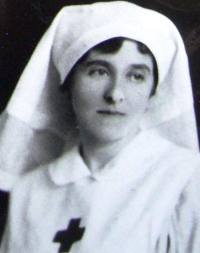
Unlike the Crawleys in Downton Abbey, the Carnarvons threw themselves fully into the war effort without hesitation. As soon as Britain entered The Great War (1914-1918), Highclere was turned into a well-equipped hospital, not just a convalescence home. Financially supported by her wealthy father, Almina hired the best in medical personel, well-trained nurses and specialized doctors, and furnished the Caslte with state-of-the-art equipment. Almina herself oversaw the whole operation and heavily involved in personal nursing care as well. A real-life Lady Cora/Isabel Crawley working in unity.

Seeing Matthew Crawley’s muddy face in the trenches cannot convey to me the horrors of the war. The detailed accounts in the book are terrifying to read. There were so many ways to die: guns and shells, broken bones even just a broken femur, long, bumpy rides to a hospital, gas, hunger, diseases, lack of medical supplies and doctors, even rain. Non-stop rain in Passchendaele had caused trenches to collapse, drowning many soldiers in the mud.

The Battle of Somme claimed 60,000 lives on its first day on July 1, 1916. Four months later, 415,000 British and Dominions soldiers had been killed or wounded. The Battle of Ypres saw the Germans use a new weapon. 168 tonnes of chlorine gas was released into Allied positions. 5,000 French soldiers in the trenches died within ten minutes, 10,000 were blinded as they escaped. In 1917, the number of British casualties and injured totalled 800,000. Many of Highclere staff were wounded and killed, those sent home were the lucky ones. The missing and the ones buried on foreign soil made the impact even more heartbreaking.

The Dowager Countess of Carnarvon, Elsie, had always been receptive to innovations and improvements. Unlike her counterpart in Downton Violet Crawley, Elsie welcomed electricity and the telephone. In 1919, at 63, she became vice-chairman of the Vocal Therapy Society and promoted the use of singing to help shell-shocked men to overcome debilitating stammers. Umm… she would have made a good team with Lionel Logue, who set up shop on Harley Street. Just ask Bertie KGVI, he knew it worked.

On a totally different note, the last chapters of the book transport me to the archaeological site of the Valley of the Kings in Luxor, Egypt. Almina’s husband George Herbert, 5th Earl of Carnarvon, was one of the last British aristocratic archaeologists, having spent £50,000 (£10 million in today’s money) over the course of fourteen years on excavating in Egypt.

Howard Carter, left, & Carnarvon at King Tut’s tomb

Lord Carnarvon personally hired the expert archaeologist Howard Carter to team up with him in his pursuit of Egyptian antiquities. Their breakthrough work came in 1922, when they discovered the burial chamber of the young King Tutankhamun. Unlike rumors that had distressed the archaeological dual that they would ship the finds to England, the King Tut artifacts have  been the possession of the Egyptian government since the discovery.

I had not realized the connection before… how Downton Abbey could have a certain degree of separation from King Tut. But the book soon ends with the sad news that the already weak Lord Carnarvon soon succumbed to illness. He died in Cairo at age 57, just a few months after the excavation. It’s noted in the book that at the time of his death, back at Highclere Castle in the night, his beloved terrier Susie howled once and died.

Here I’ve just touched on a few yellow stickies. You need to read the book to grasp all the significant events during that first quarter of the 20th century. As the book has been written and published ‘in record time’ as the author has noted, likely to coincide with the broadcast of Downton Abbey Season 2, it is not a literary work, not even a social or political commentary of any sort. Yes, I was looking for the author’s view on aristocracy and the Empire. Nevertheless, it is a compact historical account that chronicles the lives of some individuals who had left indelible marks in an era of irreversible change and new discoveries. 

Excellent Photos, A Bibliography of researched works and archival materials, and an Index make up the supplementary resources.

~ ~ ~ Ripples

Lady Almina and the Real Downton Abbey: The Lost Legacy of Highclere Castle by The Countess of Carnarvon, Broadway Paperbacks, NY, November, 2011, 310 pages.

***

Other posts you may like:

Quotable Quotes from Downton Abbey

The Rant of the Armchair Traveller

***

Midnight’s Children by Salman Rushdie, Book Two (Part A)

CLICK HERE to read my Movie Review of Midnight’s Children

***

While Part One of the book is a macro view of historical background and family genealogy dating back a few generations, Part Two is what we’re all waiting for, the emergence of Midnight’s Children, in particular, our young hero Saleem Sinai. This present section of our Read-Along is the first part of Book Two, ending with the chapter ‘Alpha And Omega’.

We see Saleem Sinai growing up from a protected infant doted on by mom Amina and maid Mary to a thinking, mature, yet mildly timid and clumsy ten year-old. He shares his childhood in the family with his sister Brass Monkey, one year younger, ‘untamed, unfeminine’. Faced with the ambivalence of sibling rivalry and camaraderie, he learns in time the axiom that blood is thicker than water.

By all standards, Saleem’s first ten years (so far) have been eventful. Not long after his birth, Ghandi is assassinated. Saleem’s father Ahmed’s assets are frozen but later rescinded by the court. He spies on his mother and follows her secretly as she meets her ex-husband, now the Communist Party leader.

Saleem’s great sense of imagination is nurtured by various cultural traditions, a generous share of fairy tales, super heroes and the cinema.

Hatim Tai and Batman, Superman and Sinbad helped to get me through the nearlynine years… I became Aladdin, voyaging in a fabulous cave… I imagined Ali Baba’s forty thieves hiding in the dusted urns… I turned into the genie of the lamp… I was mild-mannered Clark Kent protecting my secret identity…

Other memorable episodes include a first taste of unrequited love from his crush on Evie Burn. As for school, colonial traditions stay. Saleem goes to a Christian mission school where he gets his multi-cultural exposure. Some learning is hard, that’s expected. But he gets more than his fair share as he tastes the ultimate in corporal punishment and humiliation as a clump of his hair is pulled out by his Peruvian geography teacher. Later in the school dance, in front of his new crush Masha Moviac, he shows her he is a man after all as he knees his insulters. Mayhem ensues that ends with a mutilated finger in the emergency room.  I can see lots of movie moments, hilarious yet endearing.

But above all, growing up in Methwold’s Estate and his part of Bombay is a close encounter with multiplicity. And to a young boy tossed in the net of a myriad of interwoven cultural strands, Saleem is preoccupied with the search for an identity. Further, with his secret, supernatural gift of tuning into other people’s mind, he eagerly looks for a purpose and meaning to his life. And here is how Rushdie so brilliantly parallels Saleem’s birth to that of a nation.

On my tenth birthday, everyone at Methwold’s Estate tried hard to be cheerful, but beneath this thin veneer everyone was possessed by the same thought: “Ten years, my God! Where have they gone? What have we done?

Saleem holds a Midnight’s Children Conference right in his mind, he himself the self-imposed leader of the 581 surviving Midnight’s Children, all born with unusual gifts. His leadership is challenged by none other than his changeling, Shiva, born at the stroke of midnight with him. While Saleem ponders on the purpose and reason for his supernatural power, his counterpart Shiva, coming from the slums, opposes him with the facts of life:

Rich kid,” Shiva yelled, “you don’t know one damn thing! What purpose, man? What thing in the whole sister-sleeping world got reason, yara? For what reason you’re rich and I’m poor? Where’s the reason in starving, man? God knows how many millions of damn fools living in this country, man, and you think there’s a purpose! Man, I’ll tell you–you got to get what you can, do what you can with it, and then you got to die. That’s reason, rich boy. Everything else is only mother-sleeping wind!

Crisp and simple. Existential pondering a luxury to many… ?

How I look forward to the rest of the book, and the movie. BTW, it has been shown to selective previewers, who were told not to write any reviews as yet. They sure know how to build up expectations and curiosity.

***

CLICK HERE to BOOK TWO: Part B
CLICK HERE to BOOK THREE CONCLUSION

Read-Along Participants’ Posts for Book Two (Part A):

Bellezza at Dolce Bellezza 

Gavin of Page247

Janell of An Everyday Life

Jerika at averydisorientedreader

ds at third-storey window

If you’ve written a post on this section, do let us know in a comment. I’ll add your link on the list.

Next section: Book Two, Part B. From ‘The Kolynos Kid’ to the end of Book Two. Share your view May 31st. You still have time to catch up if you like to start the book now.

***

Everything In This Country Must by Colum McCann

This is my third installment for Ireland Reading Challenge at Books and Movies. And just recently, I’ve come across another interesting reading event, so I’m using this review as well to participate in the Irish Short Story Week Year Two at The Reading Life.

A book compiling two short stories and a novella, Everything in this Country Must reaffirms my admiration for Colum McCann’s spare and powerful writing.

McCann is the author of the 2009 National Book Award winner Let The Great World Spin. In my review of that book, I noted how he’d intricately woven together seemingly unrelated stories against the backdrop of the Twin Towers, crafting a moving tribute to NYC.

Before NYC, McCann had written about his home country Ireland. Everything In This Country Must (2000) is a poignant portrayal of how the political turmoils in Northern Ireland during the 80’s affect the three young protagonists in each of these stories. All the short pieces in the book are masterfully rendered, immediate, sharply focused, intense, minimal yet deeply charged. Above all, I’ve appreciated, as with Great World, McCann’s insightful metaphors.

***

Everything In This Country Must: Short Story

Nightfall, cold and raining. A man’s favorite work horse is near drowning with its forelegs caught in some rocks at the bottom of a flooding river. He gets his 15 year-old daughter to help him hold the horse’s head above water with a rope while he frantically dives into the water to get its legs out, but to no avail. He desperately needs help.

Soon enough, an army truck passes by. A few British soldiers quickly jump out to help. O what plight! The wrong people coming to the man’s aid. These soldiers remind him of the loss of his beloved. Despite his protest, they save the horse. The daughter now is torn between her gratitude towards the soldiers and her father’s anger.

Of course I will not tell you everything about this story. You must experience it yourself. Then you’ll be amazed how in just fourteen pages, McCann can depict a human flood of hatred and rage that can drown any living soul, and slap you with a haunting end that leaves you cold like night.

Wood: Short Story

With his father stricken ill in bed, a young boy helps his mother to secretly work in the family mill to earn some money, cutting logs and refining them to make poles which will then be used to hold political banners for the Protestant marches. The boy knows that his father, despite being Protestant, disapproves of these marches. That’s why he knows he has to do this stealthily, yes, to protect the pride of his father who now lays in bed unable to work, but maybe even more importantly, so not to betray his political stance. Mother and son toil in secret, turning raw wood into polished poles. The boy loves both parents, his loyalty a dilemma between reality and ideal.

And all this time the wind blows obliviously, swaying the oak trees behind the mill. “The trunks were big and solid and fat, but the branches were slapping around like people.”

Hunger Strike: Novella

Kevin is a new arrival to a Southern seaside town, living with his mother in a caravan by the shore. The move apparently is an attempt of his mother to get away from the political conflicts in the North. Kevin’s father had been killed in an accident some years ago. Currently his uncle, an IRA member imprisoned in Northern Ireland, is one of a group of inmates holding a hunger strike. Some have already died.

The uncle’s ordeal disturbs 13 year-old Kevin deeply. While his mother wants to give him a better life away from the turmoil, Kevin is emotionally entwined with his uncle’s struggle. The boy vicariously partakes in the hunger strike, counting the days, noting closely the deterioration of his uncle’s health, and even secretly dumps his own food away.

An older couple with a yellow kayak live close by. Kevin observes that they paddle in sync, they move and rest in perfect harmony. Their calm and quiet life is a huge contrast to his. Later, the couple befriend him. The old man teaches him how to paddle:

The blade should never go too deep into the water or else too much energy would be used. And there should never be too much of a splash when the paddle came out — it should look as if the sea had hardly been disturbed.

A hopeful new beginning for Kevin seems to ensue, but the situation continues to deteriorate in his hometown in the North, and with the plight of his uncle. The waves inside Kevin is just too rough for smooth and quiet paddling. A sea undisturbed belongs to the apathetic, and sometimes splashes are called for. McCann’s description of a tormented young life is both visual and haunting, and propels us to a poignant and heart-wrenching end.

~~~~ Ripples
(yes, exactly my point)

Everything in This Country Must by Colum McCann, A Novella And Two Stories, Picador U.S.A., 2000, 150 pages.

***

For my other Ireland Reading Challenge posts: 

Molly Fox’s Birthday by Deirdre Madden

The Importance of Being Earnest by Oscar Wilde

***

Dances with Words

After listening to an audiobook, do you consider having read the book?

Why or why not?

I’ve been mulling over this question for some time now. I love reading, but I’m a slow reader. It’s always faster to listen to a book read to me than reading it myself. So you see the appeal there. And I can make good use of my time while driving.

But I always feel there’s a difference between listening and reading. All along, I don’t equate having listened to an audiobook with having read the printed pages. I’m beginning to find the word ‘finish’ most apt, since it can apply to both. Saying ‘I have finished a book’ can mean either.

Oral tradition of storytelling has long been around in human history, a way to preserve tales and legends that had not found a written form. But for those that do have a life in words, or, ‘texts’ in our eAge, why do I still hesitate to consider listening to them the same as reading the print version?

At long last, I think I’m beginning to get a hold of what could be the difference… and this may sound so common sense to you. But, it’s an Eureka moment for me.

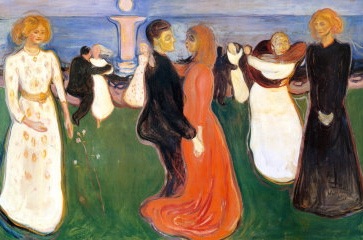
Here it is: Reading a book is a first-hand encounter. I’m the sole interpreter of the text. Like partners in a dance, as a reader I respond and move with every single word in my own way.

The Dance of Life by Edvard Munch (1900)

With audiobooks, I’m listening to a voice that has already interpreted the written codes. Every audio recording is a performance. And I mean it in a good sense. The reading I’m listening to has passed through an interpretive filter. That voice must have first read the words, internalized, and then delivered them with what the voice thought was the appropriate diction, pitch, accent, tempo, emotion…

When I’m reading a book, I’m dancing with the words as partners. When I’m listening to an audiobook, I’m watching a dance performance. I enjoy both. But the experiences are different… and there’s only one first-hand encounter that’s unique to me: my own.  But sometimes, I need to see how others dance too in order to appreciate the story or the characters more. We just may need dancing lessons every now and then.

I must give kudos to two audiobooks I finished recently. In both of them, the voice reading the text confirms how fascinating dances with words can be.

On Beauty by Zadie Smith, read by Peter Francis James:

I’m amazed how one reader can give life to characters of various cultural background in such a vivid manner. On Beauty explores in a nuanced and comical way, relationships and conflicts within a family, as well as between races, generations, and genders. It was shortlisted for a Booker (2005) and was the Orange Prize winner in 2006. Now imagine the myriad of characters.

The book describes two families intertwined in a cacophony of cultural dissonance, the fathers being academic rivals. In the Belsey family we have father Howard who is a white Englishman, his African American wife Kiki, their three youthful offspring who have grown up in America influenced by different subcultural vernaculars. Melting pot is a wrong term to describe them. It’s more like you’ve thrown classical, jazz, hip-hop, rap, all into the wok and stir fry.

Howard’s academic rival is Monty Kipps, who has brought his family from England to stay in America shortly as a visiting scholar teaching at the same college as Howard. The Kipps family members are all British citizens with Trinidadian heritage. Their two college age children have grown up in England.

The talented actor Peter Francis James has given a worthy portrayal of such a cultural mix of characters without turning them into caricatures, but has rendered them convincing and real. Zadie Smith’s nuanced dialogues and humor are well executed. It is a close encounter of dissonance in language, accents, values, and racial influences. What a dance performance this is. I have not read the book, but when I do read it, I’m sure I will not appreciate it as much if I haven’t heard the voices jumping up and down in my mind.

Gilead by Marilynne Robinson, read by Tim Jerome

Gilead was the 2005 Pulitzer Prize fiction winner. I read the book a few years back. Listening to the audio CD’s recently has not only brought back memory of my previous enjoyment, but insights that I’d missed my first time reading the book. All thanks to the calm, soothing, and gentle voice of Tim Jerome, portraying spot-on the ageing John Ames, Congregationalist minister of Gilead, Iowa.

Throughout the book, there’s only one character speaking, that of John Ames leaving a legacy to his very young son, telling him stories of his own grandfather and father, a family tradition of ministers. Jerome’s audio rendition of the book works in me like a devotional. His voice embodies grace and forgiveness. Listening to him can only augment my own reading experience, a performance to emulate for the dance of life.

***

What are some of your experiences of reading vs. listening to books? Which are your favorite audiobooks?

***

Diary of A Country Priest: A Book for Easter

Every year around this time, I come back to my perennial read The Diary of A Country Priest by French author Georges Bernanos(Journal d’un curé de campagne, 1936). In this book, I find the essence of Easter.

A young preist comes to his first parish, the rural town of Ambricourt, full of humble ideals. All he wants is to serve the people, to give of himself, to bring God’s love. But as soon as he sets foot in the village, he is engulfed by hatred and rejection. There are dark secrets too sinister to be exposed. The young priest is an unwelcome alien. In a town afflicted by hypocrisy, pride, anger and bitterness, he is despised, taunted and ridiculed. His own innocence is no match even for the children in his catechism class, especially the precocious Seraphitas, a girl ‘with a hardness far beyond her years.’

Ambricourt is a world afflicted by the ‘leprosy of boredom’, a microcosm of the human condition. Bernanos uses diseases to illustrate his point well. The young priest himself is being slowly consumed by terminal illness. The pain in his stomach ultimately defeats his body, cancer. His diet consists mainly of bread dipped in wine which he makes for himself, and some potato soup. Poverty of means, but also frailty of body to take in solid food. Many a times we see him in the Garden of Gethsamane, pleading for strength in anguish. But he faithfully presses on, using his diary to confide his deepest thoughts, a means to commune with his God.

On the outskirt of Ambricourt is the Château of the powerful M. le Comte. The Count needs no priest to know about his adulterous affairs, this time, with the governess Mlle Louise. His wife Mme la Comtesse is totally absorbed by her long-held bitterness and grief from the loss of her young son. And his daughter Mlle Chantal is a deeply disturbed girl eaten up by anger and jealousy. Soon, she will be sent away to England, a most convenient plan devised by her father.

It is with this deep mess of a family that the young priest finds himself entangled. The most intense scene of the whole book, the climatic moment, comes when the priest goes to the Château to meet with Mme la Comtesse. She lost her beloved son when he was only eighteen months old, a child hated by his jealous older sister Chantal.

On his last day they went out for a walk together. When they came back my boy was dead.

Mme la Comtesse is fully engulfed by hatred for her daughter, grief for her lost son, and bitterness towards God.

Hearing her speak, a tear flows down the face of the young priest. “Hell is not to love any more, madame.” The young priest responds. And with miraculous strength, he delivers the following words.

… But you know that our God came to be among us. Shake your fist at Him, spit in His face, scourge Him, and finally crucify Him: what does it matter? It’s already been done to Him.

Towards the end of some soul piercing exchanges, Mme la Comtesse kneels down, releases her pain, and receives blessings from the young priest. Afterwards, she writes to him in a letter:

… I have lived in the most horrible solitude, alone with the desperate memory of a child. And it seems to me that another child has brought me to life again…

And this young child, a priest, consumed by illness, wreaked by frailty of spirit, can only marvel at the power through weakness:

Oh miracle — thus to be able to give what we ourselves do not possess, sweet miracle of our empty hands!

Not long after this, he succumbs to his illness. A life too short, a mission seems unaccomplished. But his last words faintly uttered on his deathbed are as powerful as the God who sends him:

Does it matter? Grace is everywhere…

And in the film, these three words leave me with one of the most impressive endings of all the films that I’ve seen:

“All is grace.”

 ***

~ ~ ~ ~ Ripples

CLICK HERE to read my film review of The Diary of a Country Priest.

The Diary of a Country Priest by Georges Bernanos, translated by Pamela Morris, Perseus Books Group, Philadelphia, PA, 1965, 298 pages.

Journal d’un curé de campagne, 1936, was winner of the Grand prix du roman de l’Académie française.

Great Film Expectations

For an updated list of 2012 premieres of film adaptations, CLICK HERE.

With written works from Suzanne Collins’ The Hunger Games to Shakespeare’s Coriolanus materialized on the big screen, what else can we anticipate in this year and next?

Here’s an update of some upcoming film adaptations from literary works. Great choices for book groups too.

A Most Wanted Man by John Le Carré

On the heels of the acclaimed “Tinker Tailor Soldier Spy”, this time, Philip Seymour Hoffman is the man. Directed by Anton Corbijn whose last film was the deep and thoughtful “The American, a film I found to be much better than the book.

.

Anna Karenina by Leo Tolstoy

Finally, dates are set for the premiere: Sept. 7 in the UK, Nov. 9 in the US. I look forward to this one: Tom Stoppard screenplay, Joe Wright (Atonement, Pride & Prejudice) directs, Keira Knightly as Anna, Matthew MacFadyen Oblonzky, Jude Law Alexai, Aaron Johnson Count Vronsky, and Downton Abbey‘s Michelle Dockery (Lady Mary) as Princess Myagkaya, plus many other British stars.

.

Cloud Atlas by David Mitchell 

Winner of multiple awards and shortlisted for a Booker in 2004, the apocalyptic novel is adapted by Tom Tykwer (Run Lola Run) and The Wachowski’s (Matrix’s). Tom Hanks, Halle Berry, Susan Sarandon, Ben Whishaw (Bright Star), Hugh Grant, Jim Broadbent. Here’s Susan Sarandon’s take on the production.

.

The Emperor’s Children by Claire Messud 

Some big names affiliated with this project are Richard Gere, Eric Bana, Keira Knightly, Emma Thompson, Rachel McAdams. Director Scott Cooper (Crazy Heart) on board. But I can find no more news after this announcement, which is fine, gives me more time to get to the book first. It’s been on my TBR list for a few years now.

.

Great Expectations by Charles Dickens

To coincide with the 200th birthday of Charles Dickens and the Olympics in London, Mike Newell (Enchanted April, Four Weddings and a Funeral) directs, screenplay by David Nicholl (One Day, Tess of d’Urbervilles, When Did You Last See Your Father) who may be also writing the third Bridget Jones movie. Ralph Fiennes is Magwitch, Helena Bonham Carter Miss Havisham, Jeremy Irvine, Pip.

.

The Great Gatsby by F. Scott Fitzgerald 

What will F. Scott think when he sees his masterpiece produced in 3D in the 21st Century? Woody: do give us a sequel to “Midnight In Paris” with your brilliant imagination. Australian director Bez Luhrmann is poised to bring us this new version of Gatsby in 3D, which I’m sure will stir up lots of discussions. It has already. But no matter how I dislike 3D (except Hugo), I want to see Leo DiCaprio play Jay G., Carey Mulligan, Daisy B., and Tobey Maguire, Nick C. Do Click Here to read a Guardian preview close to 3D.

.

The Guernsey Literary and Potato Peel Pie Society by Mary Ann Shaffer and Annie Barrows

Kenneth Branagh will direct Kate Winslet in this popular novel about the power of literature in desperate wartime. This is a reprise of their cooperation from 1996, when Branagh, as Hamlet, also directed Winslet as Ophelia. No dates have been set for its production or release, but something to keep in mind.

.

The Hobbit by J. R. R. Tolkien

Coming out in three parts. “The Hobbit: An Unexpected Journey” in 2012, and “The Hobbit: The Desolation of  Smaug’ in Dec. 2013, and ‘The Hobbit: There and Back Again’ in July, 2014. Peter Jackson attempts to reprise his Rings Trilogy magic. Elijah Wood, Ian McKellen, Cate Blanchett, Orlando Bloom… the whole gang. Again, we’ll get to see beautiful New Zealand as setting.

.

The Invisible Woman: The Story of Nelly Ternan and Charles Dickens by Claire Tomalin

Claire Tomalin’s account of Charles Dickens’ affair with the young writer Nelly Ternan will be brought to screen with script from Abi Morgan (Shame, The Iron Lady) to be directed by Ralph Fiennes, who will play Dickens himself. To add to the rave, Kristin Scott Thomas is also on board. Felicity Jones will be playing Nelly Ternan. Fiennes never ceases to amaze us with his versatility, after directing Shakespeare’s Coriolanus in postmodern style.

.

Les Miserables by Victor Hugo

Tom Hooper of “The King’s Speech” directs an all star cast in this musical offering. Hugh Jackman as Jean Valjean, Russell Crowe as Inspector Javert (is he going to sing too?), Helena Bonham Carter, Anne Hathaway join in the chorus. Just too bad Geoffrey Rush and Colin Firth are missing here. Release date for North America is Dec. 2012, which means it can be a contender in next Awards Season.

.

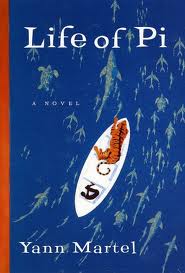
Life of Pi by Yann Martel

Director Ang Lee picked 17 year-old Suraj Sharma of Delhi, India, from 3,000 teenagers to play Pi Patel. Interesting that Tobey MacGuire will play Yann Martel, the author of the book which won the 2002 Man Booker Prize. The film to be shot in 3D has a December 2012 release date. Again, films opening in December usually have eye on the next Awards Season. Will keep our eyes peeled.

.

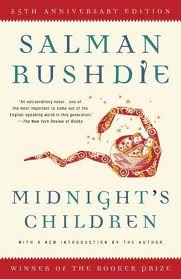
Midnight’s Children by Salman Rushdie

The Booker of Bookers winning work will see its author Salman Rushdie team up with acclaimed Canadian director Deepa Mehta in the film adaptation. Mehta in a recent interview hinted it will debut either at the Venice or the Toronto Film Festival this fall. You can still join us for a slow Read-Along of Midnight’s Children before the film comes out.

.

Rebecca by Daphne DuMaurier 

On the drawing board of Dreamwork and Working Title. Who can take the helm to reprise an adaptation made famous by Alfred Hitchcock, and actors to replace Sir Laurence Olivier as Mr. de Winter and Joan Fontaine as the new Mrs? Now, why does Carey Mulligan emerges in my mind… and Michael Fassbender

.

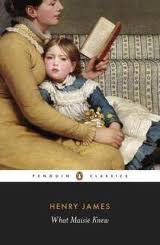
What Maisie Knew by Henry James

Looks like a good classic to read before seeing the movie. Julianne Moore and Alexander Skarsgård lead the cast. I’ve enjoyed previous Henry James adaptations of The Wings of the Dove, The Golden Bowl, and The Portrait of a Lady. Look forward to this one.

.

Books to be turned into TV series:

The Corrections by Jonathan Franzen

To be adapted into an HBO TV series with an all-star cast under the helm of Noah Baumbach (The Squid and the Whale). Stars include Ewan McGregor, Maggie Gyllenhaal, Rhys Ifans, Dianne Wiest, Chris Cooper and Greta Gerwig. But, will the author be involved in any of the writing?

.

A Visit From the Goon Squad by Jennifer Egan

Again, HBO has bought the rights to this one. The 2011 Pulitzer Prize winner is to be adapted into a half-hour TV series.

.

.

The Art of Fielding by Chad Harbach

Yet again, it’s HBO that will be developing the novel into a TV drama series, another project by the “uber producer” Scott Rudin, who also oversees “The Corrections.”

.

***

What are some of  your most anticipated films or books in the coming year(s)?

Midnight’s Children Read-Along Begins

CLICK HERE to read my review of Midnight’s Children the Movie

Our slow and flexible read-along of Midnight’s Children by Salman Rushdie begins today. How slow? Here’s the plan. Each section about 130 pages is to be covered in a month from March to June. On the last day of each month, we post our reading response to that part:

March 31 — Book One
April 30   — Book Two (Part A ending with ‘Alpha and Omega’)
May 31    —  Book Two (Part B starting with ‘The Kolynos Kid’)
June 30   — Book Three

How flexible? I’m not even calling them ‘reviews’. Let’s just share our thoughts as we read along. You can still continue with your regular blogging activities. And if for any reasons, you can’t keep up, don’t worry. If you miss writing a post, feel free to visit others’ and join in the discussion. If you’re not a blogger, you’re welcome to stop by as well on the last day of every month from March to June to share your view.

From the open invitation posted on Jan. 8, the following readers had shown interest to join in. I’ve put your links down so we’ll know where to go for the response posts at the end of the month. If you want to join in now, you’re most welcome. Just indicate your intention in a comment below and I’ll add in your link. Conversely, if you feel you can’t commit at this point, just let me know so I can take your link off.

  1. Bellezza of Dolce Bellezza
  2. Colleen of Books in the City
  3. Deborah of Temptations of Words
  4. ds of Third-Storey Window
  5. Janell of An Everyday Life
  6. Lauren of The Very Hungry Bookworm
  7. Gavin of Page247
  8. Jerika of averydisorientedreader
Do go to Bellezza’s blog to check out other participants’ links as well. 

In between these monthly posts, if being succinct is your style, you can share your thoughts in 140 characters with tweets anytime you want. Just leave your twitter name @… in the comment. You’re most welcome to follow some clumsy attempts at laconic expressions @Arti_Ripples

A General Introduction:

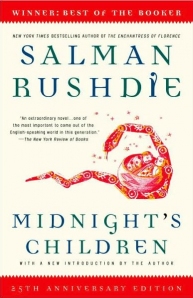
Voted Best of The Booker in 2008, Salman Rushdie’s Midnight’s Children has been classified as post-colonial literature, genre historical fiction and magic realism, rich in symbols and allegories. Here’s the Synopsis from the Booker site:

“Born at the stroke of midnight on August 15, 1947, at the precise moment of India’s independence, the infant Saleem Sinai is celebrated in the press and welcomed by Prime Minister Nehru himself. But this coincidence of birth has consequences Saleem is not prepared for: telepathic powers that connect him with 1,000 other “midnight’s children” – all born in the initial hour of India’s independence – and an uncanny sense of smell that allows him to sniff out dangers others can’t perceive. Inextricably linked to his nations, Saleem’s biography is a whirlwind of disasters and triumphs that mirror the course of modern India at its most impossible and glorious.”

Helpful Background Resources Online:

History of modern India from Colonial time

History India Timeline

Setting of Midnight’s Children

Characters in Midnight’s Children 

Book Review on 1981 publication from New York Review of Books

Deepa Mehta and Salman Rushdie collaborate on film adaptation

To all reading along, Enjoy!

***

Death Comes to Pemberley by P. D. James

This is how I see it. Living to 91 is an achievement in itself, let alone write a book at that age. I admire the adventurous spirit of P. D. James, sailing out to new waters at this stage of her career. This is her first attempt at creating an Austen sequel, a Pride and Prejudice fan fiction. So, how do I reconcile the flaws in this book with her previous acclaimed mystery works?  Let’s just say… the editor did it.

Take for example the error in referring Darcy as an Oxford man, who had actually gone to Cambridge, and with Wickham too. The ubiquitous redundancy of retelling, or the irrelevant details such as taking an inventory of how many candles are lit in which room.

Or, this dialogue between Sir Selwyn’s, the magistrate, and Darcy, as Darcy goes to his home to report to him a body is found in the woodlands. Are lines like these necessary? I find them incredibly amusing. Greeting Darcy, Sir Selwyn says:

Please sit. That chair with the carved back is said to be comfortable and should hold your weight.”

Since it was the chair Darcy usually occupied he had every confidence that it would. He seated himself and told his story…

The book begins with an epilogue detailing the story of Pride and Prejudice framed by a Jamesian view. It then starts off with the Darcy household preparing for the annual Lady Anne’s Ball at Pemberley, a tradition honouring Darcy’s mother ever since he was a child. A screaming Lydia comes charging in, uninvited, manically hysterical. Somebody has shot her dear husband Wickham, she claims. A search party led by Colonel Fitzwilliam soon takes action, and a body is found lying in the dense woodlands on Pemberley grounds. Wickham, very much alive, is seen hovering over it, blood stained and drunk. The episode comes early, the rest of the book is the revealing of the facts, whodunnit and why.

This is no CSI. The body is removed once found and brought back to Pemberley. Wickham, the key witness also now the key suspect, is washed clean of the blood on him, given a sedative, and is deep asleep when the magistrate arrives to question him. The later inquest at Lambton and final trial at London’s Old Bailey sound like child’s play when compared to, what comes to mind for me, Dicken’s Bleak House trials.

Simple, straight forward, not much mystery to it. But readers get to be entertained by James’ literary rendering and imagination of all the main characters from Pride and Prejudice, six years after it has ended in Austen’s hands. Darcy and Elizabeth now are parents to two boys, Fitzwilliam, 5, and Charles, 2. Readers so fond of their courtship would be disappointed at not seeing them together much in the book. Georgiana still lives in Pemberley, has two suitors, Colonel Fitzwilliam and a young lawyer Alveston, who seems to have a much higher chance.

At the end, we see the problem that has given rise to the motive of the crime neatly resolved by … Harriet Smith, who is married to farmer Robert Martin, no kidding. You’re right, that’s the Harriet Smith who used to go to a successful girl’s school run by Mrs. Goddard in Highbury, and the farmer Robert Martin who is a good friend of Mr. and Mrs. Knightley. All characters from Emma. This part reads like a parody. But we ought to be familiar with this sort of things by now in our current culture, a total mash-up.

All in all, I say, don’t resist your curiosity. Despite its flaws, and if you don’t take Austen or James too seriously, this just could make one great escape from all the demands of rationality in your daily routines.

~ ~ 1/2 Ripples

***

For all Jane Austen / Pride and Prejudice fans, this review from The Guardian is a must-read.

The End of the Affair: Book and Movie

It’s a bit ironic to post this on Valentine’s Day. It’s a story of an extramarital affair, and it doesn’t end well. But then again, maybe this is the best time to talk about it.

This is my second instalment to meet the Graham Greene Challenge hosted by Carrie of Books and Movies. Spoiler Alert here. But since it’s a classic, I’m sure many of you have read it or seen the movie.

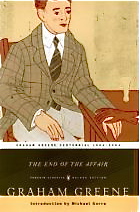
The End of the Affair

The book opens with a meeting between novelist Maurice Bendrix and civil servant Henry Miles on a cold, rainy night in 1946 London. Miles’ wife Sarah had ended an affair with Bendrix 18 months earlier. Bendrix has not seen them since. In this chance meeting on the street, Bendrix observes that Miles is heavy-laden, suspecting Sarah has ‘secrets’. Volunteering to hire a detective to tail the wife for the husband, Bendrix is in fact acting out of jealousy, for he too wants to find out who Sarah is seeing now. “Anyone who loves is jealous.”

Again, in just 160 pages, Greene has intricately explored the depth and complexity of the human psyche, love and hate, trust and insecurity, faith and lameness. Yes, the lameness in Bendrix’s leg can well be a metaphor for his numbness of unbelief. Isn’t there such an argument: “If God does not exist, everything is permitted?”

Love with all its smothering, blinding passion, its persistent, burning desire, its all-consuming emotions that distill into pure jealousy and hate… Graham Greene is a master of such incisive descriptions. But here’s the rub, they’re all found in an adulterous affair.

Isn’t that a pity that such intensity of love is often depicted outside of a marriage. Why, we see them all the time in literature and movies. And, don’t we tend to cheer for the romantic heroes and heroines? Guinevere and Lancelot, for example, to whom Bendrix in the book alludes when he talks to the detective Parkis, who has named his son Lance. Readily come to mind are some others: Madame Bovary, Anna Karenina, and in the epic cinematic versions like The English Patient, in a more restrained way Out of Africa, and the near success in The Bridges of Madison County…  didn’t you wish Meryl Streep would have gone with Clint Eastwood? I’m just thinking, if Ralph Fiennes were the one beckoning her, she’d probably had jumped out of her husband’s truck.

O the fantasy of romance vs. the mundane reality of a marriage. The forbidden fruit seems sweeter, for it arouses excitement, it entices with adventure. Bendrix accuses the oblivious and dull husband Henry Miles as an accomplice in Sarah’s affairs, calling him ‘an eternal pimp’:

“You pimped with your ignorance. You pimped by never learning how to make love with her, so she had to look elsewhere. You pimped by giving opportunities… You pimped by being a bore and a fool…”

There might be some truths in his rants. But then again, are these reasons enough to drive one to discard the marriage vow and seek other allurements? Alas, it seems like boredom is the major impediment to fulfilling that commitment… “If I could love a leper’s sores, couldn’t I love the boringness of Henry?” Sarah tries to reason with herself.

But of course, here, the key is the End of the affair between Bendrix and Sarah. What causes the end is none other than God Himself according to Sarah. A bomb drops near Bendrix’s home while they are both there, striking him dead. Sarah, in her horror and desperation, prays to a God she doesn’t believe to exist, but pleads for the life of her lover just the same. She makes the promise that if God gives Bendrix back his life, she would stop seeing him. As she’s still kneeling by her bed praying, Bendrix walks into the room, injured but very much alive. Thus begins the agony of keeping a promise to a God whose existence now has become an inconvenient truth.

We learn at the end, Sarah has attempted to shift her love from Bendrix to God, albeit with much searing pain. She has gone to a priest and converted to Catholicism. In the crucifix she knows that God Himself is a suffering God too. If only she can see the scale of the pain in the nail-pierced hands in a greater cosmic proportion compared to her own…

***

The marvellous cinematography, the diffused lighting of many scenes, all work to cast a romantic veil over an adulterous affair. Two Oscar noms in 2000 included one in cinematography and one for Julianne Moore as Sarah Miles. Ralph Fiennes plays Bendrix, a suitable choice. He is in his element. Since The English Patient (1996), Fiennes seems to have mastered the persona of the romantic tragic hero and obsessed lover.

While the screenwriter is understandably free to invent more scenes for the visual storytelling and change some plot points, one alteration I feel  is definitely unacceptable and that’s the character Richard Smythe. In the book, Smythe is an atheist whom Sarah visits several times to discuss views about atheism. Ironically it is Smythe’s atheistic stance that drives Sarah into believing God. She then confides in Father Crompton her wish to convert to Catholicism. But in the film, Smythe is the priest, and what more, he is implied to be another of Sarah’s lovers. I think here is where integrity to the source material should have given priority over dramatic effects.

***

And what does Colin Firth have to do with The End of the Affair? Well, for all you Colin fans, he is among some A-list stars to have signed with the UK audiobook provider Audible to record their reading of their favorite classic novel.

Audible’s founder, Donald Katz, told the Observer: “Colin Firth could read me the back of a Marmite jar and I would listen.” Well, Colin has chosen, not Marmite or Cornflakes, but for more flavour, Graham Greene’s The End of the Affair. CLICK HERE to read the announcement and see what other stars are reading for Audible’s recordings.

Now we have another portal to appreciate Colin, and, another channel to enjoy a Graham Greene book.

Update May 7, 2012: The Audiobook The End of the Affair narrated by Colin Firth is released today.

***