Before I Go To Sleep by S. J. Watson

Before I Go to Sleep47 year-old Christine has lost her memory for twenty some years due to trauma. She wakes up every morning to a forgotten past. She spends her day piecing together a life, who and where she is, her personal history, and, who her husband Ben is. Upon the advice of Dr. Nash, she writes it all down in a journal before she goes to sleep at night, for she’ll wake up the next morning wiped clean of her day old memory once again.

The book deals with some interesting issues. If the past is horrible to recall, would it be better if one does not remember, or, would one be better off knowing the truth despite pain? Is one made more vulnerable by knowing or not knowing? Further, if mental images conjure up, how can one be sure they are memories of actual happenings and not one’s imagination?

Author S. J. Watson leads the reader into a maze of intrigues, teasing us with an unreliable narrator Christine, casting shadows of imminent dangers, and trying to capture us with her vulnerability. So memory loss is an effective plot device, keeping us in the dark guessing, creating suspense, and revealing ever so slowly what really had taken place that caused the amnesia to set in, and how she could ever escape.

The book starts off with a most interesting scenario as Christine wakes up to an unknown world, but towards the middle it seems like it has forgotten that it is just the protagonist who has amnesia, not the readers, as it repeats the facts and descriptions with Christine’s journal entries. The last part is a page-turning thriller, albeit with a relatively improbable ending. The last pages explaining everything with a neatly wrapped up ‘here you go, see how logical it is’ kind of finish.

Memories… such a thematic element can be exceptionally gratifying to explore with deeper characterization. Surely the author has brought up the idea that memory defines us, a reader seeking for a more contemplative rendering of such a concept would be disappointed however, for Watson has chosen to use this interesting thematic material to craft a suspense thriller and not an idea-driven literary work. So what we have with notions relating to memories, to the nature of our identity and personality… etc. are merely used to build up a suspenseful plot. As a thriller, the book aims to lead on and not delve in.

Am I being a bit harsh here? Why, I just caught myself. I could well have been more lenient if I were not reading it along with Proust’s In Search of Lost Time (Remembrance of Things Past). Am I being fair to make comparison? It’s like comparing apples with oranges. Yet the coincident is too fascinating… both deal with remembering and sleeping, albeit one trying to fall asleep while the other trying not to. Just thinking… even the book covers that I have are similar.

Lots of ‘I love you’s’ are uttered, but none that can stir up any emotions in me the reader. Several films kept conjuring up in my mind as I read… Memento, Eternal Sunshine of the Spotless Mind, The Vow, and I must say the latter two managed to stir some affective resonance in me while exploring the topic of amnesia and a love relationship. But with this book, I just wanted to race to the end. For some, this might well be proof of an entertaining read.

And that is why I have high hopes for its film adaptation. Yes, I must applaud Watson for his strong debut. This novel published in 2011 has gained awards and accolades, on the bestseller lists in several countries, and translated into 30 plus languages. Its film rights has been snatched up by Ridley Scott. Filming now, it features the impressive cast of Nicole Kidman as Christine, Colin Firth (The King’s Speech) as Ben, and Mark Strong (Zero Dark Thirty) as Dr. Nash; Anne-Marie Duff (Nowhere Boy) is also on board. This is definitely a film I want to watch, not just because of the actors, but the screenwriter Rowan Joffe, who will direct as well. Joffe has shown us, with his script for The American (George Clooney stars) that yes, sometimes the film can be better than the book. Let’s hope this is also the case.

In the end page Watson notes that his novel, though totally fictitious, is inspired by actual medical cases, particularly that of Clive Wearing‘s, the British musicologist, conductor and BBC music producer, who has the same condition as Christine’s, albeit his is an even shorter memory span, just a short minute or so. His real life accounts have been recorded by his loving wife Deborah Wearing in her book Forever Today: A Memoir of Love and Amnesia. While he lives in the constantly present, he does not forget music or his love for his wife. Now that would be one inspiring book to read.

***

Click here to watch a short clip on Clive and Deborah Wearing on YouTube. Does he not remind you of another real life character, a pianist, whose life had also been made into a movie?

Diary of a Country Priest: An Easter Meditation

Last year around this time, I wrote about the book The Diary of A Country Priest by French author Georges Bernanos, (Journal d’un curé de campagne, 1936). I’d like to repost my review this week, for every time I read it, I find the essence of Easter.

***

The Diary of a Country Priest Book Cover

A young priest comes to his first parish, the rural town of Ambricourt, filled with humble hopes. All he wants is to serve the people, to give of himself, to bring God’s love. But as soon as he sets foot in the village, he is engulfed by hatred and rejection. There are dark secrets too sinister to be exposed. The young priest is an unwelcome alien. In a town afflicted by hypocrisy, pride, anger and bitterness, he is despised, taunted and ridiculed. His own innocence is no match even for the children in his catechism class, especially the precocious Seraphitas, a girl ‘with a hardness far beyond her years.’

Ambricourt is a world afflicted by the ‘leprosy of boredom’, a microcosm of the human condition. Bernanos uses diseases to illustrate his point well. The young priest himself is being slowly consumed by terminal illness. The pain in his stomach ultimately defeats his body, cancer. His diet consists mainly of bread dipped in wine which he makes for himself, and some potato soup. Poverty of means, but also frailty of body to take in solid food. Many a times we see him in the Garden of Gethsemane, pleading for strength in anguish. But he faithfully presses on, using his diary to confide his deepest thoughts, a means to commune with his God.

On the outskirt of Ambricourt is the Château of the powerful M. le Comte. The Count needs no priest to know about his adulterous affairs, this time, with the governess Mlle Louise. His wife Mme la Comtesse is totally absorbed by her long-held bitterness and grief from the loss of her young son. And his daughter Mlle Chantal is a deeply disturbed girl eaten up by anger and jealousy. Soon, she will be sent away to England, a most convenient plan devised by her father.

It is with this deep mess of a family that the young priest finds himself entangled. The most intense scene of the whole book, the climatic moment, comes when the priest goes to the Château to meet with Mme la Comtesse. She lost her beloved son when he was only eighteen months old, a child hated by his jealous older sister Chantal.

On his last day they went out for a walk together. When they came back my boy was dead.

Mme la Comtesse is fully engulfed by hatred for her daughter, grief for her lost son, and bitterness towards God.

Hearing her speak, a tear flows down the face of the young priest. “Hell is not to love any more, madame.” The young priest responds. And with miraculous strength, he delivers the following words.

… But you know that our God came to be among us. Shake your fist at Him, spit in His face, scourge Him, and finally crucify Him: what does it matter? It’s already been done to Him.

Towards the end of some soul piercing exchanges, Mme la Comtesse kneels down, releases her pain, and receives blessings from the young priest. Afterwards, she writes to him in a letter:

… I have lived in the most horrible solitude, alone with the desperate memory of a child. And it seems to me that another child has brought me to life again…

And this young child, a priest, consumed by illness, wreaked by frailty of spirit, can only marvel at the power through weakness:

Oh miracle — thus to be able to give what we ourselves do not possess, sweet miracle of our empty hands!

Not long after this, he succumbs to his illness. A life too short, a mission seems unaccomplished. But his last words faintly uttered on his deathbed are as powerful as the God who sends him:

Does it matter? Grace is everywhere…

And in the film, these three words leave me with one of the most impressive endings of all the films that I’ve seen:

“All is grace.”

 ***

~ ~ ~ ~ Ripples

CLICK HERE to read my film review of The Diary of a Country Priest.

The Diary of a Country Priest by Georges Bernanos, translated by Pamela Morris, Perseus Books Group, Philadelphia, PA, 1965, 298 pages.

Journal d’un curé de campagne, 1936, was winner of the Grand prix du roman de l’Académie française.

Bonhoeffer Read-Along Part 2: Ch. 19 – 31

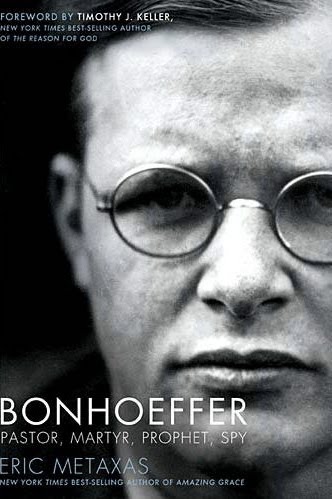
I’ve read some of Dietrich Bonhoeffer’s writing years ago, but knew close to nothing about the life of this highly admired Christian theologian, pastor and anti-Nazi martyr. Eric Metaxas’s 2010 biography of Bonhoeffer is an informative first step for me to delve into a selfless and heroic life. Within the close to 600 pages are highly readable narratives, at times humorous and even entertaining, albeit juxtaposed with pathos and sombre accounts.

Book Cover

What I’ve appreciated most is Metaxas’s inclusion of Bonhoeffer’s own voice, excerpts from his writing, letters, sermons, and words spoken as reported by witnesses. One of the most important sources is from his theology student and confidant Eberhard Bethge who had written what generally considered the definitive biography on Bonhoeffer. That’s over a thousand pages. I’m in no position to offer any critique on the accuracies of Metexas’s book, for I have not read both or any other historical documents to compare notes. Here I’m just sharing my thoughts as a reader, casting my two pebbles into the pond of resonance.

In this second part, Chapters 19 to the end, the mood changes as we see Hitler tightening the noose on his opponents, especially the Jews and their sympathizers. Bonhoeffer had to help his twin sister Sabine’s family flee the country before it was too late, as her husband Gerhard Leibholz was Jewish.

Dietrich’s own Confessing Church which had boldly stood against Hitler’s anti-semitic laws was now facing Gestapo arrests, its seminary Finkenwalde shut down, and its pastors slapped with the ordinance to swear an oath to Hitler. For his own safety, he had made arrangement to leave Germany for America. The Union Seminary in NYC had offered him a teaching post, welcoming the return of this brilliant theologian from Germany.

Bonhoeffer sailed to NYC on June 12, 1939, finding a safe haven in America, but not peace of mind. His inner turmoils were so overwhelming that he stayed there for just twenty-six days. His pastor’s heart prodded him to rush back to Germany to be with those who were suffering. My admiration for the man grew even more as I came to this part.

Mere waiting and looking on is not Christian behavior. The Christian is called to sympathy and action, not in the first place by his own sufferings, but by the sufferings of his brethren, for whose sake Christ suffered.

It was a much deteriorated country to which he returned under the grip of a mad Führer. War broke out. His brother Karl and brother-in-law Dohnanyi were in the Resistance against Hitler’s regime. Soon, Dietrich was involved too, at first offering encouragement and emotional support, but later worked for the Abwehr, the German spy agency, as a pastor, which he was, but unbeknownst to the Abwehr, as an undercover for the Resistance. What a dangerous job to take on!

In Operation 7, Bonhoeffer successfully helped seven Jews escape to Switzerland from certain death. A larger amount of foreign currency had to be transferred out of the country to suport their livelihood. Thus a track was left for his later Gestapo arrest. It’s interesting to note one of the two relatively minor reasons for his arrest is money laundering, for it’s much easier for the Gestapo to believe that than for them to think any German of sound mind would want to help Jews escape.

I can see a courageous man with integrity. Bonhoeffer could not stand aside to see the murders of innocents and the spread of evil. Yet, it’s disturbing to see his stance belonged only to a dearth of people at that time. Hitler’s murderous rampage and the Gestapo’s torturous tactics seized the country with a ferocious grip. Soon, those few dissident voices had to go underground, for their own lives were at stake. I kept asking myself what would I have done… a question I’m afraid to answer.

It was also then that Dietrich was swept by love with Maria von Wedemeyer. Their love was like silver linings behind dark, ominous clouds. Most of their time was spent apart, for Dietrich was held in prison by then, a most precarious relationship indeed. Yet from their letters, I could see love bring them hope, and hope in turn enriches their bond. It was heartbreaking to read their letters to each other, foreseeing wedding and marriage. From the dreadful Gestapo prison, Dietrich wrote Maria:

You mustn’t think I’m unhappy. Anyway, what do happiness and unhappiness mean? They depend so little on circumstances and so much more on what goes on inside us. I’m thankful every day to have you – you and all of you – and that makes me happy and cheerful.

Maybe the title of this book should add in one more description: Lover.

Bonhoeffer and Bethge
Photo taken from the book.

Dietrich had earlier written a Wedding Sermon from the Tegel military prison in Berlin for the wedding of his best friend Eberhard and his niece Renate. In there is a most inspiring thought:

It is not your love that sustains your marriage, but from now on, the marriage that sustains your love.

Later, he was transferred to the Buchenwald death camp outside Berlin, and ultimately, to Flossenbürg for his execution. It’s heart-wrenching to read about Bonhoeffer’s last days, still keeping a calm and peaceful composure, touching other prisoners and even the doctor overseeing his execution. What is death? In his own words:

… life only really beigns when it ends here on earth, that all that is here is only the prologue before the curtain goes up….  if only we can be still and hold fast to God’s Word… Death beckons to us with heavenly power, if only we realize that it is the gateway to our homeland, the tabernacle of joy, the everlasting kingdom of peace.

I had expected Metexas’s book to be informative, but I had not thought it would read like a page-turner. The last chapters are so intense and engrossing that it felt like I was reading the script to the film Valkyrie, about the foiled plan to assassinate Hitler by Colonel Stuaffenberg and a subsequent coup. Bonhoeffer was not personally involved in the operation. But it was due to the failure of the Valkyrie plan that Bonhoeffer’s hidden identity with the Resistance was later discovered. Nine months after Stuaffenberg’s execution, Bonhoeffer was hanged at the Flossenbürg prison on April 9, 1945, just two weeks before the Allies marched in, and three weeks before Hitler took his own life.

Maria and Dietrich’s parents did not know of his demise until much later. Upon hearing the memorial service on BBC radio broadcast on July 27, 1945, Dietrich’s parents were confirmed of the saddest news a parent could ever hear. I was deeply moved to read the Sermon on the Mount excerpt from Matthew 10:17-42. What jumped out from the passage were these most apt and powerful verses:

And fear not them which kill the body, but are not able to kill the soul…

Whoever therefore shall confess me before men, him will I confess also before my Father which is in heaven. But whosoever shall deny me before men, him will I also deny before my Father which is in heaven.

And with the script of Bishop Bell’s poignant sermon at the Memorial Service, Metaxas ends his biography of Bonhoeffer: Pastor, Martyr, Prophet, Spy.

I thank all those who have read along with me, some with their thoughts posted on their blogs, some silently participating. If you’ve written a post, do let me know in a comment. I’ll be sure to link it here.

Alison of Chino House: 3 Encouragements from reading Bonhoeffer

***

CLICK HERE to read my post on Part 1: Chapters 1 – 18

***

Next Read-Along: Marcel Proust’s In Search of Lost Time Vol. 1: Swann’s Way

Downton Abbey Season 3: Episodes 6 & 7 Finale

WARNING: MAJOR SPOILERS in this post.

Apparently I’m one of the last ones to find out what happens at the end of Season 3. Only a couple of weeks ago, I stumbled upon this video of the Downton Cast meet the Press after their SAG awards. Mrs. Hughes spilled the beans about Dan Stevens not coming back for S4 and what a bombshell for me.

I Googled it right away and found, lo and behold, it was already a known fact since last December. Of course, that’s when Britain had their first round of the Season 3 experience. So now the ripples have finally reached North American shore. What do you call it? Delayed shock? And we’ve just witnessed it. People, face the fact, Matthew Crawley is no more. Now, we have one whole year to process it, let it sink in, accept the fact, and move on to the next Season.

Just a brief recap of these last two episodes.

Episode 6

Mr. Bates is finally released from prison. All your Free Bates posters can now come down. While Thomas is the last one to join the welcome home party, ironically he is the one receiving the good graces of Bates and others. O’Brien has no place in any plot against anyone, for she has her soapy track record. She should have known better.

The clubbing fling of young cousin Rose with a married man old enough to be her father takes us away from Downton a while. The Gatsby-like 20’s atmosphere reminds us what the rest of the world is like if one is not a Downtonite.

And way to go for Edith, finding something to do before she is permanently settled into her destined role at home, at least this is what Granny Violet would have wanted for her Grand-daughter.

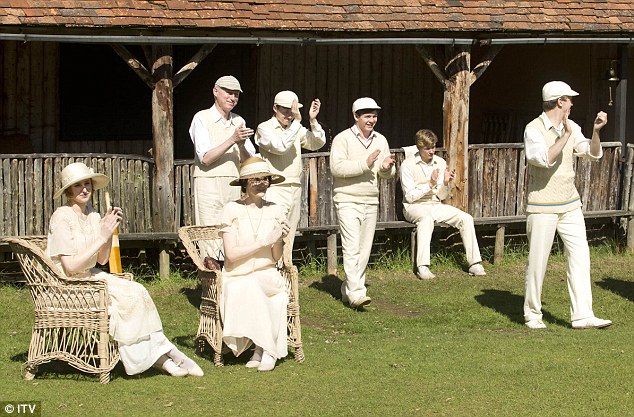
The Cricket Match

The cricket match is a visually beautiful scene. I love the colour scheme. The character that starts to come alive? Molesley. Wait till E7 where he will show what he’s truly made of.

Episode 7

By now we all know the ending. We have a whole year to forgive and forget. But of course, we’ll treasure the memories… The Scottish vacation takes us away from Downton for a short while to let us see how the usual characters behave in different situations. And that’s when we find O’Brien meeting her equal, Anna’s hidden talents, and Molesley’s true colours. Never underestimate a couple gulps of whiskey can do… total emancipation. Never thought Molesley can be so alive.

It’s the country fair again. Last year, Mrs. Hughes turned down an old crush there. This year, it’s Mrs. Patmore’s turn of stopping just in time of being fooled. Jimmy and Thomas come to an understanding that despite differences, they can still be friends. And Dr. Clarkson and Isobel Crawley? What will happen to them now? And oh, what will Mary name the young heir of Downton? Baby Matthew?

Downton Abbey Christmas Special

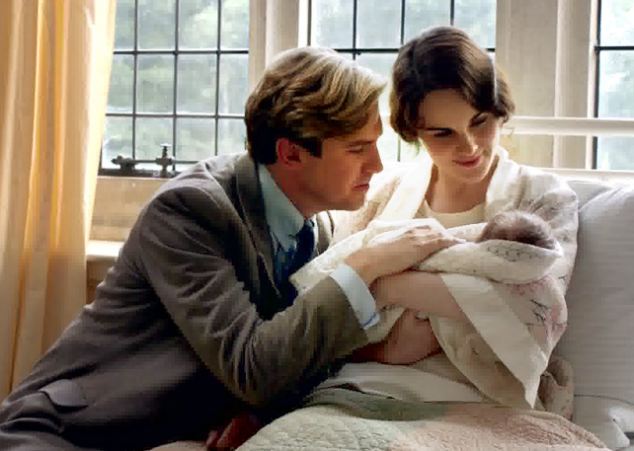
If you find Sybil’s death the saddest episode, I don’t know what to call this one. Matthew Crawley, the madly-in-love young husband and day-old new father, terminating his contract with a senseless car crash. After three Seasons, his demise covers less than a minute of screen time. What a difference between the endings of S2 and S3.

All these just show the cruel reality of media contracts and the inevitable plot treatment faced by TV script writers… killing off a character when his/her contract is up. Do you feel betrayed? Short-changed? Are you looking forward to Season 4? Will it begin with a funeral? Can you imagine how everyone will react… I think of Isobel first, then Mary, and Tom who has just found a friend in his new place in Downton. What about Robert, can he wait for another twenty years for the baby heir to grow up?

But most tricky of all… what will happen if another character or characters decide not to renew their contract? Wait, WWII is coming up soon, now that’s easy enough.

***

CLICK on the following links to:

Season 3: Episodes 4 & 5

Episodes 2 & 3 

Episode 1

Quotable Quotes from Downton Abbey (S1 & S2)

***

Bonhoeffer Read-Along Part 1: Chapters 1-18

February 4 has come and gone without fanfare, without even being noticed by me, the one hosting a read-along of a bio on Bonhoeffer. That day two weeks ago would have been Dietrich Bonhoeffer’s 107th birthday (1906-1945). I’m feeling a sense of loss for missing it.bonhoefer book cover

A sense of sadness too which comes from knowing a young and brilliant life so purposeful even from the start was cut short violently. It also comes from empathy with the parents Karl and Paula, who had to experience the death of three of their four sons and two sons-in-law during war time. Back in 1918, their second son Walter died in action in WWI. And during WWII, their third son Klaus, youngest Dietrich, and two sons-in-law were executed by the Nazis for their role in the German resistance against Hitler. Sad especially that they only learned of Dietrich’s death through a radio broadcast of his memorial service from England. He was only 39.

My impression from the outset is, Dietrich Bonhoeffer’s was a life of purpose, even from an early age. It was made possible largely by a nurturing and vibrant family, and a lively brood of four boys and four girls. Father Karl Bonhoeffer, a prominent psychiatrist and university professor, instilled intellectual rigor; mother Paula imparted faith and fervor. The young lives benefitted from the cultural and musical home environs, but more importantly, the indomitable sense of social justice.

The Bonhoeffer children
The eight Bonhoeffer children with their governess at a holiday home (ca. 1910). Karl and Paula Bonhoeffer in the background. Dietrich to the right of the governess.

Dietrich knew he wanted to study theology when he was only thirteen. He graduated summa cum laude from the University of Berlin, obtaining his doctorate when he was only twenty-one. What brilliant mind and potential! And with that mind he saw through the trickery and schemes of an emerging demigod in Hitler. This is probably my favorite quotes from him. You can see his driven sense of direction:

If you board the wrong train it is no use running along the corridor in the opposite direction.

This has been my query all the time, and Eric Metaxas’s accounts have partially answered it. How could Hitler have gained such power without being challenged? It can’t be all due to fear, that came later. Hitler was democratically elected by the people as chancellor in 1933. The Führer Principle was readily embraced by most. So nationalism played a large part. Then came racism, with the establishment of new laws barring Jews, many of them in prominent positions too from the legal, academic, and medical fields, and then the engulfment of the German Church by the Third Reich. It’s utterly mind boggling. Why was it that the Bonheoffer family was only one of a dearth of lucid observers during this dark chapter in German history?

Nothing is beyond the Nazis reach. The ‘purging’ of the literary and scientific realms resulted in the casting out of thoughts and works by anyone not of the Aryan race, including Helen Keller, Jack London, H.G. Wells, Albert Einstein, Thomas Mann, and the poet Heinrich Heine, who wrote these prophetic words in 1821 in his play Almansor:

Where books are burned, they will, in the end, burn people too.

Metaxas’s book is informative and detailed, especially on Bonhoeffer’s effort to take back the German Church from the Nazis by establishing The Confessing Church with Karl Barth. Metaxas has also painted a very human portrait, a purposeful young man, bold, principled, passionate, and full of life. I move along eagerly, albeit sometimes confused by the numerous names and historical accounts. I want to find out what actually happened in the end, although not so sure how I can bear to read about Dietrich’s ultimate demise.

What are your thoughts so far? Throw your two pebbles into the pond. I’ll be glad to link your post here. Do go and visit:

Alison of Chino House

Ellen The Happy Wonderer

***

To read my wrap-up post on Chapters 19 – 31, CLICK HERE.

***

The Girl In the Cafe (2005): The Hunger for Connection

February is the month that raves about love. It’s also Awards Season, culminating with the Oscars. With all the competing productions on the big screen, are you getting a bit overwhelmed by now? Or maybe a little indigestion even?

Here’s a little gem of a film, like lemon sorbet, simple and fresh, just to clear the palette. It’s only recently that I come across this DVD dated a few years back. O what a find! I took it out from the public library, have watched it three times, and maybe more before I ultimately return it.

Directed by David Yates (State of Play, TV) and written by the screenwriter who has brought us Bridget Jones’s Diary, Notting Hill, Four Weddings and a Funeral, Love Actually… Richard Curtis, The Girl in the Cafe is a reason why we should not dismiss TV movies or those that go directly from production to DVD.

The Girl in the Cafe

The story begins with a chance encounter. Lawrence (Bill Nighy, The Best Exotic Marigold Hotel) is an aging civil servant, a senior-level analyst working for the British Chancellor (Ken Stott). During one coffee break Lawrence, single, well no, married to his job, shares a table with a girl Gina (Kelly Macdonald, Dolly in Anna Karenina) in a crowded cafe. Thus sparks a genuine connection between the two. On a whim, Lawrence asks Gina to accompany him to attend the G8 Summit in Reykjavík, Iceland, the following week.

What’s that? Gina asks. Right, a most incompatible relationship. But just because of that, the drama, and conflict, sparks off. Lawrence’s shy demeanour fits perfectly with Gina’s quiet composure. But for both actors, their restrained and understated performance form the very essence of this charming and thought-provoking film.

Once there in Reykjavík, Gina is appalled by the facts she learns about world poverty from Lawrence, like, one child dying in every three seconds. She takes a very personal stance on the success of the Millenium Development Goals to fight extreme poverty. While heavy police force keeps protesters out of the Conference venue, Gina becomes one small voice that speaks out from inside, genuine and innocent among seasoned politicians, albeit bringing Lawrence unexpected ambivalence. Some may find it uncomfortable to watch this scenario, but I feel it is one that deserves to be played out, and definitely to be heard.

What grabs me right away as the movie begins is the soul stirring song ‘Cold Water’ as the images of Lawrence going by his daily routine all alone. At coffee break, he steps into the crowded cafe, and finds another soul also alone. It’s gratifying and a pleasure to watch them connect and warm up to each other in a most genuine and tender manner.

As the film ends, ‘Cold Water’ reprises, but by now I see the parallel. Not only do Lawrence and Gina reach out for human connectedness and love, the millions of dying children in extreme poverty are also uttering these words of the lyrics:

“Cold water surrounds me now.
And all I’ve got is your hand.
Lord can you hear me now?
Or am I lost?”

Don’t we all need a helping hand for the different kinds of hunger we experience as human? The song and the music in the film augment its impact in a quiet and haunting way.

Bill Nighy owns the role of Lawrence. His self-deprecating and gentle manner fits in perfectly with Kelly Macdonald’s authentic and genuine Gina. The two have such connectedness in their performance that they earned Golden Globes nomination for Best Actor and Actress the following year.

The DVD came with special features which include director and screenwriter’s commentary. That is definitely a bonus after viewing the film. From there I found out Nighy and Macdonald were in the British TV series State of Play before doing The Girl in the Cafe. So that’s exactly what I did… went to the library to borrow the DVD’s of the TV series, and binged-watched all six episodes, which I highly recommend as well.

~ ~ ~ Ripples

***

Watch on YouTube Damien Rice’s ‘Cold Water’ with lyrics.

***

Read my other reviews on films about love:

I’ve Loved You So Long

Away From Her

Never Let Me Go 

Downton Abbey Season 3: Episodes 2 & 3

Posts like this should go without saying: Spoilers Alert!

After a shaky start in E1, slowly picks up in E2, Downton Abbey is back on track and full steam ahead in E3. What a relief! I want to see it go on and on, season after season. But I would not wish to see it just ride on its popularity. I want the Downton feel back, that appeal which first captivated me from Seasons 1 and 2. I can feel it again in last night’s E3.

Previously in E2, the main event is the Runaway Groom: Sir Anthony Strallan gets cold feet and jilts Edith at the altar. Dramatic? Yes. Contrived? No. It takes courage for him to run away like that. Of course, he should have done that long ago and not wait till everyone is all dressed up. But I know, he isn’t sure before. I give him credits though for stopping the new career of Edith right there at the altar. And he needs to get out of there quick, before he changes his mind again.

I trust Sir Anthony is altruistic, thinking only of Edith. It’s not right for her to give up her life for an old man even though she sees him as her life work. Violet Crawley is quick to step in, contradicting Robert, with the three words that show who is still in charge: “Let him go.” With this dramatic scene, all else in E2 seems to fade by comparison.

The fancy wedding cuisine goes to the servants downstairs, and to the poor. But if they don’t want it, Violet Crawley wants them doggie bagged.

Gourmet wedding cuisine for downstairs

And oh yes, a letter suddenly appears, from Lavinia’s dead father, its content releases Matthew of his guilt for inheriting the large sum. So he is now free to chip in to save Downton Abbey from appearing on the real estate page in the paper. Does this deus ex machina device qualify the show as melodrama, or just sloppy screenwriting? Oh, who cares, the Crawleys don’t have to move, and that’s what’s important. A big hassle, downsizing. You can ask the Dashwoods of Sense and Sensibility, no fun moving from a big mansion to a little cottage.

Good news for Mrs. Hughes, it’s benign something something, not cancer. The relief is equally shared by Mr. Carson. Good man, the news sends him back to his former showbiz days, singing his heart out. But the kind words from Cora Crawley should not go unchecked. I’m sure Mrs. Hughes will be forever grateful: “You will stay here, and we will look after you.” Even though not getting cancer is still better.

**

With that we move on to E3, that’s where the drama begins, and the plot thickens.

Watching E3, I’m captivated once again as in previous Seasons. There are witty LOL lines, mostly from Violet Crawley as always; there are some not so LOL lines that are equally well said by others.

First off, I’m glad that Edith is no Ms. Havisham. Life is too good to be bogged down, even when you’re being jilted at the altar. And, as her mother says, testing can only make you stronger. That turns her from a jilted bride to women’s suffrage advocate. Take that, Ms. Havisham. So Edith has shifted her life purpose from taking care of an old man donning an arm sling to writing letters to the editor.

But the main event here in E3 involves Tom Branson, the former Downton chauffer turned Downton son-in-law turned Irish revolutionary. Woa, what drama. He escapes from Dublin police and slips back into Downton, leaving Sybil to run for her life. Oh, it’s all planned. But still, herein lies the dilemma. He wants to go back to Dublin but he’ll be arrested as soon as he sets foot there. Sybil wants to give birth in Downton, peaceful and safe, two words that are not in her husband’s dictionary.

Some memorable lines come from Tom’s confrontation with his father-in-law Robert Crawley, patriarch of Downton, who seldom wears anything else other than a tux, choice of wardrobe being black or white ties, with clout in high places, albeit still a good man he is.

Robert:  What a harsh world you live in.

Tom: We all live in a harsh world, but at least I know I do.

Something Robert would not have understood.

Ethel saying goodbye

Ethel the former maid turned prostitute can surely understand. It is a harsh world she lives in, having to raise a child with little means. Of course it’s heart wrenching to have to give up her son, handing him back to his grandparents, out of her own choice this time, knowing the child will have the best opportunities with them; with her, he has no chance. She had fought to keep him, tried to raise him on her own, but it didn’t work. That’s what makes it sad. It is poignant to see her wave goodbye as the coach moves away, with Mrs. Hughes and Isobel Crawley standing behind her, supportive yet each holding a different opinion about her choice.

New footman Jimmy is the main attraction downstairs, a timed bomb I can tell. And Mrs. Patmore finally gets a new kitchen maid to lighten up Daisy’s work load. But with this new gal, I’m sure Daisy regrets having started labor grievances. Alfred wants to make the new kitchen maid feel at home in no time. Be careful what you wish for, Daisy, you just may get it, nemesis in disguise.

I haven’t mentioned Bates and Anna you may have noticed. I know, Bates legal team is working day and night on Twitter, and free John Bates signs in the real world. But for dramatic effects, and a change of scenery from the lofty and elegant Downton Abbey, we see Bates debased in a prison cell. Here’s another person to agree with Tom. It’s a harsh world outside Downton. But then as Cora Crawley has said, testing would only make you stronger. Bates and Anna are exemplary in living out this motto. That Julian fellow sure knows how to lead and tease. With Bates and Anna madly reading each other’s letters after weeks of non-communication, Episode 3 ends, leaving us wishing the week would just fly by.

***

Other Related Posts:

Downton Abbey Season 3, Episode 1

Season 3, Episodes 4 & 5

Season 3, Episodes 6 & 7 Finale

Quotable Quotes from Downton Abbey

Lady Almina and the Real Downton Abbey: Facts that Give Rise to Fiction

***

Zero Dark Thirty and Argo

There are several reasons I link these two films together. Both are acclaimed productions which have already garnered awards. While both films have been nominated for Best Picture in the 2013 Academy Awards, both directors, Kathryn Bigelow and Ben Affleck have been snubbed in the Best Director category. The reason I do not want to speculate. But for one of them, I have a hunch.

These are very American films, depicting Americans in crisis and its aftermath. Argo is about getting Americans out of Iran during the 1979-80 hostage crisis in Tehran, Zero Dark Thirty (ZD30) about hunting and getting into Pakistan to take down Osama bin Laden. Both involve the intricate work of the CIA.

And, both have driven me to the edge of my seat, despite the fact that I know the ending of the event they portray. This is the power of visual storytelling. But for me, the similarities may well end here.

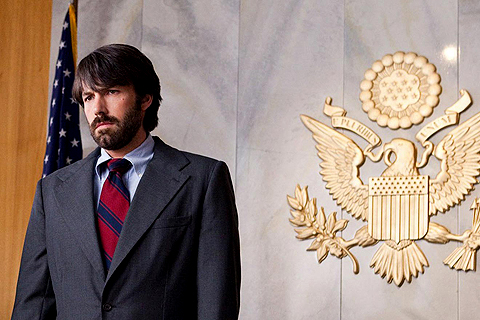
Ben Affleck

Argo rests on one man, Tony Mendez, a CIA officer who masterminded the rescue mission, information declassified only in recent years. Played by director Ben Affleck, Mendez is decorated with CIA’s Intelligence Star and received other accolades after that.

ZD30 rests on one woman, known only as Maya in the film. A young CIA officer who for ten years, dedicated her life to the searching for Osama bin Laden. She is relentless in her pursuit, fighting not only outward threats of physical dangers but bureaucracy within an alpha male work environment. Her identity remains hidden.

Jessica Chastain has once again shown how versatile an actor she is. I have seen her in some very different roles: The Debt, The Tree of Life, Take Shelter, The Help. Here in ZD30, she has convincingly portrayed a strong leading female character with finesse. Her performance not only carries the film but our emotion as well.

Jessica Chastain

And not only Maya, ZD30 has shown us there are other female CIA officers performing perilous duties. Her friend and colleague Jessica is one of them. Now, as I watched this Jessica on screen, I kept thinking she looked so familiar. Only when I watched the credits roll at the end did I find out, lo, that’s Jennifer Ehle, Elizabeth Bennet (Pride and Prejudice, 1995) or a bit closer, Myrtle Logue in The King’s Speech (2010).

Director Kathryn Bigelow has done an exceptional job in turning Mark Boal’s original screenplay into a tight and engrossing film. Both won Oscars for The Hurt Locker (2008), Bigelow being the first woman to win the Best Director award. At the beginning of the film, we are told it is based on firsthand accounts of actual events. Despite knowing the ending, I was still captivated every step of the way, following the intelligence gathering process, the narrowing down of leads and locations, the red tape. The film is an alchemy of facts and fiction, a creative fusion. But for the audience, there is no way to distinguish which is which.

That leads to the controversial issue, one that some in Washington and now the Academy have condemned, the issue of torture. And here’s my take. Isn’t it a bit simplistic to argue that since the film depicts scenes of torture of detainees to get leads and information, it means that the filmmakers condone or even promote torture?

While the U.S. Administration had denied using any torture tactics in the final capture of bin Laden does not mean the total absence of them over the ten year post 9/11 period, both known or later discovered. The photos from Abu Ghraib prison are still vivid in my mind. None of the scenes in the film can compare to those real life photos. Or, come to think of it, could Abu Ghraib have informed the screenwriting? This being not a documentary, but a dramatized fusion, can one separate facts and fiction so clearly?

Or take Argo, how much is true about the rescue mission? How much is dramatized? What proportion should we give credits to the mastermind Mendez and the CIA, and how much should we credit the Canadian ambassador Ken Taylor (Victor Garber) for hiding the six American embassy staff in his home at his own risk? The same kind of simplistic accusation ZD30 is getting could also apply here: Does the fact that they all escaped Iran using false identity mean the filmmakers, or the Canadian government for that matter, promote deception and the forging of Canadian passports?

Unlike Argo, the ending is not celebratory in ZD30. Things are not as clean cut as planned. The final mission of assassination is messy, a helicopter is down and has to be destroyed on site. There are collateral damages. But the target is hit, mission accomplished. Nevertheless, there is no applause or celebration. The tone is sombre, which I think is most apt. The final scene with Maya alone on the large transport plane leaving Pakistan is the epitome of ambivalence. Jessica Chastain leaves us with a poignant expression. Is it justice, national security, or rather, personal vendetta that has been accomplished? The last line delivered by the pilot echoed in my mind after I’d left the theatre, dazed… Where do we want to go from here?

Zero Dark Thirty ~~~~ Ripples

Argo ~~~1/2 Ripples

***

CLICK HERE to read Kathryn Bigelow’s article on L.A.Times addressing the controversy of torture in the film Zero Dark Thirty. 

Golden Globes, Jan. 13, 2013: Argo won Best Picture, Drama, and Ben Affleck Best Director. Jessica Chastain won Best Actress, Drama, for Zero Dark Thirty.

Related posts on Ripple Effects:

History Made At The Oscars

The Hurt Locker 

***

Downton Abbey Season 3: Episode 1

CLICK HERE to Season 3: Episodes 2 & 3

When the pre-show outshines the main feature, I’m beginning to have a little concern.

The episode “The Secrets of Highclere Castle” is a fantastic one-hour focus on the history and present day Highclere Castle, the setting of Downton’s Crawley mansion. The information is largely collected in the book written by Countess Fiona Carnarvon, Lady Almina and the Real Downton Abbey: The Lost Legacy of Highclere Castle. Read my review of the book here. And you can watch the whole one hour feature here.

Lady and Lord Carnarvon
Lady Fiona and Lord George Herbert Carnarvon

I have high praise for Downton Abbey S1 and S2. That’s why since last February, there have been quite a few ripples sent out from the pond here. Like numerous others, I’m following the countdown to S3, this cultural phenomenon of using Downton Abbey to measure the passing of a year. So it was with much anticipation that I watched S3 premiered in North America on PBS last night.

It begins shakily (metaphorically and literally… maybe some shots with a hand-held camera?) telling the recent development of how everyone is doing. So many stories, so little time. So what we get is a montage, vignettes by the seconds. That is fine too, but somehow, the people seem different now.

It takes a while for me to get into the act, to get back that captivating feel as in S1 and S2. Such moments are sparse and far between, I’m afraid to say. Ok… before you fans of Downton throw pebbles at me instead of into the pond, there are a few ‘movie moments’.

My favorite is when Robert reveals to Cora he has lost all her money in a failed railroad company (Canadian? Sorry). He sheds tears for the loss while she is so forgiving and loving. What a moving scene. Cora Crawley is now my favourite Downton character.

Matthew and Mary
Matthew and Mary

Another sweet moment gives me back the feeling of why I love DA in the first place, is the Matthew and Mary blind kiss the night before the wedding, a wedding that is almost called off. But here in S3 E1, it seems Mary has gone back to her old, old self where practical matters and Downton heritage surpasses love and honor. In this case, I’m all for Matthew, who is unwilling to take the large sum he inherits from Lavinia’s father. Again, here’s the guy with some backbone when it comes to moral dilemmas.

Shirley MaClaine as Martha Levinson
Grandmama from America

Shirley MacLaine as Martha Levinson, the Grandmama from America, is the highly anticipated new twist. And she doesn’t disappoint. We need someone to turn the table, tip the balance, add some spice of life to the stiff traditions of Downton, if that means setting a buffet table, guests choose their own food, be it cold cuts and what not, sit anywhere they like, and joining in an after dinner singing of ‘Let Me Call You Sweetheart’. Violet Crawley, take that.

The prison scenes with Bates and Anna are heartwarming, another reminder of why I love DA in the first place. Some nice shots. I particularly like the one he slowly limps down the long flight of stairs. While for justice’s sake he should be out of there. But for cinematic variety, I think Bates in prison offers a nice human touch of pathos, which again is why I like DA in the first place.

Other plot lines seem quite weak. Daisy goes on strike? She should first join a union. The too tall footman/valet Alfred’s troubles with Thomas, recycled from previous episodes of Bates’. And Mrs. Hughes, I feel so sorry for her. But Mrs. Patmore proves to be a solid and lively character. Edith has grown more beautiful while Sybil turns lacklustre.

I hope the rest of the episodes deliver what I’ve so highly anticipated. The 20’s is a stylish backdrop for a costume drama. They’re all dressed up, and I wish they have somewhere to go, and bring me there with them.

***

Other Related Posts:

Season 3: Episodes 2 & 3

Season 3: Episodes 4 & 5

Season 3: Episodes 6 & 7 Finale

Quotable Quotes from Downton Abbey

The Downton Ripples

Lady Almina and the Real Downton Abbey: Facts that give rise to Fiction

***

Les Miserables (2012)

These last months of 2012 see a bumper crop of film adaptations from literary sources. We have an eclectic array from the minimalist rendition of Yann Martel’s Life of Pi, to this long awaited maximalist Les Misérables, adapted from Alain Boublil and Claude-Michel Schönberg’s 1980 stage musical based on Victor Hugo’s 1862 novel. From Ang Lee to Tom Hooper, we are gratified on both ends of the spectrum.

It is a shift too for Hooper, fresh from his much smaller scale, Oscar winning The King’s Speech (2010), to turn and adapt a successful stage musical into a huge cinematic production. Yes, maximalist could well be the word to describe Tom Hooper’s Les Misérables.

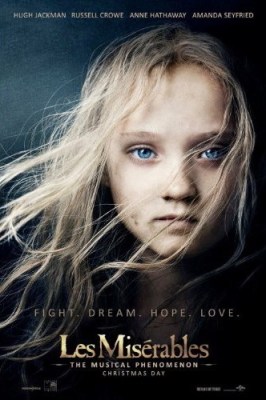
Les Miserables Movie Poster

I sat in a Cineplex theatre that offered Ultra AVX, Audio Visual Experience: wall to wall screen, big sound, huge images. Now of course, I would have seen it on a regular screen and with smaller head shots. For me, the AVX extravagance might even be a distraction. For as I watched the movie, it was in the small moments of torn sentiments, the minute scale of personal transformation, and the internal moral dilemmas so well acted out that I found Hugo a brilliant writer of the human soul. I don’t need big boom sound and maximized frames to sensitize me.

The epic scale is effective, and the cast is admirable in delivering a heartfelt performance. I can fully imagine the difficulty of casting, finding good film actors who can sing well. But overall, they are well chosen.

Hugh Jackman as Jean Valjean is impressive. No stranger to musicals, Jackman is a Tony Award winner himself, and here he is perfect for the role in every aspects, physiques, singing and acting. I’m glad to see he get a Golden Globe nomination for Best Actor (Comedy or Musical) in the coming Award Season.

Colm Wilkenson, a Broadway star dating back to Jesus Christ, Superstar and as Jean Valjean in the original musical of Les Miserables has a brief appearance as the Bishop, whose forgiveness of Valjean’s theft when he put him up for the night transforms the bitter soul of the hardened ex-con. His singing of course is impeccable.

Also glad to find out Eddie Redmayne can sing so well too. Like Jackman, he is a Tony Award winner, more recent and a much younger one. He plays Marius, among a group of young revolutionaries who set up the Barricade to defy the French militia. He is the young man who falls in love with Cosette (Amanda Seyfried) at first sight. Compared to his A Week With Marilyn, his performance here could well catapult him into more prominent roles in the future.

While many of the other main cast are not Broadway singers, their skills are laudable. Anne Hathaway singing ‘I Dreamed A Dream’ is probably one of the most successful trailers made. And here in the film, her affective appearance as Fantine only makes me wish she can stay a while longer. Good to see she gets a Golden Globe nomination for Best Supporting Actress (Comedy or Musical).

Anne Hathaway

Russell Crowe’s singing experience could have come mainly from his rock band, but his voice is fine here as Javert, the prison guard and later policeman on the trail looking for Valjean through the years. Yet it is not the singing, but the acting that I expected more. I know he is supposed to be cold and harsh, yet it is the internal fervor and depth that I find lacking. I think Geoffrey Rush is a more convincing Javert in the 1998 film adaptation… and I suppose he can sing too.

A marvellous duo that serve as a much needed comic relief is Sacha Baron Cohen’s Thénardier, ‘Master of the House’ and his Madame played by and Helena Bonham Carter. What a contrast with her role as Queen Elizabeth in The King’s Speech. The Thénardiers make one apt comic duo with their lively screen presence, great comic timing, and wonderful singing from both.

I must mention the two young actors. Daniel Huttlestone shines in his role as Gavroche, the boy at the Barricade. He has delivered a mature and poignant performance. I hope to see him appear in more films in the future.

The other is in the movie poster, an icon taken from the Musical. It is the image of little Cosette, here in the film movingly played by Isabelle Allen. The look-alike of the two images leads me to this thought:

I’m surprised to find the film adaptation follow the musical to the dot in terms of the song sequence. I think every one of them is performed, plus one more, ‘Suddenly’, written by Schönberg for the film. I was expecting a bit more creative cinematic treatment on screen. Further, the whole movie is connected by one song after another with almost no dialogues. For the film medium, editing could be better used here for pacing and avoiding redundancy. I feel the 157 minute production could be much tighter. With Schönberg directly involved in the adaptation, I’m sure he must have wanted every song preserved. Cutting the length must have been a delicate matter.

Overall, Hooper’s bold attempt to have the actors sing live instead of record the songs in a studio pays off. A first in recent decades, singing while they are acting creates and captures the emotions of the moment. With the title Les Misérables, we see a lot of heartfelt tears, and pathos of the human condition laid bare and raw. But Hugo’s universal theme also flows out as ready as the tears, that the power of forgiveness surpasses all wrongs, and grace triumphs over law. An apt offering for the Christmas season.

~ ~ ~ 1/2 Ripples

***

Reading the Season: Surprised by Joy

If Shakespeare and Hamlet could ever meet, it must be Shakespeare’s doing. Shakespeare could, in principle, make himself appear as Author within the play, and write a dialogue between Hamlet and himself. The ‘Shakespeare’ within the play would of course be at once Shakespeare and one of Shakespeare’s creatures. It would bear some analogy to Incarnation. — C. S. Lewis, Surprised by Joy (p. 227)

What an apt analogy for Christmas. surprised_by_joy_the_shape_of_my_early_life_frontcover_large_1thqlUR3XQVIcV2 Chronicle of Joy Surprised by Joy is C. S. Lewis’s (1898-1963) autobiographical account of his experience with Joy in his younger days, that elusive something of which he had a hard time grasping. Subtitled The Shape of my Early Life, it is an honest chronicle of an intellectual journey. As a young teenager going to the junior school of Wyvern, Lewis had shed the veneer of Christianity from home and declared himself an atheist. But his quest for Joy remained. It was to him an ‘inconsolable longing’ for ‘the real Desirable’. As a child, a form of Joy came to him through solitary reading, writing and drawing. In his youth, Joy channelled through Wagner’s Ring Cycle and Norse mythology, or Northernness. As he grew, he began to realize that pleasure did not equate with Joy, neither physical nor aesthetic, neither Nature nor Wagnerian music, neither books nor poetry, nor the intellectual gratification from reading, nor the excitement of Northernness.

You might as well offer a mutton chop to a man who is dying of thirst as offer sexual pleasure to the desire I am speaking of. .. Joy is not a substitue for sex; sex is very often a substitute for Joy. I sometimes wonder whether all pleasures are not substitutes for Joy. (p. 170)

Reading and Studying Surprised by Joy is Lewis’s chronicle of his encounters with books and countless authors. As a young boy he was first taught Latin by his mother, who sadly died of illness when he was only nine years old. He went through all forms of education, home, public, boarding school, and the most gratifying to him was after his father pulled him out of Wyvern and directed him to a private teacher in preparation for Oxford. While his father was uncertain about the move, Lewis secretly relished the idea and thrived in the experience. His teacher was Mr. Kirkpatrick, or ‘Bookman’. He was an atheist, a rationalist, a logician. He had acutely sharpened Lewis’s critical thinking with logic and Dialectics, and well prepared him to enter Oxford. He assigned to Lewis readings from classical literature: Homer, Demosthenes, Cicero, Lucretius, Catullus, Tacitus, Herodotus, Virgil, Euripides, Sophocles, and Aeschylus. On his own, Lewis immersed in Norse myths and the Wagner’s Ring Cycle. His reading expanded to Goethe and Voltaire. It was only later upon a friend Arthur’s influence that he began to devour literature in the English language. “I read … all the best Waverleys, all the Brontes, and all the Jane Austens.” There were of course others, Donne, Milton, Spenser, Malory, Thomas Browne, George Herbert, the Romantics, Yeats, William Morris, G. K. Chesterton, and George MacDonald.

I was by now a sufficiently experienced reader to distinguish liking from agreement. I did not need to accept what Chesterton said in order to enjoy it. (P. 190)

Yet he could not help but began to revise some of his world views. Yeats, Maeterlinck, and ultimately, George MacDonald informed him of alternative glimpses other than the material world. Unde hoc mihi I admit I had to look this Latin phrase up. And this I found: Unde hoc mihi … translated as “And whence is this to me” (KJV), or “And why is this granted to me” (ESV) A phrase that moved me so. As I was reading, two-third into his autobiography these words leapt out:

Unde hoc mihi? In the depth of my disgraces, in the then invincible ignorance of my intellect, all this was given me without asking, even without consent. (p. 181)

Lewis describes the epiphany, utterly inexplicable, the moment which came to him when all things seemed so clear, and the presence of something not mythical or magical which he had craved in his mind, but ‘Holiness’. It was then that his Atheism was transformed into Theism (In a moment of divine enlightenment not unlike Levin’s conversion at the end of Anna Karenina.) This humble exclamation unde hoc mihi is used by Lewis as he alludes to Luke 1:43 when Mary, pregnant with the Christ Child, went to see her cousin Elizabeth, who also by miraculous means in her barren state, pregnant with John, the forerunner before Christ. Upon hearing Mary’s salutation to her, Elizabeth felt the babe leap in her womb, and she exclaimed: “And why is this granted to me that the mother of my Lord should come to me?” Why, a learned scholar, specialist of the Classics, logical thinker skilled in Dialectics, claimed no credits of his own in this enlightenment. But it is only the beginning, he had not met the Person yet. Further, he realized that whatever that had given him Joy before, like Nature,

that those mountains and gardens had never been what I wanted but only symbols which professed themselves to be no more, and that every effort to treat them as the real Desirable soon honestly proved itself to be a failure. (p. 204)

As he began to teach at Oxford, Lewis was surprised to find two fellow professors he respected were, alas, Christians. One of them was J. R. R. Tolkien. But Lewis was an unlikely candidate for Christianity, with his ‘deep-seated hatred of authority, monstrous individualism, lawlessness’ and his abhorrence of a ‘transcendental Interferer’ (p. 172). Yet that unquenchable longing for Joy was ever present. Friendship with Tolkien began to break down some long held biases. He admitted that “I was by now too experienced in literary criticism to regard the Gospels as myths… To accept the Incarnation was a further step… It brings God nearer, or near in a new way.” It was another year before Lewis finally “gave in and admitted that God was God… Perhaps the most reluctant convert in all England.” Ironically, as he humbly exclaimed unde hoc mihi, ‘why is this granted to me’, he was submitting to ‘Divine humility’, the Incarnation. Hamlet finally met his Author. And what of Joy? I can’t give out too many spoilers, can I?

**

I read Surprised By Joy along with Bellezza. Do click here to read her thoughts on the book.

Surprised by Joy: The Shape of my Early Life by C. S. Lewis, Harcourt Publishing, Orlando, Florida, 1955, 238 pages. This is the edition I read with the image posted.

**

Reading the Season Posts in Previous Years:

2020: Jack by Marilynne Robinson

2019: ‘A Hidden Life’ by Terrence Malick: a film for the Season

2018: Madeleine L’Engle’s Poem The Irrational Season

2017: A Wrinkle In Time by Madeleine L’Engle

2016:  Silence by Shusaku Endo

2015: The Book of Ruth

2014: Lila by Marilynne Robinson

2013: Poetry by Madeleine L’Engle

2012: Surprised by Joy by C. S. Lewis

2011: Walking on Water by Madeleine L’Engle

2010: A Widening Light, Luci Shaw

2009: The Irrational Season by Madeleine L’Engle 

2008: The Bible and the New York Times by Fleming Rutledge

2008: A Grief Observed by C. S. Lewis

***

Travels with My Aunt by Graham Greene

And with this book, I declare all my reading challenges for 2012 completed!

Graham Greene Reading Challenge 2012

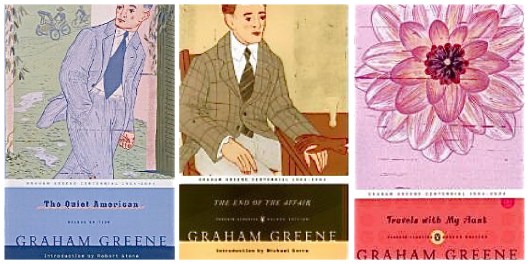
Travels with my Aunt is my third and final installment for the Graham Greene Reading Challenge hosted by Carrie of Books and Movies. My previous two titles are The Quiet American (1955) and The End of the Affair (1951).

Here they are. Look at the book covers, all from the Penguin Classics Graham Greene Centennial Edition (2004), trade paperbacks with French flaps. It’s a delight to just hold them in my hands:

Graham Greene Books

Travels with my Aunt (1969) is my first taste of Greene humor. Compared to the other two I’ve read, which are intense and deeply serious, this one is a light comic relief.

A conservative, retired bank manager Henry Pulling found a new relative at his mother’s funeral, his Aunt Augusta. She is everything he is not, an eccentric and liberal seventy-five-year-old sets to open a whole new world for his nephew. Upon Aunt Augusta’s insistence, Henry accompanies her travelling in Europe. In the process, she widens his contacts with some shady characters, opens his eyes to an underground world he has never imagined, leaves his trails with police investigations, and overturns his carefully guarded self into disarray.

The humor in Travels with my Aunt reminds me of Oscar Wilde’s The Importance of Being Earnest, and makes me think that, if it were written as a play, probably it would have been more effective and enjoyable.

I mean, considering it takes Greene only 180 pages to tell the complex story of The Quiet American, and 160 pages to depict the deeply conflicting The End of the Affair, why would he need 254 pages to jot down some travel notes. That’s right, he narrates in details and often digresses to leave us with some clever one-liners along the way. But, if he had picked up the pace a bit, and tightened up like the two previous books I read, I would have appreciated it much more. Okay, it’s selfish wishful thinking on my part, me being a very slow and easily diverted reader.

***

Ireland Reading Challenge 2012

ireland-reading-challenge-2012

And earlier in November, I’d finished The Ireland Reading Challenge 2012 also hosted by Carrie at Books and Movies. I aimed at the ‘Shamrock Level’ and read four books of at least three different genres. Here are my selections and links to my reviews:

Molly Fox’s Birthday by Deirdre Madden (Novel)

Everything in this Country Must by Colum McCann (Short Stories)

The Importance of Being Earnest by Oscar Wilde (Play)

Dubliners by James Joyce (Short Stories and Novella)

***

No plans for taking up any Reading Challenge for 2013 yet. However, I do have two Read-Along’s planned for the coming year. Hope you can join me then. Will post soon.

***