The hardest part is getting out of the car

In chilly -5C (23F), snow a foot deep in some areas, the hardest thing is to get out of a warm car. I drove around, actually left the natural park and then, a couple of blocks later, thought about turning back, all because of the flocks of dark spots by the river I saw from afar.

Glad I finally mustered the will to make a U-turn, find a spot to park and part with the story I’ve been listening from the audiobook CD.  I layered up, attached the ice grippers on my shoes (discovered this secret only a year ago), put on toque and gloves, and with my camera gear in tow, stepped out of the car.

Here’s my reward.

From afar, just some tiny black dots on the water…

From afar


that turned out to be a party of ducks and geese, basking in the afternoon sun on the icy river:

DSC_0406


Basking

And from behind tall grass, a buck watching me watching the ducks:

Buck behind grass

Suddenly from the corner of my viewfinder, a pheasant flew into frame. Here’s the serendipitous sequence:

Pheasant 1Pheasant 2Pheasant 3

At another spot, more Mallards gathering, over a hundred of them:

More ducks

These pigeons could only watch.

Pigeon A: Don’t you wish you could swim?

Pigeon B: And get all wet in the icy water? I’m thankful that I can’t swim.

Your guess: which is A? and B?

If only we could swim


In the sky Canada Geese flew by:

DSC_0565

On the ground, remnants of fall:

DSC_0549


and some positive human footprints left behind.

DSC_0489


And so I learned: Any worthwhile journey began with a step out of a warm car.

Oh, and one more thing… 

Wisdom from the pigeon: Be thankful for what you can’t do. I’ve got lots to be thankful for.

***

This is my post for Saturday Snapshot: Nov. 28. Thanks to West Metro Mommy Reads for hosting. CLICK HERE to see what others have posted.

ALL PHOTOS IN THIS POST TAKEN BY 

ARTI OF RIPPLE EFFECTS

DO NOT COPY OR REBLOG


Write Where You Are

During my New England road trip, I’ve visited several literary places. Now these are my own way of storing my memories. Whatever site I’ve been that relates to a literary figure, I categorize it as such. And it’s interesting to note the different sources of inspiration.

Thoreau went for the minimal, the Spartan way of existence. So he built a log cabin in the woods and kept only the simplest furniture. Why he only stayed for two years two months and two days may be self-explanatory. But no matter, we’re glad he had tasted the bare minimum for us so we can read all about it in his book.

Interior

By comparison, his friend Ralph Waldo Emerson, who owned those woods where Thoreau had his experiment, lived in relative luxury and comfort. Here’s his residence, not a mansion but still a handsome house.

DSC_0561

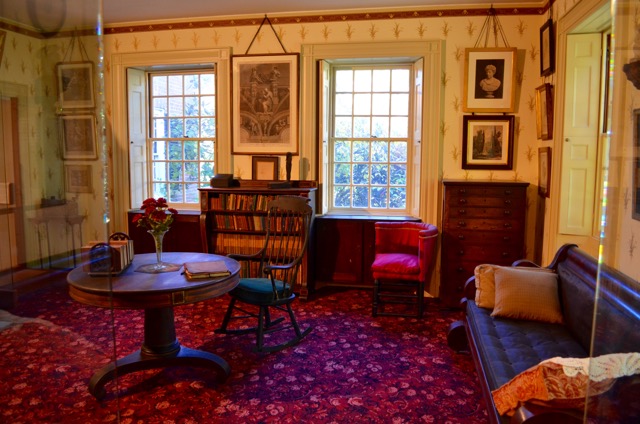
And inside the Concord Museum I saw his study with a flashy fuchsia decor which Thoreau might not have raved about. Just might not, but one never knows. They were friends.

Emerson's Study

Ralph Waldo’s grandfather The Rev. William Emerson’s house, The Old Manse (Scottish term for ‘Minister’s House’), wasn’t shabby either. Quietly situated by the river, a historic residence where literary figures gathered and where Ralph Waldo had lived for a while and wrote Nature, which sparked the Transcendental Movement (1834-35).

Manse 2

Nathaniel Hawthorne had lived in the same house too for a few years (1842-45), writing a book called Mosses from an Old Manse. He enjoyed the garden immensely; it was planted by Thoreau in 1842 to celebrate Hawthorne’s marriage to Sophia Peabody. Hawthorne could have found inspiration right there among the beets.

The Beets

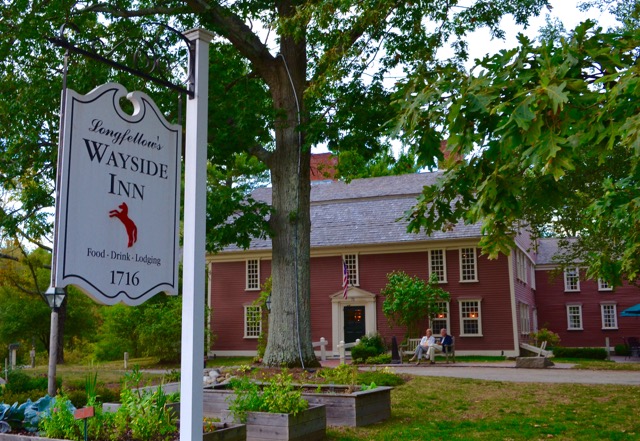
Longfellow, on the other hand, was intrigued by an old tavern and boarding house he had stayed one time in 1862. A homestead made into a lodge for itinerant farmers and transient guests had put stories in the mind of the creative, hence the publication of the Poet’s Tales of a Wayside Inn. For its namesake, the premises had since been named Longfellow’s Wayside Inn.

DSC_0193

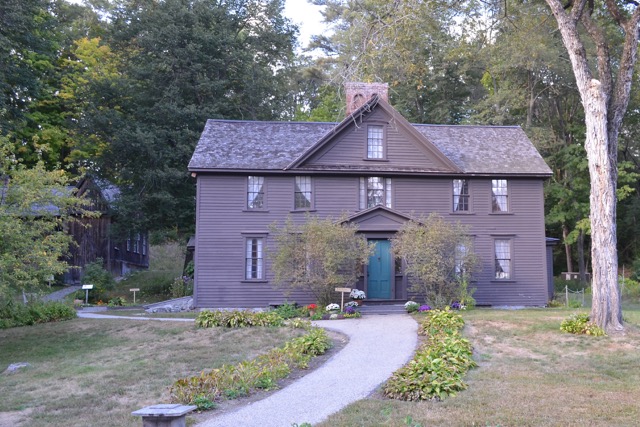
Louisa May Alcott’s Orchard House looks like a warm haven for story brewing too, even though the family could have used more material goods than their philosophically-minded father had provided:

The Orchard House

Back to Nature, the aspiring young poet Edna St. Vincent Millay climbed to the top of Mt. Battie in Camden and beheld the magnificent bird’s eye view of Penobscot Bay. Sky and water pressed close into the impressionable mind of young Edna, triggering a catalyst reaction of permanent change.

View from the top 3

For another, it’s the connection with the land, the toiling of the soil, the gathering of its fruits that inspired. He might have many roads to choose, but aren’t we glad Robert Frost had chosen orchard tending in Vermont and not the ones he did not; we get plenty of thoughts.

Frost's Apple

And for those born into affluence and wed into more, life was a choice of how to use the resources one gets. I’m glad that Edith Wharton had spent her fortune on something that can be left behind for me to set foot on, yes, The Mount.

EW's Garden

I learned too that her legacy had been more than literary pleasures and architectural delights, but something more altruistic after she moved to Paris.

As WWI broke out, Wharton could have gone back to America for safe haven. But she stayed in France, and poured herself in the war efforts, which was inspiration in itself. Here I quote from The Mount’s webpage:

“She set up workrooms for unemployed seamstresses, convalescent homes for tuberculosis sufferers, hostels for refugees, and schools for children fleeing war-torn Belgium. In the first seven months of her efforts, nearly 900 refugees were cared for, “including the nuns and about 200 infirm old men and women, who are ‘children’ too … and could not be left alone in the ruins.” (Edith Wharton, New York Times, 1915)”

and the story didn’t end there… Click on the above link to read more.

Where does one find inspiration, motivation? The answer can vary as much as asking what I should eat today. But one thing I’d experienced on this trip was that life can be lived in myriads of ways, and with it comes inspiration; it could be as simple as a leaf on the ground, or as huge as a war. But I’ll choose the leaf, thank you.

The Leaf

Wherever I am, that’s a good start.

***

My New England Road Trip Series:

Irrational Man (2015): A Teaser for Sartre

Can a director who churns out a movie every year continuously over the past four decades bring us anything new at age 79?

Yes, and no. But here’s the thing with Woody Allen’s annual offering, a summer treat in recent years, the answer is… does it matter?

Before you read on, be warned that the following discussion contains, no, implies, Spoilers.

Unlike his recent films – Magic In the Moonlight, Blue Jasmine, To Rome With Love, and Midnight In Paris – Irrational Man is not a comedy. It is a semi-serious drama carrying some signature WA thematic materials. Those familiar with his Match Point (2005) and Crimes and Misdemeanors (1989) will find Irrational Man a variation on the same theme, but this time with a twist. So there you go, the old has become new.

Here again, the writer/director is toying with Dostoevsky’s Crime and Punishment, Raskolnikov’s idea of getting away with crime for those who are superior. What if one commits a crime out of a superior motive, purely altruistic and benevolent? If a crime is committed with the full intention to rescue someone from a miserable predicament, shouldn’t the criminal be thanked rather than punished?

Interesting premise, and when the idea is embodied in Joaquin Phoenix, the character actor who is beyond categorization, here’s the attraction. First time in a WA film, Phoenix has prepared well with the right physique – an obvious paunch – to show his method immersion. He plays a listless philosophy professor Abe, who has no life purpose, no drive even when starting a new position or finish writing his book, but just passing his summer teaching hours with easy chats on Kant, Kierkegaard, and Sartre, while still attracting students and colleagues alike.

Irrational Man's pivotal scene

One day in a coffee shop, upon overhearing a woman talk to her friends about her desperate child custody case, Abe is overcome with empathy. (Photo above: a pivotal scene.) He is ready to live out an existential choice: by taking actions in his owns hands in committing a crime to help the woman, he in turn discovers the purpose for his own existence. Did I say this is not a comedy? Well, let me qualify that. There’s no laughter in the theatre. However, Phoenix’s character and action is inherently an ironic jest; the story we see on screen works like an object lesson on the freedom of choice, and a teaser for Sartre.

I look forward to these annual WA productions, even when I hear dialogues that sound like I’ve heard them before. Why? Where else would one find nowadays philosophical chitchats on screen for our entertainment? Philosophical chitchats, the term itself is an oxymoron; here lies the fun of a WA film. Allen doesn’t take his characters seriously, so we have light characters engaged in serious talks.

The psuedo-intellectual screen talks are humour in themselves. Just because we can’t spot a Marshall McLuhan in a theatre line-up anymore to clarify his own ideas as in Annie Hall, let alone get Sartre to referee the on-screen discourses, so we can sit back leisurely and be amused at Allen’s characters delving in philosophical problems, while their life and fate collide in twists and turns.

The is Emma Stone’s second WA movie back-to-back with her Magic in the Moonlight in 2014. As a college student falling for her philosophy prof sounds more convincing a role for Stone than as a young medium with telepathic ability to contact the dead. What’s interesting about these annual WA productions are the interesting combinations of A-listers being cast in some wacky roles. Something new, something old… thought you’ve seen it before? Just wait till the end.

To kick off your Philosophy 101 class, Irrational Man could be a lively visual aid to hold your students’ interest. Breezy, entertaining, lines to discuss and dispel, with an ending that long-time WA watchers could well interpret as the director redeeming himself from creating those in Match Point and Crimes and Misdemeanors in his younger days. Turning 80 the end of this year, maybe Allen has finally decided to lean towards the side that says, yes, there’s poetic justice after all.

~ ~ ~ Ripples

Other Related Ripple Reviews:

Magic In The Moonlight (2014)

Blue Jasmine (2013)

To Rome With Love (2012)

Midnight In Paris (2011)

***

Saturday Snapshot August 1: A Summer Wood

Colours growing wild.

Fields of wildflowers

I can easily imagine a lavender field in Provence.

I can imagine lavendar

Ripening Saskatoon berries, food for everyone.

Ripening Saskatoon Berries

The tiny Yellow Warbler never ceases to fascinate me.

The Yellow Warbler

… here practising her trapeze skill.

Yellow Warbler 2

Or the American Goldfinch… common for the Americans, but always a golden moment for me when I capture one in picture.

American Goldfinch 2

Am Goldfinch 2

A delight even just to see the common Robin basking in the the setting sun, redder than ever.

Robin red breast indeed in the eveing light

The ordinary in a different frame.

Cobweb in Early Evening
Common sight, common light, common grace.


***

Saturday Snapshot is hosted by West Metro Mommy Reads. CLICK HERE to see what others have posted.

***

ALL PHOTOS TAKEN BY ARTI OF RIPPLE EFFECTS

DO NOT COPY OR REBLOG


Saturday Snapshot May 16: Silhouettes

Often when I’m outdoor, the light, shadow, direction of the sun and the time of day are less than ideal for photography. That’s the time when I see beauty from another perspective. The lack of light on the subject, or when it’s backlit, makes it all the more intriguing.

I’ve learned to appreciate silhouettes. They are more soulful and quiet. When devoid of colour, I can see more clearly the subject’s shape and form, and its solitary existence. Here are some photos I’ve taken lately… a kind of Wabi-sabi.

The slow and meditative movement of the Great Blue Heron:

GBH

Great Blue Heron

Great Blue Heron Flying

Look at the shadow in the water, like a Chinese brush stroke:

Chinese brush painting 1


A solitary Belted Kingfisher:

Belted Kingfisher


Cattails by the pond in the evening light:

Cattails


Guess who’s still busy at dusk:

Beaver

***

Saturday Snapshot is hosted by West Metro Mommy Reads. CLICK HERE to see what others have posted.

Photos Taken by Arti of Ripple Effects

Do No Copy or Reblog

***

Seven Stanzas for a Happy Easter

Rocks


“Seven Stanzas At Easter” by John Updike

Make no mistake: if he rose at all
It was as His body;
If the cell’s dissolution did not reverse, the molecule reknit,
The amino acids rekindle,
The Church will fall.

It was not as the flowers,
Each soft spring recurrent;
It was not as His Spirit in the mouths and fuddled eyes of the
Eleven apostles;
It was as His flesh; ours.

The same hinged thumbs and toes
The same valved heart
That—pierced—died, withered, paused, and then regathered
Out of enduring Might
New strength to enclose.

Let us not mock God with metaphor,
Analogy, sidestepping, transcendence,
Making of the event a parable, a sign painted in the faded
Credulity of earlier ages:
Let us walk through the door.

The stone is rolled back, not papier-mache,
Not a stone in a story,
But the vast rock of materiality that in the slow grinding of
Time will eclipse for each of us
The wide light of day.

And if we have an angel at the tomb,
Make it a real angel,
Weighty with Max Planck’s quanta, vivid with hair, opaque in
The dawn light, robed in real linen
Spun on a definite loom.

Let us not seek to make it less monstrous,
For our own convenience, our own sense of beauty,
Lest, awakened in one unthinkable hour, we are embarrassed
By the miracle,
And crushed by remonstrance.

– John Updike (1932-2009)

***

Happy Easter to All!

Staying Awake in the Garden

I came across this image in Biola University’s Lent Project. It is by the Austrian children’s book illustrator Lisbeth Zwerger. Among several awards she had won, Zwerger received the acclaimed Hans Christian Andersen Medal for illustration—the highest international award given for “lasting contributions to children’s literature”.

Staying Awake in GG

Its title is Jesus praying in the Garden of Gethsemane, from her book Stories From the Bible. Without condescension, Zwerger’s image speaks with clarity such that a child can easily grasp its essence. Three people dozing off, each against a tree. From a distance, under a massive dark cloud, a tiny, lone figure walking towards the ominous void. The illustration is perhaps one of the rarer perspectives that accompanies this narrative:

“Then Jesus went with them to a place called Gethsemane, and he said to his disciples, “Sit here, while I go over there and pray.” And taking with him Peter and the two sons of Zebedee, he began to be sorrowful and troubled. Then he said to them, “My soul is very sorrowful, even to death; remain here, and watch with me.” And going a little farther he fell on his face and prayed, saying, “My Father, if it be possible, let this cup pass from me; nevertheless, not as I will, but as you will.” And he came to the disciples and found them sleeping. And he said to Peter, “So, could you not watch with me one hour? Watch and pray that you may not enter into temptation. The spirit indeed is willing, but the flesh is weak.” Again, for the second time, he went away and prayed, “My Father, if this cannot pass unless I drink it, your will be done.” And again he came and found them sleeping, for their eyes were heavy. So, leaving them again, he went away and prayed for the third time, saying the same words again. Then he came to the disciples and said to them, “Sleep and take your rest later on. See, the hour is at hand, and the Son of Man is betrayed into the hands of sinners. Rise, let us be going; see, my betrayer is at hand.”    – Matthew 26: 36 – 46

What struck me is how modern the feel; these three guys could be anyone. And they are so casual too, like, barefoot in the park. Considering the horrific mission their Master is facing, their body language speaks avoidance, indifference, and, even betrayal. The spirit is willing but the flesh is weak – blame it on the good supper – they’re totally oblivious while their Master in a distance, alone, is fighting the most anguished battle of his life.

Are these guys named Peter, James and John? Why, they could be you and me.

***

Reading The Season: Lila by Marilynne Robinson

Every year before Christmas, I read something that can draw me closer to the meaning of the Season. Amidst the busyness of the festivities, I try to carve out a piece of quiet. I name these annual posts Reading The Season. You can click on the links at the bottom for previous entries, dating back to 2008. This year, the publication of Marilynne Robinson’s third Gilead book, Lila, is a most timely read.

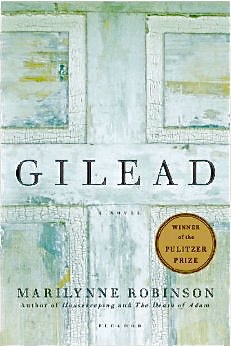
GileadGilead (2004) – Marilynne Robinson’s Pulitzer Prize and National Book Critic Circle Award winning novel introduces us to the fictional town of Gilead, Iowa. We hear the gentle voice of the narrator, the ageing Rev. John Ames, as he writes a letter to his seven-year-old son Robby, leaving a legacy of family heritage, love, forgiveness, and serenity.

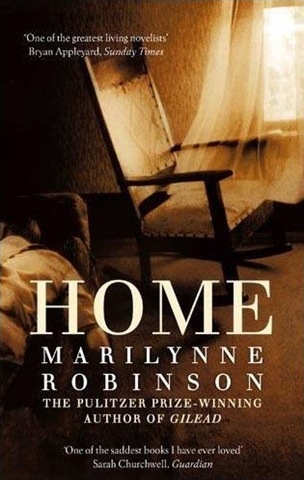
HomeHome (2008) – Based on the same Gilead characters, but from a different point of view allowing us privy to the household of the Rev. Robert Boughton, John Ames’s life long-friend. Glory, Boughton’s daughter, comes home to take care of her ailing father. She is there when her brother Jack returns after an absence of twenty years. The black sheep of the family, Jack’s estranged self yearns for reconciliation like a prodigal. The book, in all its complexities and depiction of alienation, escape, return and lost yet again, suggests home may not be a solace as sweet as one hopes.

Lila

Lila (2014) – Robinson’s newest, and 2014 National Book Award finalist. It is the third novel based on the characters in the town of Gilead, offering yet another point of view. But one can just read it on its own, albeit best to have read Gilead first, then the kind face of John Ames can be conjured up more readily. In this book, the perspective is from Ames’s much younger wife Lila, at first lonely and desolate, slowly drifting into place.

**

Lila Dahl

At the outset, we see Lila as an unwanted child, “cold”, ‘all cried out’. She is rescued by Doll, a destitute woman herself yet still has room in her heart for an abandoned little girl. Doll wraps Lila into her shawl and decides to bring her up. “Lila was the loneliest child, and there they were, the two of them together, keeping each other warm in the rain.” Lila later takes up Doll’s name as Dahl.

The two joins a small group of itinerant field workers led by Doane, living in camps out in the open. But the Depression breaks up the cohesive work party. Lila is later left on her own and for a little while, works in a brothel in St. Louis. Knowing she can’t stay there for long, she slips out one night, escaping from a blackhole of hopelessness.

After that she finds herself a cleaning job at a hotel, from which she has to escape again after seeing her nemesis whom she first encounters while in the brothel. She packs her bag and leaves town, taking rides from strangers going to wherever they drop her. Ultimately, Lila drifts to the outskirt of Gilead, finds an abandoned shack and takes shelter there. She cleans up the shack for a place to sleep, having no plans except to find odd jobs in the town yonder, earn enough money, then moves on, maybe to Sioux City.

Lila lives a life of poverty, loneliness and fear, mistrusting everyone. Doll may have been like a mother to her but she too has her own rough life and struggles. Doll knifes and kills a man who might be Lila’s own father, could well be out of protecting Lila. She is later jailed, leaving the knife in Lila’s possession. Lila keeps it with her all the years as a memento, a murder weapon, yes, but also a symbol of Doll’s loving protection and Lila’s own desolate past.

One day walking into Gilead Lila stumbles into a church to escape the rain, that is the turning point of her life. She sees the old man at the pulpit, the Rev. John Ames, and, he sees her.

John Ames

We know a lot about Ames from Robinson’s first book of Gilead, set in the 1950’s. A Congregationalist pastor in the town, Ames is sixty-seven years old when he first meets Lila, “a big, silvery old man”. Coming from a family tradition of ministers, John Ames is a man with a pastor’s heart.

Ames has had his share of personal grief. He had to bear the death of his beloved wife of his youth and his newborn son as she died in childbirth. Such unspeakable pain he had shared with his best friend Robert Boughton, pastor of the Presbyterian church in Gilead.

Ames and Boughton have been life long friends. They share pastoring advice, discuss foreign policies, debate theological problems, and bear the burden of each other’s family woes. Boughton has his in his son Jack, who takes John Ames’s namesake.

After seeing Lila at the church as she comes in from the rain, Ames keeps her in his heart. Residents of Gilead befriend Lila, giving her jobs, welcoming her in their midst, but Lila is aloof and skeptical, an outsider still. Ames personally engages her to talk and to know her more. One day, he goes to seek her out at the shack. She sees him coming as she walks towards Gilead. There on the path he reaches out to her and promises marriage. An inexplicable love story takes shape.
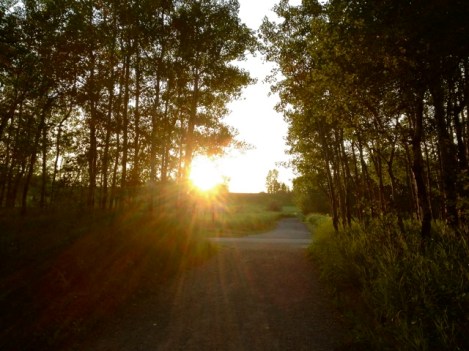
Sunset

Ames and Lila

“… the old man kept on courting her, like a boy, when she was hard and wary…”

After they are married, however incompatible it looks in Ames’s home, Lila still keeps Doll’s knife with her as a memento and as a symbol of her own tumultuous past, a part of herself. Ames is unperturbed. He lets her keep it, and he even uses it, taking it as a normal tool around the house. Total acceptance.

If condescension is present in the relationship, it is Ames who wants to learn from Lila. His utter humility is what moves her. Barely literate, Lila yearns to know about the Bible, study it and grasp its richness and meaning. They talk about the difficult books of Ezekiel and Job. Ames shares his thoughts about this elusive notion called existence, and listens attentively Lila’s perspective and experiences. Total respect.

Lila has questions rooted in her bitter past, the why’s of misfortunes, cruelty, and the hardships in life. She asks Ames with an inquiring heart. Ames, a pastor of many years, can find no easy answers. He ponders Lila’s queries, and readily and honestly admits his own limitations in knowing, while loving her all the more. Total humility.

Even after they are married, Lila sometimes still conjures up thoughts of leaving. Ames  knows this and gives her the freedom:

… if you ever change your mind, I want you to leave by daylight. I want you to have a train ticket in your hand that will take you right where you want to go, and I want you to take your ring and anything else I have given you. You might want to sell it. That would be all right. It’s yours, not mine… ” He cleared this throat. “You’re my wife,” he said. “I want to take care of you, even if that means someday seeing you to the train.” He leaned forward and looked into her face, almost sternly, so she would know he meant want he said.

She chooses to stay, a genuine response to his love.

When I read the book, I see a tender love story between two utterly incompatible beings, like an allegory and a parallel of the Christmas story, how the Creator God reaches out to take our hand, initiating an unfathomable relationship. Love for the reason of pure love. An unlikely and inexplicable union.

The Christmas Story

I first felt a little uncomfortable about the obvious incongruous pairing of Ames and Lila, yet, their love relation comes to fruition, albeit looking tentative at first. The gap between Ames and Lila is just a crack in the pavement when compared to the abyss separating Creator God and His creation. I see Ames and Lila’s story as an allegory, if you will, a parallel, however meagre, illustrating the joining of two utterly disparate sides.

The essence of the Season is in the reaching out to bridge that huge chasm. As Ames and Lila’s newborn son at the end of the book is an evidence of their love, we too receives a child, born in a manger that day in Bethlehem, a sign of ultimate mending. Total reconciliation.

***

Other Reading the Season Posts:

2020: Jack by Marilynne Robinson

2019: A Hidden Life, a film by Terrence Malick

2018: Madeleine L’Engle’s Poem The Irrational Season

2017: A Wrinkle In Time by Madeleine L’Engle

2016:  Silence by Shusaku Endo

2015: The Book of Ruth

2014: Lila by Marilynne Robinson

2013 Poetry by Madeleine L’Engle

2012: Surprised by Joy, C. S. Lewis

2011: Walking on Water, Madeleine L’Engle 

2010: A Widening Light, Poetry by Luci Shaw

2009: The Irrational Season, Madeleine L’Engle 

2008: The Bible and the New York Times, Fleming Rutledge 

2008: A Grief Observed, C. S. Lewis

 ***

Spoilers as Pointers

Last week, I wrote a review of Gone Girl, the movie adaptation of Gillian Flynn’s wildly popular book, and I caught myself tiptoeing around the story trying not to drop any spoilers. Now as I think back to it, that episode leads me to a minor revelation.

Why do I have to be so extra careful? The answer is obvious enough. If I just hint at what the major twist is, I’d be giving away the story, largely diminishing the viewer’s enjoyment, eliminating the element of surprise. In reply to some comments, I’d even suggested to people not to read the book first if they are going to see the movie.

Here’s the question I’ve been mulling over this past week, and I can’t help but be a bit amused. I don’t think I’ve ever written a post in this state of mind before. The word used by a commenter was ‘restraint’. I felt more like ‘silenced’.

Did I put a “Spoiler Alert” at the beginning of my review of say, Anna Karenina (2012)? Since its publication as a serial in the 1870’s, the trajectory of this extra-marital affair is well-known; critics are not muffled from discussing the tragic end of that gone girl. Revealing the storyline has not dampened people’s interest from reading the book or watching its movie adaptations, ten of them so far, as full features or TV series.

Or take The Great Gatsby, that fateful yellow car ride ultimately leads to the end of Gatsby. Ooops, there goes the spoiler. With this, have I killed the movie for would-be viewers? I don’t think so. Why? Simply because that green light blinking across the shore is so powerful a lure, driving a man to dream the impossible dream. And we want to see the elaborate efforts this enigmatic character exerts to strive for that unreachable goal.

Or, let’s say, 12 Years A Slave (2013) based on Solomon Northup’s memoir. Here, the title is the spoiler. The slave had to survive the twelve years in order to write his own memoir. But of course, we want to know how he survived, his resilience, and what he has to say about the slavery system, about human nature.

Or take a contemporary novel, Life of Pi (2012). After a shipwreck, a 16 year-old boy adrift on the Pacific Ocean for 227 days on a life raft is finally rescued and lives to tell his tale. Now that’s giving away the whole story. Does that spoil the fun of watching the movie? Not at all. Why? Because we see spectacular scenes of the boy pitted against nature, persevering over perils that could shatter or enhance his faith, dealing with personal loss, recapturing memories and reality … we are hooked because there are rich layers of meaning packed inside a simple storyline.

So, for stories that explore more than the plot can tell, even though we may know the ‘what’, we want to see the ‘how’. We want to get on the ride and enjoy the scenery, for there are interesting and intriguing sights along the way.

To spoil or not to spoil… depends if the book is just only about the plot, manipulating the twists and turns to shock and surprise, yes, a clever page turner, then a spoiler would definitely diminish the enjoyment, robbing the viewer of the element of surprise and entertainment.

But if the kind of reading or viewing offers a deeper exploration of characters and the human condition, or framing from a historical or social backdrop to confront issues, or depicting scenes of a shared humanity, or unpacking subtext and meaning… then, dropping a spoiler may not be so disastrous.

I know, there are exceptions and I’m not trying to generalize, but, could the acceptability of spoilers be the pointers to the difference between literature and pulp fiction?

***

Related Movie Reviews on Ripple Effects:

Gone Girl (2014)

12 Years A Slave (2013)

Anna Karenina (2012)

The Great Gatsby (2013)

Life of Pi (2012)

***


How Proust Can Change Your Life by Alain De Botton

Here’s my second instalment for the blogging event Paris in July 2014.

Paris In July 2014

***

You must have heard of this book by a Swiss-born Brit writing about a French novelist called Proust. You probably have read it, and let me guess, were surprised when reading the first chapters? Well, I was. For before reading this book, my knowledge of Alain de Botton, the popular British writer and media personality, mainly came from an art critic’s thoughtful posts on her blog.

How Proust Can Change Your Life

Is Botton joking? This book reads like a parody.

First we are introduced to Dr. Proust, Marcel’s father, who was a renowned physician and prolific writer. His thirty-four books had helped the French people from defences against the plague to the correct postures and exercises for the ladies. Botton being an image-driven person does not hesitate to include some of Dr. Proust’s instructional illustrations for his female readers such as how to jump off walls, or balance on one foot.

Not your definition of parody? How about this chapter on ‘How to Suffer Successfully’. Proust is well known for his physical ailments, having had to lie in bed most of the time when he wrote the longest novel ever written, In Search of Lost Time. Botton exhaustively lists down the various trials Proust had to live with throughout his life:

  • The Problem of a Jewish Mother
  • Awkward Desires
  • Dating Problems
  • A Lack of Career in the Theatre
  • The Incomprehension of Friends
  • At 31, His Own Assessment
  • Asthma
  • Diet
  • Digestion
  • Underpants
  • Sensitive Skin
  • Mice
  • Cold
  • Coughing
  • Noise from Neighbours

… Should I go on? And oh, he does include Death.

I know, that’s what Botton does, bring the extraordinary into the ordinary realm of common readers, and by so doing, explaining Proust to us lowly creatures. And of course, it would help if you have at least read the first two volumes of In Search of Lost Time, for many of his examples are taken from there, so you would feel a resonance, or disagree with Botton’s interpretation, when he talks about Francoise, Swann, Albertine, Combray, or Balbec.

Do I get anything out of it? Plenty. I’ve lots of highlighted passages and my own handwritten notes on the margins. When Botton gets serious between the lines, he leaves me with some useful tips:

So if speaking in clichés is problematic, it is because the world itself contains a far broader range of rainfalls, moons, sunshines, and emotions than stock expressions either capture or teach us to expect. (p.106)

For one thing, express your own feelings and ideas instead of saying ‘nice’, or describing the setting sun as ‘a ball of fire’. I love this little passage Botton quotes from Proust about the novelist’s description of his ‘lunar experience’:

Sometimes in the afternoon sky a white moon would creep up like a little cloud, furtive, stout display, suggesting an actress who does not have to ‘come on’ for a while, and so goes ‘in front’ in her ordinary clothes to watch the rest of the company for a moment, but keeps in the background, not wishing to attract attention to herself. (p.98 of Botton’s, but no mention of where this is from Proust’s)

The key of course is not so much of trying to use a new language to describe a common scene or object, but to be able to look at them from a distinctively new perspective to begin with. How can we invent new lenses to see the world? Towards this end, Botton has failed to go further. So we’re told to avoid clichés, but not how. If you sense my ambivalence, you’re right.

In order to avoid clichés himself, Botton has resorted to hyperboles. The title of the book is a ready example. The 200 page book comprises of nine short chapters, each can be a book in itself. So you can expect the oversimplification of the ideas. Further, with no citing of sources for the Proust quotes, the critical reader could be left unsatisfied; it feels like Botton has jumped to generalizations and found expressions of his own thoughts from one or two excerpts of Proust’s. Makes one feel that Proust could just be a selling point.

However, this is an entertaining read, like a self-help manual with instructional tidbits and amusing images. The book is a mixed bag of common-sense wisdom, with a ‘moral’ at the end of each chapter. Throughout, it is obvious that Botton could well find it not as easy as he tells his readers to do… to be original and not say what others have said before. Here are some of his main points:

  • Live life today
  • Read books to form your own ideas
  • Suffering makes you strong
  • Find art and beauty in the ordinary
  • Avoid clichés like the plague
  • A time to pick up a book, a time to put it down
  • Win friends by your praises
  • but pour your honest criticisms of them into a work of fiction (now that’s a novel idea).

Is there anything new under the sun?

Speaking of the sun, take this to the beach. It would make one breezy read.

Lastly, following Botton’s (actually Proust’s) advice on reading:

We should read other people’s books in order to learn what we feel, it is our own thoughts we should be developing even if it is another writer’s thoughts which help us do so. (P. 195) Reading… is only an incitement…


So I’d say the moral is: read Proust yourself. Don’t let Botton tell you what Proust can do for you.

That’s just the prodding I need to press on to In Search of Lost Time, Vol. III.

***

Paris in July 2014 on Ripple Effects:

Haute Cuisine Movie Review

CLICK HERE, HERE and HERE to see what others have posted.

***

Related (Proust) Posts on Ripple Effects:

Proust Read-Along: Swann’s Way Part 1, Combray

The Swann and Gatsby Foil

Half Way Through a Budding Grove

Out of the Budding Grove

***

Ida’s Choice: Thoughts on Pawlikowski’s Ida (2013)

This review is about the acclaimed Polish-born director Pawel Pawlikowski’s newest film Ida (2013)It was screened at TIFF 2013, and since then, at numerous other film festivals. Slowly, it has arrived at the big screens in our cities recently. The following post discusses crucial thematic elements. Therefore, spoiler warning.

***

What forms one’s identity? Is it nationality? Race and ethnicity? Or something that transcends these boundaries? And, does one have a choice?

IDA

At the beginning, Anna’s (Agata Trzebuchowska) Catholicism is chosen for her. Raised in a Polish convent as an orphan, Anna knows no other kind of life. As an 18 year-old novitiate on the verge of taking her vow to become a nun, her Mother Superior tells her she should meet her closest relative. The one living relative she has is her mother’s sister, her aunt Wanda (Agata Kulesza).

Wanda is a hard-drinking, life-weary and tormented soul. Having lived through the horror of the second world war, she is confronted by yet another formidable front in post-war Poland, Soviet Communism. As a state prosecutor and later a judge, Wanda survived by compromising with the oppressive regime. She rises to a respectable position while sending many to their doom.

Poland in the 1960’s saw the beginning of wavering in hardline communism, a loosening up in society. Wanda has now become disillusioned and cynical, immersing in alcohol and one-night stands. With Anna appearing at her doorstep, she has to confront with not only a family’s dreadful past but her own existential present. Her licentious lifestyle is a sharp contrast to Anna’s spiritual devotion. A foil of the sacred and the profane, but not in a dogmatic frame. We see the two learning to appreciate and understand each other in a poignant way.

The sacred and the profane

For Anna, coming out of the convent does not mean only an eye-opener of the real world. From her aunt, she learns that her real name is Ida Lebenstein, and she is a Jew. Her parents were murdered during the Nazi occupation of Poland. She was kept safe in the shelter of the Catholic nuns. Her lineage concealed. Now Anna/Ida has to face with a seemingly incompatible identity, as her aunt bluntly puts it, ‘a Jewish nun’.

Aunt and niece go on a road trip to seek out the graves of Ida’s parents and eventually discover more about their deaths. They begin to know each other in a deeper way. The knowledge and the experience they have with each other may be life affirming for Ida; unfortunately for Wanda, they lead to despair.

While on the road, Wanda picks up a hitch-hiker, a young jazz musician, saxophonist Lis (Dawid Ogrodnik). He opens up yet another window for Anna, that of jazz, Coltrane, and all the rest.

The 80-minute, visually inspiring film is shot in aesthetically stunning black and white cinematography, 1.37:1 Academy Ratio with a square frame; the medium is the message. Austere, minimal, suggestive of harsh, bygone days, and with human characters often in the bottom of the frame, small and insignificant compared to the vast landscape. What is human in the whole scheme of things? How does one define oneself?

Small characters against large landscape

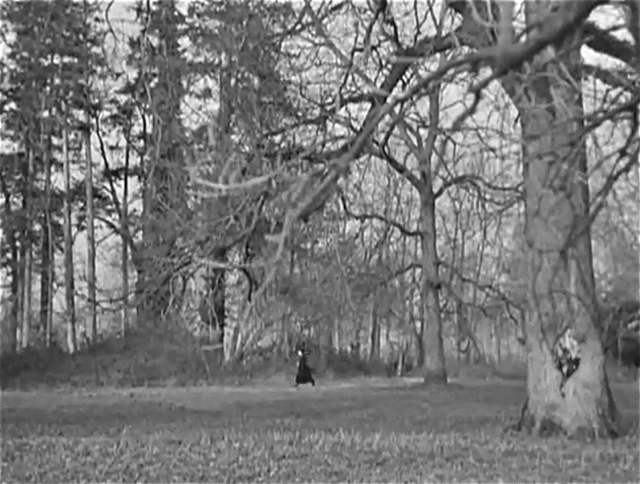
The cinematography reminds me of Robert Bresson’s Diary of a Country Priest. The young priest comes into his first parish, dwarfed and intimidated by the burden of his task, the spiritual warfare for which he is unprepared:

Walking through the woods

Like Bresson, Pawlikowski uses a non-actor for a major role. Agata Trzebuchowska plays Ida. She has never acted before. Pawlikowski found her in a coffee shop. Her portrayal of Anna/Ida is hauntingly authentic. Her face is pristine, yet her gaze is wise beyond her looks. Her aloof expression offers an unspoken evaluation of the world she sees, both in and out of the convent’s walls.

After a pivotal event, Ida tries on her aunt’s dresses, her high heels, smokes her cigarette and imagines another life. In this elegant attire she dances with the Jazz musician Lis. She listens to him play Coltrane on his sax. A whole new world awaits her if she so chooses. But it only entices for a short while. Ida yearns for something deeper, more meaningful. “And then?” she asks Lis several times in response to his offer of coming along with him.

Three characters, three different choices. Wanda chooses a way out that’s tragic.

The young musician Lis chooses jazz and whatever that path might take him. Despite his desire to have Ida come along with him, he does not, or maybe cannot, answer her two-word questions: “And then?” What’s the purpose, after all?

Ida chooses the transcendent over the secular, not that she judges the world, but that she yearns for meaning in the spiritual. It is not so much about choosing Catholicism over her Jewish lineage, but that she has made her own decision in becoming who she is. Ida’s choice is one that surpasses arbitrary, man-made boundaries of race and ethnicity, or the appeal of materials and pleasures; she chooses to devote to her Christ who had sacrificed all.

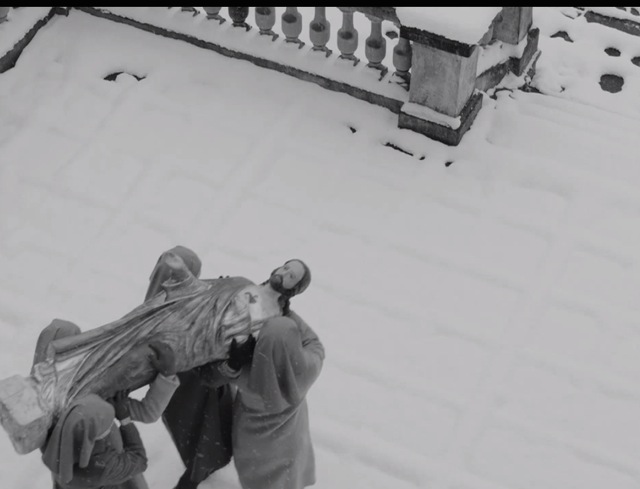
An image from the beginning of the film vividly comes back to my mind. Anna and three others carrying the Christ statue on their shoulders like a cross:

Carrying Christ

In the final shot we see Ida back in her habit attire. The moving camera captures a resolved and almost rejuvenated face, walking briskly with her little suitcase in hand, heading back to the convent. This place is now a personal choice.

~ ~ ~ 1/2 Ripples

***

Awards Update:

Feb. 22, 2015: Ida wins The Oscar for Best Foreign Language Film of the Year.

Feb. 21, 2015: Ida wins Best Foreign Language Film at the Independent Spirit Awards.

Feb. 8, 2015: Wins BAFTA Best Film not in the English Language

Jan. 15, 2015: 2 Oscar noms, Best Foreign Language Film, Best Cinematography

Dec. 11: Golden Globe nom for Best Foreign Language Film

Dec. 7: Ida wins Best Foreign Language Film and Agata Kulesza Best Supporting Actress at the L.A. Film Critics Awards

Dec. 1: Ida wins Best Foreign Language Film from the New York Film Critics Circle

Other posts you might like:

Nebraska: Colour Is Superfluous

Diary of a Country Priest: An Easter Meditation

Diary Of A Country Priest: Film Adaptation

AGO Exhibition: Terror And Beauty

The Art Gallery of Ontario, AGO, is a must-see whenever I visit Toronto. Not only because I’m a Frank Gehry fan who never gets tired of looking at the centre spiral staircase in there, but the exhibits are always intriguing and thought-provoking. Spent a few days in Toronto last week and this time, I was much gratified to view the current show at AGO: “Francis Bacon, Henry Moore: Terror and Beauty”.

Terror and Beauty, the motif resonates with the idea of Wabi-sabi. I’ve explored visually the notion of Wabi-sabi before. Two seemingly incompatible states juxtaposed against each other, beauty and sadness.

“You can’t be more horrific than life itself” says a quote from Francis Bacon on the AGO’s Artist page. The exhibits speak to that by extracting from the horrors of WWII and other forms of human sufferings and struggles depicted in the works of these two 20th century Irish/English artists who were contemporaries of each other.

The exhibit is a wealth of surrealist works from Bacon, and sculptures and drawings from Moore. But I was particularly captivated by the WWII items. While Moore is well-known for his abstract sculptures of the human body in larger than life poses, here’s a rare chance to see his more personal, wartime drawings.

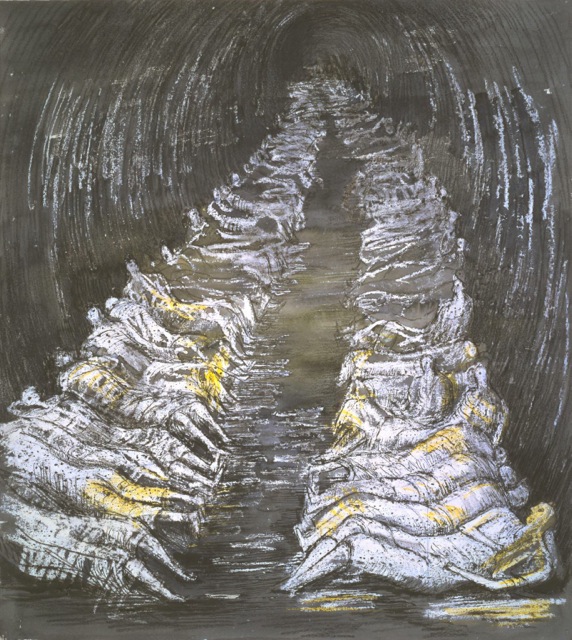
Going home one evening in 1940, as he entered a London subway station, Moore discovered crowds of people sleeping on the platform to take shelter from an impending German air strike, the Blitz. He was taken aback by what he saw and his later drawing was a ghastly interpretation:

Tube Shelter Perspective 1941 by Henry Moore OM, CH 1898-1986

Photo Source: http://www.tate.org.uk/art/artworks/moore-tube-shelter-perspective-n05709

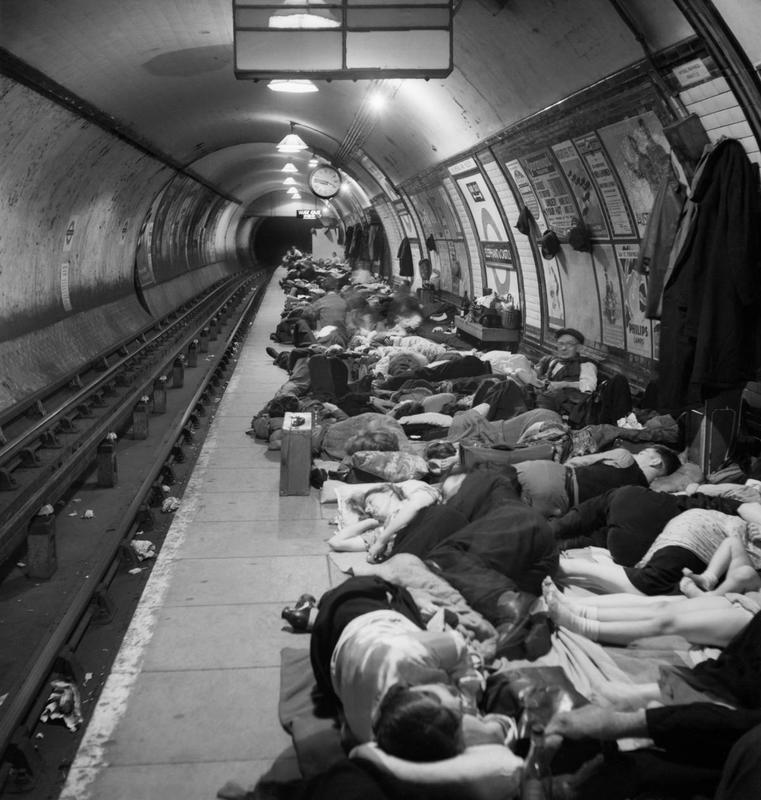
That’s Moore’s view of the underground subway station used as impromptu bomb shelter. But what was it really like in those tube stations? That’s when I was totally captivated by the photos of the renowned photojournalist Bill Brandt displayed alongside Moore’s shelter drawings.

Rather than horrific depictions, I was utterly surprised by the actual photographs by Brandt, who acted as official war photographer. His noir and darkened perspective is haunting and yet, full of mystique and beauty.

What I saw was an opposite interpretation of the subway scene: rather than terror, I saw resilience. Indeed, the London populace came out in droves to seek shelter in the subway, a much safer haven than their own homes. What I saw in many of Brandt’s photographs was the strong sense of ‘life goes on’.

Two photographs in the exhibition will forever remain in my mind.

First is the Liverpool Street Underground Station Shelter during an air raid in November, 1940. The photograph shows a family sleeping soundly, bedding against the grooves in between the steel structures of the tunnel. But look more carefully, there’s even a bunk and blanket for a doll beside the child. They all look peaceful and calm.

For the archive in my mind, let me call this photo: “The Doll in the Subway”

Sleeping in the subway bunk-child & doll

© IWM Non-Commercial License http://www.iwm.org.uk/collections/item/object/205194652?cat=photographs

The second picture by Brandt is in the Elephant and Castle London Underground Station Shelter. Here, people sleeping on the crowded platform while taking shelter from German air raids during the Blitz.

But look how they were dressed in. The mid-heel pump the woman in the foreground was wearing caught my attention. Looks like she was dressed for work. Blitz or no Blitz, after she woke in the morning, she had to go to work. Life as usual.

In my mental archive, this photo will now be entitled “The Mid-heel Pump”.


The mid-heel pump

© IWM Non-Commercial License http://www.iwm.org.uk/collections/item/object/205194638

What more, after civilians had crowded into the subway stations against government’s advice, the officials had to respond with helpful measures by installing chemical toilets, first aid facilities, and providing drinks, while the people created their own entertainment. With all due respect to the victims of the Blitz, the resilience and adaptability of the Londoners are most inspiring.

After I stepped out of AGO, I wanted to go back in to take a more careful look at the exhibits again. But that was not feasible so I had to write this post from memory (no photos of the exhibits were allowed) and from some online digging. Glad to have found these two  memorable images from the Imperial War Museum website. Thanks to AGO, these two historic photos will remain in my mental archive for a long, long time.

CLICK HERE to see 9 Incredible photos of the London Underground as Bomb Shelter.

***

Related Posts on Ripple Effects:

The Frank Gehry designed Art Gallery of Ontario

Sketches of Frank Gehry (2005)

Art Gallery of Alberta