Saturday Snapshot May 31: After the Rain

Ever since I first read Annie Dillard, I’d wanted to see Puget Sound. But after all these years, I’ve been firmly rooted in the foothills of the Rocky Mountains in Alberta. My neck of the woods is a boreal forest. So, I’m more at home with spruce trees than sandy beaches. Puget Sound will have to remain on my bucket list.

All through winter, spruce and pines are sustenance, the bulwark and shelter for birds and small creatures that stay behind, and me.

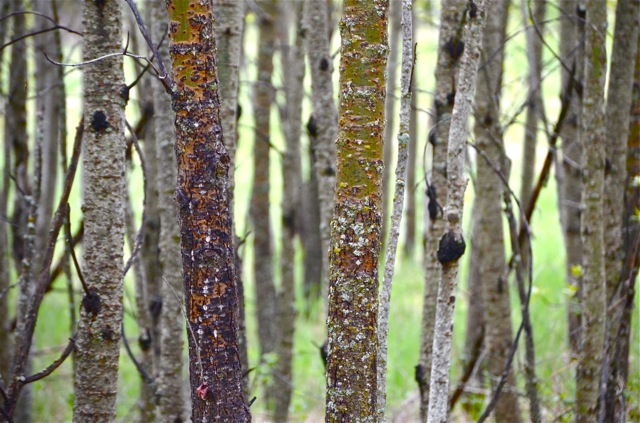
After two days of spring rain, I ventured out just when it broke clear slightly, and was mesmerized by the greens. From among the hardy spruce, the aspens burst out to embrace spring.


Walking into the green Ripple Effects


The tall, slender trunks, each a natural canvas


Aspens


Colours and textures wrapped around


Nature's canvas


and moss as paints.


Moss on branch


Moss on tree stump


Nature’s artwork

Moss on tree trunk


Moss or fungus? No matter. Here’s life

Moss, Fungi, or Ivory?


Monet in Nature

DSC_0296


And I couldn’t resist the capture, even though just a common sparrow, obscure, blocked by a branch:

Sparrow


Nature’s Artist at work in Annie Dillard’s Puget Sound as well as my Boreal Forest. Her descriptions are strikingly close to what I had experienced.

“I see a hundred insects moving across the air, rising and falling. Chipped notes of birdsong descend from the trees, tuneful and broken; the notes pile about me like leaves.”


Despite geographical distances and variance in environs, her words resonate:

“Time and space are in touch with the Absolute at base.”

– Annie Dillard, Holy The Firm

***

Saturday Snapshot is hosted by Melinda of West Metro Mommy Reads. CLCIK HERE to see what others have posted.

 Photos in this post taken by Arti of Ripple Effects

Do Not Copy or Reblog

***


When Easter is the Spring

Quickening

Dead trees draw life
when the days expand and the sun
fulfills its promise, oft delayed
by the clutch of ice.

Clotted, gnarled, knotted twigs
on the trees sense sap and the death
of death. They stretch, begin
to puff green on the end.

We sing new songs
of a Life laid down for rebirth
when Easter is the Spring
and the branch is Christ.

— Mark A. Noll

**

Every new birth is a miracle. I saw two yesterday:

2 Owlets

***

And To All, A Happy Easter!

***

Robert Bresson’s Au Hasard Balthazar (1966): A Timeless Parable

Surely he has borne our griefs
and carried our sorrows;
yet we esteemed him stricken,
    smitten by God, and afflicted. 

— Isaiah 53:4 ESV

Several days before He is crucified, Jesus enters Jerusalem riding on a donkey. I love this scene. If there’s any cognitive dissonance in the crowd, here’s the stark message for their bewilderment. The King for whom they are cheering is not to be a glamorous celebrity. Rather, like the donkey, He comes as a humble servant, one who carries their load, and ultimately, even lays down his life for them. His kingdom belongs to another world.

Marie and Balthazar


As with my Easter viewing from previous years, I watch a film by the French auteur Robert Bresson. Bresson’s work has a transcending and spiritual quality that is deeply moving. In Au Hasard Balthazar, he creates an unusual metaphor using a donkey as his protagonist. We follow Balthazar as a young colt, loved by his first owner Marie. We see him grow up, weaving his life among different owners. We also see Marie grow up. Despite her love for Balthazar, she cannot stop the encroachment of evil, or maybe she is simply powerless. She does not defend Balthazar when a gang of young men abuse the donkey, tormenting him, whipping, mocking.

The gang leader is Gérard, whose sadistic, mean streak speaks for human depravity. He would pour gasoline on the road to cause unsuspecting drivers to skid and crash. He and his gang would watch nonchalantly from a distance, gratified that their prank has worked. He steals and deceives. What is a donkey to him if he does not even have the slightest respect for other humans. Once, to prod Balthazar to move forward, Gérard ties a newspaper to his tail and light it on fire.

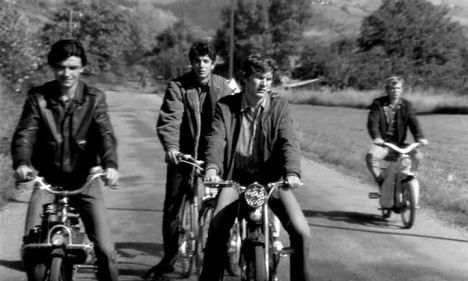
The Gang

Throughout, Balthazar lives his life quietly in a parallel course to the growing depravity of the humans he serves. He suffers their cruelty in silence, occasionally he would bray in pain, but he continues to bear his load, pull a cart, or do whatever he is prodded to do, even a circus act. Due to neglect and maltreatment, he often becomes ill.

As she grows up, Marie discards childhood innocence and seeks to gratify her sensual pleasures. Against the protest of her parents, she falls for Gérard. She could have another choice, one who offers her genuine love, Jacques, the son of the owner of the farm where Marie and her parents reside. Jacque would come by every summer from the city with his father and sister to stay on the farm. When they were still children, they had spent endearing moments together with Balthazar. Jacques has declared lifelong commitment to Marie. But Gérard is a more instant and attractive outlet for Marie. Ultimately, she is dealt the harshest blow and most degrading abuse from Gérard and his gang as they rape her. Bresson spares us the ugly scene, but in the chilling aftermath, we see the young men walk away, nonchalant, throwing her garments on the ground behind them. After that tragic incident, Marie runs away. Her father is grief stricken, and soon falls ill and dies.

Gérard is unrepentant. After all, it’s self-serving lust he seeks; his callousness is most disturbing. In the last scene, we see he uses Balthazar to do one more job for his gang. They are to smuggle goods across the mountainous border. At night, he loads up his goods on the donkey and leads him to the border. From a distance, he hears gun shots from armed customs police. Gerard and his gang flee, abandoning Balthazar on the mountain. But it’s too late for Balthazar, he has been shot.

The final scene is most moving. In the open field, Balthazar walks slowly, haggard, blood streaming from his leg. He finally lies down, still carrying the goods Gérard has put on him, the load of sin. He breathes his last and quietly dies, alone.

Like Bresson’s Diary of a Country Priest, Au Hasard Balthazar is an apt meditation for Good Friday. But not just for this one day, their timeless message is like the Easter Season itself, a moveable feast.

~ ~ ~ ~ Ripples

***

Related Posts and Links:

Diary of a Country Priest: A Book For Easter

Diary of a Country Priest: Film Adaptation

Video of Robert Bresson on Au Hasard Balthazar

Homage to Flannery O’Connor: Looking for ‘Intrusions of Grace’ in Films

Today is the birthday of Flannery O’Connor. As a tribute, I’m re-posting a piece I wrote a few years ago entitled “Looking for ‘Intrusions of Grace’ in Films: Pickpocket and Drive”

**

Our age not only does not have a very sharp eye for the almost imperceptible intrusions of grace, it no longer has much feeling for the nature of the violence which precede and follow them.” — Flannery O’Connor (quoted in my post A Good Man Is Hard to Find and Other Stories)

Flannery O’Connor made this remark back in 1963. It was not only a sharp social commentary and prophetic, but to me, it also stands as one of the signs of a good film. Amidst the violence and ugliness a film may depict, the presence of grace, however small, or a mere spot of purity, could bring out a powerful contrast. Usually that is what’s needed to emit a redemptive spark, a glimpse of light pointing to the transcendent.

With this frame of grace among violence, I go back to the films I’ve watched and try to find some good examples. My task proves to be more difficult than I first thought. But after some deep searching through my mental archive, several films came to mind. I’ll just mention two for this post.

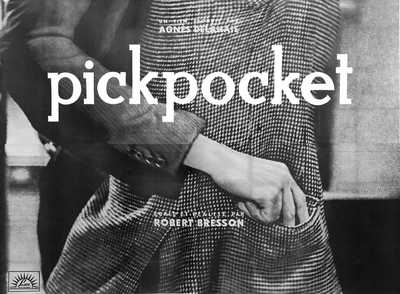
Pickpocket (1959)


pickpocket movie poster

Robert Bresson’s modern version of Dostoevsky’s Crime and Punishment. Caught in his own desensitized internal world, our protagonist Michel commits acts of theft as a desperate measure to fill the void in his existence. He goes through his days in a haunting vacuum devoid of meaning and emotions. He is unfeeling even towards his own dying mother, reminds me of Meursault in Camus’s The Stranger. Although not an axe murderer like Raskolnikov in Crime and Punishment, Michel theorizes that those with superior talents and intelligence, the supermen in society, should be free to disobey laws in certain cases. He is numbed by his own hubris, and stifled by his cold and absurd worldview. Outright violence is not visible here, but we see the battle of wits he engages with the police inspector behind his trails, and we see him struggle in an amoral and meaningless existence.

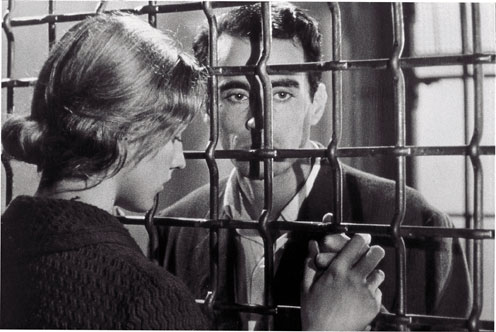
Grace comes as Jeanne, a neighbor and carer of Michel’s ailing mother. Jeanne lives on her own looking after her younger brother. Her father is a drunk and her mother has deserted them. But she continues to live and care. She accepts her circumstances calmly, and extends kindness to those unrelated to her, caring for Michel’s mother, a neighbor on another floor. She stands as a stark contrast to Michel’s aloofness. At the end of the film, Jeanne came to visit Michel in prison after he was arrested, the two separated by the cold iron bars. For the first time, Michel feels love and wants to reciprocate it. And thus the cathartic ending as he totally melts in the presence of pure love and grace, wrapping up the film with this last line:

“Oh, Jeanne, to reach you at last, what a strange path I had to take.”


Pickpocket


**

Drive (2011)

A current release that comes with high acclaims. The film was nominated for the Palme d’Or and Nicolas Winding Refn won Best Director at the Cannes Film Festival this year (2011). With slick and dashing camera work, the violence in “Drive” is visceral and graphic, a big contrast to the black and white, internal “Pickpocket”. However, I see some parallels between these two films made 50 years apart.

Ryan Gosling is “the Driver”. He does not even have a name. He is an expert stunt driver for movies and works at an autobody shop by day, drives a get-away car in the underworld of crimes by night. Like Michel in “Pickpocket”, he drifts in existence, numb and desensitized to the world around him. That is, until he meets Irene (Carey Mulligan), his neighbor.

Drive 1


Mulligan’s almost angelic presence in the film is most effective as a stark contrast to those around her. She lives alone looking after a child and works as a waitress in a diner. She appeals to the Driver by being herself, innocent, taking life as it is, responsible, caring for a child alone while his father is locked up in prison. Irene is a spot of purity in a rough environment. Her mere presence has transformed the Driver. From being aloof the Driver has become engaged emotionally, friendly and protective of both mother and son.

Drive

The plot thickens as Irene’s husband is released from prison and rejoins his family. The Driver is caught in an awkward situation. But he soon realizes that the husband’s resolve for a new start is genuine. The power of transformation is so thorough that the Driver is willing to go out on a limb to help the husband with one last heist in order to break the hold a gang has on the man, his wife and kid. While things go awry terribly and the ending is not as clean-cut as “Pickpocket”, we learn that the Driver remains a changed man from the ephemeral friendship he once had with Irene and her child.

Some might say Mulligan is a miscast, that she’s not “damaged enough”, and would prefer a ‘stronger’ character. I disagree. I feel that Mulligan has portrayed Irene’s innocent persona aptly, and yes, those ethereal dimples can just melt any heart. Hers is the perfect role for exactly the right reason. In the dark underworld of gangs, violence and crimes, she stands out as a tiny source of purity, a spark of grace. It all shows that what may look weak and vulnerable can have transformative power over the strong. A thought that may well be unpopular today.

***

Other related posts from Ripple Effects:

A Good Man Is Hard To Find and Other Stories by Flannery O’Connor

Bernini’s Corpus and Modern Movies

Notes on the Synthesis of Film, Art… Life?

***

Listening for Lent

In the old days, say, six years ago, reading for me was, simply, reading. Holding a book in my hands, read through the printed words, turned the pages manually, feeling the paper at my fingertips. But today, I have several ways to ‘experience’ a book. I can still read in the old traditional way, or download the eBook to my iPad using the app ‘OverDrive’, or, listen to an audiobook, on CD’s or MP3.

As a slow reader, I find listening to audiobooks a time-saving way, albeit I still prefer to hold a book in my hands and see prints on paper. But in this day of multi-tasking, I sometimes listen to audiobooks while driving as I can fit in my reading time. I confess, I could be distracted by the story, or the traffic. But overall, listening to audiobooks while driving is a perfect alternative for me, in lieu of time and space for ‘actual’ reading.

Recently I read an article by T. M. Luhrmann in the New York Times entitled Audiobooks and the Return of Storytelling. This insightful piece introduced me to a different reason for listening to audiobooks.

First off, Luhrmann takes down the generally accepted view that reading with our eyes as ‘more serious, more highbrow’ than listening to a story being told orally. She points to the early childhood experience when way before we could read, we were introduced to stories through listening to them. So maybe such a notion extends to our adult life making us feel that listening to stories is a childlike activity than reading the text on our own.

Many great books were actually oral legends, Luhrmann points out, “… for most of human history literature has been spoken out loud. The Iliad and the Odyssey were sung.” Noted. Can’t say listening to audiobooks is child’s play.

Luhrmann then comes to the crux of her idea. While we listen to an audiobook, we can do something else with our eyes and hands. That’s just obvious, isn’t it? Exactly what I said at the beginning of this post, the benefit of multitasking. But I was too rash to have thought I knew it so. What I read after this was nothing short of an epiphany for me.

No, not while driving, but when Luhrmann is gardening, she listens. Often, she would listen to the Bible. I love what she has to say next (emphasis mine):

Listening to a book is a different sensory experience than reading it. The inner imagining of the story becomes commingled with the outer senses — my hands on the trowel, the scent of tansy in the breeze. The creation of this sensory richness was in fact an explicit goal of the oral reading of the Bible in the medieval European cloister, so that daily tasks would be infused with Scripture, and Scripture would be remembered through ordinary tasks.

Whenever she looks at the “50 polypodium californicas and 50 festuca idahoensis in the dappled light beneath [her] oaks” she would think of “Gatsby’s extraordinary gift for hope.” Why, Luhrmann was listening to Fitzgerald’s novel while planting those the year before. Now looking at the plants would flash upon that inward eye what she had heard.

Of course, that sounds so simple and natural, a kind of classical conditioning, if you will. We fuse our senses and experience. All the more that we should listen to good books or we’ll have bad memories looking at the tasks we’d performed.

And what a wonderful idea Luhrmann had left me with: Scripture-infused daily tasks. That can’t be more apt for Lent.

***

Tanya Marie Luhrmann teaches Anthropology at Stanford.

Related Posts on Ripple Effects:

No Texting for Lent and the End of Solitude

The Dinner by Herman Koch: A Timely Read, for Lent?

Dances With Words

What Makes a Good Audiobook Narrator?

***

And The Word Was Made Homeless

Awesome Sky

The House of Christmas

by G. K. Chesterton (1874–1936)

There fared a mother driven forth
Out of an inn to roam;
In the place where she was homeless
All men are at home.
The crazy stable close at hand,
With shaking timber and shifting sand,
Grew a stronger thing to abide and stand
Than the square stones of Rome.

For men are homesick in their homes,
And strangers under the sun,
And they lay on their heads in a foreign land
Whenever the day is done.
Here we have battle and blazing eyes,
And chance and honour and high surprise,
But our homes are under miraculous skies
Where the yule tale was begun.

A Child in a foul stable,
Where the beasts feed and foam;
Only where He was homeless
Are you and I at home;
We have hands that fashion and heads that know,
But our hearts we lost – how long ago!
In a place no chart nor ship can show
Under the sky’s dome.

This world is wild as an old wives’ tale,
And strange the plain things are,
The earth is enough and the air is enough
For our wonder and our war;
But our rest is as far as the fire-drake swings
And our peace is put in impossible things
Where clashed and thundered unthinkable wings
Round an incredible star.

To an open house in the evening
Home shall men come,
To an older place than Eden
And a taller town than Rome.
To the end of the way of the wandering star,
To the things that cannot be and that are,
To the place where God was homeless
And all men are at home.

*****

“And the Word was made flesh, and dwelt among us.” John 1:14

**

(Photo taken by Arti of Ripple Effects, Sept. 2010. All Rights Reserved.)

***

 MERRY CHRISTMAS EVERYONE!

 
***


Reading the Season: Poetry by Madeleine L’Engle

The brilliance of A Wrinkle in Time is that its author Madeleine L’Engle can convey scientific and spiritual concepts at the same time and in a way that young readers can enjoy. There’s no conflict between the cerebral and the spiritual; they co-exist comfortably in L’Engle’s work. Not only that, they fuse together and from that alchemy rises a whole new, inexplicable entity: Faith.

It’s that time of the year when I try to tune out distractions to dwell on the meaning of the Season, the reason why we have Christmas in the first place. I call these posts ‘Reading the Season’.

This time, I’ve selected four of Madeleine L’Engle’s poetry. ‘After Annunciation’ I have posted before. But I’d like to share it again here because the deceptively simple lines carry much depth and wisdom. Same with ‘The Risk of Birth, Christmas, 1973’. These two remain my favourite thoughts during Advent. 1973 or now? Ever timely. The poems are taken from The Ordering of Love: The New & Collected Poems of Madeleine L’Engle, published by Shaw Books, 2008.

The Ordering of Love

**

After Annunciation

This is the irrational season
When love blooms bright and wild.
Had Mary been filled with reason
There’d have been no room for the child.

**

Sonnet, Trinity 18

Peace is the centre of the atom, the core
Of quiet within the storm. It is not
A cessation, a nothingness; more
The lightning in reverse is what
Reveals the light. It is the law that binds
The atom’s structure, ordering the dance
Of proton and electron, and that finds
Within the midst of flame and wind, the glance
In the still eye of the vast hurricane.
Peace is not placidity: peace is
The power to endure the megatron of pain
With joy, the silent thunder of release,
The ordering of Love. Peace is the atom’s start,
The primal image: God within the heart.

**

Instruments (I)

The sky is strung with glory.
Light threads from star to star
from sun to sun
a liv­ing harp.
I rejoice, I sing, I leap upwards to play.
The music is in light.
My fin­gers pluck the vibrant strings;
the notes pulse, throb, in exul­tant harmony;
I beat my wings against the strands
that reach across the galaxies
I play

NO

It is not I who play
it is the music
the music plays itself
is played
plays me
small part of an innumerable
innum­ber­able
orches­tra.
I am flung from note to note
impaled on melody
my wings are caught on throb­bing fil­a­ments of light
the wild cords cut my pinions
my arms are outstretched
are bound by ropes of counterpoint
I am cross-eagled on the singing that is strung
from puls­ing star
to flam­ing sun
to

I burn in a blaze of song.

**

The Risk of Birth, Christmas, 1973

This is no time for a child to be born,
With the earth betrayed by war & hate
And a comet slashing the sky to warn
That time runs out & the sun burns late.
That was no time for a child to be born,
In a land in the crushing grip of Rome;
Honour & truth were trampled by scorn–
Yet here did the Saviour make his home.
When is the time for love to be born?
The inn is full on the planet earth,
And by a comet the sky is torn–
Yet Love still takes the risk of birth.

***

‘Reading The Season’ Posts over a Decade:

2020: Jack by Marilynne Robinson

2019: ‘A Hidden Life’ – A Film for the Season

2018: A Verse from Madeleine L’Engle’s The Irrational Season

2017: A Wrinkle in Time by Madeleine L’Engle

2016: Silence by Shusaku Endo

2015: The Book of Ruth

2014: Lila by Marilynne Robinson

2012: Surprised by Joy by C. S. Lewis

2011: Walking on Water by Madeleine L’Engle 

2010: A Widening Light by Luci Shaw

2009: The Irrational Season by Madeleine L’Engle

2008: The Bible and the New York Times by Fleming Rutledge 

2008: A Grief Observed by C. S. Lewis

***

Half Way Through a Budding Grove

Half way through reading In Search of Lost Time, Vol. II, Within A Budding Grove, I’ve discovered a key to enjoying Proust. Just as it’s best to eat madeleines by dipping them in tea before putting the moistened petite cakes in your mouth, the most enjoyable way to read Proust is lying in bed with an unhindered mind. In this most relaxed state, I’m at ease to stroll leisurely through a budding grove, or the thickets of a genius’s mind.

Within A Budding Grove Modern Library

So far, I’ve gone passed the narrator Marcel’s painful struggles with adolescent, unrequited love for M. Swann’s daughter Gilberte. In contrast, his crush for Mme Swann has been appreciated and normalized. Unlike the cool and aloof Gilberte, Mme Swann welcomes Marcel into their home warmly, including him in their family outings, and their home gatherings with their friends, thus allowing him an opportunity to meet his literary hero, the writer Bergotte.

And here’s the passage I’m most impressed by, so far. The man Bergotte is very different from the writer Marcel has encountered in his ‘divine writing’. The man appears to be very common, inarticulate even, and devoid of eloquence, a man who spent his childhood in a ‘tasteless household’. Marcel is shocked by this discovery, and scrambles to come to terms with such dissonance. In a most ingenious analysis, the young Marcel comes to this conclusion:

But genius, and even great talent, springs less from seeds of intellect and social refinement superior to those of other people than from the faculty of transforming and transposing them… To mount the skies it is not necessary to have the most powerful of motors, one must have a motor which, instead of continuing to run along the earth’s surface… is capable of converting its speed into lifting power. (p. 175)

As I read these few pages, Jane Austen came to mind. A writer who had lived her short life mainly in a rural setting, her associations parochial and far from ‘high society’, and yet could transport herself and thus her readers to a different world from her mundane social environs. Her imagination soared as it took flight with her incisive observations of human nature.

… the men who produce works of genius are not those who live in the most delicate atmosphere, whose conversation is the most brilliant or their culture the most extensive, but those who have had the power, ceasing suddenly to live only for themselves, to transform their personality into a sort of mirror… genius consisting in reflecting power and not in the intrinsic quality of the scene reflected. (p. 175-176)

The adolescent Marcel’s disillusionment with the discrepancy between the man and writer Bergotte leads him to an uplifting insight:

The day on which the young Bergotte succeeded in showing to the world of his readers the tasteless household in which he had spent his childhood, and the not very amusing conversations between himself and his brothers, was the day on which he rose above the friends of his family, more intellectual and more distinguished than himself; they in their fine Rolls-Royces might return home expressing due contempt for the vulgarity of the Bergottes; but he, in his modest machine which had at last ‘taken off,’ soared above their heads. (p. 176)

Yes, more Proust’s words than mine on this post. Many other highlighted passages and surprising delights, but will have to wait till I’ve come out of the budding grove the end of November. If you’re interested, you’re welcome to join me in a read-along of In Search of Lost Time, Vol. II: Within A Budding Grove.

CLICK HERE to my wrap-up post: Out of the Budding Grove

***

Related Posts:

Proust Read-along Swann’s Way Part I: Combray (Featured in ‘Freshly Pressed’)

The Swann and Gatsby Foil

What Was Jane Austen Really Like? Reading Tomalin and Shields

In Praise of Austen: Virginia Woolf’s A Room of One’s Own

***

Before Midnight (2013): Reality Check

Spoiler Alert: It’s impossible to discuss this film meaningfully without giving out the storyline, same with the two prequels.

***

We are gleaners of memories. An interesting parallel applies to the two characters Celine and Jesse as well as ourselves as audience. But if you haven’t seen Before Sunrise and Before Sunset, it would enhance your viewing pleasure to watch them first.

Flashback: Before Sunrise (1995)
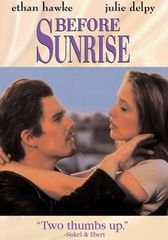
Before SunriseTwo young people, Parisian Celine (Julie Delpy) and American Jesse (Ethan Hawkes) meet on a train passing through Europe. They strike up a conversation and become so in-tuned with each other that when the train arrives Jesse’s stop in Vienna, he convinces Celine to get off with him even though her destination is Paris. There for just one night until sunrise, they walk around the city and talk about life, death, love, religion, relationships, and being transients… for they know this may well be their only encounter with each other in both of their lives. The next morning Jesse has to fly back to the U.S. As they part, they promise to meet again in six month at the same hour, on the same train platform. Throughout the film, we feel fate, or whatever you call it, has a strong presence in their short few hours together. We feel their sincerity in capturing those precious  moments, as we hear Celine’s words ring true:

“If there’s any kind of magic in this world… it must be in the attempt of understanding someone sharing something.”

Flashback: Before Sunset (2004)
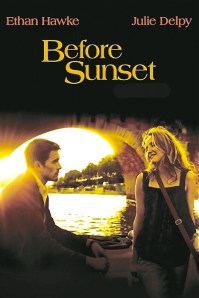
Before SunsetNine years after that chance meeting, Jesse is in Paris on the last leg of a book tour. He has written a book based on that memorable encounter nine years ago. At the Shakespeare and Company bookstore, Celine shows up. They now meet for a second time, again for a short few hours before Jesse has to leave on a plane to fly back to the U.S. Their conversation reveals that, alas, their well intended reunion six months after their first chance meeting has turned into a star-crossed, missed opportunity. After that, fate has led them down separate paths. Jesse is now married and has a son. Celine, still on her own, yearns for that first romance to develop but now seems even more elusive.

To the present: Before Midnight (2013)

Before Midnight

So we have been following Jesse and Celine like a longitudinal study, albeit meeting them just twice within this eighteen year period. In the first two films, director Richard Linklater has us follow Jesse and Celine in real time through long takes, walking along with them in Vienna and Paris, listening in on their conversations and see them pour their hearts out, just to be heard, to be known. Those were romantic moments. This time is summer in Greece; this time is reality check.

We see Jesse and Celine now married. What happens in between those nine years is that Jesse has divorced his wife in Chicago, come over to Paris, married Celine and together they have two lovely twin daughters. But things aren’t so idyllic, for Jesse is troubled by not being around for his now young teenaged son Hank from his previous marriage and whom he can only see in the summer. The film begins with Jesse seeing his son off at the airport.

For the next 15 minutes and in one stationary take through the front windshield of the car, we see a happy couple Jesse and Celine driving from the airport to a Greek country house, with their twin daughters sleeping in the backseat. We hear them talk, yes, they love to talk to each other, just as we’ve seen in the past.

In the setting of an idyllic seaside residence, Jesse and Celine join a small gathering of writers. we see them prepare and eat healthy Greek salads and discuss equally idyllic topics such as writing, love, knowing each other, virtual reality (yes, for the contemporary effect), and being transients in life. Again, that first train encounter comes to mind. In conclusion they drink to ‘passing through’.

The next act is reminiscence of previous Before films… Jesse and Celine walk to a hotel paid for by their writer friends, who have also taken up the duty of babysitting their twins so the two of them can fully enjoy each other for the night. For twenty minutes the camera follows them in real time strolling through some scenic rural town toward their country hotel, exchanging thoughts like before. But no, not totally like before, for now they are eighteen years older, 41, and each with emotional undercurrents running deep.

Five minutes in the hotel room, discordant riptides begin to surface. Talk turns into quarrel. Why, this is just too real. In the past, we see them only in romantic mode. Now as they expose their underlying thoughts and suspicions, tempers flare, words turn callous. We would silently say ‘ouch!’ occasionally.

The beginning scene of the first film, Before Sunrise, has become a stark foreshadowing… sitting near Jesse and Celine on that train, two middle-aged couple argue fiercely in German. Seeing their temper flare but not understanding what they were arguing about, Jesse and Celine ponder on the question of how two people can grow old together in harmony.

Now here in what is supposed to be an ideal get-away, for twenty minutes we are the invisible witnesses of a marital conflict, and we would want to stay in there to see what happens next, not because of the schadenfreude effect, but because this is just too real.

Romance is holiday, marriage is work.

Hawke and Delpy own these scenes depicting realistically what marriage could entail. Other films readily come to mind… Ingmar Bergman’s Scenes From A Marriage (1973) and Woody Allen’s Husbands and Wives (1992). Before Midnight is a contemporary version, with a highly watchable backdrop and natural performance. Unlike Bergman and Allen, Linklater is commendable in crafting a more positive ending. It’s refreshing to see a glimmer of hope at the end of nasty quarrels.

In the final act, Jesse attempts to woo his wife back. How he does it is most endearing. Every moment in the present is an opportunity to create a fond memory to look back to in the future. This complicated package called love is a piece of work. Director Linklater and his two stars, who co-wrote the screenplay with him, might well have passed to us the secret of marital success… Before too late, glean fond memories from the past to sustain the relationship at present; before too late, create more loving memories to carry it into the future.

One line from Celine in Before Sunset is most apt here: “Memory is a wonderful thing if we don’t have to deal with the past.” Jesse might have known this too well, not to leave the present a mess for future to deal with, but leave it as a pleasant memory to cherish in the days ahead.

With a trilogy of films beginning with the word ‘Before’ in the title, we should know that time is of the essence. Time to make the present a memorable past for the future, before too late.

That line still lingers as the film ends… ‘To passing through.’

~ ~ ~ 1/2 Ripples for all three films

***

Munch 150: The Works Still Scream

This captivating documentary is the second installment of the ‘Exhibition: Great Art On Screen’ series with host Tim Marlow. An ‘event film’, the term refers to this kind of doc focusing on a special occasion, here, the 150th year of the renowned Norwegian expressionist Edvard Munch’s birthday (1863-1944). To celebrate, a comprehensive exhibition of Munch’s works is being held in two venues in Oslo from June to October, 2013, the National Museum and the Munch Museum. The film captures the highlights of this exhibition.

I soon learned too that the theatre charged more for the experience. However, the $17 ticket is acceptable. Short of seeing the actual paintings at the two venues and being free to walk around, I’ve saved a hefty plane ticket to Oslo, and I get to see the works magnified clearly on the big screen and hear expert commentary so I can appreciate even the minute brushstrokes up close. Sure, I can always wear a headphone, if it’s available, to hear the commentary while walking through the exhibition. But it’s a refreshing experience to look at the paintings enlarged on a giant screen, hearing in-depth analysis juxtaposed with dramatized biopic vignettes as I sit back and eat popcorn in a dark, air-conditioned theatre on a hot summer day.

The film Munch 150 has aptly taken advantage of the medium of the cinema. Unlike the previous film in this series, Manet: Portraying Life, which ironically, is devoid of life, Munch 150 has presented to the viewer what such a medium can best do. The camera as a guide and magnifying glass, projecting onto the big screen images larger than life, accompanied by insights from curators and host Tim Marlow, an audio-visual experience. Yes, I’ve mentioned ‘big screen’ several times. That is essentially the benefit that the TV screen or your computer monitor would not suffice.

Edvard Munch (Norwegian pronunciation: [ˈmuŋk], in English, something like ‘Moonk’ with a glottal sound on the ‘n’) was born in 1863 in a small Norwegian village. His family moved to Kristiania (now Oslo) the next year. From an early age, Munch was haunted by death and illness. He first saw his mother die of tuberculosis when he was five, and later, his beloved older sister Sophie tormented and died of the same illness when he was fourteen. He himself was plagued by frequent sickness, and at one time was near death with tuberculosis. Physically struggling with poor health, inwardly, Munch was often stricken by desires and guilt. Nihilistic thoughts added burning fuel to an already troubled soul. These all led to alcoholism, depression and breakdown later in life.

Writing and painting became his outlets. Journals allowed him to spill his thoughts, and the canvas was the visceral medium for him to release deep, psychological turmoils. His fears and anguish, all angst and pains found expression in his art.

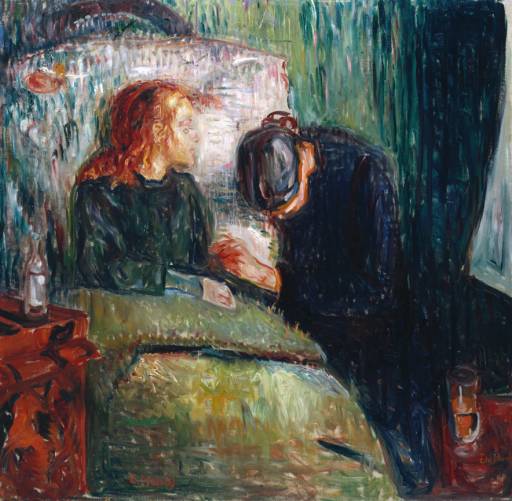
The Sick Child

I was particularly impressed by his early work The Sick Child (1885-86), depicting the trauma he had experienced as he watched his beloved, ailing sister Sophie lay in bed frail with tuberculosis. A grieving woman holding her hand, head bowed in sorrow. It was a disturbing scene, and yet I’d appreciated the colours and brushstrokes that seemed as if they were just rendered in a free and haphazard way. From the commentary, I felt the poignancy.

The Sick ChildThe camera and commentator guided me to see the scratches left on the canvas, most noticeably on the pillow near Sophie’s face, something which I wouldn’t have noticed if I just walked by it in the museum. These scratches were troubling to look at, probably made by a pallette knife, or a hard brush. They were marks of anguish and frustration, the outburst of emotions during what must have been a painful process. Munch always left ‘blemishes’ on his paintings. Here, the scratches and patchy layers of paints on paints showed raw emotions unleashed. That was the reason the work was met with criticisms and rejections in his day. It was not pretty and neat as his predecessors had done. He was, literally, painting outside the lines.

The Frieze of Life

Many of Munch’s more well known works are in the series called The Frieze of Life—A Poem about Life, Love and Death. The Munch Museum in Oslo exhibits the paintings as a series on four white walls in a room — and here’s the unconventional — without frames. The curator commented that this was what Munch would have intended. Without the distractions of the frames, the paintings speak out loud and clear. In The Frieze of Life, Munch explored the very essence of being human, the frameless, existential experience that is universal.

The Scream (1893)

The_ScreamThe Scream is in the section of The Frieze of Life categorized as ‘Angst’. It is the most well-known of Munch’s paintings. A deathlike skull-face devoid of gender, hands covering the ears and screaming out into the void. Munch painted this after an actual experience while he was walking in the woods, hearing a huge scream inside him. He was overcome with fear. After that episode, he painted The Scream. In it is a figure that has since become the epitome of existential angst. I’d appreciated the comment in the film stating that ‘it’s an icon, not a cliché.’

The Scream made history just last May. It had set an auction record for a piece of art work, fetching $119.9 million (£74m) at Sotheby’s in New York. Almost seventy years after his death, Munch’s works still scream.

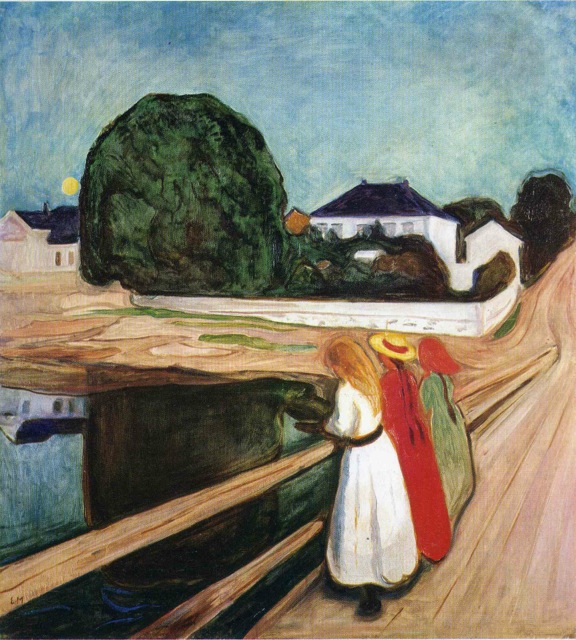
The Girls on the Bridge (1901)

The Girls on the BridgeA more delightful painting, The Girls on the Bridge is fresh, bright, and colourful, exuding a summer spirit. But even in this work, Munch depicted the struggles between innocence (white dress) and desire (red). And while we see the green clump of a tree, full of life, we also see its ominous, dark reflection on the water. In the midst of life, we are in death. Munch seemed like a party pooper, but maybe that’s why he needed to scream. Or else we wouldn’t have heard him.

~ ~ ~ Ripples

The next and last installment in the series is Vermeer and Music.

Sources of images: Wikipedia

***

Related Posts:

Art and Cliché

Arles: In the Steps of Van Gogh

Inspired by Vermeer

Edward Hopper, William Safire: The Visual and the Word

***

Our Mega Culture

A look at our summer offerings on the big screens can readily point to one fact: Bigger and louder is what we get. Apparently, they seem to be the key to box office sales. After all, aren’t those figures the raison d’etre, the reason why movies are made in the first place?

From Box Office Mojo come these stats: Iron Man 3 ($400m+ domestic box office sales, 8 weeks in release), Star Trek Into Darkness ($200m+, 6 weeks), Man of Steel ($200m+, 2 weeks), World War Z ($88m, 1 week). Don’t think it’s only the superheroes and zombies that dominate, Luhrmann’s spectacle The Great Gatsby rakes in $142 million in 7 weeks.

Here’s the irony: the bigger your city is, the more small movies you can see. And if you’re like me dwelling in one of those hamlets not on the list of ‘selective cities’, then you’re stuck with bigness all summer, like it or not. (This is my list of ‘small’ movies I’m waiting for.)

The French director Jean-Luc Godard once said:

As soon as you can make films, you can no long make films like the ones that made you want to make them.

The legendary film critic Pauline Kael interpreted his statement as follows [1]:

This we may guess is not merely because the possibilities of making big expensive movies on the American model are almost nonexistent for the French but also because as the youthful film enthusiast grows up, if he grows in intelligence, he can see that the big expensive movies now being made are not worth making. And perhaps they never were: the luxury and wastefulness, that when you are young seems … magical, become ugly and suffocating when you’re older and see what a cheat they really were.

Kael wrote that in 1966, that’s forty-seven years ago. How I wish she could be around now. Sure like to hear what she has to say about all the summer blockbusters we’re getting. What we have mainly are sequels to previous blockbusters, their makers hoping the trend would perpetuate. Would Kael revise her view now? Big movies not only are still being made, they have become more and more popular. It seems viewers don’t care much that the emperor has no clothes.

It’s Gatsby’s idea, isn’t it? The grander, louder and more spectacular the party you throw, the higher chance you just might get what you’re looking for. Alas, look at the ending.

Who makes the trend? The marketers of movies would tactfully say they’re just offering what people want. But subtly, or not so subtly, what people want is also shaped by marketers. Mass appeal and popularity have overridden discernment and individuality. Do you find viewers’ tastes have changed over the years? Or, do movie goers nowadays belong to a different demographics than before?

What I’m concerned is the obliteration of the already elusive notion of film as an art form. We’re now too dominated by bigness, and spectacles, and technologies, rather than going into the story, characters, techniques, meaning… the still, small voice of fine artistry.

Star Trek Into Darkness

I’d the chance, ok, my choice, to go watch Star Trek Into Darkness and Man of Steel recently. Interesting contrasts there. I used to be a Star Trek fan. Yes, used to be because the Star Trek we have today is a totally different product altogether, albeit the character names remain the same. This current one looks like school children play-acting… serious pretending, frantic scurrying here and there, and loud blasts into oblivion. The only adult seems to be Benedict Cumberbatch as Khan.

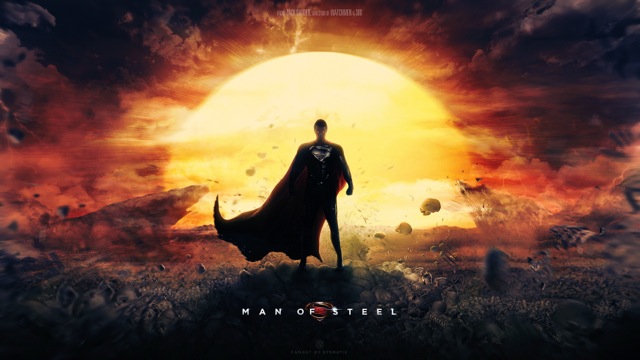
Man of Steel has more mature actors and more serious acting, but the second half is not much different, gratuitous CGI action sequences that are 30 minutes too long, and loud blasts into oblivion.

The constant bombardment of expanded loudness in the theater had only one effect on me, made me turn off my receiver, same effect as somebody wanting to win an argument by raising his voice at me.

Man of Steel 1

Truth be told, because of the cast I went to see this revision of Superman. Kevin Costner and Diane Lane as Clark Kent’s earth parents? Who can miss that? Amy Adams as Lois Lane? I’m sold. And, Michael Shannon as the evil General Zod coming to turn earth into Krypton? I must see how he does it.

And the current Star Trek, what strange new world it has gone to where no one had predicted before. My favorite is still the original TV series. As for the movies? It’s Star Trek VI: The Undiscovered Country (1991). That’s the swan song of the original TV cast and one where Christopher Plummer as the Klingon General Chang recites Shakespeare like he’s at the Stratford Festival. His lines come from The Merchant of Venice, The Tempest, Romeo and Juliet, Julius Caesar and Hamlet. If you want postmodernism across the media, here you have a perfect mash-up. Yes, light years away from the Star Trek of Summer 2013, and generations apart.

Steven Spielberg in a recent statement made at the opening of a new USC Cinematic Arts building predicted there would be an ‘implosion’ in the movie industry, ‘where three or four or maybe even a half-dozen megabudget movies are going to go crashing into the ground, and that’s going to change the paradigm.”

He also added we might have to pay $25 to see the next Iron Man, but $7 to see Lincoln. A scenario which George Lucas echoed. Umm… if those are the ticket prices for the different kinds of movies in the future, not a bad sort of a paradigm shift.

***

[1] These two quotes are taken from Pauline Kael’s review of Jean-Luc Godard’s Band of Outsiders (1964), from American Movie Critics: An Anthology from the Silents Until Now, Expanded Edition, edited by Phillip Lopate, published by The Library of America, N.Y., 2008.

Proust Read-Along: The Swann and Gatsby Foil

“He knew perfectly well as a general truth that human life is full of contrasts…” Swann’s Way, P. 510

While plowing through Part 2, ‘Swann In Love’, I happened to reread The Great Gatsby. Thanks to Baz Luhrmann’s new movie adaptation, I’m sure many more are doing the same. And oh what interesting contrasts Swann and Gatsby make.

Both are deeply in love, yearning for a woman who seems to be utterly elusive. Gatsby frantically maximizes to attract Daisy; Swann willingly minimizes to reach Odette. From a poor background, Gatsby grabs whatever means he can to build his wealth; Swann whose niche belongs to high society, has to pretend that he is nobody special, stooping to ‘a lower social sphere’ (P. 285) to be near Odette.

That distance is more than social. Swann is willing to forsake his cultured tastes of art and music, to lay aside even his own research and writing on Vermeer (Odette: I’ve never heard of him, is he alive still? P. 279). Swann is willing to lay down his interests and privileges for a woman who is uncouth in the sophistication of high society, who has superficial views and flashy tastes, and alas, even promiscuous.

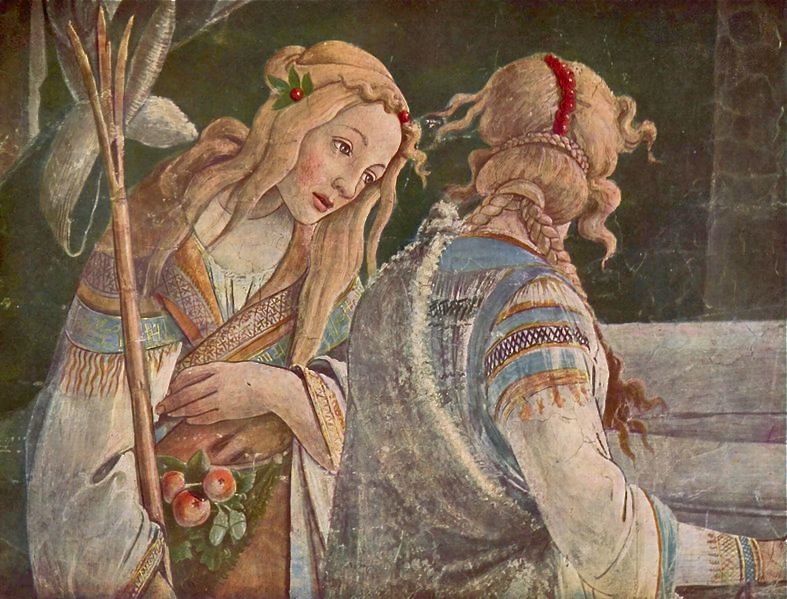
However, love transforms all deficiencies and blemishes into ethereal beauty. Here’s how Swann visualizes Odette. To him, she is like Sipporah, Jethro’s daughter, Botticelli’s fresco in the Vatican’s Sistine Chapel:

Zipporah, Jethro's Daughter by Botticelli

Following Odette to her ‘little nucleus’ at the Verdurins, Swann downplays his association with prominent people and tries not to be so outspoken with his knowledge and opinion about art and music.

When he is alone with Odette, he has taken her values and interests:

he tried at least to ensure that she should be happy in his company, tried not to counteract those vulgar ideas, that bad taste which she displayed on every possible occasion, and which in fact he loved, as he could not help loving everything that came from her, which enchanted him even. (P. 348)

Is this measurement of incompatibility in tastes inherently snobbish? Yes, Swann (or Proust) is sensitive enough to analyze this in depth. What is ‘taste’ anyway, or the intellectual beliefs with which he has been raised from the days of his youth?

… the objects we admire have no absolute value in themselves, that the whole thing is a matter of period and class, is no more than a series of fashions, the most vulgar of which are worth just as much as those which are regarded as the most refined. (P. 350)

So, all for love of Odette, Swann is willing to give up going to the Jockey Club, lunching with the Prince of Wales, or his love of Holland, or a visit to the Versailles (‘which bored her to tears’):

And so he denied himself the pleasure of visiting those places, delighted to tell himself that it was for her sake, that he wished only to feel, to enjoy things with her. (p. 350)

Those colorful shirts Gatsby has hoarded, Odette would have loved them, just like Daisy, and his mansion too… if only Swann had resided in a more prestigious address, somewhere ‘more worthy of him’ instead of his house on the Quai d’Orleans. (P. 346)

Odette’s fondness of Swann begins to wane as Forcheville enters into the picture. She becomes even harder to get. Swann is burned with jealousy, anger and bitterness. Yet he cannot forget her. His love even grows stronger for her, despite receiving an anonymous letter defaming her. Why,

People often say that, by point out to a man the faults of his mistress, you succeed only in strengthening his attachment to her… he had begun to desire the possession — as if that were ever possible — of another person. (P. 517)

Perhaps that is a mark of love: the demand for exclusivity. This is exactly what Gatsby wants Daisy to admit, that she has never loved Tom, that she has always loved him. “Oh, you want too much,” she cried to Gatsby.

But Swann is more fortunate. He knows he must gain back Odette’s full and exclusive devotion and somehow he does. I’m glad to read in Part 3 that eventually Odette does become Mme Swann. I’d be curious to know how that comes about. (Proust’s strategy to get us go on reading the next volumes?)

**

Part 3 is an enjoyable and much swifter read as the narrator remembers his childhood in Paris drown in unrequited love (so far, not sure about how this unfolds later) for Swann and Odette’s daughter Gilberte. Because of his love for Gilberte, the boy is infatuated with M and Mme Swann as well. His crush on the elusive Gilberte parallels Swann’s love for Odette in their earlier days.

The last sentence in Volume 1 of In Search of Lost Time, like that in The Great Gatsby, ends with a haunting remark on memory and the past:

The places we have known… were only a thin slice, held between the contiguous impressions that composed our life at that time; the memory of a particular image is but regret for a particular moment; and houses, roads, avenues are as fugitive, alas, as the years.

There are much more to be said, but nothing can replace the actual experience of reading Proust first hand. From March to May as I plowed through Swann’s Way, there had been up’s and down’s. Numerous times long sentences entangled, yet the very next moment could be so beautiful and lucid it dissipated all frustrations. I now look forward to Volume II.

**

Thanks for joining me in this Read-Along. Finish or not, you’re welcome to share your thoughts. Throw your two pebbles into the pond and make some ripples. If you have written a post, do let me know so I can link it here.

Bellezza of Dolce Bellezza

**

CLICK HERE to my post on Part 1 of Swann’s Way: Combray

***