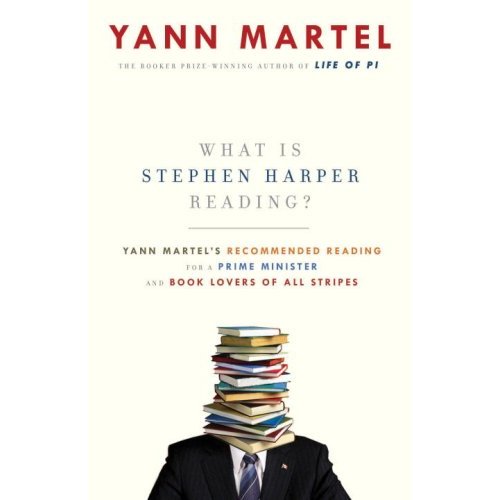
What Is Stephen Harper Reading?

.
Now that the Winter Olympics have come to a close, maybe more of the world would have heard of Stephen Harper.  No, no, he isn’t a medal winner.  Just a hockey fan, and, he happens to be Canada’s Prime Minister.
.

And it’s good time to read this book.  It all started one March day in 2007.  Fifty Canadian artists of all sorts were invited to a Parliamentary session to celebrate the fiftieth anniversary of the Canada Council for the Arts, each of them representing a particular year.

There they were sitting in the Visitors’ Gallery of the House of Commons, waiting for their item to come up on the long agenda of the day.  At 3:00 pm, the business came to the celebration.  All fifty of them were asked to stand up. The Minister for Canadian Heritage, Bev Oda at the time, rose up, acknowledged their presence, and gave a five-minute speech.  Applause.  Then on to the next business item.  Stephen Harper did not even look up at them standing in the Gallery.

The fifty guest artists were incredulous.  Among them was Yann Martel, who received a Canada Council grant in 1991 allowing him to write his first novel.  His literary career reached an admirable high in 2002 when he was awarded The Man Booker Prize for his book Life of Pi.  (CLICK HERE to read one appreciative reader’s response to the book, a personal note from Barack Obama.)

After this incident, driven by frustration, Martel decided to launch a most interesting project.  He started sending Stephen Harper a book every two weeks, with his personal letter introducing  the work, and of course, whenever appropriate, fill him in as to why that’s a good read for a Prime Minister.   With such an intention, one can predict the tone of these letters.  They are mostly sincere, mind you, albeit embedded with the occasional sarcasm, irony, and yes, some condescending subtext.

But overall, these letters to the Prime Minister sent with the books are genuine appeal to the Leader of the country to place more emphasis on the arts. They offer a place of stillness in the busy agenda of a politician.  Martel’s is a gentle voice to remind the prime policy maker the role of the arts, in particular, literature and its appreciation, in the making of a nation, the importance of beauty and the imagination in the building of a vision and in shaping the humanity of her people.

So, it’s not so much as to what Stephen Harper is reading, but what’s on his TBR list.  It remains unknown whether the PM has actually read any of these gifts, although letters of appreciation had been sent to Martel from his office. It’s fun too to read the choices of the titles… and their reasons.  But above all, I’ve enjoyed reading Martel’s insights into how the literary speaks in the context of contemporary political and social landscape.  Here are some examples.  I’ve included a quote or two from Martel’s letter sent with each title:

Animal Farm by George Orwell

Animal Farm is about collective folly.  It is a political book, which won’t be lost on someone in your line of business.  It deals with one of the few matters on which we can all agree:  the evil of tyranny.

Animal Farm is a perfect exemplar of one of the things that literature can be: portable history.  … in a scant 120 pages, … the reader is made wise to the ways of the politically wicked.  That too is what literature can be: an inoculation.”

The Island Means Minago by Milton Acorn (People’s Poet of Canada)

“But any revolution that uses poetry as one of its weapons has at least one correct thing going for it: the knowledge that artistic expression is central to who and how a people are.”

“… the past is one thing, but what we make of it, the conclusions we draw, is another.  History can be many things, depending on how we read it, just as the future can be many things, depending on how we live it… And it is by dreaming first that we get to new realities.  Hence the need for poets.”

The Educated Imagination by Northrop Frye

“Literature speaks the language of the imagination.”

“… the better, the more fertile our imagination, the better we can be at being both reasonable and emotional. As broad and deep as our dreams are, so can our realities become.  And there’s no better way to train that vital part of us than through literature.”

A Modest Proposal by Jonathan Swift

“So, more cuts in arts funding… What does $45 million buy that has more worth than a people’s cultural expression, than a people’s sense of who they are?”

Mister Pip by Lloyd Jones

“Lloyd Jones’s novel is about how literature can create a new world.  It is about how the world can be read like a novel, and a novel like the world.”

The Kreutzer Sonata by Leo Tolstoy

“Why a book on music?  Because serious music, at least as represented by new and classical music, is fast disappearing from our Canadian lives… the latest proof of this: the CBC Radio Orchestra is to be disbanded… How much culture can we do without before we become lifeless, corporate drones?  I believe that both in good and bad times we need beautiful music.”

The Uncommon Reader by Alan Bennett

“The irony in the story is as light as whipped cream, the humour as appealing as candy, the characterization as crisp as potato chips, but at the heart of it there’s something highly nutritious to be digested:  the effect that books can have on a life.”

“Whenever an independent bookstore disappears, shareholders somewhere may be richer, but a neighbourhood is for sure poorer.”

Gilead by Marilynne Robinson

“Speaking of President Obama, it’s because of him that I’m sending you the novel Gilead, by the American writer Marilynne Robinson.  It’s one of his favourite novels.”

“I would sincerely recommend that you read Gilead before you meet President Obama on February 19.  For two people who are meeting for the first time, there’s nothing like talking about a book that both have read to create common ground and a sense of intimacy, of knowing the other in a small but important way.  After all, to like the same book implies a similar emotional response to it, a shared recognition of the world reflected in it. This is assuming , of course, that you like the book.”

Julius Caesar by William Shakespeare

“Since Julius Caesar is about power and politics, we might as well talk about power and politics.  Let me discuss concerns I have with two decisions your government recently announced.

My first concern is about the Social Sciences and Humanities Research Council.  New money allocated to the Council is apparently to be spent exclusively on “business-related degrees”…. we’re losing sight of the purpose of a university if we think it’s the place to churn out MBAs.  A university is the repository and crucible of a society, the place where it studies itself.  It is the brain of a society.  It is not the wallet… A university builds minds and souls.  A business employs.”

Louis Riel by Chester Brown and The Sailor Who Fell From Grace With The Sea by Yukio Mishima

“But I’ve always liked that about books, how they can be so different from each other and yet rest together without strife on a bookshelf.  The hope of literature, the hope of stillness, is that the peace with which the most varied books can lie side by side will transform their readers, so that they too will be able to live side by side with people very different from themselves.”

**

Yann Martel is still sending books to Stephen Harper every two-weeks.  Other authors he has sent include Jane Austen, Flannery O’Connor, Ayn Rand, Gabriel Garcia Marquez, Douglas Coupland, Philip Roth, Alexander Solzhenitsyn, Franz Kafka, Virginia Woolf, Samuel Beckett, Michael Ignatieff, Paul McCartney, Dylan Thomas, Laura and Jenna Bush… quite an eclectic selection. Excellent demonstration of how we can be so drastically different in our perspectives and background, and yet can still stand shoulder to shoulder in this vast land of the free.

To read the full list of all the books he has sent, and yes, including this one, CLICK HERE to go to the official site:  What Is Stephen Harper Reading dot ca

What Is Stephen Harper Reading? by Yann Martel, published by Vintage Canada, 2009, 233 pages.

****

Regarding the role of universities and the humanities as dying disciplines, CLICK HERE to read my post: THE HUMANITIES AS AN ENDANGERED SPECIES.
Popularity versus Art

This year’s Oscars marks a new battleground for the dichotomy of art-house vs. blockbuster movies.  By increasing the Best Picture category from 5 to 10 selections, it looks like the Academy is aiming at allowing the blockbusters a shot at the coveted statuette, and not the other way round.

[picapp align=”center” wrap=”false” link=”term=oscars+statuette&iid=6857799″ src=”0/7/6/2/Academy_Of_Motion_6f24.jpg?adImageId=10186953&imageId=6857799″ width=”234″ height=”156″ /]

.

Why do I say that?  A look at the past winners in recent years would give a hint or two:  Slumdog Millionaire (2008), a production of just $15 million and a cast of unknown, foreign actors; No Country for Old Men (2007), a $25 million production and not a big hit domestically in terms of box office sales.

Several of the Best Picture contenders in recent years are represented by low-budget indie films, such as Juno (2007) and Little Miss Sunshine (2006).  Mind you, they might have reaped millions from their Oscar nods after the fact.

Not that blockbusters are necessarily artistically deficient, or that indie films must be artistically worthy, but it’s safe to say that blockbuster movies are crowd pleasers and more readily received. Art-house films are offered only in limited release, and appreciated by a much smaller audience.  Their low budget usually means no A-list stars.  It also restricts the profuse use of innovative technology as in big budget productions such as Avatar (2009).  So their general appeal is the essence of the screenplay, the acting, the storytelling within very limited means.

[picapp align=”center” wrap=”false” link=”term=oscars+academy+awards&iid=7789226″ src=”7/2/4/e/Kathryn_Bigelow_nominated_99e7.JPG?adImageId=10186835&imageId=7789226″ width=”234″ height=”156″ /]

.

The two front-runners of this year’s nominations best illustrate this point. The battle of the ex-es aside, Avatar and The Hurt Locker are neck and neck with 9 nods, competing in many of the same categories. But The Hurt Locker appears in two that are crucial in defining its artistic value as a motion picture:  Best Actor (Jeremy Renner) and Best Writing, Screenplay Written Directly for the Screen (Mark Boal), while Avatar falls short in these categories.

From the popularity angle, some refer their contention as David and Goliath.  The Hurt Locker, with a production cost of just $11 million and box office sales of $12.6 million, is miniscule when compared to that of Avatar’s $635 million, so far, and a reported budget of $237 million, one of the most expensive movies ever made.

Another way of seeing the two is the number of theatres screening the movies.  Avatar has over 3,000 theatres domestically, while The Hurt Locker, well, you’re lucky to catch it before it disappears from its limited release.  The DVD is out, so that really helps if you want to see it before the Awards night.

The other contenders pose a similar scenario.  Other than Avatar, four Best Pictures nominees have passed, way passed, the $100 million box office sales:The Blind Side ($242 million)Up ($293 million)Inglorious Basterds ($120 million), and District 9 ($115 million). Slightly trailing behind are Up In The Air ($77 million) and Precious: Based On The Novel Push By Sapphire ($46 million).

So what stand out are two little films, meager in comparison in terms of box office sales:  An Education ($9.6 million) and A Serious Man ($9.2 million).Their high acclaim from critics do not materialize in popular reception from movie goers, which is not surprising, for generally, these two groups don’t always see eye-to-eye.

Box office sales are the mark of popularity.  They measure how many have flocked to the theatres and are willing to pay to see a movie. Low ticket sales of course is related to how widely released the movie is, but it also gauges popular taste. There’s the rub, would the Academy members vote for a movie that has been seen by just a fraction of the viewing public?  Would they judge a movie only on its artistic and technical merits rather than the sales it generates?

[picapp align=”center” wrap=”false” link=”term=oscars+academy+awards&iid=7783787″ src=”6/8/5/9/The_Blind_Side_eb8a.JPG?adImageId=10187133&imageId=7783787″ width=”234″ height=”156″ /]

.

Michael Phillips of Chicago Tribune calls the inclusion of The Blind Side in this year’s Best Picture pool “a triumph of the till”.  Many critics are surprised to see it on the list.  And I suppose for Hollywood insiders and members of the Academy, they know very well what the bottom line is.  I’ve heard the argument before: If you want to see indie films and artsy productions, go to Sundance and Cannes.  I can hear them grumble … be realistic, the Oscars is a celebration of the movie business in all its glory and glamour.

I’ve appreciated what one entertainment writer has noted:

… popularity is the spiritual currency of Hollywood’s art. That’s why we call it ‘pop culture.’

It seems that nowadays, spurred on by reality talent shows which generate winners through popular votes, the contention of popularity versus skills or artistic merits is tipped way out of balance.  The critics are now made up of the populace; the panel of judges can only voice their opinion, however biting, but they do not get to vote.

And for the lesser known gems like An Education and A Serious Man, I’m glad they are included in the Best Picture pool, thanks to those who have nominated them despite their meager showing at the box office. After all, besides the money-generating function, film is in essence an art form.  Art for art’s sake or for profit remains the on-going debate.  Of course, the two need not be mutually exclusive… reality is, the financial component often is the main sustenance of a production.  It’ll be interesting to see though how the battle of David and Goliath turns out at the Oscars this year.  The implications could be more far-reaching than just churning out another winner.

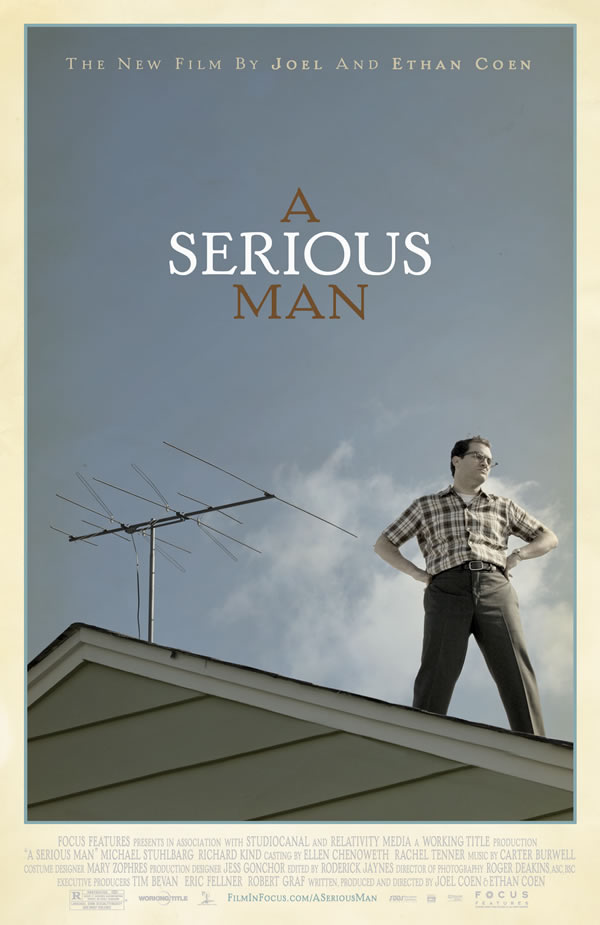
A Serious Man (2009)

UPDATE:  A Serious Man has been nominated for a Best Picture Oscar in the coming 82nd Academy Awards, to be held March 7th, 2010.  Joel and Ethan Coen receive a nod for Best Original Screenplay.

Do we go to the movies to be entertained, or to search for meaning and answers about life? For those who frequent Ripple Effects, you probably can guess what my stance is. Yes, allow me to answer a question with a question… Why must the two be mutually exclusive?

I’m all intrigued about films that explore deep subjects and yet remain as comedies, or, dramedies, as the genre has evolved in recent years. A Serious Man is one such films, entertaining and yet hauntingly serious. But it’s not entertaining with a big splash of hilarity. It is a dark comedy, a film that makes you chuckle in a most poignant way. It’s the deadpan humor that strikes deep. The subject matter in A Serious Man deals with the inscrutable question: Why do bad things happen to good people? And, if we can’t find the answer to the why, then at least, how should we then live?

The film has been described as the most personal of Joel and Ethan Coen’s works; others see it as the most Jewish they’ve done, or even somewhat autobiographical. The setting is 1967 Minnesota, where the Coen brothers grew up.

A Serious Man has won the 2009 Independent Spirit’s Robert Altman Award, and accolades for its screenplay.  It’s one of the American Film Institute’s Top 10 Films of 2009. Michael Stuhlbarg’s excellent performance receives a 2010 Golden Globe nom for Best Actor, Musical or Comedy.

Larry Gopnik (Michael Stuhlbarg) is a college physics professor, a conscientious man who just tries to live his life minding his own business, trying to do what is right.  Yet, it’s trouble he finds everywhere he turns. His wife Judith (Sari Lennick) is divorcing him for their mutual friend Sy Ableman (Fred Melamed); his daughter Sarah (Jessica Mcmanus) is stealing from him to do a nose job; his son Danny (Aaron Wolff) is taking drugs even as he prepares for his bar mitzvah; his unstable brother Arthur (Richard Kind) is staying uninvited in his house and has no intention to leave any time soon.  On the career front, his student Clive (David Kang) is bribing him for a passing grade; his tenure committee is making decision on his future while an anonymous letter is circulating, defaming him. At the same time, his chest x-ray result is back, and, an ominous tornado is making its way to his son’s school. I’m exhausted just to keep up. Can anyone explain why Larry is having so many problems while he is only trying to be a mensch, or, a serious man?

Larry goes searching for answers from three rabbis. While the first two cannot give him a satisfactory answer, the third, the most senior, is too busy to see him. Who then is left to help him through all his troubles?

Many critics equate Larry’s predicament with Job of the Bible, a righteous man facing incredulous torments. But Larry is no Job. He may attempt to be a righteous man, but he is not totally blameless. I feel the film may reflect the notion described in the book of Ecclesiastes even more:

… And yet I perceived that the same event happens to all of them. Then I said in my heart, ‘What happens to the fool will happen to me also.  Why then have I been so very wise?’ … this too is meaningless.

Ecclesiastes 2: 14 – 15

If we have no control over the bad things that happen to all, it’s only natural to question why we ought to be good then. If his wife runs away with another man, is it justified that Larry should lust for another woman? Since bad things will happen to the good and the bad alike, why bother being good? Do we act prudently because we expect positive consequences, or, do we act prudently because it is the right thing to do, period. And now, the moment of decision, the bribe…

A Serious Man throws at us more questions than answers, expectedly so, for who has all the answers? It is in such precarious situations that we look into our hearts and search ourselves. Instead of a challenge thrown at HaShem, God, I see the film as one that’s turned towards us: what would I have done?

~ ~ ~ Ripples

****

Those Magical Numbers: Year-End Musings

10

Are we coming to the end of a decade?  Or still have another year to go?  Does the new decade start with 2010, or 2011?  No matter, that debate is just academic and immaterial in light of the actual events that had taken place after we entered the new century.  From a wider perspective, it’s been a period that TIME magazine called ‘the Decade from Hell’, ‘the Reckoning’, ‘the Decade of Broken Dreams’.  Now, the new normal is recession, terrorism, climate change, pandemic.

On a personal level, a decade sounds weighty enough to send chills down the spine.  Where have all the years gone?  A decade of our life has already slipped by since the beginning of the millenium, the novelty of Y2K rubs off like the fleeting fragrance of the night-blooming flower.  Above all, how do we put into perspective a life among all the tensions on a wider scale?  Can we sculpt out a little private, inner space where peace can still thrive, and faith, hope, and love indwell despite the overwhelming odds in the outside world?

12

According to the liturgical calendar, Christmas celebration continues for 12 more days into the new year, until the Epiphany, January 6th.  With the backdrop of mostly negative global affairs, it’ll do us good to stretch the Christmas spirit a bit longer.  Let the joy and peace last for a few more days.  A reader has reminded me that Christmas Day is arbitrarily picked anyway.  True.  But since we’re given one day to ‘legitimately’ celebrate the birth of Christ, might as well make the best use of it… for I really don’t know how long such a tradition will last, or us given the ‘right’ to mention Christ publicly.  So it’s Epiphany then, 12 more days.  But… is that enough?  I mean the peace and joy, not the hustle and bustle.  Shouldn’t we extend the spirit of Christmas to all the days of the year?  Wouldn’t it be a better world if we let the Word dwell among us just a while longer, or in our wildest dream, let Truth and Grace prevail in every single day?

24

Never mind the decade, just think about the 24 hours I’m endowed with.  How should I spend my next allotment?  Not until I break down the day into 24 units can I find some pressing reality and urgency.  Years back, I used to work in a consulting firm where we had to fill in a time-sheet at the end of the day.  I had to account for my time in 15-minute units, so the firm could charge my time back to the right clients.  My boss would really frown on the category ‘general office’.  That’s what we put down when we were not actually working on a particular project, so our time is charged back to the firm.  I’m afraid it’s ‘general office’ most of the time these days… Is taking care of elderly parents ‘general office’?  umm… what about blogging?  Is it real work?  Who do I charge to?  Can I measure my time in chargeable units?

365

The most amazing site I’ve come across this year is Nina Sankovitch’s Read All Day.  On October 28, 2008 Nina embarked on the 365 Project.  She was to read one book a day and write a review on her blog for one year.  On October 28, 2009 she completed it.  What an incredible endeavour!

Nina lives in Westport, Connecticut, with a family of four reading boys to raise.  Incredible indeed.  Her first book in the Project?  The Elegance of the Hedgehog, one of my favorite books of the year.  Click Here to read her New York Times interview.

As a book lover, there’s nothing more she’d rather do than just to read all day. But Nina embarked on this project for some other reasons as well.  She read to learn, to find her place in the world, to seek directions on how to conduct her life, raise her children, relate to her fellow humanity. Also, four years after the death of her older sister at age 46,  she had now come to that age herself. She wrote on her site her purpose for reading with the most poignant words.  I would not paraphrase a single line:

“This year I am the age she was when she died: 46.  She was too young to die, she loved to read, I am fulfilling maybe even a fraction of the reading she should have had left to her. But I am not only reading to compensate, I am reading to endure.  Books — especially novels — offer a window into how other people deal with life, its sorrows and joys and monotonies and frustrations.  I can find empathy, guidance, fellowship, and experience through my reading.  I will never be relieved of my sorrow for my sister.  I am not looking for relief: I am looking for resilience.”

This is one of the most moving reasons for reading.  Nina Sankovitch now writes a book column for Huffington Post, and is still keeping her Read All Day site, down to maybe three books a week.  She is also preparing for publication a book on her 365 Project.

My next allotment of 365 is coming up very shortly.  I know I can’t take that for granted.  Who can guarantee 365, or even 24.  A book a day, what an inspiring concept… something I can never imagine myself doing.  What motivates me though isn’t her achieving that 365, but maintaining the momentum every 24.

It’s not so much about reaching that magical number, or completing a task, it’s all about finding a purpose, and the resilience to live it every single day.

***

Photo:  Footbridge to Bow Lake, Alberta.  Taken by Arti of Ripple Effects, August, 09. All Rights Reserved.

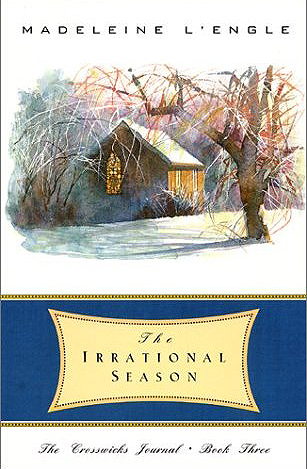
Reading The Season: The Irrational Season by Madeleine L’Engle

Striving to maintain some inner quiet, I casually took from the shelf a book by Madeleine L’Engle. Pure serendipity.  It’s one of The Crosswicks Journals, which I’ve shoved to the back of my mind for years, albeit they’ve been my all time favorite reads.  But how apt it is to flip through The Irrational Season, the third installment of The Crosswicks Journals, at this Christmas time.  Oh what joy to discover Madeleine L’Engle all over again.

Famous for her Newbery Award winning young adult novel A Wrinkle In Time, L’Engle was a prolific writer who had 63 publications to her credits.  Her works span from young adults to adults, fiction, science fiction, memoir, journals and poetry, with non-fiction books on faith, art, family, and humanity.  Yes, I say humanity, because L’Engle’s essays depict her strive to be human, and how her faith has defined the essence in her quest.

The Irrational Season comprises L’Engle’s ruminations on the significant events in the liturgical calendar.  And of course, it is Advent and Christmas that I dwell upon for my seasonal read.  This time, my reading has stirred in me a deeper appreciation of her insight and eloquence.

Art is for me the great integrater, and I understand Christianity as I understand art.  I understand Christmas as I understand Bach’s Sleepers Awake or Jesu, Joy of Man’s Desiring; as I understand Braque’s clowns, Blake’s poetry.  And I understand it when I am able to pray with the mind in the heart… I am joyfully able to affirm the irrationality of Christmas.

…  Christmas evoked in me that response with makes me continue to struggle to understand, with the mind in the heart, the love of God for his creation, a love which expressed itself in the Incarnation.  That tiny, helpless baby whose birth we honor contained the Power behind the universe, helpless, at the mercy of its own creation.

Cribb’d, cabined, and confined within the contours of a human infant.  The infinite defined by the finite?  The Creator of all life thirsty and abandoned?  Why would he do such a thing?  Aren’t there easier and better ways for God to redeem his fallen creatures?

And yet, in His most inscrutable, incomprehensible move, the One who called forth the universe from nothing, the Light and the Word, became flesh and drew near to us, to partake life as mortals knew it, and at the end, willingly go through an excruciating experience no mortals had ever known.  Impossible!  Utterly irrational!  And yet L’Engle embraces such an unimaginable scenario:

I live by the impossible… How dull the world would be if we limited ourselves to the possible.

And how grateful we ought to be, that such an accepting spirit pervaded in Mary’s heart and mind as well…

This is the irrational season
When love blooms bright and wild.
Had Mary been filled with reason
There’d had been no room for the child.

.

.

But now is the hour
When I remember
An infant’s power
On a cold December.
Midnight is dawning
And the birth of wonder.

*****

‘Reading The Season’ Posts over a Decade:

2020: Jack by Marilynne Robinson

2019: ‘A Hidden Life’ – A Film for the Season

2018: A Verse from Madeleine L’Engle’s The Irrational Season

2017: A Wrinkle in Time by Madeleine L’Engle

2016: Silence by Shusaku Endo

2015: The Book of Ruth

2014: Lila by Marilynne Robinson

2012: Surprised by Joy by C. S. Lewis

2011: Walking on Water by Madeleine L’Engle 

2010: A Widening Light by Luci Shaw

2009: The Irrational Season by Madeleine L’Engle

2008: The Bible and the New York Times by Fleming Rutledge 

2008: A Grief Observed by C. S. Lewis

*****

Photos: Except the book cover, all photos taken in Israel by Arti of Ripple Effects, November, 07. All Rights Reserved.

Season’s Musings

At this time of the year I always have a struggle, a fight against numbness.  The hustle and bustle of the Season leaves me striving to grasp something authentic and meaningful.  I have a hard time staying afloat the flood of packaged cheeriness, muzak in jingles or bells, ephemeral Santa’s and reindeer.   With the word “Hallelujah” almost becoming a laughable cliché, an ordinary expression for scenarios from finally finding the right gift for the family pet to paying up the Visa bill,  soon it would take a history lesson to clarify the origin of this festival called Christmas.

Intentionally or not, the Reason of the Season has been masked so not to offend, the birth of Christ replaced by themes acceptable to most cultures, like gift-giving, family reunion, ornaments, decorations, and good will towards all.  ‘Season’s Greetings’ has become the politically correct sign of the time.

On that winter night in Bethlehem, the shepherds bore no gifts. Indeed, their very presence and worship could well be the gift they offered.  Yes, the several wise men brought along gold, frankincense, and myrrh for the Christ child only, not to share among all.  For these gifts symbolized the very reason for His Advent, the infinite King debased, the lowly birth was just the beginning of a short and misconstrued life that ultimately ended in a horrific death.

The Advent, the few weeks before Christmas, is the best time for me to ponder again such a paradox.  If there is any joy or cheeriness, it comes from the initial degradation and ultimate agony of One.  It is from that vicarious suffering with humanity and the offering of substitutional death that Christmas derives its meaning for me.

A few weeks ago during a Sunday message, the name Joni Eareckson re-emerged in my mind.  I was a young teenager when I first read her tragic story.  At 17, she dove into shallow water and broke her neck, and remained a quadriplegic ever since.  I cannot imagine myself paralyzed from the neck down, having had to be lifted from bed to wheelchair for 37 years.

But what she has done sitting in that wheelchair has surpassed many able bodies. Her international ministry to people with disabilities is still thriving after 30 years.  The paintings which she has labored over inch by inch with a paintbrush between her teeth have become a testimony of perseverance, every stroke an ode to life.  Through her writing and broadcasting, Joni has become a voice and inspiration for the disabled and their families, all because she knows her suffering had been vicariously borne by the One who came just to share that pain, and redefine the meaning of life.

The hymn (Phillip Bliss, 1875) that had uplifted Joni in her most despondent hours painted not a cheery figure but a suffering Christ who came with no jingles or bells, and utterly devoid of packaging:  “Man of sorrows, what a name, for the Son of God who came…”

If you have a few minutes in this busy Christmas season, pause and take a look at this short clip.  Of all interviewers, I found Joni talking to Larry King, dated June, 2009.

A Thousand Responses

In the postmodern scheme of things, the old saying ‘A picture is worth a thousand words’ takes on a whole new meaning.  It is not so much what those thousand words are that the picture intends to convey, but rather what the thousand responses it evokes.  Be it a painting, a film, or a literary work, all have the potential to elicit a myriad of responses, reactions as varied as each individual life lived.

Some ready examples can be found in Ripple Effects’ comment sections.  On a post about a movie I highly recommended, a reader responded that she had fallen asleep while watching it.  Or, take the Edward Hopper paintings.  While I found the phrase ‘existential loneliness’ to be an apt description for his works Nighthawk and Automat, a commenter expressed a sense of coziness and quiet content as her response to these paintings. Conversely, while I perceive Cape Cod Morning as anticipatory with positive excitement, the commenter sees “a woman trapped, caught in frustration or even despair, longing to move into the world but still constrained inside the structures of her life.”

magritte01

There had been readers’ responses in the past long before the computer age. But what we have now is nothing short of phenomenal.  The Internet has enabled us to share and exchange our very personal reaction to a single source material simultaneously, allowing multiple voices to resound instantaneously from all corners of the world.  Every voice has the potential to call forth attention, every subjectivity can be equally amplified.  Reader’s response is thus given a heightened significance.

From this perspective then, the reality of a piece of writing, or artwork, seems to have shifted from the author to the reader, or the artist to the viewer, for it is the recipient now that speaks to the work, giving it meaning and application.

Should we still be concerned with the original intent of the piece?  Is it mere speculation to discuss about it, while in the mean time, it is more real and substantial to talk about what our response is, our own personal engagement with it?  Further, instead of focusing on one intended interpretation, should we explore rather the multiplicity of interpretations elicited from readers’ own perspectives and experiences?

Writing before the rise of the Internet, the French literary critic Roland Barthes put it most starkly in his essay “The Death of the Author”:

“… a text is made of multiple writings, drawn from many cultures and entering into mutual relations of dialogue, parody, contestation, but there  is one place where this multiplicity is focused and that place is the reader, not, as was hitherto said, the author.  The reader is the space on which all the quotations that make up a writing are inscribed without any of them being lost; a text’s unity lies not in its origin but in its destination…”

and a warning here, the language used in the following excerpt may be objectionable to some:

“Classic criticism has never paid any attention to the reader; for it, the writer is the only person in literature.  We are now beginning to let ourselves be fooled no longer by the arrogant antiphrastical recriminations of good society in favor of the very thing it sets aside, ignores, smothers or destroys; we know that to give writing its future, it is necessary to overthrow the myth:  the birth of the reader must be at the cost of the death of the Author.”

The postmodern theorist Michel Foucault wraps it up succinctly:

“What difference does it make who is speaking?”

The listener seems to have taken up a much more significant role these days.

Our postmodern literary theorists have thus spoken: The author is dead, long live the reader, and the words.

This idea may not sound so radical, for similar notions have been expressed. Instead of an all-knowing authority, the author is more like a recorder of a tale, the scribe writing down the oracle.  The Canadian writer Michael Ondaatje’s words come to mind.  Even as an author, it seems his creative process is one that awaits the revealing of his story, capturing it in words as it unfolds itself:

“I don’t know what would happen… I don’t want to know.”

Further, Ondaatje welcomes the multiplicity of interpretations.  In his discussion with film editor Walter Murch, he addresses this issue in a positive light:

“We are not held hostage by just one certain story, or if we are, we know it is just one opinion: there are clear hints of other versions.”   — The Conversations, p. 160.

Multiplicity enhances and enriches a scene.  That is the amiable way of putting it, while Barthes is more matter-of-fact in pointing out where meaning and significance lie:

“… it is language which speaks, not the author.”

In a way, such a perspective could be a much-needed humbling reminder in our too crazed, celebrity-driven culture.

But for those of us who strive with all earnestness and honesty to instill meaning in our writing, who have been meticulous and intentional in our craft and guarding its integrity as we create, when we speak, don’t we wish someone out there would receive our message accurately, as it is intended?

Why do we write, or create anyway?  Do we want our readers to know about us or just to hear the words we happen to utter?  Further, shouldn’t we be concerned that what we elicit could well be interpretations far from what we have intended to get across?  How do we balance author’s intent with readers’ response?

Simple questions, but ones which I’m sure can elicit a thousand responses.

***

To read Roland Barthes’s essay ‘The Death of the Author’,  Click Here.

To read Michel Foucault’s essay ‘What Is an Author’,  Click Here.

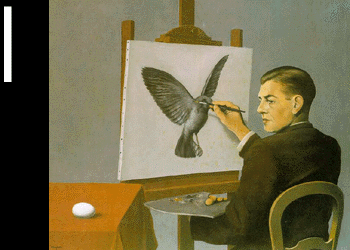
Visual: ‘Self Portrait’ by René Magritte, 1936.

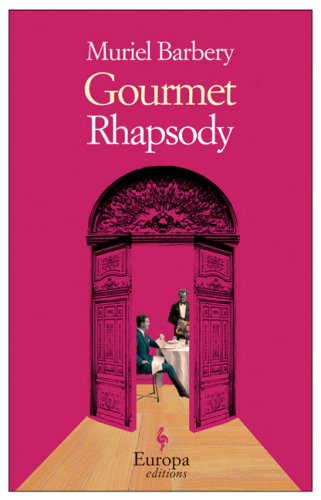
Gourmet Rhapsody by Muriel Barbery

Gourmet Rhapsody

Before the French publishing sensation The Elegance of the Hedgehog, there was Gourmet Rhapsody.  We in English-speaking North America were not aware of such a delicacy until after the translation of Hedgehog was introduced to us.  Too risky to sell to a different palate?

As a first novel, Gourmet Rhapsody, the 156-page collection of short chapters, is like an appetizer to the main dish that is Hedgehog.  It is a foretaste of the more meaty philosophical pondering of the latter.  Now that we have savored the main dish first,  might as well treat Gourmet Rhapsody as the dessert.  Does the cover not make you think of a raspberry sorbet?

If food is a metaphor for life, then the food critic is almost at the status of divinity, especially ‘the greatest food critic in the world’.  That self-ascribed praise is the egotistic utterance of none other than Pierre Arthens, the celeb resident on the fourth floor of the luxury apartment at 7 Rue  de Grenelle, the setting for Hedgehog.

Pierre Arthens’ pen is indeed mightier than the sword.  The knowledgeable and merciless food critic, the ‘true genius of the food world’, is feared from all corners of the world, ‘from Paris to Rio, Moscow to Brazzaville, Saigon to Melbourne and Acapulco’.  He holds the power to exalt a chef and restaurateur to stardom or crush their ego and future like eggshells.

Between these two extremes — the rich warmth of a daube and the clean crystal of shellfish, I have covered the entire range of culinary art, for I am an encyclopedic esthete who is always one dish ahead of the game — but always one heart behind.

But what use is the allure of fame and power when one is on deathbed, at 68, given only 48 hours to live.  Alas, from the years of Epicurean pursuits of cream and butter, oil and sauces, games and other culinary delights, the world renowned food critic is dying not from liver or stomach ailments, but cardiac failure.

Gourmet Rhapsody is a collection of Arthens’ own reminiscence of a life with food and his final quest.  The vividly evoked memories are interspersed with poignant commentaries by those who have come into the path of his life, including his wife, children, nephew, granddaughter, restaurateurs, his doctor, his concierge, his mistress, and even his cat.

And alas, what pity it is to find that none of the entries from these people is positive.  His daughter Laura stays in the stairway, refuses to go into his room to see his last.  His son loathes his ego and his ruthless destruction of theirs.  His wife Anna, whom he had loved as an object of possession, is ever more ambivalent at his deathbed.

And what irony, the only positive review of his life comes from his cat Rick:

… here I am, nineteen years I’ve knocked about as head tomcat on the Persian rugs of my abode;  just me, the favorite, the master’s alter ego, the one and only, to whom he declared his thoughtful, undying love…

So, what does it profit a man if he gains the whole world but loses the love from his wife and children, or respect from those who have crossed his path?  This ultimate question belies the enticing and delicious offering described throughout the chapters.  As in Hedgehog, Barbery has cleverly created a philosophical concoction without appearing didactic.  Here in Gourmet Rhapsody, food is the delightful sauce bringing up the taste of such rumination.

As a lover of sushi and sashimi, my favorite chapter is ‘Raw’, in which Arthens reminisce on his first taste of these Japanese culinary delights:

It was dazzling… True sashimi is not so much bitten into as allowed to melt on the tongue.  It calls for slow, supple chewing, not to bring about a change in the nature of the food but merely to allow one to savor its airy, satiny texture… sashimi is velvet dust, verging on silk, or a bit of both, and the extraordinary alchemy of its gossamer essence allows it to preserve a milky density unknown even by clouds.

But the powerful food critic has but one final quest on his deathbed.  There is one particular food that he wants to taste most before his imminent demise, but which he fails to name.  No, not the coq au vin, or the extravagant pots-au-feu, or poulets chasseur, or the grilled meat of Tangiers, or the Moroccan kesra, or the velvety, melt-in-your-tongue sashimi.  Should I reveal it here?  Alright, Spoiler Alert.

It is the chouquettes, cream puffs, but not from fancy patisserie.  Pierre Arthens wants to taste those chouquettes that are stuffed in plastic bags from the supermarket.  After a life of bourgeois elegance and Epicurean odyssey, it is the mundane, ordinary thing that Arthens seeks on his deathbed.  In the face of mortality, every single moment of mundaneness is something to devour.

If only he had savored that sooner, not just food, but the people in his life, and everything else.

~ ~ ~Ripples

Gourmet Rhapsody by Muriel Barbery, translated by Alison Anderson, Europa Editions, 2009.  156 pages.         

To read my review of  The Elegance of the Hedgehog, CLICK HERE.

***

Edward Hopper, William Safire: The Visual and the Word

If you could say it in words, there would be no reason to paint.

In general it can be said that a nation’s art is greatest when it most reflects the character of its people.

—- Edward Hopper (1882 – 1967)

Edward Hopper’s words point to the power of the visual.  I always find Hopper’s realist paintings hauntingly retrospective, convey indescribable feelings, a sense of loneliness, a touch of alienation, yet, it’s hard to say exactly what it is.

Some use the phrase ‘urban loneliness’ to pinpoint the sentiment, as most readily expressed in his famous painting Nighthawks.  But others find the term too parochial even, opting for the more universal description of the human condition, ‘existential loneliness’.

In this visually-driven age, where pictures are instantly produced by a click, eliminating the wait for film processing, and where digitally created images can elicit unimaginable possibilities, has the value of words diminished, both in function and significance? In a time when ‘reading skills’ refer not only to the comprehension of the written language but the deciphering of graphics and visual symbols, has the power of words been eroded?

Does the recent passing of William Safire, called ‘the oracle of language’ by the NY Times, represent the passing of an era?  How many are left to champion the traditional form of communication, to point out word origin, to extol proper grammar usage?  While these gatekeepers are frowning on the split infinitive, the rest of the world has already jumped on board the newer vessel to boldly go where no person has gone before. The reign of literal communication has gradually (or quickly, or___ you fill in the blank) been replaced by the more accessible instant imaging, flickring, youtubing…

Let’s hope too that the traditional art form of painting will not be soon replaced by iPhone sketching.  If the New Yorker’s cover artist is using an iPhone app to touch-produce its cover pages, will the demise of oils and paints be far away?

Of course, I come to praise Hopper, not to bury words, or paints. Rather than saying his paintings defy literal descriptions, let’s just take up this bemusing challenge and do a role reversal:  What words conjure up in your mind when you look at these Hopper paintings? Let’s celebrate words, and paints, while we still have them.

Of all the subjects in his works, I particularly like the solitary figure, or the non-figure, like the room devoid of human presence.  Here are some of them:

Automat (1927):  Layered with subtext, what are the stories behind this lone female customer at the automat in such hour?  What is a good description of her predicament?

Automat 1927

.

New York Movie (1939): Here’s the reason why I love Hopper’s works.  The contrast, the darker side, the quiet undercurrent beneath the glamorous, the sombre reminder of complexity.

eh_new_york_movie

.

Rooms by the Sea (1951):  A touch of Magritte I feel.  An example of what I call the non-figure.  The philosophical quest of knowing: If nobody’s around to see it, does it still exist?

Edward - Hopper - rooms_by_the_sea

.

Cape Cod Morning (1950):  Unlike his other works, this solitary female figure is positive, eager,  enthused, and achingly expectant.  Is she a symbol of the optimism of a new age, or will she be disillusioned as reality sets in? 1950 or 2009, is there so much difference anyway?

Cape Cod Morning Hopper (1950)

.

Gas (1940):  I’m sure it’s not all about gas… does it allude to the lone traveling salesman like Willy Loman, or the gas station owner like George Wilson in The Great Gatsby?

gas_by_edward_hopper

.

Nighthawks (1942):  Perhaps the most famous of Hopper’s paintings.  As some call it, the depiction of ‘existential loneliness’.  Is that Sartre sitting there all alone at 2:00 am, contemplating in a diner with no exit?

nighthawk-by-edward-hopper

****

Click here to go to a related post ‘Inspired by Vermeer’ with another Edward Hopper painting, Morning Sun.


If I Must Tweet

Don’t look for me on Facebook, I’m not there.  No Twitter account either.  But don’t mistake me for a Luddite, I have my iPhone as my defence… and the Apps for all the social networking sites ready to install.

Truth is, I have no need to lure a million followers.  If there isn’t such a phrase, let me coin it now: ‘Cyber Crowd Phobia’.  I think I have that… or ‘Cyber Agoraphobia’ will work too.  Why would I want to announce to the world what I have for breakfast?  No, I will not fall into the trap of offering free advertising for cereal companies.  Really, who’d care that I’m still having indigestion from last night’s chow mein?

Further, with the limit of just 140 characters to tweet, the message I send must be of prime importance, no verbiage whatsoever.  I can’t think of any such occasions where I need to reveal my predicament publicly except maybe in emergency situations like:

“Having a heart attack! Safeway check-out 5. Call 911!”

or this:

“AAAAARH! Chased by #zombie chickens! @oh dear, oh! Thanks!!”

Less than 60 characters, so I can call out twice.

Ok, seriously,  if I must tweet, I’d probably be tweeting quotes.

Quotes are one-liners, pearls of wisdom.  I know, I know… not all are pearls, but, gems can still be found.  And they fit right in the endurance level of Twitter.  Dense, sharp and swift, ideal for people on-the-go.

Thanks to Shoreacres, I’ve been thinking about quotable quotes after she left an ingenious one in her comment on my last post.  It speaks to those who fondly reminisce the good old days every time they watch the News on TV.  Here’s the line to ponder:

“Nostalgia is like a grammar lesson: you find the present tense, but the past perfect.”

Now, that gets me thinking about the future… simple quotes to tweet for all my followers.  A good quote for every hour of the day.

Let’s say, you’re struggling to get up in the morning, almost losing the battle.  Still lying in bed, you grab your iPhone and check your feeds. I have the best tweet for you, thanks to our modern sage, Woody Allen:

“80% of success is showing up.”

Hey, not bad for just 28 characters.  Showing up needs getting up… that’ll start your day.

Now you’re at the office, you just have a heated argument with your colleague.  As always, he’s wrong, and you’re  gravely mistreated.  But just at that moment, you stop and check your stream of tweets.  How timely,  there’s this piece of sound advice, yes, urging you in earnest from none other than Oscar Wilde himself:

“Always forgive your enemies, nothing annoys them so much.”

Ha… you win again.

Suddenly you hear your boss calling you.  Shucks!  You forgot all about the performance evaluation he wanted to discuss with you.  You start to panic, cold sweat, shortness of breath.  You instinctively get out your phone and check your tweets… Voila!  You’re in luck.  Here’s one just for you, from G.K. Chesterton, … no matter if you haven’t heard of him, just read this instant message:

“I believe in getting into hot water, it keeps you clean.”

Wonderful!  You’re all sweaty anyway.  Quotes on Twitter saves the day… again.

You get my idea… a timely tweet for every moment of your life.

I know how people love quotes.  The most viewed post on Ripple Effects is “Memorable Movie Love Quotes“.  That was for Valentine’s Day last year, now gathering more than 20,000 hits.  I still receive new ones every now and then from readers contributing to the list.

So this is my appeal to you all.  Send me your quotable quotes, 140 characters or less, so I can send them out should I open a Twitter account in the future.  Believe me, this could well be the most meaningful thing you do today, passing on words of wisdom.  And the world will thank you… some day.

The Humanities as an Endangered Species

While there are those who sense that the appreciation of literature and the humanities are slowly fading in our instant-messaging generation, here are some facts.  In an article entitled “The Decline of the English Department” in the current issue of The American Scholar, William M. Chace presents the following data from the academic years between 1970/71 to 2003/04, showing the change in college majors:

English: from 7.6 percent of the majors to 3.9 percent
Foreign languages and literatures: from 2.5 percent to 1.3 percent
Philosophy and religious studies: from 0.9 percent to 0.7 percent
History: from 18.5 percent to 10.7 percent
Business: from 13.7 percent to 21.9 percent

The little bio at the bottom of the article tells me that William M. Chace has taught at Berkeley, Stanford, Wesleyan, and Emory, and served as president of the last two.  So the figures here do carry some weight and urgency.

These numbers are indeed distressing.  If such a trend continues, chances are college English departments would disappear from the face of this earth faster than beluga whales, and philosophy and religious studies as an academic discipline could soon fall off like leaves in autumn.

P1010375

Chace points out that there was once a time when majoring in English literature represented an idyllic pursuit.   It used to reflect the appreciation of a historical tradition and literary culture.  It was a declaration, even a defiance, showing that education was not at all about getting a job.  It was a decision made with much self-reflection, innocence, and yes, an idealistic fervor.  Here’s his own reminiscence, an English major in the 50’s and 60’s :

With the books in front of us, we were taught the skills of interpretation. Our tasks were difficult, the books (Emerson’s essays, David Copperfield, Shaw’s Major Barbara, the poetry of Emily Dickinson, and a dozen other works) were masterly, and our teacher possessed an authority it would have been “bootless” (his word) to question.

Studying English taught us how to write and think better, and to make articulate many of the inchoate impulses and confusions of our post-adolescent minds. We began to see, as we had not before, how such books could shape and refine our thinking. We began to understand why generations of people coming before us had kept them in libraries and bookstores and in classes such as ours.

Alexander W. Astin, director of the Higher Education Research Institute at UCLA, reports that in the mid 60’s, more than 80% of college freshmen rated nothing was more important than “developing a meaningful philosophy of life”.  Less than 45% of them felt “being very well off financially’ was a priority.

The trend saw its reversal by 1977, when financial goals had surged past philosophical ones.  By 2001, more than 70% of undergraduates rated financial success as a much more important pursuit, leaving behind 40% clinging to the search for meaning as their prime objective in college.

But my concern is very simple, and it needs no statistics to sound the alarm:  Who is reading all the ‘great books’?  If the English departments are fighting for their raison d’etre, can Literature survive?

Or, can we still hold on to the idealistic view that Literature has intrinsic value of its own, that in great books, we can still find glimpses of how we should live?  Further, in the face of strangling economic reality, can we still bask in the goodness of beauty and not become a laughing stock if we insist on the pursuit of meaning?

***

To read the article ‘The Decline of the English Department’ in The American Scholar, CLICK HERE.

Of Film and Faith

Now, the reason to be… in Vancouver.   As I mentioned in a previous post, I was at Regent College for two weeks in May to learn the language of film, and its interface with elements of theology.  I came home much gratified.  I’ve delayed writing about the course per se because it would mean the difficult task of capturing the Genie of ideas back and recapping the bottle.  But I know I need to do it sooner or later, for I want to record down a learning experience that’s, well, let’s just say epiphany is not too far-fetched a word.  It could well be that the little I knew initially made it more gratifying as I could gobble up more to fill the empty vessel.

My thoughts are random here, but that might be the best way to capture whatever that comes to my mind that I think is important and meaningful.  Allow me to ruminate freely.

The language of film is multi-faceted, but it more or less can be condensed into the phrase mise-en-scène: what the director puts into the scene by means of setting, camera angle, lighting, staging, wardrobe, blocking… all the cinematic elements.     Like the artist of a painting, the director conveys his point of view and aesthetics through a frame or a scene.  And for us viewers, it’s a matter of honing the skill of observing the obvious, and the not-so-obvious.  Our pleasure is to decipher and savor that which is created on screen.   It all relates to the Auteur Theory, the director as the author, the concept of caméra-stylo, the camera as pen.

The power of the cinematic pen is mighty indeed.  Take the Disney movie Bambi for example.  The screening of Bambi resulted in a huge decrease of hunting licenses sold after it was released, and subsequently the term ‘Bambi Effect’ was coined.  Or, the movie Billy Elliot, which resulted in a significant increase in ballet school enrollment.

***

Knowing the history of motion picture is essential to appreciate films, and this is the major emphasis of the course.  I’ve come to appreciate the pioneers of motion pictures whose works have become the exemplars and the artistic foundations of modern cinema: Vincente Minnelli, Preston Sturges, Charles Chaplin, Fritz Lang, John Ford, Orson Welles, Frank Capra…

Fjilm Noir Third Man Alley

Further, it’s most interesting to trace the influence of German expressionism has on Film Noir, how the idea behind Edvard Munch’s The Scream can effectively be transformed into cinematic expression, revealing the inner state of modern man.

Over the intensive two-weeks, we’d only have time to cover mostly black and white features, savoring their richness in techniques and their multi-layered meaning.  I’ve come to understand why the years 1930  to 1946 are called “The Golden Age of Cinema”.

And where does theology come in?  While knowing some Kierkegaard and Buber might help, but basically the content is very accessible.  Herein lies the ingenuity of the auteurs and their works.  The process of exploring the transcendent in the movies viewed by the populace is just fascinating.

Citizen Kane

I’ve learned how Citizen Kane (1941, produced when Orson Welles was just 24!), generally considered one of the best movies of all time, like the Vanitas still life of Vermeer’s time, expresses the theme of Ecclesiastes, and asks the question, “So one has gained the whole world, then what?”

Another theological element is the archetype of the Christ figure, and I’m surprised to find it quite prevalent in many of these early motion pictures.  I admit I’ve never watched a Charlie Chaplin movie in its entirety until now.  In The Kid (1921) and City Lights (1931), the savior figure is humorously portrayed in the story, and the concept of unconditional love warmly illustrated.

City Lights

This archetype also appears  in Frank Capra’s  Meet John Doe (1941), where a main character declares the universal significance of the first John Doe two thousand years ago dying for all John Doe’s.  Visually, I’ve learned to identify the Pietà and the crucifix image in the composition of a frame in several of the features, an example being How Green Was My Valley (1941, John Ford).

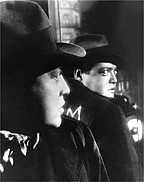
M by Fritz LangMotion pictures are an effective medium to convey the human condition.  In Fritz Lang’s thriller M (1931), the letter obviously refers to the murderer, a child killer that the whole town was after.  The not-so-obvious is the depiction of universal depravity, from the police to the masses, the message that we’re all complicit in the moral fabric of our society.  Similarly, Mel Gibson puts himself in his movie The Passion of the Christ (2004) as the Roman soldier nailing Christ on the cross.

Fast forward to the 80’s, I was introduced to the renowned Polish auteur Krzysztof Kieslowski.  It’s amazing how in Decalogue (1988), the essence of The Ten Commandments and their relevance in contemporary society are transformed into ten independent, one-hour stories and broadcast as a prime time TV series in Poland.  Decalogue is an artistically crafted and poignantly executed production that has won numerous international awards.  But would we see such kind of meaningful work as a prime time TV program here in North America?  The answer is obvious.

On the last day, I’d the chance to savor Babette’s Feast (1987), a highly acclaimed movie from Denmark (Oscar Best Foreign Language Film, 1988).  Based on a story by Isak Dinesen (Out of Africa), Babette’s Feast is a cinematic metaphor of goodness and freedom.  Its unique story and powerful visual images richly convey the theme of grace and mercy, and the liberating power of compassion.  The table prepared before us is free, sumptuous and abundant, but it takes an open heart of full acceptance and gratitude to fully enjoy it.  An inspiring film to wrap up my sojourn, creating resonance for the journey ahead.

Babette's Feast

***