You can imagine what a pleasant surprise it was for me as I came out of the Book Sale at Crossroads Market. The name on the back of that antique truck had an almost electrifying effect: STUDEBAKER.
Wow here it is, a real-life, bright and shiny Studebaker. From the antique license plate at the front you can see it’s a 55. I know the one that brings Baby Saleem home has to be 1947 or older, and definitely not a farm truck.
Here are the back, side, and front views… exact sequence of my discovery. O what joy. Those two people watching me take photos of it with my iPhone must have thought I was … uh… born yesterday.
***
Thanks to Alyce of At Home With Books for hosting Saturday Snapshot… for keeping my eyes peeled, making finding a farm truck as exciting as watching a sunset.
“What has been will be again, what has been done will be done again;
there is nothing new under the sun. ” — Ecclesiastes 1:9
**
We went to see Prometheus on Fathers Day. That’s a ‘family movie’ for us. Literal meaning: son taking father to the theatre, mom gladly tagged along as chaperone.
The quote above was what came to mind as I left the theatre. Haven’t I seen them all somewhere before? The whole idea of advanced ancient civilizations, as one blogger mentioned von Daniken (Chariots of the Gods), or the enemy inside (literally), or a robot watching old films to be informed of the human way (Wall-E). O wait, maybe there are plenty of CGI techniques that are new and that my amateur and non-technical eyes could not pick out. And the fact that I chose not to watch the 3D version means I’d missed out a lot of technical extravaganza.
Let’s just pick up where I left off.
I watched the very first, Ridley Scott’s Alien, in the theatre… that was 1979. In one notorious cinematic moment, the alien bursts out from within a human belly. That’s quite original I think, shocking scene at that time. So there incubates the subsequent alien offshoots, not only in movies, but I’ve read something like that too, unexpectedly, in the book The Astronaut’s Wife.
Prometheus is the latest version of Ridley Scott’s Alien. At the start we see a couple of archeologists/scientists discovering some ancient cave paintings pointing to a star map that they think could be invitation for them to find out the origin of human life. Following their instinct, they are put to cryo sleep and waken up in the year 2093 on the space exploration vessel Prometheus heading towards those stars.
Prometheus is a space ship purely for scientific discovery. It is also privately funded by Weyland (unrecognizable Guy Pearce) for his own agenda, to find the means to eternal life. Heading the ship’s operation is hard-nosed Meredith Vickers (Charlize Theron). Unfortunately, her character seems unnecessary except to deliver a few trite dialogues.
Leading the scientific team is Dr. Elizabeth Shaw, most aptly played by Noomi Rapace (Lisbeth… obvious name derivation). She has a chance to demonstrate her Dragon Tattoo Girl agility in combat, in resourcefulness, in quick thinking, and in acting. She’s a ‘believer’, wearing a cross necklace, always searching for the truth, despite the discovery that her Maker could be a creator-turned-terminator. She wants to know why.
In contrast, there’s David, an android/robot programmed to offer objective and unemotional info in all areas from scientific data to the various scopes of human civilization, icily played by Michael Fassbender (Jane Eyre, Shame, A Dangerous Method…) In a short exchange, David asks Elizabeth why she needs to know the reason for her Maker turning against its own creation. Elizabeth gives the answer: because I’m human and you’re just a robot.
So the search lands them on the moon LV 223 where they find some humanoid creatures with much more advanced technology. But who made them? Soon they see their dangerous predicament as some organic matter inside these ‘engineers’ are still alive and can turn agressive and powerful. Spectacular warfares ensue and lives lost as a result. And I should stop here to avoid giving away any more spoilers.
The movie ends with the idea that the search continues, and so will its sequels…
I’m not a fan of the Sci-Fi/futuristic genre. But I’m glad in the year 2093, these things remain: Chopin’s music, classic films, Christmas, and human’s search for their Maker.
Or, How I Overcome Downton Abbey Withdrawal Syndrome.
First, I bought the Blu-rays and rewatched both Season 1 and 2 several times. And then, I let my curiosity lead and follow mere intuition. Downton has prompted me to seek out books and films with setting in the early part of the 20th C.
I was most intrigued by the irreversible changes modernity has brought about, but on a more sombre note, I was moved to learn of the grave number of lives lost in a war I knew so little, WWI.
As heir to Downton Matthew Crawley has aptly noted while fighting in the trenches:
War has a way of distinguishing between the things that matter and the things that don’t.
The Great War did not end all wars as claimed, but had ended countless lives of a young generation, and altered numerous others. On the positive side, it had toppled society’s status quo and broken down previously impenetrable barriers, when men of different social classes fought side by side in the trenches, and where women played a substantial role in the war effort.
And then there are the stories of individuals and families… I’ve thoroughly enjoyed this reading and watching spree. But I have to stop somewhere and share with you what marvellous works you can follow while waiting for Downton Abbey Season 3 to arrive.
So, here’s Arti’s Annotated List of Downton Ripples:
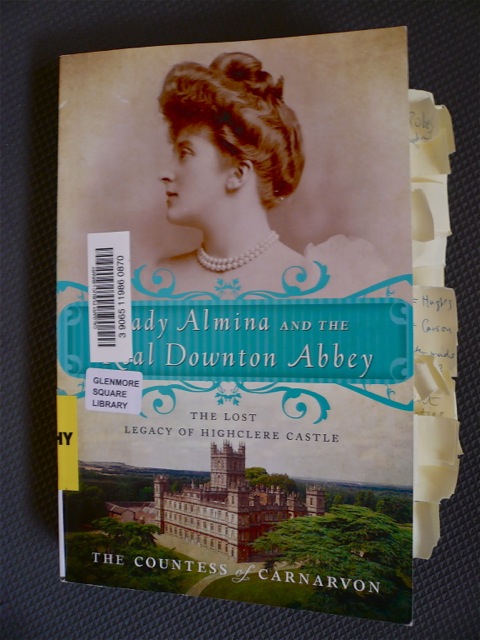
Lady Almina and the Real Downton Abbeyby Fiona Carnarvon — A springboard to all my WWI period exploration. What impressed me was that Highclere Castle itself was actually turned into a hospital during the War and many of its staff enlisted and some killed. I was moved by the number of casualties and the horrific conditions in the battlefields. My full review of the book is posted here.
The World of Downton Abbey — by Jessica Fellowes, niece of write/creator of the series Julian Fellowes. A compendium to the production, the hardcover larger-sized book is filled with photos, background info and quotes from the actors. After skimming through the whole book, one item stands out: Mr. Bates’ fall. That’s when Mrs. O’Brien trips him and he falls flat on his face on the gravel. How did they shoot this? Any special effects? Well, unfortunately for Mr. Bates, none whatsoever.
This is what Bates, Brendan Coyle said:
I must have done it 18 times and by the end I was wounded! I wore knee pads and a torso shield, but when you fall you have to really commit to falling.
Ouch! Some method acting.
Lost Empires (1986)— 7 Episode mini-series based on J. B. Priestly’s novel set in 1913, a year before WWI broke out. Colin Firth is young Richard Herncastle. Lost both parents at 19, he follows his Uncle Nick on his travelling magic stage show, learning the ropes of the itinerant performer in the music hall circuit. A coming-of-age saga chronicling the loss of innocence in love and life. Some noted actors in the series include Sir Laurence Olivier and John Castle.
A Farewell to Arms (1929) — Hemingway’s WWI semi-autobiographical sketch of love and loss. I listened to the audiobook read by Mad Men’s John Slattery. In authentic Hemingway style, his narrative is matter-of-fact and stoic. After that I watched the 1932 movie adaptation with Gary Cooper and Helen Hayes. An adaptation that makes me wish Hemingway was the screenwriter and director.
Brideshead Revisited (1945)– Evelyn Waugh has used a huge and magnificent mansion owned by an aristocratic family to tell his story. Something like Downtown but in a much serious tone. Its subtitle “The Sacred and Profane Memories of Captain Charles Ryder” sets the stage for a tug of war between God and man. I listened to the audio book read by Jeremy Irons, who has turned Waugh’s narratives into pure poetry. Probably the best audiobook I’ve ever listened to.
I’m still watching the 11 Episode TV series (1981) with Jeremy Irons playing the main character of Charles Ryder. So far, I’ve enjoyed the detailed and slower-paced depiction of the work. The book really needs a whole series to tell its story.
I’ve also rewatched the 2008 movie adaptation. As much as I respect the actors in it, Emma Thompson, Matthew Goode, Michael Gambon… I think it has trivialized Waugh’s masterpiece. The adaptation has taken the crux of the matter out and replaces with photogenic visuals and a story converted for more popular appeal. But it could well send one back to the book for curiosity’s sake.
Easy Virtue (2008) — For something totally light and swift, I rewatched this movie based on a Noel Coward play. Filled with Coward’s own music and some Cole Porter, the film depicts how the changes of the times have brought to yet another aristocratic family.
Larita (Jessica Beale) is the first woman race car driver to cross the finish line in Monte Carlo. The year is 1930. An American, she marries on a whim John Whittaker (Ben Barnes), the son of an English aristocratic family… and quickly becomes enemy on the home front to matriarch Veronica Whittaker (Kristin Scott Thomas), and subversive ally to her husband, disillusioned WWI officer played by Colin Firth. If you’re interested, here’s my full review of the movie.
A Handful of Dust (1988) — After Brideshead Revisited I went on to watch another of Evelyn Waugh’s adaptation. Again, a large mansion… how many of these architectural heirlooms do they have in England? Anyway, the master of this house Tony Last (James Wilby) is too busy looking after his property that he loses his wife Brenda (Kristin Scott Thomas). Title comes from T.S. Eliot’s The Waste Land (1922)… that sent me into reading the poem again.
Goodbye To All That (1929) — Autobiography of Robert Graves, English poet and writer. I’m most impressed by the men of letters in that period, they enlisted readily. Robert Graves and Siegfried Sassoon were both involved in the most devastating battles in France. Both were seriously injured. Deep in the trenches they wrote poetry. Their views towards the war changed as time went by, but their experiences in the battlefields brought about poignant legacies as eye witnesses of a horrific war and its aftermath. Ironically, Graves handles his subject matter with some light-hearted reminiscence.
The Remains of the Day (1993) — Not quite the same period but a bit later in the brewing year before England’s engagement in WWII. I rewatched this film adaptation of Kazuo Ishiguro’s Booker Prize winning novel in full, sumptuous Merchant Ivory style. The film leads me to think of a few parallels… Darlington ~ Downton, Stevens ~ Carson, but I’m glad Carson has more heart. And in both Downton and Remains of the Day, a character named Richard Carlisle.
The list goes on with Passchendaele and Birdsong yet to read and watch. But I know when Season 3 of Downton commences, I’ll gladly return and transfix myself once again in the Crawley family.
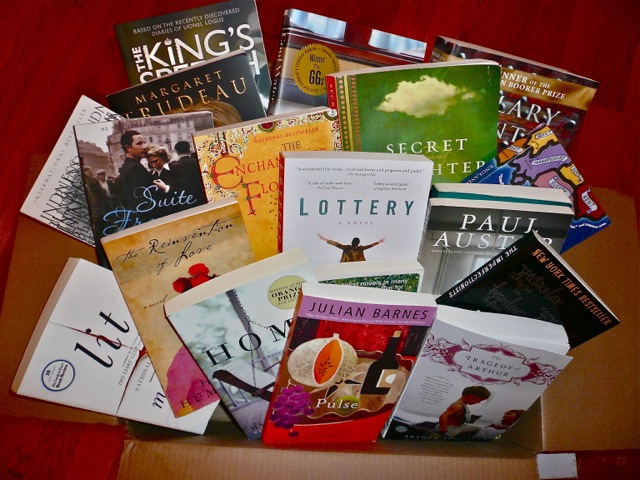
Every year the gigantic book sale organized by the Servants Anonymous Society in our City kicks off my summer reading stock-up. This weekend begins their tenth annual book sale at the Crossroads Market. Here’s a photo of the books I hauled back yesterday, all in like-new condition, all for $1.50 each since I’ve got 20 of them.
Many of the titles I’ve been watching out for some time. Some of them I came to know when I read their reviews on your blogs. Glad I can find them in the book sale and in such good condition. A few of the books look like they haven’t been opened.
Here’s the list in no particular order:
Travels In The Scriptorium by Paul Auster
England, England by Julian Barnes
Pulse, stories by Julian Barnes
Home by Marilynne Robinson
The Virgin Suicides by Jeffrey Eugenides
The Tragedy of Arthur by Arthur Phillips
Lit by Mary Karr
Suite Française by Irène Némirovsky
The Secret Daughter by Shilpi Somaya Gowda
Lottery by Patricia Wood
Blindness by José Saramago
The Reinvention of Love by Helen Humphreys
The Enchantress of Florence by Salman Rushdie
Wolf Hall by Hilary Mantel
The Mistress of Nothing by Kate Pullinger
Cool Water by Dianne Warren
The Imperfectionists by Tom Rachman
One Summer by David Baldacci
The King’s Speech by Mark Logue and Peter Conradi (biography of Lionel Logue)
Changing My Mind by Margaret Trudeau (autobiography)
**
Any of your favorites here? The Sale lasts for three weekends beginning June 8. If you were me, would you go back in the next two? Know my struggling sentiment?
From the best exotic Marigold Hotel of today we go back to 1960’s India and Pakistan…
Here in this part, we see our protagonist Saleem Sinai’s changeling status finally revealed to his parents. The ‘Alpha and Omega’ chapter in our last section has let out Saleem’s blood type being neither A nor O, throwing question on his origin. Mary Pereira finally confesses to the crime of switching the two babies at birth.
This is where I find most true and moving. Saleem talking about his parents Ahmed and Amina:
Never once, to my knowledge, never once in all the time since Mary Pereira’s revelations, did they set out to look for the true son of their blood… maybe, despite everything, despite cucumber-nose stainface chinlessness horn-temples bandy-legs finger-loss monk’s-tonsure… my parents loved me. I withdrew from them into my secret world; fearing their hatred, I did not admit the possibility that their love was stronger than ugliness, stronger even than blood.
And from here, Saleem experiences two important moves of his life. One is being sent to temporarily live with his filmmaker uncle Hanif and his wife Pia Aziz, and has enjoyed a fun and pampered time in their home.
Later, in the sixteenth year of Saleem’s life and India’s independence, his father Ahmed makes the resolute decision: there is no future for them as a Muslim family in India. They are moving to Pakistan.
I’m afraid Mr. Rushdie begins to lose me here. As one not familiar with Indian/Pakistani political history, I can only follow his narratives on the surface regarding the war between the two countries. I must have lost the deeper meaning and parallels as he depicts the political turmoils there, or the Indo-Pakistani war of 1965.
While in Pakistan, Saleem’s sister Brass Monkey has changed her name to Jamila and turned into a singer of patriotic songs. Saleem is ambivalent about this… he is excited about Monkey finding her voice, but is apprehensive about her fanaticism. With his ultra sensitive Snotnose, Saleem can distinguish the different kinds of smells that pass through it, one of them being “the hard unchanging stink of my fellow-students’ closed minds.”
Despite being an outsider and not understanding the political parallels of the narratives, I can grasp Rushdie’s meaning about political ‘truths’ declared by the government. Saleem has gleaned some insights into his short life growing up in both India and Pakistan:
… and maybe this was the difference between my Indian childhood and Pakistani adolescence–that in the first I was beset by an infinity of alternative realities, while in the second I was adrift, disorientated, amid an equally infinite number of falsenesses, unrealities and lies.
And a little sardonic humour as he concludes:
A little bird whispers in my ear: “Be fair! Nobody, no country, has a monopoly of untruth.” I accept the criticism: I know, I know…
An outsider can still enjoy Rushdie’s stylish surprises.
It is also in this section that I’m a bit disappointed to read that along with the move to Pakistan, Saleem loses his supernatural power to tune into the minds of all other Midnight’s Children, thus terminating any more Conferences. I hope this is temporary though, for I relish the confrontations between Saleem and the others he calls to congregate in his mind, in particular, the opposing sides represented by Saleem and Shiva: idealism and pragmatism, thoughts and things.
I look forward to the last section, Book Three, and see how the story concludes. Hope you’re still with me…
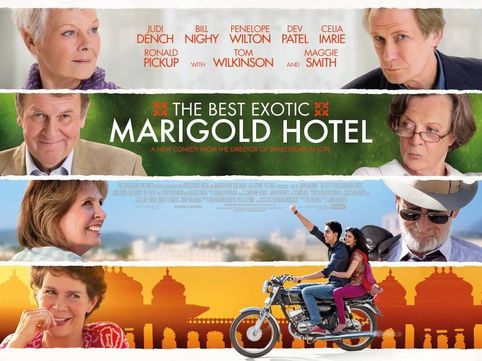
Imagine in the distant (or not so distant) future, you retire to a warm climate, enjoy a colourful land and best of all, affordable living in a retirement resort. The concept is sold to several retirees from Britain. Little do they know the advertised Best Exotic Marigold Hotel for the Elderly and Beautiful is a run-down establishment of faded glory. The place is Jaipur, India.
The Hotel owner is Sonny Kapoor (Dev Patel of Slumdog Millionaire fame) who has inherited the property from his late father. Despite his mother’s insistence to close it down and get him back to live with her in Delhi to marry the girl of her choice, Sonny is determined to make it on his own. He has already picked out his girl, and is positive about his plan to outsource retirement, among many other services India is already offering to foreign countries.
The trailer doesn’t do justice to the movie. When I first watched it, I was totally baffled … why would such a top-notch cast of veteran British actors take up what seems to be a shallow and silly farce? But after watching the movie, I think I can make a guess: they must have known what fun it would be to do this, they must have sensed the thematic relevance as well. Why I went out to see it if I didn’t like the trailer? I just couldn’t resist the combined star power and my trust in their judgment.
Where can you see these actors together on one big screen: Judi Dench, Evelyn, who has depended on her husband all the years but now recently widowed, decides to take charge of her life; Maggie Smith, Muriel, who is xenophobic and won’t eat anything she can’t pronounce, goes to India mainly to have a hip replacement she can afford; Bill Nighy and Penelope Wilton, Douglas and Jean, are an incompatible couple who sticks together out of habit and loyalty; Tom Wilkinson, Graham, a judge who follows his heart and returns to his former home to look for a long-lost friend; Celia Imrie, Madge, who at retirement is still looking for the right one, and Ronald Pickup, Norman, seems to know exactly what he wants.
The humour is natural and not forced, the dialogues are witty and refreshing. Something that is not easily found in comedies, with the expert cast of veteran actors, a sense of seriousness exudes from their performance, giving weight to the characters and making their simple storylines convincing.
Oscar nominated director John Madden (Shakespeare In Love,1998) has done a great job in concocting the on-screen chemistry of his cast. Their camaraderie as fellow travellers from the UK and as guests in the Marigold Hotel emit an appealing and quiet persuasion. I’ve enjoyed every one of their storylines. From the very start of the film, I’m drawn into each of the characters while they are still in England. I follow their journey expectantly, open and ready to accept the unfolding of events.
As with all ‘exotic’ movies, there bound to be cultural features that can easily lead to stereotyping and patronizing. That I expected. But what I didn’t was that these ‘typical’ renderings are few and mostly restrained. Further, shot right in Udaipur, India, many scenes are in situ happenings that come out naturalistic and real. The whole movie is a delightful surprise, probably the main one is, I don’t mind watching it again.
From the comments in my last post, seems like Egyptology is a favorite subject of many, if not now, at least some time in our curious life. I’ve had the chance to visit Egypt twice during my travels to the Middle East. Since now is the warm month of May, kicking off the travelling season, and alas, since going anywhere far is a remote possibility for me at present, an armchair revisit is timely, if only to suppress burning wanderlust.
Here are some file photos from my last trip to Egypt five years ago. I only stayed in Cairo and its vicinity. But from my recent reading of Lord Carnarvon and Carter’s King Tut Tomb discovery, I regret I didn’t venture further to the Valley of the Kings in Luxor. However, I did see the iconic King Tut’s mummy mask at Cairo’s Egyptian Museum. Photography was forbidden, so no King Tut’s portrait here.
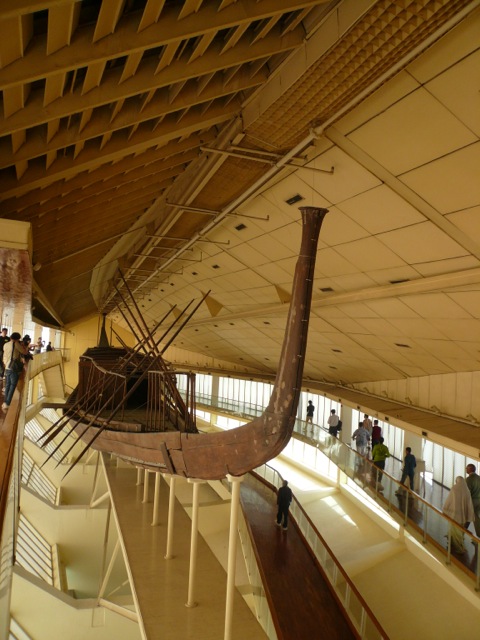
But I can show you another marvellous exhibit. In 1954, a Pharoah’s boat dating back four millenium was dug up in pieces and since reassembled. Beautifully showcased in another museum near the Great Pyramid of Giza. Photos were allowed here, but Arti’s pocket Lumix wasn’t enough to capture the magnificent whole. If you’re interested, click here to a full description.
Pharaoh’s Boat buried 26th Century B.C.
Another view:
The Pyramid and the Sphinx are probably what travellers go to Egypt for. While the Sphinx is a limestone statue of the mythical creature with the lion body and the human head, the Pyramid was piled up in stones. Can’t say which one is easier to make.
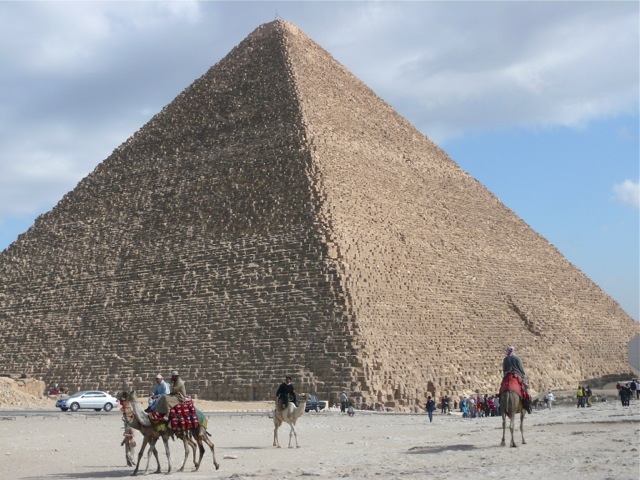
The oldest of the Seven Wonders of the Ancient World that is still standing, The Great Pyramid of Giza was built for the fourth dynasty Egyptian Pharaoh Khufu, a 20 year construction process which concluded around 2560 B.C. (Wikipedia data) As for Arti, no exact date was needed. Standing at the foot of the humungous pile of neatly stacked up stones was an experience itself.
The Great Pyramid of Giza
Not far from the Pyramid, The Sphinx:
The Pyramid and The Sphinx
A closer look… so what if I’ve lost a nose, I still stand sit after all these years:
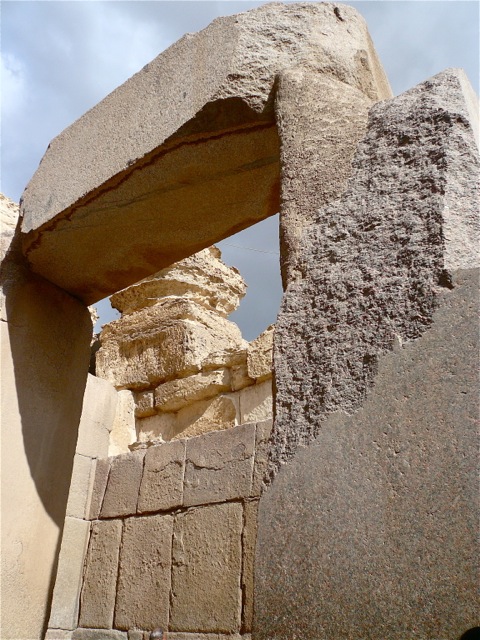
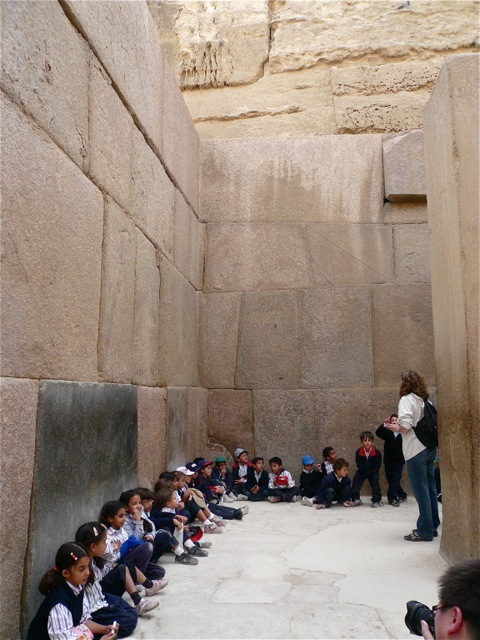
Let the stones speak:
and the children listen:
We were travelling in a bus through the desert, and stopped for a view. Here are some other children I saw, took this picture through the window:
Mount Sinai, the legendary place Moses received the Ten Commandments from God. At the foot of the mountain range is St. Catherine’s Monastery:
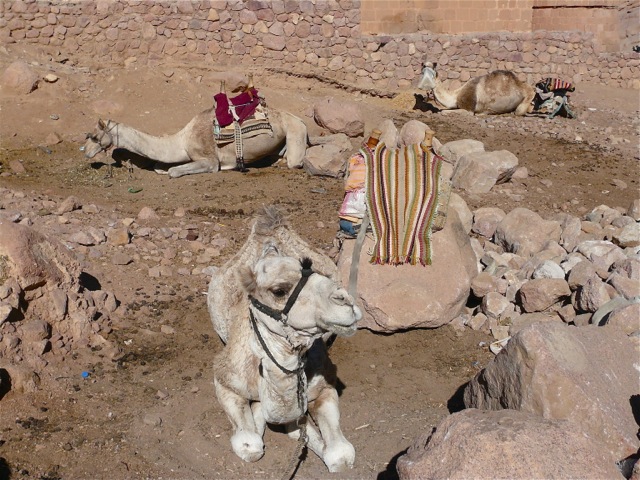
Man’s best friend. They wait without complaint:
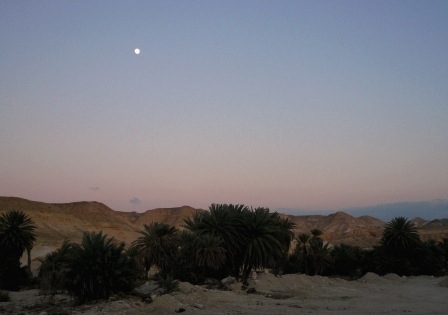
The desert is mesmerizing regardless of the hour:
Desert moon at dusk
While I faithfully pick up mail for neighbors gone to Paris, or read with pleasure blog posts of your recent travels, I feel like jumping on the armchair bandwagon and join the massive global tourism movement. Ok everyone, I’m coming along.
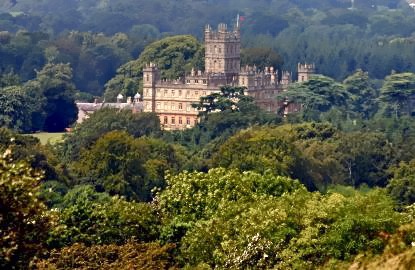
Downton Abbey in real life is Highclere Castle, situated among a thousand acres of beautiful parkland, perching on a hill with a vantage point of even more spectacular views. It is home to the Earls of Carnarvon for centuries. The book is written by Fiona Carnarvon. Lady Almina is the great grandmother of her husband, the 8th Earl of Carnarvon. The book chronicles the life and legacy of Lady Almina, who married into Highclere at 19, and evolved from a youthful debutante to a seasoned and capable, aristocratic lady with a heart. Here is the source material for the fictional creation so well received by viewers all over the world.
I’m not one easily swayed to follow what’s being hailed in current culture. But for some reasons I’ve been drawn to the human drama of the hugely successful Downton Abbey. Until I read this book I have not thought that mere facts can be as engaging as fiction. Compared to the epic proportion of historical events detailed in the book, the TV series are but minute vingnettes, albeit they do have their endearing appeal.
This is my library copy of the book after I finished reading it. There are no less than 80 tiny yellow stickies to mark my interest:
At first, I was expecting a book offering tidbits of the Highclere Castle, its designs and architecture, and how its life, both upstairs and downstairs, corresponds with the TV production, etc.
But while it lacks the design and architectural specifics I was looking for, the book has brought me something else. Yes, there is a myriad of Edwardian high society accounts, the fashion and the opulence, as expected. But to my surprise, the latter part of the book offers a greater appeal to me. I was fully absorbed by its massive archival information on The Great War, from the trenches in Europe to the battlefields in the Middle East, wartime to post-war politics, Highclere’s involvement in international power brokerage, George’s brother Aubrey and T.E. Lawrence’s friendship, and the last chapters bring me to the archeological site of the Valley of the Kings in Egypt.
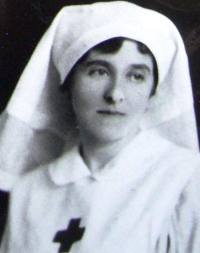
Nurse Almina
Unlike the Crawleys in Downton Abbey, the Carnarvons threw themselves fully into the war effort without hesitation. As soon as Britain entered The Great War (1914-1918), Highclere was turned into a well-equipped hospital, not just a convalescence home. Financially supported by her wealthy father, Almina hired the best in medical personel, well-trained nurses and specialized doctors, and furnished the Caslte with state-of-the-art equipment. Almina herself oversaw the whole operation and heavily involved in personal nursing care as well. A real-life Lady Cora/Isabel Crawley working in unity.
Seeing Matthew Crawley’s muddy face in the trenches cannot convey to me the horrors of the war. The detailed accounts in the book are terrifying to read. There were so many ways to die: guns and shells, broken bones even just a broken femur, long, bumpy rides to a hospital, gas, hunger, diseases, lack of medical supplies and doctors, even rain. Non-stop rain in Passchendaele had caused trenches to collapse, drowning many soldiers in the mud.
The Battle of Somme claimed 60,000 lives on its first day on July 1, 1916. Four months later, 415,000 British and Dominions soldiers had been killed or wounded. The Battle of Ypres saw the Germans use a new weapon. 168 tonnes of chlorine gas was released into Allied positions. 5,000 French soldiers in the trenches died within ten minutes, 10,000 were blinded as they escaped. In 1917, the number of British casualties and injured totalled 800,000. Many of Highclere staff were wounded and killed, those sent home were the lucky ones. The missing and the ones buried on foreign soil made the impact even more heartbreaking.
The Dowager Countess of Carnarvon, Elsie, had always been receptive to innovations and improvements. Unlike her counterpart in Downton Violet Crawley, Elsie welcomed electricity and the telephone. In 1919, at 63, she became vice-chairman of the Vocal Therapy Society and promoted the use of singing to help shell-shocked men to overcome debilitating stammers. Umm… she would have made a good team with Lionel Logue, who set up shop on Harley Street. Just ask Bertie KGVI, he knew it worked.
On a totally different note, the last chapters of the book transport me to the archaeological site of the Valley of the Kings in Luxor, Egypt. Almina’s husband George Herbert, 5th Earl of Carnarvon, was one of the last British aristocratic archaeologists, having spent £50,000 (£10 million in today’s money) over the course of fourteen years on excavating in Egypt.
Howard Carter, left, & Carnarvon at King Tut’s tomb
Lord Carnarvon personally hired the expert archaeologist Howard Carter to team up with him in his pursuit of Egyptian antiquities. Their breakthrough work came in 1922, when they discovered the burial chamber of the young King Tutankhamun. Unlike rumors that had distressed the archaeological dual that they would ship the finds to England, the King Tut artifacts have been the possession of the Egyptian government since the discovery.
I had not realized the connection before… how Downton Abbey could have a certain degree of separation from King Tut. But the book soon ends with the sad news that the already weak Lord Carnarvon soon succumbed to illness. He died in Cairo at age 57, just a few months after the excavation. It’s noted in the book that at the time of his death, back at Highclere Castle in the night, his beloved terrier Susie howled once and died.
Here I’ve just touched on a few yellow stickies. You need to read the book to grasp all the significant events during that first quarter of the 20th century. As the book has been written and published ‘in record time’ as the author has noted, likely to coincide with the broadcast of Downton Abbey Season 2, it is not a literary work, not even a social or political commentary of any sort. Yes, I was looking for the author’s view on aristocracy and the Empire. Nevertheless, it is a compact historical account that chronicles the lives of some individuals who had left indelible marks in an era of irreversible change and new discoveries.
Excellent Photos, A Bibliography of researched works and archival materials, and an Index make up the supplementary resources.
~ ~ ~ Ripples
Lady Almina and the Real Downton Abbey: The Lost Legacy of Highclere Castle by The Countess of Carnarvon, Broadway Paperbacks, NY, November, 2011, 310 pages.
A film that you have not seen in the theatre in North America. It premiered at the 2008 Toronto International Film Festival and disappeared until it emerged on DVD in April, 2012. A Summer in Genoa is a fine film that has slipped through the blockbuster-craving, profit-driven distribution network.
This is from Colin Firth’s pre-Oscar days, a performance that could well be a foreshadow of his Oscar nominated role in A Single Man a year later.
In A Summer in Genoa, Firth plays Joe, an English professor in Chicago who has lost his wife Marianne (Hope Davis) in a car accident. As father to teenager Kelly (Willa Holland) and her younger sister Mary (superbly played by then 10 year-old Perla Haney-Jardine), Joe has to lay aside his grief to continue with his family life in taking care of his daughters.
Five months after the accident, Joe’s old colleague Barbara (Catherine Keener) has lined up a teaching position for him in Genova, Italy. It is summer. The beautiful, historical seaside city will be a totally different scenery from Chicago. Joe thinks that could be a good change for all of them.
How does a family deal with loss? Here we see each person has to face it individually before coming together as a family.
Acclaimed director Michael Winterbottom (A Mighty Heart, 2007) uses a naturalistic style to depict the three of them adjusting to a new situation in their own way. Through a hand-held camera, we are privy to the life of a family like watching a home video. As with any other family, their daily routine is ordinary and mundane. Yet because of their predicament, we care for these characters, especially with young Mary always drifting off on her own. We fear for her safety.
I’ve appreciated Winterbottom’s naturalism throughout the film, not only in the camera work, but with the ‘non-acting’ of the characters (using Bresson’s notion). They come across as real people dealing with daily issues we could relate to. On top of adjusting to a new city and nursing or ignoring a wound that has yet closed, a family still needs to go on living as a family.
We see Joe make breakfast for his girls, go to teach at the university, come home and make dinner. The girls go to their piano lessons, and Kelly takes her younger sister walking in long and narrow alleyways of the old city finding their way. We see Kelly making acquaintances with some young men, and how she riskily push the limits and attempt some youthful explorations. As for the younger Mary, we see her sorely locked in her solitary self of guilt and loss.
The young actor Perla Haney-Jardine’s performance as Mary is particularly poignant. With her father and older sister preoccupied with their own interests, she is left alone to deal with her private pain. She sees her mother appear to her, communicating to her with her presence and words.
The music selection is a major appeal to me. A film that starts off with the beginning theme of Chopin’s Etude no.3 and carries it as a motif throughout is sure to capture my attention. Music is also a legacy from their mother who used to teach piano at the university.
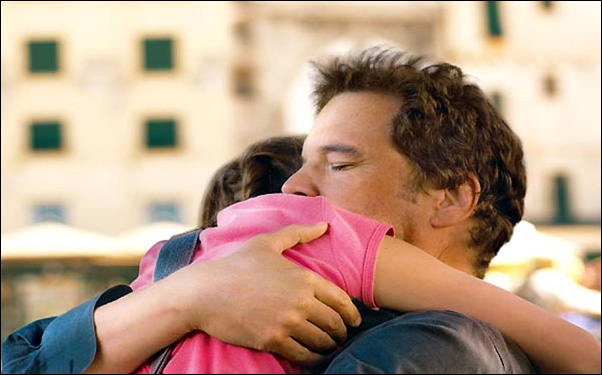
But I’m totally won over as this is read with a voiceover. A final class assignment Joe gives out to his students. He listens to the recording with them, his face lost in thought. It is so thematically perfect. As he ponders, he must have tasted the relevance of its words to his own predicament, raising his two daughters, through life’s ebb and flow. Here in this shot confirms Firth’s talent of ‘non-acting’.
Shakespeare’s Sonnet 2
When forty winters shall besiege thy brow, And dig deep trenches in thy beauty’s field, Thy youth’s proud livery so gazed on now, Will be a tatter’d weed, of small worth held: Then being asked, where all thy beauty lies, Where all the treasure of thy lusty days; To say, within thine own deep sunken eyes, Were an all-eating shame, and thriftless praise. How much more praise deserved thy beauty’s use, If thou couldst answer ‘This fair child of mine Shall sum my count, and make my old excuse,’ Proving his beauty by succession thine! This were to be new made when thou art old, And see thy blood warm when thou feel’st it cold.
Special Features include equally naturalistic behind-the-scenes footage and cast interviews.
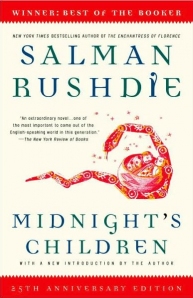
While Part One of the book is a macro view of historical background and family genealogy dating back a few generations, Part Two is what we’re all waiting for, the emergence of Midnight’s Children, in particular, our young hero Saleem Sinai. This present section of our Read-Along is the first part of Book Two, ending with the chapter ‘Alpha And Omega’.
We see Saleem Sinai growing up from a protected infant doted on by mom Amina and maid Mary to a thinking, mature, yet mildly timid and clumsy ten year-old. He shares his childhood in the family with his sister Brass Monkey, one year younger, ‘untamed, unfeminine’. Faced with the ambivalence of sibling rivalry and camaraderie, he learns in time the axiom that blood is thicker than water.
By all standards, Saleem’s first ten years (so far) have been eventful. Not long after his birth, Ghandi is assassinated. Saleem’s father Ahmed’s assets are frozen but later rescinded by the court. He spies on his mother and follows her secretly as she meets her ex-husband, now the Communist Party leader.
Saleem’s great sense of imagination is nurtured by various cultural traditions, a generous share of fairy tales, super heroes and the cinema.
Hatim Tai and Batman, Superman and Sinbad helped to get me through the nearlynine years… I became Aladdin, voyaging in a fabulous cave… I imagined Ali Baba’s forty thieves hiding in the dusted urns… I turned into the genie of the lamp… I was mild-mannered Clark Kent protecting my secret identity…
Other memorable episodes include a first taste of unrequited love from his crush on Evie Burn. As for school, colonial traditions stay. Saleem goes to a Christian mission school where he gets his multi-cultural exposure. Some learning is hard, that’s expected. But he gets more than his fair share as he tastes the ultimate in corporal punishment and humiliation as a clump of his hair is pulled out by his Peruvian geography teacher. Later in the school dance, in front of his new crush Masha Moviac, he shows her he is a man after all as he knees his insulters. Mayhem ensues that ends with a mutilated finger in the emergency room. I can see lots of movie moments, hilarious yet endearing.
But above all, growing up in Methwold’s Estate and his part of Bombay is a close encounter with multiplicity. And to a young boy tossed in the net of a myriad of interwoven cultural strands, Saleem is preoccupied with the search for an identity. Further, with his secret, supernatural gift of tuning into other people’s mind, he eagerly looks for a purpose and meaning to his life. And here is how Rushdie so brilliantly parallels Saleem’s birth to that of a nation.
On my tenth birthday, everyone at Methwold’s Estate tried hard to be cheerful, but beneath this thin veneer everyone was possessed by the same thought: “Ten years, my God! Where have they gone? What have we done?
Saleem holds a Midnight’s Children Conference right in his mind, he himself the self-imposed leader of the 581 surviving Midnight’s Children, all born with unusual gifts. His leadership is challenged by none other than his changeling, Shiva, born at the stroke of midnight with him. While Saleem ponders on the purpose and reason for his supernatural power, his counterpart Shiva, coming from the slums, opposes him with the facts of life:
Rich kid,” Shiva yelled, “you don’t know one damn thing! What purpose, man? What thing in the whole sister-sleeping world got reason, yara? For what reason you’re rich and I’m poor? Where’s the reason in starving, man? God knows how many millions of damn fools living in this country, man, and you think there’s a purpose! Man, I’ll tell you–you got to get what you can, do what you can with it, and then you got to die. That’s reason, rich boy. Everything else is only mother-sleeping wind!
Crisp and simple. Existential pondering a luxury to many… ?
How I look forward to the rest of the book, and the movie. BTW, it has been shown to selective previewers, who were told not to write any reviews as yet. They sure know how to build up expectations and curiosity.
If you’ve written a post on this section, do let us know in a comment. I’ll add your link on the list.
Next section: Book Two, Part B. From ‘The Kolynos Kid’ to the end of Book Two. Share your view May 31st. You still have time to catch up if you like to start the book now.
A book compiling two short stories and a novella, Everything in this Country Must reaffirms my admiration for Colum McCann’s spare and powerful writing.
McCann is the author of the 2009 National Book Award winner Let The Great World Spin.In my review of that book, I noted how he’d intricately woven together seemingly unrelated stories against the backdrop of the Twin Towers, crafting a moving tribute to NYC.
Before NYC, McCann had written about his home country Ireland. Everything In This Country Must (2000)is apoignant portrayal of how the political turmoils in Northern Ireland during the 80’s affect the three young protagonists in each of these stories. All the short pieces in the book are masterfully rendered, immediate, sharply focused, intense, minimal yet deeply charged. Above all, I’ve appreciated, as with Great World, McCann’s insightful metaphors.
***
Everything In This Country Must: Short Story
Nightfall, cold and raining. A man’s favorite work horse is near drowning with its forelegs caught in some rocks at the bottom of a flooding river. He gets his 15 year-old daughter to help him hold the horse’s head above water with a rope while he frantically dives into the water to get its legs out, but to no avail. He desperately needs help.
Soon enough, an army truck passes by. A few British soldiers quickly jump out to help. O what plight! The wrong people coming to the man’s aid. These soldiers remind him of the loss of his beloved. Despite his protest, they save the horse. The daughter now is torn between her gratitude towards the soldiers and her father’s anger.
Of course I will not tell you everything about this story. You must experience it yourself. Then you’ll be amazed how in just fourteen pages, McCann can depict a human flood of hatred and rage that can drown any living soul, and slap you with a haunting end that leaves you cold like night.
Wood: Short Story
With his father stricken ill in bed, a young boy helps his mother to secretly work in the family mill to earn some money, cutting logs and refining them to make poles which will then be used to hold political banners for the Protestant marches. The boy knows that his father, despite being Protestant, disapproves of these marches. That’s why he knows he has to do this stealthily, yes, to protect the pride of his father who now lays in bed unable to work, but maybe even more importantly, so not to betray his political stance. Mother and son toil in secret, turning raw wood into polished poles. The boy loves both parents, his loyalty a dilemma between reality and ideal.
And all this time the wind blows obliviously, swaying the oak trees behind the mill. “The trunks were big and solid and fat, but the branches were slapping around like people.”
Hunger Strike: Novella
Kevin is a new arrival to a Southern seaside town, living with his mother in a caravan by the shore. The move apparently is an attempt of his mother to get away from the political conflicts in the North. Kevin’s father had been killed in an accident some years ago. Currently his uncle, an IRA member imprisoned in Northern Ireland, is one of a group of inmates holding a hunger strike. Some have already died.
The uncle’s ordeal disturbs 13 year-old Kevin deeply. While his mother wants to give him a better life away from the turmoil, Kevin is emotionally entwined with his uncle’s struggle. The boy vicariously partakes in the hunger strike, counting the days, noting closely the deterioration of his uncle’s health, and even secretly dumps his own food away.
An older couple with a yellow kayak live close by. Kevin observes that they paddle in sync, they move and rest in perfect harmony. Their calm and quiet life is a huge contrast to his. Later, the couple befriend him. The old man teaches him how to paddle:
The blade should never go too deep into the water or else too much energy would be used. And there should never be too much of a splash when the paddle came out — it should look as if the sea had hardly been disturbed.
A hopeful new beginning for Kevin seems to ensue, but the situation continues to deteriorate in his hometown in the North, and with the plight of his uncle. The waves inside Kevin is just too rough for smooth and quiet paddling. A sea undisturbed belongs to the apathetic, and sometimes splashes are called for. McCann’s description of a tormented young life is both visual and haunting, and propels us to a poignant and heart-wrenching end.
~~~~ Ripples (yes, exactly my point)
Everything in This Country Must by Colum McCann, A Novella And Two Stories, Picador U.S.A., 2000, 150 pages.
















 Ripple Effects