Oscar Nominations 2010

February 2, 2010 was a big day for announcements.  We’d all been waiting for this special occasion… yes, groundhog day.  For us who live in the Calgary area, we welcomed the news as we began the day: our very own groundhog Balzac Billy did not see his own shadow.  A reward for us resilient folks: an early spring.

But even hours before Balzac Billy popped his head out of his burrow, another excitement stirred at 5:38 am PST.  At the Samuel Goldwyn Theater in Beverly Hills, CA, Academy President Tom Sherak and actress Anne Hathaway got up on the stage and announced this year’s Oscar Nominations to a house full of early risers.  What a way to start the day.   Click here to watch the announcement video.

[picapp align=”none” wrap=”false” link=”term=oscar+nominations&iid=7783783″ src=”4/b/0/8/Anne_Hathaway_and_a398.JPG?adImageId=9870627&imageId=7783783″ width=”275″ height=”300″ /]

.

The major change this year of course is the expansion of the Best Picture category from 5 to 10 selections.  I’ve pondered the pros and cons about this move.  While more films can be included so not to snub deserving ones, it also begs the question of what’s so deserving if the number of contenders are increased.

For the full list of nominations, CLICK HERE.  I won’t repeat them here but I’ll just highlight some items that pique my interest.

The Golden Globes and the SAG Awards remain the best predictors of the Oscars.  So, there are no surprises, just delights, for the three films I’ve reviewed here on Ripple Effects have all been nominated for Best Picture.

[picapp align=”none” wrap=”false” link=”term=oscar+nominations&iid=7783801″ src=”8/7/b/4/Up_in_the_bd47.JPG?adImageId=9870657&imageId=7783801″ width=”395″ height=”275″ /]

Up In The Air receives 6 noms.  Other than Best Picture,  Jason Reitman gets a nod for Best Director and Best Adapted Screenplay.  Clooney, Kendrick, and Farmiga all nominated in their respective acting category.

[picapp align=”none” wrap=”false” link=”term=oscar+nominations&iid=7784549″ src=”9/b/d/e/Carey_Mulligan_nominated_8cec.JPG?adImageId=9870639&imageId=7784549″ width=”395″ height=”270″ /]

An Education gets a Best Picture nod with Nick Hornby nominated for Best Adapted Screenplay, while Carey Mulligan, who plays 16 year-old Jenny, gets to compete with Meryl Streep, 16-time Oscar nominee, this time as Julia Child in Julie and Julia.

[picapp align=”none” wrap=”false” link=”term=oscar+nominations&iid=7784555″ src=”5/a/2/b/Meryl_Streep_nominated_5614.JPG?adImageId=9870681&imageId=7784555″ width=”395″ height=”275″ /]

.

I’m glad too that the Coen brothers’ A Serious Man gets a nod for a chance at the Best Picture Oscar Award as well as a nom for Best Original Screenplay.

Are these deserving smaller films getting the nods reaping the benefits of the expanded Best Picture category?  Or, is it just the other way round, that popular, big box office hits get a chance to be included because of their mass appeal?  It’s that same old art vs. popularity debate again… well, some other time.

Avatar and The Hurt Locker each receives 9 nominations. Both are contenders in the coveted Best Picture and Best Director categories.  Yes, James Cameron will be competing with his ex-wife Kathryn Bigelow for these two coveted prizes.  In all of the Academy Awards’ 82 years history, there have only been three female directors nominated, and none has won. Kathryn Bigelow is the fourth.  Will she make Oscar history this year by being the first woman Director taking home the statuette?  After all, it’s a decade past the twenty-first century now.

[picapp align=”none” wrap=”false” link=”term=avatar&iid=7789230″ src=”9/2/0/c/James_Cameron_nominated_7354.JPG?adImageId=9871271&imageId=7789230″ width=”160″ height=”235″ /]

[picapp align=”none” wrap=”false” link=”term=hurt+locker&iid=7764534″ src=”f/7/c/d/Kathryn_Bigelow_wins_6674.JPG?adImageId=9871306&imageId=7764534″ width=”210″ height=”235″ /]

.

Inglorious Basterds is another major contender with 8 nods.  Quentin Tarantino’s altered-history fantasy is ingloriously riveting.  Christoph Waltz, who brilliantly plays the cold, callous, and calculating Nazi Colonel Hans Landa, is likely to continue his winning streak following the GG and SAG.

Christopher Plummer gets a nom for his role as Tolstoy in the film The Last Station, a biopic about the last years of the great Russian author.  So, why is he nominated in the Best Supporting Actor category?  Who is he supporting?  Mrs. Tolstoy? … whose star Helen Mirren gets to be nominated for Best Actress, not supporting.

[picapp align=”none” wrap=”false” link=”term=oscar+nominations&iid=7788913″ src=”3/4/1/b/Christopher_Plummer_nominated_c758.JPG?adImageId=9871178&imageId=7788913″ width=”152″ height=”190″ /]

[picapp align=”none” wrap=”false” link=”term=helen+mirren+oscar&iid=7784548″ src=”3/b/8/5/Helen_Mirren_nominated_6e30.JPG?adImageId=9871651&imageId=7784548″ width=”215″ height=”160″ /]

.

It’s interesting to see the animated feature Up get to compete with the other nine feature films, aiming for the highest prize in the Best Picture category.  I believe only Beauty And The Beast had that honor in the past.  Animated features have taken on a brand new versatility in recent years, with all sorts of technical innovations creating fresh new visual effects.  But it’s always the story that is the winning factor.  Up deserves the nom.

[picapp align=”none” wrap=”false” link=”term=oscar+nominations&iid=7783800″ src=”4/d/4/2/Up_nominated_for_5299.JPG?adImageId=9870774&imageId=7783800″ width=”385″ height=”275″ /]

So hopefully March 7 will not only bring star-studded excitement but the warm and gentle breeze of spring for me as well.

**All photos from the copyright-free picapp.com**

Emma (2009, TV): Episode 2

‘An authentic human being’ is how the host of Masterpiece Classic Laura Linney describes Emma.  Jane Austen’s characters have no supernatural powers, she notes.  But herein lies the magic of her writing.  She takes the ordinary and draws out the unnoticed features.  From these everyday characters like you and me, she skillfully displays the intricacies woven in their interactions, and reveals the undercurrents of hidden intentions and desires.  It is in the revealing of the subtext that makes her story so captivating even for us modern day readers.

Episode 2 continues with this interesting story as we see Emma confused by her own feeling towards Frank Churchill, Harriet’s shifting admiration for the same, Frank Churchill’s seemingly open admiration for Emma, Mr. Knightly’s growing sentiments for the same, and, Jane Fairfax’s hidden anguish, ignored by the subject of her desire.  It seems that everybody’s feeling is mixed up with everybody else’s.  The comedy of errors gathers momentum.

Cinematography continues to be a major contributor to the storytelling.  I particularly appreciate the several Vermeer moments, like the one with Emma gazing out the window deep in thought, or the camera silently captures her playing the pianoforte, immersed in diffused light.  I’ve also enjoyed how the visual reveals inner thoughts.  Mr. Knightly’s longing is projected by the flashback of his dancing with Emma, shifting to the single swan in the pond, warm music enfolding… a beautiful cinematic moment where the visual and music communicate effectively without words.

Mrs. Elton is animatedly played by Christina Cole.  In terms of comedic and obnoxious effects, she is of her husband’s equal, a good match indeed. While Rupert Evans is proficient in portraying a sly Frank Churchill, he does not look like the one I have in mind.  But that is not important. My main concern is with the role of Jane Fairfax.  This second episode confirms my misgiving from the beginning.  I feel there is a miscast here.  I miss her elegance, poise and subtleties as described by the author.  She is supposed to be Emma’s worthy rival after all.

The dance at The Crown Inn is a delight to watch.  That is also the occasion showing everybody’s true colour.  And Mr. Knightly has proven himself to be one considerate gentleman as he invites Harriet to dance after she is slighted by Mr. Elton.  Also, we’re beginning to see Mr. Knightly more and more in love, while the object of his desire remains relatively clueless, albeit a sense of appreciation has arisen in her confused heart.  The dances are fun to watch too, much more lively and convivial than the courtly dances we see in other Austen adaptations.

After two episodes, the story and the characters are well developed, the overall effects pleasing and enjoyable.  I look forward to the next instalment.

*****

CLICK HERE TO GO TO MY REVIEW OF EPISODE 1

CLICK HERE TO GO TO EPISODE 3, THE CONCLUSION

Arti’s reviews of Emma (2009), Episodes 1 to 3, have been compiled into one article and published in the Jane Austen Centre Online Magazine. CLICK HERE to read the many other interesting articles on Jane Austen and her time.


Emma (2009, TV): Episode 1

Previously on Masterpiece Classic

Yes, treat this post as a recap to prepare you for Episode 2 in just a couple of days.

So finally, North American viewers have the chance to see the long awaited 2009 BBC production of Emma, three months after its release in the UK.  A click on imdb will find no less than 15 different versions of this popular Austen work.  Yet another one?  It just naturally leads one to question, why?  After seeing this first episode, let me give it a shot: just because it’s so much fun to do.

That’s how I felt as I watched the PBS broadcast last Sunday.  This newest adaptation of Emma is probably the best I’ve seen, and Romola Garai easily the best-cast Emma so far.  Yes, I’m comparing her with Gwyneth Paltrow (1996) and Kate Beckinsale (1996, TV).  She may well be one of the best-cast Austen heroines for their roles in my opinion, let’s just say, neck and neck with Jennifer Ehle’s Elizabeth Bennet.

What a difference from her guilt-ridden Briony in the movie Atonement.  Well, Garai’s Emma is guilt-ridden too as the errant, over-confident matchmaker, but her genuine heart and willingness to own up to her misjudgment have made her personality shine through.

In creating Emma, Austen had said that “I’m going to take a heroine whom no-one but myself will much like.”  Seems like this adaptation does a great service pulling us over to Austen’s side. Garai’s Emma reflects the probable reasons why the author found her character likable: vivacious, charmingly clueless, and above all, her readiness to admit faults, her genuine heart towards herself and others.  Garai’s animated performance is most apt in a comedic genre such as this.  So far in the first episode, the irony and humor have come through.

The impressive cinematography matches perfectly the personality and atmosphere of the novel, brisk, agile, fun, and yes, as Mr. Knightly narrates in the beginning, golden.  Just the kind of colour scheme for a clever comedy, the exact reflection of its main character.  As a comedy, a little exaggeration in the colours is acceptable and quite effective I think.  Overall, the visuals are captivating, beautiful shots of the English country landscape, the well situated mansions and their interior renderings.  I’ve particularly appreciated the few overhead shots, and some of the contrasting darker scenes in the beginning.

And yes, the beginning is where a film can captivate right away.  I’ve enjoyed screenwriter Sandy Welch’s treatment of the plot, drawing out three characters, Emma, Frank Churchill, and Jane Fairfax, who had all lost their mother as a young child, and focusing on how markedly different their lives have turned out.

For the casting of Jonny Lee Miller as Mr. Knightly, however, I have a little reservation, in this first episode anyway.  The sparks between Emma and him look more like sibling bickering than the undercurrents of subliminal lovers’ quarrels, which Austen so brilliantly depicts. The 16 years of age difference is almost unobservable here, although in real life they are ten years apart.  But I’ve enjoyed Jonny Lee Miller’s portrayal of the conflicting Mr. Knightly, at times detached, at times involved, and at times, exasperated.

Michael Gambon is excellent as the fastidious Mr. Woodhouse. The legendary actor has delivered a convincing performance as an endearing but taxing hypochondriac.  As for Harriet Smith and Jane Fairfax, I’m afraid my preference is the 1996 TV production‘s casting of Samantha Morton and Olivia Williams in these roles.  But then again, my view can change as I continue watching.

This first episode strikes me as a lively, contemporary rendition. While screenwriter Sandy Welch had chosen to use more modern language in her dialogues, I don’t think she needed to stray too far from the original to achieve this.  As I’m re-reading Emma for these screenings, I find the book very accessible for modern readers, the characters are those whom we can relate to, their motives and emotions very similar to what we are familiar with.  Austen’s skills in observation and her intelligence in depicting human nature and her characters’ inner world are simply impressive, considering she was writing almost a hundred years before Freud and the birth of modern psychology.

****

CLICK HERE TO GO TO MY REVIEW OF EPISODE 2

CLICK HERE TO GO TO EPISODE 3, THE CONCLUSION

Arti’s reviews of Emma (2009), Episodes 1 to 3, have been compiled into one article and published in the Jane Austen Centre Online Magazine. CLICK HERE to read the many other interesting articles on Jane Austen and her time.


Haiti Benefit Concert

There was no U2, Bono, or Sir Paul, no Clooney or other big stars answering phone lines, just our own local musicians from Western Canada pitching in to raise funds for earthquake-stricken Haiti. While the Olympic torch had just passed by our city and moved on to cheering crowds in Banff, the flame of compassion burned bright here at the amazing concert last night in Calgary’s Centre Street Church.

Partnered with the Christian relief organization Samaritan’s Purse, the benefit concert was organized on short notice.  With just a few days to prepare, some of Canada’s top Christian musicians and recording artists gathered, together with the Centre Street Church orchestra and choir, to deliver a moving, high-calibred performance.  All funds raised will be sent to Haiti for urgently needed relief work.

I’ve long wanted to hear Juno Award winner, singer songwriter Steve Bell in person, and I had the chance last night.  But I was much more gratified to discover other singers that I would never have known if not for an occasion like this.  For I’m a sporadic listener of Christian music, have not been a fan of the genre, I admit.  But last night I had an altered view and gained a new appreciation for Christian artists and their music.

Steve Bell and Carolyn Arends opened the concert.  Bell had that amazing voice and musicianship.  From his guitar, I could hear chords that seemed to be created new and yet so natural in their progression. From Surrey, B.C., award-winning singer and songwriter Carolyn Arends wrote on her blog about this concert. And there I discovered some inspiring posts.  I was captured by her voice, her lyrics, piano and guitar playing, and now from her blog, her writing.

The spoken words written for the occasion were delivered rap-style, backed by the rhythms of a djembe drum, riveting and forceful. Other musicians came up one after another, among them were Jason Zerbin, Dan Nel, recording artists Raylene Scarrott, John Bauer, the humorous ‘hip hop artist for the night’, Corey Doak, and the group ‘Junkyard Poets’, just love that name.  Brad McGillvrey, with the choir harmonizing, gave a touching rendition of Lenard Cohen’s ‘Hallelujah’.

They came up one after the other, quietly, low-key and unpretentious.  That in itself was moving, for this was not a show for the musicians themselves.  There was no limelight; their performance had only one purpose, to draw our attention to the devastated victims in Haiti.

It wasn’t just music, of course.  A group from Compassion Canada shared their harrowing experience as they arrived Haiti one hour before the earthquake hit.  Their lives were spared as they were tied up with some VIP protocols and were delayed reaching their hotel.  Hotel Montana was crumbled by the quake an hour later.  Spared for what?  Brent Trask of the group shared his insight from the ordeal using Psalm 116.  Spared to fulfill one’s vows to the Lifegiver, to make one’s life count, to serve, to praise.

The finale is a moving sight with all performers coming on stage to wrap up with Carolyn Arends’ ‘Seize The Day’.

We were excited to hear that the effort of the night was well rewarded as we raised $115,000.  With the Canadian government matching the amount, a total of $230,000 will be sent to relieve the urgently waiting victims in devastated Haiti.  No big Hollywood stars, no international phenom’s, just plain local musicians with a heart, and a community of united spirit.  Steve Bell added an apt reminder. Don’t say ‘pray for Haiti’, he urged us, but ‘pray with Haiti’.  We are all in it together, our shared humanity, one communal spirit.  Something worthwhile to ponder as we drove back to our warm and secure homes.

Update Jan. 24, 2010:  Since the concert, more donations have been pouring in.  As of today, the amount is at $134,000. With the government’s matching funds, $268,000… so far.

*****

** All photos taken by Arti, seated in the eighth row from the stage, using a pocket-sized digital camera.  The actual scene was much more impressive than these blurry photos show. **

Golden Globes 2010

I love quotes.  So instead of checking out who wore who, I was more interested in who said what as I watched the Golden Globes last night. Of course, I was curious to see who won what.  There was no major sweep, but Avatar took the two most coveted ones, Best Picture and Best Director.  And then there were the unexpected ones.  For a list of the winners, you can click here to go to the Hollywood Foreign Press Association’s official website.

But here are the quotes of the night that I find most interesting.  Among all of Ricky Gervais’ jokes, prepared and improvised, which can be dismissed the next minute, this one seems to have a stronger aftertaste. When introducing the Best Screenplay Award, referring to what’s more important, he quipped, “It’s not the words but how good you look when saying them.”

And for the winner of that writing award, I’m glad to see Up In The Air get to bring home the Globe, shared by both Jason Reitman and Sheldon Turner, in their adaptation of Walter Kirn’s novel. Montreal born Reitman delivered an endearing speech, giving credits to the most important people in his life.  “… people like how I write women.  I can never write women who wasn’t for my wife. You are the fuel to my creative fire, Michelle.”

[picapp align=”none” wrap=”false” link=”term=golden+globes+2010&iid=7581735″ src=”4/4/e/d/11th_Annual_Warner_5996.jpg?adImageId=9210655&imageId=7581735″ width=”180″ height=”255″ /]

.

And to his parents, director Ivan Reitman and actress Genevieve Robert, he left with these words: “… you taught me how to be the man I am… to be the storyteller that I am.  I love you.  I thank you for everything.”  I think his films show his parents had done a pretty good job.

Meryl Streep won the Best Actress Globe for a Motion Picture, Comedy or Musical, for her role as Julia Child in Julie and Julia.  She started off with this most interesting line: “I just want to say that in my long career, I’ve played so many extraordinary women, I’m being mistaken for one.”

[picapp align=”none” wrap=”false” link=”term=golden+globes+2010&iid=7579893″ src=”1/6/6/6/67th_Annual_Golden_d034.jpg?adImageId=9211762&imageId=7579893″ width=”180″ height=”250″ /]

.

Remembering her mother, who was not unlike Julia Child, Streep noted her ‘joy in living’.  And if she ever needed a new image, she wished to be called ‘T-Bone Streep’.  Ah… the power of Julia Child.

And then there’s this line from Robert Downey Jr., who won the Best Actor Award, Comedy or Musical, for his portrayal of Sherlock Holmes, quoting Arthur Conan Doyle:

“Art in the blood is liable to take the strangest forms.”

Of course he was just joking when he said: “I don’t have anybody to thank.” But besides the people he did mention, he forgot Sherlock himself.

[picapp align=”none” wrap=”false” link=”term=golden+globes+2010&iid=7581377″ src=”3/5/a/d/Robert_Downey_Jr_0b01.JPG?adImageId=9211567&imageId=7581377″ width=”180″ height=”250″ /]

.

The most thought-provoking speech of the night comes from Martin Scorsese, who received the Cecil B. DeMille Award for his contribution as an iconic filmmaker.  He quoted William Faulkner’s words:

“The past is never dead.  It’s not even past.”

I like his perspective in acknowledging that they are all living history, continuing and in debt to the works of pioneers and pathfinders in filmmaking.  “We’re all walking in their footsteps everyday, all of us.” Herein lies humility, a most apt reminder for all in attendance at the glitzy Beverly Hilton ballroom.

[picapp align=”none” wrap=”false” link=”term=golden+globes+2010&iid=7581861″ src=”9/8/d/0/Scorsese_given_the_58dc.JPG?adImageId=9211366&imageId=7581861″ width=”255″ height=”200″ /]

.

****

All photos from picapp.com

Why We Read Jane Austen

The first challenge you face when writing about Pride and Prejudice is to get through your first sentences without saying, “it is a truth universally acknowledged…”

—–  Martin Amis

Isn’t it true that these words from the clever and satirical opening line of Jane Austen’s Pride and Prejudice [1] have been so overused that they have sadly become a cliché in our contemporary language, together with ‘zombies’ and ‘vampires’?

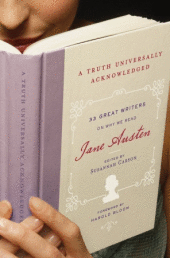
So what did I expect from a book entitled A Truth Universally Acknowledged:  33 Great Writers on Why We Read Jane Austen?

I admit, at first I thought it was a literary version of those lifetime achievement award presentations, where the honoree is showered with superfluous speeches by his/her peers, over champagne and frivolous dinner, something which Jane Austen herself would abhor.

I found out soon enough that between the modest and classic looking covers, Susannah Carson, the editor of the volume, had gathered the essays of 33 writers, not toasts or roasts, but detailed biographical notes, thoughtful musings, heartfelt admiration and in-depth analysis of Austen characters and works.  It is a collection of articles stemming from a balanced fusion of sense and sensibility, something that Austen herself would have approved.

Included are literary figures from the late 19th to 20th centuries like E. M. Forster, W. Somerset Maugham, C. S. Lewis, Eudora Welty and Virginia Woolf.  Contemporary contributors include writers, academics, Austen historian, and screenwriters.  There are views from Harold Bloom, Lionel Trilling, Janet Todd, Anna Quindlen, A. S. Byatt, Amy Bloom, to name a few.  All of them point to Austen’s inimitable humor, incisive observations of human nature and unwavering moral stance that make her works still relevant two hundred years later today.

The following are some samples from this smorgasboard of Austen delights.

Harold Bloom, writing the preface, concludes with these lines:

We read Austen because she seems to know us better than we know ourselves, and she seems to know us so intimately for the simple reason that she helped determine who we are both as readers and as human beings.

Anna Quindlen, defending the subject matter in Austen’s works being mainly about the family (it’s a pity that she even needs to do this):

…[Austen was] a writer who believed the clash of personalities was as meaningful as—perhaps more meaningful than—the clash of sabers.  For those of us who suspect that all the mysteries of life are contained in the microcosm of the family, that personal relationships prefigure all else, the work of Jane Austen is the Rosetta stone of literature.

Austen once referred her own writing as “the little bit (two inches wide) of ivory on which I work with so fine a brush, as produces little effect after much labour.”  In response, screenwriter and director Amy Heckerling, who has adapted Emma into the movie ‘Clueless’, compares Austen’s writing to a Vermeer painting:

“Sometimes the finest brushes paint the biggest truths.”

James Collins, a writer and editor, and frequent contributor to The New Yorker, shares a very personal view:

I find that reading Jane Austen helps me clarify ethical choices, helps me figure out a way to live with integrity in the corrupt world, even helps me adopt the proper tone and manner in dealing with others… Reading Austen I sometimes feel as if my morals are a wobbly figurine that her hand reaches out and steadies.

But she is not all didactic and stern… far from it.  Jane Austen has long been celebrated for her animated humour and witty ironies, the essence of her writing.  I love this analogy that Collins uses:

Her ironies swirl and drop like the cast of a fly fisherman. This rhythmic motion seems to me ideal for both accepting and rejecting the ways of the wretched world while maintaining balance.

Demonstrating the relevance of her satires for today, Benjamin Nugent, the author of American Nerd: The Story of My People, discusses the nerds in Pride and Prejudice, Mary Bennett and Mr. Collins, and why they miss out on life.

If you read sci-fi novels, you’ll generally read about worlds in which scientists and the technologies they create drive the plot; if you read Austen, you’ll read about a world in which technology means nothing and the triumphs and failures of conversational agility drive everything.

His advice for modern day nerds:

Young nerds should read Austen because she’ll force them to hear dissonant notes in their own speech they might otherwise miss, and open their eyes to defeats and victories they otherwise wouldn’t even have noticed.  Like almost all worthwhile adolescent experience, it can be depressing, but it can also feel like waking up.

It takes a sharp ear and intelligence to be a good humorist, and Austen shows that she has what it takes to be one at an early age.  About her prodigious talent, Virginia Woolf praises her first work, the novella Love and Friendship, written when Austen was only 15:

an astonishing and unchildish story… Spirited, easy, full of fun, verging with freedom upon sheer nonsense–Love and Friendship is all that…  The girl of fifteen is laughing, in her corner, at the world.

Indeed, as editor Susannah Carson has stated, any hint of ‘romance’ in her novels is merely the irony of it. About the seemingly unconvincing romantic plot in Northanger Abbey, Carson asserts:

What if Austen actually intended the romance plot to be unconvincing?  … It is probable… that Austen intended the failure of the romance plot, not to sabotage her own work, but to make a point about romance plots in general… that [they] are inherently artificial.

That Northanger Abbey is a satire on the gothic novel has long been noted.  Other writers also stress that Austen should not be labelled as a ‘romance writer’ because of the satirical styling behind her writing.  W. Somerset Maugham keenly observes:  “She had too much common sense and too sprightly a humor to be romantic.”

In his essay ‘Beautiful Mind’, writer Jay McInerney bravely admits that: “If my actual romantic life has sometimes been influenced by superficial considerations, as an Austen reader the basis of my affections has been almost entirely cerebral.

Amy Bloom sums it up succinctly about this common confusion about romance and love:

Jane Austen is, for me, the best writer for anyone who believes in love more than in romance, and who cares more for the private than the public. She understands that men and women have to grow up in order to deserve and achieve great love, that some suffering is necessary (that mewling about it in your memoir or on a talk show will not help at all), and that people who mistake the desirable object for the one necessary and essential love will get what they deserve.

To master such a distinction could well be one of the main reasons why we read Jane Austen.

**

A Truth Universally Acknowledged:  33 Great Writers on Why We Read Jane Austen, edited by Susannah Carson, published by Random House, NY, 2009, 295 pages.

**

[1] The first line of Pride and Prejudice goes like this: “It is a truth universally acknowledged, that a single man in possession of a good fortune, must be in want of a wife.”

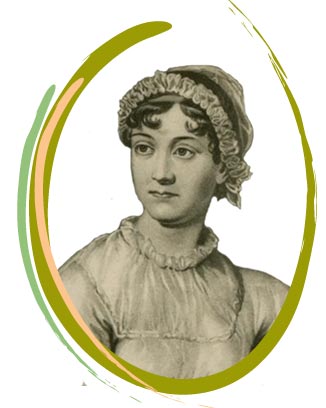
Photos Sources: Book cover randomhouse.com, Jane Austen Portrait tvo.org, Jane Austen Centre, Bath, taken by Arti of Ripple Effects, Dec. 07.

This article has recently been published in the current Jane Austen Centre Online Magazine. Click to go there for other interesting articles on Jane and the Regency world.

**

Related Posts you might enjoy:

In Praise of Austen: Virginia Woolf’s A Room Of One’s Own

A Jane Austen Education by William Deresiewicz

**

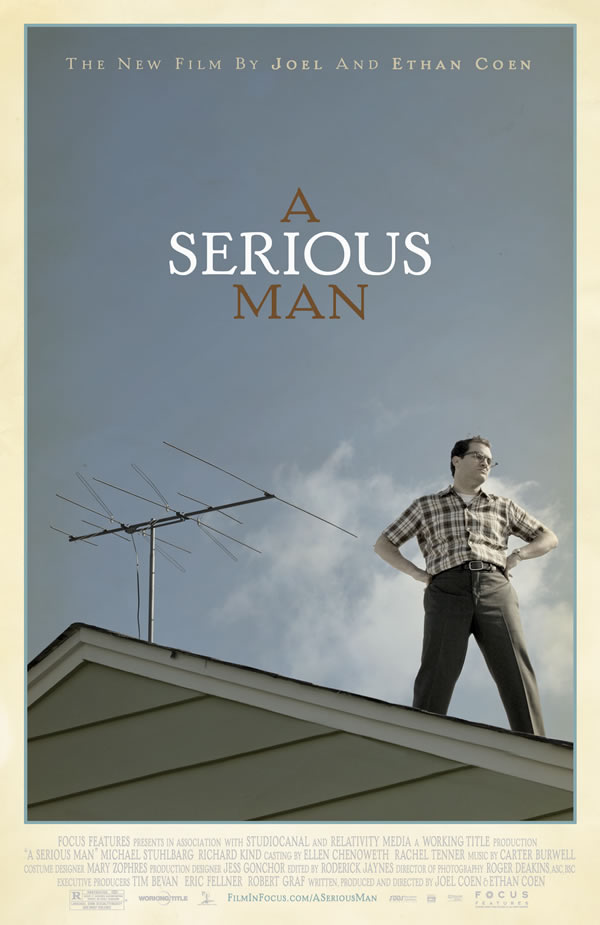
A Serious Man (2009)

UPDATE:  A Serious Man has been nominated for a Best Picture Oscar in the coming 82nd Academy Awards, to be held March 7th, 2010.  Joel and Ethan Coen receive a nod for Best Original Screenplay.

Do we go to the movies to be entertained, or to search for meaning and answers about life? For those who frequent Ripple Effects, you probably can guess what my stance is. Yes, allow me to answer a question with a question… Why must the two be mutually exclusive?

I’m all intrigued about films that explore deep subjects and yet remain as comedies, or, dramedies, as the genre has evolved in recent years. A Serious Man is one such films, entertaining and yet hauntingly serious. But it’s not entertaining with a big splash of hilarity. It is a dark comedy, a film that makes you chuckle in a most poignant way. It’s the deadpan humor that strikes deep. The subject matter in A Serious Man deals with the inscrutable question: Why do bad things happen to good people? And, if we can’t find the answer to the why, then at least, how should we then live?

The film has been described as the most personal of Joel and Ethan Coen’s works; others see it as the most Jewish they’ve done, or even somewhat autobiographical. The setting is 1967 Minnesota, where the Coen brothers grew up.

A Serious Man has won the 2009 Independent Spirit’s Robert Altman Award, and accolades for its screenplay.  It’s one of the American Film Institute’s Top 10 Films of 2009. Michael Stuhlbarg’s excellent performance receives a 2010 Golden Globe nom for Best Actor, Musical or Comedy.

Larry Gopnik (Michael Stuhlbarg) is a college physics professor, a conscientious man who just tries to live his life minding his own business, trying to do what is right.  Yet, it’s trouble he finds everywhere he turns. His wife Judith (Sari Lennick) is divorcing him for their mutual friend Sy Ableman (Fred Melamed); his daughter Sarah (Jessica Mcmanus) is stealing from him to do a nose job; his son Danny (Aaron Wolff) is taking drugs even as he prepares for his bar mitzvah; his unstable brother Arthur (Richard Kind) is staying uninvited in his house and has no intention to leave any time soon.  On the career front, his student Clive (David Kang) is bribing him for a passing grade; his tenure committee is making decision on his future while an anonymous letter is circulating, defaming him. At the same time, his chest x-ray result is back, and, an ominous tornado is making its way to his son’s school. I’m exhausted just to keep up. Can anyone explain why Larry is having so many problems while he is only trying to be a mensch, or, a serious man?

Larry goes searching for answers from three rabbis. While the first two cannot give him a satisfactory answer, the third, the most senior, is too busy to see him. Who then is left to help him through all his troubles?

Many critics equate Larry’s predicament with Job of the Bible, a righteous man facing incredulous torments. But Larry is no Job. He may attempt to be a righteous man, but he is not totally blameless. I feel the film may reflect the notion described in the book of Ecclesiastes even more:

… And yet I perceived that the same event happens to all of them. Then I said in my heart, ‘What happens to the fool will happen to me also.  Why then have I been so very wise?’ … this too is meaningless.

Ecclesiastes 2: 14 – 15

If we have no control over the bad things that happen to all, it’s only natural to question why we ought to be good then. If his wife runs away with another man, is it justified that Larry should lust for another woman? Since bad things will happen to the good and the bad alike, why bother being good? Do we act prudently because we expect positive consequences, or, do we act prudently because it is the right thing to do, period. And now, the moment of decision, the bribe…

A Serious Man throws at us more questions than answers, expectedly so, for who has all the answers? It is in such precarious situations that we look into our hearts and search ourselves. Instead of a challenge thrown at HaShem, God, I see the film as one that’s turned towards us: what would I have done?

~ ~ ~ Ripples

****

Up In The Air (2009)

UPDATE February 21: Up In The Air just won Best Adapted Screenplay at the BAFTA (British Academy of Film and Television Arts) Awards.   CLICK HERE TO READ MORE.

UPDATE February 2nd OSCARS NOMINATIONS:  Up In The Air has been nominated for a Best Picture Oscar in the coming 82nd Academy Awards.  Jason Reitman gets a nod in the directing category, George Clooney in the Best Actor category, Vera Farmiga and Anna Kendrick for Best Actress.  Jason Reitman and Sheldon Turner also received nomination for Best Adapted Screenplay.

UPDATE January 17th: Jason Reitman and Sheldon Turner have just won the Best Screenplay Award at the Golden Globes tonight.

Now that we’ve entered the new year, the awards season has arrived.  Only two weeks to go before the Golden Globes presentation, and about a week after that the Screen Actors Guild Awards, the buzz now is around the nominees.  And this one is a good start for the new year.

Watching Up In The Air is like reading an O. Henry story.  The twist at the end makes it hauntingly poignant. But O. Henry probably would not have imagined that a story could be told in such a visually dynamic way.

Following Oscar nominated Juno (2007) and Golden Globe nom Thank you for Smoking (2005), director Jason Reitman, together with screenwriter Sheldon Turner, have created a screen adaptation of Walter Kirn’s novel.  Reitman has crafted an apt and relevant contemporary tale with just the right pacing, suitable for those too rushed to stop for a story.  I’m sure they’ll enjoy this one.

‘I fly, therefore I am’ … that could well be the philosophical stance of Ryan Bingham (George Clooney).  He flies from city to city, doing something most bosses shy away from: laying off people.  Apparently Ryan loves his job.  It gives him the reason to be constantly on the go. One time on the plane, he is asked “Where are you from?’  With just the slightest hesitation, he answers: “Here.”

Ryan Bingham is also a motivational speaker.  He brings a backpack to the podium, an object lesson too vivid to ignore:  the more you put in, things and people the same, the heavier it’ll get, the more bogged down you’ll be.  His warning to his audience: ‘The slower we move, the faster we die.’  He’s the guru of non-committal living.

Goerge Clooney is perfectly cast as Ryan Bingham.  His suave, urbane sophistication is tailor-made for the role. Add in the nonchalant nuances, no wonder his performance earns him a nom for the Golden Globe.

But just when Ryan is performing so well with his air ballet — even his carry-on-suitcase-packing manuevers look sleek and stylish, thanks to some fascinating series of shots — Ryan gets notification that he’ll soon be grounded. Thanks to newly hired, Cornell grad Natalie Keener (Anna Kendrick), who has developed a video conferencing system for the company, Ryan can now do his job without leaving his office.

To phase in, Ryan is to bring Natalie along to familiarize her with his job.  It’s most amusing to watch the foil between the experienced and the naive, the callous and the tender.  At the same time, the plot thickens as Ryan meets another frequent flyer, Alex Goran (Vera Farmiga), in a hotel lounge.  Meeting Alex, who seems to share his airborne lifestyle, Ryan’s outlook on life soon faces a major turnaround.

As the film unfolds, you’ll find the title ‘Up In the Air’ not so much refers to the obvious: air travel, but a more metaphorical meaning.  It points to the existential limbo in which we sometimes find ourselves, always moving but never arriving, constantly twirling in the transitory, never coming to a rest.

Further, the film deftly deals with the questions most relevant to us all:  Is the rootless and ungrounded life worth living?  Does the ‘airborne’ phenomenon define the modern man/woman? What makes life meaningful after all?

The dramedy explores these issues without being didactic.  You’d be gratified to see Ryan’s awakening, and empathize with his situation as his path twists and turns.  With its slick editing, catchy music, witty dialogues, and great acting, the movie offers some worthwhile and enjoyable entertainment.

Up In The Air is nominated for 6 Golden Globes: Best Picture, Best Director, Best Actor, Best Supporting Actress (both, Farmiga against Kendrick), and Best screenplay.  I think this will be a strong contender comes January 17th, and will likely soar to the Oscars.

As to which O. Henry story particularly stood out in my mind as I was watching the movie? Without giving out any spoilers, let me just say: when we know we need to change, let’s just hope that we’d get the chance to do so.

~ ~ ~ Ripples

Those Magical Numbers: Year-End Musings

10

Are we coming to the end of a decade?  Or still have another year to go?  Does the new decade start with 2010, or 2011?  No matter, that debate is just academic and immaterial in light of the actual events that had taken place after we entered the new century.  From a wider perspective, it’s been a period that TIME magazine called ‘the Decade from Hell’, ‘the Reckoning’, ‘the Decade of Broken Dreams’.  Now, the new normal is recession, terrorism, climate change, pandemic.

On a personal level, a decade sounds weighty enough to send chills down the spine.  Where have all the years gone?  A decade of our life has already slipped by since the beginning of the millenium, the novelty of Y2K rubs off like the fleeting fragrance of the night-blooming flower.  Above all, how do we put into perspective a life among all the tensions on a wider scale?  Can we sculpt out a little private, inner space where peace can still thrive, and faith, hope, and love indwell despite the overwhelming odds in the outside world?

12

According to the liturgical calendar, Christmas celebration continues for 12 more days into the new year, until the Epiphany, January 6th.  With the backdrop of mostly negative global affairs, it’ll do us good to stretch the Christmas spirit a bit longer.  Let the joy and peace last for a few more days.  A reader has reminded me that Christmas Day is arbitrarily picked anyway.  True.  But since we’re given one day to ‘legitimately’ celebrate the birth of Christ, might as well make the best use of it… for I really don’t know how long such a tradition will last, or us given the ‘right’ to mention Christ publicly.  So it’s Epiphany then, 12 more days.  But… is that enough?  I mean the peace and joy, not the hustle and bustle.  Shouldn’t we extend the spirit of Christmas to all the days of the year?  Wouldn’t it be a better world if we let the Word dwell among us just a while longer, or in our wildest dream, let Truth and Grace prevail in every single day?

24

Never mind the decade, just think about the 24 hours I’m endowed with.  How should I spend my next allotment?  Not until I break down the day into 24 units can I find some pressing reality and urgency.  Years back, I used to work in a consulting firm where we had to fill in a time-sheet at the end of the day.  I had to account for my time in 15-minute units, so the firm could charge my time back to the right clients.  My boss would really frown on the category ‘general office’.  That’s what we put down when we were not actually working on a particular project, so our time is charged back to the firm.  I’m afraid it’s ‘general office’ most of the time these days… Is taking care of elderly parents ‘general office’?  umm… what about blogging?  Is it real work?  Who do I charge to?  Can I measure my time in chargeable units?

365

The most amazing site I’ve come across this year is Nina Sankovitch’s Read All Day.  On October 28, 2008 Nina embarked on the 365 Project.  She was to read one book a day and write a review on her blog for one year.  On October 28, 2009 she completed it.  What an incredible endeavour!

Nina lives in Westport, Connecticut, with a family of four reading boys to raise.  Incredible indeed.  Her first book in the Project?  The Elegance of the Hedgehog, one of my favorite books of the year.  Click Here to read her New York Times interview.

As a book lover, there’s nothing more she’d rather do than just to read all day. But Nina embarked on this project for some other reasons as well.  She read to learn, to find her place in the world, to seek directions on how to conduct her life, raise her children, relate to her fellow humanity. Also, four years after the death of her older sister at age 46,  she had now come to that age herself. She wrote on her site her purpose for reading with the most poignant words.  I would not paraphrase a single line:

“This year I am the age she was when she died: 46.  She was too young to die, she loved to read, I am fulfilling maybe even a fraction of the reading she should have had left to her. But I am not only reading to compensate, I am reading to endure.  Books — especially novels — offer a window into how other people deal with life, its sorrows and joys and monotonies and frustrations.  I can find empathy, guidance, fellowship, and experience through my reading.  I will never be relieved of my sorrow for my sister.  I am not looking for relief: I am looking for resilience.”

This is one of the most moving reasons for reading.  Nina Sankovitch now writes a book column for Huffington Post, and is still keeping her Read All Day site, down to maybe three books a week.  She is also preparing for publication a book on her 365 Project.

My next allotment of 365 is coming up very shortly.  I know I can’t take that for granted.  Who can guarantee 365, or even 24.  A book a day, what an inspiring concept… something I can never imagine myself doing.  What motivates me though isn’t her achieving that 365, but maintaining the momentum every 24.

It’s not so much about reaching that magical number, or completing a task, it’s all about finding a purpose, and the resilience to live it every single day.

***

Photo:  Footbridge to Bow Lake, Alberta.  Taken by Arti of Ripple Effects, August, 09. All Rights Reserved.

Reading The Season: The Irrational Season by Madeleine L’Engle

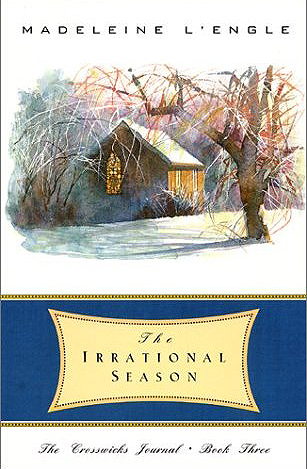
Striving to maintain some inner quiet, I casually took from the shelf a book by Madeleine L’Engle. Pure serendipity.  It’s one of The Crosswicks Journals, which I’ve shoved to the back of my mind for years, albeit they’ve been my all time favorite reads.  But how apt it is to flip through The Irrational Season, the third installment of The Crosswicks Journals, at this Christmas time.  Oh what joy to discover Madeleine L’Engle all over again.

Famous for her Newbery Award winning young adult novel A Wrinkle In Time, L’Engle was a prolific writer who had 63 publications to her credits.  Her works span from young adults to adults, fiction, science fiction, memoir, journals and poetry, with non-fiction books on faith, art, family, and humanity.  Yes, I say humanity, because L’Engle’s essays depict her strive to be human, and how her faith has defined the essence in her quest.

The Irrational Season comprises L’Engle’s ruminations on the significant events in the liturgical calendar.  And of course, it is Advent and Christmas that I dwell upon for my seasonal read.  This time, my reading has stirred in me a deeper appreciation of her insight and eloquence.

Art is for me the great integrater, and I understand Christianity as I understand art.  I understand Christmas as I understand Bach’s Sleepers Awake or Jesu, Joy of Man’s Desiring; as I understand Braque’s clowns, Blake’s poetry.  And I understand it when I am able to pray with the mind in the heart… I am joyfully able to affirm the irrationality of Christmas.

…  Christmas evoked in me that response with makes me continue to struggle to understand, with the mind in the heart, the love of God for his creation, a love which expressed itself in the Incarnation.  That tiny, helpless baby whose birth we honor contained the Power behind the universe, helpless, at the mercy of its own creation.

Cribb’d, cabined, and confined within the contours of a human infant.  The infinite defined by the finite?  The Creator of all life thirsty and abandoned?  Why would he do such a thing?  Aren’t there easier and better ways for God to redeem his fallen creatures?

And yet, in His most inscrutable, incomprehensible move, the One who called forth the universe from nothing, the Light and the Word, became flesh and drew near to us, to partake life as mortals knew it, and at the end, willingly go through an excruciating experience no mortals had ever known.  Impossible!  Utterly irrational!  And yet L’Engle embraces such an unimaginable scenario:

I live by the impossible… How dull the world would be if we limited ourselves to the possible.

And how grateful we ought to be, that such an accepting spirit pervaded in Mary’s heart and mind as well…

This is the irrational season
When love blooms bright and wild.
Had Mary been filled with reason
There’d had been no room for the child.

.

.

But now is the hour
When I remember
An infant’s power
On a cold December.
Midnight is dawning
And the birth of wonder.

*****

‘Reading The Season’ Posts over a Decade:

2020: Jack by Marilynne Robinson

2019: ‘A Hidden Life’ – A Film for the Season

2018: A Verse from Madeleine L’Engle’s The Irrational Season

2017: A Wrinkle in Time by Madeleine L’Engle

2016: Silence by Shusaku Endo

2015: The Book of Ruth

2014: Lila by Marilynne Robinson

2012: Surprised by Joy by C. S. Lewis

2011: Walking on Water by Madeleine L’Engle 

2010: A Widening Light by Luci Shaw

2009: The Irrational Season by Madeleine L’Engle

2008: The Bible and the New York Times by Fleming Rutledge 

2008: A Grief Observed by C. S. Lewis

*****

Photos: Except the book cover, all photos taken in Israel by Arti of Ripple Effects, November, 07. All Rights Reserved.

Susan Boyle’s Dream

So Susan Boyle’s dream has come true.  I’m glad I’ve participated in the process.  I’ve contributed to this whole massive dream fulfillment, albeit just a drop in the bucket… bought her CD today.  (No, I did not get this product free… there you go FTC)

The fact that Susan Boyle did not win British Got Talent didn’t affect the sales of her debut Album.  Even before its release in late November, she has broken the pre-sales record on Amazon.  Immediately after its release, her Album has broken the first week sales record for a debut album in the UK (410,000), beating U2 and Michael Jackson. In Australia (85,000), highest first week sales record, gone platinum right away.  In the US, sales reached 701,000 for just the week of Thanksgiving, surpassing the record set by Eminem in May this year for one week sales, by a gap of almost 100,000.  Needless to say, it tops the sales list in Canada as well.

So why did I bother to add another drop in the bucket?  Simple, I just wanted to show my support.  I know, the cynics would say it’s Simon Cowell, her producer, who is the one grinning from ear to ear.  Okay, if it takes Simon to realize her dream, so be it.

I’d like to see the 48 year-old unemployed single woman, church volunteer and obscure Scottish village dweller, who has been living and caring for her mother until her passing at 91, fulfill her singing dream.  In a previous post, I have written about the possible fallout of Susan Boyle’s 15-minute fame, the sensational YouTube appearance, and her later makeover.  But I’m glad it has turned out amazingly well for her.

Now to those who want her not to change but remain an uncouth, rural woman, I’d say, let her be. Although there’s nothing wrong being just that, uncouth and rural.  However, Susan Boyle can be whoever she wants to be,  get whatever hairdo she likes, buy new clothes if she wants, and smile or not smile for the paparazzi ….

I trust her dream is a genuine one, and she deserves to be noticed because of her humble root and high aspiration with its matching talent.  With more professional instructions and training, her skills could be augmented still some more.  Greater versatility means a wider repertoire, maximizing her potential.  From the few selections here on her CD, I feel that her voice can perform convincingly from Broadway show tunes to soft, quiet folk… blues and even jazz.

Just because of that, I’m a bit disappointed in the selections and some of the arrangements on this CD.  Except for her ‘I Dreamed A Dream’, ‘Cry Me a River’, ‘Who I was born to be’ and ‘Proud’, the other titles are somewhat limiting and have not given her enough range to showcase her wonderful voice.  The arrangements are all slow, with piano and/or guitar accompaniment.  At times her voice is solitary, at times blended with nice background chorus and beautiful strings.  Easy, gratifying listening overall… but I think the producers can take greater risks with her strong higher range, and the soulful, slightly raspy voice.

Here’s the track listing:

1.  Wild Horses (A nice rendition of The Rolling Stones classic.  Hear her sing this song on YouTube. http://www.youtube.com/watch?v=Yb3XAP0c8WU)

2.  I Dreamed A Dream (As if she’s the first one singing it!)

3.  Cry Me A River (A song she’d recorded in  1999 for a charity.  Shows she can do blues and maybe even jazz)

4.  How Great Thou Art (Somewhat weak arrangement, with just the four-line chorus)

5.  You’ll See (‘About determination, independence, and the ability to show them what your are made of’)

6.  Daydream Believer (A slow, even meditative rendition of The Monkees hit, my fave as a teenager.)

7.  Up To The Mountain (‘Sometimes I just lay me down Lord, no more can I do. But then I go on again, because you ask me to’… reminiscence of a spiritual. )

8.  Amazing Grace (So many have recorded this and it still feels fresh.)

9.  Who I Was Born To Be (The song says: ‘And though I may not know the answers, I can finally say I’m free. And if the questions lead me here, then I am who I was born to be.’… and then she writes: ‘Mom must have picked this for me.’)

10.  Proud (‘My dilemma was finding my own identity – a conflict… with myself.’)

11.  The End Of The World (A touch of nostalgia.)

12.  Silent Night (For Christmas … and anytime.)

What I’ve appreciated is that in the booklet, she writes a short personal note at the end of each song.  And on the last page, after thanking all who need to be thanked, she wrote these words:

I would like to dedicate this Album to my beloved Mother, to whom I made a promise to ‘be someone’.

X  God Bless

I’ve made a right choice with that drop in the bucket.

***