Tate Modern: Georgia O’Keeffe Exhibition

TUESDAY, OCT. 4

Six years ago I first visited Tate Modern. I was wowed by its ingenuity, a derelict power plant on the south bank of the River Thames converted into a modern art gallery. I didn’t hesitate to revisit this time around.

The Tate Modern was designed by the Swedish architects Jacques Herzog and Pierre de Meuron, the 2001 winner of the Pritzker Prize, the ‘Nobel Prize’ of architecture.  Their concept of maintaining the industrial motif and juxtaposing it with the artistic is a marvellous idea.  Furthermore, they have turned the massive, hollow industrial space in the centre into a welcoming people space, the Turbine Hall. When I got there on an overcast Tuesday morning, I saw people, many are families with children and babies, lay on the massive floor space, yes, actually lying down, to view the mobile, mixed media installation from the ground.

How much more ‘grassroot’ can you get? The symbolism is ingenious as the people space breaks down the barrier of ‘high art’ and ‘public art’. In another area, several large helium-filled fish ‘balloons’ floating in mid-air, kids and adults playing with them. Interactive art, like an invisible sign saying, ‘Please do touch the art objects.’

While most of the collections were free and photography was allowed, I was excited to learn their current event was a Georgia O’Keeffe exhibition, paid admission and no photography. Interesting to note that there’s no O’Keeffe works in UK public collections, thus making this exhibition all the more rare and valuable.

Before I entered the exhibition room, I only had one image in my mind: flowers. Georgia O’Keeffe was a painter of flowers, wasn’t she? And with 100 pieces of O’Keeffe’s works on exhibit, lots of flowers. How wrong I was.

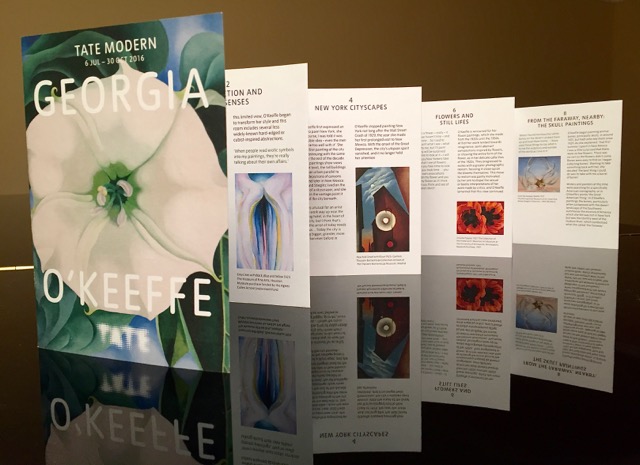
Certainly, the cover of this beautifully designed accordion pamphlet uses the iconic O’Keeffe subject of flowers, but I soon found that she was a highly versatile artist, and cerebral in style and subject matter. No photos were allowed in there so I had to take a picture of the pamphlet for you to visualize. For the rest of the post, I’m afraid I’ll have to make do with my clumsy written words to describe my experience with the magnificent visuals.
 

georgia-okeeffe-exhibition

Here’s a synopsis of the exhibition in a sequence of rooms following the life of O’Keeffe as an artist. And thanks to this compact, informative pamphlet, I’m still learning even after I’ve come home.

1. The Early Years – abstractions in charcoal, made while she was an art teacher in Virginia and Texas. There are colourful watercolours and vivid oil paintings inspired by the landscapes of both States. My fave has to be the Red and Orange Streak, 1919. So here I see Georgia O’Keeffe, the emerging abstract painter.

2. Moved to New York in 1918 and produced more abstraction while exploring other artistic possibilities such as chromesthesia, where musical tones elicit particular colours, “the idea that music can be translated into something for the eye”. This is also the period when she painted more sensory content, and for some, eroticism is evoked. I like this quote: “When people read erotic symbols into my paintings, they’re really talking about their own affairs.”

3. O’Keeffe, Stieglitz and their Circle. As muse, collaborator, and finally spouse of photographer Alfred Stieglitz, O’Keeffe is presented in photography in this section. I find O’Keeffe’s personal portraits particularly revealing; Stieglitz’s portraits of her all exude a special boldness and independence. Here we see her beginning fondness of clouds, depicted in A Celebration 1924, the year they married. Clouds evolving into petals later?

4. O’Keeffe the New Yorker. I never knew. Here I see her stylistic depiction of the urban cityscape of NYC. O’Keeffe and Stieglitz lived on the 30th floor of a skyscraper, a convenient vantage point to paint tall buildings. “… I think that’s just what the artist of today needs for stimulus.” After the 1929 Wall Street crash, however, she moved out of NYC. The vision of the urban promise dismantled with the market crash.

5. Upstate, New York, Maine, and Canada. Lake George, trees, clouds, apples and leaves. For a change, from metropolitan New York to Nature.

6. Finally, we begin to see her flower paintings. They are huge. The photo of the pamphlet cover above, Jimson Weed/ White Flower 1, 1932, is 48″ x 40″. BTW, I just checked online, that painting is the world’s most expensive painting by a woman. Walmart heiress Alice B. Walton bought it for $44.4 million in 2014. I should have looked at it a while longer. But from the short stop when I stood in front of it, I could see the gradual change of light and shadow on the petals, meticulously painted. Most impressive was the sheer size of it.

Why paint a tiny flower this big? Here’s O’Keeffe’s answer:

“Nobody sees a flower, it’s so small… I’ll paint it big and they will be surprised into taking time to look at it… I will make even busy New Yorkers take time to see what I see of flowers…”

7. New Mexico: Taos and Alcalde. Paintings of the vast, horizontal expanse of the land in contrast to the vertical, tall skyscrapers of NYC, earth-built dwellings, crosses, Native American and Spanish colonial features. In Taos O’Keeffe met Ansel Adams and other artists.

8. O’Keeffe found the white bones and animal skulls left on the barren Southwestern desert a worthy subject for her paintings. A sharp, harsh contrast with the soft petals of flowers, but the light and shadow gradients convey the same fondness from the artist’s eyes.

9. Red earth, pink cliff of the landscape in the Southwestern expanse. O’Keeffe discovered Ghost Ranch, a tourist attraction and later bought her first home there. During the 1930’s to the 40’s, she delved into the area with immense passion, especially the flat-top mountains or mesa.

10. White Place and Black Place, two locales she continued to stylize in her painting. From the realism of the earthy desert expanse shifted to more stylized contrast of white and black.

11. The artist continued her focus on bones, in particular, the holes in them; when she lifted them up towards the sky, the blue piercing out from these holes. The bones too are symbols of death and destruction, a parallel of WWII and the death of Stieglitz in 1946.

12. The Southwest and Native American influences on her subjects while living in New Mexico during the 1930’s and 40’s.

13. Lastly, from landscapes to skyscapes. I was confronted with another huge painting, inspired from her airplane travels during the 50’s and 60’s: Sky Above the Clouds III, 1963. Since I couldn’t take any pictures at the exhibition, I just have to do this. Here, take a look at this photo of the pamphlet, section 13 on the right. The painting is on there. Clouds like ice floes against a distant, pinkish sky.

sky-above-the-clouds


Definitely more than just flowers.


 ***

Related Posts on Ripple Effects:
 Tate Modern and Billy Elliot

Alex Colville and the Movies 

Art Gallery of Ontario

Beauty and Terror


Saturday Snapshot Oct. 15: Five Days in London

About this time last year I’d just finished a Thelma-and-Louise kind of road trip (exclude the ending, of course) to New England with my cousin to see fall foliage. The series of travel posts begins here.  This year, it’s London, England.

Here are the highlights of our short, five-day escape to London on the week of Oct. 3-7. Detailed blog posts to come.

MondayThe Go-Between at the historic Apollo Theatre (since 1901) on Shaftesbury Avenue. Leading star is Michael Crawford, the original Phantom.


Apollo Theatre.jpg

gb

Tuesday — Tate Modern, Georgia O’Keeffe Exhibit. No photos allowed for that exhibit, but I was free to take artworks from other areas in brilliant Tate Modern. Here’s one I love the best. View from its 10th floor observation level:

img_4373


Wednesday — Day trip to Cambridge:

Cambridge.jpg

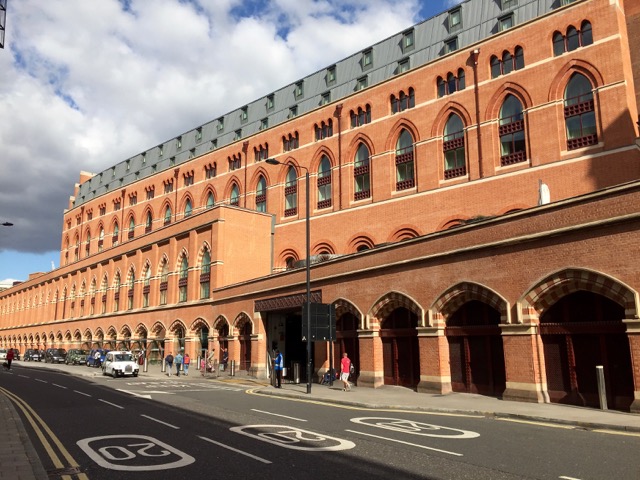
Thursday — The British Library, King’s Cross and the St. Pancras Stations. Why a train and tube station could be the highlights of the day? Wait and see. Here’s St. Pancras Station:

St. Pancras Station.jpg

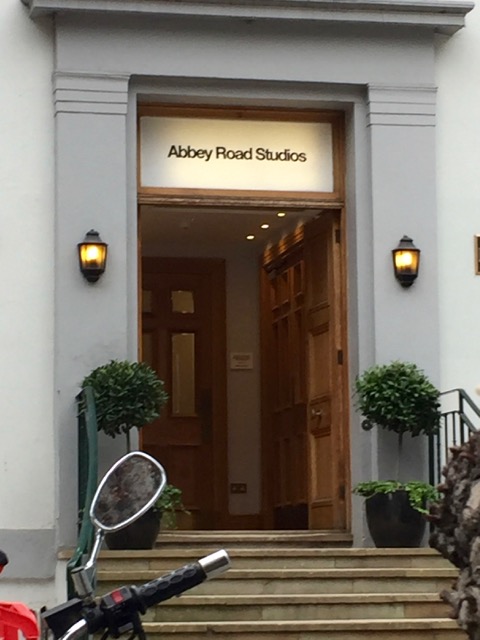
Friday — Which zebra crossing (those in N. America, no zebra, just pedestrian) is a point of interest for world visitors?

Abbey Road Studios.jpg

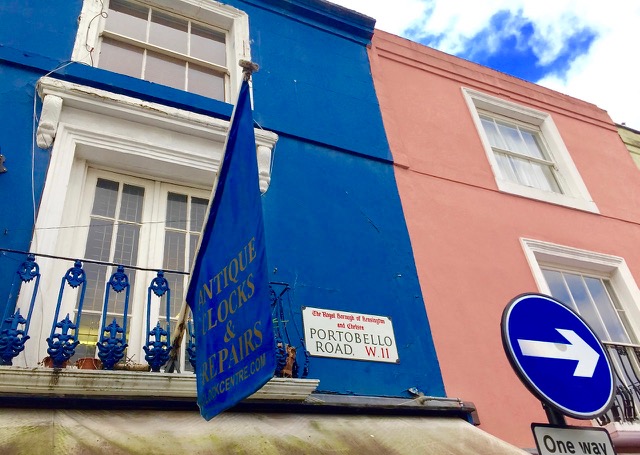
And which movie puts a community and street market on the to-see list of visiting cinephiles and antique hunters?

Portobello Rd (1).jpg


Detailed London posts coming up.

***

Saturday Snapshots is hosted by West Metro Mommy Reads. CLICK HERE to see what others have posted.

Paterson: Of Pug and Poetry

Some movies are like the roaring ocean, waves mounting upon waves rousing up excitement, eliciting continuous, sensational reactions. Some are like a bubbling brook, smaller but still boisterous, teeming with life and sounds. The film Paterson is a quiet stream, water gently flows along, seemingly uneventful, and yet, you can sit there by its side and just watch its quiet swirling.

Paterson has been screened at many film festivals this year. I missed it at TIFF, glad I could catch it when I came home to CIFF. For a film about poetry and a loving couple (not dysfunctional, for a change) with a British bulldog named Marvin, a character in his own right, and helmed by a Palm d’Or winning director, it’s got to be a unique experience.

Director Jim Jarmusch has been garnering accolades at the Cannes Film Festival since 1984, with his early feature Stranger Than Paradise. His most commercially known work probably is Broken Flowers (Cannes Grand Prize of the Jury, 2005) with Bill Murray and Julie Delpy. This year, Paterson has once again brought the director to Cannes as a nominee for the prestigious Palme d’Or. 

Jarmusch ought to be applauded for making a film on poetry, for who in this day of mega explosive, blockbuster productions would think of turning Williams Carlos Williams’ poetic notion into a movie. Yes, WCW himself was a resident of Paterson, New Jersey, and his 5-volume epic poem Paterson must have been the source inspiration for Jarmusch.

paterson

The movie Paterson is about an admirer of WCW and an aspiring poet whose occupation may be furthest from the creative process. But that’s exactly the point. Where do we get inspirations and ideas? What kickstarts our creative process? Do we need to climb to the top of the mountain, soak up a magnificent sunrise to unleash our creativity? Apparently not.

We see in the film that the most mundane of everyday objects, like, a box of matches, can spark off a new poem. Jarmusch has his own style of cinematic poetry making: the deadpan, casual expressions of his main character, thus, embedding humour in the serious. Adam Driver (While We Were Young, 2014) is probably the best person to star in this film, not only in name, but in his demeanour. He is Paterson, a bus driver with a daily route of driving bus route no.23 around the small town of Paterson, New Jersey.

We follow Paterson for a week. He gets up at the same time, around 6:20 am, plus or minus 5 minutes, eats his breakfast cereal, carries his lunch box and goes to work. He drives his no. 23 route around town, overhearing passengers’ small talks, brewing in his mind thoughts and ideas, writing down lines in a note book when he has a chance, has his lunch sitting on a bench overlooking the Great Falls of the Passaic River, then back to work. After work he goes home, has dinner with his loving wife Laura (Golshifteh Farahani), walks the pug Marvin, ties him outside the bar, goes in and have his beer, chats with bartender Doc (Barry Shabaka Henley), meets the regulars Everett (William Jackson Harper) and Marie (Chasten Harmon) and listens to their stories, then walks Marvin back home and sleep.

As viewers we see this seven times over. Reminds me of Groundhog Day (1993). But Jarmusch is clever in sprinkling subtle humour and surprises, quite like life. Paterson is a contented soul, driving a bus may be as fulfilling as writing poetry. Wife Laura is more experimental, and takes charge of her creative expressions more explicitly, like learning the guitar to reach her dream of being a country singer, like interior decorating her home according to her obsession with black and white, or baking cupcakes in her own signature style as a step to opening her own cupcake store. Whatever, the two are a loving, contented couple. Creativity manifests in various ways.

Marvin.jpg

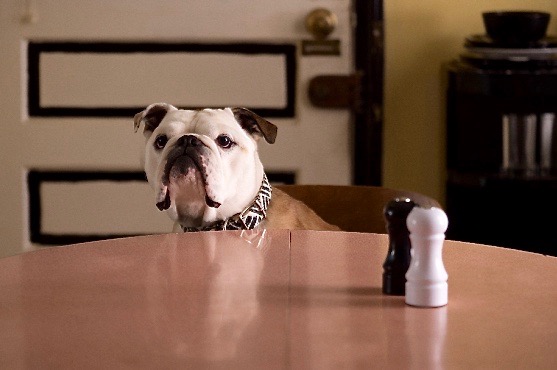
And then there’s Marvin, who may be the best pug in pictures. He has a role to play too in this mundane plot. His story line is, again, life as well.

That’s about all I’ll reveal about the movie without giving out the spoiler, yes, even for this seemingly uneventful film. But as I write, I’m thinking of another matter. This film is probably screened only at very limited cities, at arthouse, independent cinemas. So, why am I writing about a film that not many of you will actually be able to see? What exactly is the relevance of writing something that few may relate to? Or… is the review a piece of writing that readers can respond to despite not experiencing the film itself?

If you have some thoughts on this, I’d appreciate your input. Throw your two pebbles into the Pond and create some ripples so I’d have an idea.

Having poured out this puzzling thought that has been troubling me for some time, I’m reminded of Paterson’s poetry writing in the basement of his home, his notebook filled with his private thoughts and lines, which nobody has ever or will ever read. What’s his purpose then?

~ ~ ~ 1/2 Ripples

***

Other Related Reviews on Ripple Effects:

Silence the Movie Arrives in the Most Unwelcome Time

While We Were Young: Wearing the Hat of Authenticity 

A Quiet Passion (2016) at TIFF16

Notes From The Dark

This post is a little different from my usual Saturday Snapshot.

I’ve been asked how I remember so many details from a movie after just watching it once. Well, of course I can Google for some of the info, but to jot down lines and scenes that I don’t want to forget, I take notes.

How do you take notes inside a dark theatre? I used to bring along a small note book, fold the corner of the page to start with, and just use my pen to write whatever I could on the small pages… usually just a few words a page, for I didn’t want to overlap my writing. When I went home, I often had a hard time deciphering what I’d written.

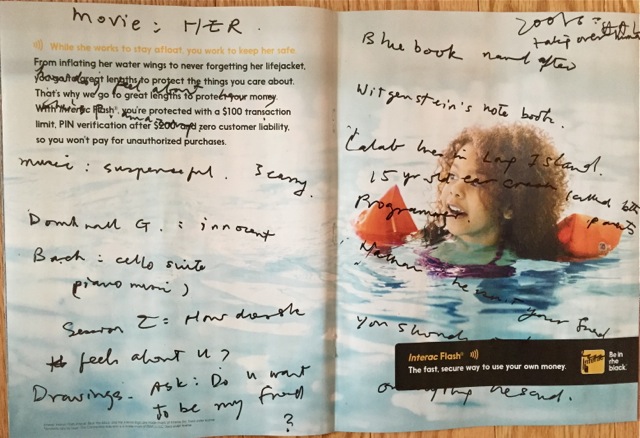
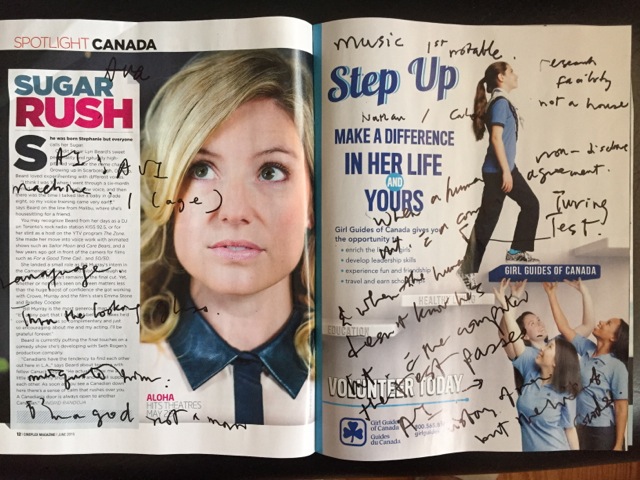
But recently I found a perfect way. Instead of a small notebook, I take with me into the movie a copy of Cineplex magazine, lots of those in the stands at the theatre. Before the movie starts, I fold down the corner of the pages that have some blank or lighter space, take out a permanent black Sharpie marker pen, and I’m all set for note taking in the dark.

I don’t take my eyes off the screen when I write. So you can say it’s blind writing in the dark. Here are some of the pages of notes I’d taken recently. For interest’s sake, I’ve included the movie I was watching when making these notes. They make fun, altered book pages, don’t you think? And the effects of words on the page are all serendipitous too. And oh, if you suddenly remember some errands you forgot to do, you can jot that down too.

A View from the Bridge, National Theatre Live. I’ve a little drawing of the stage and seating here:

Dark Notes

View from the Bridge 1

**

Here are the pages from watching the movie Ex Machina (Review coming):

Ex Machina

Ex Machina 4

Ex Machina 1

Ex Machina 2

Ex Machina 3

When memory fails, mnemonic devices save the day all the time. Just need to channel a little creativity.

***

Saturday Snapshot is hosted by West Metro Mommy Reads. CLICK HERE to see what others have posted.

Saturday Snapshot May 16: Silhouettes

Often when I’m outdoor, the light, shadow, direction of the sun and the time of day are less than ideal for photography. That’s the time when I see beauty from another perspective. The lack of light on the subject, or when it’s backlit, makes it all the more intriguing.

I’ve learned to appreciate silhouettes. They are more soulful and quiet. When devoid of colour, I can see more clearly the subject’s shape and form, and its solitary existence. Here are some photos I’ve taken lately… a kind of Wabi-sabi.

The slow and meditative movement of the Great Blue Heron:

GBH

Great Blue Heron

Great Blue Heron Flying

Look at the shadow in the water, like a Chinese brush stroke:

Chinese brush painting 1


A solitary Belted Kingfisher:

Belted Kingfisher


Cattails by the pond in the evening light:

Cattails


Guess who’s still busy at dusk:

Beaver

***

Saturday Snapshot is hosted by West Metro Mommy Reads. CLICK HERE to see what others have posted.

Photos Taken by Arti of Ripple Effects

Do No Copy or Reblog

***

Woman in Gold (2015): Then and Now

Gustav Klimt (1862 – 1918) was an Austrian Symbolist painter and one of the most prominent members of the Vienna Art Nouveau (Vienna Secession) movement. His major works include paintings, murals, sketches, and other art objects, but the most recognizable piece probably is the painting “Portrait of Adele Bloch-Bauer I” (1907), commonly known as “The Woman in Gold”.

The painting measures 54″ x 54″, oil, silver and gold on canvas, a highly embellished work reflecting the elegant lady active in the Viennese art circle, patron and muse of Klimt’s, Adele Bloch-Bauer. Adele was married to Ferdinand Bloch-Bauer, an Austrian Jewish industrialist who commissioned Klimt to do the two portraits of his wife. It had been hanging in his home until seized by the Nazis.

Portrait of Adele Bloch-Bauer I
Source: Wikipedia

After the war, the famous painting had been hanging in Austria’s federal art museum, the Galerie Belvedere, as a national treasure, until a near eight-year legal battle finally decided its restitution back to the hands of Adele and Ferdinand’s niece, Maria Altmann, who had escaped to the United States before the War broke out. The long legal fight to gain back the painting’s rightful ownership is the focus of this movie.

Arts looted by the Nazis have their screen time twice in the past year, first The Monuments Men, and now Woman in gold. Important subject but unfortunately both films fall short of cinematic rendering. Director Simon Curtis’s handling in Woman in Gold emits less glimmer than his previous My Week with Marilyn.

Helen Mirren delivers a fine performance as the determined yet conflicting Altmann, who, on the one hand, wants to see justice done in the restitution of her family heirloom but reluctant to re-open a traumatic chapter of her life and return to Austria for the case. She remembers her Aunt Adele well, with some endearing and awestruck moments beholding her beauty. The film handles the shifting between the past and present quite well. It is heart wrenching for a daughter to have to make a hasty escape from her home, leaving her parents behind as the Nazis take over the country.

The David and Goliath legal battle is handled by a young and inexperienced Los Angeles attorney E. Randol Schoenberg. Yes, that’s the grandson of the Austrian composer Arnold Schoenberg, who had escaped to the U.S. in time to avoid the Holocaust, just like Altmann. In 2004, the young lawyer argues his case Republic of Austria v. Altmann in the U.S. Supreme Court, and in January, 2006, heads over to Austria to present his arguments in front of a panel for a binding arbitration. An emotional Altmann sits beside Schoenberg as they hear the decision announced by the panel of three Austrian judges ruling in their favour.

The choice of Ryan Reynolds as Randol Schoenberg looks like a miscast. Something’s missing… But then again, it could be the screenplay, maybe infusing more cinematic moments, or cutting some banal scenes and dialogues would help. Katie Holmes who plays Randol’s wife and Daniel Brühl (excellent in Rush, 2013) as a helpful journalist are incidentals. I can understand condensing the almost decade-long legal story into 109 minutes with an ending that is already known is itself a difficult feat. So all the more we need a more effective screenplay.

However, for someone who did not know about the details of this piece of art history, the movie still captured my attention. I watched it like a documentary. Not knowing the details of this legal case, I found the movie informative in taking me through the obstacles, albeit in synopsis format and simplification.

The beginning is probably one of the most appealing sequence of the whole movie, and that’s a close up on the technique the painter Klimt uses on his painting, meticulously forming a gold leaf and pasting it on his work in progress. Unfortunately, the scene is way too short to allow us to savour. This may well be the only artistic spot a viewer will get.

In a post-script text, we learn that Altmann sold “The Woman in Gold” to Ronald Lauder for $135 million in 2006, at the time the highest purchase price on record for a painting. Those living in or visiting New York City now have a chance to see the current exhibition at the Neue Galerie – opened by Lauder in 2001 – “Gustav Klimt and Adele Bloch-Bauer: The Woman in Gold”, April 2 – Sept. 7, 2015.

In August last year, Lauder, as President of the World Jewish Congress, wrote a moving op-ed for the NYT about the persecution of Christians in the Middle East and Africa. He ends with this: “The Jewish people understand all too well what can happen when the world is silent. This campaign of death must be stopped.”

It’s all about speaking out. That’s what makes this movie important. I can’t help but imagine though: what if it were Klimt who made it…

~ ~ 1/2 Ripples

***

Alex Colville and the Movies

“It’s the ordinary things that seem important to me.” — Alex Colville Whenever I go to Toronto, The Art Gallery of Ontario (AGO) is always a must. As if to correspond with The Toronto International Film Festival, the current exhibition of more than 100 pieces of works by Canadian artist Alex Colville is a timely offering. Before my visit to AGO I’d looked up some info on Toronto born Alex Colville (1920-2013) who later moved to Nova Scotia and became an icon of Canadian art. His “Man on Verandah” (1953) set the record as the highest auctioned price recorded for a living Canadian artist in 2010. He was then 90 years old. The realism of Colville’s paintings at first reminded me of the American painter Edward Hopper. But a closer look at his meticulous renderings and precise details, I had the feeling that I was looking at a photograph, but the dramatic depictions made them look more like movie stills. As I walked through the exhibits, my inkling was confirmed. The quote on this banner may well set the tone as one enters the exhibition hall: EnteringAs soon as I stepped into the gallery, I saw this familiar work but only then did I find out its title: “To Prince Edward Island” (1965):

Alex Colville

Adjacent to the painting is a movie clip projected on the wall, showing Colville’s influence on the director Wes Anderson. Of course, that’s Suzy from Moonrise Kingdom (2012). The ever watchful female gaze through the binoculars. Both works exude mystery and nostalgia:

Moonrise KingdomApparently Colville’s influence can be found in several other filmmakers. In the exhibitions I was led to view samples of some close associations.

Artists influence each other. Colville’s “Target Pistol and Man” (1980) could be the inspiration for the Coen brother’s imagery of the psychotic and sinister character Anton Chigurh in No Country for Old Men (2007). But of course, one could argue that the movie was based on Cormac McCarthy’s book (2005). So it could be McCarthy being first spooked by Colville’s depiction of this cold, hard, and unpredictable character in the painting:

Pistol and Man

Further down the exhibits, I was confronted with a set of four Colville paintings in the scenes of Stanley Kubrick’s famous horror film The Shining (1980), adaptation of Stephen King’s novel. Too ‘in-your-face’? Some critics think so. No matter, I’m not posting them here to avoid sensationalism.

However, as I walked through the exhibits without any explicit prompting, I could indeed draw connections between some of them and the movies I’ve seen. Here are a few more examples:

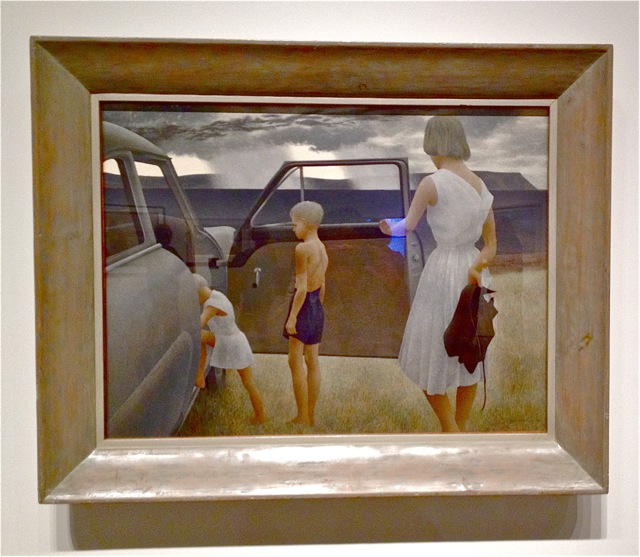
Just when you think you’re going to have a good time taking the children on an outing, maybe a swim or a picnic, and then you see the rainstorm approaching.

Family and Rainstorm (1955):

Family & RainstormJust like the ending scene of A Serious Man (2009) by the Coen brothers, impending storm in the school yard. The unpredictable and precariousness in everyday life.

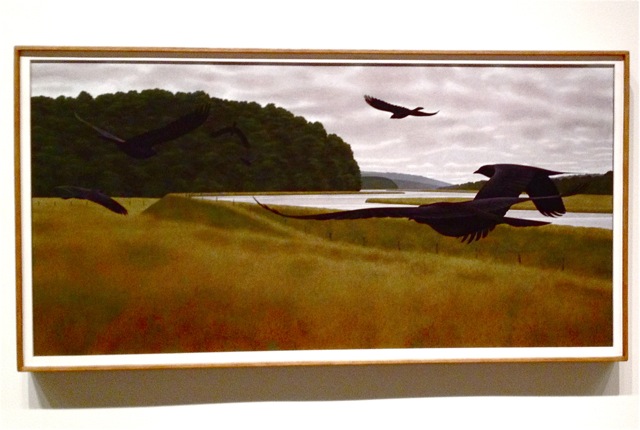
Or, how about this, which movie does this painting “Seven Crows” (1980) lead you to think of:

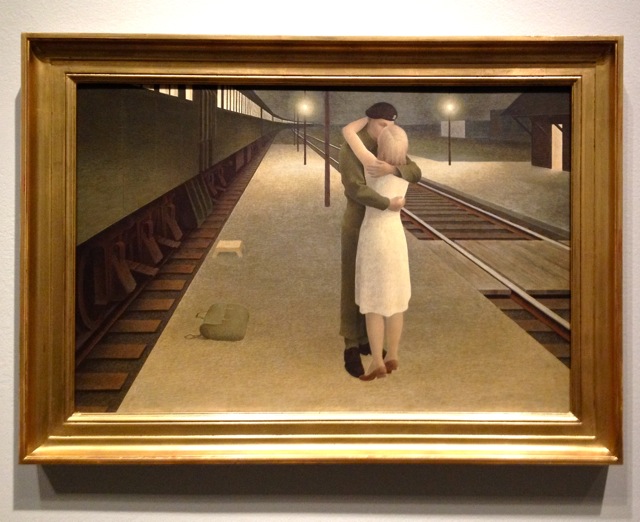
Seven CrowsOr this one, “Soldier and Girl at Station” (1953):

Soldier and Girl at Station“Anxiety is the normality of our age,” Colville had said. I could totally feel it while looking at his works.

**

To correspond with my weekly photo meme, I’m linking this post to Saturday Snapshot Sept. 27 hosted by West Metro Mommy Reads. CLICK HERE to see what others have posted.

***

Some related post on Ripple Effects:

Art Gallery of Ontario

AGO Exhibition: Terror and Beauty

Bernini’s Corpus and Mordern Movies

Edward Hopper, William Safire: The Visual and the Word

***

AGO Exhibition: Terror And Beauty

The Art Gallery of Ontario, AGO, is a must-see whenever I visit Toronto. Not only because I’m a Frank Gehry fan who never gets tired of looking at the centre spiral staircase in there, but the exhibits are always intriguing and thought-provoking. Spent a few days in Toronto last week and this time, I was much gratified to view the current show at AGO: “Francis Bacon, Henry Moore: Terror and Beauty”.

Terror and Beauty, the motif resonates with the idea of Wabi-sabi. I’ve explored visually the notion of Wabi-sabi before. Two seemingly incompatible states juxtaposed against each other, beauty and sadness.

“You can’t be more horrific than life itself” says a quote from Francis Bacon on the AGO’s Artist page. The exhibits speak to that by extracting from the horrors of WWII and other forms of human sufferings and struggles depicted in the works of these two 20th century Irish/English artists who were contemporaries of each other.

The exhibit is a wealth of surrealist works from Bacon, and sculptures and drawings from Moore. But I was particularly captivated by the WWII items. While Moore is well-known for his abstract sculptures of the human body in larger than life poses, here’s a rare chance to see his more personal, wartime drawings.

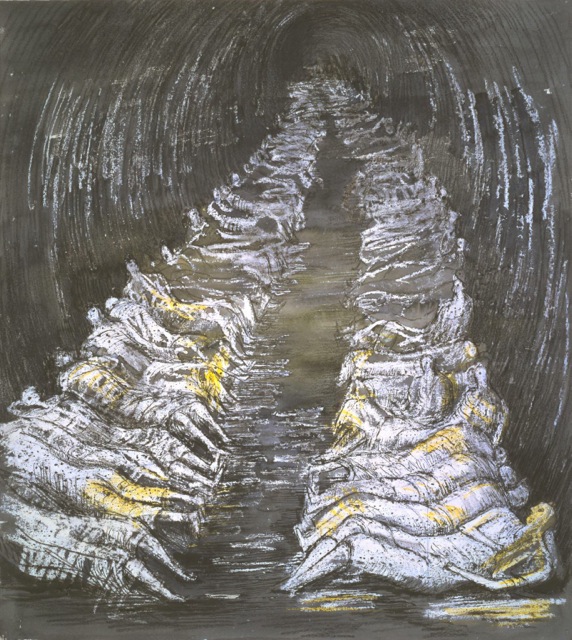
Going home one evening in 1940, as he entered a London subway station, Moore discovered crowds of people sleeping on the platform to take shelter from an impending German air strike, the Blitz. He was taken aback by what he saw and his later drawing was a ghastly interpretation:

Tube Shelter Perspective 1941 by Henry Moore OM, CH 1898-1986

Photo Source: http://www.tate.org.uk/art/artworks/moore-tube-shelter-perspective-n05709

That’s Moore’s view of the underground subway station used as impromptu bomb shelter. But what was it really like in those tube stations? That’s when I was totally captivated by the photos of the renowned photojournalist Bill Brandt displayed alongside Moore’s shelter drawings.

Rather than horrific depictions, I was utterly surprised by the actual photographs by Brandt, who acted as official war photographer. His noir and darkened perspective is haunting and yet, full of mystique and beauty.

What I saw was an opposite interpretation of the subway scene: rather than terror, I saw resilience. Indeed, the London populace came out in droves to seek shelter in the subway, a much safer haven than their own homes. What I saw in many of Brandt’s photographs was the strong sense of ‘life goes on’.

Two photographs in the exhibition will forever remain in my mind.

First is the Liverpool Street Underground Station Shelter during an air raid in November, 1940. The photograph shows a family sleeping soundly, bedding against the grooves in between the steel structures of the tunnel. But look more carefully, there’s even a bunk and blanket for a doll beside the child. They all look peaceful and calm.

For the archive in my mind, let me call this photo: “The Doll in the Subway”

Sleeping in the subway bunk-child & doll

© IWM Non-Commercial License http://www.iwm.org.uk/collections/item/object/205194652?cat=photographs

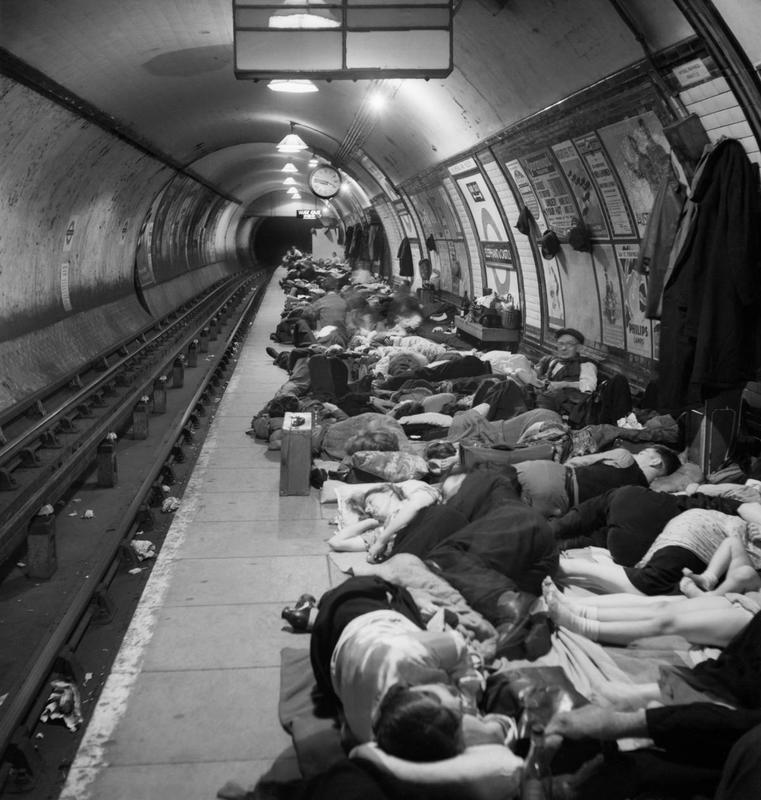
The second picture by Brandt is in the Elephant and Castle London Underground Station Shelter. Here, people sleeping on the crowded platform while taking shelter from German air raids during the Blitz.

But look how they were dressed in. The mid-heel pump the woman in the foreground was wearing caught my attention. Looks like she was dressed for work. Blitz or no Blitz, after she woke in the morning, she had to go to work. Life as usual.

In my mental archive, this photo will now be entitled “The Mid-heel Pump”.


The mid-heel pump

© IWM Non-Commercial License http://www.iwm.org.uk/collections/item/object/205194638

What more, after civilians had crowded into the subway stations against government’s advice, the officials had to respond with helpful measures by installing chemical toilets, first aid facilities, and providing drinks, while the people created their own entertainment. With all due respect to the victims of the Blitz, the resilience and adaptability of the Londoners are most inspiring.

After I stepped out of AGO, I wanted to go back in to take a more careful look at the exhibits again. But that was not feasible so I had to write this post from memory (no photos of the exhibits were allowed) and from some online digging. Glad to have found these two  memorable images from the Imperial War Museum website. Thanks to AGO, these two historic photos will remain in my mental archive for a long, long time.

CLICK HERE to see 9 Incredible photos of the London Underground as Bomb Shelter.

***

Related Posts on Ripple Effects:

The Frank Gehry designed Art Gallery of Ontario

Sketches of Frank Gehry (2005)

Art Gallery of Alberta


Saturday Snapshot May 31: After the Rain

Ever since I first read Annie Dillard, I’d wanted to see Puget Sound. But after all these years, I’ve been firmly rooted in the foothills of the Rocky Mountains in Alberta. My neck of the woods is a boreal forest. So, I’m more at home with spruce trees than sandy beaches. Puget Sound will have to remain on my bucket list.

All through winter, spruce and pines are sustenance, the bulwark and shelter for birds and small creatures that stay behind, and me.

After two days of spring rain, I ventured out just when it broke clear slightly, and was mesmerized by the greens. From among the hardy spruce, the aspens burst out to embrace spring.


Walking into the green Ripple Effects


The tall, slender trunks, each a natural canvas


Aspens


Colours and textures wrapped around


Nature's canvas


and moss as paints.


Moss on branch


Moss on tree stump


Nature’s artwork

Moss on tree trunk


Moss or fungus? No matter. Here’s life

Moss, Fungi, or Ivory?


Monet in Nature

DSC_0296


And I couldn’t resist the capture, even though just a common sparrow, obscure, blocked by a branch:

Sparrow


Nature’s Artist at work in Annie Dillard’s Puget Sound as well as my Boreal Forest. Her descriptions are strikingly close to what I had experienced.

“I see a hundred insects moving across the air, rising and falling. Chipped notes of birdsong descend from the trees, tuneful and broken; the notes pile about me like leaves.”


Despite geographical distances and variance in environs, her words resonate:

“Time and space are in touch with the Absolute at base.”

– Annie Dillard, Holy The Firm

***

Saturday Snapshot is hosted by Melinda of West Metro Mommy Reads. CLCIK HERE to see what others have posted.

 Photos in this post taken by Arti of Ripple Effects

Do Not Copy or Reblog

***


The Budapest Hotel: A Grand Escape

“But it doesn’t mean anything.”
“So we put in words. One word for every note, like this…”

— ‘Do-Re-Mi’ from The Sound of Music

Does music need words to make it meaningful? Do we have to find a message in a work of art before we can appreciate it?

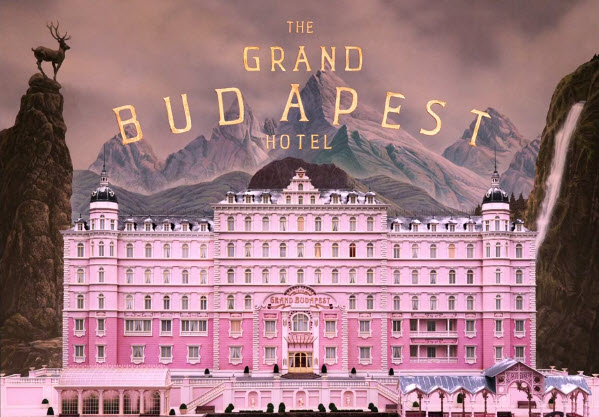
the-grand-budapest-hotel movie poster

Here we are with a cinematic piece that can’t be ‘explained’. What genre? What theme? What purpose? I’m not going to bother. As with my experience of watching previous Wes Anderson movies, somehow, I feel I need to let my rational side relax and just enjoy the ride. Rushmore probably has more of a traditional storytelling mode and thematic content. But with The Royal Tenenbaums, I have to adjust the quirky frequency to high, it’s a totally different kind of viewing experience. Fantastic Mr. Fox, I was mesmerized by the stop-motion animation and humour, great voices add to the lively adaptation of Roald Dahl’s story. Moonrise Kingdom, I wasn’t fully gratified but by then, I was used to the Wes Anderson style of ‘magical realism’.

That ‘magical realism’ strikes again in The Grand Budapest Hotel. Not my favourite colour palette, red and pink, by I was totally captivated as soon as the film began. I was being led into a fairytale world of real life people. From the cinematic framing, it aptly demonstrates the idea of symmetry. In many frames, the subject is right in the centre, almost perfect symmetry on both sides of the screen. But does it mean anything? One might ask. If we have to be rational about it, shall we just say, for the effects of a neat and tidy piece of the old world. Framing nostalgia before the world becomes too distorted, too inhumane. This is, after all, 1930’s Europe. And we can see the parallels in signs and symbols especially towards the end of the movie when uniformed men take over the Hotel.

Grand Budapest Signs & Symbols

Wes Anderson credits Stefan Zweig in creating The Grand Budapest Hotel. The Austrian writer’s name is shown at the very beginning of the end credits. In numerous interviews, Anderson pays tribute to Zweig’s whole collection of works, a writer who is noted as once ‘the world’s most translated author’. Zweig is a relatively new discovery for Anderson but so deeply has the writer inspired the filmmaker that ‘it’s basically plagiarism’, Anderson joked at the news conference when the film premiered at the Berlin Film Festival.

As someone who is much intrigued by the creative process of adapting books into films, I did read some Zweig before watching Budapest. I must be reading the wrong works though, I’d thought. From the novella Chess Story, to a few of the stories I read in the new collection recently translated into English, all tell very gloomy tales. The writings almost exude a sense of despair, as the characters are mostly running away from persecutions and ethnic cleansing, or memories thereof, even driven to madness as the chess champion Czentovic in Chess Story, albeit some descriptions embed a subtle trace of humour.

Maybe along the notion of ‘Wabi-sabi“, beauty and sadness, what Zweig has done subtly and now Anderson explicitly is to extract and fuse “humor and sadness”. Here in Budapest, writer/director Anderson has freely utilized the element of fantasy and fun to paint the passing of an old world, a realism too sad for millions in 1930’s Europe, Zweig being one of the subsequent victims. To escape the incendiaries of Nazism, Zweig and his second wife moved to England, then to the U.S., and finally to Brazil in 1940 where he ultimately committed suicide together with his wife in 1942, leaving a note of utter despair as he saw Nazism dominating Europe and his former homeland Austria.

In this fictitious Republic of Zubrowka, where The Grand Budapest Hotel is situated, Anderson offers us a great escape despite setting his story within the brewing tension of 1930’s Europe. The story begins with a closer to present day author (Tom Wilkinson) reminiscing upon an extraordinary experience which has inspired his book The Grand Budapest Hotel.

The Concierge Desk and Main Staircase

Years ago when he was still a young writer (Jude Law), in finding cures for writer’s block, he had retreated to a mountain hotel The Grand Budapest and in there met its owner, Mr. Moustafa (F. Murray Abraham). Known as Zero when he  himself was just a lobby boy in an age long passed, the owner told the writer his story of how he came to inherit this grand piece of property, albeit in a run-down shape now. Someone volunteering an extraordinary life story to an author in an exotic locale, the beginning of Budapest reminds me of Life of Pi, another great tale of magical realism.

But the movie belongs to Ralph Fiennes as the hotel Concierge and go-to person for all sorts of favours, M. Gustave. The death of long time patroness of the Hotel Madame D. (Tilda Swinton) has dragged M. Gustave and his protégé, the new lobby boy Zero, down a rabbit hole of misadventures and fortunes. Fiennes has proven that he is a versatile actor that can be as evil as Amon Goeth in Schindler’s List, or as madly romantic as Count Almasy in The English Patient, or as charming and fun here in Budapest. His comic timing is first-rate, his expressions, spot-on. My long-range forecast, an Oscar nom awaits him next year for his role in Budapest.

Gustave & Zero

The line-up of talents is long, not just in acting, where we find the usuals of Wes Anderson movies like Edward Norton, Tilda Swinton, Bill Murray, Owen Wilson, Adrien Brody, Willem Dafoe, Jeff Goldblum. Saoirse Ronan (breakout role as young Briony in Atonement) as Agatha the pastry maker is adroit and whimsical. She’s well matched to the young lobby boy Zero, aptly played by Tony Revolori.

The movie is also marked by the delightful compositions of Alexandre Desplat, whose musical scores adorn many notable movies in recent years. A collaborator with Anderson since Rushmore but here, Desplat’s scores captivated me early on with the lively East European themes and in particular, the Russian folk melodies. Some instruments that we seldom hear in other films are distinctly alluring, such as balalaikas, zithers, dulcimers, and organ, with full orchestral rendering. Another long-range forecast, Oscar for original score.

And then there’s the make-up of Tilda Swinton, the art work and production design of the whole Budapest experience (even the parody painting “Boy with an Apple” is an original art work by English painter Michael Taylor from a real life model), the flowing editing, the original screenplay and directing, the cinematography, Budapest Hotel is going to be one grand entry in the next Academy Awards.

~ ~ ~ 1/2 Ripples

 ***

Read a related post: How Zweig Inspired Anderson’s The Grand Budapest Hotel

Awards Update:

Feb. 22, 2015: Oscars for Best Costume Design, Make-up, Production Design, Original Score.

Feb. 14, 2015: Wins Best Original Screenplay from WGA.

Feb. 8, 2015: 5 BAFTA wins, Original Screenplay, Original Music, Production Design, Make-up and Hair, Costume Design.

Jan. 15, 2015: 9 Oscar noms, Best Picture, Best Director, Best Original Screenplay, Cinematography, Editing, Production Design, Make Up and Hair-Styling, Costume Design, Original Score.

Jan. 11, 2015: Golden Globe win for Best Motion Picture – Comedy or Musical

Dec. 11: 4 Golden Globe noms for Best Motion Picture – Comedy or Musical, Wes Anderson for Best Director and Best Screenplay, Ralph Fiennes for Best Actor – Comedy or Musical

Dec. 10: SAG nom for Best Cast in a Motion Picture

Dec. 7: The Grand Budapest Hotel wins Best Screenplay and Best Production Design at the L.A. Film Critics Awards

Dec. 1: The Grand Budapest Hotel just wins Best Screenplay from the New York Film Critics Circle

Related Links:

From BBC CULTURE: The Writer Behind Budapest Hotel

From NPR: The Rise and Fall of Stefan Zweig

The Music Behind the Screen

The Untold Story Behind ‘Boy With Apple’

Saturday Snapshot February 15: Windows & Doors

By now, I’m sure many of you are tired of looking at white and greyish stuff, be it snow, or its liquid form. Let me take you on my escapade to Provence, France, and continue to bask in some warm colours.

This time, we’re looking at windows and doors. Again, they are photos from my trip to Avignon and Arles in the summer of 2010.

Blue Windows in ArlesShop windowAvignonSix windows in ArlesPink window

A shop window

Yellow windows2 blue windows

Now here’s the trick: Choose a photo. Look intensely at it for one minute then close your eyes and let the image imprint in your mind. When you reopen your eyes, I’m sure you won’t see white. Let’s just dream a little dream of warm summer daze.

Saturday Snapshot is hosted by Melinda of West Metro Mommy Reads. CLICK HERE to see what others have posted.

***

ALL PHOTOS TAKEN BY ARTI OF RIPPLE EFFECTS.
DO NOT COPY OR REBLOG

Saturday Snapshot January 11: Inspired by Llewyn Davis

The movie Inside Llewyn Davis strikes me with its overall atmospheric tone colour. The almost black-and-white, cyan greyness that shroud the scenes convey a pervasive sense of melancholy. While I was seized by the gloominess, I also saw the beauty in the cinematography.

And the snow. During his trip to Chicago, Llewyn has to tread through snow on the streets, without a winter coat, without proper shoes. His socks are soaked through.

I took these two snow photos just recently. At first I wasn’t pleased with their lack of colour. But after watching the movie, I’ve come to appreciate them more. These are all colour photos, not black and white:

Snowflakes

Snowflakes 2

Without any green, trees can still be beautiful.

Tree

Trees

O the beauty of greyness.

***

Saturday Snapshot is hosted by Melinda of West Metro Mommy Reads. CLICK HERE to see what others have posted.

Photos in this post taken by Arti of Ripple Effects. Do Not Copy or Reblog.

***

CLICK HERE to read my review of the movie Inside Llewyn Davis.