Out of the Budding Grove

When I picked up Swann’s Way earlier in March, I had no idea that 2013 is the 100th Anniversary of its publication. Now in hindsight, I’m all the more excited with this serendipitous selection for a Read-Along. And what discoveries I’ve made reading Proust!

Six months later in September, I started Vol. II Within A Budding Grove, allowing myself and any fellow reader two months to finish this 730 page volume.

Within A Budding Grove Modern Library

I reiterate, I’ve encountered thickets blocking the way through the budding grove, but I must say, the enjoyment I’ve reaped from slashing and plowing through it is greater than my frustration. All in all, coming out of it feels like finding my way through a corn maze. Out I come dazed but gratified.

I’ve posted some thoughts on Part One of Within A Budding Grove here. This latter part is about Balbec, a seaside resort the adolescent narrator travels with his Grandmother to stay for the summer to recuperate his health. Like his memories of Combray, Proust’s description of Balbec is detailed and colourful. He relays to his reader his journey, the scenery, the Grand Hotel they stay in, its guests and their social hierarchical interactions, his new-formed friendship with the painter Elstir who introduces him to the band of girls the young narrator admires but is too shy to greet on his own, Albertine, Andrée, Rosemonde, Gisele…

The original title of this volume is In the Shadow of Young Girls in Flower (À l’ombre des jeunes filles en fleurs) which I think is spot on. But, the budding grove is an apt metaphor too for his adolescent self discoveries of love and passion. And in one hilarious scene with Albertine, Proust has shown he can be a writer for Saturday Night Live any time. Too long to quote here but well worth the read. (p. 700-701 in case you want to skip the first 699 pages.)

And young Marcel is ever in-touch with his own feelings for these girls, especially Albertine. Here is his honest analysis:

At the start of a new love as at its ending, we are not exclusively attached to the object of that love, but rather the desire to love from which it well presently arise (and, later on, the memory it leaves behind)… (p. 676)

Ahh… romancing a desire and a future memory.

What about Gilberte, Swann’s daughter, with whom the young narrator is so obsessed earlier? To his credit, young Marcel has a full grasp of his own psyche. Why? It’s all a matter of Habit, he reasons. Since Gilberte has snubbed him, he needs to forget her and let go of any form of Habit reminding him of his previous life in pursuing her. This trip to Balbec takes him away from the familiar and replaces his memories of Gilberte, and a static existence, with fresh experiences and revitalized senses. Getting out of his home in Paris and going away might just be the best medicine:

… one’s days being paralysed by a sedentary life, the best way to gain time is to change one’s place of residence. My journey to Balbec was like the first outing of a convalescent who needed only that to convince him that he was cured. (p. 301)

Even before he gets to Balbec, while on the train stopping at a station, the sensitive and observant narrator is already filled with delight as he sees a young milk-girl carrying a jar of milk walking to the train at the break of dawn:

She passed down the line of windows, offering coffee and milk to a few awakened passengers. Flushed with the glow of morning, her face was rosier than the sky. I felt on seeing her that desire to live which is reborn in us whenever we become conscious anew of beauty and of happiness. (P. 318)

My own memories of the changing hue on those Bohemian Waxwings come to mind. Proust has effectively conveyed the power of association, the linking of words on a page to the reader’s own memory and the joy it had once elicited.

**
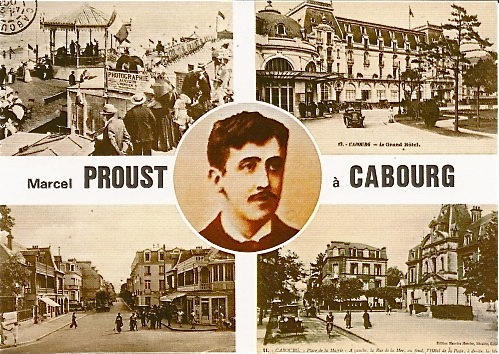
Proust in Cabourg copy 1
Photo Source: franceculture.fr

Proust insists that In Search of Lost Time is not autobiographical, but said “The pleasure that an artist gives us, is to introduce us to another universe.” No matter, his writing relates closely to his life experiences, parallel universe if you will.

Balbec is the fictitious reconstruction of Cabourg, a seaside resort town in the Basse-Normandie region of France where Proust frequented between 1907-1914. While Proust explores voluntary and involuntary memories in his long work, he could well be weaving memories with imagination, fusing fiction with real life experiences, creating an intricate tapestry.

Lydia Davis, translator of the most recent edition of Swann’s Way (The Way by Swann’s), offers this insight: “this novel is not autobiography wearing a thin disguise of fiction but . . . fiction in the guise of autobiography.”

Right.

Whichever way you slice it, it’s still as delicious as madeleines dipped in tea.

***

Some Relevant Links:

The TLS blog: French literary anniversaries, part 4 – Du côté de chez Swann

CLICK HERE to a webpage on Cabourg where you can see the video of The Grand Hotel, with Proust’s room still being kept there.

Proust in Cabourg

In The Shadow of Young Girls in Flowers, from The Modernism Lab at Yale University

Photo Source: franceculture.fr

***

Related Posts on Ripple Effects:

Half Way Through a Budding Grove

Swann’s Way Part I: Combray

Parts 2 & 3: Swann In Love

***

Half Way Through a Budding Grove

Half way through reading In Search of Lost Time, Vol. II, Within A Budding Grove, I’ve discovered a key to enjoying Proust. Just as it’s best to eat madeleines by dipping them in tea before putting the moistened petite cakes in your mouth, the most enjoyable way to read Proust is lying in bed with an unhindered mind. In this most relaxed state, I’m at ease to stroll leisurely through a budding grove, or the thickets of a genius’s mind.

Within A Budding Grove Modern Library

So far, I’ve gone passed the narrator Marcel’s painful struggles with adolescent, unrequited love for M. Swann’s daughter Gilberte. In contrast, his crush for Mme Swann has been appreciated and normalized. Unlike the cool and aloof Gilberte, Mme Swann welcomes Marcel into their home warmly, including him in their family outings, and their home gatherings with their friends, thus allowing him an opportunity to meet his literary hero, the writer Bergotte.

And here’s the passage I’m most impressed by, so far. The man Bergotte is very different from the writer Marcel has encountered in his ‘divine writing’. The man appears to be very common, inarticulate even, and devoid of eloquence, a man who spent his childhood in a ‘tasteless household’. Marcel is shocked by this discovery, and scrambles to come to terms with such dissonance. In a most ingenious analysis, the young Marcel comes to this conclusion:

But genius, and even great talent, springs less from seeds of intellect and social refinement superior to those of other people than from the faculty of transforming and transposing them… To mount the skies it is not necessary to have the most powerful of motors, one must have a motor which, instead of continuing to run along the earth’s surface… is capable of converting its speed into lifting power. (p. 175)

As I read these few pages, Jane Austen came to mind. A writer who had lived her short life mainly in a rural setting, her associations parochial and far from ‘high society’, and yet could transport herself and thus her readers to a different world from her mundane social environs. Her imagination soared as it took flight with her incisive observations of human nature.

… the men who produce works of genius are not those who live in the most delicate atmosphere, whose conversation is the most brilliant or their culture the most extensive, but those who have had the power, ceasing suddenly to live only for themselves, to transform their personality into a sort of mirror… genius consisting in reflecting power and not in the intrinsic quality of the scene reflected. (p. 175-176)

The adolescent Marcel’s disillusionment with the discrepancy between the man and writer Bergotte leads him to an uplifting insight:

The day on which the young Bergotte succeeded in showing to the world of his readers the tasteless household in which he had spent his childhood, and the not very amusing conversations between himself and his brothers, was the day on which he rose above the friends of his family, more intellectual and more distinguished than himself; they in their fine Rolls-Royces might return home expressing due contempt for the vulgarity of the Bergottes; but he, in his modest machine which had at last ‘taken off,’ soared above their heads. (p. 176)

Yes, more Proust’s words than mine on this post. Many other highlighted passages and surprising delights, but will have to wait till I’ve come out of the budding grove the end of November. If you’re interested, you’re welcome to join me in a read-along of In Search of Lost Time, Vol. II: Within A Budding Grove.

CLICK HERE to my wrap-up post: Out of the Budding Grove

***

Related Posts:

Proust Read-along Swann’s Way Part I: Combray (Featured in ‘Freshly Pressed’)

The Swann and Gatsby Foil

What Was Jane Austen Really Like? Reading Tomalin and Shields

In Praise of Austen: Virginia Woolf’s A Room of One’s Own

***
Read Some Possible Oscar Contenders

Emphasis on the ‘possible’. At this point of the race, some films have not been released other than screened in Film Festivals. The frontrunner so far is 12 Years A Slave. And then there are the rest, some long shots, some longer. But I’d like to include them on this list because I want to draw your attention to the books which inspire these film adaptations.

How come Gravity isn’t here? You ask. It’s a frontrunner too. Yes. But, ah… find me the book first. No book? Maybe because it’s much easier to pass you the 3D glasses.

Here’s a list of fall/winter reading to gear up for the upcoming Awards Season.

12 Years A Slave by Solomon Northup

12 Years a Slave copyThe movie adaptation directed by Steve McQueen is TIFF13 People’s Choice Award winner. From past years, this accolade is a good predictor of Oscar wins. Based on the real life story of Solomon Northup, a free black man in Upstate New York who was kidnapped into slavery in Louisiana. For twelve years he suffered in the hands of several masters. First published in 1853, the book is Northup’s first-person accounts of slavery in 19th C. America, noteworthy for its historical value and poignancy. The actor Chiwetel Ejiofor a likely Oscar Best Actor nom for his role as Solomon Northup. You can download the whole book in its original form here.

August: Osage County by Tracy Letts

August Osage CountyThe play won the 2008 Pulitzer Prize for Drama. Members of a dysfunctional family inevitably come together after tragedy strikes. The stage production was described by the NYT as ‘a fraught, densely plotted saga of an Oklahoma clan in a state of near-apocalyptic meltdown’. Before you see how the A-list cast interpret their roles on screen, maybe reading the play is rewarding since you get to experience the story first hand before being influenced by Meryl Streep, Julia Roberts, Benedict Cumberbatch, Ewan McGregor…

The Monuments Men by Robert Edsel

The Monuments MenI’ve mentioned this title in a previous post. Now I’ve got the book in my hands. The true but untold story of how a group of rescuers called the Monuments Men in war-torn Europe saved  art and artifacts from the Nazi’s. In the introduction of the book, the author writes: “Hitler and the Nazis pulled off the ‘greatest theft in history’, seizing and transporting more than five million cultural objects to the Third Reich.” George Clooney, Matt Damon, Cate Blanchett, Jean Dujardin (The Artist), Hugh Bonneville (so Lord Grantham finally gets the chance to go into the battlefield).

A Captain’s Duty: Somali Pirates, Navy SEALS, and Dangerous Days at Sea by Richard Philips

A Captain's Duty..Another likely contender that has been getting a lot of buzz is this thriller starring Tom Hanks, based on Captain Richard Phillips’ real life ordeal in the hands of Somali pirates. A lawsuit will begin in a few weeks filed by the crew of the ship Maersk Alabama against the shipping company for sending them to pirate-infested waters unprepared. They also claim the Captain was at fault in the case. Their attorneys had set up a Webpage to clarify the truths from the fiction. A turbulent epilogue to the real life adventure on high seas.

The Lost Child of Philomena Lee by Martin Sixsmith

The Lost Child of Philomena Lee copyJudi Dench could get a possible Best Actress Oscar nomination with her role as Philomena Lee. In her youth as an unwed mother, Philomena was sent to the convent of Roscrea, Limerick, her baby taken away and ‘sold’ to America for adoption. As she became an adult, Philomena was determined to search for her lost child. I missed this at TIFF13. Maybe an Oscar nomination for Dench could raise the prospect of it being screened in our theatres.

.

‘Hateship, Friendship, Courtship, Loveship, Marriage’ by Alice Munro

Hateship-Friendship-Courtship-Loveship-Marriage-book-cover copyWith Alice Munro garnering the newest top honor as Nobel Laureate, hopefully the film adaption of this short story with a shorter title Hateship, Loveship will receive a wider release. It has been a long while since Away From Her (2006). The film receives positive feedbacks at TIFF13. A good cast with Kristen Wiig (Best Actress and Best Original Screenwriting Oscar noms for Bridesmaids), Guy Pearce (The King’s Speech), Hailee Seinfeld (True Grit), Nick Nolte (too many to name).

The Secret Life of Walter Mitty by James Thurber (Click on link to read the story online.)

The Secret Life of Walter MittyInteresting to see another film adaptation of a short story. This one I have a feeling that it’s very loosely based on Thurber’s character Walter Mitty, considering it’s a Ben Stiller movie. I’m sure many have read this story in school, time to reread just to get the Walter Mitty psyche, then go and check out the Ben Stiller ride. Other than Stiller, there are Kristen Wiig (again, in two short story film adaptations the same year), Sean Penn (can you imagine?), Shirley MacLaine.

The Wolf of Wall Street by Jordan Belfort

The Wolf of Wall Street copyCoincidence that Leonardo DiCaprio jumps from being Jay Gatsby to Jordan Belfort, the real life fraud on Wall Street, notorious for his highflying lifestyle and his operating a boiler room brokerage firm Stratton Oakmont. A multimillionaire at 26, he was later indicted in 1998 for securities fraud and money laundering but only served 22 months in federal prison. The Wolf of Wall Street is his unabashedly candid memoir. Martin Scorsese directs with DiCaprio touted as a likely contender in the Best Actor Oscar category.

The Book Thief by Markus Zusak

The Book Thief copyNo Oscar buzz around this one, but a look at the movie trailer, I know I want to see it. Yes, mainly because of Geoffrey Rush I admit. And also, Brian Percival… ring a bell? Director of Downton Abbey. The film will be released in November, a time slot where contenders are placed. So, you can say it’s a long, long shot for, who knows, maybe Geoffrey Rush, or Emily Watson? I admit I still haven’t read this very popular YA title. I’d like to do that before watching the film. Is this one on your movie viewing radar?

***
Munro and Movies

Thanks to the Swedish Academy, Alice Munro doesn’t need a blockbuster movie to raise awareness of her works. Described by The New York Times as ‘Master of the Intricacies of the Human Heart’, and with her story settings mostly in rural counties and small towns, the 82 year-old writer must have known how the small and intimate can have far-reaching effects.

The short story as a literary form too must have gained importance and legitimation overnight now that Munro is honored as Nobel Laureate. The novel isn’t the only peak of the mountain of literary pursuits. Readers too, can now be totally comfortable with reading ‘just a short story’.

Back to movies, with our contemporary mega, blockbuster culture, it sure looks like the general public need to see a movie before knowing about a literary work. While I don’t like the idea, I’ve to admit that could well be the case nowadays. But for Munro, can anyone name a full feature movie that’s based on her short stories?

Right. Actually there are four. Edge of Madness (2002) is relatively unknown. Another one interestingly is an Iranian film, Canaan, which won the Audience Awards–Best Film at the Fajr International Film Festival in 2008. A better known adaptation is Away From Her (2006). It remains one of my all time favorite films. The most recent completed production is Hateship Loveship which premiered at TIFF13. I regret missing it when I was there in September. A film based on her story ‘Runaway’ is currently in development.

With Munro winning the Nobel, hopefully we’ll have the chance to see a general release of Hateship Loveship. So there you go, Munro could well be helping to reverse the trend: the writer promoting the film.

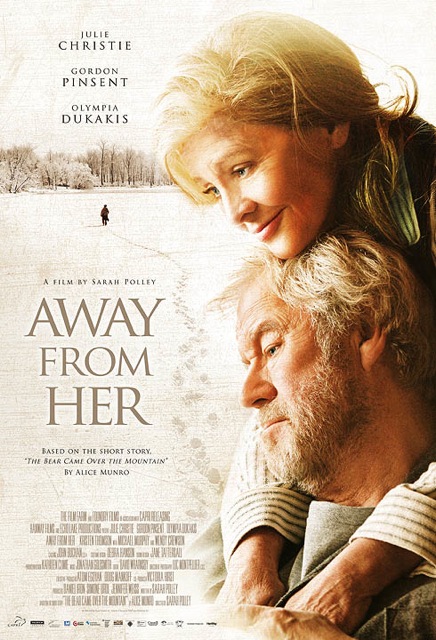
To celebrate Munro’s Nobel win, I’d like to repost in the following a review of Away From Her which I wrote in 2008. The film was directed by the young and talented Canadian actor/director Sarah Polley, who was nominated for an Oscar for her adapted screenplay based on Munro’s short story ‘The Bear Came Over the Mountain’. Julie Christie received an Oscar nomination for her role as Alzheimer’s afflicted Fiona.

You can read Munro’s story ‘The Bear Came Over the Mountain’ now online, thanks to a timely reprint by The New Yorker.

**

Capri_AwayFromHer_PosterB

AWAY FROM HER: A Short Review

How can you turn a good short story into a full length movie without compromising its quality? By turning it into a screenplay written by an equally sensitive and passionate writer, and then, through her own talented, interpretive eye, re-creates it into a visual narrative. Along the way, throw in a few veteran actors who are so passionate about what the script is trying to convey that they themselves embody the message.

Sarah Polley has made her directorial debut with a most impressive and memorable feat that I’m sure things will go even better down her career path. What she has composed on screen speaks much more poignantly than words on a page, calling forth sentiments that we didn’t even know we had. As Alzheimer’s begins to take control over Fiona, what can a loving husband do? Julie Christie and Gordon Pinsent stir up thoughts in us that we’d rather bury: how much are we willing to give up for love? Or, how would we face the imminence of our loved ones’ and our own mental and physical demise?

Based on the story by Alice Munro, ‘The Bear Came Over the Mountain’, Polley brings out the theme of unconditional love not with your typical Hollywood’s hot, young, and sexy on screen, but aging actors in their 60’s and 70’s. It may not be as pleasurable to watch wrinkled faces hugging and kissing, or a man and a woman in bed, bearing age spots and all, but such scenes effectively beg the question: why feel uncomfortable?

Why does love has to be synonymous with youth, beauty, and romance? It is even more agonizing to watch how far Grant is willing to go solely for love of Fiona. Lucky for us, both writers spare us the truly painful at the end. It is through persistent, selfless giving that one ultimately receives; however meager and fleeting that reward may seem, it is permanence in the eyes of love. And it is through the lucid vision of a youthful 28-year-old writer/director that such ageless love is vividly portrayed…. Oh, the paradoxes in life.

~ ~ ~ Ripples

***

Another Proust Read-Along

… as if we’re not busy enough?

Truth is, reading Proust calms me down. Maybe because I’ve to slow down, really slow down, to savor, and decipher. These two have become a fused enjoyment for me while reading Vol. 1 of In Search of Lost Time, Swann’s Way.

After finishing that, I quickly ordered the next volume Within a Budding Grove, but have since put it aside… until now, thanks to Bellezza of Dolce Bellezza, who read Vol. I with me. She’s right, of course, as she wrote on her invitation post for Vol. II:

‘No one should read Proust alone.”

So here we are, embarking on another Proust Read-Along, In Search of Lost Time Vol. II, Within A Budding Grove.

Within A Budding Grove Modern Library

Yes, this is a slow read, as always on Ripple Effects. We plan to finish and post our thoughts on November 30. I just might add in a mid-way post around end of October.

You are invited to join us for another slow and enjoyable ride.

If quantifying makes it easier to grasp, counting the days in October and November, and the 730 pages in my Modern Library Classic edition, you only need to read about 12 pages every day. A very doable plan.

Those of you who have read it all… how about a re-read now?

***

First Post for Vol. II:

Half Way Through A Budding Grove

My posts on Vol. I, Swann’s Way:

Part 1: Combray (my ‘Freshly Pressed’ post)

Wrap-up: The Swann and Gatsby Foil

***

TIFF 2013: Books into Films

Have been in Toronto all week for the Toronto International Film Festival. Taken a lot of photos but these few I’m going to share with you first for Saturday Snapshot Sept. 14, for they are what Ripple Effects is all about: Books and Films.

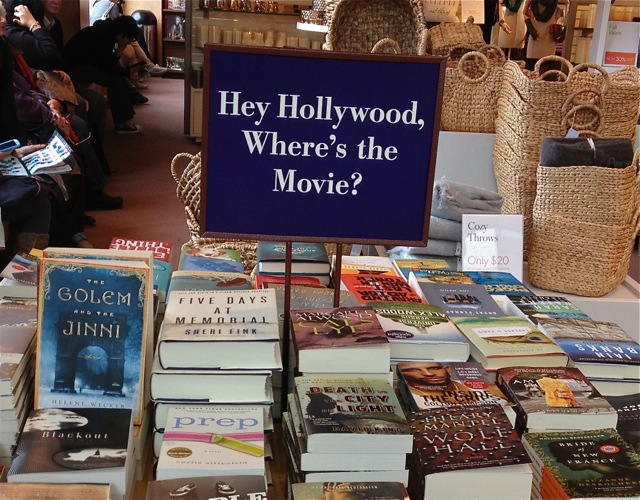
Saw this sign in a major bookstore beside a TIFF screening venue:

Hey Hollywood

The movie is in the book.

Indeed, many of this year’s TIFF selections are based on literary sources.

Film Adaptations at TIFF 2013

Books to filmsFrom biographies to biopics:

Biographies into BiopicsIf you or your book group are starting a new season of reading, you may find some interesting titles in the following list of films screened at TIFF this year (click on link to the film adaptation):

12 Years a Slave by Solomon Northup

August: Osage County by Tracy Letts (Pulitzer Prize-winning play)

Child of God by Cormac McCarthy

The Dinner by Herman Koch

The Double by Fyodor Dostoevsky

The Double by Nobel Prize-winning author José Saramago (Film: Enemy)

Half of a Yellow Sun by Chimamanda Ngozi Adichie

Hateship, Friendship, Courtship, Loveship, Marriage by Alice Munro (Film: Hateship, Friendship)

Horns by Joe Hill

How I Live Now by Meg Rosoff

The Invisible Woman by Claire Tomalin

Known and Unknown by Donald Rumsfeld (Film: The Unknown Known)

Labor Day by Joyce Maynard

Long Walk to Freedom by Nelson Mandela

Mary Queen of Scotland by Stefan Zweig (Film: Mary Queen of Scots)

The Railway Man by Eric Lomax

Salinger by David Shields and Shane Salemo

The Sea by John Banville

The Switch by Elmore Leonard (Film: Life of Crime)

Under the Skin by Michel Faber

***

Saturday Snapshot is hosted by Melinda of West Metro Mommy Reads. Click here to see what others have posted.

***

Summer Reading for Future Viewing

NOTE: Just added Far From The Madding Crowd by Thomas Hardy

Some updates on books into films or TV adaptations. Some I’ve read, some TBR.

Under The Dome copyUnder The Dome by Stephen King — Now a new TV series (CBS) produced by Steven Spielberg’s Amblin Entertainment, joining the trend of bypassing the big screen to opt for TV production. The future is now as the series has already started airing. First episode with 13.5 million viewers. Could this be a foretaste of the ‘implosion’ phenom Spielberg predicted, TV screen replacing the big screen?

.

outlanderOutlander by Diana Gabaldon — This wildly popular, NYT bestselling cross-genre series of novels (Sci-Fi/Romance/Historical/Adventure) will be adapted into a TV series. Again, TV is the emerging medium for literary adaptations. Versatile Gabaldon has multiple degrees in science and was a university professor before creating the Outlander book series. She’s also a comic script writer. Here’s her bio.

.

Winters-Tale-CoverWinter’s Tale by Mark Helprin — Sci-Fi is trending. This one will be on the big screen with some big names such as Will Smith, Russell Crowe, Colin Farrell. But if you are a fan of Downton Abbey, you’d be interested to know this is one of the reasons Lady Sybil met her tragic end. No hard feeling. I wish Jessica Brown Findlay all the best in her pursuit of big screen presence. Take a look at these photos.

.

The Ocean at the End of the LaneThe Ocean at the End of the Lane by Neil Gaiman — Book published June 18, 2013, film rights of Gaiman’s new novel (this one for adults) about childhood memories had already been snatched up by Tom Hanks’ production company Playtone and director found. That’s Joe Wright who brought us the screen adaptation of Ian McEwan’s Atonement (2007) and the most recent version of Anna Karenina (2012). Have put a hold on the audiobook from the library.

.

In The Garden of BeastsIn the Garden of Beasts by Erik Larson — Again, Tom Hanks had picked up the film rights and he will star in it. Before you say ‘Ha! Self-gratification’, I’d say he’s an apt choice to play William E. Dodd, America’s first ambassador to Hitler’s Nazi Germany. Natalie Portman is on board as Dodd’s flirtatious zealous daughter Martha. Michel Hazanavicius, the Oscar-winning director of The Artist (2011), will helm. The book focuses on dry facts and livens up with Martha’s escapades. I can expect how the movie would use them as leverage. But I certainly hope not.

.

The Monuments MenThe Monuments Men by Robert M. Edsel — A different perspective into Nazi atrocities. This time the victims are the art works in Europe. A special force of American and British museum directors, curators, art historians, and others, called the Monuments Men, risked their lives to prevent the destruction of thousands of years of culture under Hitler’s order and for his private gains. George Clooney, Matt Damon, Cate Blanchett star. Downton fans, Hugh Bonneville is also in. I’ve seen a doc based on Edsel’s other book The Rape of Europa, which is excellent. I eagerly await The Monuments Men.

Death Comes to PemberleyDeath Comes to Pemberley by P. D. James — BBC will produce this Austen’s Pride and Prejudice spin-off. Will it shift our devotion for Darcy from Colin Firth to Matthew Rhys? Not a chance. So why do it, especially when the book is overwhelmingly lackluster (there’s a new oxymoron for you). Lots of alterations will be needed for it to be put on screen. Here’s my take on the book.

.

AustenlandAustenland by Shannon Hale — Jane Austen spinoffs have to work extra hard to capture a wider audience, considering there are multitudes in the male population who avoid reading even the brilliant, original author Jane herself. Further, these imaginary sequels to P & P even have to woo female Austen purists. Kerri Russell stars, Stephenie Meyer produces. Maybe Meyer is ok with just reaching her own fans. If you’re not an Austen purist, here’s a beach read for you.

.

RebeccaRebecca by Daphne Du Maurier — Currently in development by Steven Spielberg’s Dreamworks. Do you think the 1940 Hitchcock film needs a makeover? Who should replace Laurence Olivier and Joan Fontaine? A new adaptation means drawing attention once again to Du Maurier’s novel, attracting first time readers. Good choice for book group, especially when you can read, discuss and watch movie together after.

.

Far from the Madding CrowdFar From The Madding Crowd by Thomas Hardy — Carey Mulligan’s next literary adaptation after The Great Gatsby. I’m glad she’s got this role, but, can she beat Julie Christie’s 1967 rendition of Bathsheba? The new version will be helmed by rising star director Thomas Vinterberg (The Hunt). Belgium actor Matthias Schoenaerts (Rust and Bone) and Juno Temple (in talks) also on board. I can see that all these remakes of classic films of literary adaptations are geared at a new generation of viewers. And I say, it’s alright. Another movie version just may draw more attention to reading literature.

the-grapes-of-wrathThe Grapes of Wrath by John Steinbeck — Just as we speak, Steven Spielberg’s Dreamworks is in talks with John Steinbeck’s estate to acquire the film rights, again, to remake another 1940 classic, this one with John Ford directing Henry Fonda. If the talk is successful, which I don’t doubt, who do you think should be in this new version? The book is on my TBR list with East of Eden, which also had plan for a new adaptation a few years back but since no more news had come out.

***

RELATED POSTS:

Upcoming Book to Movie Adaptations

Summer Viewing List

Can a movie adaptation ever be as good as the book?

My Review of:

The Artist

Atonement: Book Into Film

Anna Karenina: Book

Anna Karenina: Movie

Death Comes to Pemberley

***

Housekeeping by Marilynne Robinson

I just finished reading Marilynne Robinson’s first novel Housekeeping, and I’m stunned.  The title is simple enough, but the subject matter is expansive, haunting, and unresolvable. Yes, from the title, you could assume it’s about family, and true, we have the story about two sisters Ruth and Lucille abandoned by their mother Helen. After leaving her two young daughters with their belongings at her mother’s home in the remote town of Fingerbone, Idaho, Helen goes out and drives her car off the cliff.

The book won the Hemingway Foundation/Pen Award for Best First Novel in 1980, and nominated for a Pulitzer that same year.

It’s about sisterhood, how Ruth and Lucille grow up first under the care of their aloof grandmother, then after her death, their two grand aunts, who can’t wait for a younger person to raise these children. So, finally, their mother’s younger sister Sylvie, the estranged daughter of their grandmother, the aunt they have never known, comes back home to Fingerbone to take care of them.

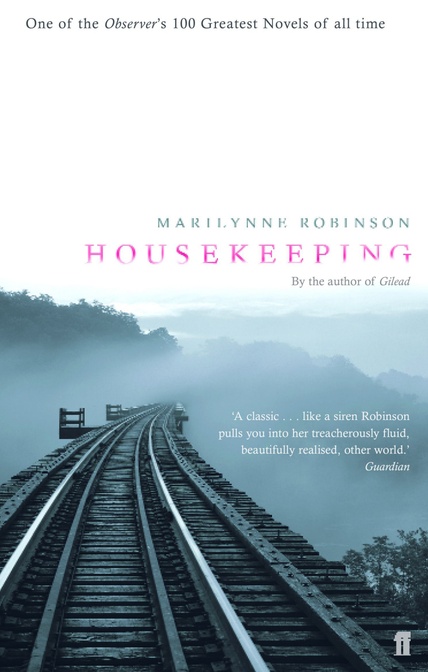
Housekeeping by Marilyn Robinson

So yes, we can expect some dysfunctional upbringing. But that’s not it. Robinson’s narratives are lyrical, internal, thought-provoking and poignant. Rather than making a social comment on a dysfunctional family, it searches deep into the human condition.

It’s about loneliness, that haunting, inconsolable feeling that can drive one off the cliff of sanity. It’s about survival, how being constrained by such loneliness, one can still go on, striving to find some meaning in blood and kin, facing others during the day and oneself in the deep darkness of the night.

It’s also about personhood, how you might think after such a childhood experience, the two sisters would have clung to each other in an inseparable bond, and yet, one can still escape to another life by squeezing out of the relational cocoon.

And it points to the larger scheme of things, that all are transient, however static we may feel about our situations. No matter how well a housekeeping job we do to keep up an orderly life or fulfill expectations, we cannot ignore our inner chamber. We’re all a diaspora of transient humanity longing for home.

So the transients wandered through Fingerbone like ghosts, terrifying as ghosts are because they were not very different from us… Sylvie was an unredeemed transient, and she was making a transient of me.

I read Gilead years ago. I don’t know why I’ve waited until now to savour Robinson’s other fictional works. Housekeeping is hauntingly true and intellectually satisfying. I know this is a book I need to reread many times in order to grasp all that the author is saying… if I can ever do that, gleaning all that Robinson had meant to say. So many thoughts in just 219 pages.

Many images from other books and movies conjured up in my mind as I was reading: the movies Thelma and LouiseStand By Me, and Jeannette Walls’s memoir The Glass Castle. And Chapter 10, where Robinson puts the story in the context of Biblical allusions, Terrence Malick’s The Tree of Life came to mind. But of course, those are merely images, or interactive memories. What draws my attention page after page is  the voice of Robinson’s narrator Ruth, and her heart-wrenching and yet unsentimental storytelling.

~ ~ ~ ~ Ripples

Housekeeping by Marilynne Robinson, published by Faber and Faber, London. Third Edition, 2005. 219 pages.

***

Related Post:

Lila by Marilynne Robinson

Dances With Words (where there’s a short write-up on Gilead)

The Glass Castle Book Review

The Tree Of Life Movie Review

***

Book Haul 2013

Here I go again, the annual Book Sale at Crossroad Market, organized by the Servants Anonymous Society. It’s a worthy cause, therefore, guilt-free looting of good condition used books, over a million of them donated by citizens like me. But I must say, I haul back more than I donate over the years, for many of them I plan to keep.

Compared to the last few years, I’m a bit more restrained this time. Here are some of my loot, all trade paperbacks for just $2 each:

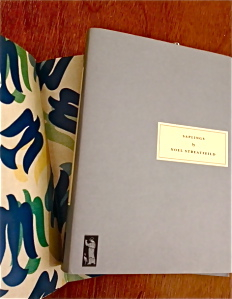
saplings-book-coverSaplings by Noel Streatfeild — I picked it up right away as soon as I saw the grey, minimalist book cover. Delighted to find inside is beautifully designed. Look at the photo I shot on the left. You can see both the dust cover and the inside of the book cover. This is my first Persephone Book, publisher of neglected women writers. I’ve not heard of the title or the author, but trust the London publisher’s choice, and glad to find it in such a mint condition at a used book sale, I quickly grabbed it.

Parade's End BBC Book Cover copyParade’s End by Ford Madox Ford — Truth be told, I’d never heard of FMF until I read Hemingway’s A Moveable Feast a couple of years ago. What a name. The only one I can think of along that line is… William Carlos Williams. Anyway, BBC’s adaptation of Parade’s End as a TV mini-series has added another name to my list of favorite actors: Benedict Cumberbatch (Again, ‘what a name.’) In these dry months in between seasons of Downton Abbey, Parade’s End makes one satisfying treat.

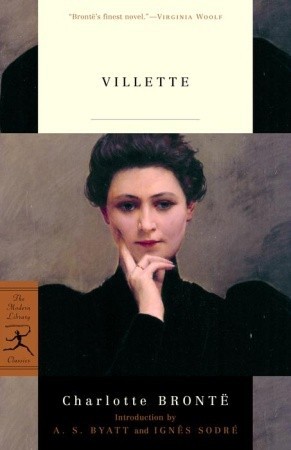
Villette by Charlotte BronteVillette by Charlotte Bronte — Here’s another reason for buying a book because of the publisher. I’m a collector of The Modern Library Classics. So finding this in the Classics section in the book sale was a pleasant surprise. A. S. Byatt offers her views in the intro. Other than Jane Eyre, I’ve not read anything else from Charlotte Bronte. Have you read this?

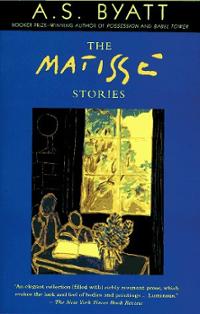
matisse-stories-a-s-byatt-paperback-cover-artThe Matisse Stories by A. S. Byatt — Three stories about three art works by Matisse. A beautiful little book. This from Goodread’s description: “These three stories celebrate the eye even as they reveal its unexpected proximity to the heart… the intimate connection between seeing and feeling…” My kind of stories.

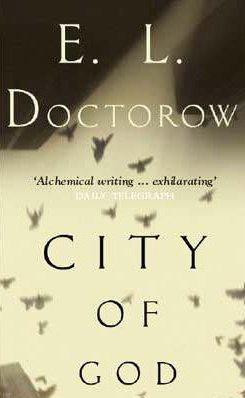
City of GodCity of God by E. L. Doctorow — Some years ago, The New York Times called the film adaptations of Doctorow’s works ‘expensive failures’. Reason: his novels are ‘too cerebral’, ‘too lyrical’, ‘too writerly’ to be transposed into cinematic images. Got it. Whenever I’ve the time and in the mood for some cerebral challenges, I know what book to pick up. After all, I’ve long wanted to read Doctorow. The subject matter of City of God just may arouse interest to help me through the thickets of Biblical proportion.

Becoming George Sand copyBecoming George Sand by Rosalind Brackenbury — George Sand I’ve heard of, Frédéric Chopin’s lover, one of those female writers who had to adopt a male pseudonym in 19th C. society. The interesting part is the modern parallel of the story of a female French professor in Edinburgh. Author Brackenbury (due to my ignorance I’ve not heard of) graduated from Cambridge University (which I’ve heard of) and now Fellow of Creative Writing at the College of William and Mary (that good name I’ve also heard of) in Williamsburg, VA. Enticing enough.

Tell It to the TreesThe Hero’s Walk and Tell It To The Trees by Anita Rau Badami — A look at the book cover of Tell It to the Trees helps me get the idea… The Indian diaspora in cold, wintry Canada, and for that I find a linkage. Not that I’m from India, but close enough. I’m sure Anita Rau Badami has a lot more to tell than adjusting to the climate. Born in India, now living in Montreal, Rau Badami has in recent years emerged as a clear voice in Canada’s literary landscape.

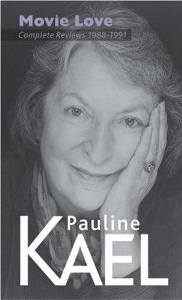
Movie Love Book CoverMovie Love: Complete Reviews 1988-1991 by Pauline Kael — Roger Ebert in his memoir Life Itself acknowledged Pauline Kael (1919-2001) as his mentor and major influence. While Ebert got a Pulitzer for his movie criticism, Kael got a National Book Award. She had been praised for re-inventing the form and aesthetics of the genre of film critiques. Along with a dearth of female literary voices in film criticism like Susan Sontag (1933-2004), seems like such a species had become extinct nowadays. All the more to appreciate ‘a classic’.

Wonderful TownWonderful Town: New York Stories from The New Yorker, edited by David Remnick — A Modern Library edition compiling over forty short stories published in The New Yorker before 2000, since that’s the pub. date. Reading the Table of Content is like reading the Who’s Who of 20th C. literary scene… John Cheever, Irwin Shaw, Philip Roth, Jonathan Franzen, James Thurber, John Updike, Vladimir Nabokov, Jamaica Kincaid, J. D. Salinger, Isaac Bashevis Singer, Susan Sontag, Woody Allen, Jeffrey Eugenides, Bernard Malamud, E. B. White… just to name a few. Woody Allen? You gasped. But, why are you surprised?

***

I’m a keeper of lists. If you’re interested, here are my loots from previous years:

2012

2011

2010

2009

***

Proust Read-Along: Swann’s Way Part One, Combray

Reading these first 264 pages of Proust conjures up some of my own memories…

I was sitting in a graduate class. A fellow student was doing a presentation on phenomenology. He brought into class a chocolate cake, cut it and gave each of us a piece. We were to describe this particular act of ‘Eating chocolate cake in class’.

What elicited only single words or phrases from us, Proust could have written pages. Why, from pages 60 to 64 the narrator details his experience of eating four morsels of the little cakes ‘petites madeleines’, the uplifting sensation, the taste, the action of dipping them into tea before eating, and the diminishing enjoyment after each mouthful. Above all, he relays how the very act of eating these madeleines has evoked long-buried childhood memories of Combray:

… in that moment all the flowers in our garden and in M. Swann’s park, and the waterlilies on the Vivonne and the good folk of the village and their little dwellings and the parish church and the whole of Combray and its surroundings, taking shape and solidity, sprang into being, town and gardens alike, from my cup of tea. (p. 64)

I don’t pretend to understand everything I read. Far from it. These first 264 pages of Proust’s seven volumes of In Search of Lost Time for me is a learning experience. I have to read through ambiguity, discard the expectations of clarity and congruity, accept incomprehension and press on. But an experience still, and surprisingly, an enjoyable one. An eye-opener too. Where have I read a sentence of 31 lines (p. 67-68) in such flowing prose, with such sensitivity and nuanced observations? And I must add, which I read at 1 a.m. I’m a quick study.

Sure, the unexamined life is not worth living. Proust must have plowed through his to the single second, and in depth too, as the madeleine-eating episode reveals. Insomnia sure has its benefits… arousing volumes of memories for the narrator.

Proust Book

From this first reading I’m surprised to find Proust’s subject matter comes from the mundane, from people and places in the village Combray where the narrator would go to stay for a period of time every year as a child. Even more a surprising delight is the loquacious way he describes the events, the people, the scenery, and the insights he can generate from the minutest observations.

A tiled roof is a tiled roof, okay, it looks more beautiful reflected on the river. But I was struck by how the narrator caught himself with speechless admiration, and ironically, articulating it with lucidity and humor:

The tiled roof cast upon the pond, translucent again in the sunlight, a dappled pink reflection which I had never observed before. And, seeing upon the water, and on the surface of the wall, a pallid smile responding to the smiling sky, I cried aloud in my enthusiasm, brandishing my furled umbrella: “Gosh, gosh, gosh, gosh!” But at the same time I felt that I was in duty bound not to content myself with these unilluminating words, but to endeavour to see more clearly into the sources of my rapture.  (p. 219)

Indeed, humor is another surprising find for me. In several places I’ve put down on the margin of the page, LOL!

So, I’ve quickly learned to go past those passages and sentences that have lost me, but soon as I come to something I can comprehend, and do resonate, I’d stop and reread, savoring the beauty of that moment.

My favourite passages include the heartbreaking accounts of the child’s longing for his mother’s goodnight kiss, the description of the church St. Hilaire where he goes to Sunday mass, the pages depicting the river Vivonne and the hawthorn trees in Swann’s park, the child’s discussions with Swann on reading and books, and his frustration with writer’s block as he strives to write poetry as a youngster.

But there is one passage I must mention. That is about the child’s Mamma caring to talk with their house maid and cook Françoise, asking her little questions about her feelings for her own family:

Francoise answered, laughing: ‘Madame knows  everything… [like] the X-rays that they brought here for Mme Octave, and which can see what’s in your heart’ — and she went off, overwhelmed that anyone should be caring about her, perhaps anxious that we should not see her in tears: Mamma was the first person who had given her the heart-warming feeling that her peasant existence, with its simple joys and sorrows, might be an object of interest, might be a source of grief or pleasure to someone other than herself (p. 73).

This, I think, is exactly what Proust has done.

Seeing the extraordinary in the ordinary, the village life, the kitchen and the table, the interactions and socializing, family relations, walking the country paths, the irises and the hawthorns… Reading this first part reminds me of paintings by Pieter Bruegel, or Van Gogh… and, not far from eating chocolate cake.

***

How’s your reading so far?

Janell of An Everyday Life

tuesday in silhouette

Wrap up post on Parts Two and Three: May 15.

***

Roger Ebert, A Close Encounter

In memory of Roger Ebert, I will recount an unforgettable experience I had two years ago. I took the following photos, which now are even more memorable.

He was still tweeting just two days before his passing on April 4. Ebert’s presence and influence had been ubiquitous over his four-decade career as a film critic. But it just takes one single encounter to make all the difference to me.

***

Thanks to the Toronto International Film Festival, in September 2011 I had the chance to meet the legend. It was only natural for me to think that wherever there were film festivals, there were film critics. But I never would have thought that I would see Roger Ebert in person and to shake hands with him.

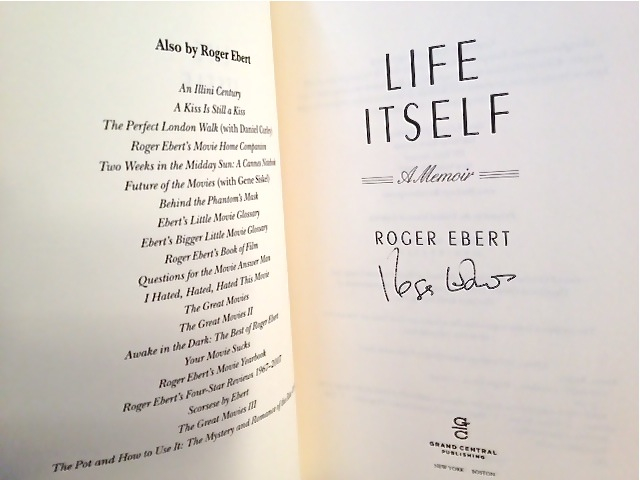
It was pure serendipity. While browsing in Indigo Books on Bay Street, I noticed a sign saying Roger Ebert would be in that store signing his memoir Life Itself a few days later. I had long followed his reviews since his “Siskel and Ebert” days, the two-thumbs-up duo. By the way, Ebert’s right thumb-up had been trademarked. Reviewing films for the Chicago Sun-Times since 1967, Roger Ebert was the first film critic to win a Pulitzer Prize for criticism (1975). He remained prolific even unto his last days.

Roger Ebert autograph Life Itself

So after seeing the sign I was thrilled to know I would have a chance to see Ebert in person, right there in Toronto. To me, such an encounter was not just about an autograph, or seeing a celebrity up close. It was about seeing a man who after torturous cancer treatments and surgeries for his thyroid, salivary gland and jaw, had lost a part of his face and the ability to talk and eat, and yet still maintained his humor and passions, who continued to press on to new ventures… this was about seeing life itself.

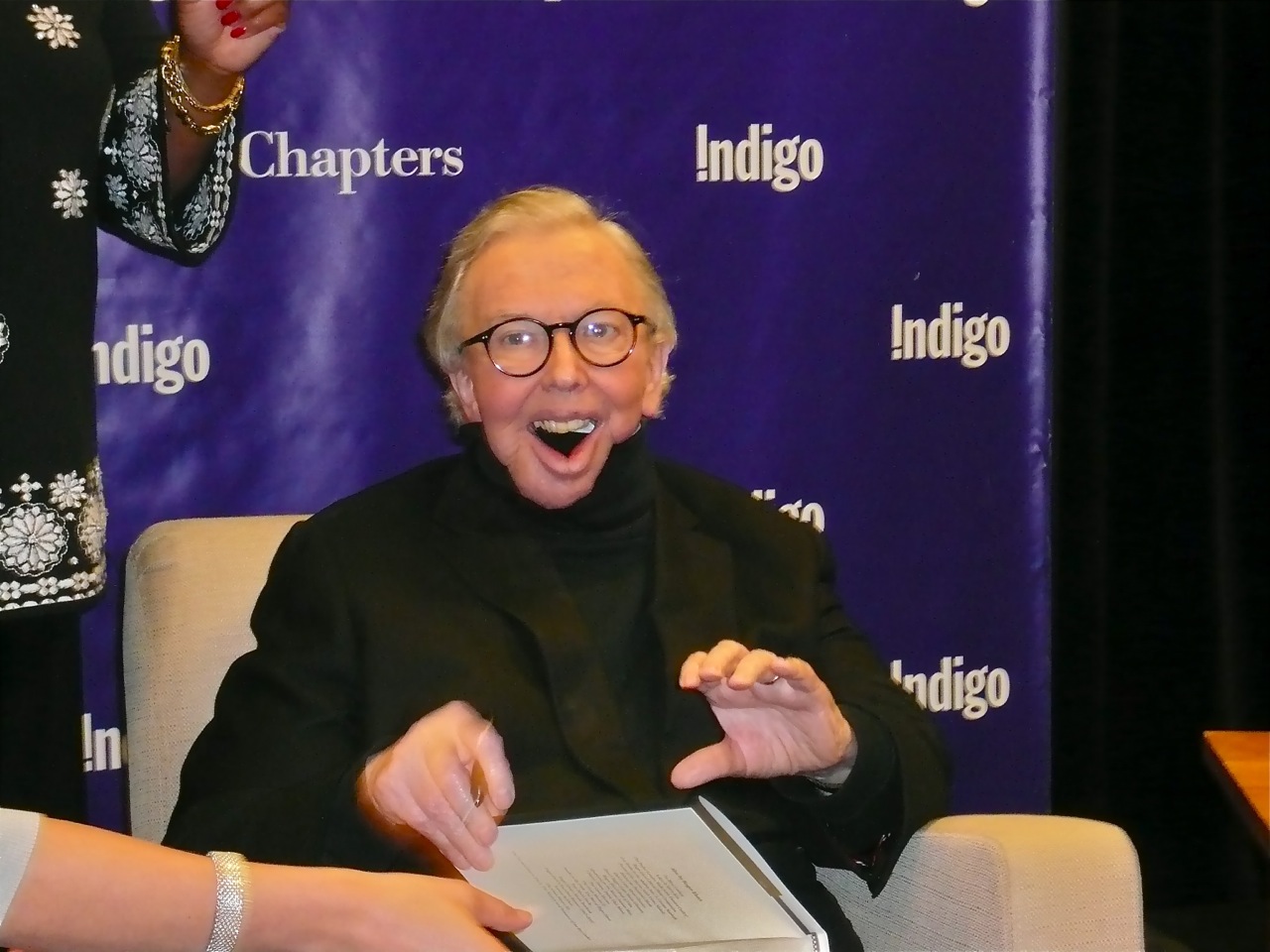
In the late afternoon on September 14, 2011, at the signing area in Indigo Books on Bay Street, people had been lining up for over an hour. I was one of them. At 7 pm, Roger came in walking slowly and with aid, stepped on stage and faced the crowd.

Ebert Signing

Together with his wife Chaz, they gave us a wave. Then he sat down and began signing. Photographs were allowed except for the rule of no posing. I waited my turn to go up to him, shake his hand and get his autograph in my copy of his memoir.

The Q & A session also began.

Roger’s wife Chaz was his voice. Personable and a film lover herself, Chaz shared some of her views of the TIFF selections. As executive producer of “Ebert Presents at the Movies”, she answered some questions without consulting Roger. But for most questions addressed to Roger, he would write in a small coiled notebook, handed it to Chaz to read out his answer.

Roger & Chaz

Here are some of the notes I had taken. Keep in mind this was a casual Q & A session in September, 2011. I’m sure Roger’s view towards 3D and CGI had changed considering his 4-star review of Ang Lee’s Life of Pi.

Q. Who influenced you the most?
A. He pointed to his wife standing behind him.

Q. Which decade is your favorite?
A. The 70’s… where you had The Godfather, Raging Bull…

Q. Buster Keaton or Charlie Chaplin?
A. Buster Keaton, albeit both are great.

Q. 3D?
A. Don’t ask. Story is number one.

Q. CGI (computer-generated imagery)?
A. Movies with CGI are soulless.

Q. All time best?
A. Citizen Kane.

Q. Favorite actor?
A. Robert Mitchum.

Q. Contemporary?
A. Al Pacino, Philip Seymour Hoffman, Tilda Swinton

Q. Favorite Canadian directors?
A. Atom Egoyan, David Cronenberg, Norman Jewison, Guy Maddin (thumb up)

Q. James Cameron?
A. Is James Cameron Canadian? Chaz asked in surprise.

Q. Favorite book?
A. A Fine Balance by Rohinton Mistry (Canadian! A voice came from the back)

Q. Any pressure from movie producers to write a good review?
A. No, he hasn’t been pressured. He was beyond reproach, Chaz answered.

Q. Any movies you haven’t seen?
A. The Sound of Music

Q. If there’s a movie made about you, who’d you want to play you?
A. Philip Seymour Hoffman. Chaz added, Oprah to play me. Diana Ross would be good too.

Q. Advice for potential film critics?
A. Do you want to get paid?

Q. Yes and no. (The questioner covered all bases.)
A. Start blogging. Roger replied. 

Q. How does your life influence the way you review a film?
A. It generates every word.

Definitely more than just an autograph. What an encounter. What a night.

***

Photos of Roger Ebert were taken with just a pocket camera at the event, book autograph page shot with iPhone at home.

Saturday Snapshot is hosted by Alyce of At Home With Books. Click Here to see what others have posted.

Before I Go To Sleep by S. J. Watson

Before I Go to Sleep47 year-old Christine has lost her memory for twenty some years due to trauma. She wakes up every morning to a forgotten past. She spends her day piecing together a life, who and where she is, her personal history, and, who her husband Ben is. Upon the advice of Dr. Nash, she writes it all down in a journal before she goes to sleep at night, for she’ll wake up the next morning wiped clean of her day old memory once again.

The book deals with some interesting issues. If the past is horrible to recall, would it be better if one does not remember, or, would one be better off knowing the truth despite pain? Is one made more vulnerable by knowing or not knowing? Further, if mental images conjure up, how can one be sure they are memories of actual happenings and not one’s imagination?

Author S. J. Watson leads the reader into a maze of intrigues, teasing us with an unreliable narrator Christine, casting shadows of imminent dangers, and trying to capture us with her vulnerability. So memory loss is an effective plot device, keeping us in the dark guessing, creating suspense, and revealing ever so slowly what really had taken place that caused the amnesia to set in, and how she could ever escape.

The book starts off with a most interesting scenario as Christine wakes up to an unknown world, but towards the middle it seems like it has forgotten that it is just the protagonist who has amnesia, not the readers, as it repeats the facts and descriptions with Christine’s journal entries. The last part is a page-turning thriller, albeit with a relatively improbable ending. The last pages explaining everything with a neatly wrapped up ‘here you go, see how logical it is’ kind of finish.

Memories… such a thematic element can be exceptionally gratifying to explore with deeper characterization. Surely the author has brought up the idea that memory defines us, a reader seeking for a more contemplative rendering of such a concept would be disappointed however, for Watson has chosen to use this interesting thematic material to craft a suspense thriller and not an idea-driven literary work. So what we have with notions relating to memories, to the nature of our identity and personality… etc. are merely used to build up a suspenseful plot. As a thriller, the book aims to lead on and not delve in.

Am I being a bit harsh here? Why, I just caught myself. I could well have been more lenient if I were not reading it along with Proust’s In Search of Lost Time (Remembrance of Things Past). Am I being fair to make comparison? It’s like comparing apples with oranges. Yet the coincident is too fascinating… both deal with remembering and sleeping, albeit one trying to fall asleep while the other trying not to. Just thinking… even the book covers that I have are similar.

Lots of ‘I love you’s’ are uttered, but none that can stir up any emotions in me the reader. Several films kept conjuring up in my mind as I read… Memento, Eternal Sunshine of the Spotless Mind, The Vow, and I must say the latter two managed to stir some affective resonance in me while exploring the topic of amnesia and a love relationship. But with this book, I just wanted to race to the end. For some, this might well be proof of an entertaining read.

And that is why I have high hopes for its film adaptation. Yes, I must applaud Watson for his strong debut. This novel published in 2011 has gained awards and accolades, on the bestseller lists in several countries, and translated into 30 plus languages. Its film rights has been snatched up by Ridley Scott. Filming now, it features the impressive cast of Nicole Kidman as Christine, Colin Firth (The King’s Speech) as Ben, and Mark Strong (Zero Dark Thirty) as Dr. Nash; Anne-Marie Duff (Nowhere Boy) is also on board. This is definitely a film I want to watch, not just because of the actors, but the screenwriter Rowan Joffe, who will direct as well. Joffe has shown us, with his script for The American (George Clooney stars) that yes, sometimes the film can be better than the book. Let’s hope this is also the case.

In the end page Watson notes that his novel, though totally fictitious, is inspired by actual medical cases, particularly that of Clive Wearing‘s, the British musicologist, conductor and BBC music producer, who has the same condition as Christine’s, albeit his is an even shorter memory span, just a short minute or so. His real life accounts have been recorded by his loving wife Deborah Wearing in her book Forever Today: A Memoir of Love and Amnesia. While he lives in the constantly present, he does not forget music or his love for his wife. Now that would be one inspiring book to read.

***

Click here to watch a short clip on Clive and Deborah Wearing on YouTube. Does he not remind you of another real life character, a pianist, whose life had also been made into a movie?