Reading the Season: The Book of Ruth

For the past seven years, I’ve a special post at Christmas which I’d named Reading the Season, just to help me dwell on the Reason behind all the festivities. Some past authors I’d read include Marilynne Robinson, C. S. Lewis, Madeleine L’Engle, Luci Shaw. This year I’m going back to the source material, The Bible, for my Christmas read. And no, my selection isn’t from Luke 2, which Linus so eloquently delivers every year in the delightful A Charlie Brown Christmas.

I reread the little love story in The Book of Ruth, one of the earliest parallels pointing to the Christmas story. This time I found it particularly relevant. So here it goes…

moonrise


A long time ago in a land far, far away a man named Elimelech and his wife Naomi, together with their two sons Mahlon and Chilion, had to pack up and leave their hometown of Bethlehem in Judah to escape from a famine in the land. As migrants, they travelled to a foreign country called Moab.

Alas, Elimelech died soon after and left behind Naomi and their two sons. Years passed, the sons married two Moabite gals, Orpah and Ruth. Could it be the food there, for not long after Naomi’s two sons also died. Bitter and despondent, Naomi sent her two daughters-in-law back to their own family and began her lone journey to return to Bethlehem.

But Ruth was adamant to follow Naomi back to where she came from with this moving vow:

Don’t urge me to leave you or to turn back from you. Where you go I will go, and where you stay I will stay. Your people will be my people and your God my God.

Touched by her loyalty, Naomi let Ruth travel with her back to Bethlehem. She was like a migrant all over again. To the people there Naomi, if anyone still recognized her, was now widowed, sonless, bitter and destitute. The two women didn’t even have a refugee camp to take shelter.

To survive, Ruth went out to the fields to glean the grains left by the harvesters. It happened that they were in the fields of a kind landowner Boaz, who after noticing Ruth and hearing of her love for her mother-in-law, told his workers to leave more grains in the fields for her to glean. Yes, it just happened that she’d come to the right field.

When Naomi learned of Boaz, she saw a glimpse of hope. Definitely this was more than the food bank; this generous landowner actually was a relative belonging to her late husband’s clan. Out of desperation, she sent Ruth on a risky mission: to go to Boaz at night and approach him tactfully, letting him know of their ties in kinship.

Lo and behold, Boaz, an honourable and compassionate man, was harbouring a deep and ardent love for Ruth. That night, though surprised to see Ruth, he received her readily and with respect, restraining and keeping his torrid passion well under wraps, umm like… Mr. Darcy.

According to the law of the land, the closest relative had the first right to redeem the lands that Naomi’s late husband Elimelech had sold and to marry Ruth to carry on the family line. But lo, Boaz wasn’t that person; instead, he did the honourable thing, extending the first right of redemption to the closest relative, yes, like umm… Mr. Collins.

And it happened that Mr. Collins was willing to buy back the land but wait a minute, he couldn’t take Ruth as a wife. There could be reverberations, for Ruth was a foreigner, a Moabite. Further, the land was for her to continue with Naomi’s family ownership, and would not be under his name. “I pass,” he said in the sight of ten elder witnesses. Phew!

So only then did Boaz declare not only his willingness to redeem the land once owned by Elimelech, but also his desire to take Ruth as his wife to save her from destitute, poverty, and childlessness. How marvellous it was that Boaz, a legit kinsman redeemer according to the laws, was also truly, madly, and deeply in love with his redeemed.

And we are definitely indebted to the two lovers for producing the line of descendants, for Ruth later became the great grandmother of David, from whose ancestral line generations later came Jesus.

With this beautiful ending I come back to Christmas 2015, and ponder on the lowly birth of Christ at the manger, to become our Kinsman for the ultimate purpose as Redeemer.

“And the Word was made flesh, and dwelt among us… full of grace and truth.”  – John 1:14

DSC_0034

**

The Risk of Birth

This is no time for a child to be born,
With the earth betrayed by war & hate
And a comet slashing the sky to warn
That time runs out & the sun burns late.
That was no time for a child to be born,
In a land in the crushing grip of Rome;
Honour & truth were trampled by scorn–
Yet here did the Saviour make his home.
When is the time for love to be born?
The inn is full on the planet earth,
And by a comet the sky is torn–
Yet Love still takes the risk of birth.

                              – Madeleine L’Engle

***

Previous ‘Reading The Season’ Posts:

2014: Lila by Marilynne Robinson

2013: Poetry by Madeleine L’Engle

2012: Surprised by Joy by C. S. Lewis

2011: Walking on Water by Madeleine L’Engle

2010: A Widening Light, Luci Shaw

2009: The Irrational Season 

2008: The Bible and the New York Times by Fleming Rutledge

2008: A Grief Observed by C. S. Lewis

Seven Stanzas for a Happy Easter

Rocks


“Seven Stanzas At Easter” by John Updike

Make no mistake: if he rose at all
It was as His body;
If the cell’s dissolution did not reverse, the molecule reknit,
The amino acids rekindle,
The Church will fall.

It was not as the flowers,
Each soft spring recurrent;
It was not as His Spirit in the mouths and fuddled eyes of the
Eleven apostles;
It was as His flesh; ours.

The same hinged thumbs and toes
The same valved heart
That—pierced—died, withered, paused, and then regathered
Out of enduring Might
New strength to enclose.

Let us not mock God with metaphor,
Analogy, sidestepping, transcendence,
Making of the event a parable, a sign painted in the faded
Credulity of earlier ages:
Let us walk through the door.

The stone is rolled back, not papier-mache,
Not a stone in a story,
But the vast rock of materiality that in the slow grinding of
Time will eclipse for each of us
The wide light of day.

And if we have an angel at the tomb,
Make it a real angel,
Weighty with Max Planck’s quanta, vivid with hair, opaque in
The dawn light, robed in real linen
Spun on a definite loom.

Let us not seek to make it less monstrous,
For our own convenience, our own sense of beauty,
Lest, awakened in one unthinkable hour, we are embarrassed
By the miracle,
And crushed by remonstrance.

– John Updike (1932-2009)

***

Happy Easter to All!

Staying Awake in the Garden

I came across this image in Biola University’s Lent Project. It is by the Austrian children’s book illustrator Lisbeth Zwerger. Among several awards she had won, Zwerger received the acclaimed Hans Christian Andersen Medal for illustration—the highest international award given for “lasting contributions to children’s literature”.

Staying Awake in GG

Its title is Jesus praying in the Garden of Gethsemane, from her book Stories From the Bible. Without condescension, Zwerger’s image speaks with clarity such that a child can easily grasp its essence. Three people dozing off, each against a tree. From a distance, under a massive dark cloud, a tiny, lone figure walking towards the ominous void. The illustration is perhaps one of the rarer perspectives that accompanies this narrative:

“Then Jesus went with them to a place called Gethsemane, and he said to his disciples, “Sit here, while I go over there and pray.” And taking with him Peter and the two sons of Zebedee, he began to be sorrowful and troubled. Then he said to them, “My soul is very sorrowful, even to death; remain here, and watch with me.” And going a little farther he fell on his face and prayed, saying, “My Father, if it be possible, let this cup pass from me; nevertheless, not as I will, but as you will.” And he came to the disciples and found them sleeping. And he said to Peter, “So, could you not watch with me one hour? Watch and pray that you may not enter into temptation. The spirit indeed is willing, but the flesh is weak.” Again, for the second time, he went away and prayed, “My Father, if this cannot pass unless I drink it, your will be done.” And again he came and found them sleeping, for their eyes were heavy. So, leaving them again, he went away and prayed for the third time, saying the same words again. Then he came to the disciples and said to them, “Sleep and take your rest later on. See, the hour is at hand, and the Son of Man is betrayed into the hands of sinners. Rise, let us be going; see, my betrayer is at hand.”    – Matthew 26: 36 – 46

What struck me is how modern the feel; these three guys could be anyone. And they are so casual too, like, barefoot in the park. Considering the horrific mission their Master is facing, their body language speaks avoidance, indifference, and, even betrayal. The spirit is willing but the flesh is weak – blame it on the good supper – they’re totally oblivious while their Master in a distance, alone, is fighting the most anguished battle of his life.

Are these guys named Peter, James and John? Why, they could be you and me.

***

Robert Bresson’s Au Hasard Balthazar (1966): A Timeless Parable

Surely he has borne our griefs
and carried our sorrows;
yet we esteemed him stricken,
    smitten by God, and afflicted. 

— Isaiah 53:4 ESV

Several days before He is crucified, Jesus enters Jerusalem riding on a donkey. I love this scene. If there’s any cognitive dissonance in the crowd, here’s the stark message for their bewilderment. The King for whom they are cheering is not to be a glamorous celebrity. Rather, like the donkey, He comes as a humble servant, one who carries their load, and ultimately, even lays down his life for them. His kingdom belongs to another world.

Marie and Balthazar


As with my Easter viewing from previous years, I watch a film by the French auteur Robert Bresson. Bresson’s work has a transcending and spiritual quality that is deeply moving. In Au Hasard Balthazar, he creates an unusual metaphor using a donkey as his protagonist. We follow Balthazar as a young colt, loved by his first owner Marie. We see him grow up, weaving his life among different owners. We also see Marie grow up. Despite her love for Balthazar, she cannot stop the encroachment of evil, or maybe she is simply powerless. She does not defend Balthazar when a gang of young men abuse the donkey, tormenting him, whipping, mocking.

The gang leader is Gérard, whose sadistic, mean streak speaks for human depravity. He would pour gasoline on the road to cause unsuspecting drivers to skid and crash. He and his gang would watch nonchalantly from a distance, gratified that their prank has worked. He steals and deceives. What is a donkey to him if he does not even have the slightest respect for other humans. Once, to prod Balthazar to move forward, Gérard ties a newspaper to his tail and light it on fire.

The Gang

Throughout, Balthazar lives his life quietly in a parallel course to the growing depravity of the humans he serves. He suffers their cruelty in silence, occasionally he would bray in pain, but he continues to bear his load, pull a cart, or do whatever he is prodded to do, even a circus act. Due to neglect and maltreatment, he often becomes ill.

As she grows up, Marie discards childhood innocence and seeks to gratify her sensual pleasures. Against the protest of her parents, she falls for Gérard. She could have another choice, one who offers her genuine love, Jacques, the son of the owner of the farm where Marie and her parents reside. Jacque would come by every summer from the city with his father and sister to stay on the farm. When they were still children, they had spent endearing moments together with Balthazar. Jacques has declared lifelong commitment to Marie. But Gérard is a more instant and attractive outlet for Marie. Ultimately, she is dealt the harshest blow and most degrading abuse from Gérard and his gang as they rape her. Bresson spares us the ugly scene, but in the chilling aftermath, we see the young men walk away, nonchalant, throwing her garments on the ground behind them. After that tragic incident, Marie runs away. Her father is grief stricken, and soon falls ill and dies.

Gérard is unrepentant. After all, it’s self-serving lust he seeks; his callousness is most disturbing. In the last scene, we see he uses Balthazar to do one more job for his gang. They are to smuggle goods across the mountainous border. At night, he loads up his goods on the donkey and leads him to the border. From a distance, he hears gun shots from armed customs police. Gerard and his gang flee, abandoning Balthazar on the mountain. But it’s too late for Balthazar, he has been shot.

The final scene is most moving. In the open field, Balthazar walks slowly, haggard, blood streaming from his leg. He finally lies down, still carrying the goods Gérard has put on him, the load of sin. He breathes his last and quietly dies, alone.

Like Bresson’s Diary of a Country Priest, Au Hasard Balthazar is an apt meditation for Good Friday. But not just for this one day, their timeless message is like the Easter Season itself, a moveable feast.

~ ~ ~ ~ Ripples

***

Related Posts and Links:

Diary of a Country Priest: A Book For Easter

Diary of a Country Priest: Film Adaptation

Video of Robert Bresson on Au Hasard Balthazar

And The Word Was Made Homeless

Awesome Sky

The House of Christmas

by G. K. Chesterton (1874–1936)

There fared a mother driven forth
Out of an inn to roam;
In the place where she was homeless
All men are at home.
The crazy stable close at hand,
With shaking timber and shifting sand,
Grew a stronger thing to abide and stand
Than the square stones of Rome.

For men are homesick in their homes,
And strangers under the sun,
And they lay on their heads in a foreign land
Whenever the day is done.
Here we have battle and blazing eyes,
And chance and honour and high surprise,
But our homes are under miraculous skies
Where the yule tale was begun.

A Child in a foul stable,
Where the beasts feed and foam;
Only where He was homeless
Are you and I at home;
We have hands that fashion and heads that know,
But our hearts we lost – how long ago!
In a place no chart nor ship can show
Under the sky’s dome.

This world is wild as an old wives’ tale,
And strange the plain things are,
The earth is enough and the air is enough
For our wonder and our war;
But our rest is as far as the fire-drake swings
And our peace is put in impossible things
Where clashed and thundered unthinkable wings
Round an incredible star.

To an open house in the evening
Home shall men come,
To an older place than Eden
And a taller town than Rome.
To the end of the way of the wandering star,
To the things that cannot be and that are,
To the place where God was homeless
And all men are at home.

*****

“And the Word was made flesh, and dwelt among us.” John 1:14

**

(Photo taken by Arti of Ripple Effects, Sept. 2010. All Rights Reserved.)

***

 MERRY CHRISTMAS EVERYONE!

 
***


Reading the Season: Poetry by Madeleine L’Engle

The brilliance of A Wrinkle in Time is that its author Madeleine L’Engle can convey scientific and spiritual concepts at the same time and in a way that young readers can enjoy. There’s no conflict between the cerebral and the spiritual; they co-exist comfortably in L’Engle’s work. Not only that, they fuse together and from that alchemy rises a whole new, inexplicable entity: Faith.

It’s that time of the year when I try to tune out distractions to dwell on the meaning of the Season, the reason why we have Christmas in the first place. I call these posts ‘Reading the Season’.

This time, I’ve selected four of Madeleine L’Engle’s poetry. ‘After Annunciation’ I have posted before. But I’d like to share it again here because the deceptively simple lines carry much depth and wisdom. Same with ‘The Risk of Birth, Christmas, 1973’. These two remain my favourite thoughts during Advent. 1973 or now? Ever timely. The poems are taken from The Ordering of Love: The New & Collected Poems of Madeleine L’Engle, published by Shaw Books, 2008.

The Ordering of Love

**

After Annunciation

This is the irrational season
When love blooms bright and wild.
Had Mary been filled with reason
There’d have been no room for the child.

**

Sonnet, Trinity 18

Peace is the centre of the atom, the core
Of quiet within the storm. It is not
A cessation, a nothingness; more
The lightning in reverse is what
Reveals the light. It is the law that binds
The atom’s structure, ordering the dance
Of proton and electron, and that finds
Within the midst of flame and wind, the glance
In the still eye of the vast hurricane.
Peace is not placidity: peace is
The power to endure the megatron of pain
With joy, the silent thunder of release,
The ordering of Love. Peace is the atom’s start,
The primal image: God within the heart.

**

Instruments (I)

The sky is strung with glory.
Light threads from star to star
from sun to sun
a liv­ing harp.
I rejoice, I sing, I leap upwards to play.
The music is in light.
My fin­gers pluck the vibrant strings;
the notes pulse, throb, in exul­tant harmony;
I beat my wings against the strands
that reach across the galaxies
I play

NO

It is not I who play
it is the music
the music plays itself
is played
plays me
small part of an innumerable
innum­ber­able
orches­tra.
I am flung from note to note
impaled on melody
my wings are caught on throb­bing fil­a­ments of light
the wild cords cut my pinions
my arms are outstretched
are bound by ropes of counterpoint
I am cross-eagled on the singing that is strung
from puls­ing star
to flam­ing sun
to

I burn in a blaze of song.

**

The Risk of Birth, Christmas, 1973

This is no time for a child to be born,
With the earth betrayed by war & hate
And a comet slashing the sky to warn
That time runs out & the sun burns late.
That was no time for a child to be born,
In a land in the crushing grip of Rome;
Honour & truth were trampled by scorn–
Yet here did the Saviour make his home.
When is the time for love to be born?
The inn is full on the planet earth,
And by a comet the sky is torn–
Yet Love still takes the risk of birth.

***

‘Reading The Season’ Posts over a Decade:

2020: Jack by Marilynne Robinson

2019: ‘A Hidden Life’ – A Film for the Season

2018: A Verse from Madeleine L’Engle’s The Irrational Season

2017: A Wrinkle in Time by Madeleine L’Engle

2016: Silence by Shusaku Endo

2015: The Book of Ruth

2014: Lila by Marilynne Robinson

2012: Surprised by Joy by C. S. Lewis

2011: Walking on Water by Madeleine L’Engle 

2010: A Widening Light by Luci Shaw

2009: The Irrational Season by Madeleine L’Engle

2008: The Bible and the New York Times by Fleming Rutledge 

2008: A Grief Observed by C. S. Lewis

***

Just another Easter thought

This Luci Shaw poem was read out in the Tenebrae service I attended on Good Friday.

***

P1000367

Judas, Peter

because we are all
betrayers, taking
silver and eating
body and blood and asking
(guilty) is it I and hearing
him say yes
it would be simple for us all
to rush out and hang ourselves

but if we find grace
to cry and wait
after the voice of morning
has crowed in our ears
clearly enough
to break our hearts
he will be there
to ask us each again
do you love me

— Luci Shaw

***

A Happy Easter to all!

Saturday Snapshot March 30: Tenebrae

Tenebrae is Latin for shadows. I was in a Tenebrae Good Friday service yesterday, a symbolic visualization of the Easter narrative.

7 candles

Seven lit candles were gradually extinguished between scriptures, poetry, and music, symbolizing the imminent death of Christ. Ultimately only the centre flame, the Christ candle, was burning. Momentarily, it too was snuffed out.

“Then [Peter] began to curse and swear, ‘I do not know the man!’ And immediately a rooster crowed.” — Matthew 26:74

Total darkness.

Tanabrae

Later, the single Christ candle was relit… the resurrection, light illuminating darkness again. The solitary flame is in the lower left in the above photo.

***

Saturday Snapshot is hosted by Alyce of At Home With Books. These two photos were taken from where I sat, using my iPhone.

***

Diary of a Country Priest: An Easter Meditation

Last year around this time, I wrote about the book The Diary of A Country Priest by French author Georges Bernanos, (Journal d’un curé de campagne, 1936). I’d like to repost my review this week, for every time I read it, I find the essence of Easter.

***

The Diary of a Country Priest Book Cover

A young priest comes to his first parish, the rural town of Ambricourt, filled with humble hopes. All he wants is to serve the people, to give of himself, to bring God’s love. But as soon as he sets foot in the village, he is engulfed by hatred and rejection. There are dark secrets too sinister to be exposed. The young priest is an unwelcome alien. In a town afflicted by hypocrisy, pride, anger and bitterness, he is despised, taunted and ridiculed. His own innocence is no match even for the children in his catechism class, especially the precocious Seraphitas, a girl ‘with a hardness far beyond her years.’

Ambricourt is a world afflicted by the ‘leprosy of boredom’, a microcosm of the human condition. Bernanos uses diseases to illustrate his point well. The young priest himself is being slowly consumed by terminal illness. The pain in his stomach ultimately defeats his body, cancer. His diet consists mainly of bread dipped in wine which he makes for himself, and some potato soup. Poverty of means, but also frailty of body to take in solid food. Many a times we see him in the Garden of Gethsemane, pleading for strength in anguish. But he faithfully presses on, using his diary to confide his deepest thoughts, a means to commune with his God.

On the outskirt of Ambricourt is the Château of the powerful M. le Comte. The Count needs no priest to know about his adulterous affairs, this time, with the governess Mlle Louise. His wife Mme la Comtesse is totally absorbed by her long-held bitterness and grief from the loss of her young son. And his daughter Mlle Chantal is a deeply disturbed girl eaten up by anger and jealousy. Soon, she will be sent away to England, a most convenient plan devised by her father.

It is with this deep mess of a family that the young priest finds himself entangled. The most intense scene of the whole book, the climatic moment, comes when the priest goes to the Château to meet with Mme la Comtesse. She lost her beloved son when he was only eighteen months old, a child hated by his jealous older sister Chantal.

On his last day they went out for a walk together. When they came back my boy was dead.

Mme la Comtesse is fully engulfed by hatred for her daughter, grief for her lost son, and bitterness towards God.

Hearing her speak, a tear flows down the face of the young priest. “Hell is not to love any more, madame.” The young priest responds. And with miraculous strength, he delivers the following words.

… But you know that our God came to be among us. Shake your fist at Him, spit in His face, scourge Him, and finally crucify Him: what does it matter? It’s already been done to Him.

Towards the end of some soul piercing exchanges, Mme la Comtesse kneels down, releases her pain, and receives blessings from the young priest. Afterwards, she writes to him in a letter:

… I have lived in the most horrible solitude, alone with the desperate memory of a child. And it seems to me that another child has brought me to life again…

And this young child, a priest, consumed by illness, wreaked by frailty of spirit, can only marvel at the power through weakness:

Oh miracle — thus to be able to give what we ourselves do not possess, sweet miracle of our empty hands!

Not long after this, he succumbs to his illness. A life too short, a mission seems unaccomplished. But his last words faintly uttered on his deathbed are as powerful as the God who sends him:

Does it matter? Grace is everywhere…

And in the film, these three words leave me with one of the most impressive endings of all the films that I’ve seen:

“All is grace.”

 ***

~ ~ ~ ~ Ripples

CLICK HERE to read my film review of The Diary of a Country Priest.

The Diary of a Country Priest by Georges Bernanos, translated by Pamela Morris, Perseus Books Group, Philadelphia, PA, 1965, 298 pages.

Journal d’un curé de campagne, 1936, was winner of the Grand prix du roman de l’Académie française.

Bonhoeffer Read-Along Part 2: Ch. 19 – 31

I’ve read some of Dietrich Bonhoeffer’s writing years ago, but knew close to nothing about the life of this highly admired Christian theologian, pastor and anti-Nazi martyr. Eric Metaxas’s 2010 biography of Bonhoeffer is an informative first step for me to delve into a selfless and heroic life. Within the close to 600 pages are highly readable narratives, at times humorous and even entertaining, albeit juxtaposed with pathos and sombre accounts.

Book Cover

What I’ve appreciated most is Metaxas’s inclusion of Bonhoeffer’s own voice, excerpts from his writing, letters, sermons, and words spoken as reported by witnesses. One of the most important sources is from his theology student and confidant Eberhard Bethge who had written what generally considered the definitive biography on Bonhoeffer. That’s over a thousand pages. I’m in no position to offer any critique on the accuracies of Metexas’s book, for I have not read both or any other historical documents to compare notes. Here I’m just sharing my thoughts as a reader, casting my two pebbles into the pond of resonance.

In this second part, Chapters 19 to the end, the mood changes as we see Hitler tightening the noose on his opponents, especially the Jews and their sympathizers. Bonhoeffer had to help his twin sister Sabine’s family flee the country before it was too late, as her husband Gerhard Leibholz was Jewish.

Dietrich’s own Confessing Church which had boldly stood against Hitler’s anti-semitic laws was now facing Gestapo arrests, its seminary Finkenwalde shut down, and its pastors slapped with the ordinance to swear an oath to Hitler. For his own safety, he had made arrangement to leave Germany for America. The Union Seminary in NYC had offered him a teaching post, welcoming the return of this brilliant theologian from Germany.

Bonhoeffer sailed to NYC on June 12, 1939, finding a safe haven in America, but not peace of mind. His inner turmoils were so overwhelming that he stayed there for just twenty-six days. His pastor’s heart prodded him to rush back to Germany to be with those who were suffering. My admiration for the man grew even more as I came to this part.

Mere waiting and looking on is not Christian behavior. The Christian is called to sympathy and action, not in the first place by his own sufferings, but by the sufferings of his brethren, for whose sake Christ suffered.

It was a much deteriorated country to which he returned under the grip of a mad Führer. War broke out. His brother Karl and brother-in-law Dohnanyi were in the Resistance against Hitler’s regime. Soon, Dietrich was involved too, at first offering encouragement and emotional support, but later worked for the Abwehr, the German spy agency, as a pastor, which he was, but unbeknownst to the Abwehr, as an undercover for the Resistance. What a dangerous job to take on!

In Operation 7, Bonhoeffer successfully helped seven Jews escape to Switzerland from certain death. A larger amount of foreign currency had to be transferred out of the country to suport their livelihood. Thus a track was left for his later Gestapo arrest. It’s interesting to note one of the two relatively minor reasons for his arrest is money laundering, for it’s much easier for the Gestapo to believe that than for them to think any German of sound mind would want to help Jews escape.

I can see a courageous man with integrity. Bonhoeffer could not stand aside to see the murders of innocents and the spread of evil. Yet, it’s disturbing to see his stance belonged only to a dearth of people at that time. Hitler’s murderous rampage and the Gestapo’s torturous tactics seized the country with a ferocious grip. Soon, those few dissident voices had to go underground, for their own lives were at stake. I kept asking myself what would I have done… a question I’m afraid to answer.

It was also then that Dietrich was swept by love with Maria von Wedemeyer. Their love was like silver linings behind dark, ominous clouds. Most of their time was spent apart, for Dietrich was held in prison by then, a most precarious relationship indeed. Yet from their letters, I could see love bring them hope, and hope in turn enriches their bond. It was heartbreaking to read their letters to each other, foreseeing wedding and marriage. From the dreadful Gestapo prison, Dietrich wrote Maria:

You mustn’t think I’m unhappy. Anyway, what do happiness and unhappiness mean? They depend so little on circumstances and so much more on what goes on inside us. I’m thankful every day to have you – you and all of you – and that makes me happy and cheerful.

Maybe the title of this book should add in one more description: Lover.

Bonhoeffer and Bethge
Photo taken from the book.

Dietrich had earlier written a Wedding Sermon from the Tegel military prison in Berlin for the wedding of his best friend Eberhard and his niece Renate. In there is a most inspiring thought:

It is not your love that sustains your marriage, but from now on, the marriage that sustains your love.

Later, he was transferred to the Buchenwald death camp outside Berlin, and ultimately, to Flossenbürg for his execution. It’s heart-wrenching to read about Bonhoeffer’s last days, still keeping a calm and peaceful composure, touching other prisoners and even the doctor overseeing his execution. What is death? In his own words:

… life only really beigns when it ends here on earth, that all that is here is only the prologue before the curtain goes up….  if only we can be still and hold fast to God’s Word… Death beckons to us with heavenly power, if only we realize that it is the gateway to our homeland, the tabernacle of joy, the everlasting kingdom of peace.

I had expected Metexas’s book to be informative, but I had not thought it would read like a page-turner. The last chapters are so intense and engrossing that it felt like I was reading the script to the film Valkyrie, about the foiled plan to assassinate Hitler by Colonel Stuaffenberg and a subsequent coup. Bonhoeffer was not personally involved in the operation. But it was due to the failure of the Valkyrie plan that Bonhoeffer’s hidden identity with the Resistance was later discovered. Nine months after Stuaffenberg’s execution, Bonhoeffer was hanged at the Flossenbürg prison on April 9, 1945, just two weeks before the Allies marched in, and three weeks before Hitler took his own life.

Maria and Dietrich’s parents did not know of his demise until much later. Upon hearing the memorial service on BBC radio broadcast on July 27, 1945, Dietrich’s parents were confirmed of the saddest news a parent could ever hear. I was deeply moved to read the Sermon on the Mount excerpt from Matthew 10:17-42. What jumped out from the passage were these most apt and powerful verses:

And fear not them which kill the body, but are not able to kill the soul…

Whoever therefore shall confess me before men, him will I confess also before my Father which is in heaven. But whosoever shall deny me before men, him will I also deny before my Father which is in heaven.

And with the script of Bishop Bell’s poignant sermon at the Memorial Service, Metaxas ends his biography of Bonhoeffer: Pastor, Martyr, Prophet, Spy.

I thank all those who have read along with me, some with their thoughts posted on their blogs, some silently participating. If you’ve written a post, do let me know in a comment. I’ll be sure to link it here.

Alison of Chino House: 3 Encouragements from reading Bonhoeffer

***

CLICK HERE to read my post on Part 1: Chapters 1 – 18

***

Next Read-Along: Marcel Proust’s In Search of Lost Time Vol. 1: Swann’s Way

Reading the Season: Surprised by Joy

If Shakespeare and Hamlet could ever meet, it must be Shakespeare’s doing. Shakespeare could, in principle, make himself appear as Author within the play, and write a dialogue between Hamlet and himself. The ‘Shakespeare’ within the play would of course be at once Shakespeare and one of Shakespeare’s creatures. It would bear some analogy to Incarnation. — C. S. Lewis, Surprised by Joy (p. 227)

What an apt analogy for Christmas. surprised_by_joy_the_shape_of_my_early_life_frontcover_large_1thqlUR3XQVIcV2 Chronicle of Joy Surprised by Joy is C. S. Lewis’s (1898-1963) autobiographical account of his experience with Joy in his younger days, that elusive something of which he had a hard time grasping. Subtitled The Shape of my Early Life, it is an honest chronicle of an intellectual journey. As a young teenager going to the junior school of Wyvern, Lewis had shed the veneer of Christianity from home and declared himself an atheist. But his quest for Joy remained. It was to him an ‘inconsolable longing’ for ‘the real Desirable’. As a child, a form of Joy came to him through solitary reading, writing and drawing. In his youth, Joy channelled through Wagner’s Ring Cycle and Norse mythology, or Northernness. As he grew, he began to realize that pleasure did not equate with Joy, neither physical nor aesthetic, neither Nature nor Wagnerian music, neither books nor poetry, nor the intellectual gratification from reading, nor the excitement of Northernness.

You might as well offer a mutton chop to a man who is dying of thirst as offer sexual pleasure to the desire I am speaking of. .. Joy is not a substitue for sex; sex is very often a substitute for Joy. I sometimes wonder whether all pleasures are not substitutes for Joy. (p. 170)

Reading and Studying Surprised by Joy is Lewis’s chronicle of his encounters with books and countless authors. As a young boy he was first taught Latin by his mother, who sadly died of illness when he was only nine years old. He went through all forms of education, home, public, boarding school, and the most gratifying to him was after his father pulled him out of Wyvern and directed him to a private teacher in preparation for Oxford. While his father was uncertain about the move, Lewis secretly relished the idea and thrived in the experience. His teacher was Mr. Kirkpatrick, or ‘Bookman’. He was an atheist, a rationalist, a logician. He had acutely sharpened Lewis’s critical thinking with logic and Dialectics, and well prepared him to enter Oxford. He assigned to Lewis readings from classical literature: Homer, Demosthenes, Cicero, Lucretius, Catullus, Tacitus, Herodotus, Virgil, Euripides, Sophocles, and Aeschylus. On his own, Lewis immersed in Norse myths and the Wagner’s Ring Cycle. His reading expanded to Goethe and Voltaire. It was only later upon a friend Arthur’s influence that he began to devour literature in the English language. “I read … all the best Waverleys, all the Brontes, and all the Jane Austens.” There were of course others, Donne, Milton, Spenser, Malory, Thomas Browne, George Herbert, the Romantics, Yeats, William Morris, G. K. Chesterton, and George MacDonald.

I was by now a sufficiently experienced reader to distinguish liking from agreement. I did not need to accept what Chesterton said in order to enjoy it. (P. 190)

Yet he could not help but began to revise some of his world views. Yeats, Maeterlinck, and ultimately, George MacDonald informed him of alternative glimpses other than the material world. Unde hoc mihi I admit I had to look this Latin phrase up. And this I found: Unde hoc mihi … translated as “And whence is this to me” (KJV), or “And why is this granted to me” (ESV) A phrase that moved me so. As I was reading, two-third into his autobiography these words leapt out:

Unde hoc mihi? In the depth of my disgraces, in the then invincible ignorance of my intellect, all this was given me without asking, even without consent. (p. 181)

Lewis describes the epiphany, utterly inexplicable, the moment which came to him when all things seemed so clear, and the presence of something not mythical or magical which he had craved in his mind, but ‘Holiness’. It was then that his Atheism was transformed into Theism (In a moment of divine enlightenment not unlike Levin’s conversion at the end of Anna Karenina.) This humble exclamation unde hoc mihi is used by Lewis as he alludes to Luke 1:43 when Mary, pregnant with the Christ Child, went to see her cousin Elizabeth, who also by miraculous means in her barren state, pregnant with John, the forerunner before Christ. Upon hearing Mary’s salutation to her, Elizabeth felt the babe leap in her womb, and she exclaimed: “And why is this granted to me that the mother of my Lord should come to me?” Why, a learned scholar, specialist of the Classics, logical thinker skilled in Dialectics, claimed no credits of his own in this enlightenment. But it is only the beginning, he had not met the Person yet. Further, he realized that whatever that had given him Joy before, like Nature,

that those mountains and gardens had never been what I wanted but only symbols which professed themselves to be no more, and that every effort to treat them as the real Desirable soon honestly proved itself to be a failure. (p. 204)

As he began to teach at Oxford, Lewis was surprised to find two fellow professors he respected were, alas, Christians. One of them was J. R. R. Tolkien. But Lewis was an unlikely candidate for Christianity, with his ‘deep-seated hatred of authority, monstrous individualism, lawlessness’ and his abhorrence of a ‘transcendental Interferer’ (p. 172). Yet that unquenchable longing for Joy was ever present. Friendship with Tolkien began to break down some long held biases. He admitted that “I was by now too experienced in literary criticism to regard the Gospels as myths… To accept the Incarnation was a further step… It brings God nearer, or near in a new way.” It was another year before Lewis finally “gave in and admitted that God was God… Perhaps the most reluctant convert in all England.” Ironically, as he humbly exclaimed unde hoc mihi, ‘why is this granted to me’, he was submitting to ‘Divine humility’, the Incarnation. Hamlet finally met his Author. And what of Joy? I can’t give out too many spoilers, can I?

**

I read Surprised By Joy along with Bellezza. Do click here to read her thoughts on the book.

Surprised by Joy: The Shape of my Early Life by C. S. Lewis, Harcourt Publishing, Orlando, Florida, 1955, 238 pages. This is the edition I read with the image posted.

**

Reading the Season Posts in Previous Years:

2020: Jack by Marilynne Robinson

2019: ‘A Hidden Life’ by Terrence Malick: a film for the Season

2018: Madeleine L’Engle’s Poem The Irrational Season

2017: A Wrinkle In Time by Madeleine L’Engle

2016:  Silence by Shusaku Endo

2015: The Book of Ruth

2014: Lila by Marilynne Robinson

2013: Poetry by Madeleine L’Engle

2012: Surprised by Joy by C. S. Lewis

2011: Walking on Water by Madeleine L’Engle

2010: A Widening Light, Luci Shaw

2009: The Irrational Season by Madeleine L’Engle 

2008: The Bible and the New York Times by Fleming Rutledge

2008: A Grief Observed by C. S. Lewis

***

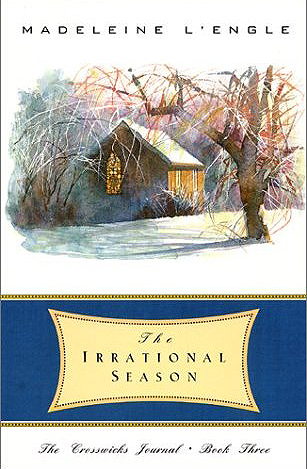
Reading The Season: The Irrational Season by Madeleine L’Engle

Striving to maintain some inner quiet, I casually took from the shelf a book by Madeleine L’Engle. Pure serendipity.  It’s one of The Crosswicks Journals, which I’ve shoved to the back of my mind for years, albeit they’ve been my all time favorite reads.  But how apt it is to flip through The Irrational Season, the third installment of The Crosswicks Journals, at this Christmas time.  Oh what joy to discover Madeleine L’Engle all over again.

Famous for her Newbery Award winning young adult novel A Wrinkle In Time, L’Engle was a prolific writer who had 63 publications to her credits.  Her works span from young adults to adults, fiction, science fiction, memoir, journals and poetry, with non-fiction books on faith, art, family, and humanity.  Yes, I say humanity, because L’Engle’s essays depict her strive to be human, and how her faith has defined the essence in her quest.

The Irrational Season comprises L’Engle’s ruminations on the significant events in the liturgical calendar.  And of course, it is Advent and Christmas that I dwell upon for my seasonal read.  This time, my reading has stirred in me a deeper appreciation of her insight and eloquence.

Art is for me the great integrater, and I understand Christianity as I understand art.  I understand Christmas as I understand Bach’s Sleepers Awake or Jesu, Joy of Man’s Desiring; as I understand Braque’s clowns, Blake’s poetry.  And I understand it when I am able to pray with the mind in the heart… I am joyfully able to affirm the irrationality of Christmas.

…  Christmas evoked in me that response with makes me continue to struggle to understand, with the mind in the heart, the love of God for his creation, a love which expressed itself in the Incarnation.  That tiny, helpless baby whose birth we honor contained the Power behind the universe, helpless, at the mercy of its own creation.

Cribb’d, cabined, and confined within the contours of a human infant.  The infinite defined by the finite?  The Creator of all life thirsty and abandoned?  Why would he do such a thing?  Aren’t there easier and better ways for God to redeem his fallen creatures?

And yet, in His most inscrutable, incomprehensible move, the One who called forth the universe from nothing, the Light and the Word, became flesh and drew near to us, to partake life as mortals knew it, and at the end, willingly go through an excruciating experience no mortals had ever known.  Impossible!  Utterly irrational!  And yet L’Engle embraces such an unimaginable scenario:

I live by the impossible… How dull the world would be if we limited ourselves to the possible.

And how grateful we ought to be, that such an accepting spirit pervaded in Mary’s heart and mind as well…

This is the irrational season
When love blooms bright and wild.
Had Mary been filled with reason
There’d had been no room for the child.

.

.

But now is the hour
When I remember
An infant’s power
On a cold December.
Midnight is dawning
And the birth of wonder.

*****

‘Reading The Season’ Posts over a Decade:

2020: Jack by Marilynne Robinson

2019: ‘A Hidden Life’ – A Film for the Season

2018: A Verse from Madeleine L’Engle’s The Irrational Season

2017: A Wrinkle in Time by Madeleine L’Engle

2016: Silence by Shusaku Endo

2015: The Book of Ruth

2014: Lila by Marilynne Robinson

2012: Surprised by Joy by C. S. Lewis

2011: Walking on Water by Madeleine L’Engle 

2010: A Widening Light by Luci Shaw

2009: The Irrational Season by Madeleine L’Engle

2008: The Bible and the New York Times by Fleming Rutledge 

2008: A Grief Observed by C. S. Lewis

*****

Photos: Except the book cover, all photos taken in Israel by Arti of Ripple Effects, November, 07. All Rights Reserved.