Never Let Me Go: Book and Movie

(Update Oct. 5, 2017: Kazuo Ishiguro has just won the Nobel Prize for Literature)
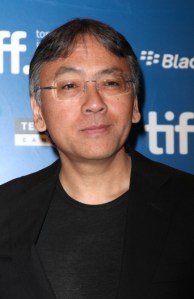
I must first declare this Spoiler Alert: It is impossible to write about the book and the movie clearly without stating the crux of the story. It is this key ingredient in the plot that instills meaning to the novel and now the film. While Never Let Me Go is a story of slow revealing, author Kazuo Ishiguro, in a Time magazine interview, admits that:

” … in a funny sort of way, I almost wanted the mystery aspect to be taken away so that people could conentrate on other aspects of the book.”

So there, even the author himself condones spoilers, for he knows there are much more to be pondered upon once the veil is removed.

Never Let Me Go (2005): The Book

Born in Nagasaki, Japan, in 1954, Kazuo Ishiguro‘s family moved to England when he was six. He is one of the most acclaimed English language writers today, listed by The Times as one of the 50 greatest British writers since 1945. Never Let Me Go is Ishiguro’s fourth nomination short-listed for the Booker Prize, which he won in 1989 with The Remains of the Day.

Based on a scientific premise, Never Let Me Go is a beautiful love story told with aching poignancy. Children of the exclusive boarding school Hailsham are told they are special from a very young age. They are to keep their bodies healthy and strong for that’s the purpose of their lives. They are told and yet not told, for theirs is a vague notion of who they really are or what is in store for them in the future. Knowing no other worlds, the children grow up in the sheltered, fenced-in compound of Hailsham, accepting their predetermined fate with docility.

Scientific advancement has made it possible. The children of Hailsham are clones, copied from an original, raised to have their organs harvested once they reach the prime stage of adulthood. While sports keep their bodies strong, they are particularly encouraged to pursue art and poetry. A mysterious figure they called Madame comes by regularly to collect their art work to keep in her Gallery.

The story focuses on three students, Kathy, Ruth, and Tommy. Their friendship on the outset matches the idyllic backdrop of the school in the 1960’s English countryside. Kathy is kind, caring and gentle, always watching out for Tommy, who is inept and temperamental. Seeing the bond forming between the two, Ruth slyly moves in and silently snatches Tommy to her side.

After reaching their eighteenth year, the three are transferred to the Cottages to live. There are just two roads ahead of them, donation of their organs and after 3 or 4 times, meets completion, death. Or they could apply to become carers of donors, but only temporarily until they too must fulfill their purpose. Living with other grown-ups who fall into the same destiny, the undercurrents of their love triangle begin to expose. For the first time in their lives, they hear about ‘deferrals’. If genuine love is evident between a couple, they could apply to have their donations deferred for a few years. When you are in love, just another day is precious enough. But what is love, and how do you prove it? There might also be another way out, and art could be the key. Ishiguro has masterfully handled layers of thematic complexity in a shroud of suspense.

While the story is based on an imaginary scientific scenario, the book is not a debate on the medical ethics of cloning. The events that take place which ultimately lead to their determined end explore, ironically, what it means to be human. Using the intricate relationships of the threesome, Ishiguro goes deep into issues of love and loss, dreams and reality, wrongs and their amends, and the ultimate search for the source of being, the very purpose of existence.

Using a first person narrative from Kathy, now a carer at 31 looking back at her past experiences, Ishiguro presents his story with detailed internal depictions and nuanced dialogues. Kathy’s voice is innocent and gracious, and all the more moving when it comes to the end when the story is fully unfurled. The three friends have since parted after the Cottages, but now after years have gone by, they meet again as carer and donors. On the canvas of imminent destiny, against the overwhelming tone of grey, we see three brisk strokes of colours, three lives, however temporal, serving their purpose, and above all, having tasted what it means to be human.

~ ~ ~ 1/2 Ripples

Never Let Me Go (2010): The Movie

Update Dec. 6: Carey Mulligan won Best Actress for Never Let Me Go at the British Independent Film Awards last night. This is her second BIFA win after An Education.


Directed by Mark Romanek (One Hour Photo, 2002), screenplay by Alex Garland (28 Days Later, 2002), the film was screened at the 2010 Toronto International Film Festival in September, and chosen to open the 54th London Film Festival on October 13th.

The mood is nostalgic, shot in greyish greens and blues, effectively capturing the general atmosphere of the book. When the future looks dim, the best one can do is to look back and savour what has been. Screenwriter Alex Garland has done an admirable job in being loyal to the source material, visualizing the key events and pertinent scenes, bringing to life the haunting memories of Kathy’s, whose narratives are taken straight out of the book.

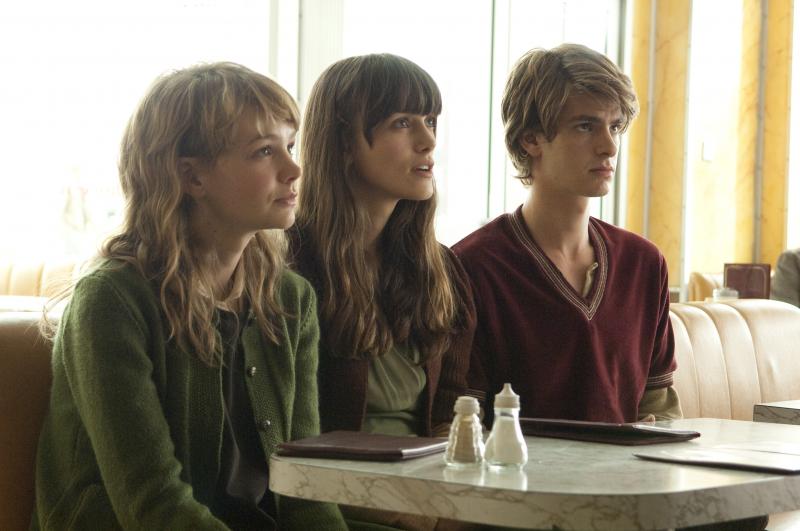
Corresponding to the novel, the film is structured in three parts. It follows Kathy (Carey Mulligan, An Education, 2009), Ruth (Keira Knightly, Pride & Prejudice, 2005) and Tommy (Andrew Garfield, The Social Network, 2010) through Hailsham in the 1960’s, young adulthood at the Cottages in the 1970’s, and lastly in the 1990’s where we see the final destination of their lives in completion. While the beginning part is the weakest, lacking the depth and details of the book, such a shortfall is compensated by the excellent performances of the three child actors as the young counterparts, Izzy Meikle-Small (Kathy), Charlie Rowe (Tommy) and Ella Purnell (Ruth). The congruence of young Kathy with her adult role played by Mulligan is particularly impressive.

As the story moves along, almost to midpoint, the unfurling of facts and feelings becomes more pronounced, calling forth some intricate and nuanced performance from Mulligan, Garfield, and Knightly. The three actors are the pillars of the production. While the original music by Rachel Portman (Academy Award Best Music, Emma, 1996) is affective and heart-wrenching, and the cinematography by Adam Kimmel (Capote, 2005) captivating, it is the performance of the threesome that makes the film so real and stirring.

Mulligan’s portrayal of Kathy and Garfield’s Tommy are particularly riveting. The hidden love Kathy has been holding for years is given a channel for expression only briefly at the end. All through Mulligan has carried her role with admirable restraint. Garfield’s portrayal of Tommy is achingly real, especially when he ultimately realizes the finality of his fate, the cry in the dark is haunting and powerful. And kudos to Knightly for accepting a role that puts her in a less than glamorous light. Her change at the end too is moving, giving depth to the exploration of what makes one human… other than love, there is also the courage to admit wrong, seek forgiveness, and the attempt to make amends.

Is it melodramatic or is it evoking deep emotions? Within context here, emotional sentiments or even a few tears at the end of the film might well be a healthy response, nothing to shy away from. Should the scenario arise some day in the future when we need to prove that we are human, and that we have a soul, what better ways to demonstrate but by our capacity to emote love, empathy, compassion, pathos, and the fear of facing such a scenario. May this all remain as science fiction for our enlightenment only.

~ ~ ~ 1/2 Ripples

***

To read other Book Into Film posts, CLICK HERE.

Paris: The Latin Quarter

Solution to Arti’s Cryptic Challenge #3: Paris

It was pure serendipity that I’d picked a hotel right in The Latin Quarter.  At the time of my booking I wasn’t aware of so culturally rich a Parisian sector I’d be staying, and with many attractions on my list within walking distance.   The Latin Quarter derived its name from the fact that Latin was widely spoken in the area during Medieval time.  This has been the academic and literary part of Paris, and remains so today. Bookstores are everywhere, almost all in French though, many specializing in philosophy.

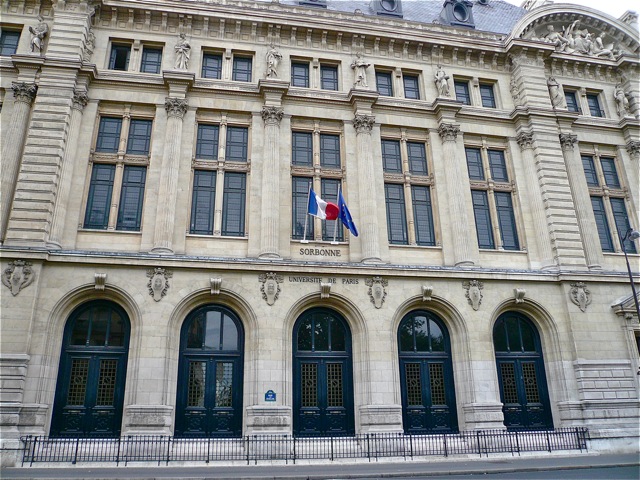
Our hotel is situated right across from the Sorbonne, Universite de Paris.  Unfortunately it was closed during the summer months, the guard at the gate making sure people stay out, so I did not get a chance to go inside or browse in their bookstore.

.

The Panthéon is also located in The Latin Quarter, about a 15 minutes walk from where we stayed.  It is the burial site of several renowned intellectual and literary figures of France, including Voltaire, Rousseau, Hugo, Zola, Pierre and Marie Curie:

.

Not just as a memorial ground, the Latin Quarter is a vibrant sector where writers, intellectuals and academics congregate, meet each other to engage in discourses over coffee or a glass of wine. Here is a restaurant where Camus and Sartre were among its prominent patrons, now a tourist point of interest on the map, Le Brasserie Balzar:

.

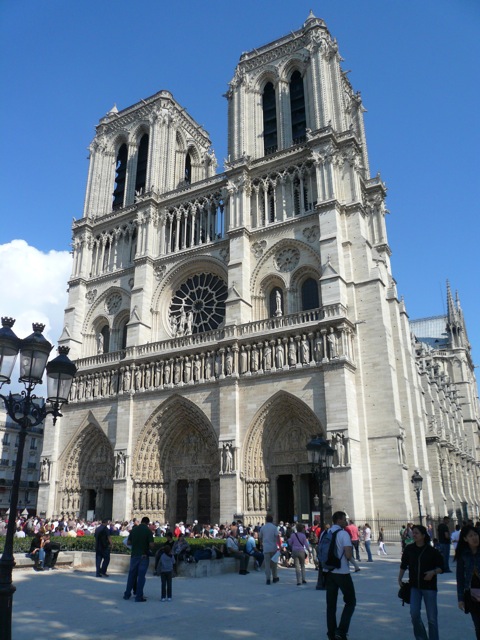
Heading down rue St. Jacques from Balzar, I walked towards the River Seine.  I could see from afar the Notre Dame:

.

.

But I wasn’t going to make my way across just yet, for I’ve found the number one item on my must-see list situated on this side of the Seine, the Left Bank, and that was the legendary bookstore-library, Shakespeare and Company:

.

.

On November 17, 1919, American expatriate Sylvia Beach opened the English language bookstore-library in Paris, and turned the page in literary history.  Beach was not merely a bookseller, but a multi-faceted literary personality, a writer and a subject for other writers, the publisher of James Joyce’s Ulysses in 1922, the proprietor of a literary hub that welcomed expatriate writers to mingle, read, write and stay.  In one of her many literary parties she introduced F. Scott Fitzgerald to James Joyce, the former was too intimidated to approach Joyce himself.   Many icons of the ‘Lost Generation’ had been affiliated with the literary hang-out, including Hemingway, Gertrude Stein, Ezra Pound, to name a few.  Click here for a historic photo of Beach and Joyce in front of Shakespeare and Company.

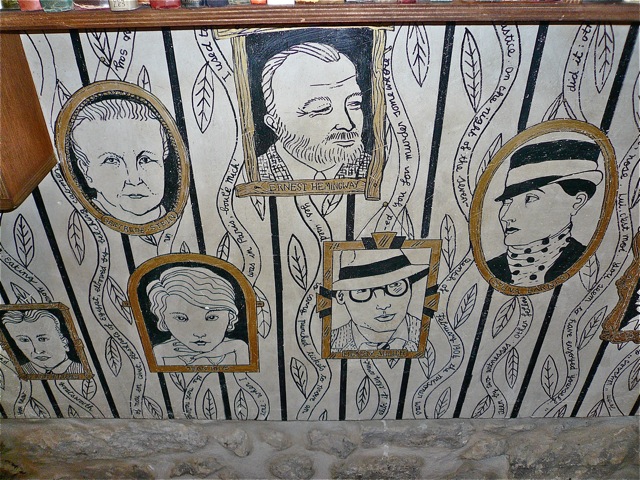
Hemingway and some of the ‘Lost Generation’ found on the walls of the bookstore:

.

.

Closed down during WWII, the new owner George Whitman, another American expat and a friend of Beach’s,  re-opened its doors in 1951 in the present location on the Left Bank of the Seine.   Now in his 90’s, Whitman has stood by his commitment not to sell his little bookstore to developers, and kept the tradition alive: a sanctuary for writers.  For almost 60 years now, Whitman, himself a writer and a poet, has offered lodging and writing opportunities to countless aspiring souls.  The bookstore is now run by daughter Sylvia Beach Whitman.  According to its website, Shakespeare and Company has served more than 50,000 heads on the pillows of its 13 bed facilities for free, accommodating such literary figures as Henry Miller, Anais Nin, Lawrence Durrell, and Alan Ginsberg.  Click here for a personal account of what it’s like staying at Shakespeare and Company, and some house rules.

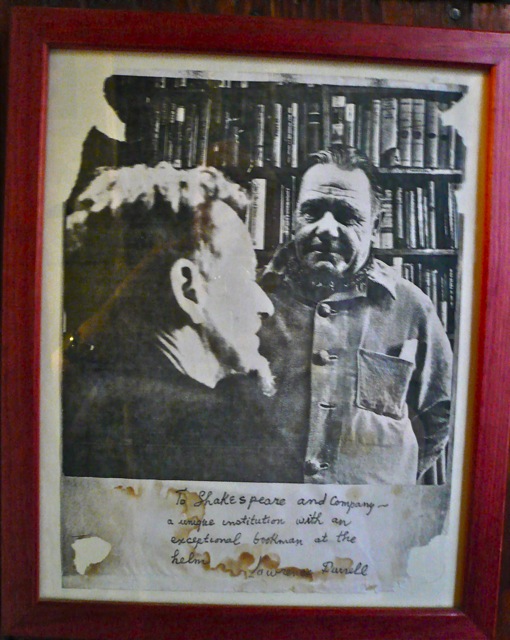
A mementos from Lawrence Durrell:

.

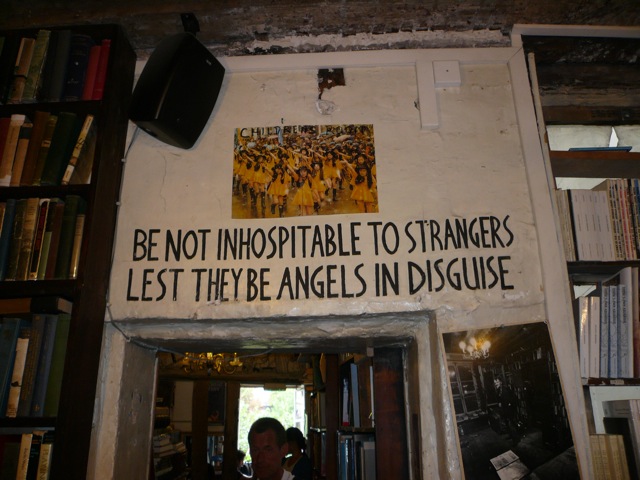
Upholding the spirit of hospitality:

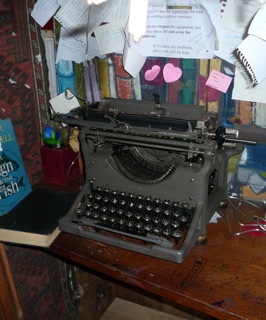
Typewriter for use, tradition alive and well:

Some impromptu music-making:

.

Just last week, even the editor of the New York Times has declared the inevitable, that the print version of the New York Times will end some time in the future. Under the sweeping torrents of eBooks and ePublishing, seems like independent bookstores are fighting an uphill, if not a losing, battle.  I wish the Whitman family well in standing strong against the tide.  From a little bookshop-library, it has stayed true to its tradition, and by so doing, gained a spot on the historic map of Paris.  In 2006, Whitman was honoured by the French Minister of Culture with the Order of Arts and Letters. More than just a point of interest for tourists, Shakespeare and Company has now become a cultural institution that just, hopefully, might not be so easily demolished to make way for new development along the Seine.

Click here to read an interesting article and personal interview with George Whitman from Bloomberg, yes, Bloomberg.

***

All Photos Taken By Arti of Ripple Effects, August 2010.  ALL RIGHTS RESERVED.

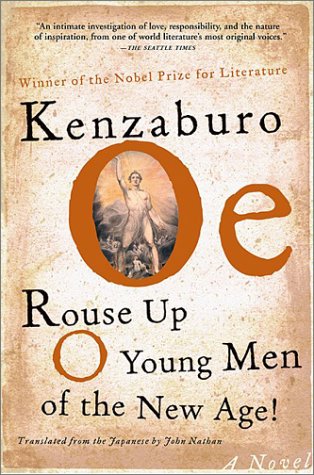
Rouse Up O Young Men of the New Age!

Thanks to Bellezza’s Japanese Literature Challenge 4, I have the chance to explore the intricate world of Kenzaburo Oe (pronounced ‘oh-ay’, 大江 健三郎 ), Japan’s second Nobel Laureate for Literature (1994), after Yasunari Kawabata (川端 康成) received the Prize in 1968.

Like his earlier work A Personal Matter*, Rouse Up O Young Men of the New Age! is an autobiographical novel dealing with the author’s experiences of raising a handicapped child.  A Personal Matter was written when Oe was young, describing an ordeal still raw from the initial shock of the birth of his brain-damaged child. Rouse Up was published in 1983, almost twenty years after A Personal Matter.

Rouse Up chronicles a more mature protagonist, the writer K, who has gone past the stage of denial and escape, to come to terms with the reality of fathering a handicapped child. Through the arduous journey, the writer has gained insights and pleasure from his relationship with his son Hikari, whom he nicknamed Eeyore in his novels.

Oe starts off the book with K’s plan to write a dictionary of terms for his now maturing son, to prepare him for his entry into the real, adult world.  This turns out to be a learning task in itself.  How do you explain to a brain-damaged person what the word ‘foot’ means?  Or ‘river’, ‘life’, or ‘death’?  He needs to deconstruct the realities of his everyday life before he can grasp the essence and meaning of his encounters.

It’s interesting to see how K get through to his son in defining ‘foot’. Eeyore understands it in relation to ‘gout’ from which his father once suffered. After the healing of the pain and swelling of the gout, it has turned into ‘a nice foot’.  So, the understanding of ‘foot’ comes in light of the pain it had experienced. K soon realizes that the definitions are more for himself as for Eeyore.

The author’s long journey of acceptance and self-discovery owes mostly to his love for the works of William Blake.  Rouse Up is a smorgasbord of selections if you are a Blake scholar. So admittedly, I have had a hard time ploughing through Oe’s use of parallels from Blake’s poetic and artistic symbolisms to reflect on his own predicament.  In certain parts, Oe’s writing is just as esoteric as Blake’s mythical depictions.  However, one thing is clear.  My enjoyment of this novel is no less, and the poignancy of a father-son relationship no weaker as I find my way through the Blake maze.  The book requires and deserves multiple reading.

Despite its complexity and denseness, the essence filters through Oe’s meticulous descriptions.  Further, John Nathan’s translation navigates effectively through Oe’s nuanced and sensitive narratives.  I’m just curious as to what the original Japanese version looks like since there are numerous references and quotes from Blake.  Are they in English or in Japanese translation?

Two lines from The Four Zoas seem to have outlined K’s personal journey:

“That Man should Labour & sorrow & learn & forget, & return
To the dark valley whence he came to begin his labours anew.”

It’s a perpetual striving, not unlike Sisyphus’s effort, and yet still leads from one path to the next, prompting a renewed acceptance and offering novel discoveries on the way.

Aside from the esoteric passages of Blake’s visions, some very simple lines shine through, and they are the ones that are most moving for me:

… healing the rift with my son, I became aware of his grief through the agency of a Blake poem, “On Another’s Sorrow,” which includes this stanza:

Can I see a falling tear,
And not feel my sorrows share,
Can a father see his child,
Weep, nor be with sorrow fill’d.

One of the “Songs of Innocence,” the poem concludes with the following verse:

O! he gives to us his joy,
That our grief he may destroy
Till our grief is fled & gone
He doth sit by us and moan.

In his attempt to know more about Eeyore, K explores the power of dreams and the imagination. Using Blake’s mythological poetry and artwork, he tries to understand Eeyore’s internal world. Both he and his wife know Eeyore does not dream, but that does not preclude he does not have imagination.

Subscribing to Blake’s conviction that: “The Imagination is not a State:  It is the Human Existence itself.”, K strives in earnest to cultivate Eeyore’s imagination. Eeyore has an almost instinctive response to bird calls, distinguishing them even before he adopts human language.  As he grows older, he is drawn towards the music of Bach and Mozart.  His imagination soon finds a channel of expression in composing, an amazing accomplishment nurtured by a highly supportive and loving family.  In real life, Oe’s son Hikari is a composer.

Adopting Blake’s vision, K sees a future for father and son together in a state of grace, from Blake’s Jerusalem:

“Jesus replied Fear not Albion unless I die thou canst not live
But if I die I shall arise again & thou with me
This is friendship & Brotherhood without it Man is Not

So Jesus spoke! The Covering Cherub coming on in darkness
Overshadowed them & Jesus and Thus do Men in Eternity
One for another to put off by forgiveness, every sin.”

From coming to terms with the tragic reality of fathering a brain-damaged child, to ultimately, almost symbiotically, sharing his life with his son, is a process not short of a personal epiphany.  At the end of the novel, Eyeore has grown to be a twenty-year-old man. While still having a limited mental capacity, Eeyore has his way of exuding his own humor, love and care for those around him.  The story is a poignant tapestry weaving real-life and the visionary, through which an imagined world of reality is beautifully conceived.

As for the source of the book title, it comes as a moving episode at the end of the book.  I should keep that for you to discover.  A heart-warming finish to a poignant chronicle.

John Nathan’s Afterword is an eloquent tribute to the father, son, and the nurturing family. It is also a helpful annotation of the novel.

Rouse Up O Young Men of the New Age! by Kenzaburo Oe, translated by John Nathan, published by Grove Press, NY, 2002.  259 pages.

***

* A touching review of A Personal Matter has been posted recently by Claire at Kiss A Cloud.  Also, Mel U’s A Reading Life has posted extensively on Oe and other Japanese writers.  Of course, there’s Bellezza at Dolce Bellezza, who has hosted Japanese Literature Challenge all these years, now in its fourth term.  I thank them all for their inspiration.

Top 20 Under 40

The New Yorker has released the anticipated list of top 20 fiction writers under 40, kicking off their summer fiction issue. It’s been eleven years now since the last list.

I’ve no trouble with the number 20, but I admit the number 40 does pose a problem.  If these figures represent the ‘defining voices’ of contemporary fiction, the stars to watch, is there still a future for those who by chance happen to be on the other side of that magic number?

Why should age be a demarkation when it comes to creative writing?  And, why 40? Why not 32 or 46?  It sounds arbitrary doesn’t it.  I know, we’re a lists-obsessed people.  Even the New Yorker editors admit that.  It’s funny that they seem to justify their act by citing The Ten Commandments, the twelve disciples, the seven deadly sins, the Fantastic Four.  Wow, do we ever need to elevate literary stardom to epic proportion… we have fierce competitions in 3-D movies, ‘Dancing with the Stars” and interactive video games, just to name a few.

Writers on their previous list include Jonathan Franzen, Jhumpa Lahiri, Michael Chabon and David Foster Wallace.  So, it’s a highly anticipated star roster.   As well, other magazines have published similar recognition.  Granta has its “Top 21 Under 35” twice a few years ago.  Sounds like a well-established marketing strategy.

Fine.  That is certainly understandable in a time when so many alternatives are competing with reading a short story or a novel. But still, the number 40 troubles me.  My sympathy goes to those who are no less promising but alas, have shot further than the 40 mark.  Without being recognized as ‘young’ anymore, will they still have a future?  Further, is there hope for those who might choose to pursue a passion that comes late in life?  I can see the futility if that dream is to be a concert pianist if one hadn’t taken up the instrument by the ripe old age of 12.  But, what about writing?  Is starting at 40, or 50, or even 60 too late?  Is the term ‘late bloomer’ a misguided notion offering false hope?

**

Oh… the promise and glamour of youth.  And woe to us who are beyond rescue in a society that’s obsessed with popularity and rankings, youthful looks and prodigious fame.

To soothe the wounded spirit, and keep the creative fire burning, Ripple Effects would like to propose the following iconoclastic list in this day ruled by ageism:

  • Top 50 over 53:  To honor the best 50 unpublished writers over 53
  • Top 100 under 67:  To seek out the best 100 blog writers under 67 in lieu of being published in the real world.  Why 100?  I’m sure this is just a minuscule sample of the tens of thousands possible candidates out there in the blogosphere.
  • Top 15 over 74:  To encourage the best 15 yet-to-be literary stars over 74, just to give hope to those still pursuing their life-long dream.
  • Top 3 over 82:  To celebrate the late-bloomers who have finally made it, actually publishing their debut novel after 82.  Why 3?  That’s obvious.

Sour grape?  No, that would be immature.  Let’s just say, virtual tasting of the elusive grape.  Never underestimate the power of hope and the freedom of casting aside the burden of age.

.

You can still see the ripples at eventide.   — Arti

.

***

Photo taken by Arti at The Inside Passage to Alaska,  September, 2009.  ALL RIGHTS RESERVED.

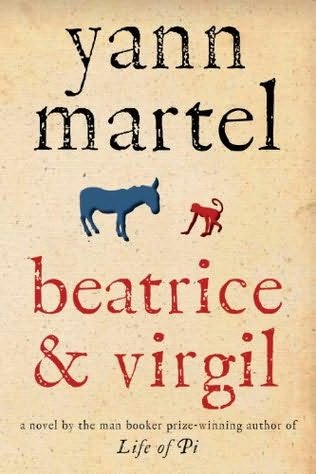
Beatrice & Virgil by Yann Martel

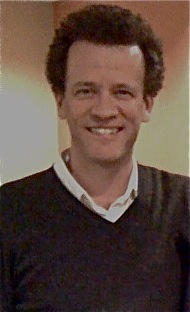
It has been nine years since Yann Martel’s second novel The Life of Pi first published. Its winning the Booker Prize in 2002 has solidly placed him on the international literary stage. Beatrice and Virgil is the long awaited third novel by this Saskatoon based Canadian author.

Beatrice is a donkey.  Virgil, a howler monkey.  They are the two characters in a play written by a taxidermist.  Beatrice and Virgil are also specimens in his shop Okapi Taxidermy.  The two names come from Dante’s Divine Comedy, to which the book has made reference. The metaphor of taxidermy is a fresh frame Martel constructed to look at the Holocaust. The preservation of evidence of lives lived, the mounting of historical facts.

Beatrice and Virgil is also a love story.  The two animals cherish each other and have to face the cruelty of extinction together.  In the play, they have elaborate talks about fruits, a striped shirt, God and faith.  It’s all allegorical of course.  And there’s the rub.

While I fully appreciate Martel’s attempt at creating a new frame to present the atrocity of the Holocaust, I doubt using animals as symbols and parallels, depicting the cruel treatment of them would suffice to convey the magnitude and severity of this horrific crime against humanity.  Despite a sincere intent and the riveting storyline, I feel the book fails to deliver the dynamics and efficacy in its form as an allegory.

Nonetheless, the book conveys some very interesting points, through which Martel has demonstrated the imaginative power of literary creation.  First off, the author plays with the notion that the line separating fiction and non-fiction is indeed blurry.  To make a case of it, he writes himself into the story.  The main character is an author called Henry, whose wife Sarah later on gives birth to their son Theo, the name of Martel’s own son with his partner, the writer Alice Kuipers.

Back to the story, Henry’s second book has stirred international sensations, winning prizes, adopted by schools and book clubs, and adapted into a Hollywood movie.  Life of Pi is all that.  And just like in real life, it has been a few years after that before the fictional Henry completes his third novel, a book on the Holocaust.  But this time, he has trouble finding a publisher (now this may diverge from real life.)

This new book Henry wants to get published is a literary fusion. He wants it to be a ‘flip book’.  One side is fiction, the other side an essay, with the title on both.  And that is exactly what the cover of this book Beatrice and Virgil is like.  Henry observes that all Holocaust accounts have been ‘historical, factual, and literal’, it is worthwhile to create a fictional rendition of it, “a new choice of stories”, providing readers with an artistic expression representing these well documented, horrific happenings.  And this is exactly what Martel has done, constructing imaginary portals based on facts.

Once these layers have been peeled off, there is yet another with Henry meeting the taxidermist who is writing the play using Beatrice and Virgil as the two main characters. Coincidentally, he is also called Henry. So, the amateur writer Henry mysteriously involves the professional writer Henry to help him with the completion of his play on the Holocaust.  But of course, there remains yet another layer of secret.

The image of Escher’s Drawing Hands keeps emerging in my mind as I read the book, how a writer would write himself into the story and into the story.

While the style of storytelling is intriguing, when one considers the topic and the major crux of the book, that being the atrocity that is the Holocaust, it is apparent that the choice of the deadpan treatment of a donkey and a howler monkey in allegorical terms just would not suffice. While the play in the book is reminiscent of other two-character plays, namely, Tom Stoppard’s Rosencrantz And Guildenstern Are Dead and Samuel Beckett’s Waiting For GodotBeatrice and Virgil seems to lack the wit of the former and the depth of the latter.

And as I think about the fact that it has taken the author nine years to come to this one, I wonder, just wonder… Oh, the creative process is indeed an incomprehensible and uncertain path, as cryptic as an Escher drawing.

Beatrice & Virgil by Yann Martel, published by Knopf Canada, 2010, 224 pages.

~~ ½ Ripples

***

Epilogue:  Yann Martel Reading at the Calgary Public Library

.

.

After writing the above section on Beatrice & Virgil, Arti has the privilege of listening to Yann Martel read from his new book at the Calgary Public Library tonight (April 28, 2010).  It’s always interesting to hear a writer read from his own work.  It’s even more gratifying listening to the Q & A session afterwards.  Yes, he is still sending books to Stephen Harper because he firmly believes that literature is the tool to understand the human condition.

The writer also talked about the creative act, and the use of animals as symbolism. Animals are inherently poignant.  And, how did he know at that pivotal moment of his life, that he wanted to become a writer?  It’s from within, you’d know it because you’d simply want to write without any consideration of monetary gains or praises.  It’s a strong feeling inside moving you to just do it.

Do I need to make any changes to the review above after hearing the author read from the book?  No, I don’t think so.  But what has changed is my view of the writer.  I have come face to face with a very personable and casual human being, someone who is convinced that literature can teach us how to be human, that fiction is as important as facts, and that the creative act of writing is driven by an inherently insatiable desire to simply write, without the intention of being published or any notion of ‘success’ in mind.

***

A Midsummer Day’s Dream

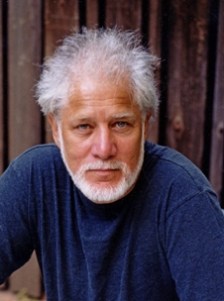
It was pure serendipity.  Finding out there would be an interview with Michael Ondaatje at the Banff Summer Arts Festival was a wonderful surprise.  Hours later I was on my way to Banff National Park.  The 90-minutes drive through the Rockies listening to the soundtrack of The English Patient was surreal.  And the destination was just as picturesque and dreamlike:

Banff Summer Arts Festival

The Banff Centre

In the event entitled ‘Literary Primetime’, Michael Ondaatje, the Sri Lanka born Canadian poet, novelist, filmmaker, winner of the Booker Prize for The English Patient, was interviewed by Marni Jackson, the Chair of the Literary Journalism Program at The Banff Centre, an acclaimed writer in her own right.

Ondaatje’s impressive body of work includes novels, memoir and a dozen books of poetry, editorial work and documentary filmmaking.  But perhaps the most famous is The English Patient, which was adapted into film by the late Anthony Minghella.  The movie was awarded nine Academy Awards in 1996.

ondaatjeThe literary event started off with Ondaatje reading several passages from Divisadero, a book that brought him the fifth Governor General Literary Award.  I sat in the huge dining hall with an audience of a couple hundreds, entranced.  From afar I held my gaze at the silver haired writer framed by the large picture windows, the evening sun seeping through majestic evergreens, and silence shrouded the place except for one man’s gentle voice.  It was simply mesmerizing.

But it was the interview that made the dreamlike experience most rewarding.  The conversation explored the creative mind behind the writing process.  I jotted down some helpful tidbits:

Curiosity goes a long way.  It sparks off the research process, generating and sustaining the creative energy for the work.

Listen to the rhythm of the sentences.   “He would” or “he’d” could elicit very different effects.  Sound advice from a poet.

I was excited to hear Ondaatje address questions stemming from his book The Conversations: Walter Murch and the Art of Editing Film, which coincidentally, I am currently reading.  Murch was the film editor of The English Patient, one of my all time favorite movies.  The serendipity is most gratifying.  The art of film editing parallels that of writing… the essence is knowing what to cut, and when to move on.

While Minghella was writing the screenplay, Ondaatje was involved in the drafts.  The story had to be taken apart and rewritten to be adapted into film.  When you see your work being dismantled and reconstructed into another form, I imagine it takes courage, trust, and humility to accept that.  Ondaatje appreciates the art form of film and respects others’ expertise, entrusting his work in their hands.  This team effort, this alchemy of talents is most prominent in the making of the movie.

In the Interview, Ondaatje was asked about one excerpt from The Conversations. The writer and the film editor shares a common appreciation for the Chinese auteur Wong Kar Wai and his film In The Mood For Love.  The layering of sounds suggests the multiplicity of going-ons, events happening off-screen.  Such an effect can also be found in The English Patient.  The thickness of the actual and imaginary scenes adds complexity and depth, weaving a much more interesting tapestry.  Again, the parallel can be drawn with novel writing.  It’s the multiple offerings and the possibilities of interpretations that make a piece of writing intriguing:

“We are not held hostage by just one certain story, or if we are, we know it is just one opinion: there are clear hints of other versions.” (The Conversations, p. 160)

There were a couple of ideas I was a bit surprised to find.

First there is the ubiquitous self-doubt throughout the writer’s creative process.  Strange, and yet comforting, to find talented minds share this same psyche.  It is a humble sign to admit self-doubt.  The architect Frank Gehry and the late filmmaker Sydney Pollack came to mind.

“Her only virtue is self-doubt.” (Divisadero).

Second, and perhaps the most precious gem I collected from the event was reflected by Odaajte’s own words on the creation of a story: “I don’t know what would happen… I don’t want to know.”  The excitement of writing is that the story reveals itself as if it has a life of its own.  The writing process is an exploratory experience.  How gratifying to know we don’t need to follow a predetermined structure to plug in the story elements.  The creative mind is not bound by structure.  Let the story lead, and, enjoy the ride.

At the end of the Interview, Ondaatje was asked about a skills and job match questionnaire he once did when he was a young man.  The results showed that he could make one good customs officer.  Aren’t we all glad he had chosen to march to a different drummer and diverged in his career plan.

***


Beach Reads and Summer Reading 2008

It’s that time of the year when you let it all hang loose and not care about whether what you’re reading is ‘literature’ or not. For some strange reasons, the hot summer months, the taking leave of work and school, the temporal evasion of chores and responsibilities seem to have emboldened us to new adventures, legitimizing ‘escape reading’. But my question is why only in the summer? Do seasons regulate our choices? Should ‘summer reading’ differ from that of the other 10 months in the year? Has the term “Beach Read” been coined merely to jack up book sales?

A look at some current writers’ “summer reading” casts even more doubts on arriving at a clear cut definition of “Beach Reads”. Dan Zak of Washington Post interviewed a sample of them and surveyed their summer reads. Here’s what he found:

  • Mary Higgins Clark: Gift from the Sea by Anne Morrow Lindbergh
  • Susan Choi: War and Peace by Leo Tolstoy
  • Janet Evanovich: The Great Gatsby by F. Scott Fitzgerald
  • Thomas Mallon: Nicholas Nickleby by Charles Dickens
  • Sue Monk Kidd: The Grimke Sisters From South Carolina: Pioneers for Women’s Rights and Abolition by Gerda Lerner.

… and so on and so forth. Click here to read more of Dan Zak’s article on summer reading.

And here’s Arti’s list. I’m currently reading Lisa Scottoline’s Lady Killer, which should satisfy a ‘traditional’ definition of a ‘beach read’. Other than that, I’m also re-reading Jane Austen’s Persuasion, and still plowing through two of Robert K. Johnston’s books, Reel Spirituality: Theology and Film In Dialogue and Reframing Theology and Film. If a ‘beach read’ is defined as a fast pace, plot-driven page-turner, these definitely don’t qualify.

I’ve just finished The Glass Castle by Jeannette Walls, which is one dynamite read, a wild ride any time of the year. It deserves a whole new post. But to categorize it as a ‘beach read’ would seem to have down-graded its quality and impact.

A few titles I plan on getting hold of this summer:

  • Then She Found Me by Elinor Lipman. After watching the film, I’m really interested to find out how a writer instills spirituality into the narrative of everyday living.
  •  Away by Amy Bloom. I’ve wanted to know more about her through her reading. So far I’ve only read one thing from her: Introduction to Jane Austen’s novel Persuasion.
  • The Savior by Eugene Drucker, founding member of the renowned Emerson String Quartet. In this debut novel, he dispels the myth of the saving power of music, using a Holocaust death camp as the backdrop. Should be one poignant read.

What’s your summer reading list like? Typical ‘beach read’ or evidence shattering its existence?

Summer Reading 2009 Click Here.

***

Chesterton Quotes

I just couldn’t resist.  Even though I posted a link to GKC Quotes in my last entry, I’m compelled to share some here for all to savor.  As a writer who encompassed social commentary, political satire, literary criticism, philosophical ponderings, Christian apologetics, poetics and plain humor in his writing, G. K. Chesterton’s (1874-1936) wit and wisdom surpassed the social and political environment of his time:

                                                                      *****


“My country, right or wrong,” is a thing that no patriot would think of saying except in a desperate case.  It is like saying, “My mother, drunk or sober.”


“A good novel tells us the truth about its hero; but a bad novel tells us the truth about its author.


“By a curious confusion, many modern critics have passed from the proposition that a masterpiece may be unpopular to the other proposition that unless it is unpopular it cannot be a masterpiece.”


“Don’t ever take a fence down until you know the reason it was put up.”


“Fallacies do not cease to be fallacies because they become fashions.”


“Journalism largely consists of saying ‘Lord Jones is Dead’ to people who never knew that Lord Jones was alive.”


“Man seems to be capable of great virtues but not of small virtues; capable of defying his torturer but not of keeping his temper.”


“Music with dinner is an insult both to the cook and the violinist.”


“The most astonishing thing about miracles is that they happen.”


“To have a right to do a thing is not at all the same as to be right in doing it.”


“Art, like morality, consists of drawing the line somewhere.”


“If there were no God, there would be no Atheists.”


                                                                   *****

Links to more GKC quotes:

The American Chesterton Society Quotations Collection

The Quotations Page


To G. K. Chesterton: Happy 134th Birthday

Well, I miss it by a day, but I don’t think he’d mind. 

To celebrate the birthday of the gifted writer G. K. Chesterton (born May 29, 1874 – June 14, 1936), I’m posting here some thoughts I wrote down after I finished reading his book The Man Who Was Thursday earlier this year.


 ‘Well, I don’t understand anything…’  — Gabriel Syme

‘I understand nothing, but I am happy…’  — Dr. Bull

Just finished this book by G. K. Chesterton.  One word had been on my mind as I was reading it:  ingenious.  Of course, there were other words too, like baffling, profound, funny, even hilarious.  Published exactly 100 years ago in 1908, The Man Who Was Thursday: A Nightmare reads like an allegory, farce, fantasy, thriller, adventure, philosophical treatise, religious exposition, and a postmodern piece of literary anime, and yes, that’s 1908.

Having said all that, I must concede and humbly admit, upon finishing this first reading, I understand very little.  The twists and turns make one doubt what actually is real, or what is disguised as real, and where the line lies between good and evil, friend and foe, government and anarchists.  I’m baffled by the symbolism and eager to seek the appropriate interpretation. 

Who is Sunday?  Is he who I think he is?  The author in his own words in the addendum says, no, he’s not.  So, what am I to think? And, even if he is, how can I explain all the events that lead up to the ending?  And…what does the ending mean?

I welcome anyone who has read, studied, or taught the book to help me out with my bewilderment.  Of course, I could research on what scholastic publications have said, but, I’d just like to entertain some casual and random thoughts.

For those who wish to explore more, here are some Chesterton links:

The American Chesterton Society: Common Sense for the World’s Uncommon Nonsense  (Plainly tells you who you’re dealing with here)

G. K. Chesterton Quotations  (Just brilliant!)

Read Chesterton Online

The Man Who Was Thursday discussion on the blog “So Many Books”