‘Certain Women’: To Connect on a Vast Landscape

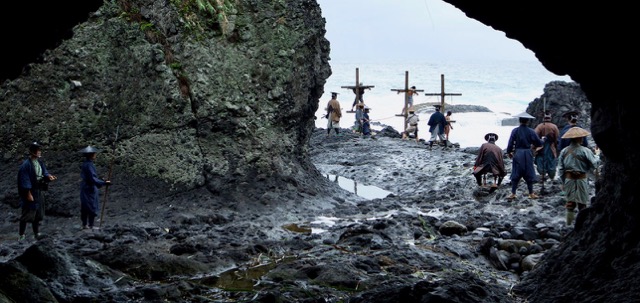
The common denominator is the landscape: Montana. Open country, clear, fresh air. The expanse of space could mean the freedom to roam. As we look into the four female characters, however, the vastness of the landscape and the cold winter could infer separateness and the need for connections. In the internal landscape, an assertion of self.

Director Kelly Reichardt (Wendy and Lucy, 2008) has chosen three short stories by Maile Meloy to form a cinematic triptych. Meloy’s stories are lean and succinct. Correspondingly, Reichardt’s style is minimal as with her previous works. She brings together three loosely linked stories that can stand on their own. To review them in a succinct way, I’ll use three words as my focal point for each.

Certain Women.jpg

Authority

Laura (Laura Dern), a woman lawyer in Livingston has to deal with a disgruntled client, Fuller (Jared Harris), who was injured in his construction job. As he has accepted a settlement, he can have no further claim for tort. Laura has explained this to him time and again, but he refuses to believe her until one day, they drive a few hours to another town to seek a second opinion from a personal injury lawyer, a male. As Fuller listens to the lawyer stating the same reason as Laura has been telling him all along, he just says ‘Okay’ and seems to accept the fact. Laura laments: “If I were a man, I could explain the law and people would listen and say ‘Okay.’ It’ll be so restful.”

A few days later, a hostage-taking incident occurs in the middle of the night, and Laura is called by the police. It’s Fuller taking a security guard hostage at a government office and wants her to go in to read him his file regarding compensation. Laura goes in and calmly diffuses the tense situation. The incident sends Fuller to prison. He seems content when Laura visits him. Laura finds a changed and much calmer Fuller. He appreciates her visit, and just wants an occasional letter from her to keep in touch. Laura does have authority after all, albeit may not be as she has hoped in the professional front. Her influence rests on her considerate demeanor making an impact on a personal and human level. And for this, Fuller learns to appreciate.

Authenticity

A city woman Gina (Michelle Williams) wants to build a country dream house, not to move in but as a weekend home. She has her eyes on a pile of sandstones that belong to long time resident of the land, Albert (Rene Auberjonois). The sandstones hold the history of the area, for they are from the original school house. We see the cracks in Gina’s relationship with her husband Ryan (James Le Gros) as they try to smooth-talk Albert, Gina seemingly caring but assertive in what she wants, while Ryan is apologetic and conciliatory. Why would a city woman want a pile of old sandstones for her country home? For authenticity, Ryan tells Albert. Ouch, is that supposed to be helpful or is he being sarcastic? Further, their daughter Guthrie (Sara Rodier) seems to be harder to placate as she is dragged along to the country reluctantly. The crevice in the mother-daughter relationship looks to be a tough fissure to fix.

Alienation

The most moving segment comes last. A young lawyer Beth Travis (Kristen Stewart) has to drive a few hours several nights a week after work from Livingston to Belfry to teach a night course on school law, a prior commitment before she found her present job. At the night class, she encounters a ranch hand, Jamie (Lily Gladstone), who drops in out of curiosity. The short moments of sharing as she accompanies Beth to a diner after class for a meal before she drives back home stir up deep longings. Gladstone’s restraint is particularly moving. Nuanced performance from both.

While she may be adroit with horses, it’s a human connection that Jamie yearns for. She comes to every class until one night, the students are told that the class will be taught by another teacher as Beth has quit due to the long drive. Eager to look for her, the ranch hand drives to Livingston to search for a lawyer named Beth Travis. What follows is an aching attempt to reach out towards an unrequited end. The last scene of the same horse-tending routines Jamie gets back to speaks poignantly. Life goes on despite…

~ ~ ~ 1/2 Ripples

***

Source materials: Short stories by Maile Meloy “Tome” and “Native Sandstone” from the collection Half In Love, and “Travis, B.” from Both Ways is the Only Way I Want it.

The Glass Castle: From Book to Screen

Jeannette Walls’ memoir had a “seven-year run on the New York Times best-seller list” after it was published in 2005, according to a NYT article . Now, 12 years later, a movie adaptation. So, the long wait is over. The wait, of course, belongs to those who don’t mind seeing a book turned into a movie.

As I’m a proponent of judging book and film as two different art forms on their own merits, I welcome movie adaptations. With this memoir, a non-fiction, I do feel the movie lacks the emotional punch as the first person narrative Jeannette Walls has so masterfully presented in her book. Walls’s memoir is a much livelier, engaging, and poignant piece of account depicting an extraordinary growing-up experience, a nomadic life of poverty until she and her siblings escaped from it.

As I’d mentioned in my review of the book, I was browsing in a bookstore when I picked up The Glass Castle randomly. The opening line captured my attention right away:

I was sitting in a taxi, wondering if I had overdressed for the evening, when I looked out the window and saw Mom rooting through a Dumpster.

That instantly drew me in. And for the rest of the book, Walls has not stopped captivating me with her growing up experience. She candidly shares how alcohol had ruined the potentials of her dreamer dad Rex, who had always dreamed of building them a glass castle. She tells us how her artistic mom Rose Mary had coped (or not), and the effects of their unconventional ‘parenting style’ had on the four children. Eventually, starting with the eldest, Lori, the children one by one escaped from their parents to NYC to start anew. As Jeanette saw her Mom digging through a Dumpster in NYC, she was a journalist at that time and living on Park Avenue. No judgement here, for the book explains all. The Glass Castle is a detailed account of Jeanette’s incredulous journey.

TGC_D40-4817.raf

Now, having said all that, I must state that the movie is still a watchable production. Unlike his previous realistic drama Short Term 12 (2013), writer director Deston Daniel Cretton has a tall order here: from the massive field of information in the memoir, to glean and pick just a few episodes to include in the film and string them up as a whole, while making them as interesting and captivating as the book. I know, Cretton must eliminate and condense, the difficult task of a movie adaptation.

Cretton chose to focus on the love hate relationships between father and daughter, and the actors have delivered, thanks to the performance of Woody Harrelson as Rex and the actors who play Jeannette as a youngster, Ella Anderson, and as adult, played by Academy Award Best Actress Brie Larson (Room, 2015). Harrelson is spot-on and dominates the screen.

Mom Rose Mary is played by Naomi Watts. And with this character, I feel there may be a miscast here. For one thing, since the film is heavily weighed on Rex, mom has a much minor role, which is a shortfall, for she does contribute to the children’s development, and taught them to appreciate reading, art, and the value of resilience, using the Joshua Tree as an object lesson, bent but alive. In my mind, Laura Dern could be a more suitable cast.

While the book is chronological, the movie juxtaposes the past with the present. It is done quite well, no confusion or disjointed feeling here. The editing is smooth and moves both storylines forward effectively. The scene of the accident when Jeanette has to cook as a young child and is burned badly is placed aptly at the beginning of the movie. Scars that can be seen visually is a good reminder of one’s past where memories could fade.

One of the main differences between The Glass Castle the book and the movie adaptation is distance. The book is intimate and close. Walls is such a straight forward writer that it feels like she’s right there sharing, opening up herself candidly to the reader. With the movie here, we are just like that, sitting afar as a spectator. It took me a while to engage.

The major issue is the mood. The book depicts a nomadic existence as Jeanette was growing up. The children were herded from place to place across States, often as dad Rex escaped from debtors. They had slept open in the Mohave desert, so, they could pick their own star as a present. Surely these may all be a disguise for their plight, euphemism offered by irresponsible parents. But none can deny the thrills and exhilaration of escapades and adventures. The togetherness of the siblings, the wonder of life are apparent in Walls’ descriptions. The word ‘dysfunctional’ had never appeared in my mind as I read the book.

The film however, focuses on the darker side. The abusive and volatile Rex dominates the screen. Poverty and gloom take over. The tipping point comes as the eldest Lori graduates from high school, and she makes an exit plan. We breathe an air of relief as the children one by one escapes to NYC. A few years later though, Rex and Rose Mary move out to be with them, so they can all be together again as one family.

Is a family being together always the best? As we see, togetherness may not be an ultimate good to pursue when harmony is impossible to reach. What’s more important is keeping oneself intact, one’s past reconciling with one’s present, the integrity of self. In the film, that is the turning point for Jeannette in the scene at the restaurant with an important client of her husband’s. Jeannette comes out from hiding about her family, albeit at the most inopportune moment.

The final scene is a beautiful wrap. The Walls gather together to have a family meal after Rex has died from illness. The siblings chat about their formative years in laughter. Resilience and loyalty to each other have kept them intact. A rewarding closure and a beginning towards a better future.

Do stay behind to watch the video of the real life Jeannette with her mom Rose Mary as the ending credits roll. And do sit through the credits until the very last line, wherein lies the emotional punch of the whole film:

“To all families, despite the scars, still find a way to love.”

~ ~ ~ Ripples


***


Related Post on Ripple Effects:

The Glass Castle Book Review

August at the Pond

Our summer is short. After a few weeks of record high temperatures, as August arrives, I can feel the cooler air creeping in.

DSC_0126.jpg

At the Pond, August brings a harvest of berries and edible delights for the birds:

DSC_0158


DSC_0147

Here are some of the guests relishing Nature’s feast.

Forget about worms, these succulent fruits are tastier. The young Robin learns fast:

The Robin

The American Goldfinch, bending over forward:

Bend over forward

The Cedar Waxwing knows her etiquettes, always graceful and poised:


Wax Wing


Among them all, I must say my favourite is the Yellow Warbler. They are not fond of berries, but there are lots to eat around here. I’m most grateful for their taste. Here’s why: Mosquitoes eat me; warblers eat mosquitoes. Simple as that.

Warbler

Warbler 1

Warbler 3.jpg

What more, it’s no simple feat to sing with a mosquito in your mouth:

Still sing.jpg

In a few weeks, the Warblers will be gone, and I’ll be capturing scenes of Autumn. Yes, that soon. But for now, I’ll feast on summer sights. So, eat to your heart’s content, my Warbler friend.

***


Metropolitan (1990): Whit Stillman’s Homage to Jane Austen

Thanks to New York born and raised director Whit Stillman, one of Jane Austen’s characters in her juvenilia, Lady Susan Vernon, had a field day last year. For those wondering how that came about, do seek out Stillman’s film Love & Friendship (2016), or his movie-tie-in book Love & Friendship: In Which Jane Austen’s Lady Susan Vernon Is Entirely Vindicated. 

But Janeites may not have noticed, back in 1990, five years before the pivotal year of wet shirt Darcy’s mortifying encounter with Lizzy Bennet, another Austen character was vindicated, Fanny Price of Mansfield Park. And they have Stillman to thank.

What does Jane Austen’s Mansfield Park, published in 1814 England, have in common with a bunch of upper class college freshmen/women in 1990 New York City, calling themselves UHB (Urban haute bourgeoisie), worrying about an ‘escort’ shortage for their debutante parties during their Christmas break?

Wait a minute, UHB? ‘Urban Haute Bourgeoisie‘? Isn’t that the kind of targets that would have interested Jane? Our astute Jane who loved to wield her pen, piercing through the façade of the rich and privileged, shaking the underlying status quo of society of her time? Jane would have loved Stillman’s film. She would be amused by the characters in this comedy of manners and their social commentaries. Debutante parties? Jane would be surprised to hear they still exist in the 20th century. If she were to write the screenplay, Jane would probably be less subtle.

Screen Shot 2017-07-17 at 10.03.38 PM

Stillman’s Metropolitan is not so much an acerbic satire but a gentle poke and  descriptive vignettes of the young UHB’s lifestyle and thinking. From his treatment of his characters, he is gentle and forbearing, albeit incisive, just enough to elicit some knowing chuckles.

In Mansfield Park, Jane presented a heroine that is a contrarian. Fanny Price is unadorned, impoverished, athletically challenged, a misfit and outsider when she enters the upper class home of Sir Thomas Bertram. But it’s her being principled and virtuous that make her stick out like a sore thumb. As Jane ends the book, Fanny gets the final praise, and an oblivious, but decent, Edmund as her ultimate reward.

Stillman’s Metropolitan is set in 1990 NYC. It has two characters that are a type of Fanny Price. First is Tom. He stands for everything that’s the opposite of the UHB. A self-professed socialist, Tom comes from the other side of the track. He wears a raincoat (albeit with a warm lining as he explains) in midwinter, and a ‘snob’ for public transit. Taxi? No, he’d rather walk.

Sure, his new found friends of the UHB know why. How many can afford to take the taxi as their usual means of transport and wears tux to parties? So, to their credit, despite knowing Tom might be from the opposite side of town, they receive him into their midst, especially as the girl Audrey likes him very much and wants him to help solve their, or her, ‘escort shortage’ to the debutante parties.

Audrey is a lover of books. She’s unpretentious, modest, and above all, a sensitive soul not unlike Fanny. In one scene, Audrey serves as a moral compass as the group gathers in the after party to a game that she disapproves of. That’s a Fanny incognito there. She insists on her stance despite everyone, Tom included, feels there’s nothing wrong with the game.

So there are the Austenesque parallels and types. You might be able to identify the Crawfords there too. The youthful characters are all serious in their viewpoints. One must give them credits. In their tux and gowns they discuss social theories. Therein lies Stillman’s gentle satire. While the sarcasm and humour is subtle, there are a few lines that are overt, lines I think Jane would have approved.

In this scene (above photo), Audrey and Tom discuss books. Audrey says Persuasion and Mansfield Park are her favorite Austen books, Tom is incredulous.

Tom:  Mansfield Park! You got to be kidding.

Audrey:  No.

Tom:  But it’s a notoriously bad book. Even Lionel Trilling – one of her
greatest admirers – thought that.

Audrey:  If Lionel Trilling thought that, he’s an idiot.

Jane probably would have thought, “Oh I wish I had written those lines.”

But wait, there’s more. Later in the party, Tom and Audrey continue to discuss Mansfield Park.

Audrey: You find Fanny Price unlikeable?

Tom: She sounds pretty unbearable, but I haven’t read the book.

Audrey: What?

Tom: You don’t have to have read a book to have an opinion on it. I
haven’t read the Bible either.

Audrey: What Jane Austen novels have you read?

Tom:  None. I don’t read novels. I prefer good literary criticism. That way
you get the novelist’s idea as well as the critic’s thinking. With
fiction I can never forget none of that has really happened. It’s all
made up by the author.

Oh I can see Jane ROFL.


~ ~ ~ 1/2 Ripples


***

Related Posts on Ripple Effects:

Stillman’s Love & Friendship: More than Book Illustration

Love & Friendship and Other Prospects

Mansfield Park: Jane Austen the Contrarian 


Jane Austen 200: Room or No Room, She Did It

Today is the Bicentenary of Jane Austen’s death. On July 18, 1817, suffering excruciating pain, Jane died of her illness at age 41. As a tribute, I’m reposting my article on Virginia Woolf’s A Room of One’s Own.

***


A Room of One’s Own is based on a series of lecture Woolf delivered at the two women’s colleges in Cambridge University on the topic of “Women and Fiction”.  It was published in 1929.

Woolf lamented the disparities women in a patriarchal society had to face throughout history.  The stream of consciousness flowed into torrents of incisive social observations and satirical commentaries.

She noted that women had long been deprived of equitable opportunities in education and employment. Men were rich, women were poor; men got to roam the country and travel the world, women had to be satisfied with the domestic.  Men were great writers, poets, playwrights, women had to concede to find fulfillment in “making puddings and knitting stockings”. Men had rooms to work, to rest, to create…women, the average, middle class women, seldom had a room of their own.

…to have a room of her own, let alone a quiet room or a sound-proof room, was out of the question, unless her parents were exceptionally rich or very noble, even up to the beginning of the nineteenth century.

And sadly, Woolf had to utter this statement:

Yet genius of a sort must have existed among women as it must have existed among the working classes.

Isn’t it true, Jane spent her most prolific years writing in a very public room in Chawton House.  In the midst of family activities, at a small and spartan desk, she revised Pride and Prejudice and Sense and Sensibility, wrote Mansfield Park, Emma, and Persuasion, and began Sanditon:

Jane's writing desk in Chawton

And isn’t it true that only in movies do we see the idyllic desk against a clear window, with soft light diffusing in, gently illuminating a lady dressed in elegant regency gown, writing on expansive papers and stationary, contemplating in solitude:

Room or no room, recognized or not, something happened towards the end of the eighteenth century that, according to Virginia Woolf, deserved much more mention in history than the Crusades or the Wars of the Roses:  The middle-class woman began to write.

Woolf pointed out that not only did Jane Austen lack a room of her own, having had to write her novels in the very public sitting-room, she had to hide her manuscripts or cover them with a piece of blotting-paper, as observed by her nephew James Edward Austen Leigh in his Memoir of Jane Austen.

Ironically, there lay the genius of Austen, and the few woman writers around her time such as Bronte and George Eliot.  Woolf wrote:

…and we must accept the fact that all those good novels, Villette, Emma, Wuthering Heights, Middlemarch, were written by women without more experience of life than could enter the house of a respectable clergyman; written too in the common sitting-room of that respectable house and by women so poor that they could not afford to buy more than a few quires of paper at a time upon which to write.

Little did they know, it was in such a room that they were trained in the prerequisites of novel writing:

…all the literary training that a woman had in the early nineteenth century was training in the observation of character, in the analysis of emotion.  Her sensibility had been educated for centuries by the influences of the common sitting-room.  People’s feelings were impressed on her; personal relations were always before her eyes.  Therefore, when the middle-class woman took to writing, she naturally wrote novels…

Not only that, they wrote good novels.  With reference to Jane Austen, Virginia Woolf concluded:

Here was a woman about the year 1800 writing without hate, without bitterness, without fear, without protest, without preaching.  That was how Shakespeare wrote.

High praise indeed.


***

Previous Post on Jane Austen 200:

Jane Austen’s Persuasion: A Bath Walking Tour

Jane Austen’s Persuasion: A Bath Walking Tour

As a tribute to the Bicentenary of Jane Austen’s death, July 18th, 2017 to be exact, I’m reposting my personal encounter with the city of Bath, Jane’s home for four years and the setting of Persuasion.

***

The second time I visited Bath, I was a more intentional traveller. I let Austen’s Persuasion be my guide.  With a detailed street map in my hand, I went exploring the places mentioned in the novel, many of them I missed in my first visit.

“I was not so much changed…” was Anne Elliot’s words to Captain Wentworth upon seeing him eight years after turning him down.  The termination of their relationship was not her own intention, but duty had driven her to yield to Lady Russell’s persuasion.  It would have been a “throw-away” for Anne at 19 to engage with “a young man who had nothing but himself to recommend him, and no hopes of attaining affluence, … uncertain profession, and no connections.” (p. 20)

But the star-crossed lovers are granted the bliss of a second chance, and rightly grab it this time. Austen’s setting of Bath in the book is no coincidence.  The Georgian City was the centre of fashion and the epitome of genteel society, a hotbed of social phenom for the critic and satirist in Austen. Jane had lived in Bath herself for four years, 1801 – 1805, with her sister Cassandra and their parents. Ironically, she was unpersuaded by its attractions according to her biographer Claire Tomalin.

Austen aptly uses Bath’s addresses for the purpose of her characterization. Geographical location is everything in a class-conscious society, as Keiko Parker’s excellent article Jane Austen’s Use of Bath in Persuasion points out.

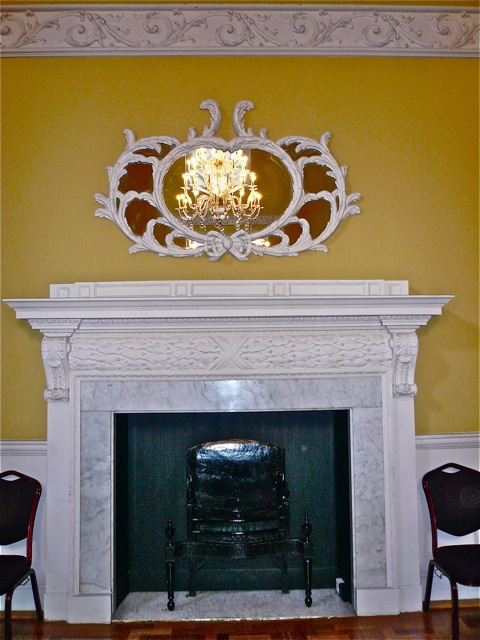
First off,  there’s the Pump Room, where in Jane Austen’s days people socialized and met one another, gathered to drink the therapeutic water, catch the latest fashion, simply to see and be seen. The magnificent structure and decor makes The Pump Room a fine restaurant now:

Despite its grand decor, the areas around the baths are residences for the common folks in Austen’s time. Mrs. Smith, the poor, infirmed widow with whom Anne maintains a loyal friendship, lives in the Westgate Buildings close to the Baths. Anne becomes a laughing stock for the snobbish Sir Walter when he hears of her least favourite daughter is determined to visit Mrs. Smith instead of accepting an invitation to Lady Dalrymple’s, someone belonging to the upper echelon of society:

“Miss Anne Elliot, you have the most extraordinary taste! Everything that revolts other people, low company, paltry rooms, foul air, disgusting associations, are inviting to you.” (p. 113)

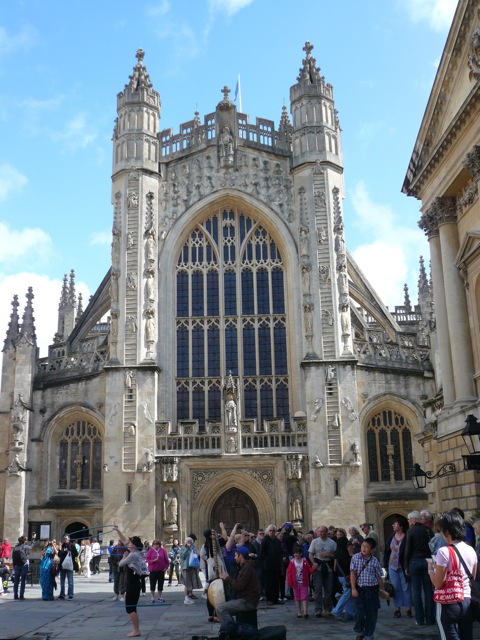
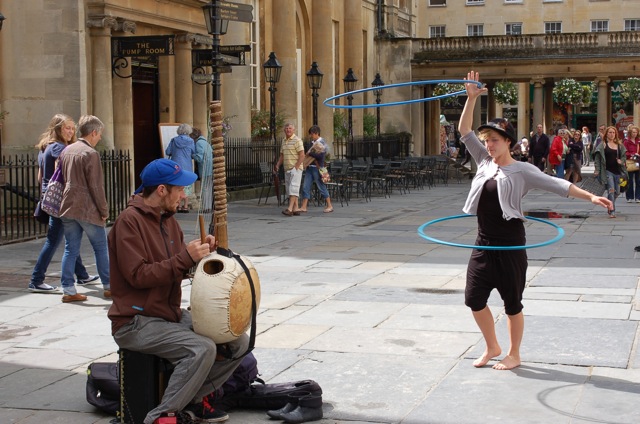
Today, the open area outside the Pump Room by the Roman Baths is perhaps the most popular tourist gathering place. Tour buses stop at the Bath Abbey for pick up and drop off, buskers perform in the open space outside the Roman Baths and Pump Room:

Nearby is Sally Lunn’s Bun, originated in 1680 by a young French refugee, in the oldest house of Bath, ca. 1482. Now a restaurant on top, the cellar a museum that houses the original kitchen and cookwares, Sally Lunn’s serves this traditional creation: a large, soft, round bun that can go with just about anything. But probably best like this, simply with garlic butter:

The beautiful street corner outside Sally Lunn’s:
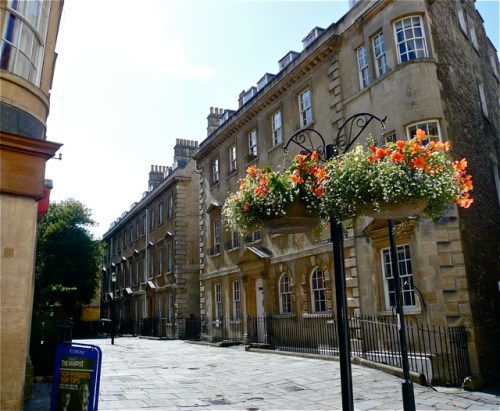
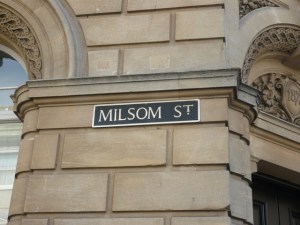
Further up the town, there’s Milsom Street, a vibrant commercial area of shops and businesses.  The first time Anne saw Captain Wentworth again in Bath was on Milsom Street.  Here’s a present day view of the same site:
.

As for Sir Walter himself, despite having to rent out his country mansion Kellynch Hall to avoid financial ruins, he has no intention that his retreat to Bath should compromise his status and comfort.  It’s only natural that others are curious: “What part of Bath do you think they’ll settle in?”  The answer is quite obvious: the part that is befitting their social standing.

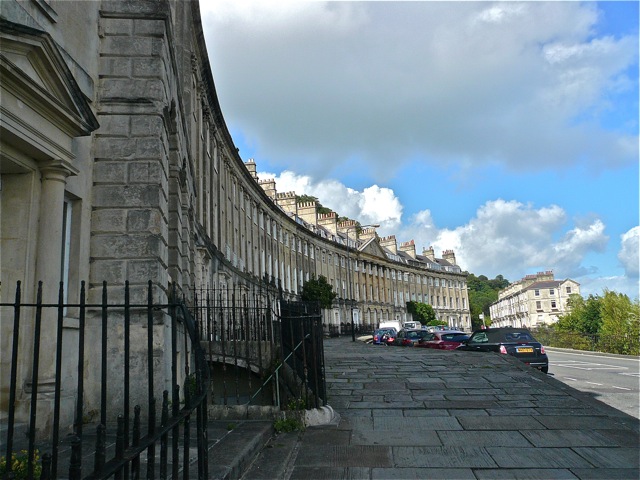
According to Keiko Parker’s insightful article, physical elevation in Bath directly corresponds to social standing. The highest point at that time would have to be Camden Place, which is today’s Camden Crescent. While I was looking for it, the ‘Ye Old Farmhouse Pub’ was mentioned to me as the marker. I was glad to find it while walking up Landsdown Road, for it was indeed quite an uphill walk.


“Sir Walter had taken a very good house in Camden Place, a lofty, dignified situation, such as becomes a man of consequence; and both he and Elizabeth were settled there, much to their satisfaction.

Anne entered it with a sinking heart, anticipating an imprisonment of many months…” (p. 98)

Just typical Austen, the overt contrast of characters using something indirect, here, the sense of place.

The houses on Camden Crescent has unobstructive view of lower Bath.  They are not grand mansions, but then again, location is everything. The following are some of the houses found on this road across from the escarpment:

And where do Sir Walter’s tenants Admiral and Mrs. Croft lodge during their short stay in Bath?  On Gay Street, not too high, not too low: “… perfectly to Sir Walter’s satisfaction.  He was not at all ashamed of the acquaintance, and did, in fact, think and talk a great deal more about the Admiral than the Admiral ever thought or talked about him.” (p. 121)

Elizabeth is not even half as kind as her vain and snobbish father.  Regarding the Crofts’ arrival in Bath, she suggests to Sir Walter that “We had better leave the Crofts to find their own level.” (p. 120)

In contrast, Anne has a good impression of the Admiral and his dear wife, the kind and down-to-earth couple, Mrs. Croft’s being the sister of Captain Wentworth having minimal bearing on Anne’s fondness of them. During their sojourn in Bath to mend a gouty Admiral Croft, Anne enjoys watching them strolling together, “it was a most attractive picture of happiness to her.” (p. 121)

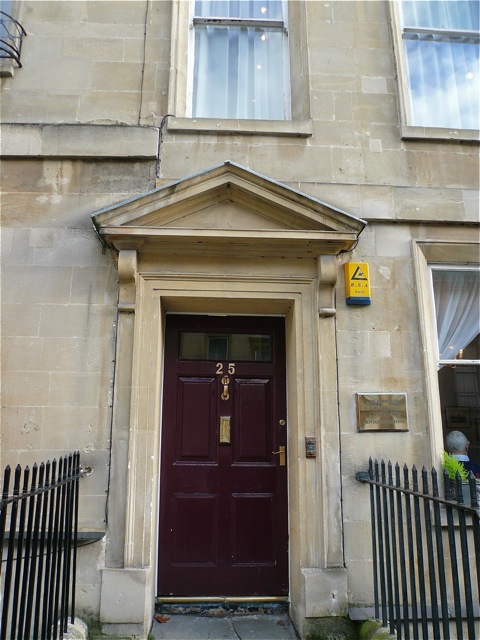
So I’m just not a bit surprised to see their temporary lodging in Bath being on Gay Street.  Who else had lived there?  Jane Austen herself: #25 to be exact:
As for a suitable place for socializing, Sir Walter and his favourite daughter Elizabeth choose the Upper Assembly Rooms, a much newer development closer to their upper, more fashionable side of town, although he would prefer entertaining in private which is even more prestigious.

The Assembly Rooms are a magnificent architectural legacy in their own rights.  Designed by John Wood the Younger, who raised the £20,000 needed for the venture, the ground-breaking project began in 1769 and opened for public use in 1771.  It was the biggest investment in a single building in 18th Century Bath. Four public rooms made up the suite:  The Octagon, Ball Room, Card Room, and Tea Room.

“Sir Walter, his two daughters, and Mrs, Clay, were the earliest of all their party at the rooms in the evening; and as Lady Dalrymple must be waited for, they took their station by one of the fires in the Octagon Room (p. 131).

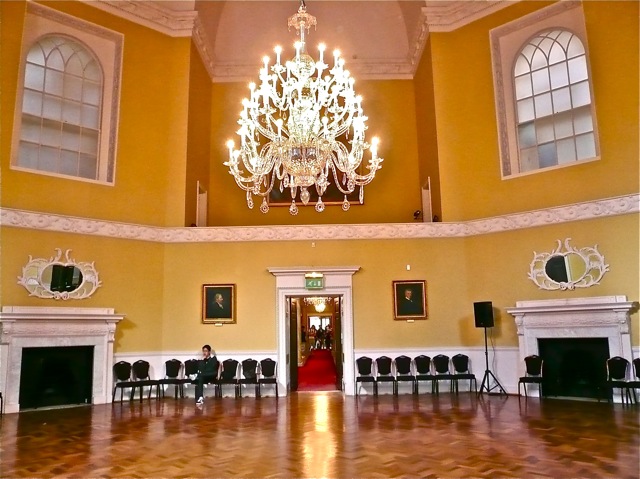
Here’s the exquisite Octagon Room:

Regarding the chandelier, there’s this interesting account in The Authorised Guide (p.7):

“On 15 August 1771 Jonathan Collett quoted £400 for supplying five cut-glass chandeliers for the Ball Room. They were up in time for the opening of the Rooms in September, but the following month disaster struck when ‘one of the arms of the chandilers in the Ballroom fell down during the time the company was dancing, narrowly missing  Gainsborough. What could be salvaged from the set was made up into a single chandelier, which now hangs in the Octagon.”

I was just simply amazed at how long these chandeliers had lasted, well over 300 years, and in excellent shape. Their brilliance had not faded, evolving from candlelight to gas, and now electric:

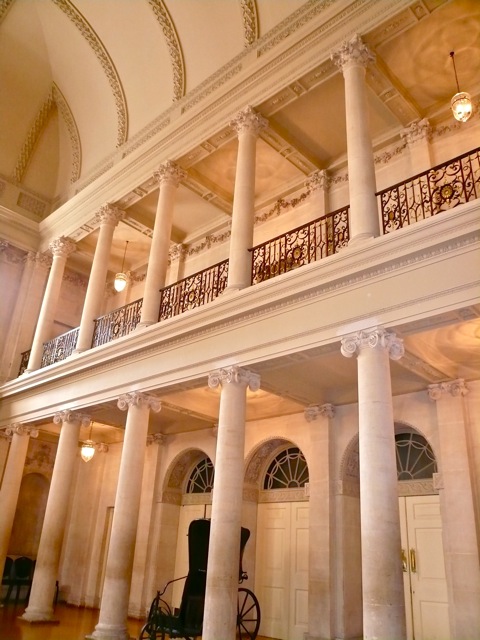
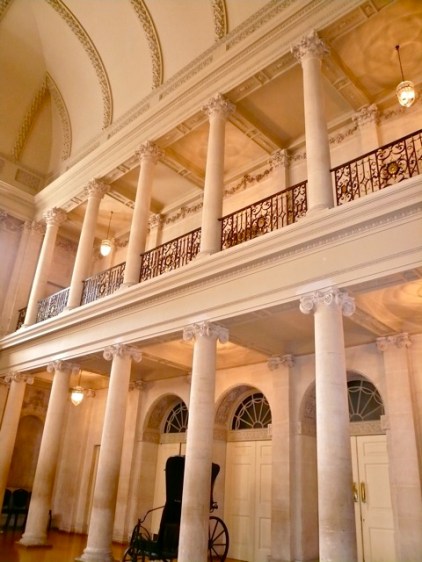
Anne and her party attend a music program in the Concert Hall.  That’s a function in the Tea Room. Despite the name which seems to convey a small and cozy setting, the Tea Room is a gorgeous room of 60 ft. by 43 ft. dimension.  On one end is a magnificent colonnade of the Ionic order.  Subscription concerts are regular events held in the Tea Room. Mozart and Haydn had written compositions to be performed there, with Haydn himself having graced the magnificent venue.
.
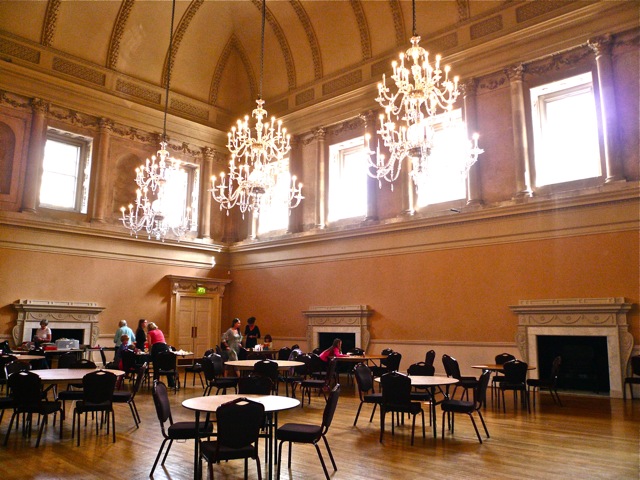
But what does Anne Elliot think about all the grandeur?  After earlier in the Octagon Room talking with Captain Wentworth, who has openly expressed his long-held passion for her, Anne, overwhelmed by a great flood of euphoria, now walks into the Concert Room (Tea Room):

“Anne saw nothing, thought nothing of the brilliancy of the room.  Her happiness was from within. Her eyes were bright, and her cheeks glowed; but she knew nothing about it.  She was thinking only of the last half hour…” (p. 134)

As a visitor to the historic venue, I was captivated by the well-maintained interior and its elegance, and presently amused and surprised to find this display in between two columns: The Chair, which is mentioned several times in Persuasion. The Bath Chair was invented right here in the Georgian City to transport the rich and the sick.  It could be steered by the passenger:

.

Jane might have noticed the frivolity and pierced through the façade of high society of the time with her critical eyes, but as a modern day tourist, I’m just amazed at how well history has been preserved, totally persuaded that Bath is a place I will definitely revisit some more in the future.

***

All photos taken by Arti of Ripple Effects, August 2010.  All Rights Reserved.

References:

1. Jane Austen: A Life by Claire Tomalin, Penguin Books, 2000.

2.  Persuasion by Jane Austen, The Modern Library Classics, Introduction by Amy Bloom, Modern Library Paperback Edition, 2001.

3. The Authorised Guide: The Assembly Rooms, Bath. Published by the Heritage Services division of Bath and North East Somerset Council in association with the National Trust.  Written by Oliver Garnett and Patricia Dunlop.

4. “What Part of Bath Do You Think They Will Settle In?”: Jane Austen’s Use of Bath in Persuasion by Keiko Parker.  Retrieved Online http://www.jasna.org/persuasions/printed/number23/parker.pdf

***

To join in the celebration of Jane Austen 200, I’ll have more Austen posts coming up this week.

Upcoming Books to Movies 2017

Half a year’s gone already. How’s your reading and watching coming along? Here are some movie adaptations I anticipate for the latter half of the year.

The Glass Castle by Jeannette Walls

the-glass-castle-bookFinally, the movie adaptation is completed. More than seven years on the NYT Bestseller list, Jeannette Walls’ 2005 memoir of resilience and delight – yes, the two can co-exist – is high on my TBW list. After receiving her Academy Best Actress Award in another book-to-screen adaptation, Room (2015), Larson is back with her Short Term 12 director Destin Cretton. Interesting cast for the parents, Woody Harrelson as dreamer dad Rex Walls and Naomi Watts as uncouth artist mom Rose Mary. Coming out in August. Should be a good summer movie.


Tulip Fever by Deborah Moggach

Tulip FeverMoggach’s best known book is probably The Best Exotic Marigold Hotel, among her many titles. Tulip Fever is the author’s first historical fiction set in 17th century Holland, evoking the paintings of Vermeer’s. The story begins with a rich merchant in Amsterdam commissioning a painter to paint his young bride. The rest is up to the further imagining of Moggach’s creative mind. From book to screen adaptation written by Tom Stoppard, directed by Justin Chadwick, who helmed the adaptation of Philippa Gregory’s The Other Boleyn Girl (2008) and the excellent TV mini series of Dickens’ Bleak House. Cast includes Alicia Vikander, Judi Dench, Christoph Waltz. Coming out in August. Should be another good summer pick.


Wonder by R.J. Palacio

Wonder Book CoverAnother one high on my TBW list. This is one YA novel that appeals to both young and old, for the theme of acceptance and empathy is so much needed in our time. A look at the trailer shows the film is well cast. Room’s breakout young star Jacob Tremblay as disfigured fifth grader, entering school for the first time in his life; Julia Roberts plays mom and Owen Wilson is dad. Stephen Chbosky (The Perks of Being a Wallflower, 2012) directs. To be released November, 2017.



Murder on the Orient Express by Agatha Christie

Murder on the Orient Express.pngDame Agatha Christie’s famous work has gone through many renditions on the big screen, small screen and even a video game. But the classic has to be the Sidney Lumet directed 1974 production with Albert Finney, Lauren Bacall, Ingrid Bergman, John Gielgud, and a young Sean Connery, just to name a few. This 2017 version is directed by Kenneth Branagh who will, of course, takes up the role of Hercule Poirot. Cast include Johnny Depp, Michelle Pfeiffer, Daisy Ridley, Penélope Cruz, Judi Dench, Derek Jacobi, Willem Dafoe, a modern classic in the making? Coming out November, 2017.
 

EXTRA, EXTRA: Ordeal by Innocence by Agatha Christie

Ordeal by Innocence

Talking about Dame Agatha, the latest, yes just hours ago, it has been announced that the prolific writer – whose books have sold only less than The Bible and Shakespeare according to The Hollywood Reporter – will ring in yet another adaptation by BBC in time for the Christmas season. BBC touts a mighty cast with Bill Nighy, Catherine Keener, Matthew Goode, Eleanor Tomlinson among many talents. A jolly good Christmas for the Brits indeed. We’ll have to wait for Masterpiece to act.


***

Related Ripple Effects Posts:

The Glass Castle Book Review

Wonder by R. J. Palacio: Required Reading for All

The Best Exotic Marigold Hotel 

The Second, Best Exotic Marigold Hotel


A Movie to Celebrate Canada Day

Happy Canada Day to all my Canadian readers!

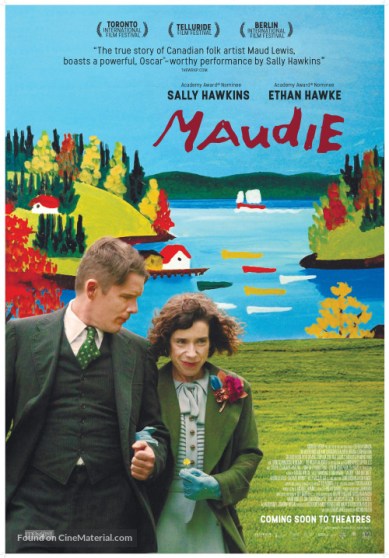
To celebrate Canada’s 150th birthday, and pay tribute to the Canadian spirit, I’d like to recommend the movie Maudie, about the folk art painter Maud Lewis (1903-1970). Born in Yarmouth, Nova Scotia, Maud lived with her brother Charles in their family house until he sold it. In the movie, Maud overhears Charles telling their Aunt Ida he will pay her to accommodate and look after Maud in her home.

Maudie

Born with a small frame, disfigured facial features and deformed fingers, Maud suffers from severe rheumatoid arthritis as an adult. Such handicaps however do not cripple Maud’s sanguine spirit and fierce independence. While staying at her Aunt’s place, she answers an ad for a housekeeper posted on the bulletin board of the local store. She jumps at the opportunity as she sees it as a way to move out of her Aunt’s and strive for her own independence.

The house that needs a housekeeper is home to Everett Lewis, a fish peddler in the village of Marshalltown, on Nova Scotia’s northwestern shore. Everett’s abode is a cramped, one-room hut with no running water or electricity. With her arthritic hands Maud cleans the floorboards and tends to Everett’s daily needs, cooking on the wood stove and bearing with Everett’s demeaning outbursts. The rule of the house is, he first, then his dogs, his chickens, and lastly, Maud.

Does Maud feel defeated? Well sure, but just temporarily. Her resilient and cheerful spirit can move even a mountain of a misanthrope. Not long after, she and Everett got married. “A pair of odd socks,” she says of their seemingly incompatible personalities. We hear it often nowadays, “diversity is strength”. The Lewis’s household is evidence to that.

And of course, there’s the economic factor.

Maud turns Everett’s dingy house into a pleasant abode. She begins to paint on every surface: the walls, windows, door, stove, washbasin with lively flowers, birds, and whatever she sees in nature. She also picks up small, discarded wood boards to paint scenery and snowscapes. Not long after, a sign “Paintings for Sale” is placed outside their tiny house to diversify the household economy.

Deer painting

Maud is one successful entrepreneur. Her folksy paintings soon draw the attention of passers by; the cheerfully decorated little house on the wayside soon becomes a stop for designated shopping and repeat customers, a point of interest for visitors. Later, it becomes a converging site for news crews and journalists. Each piece of board painting is sold for about five to six dollars, a card, 10 cent. Everett is the finance minister and holds the purse strings.

The movie presents Maud’s story with beautiful and absorbing cinematography. The pace is slow, allowing viewers to immerse in the outwardly harsh life of Maud’s, in contrast to her vibrant spirit and life-affirming talents. A tiny window is a frame of the world outside. The last part of the film comes to a sad note as Maud succumbs to illness of the lungs.

Now, to the making of the movie. The subject is Canadian, Maud Lewis is very much a Canadian folk art icon, her works are in the collection of the Art Gallery of Nova Scotia. The filming location is Newfoundland and Labrador. But note this: the movie is helmed by Irish director Aisling Walsh (BAFTA nom Fingersmith, 2005), Maud is played by the English actor Sally Hawkins (Oscar nom Blue Jasmine, 2013), Everett is played by American actor Ethan Hawke (Oscar nom Boyhood, 2014). If I were a protectionist ruler, I wouldn’t have let them come in to make it.

But then again, this is Canada, eh?


~ ~ ~ 1/2 RIPPLES

***

RELATED POST ON RIPPLE EFFECTS:

Séraphine and the wrought-iron chair 


10 Years

WordPress tells me I’ve been blogging for 10 years now. It’s been a life-changing decade. From a film lover writing reviews just for personal journalling, I’ve developed into writing to share. Hundreds of movies later, I’m now an Arts and Film Writer for Asian American Press. In recent years, I started covering Film Festivals; my appreciation for cinema art and independent films from all over the world had grown deeper.

Books, I’ve read a few, but then again, too few to mention. My TBR piles is expanding much faster than I can tackle. To manage them, I use the simplest method: deleting them from my memory. Many I’ve bought from the annual Book Sale (several posts), but I’ve since donated them back. There’s one on my Goodreads ‘currently reading’ shelf for years now which I don’t want to give up just yet, and that’s Proust’s In Search of Lost Time Vol. 3, The Guermantes Way.  Some day.

Other than books, movies, and my special interest in the transposition of one into the other, I’ve also become an avid birder. Arti of Ripple Effects has turned into a nature paparazzo. I’d thought of starting another blog just for nature photography but thought, hey, everyone needs a respite even from books and films. The Pond is open to all to throw in their two pebbles, make some ripples while enjoying a piece of natural beauty.

WordPress tells me in the side bar that I have 6,843 followers. Simply amazing, considering the number of comments I receive in each post. No matter, commenting isn’t a requirement when you visit the Pond. I’m just glad to know you’ve enjoyed your stay, even if it’s a short minute or two. And to all visitors and followers, a hearty thank-you. You’ve made my presence in the blogosphere meaningful.

To celebrate 10 years, to say goodbye to Spring (already) and welcome Summer, I’ll leave you with a few photos I’ve taken in the past few days.

The forest by the Pond:

DSC_0497 (2)

They may be the most common bird, but every Robin is a welcome sight against the blue sky:

DSC_0211

The well-groomed and handsome Cedar Waxwing, always camera ready:

DSC_0428 (1)

True to their name, the Yellow-headed Blackbird on a cattail:

DSC_0344


DSC_0182.jpg

The female Red-Winged Blackbird. Nature endows with different features:

DSC_0060

Up in the sky, an Osprey is busy transporting his building materials:

DSC_0289

And a touring group of Pelicans, looking for my Air BnB?

DSC_0479 (1)


More to come.


***


Voicing out for ‘Silence’ and other adaptations

It’s a bit sad to see Martin Scorsese having had to defend the cinema. He wrote the piece in the May 31 issue of The Times Literary Supplement in response to the review of his film Silence by the novelist and literary critic Adam Mars-Jones. It is telling that the director didn’t write a defence of his film, but cinema itself.

Here’s the contentious viewpoints of Mars-Jones’s review, entitled “Subtle absolutisms”:

The transposition of a novel like Endo’s Silence into film, however “faithful”, can only amount to a distortion, an exaggeration overall however many elements of the book are represented.

and this:

In a book, too, reader and writer collaborate to produce images, while a film director hands them down.

Really? Is a movie, and in this case, Scorsese’s adaptation of Japanese writer Shūsaku Endō’s novel Silence, a piece of “subtle absolutisms” as Mars-Jones’s title suggests? Do viewers in the theatre have no say but to receive from whatever mood or themes the director hands down to them, devoid of ‘collaboration’? Has the director presented to us – subversively as the title implies – his interpretations and we remain as the silent, passive, unthinking targets?

We’ve heard it before, haven’t we, that a movie leaves no room for the imagination. We can see it all, so explicitly displayed, in actions, colour, and mood, while readers reading a book interact with the book author to create a mental picture as they read, exercising their imagination.

Silence (1)

Any regular visitor to the Pond knows Arti disagrees with such criticisms. Even a two-dimensional painting can evoke in viewers a myriad of responses, let alone moving pictures. And how we interpret and interact with such sequential, moving images can be as diverse and subjective as our personalities and life experiences.

If as Mars-Jones says “those images [have] their predetermined progress in a darkened space imposes mood insistently” and if Scorsese embeds his ‘subtle absolutisms’ so ingeniously, the film should bring out very similar responses, predominantly one, as Mars-Jones has concluded: “desolation.”

But as one who dwells in a liminal, in-between space of two cultures, I’ve come across very different reactions to the film Silence. Such could well be said are the results of internal collaborations viewers have had while experiencing Scorsese’s visual storytelling. Indeed, the film has aroused different responses across cultures.

Among Western critics, it’s usually the aesthetics, acting, cinematography, and mood that are the key features noted, as with Mars-Jones’s review. Many point out they’d like to see the roles reversed with the two actors Andrew Garfield and Adam Driver. Many have noted that the film is being ‘faithful’ to the book, however, falling short of discussing the significance of such ‘faithfulness’.

This is an important point when reviewing the film. I usually do not seek how faithful a film is to its original literary work, for the two are totally different art forms, each expresses in its own terms and the appreciation of such should not be measured using the same criteria. When it comes to Scorsese being ‘faithful’ to Endo’s descriptions and narratives, unlike Mars-Jones’s critique of ‘exaggeration’, I find the director is unusually restrained here. He follows closely with Endo’s narratives, his treatment of the persecutions of Japanese Christians poignant and heart-stirring, inferring meaning rather than exposing gratuitous images. All such restraints point to Scorsese’s admiration and respect for the author and his work. At times, I feel Endo’s writing even more graphic.

On the other hand, among Asian viewers, especially among Chinese Christians (overseas and in Hong Kong), the film stirs up deep, theological resonance. Many have shared their heartfelt responses in the print and social media, heated debates ensue among believers, and even from the Sunday pulpit. The film’s characterization emerge as the prime subject for debates: Is Father Rodrigues a true Christian? Can apostasy be pardoned in the face of coercion? What does the last scene tell us about Rodrigues? Can one lead a two-faced, dichotomized life of faith like the hidden Japanese Christians? Or with some, the film has prodded the reflexive to see oneself in the Judas character Kichijiro. A call for empathy for those under authoritarian pressures to give up their faith appear to be an unexpected result, albeit the other side would push for perseverance no matter what.

Rather than the overhanging cloud of near desolation as Mars-Jones points out, the film had stirred up ripples of vibrant discussions around the issues of salvation, suffering, apostasy, betrayal, denial, and redemption. Many of the views I’ve read reflect a pleasurable gratitude as having indulged in a thought-provoking film well made, their faith energized as they ponder on soul-stirring applications to their life.

Perhaps there’s a Roland Barthes parallel here. The death of the author comes after a piece of work is written, for it has reached its destination. Now it’s the reader’s turn to interact and give it meaning. Maybe it is so with film as well. As the director completes his production, it is given a new state of being when it is screened. As viewers interact with it, interpreting and extracting personal meaning, appreciating those elements that strike a chord with their own life experiences, they’re giving life to it in the cinema of their minds.

***

RELATED POSTS ON RIPPLE EFFECTS:

Reading the Season: Silence by Shusaku Endo

Silence the movie arrives in the most unwelcome time

Can a movie adaptation ever be as good as the book?


Seattle International Film Festival 2017

The Seattle International Film Festival (SIFF) is the largest film festival in the United States, with an annual average attendance of 155,000. The 43rd SIFF kicks off tomorrow, May 18. For 25 days until June 11, film lovers in the Seattle area will be treated to a smorgasbord of films to whet their appetite: features, documentaries, shorts, premieres, competitions, from archival to avant-garde, and any genres to match their mood. SIFF 2017 offers close to 400 titles coming from over 70 countries.

What’s the difference between watching films in a Film Festival (FF) and watching movies in a theatre? You might ask. First off, in a FF, the international aspect is emphasized. True, you’ll have to read subtitles for those not in English, but watching foreign language films is one of the easiest ways to appreciate another culture and expand empathy. You’ll likely find there are more things in common than differences among us all.

Another special feature about FF is that many of the productions are from independent filmmakers. Hollywood and blockbuster movies are the mainstay in our Cineplexes, but in FF’s, we can savor the creative fruits from individual artists. Every year, SIFF receives over 4000 independent film submissions. It is therefore an honor for a film to be an ‘official selection’ at a major FF.

Some of them have come to compete, in other words, you will see quality productions. The SIFF website notes that more than 70% of the films screened at the Festival will not return to theaters. Many of these are works of film arts that are not distributed in commercial theaters. Of course we wish them all the best, especially quality ones and competition winners, as film industry buyers and distributors will be eyeing for good films at FF’s, ready to distribute them for the largest exposure possible later in theatrical releases.

**

In the Seattle area this weekend? Love French films? I’ve a recommendation for you. Here’s my capsule review.

The Midwife

Midwife_KeyArt

Two venerable French actresses in one comedy drama is a major attraction from the director of Séraphine, Martin Provost. Claire (Catherine Frot) is an expert midwife, the encourager of new births. Her personal life though isn’t as up-lifting. One day her deceased father’s former mistress reappeared in her life, hurtful memories re-emerge. She is Béatrice, played by the legendary Catherine Deneuve. Their reunion sparks off comic and dramatic clashes. Béatrice is everything Claire avoids: booze, cigarettes, red meats, frivolity. Yet reconciliation is the only way to deal with their lot in life.

**

The Midwife will screen in Seattle this Friday and Saturday May 19, 20, and Tuesday, May 30. CLICK HERE to SIFF’s webpage for more info, trailer and tickets.

**

Related Post:

Séraphine and the Wrought-iron Chair

Owl Babies’ Day Out

It has been three weeks since I last posted about a first sign of spring: Grizzly bear coming out of hibernation. Now, spring is in full force. Another sure sign in my neck of the woods is Great Horned Owlets out to enjoy the sunshine.

First, let me play a little ‘Where’s Waldo’ with you. Can you find the owls in this photo? How many do you see?

DSC_0613

The obvious ones are on the top branch, mom on the right with her baby, and in the lower, closer to the trunk, another owlet.

Some are just born to be more independent. Take a closer look at this cool, furry owl baby perching on her own branch. Seeing me eagerly snapping her photo, she sits still for me, giving me a big smile even:

Doll


She reminds me of those Ukrainian dolls.

Furry

But don’t think she’s all innocent and vulnerable, look at her claws:

Claws

And to the mother and the other baby in the upper branch, again, they know how to please us nature paparazzi, just by being themselves:

DSC_0607

Babe & Mom.jpg

And here, a little action for us, Mom preening her baby. The term of endearment is instinct:

Mom preening baby

Preening babe.jpg

I can hear the baby say: “Thanks Mom. Happy Mother’s Day!”

***