Staying Awake in the Garden

I came across this image in Biola University’s Lent Project. It is by the Austrian children’s book illustrator Lisbeth Zwerger. Among several awards she had won, Zwerger received the acclaimed Hans Christian Andersen Medal for illustration—the highest international award given for “lasting contributions to children’s literature”.

Staying Awake in GG

Its title is Jesus praying in the Garden of Gethsemane, from her book Stories From the Bible. Without condescension, Zwerger’s image speaks with clarity such that a child can easily grasp its essence. Three people dozing off, each against a tree. From a distance, under a massive dark cloud, a tiny, lone figure walking towards the ominous void. The illustration is perhaps one of the rarer perspectives that accompanies this narrative:

“Then Jesus went with them to a place called Gethsemane, and he said to his disciples, “Sit here, while I go over there and pray.” And taking with him Peter and the two sons of Zebedee, he began to be sorrowful and troubled. Then he said to them, “My soul is very sorrowful, even to death; remain here, and watch with me.” And going a little farther he fell on his face and prayed, saying, “My Father, if it be possible, let this cup pass from me; nevertheless, not as I will, but as you will.” And he came to the disciples and found them sleeping. And he said to Peter, “So, could you not watch with me one hour? Watch and pray that you may not enter into temptation. The spirit indeed is willing, but the flesh is weak.” Again, for the second time, he went away and prayed, “My Father, if this cannot pass unless I drink it, your will be done.” And again he came and found them sleeping, for their eyes were heavy. So, leaving them again, he went away and prayed for the third time, saying the same words again. Then he came to the disciples and said to them, “Sleep and take your rest later on. See, the hour is at hand, and the Son of Man is betrayed into the hands of sinners. Rise, let us be going; see, my betrayer is at hand.”    – Matthew 26: 36 – 46

What struck me is how modern the feel; these three guys could be anyone. And they are so casual too, like, barefoot in the park. Considering the horrific mission their Master is facing, their body language speaks avoidance, indifference, and, even betrayal. The spirit is willing but the flesh is weak – blame it on the good supper – they’re totally oblivious while their Master in a distance, alone, is fighting the most anguished battle of his life.

Are these guys named Peter, James and John? Why, they could be you and me.

***

Leviathan: The Beast Within Us

The Chinese have a saying – while we’re at foreign language films – ‘A tyrannical government is more ferocious than the tiger’. That Leviathan is selected as the official entry from Russia to the Oscar race baffles me. But I can also see those in power there just may not be bothered by small town corruptions which the film depicts, for they must be more focused on the larger picture that carries greater magnitude, the scenery in Crimea.

Leviathan, that monstrous beast the priest in the film quotes to the main character Kolya is from the book of Job in the Bible. While the context in the Biblical passage is about the Creator’s might over the huge creature, it is a metaphor with layered meaning in writer/director Andrey Zvyagintsev’s film: A citizen against a powerful mayor vying for his home property, and the monstrous beast inside the characters with which they all have to wrestle.

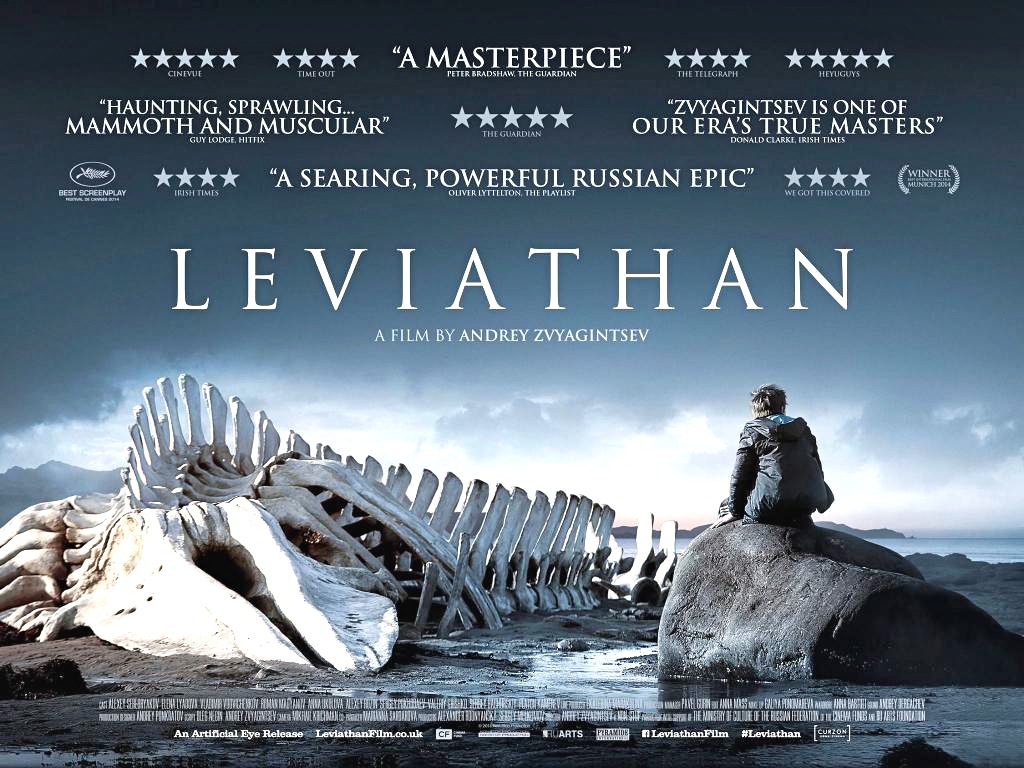
Leviathan Movie Poster

Kolya (Aleksey Serebryakov) is an apt parallel of a modern day Job in the sense of the misfortunes he encounters. The little guy is no match for a greedy and powerful mayor and a corrupt system when it comes to holding on to what he legally owns, his home on a piece of  land by the shoreline in the coastal town of Pribrezhny. Even his lawyer friend Dimitry (Vladimir Vdovichenkov), who has come all the way from Moscow to advocate for him, falls victim to the small town mayor Vadim (Roman Madyanov).

The seemingly idyllic setting of Kolya’s coastal home is apparently an illusion. The cinematography is stunning and probing at the same time, for apart from the scenic serenity, there are also broken and derelict boats discarded on the shore, as well as carcasses of sea creatures, in particular, a whale-like skeleton that we the audience would gasp upon seeing but that the local residents don’t even take a second look. Their lives are intertwined with the Leviathan, however skeletal its remains.

But Kolya is not Job. He is hotheaded and impulsive. Apart from fighting the external beast of the mayoral hostile take-over of his home property, Kolya has to keep his wife Lilya (Elena Lyadova) at bay from his lawyer friend Dimitry, as well as bring up teenaged son Roman (Sergey Pokhodaev) on a path he himself is at a loss in finding. The worst is yet to come though. We empathize with Kolya, a man so trapped, he is unable to find a way out other than drowning his misery in alcohol. The church is not helping either, why, its most powerful congregation member is the mayor himself.

Too far and remote a film to identify? The setting maybe, but not the story. Leviathan resonates with the human condition it depicts, the Leviathans within us that we have to wrestle wherever we may be. Not just Kolya, but every character is crying for a redemptive way out of his or her predicament, unless blind as the mayor who basks in his own schemes. With the nuanced performance of the cast, we have the pleasure to appreciate a production superbly crafted, and that’s what gratifies when watching a film well made, despite the subject matter.

Leviathan has won 2014 Cannes Film Festival’s Best Screenplay Award, and last month the Golden Globe’s Best Foreign Language Film. This Sunday at the Oscars, Leviathan has a good chance of grabbing the coveted prize in its category, Best Foreign Language Film of the Year.

My pick? Still rooting for Ida, for its positive choice at the end.

~ ~ ~ 1/2 Ripples

***

My Reviews of 2015 Oscar Nominated Films:

Ida

Boyhood

The Grand Budapest Hotel

Whiplash

Gone Girl 

Interstellar and Ida

Saturday Snapshot Feb. 7: Who’s Afraid of A Little Cold?

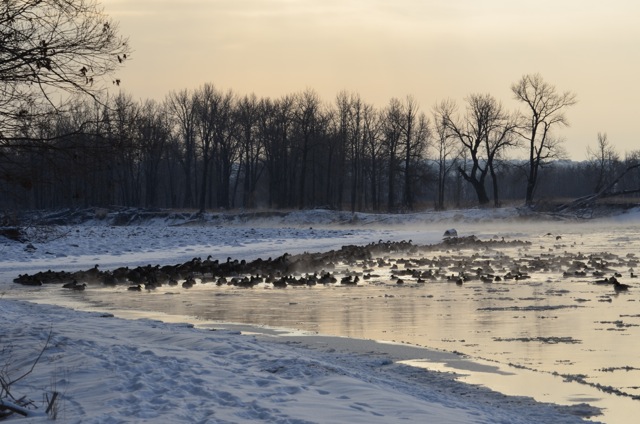
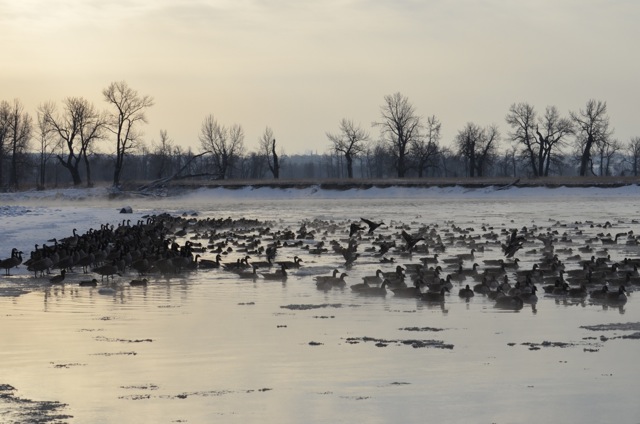
Dawn broke cold and misty. At -17C (0F) one would not expect too much activity in the early morning hour. So you can see I was surprised by this large gathering of Canada Geese. There must be a couple hundreds of them.

Dawn broke cold

Nothing has been added to these photos. I quite like the natural sepia look as the sun slowly broke through the mist and heavy clouds.

Can Geese

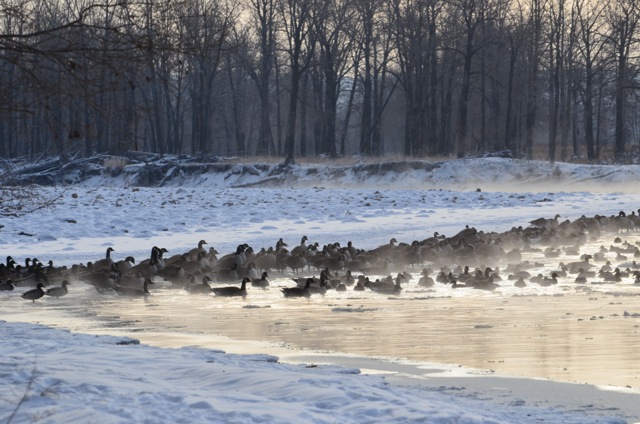
As I approached nearer, the more insecure ones started to fly away. But there were those who sat tight. Come what may, they enjoyed their hub in the frigid water.

Can Geese 2

Can Geese 4My fingers were frozen stiff and I could feel the intense pain, but I stayed still, seizing the moment. Glad too that they didn’t treat me as an intruder, just another creature more vulnerable to the cold, couldn’t fly or wouldn’t get into the water, totally harmless.

Canada Geese

Thanks pals, for the photo op.

Can Geese 3

***

Saturday Snapshot is hosted by West Metro Mommy Reads. CLICK HERE to see what others have posted.

Photos taken by Arti of Ripple Effects.

DO NOT COPY OR REBLOG

***


And Heaven and Nature Sing

In 2014, I’ve been very fortunate in capturing many wonderful sightings. Some may seem mundane, but once loaded onto my laptop, I was delighted at the results, everyone a unique experience.

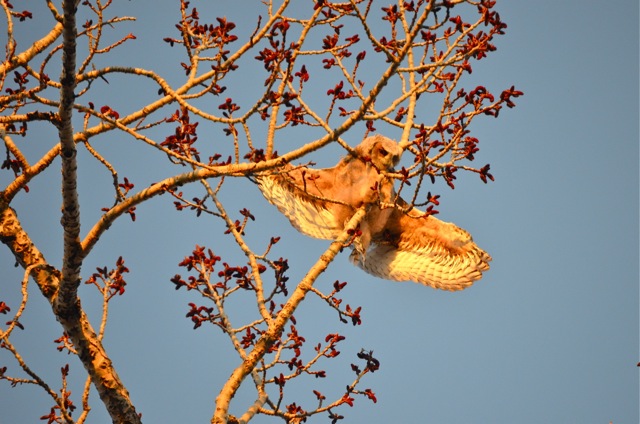
Here are some I’d easily give 4 Ripples, like the glowing wings of Canada Geese overhead, flying into the sunset, or two dragonflies in their intimate moment, a squirrel in the morning rays, a Monarch sucking nectar, an Owlet spreading wings, a Pelican taking flight, a pure white weasel in the snow, or the very ‘ordinary’ sunset that recurs every twenty-four hours.

It has been a year full of natural beauty and exclamations. These photos were taken in different circumstances, some I’d to wait quietly for quite a while, others serendipitously, giving witness to the variance of life’s happenstance, the joy of seeing creatures that sing with their mere existence, and the awesome Creator that willed them all into being.


Geese Overhead

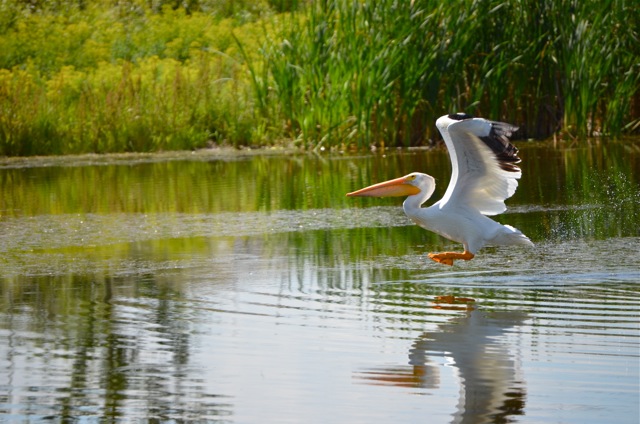
Pelican Takes Flight
Red squirrel

Western Tanager


Intimate moment

Owlet spreads wings


The Monarch Butterfly

White weasel

Ducks at Sunset

***

And To All A Merry Christmas!


Interstellar and Ida: The Sound and Silence of Exploration

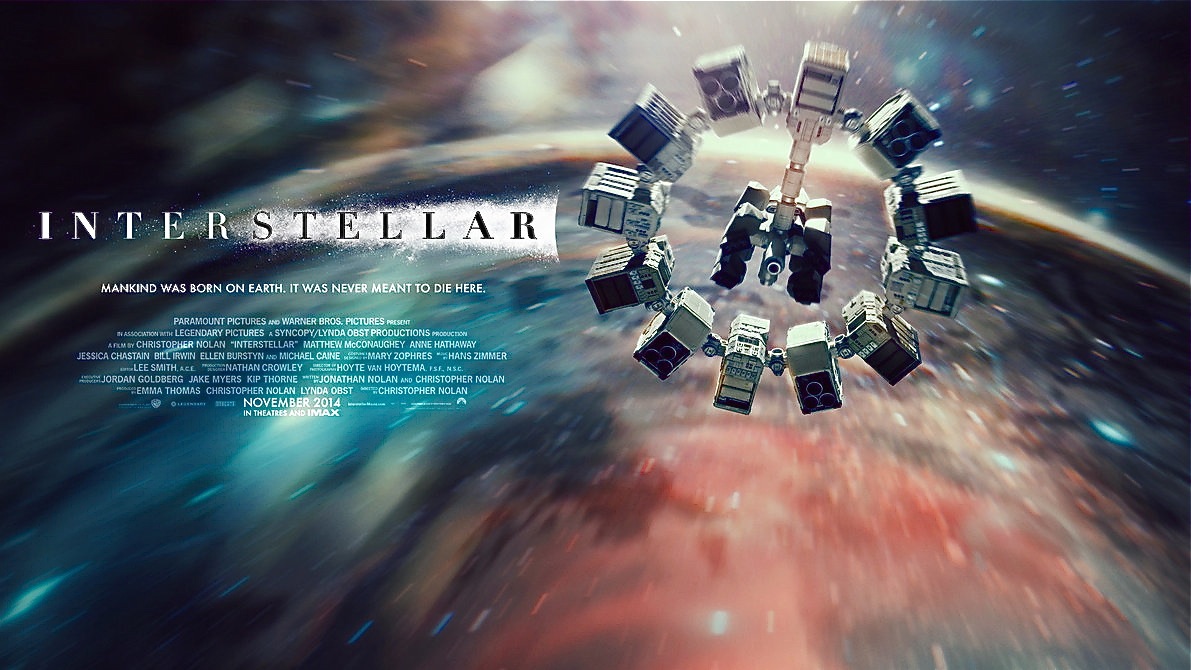
Two movies this year represent the opposite ends of a cinematic spectrum. One is on the cutting edge of technology in IMAX, with huge visual and sound effects, taking the audience far out into space. The other is a black-and-white film shot in boxy Academy ratio, a quiet focus on one individual.

Interestingly, both deal with the similar theme of exploration, albeit from contrasting perspectives. Interstellar leads us to outer space; Ida brings us inward to explore the inner space of the self.

This is not a full review of Interstellar but just some ripples from my viewing experience. Nevertheless, the following discussion may contain spoilers, so consider this a caution. I did write a review of Ida, you can read it here.

First it’s the buzz, then it’s a bang. Christopher Nolan’s Interstellar has landed with a weekend opening of $50 million in box office sales; interestingly, still second to Disney’s Big Hero 6‘s $56 million. Nolan is no stranger to mind-boggling productions, Memento (2000), The Prestige (2006), and Inception (2010); and then there are the legendary Batman/Dark Knight series, but Interstellar is his most grandiose… and loudest.
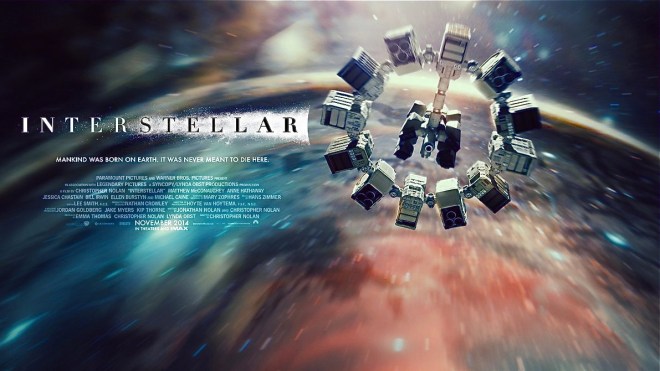
Interstellar

Some time in the future, we see Earth barely habitable. Gravitational abnormalities have offset the functioning of this meagre planet, which has deteriorated into an uninhabitable dust bowl. Space exploration is prohibited, for the mere survival on Earth has become the priority. The younger generation is encouraged to be farmers, growing corn mainly as it seems to be the hardiest of crops.

Even NASA has gone underground, yes, an alarming irony. Farmer Cooper (Matthew McConaughey), a former pilot and astronaut, stumbles upon it and is quickly persuaded by Professor Brand (Michael Caine) to come out again to pilot the space craft ‘Endurance’ to seek out new lands, for the sake of his children, as they could be the last generation on Earth. Further, Brand’s ambition echoes Cooper’s ideals that humans are explorers and pioneers, not caretakers of this dusty land.

To accompany the exploratory spirit, we hear the ear-piercing blastoff of ‘Endurance’ into space. I was in a ‘regular’ theatre, not IMAX, and not the UltraAVX (Audio Visual Experience), so it was bearable for me. For realistic depiction, I can totally understand why such volume is needed. But I did find there were moments where the sound had drowned out the dialogues at the most critical points.

Regardless of such mishaps, the music is commendable. Noland’s music collaborator in the past, film composer Hans Zimmer’s soundtrack exudes more than realism. His score involves an ensemble combining 34 strings, 24 woodwinds, 4 pianos, and a 60 voice choir. But the major, humungous sound comes from a 90 year-old pipe organ in London’s 12th Century Temple Church.

I’m glad the pipe organ is the instrument of choice and not, say, electronic heavy metal band with guitars and drums, because loudness is not a self-serving end. The huge, stunning sound of the pipe organ evokes sacred, cathedral music, and here, the cathedral of space. Into the vast and lofty universe, human exploration is more than mere colonization. Space travel is the vehicle by which infinitesimal human searches for the ultimate or to attempt comprehending minutely the grand design. The huge sound of the organ literally vibrated under my feet, aptly depicting our awe-inspiring universe. I must stress too that there were quieter moments as well, I especially enjoyed the flowing strings sending the spacecraft towards Saturn like a cosmic ballet.

In their collaboration process, Zimmer and Nolan may had been fascinated by the intricate machinery that is the construction of the organ, or the pipes that look like rocket burners, or its loudness best to depict the grandiose human venture of space exploration, or as Zimmer puts it, to “celebrate science”. But maybe unbeknownst to them, that deep human quest in search of the Infinite could well be the hidden inspiration that sparks the sounds in Interstellar, just like in the movie, unbeknownst to Murph (Mackenzie Foy/Jessica Chastain), Cooper’s scientifically-minded daughter, a well-intended ‘ghost’ tries to communicate with her by leaving hints in codes, guiding her onto a purposeful path.

Coincidentally (or not) the recent groundbreaking Rosetta’s Philae probe landing on Comet 67P/Churyumov-Gerasimenko has ignited jubilation not just because of man’s achievement, but also, as a news announcer said, the probe could bring answers to questions such as ‘how did we get here?’, ‘are we alone?’ or even solve the enigma of ‘life itself.’

Throughout the movie, we hear Cooper mention ‘They’ many times. ‘They’ have led him to discover the underground NASA site; ‘They’ had constructed the several dimensions, the time/space reality… His daughter Murph has asked him, “Who are ‘They’?” Cooper might have the inkling of who ‘They’ are at the end of the movie: ‘We brought ourselves here,’ he says. He might be the agent, but there still remains the question of the a priori Initiator: who had constructed the different dimensions to start with, the time/space continuum, the planets, the stars, galaxies, wormholes, or, gravity?

I feel the organ music is just right for the ultimate exploration.

**

In contrast to the sound of Interstellar, Ida is a film that offers silence.

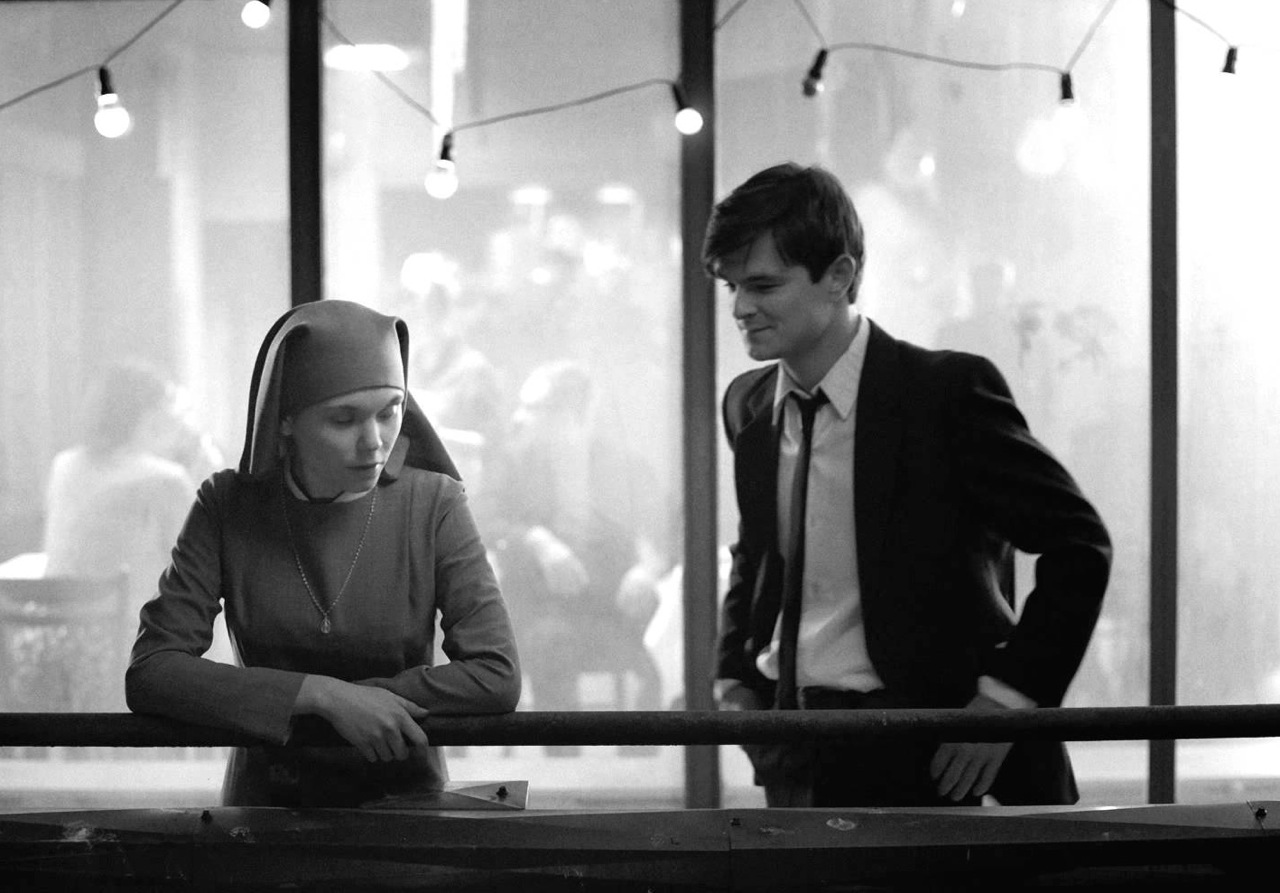
Anna has been raised as an orphan in a Catholic convent in post-war Poland. At eighteen, on the verge of her vow to become a nun, Mother Superior tells Anna to seek out her only, closest relative, her Aunt Wanda. The film follows Anna’s trip to the city. In her uniting with her Aunt, she also discovers her past, and a totally different identity. Her parents were Jewish, killed in the Holocaust; her birth name is Ida Lebenstein.

With her Aunt Wanda, Ida goes on a road trip to seek out those who might know her family’s past. On the way, they pick up a hitchhiker, a jazz musician called Lis, who exposes Ida to a new tune, and a different set of pursuits. Her cynical, life weary Aunt also reveals to her what other lives are like. With the opening up of possibilities comes the burden of choice.

Ida and Lis

The film is shot in black and white, boxy Academy ratio like early films. It carries minimal sound, no score, sparse dialogues, but the images speak with deep poignancy. In the flow of human history, what is one individual anyway? But what responsibilities one has to bear for one’s decisions. What leads Aunt Wanda to jump out the window? Or Lis to go on travelling, playing the saxophone gig after gig? Ida or Anna, what does each name hold in terms of meaning and purpose?

Director Pawel Pawlikowski had done post-graduate work in philosophy and literature at Oxford. His background might have led him to explore with a contemplative mind. He must have known too that the self is a vast space for exploration, as unknown and inexplicable as outer space, yet no less a subject of intrigue.

And personal identity, another realm to decipher. Is identity determined by birth, race and ethnicity, or something else? Does one have a choice? How does one define oneself? Is there anything worthwhile to pursue that transcends traditions or even religion? Maybe the best way to explore that inner space is through silence and a meditative mind. You don’t want to let the irrelevant sound drown out the relevant. Truth may just be hidden in a still, small voice.

**

Awards Update:

Feb. 22, 2015: Ida wins Best Foreign Language Film Oscar, Interstellar wins Visual Effects Oscar.

Feb. 21, 2015: Ida wins Best Foreign Language Film at Indie Spirit Awards.

Jan. 15, 2015: 5 Oscar noms, Best Production Design, Best Original Score, Sound Mixing, Sound Editing, Visual Effects

Dec. 11: Hans Zimmer gets a Golden Globe nom for Best Original Score
Ida gets a Golden Globe nom for Best Foreign Language Film

Dec. 7: Ida wins Best Foreign Language Film and Agata Kulesza Best Supporting Actress at the L.A. Film Critics Awards

Dec. 1: Ida wins Best Foreign Language Film from the New York Film Critics Circle

Related Post on Ripple Effects:

Ida’s Choice: Thoughts on Pawlikowski’s Ida

The Tree of Life by Terrence Malik

Notes on the Synthesis of Films, Art… Life?

Alex Colville and the Movies

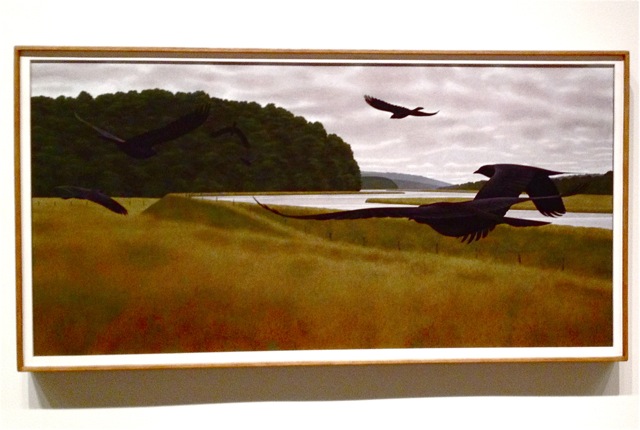
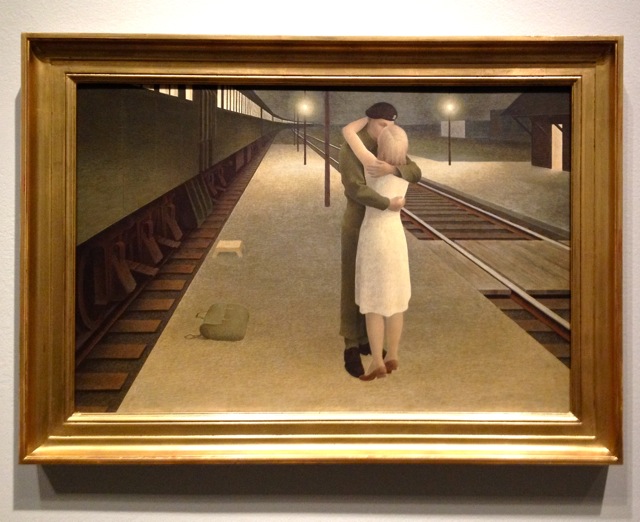
“It’s the ordinary things that seem important to me.” — Alex Colville Whenever I go to Toronto, The Art Gallery of Ontario (AGO) is always a must. As if to correspond with The Toronto International Film Festival, the current exhibition of more than 100 pieces of works by Canadian artist Alex Colville is a timely offering. Before my visit to AGO I’d looked up some info on Toronto born Alex Colville (1920-2013) who later moved to Nova Scotia and became an icon of Canadian art. His “Man on Verandah” (1953) set the record as the highest auctioned price recorded for a living Canadian artist in 2010. He was then 90 years old. The realism of Colville’s paintings at first reminded me of the American painter Edward Hopper. But a closer look at his meticulous renderings and precise details, I had the feeling that I was looking at a photograph, but the dramatic depictions made them look more like movie stills. As I walked through the exhibits, my inkling was confirmed. The quote on this banner may well set the tone as one enters the exhibition hall: EnteringAs soon as I stepped into the gallery, I saw this familiar work but only then did I find out its title: “To Prince Edward Island” (1965):

Alex Colville

Adjacent to the painting is a movie clip projected on the wall, showing Colville’s influence on the director Wes Anderson. Of course, that’s Suzy from Moonrise Kingdom (2012). The ever watchful female gaze through the binoculars. Both works exude mystery and nostalgia:

Moonrise KingdomApparently Colville’s influence can be found in several other filmmakers. In the exhibitions I was led to view samples of some close associations.

Artists influence each other. Colville’s “Target Pistol and Man” (1980) could be the inspiration for the Coen brother’s imagery of the psychotic and sinister character Anton Chigurh in No Country for Old Men (2007). But of course, one could argue that the movie was based on Cormac McCarthy’s book (2005). So it could be McCarthy being first spooked by Colville’s depiction of this cold, hard, and unpredictable character in the painting:

Pistol and Man

Further down the exhibits, I was confronted with a set of four Colville paintings in the scenes of Stanley Kubrick’s famous horror film The Shining (1980), adaptation of Stephen King’s novel. Too ‘in-your-face’? Some critics think so. No matter, I’m not posting them here to avoid sensationalism.

However, as I walked through the exhibits without any explicit prompting, I could indeed draw connections between some of them and the movies I’ve seen. Here are a few more examples:

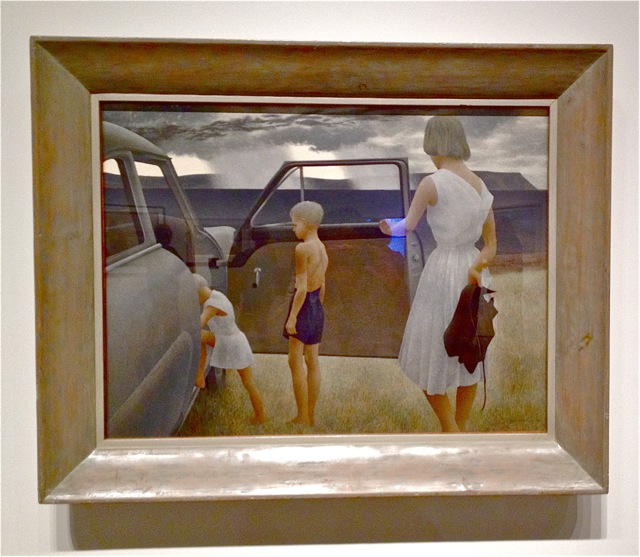
Just when you think you’re going to have a good time taking the children on an outing, maybe a swim or a picnic, and then you see the rainstorm approaching.

Family and Rainstorm (1955):

Family & RainstormJust like the ending scene of A Serious Man (2009) by the Coen brothers, impending storm in the school yard. The unpredictable and precariousness in everyday life.

Or, how about this, which movie does this painting “Seven Crows” (1980) lead you to think of:

Seven CrowsOr this one, “Soldier and Girl at Station” (1953):

Soldier and Girl at Station“Anxiety is the normality of our age,” Colville had said. I could totally feel it while looking at his works.

**

To correspond with my weekly photo meme, I’m linking this post to Saturday Snapshot Sept. 27 hosted by West Metro Mommy Reads. CLICK HERE to see what others have posted.

***

Some related post on Ripple Effects:

Art Gallery of Ontario

AGO Exhibition: Terror and Beauty

Bernini’s Corpus and Mordern Movies

Edward Hopper, William Safire: The Visual and the Word

***

Saturday Snapshot August 16: Serendipitous Supermoon

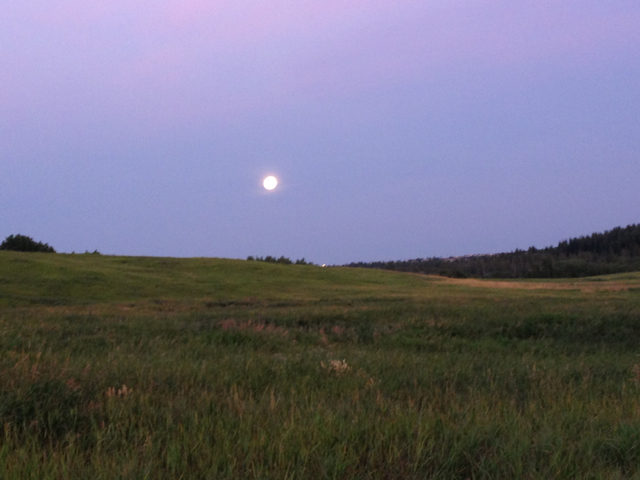
Again, it was pure serendipity. I was driving by a natural area on my way home last Sunday, August 10, when I just casually looked out my side window. The moon was mesmerizing. I did not have my camera with me, but I knew I needed to stop and capture the moment.

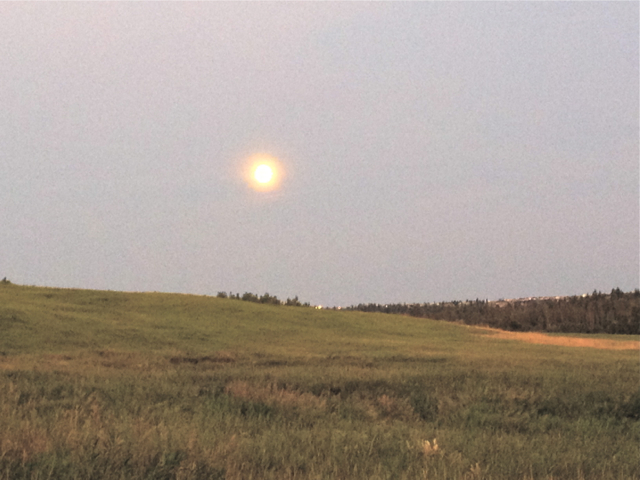
I parked my car along the road, got out and took these photos using my iPhone. I’m posting them just as they are, with no editing.

At 9:20 p.m.

Supermoon @920

9:21 p.m.

Supermoon @9-21

9:23 p.m.

Supermoon @923

Interesting, isn’t it? The sky seemed to have brightened as time passed.

Here’s the view as I turned around, the ‘opposite side’ of the evening sky:

Red Sky At Night

Sailor's Delight

Red Sky @926

Only after I got home and watched the news did I realize that was the Supermoon, the brightest celestial beauty we could see this summer. That night, the moon was up to 14 per cent bigger and 30 per cent brighter than a regular full moon.

And with this, I suddenly realized something … Serendipity is more likely to come to those who are uninformed. No wonder they say ignorance is bliss.

***

Saturday Snapshot is hosted by West Metro Mommy Reads. CLICK HERE to see what others have posted.

ALL PHOTOS TAKEN BY ARTI OF RIPPLE EFFECTS.

DO NOT COPY OR REBLOG

***

Saturday Snapshot July 26: Serendipity

It has always been one of my favourite words, serendipity. But now, I love it even more.

While birding in the woods a few days ago, I saw in the not too distant sky a huge bird slowly gliding. I remember two words conjured up in my mind: mythical, and mystical. I was trying to decide which one was more apt to describe my sighting. It looked like a crane or maybe a swan; my imagination at that instant had just gone haywire with excitement.

She (or he) glided gracefully, lowering and finally landing somewhere, disappearing from my view. With my stalking instinct automatically kicked into overdrive, I made a 400 m. dash and lo and behold, found a little stormwater pond behind a grassy berm, a pond I was not aware of before.

What I saw was magical. Swimming slowly on the serene water was this calm and solitary Pelican, a huge contrast to the exuberant paparazzo nearby, huffing and puffing behind the bushes:

Pelican 1I watched her quietly … preening:

Preening

Gulping down her lunch. She dipped her beak into the water and came up with her prey. I could see the shape of a fish in her large pouch; the next second it was gone, swallowed up whole:

Fish Gulping

After some time, she suddenly decided to take off. The following sequence was probably the most rewarding for any nature paparazzo:

Taking off 1

Taking off 2

Taking off 3

Taking off 4

Taking off

Taking off 5

Taking off 6

I later found out that the American White Pelican is one of the largest birds in North America. Averaging about 16 pounds, but some grow to as large as 30 pounds. They are among the heaviest flying birds in the world. Their 9-foot wing span, snowy white body and contrasting black wing tip give them their majestic look and graceful flight in the sky. They are gregarious, hanging out in groups.

That’s why I love my serendipitous find even more, a solitary Pelican, quiet and serene, and not along the ocean shore, but right in my neck of the woods at the foothills of the Rocky Mountains.

***

Saturday Snapshot is hosted by West Metro Mommy Reads. CLICK HERE to see what others have posted. In addition, this is also a Weekend Reflections post. CLICK HERE to see other reflections.

All Photos on this post are taken by Arti of Ripple Effects, July, 2014.

DO NOT COPY OR REBLOG

***

Ida’s Choice: Thoughts on Pawlikowski’s Ida (2013)

This review is about the acclaimed Polish-born director Pawel Pawlikowski’s newest film Ida (2013)It was screened at TIFF 2013, and since then, at numerous other film festivals. Slowly, it has arrived at the big screens in our cities recently. The following post discusses crucial thematic elements. Therefore, spoiler warning.

***

What forms one’s identity? Is it nationality? Race and ethnicity? Or something that transcends these boundaries? And, does one have a choice?

IDA

At the beginning, Anna’s (Agata Trzebuchowska) Catholicism is chosen for her. Raised in a Polish convent as an orphan, Anna knows no other kind of life. As an 18 year-old novitiate on the verge of taking her vow to become a nun, her Mother Superior tells her she should meet her closest relative. The one living relative she has is her mother’s sister, her aunt Wanda (Agata Kulesza).

Wanda is a hard-drinking, life-weary and tormented soul. Having lived through the horror of the second world war, she is confronted by yet another formidable front in post-war Poland, Soviet Communism. As a state prosecutor and later a judge, Wanda survived by compromising with the oppressive regime. She rises to a respectable position while sending many to their doom.

Poland in the 1960’s saw the beginning of wavering in hardline communism, a loosening up in society. Wanda has now become disillusioned and cynical, immersing in alcohol and one-night stands. With Anna appearing at her doorstep, she has to confront with not only a family’s dreadful past but her own existential present. Her licentious lifestyle is a sharp contrast to Anna’s spiritual devotion. A foil of the sacred and the profane, but not in a dogmatic frame. We see the two learning to appreciate and understand each other in a poignant way.

The sacred and the profane

For Anna, coming out of the convent does not mean only an eye-opener of the real world. From her aunt, she learns that her real name is Ida Lebenstein, and she is a Jew. Her parents were murdered during the Nazi occupation of Poland. She was kept safe in the shelter of the Catholic nuns. Her lineage concealed. Now Anna/Ida has to face with a seemingly incompatible identity, as her aunt bluntly puts it, ‘a Jewish nun’.

Aunt and niece go on a road trip to seek out the graves of Ida’s parents and eventually discover more about their deaths. They begin to know each other in a deeper way. The knowledge and the experience they have with each other may be life affirming for Ida; unfortunately for Wanda, they lead to despair.

While on the road, Wanda picks up a hitch-hiker, a young jazz musician, saxophonist Lis (Dawid Ogrodnik). He opens up yet another window for Anna, that of jazz, Coltrane, and all the rest.

The 80-minute, visually inspiring film is shot in aesthetically stunning black and white cinematography, 1.37:1 Academy Ratio with a square frame; the medium is the message. Austere, minimal, suggestive of harsh, bygone days, and with human characters often in the bottom of the frame, small and insignificant compared to the vast landscape. What is human in the whole scheme of things? How does one define oneself?

Small characters against large landscape

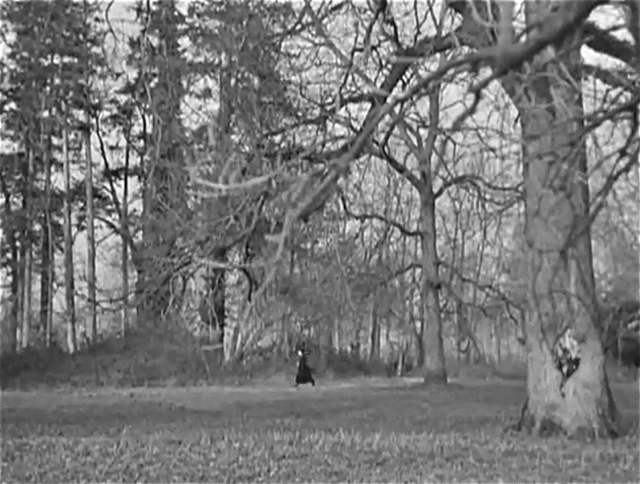
The cinematography reminds me of Robert Bresson’s Diary of a Country Priest. The young priest comes into his first parish, dwarfed and intimidated by the burden of his task, the spiritual warfare for which he is unprepared:

Walking through the woods

Like Bresson, Pawlikowski uses a non-actor for a major role. Agata Trzebuchowska plays Ida. She has never acted before. Pawlikowski found her in a coffee shop. Her portrayal of Anna/Ida is hauntingly authentic. Her face is pristine, yet her gaze is wise beyond her looks. Her aloof expression offers an unspoken evaluation of the world she sees, both in and out of the convent’s walls.

After a pivotal event, Ida tries on her aunt’s dresses, her high heels, smokes her cigarette and imagines another life. In this elegant attire she dances with the Jazz musician Lis. She listens to him play Coltrane on his sax. A whole new world awaits her if she so chooses. But it only entices for a short while. Ida yearns for something deeper, more meaningful. “And then?” she asks Lis several times in response to his offer of coming along with him.

Three characters, three different choices. Wanda chooses a way out that’s tragic.

The young musician Lis chooses jazz and whatever that path might take him. Despite his desire to have Ida come along with him, he does not, or maybe cannot, answer her two-word questions: “And then?” What’s the purpose, after all?

Ida chooses the transcendent over the secular, not that she judges the world, but that she yearns for meaning in the spiritual. It is not so much about choosing Catholicism over her Jewish lineage, but that she has made her own decision in becoming who she is. Ida’s choice is one that surpasses arbitrary, man-made boundaries of race and ethnicity, or the appeal of materials and pleasures; she chooses to devote to her Christ who had sacrificed all.

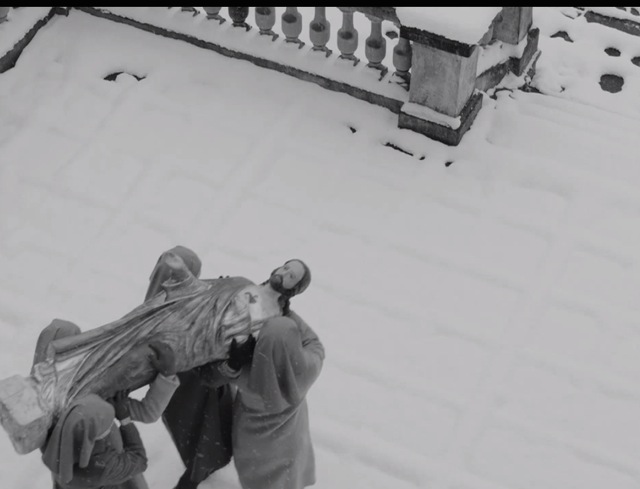
An image from the beginning of the film vividly comes back to my mind. Anna and three others carrying the Christ statue on their shoulders like a cross:

Carrying Christ

In the final shot we see Ida back in her habit attire. The moving camera captures a resolved and almost rejuvenated face, walking briskly with her little suitcase in hand, heading back to the convent. This place is now a personal choice.

~ ~ ~ 1/2 Ripples

***

Awards Update:

Feb. 22, 2015: Ida wins The Oscar for Best Foreign Language Film of the Year.

Feb. 21, 2015: Ida wins Best Foreign Language Film at the Independent Spirit Awards.

Feb. 8, 2015: Wins BAFTA Best Film not in the English Language

Jan. 15, 2015: 2 Oscar noms, Best Foreign Language Film, Best Cinematography

Dec. 11: Golden Globe nom for Best Foreign Language Film

Dec. 7: Ida wins Best Foreign Language Film and Agata Kulesza Best Supporting Actress at the L.A. Film Critics Awards

Dec. 1: Ida wins Best Foreign Language Film from the New York Film Critics Circle

Other posts you might like:

Nebraska: Colour Is Superfluous

Diary of a Country Priest: An Easter Meditation

Diary Of A Country Priest: Film Adaptation

AGO Exhibition: Terror And Beauty

The Art Gallery of Ontario, AGO, is a must-see whenever I visit Toronto. Not only because I’m a Frank Gehry fan who never gets tired of looking at the centre spiral staircase in there, but the exhibits are always intriguing and thought-provoking. Spent a few days in Toronto last week and this time, I was much gratified to view the current show at AGO: “Francis Bacon, Henry Moore: Terror and Beauty”.

Terror and Beauty, the motif resonates with the idea of Wabi-sabi. I’ve explored visually the notion of Wabi-sabi before. Two seemingly incompatible states juxtaposed against each other, beauty and sadness.

“You can’t be more horrific than life itself” says a quote from Francis Bacon on the AGO’s Artist page. The exhibits speak to that by extracting from the horrors of WWII and other forms of human sufferings and struggles depicted in the works of these two 20th century Irish/English artists who were contemporaries of each other.

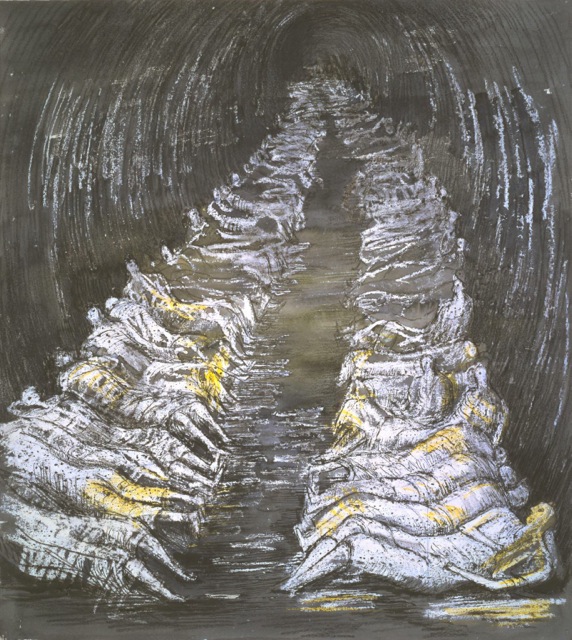
The exhibit is a wealth of surrealist works from Bacon, and sculptures and drawings from Moore. But I was particularly captivated by the WWII items. While Moore is well-known for his abstract sculptures of the human body in larger than life poses, here’s a rare chance to see his more personal, wartime drawings.

Going home one evening in 1940, as he entered a London subway station, Moore discovered crowds of people sleeping on the platform to take shelter from an impending German air strike, the Blitz. He was taken aback by what he saw and his later drawing was a ghastly interpretation:

Tube Shelter Perspective 1941 by Henry Moore OM, CH 1898-1986

Photo Source: http://www.tate.org.uk/art/artworks/moore-tube-shelter-perspective-n05709

That’s Moore’s view of the underground subway station used as impromptu bomb shelter. But what was it really like in those tube stations? That’s when I was totally captivated by the photos of the renowned photojournalist Bill Brandt displayed alongside Moore’s shelter drawings.

Rather than horrific depictions, I was utterly surprised by the actual photographs by Brandt, who acted as official war photographer. His noir and darkened perspective is haunting and yet, full of mystique and beauty.

What I saw was an opposite interpretation of the subway scene: rather than terror, I saw resilience. Indeed, the London populace came out in droves to seek shelter in the subway, a much safer haven than their own homes. What I saw in many of Brandt’s photographs was the strong sense of ‘life goes on’.

Two photographs in the exhibition will forever remain in my mind.

First is the Liverpool Street Underground Station Shelter during an air raid in November, 1940. The photograph shows a family sleeping soundly, bedding against the grooves in between the steel structures of the tunnel. But look more carefully, there’s even a bunk and blanket for a doll beside the child. They all look peaceful and calm.

For the archive in my mind, let me call this photo: “The Doll in the Subway”

Sleeping in the subway bunk-child & doll

© IWM Non-Commercial License http://www.iwm.org.uk/collections/item/object/205194652?cat=photographs

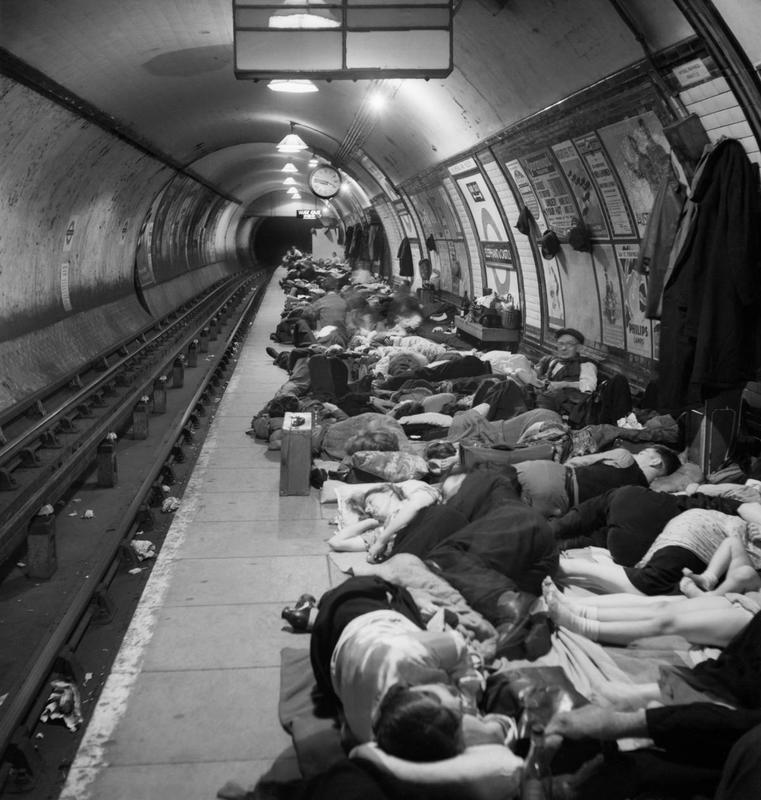
The second picture by Brandt is in the Elephant and Castle London Underground Station Shelter. Here, people sleeping on the crowded platform while taking shelter from German air raids during the Blitz.

But look how they were dressed in. The mid-heel pump the woman in the foreground was wearing caught my attention. Looks like she was dressed for work. Blitz or no Blitz, after she woke in the morning, she had to go to work. Life as usual.

In my mental archive, this photo will now be entitled “The Mid-heel Pump”.


The mid-heel pump

© IWM Non-Commercial License http://www.iwm.org.uk/collections/item/object/205194638

What more, after civilians had crowded into the subway stations against government’s advice, the officials had to respond with helpful measures by installing chemical toilets, first aid facilities, and providing drinks, while the people created their own entertainment. With all due respect to the victims of the Blitz, the resilience and adaptability of the Londoners are most inspiring.

After I stepped out of AGO, I wanted to go back in to take a more careful look at the exhibits again. But that was not feasible so I had to write this post from memory (no photos of the exhibits were allowed) and from some online digging. Glad to have found these two  memorable images from the Imperial War Museum website. Thanks to AGO, these two historic photos will remain in my mental archive for a long, long time.

CLICK HERE to see 9 Incredible photos of the London Underground as Bomb Shelter.

***

Related Posts on Ripple Effects:

The Frank Gehry designed Art Gallery of Ontario

Sketches of Frank Gehry (2005)

Art Gallery of Alberta


Saturday Snapshot May 31: After the Rain

Ever since I first read Annie Dillard, I’d wanted to see Puget Sound. But after all these years, I’ve been firmly rooted in the foothills of the Rocky Mountains in Alberta. My neck of the woods is a boreal forest. So, I’m more at home with spruce trees than sandy beaches. Puget Sound will have to remain on my bucket list.

All through winter, spruce and pines are sustenance, the bulwark and shelter for birds and small creatures that stay behind, and me.

After two days of spring rain, I ventured out just when it broke clear slightly, and was mesmerized by the greens. From among the hardy spruce, the aspens burst out to embrace spring.


Walking into the green Ripple Effects


The tall, slender trunks, each a natural canvas


Aspens


Colours and textures wrapped around


Nature's canvas


and moss as paints.


Moss on branch


Moss on tree stump


Nature’s artwork

Moss on tree trunk


Moss or fungus? No matter. Here’s life

Moss, Fungi, or Ivory?


Monet in Nature

DSC_0296


And I couldn’t resist the capture, even though just a common sparrow, obscure, blocked by a branch:

Sparrow


Nature’s Artist at work in Annie Dillard’s Puget Sound as well as my Boreal Forest. Her descriptions are strikingly close to what I had experienced.

“I see a hundred insects moving across the air, rising and falling. Chipped notes of birdsong descend from the trees, tuneful and broken; the notes pile about me like leaves.”


Despite geographical distances and variance in environs, her words resonate:

“Time and space are in touch with the Absolute at base.”

– Annie Dillard, Holy The Firm

***

Saturday Snapshot is hosted by Melinda of West Metro Mommy Reads. CLCIK HERE to see what others have posted.

 Photos in this post taken by Arti of Ripple Effects

Do Not Copy or Reblog

***


Robert Bresson’s Au Hasard Balthazar (1966): A Timeless Parable

Surely he has borne our griefs
and carried our sorrows;
yet we esteemed him stricken,
    smitten by God, and afflicted. 

— Isaiah 53:4 ESV

Several days before He is crucified, Jesus enters Jerusalem riding on a donkey. I love this scene. If there’s any cognitive dissonance in the crowd, here’s the stark message for their bewilderment. The King for whom they are cheering is not to be a glamorous celebrity. Rather, like the donkey, He comes as a humble servant, one who carries their load, and ultimately, even lays down his life for them. His kingdom belongs to another world.

Marie and Balthazar


As with my Easter viewing from previous years, I watch a film by the French auteur Robert Bresson. Bresson’s work has a transcending and spiritual quality that is deeply moving. In Au Hasard Balthazar, he creates an unusual metaphor using a donkey as his protagonist. We follow Balthazar as a young colt, loved by his first owner Marie. We see him grow up, weaving his life among different owners. We also see Marie grow up. Despite her love for Balthazar, she cannot stop the encroachment of evil, or maybe she is simply powerless. She does not defend Balthazar when a gang of young men abuse the donkey, tormenting him, whipping, mocking.

The gang leader is Gérard, whose sadistic, mean streak speaks for human depravity. He would pour gasoline on the road to cause unsuspecting drivers to skid and crash. He and his gang would watch nonchalantly from a distance, gratified that their prank has worked. He steals and deceives. What is a donkey to him if he does not even have the slightest respect for other humans. Once, to prod Balthazar to move forward, Gérard ties a newspaper to his tail and light it on fire.

The Gang

Throughout, Balthazar lives his life quietly in a parallel course to the growing depravity of the humans he serves. He suffers their cruelty in silence, occasionally he would bray in pain, but he continues to bear his load, pull a cart, or do whatever he is prodded to do, even a circus act. Due to neglect and maltreatment, he often becomes ill.

As she grows up, Marie discards childhood innocence and seeks to gratify her sensual pleasures. Against the protest of her parents, she falls for Gérard. She could have another choice, one who offers her genuine love, Jacques, the son of the owner of the farm where Marie and her parents reside. Jacque would come by every summer from the city with his father and sister to stay on the farm. When they were still children, they had spent endearing moments together with Balthazar. Jacques has declared lifelong commitment to Marie. But Gérard is a more instant and attractive outlet for Marie. Ultimately, she is dealt the harshest blow and most degrading abuse from Gérard and his gang as they rape her. Bresson spares us the ugly scene, but in the chilling aftermath, we see the young men walk away, nonchalant, throwing her garments on the ground behind them. After that tragic incident, Marie runs away. Her father is grief stricken, and soon falls ill and dies.

Gérard is unrepentant. After all, it’s self-serving lust he seeks; his callousness is most disturbing. In the last scene, we see he uses Balthazar to do one more job for his gang. They are to smuggle goods across the mountainous border. At night, he loads up his goods on the donkey and leads him to the border. From a distance, he hears gun shots from armed customs police. Gerard and his gang flee, abandoning Balthazar on the mountain. But it’s too late for Balthazar, he has been shot.

The final scene is most moving. In the open field, Balthazar walks slowly, haggard, blood streaming from his leg. He finally lies down, still carrying the goods Gérard has put on him, the load of sin. He breathes his last and quietly dies, alone.

Like Bresson’s Diary of a Country Priest, Au Hasard Balthazar is an apt meditation for Good Friday. But not just for this one day, their timeless message is like the Easter Season itself, a moveable feast.

~ ~ ~ ~ Ripples

***

Related Posts and Links:

Diary of a Country Priest: A Book For Easter

Diary of a Country Priest: Film Adaptation

Video of Robert Bresson on Au Hasard Balthazar