Notes on the Synthesis of Film, Art… Life?

Recently I’ve just finished reading Paul Schrader’s Transcendental Style in Film: Ozu, Bresson, Dreyer (1972).  Yes, that’s before Schrader rose to prominence as a screenwriter and filmmaker. Is such a book a bit dated?  Considering the techno-reigning world we’re living in now, where speed is measured by nanoseconds, and where 3D and CGI have become the necessary features for movies to generate sales, I think we need to read this all the more.

The three directors in the book had produced some of the best movies of all time. Since I have not seen all the films Schrader discusses, I might not have grasped as fully his arguments and illustrations as they deserve. And I admit I do not embrace unquestionably all those that I do get. Nevertheless, there are many, many parts that I want to record down. I’d consider them crucial elements to mull over during the creative process in just about anything. I’ve listed some of these fine quotes in the following.

They all point to the axiom of ‘less is more’, the value of stillness and simplicity, the speechless sketch that speaks volumes, the importance of being over doing, the quality of sparseness over abundance, the bare essence of life.

Notes to myself: when watching, writing, reading, doing, or just plain walking down the mundane path of everyday, keep these points in mind.

  • Ozu’s camera is always at the level of a person seated in traditional fashion on the tatami, about three feet above the ground. “This traditional view is the view in repose, commanding a very limited field of vision. It is the attitude for watching, for listening, it is the position from which one sees the Noh… It is the aesthetic attitude; it is the passive attitude.”[1]
  • Ozu chose his actors not for their “star” quality or acting skill, but for their “essential” quality. “In casting it is not a matter of skilfulness or lack of skill an actor has. It is what he is…”
  • “Pictures with obvious plots bore me now,” Ozu told Richie. “Naturally, a film must have some kind of structure or else it is not a film, but I feel that a picture isn’t good if it has too much drama or action… I want to portray a man’s character by eliminating all the dramatic devices. I want to make people feel what life is like without delineating all the dramatic up’s and downs.”
    .
  • His films are characterized by “an abstentious rigor, a concern for brevity and economy, an aspiring to the ultimate in limitation.”
  • Given a selection of inflections, the choice is monotone; a choice of sounds, the choice is silence; a selection of actions, the choice is stillness–there is no question of “reality”. It is obvious why a transcendental artist in cinema (the “realistic” medium) would choose such a representation of life: it prepares reality for the intrusion of the Transcendent…
  • “The opening five shots of An Autumn Afternoon: The everyday celebrates the bare threshold of existence; it meticulously sets up the straw man of day-to-day reality.”
  • In films of transcendental style, irony is the temporary solution to living in a schizoid world. The principal characters take an attitude of detached awareness, find humor in the bad as well as the good, passing judgment on nothing.

***

.

  • Like Ozu, Bresson has an antipathy toward plot: “I try more and more in my films to suppress what people call plot. Plot is a novelist’s trick.”
  • As far as I can I eliminate anything which may distract from the interior drama. For me, the cinema is an exploration within. Within the mind, the cinema can do anything.”
  • On the surface there would seem little to link Ozu and Bresson… But their common desire to express the Transcendent on film made that link crucial… Transcendental style can express the endemic metaphors of each culture: it is like the mountain which is a mountain, doesn’t seem to be a mountain, then is a mountain again.
    .
  • The abundant means sustain the viewer’s (or reader’s or listener’s) physical existence, that is, they maintain his interest; the sparse means, meanwhile, elevate his soul.  The abundant means are sensual, emotional, humanistic, individualistic. They are characterized by realistic portraiture, three-dimensionality…
    .
  • The “religious” film, either of the “spectacular” or “inspirational” variety, provides the most common example of the overuse of the abundant artistic means… the abundant means are indeed tempting to a filmmaker, especially if he is bent on proselytizing. (Now… why am I thinking of Avatar?)
  • The transcendental style in films is unified with the transcendental style in any art, mosaics, painting, flower-arranging, tea ceremony, liturgy.  At this point the function of religious art is complete; it may now fade back into experience. The wind blows where it will;  it doesn’t matter once all is grace.

***

Transcendental Style In Film: Ozu, Bresson, Dreyer, published by University of California Press, 1972. 194 pages.

[1] Schrader quoting Donald Richie, “The Later Films of Yasujiro Ozu,” Film Quarterly, 13 (Fall 1959), p. 21.
The following three quotes are from the same source.

.

Some informative links:

Paul Schrader http://www.paulschrader.org/, http://www.imdb.com/name/nm0001707/

Donald Richie http://www.movingimagesource.us/dialogues/view/274

Yasujiru Ozu http://www.guardian.co.uk/film/2010/jan/09/yasujiro-ozu-ian-buruma, http://www.a2pcinema.com/ozu-san/home.htm

Robert Bresson http://www.mastersofcinema.org/bresson/, http://www.imdb.com/name/nm0000975/

Carl Theodor Dreyer http://archive.sensesofcinema.com/contents/directors/02/dreyer.html

David Bordwell http://www.davidbordwell.net/

***

Floating Weeds (1959)

‘Floating weeds, drifting down the leisurely river of our lives.’

.

.

April is national poetry month… and I’ve been thinking poetry these days.  So that’s why the very title of this DVD on the shelf of the indie video store attracted me right away.  I took it down soon as I saw it was directed by Ozu.  Ozu’s films are visual poetry, the title ‘Floating Weeds’ is an apt prelude.

Floating Weeds (浮草, Ukigusa, 1959) is a remake of Ozu’s 1934 silent film ‘A Story of Floating Weeds’.  The title comes from a favored Japanese metaphor as the above quote depicts.  In this newer version the director has added colors and sound, and given his story a blossoming rebirth. The colors are vibrant yet the cinematography is contemplative.  Unlike some art house films, and despite its title, ‘Floating Weeds’ is enlivened by humor, human interests, and augmented by actions.  Despite the pensive mood the title evokes, I found it to be more story-driven than many of his other works.  However, it is characters that ultimately carry the story, and Ozu’s brilliant direction that makes viewers care about them.

The story begins with a train dropping off a troupe of travelling players to perform in a small town.  The master of the company Komajuro takes the chance to visit his former lover and see his son Kiyoshi, now grown up to be a fine young man, aspiring to attend college in the big city.  But Komajuro has kept his real identity as Kiyoshi’s father from his son because he does not wish his low social status as a travelling actor, and the vulgar circle he associates with to tarnish Kiyoshi’s future.  The plot thickens as Komajuro’s current mistress Sumiko finds out about his secrets. Burnt with anger and jealousy, she plots a scheme to destroy Kiyoshi by bribing the young actress Kayo to seduce him.  The young man soon falls for the actress, but the scheme turns into a full-blown mutual love relation.  Sadly, a marriage with Kayo would mean the quashing of his aspiration for higher education, and possible social reverberations and disgrace.

At the mean time, the drama troupe hits a low with disappointing attendance. The company has to disband.  Komajuro facing failure on different fronts, has to make choices not only for himself, but the future of his son.  In the final shot, the train that once took the travelling players to town now carries them off as disbanded individuals facing uncertain future. Like floating weeds, they drift on in the stream of life. And for Komajuro, he leaves town with the slim hope that his son would fare better than he in the oblivious currents of time.

I’ve enjoyed the subtle style of Ozu.   Here is one of my favorite scenes in the film, and the dialogues are as contemporary as you can find in a 2010 movie.  Whether one sees it as insight or foresight (considering it was remade in 1959), both are gems one discovers while watching the story unfold as casually as a quiet flowing stream.

The scene is about Komajuro talking to his son Kiyoshi as he arrives to his former lover’s home. All the years, Kiyoshi has only known Komajuro as an uncle.  Although Komajuro is ecstatic to see his son all grown up with a bright future, he is also wary that his travelling drama troupe does not measure up to what he would wish for his son.  Here in this scene, father and son’s conversation seems to touch on another issue: art and popularity.  Through this most casual dialogue exchange, Ozu might have conveyed his own ambivalence on the subject more sharply than any wordy treatise.

Kiyoshi: I’ll go see your show.  What do you play?

Komajuro: Forget it.  It’s not meant for you.

Kiyoshi:  Who is it for?

Komajuro:  An audience.

Kiyoshi:  I’m an audience.

Komajuro:  I know.  It’s nothing high-class.  Forget about it.

Kiyoshi:  Why show such plays?  Show something better.

Komajuro:  But I can’t.

Kiyoshi:  Why?

Komajuro:  Audiences today won’t understand good plays.  So you can’t come to see it.

**

In his commentary on the 1934 silent movie, writer and film critic Donald Richie notes that Ozu’s films are full of ellipses. There are story sequences he left out for the audience to bridge.  As well, he handled the story with restraints.  Such a subtle way of presenting the material is a very modern style of storytelling.  That might explain why I would care for characters in a Japanese movie made half a century back, where I have to read subtitles, and watch in black and white, or even silent.  Herein lies the ingenuity and artistry of Ozu, that an audience so far removed in time, space, and culture, would find universality and common ground to be totally absorbed.

The Criterion Collection 2-DVD set includes both the 1934 silent movie and the 1959 color remake. The first features commentary by Donald Richie, the later version by Roger Ebert. According to IMDB, ‘Floating Weeds’ (1959) is on Ebert’s list of 10 best movies of all times.

~~~~ Ripples

CLICK HERE to my review of Ozu’s classic Tokyo Story.

***

The AGA Exhibits: Images In Sight And Sound

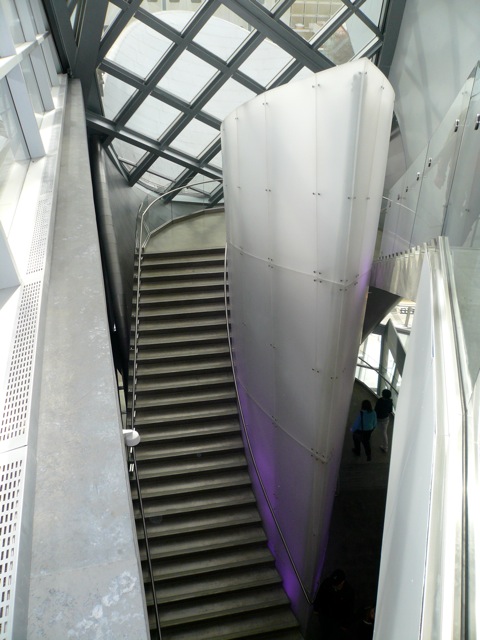
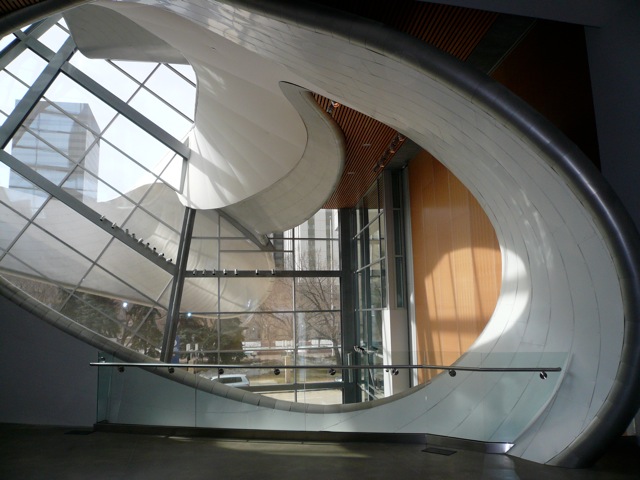
The AGA actually is a much smaller building than I expected.  But what’s appealing is the ubiquitous windows and glass allowing natural light to pour in, visually expanding the interior space.  The windows also make the surrounding downtown buildings visible from within, enhancing the sense of connection with the adjacent urban environs.  The exhibits are distributed among three floors of galleries.

Figures in Motion showcases 40 of Edgar Degas’ (1834-1917) bronze sculptures of dancers, bathers, and horses.  Juxtaposed in the exhibits are paintings, pastels, drawings, and prints of early photographs showing these figures in action.  The nuance of a single movement, as simple as the drying motion of bathers, can turn into a subject of grace and beauty under the sensitive eyes and expressive hands of the artist.

In contrast, Francisco Goya’s (1746-1828) etching prints suites Los Caprichos (1799) and The Disasters of War (1810-1820) are the realistic depiction of the ugliness and foibles of humanity.  A sharp social critic, his art mightier than the sword, Goya’s works expose unreservedly the horror of war and his critique of his time.

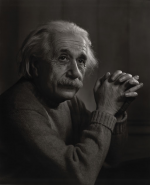
Up to the second floor I came face to face with the archetypal portraits by the renowned Canadian photographer Yousuf Karsh (1908-2002) in the exhibit Karsh: Image Maker.  We all must have seen some of his black and white portraits of famous people, somewhere.  The most well-known probably is Winston Churchill from whose mouth Karsh reportedly pulled out a cigar as he did his work.  Other famous portraits include that of Albert Einstein, Martin Luther King, Ernest Hemingway, Princess Elizabeth, Pablo Picasso, Andy Warhol, Alfred Hitchcock, Helen Keller, Grey Owl and numerous remarkable history makers.  I was totally absorbed as I walked by these meditative portraits of iconic personalities.

It seemed that the exhibits grew more interesting with every flight of stairs I stepped up.  The third floor offered an experience totally new to me.  As far as I can recall, this is the first sound installation mixed media art that I’ve encountered.  In a large, rectangular room occupying the whole floor, The Murder of Crows is installed.  Sound sculptors Janet Cardiff and George Miller have shown this work, their largest sound installation, in Australia, Germany and Brazil.  This is their North American premiere.

98 speakers are placed strategically and aesthetically in a large room, surrounding a table in the middle.  On the table is a megaphone.  Audience seats are grouped in the space encircled by the speakers.  The whole setting visually is a minimalist display.  The photo below is this installation in Berlin.  Even without the sound, the arrangement is an artistic presentation in itself.

But what we had at the AGA was a windowless room with dim lighting.  The added effects were even more haunting and claustrophobic.

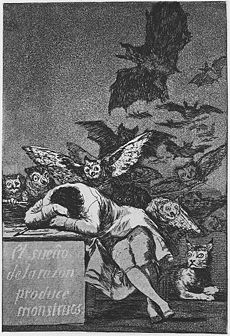
The 30 minutes sound presentation is a fusion of narrations, voices, footsteps, birds and bats, choral and orchestral music.  It evokes sequences of dreamscapes, and in part is an audio rendition of Goya’s etching The Sleep of Reason Produces Monsters in the Los Caprichos series (See image above).  The etching shows the artist himself asleep at his desk, with owls and bats hovering over him. The title divulges layers of meaning, prompting speculations of Goya’s actual thoughts.  The sleep of reason unleashes powerful imagination, even nightmares. Or, the erosion of reason led humanity into chaos and irrationality…

The phrase ‘the murder of crows’ refers to the collective gathering of the ominous birds, re-created here by the groupings of the 98 black speakers, some mounted on stands, some placed on chairs.  The very title and the effects made me feel like I was in the middle of the Hitchcock movie The Birds.  The sound was so riveting that I was glued to my seat in suspense… and the music from the massive choir and orchestra was both amazing and disturbing.  Click here to watch a 5-minute video clip of the sound installation. Click here to read an interview with Cardiff and Miller.

The AGA is not a big structure, but what is offered inside spans the artistic expressions separated by a chasm of time, form, and style.  From Goya’s disturbing etchings to the graceful renditions of Degas’ dancers, to the photographic images of iconic personalities captured by Karsh, and to end with the haunting sound installation The Murder of Crows, the exhibits were rains of pebbles into this quiet pond of thoughts… something I had not anticipated at the start of the trip.

Photography was not allowed in the galleries, so I cannot post any authentic visual experience here.  The above images are from the following sources:

Degas’ bronze sculpture Little Dancer and Karsh’s portrait of Albert Einstein from AGA website http://youraga.ca/current

Goya’s The Sleep of Reason Produces Monsters from Wikipedia Commons

The Murder of Crows sound installation from Cardiff and Miller’s website  http://www.cardiffmiller.com/artworks/inst/murder_of_crows.html

***

Art Gallery of Alberta

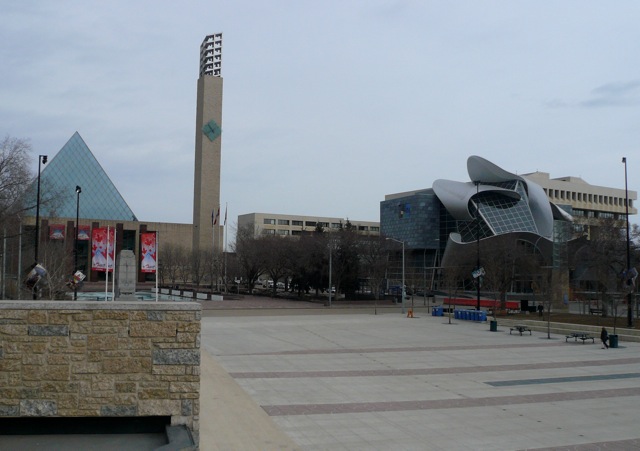
Drove up to Edmonton to take in the new Art Gallery of Alberta.  My first impression when I looked at the promotional materials was its similarity to a Frank Gehry like the Disney Concert Hall in L.A. and the Peter B. Lewis Building on the Case Western Reserve University campus.

A look at it in real life confirmed my thought, it sure was a Gehry style architecture.  A little googling later led me to the information that its architect Randall Stout used to work at Frank Gehry’s studio.  CLICK HERE for an extensive interview of Randall Stout and some spectacular images of his portfolio.

I don’t have any sophisticated photo software to take out the traffic lights and the sewage repair work underway, so the following picture shows the real life street scene of the remarkable structure at its most authentic.  But for some sparkling clear views and a detailed description of the architecture, CLICK HERE.

And here are some pictures of the inside, like the above, were taken by my little Panasonic Lumix pocket camera, no touch-up or editing:

.

.

.

The AGA is situated adjacent the Sir Winston Churchill Square in downtown Edmonton, a public open space linking the City Hall with the arts:

The Winspear Centre, home of the Edmonton Symphony is just across from the Square:

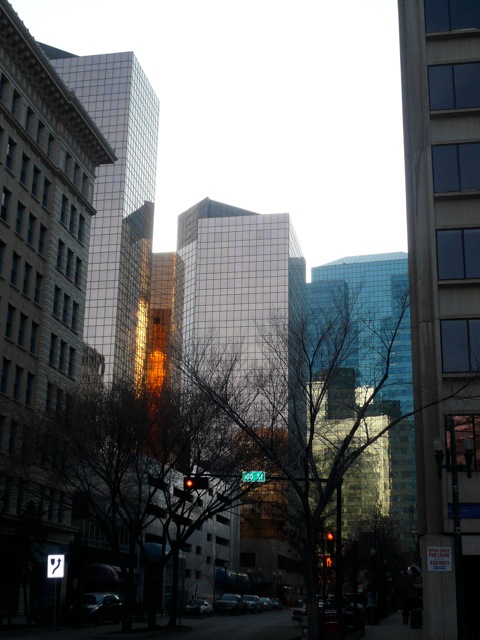
To finish off my day visit, I saw this colourful reflection of the slowly setting sun on the downtown buildings:

.

Of course, I didn’t drive three hours from Calgary just see the the architecture, but the exhibits.  And that has to be another post.

Photos taken by Arti of Ripple Effects, March 2010.
All Rights Reserved

Yasujiro Ozu and The Art of Aloneness

Growing up in Hong Kong during the 60’s, I had my share of Japanese literature and films, as well, the early version of anime.  Books were in Chinese translations, films with Chinese subtitles, and anime needed no language.  As a youngster I had my fix of Samurai action flicks by the legendary Akira Kurosawa, or the early sagas of The Blind Swordsman deftly performed by Shintarô Katsu.  The fast, magical sword-fighting movements displayed in elegantly choreographed sequences defined what ‘cool’ was in the eyes of a very young film lover, decades before Jason Bourne emerged.

But I admit, I had never heard of Yasujiro Ozu (小津 安二郎, 1903-1963) before reading the book The Elegance of The Hedgehog, and since, have become a mesmerized Ozu fan.

In Muriel Barbery’s marvellous work of fiction The Elegance of The Hedgehog, I was fascinated by the following excerpt that led me to explore the world of Ozu. Barbery mentioned some dialogues in the Ozu film ‘The Munekata Sisters’ (1950). Here, after quoting elder sister Setsuko, Barbery wraps up the chapter from the point of view of the concierge Renée, narrator of the book:

SETSUKO
True novelty is that which does not grow old, despite the passage of time.

The camellia against the moss of the temple, the violet hues of the Kyoto mountains, a blue porcelain cup — this sudden flowering of pure beauty at the heart of ephemeral passion: is this not something we all aspire to?  And something that, in our Western civilization, we do not know how to attain?

The contemplation of eternity within the very movement of life.

I could not find any copy of ‘The Munekata Sisters’, but I did manage to find a few other Ozu films on DVD in The Criterion Collection at an independent video store. One particularly stands out, both the film and the special features.  And that’s Tokyo Story (1953), the best known and most acclaimed Ozu work.

.

TOKYO STORY (with spoiler)

.

.

Instead of the macho samurai films of his time, Ozu chose to explore the quiet subject of family relationships, parents and children, brothers and sisters, husbands and wives, and from them come the topics of marriage, loyalty, aging, death, filial duties, parental expectations, and generational conflicts.  Through his perceptive camera work, Ozu sensitively revealed the undercurrents beneath the seemingly calm surface of daily family interactions.

‘Tokyo Story’ is about an aging couple Shukichi (the Ozu actor Chishu Ryu) and Tomi (Chieko Higashiyama) from small town Onomichi going on a trip to visit their adult children in bustling Tokyo.  At that time, postwar Japan was cranking up her economic engine, and urbanization was taking off.  Shukichi and Tomi’s children were all busily engaged in their work and family, with no time or patience to entertain their visiting parents, albeit struggling with a thin sense of obligation. They passed the two old folks from home to home, and finally sent them off to a spa resort on their own, a supposedly well-meant package substituting for their absentee hospitality.

With his subtle cinematic language, Ozu explored the issues facing the family in urban, postwar Japan. I’m surprised that in a time when the rebuilding of national pride was as much an essential as that of the economy,  Ozu was brave enough to depict the collapse of the family, revealing the conflicts and tensions behind the amicable social façade.  It’s interesting how contemporary and universal they are.  Have we not heard of those ubiquitous ‘mother-in-law jokes’ in our modern Western society?  Or, in real life, do we not struggle between taking care of our own family and career, and finding the time and energy to look after our aging parents?

.

But the contemplative cinematic offerings of Ozu draw us into deeper thoughts. ‘Tokyo Story’ quietly depicts the truth of these issues: No matter how many siblings there are in a family, each person is responsible for his or her own decision and action.  Even in a mass society like Japan, one can still make individual choices. Despite the currents, one can stand alone against the tides, and act according to one’s heart and conviction. While the brothers and sister are evading the task of hospitality, the young widowed daughter-in-law Noriko (the Ozu actress Setsuko Hara) chooses to care for her deceased husband’s parents out of genuine love.  She stands alone in her kindness and grace, a selfless heroine in a family hinged upon superficial ties.

Illness and death too have to be borne alone.  Despite their being together all the years of their marriage, Shukichi and Tomi each has to face the imminent all alone.  After Tomi falls ill upon arriving home from Tokyo, the strong bond of togetherness in marriage quickly dissolves into helpless resignation of parting and letting go.  Shukichi soon realizes he has to face life all alone.  The poignant scene though is that despite his loss, he looks out for his daughter-in-law Noriko, appreciating her loyalty, and relieving her of further obligations.  Despite having no blood ties, the two of them have touched each other in a way that’s beyond flesh and blood. Noriko selflessly gives while Shukichi accepts and appreciates in the midst of aloneness. The tables are turned, while they are left to face life alone, they are yet bound together in an unspoken bond, one that’s far stronger than filial ties.

The Criterion Collection carries several sets of Ozu titles.  ‘Tokyo Story’ is one in a trilogy of Noriko’s stories.  Disc Two features ‘I Lived, But…’,  a two-hour documentary on the life of Ozu, and ‘Talking with Ozu’: a 40-minute tribute to the great director featuring reflections from international auteurs Stanley Kwan, Aki Kaurismaki, Claire Denis, Lindsay Anderson, Paul Schrader, Wim Wenders, and Hou Hsiao-hsien.  It also features audio commentary by Ozu film scholar David Desser.

~~~~ Ripples

CLICK HERE to my review of another Ozu classic: Floating Weeds (1959)

History Made At The Oscars: Kathryn Bigelow Wins Best Director

The 82nd Annual Academy Awards has made history on several fronts.

Probably the most talked about is Kathryn Bigelow becoming the first woman to claim the Best Director Oscar. And lesser known is the fact that her film “The Hurt Locker” has also distinguished itself as the lowest grossing movie to win Best Picture. With $15 million spent on its production, “The Hurt Locker” has gained back $14.7 million in its domestic gross, and a total worldwide sale of $21 million, paltry compared to Avatar’s $2.6 billion. Bravo to the Academy voters.

Another major breakthrough at Oscars 2010 is Geoffrey Fletcher winning Best Adapted Screenplay for his work “Precious: Based on the Novel Push by Sapphire.”  He is the first African American ever to win a screenwriting Oscar.  Let me re-direct you to an inspiring post on Geoffrey Fletcher’s win from the blog Screenwriting From Iowa.

The Celluloid Ceiling

Does Bigelow’s win signify the turning of a new page for all female directors and woman workers in the film industry? Or is it just a one-time victory? Throughout Oscar history, there have only been three other women nominated for Best Director: Lina Wertmüller for “Seven Beauties” in 1976, Jane Campion for “The Piano” in 1993; and Sofia Coppola for “Lost in Translation” in 2003. None of them won.  It has taken 82 Academy Awards to arrive at this point today.

The annual ‘Celluloid Ceiling’ report compiled by Dr. Martha Lauzen at the Center For the Study of Women in Television and Film at San Diego State University tracks women employed in the film industry over the years. Her 2009 study records the following findings:

  • Women comprised of 16% of all directors, executive producers, producers, writers, cinematographers, and editors working on the top 250 domestic grossing films. This represents a decline of 3% from 2001.
    .
  • Women accounted for 7% of directors in 2009, a decrease of 2% from 2008, and no change since 1987.
    .
  • As for behind-the-scenes employment of 2,838 individuals working on the top 250 domestic grossing films of 2009, women represented 2% of the cinematographers and 8% of writers.

Has Bigelow shattered the Celluloid Ceiling once and for all? The answer is yet to be seen.  Considering the gender disparity in the film industry, it remains a long and arduous journey for aspiring woman filmmakers.

But I admire Kathryn Bigelow for one thing: she downplays the gender issue and pursues the universal role of ‘director’, shunning being called a ‘female director’.  When accepting her Award, she did not even mention the history-making significance of her win but rather acknowledged the troops at war.

Of course, she won on her own merits and not on account of her gender.  So just let me help Barbra Streisand utter what is unsaid in her statement, the all important subtext:

“Well, the time has come … for us to recognize the excellent work of a director despite the fact that she is a woman.”

Bigelow, a painter turned filmmaker, was first trained at the San Francisco Art Institute and later won a scholarship for the Independent Study Program at the Whitney Museum in New York, “which gave her the opportunity to study and produce conceptual art that was critiqued by the likes of Richard Serra and Susan Sontag.” Later she re-directed her passion to film theory and criticism at Columbia University.

When asked about her movies not being “female”, Bigelow, gives a thought-provoking answer from the point of view of an artist [1]:

But you don’t get exasperated with this notion that your movies are not “female”?

No, because I respect it, and I understand it. The thing that’s interesting is that I come from the art world, or that’s where I was creatively, aesthetically, and intellectually formed and informed.

Certainly at the time I was there, there was never a discussion of gender per se. Like, this is a woman’s sculpture or a man’s sculpture. There was never this kind of bifurcation of particular talent. It was just looked at as the piece of work. The work had to speak for itself. And that’s still how I look at any particular work.

I think of a person as a filmmaker, not a male or female filmmaker. Or I think of them as a painter, not a male or female painter. I don’t view the world like that. Yes, we’re informed by who we are, and perhaps we’re even defined by that, but yet, the work has to speak for itself.

Hopefully the film industry can learn from the art world, such that we would never have to give a movie a gender, or stigmatize its filmmaker for being a woman.  Then we can comfortably call them all artists.

****

[1]  CLICK HERE to read the full interview by Willa Paskin on Slate Magazine “What Kathryn Bigelow learned from Rembrandt.

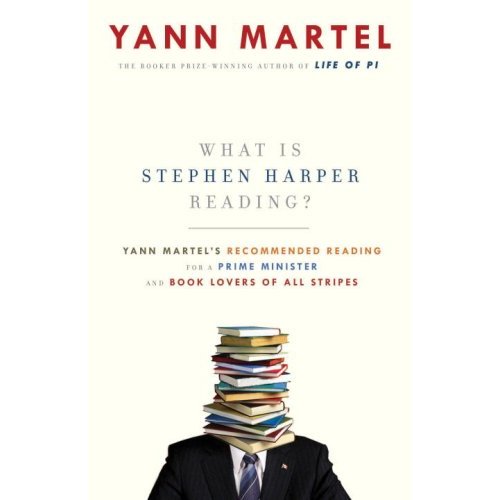
What Is Stephen Harper Reading?

.
Now that the Winter Olympics have come to a close, maybe more of the world would have heard of Stephen Harper.  No, no, he isn’t a medal winner.  Just a hockey fan, and, he happens to be Canada’s Prime Minister.
.

And it’s good time to read this book.  It all started one March day in 2007.  Fifty Canadian artists of all sorts were invited to a Parliamentary session to celebrate the fiftieth anniversary of the Canada Council for the Arts, each of them representing a particular year.

There they were sitting in the Visitors’ Gallery of the House of Commons, waiting for their item to come up on the long agenda of the day.  At 3:00 pm, the business came to the celebration.  All fifty of them were asked to stand up. The Minister for Canadian Heritage, Bev Oda at the time, rose up, acknowledged their presence, and gave a five-minute speech.  Applause.  Then on to the next business item.  Stephen Harper did not even look up at them standing in the Gallery.

The fifty guest artists were incredulous.  Among them was Yann Martel, who received a Canada Council grant in 1991 allowing him to write his first novel.  His literary career reached an admirable high in 2002 when he was awarded The Man Booker Prize for his book Life of Pi.  (CLICK HERE to read one appreciative reader’s response to the book, a personal note from Barack Obama.)

After this incident, driven by frustration, Martel decided to launch a most interesting project.  He started sending Stephen Harper a book every two weeks, with his personal letter introducing  the work, and of course, whenever appropriate, fill him in as to why that’s a good read for a Prime Minister.   With such an intention, one can predict the tone of these letters.  They are mostly sincere, mind you, albeit embedded with the occasional sarcasm, irony, and yes, some condescending subtext.

But overall, these letters to the Prime Minister sent with the books are genuine appeal to the Leader of the country to place more emphasis on the arts. They offer a place of stillness in the busy agenda of a politician.  Martel’s is a gentle voice to remind the prime policy maker the role of the arts, in particular, literature and its appreciation, in the making of a nation, the importance of beauty and the imagination in the building of a vision and in shaping the humanity of her people.

So, it’s not so much as to what Stephen Harper is reading, but what’s on his TBR list.  It remains unknown whether the PM has actually read any of these gifts, although letters of appreciation had been sent to Martel from his office. It’s fun too to read the choices of the titles… and their reasons.  But above all, I’ve enjoyed reading Martel’s insights into how the literary speaks in the context of contemporary political and social landscape.  Here are some examples.  I’ve included a quote or two from Martel’s letter sent with each title:

Animal Farm by George Orwell

Animal Farm is about collective folly.  It is a political book, which won’t be lost on someone in your line of business.  It deals with one of the few matters on which we can all agree:  the evil of tyranny.

Animal Farm is a perfect exemplar of one of the things that literature can be: portable history.  … in a scant 120 pages, … the reader is made wise to the ways of the politically wicked.  That too is what literature can be: an inoculation.”

The Island Means Minago by Milton Acorn (People’s Poet of Canada)

“But any revolution that uses poetry as one of its weapons has at least one correct thing going for it: the knowledge that artistic expression is central to who and how a people are.”

“… the past is one thing, but what we make of it, the conclusions we draw, is another.  History can be many things, depending on how we read it, just as the future can be many things, depending on how we live it… And it is by dreaming first that we get to new realities.  Hence the need for poets.”

The Educated Imagination by Northrop Frye

“Literature speaks the language of the imagination.”

“… the better, the more fertile our imagination, the better we can be at being both reasonable and emotional. As broad and deep as our dreams are, so can our realities become.  And there’s no better way to train that vital part of us than through literature.”

A Modest Proposal by Jonathan Swift

“So, more cuts in arts funding… What does $45 million buy that has more worth than a people’s cultural expression, than a people’s sense of who they are?”

Mister Pip by Lloyd Jones

“Lloyd Jones’s novel is about how literature can create a new world.  It is about how the world can be read like a novel, and a novel like the world.”

The Kreutzer Sonata by Leo Tolstoy

“Why a book on music?  Because serious music, at least as represented by new and classical music, is fast disappearing from our Canadian lives… the latest proof of this: the CBC Radio Orchestra is to be disbanded… How much culture can we do without before we become lifeless, corporate drones?  I believe that both in good and bad times we need beautiful music.”

The Uncommon Reader by Alan Bennett

“The irony in the story is as light as whipped cream, the humour as appealing as candy, the characterization as crisp as potato chips, but at the heart of it there’s something highly nutritious to be digested:  the effect that books can have on a life.”

“Whenever an independent bookstore disappears, shareholders somewhere may be richer, but a neighbourhood is for sure poorer.”

Gilead by Marilynne Robinson

“Speaking of President Obama, it’s because of him that I’m sending you the novel Gilead, by the American writer Marilynne Robinson.  It’s one of his favourite novels.”

“I would sincerely recommend that you read Gilead before you meet President Obama on February 19.  For two people who are meeting for the first time, there’s nothing like talking about a book that both have read to create common ground and a sense of intimacy, of knowing the other in a small but important way.  After all, to like the same book implies a similar emotional response to it, a shared recognition of the world reflected in it. This is assuming , of course, that you like the book.”

Julius Caesar by William Shakespeare

“Since Julius Caesar is about power and politics, we might as well talk about power and politics.  Let me discuss concerns I have with two decisions your government recently announced.

My first concern is about the Social Sciences and Humanities Research Council.  New money allocated to the Council is apparently to be spent exclusively on “business-related degrees”…. we’re losing sight of the purpose of a university if we think it’s the place to churn out MBAs.  A university is the repository and crucible of a society, the place where it studies itself.  It is the brain of a society.  It is not the wallet… A university builds minds and souls.  A business employs.”

Louis Riel by Chester Brown and The Sailor Who Fell From Grace With The Sea by Yukio Mishima

“But I’ve always liked that about books, how they can be so different from each other and yet rest together without strife on a bookshelf.  The hope of literature, the hope of stillness, is that the peace with which the most varied books can lie side by side will transform their readers, so that they too will be able to live side by side with people very different from themselves.”

**

Yann Martel is still sending books to Stephen Harper every two-weeks.  Other authors he has sent include Jane Austen, Flannery O’Connor, Ayn Rand, Gabriel Garcia Marquez, Douglas Coupland, Philip Roth, Alexander Solzhenitsyn, Franz Kafka, Virginia Woolf, Samuel Beckett, Michael Ignatieff, Paul McCartney, Dylan Thomas, Laura and Jenna Bush… quite an eclectic selection. Excellent demonstration of how we can be so drastically different in our perspectives and background, and yet can still stand shoulder to shoulder in this vast land of the free.

To read the full list of all the books he has sent, and yes, including this one, CLICK HERE to go to the official site:  What Is Stephen Harper Reading dot ca

What Is Stephen Harper Reading? by Yann Martel, published by Vintage Canada, 2009, 233 pages.

****

Regarding the role of universities and the humanities as dying disciplines, CLICK HERE to read my post: THE HUMANITIES AS AN ENDANGERED SPECIES.

Popularity versus Art

This year’s Oscars marks a new battleground for the dichotomy of art-house vs. blockbuster movies.  By increasing the Best Picture category from 5 to 10 selections, it looks like the Academy is aiming at allowing the blockbusters a shot at the coveted statuette, and not the other way round.

[picapp align=”center” wrap=”false” link=”term=oscars+statuette&iid=6857799″ src=”0/7/6/2/Academy_Of_Motion_6f24.jpg?adImageId=10186953&imageId=6857799″ width=”234″ height=”156″ /]

.

Why do I say that?  A look at the past winners in recent years would give a hint or two:  Slumdog Millionaire (2008), a production of just $15 million and a cast of unknown, foreign actors; No Country for Old Men (2007), a $25 million production and not a big hit domestically in terms of box office sales.

Several of the Best Picture contenders in recent years are represented by low-budget indie films, such as Juno (2007) and Little Miss Sunshine (2006).  Mind you, they might have reaped millions from their Oscar nods after the fact.

Not that blockbusters are necessarily artistically deficient, or that indie films must be artistically worthy, but it’s safe to say that blockbuster movies are crowd pleasers and more readily received. Art-house films are offered only in limited release, and appreciated by a much smaller audience.  Their low budget usually means no A-list stars.  It also restricts the profuse use of innovative technology as in big budget productions such as Avatar (2009).  So their general appeal is the essence of the screenplay, the acting, the storytelling within very limited means.

[picapp align=”center” wrap=”false” link=”term=oscars+academy+awards&iid=7789226″ src=”7/2/4/e/Kathryn_Bigelow_nominated_99e7.JPG?adImageId=10186835&imageId=7789226″ width=”234″ height=”156″ /]

.

The two front-runners of this year’s nominations best illustrate this point. The battle of the ex-es aside, Avatar and The Hurt Locker are neck and neck with 9 nods, competing in many of the same categories. But The Hurt Locker appears in two that are crucial in defining its artistic value as a motion picture:  Best Actor (Jeremy Renner) and Best Writing, Screenplay Written Directly for the Screen (Mark Boal), while Avatar falls short in these categories.

From the popularity angle, some refer their contention as David and Goliath.  The Hurt Locker, with a production cost of just $11 million and box office sales of $12.6 million, is miniscule when compared to that of Avatar’s $635 million, so far, and a reported budget of $237 million, one of the most expensive movies ever made.

Another way of seeing the two is the number of theatres screening the movies.  Avatar has over 3,000 theatres domestically, while The Hurt Locker, well, you’re lucky to catch it before it disappears from its limited release.  The DVD is out, so that really helps if you want to see it before the Awards night.

The other contenders pose a similar scenario.  Other than Avatar, four Best Pictures nominees have passed, way passed, the $100 million box office sales:The Blind Side ($242 million)Up ($293 million)Inglorious Basterds ($120 million), and District 9 ($115 million). Slightly trailing behind are Up In The Air ($77 million) and Precious: Based On The Novel Push By Sapphire ($46 million).

So what stand out are two little films, meager in comparison in terms of box office sales:  An Education ($9.6 million) and A Serious Man ($9.2 million).Their high acclaim from critics do not materialize in popular reception from movie goers, which is not surprising, for generally, these two groups don’t always see eye-to-eye.

Box office sales are the mark of popularity.  They measure how many have flocked to the theatres and are willing to pay to see a movie. Low ticket sales of course is related to how widely released the movie is, but it also gauges popular taste. There’s the rub, would the Academy members vote for a movie that has been seen by just a fraction of the viewing public?  Would they judge a movie only on its artistic and technical merits rather than the sales it generates?

[picapp align=”center” wrap=”false” link=”term=oscars+academy+awards&iid=7783787″ src=”6/8/5/9/The_Blind_Side_eb8a.JPG?adImageId=10187133&imageId=7783787″ width=”234″ height=”156″ /]

.

Michael Phillips of Chicago Tribune calls the inclusion of The Blind Side in this year’s Best Picture pool “a triumph of the till”.  Many critics are surprised to see it on the list.  And I suppose for Hollywood insiders and members of the Academy, they know very well what the bottom line is.  I’ve heard the argument before: If you want to see indie films and artsy productions, go to Sundance and Cannes.  I can hear them grumble … be realistic, the Oscars is a celebration of the movie business in all its glory and glamour.

I’ve appreciated what one entertainment writer has noted:

… popularity is the spiritual currency of Hollywood’s art. That’s why we call it ‘pop culture.’

It seems that nowadays, spurred on by reality talent shows which generate winners through popular votes, the contention of popularity versus skills or artistic merits is tipped way out of balance.  The critics are now made up of the populace; the panel of judges can only voice their opinion, however biting, but they do not get to vote.

And for the lesser known gems like An Education and A Serious Man, I’m glad they are included in the Best Picture pool, thanks to those who have nominated them despite their meager showing at the box office. After all, besides the money-generating function, film is in essence an art form.  Art for art’s sake or for profit remains the on-going debate.  Of course, the two need not be mutually exclusive… reality is, the financial component often is the main sustenance of a production.  It’ll be interesting to see though how the battle of David and Goliath turns out at the Oscars this year.  The implications could be more far-reaching than just churning out another winner.

Reading The Season: The Irrational Season by Madeleine L’Engle

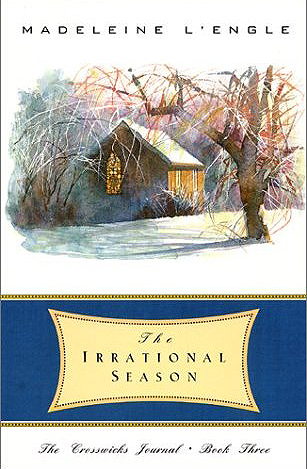
Striving to maintain some inner quiet, I casually took from the shelf a book by Madeleine L’Engle. Pure serendipity.  It’s one of The Crosswicks Journals, which I’ve shoved to the back of my mind for years, albeit they’ve been my all time favorite reads.  But how apt it is to flip through The Irrational Season, the third installment of The Crosswicks Journals, at this Christmas time.  Oh what joy to discover Madeleine L’Engle all over again.

Famous for her Newbery Award winning young adult novel A Wrinkle In Time, L’Engle was a prolific writer who had 63 publications to her credits.  Her works span from young adults to adults, fiction, science fiction, memoir, journals and poetry, with non-fiction books on faith, art, family, and humanity.  Yes, I say humanity, because L’Engle’s essays depict her strive to be human, and how her faith has defined the essence in her quest.

The Irrational Season comprises L’Engle’s ruminations on the significant events in the liturgical calendar.  And of course, it is Advent and Christmas that I dwell upon for my seasonal read.  This time, my reading has stirred in me a deeper appreciation of her insight and eloquence.

Art is for me the great integrater, and I understand Christianity as I understand art.  I understand Christmas as I understand Bach’s Sleepers Awake or Jesu, Joy of Man’s Desiring; as I understand Braque’s clowns, Blake’s poetry.  And I understand it when I am able to pray with the mind in the heart… I am joyfully able to affirm the irrationality of Christmas.

…  Christmas evoked in me that response with makes me continue to struggle to understand, with the mind in the heart, the love of God for his creation, a love which expressed itself in the Incarnation.  That tiny, helpless baby whose birth we honor contained the Power behind the universe, helpless, at the mercy of its own creation.

Cribb’d, cabined, and confined within the contours of a human infant.  The infinite defined by the finite?  The Creator of all life thirsty and abandoned?  Why would he do such a thing?  Aren’t there easier and better ways for God to redeem his fallen creatures?

And yet, in His most inscrutable, incomprehensible move, the One who called forth the universe from nothing, the Light and the Word, became flesh and drew near to us, to partake life as mortals knew it, and at the end, willingly go through an excruciating experience no mortals had ever known.  Impossible!  Utterly irrational!  And yet L’Engle embraces such an unimaginable scenario:

I live by the impossible… How dull the world would be if we limited ourselves to the possible.

And how grateful we ought to be, that such an accepting spirit pervaded in Mary’s heart and mind as well…

This is the irrational season
When love blooms bright and wild.
Had Mary been filled with reason
There’d had been no room for the child.

.

.

But now is the hour
When I remember
An infant’s power
On a cold December.
Midnight is dawning
And the birth of wonder.

*****

‘Reading The Season’ Posts over a Decade:

2020: Jack by Marilynne Robinson

2019: ‘A Hidden Life’ – A Film for the Season

2018: A Verse from Madeleine L’Engle’s The Irrational Season

2017: A Wrinkle in Time by Madeleine L’Engle

2016: Silence by Shusaku Endo

2015: The Book of Ruth

2014: Lila by Marilynne Robinson

2012: Surprised by Joy by C. S. Lewis

2011: Walking on Water by Madeleine L’Engle 

2010: A Widening Light by Luci Shaw

2009: The Irrational Season by Madeleine L’Engle

2008: The Bible and the New York Times by Fleming Rutledge 

2008: A Grief Observed by C. S. Lewis

*****

Photos: Except the book cover, all photos taken in Israel by Arti of Ripple Effects, November, 07. All Rights Reserved.

A Thousand Responses

In the postmodern scheme of things, the old saying ‘A picture is worth a thousand words’ takes on a whole new meaning.  It is not so much what those thousand words are that the picture intends to convey, but rather what the thousand responses it evokes.  Be it a painting, a film, or a literary work, all have the potential to elicit a myriad of responses, reactions as varied as each individual life lived.

Some ready examples can be found in Ripple Effects’ comment sections.  On a post about a movie I highly recommended, a reader responded that she had fallen asleep while watching it.  Or, take the Edward Hopper paintings.  While I found the phrase ‘existential loneliness’ to be an apt description for his works Nighthawk and Automat, a commenter expressed a sense of coziness and quiet content as her response to these paintings. Conversely, while I perceive Cape Cod Morning as anticipatory with positive excitement, the commenter sees “a woman trapped, caught in frustration or even despair, longing to move into the world but still constrained inside the structures of her life.”

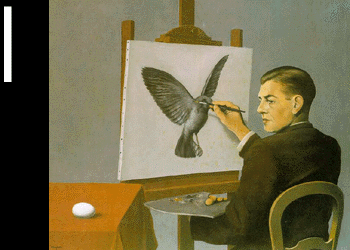
magritte01

There had been readers’ responses in the past long before the computer age. But what we have now is nothing short of phenomenal.  The Internet has enabled us to share and exchange our very personal reaction to a single source material simultaneously, allowing multiple voices to resound instantaneously from all corners of the world.  Every voice has the potential to call forth attention, every subjectivity can be equally amplified.  Reader’s response is thus given a heightened significance.

From this perspective then, the reality of a piece of writing, or artwork, seems to have shifted from the author to the reader, or the artist to the viewer, for it is the recipient now that speaks to the work, giving it meaning and application.

Should we still be concerned with the original intent of the piece?  Is it mere speculation to discuss about it, while in the mean time, it is more real and substantial to talk about what our response is, our own personal engagement with it?  Further, instead of focusing on one intended interpretation, should we explore rather the multiplicity of interpretations elicited from readers’ own perspectives and experiences?

Writing before the rise of the Internet, the French literary critic Roland Barthes put it most starkly in his essay “The Death of the Author”:

“… a text is made of multiple writings, drawn from many cultures and entering into mutual relations of dialogue, parody, contestation, but there  is one place where this multiplicity is focused and that place is the reader, not, as was hitherto said, the author.  The reader is the space on which all the quotations that make up a writing are inscribed without any of them being lost; a text’s unity lies not in its origin but in its destination…”

and a warning here, the language used in the following excerpt may be objectionable to some:

“Classic criticism has never paid any attention to the reader; for it, the writer is the only person in literature.  We are now beginning to let ourselves be fooled no longer by the arrogant antiphrastical recriminations of good society in favor of the very thing it sets aside, ignores, smothers or destroys; we know that to give writing its future, it is necessary to overthrow the myth:  the birth of the reader must be at the cost of the death of the Author.”

The postmodern theorist Michel Foucault wraps it up succinctly:

“What difference does it make who is speaking?”

The listener seems to have taken up a much more significant role these days.

Our postmodern literary theorists have thus spoken: The author is dead, long live the reader, and the words.

This idea may not sound so radical, for similar notions have been expressed. Instead of an all-knowing authority, the author is more like a recorder of a tale, the scribe writing down the oracle.  The Canadian writer Michael Ondaatje’s words come to mind.  Even as an author, it seems his creative process is one that awaits the revealing of his story, capturing it in words as it unfolds itself:

“I don’t know what would happen… I don’t want to know.”

Further, Ondaatje welcomes the multiplicity of interpretations.  In his discussion with film editor Walter Murch, he addresses this issue in a positive light:

“We are not held hostage by just one certain story, or if we are, we know it is just one opinion: there are clear hints of other versions.”   — The Conversations, p. 160.

Multiplicity enhances and enriches a scene.  That is the amiable way of putting it, while Barthes is more matter-of-fact in pointing out where meaning and significance lie:

“… it is language which speaks, not the author.”

In a way, such a perspective could be a much-needed humbling reminder in our too crazed, celebrity-driven culture.

But for those of us who strive with all earnestness and honesty to instill meaning in our writing, who have been meticulous and intentional in our craft and guarding its integrity as we create, when we speak, don’t we wish someone out there would receive our message accurately, as it is intended?

Why do we write, or create anyway?  Do we want our readers to know about us or just to hear the words we happen to utter?  Further, shouldn’t we be concerned that what we elicit could well be interpretations far from what we have intended to get across?  How do we balance author’s intent with readers’ response?

Simple questions, but ones which I’m sure can elicit a thousand responses.

***

To read Roland Barthes’s essay ‘The Death of the Author’,  Click Here.

To read Michel Foucault’s essay ‘What Is an Author’,  Click Here.

Visual: ‘Self Portrait’ by René Magritte, 1936.

Bright Star (2009)

Bright Star 1

Was it a vision, or a waking dream?

Fled is that music:– Do I wake or sleep?

— John Keats, Ode to a Nightingale (1819)

1819 was the most prolific year of the English Romantic poet John Keats.  Many of his well-known works were created then, two years before his untimely death from tuberculosis at age 25.  His muse was Fanny Brawne, his 18 year-old neighbor, a fresh and self-assured young fashion designer whom he met a year earlier. Untrained in poesy or prose, Fanny Brawne had nothing in common with the brooding poet, but Fate, cruel or kind, instilled in them a burning passion for each other.

Unable to maintain a living financially, Keats was honorable to restrain his love for Fanny, knowing marriage would never be realized.  Yet Fanny’s incessant devotion for him soon won him over.   In a short time, she devoured all of Keats’ poetry, as well as other literary works through the ages.  Their short-lived romance culminated in an engagement.  But they were never married.  Stricken by tuberculosis,  Keats left for Italy in 1820 to seek better climate for his ailing health, knowing that would be their last farewell.

When I have fears that I may cease to be

Before my pen has glean’d my teeming brain…

Nominated for a Palme d’Or at the Cannes Film Festival this year, Jane Campion’s Bright Star is a beautiful tapestry weaving together the visual and the word.  Based partly on Sir Andrew Motion’s biography on Keats, the film depicts the bittersweet romance between the poet and his muse, tragically short-lived yet ever burning bright.

Bright Star 3

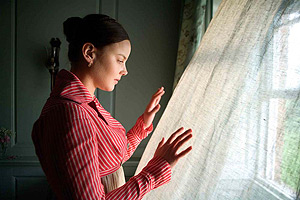
Campion has created on screen the dazzling visuals of the master painters.  There are numerous Vermeer moments in the interior shots, all done by the window with natural light seeping in as Fanny sews, makes her laces, reads love letters.  Outdoor scenes are a natural cinemascape reminiscence of impressionist vision.  Like the paintings of Monet and Seurat, hazy and dreamlike, they effectively convey the illusive union the young lovers achingly long for but is teasingly placed out of their reach.

Although never consummated, their passion for each other is no less ablaze.  The film is a clear statement that love is not synonymous with nudity and sex on screen.  Campion has depicted their passionate ardor with sensitivity and restraints.  There are moments of utter quietness, for love needs no language.  There are scenes adorned with melodious vocals and instrumentals, augmenting the yearning within.  Campion is a master of cinematic effects.

The talented Ben Whishaw (Perfume: The Story of a Murderer, 2006) is aptly cast as Keats.  Fanny Brawne is played by Abbie Cornish (Elizabeth: The Golden Age, 2007).  Both are award-winning rising stars in their homeland of England and Australia.  Bright Star could well be their breakout work in North America.

Bright Star 2

Paul Schneider (Lars and the Real Girl, 2007) is convincing as Keats’ friend Charles Brown, and what looks like Fanny’s love rival.  A stark contrast in character with the poet, Brown offers much needed tension and conflicts. Fanny’s adorable little sister Toots (Edie Martin) gets some of the best lines. Her brother and chaperone Samuel is played by Thomas Sangster.  But why Thomas Sangster?  The talented young actor who has held his own in such films as Love Actually (2003), Nanny McPhee (2005), and The Last Legion (2007) playing against such calibre actors as Liam Neeson, Ben Kingsley, Colin Firth and Emma Thompson, is put in the background only, with less than half a dozen speaking lines.  There’s definitely a miscast here. (Watch for his role as Paul McCartney in the upcoming John Lennon biopic Nowhere Boy.)

While the film is a beautiful testament of a star-crossed romance, compared to Campion’s previous works, I find it lacks the depth and complexity of The Piano (1993, Palme d’Or) and the intensity and riveting effect of The Portrait of a Lady (1996).  I have no problem with the slow pacing of Bright Star, but I do wish to see more dramatic conflicts and deeper exploration of character.  A thing of beauty should indeed bring us joy, or deep emotion, but for some reasons the visual beauty has not come across to me as affectively and engagingly as they are intended.

Nevertheless, as the only woman director to have won the Palme d’Or in the 62 years history of the Cannes Film Festival, and one of three women ever nominated for an Oscar in directing, Campion has much to offer.  I’m excited to see that it looks like the trajectory of Bright Star is one that shoots for the Academy Awards comes next March.

~ ~ ~ Ripples

(Photo Sources: canada.com, ctv.ca)

***

Edward Hopper, William Safire: The Visual and the Word

If you could say it in words, there would be no reason to paint.

In general it can be said that a nation’s art is greatest when it most reflects the character of its people.

—- Edward Hopper (1882 – 1967)

Edward Hopper’s words point to the power of the visual.  I always find Hopper’s realist paintings hauntingly retrospective, convey indescribable feelings, a sense of loneliness, a touch of alienation, yet, it’s hard to say exactly what it is.

Some use the phrase ‘urban loneliness’ to pinpoint the sentiment, as most readily expressed in his famous painting Nighthawks.  But others find the term too parochial even, opting for the more universal description of the human condition, ‘existential loneliness’.

In this visually-driven age, where pictures are instantly produced by a click, eliminating the wait for film processing, and where digitally created images can elicit unimaginable possibilities, has the value of words diminished, both in function and significance? In a time when ‘reading skills’ refer not only to the comprehension of the written language but the deciphering of graphics and visual symbols, has the power of words been eroded?

Does the recent passing of William Safire, called ‘the oracle of language’ by the NY Times, represent the passing of an era?  How many are left to champion the traditional form of communication, to point out word origin, to extol proper grammar usage?  While these gatekeepers are frowning on the split infinitive, the rest of the world has already jumped on board the newer vessel to boldly go where no person has gone before. The reign of literal communication has gradually (or quickly, or___ you fill in the blank) been replaced by the more accessible instant imaging, flickring, youtubing…

Let’s hope too that the traditional art form of painting will not be soon replaced by iPhone sketching.  If the New Yorker’s cover artist is using an iPhone app to touch-produce its cover pages, will the demise of oils and paints be far away?

Of course, I come to praise Hopper, not to bury words, or paints. Rather than saying his paintings defy literal descriptions, let’s just take up this bemusing challenge and do a role reversal:  What words conjure up in your mind when you look at these Hopper paintings? Let’s celebrate words, and paints, while we still have them.

Of all the subjects in his works, I particularly like the solitary figure, or the non-figure, like the room devoid of human presence.  Here are some of them:

Automat (1927):  Layered with subtext, what are the stories behind this lone female customer at the automat in such hour?  What is a good description of her predicament?

Automat 1927

.

New York Movie (1939): Here’s the reason why I love Hopper’s works.  The contrast, the darker side, the quiet undercurrent beneath the glamorous, the sombre reminder of complexity.

eh_new_york_movie

.

Rooms by the Sea (1951):  A touch of Magritte I feel.  An example of what I call the non-figure.  The philosophical quest of knowing: If nobody’s around to see it, does it still exist?

Edward - Hopper - rooms_by_the_sea

.

Cape Cod Morning (1950):  Unlike his other works, this solitary female figure is positive, eager,  enthused, and achingly expectant.  Is she a symbol of the optimism of a new age, or will she be disillusioned as reality sets in? 1950 or 2009, is there so much difference anyway?

Cape Cod Morning Hopper (1950)

.

Gas (1940):  I’m sure it’s not all about gas… does it allude to the lone traveling salesman like Willy Loman, or the gas station owner like George Wilson in The Great Gatsby?

gas_by_edward_hopper

.

Nighthawks (1942):  Perhaps the most famous of Hopper’s paintings.  As some call it, the depiction of ‘existential loneliness’.  Is that Sartre sitting there all alone at 2:00 am, contemplating in a diner with no exit?

nighthawk-by-edward-hopper

****

Click here to go to a related post ‘Inspired by Vermeer’ with another Edward Hopper painting, Morning Sun.