The Elegance of the Hedgehog

To read my Movie Review of The Hedgehog (Le Hérisson, 2009), CLICK HERE.

It’s all about seeing and being seen.
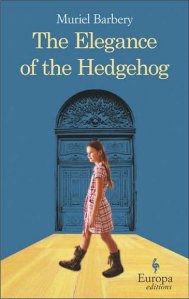
the-elegance-of-the-hedgehog

Hailed as the French publishing phenomenon in recent years, The Elegance of the Hedgehog has maintained 102 weeks straight on France’s best seller lists since its publication in 2006, and sold over 1 million hardback copies in 2007.

Author Muriel Barbery has created an intellectual delicacy for us to savor.   She is a former philosophy teacher in France and is now living in Japan.   Only in France you may say, where philosophy is still a compulsory subject in schools.  But no, it’s an international sensation reaching as far as South Korea, translated into half a dozen languages, sold its film rights, and garnered several literary awards.  The ripples finally reached North America last September… why so late?

This modern tale takes place in a luxury apartment at 7 rue de Grenelle, a prestigious address in Paris.  Its eight exclusive units are home to the upper echelon of French society, the elite in politics, finance, lifestyle and education.

Renée Michel knows too well what this is like… she lives here, in the quarter especially meant for her, the concierge.   For twenty-seven years she has served the residents well.   She knows how to keep her job.  Although in her mind, she thinks of them as  “a class that reproduces itself solely by means of virtuous and proper hiccups”, she keeps her thoughts very private, sharing only with her friend Manuela, the cleaning maid.

Renée’s self description may say just about what other people see on the outside, if they even care to look at her:

I am fifty-four years old… I am a widow, I am short, ugly, and plump, I have bunions on my feet and… I have always been poor, discreet, and insignificant.  I live alone with my cat…

For some reasons, these words attracted me to buy and read this book in the first place.  Herein lies the excitement.   The reader soon discovers that Renée is an autodidact.  A devoted library user, she studies on her own, philosophy, literature, history, art, semantics,  Japanese culture…  She avidly reads Kant, Proust, and Husserl after work,  contemplates phenomenology during work, and considers it not worth her while at either.  She names her cat Leo after her favorite writer Tolstoy.  On top of her eclectic reading, she listens to Mozart, Mahler, and Eminem.  She is a fan of the Japanese director Yasujiro Ozu whose works formed the classics of Japanese cinema.  And she loves Vermeer.

To survive in the social pecking order, Renée has learned to be clandestine.

Cut to Paloma Josse who lives on the fifth floor.  She is the 12 year-old daughter of a parliamentarian and his wife, who holds a Ph. D in literature.  Paloma’s older sister is a graduate student of philosophy.   But within this cocoon of sheltered upper-class family, Paloma might well be the most lucid of them all.   Her preoccupation is with the search beyond the status quo, the quest for meaning in this whole idea called life.  Among her many profound thoughts is this one:

People aim for the stars, and they end up like goldfish in a bowl.

Alas, she concludes in her 12 year-old mind, albeit being a precocious savant, that there isn’t much for her to stay on.  To escape her fate in the fish bowl, she is contemplating committing suicide on her 13th birthday coming up in a few months.

The book alternates between the ruminations of Renée and Paloma. Their sharp commentaries present some incisive, and at times, hilarious social satires.  Their personal reflections are perceptive and poignant.

Within the confines of the luxury abode, all seems to be mundane, routine, and hierarchical.  Until one day, a new tenant moves in.  He is Kakuro Ozu.  His presence at 7 rue de Grenelle changes the lives of both Renée and Paloma in a most extraordinary way.  For the first time in their lives, they have been seen, and appreciated.

Kakuro Ozu is a Japanese gentleman in his 60’s.  From his first contact with Renée, the moment she lets the first line of Anna Karenina slip out of her tongue, Kakuro knows he has discovered a hidden treasure.  This is more than a concierge he is looking at.  No, he does not respect her more for the books she has read, but for the lucidity of her insights.

It’s all about seeking beauty in the mundane.

… like viewing a Vermeer in the hustle and bustle of the city, or listening to Bach in the subway, or watching films that evoke flashes of transcendence…. yes, we’ve all experienced those moments.

Kakuro shares with Renée the ability to notice Art in the most ordinary of life.  What does she see in Ozu’s film The Munekata Sisters?  The camellia on the moss.

True novelty is that which does not grow old, despite the passage of time.”

The camellia against the moss of the temple, the violet hues of the Kyoto mountains, a blue procelain cup — this sudden flowering of pure beauty at the heart of ephemeral passion: is this not something we all aspire to?

It’s all about beholding eternity in the temporal.

And what beauty, what fate, it is to find someone who has named his cats Kitty and Levin, from Anna Karenina, while yours is Leo, someone who appreciates the meaning behind 17th C. Dutch still-life, someone who seeks the authentic human face behind the façade of social norms… someone whose toilet, even, exuberates with Mozart’s Confutati?

And oh… what an experience in that bathroom at Kakuro’s suite.  Kudos to Alison Anderson, I’ve totally forgotten that I’m reading a translation.  Just one of the rare cases that shows humor can be translated.  And that night, how gratifying for Renée to find so much inspiration in a Dutch painting, a sliding door, a bowl of ramen noodles…

What congruence links a Claesz, a Raphael, a Rubens, and a Hopper?

Are there universals?

And 12 year-old Paloma, with her quest for meaning and authenticity, is soon confronted with something much more engrossing than she had started out to seek…

At times LOL funny, at times, absorbingly heart-breaking.  This is one of the rare occasions where I had tears welled up in my eyes as I came to the end, an ending so powerful it propelled me to start from the beginning again.

~ ~ ~½ Ripples

The Elegance of the Hedgehog by Muriel Barbery, translated by Alison Anderson, translation published by Europa Editions, 2008, 325 pages.

***

Endnote:

If there are no universals, why would we experience such delight when someone else shares our joy in discovering that same beauty?  Why would we seek beauty in the first place?

“… He has set eternity in their heart…”  — Ecclesiastes 3: 11

***
To read my review of Muriel Barbery’s Gourmet Rhapsody, CLICK HERE.

Joshua Bell in the Subway

I watched Joshua Bell play the Mendelssohn Violin Concerto last night on PBS Live at Lincoln Center.  It’s the Mostly Mozart Festival in NYC.

This is one of my favorite pieces of classical music.  The melodious theme comes right out in the opening bars, not needing any intro from the orchestra as in conventional concertos.  I like it that way, swift, cut to the chase.  And here’s the sign of greatness:  the audacity to break new grounds.  Last night I saw the violinist’s audacity matching that of Mendelssohn’s: Bell re-wrote the cadenza for himself.  He has not only given an engaging performance, but has left his watermark in the piece as well.

If you want to see what a born winner is like, just briefly look at his bio.  At 10, he was a tennis champion.  Four years later, he made his professional debut as a violinist and became the youngest person to play with the Philadelphia Orchestra.  And the rest is history.

Bell has recorded more than 30 CD’s, won 4 Grammys, indirectly an Oscar as he performed the winning soundtrack for Best Original Score in ‘The Red Violin’, and garnered accolades too numerous to mention.  His achievements culminated in the prestigious Avery Fisher Prize in 2007, the highest honor for a musician in America.  That puts him in rank with previous prize winners Yo-Yo Ma, Emanuel Ax, and Andre Watts.  But beyond his musical career, he continues with sports and pursues other pastimes.  How about a video games world championship for versatility? Yup, he got that too, in 1996.

Well ok, so far so good… until he was asked by Washington Post writer Gene Weingarten to busk in a Washington DC subway station during morning rush hour.  At 7:51 am on January 12, 2007, a few months before he won the Avery Fisher Prize, Joshua Bell stood in a DC subway station in jeans and a long-sleeve T.  He opened up his case, and started playing his 1713 Stradivarius.

That was probably the first time he had been ignored or even given the cold shoulder:

He got $32.17 for his 43 minutes playing, not counting the woman who recognized him and gave him a twenty.  And yes, there were a few pennies in his case.  More than a thousand people passed by.  In the hustle and bustle of morning rush, few had even stopped to look at him, despite hearing the music.

The commuters were oblivious to the treat that would have cost them a hefty $100 in a concert hall, if they could find a ticket that is.  And for Weingarten,  he got a Pulitzer Prize for Feature Writing for his Washington Post cover story ‘Pearls Before Breakfast’.  To read this fascinating article, CLICK HERE.

Meant to be a philosophical musing on ‘Art and Contexts’, the experiment aims at exploring the epistemology of beauty.  Will we know what beauty is once it’s taken out of context?  Are there preconditions for us to appreciate the arts?  Do we have to recognize a musician before we can admire the music he plays?  If art is taken out of its frame, is it still art?

But… maybe it’s more a sociological study of urban life, or one of economics.  Even if people recognize beauty, is it worthwhile to stop and sacrifice a few precious minutes?   Weighing the economic cost of being late for work, and the enjoyment of music, the bottom line is quite obvious.  What place does beauty have in the pragmatics of our daily routines?  Where do music and the arts rank in life’s competing priorities?

Pearls before breakfast… What breakfast?  Gotta run…

***

A Midsummer Day’s Dream

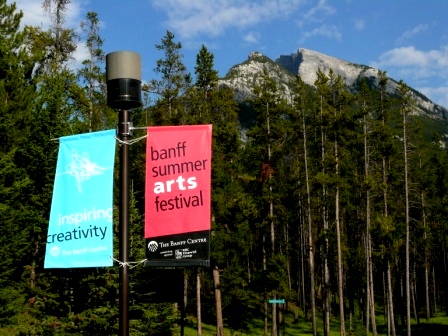
It was pure serendipity.  Finding out there would be an interview with Michael Ondaatje at the Banff Summer Arts Festival was a wonderful surprise.  Hours later I was on my way to Banff National Park.  The 90-minutes drive through the Rockies listening to the soundtrack of The English Patient was surreal.  And the destination was just as picturesque and dreamlike:

Banff Summer Arts Festival

The Banff Centre

In the event entitled ‘Literary Primetime’, Michael Ondaatje, the Sri Lanka born Canadian poet, novelist, filmmaker, winner of the Booker Prize for The English Patient, was interviewed by Marni Jackson, the Chair of the Literary Journalism Program at The Banff Centre, an acclaimed writer in her own right.

Ondaatje’s impressive body of work includes novels, memoir and a dozen books of poetry, editorial work and documentary filmmaking.  But perhaps the most famous is The English Patient, which was adapted into film by the late Anthony Minghella.  The movie was awarded nine Academy Awards in 1996.

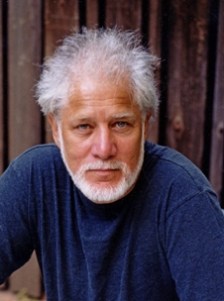
ondaatjeThe literary event started off with Ondaatje reading several passages from Divisadero, a book that brought him the fifth Governor General Literary Award.  I sat in the huge dining hall with an audience of a couple hundreds, entranced.  From afar I held my gaze at the silver haired writer framed by the large picture windows, the evening sun seeping through majestic evergreens, and silence shrouded the place except for one man’s gentle voice.  It was simply mesmerizing.
But it was the interview that made the dreamlike experience most rewarding.  The conversation explored the creative mind behind the writing process.  I jotted down some helpful tidbits:

Curiosity goes a long way.  It sparks off the research process, generating and sustaining the creative energy for the work.

Listen to the rhythm of the sentences.   “He would” or “he’d” could elicit very different effects.  Sound advice from a poet.

I was excited to hear Ondaatje address questions stemming from his book The Conversations: Walter Murch and the Art of Editing Film, which coincidentally, I am currently reading.  Murch was the film editor of The English Patient, one of my all time favorite movies.  The serendipity is most gratifying.  The art of film editing parallels that of writing… the essence is knowing what to cut, and when to move on.

While Minghella was writing the screenplay, Ondaatje was involved in the drafts.  The story had to be taken apart and rewritten to be adapted into film.  When you see your work being dismantled and reconstructed into another form, I imagine it takes courage, trust, and humility to accept that.  Ondaatje appreciates the art form of film and respects others’ expertise, entrusting his work in their hands.  This team effort, this alchemy of talents is most prominent in the making of the movie.

In the Interview, Ondaatje was asked about one excerpt from The Conversations. The writer and the film editor shares a common appreciation for the Chinese auteur Wong Kar Wai and his film In The Mood For Love.  The layering of sounds suggests the multiplicity of going-ons, events happening off-screen.  Such an effect can also be found in The English Patient.  The thickness of the actual and imaginary scenes adds complexity and depth, weaving a much more interesting tapestry.  Again, the parallel can be drawn with novel writing.  It’s the multiple offerings and the possibilities of interpretations that make a piece of writing intriguing:

“We are not held hostage by just one certain story, or if we are, we know it is just one opinion: there are clear hints of other versions.” (The Conversations, p. 160)

There were a couple of ideas I was a bit surprised to find.

First there is the ubiquitous self-doubt throughout the writer’s creative process.  Strange, and yet comforting, to find talented minds share this same psyche.  It is a humble sign to admit self-doubt.  The architect Frank Gehry and the late filmmaker Sydney Pollack came to mind.

“Her only virtue is self-doubt.” (Divisadero).

Second, and perhaps the most precious gem I collected from the event was reflected by Odaajte’s own words on the creation of a story: “I don’t know what would happen… I don’t want to know.”  The excitement of writing is that the story reveals itself as if it has a life of its own.  The writing process is an exploratory experience.  How gratifying to know we don’t need to follow a predetermined structure to plug in the story elements.  The creative mind is not bound by structure.  Let the story lead, and, enjoy the ride.

At the end of the Interview, Ondaatje was asked about a skills and job match questionnaire he once did when he was a young man.  The results showed that he could make one good customs officer.  Aren’t we all glad he had chosen to march to a different drummer and diverged in his career plan.

***


Of Film and Faith

Now, the reason to be… in Vancouver.   As I mentioned in a previous post, I was at Regent College for two weeks in May to learn the language of film, and its interface with elements of theology.  I came home much gratified.  I’ve delayed writing about the course per se because it would mean the difficult task of capturing the Genie of ideas back and recapping the bottle.  But I know I need to do it sooner or later, for I want to record down a learning experience that’s, well, let’s just say epiphany is not too far-fetched a word.  It could well be that the little I knew initially made it more gratifying as I could gobble up more to fill the empty vessel.

My thoughts are random here, but that might be the best way to capture whatever that comes to my mind that I think is important and meaningful.  Allow me to ruminate freely.

The language of film is multi-faceted, but it more or less can be condensed into the phrase mise-en-scène: what the director puts into the scene by means of setting, camera angle, lighting, staging, wardrobe, blocking… all the cinematic elements.     Like the artist of a painting, the director conveys his point of view and aesthetics through a frame or a scene.  And for us viewers, it’s a matter of honing the skill of observing the obvious, and the not-so-obvious.  Our pleasure is to decipher and savor that which is created on screen.   It all relates to the Auteur Theory, the director as the author, the concept of caméra-stylo, the camera as pen.

The power of the cinematic pen is mighty indeed.  Take the Disney movie Bambi for example.  The screening of Bambi resulted in a huge decrease of hunting licenses sold after it was released, and subsequently the term ‘Bambi Effect’ was coined.  Or, the movie Billy Elliot, which resulted in a significant increase in ballet school enrollment.

***

Knowing the history of motion picture is essential to appreciate films, and this is the major emphasis of the course.  I’ve come to appreciate the pioneers of motion pictures whose works have become the exemplars and the artistic foundations of modern cinema: Vincente Minnelli, Preston Sturges, Charles Chaplin, Fritz Lang, John Ford, Orson Welles, Frank Capra…

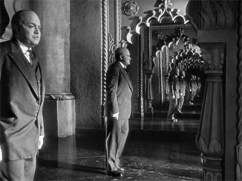
Fjilm Noir Third Man Alley

Further, it’s most interesting to trace the influence of German expressionism has on Film Noir, how the idea behind Edvard Munch’s The Scream can effectively be transformed into cinematic expression, revealing the inner state of modern man.

Over the intensive two-weeks, we’d only have time to cover mostly black and white features, savoring their richness in techniques and their multi-layered meaning.  I’ve come to understand why the years 1930  to 1946 are called “The Golden Age of Cinema”.

And where does theology come in?  While knowing some Kierkegaard and Buber might help, but basically the content is very accessible.  Herein lies the ingenuity of the auteurs and their works.  The process of exploring the transcendent in the movies viewed by the populace is just fascinating.

Citizen Kane

I’ve learned how Citizen Kane (1941, produced when Orson Welles was just 24!), generally considered one of the best movies of all time, like the Vanitas still life of Vermeer’s time, expresses the theme of Ecclesiastes, and asks the question, “So one has gained the whole world, then what?”

Another theological element is the archetype of the Christ figure, and I’m surprised to find it quite prevalent in many of these early motion pictures.  I admit I’ve never watched a Charlie Chaplin movie in its entirety until now.  In The Kid (1921) and City Lights (1931), the savior figure is humorously portrayed in the story, and the concept of unconditional love warmly illustrated.

City Lights

This archetype also appears  in Frank Capra’s  Meet John Doe (1941), where a main character declares the universal significance of the first John Doe two thousand years ago dying for all John Doe’s.  Visually, I’ve learned to identify the Pietà and the crucifix image in the composition of a frame in several of the features, an example being How Green Was My Valley (1941, John Ford).

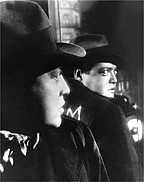
M by Fritz LangMotion pictures are an effective medium to convey the human condition.  In Fritz Lang’s thriller M (1931), the letter obviously refers to the murderer, a child killer that the whole town was after.  The not-so-obvious is the depiction of universal depravity, from the police to the masses, the message that we’re all complicit in the moral fabric of our society.  Similarly, Mel Gibson puts himself in his movie The Passion of the Christ (2004) as the Roman soldier nailing Christ on the cross.
Fast forward to the 80’s, I was introduced to the renowned Polish auteur Krzysztof Kieslowski.  It’s amazing how in Decalogue (1988), the essence of The Ten Commandments and their relevance in contemporary society are transformed into ten independent, one-hour stories and broadcast as a prime time TV series in Poland.  Decalogue is an artistically crafted and poignantly executed production that has won numerous international awards.  But would we see such kind of meaningful work as a prime time TV program here in North America?  The answer is obvious.

On the last day, I’d the chance to savor Babette’s Feast (1987), a highly acclaimed movie from Denmark (Oscar Best Foreign Language Film, 1988).  Based on a story by Isak Dinesen (Out of Africa), Babette’s Feast is a cinematic metaphor of goodness and freedom.  Its unique story and powerful visual images richly convey the theme of grace and mercy, and the liberating power of compassion.  The table prepared before us is free, sumptuous and abundant, but it takes an open heart of full acceptance and gratitude to fully enjoy it.  An inspiring film to wrap up my sojourn, creating resonance for the journey ahead.

Babette's Feast

***

Inspired by Vermeer

I’m just having so much fun discovering the immense influence of Vermeer on his posterior that I must post some more.  Here are a few interesting samples that I’ve found.

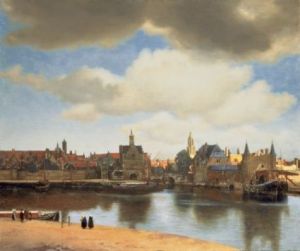
Holland has long been renowned for its natural light, and Vermeer has long been credited with his keen sensitivity in capturing that.  Here’s his View of Delft (ca. 1660),  which Marcel Proust called “the most beautiful painting in the world”:

Vermeer View of Delft

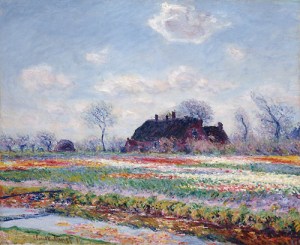
Visiting the Netherlands in 1886, Claude Monet adopted Vermeer’s point of view in observing the light of Holland in his painting of tulip fields and a farmhouse near Leiden:

Monet Tulip Fields near Leiden, Netherlands

**

Look at this famous Vermeer painting entitled Woman in Blue (ca. 1663):

Vermeer Woman in Blue

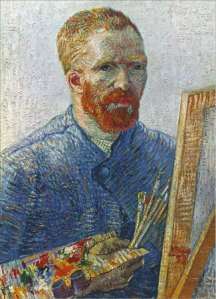
Van Gogh commented in 1888 on the exquisite artistry of Vermeer’s colors in the painting, “…blue, lemon-yellow, pearl-gray, black and white… the whole gamut of colors.”   He must have really liked Vermeer’s palette:

Van Gogh Self Portrait at Easel

**

Vermeer loved his subjects by the window.  Here’s another well known painting Girl Reading A Letter At An Open Window (1658), and below, Salvador Dali’s parody, homage, to Vermeer’s signature pose entitled Disappearing Image (1938).  Like Hitchcock, Dali liked to put himself in the picture:

Vermeer Girl Reading A Letter By The Window

Dali The Image Disappears

Tom Hunter Woman Reading A Possession Order

Now here’s a more contemporary example.  UK artist Tom Hunter, the first photographer to have a one-man show at the National Gallery of London, won the Kobal Photographic Portrait Award in 1998 with this poignant picture of a squatter, entitled Woman Reading a Possession Letter:

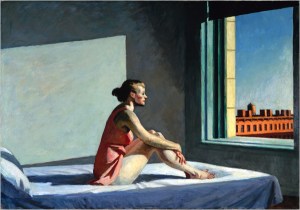
How about this from American realist painter Edward Hopper, Morning Sun (1952):

Edward Hopper Morning Sun

(For more Edward Hopper, Click Here.)

**

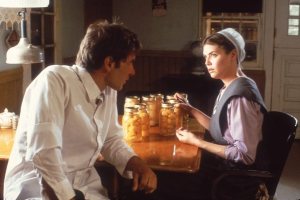
Director Peter Weir has created some ‘Vermeer scenes’ in his highly acclaimed 1985 movie ‘Witness’, with Harrison Ford and Kelly McGillis.  I can’t find pictures of the scene where the young Amish woman Rachel Lapp (McGillis) tending the wounded detective John Book (Ford) in the attic of her Amish house.  That is signature Vermeer.  But this one by the window can give you a glimpse.  Look at the contrast between the light and shadow on the two characters, the innocent and cloistered Rachel Lapp and the street-smart and gun wielding John Book:

Witness Harrison Ford and Kelly McGillis

**

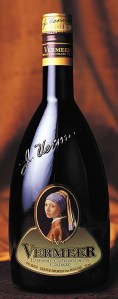
And last but not least, Vermeer’s inspiration on modern packaging and product design.  Click here to read more about it.

Vermeer inspired Dutch Chocolate Cream Liquer

****

Related Posts:

Vermeer in Vancouver: Noticing the Obvious

Girl With A Pearl Earring

Edward Hopper, William Safire: The Visual and the Word.

Arles: In the Steps of Van Gogh

The Letters of Van Gogh

***

Sources and links:  All Vermeer paintings, Click here to go to Essential VermeerClick here to Tom Hunter Website. Click here to Webmuseum for Edward Hopper. Click here to Van Gogh Gallery. Click here to Metmuseum for Monet’s Tulip Fields near Leiden.

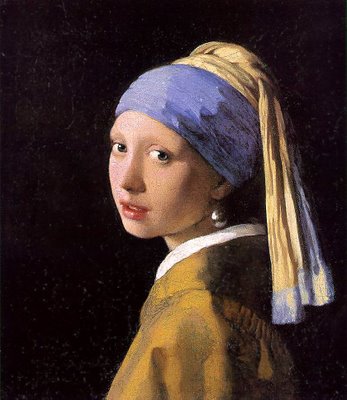
Girl With A Pearl Earring

The Painting (1665)

Girl With A Pearl Earring

Not much is known about this girl looking back at the artist with her soulful glance.  The pearl earring, the focal point of the painting, is obviously incompatible with her humble attire.  Vermeer has captured a mystery open to anyone’s imagination.  But it takes a master storyteller to create a believable and poignant narrative that can move modern readers three hundred some years later.

**

The Novel (1999)

Vermeer taught me that Less Is More, and I have been practicing that aesthetic principle in my writing ever since.”     — Tracy Chevalier

You can see it coming… it’s almost like reflex that after seeing a Vermeer exhibition I’d go back to the book Girl With A Pearl Earring by Tracy Chevalier, and re-watch the DVD of the movie based on it.  Well, especially when I didn’t get the chance to see the painting itself in the exhibition.

GWAPE Book CoverIt was this book that first sparked curiosity in me about Vermeer and his works.  Tracy Chevalier has done a superb job in creating out of her imagination the story behind the girl with the pearl earring, within the realistic social and historical contexts.  She has brought to the surface layers of possible subtexts hidden in this seemingly simple portrait.

I’ve appreciated that she has chosen the social segregation and hierarchical class structure of 17th century Delft as the backdrop of her novel.  So, instead of a sweet little tale or melodramatic story,  Chevalier highlights the complex social reality of power relations between servant and master, artist and patron.  She has masterfully created a scenario whereby the social distance between the servant girl, Griet,  and her master Vermeer, is drawn closer by her quiet understanding and appreciation of aesthetics.  With the same sharpness and sensitivity,  Chevalier has also shown how a wealthy patron can exploit art with his despicable, self-serving lust.

Chevalier’s ingenuity tugs at our heartstrings as we see the innocent and powerless being played as pawns,  no more than flies caught in the web of the rich and powerful.  The struggle between survival and artistic freedom is poignantly painted as irreconcilable subjects on the canvas of financial reality.  And fate teases all.  Yet among all these, the natural light that comes from art and beauty silently seeps through, brushing us warmly with a tender glow.

Do try to get hold of the Deluxe Edition.  It includes 9 full-color Vermeer paintings, which are cleverly incorporated into the story by the author.

Girl With A Pearl Earring by Tracy Chevalier, Deluxe Edition, published by PLUME, Penguin Group, 2005, 233 pages.

~ ~ ~ 1/2 Ripples

**

The Movie (2003)

.

GirlWithPearEarring1

Watching the movie Girl With A Pearl Earring is the closest to actually seeing a Vermeer exhibition.  Every frame is like a Vermeer painting with its extensive use of natural light from windows, contrasting the shadows in the interior of the Delft household.  The film was nominated for three Oscars in 2004, Best Art Direction-Set Decoration, Best Cinematography, and Best Costume Design.  In other words, it’s a pleasure to watch… it has to be because dialogues are sparingly used throughout.  Herein lies the strength of acting and the effectiveness of sound and visual communication.

The restrained performance of Colin Firth as Vermeer and Scarlett Johansson as Griet brings out the reality of the social order of the day.  A servant is not supposed to speak unless spoken to.  And what does a master has to say to an uneducated maid, unless he sees in her the appreciation of art and the clear understanding of aesthetics, of light and shadows, of beauty in the mundane.

Vermeer’s asking Griet to be his assistant and ultimately putting her in one of his works, albeit reluctantly for both, sparks off repugnant reverberation in town, and of course, the fierce jealousy of the painter’s wife Catherine (Essie Davis).  But as flies caught in the web of patron Van Ruijven (Tom Wilkinson), with debts to pay and a full household of mouths to feed, the artist has to bow to reality, and the even lower-ranked servant has to yield to her fate.

The visuals and music are the key to revealing the internal.  Beautifully shot in Luxembourg to simulate 17th Century Delft, the movie is a work of art in itself.  Colin Firth’s usual reticent persona on film fits him perfectly this time.  His taciturn portrayal of the ambivalent artist betrays the struggles within.  Scarlett Johansson delivers a convincing performance as pure and innocent Griet, and her gradual growth on the path of experience, albeit the book, as usual, depicts the inner turmoil more effectively.

The special feature on the DVD is enjoyable as well, chronicling the making of the movie.  I hope though that a Blu-ray version will come out one of these days, for that will indeed do justice to the cinematography and to the original artist, the master painter Johannes Vermeer himself.

~~~ Ripples

CLICK on the following links to go to related posts on Ripple Effects:

Inspired By Vermeer

Books and the Gender Issue


**

Vermeer in Vancouver: Noticing the Obvious

For more Vermeer, Click Here to go to my post “Inspired By Vermeer”.

Vancouver Art Gallery’s premier summer kick-off is the impressive exhibition: Vermeer, Rembrandt and the Golden Age of Dutch Art. The exclusive show of masterpieces from Amsterdam’s renowned Rijksmuseum includes paintings, drawings, and decorative arts from 17th century Holland. After five hours at the Gallery, I left hungry for more Vermeer. Overall it was gratifying, but I was expecting just a few more glimpses of the great master.

Of all the 128 pieces of art work, there’s just one Vermeer painting. Placed at the end of the exhibit, apparently the highlight and climax of the show, is Vermeer’s Love Letter (1669). From his signature point of view, peeking through a partial opening of pulled-back curtain, we look into another room and see a maid just handed her mistress a letter. By the exchange of their glances, it seems they’re sharing a secret understanding. This is another one of Vermeer’s works that’s full of potential stories and rich in subtexts. Actually anyone of them is a novel to be written, not less dramatic as Girl With A Pearl Earring.

Vermeer's The Love Letter

Love Letter by Vermeer (1669-70)

~~

17th century Holland was a new Republic that had just gained independence from Spanish rule. The beginning of the exhibits sets the stage depicting a young nation with great maritime power. Domestically, it was a country marked by a vibrant economy and a rising middle class, as well as the flowering of arts and science, architecture and urban planning.

In the midst of such affluence and fresh hope, some of the artists spoke with their brushes as prophets of their time. Among paintings of naval glory and conquests, as well as glimpses of domestic life of the rich, there are also the quiet displays of still life. I must have seen them before. Why have I not noticed their significance previously?

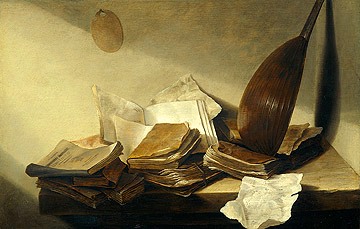
They are paintings of withered blossoms, burnt out candles, hourglasses, books and musical instruments, and most prominently, skulls, eerie arrays of them, decaying bones and teeth. Why all these objects? The audio commentary confirms that they are Vanitas still life, the term rooted in Ecclesiastes, “Vanity of vanities.” And obviously, they are symbols of the fleeting nature of life, the callous passage of time, the transience of knowledge and human achievements:

Pieter Claesz Vanitas Still Life

Pieter Claesz: Vanitas Still Life (1628)

~

Skulls on a Table

Aelbert Jansz van der Schoor: Skulls on a Table (1660)

~

On the piece of writing crumpled up is one last word, Finis, The End:

Still Life with Books Jan de Heem

Jan Davidsz de Heem, Still Life with Books (1625-29)

It’s commendable that the rich and powerful were willing to be reminded thus, considering these were once paintings adorning the walls of their affluent homes, a nagging presence they could not ignore. And they must have paid to have them painted.

~~

One of my favorites in the exhibition is Nicolaes Maes’ Old Woman in Prayer. Maes, a student of Rembrandt, had captured the simple piety of the old woman of lowly means: her earnest concentration, wrinkled face and hardened hands, the earthen wares and simple meal, and above all, her meager possessions on the ledge, an open Bible, a lamp, an hourglass and a prayer book. The warm light on her face almost makes her look divine. Maes did not forget to include a comic relief, her cat at the lower right bottom must have known what’s for dinner:

Nicolaes Maes Old Woman in Prayer

Nicolaes Maes: Old Woman in Prayer (1650-60)

~~

Sources: Skulls on a Table from Vancouver Sun. All other paintings in this post: Rijkmuseum, Amsterdam.

Beauty and Truth

Unlike my previous trips out here, this time in Vancouver is a learning experience. I’m spending two weeks at Regent College on the UBC campus to learn the language of faith and film. The art and architecture of Regent set the inspiring milieu for exploring beauty and truth. Here are a few vignettes:

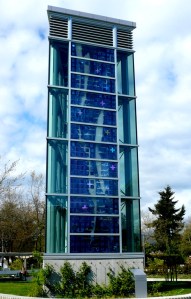
The True North Wind Tower and Lux Nova Art Glass:

Installed in 2007, the tower stands as a symbol of integration. Its highest point is designed to be in line with the North Star, the beacon of direction through the ages. The structure brings together the seemingly polarized ends of science and art, and accentuates faith in all aspects of life. CLICK HERE to read more about this 40 foot tall distinguished landmark.

Architect Clive Grout designed the self-sustaining, energy efficient True North Wind Tower as a natural ventilation system for the library built underneath it. Artist Sarah Hall incorporated solar cells into a cascade of glass work. They store energy during the day to illuminate a colored, celestial waterfall at night. This is the first installation of solar energy and art glass fusion in North America.

Embellishing this graceful design are twelve dichroic glass crosses, weaving through an inscription of the Lord’s Prayer in Aramaic, the spoken language in Jesus’ time. What a magnificent alchemy of art, architecture, faith and science. Just two weeks ago, on April 29th, this beautiful architecture won the prestigious Design Merit Award for Sacred Landscapes from the American Institute of Architects (AIA) in San Francisco. CLICK HERE to read more about this Award.

Regent Wind Tower

A closer look at the art glass:

Lux Nova Art Glass Close Up 2

For the magnificent night view, CLICK HERE to go to Regent’s site.

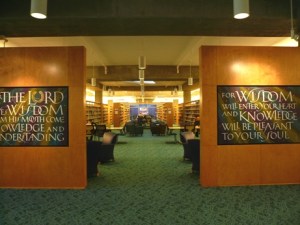
As for the theology library built underneath the tower, it’s another beauty:

Regent Library

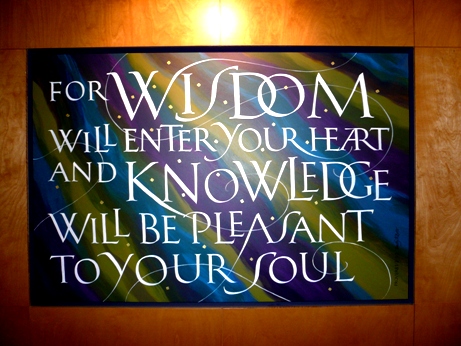
Wisdom

A stone-throw away from the Wind Tower is this serene setting:

Garden Bench

Even the wisteria speak to the intertwining togetherness of Beauty and Truth:

Intertwining Westeria Stems 4

Intertwining Westeria Stems 2

***

Original Photos and Text by Arti of Ripple Effects. ALL RIGHTS RESERVED, May, 2009. If you see them on a site that is not Ripple Effects, then they are copied without permission. CLICK HERE to go to the original post https://rippleeffects.wordpress.com

Vancouver Journal

Arti is blogging from Vancouver these two weeks. Here are some initial sights from yesterday’s roaming.

Rhododendrons everywhere:

Rhododendron everywhere

Rhododendron in bloom

Views from Spanish Bank:

Vancouver Skyline

Vancouver skyline from Spanish Bay

Solitary Moment

Solitude at Spanish Bay

Woodpecker hard at work and play

Woodpecker at work and play

Despite the temperamental weather, Arti will be soaking in all the views, making best use of her solitary moments to peck away … oh, who cares whether it’s for work or play. The woodpecker knows there’s no boundary separating the two.

ORIGINAL PHOTOS AND TEXT BY ARTI OF RIPPLE EFFECTS. ALL RIGHTS RESERVED. MAY, 2009.

IF YOU SEE THIS ON A SITE OTHER THAN RIPPLE EFFECTS, YOU’RE SEEING A POST THAT’S BEEN COPIED WITHOUT PERMISSION. CLICK HERE TO GO TO THE ORIGINAL SITE https://rippleeffects.wordpress.com

Man On Wire (2008, DVD): Romancing the Towers

man-on-wire1When the idea of building the World Trade Center Twin Towers began to germinate in NYC, on the other side of the globe, a young man in France started to weave a dream.  He wanted to walk across the top of the Towers on a wire after they were built.  Six years later, with the Towers nearing completion, Philippe Petit fulfilled his dream a few days short of his 25th birthday.  On August 7, 1974, he stepped on a wire strung across the roof top of the then tallest buildings in the world.  Hailed as ‘The Artistic Crime of the Century’, Philippe Petit’s breathtaking, and illegal, high wire act is the ultimate test of the human spirit, pushing the limit of audacity and strength.
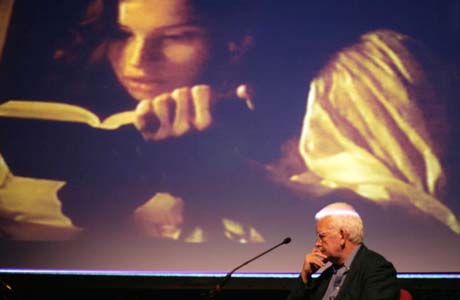
Based on Philippe Petit’s book To Reach The Clouds,  Man On Wire has won over 20 film awards only a few short months after its release, ultimately receiving the Oscar Best Documentary for 2008.  Director James Marsh chronicles the extraordinary endeavor of Philippe Petit by means of interviews, dramatic re-creation, and archival footage.  Before the WTC, Petit had walked across the two steeples of the Nortre Dame Cathedral in Paris, and the Sydney Harbour Bridge.  The WTC Towers meant the summit of his aspirations.  In a Sundance Film Festival interview, he described his act as ‘marrying the Towers’.

 Director James Marsh has chosen a very human angle to present his subject, such that we’re not just watching an extraordinary circus feat.  The documentary reveals a child growing up with unusual physical talents.  It vividly depicts the fearlessness of youth, the weaving of a fairy tale, the bond of friendship without which Philippe could not have achieved, and finally the euphoria of a dream fulfilled.  The smile on Philippe’s face while on the wire says it all.

The interviews in the film have also brought some very personal elements into this enthralling event.  We see Philippe’s childhood friend and accomplice Jean-Louis overcome with emotion, now more than 30 years later, as he recalls and is still moved by the immensity of the experience.

It’s a crime, no doubt, but it’s team work of the highest level of difficulty.  That they had to haul hundreds of pounds of wire and equipment up to the roof top, shoot the wire across, anchor it safe, all without detection was itself an incredible feat.  Once that was done, the rest was easy for Philippe, he just needed to walk on the wire suspended 1,350 feet above ground.

And that is when the artful part comes in.  Philippe had not just walked on tightrope, but performed with grace and serenity, movements conjuring up images of ballet on air.  For 45 minutes, he slow-danced across the Towers eight times, lay, knelt, and sat on the wire to the amazement of the awestruck crowd on the ground.  There was unspeakable beauty in his magnificent boldness.

Police had to threaten him with a helicopter to get him off.  He and his friends were immediately handcuffed, taken to jail, and Phillipe undergone a psychiatric examination.  He was later released and given a life-time pass to the Towers.  When asked why he did it, he answered:

“There’s no why… Life should be lived on the edge.”

Excellent special features that come with the DVD include Philippe Petit’s 1973 Sydney Harbour Bridge Crossing, exclusive interview with Philippe Petit, and an animated short film based on the children book by Mordicai Gerstein “The Man Who Walked Between the Towers”, narrated by Jake Gyllenhaal.  Further,  in this post 9/11 world, the DVD is even more significant in that it chronicles someone who had taken the arduous steps to appreciate and to relate to the Towers in a most memorable way.

And then there’s the music.  I admit it’s the music that has enthralled me from the start, yes, even with just the menu.  While Michael Nyman has written some fantastic original score for the documentary, it’s French composer Eric Satie’s pieces that so captivate me.   Satie’s Gymnopedie No. 1 is the music that augments the beauty of Philippe’s poetic walk on wire.

While most of us would rather watch life being lived on the edge from the comfort of our living room, we would be inspired nonetheless to venture out of our couch for a little more excitement, and motivated to take just a bit more risks with our life.  For us ordinary folks, maybe living life to the fullest is an aspiration challenging enough.

~ ~ ~ ½ Ripples

  “If no one ever took risks, Michaelangelo would have painted the Sistine floor.”      — Neil Simon 


Philippe Petit and James Marsh Interviews:

Click here for the  NPR’s Studio 360 Interview

Click here for the Sundance Film Festival Interview on YouTube


Too Much Jane?

davies460

Andrew Davis pondering

The Welsh filmmaker Peter Greenaway once made a controversial remark criticising film versions of literary work as mere “illustrated books”.  Regarding Jane Austen’s work, he said:

Cinema is predicated on the 19th century novel.  We’re still illustrating Jane Austen novels–there are 41 films of Jane Austen novels in the world.

What a waste of time.

Click here for the Wales news article containing the above quote.

To the discomfort of Mr. Greenaway, there have been more Austen adaptations made since he spoke.  As recent as just two weeks ago, BBC has announced that a four-episode production of Emma will be launched this fall.  The award-winning writer Sandy Welch (Jane Eyre, 2006, TV; Our Mutual Friend, 1998, TV) is working on the new script, with actors pending.

Why do we need another Austen adaptation?  Do we need another “illustrated book” as Greenaway has argued?

I was surprised to hear such remarks from Mr. Greenaway, himself an art house filmmaker.  He certainly doesn’t need to be reminded of the power of the visual.  I have expressed my stance against his argument in a previous post entitled ‘Vision not Illustration’.  But as more Austen adaptations appear, laying ratings and profits aside, I still believe there is an artistic merit in turning book into film.

The visual has an immense power in bringing out the essence of the literary.  An image can elicit deep and hidden thoughts, stir up emotions of past experiences, point to new insights, and unleash multiple responses in just a short lapse of time.  The cliché  “A picture speaks a thousand words” has its application in this visually driven generation.  Not that I do not treasure the classics, or the literary tradition.  Far from it.  I think a good film adaptation can, at best, enhance our enjoyment of the literary, and if it fails, can only help us appreciate the original genius even more.

If Bach, over 300 years ago, could invent Theme and Variations, why can’t we in this post-modern age, where multiple narratives are cherished, create adaptations to a recognized original?  Of course, the key is held by the filmmakers. It takes the insightful and  interpretive lens of a good writer, director, and cinematographer to craft a fresh perspective, one that can evoke a new vision and yet still remain true to the spirit of the original.

Kate Harwood of BBC explains why another adaptation of Emma is ensued:

In Emma, Austen has created an intriguing heroine, and our four-hour canvas allows us to explore this multi-faceted character in detail.  Emma was Austen’s last novel, written when she was at the height of her craft, and we are delighted that such an esteemed writer as Sandy Welch is bringing her vision to this appealing story.

How appropriate it is for Harwood to see film as a canvas for visual exploration, and the writer’s vision as a crucial element in the creative process.

I say, bring on more Austen adaptations.  Jane would be most pleased… belatedly.

*****

The above posted article has since been published in the Jane Austen Centre Online Magazine, where you can read more about Jane and her world.  Click here to go there.   

Click here to read my review of Part 1 and Part 2 of Sense and Sensibility, broadcast on PBS Masterpiece Classic Feb. 1 and 8.

Reading the Season: Fleming Rutledge

Two things I always do whenever I go to Vancouver:  Check out the indie movies and visit the Regent College Bookstore on the UBC campus.  I admit before that gloomy December day when I entered the Regent Bookstore,  I had not heard of the name Fleming Rutledge.  Thanks to Regent’s gigantic book sale, I came out with, among others, two of Rutledge’s titles:  The Bible and The New York Times and The Battle for Middle-earth, a commentary on Tolkein’s writing.  For the purpose of basking in the Christmas Season in a more meaningful way, I delved right into The Bible and The New York Times.

The theologian Karl Barth has a famous axiom that says sermons should be written with the Bible in one hand and the newspaper in the other.  This book is evidence that Fleming Rutledge has taken this motto to heart in her over twenty years of preaching and teaching ministry.  The book is a compilation of her sermons delivered in the 80’s and 90’s from the pulpit of Manhattan’s Grace (Episcopal) Church where she has served for 14 years, as well as from her visits to other churches in Eastern U.S.  As for her writing, Annie Dillard has commented that, “this is beautiful, powerful, literary writing.”

The 34 sermons are arranged according to the liturgical calendar, all eloquent reflections on the meaning of the occasion, from Thanksgiving to Advent, Christmas to Lent.  I’ve heard numerous sermons in my life, countless I dare say, but I admit this is the first time that I read through a compilation of sermons and thoroughly enjoy them all like a page-turner.  They throw light on events of our world, from politics to popular culture, addressing them as springboard to a spiritual perspective albeit not without practical wisdom; her commentaries on the human condition are incisive and spot-on.  I’ve come out heartily admiring Rutledge’s intellectual prowess and literary repertoire, but above all, her boldness in proclaiming what may not be politically correct in this day.

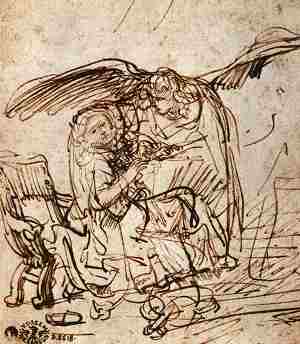
rembrandts-annunciation-of-the-angel-gabriel-to-mary

The four Advent Sundays are preparatory for the main event of Christmas.  Rutledge reminds us that without recognizing the darkness we are in, there is no need for the Light.  Oblivious to unresolvable conflicts and the depravity of our human condition, we would not be desperate enough to search for truth and redemption.  Without being shattered by tragedies and wounded by sorrow and grief, we would not be genuinely seeking solace and healing.  And, not until we see the absurdity of our human world, we would not humbly seek meaning in the transcendent.

In one of her Advent sermons, actually exactly today, the last Sunday of Advent, Rutledge relates the spiritual experience of John Updike one time when he was alone in a hotel room in Finland.   He was besieged by a sense of awareness that pulled him to confront what he called a “deeper, less comfortable self.”   She quotes Updike’s own words:

“The precariousness of being alive and human was no longer hidden from me by familiar surroundings and the rhythm of habit.  I was fifty-five, ignorant, dying, and filling this bit of Finland with the smell of my stale sweat and insomniac fury.”

Rutledge notes that at the time:

Updike is in the prime of his life, at the peak of his powers and the pinnacle of his fame.  Yet even a celebrity has to be alone with himself at three o’clock in the morning, even as you and I.

If we approach Christmas in such a state of  “deeper, less comfortable selves”, then we might come closer to appreciate the magnitude of its significance and meaning.

Annie Dillard has commented that Rutledge “writes as a person who knows she is dying, speaking to other dying people, determined not to enrage by triviality.”  The world situation today is grave, our hope lies not within but beyond ourselves.  For this reason the Word became flesh and dwelt among us.

Emmanuel, God with us …

This is the meaning of the Virgin Birth:  God has moved.  God has moved, not we to him in our impotence, but he to us.

This is not the Season to be merely festive and jolly.  Christmas is the celebration of the Grand Entrance into humanity, thus reason for deep rejoicing.

“All hopes and fears of all the years,

Are met in Thee tonight.”

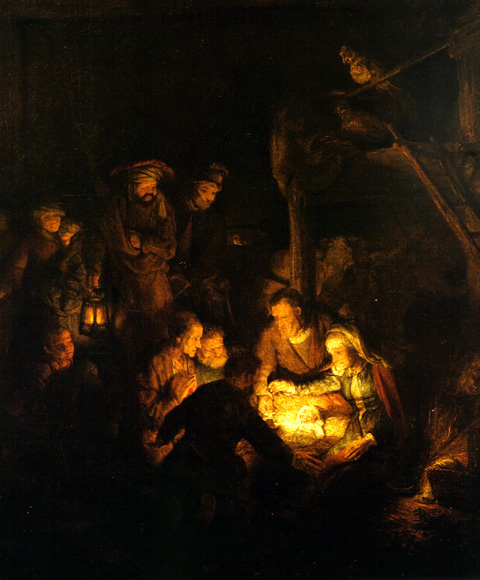
rembrandts-adoration-of-the-shepherds

******

Art images:  Rembrandt’s Annunciation of the Angel Gabriel to Mary and Adoration of the Shepherds

‘Reading The Season’ Posts over a Decade:

2020: Jack by Marilynne Robinson

2019: ‘A Hidden Life’ – A Film for the Season

2018: A Verse from Madeleine L’Engle’s The Irrational Season

2017: A Wrinkle in Time by Madeleine L’Engle

2016: Silence by Shusaku Endo

2015: The Book of Ruth

2014: Lila by Marilynne Robinson

2012: Surprised by Joy by C. S. Lewis

2011: Walking on Water by Madeleine L’Engle 

2010: A Widening Light by Luci Shaw

2009: The Irrational Season by Madeleine L’Engle

2008: The Bible and the New York Times by Fleming Rutledge 

2008: A Grief Observed by C. S. Lewis