Saturday Snapshot Dec. 3: Late Autumn

After I came back from London in mid October, the Pond already looked deserted. Suddenly in the last few days my Air (Avian) B&B was buzzing with activities again. The Pond had become the meeting place of waterfowls making their last stop before heading south.

Here are some of them on a sunny, cheery afternoon. So glad to see signs of life before the big chill. Forecast for next week’s lowest temperature: -24C (-11F).

late-autumn

riverview

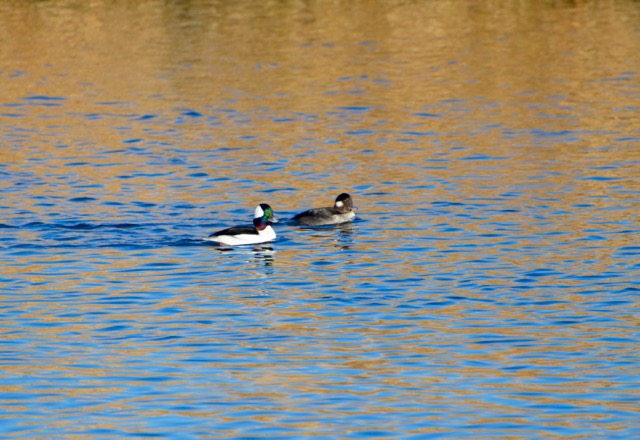
Pardon me for not showing my regulars the Mallards, but it’s the infrequent guests that I treasure more; although still ‘common’, there are just less of them than Mallards. Here are the Buffleheads. Like they’re right out of a Monet painting. No colour alteration here:

buffleheads


bufflehead-couple

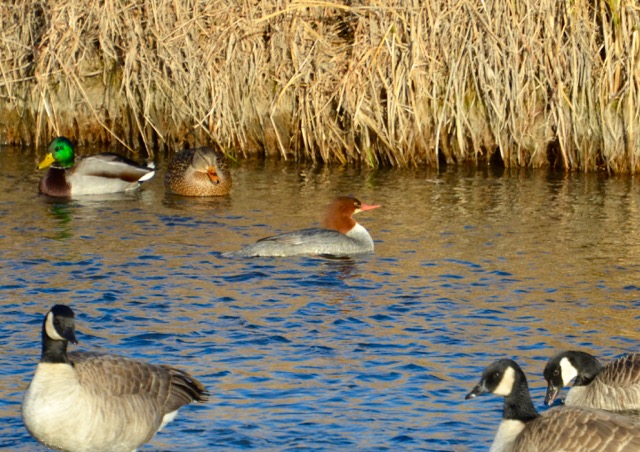
My favourite has to be Mrs. Merganser. No matter what time of day, she looks like Lucille Ball just out of bed. Her uncombed, red hair stands out particularly:

lucille-ball


lucille

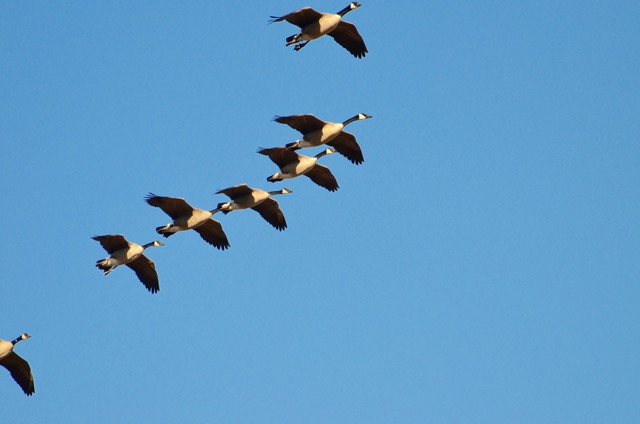
Up in the sky, more Canada Geese getting ready to land on the Pond, joining the late Autumn sendoff party:

canada-geese

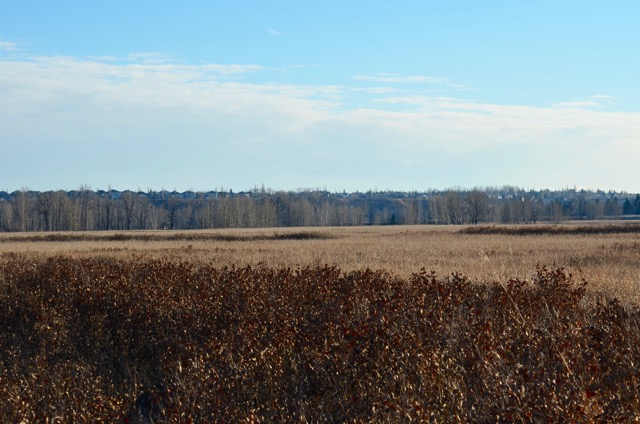
Less convivial on land, I’m afraid. Why, it’s all brown and barren. The white-tailed deer filling up in the evening sun. Yes, it looks desolate. Dry shrubs are all that’s left for food.

autumn-brown


deer

And -20’s C. next week? Good time to tackle the piles of books on my bedside table.

***

Saturday Snapshot is hosted by West Metro Mommy Reads. CLICK HERE to see what others have posted.

Arrival: From Novella to Film

The following discussion is relatively spoiler free. To talk about the novella and the film without giving out the most crucial piece of information is like writing with both hands tied at my back, and trying to hold a pen with my mouth to scribble down words. A difficult task. But it’s all worth it, as that’s the main thrust of the story: to communicate takes effort and hard work.

After watching the movie, spellbound for two hours, I left the theatre knowing  I must get hold of the story to read. I found it here. But, I most likely will seek out Ted Chiang’s other sci-fi fiction to explore more, despite not being a regular reader of the genre. His writing just grabs me with its insight and sensitivity.

Novella: “Story of Your Life”

The source material of the movie Arrival is Ted Chiang’s “Story of Your Life”, winner of the Nebula Award in 2000.  A host of aliens had touched down in numerous spots in different countries on Planet Earth; in the U.S. alone there are nine. Their intention does not appear to be conquest. With multiple tentacles that look somewhat like an octopus, they are hence called heptapods by their cautious human observers. In order to understand their purpose, the U.S. Government sends teams of physicists and  linguists to establish communication with the foreign arrivals. They do this via the aliens’ transparent, face-to-face meeting devices, again, nicknamed by humans “the looking glass”. The large, two way glass separates the two living species, but joining them is the desire to communicate peacefully using each other’s language.

An ideal case Chiang has depicted. One, that the aliens come in peace; two, that humans respond with peaceful means all for the purpose of understanding and communication. A much needed case study for us Earthlings today. While they have set up military base surrounding the alien spacecraft in the open field to stand guard, the commander Colonel Weber leaves the task of communicating with the foreign arrivals to linguist Dr. Louise Banks and physicist Dr. Gary Donnelly.

Running parallel to this major plot line we see a more intimate story of human interactions, Louise and her daughter. Chiang’s writing is emotionally subtle and sensitive as he juxtaposes different episodes to depict the bond between Louise and her daughter through the stages of her life, as infant, child, teenager and later adult. Every stage we read some realistic situations. The human mother-child relationship is not without conflicts, but all interwoven with the bond of love. That’s the whole package of motherhood, the joys, the risks, the pains.

The language the aliens use to communicate with humans looks like a system of semagrams, each semantic symbol referring to a concept. It doesn’t appear to have a phonetic association, i.e., can’t be read out audibly, but is visually transmitted. Here’s Chiang’s eloquent description through Louise’s words:

“If I wasn’t trying to decipher it, the writing looked like fanciful praying mantids drawn in a cursive style, all clinging to each other to form an Escheresque lattice, each slightly different in its stance.”

I just love this idea: “An Escheresque lattice”. Fascinating.

MOVIE: ARRIVAL

Arrival.jpg

A movie will be the best means to depict such kind of a language system. But then again, the movie Arrival is much more than illustrations of the story. In this case, Arrival is one of the most apt transference of art forms, from literary to cinematic that I’ve seen.

Arrival the film has magically lifted the story out of the page. It has transferred the imaginary onto a visual plane in an aesthetic and inspiring way. We see the alien spacecraft suspended just slightly above ground in the open field like a vertical Hindenburg, or a stylistic installation of an objet d’art balancing in midair.

Canadian director Denis Villeneuve (Sicario, 2015; Incendies, 2010) and cinematographer Bradford Young (Selma, 2014) had transported Chiang’s eloquence from page to screen affectively, emotionally enhanced. The juxtapositions of time is seamless and effective, spurring my curiosity to think. Villeneuve leads us through a passage of cerebral perplexity, prodding me to decipher, to try to understand, like linguist Dr. Louise Banks (Amy Adams) does through her experience.

Amy Adams’ nuanced performance is effective in emotional capture. That’s the key factor for the film to work. Kudos also to Jeremy Renner as physicist Dr. Ian Connelly. The leading man Renner, who usually plays the cool hero in other movies here steps aside to let Louise run the show, offering his support and tender loving care wherever needed, most moving in the climatic scene.

Of course there are alterations and elaborations for dramatic effects. In situations like this where different countries on Planet Earth need to operate in a united front to share information and knowledge, there’s bound to be conflicts and dissensions. So some countries decide on military action to assault and take down the arrivals soon after attempts at understanding fail.

Computer technology might have helped Louise to decipher each symbol and finally the whole train of alien thoughts, it is her inner passion that drives her to persist and continue with the peaceful means to communicate, against the order of Colonel Weber (Forest Whitaker) to withdraw the operation and leave the military to handle the situation.

Computer technology is crucial no doubt, but it is the human heart that has motivated Louise Banks to reach out, to achieve a Non-Zero-Sum Game: a win-win situation for both sides. The aliens’ gains does not necessarily mean human’s loss. Both sides can benefit from their exchanges.

In the grand scheme of things, however small the individual human may seem, the significant acts could be the everyday choices one makes. For Louise Banks, choosing to take up the role as a frontline translator to liaise with unknown aliens is a courageous act, but then again, so is choosing to embark on love and to take up the whole package of motherhood, with all that her choice will entail.

***

Short Story and Film:

~ ~ ~ ~ Ripples

Books to the Big Screen

Here are a few Book to Movie Adaptations that I look forward to. Some are already in theatres, others will come later this year, poised for the Awards Season. Still others have just been announced or in the early stage of development.

Arrival

arrival

Already arrived in theatres, acclaimed Canadian director Denis Villeneuve’s (Sicario, 2015) first sci-fi feature that’s gaining buzz as this year’s award hopeful. Seems like every year we have one of those, like Gravity (2013), Interstellar (2014), and The Martian (2015). Alien arrival to planet Earth isn’t a new topic, but communicating with aliens in a cerebral, linguistic framework, with a female leading role is a first. Amy Adams plays linguist Dr. Louise Banks, moved to translate. What interests me most though is that the movie is based on a short story, “Story of Your Life” by the award-winning sci-fi writer Ted Chiang. From short story to the big screen will be a future post on Ripples soon. I’ve been reading quite a few to catch up.


Nocturnal Animals

Nocturnal Animals.jpgAmy Adams is on a roll. She has been in recent years. With five Oscar noms and yet to win, will this coming Awards Season end the drought? A movie based on a novel of a novel. Right, and that real novel is Austin Wright’s Tony and Susan. Exactly, probably that’s why director Tom Ford changed it to this current title for his movie. Amy Adams plays an art gallery director troubled by her ex-husband’s novel, which she thinks is a revenge tale on her. Intriguing storyline. Jake Gyllenhaal plays her ex. Director Tom Ford won the Grand Jury Prize at Venice Film Festival this year. Not bad considering this is only his second feature in directing. His first? He led Colin Firth to the actor’s first Oscar nom in A Single Man (2009).


Silence

silenceI’ve just reread this novel by Japanese writer Shûsaku Endô (1923-1996). This time it’s even more disturbing. In 17th C. Japan, a sadistic governor was determined to eradicate Christianity by turning devout Jesuits missionaries into apostates. His methods were ruthless and unimaginable, making waterboarding look like squirting with a water gun. Endô, a Catholic, had written a thought-provoking masterpiece, bringing out the unanswerable Question: Why is God silent in the midst of insufferable torments of his own? And now, the film adaptation by none other than Martin Scorsese, also a Catholic. I’ve a feeling that I need to gird myself for some tormenting scenes. But I just can’t resist that cast: Liam Neeson, Andrew Garfield, Adam Driver. Also, screenplay adaptation by Jay Cocks, two times Oscar nominee for his writing, The Age of Innocence (1993) adapted from Edith Wharton’s novel, and original script Gangs of New York (2002).

**

And now, to some announcements of future adaptations. Looks like F. Scott Fitzgerald is on a roll too. The Great Gatsby (2013) isn’t too distant a memory and now two upcoming features with prominent actors:


Zelda

Zelda.jpgFilm is inspired by Nancy Milford’s bio of Zelda Fitzgerald, a finalist for the Pulitzer and National Book Award when it first came out in 1970. Please note it’s not Z by Therese Anne Fowler as I first thought. So I read the wrong book and now I need to find Milford’s Zelda. I want to, for I trust an acclaimed biographer to tell me the ‘true’ story. Zelda and F. Scott’s situation is such an intriguing scenario: Can a couple with the same professional pursuit still be a loving pair and not rivals? Especially in the Jazz Age, where men dominated all scenes and women were but ornate “flappers” in parties, and yes, even as muses. Jennifer Lawrence is Zelda, Ron Howard directing. Sounds like a promising production.


The Beautiful and the Damned

The Beautiful and the Damned.jpg

That’s the name of the novel by F. Scott Fitzgerald whose married life with Zelda isn’t too far off from the characters in the book. Whether the film is an adaptation of the book, or just use the book title as the film title to tell the real story of Scott and Zelda is yet to be seen. Either way, it is one tumultuous marriage amidst the glamour of the Jazz Age. The movie is said to be in development, not much else is announced  except that Zelda is going to be another A-lister: Scarlett Johansson. For those interested in reading the book first, you have lots of time to catch up on the lives of Scott and Zelda, as well as this book.


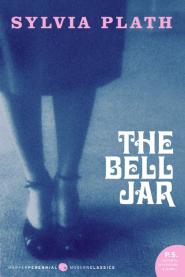
The Bell Jar

The Bell Jar.jpg


For her directorial debut, Kirsten Dunst has picked Sylvia Plath’s The Bell Jar. I’d say, a challenging book to be adapted into film, albeit dramatic. Dakota Fanning will play Esther Greenwood, the coming-of-age story that leads her all the way to the border of madness. A heavy and difficult novel to handle as a directorial debut. But I’m sure Kirsten Dunst has her reason for picking Sylvia Plath’s famous work. Could this be the ripple effects of her experience starring in Lars von Trier’s Melancholia ? Patricia Arquette (Boyhood, 2014) co-stars.


***

Related Posts on Ripple Effects:

Boyhood: The Moment Seizes Us 

The Great Gatsby 

British Library & St. Pancras Station

THURSDAY, OCT. 6

Well you win some and you lose some. Having tasted the delicious treat that’s the Georgia O’Keeffe at Tate Modern, I came to British Library the next day to find they’ve just finished with a major Shakespeare exhibition there marking the 400th anniversary of the Bard’s death.

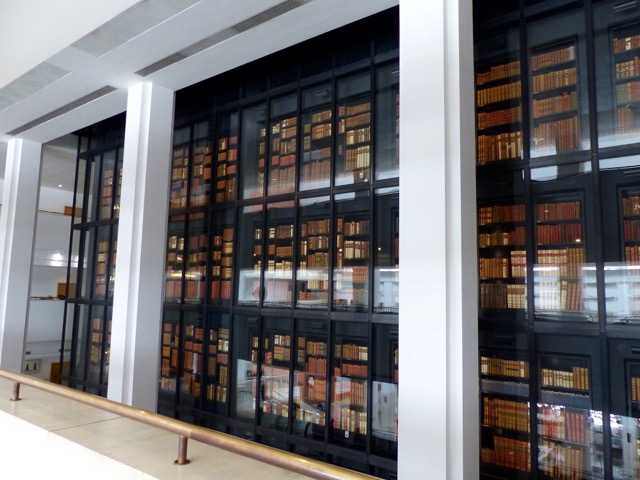
The British Library is another must see for me, having ‘discovered’ it the last time I was in London a few years ago. In their Gallery is their permanent collections of iconic papers and manuscripts that define the history of civilization, like the Gutenberg Bible, The Magna Carta, handwritten score of Handel’s Messiah, Middle Eastern and Asian manuscripts and sacred scripts, Leonardo da Vinci’s notebook, handwritten lyrics by the Beatles with comic drawings on the side… just to name a few of the 200 items on display, free to the public.


Enough of words. Here are some pics of British Library:

wall-of-books

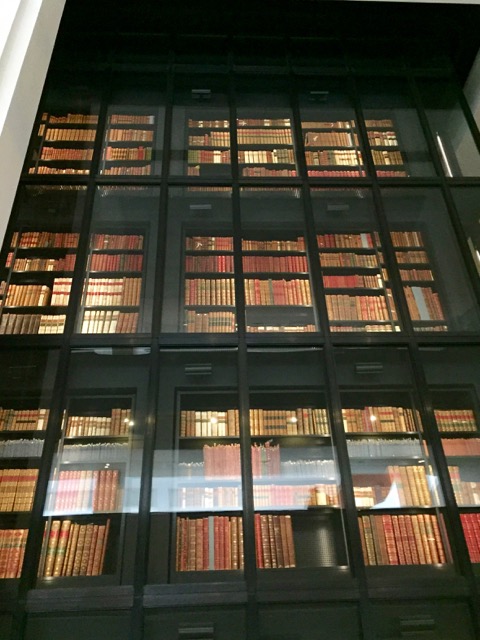
Storeys of rare books:

storeys of rare books.jpg

Looking down to the main area:

main-area

Art works are everywhere. I like this piece by British artist Patrick Hughes, entitled “Paradoxymoron”. His signature style is the changing perspective for the viewer. A ‘normal’ painting from the front:

Paradoxymoron Front View.jpg

The painting gradually shifting to 3D as the viewer moves to the side:

Shifting Perspective.jpg

Finally, from the side, a complete 3D version:

Side View.jpg

Here’s from the other side:

The other side.jpg


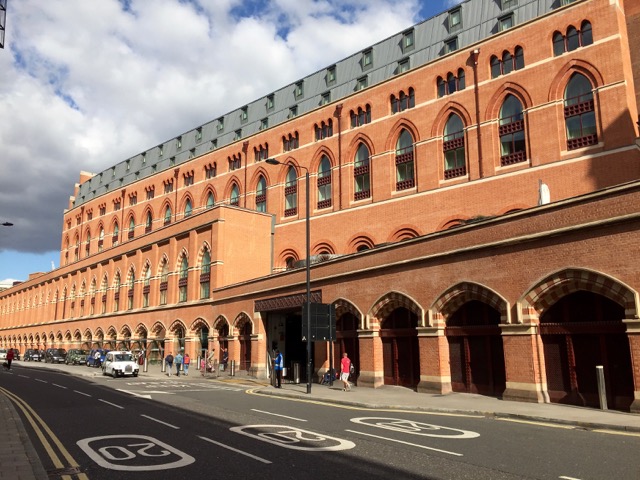
And how did we get to British Library? We took the Tube from Victoria Station to the St. Pancras Station. You’ve seen the magnificent make-over of King’s Cross Station from my last post, here’s another superb alchemy of the old and the new. St. Pancras Station is an international transportation hub for trains. The scale is massive and the architecture style, Gothic Revival.

st-pancras-station

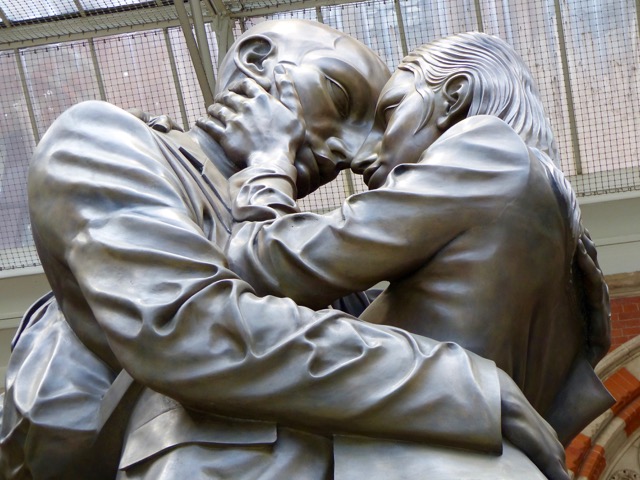
I’m most impressed by the interior, the public art and the huge bronze sculpture by Paul Day (2007). Here are some pics:

St. Pancras Station.jpg

Public Art.jpg

Bronze Sculpture.jpg

Amazed by how detailed this huge sculpture is. Look at the folds of the clothing:

Details.jpg

Here are some of the vignettes circling below the tall sculpture. Whimsical perspectives:


P1020849.jpg


perspective


Saying goodbye to soldiers going to war:

Going to War.jpg


… and the modern goodbye. I like this one the best:

P1020853.jpg

***

Tate Modern: Georgia O’Keeffe Exhibition

TUESDAY, OCT. 4

Six years ago I first visited Tate Modern. I was wowed by its ingenuity, a derelict power plant on the south bank of the River Thames converted into a modern art gallery. I didn’t hesitate to revisit this time around.

The Tate Modern was designed by the Swedish architects Jacques Herzog and Pierre de Meuron, the 2001 winner of the Pritzker Prize, the ‘Nobel Prize’ of architecture.  Their concept of maintaining the industrial motif and juxtaposing it with the artistic is a marvellous idea.  Furthermore, they have turned the massive, hollow industrial space in the centre into a welcoming people space, the Turbine Hall. When I got there on an overcast Tuesday morning, I saw people, many are families with children and babies, lay on the massive floor space, yes, actually lying down, to view the mobile, mixed media installation from the ground.

How much more ‘grassroot’ can you get? The symbolism is ingenious as the people space breaks down the barrier of ‘high art’ and ‘public art’. In another area, several large helium-filled fish ‘balloons’ floating in mid-air, kids and adults playing with them. Interactive art, like an invisible sign saying, ‘Please do touch the art objects.’

While most of the collections were free and photography was allowed, I was excited to learn their current event was a Georgia O’Keeffe exhibition, paid admission and no photography. Interesting to note that there’s no O’Keeffe works in UK public collections, thus making this exhibition all the more rare and valuable.

Before I entered the exhibition room, I only had one image in my mind: flowers. Georgia O’Keeffe was a painter of flowers, wasn’t she? And with 100 pieces of O’Keeffe’s works on exhibit, lots of flowers. How wrong I was.

Certainly, the cover of this beautifully designed accordion pamphlet uses the iconic O’Keeffe subject of flowers, but I soon found that she was a highly versatile artist, and cerebral in style and subject matter. No photos were allowed in there so I had to take a picture of the pamphlet for you to visualize. For the rest of the post, I’m afraid I’ll have to make do with my clumsy written words to describe my experience with the magnificent visuals.
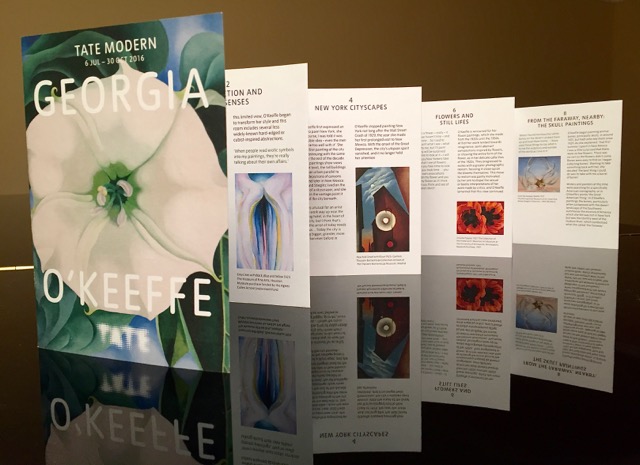
 

georgia-okeeffe-exhibition

Here’s a synopsis of the exhibition in a sequence of rooms following the life of O’Keeffe as an artist. And thanks to this compact, informative pamphlet, I’m still learning even after I’ve come home.

1. The Early Years – abstractions in charcoal, made while she was an art teacher in Virginia and Texas. There are colourful watercolours and vivid oil paintings inspired by the landscapes of both States. My fave has to be the Red and Orange Streak, 1919. So here I see Georgia O’Keeffe, the emerging abstract painter.

2. Moved to New York in 1918 and produced more abstraction while exploring other artistic possibilities such as chromesthesia, where musical tones elicit particular colours, “the idea that music can be translated into something for the eye”. This is also the period when she painted more sensory content, and for some, eroticism is evoked. I like this quote: “When people read erotic symbols into my paintings, they’re really talking about their own affairs.”

3. O’Keeffe, Stieglitz and their Circle. As muse, collaborator, and finally spouse of photographer Alfred Stieglitz, O’Keeffe is presented in photography in this section. I find O’Keeffe’s personal portraits particularly revealing; Stieglitz’s portraits of her all exude a special boldness and independence. Here we see her beginning fondness of clouds, depicted in A Celebration 1924, the year they married. Clouds evolving into petals later?

4. O’Keeffe the New Yorker. I never knew. Here I see her stylistic depiction of the urban cityscape of NYC. O’Keeffe and Stieglitz lived on the 30th floor of a skyscraper, a convenient vantage point to paint tall buildings. “… I think that’s just what the artist of today needs for stimulus.” After the 1929 Wall Street crash, however, she moved out of NYC. The vision of the urban promise dismantled with the market crash.

5. Upstate, New York, Maine, and Canada. Lake George, trees, clouds, apples and leaves. For a change, from metropolitan New York to Nature.

6. Finally, we begin to see her flower paintings. They are huge. The photo of the pamphlet cover above, Jimson Weed/ White Flower 1, 1932, is 48″ x 40″. BTW, I just checked online, that painting is the world’s most expensive painting by a woman. Walmart heiress Alice B. Walton bought it for $44.4 million in 2014. I should have looked at it a while longer. But from the short stop when I stood in front of it, I could see the gradual change of light and shadow on the petals, meticulously painted. Most impressive was the sheer size of it.

Why paint a tiny flower this big? Here’s O’Keeffe’s answer:

“Nobody sees a flower, it’s so small… I’ll paint it big and they will be surprised into taking time to look at it… I will make even busy New Yorkers take time to see what I see of flowers…”

7. New Mexico: Taos and Alcalde. Paintings of the vast, horizontal expanse of the land in contrast to the vertical, tall skyscrapers of NYC, earth-built dwellings, crosses, Native American and Spanish colonial features. In Taos O’Keeffe met Ansel Adams and other artists.

8. O’Keeffe found the white bones and animal skulls left on the barren Southwestern desert a worthy subject for her paintings. A sharp, harsh contrast with the soft petals of flowers, but the light and shadow gradients convey the same fondness from the artist’s eyes.

9. Red earth, pink cliff of the landscape in the Southwestern expanse. O’Keeffe discovered Ghost Ranch, a tourist attraction and later bought her first home there. During the 1930’s to the 40’s, she delved into the area with immense passion, especially the flat-top mountains or mesa.

10. White Place and Black Place, two locales she continued to stylize in her painting. From the realism of the earthy desert expanse shifted to more stylized contrast of white and black.

11. The artist continued her focus on bones, in particular, the holes in them; when she lifted them up towards the sky, the blue piercing out from these holes. The bones too are symbols of death and destruction, a parallel of WWII and the death of Stieglitz in 1946.

12. The Southwest and Native American influences on her subjects while living in New Mexico during the 1930’s and 40’s.

13. Lastly, from landscapes to skyscapes. I was confronted with another huge painting, inspired from her airplane travels during the 50’s and 60’s: Sky Above the Clouds III, 1963. Since I couldn’t take any pictures at the exhibition, I just have to do this. Here, take a look at this photo of the pamphlet, section 13 on the right. The painting is on there. Clouds like ice floes against a distant, pinkish sky.

sky-above-the-clouds


Definitely more than just flowers.


 ***

Related Posts on Ripple Effects:

 Tate Modern and Billy Elliot

Alex Colville and the Movies 

Art Gallery of Ontario

Beauty and Terror


Saturday Snapshot Oct. 15: Five Days in London

About this time last year I’d just finished a Thelma-and-Louise kind of road trip (exclude the ending, of course) to New England with my cousin to see fall foliage. The series of travel posts begins here.  This year, it’s London, England.

Here are the highlights of our short, five-day escape to London on the week of Oct. 3-7. Detailed blog posts to come.

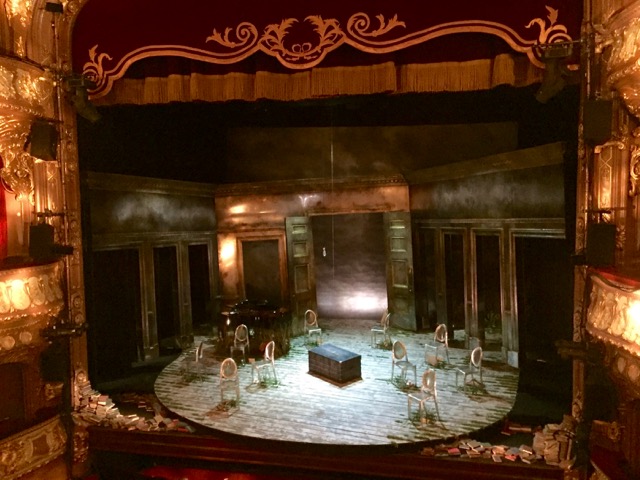
MondayThe Go-Between at the historic Apollo Theatre (since 1901) on Shaftesbury Avenue. Leading star is Michael Crawford, the original Phantom.


Apollo Theatre.jpg

gb

Tuesday — Tate Modern, Georgia O’Keeffe Exhibit. No photos allowed for that exhibit, but I was free to take artworks from other areas in brilliant Tate Modern. Here’s one I love the best. View from its 10th floor observation level:

img_4373


Wednesday — Day trip to Cambridge:

Cambridge.jpg

Thursday — The British Library, King’s Cross and the St. Pancras Stations. Why a train and tube station could be the highlights of the day? Wait and see. Here’s St. Pancras Station:

St. Pancras Station.jpg

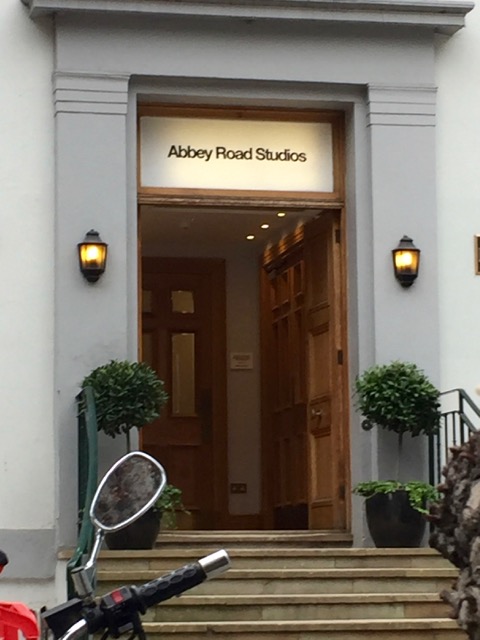
Friday — Which zebra crossing (those in N. America, no zebra, just pedestrian) is a point of interest for world visitors?

Abbey Road Studios.jpg

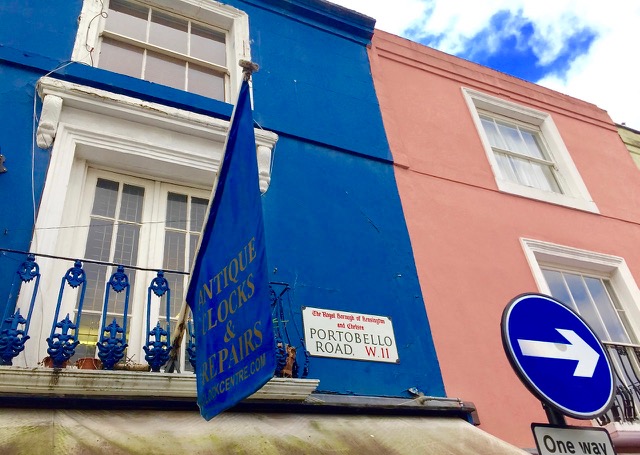
And which movie puts a community and street market on the to-see list of visiting cinephiles and antique hunters?

Portobello Rd (1).jpg


Detailed London posts coming up.

***

Saturday Snapshots is hosted by West Metro Mommy Reads. CLICK HERE to see what others have posted.

Paterson: Of Pug and Poetry

Some movies are like the roaring ocean, waves mounting upon waves rousing up excitement, eliciting continuous, sensational reactions. Some are like a bubbling brook, smaller but still boisterous, teeming with life and sounds. The film Paterson is a quiet stream, water gently flows along, seemingly uneventful, and yet, you can sit there by its side and just watch its quiet swirling.

Paterson has been screened at many film festivals this year. I missed it at TIFF, glad I could catch it when I came home to CIFF. For a film about poetry and a loving couple (not dysfunctional, for a change) with a British bulldog named Marvin, a character in his own right, and helmed by a Palm d’Or winning director, it’s got to be a unique experience.

Director Jim Jarmusch has been garnering accolades at the Cannes Film Festival since 1984, with his early feature Stranger Than Paradise. His most commercially known work probably is Broken Flowers (Cannes Grand Prize of the Jury, 2005) with Bill Murray and Julie Delpy. This year, Paterson has once again brought the director to Cannes as a nominee for the prestigious Palme d’Or. 

Jarmusch ought to be applauded for making a film on poetry, for who in this day of mega explosive, blockbuster productions would think of turning Williams Carlos Williams’ poetic notion into a movie. Yes, WCW himself was a resident of Paterson, New Jersey, and his 5-volume epic poem Paterson must have been the source inspiration for Jarmusch.

paterson

The movie Paterson is about an admirer of WCW and an aspiring poet whose occupation may be furthest from the creative process. But that’s exactly the point. Where do we get inspirations and ideas? What kickstarts our creative process? Do we need to climb to the top of the mountain, soak up a magnificent sunrise to unleash our creativity? Apparently not.

We see in the film that the most mundane of everyday objects, like, a box of matches, can spark off a new poem. Jarmusch has his own style of cinematic poetry making: the deadpan, casual expressions of his main character, thus, embedding humour in the serious. Adam Driver (While We Were Young, 2014) is probably the best person to star in this film, not only in name, but in his demeanour. He is Paterson, a bus driver with a daily route of driving bus route no.23 around the small town of Paterson, New Jersey.

We follow Paterson for a week. He gets up at the same time, around 6:20 am, plus or minus 5 minutes, eats his breakfast cereal, carries his lunch box and goes to work. He drives his no. 23 route around town, overhearing passengers’ small talks, brewing in his mind thoughts and ideas, writing down lines in a note book when he has a chance, has his lunch sitting on a bench overlooking the Great Falls of the Passaic River, then back to work. After work he goes home, has dinner with his loving wife Laura (Golshifteh Farahani), walks the pug Marvin, ties him outside the bar, goes in and have his beer, chats with bartender Doc (Barry Shabaka Henley), meets the regulars Everett (William Jackson Harper) and Marie (Chasten Harmon) and listens to their stories, then walks Marvin back home and sleep.

As viewers we see this seven times over. Reminds me of Groundhog Day (1993). But Jarmusch is clever in sprinkling subtle humour and surprises, quite like life. Paterson is a contented soul, driving a bus may be as fulfilling as writing poetry. Wife Laura is more experimental, and takes charge of her creative expressions more explicitly, like learning the guitar to reach her dream of being a country singer, like interior decorating her home according to her obsession with black and white, or baking cupcakes in her own signature style as a step to opening her own cupcake store. Whatever, the two are a loving, contented couple. Creativity manifests in various ways.

Marvin.jpg

And then there’s Marvin, who may be the best pug in pictures. He has a role to play too in this mundane plot. His story line is, again, life as well.

That’s about all I’ll reveal about the movie without giving out the spoiler, yes, even for this seemingly uneventful film. But as I write, I’m thinking of another matter. This film is probably screened only at very limited cities, at arthouse, independent cinemas. So, why am I writing about a film that not many of you will actually be able to see? What exactly is the relevance of writing something that few may relate to? Or… is the review a piece of writing that readers can respond to despite not experiencing the film itself?

If you have some thoughts on this, I’d appreciate your input. Throw your two pebbles into the Pond and create some ripples so I’d have an idea.

Having poured out this puzzling thought that has been troubling me for some time, I’m reminded of Paterson’s poetry writing in the basement of his home, his notebook filled with his private thoughts and lines, which nobody has ever or will ever read. What’s his purpose then?

~ ~ ~ 1/2 Ripples

***

Other Related Reviews on Ripple Effects:

Silence the Movie Arrives in the Most Unwelcome Time

While We Were Young: Wearing the Hat of Authenticity 

A Quiet Passion (2016) at TIFF16

TIFF16 Review: After The Storm

“After the Storm” was screened at TIFF in September. Next week, it will be at BFI London FF and after that, the Chicago IFF. My review was first published on Asian American Press. I thank the editor for allowing me to post my review here on Ripple Effects.

***

Japanese auteur Koreeda Hirokazu graced the Toronto International Film Festival once again this year with his new feature, “After the Storm”. Since 1995, with his multiple award-winning feature “Maborosi”, Koreeda has been a staple at TIFF, which has screened every one of his feature films. His recent works are still fresh in many viewers’ minds, “Still Walking” (2008), “Like Father, Like Son” (2013), and “Our Little Sister” (2015).

With all the avant garde and experimental, new waves of filmmaking bursting out at film festivals every year, Koreeda’s traditional style of storytelling offers a fine balance and an affirming voice. His films focus on the contemporary Japanese family, bringing out themes arising from the individual and extending to the universal. Humanity is what Koreeda is interested in, and his treatment of human foibles and failures is kind and forgiving. “After the Storm” is no exception.

Ryota (Abe Hiroshi) used to be an award-winning author. But for years he has not produced any more works. Divorced from his wife Kyoko (Maki Yoko) and sorely missing his 9 year-old son Shingo (Yoshizawa Taiyo), Ryota is at the bottom of his life. Months behind in his child support payments, he is laden with debt, entrapped by a gambling habit that’s hard to kick. It runs in the family it seems, for his late father had also been a gambler. With his work at a detective agency, Ryota would try all means to squeeze extra cash out of his clients, including deception and even extortion.

Koreeda’s dealing of Ryota is gentle and sympathetic. While he may look unkempt, the six-foot-two actor Abe Hiroshi has his charm and charisma. We see the nasty side of Ryota as he slips into his mother’s cramped unit in a housing project, looking for anything of value he could lay his hands on for pawning. A moment later, Koreeda lets us have a glimpse too of the other side of Ryota, that of a son to an ageing mother Yoshiko (Kiki Kilin). The mother-son portrait is witty and tactful, punctuated with heartwarming humour. It is a reunion of the two actors, also as mother and son, from Koreeda’s 2008 feature film “Still Walking”.

Mother knows best, even when your son doesn’t live with you any more. Deep in her heart, Yoshiko wishes to see her son reunite with her daughter-in-law Kyoko whom she is very fond of. She also treasures the affectionate bonding with grandson Shingo. If only they could get back together as a family, that would be a big relief and comfort, growing old can then be much bearable.

One evening, a passing storm keeps them together in Yoshiko’s home for the night. The impromptu reunion, though awkward, is probably gratifying for every one of them. Koreeda is, alas, a realist. Life is full of disappointments. However close they have come to bonding once again, the moment is short-lived. But the reminiscence and dynamics of the small family’s once intimate relationship regurgitates enough to spark off a renewal for Ryota. While they may continue on with their own separate ways, a new perspective has subtly wiggled in. Perhaps, there’s hope after all. The young, green grass covered with raindrops the morning after the storm is a refreshing metaphor.

koreeda

The film was shot in the housing project where Koreeda had spent his youthful years. That was where his mother lived after his father had passed away. In the Q & A session, Koreeda admitted that certain incidents in the film did happen in the director’s own family. When writing the script though, once he has created his characters, Koreeda would let them run free and so they would develop themselves. Their stories just came out naturally.

Answering questions in Japanese with a translator beside him, Koreeda humbly thanked his Toronto audience, whom he had in mind when he made his films, as TIFF had screened every one of his features. He noted that as we grew older, we had to deal with disappointments, for life often didn’t turn out to be what we’d like to see. “After the Storm” shows us that Koreeda has dealt with his characters’ life disappointments with a forbearing spirit. As for viewers of his films, Koreeda does not disappoint.

~ ~ ~ 1/2 Ripples

***

Other reviews of Koreeda films on Ripple Effects:

Our Little Sister: A Respite from Summer Superhero Movies

Like Father, Like Son: Parent and Child Reunion 

A Quiet Passion at TIFF16

“A Quiet Passion” is a biopic of the reclusive 19th century American poet Emily Dickinson. It is written and directed by the esteemed English auteur Terence Davies, who brought us the adaptation of Edith Wharton’s novel “The House of Mirth” in 2000, “The Deep Blue Sea” based on Terence Rattigan’s play in 2011, and last year’s “Sunset Song”, a beautiful cinematic rendition of Scottish writer Lewis Grassic Gibbon’s work.

Literary filmmaking is Davies’ repertoire. If a movie is about a poet, under his helm, it is only natural that it would be crafted like poetry. In this sense, “A Quiet Passion” is a fine example. Every frame is meticulously composed and lit, the atmosphere dense with meaning. We also hear lines from Dickinson’s poems read out as voiceover. We experience poetry in sight and sound.

However, not all poetry is of the Romantics, roaming vales and hills, dancing with the daffodils. Davies’s Emily Dickinson (Cynthia Nixon) is confined in her father Edward’s (Keith Carradine) Amherst house. Her main human interactions are with her immediate family, a stern father, a depressed mother (Emily Norcross), an attorney brother Austin (Duncan Duff), and her younger sister (Jennifer Ehle). If she ever felt claustrophobic, there’s her sister-in-law Susan Gilbert (Jodhi May) and her close friend Vryling Buffam (Catherine Bailey). Too narrow a social circle? Not really, for they are all responsible for sharpening her views and words. And they make a wonderful cast.


a-quiet-passion
Terence Davies, Cynthia Nixon, Jennifer Ehle, Jodhi May, Catherine Bailey
Under the direction of Davies, Cynthia Nixon (of ‘Sex and the City’ fame) portrays Emily Dickinson with an austere persona restrained by social mores and troubled by unrequited romantic pursuit. She might have been a rebel with a just cause in confronting restrictive societal norms, but I was surprised to see Dickinson here as a verbal combatant, a bitter and belligerent soul. Somehow from my limited reading of her poetry, that image has not set in my mind.

“A Quiet Passion” is a mixed bag of oxymoron. In an austere setting, characters deliver ornate speeches like you only hear in a stage play. Shrouded in a confining milieu, you hear comedic exchanges and humorous, deadpan facial expressions, even LOL moments. While the cinematography is meditative and calm (as in Davies’ last work “Sunset Song”), the feeling evoked is unsettling anticipation.

Emily’s supportive and devoted sister Lavinia (Vinnie), well played by Jennifer Ehle (of Elizabeth Bennet fame), gives me a breath of fresh air, for often she is the quiet passion supporting the poet, a gentle strength and a moral compass. Vinnie is the pragmatic and rational voice, like reminding Emily that Rev. Wadsworth—on whom Emily has a romantic crush—is a married man. But she is ever so sweet and pleasant as Jennifer Ehle is, even when admonishing.

The sisterhood between Nixon’s Emily and Ehle’s Vinnie makes me think of another literary sisterhood, that of Jane and Cassandra Austen. But what a difference. I long for Jane’s joie de vivre, something that’s missing here in this relatively harsh portrayal of Emily Dickinson. Further, I couldn’t help but compare this film with another that’s also about a poet: Jane Campion’s “Bright Star” (2009), a beautiful cinematic rendering of the English Romantic poet John Keats (Ben Whishaw) and his muse Fanny Brawne (Abbie Cornish).

The last scenes are as severe as they are heart breaking. Death may be a frequent motif in Dickinson’s poetry, as Emily had experienced the passing of her parents, but the constant pounding of her own illness makes me think of another oxymoron: superfluous suffering. The repeated scenes of seizures Emily goes through in the last section of the film may be a bit too much to watch for some, although Nixon has certainly given us a true-to-life performance. I can’t imagine all the takes she had to repeat, acting out those excruciating seizures on her bed.

When asked about the seizures in the Q & A after, Nixon replied that she had not done any research or specifically prepared; she just went ahead and did it. All the research had been done by Davies. He had read up on volumes of Dickinson’s biographies for the film.

What “A Quiet Passion” has done for me is stirring up my curiosity in finding out what Emily Dickinson the person was really like, and, I want to delve into more of her poetry. I have to remind myself though that the cinematic portrayal here is only Davies’ own interpretation and personal response to her poetry. I just like to explore on my own.

~ ~ ~ Ripples


Establishing Shot

What is a film buff, avid birder, and nature lover going to do in Toronto during TIFF, torn between so many attractions?

Well, one has to stay grounded first. So here’s the establishing shot. Indeed, it’s Toronto. And a memorable date it was when I took this photo of the early morning cityscape. My computer told me it was Sept. 11, 2016, at 6:38 am:

9-11-638

I was fortunate to be able to shoot these pics from a high-rise building with magnificent views. Here let me call this one Urban Canadian Sunrise. Yes, see the flag in the foreground? Can’t say it’s just another city:

urban-canadian-sunrise

And from the balcony above looking down, my birding instinct was gratified as I made my first sighting of a Mute Swan taking in the early morning air:

mute-swan

A stone-throw away was a park where I made this other first-time encounter. I had no clue what it was until I looked it up in a bird book after I’d come back home:

Juvenile Black Crowned Night Heron

Know what it is? A Juvenile Black-crowned Night Heron.

Several other first time sightings awaited me as I went on the ‘Marshwalk’ at the Royal Botanical Gardens in Burlington, 57 km (35 mi) southwest of Toronto a few days later. The Great Egret and some juvenile (brownish colour) mute swans:

great-egret

egret-swans

Yes, TIFF16 was a cinephile fantasy. And the people there were overflowing with enthusiasm to make your visit memorable:

tiff

More posts coming up on that main event.

Literary TIFF

The Toronto International Film Festival (Sept. 8 – 18) is just a week away. While many movie fans will be charging up their cell phones to catch some pics or selfies with the stars on the red carpet, Arti here at the Pond is interested in spotting the film adaptations of books, or those with literary interest.

This is a photo of the Toronto skyline from Lake Ontario on a hazy morning. Arti took the pic during TIFF14 two years ago. Yes, she’s heading there soon for TIFF16. So stay tuned for future posts.

Hazy Toronto Morning

Here’s a list of some literary titles at TIFF16:

A Quiet Passion 

Not based on a book but no short of literary interest. This is a cinematic biopic of the American poet Emily Dickinson. What’s more, it’s a new film written and directed by the venerable English auteur Terence Davis, who brought us such acclaimed works as Sunset Song (2015), The Deep Blue Sea (2011), and The House of Mirth (2000). Cynthia Nixon plays Emily Dickinson, with Jennifer Ehle as her sister Vinnie. Yes, that Jennifer Ehle. Love to see her in another period role but I know, hard to be rid of the Lizzy Bennet image.

American Pastoral 

Philip Roth actually has two movie adaptations of his books coming out this fall. One is Indignation (2008). The other is American Pastoral (1997), which won him a Pulitzer and was considered a seminal work in his oeuvre. Roth later won the Man Booker International Prize in 2011. The prolific author has long been regarded as the astute depicter of the 20th C. Northeastern Jewish-American psyche. Interesting fact of this adaptation is that it’s the directorial debut of Scottish actor Ewan McGregor, who will also take up the role of Roth’s famous character Seymour ‘Swede’ Levov. How well can he pull it off? Dakota Fanning and Jennifer Connelly co-star.

Julieta 

Based on three short stories by Alice Munro, Canada’s first Nobel Laureate in Literature (2013). Juliet is the protagonist of “Chance”, “Soon”, and “Silence”,  from Munro’s 2004 volume Runaway. So why the name Julieta? Well, these stories are being transported from a Canadian setting into Spain. The film is helmed by director Pedro Almodóvar, who is described as “the most internationally acclaimed Spanish filmmaker since Luis Buñuel” (IMDb). Almodóvar won an Oscar for his writing/original screenplay with “Talk To Her” (2002). Hopefully this adaptation is worthy of Munro’s source material. I’m curious to see how a totally Canadian story is transplanted into a Euro-Spanish milieu.


Certain Women

Another film adaptation based on short stories, this one by author Maile Meloy, from her book Both Ways is the Only Way I Want It (2009). The adaptation tells the story of three women and boasts a high calibre cast with Kristen Stewart, Michelle Williams, and Laura Dern. It is helmed by Kelly Reichardt who had directed Michelle Williams in Wendy and Lucy (2008) to critical acclaims. Last I read is that some elements of the stories had been altered to appeal to a contemporary audience.


Paterson

This 2016 Cannes Film Festival Palme d’Or nominee explores an interesting concept: A bus driver by day, a poet by night in Paterson, New Jersey. Can’t find a better named actor than Adam Driver to take up this unique dual occupational role. Writer/director Jim Jarmusch takes the helm. No stranger to Cannes, Jarmusch’s Broken Flowers (2005, remember Bill Murray?) won the Cannes Grand Prize of the Jury in 2005. The director’s versatility has brought us very different kinds of works throughout his career.


The Salesman

Since the 1990’s, several Iranian film directors have gained high praises internationally for their cinematic works. The recent death of Abbas Kiarostami is a loss on a grand scale for film art. Another distinctive figure is his younger friend and compatriot Asghar Farhadi, whose A Separation is the first Iranian film to win an Oscar (Best Foreign Language Film, 2012). After that Farhadi crafted another multiple-award-winner The Past (2013). This year he brings us The Salesman. The name is a big hint of its literary affiliation. The story is about the disintegration of a marriage as a couple perform Arthur Miller’s play Death of a Salesman as Willy and Linda Loman. Life imitates art, or vice versa? Farhadi is a master of probing conflicts in domestic relationships. At Cannes earlier this year, The Salesman won Farhadi the Best Screenplay and Shahab Hosseini the Best Actor award.

The Secret Scripture 

After a long wait, and a change in the cast, the film adaptation of Irish writer Sebastian Barry’s Booker shortlisted work is finally completed. In the book, the narrator is a 100 year-old mental hospital patient recalling her life. The old and her younger self are played by Vanessa Redgrave and Rooney Mara respectively. The director is Jim Sheridan, the six-times Oscar nominee who introduced us to Daniel Day-Lewis with the excellent productions of My Left Foot: The Story of Christy Brown (1989) and later In the Name of the Father (1993).


Unless

Born in Oak Park, Illinois in 1935 and after her marriage became a Canadian citizen in 1971, Carol Shields received honours from both countries and internationally as well. The Stone Diaries won the Pulitzer in 1993, among many other accolades, while Unless (2002) was shortlisted for the Booker Prize. Here’s the intriguing tale of Unless: a mother one day finds her runaway daughter living on the street and mute. Oscar nominated Catherine Keener plays the mother Reta Winter. Downton Abbey fans should note, Mr. Bates Brendan Coyle also stars.


***


‘Our Little Sister’: A Respite from Summer Superhero Movies

The following is my review of the film “Our Little Sister” by the acclaimed Japanese director Hirokazu Kore-eda, published in Asian American Press. I thank aapress.com for allowing me to post it here on my blog.

For those who might think a Japanese film would never make it to your local cinema, check this list of U.S. screenings:

http://sonyclassics.com/ourlittlesister/dates.html

***

our-little-sister

Premiering last year at Cannes, and later screened at other international film festivals the world over, Hirokazu Kore-eda’s “Our Little Sister” finally trickles into the local theatres of North American cities, which is timely. In a world rocked by tumultuous strife and unrests, this latest from Kore-eda makes a quiet solace, offering a taste of the ideal in human relationships and harmony despite brokenness.

“Our Little Sister” is Kore-eda’s most recent work after his 2013 Cannes Jury Prize winning “Like Father Like Son”. Following his usual subject of relationships in various family situations, “Our Little Sister” sees Kore-eda at the helm as director, writer, and editor of this production based on the popular Japanese graphic novel “Umimachi Diary” by Yoshida Akimi.

The three Koda sisters have not seen their estranged father for fifteen years. Sachi (Haruka Ayase), Yoshino (Masami Nagasawa) and Chika (Kaho) are now adults, living in the family’s traditional home his father had long deserted in the seaside town of Kamakura. His recent death sends the sisters to his funeral, awkwardly, meeting the woman who had stolen their father’s heart. But it is an inciting incident that changes all their lives. They meet their half sister, 15 year-old Suzu (Suzu Hirose). Herein lies the turning point for the four sisters. Moved by her little step-sister’s mature and quiet demeanor, or maybe stirred by her own older-sister instinct, Sachi invites Suzu to come away and live with them in Kamakura. Suzu gladly agrees.

The new Koda household now is a haven of happy sisterhood. Living under one roof, we see minimal conflicts and constant congeniality. Viewers from a different culture may find the saccharine relationships unrealistic. Are there not any conflicts at all? Of course there are. Kore-eda deftly leads us to some slow revealing. After three quarters of the 120-minute film, we begin to see inner turmoil rise to the surface.

Suzu had to take care of her father in his illness and seeing him to his last breath due to the incompetence of her mother; here is a young teenager bearing the burden of an adult. Now living with three older sisters, Suzu can finally enjoy the childhood she has missed. She quickly captures the attention of other students in her new school with her soccer skills, congeniality and maturity.

In the Koda household, Suzu is the angel of harmony, stirring up love and life. Kore-eda may have spent too much time on the leisurely-paced, day-to-day living such that viewers might feel the lack of conflicts to move the story along. I credit the style to Kore-eda’s realism and a candid camera focusing on the subtleties of nuanced interplay among the characters. Like his previous films “I Wish” (2011), the yearning for family connections of a young boy is shown by his actions and not so much by words, or in “Like Father Like Son” (2013), wherein conflicts are portrayed by contrasts and parallels. Here, while still nursing a deep resentment towards her father for deserting them years ago, Sachi struggles with the moral parallel now as she carries on a relationship with a married doctor at the hospital where she works.

Moral dilemmas, what to choose, how to live, and the search for identity are the issues Kore-eda’s characters have to deal with, but in a way that is quiet and gentle. He introduces us to other endearing characters in the town, adding numerous episodes to build up a human mosaic of harmony in the presence of brokenness and even death.

The scenic seaside town of Kamakura provides a beautiful backdrop for cinematographer Mikiya Takimoto (“Like Father, Like Son”) to shoot the film, reflective of the idyllic life that can be had, even in an imperfect world. The arching branches of the cherry blossoms, landscapes and seascapes mark the healing power of nature. But also like the petals of the cherry blossoms, which third sister Chika likes to pick up and gather in her palm, life is ephemeral.

Reminiscent of Ozu’s films, the passing train is a visual metaphor for the passage of time, changes, and the transience of life. To enrich the visuals, Yoko Kanno’s original score sweeps us through with warmth and tenderness, as a supporting voice telling the story. “Our Little Sister” is a heartwarming film for the unhurried heart to savor.


~ ~ ~ Ripples

***

Related Posts on Ripple Effects:

‘Like Father Like Son’: A Parent and Child Reunion

Yasujiro Ozu and the Art of Aloneness